Procedia - Social and Behavioral Sciences 229 ( 2016 ) 234 – 245
1877-0428 © 2016 The Authors. Published by Elsevier Ltd. This is an open access article under the CC BY-NC-ND license (http://creativecommons.org/licenses/by-nc-nd/4.0/).
Peer-review under responsibility of the International Conference on Leadership, Technology, Innovation and Business Management doi: 10.1016/j.sbspro.2016.07.134
ScienceDirect
5
thInternational Conference on Leadership, Technology, Innovation and Business Management
Role Of Stakeholder Participation Between Transparency And Qualitative
And Quantitive Performance Relations: An Application At Hospital
Managements
Cemal Zehir
a, Fadime Çınar
b,Halil Şengül
cb
aYıldız Technical University, Istanbul,34349, Turkeyb,c
Beykent University, Istanbul, 34396, Turkey
Abstract
Transparency is one of the basic principles of corporate governance and ın this study, applicability of transparency variables in the private and public hospitals in İstanbul were investigated. A positive relationship is estimated between transparency and stakeholder participation as a good governance element in qualitative and quantitative performance of corporate performance. Survey method is preferred as a research method and it was applied to 351 upper and mid-level managers in 74 hospitals listed in the list of hospitals in the provincial health directorates between 2013- 2014 in Istanbul. Data were analysed with SPSS 16.00 and factor analysis, reliability analysis, correlation analysis and regression analysis were used to test the data. As a result of these analyses, it was understood that applicability of transparency principles have a positive effect on qualitative and quantitative performance through stakeholder participation. The mediating effect of stakeholder participation on the relationship between transparency principle and qualitative and quantitative performance was identified first time in this research. Therefore it is an important contribution to the literature.
© 2015 Published by Elsevier Ltd. Selection.
Peer-review under responsibility of the International Conference on Leadership, Technology, Innovation and Business Management
Keywords: Stakeholder Participation, Transparency ,Qualitative and Quantitive Performance
1. Introductıon
Improvements on information technologies’ provide better data collection and evaluation. In addition, improvements on communication technologies also provide data sharing and follow-up in a shorter period than in the
Corresponding author. phone + 90-542-392-99-03
E-mail address: [email protected]
© 2016 The Authors. Published by Elsevier Ltd. This is an open access article under the CC BY-NC-ND license (http://creativecommons.org/licenses/by-nc-nd/4.0/).
past. With improvement on transparency issues, following up company accounts has more priority than before. Today most of the public and private sector companies share all account information with their stokeholders and customers. As well as it is an obligation, improvement on transparency issues has a positive effect on companies as well.
In hospitals, as a management point of view, transparency and stokeholder directly relate with quality and performance. Especially in regulations arranged according to performance-based assessment system, these performance-based assessment systems can be easily manipulated by managers. In order to avoid such problems, transparency and stokeholder participation are strongly needed. As a business; efficient use of hospital resources and increase in the qualitative service delivery can be achieved by the implementation of corporate governance principles.
2. Conceptual Framework
2.1. Transparency
Transparency represents realization of obvious and foreseeable processes and activities in an understandable way in decision-making, implementation and monitoring phases (Auld and Gulbrandsen 2010). of transparency by member states, Transparency is defined by The United Nations participants as appropriate and reliable access to information for the public sector decisions and performance (Armstrong, 2005). Transparency as political and administrative activities, means reliable and on time information provided to the public. (Kondo, in 2002).
2.2. Application for Increasing Transparency
Business owners have right to know what their representatives are doing and this right is not related only with business owners but it is also valid for potential investors and all relevant stakeholder groups. Borgia (2005) stated that in some situations a party has a right to know, on the other side, the other party has a right to privacy by saying "transparency is at the intersection between public’s ‘right to know' and businesses’ ‘right to privacy’”. Borgia (2005) has identified the list of fully transparent business characteristics as below;
x A corporate culture, giving importance to full transparency starting from top management, x Reward and punishment processes for transparency which encourages transparency for each level,
x An effective communication between all employees and stakeholders provided by management, classified as important features.
Based on this information, applications to improve transparency can be listed as below; 9 The public Lighting Obligations and Right to Know
9 Accounting and Financial Reporting 9 Non-Financial Reporting
2.3. Stokeholder Participation
The decisions are not only for making them; they need to be applied for getting results. An agreement and wide participation is required for effective level of application. Stakeholder participation is another expression of this effort to create this agreement. If Stakeholder participation is adequate, a positive commitment occurs between business and employees. Socializing by integrating with business, adopting business culture and values make an employee to spend his/her time, intelligence and energy for the sake of his/her business. Therefore business can be successful and can increase their performance when they expose and reach this creative potential (Heath and Norman ,2004) ; Ghayour 2012).
Stakeholder participation should not be considered dealing with only employees. The idea of stakeholder participation, sharing management and sharing approach to strategic management includes all groups in business should have satisfaction by mentioning and applying all processes clearly. The basic task in this process is, managing and integrating the relations among shareholders, employees, customers, suppliers, communities and other groups make warranty to company's long-term success. Sharing approach highlights the support for shared demands and mutual relations of business environment (Freeman and McVea, 2001). Stakeholder participation is important for risk and opportunity management. It contributes to developing sustainable performance capabilities of businesses.
2.4.Corporate Performance
Effective implementation of organizational strategies and the administrative effectiveness plays a critical role in organizational performance improvement. (Malina and Selto, 2004). In the last 20 years, interest in performance measurement has increased and rather than focusing on financial point of view, non-financial perspective has increased to measure corporate performance (Otley 1999). Also, in addition to the parameters related to cost, quality and improved service parameters have been highlighted in recent researches (Amaratunga and Baldry, 2002). Performance measurements can be related to objective (financial - quantitative) or subjective (non-financial – qualitative ) subjects. Some researchers believe that, even though they are separate, qualitative and quantitative performance interacts during performance and there is a positive relationship between them (Denison and Mishra, 1996; Fisher, 1997).
2.5. Transparency, Stokeholder Participation and Corporate Performance in Health Sector
Transparency and stakeholder participation in both public and private hospitals is essential in health sector in Turkey. As it is known from the reflection in public opinion, due to the varying public policies, transparency and accountability are tried to be applied in hospitals by taking supervisory measures. However these measures always have been updated because of the lack of adequate supervisory mechanism or preventing from application.
Klomp and Haan (2008) criticise that corporate governance is examined in different sectors but not in the health sector. We can consider this point as the most important statement of this article since, it points out the possible results of the ignorance of corporate management policies in health sector. Because human health is the most important part of life. Total of 101 countries were studied in Klomp and Haan’s (2008) research and the years between 2000-2005 were analysed with pooled regression analysis to show the effects of corporate governance on health sector; both individual level effects and cumulative effects. Here, the basic argument is the expectation of the convergence of the effects of corporate governance on individuals and industries starting from the divergence of the effects of corporate governance on individuals and industries. With the rolling regression method convergence was showed by investigating the effects of governance. According to general results in this research, corporate governance does not directly affect individuals, but indirectly affects. This effect makes it possible for overall health sector. It has a positive effect even for income and quality terms. However, this relation differs depending on countries. In addition, income level in countries is very significant for corporate governance as well as the development level of countries.
The article of Collins and Davis (2006) is first and the basic article for transparency policy effects on health sector. In this study, only descriptive statistics were studied without any technical analysis and it has important arguments about American health sector which is the most advanced and diversified healthcare industry in the world. In the article of Klomp and Haan (2008), the development level of countries naturally has a positive effect with transparency. An increase in the development level also leads an increase in transparency.
The article of Eeckloo et al. (2004), is very important in literature since it is the first and the only article about corporate governance and corporate performance relation. The research was applied to 82 hospitals located in Belgium and designed as an interdisciplinary study. As a result, a positive relation is determined between hospital management and medical council. Process of changes on performance measurement and management, reflects on health care services as well. Performance management is a concept which is adapted to health sector from management literature. As it is known, many countries and institutions use health care systems for different purposes. Health care servers are classified according to their measured performance results. However, there is no accepted performance measurement models and standards for information system designs all over the world yet ( Beyan, 2010).
2.6. Creating of Hypotheses
Transparency is the basic principle of corporate management. Transparency applications as a decisive elements in corporate management framework and the differences between detection levels of transparency result problems on application and different levels of assessment for each business. Due to this, transparency policy and its dimensions are determined as independent variables. Krishnamurti and Sevic (2003) worked with 97 companies in 8 Asian countries and studied on the relation between CLSA-transparency and social responsibility sub scales as independent variable and business performance and Tobin's Q value as dependent variable. CLSA's (Credit Lyonnais Securities
Asia) research on 495 business in 25 developing countries is the most detailed study examining relation between corporate management principles and business performance and also, considering corporate management principles as independent variable, business performance as dependent variable (Amar,2001).
"Stakeholder Participation" as a good corporate governance element determined as mediating variable and its mediating effect on the relationship between transparency policy and performance is investigated. If companies want to increase their performance, they need to have good relations with their stakeholders and ensure participation of stakeholders to each decision (Maurer and Sachs, 2005). Another research studying on relations between stakeholders and business performance mentions that positive relations with stakeholders will affect the long-term profitability (Mattingly, 2004). However, none of these researches mentions about direct relations between transparency and stakeholder participation, our study will contribute to literature about this relation. According to this, the following hypotheses have been developed.
H1: The right to know as transparency subscale, financial reporting and public lighting and non-financial reporting have positive effects on stakeholder participation.
A relation should be established between the business performance or success indicators and strategies that are used for managing businesses successfully. The main objective of the business performance indicators’ analyses is to transfer knowledge to decision makers about financial status and development of companies. Financial analyses help managers about making investment and management decisions and evaluating investment decisions For this reason, quantitative performance analysis results do not only affect businesses but also affect business partners, their employees and creditors. Also ensuring all the stakeholders’ participation in management creates a positive effect on corporate performance (Heath, J. and Norman W., 2004; Ghayour,2012). Accordingly, the following hypotheses are proposed.
H2: Stakeholder participation positively affects quantitative performance. H3: Stakeholder participation positively affects qualitative performance.
Krishnamurti, Sevic applied (2013) corporate governance survey includes CLSA-transparency and social responsibility dimensions to 97 firms in 8 Asian countries and a result it is found that transparency dimension has a positive effect on firm performance that measured with Tobin’s Q. The Klapper and Love (2004) applied CLAS scale to 374 firms in 14 countries and it is found that as corporate governance principles, the transparency dimension has positive relations with Tobin's Q and return on assets. However there is almost any study that investigates the effects dimensions of transparency principle directly or through stakeholder participation on quantitative and qualitative performance. According to this, the following hypotheses are proposed and developed
H4: As transparency subscales the right to know, financial reporting, and public lighting and non-financial reporting positively affect quantitative performance.
H5: As transparency subscales the right to know, financial reporting, and public lighting and non-financial reporting positively affect qualitative performance.
H6: As transparency subscales the right to know, financial reporting, and public lighting and non-financial reporting increase quantitative performance by means of stakeholder participation.
H7: As transparency subscales the right to know, financial reporting, and public lighting and non-financial reporting increase qualitative performance by means of stakeholder participation.
3. Methodology And Applıcatıon
3.1. The Purpose of Study
In this study, as the most important businesses of the health sector, evaluating the public and private hospitals according to corporate governance principles is emphasized as a necessity. For this reason, the effects of activities related to transparency principle on corporate performance of hospitals located in Istanbul are investigated and in this relation, the mediating effect of stakeholder participation as a good governance principle is investigated.
3.2. The Importance of Research
Transparency is the most important principles of corporate governance. This study fills an important gap in the literature because the previous studies focusing on the effects of transparency on corporate performance were inadequate. This study is one of the empirical work conducted on hospitals in the health sector. Also the mediating effect of stakeholder participation on the relation between corporate governance principles and corporate performance were identified first time with this research. Subscale of the principles of transparency were considered as separate variables and their effects on quantitative and qualitative performance were investigated.
3.3. The Data Collection Method And Used Scales
This study is based on a survey carried out using the research methodology. A survey has been prepared for testing hypotheses and surveys performed by the researchers. Research activities were carried out between 01 June 2013-31 Jan 13 in private and public hospitals, who agreed to participate in the study with 351 senior and middle level managers in the province of Istanbul. In the study, all hospitals in İstanbul were considered to be included in the sample and this idea represents easy sampling method (Tonta, 2007). The population of this study is the public and private hospitals in İstanbul registered in Provincial Health Directorate. There were 64 public and 143 private hospitals in June, 2013 and total was 207. There were 320 managers on public hospital and 572 managers in private hospitals and total was 892 (ISM,2013). 500 the survey were distributed. But 133 hospital managers have not accepted the study. Therefore study was conducted in 42 public hospitals and 32 private hospitals. Distributed questionnaires 364 of them were taken back but 13 is marked wrong and missing were not included in the study for the survey. Total of 351 surveys were evaluated.
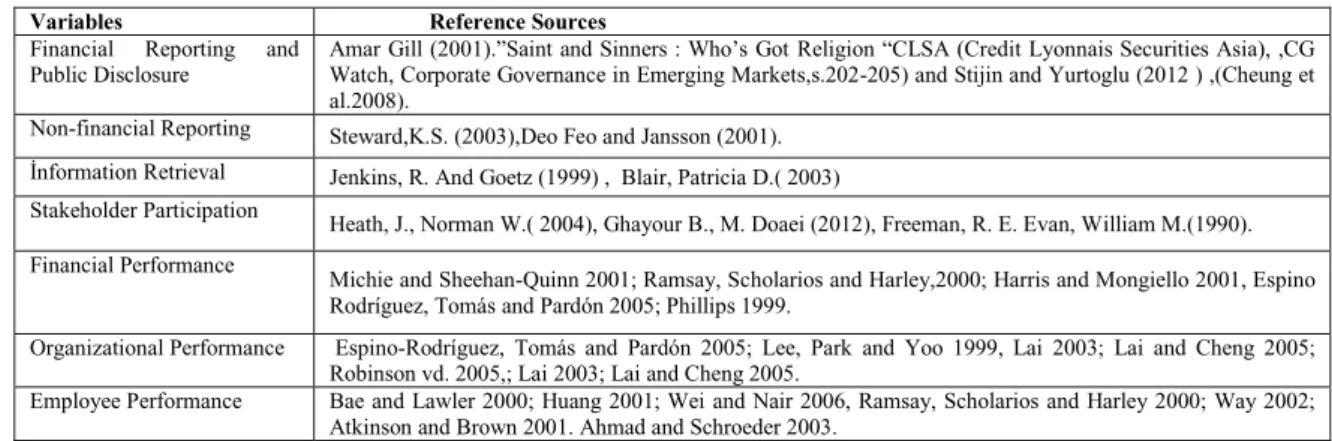
In this study, a questionnaire with 4 parts applied and the scale consists of 47 questions. The first part of the questionnaire aimed to indentify demographic characteristics (task / title, age, gender, educational level, marital status, service time). The second part is designed according to international scientific studies to determine working top and middle level managers 'questions about the perception of Transparency Practices and includes 14 questions and 3 dimensions: Financial Reporting And Public Disclosure (3items): Non-financial Reporting (5 items), İnformation Retrieval (6 items). The third part of working top and middle level managers perceptions of the Stakeholder Participation and it includes 8 questions in one dimension. The fourth part of working top and middle level managers perceptions of Quantitative And Qualitative Performance questions includes 25 questions. Quantitative And Qualitative Performance is composed of five dimensions. Quantitative Performance: ( 1) Organizational Performance (4items), Financial Performance (4items):,Qualitative Performance: (1) Organizational Performance (3items),Employee Performance (9 items),Customer Performance (5 items). To create survey scale literature review was made primarily. However previous studies were not conducted in the same format. Therefore, a detailed scale was created to conduct survey depending on different studies made before. 5 point Likert Scale is used in the survey questions these are "strongly disagree", "disagree", "undecided", "agree", "strongly agree ". There are no reverse questions in the scales. Resources on the variables used in the scale shown in the following table.
Table 1: Scale Variables and Reference Sources
Variables Reference Sources
Financial Reporting and Public Disclosure
Amar Gill (2001).”Saint and Sinners : Who’s Got Religion “CLSA (Credit Lyonnais Securities Asia), ,CG Watch, Corporate Governance in Emerging Markets,s.202-205) and Stijin and Yurtoglu (2012 ) ,(Cheung et al.2008).
Non-financial Reporting Steward,K.S. (2003),Deo Feo and Jansson (2001). İnformation Retrieval Jenkins, R. And Goetz (1999) , Blair, Patricia D.( 2003) Stakeholder Participation
Heath, J., Norman W.( 2004), Ghayour B., M. Doaei (2012), Freeman, R. E. Evan, William M.(1990). Financial Performance
Michie and Sheehan-Quinn 2001; Ramsay, Scholarios and Harley,2000; Harris and Mongiello 2001, Espino Rodríguez, Tomás and Pardón 2005; Phillips 1999.
Organizational Performance Espino-Rodríguez, Tomás and Pardón 2005; Lee, Park and Yoo 1999, Lai 2003; Lai and Cheng 2005; Robinson vd. 2005,; Lai 2003; Lai and Cheng 2005.
Employee Performance Bae and Lawler 2000; Huang 2001; Wei and Nair 2006, Ramsay, Scholarios and Harley 2000; Way 2002; Atkinson and Brown 2001. Ahmad and Schroeder 2003.
Customer Performance Harris and Mongiello 2001; Atkinson and Brown 2001; Bae and Lawler 2000.
3.4. Limitations
In this study the persons referred to consists of information only hospital managers and data has been unilaterally. The underlying data in this study, as seen in many studies done only in public and private hospitals in Istanbul. It could not be done all hospitals in Turkey. Also data were equally distributed between public and private hospitals. 10 questionnaires were sent for each public hospitals and 4 questionnaires were sent for each private hospitals but only351 manager from 74 of the hospital filled the questionnaires. All the managers in 74 hospitals did not response, and this has created perception differences.
4 Analysis and Results
4.1 Data Analysis
The data obtained through a questionnaire applied to 351 hospital managers who agreed to participate in the study from 74 hospitals (42 state and 32 private hospitals) were analyzed by SPSS 16.00 Statistical Software Package. In order to measure the internal consistency of the questionnaire, which was first created in this study, a pilot questionnaire was applied to 50 managers from 5 hospitals, of which 3 were state hospitals and 2 were private hospitals, with a 15 days of interval, and the overall internal consistency of the questionnaire was tested in this context, and its design and misconceptions were corrected. Overall reliability test results of the questionnaire was α=0.979. This indicated that the scale has a construct reliability of 97.9%. Following these results, the questionnaires were applied to all participants. Factor analysis was performed on questionnaire items first, and Cronbach's Alpha was used to measure the reliability of factors. The relationships between variables were assessed by correlation analysis, and regression analysis was used to test hypotheses. p<0.05 and p<0.01 were accepted as the level of significance.
4.2. Factor Analysis
Except the question set on the personal introductory information in the study, three basic variables consistent with the theoretical part, which are the independent variable (transparency), intermediate variable (stakeholder engagement) and dependent variables (qualitative and quantitative performance) were subjected to factor analysis one by one using SPSS 16.0 statistical software package. In order to obtain the question groups of the factors and test the construct validity of the scales used, first the variables in the dataset were examined for suitability of factor analysis. As a result of the factor analysis conducted over a total of 53 items in the study, 6 items were removed from the scale due to lack of factor distribution or reduced reliability of the scale due to ambiguous factors. Accordingly, the transparency items were grouped under 3 factors, stakeholder participation was grouped under 1 factor, and the quantitative and qualitative performance items, which form the organizational performance, were grouped under 2 and 3 factors respectively. After completing the factor analysis of research items, the reliability of the scale questionnaire was tested with the help of correlation analysis.
4.2.1. Reliability Analysis and Factor Analysis of the Transparency Scale
The internal consistency coefficient Cronbach's Alpha =0.870 of the 14 items in the transparency scale was found to be quite high. And, the sample size was found to be adequate and the variables were found to be correlated with each other (KMO=0.839>0.60). As a result of the factor analysis, the variables explained the 69.366% of the total variance, which are grouped under 3 factors. According to these results, the transparency scale is valid and reliable. The reliability of 4 items in the first factor was alpha = 0.854, the reliability of 5 items in the second factor was alpha=0.836, and the reliability of 6 items in the third factor was alpha=0.730. The scale has a strong factor structure.
4.2.2. Reliability Analysis and Factor Analysis of the Stakeholder Participation Scale
The internal consistency coefficient Cronbach's Alpha=0.898 was quite high for the 8 items in the stakeholder participation scale, which is one of the indicators of the good governance. And, the sample size was found adequate and the variables were found correlated with each other (KMO=0.877>0.60). As a result of the factor analysis, the variables explained 58.471% of the total variance, which are grouped under 1 factor. Based on these results, the stakeholder participation scale is valid and reliable. The scale has a strong factor structure. The factor structure of the scale is shown below.
4.2.3. Reliability and Factor Analysis of the Quantitative Performance Scale
The internal consistency coefficient Cronbach's Alpha=0.919 was quite high for the 8 items in the Quantitative Performance scale. The sample size was found to be adequate (KMO=0.904>0.60) and the variables were found to be correlated with each other. As a result of the factor analysis, the variables explained 99.501% of the total variance, which are grouped under 2 factors. The reliability of 4 items in the first factor was alpha = 0.892, and the reliability of the 4 items in the second factor was alpha=0.923. The scale has a strong factor structure.
4.2.4. Reliability and Factor Analysis of the Qualitative Performance Scale
The internal consistency coefficient Cronbach's Alpha=0.913 was quite high for the 17 items in the Qualitative Performance scale. The sample size was found to be adequate (KMO=0.882>0.60) and the variables were found to be correlated with each other. As a result of factor analysis, the variables explained 82.860% of the total variance, which are grouped under 3 factors. The reliability of 3 items in the first factor was alpha = 0.893, the reliability of the 9 items in the second factor was alpha=0.855, and the reliability of the 5 items in the third factor was alpha=,799. The scale has a strong factor structure.
4.3. Reliability and Correlation Analysis
After completing factor analyses to test reliability of all items in the questionnaire, the sub-scales and the correlations between these sub-scales were determined with the help of correlation analysis performed in SPSS software.
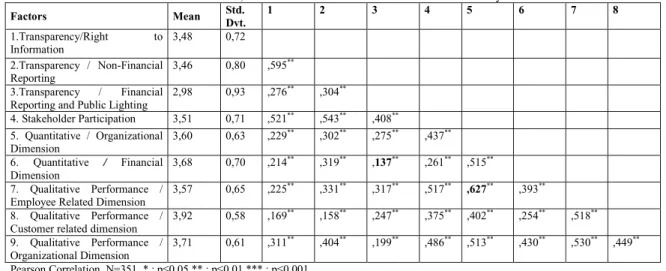
Table 2 shows correlation results, and looking at the values of r, it is seen that there is a positive correlation between all variables (p<0.05). Given the strength of the correlations, the lowest correlation was found between the financial dimension of the quantitative performance and financial reporting and public disclosure dimensions of the transparency scale (.137), and the highest correlation was found between the employee dimension of the qualitative performance and organizational dimension of the quantitative performance (.627). It's also seen in Table 2 that there is a medium to high level of relationship between all other variables.
Tablo 2: Results of Mean, Standard Deviation Periods and Correlation Analyses of Variables
Factors Mean Std. Dvt. 1 2 3 4 5 6 7 8 1.Transparency/Right to Information 3,48 0,72 2.Transparency / Non-Financial Reporting 3,46 0,80 ,595** 3.Transparency / Financial Reporting and Public Lighting
2,98 0,93 ,276** ,304** 4. Stakeholder Participation 3,51 0,71 ,521** ,543** ,408** 5. Quantitative / Organizational Dimension 3,60 0,63 ,229** ,302** ,275** ,437** 6. Quantitative / Financial Dimension 3,68 0,70 ,214** ,319** ,137** ,261** ,515** 7. Qualitative Performance / Employee Related Dimension
3,57 0,65 ,225** ,331** ,317** ,517**
,627** ,393**
8. Qualitative Performance / Customer related dimension
3,92 0,58 ,169** ,158** ,247** ,375** ,402** ,254** ,518**
9. Qualitative Performance / Organizational Dimension
3,71 0,61 ,311** ,404** ,199** ,486** ,513** ,430** ,530** ,449**
Pearson Correlation, N=351, * : p≤0.05 ** : p≤0.01 *** : p≤0.001
4.4. Proposed Hypotheses and Regression Analysis
Before discussing the statistical relationships in the study, the kind of relationship between the variables was investigated in order to create and interpret a theoretical framework for causality. Therefore, causality analyses focus on when, how and which variables affect the others. In the literature, MacKinnon (2008, p.6) stressed out that variables in researches differentiate as dependent and independent variables, and has a negative or positive correlation between them, indicating that studies need to consider this fact.
In this study, the transparency was taken as the independent variable, stakeholder participation was taken as both independent and intermediate variable, and quantitative and qualitative performance were taken as a single, one-dimensional dependent variable under the organizational performance, and multiple regression analysis was performed because of multiple independent variables. The results of the regression, which were carried out by assuming that transparency contributes to stakeholder participation positively and increases the organizational performance through stakeholder participation, are shown below.
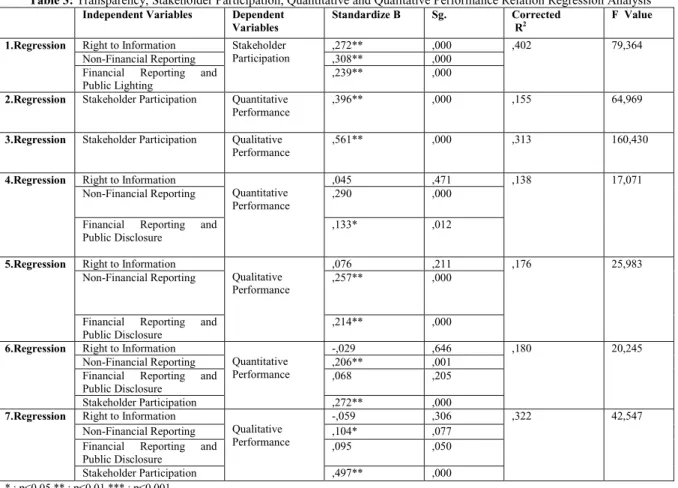
Table 3: Transparency, Stakeholder Participation, Quantitative and Qualitative Performance Relation Regression Analysis
Independent Variables Dependent
Variables
Standardize B Sg. Corrected
R2
F Value
1.Regression Right to Information Stakeholder
Participation
,272** ,000 ,402 79,364
Non-Financial Reporting ,308** ,000
Financial Reporting and Public Lighting
,239** ,000
2.Regression Stakeholder Participation Quantitative
Performance
,396** ,000 ,155 64,969
3.Regression Stakeholder Participation Qualitative
Performance
,561** ,000 ,313 160,430
4.Regression Right to Information
Quantitative Performance
,045 ,471 ,138 17,071
Non-Financial Reporting ,290 ,000
Financial Reporting and Public Disclosure
,133* ,012
5.Regression Right to Information
Qualitative Performance
,076 ,211 ,176 25,983
Non-Financial Reporting ,257** ,000
Financial Reporting and Public Disclosure
,214** ,000
6.Regression Right to Information
Quantitative Performance
-,029 ,646 ,180 20,245
Non-Financial Reporting ,206** ,001
Financial Reporting and Public Disclosure
,068 ,205
Stakeholder Participation ,272** ,000
7.Regression Right to Information
Qualitative Performance
-,059 ,306 ,322 42,547
Non-Financial Reporting ,104* ,077
Financial Reporting and Public Disclosure
,095 ,050
Stakeholder Participation ,497** ,000 * : p≤0.05 ** : p≤0.01 *** : p≤0.001
At beginning of the study, it was expected that transparency principle would indirectly affect quantitative and qualitative performance of corporate performance and it is expected that transparency principle would increase quantitative and qualitative performance via stakeholder participation. 7 stepwise regression analyses were performed to investigate the intervening effect of stakeholder participation. In the first stage, the relationships between the dimensions of transparency and stakeholder participation. In order to show mediating effect of stakeholder participation, in the first stage regression analyses all the dimensions of transparency should constitute a significant relationship with stakeholder participation. In the regression analyses that used to determine the direction of the relationship and to test hypotheses, it is found that all the dimensions of transparency constitute a significant relationship with stakeholder participation (p<0.01).
As seen in Table 2, stakeholder participation has positive and significant relationships with right to information (β=,272 p≤0,01), non-financial reporting (β = 308; p≤ 0.01) and financial reporting and the public lighting (β = 239; p≤ 0.01). According to these results of hypothesis 1 is accepted. The results obtained here are achieved first time in the literature because of the lack of studies dealing with the dimensions of transparency.
In the second phase the relation between stakeholder participation and quantitative performance and in the third phase the relation between stakeholder participation and qualitative performance were investigated and it is found that
there is a positive and significant relationship between stakeholder participation and quantitative performance (β=,396 p≤0,01) and there is a positive and significant relationship between stakeholder participation and qualitative performance (β=,561 p≤0,01). In the results of regression analyses conducted to test effects of stakeholder participation on quantitative and qualitative performance, it is understood that the model is generally significant and the change on the qualitative performance with quantitative is explained in a ratio between 6% and 26%. The effects of stakeholder participation on quantitative and qualitative performance were statistically significant (p <0.01). According to these result hypotheses 2 and 3 are accepted. Stakeholder participation has been accepted hypothesis qualitative performance affects positively. Thus, the most important condition to show the mediating effect of stakeholder participation on the relation between transparency dimensions and quantitative and qualitative performance is provided.
The results obtained in this study make the first contribution to the literature because there weren’t any studies investigate the effects stakeholder participation on corporate quantitative and qualitative performance. However the study (Francesco, et.al., 2006 s.296-308) related to corporate performance found that corporate sustainability and stakeholder participation affect directly corporate performance. Maurer and Sachs (2005, p.93) found that participation in management and establishment of good relations with stakeholders affect directly financial performance by increasing long term profitability of businesses.
In the results of regression analysis conducted to test the effects of sub-dimensions of transparency on the quantitative performance, it is found that the model is generally significant and the change on the quantitative performance explained with sub-dimensions of transparency at a rate 13% and 14%. Although the effect of the right to information dimension of transparency on quantitative performance is insignificant the other dimensions have significant effect on quantitative performance. Thus, hypothesis 4 is partially accepted.
In the results of regression analysis conducted to test the effects of sub-dimensions of transparency on the qualitative performance, it is found that the model is generally significant and the change on the qualitative performance explained with sub-dimensions of transparency at a rate 16% and 17%. Although the effect of the right to information dimension of transparency on qualitative performance is insignificant the other dimensions have significant effect on qualitative performance. Thus, hypothesis 5 is partially accepted.
Krishnamurti, Sevic applied (2013, S.18) corporate governance survey includes CLSA-transparency and social responsibility dimensions to 97 firms in 8 Asian countries and a result it is found that transparency dimension has a positive effect on firm performance that measured with Tobin’s Q. The Klapper and Love (2004) applied CLAS scale to 374 firms in 14 countries and it is found that as corporate governance principles, the transparency dimension has positive relations with Tobin's Q and return on assets. In this study, transparency principle considered as a single dimension under corporate governance. Thus, this performance study generally supports the results obtained in the fourth and fifth hypothesis.
In order to mention about the mediating effect of stakeholder participation, first of all transparency dimensions and should have significant relations with quantitative and qualitative performance (4th and 5. regression) and when stakeholder participation is included in the analyses with transparency dimensions, the direct effect of transparency dimensions on quantitative and qualitative performance should disappear or reduce (6 and 7. regression). So, in the regression analyses, only the right to information do not have a significant relationship with quantitative (β =, 045 p≤0,05) and qualitative (β =, 076 p≤0,05) performance. Due to the insignificant relationship, their effects in 6th
and 7th regressions are omitted.
In the regression analyses which are conducted to test the mediating effect of stakeholder participation on the relationship between transparency dimensions and quantitative performance, it is found that the model is generally significant and the change in the quantitative performance observed at rates 11% and 20%. In the 6th regression analysis, the effects of non-financial reporting and financial reporting and the public lighting on quantitative performance are reduced with the addition of stakeholder participation in the regression. In the 4th and 5th regression analyses, the significance of the relation between non-financial and quantitative performance (β=,290; p≤,0,01) and the relation between financial reporting and public lighting and quantitative performance (β=,133; p≤,0,05) reduced in the 6th and 7th regression analyses (β=,206 ; p≤,0,01 and β=,068 ; p≤,0,01 respectively). Therefore it is proved that stakeholder participation has partial mediation effect in these relations. So, financial reporting and non-financial reporting affect quantitative performance both directly and via stakeholder participation. Therefore hypothesis 6 is accepted.
In the regression analyses which are conducted to test the mediating effect of stakeholder participation on the relationship between transparency dimensions and qualitative performance, it is found that the model is generally significant and the change in the qualitative performance observed at rates 11% and 29%. In the 7th regression analysis, the effects of non-financial reporting and financial reporting and the public lighting on qualitative
performance are reduced with the addition of stakeholder participation in the regression. In the 4th and 5th regression analyses, the significance of the relation between non-financial and qualitative performance (β=,257 ; p≤,0,01) and the relation between financial reporting and public lighting and qualitative performance (β=,214 ; p≤,0,01) reduced in the 6th and 7th regression analyses (β=,206 ; p≤,0,01 and β=,068 ; p≤,0,01 respectively). Therefore it is proved that stakeholder participation has partial mediation effect in these relations. So, financial reporting and non-financial reporting affect quantitative performance both directly and via stakeholder participation. Therefore hypothesis 7 is accepted.
5. Conclusıon
In this study the results of the research conducted on hospitals showed that transparency principle of corporate governance can effect corporate performance positively through stakeholder participation which is one of the best applications of the new management approach. In other words, hospital managers adopt and give importance to transparency principle for corporate performance success. Effective realization of the practices related to the principle of transparency will increase the performance of hospitals.
Transparency principle to the public makes a fear for hospital managers because it brings additional responsibilities and new hospital regulations. In this case, although the results obtained from this study supported by the literature, it has a probability that managers can not reflect the true feelings. Also it is observed that the proposed model for the applicability of the corporate governance principles was not known by many public and private hospitals. However if the managers in hospitals understand the importance of corporate performance measurement, know the transparency principles of corporate governance and be willing for managing these principles effectively a new way can be opened for further studies in this field.
Transparency can be carried out in order to strengthen the implementation of legislation, in other words, standards, principles and behavioural norms should be developed and implemented by managers. With the standards of good governance practices that can help in determining the extent and degree of performance appraisal should be used by hospital administrators.
The subject of this research is the concept of transparency, and the dimensions are determined based on the literature and it was decided to be examined with sub dimensions. In the research it is understood that hospitals have different transparency and accountability practices because of the fear of managers about losing their job, hospitals’ different legislative regulations and knowing less about this subject. Thus, although investigating a large number of corporate governance principles together enriches the content of the study, on the other hand different assessments of these principles in each hospital could affect the results of this study negatively. Therefore, ın the further researches hospitals should be selected from same segments giving same importance to selected criteria. In addition, a smaller number of basic principles together or individually can be examined and should be applied to businesses outside the hospitals in the health sector. In the following studies more time and resources can be used and surveys can be applied to all hospitals in order to guide for hospital managers and academicians.
Considering the other basic principles of the corporate governance with different combinations or one by one, investigating how the role of stakeholder participation in the relationship between transparency and corporate performance will affect performance, will provide new opportunities for researches.
Conducting the survey only for hospital managers make data away from universality. Therefore, in the further studies both service takers and service providers can be participants to draw a general framework and to obtain more realistic results. In order to minimize perception differences, all managers should be made to respond to the survey, and averages of the answers obtained from each hospital can be used. Also, participation of the private hospitals can be increased.
References
Ahmad, S. and Schroeder, R.G. (2003). The Impact of Human Resource Management Practices on Operational Performance: Recognizing Country and Industry Differences, Journal of Operations Management, 21: 19–43.
Atkinson, H. and Brown, J. B. (2001). Rethinking Performance Measures: Assessing Progress in UK Hotels, International Journal of Contemporary Hospitality Management, 13(3):128- 135.
Amar Gill (2001).Saint and Sinners : Who’s Got Religion ,CLSA (Credit Lyonnais Securities Asia), ,CG Watch, Corporate Governance in Emerging Markets,pp,202-205)
Amaratunga, Dilanthi and Baldry, David (2002). Moving From Performance Measurement to Performance Management, Facilities. Vol-20,Num 5/6 pp,217-223.
Armstrong, Elia,(2005). Integrity, Transparency and Accountability in Public Administration Recent Trends, Regional and International Developments and Emerging Issues, United Nations, pp.1-2.
Auld, Graeme and Gulbrandsen, Lars H. (2010). Transparency in non-state certification: consequences for accountability and transparency. Global Environmental Politics 10, 97–119.
Bae, J. ve Lawler, J. J. (Jun 2000). Organizational and HRM Strategies in Korea: Impact on Firm Performance in an Emerging Economy, Academy of Management Journal, 43 (3): 502-517.
Beyan, Oya Deniz (2010) .A New Ontology and Knowledge Base System for Performance Measurement In Health Care, Doctoral Thesis, The Department of Health Informatics, Middle East Technical University, Turkey/Ankara
Blair, Patricia D., Make Room for Patient Privacy. Nursing Management, Chicago, Jun 2003, Vol.34.
Borgia, Fiammetta, (2005), Corporate Governance & Transparency Role Of Disclosure: How Prevent New Financial Scandals And Crimes?, Transnational Crime And Corruption Center, School Of International Service, American University, Washington D.C.,
Bredrup, Harald. (2005). Background For Performance Management, Performance Management, Chopman&Hall, London,pp.110. Collins, Sara. R. and Davis, Karen (2006). Transparency In Health Care: The Time Has Come. Commonwealth Fund.
Denison, Daniel R. and Mishra, Aneil K. (1995).Tword A Theory Of Organizational Culture And Effectiveness, Organizational Science, 6(2),pp,.204-223.
Eeckloo, K., Van Herck, G., Van Hulle, C., & Vleugels, A. (2004). From Corporate Governance To Hospital Governance.: Authority, Transparency And Accountability Of Belgian Non-Profit Hospitals, Board And Management, Health Policy, 68(1), 1-15.
Espino-Rodríguez, T. F.and Padrón-Robaina, V. (2005). A Resource-Based View of Outsourcing and Its Implications Organizational Performance in the Hotel Sector, Tourism Management, 26:707–721.
Feo A.De Joseph and Alexander Jansson (2001).İmplementing Astrategy Successfully, Measuring Business Excellence 5,4 ,pp.4-6 MBC University Press 1368-3047
Fisher, Coraline Jean(1997).Corporate Culture and Perceived Business Performance: A Study Of Relationship Between The Culture Of An Organization And Perceptions of İts Financial and Qualitative Performance, PhD Thesis, California School of Professional Psychology, Los Angeles.
Francesco, Perrini and Antonio Tencati (2006).Sustainability and Stakeholder Management: Need For New Corporate Performance Evulation and Reporting Systems, Business Strategy and the Environment, Bus.Strat. 296-308 Published online in Wilwy InterScience.
Freeman, R. Edward ,Wıllıam M. Evan (1990). Corporate Governance: A Stakeholder Interpretation, The Journal of Behavioral Economica, Volume 19, Number 4, PP 337-359
Freeman, R. Edward and Mcvea, John (2001).A Stakeholder Approach To Strategic Management, The Darden School University of Virginia, Working Paper No: 01-02.
Ghayour, B.S. Morteza. , Meysam Doaei (2012). A Dialectic Model of Development of Stakeholders’ Theory and Corporate Governance: from Hume Utilitarianism to Aristotelian Virtue Ethics, International Journal of Financial Research , Vol. 3, No. 2; April 2012.
Harris, P. J. and Mongiello, M. (2001). Key Performance Indicators in European Hotel Properties: General Managers’ Choices and Company Profiles, International Journal of Contemporary Hospitality Management, 13(3): 120- 127.
Heath, Joseph. And Norman Wayne., “Stakeholder Theory, Corporate Governance and Public Management, What Can The History Of State-run Enterprises Teach Us In The Post-Enron Era?, ”Journal of Business Ethics September 2004, Volume 53, Issue 3, pp 247-265
Huang, T. (2001). The Relation of Training Practices and Organizational Performance in Small and Medium Size Enterprises, Education & Training, 43 (8- 9): 437- 444.
Jenkıns R. and Anne Marıe Goetz (1999). Accounts and accountability: theoretical implications of the right-to-information movement in India, Third World Quarterly, Vol 20, No 3, pp 603±622.
Klomp, Jeroen., & De Haan, Jakob (2008). Effects Of Governance On Health: A CrossǦNational Analysis Of 101 Countries. Kyklos, 61(4), 599-614.
Klapper, Leora F.and Love, Inessa (2004),”Corporate Governance,Investor Protection and Performance in Emerging Markets,Journal of Corporate Finance,10,s.703-728.
Kondo, Seiichi. (2002). Fostering Dialogue to Strengthen Good Governance. Public Sector Transparency and Accountability: Making it Happen. Paris, OECD,p.7.
Krishnamurti, Chandrasekhar; Sevic, Aleksandar ve Sevic, Zelijko (2005).Legal Environment Firm-level Corporate Governance and Expropriation of Minority Shareholders in Asia, Corporate Governance Conferance, Baptist University, Hong Kong.
Lai, K. (2003). Market Orientation in Quality-Oriented Organization and its Impact on Their Performance, International Journal of Production Economics, 84:17-34.
Lai, K. and Cheng, E. (2005). Effects of Quality Management and Marketing on Organizational Performance, Journal of Business Research, 58: 446-456.
Lee, Y. K.; Park, D.H. and Yoo, D.K. (Fall 1999). The Structural Relationships Between Service Orientation, Mediators, and Business Performance In Korean Hotel Firms, Asia Pasific Jornal of Tourism Research, 4(1): 59- 70.
Malina, Mary A. and Selto, Frank H.(2004). Causality in Performance Measurement Model, Social Science Research Network.
Mattıngly, James E.(2004). Stakeholder Salience, Structural Development, and Firm Performance: Structural and Performance Correlates of Sociopolitical Stakeholder Management Strategies, Business and Society, 43, 1, p:97-114.
Maurer, March and Sachs, Sybille (2005).Implementing the Stakeholder View, Learning Process for a Changed Stakeholder Orientation, The Journal of Corporate Citizenship, 17, p:93.
Michie, J. and Sheehan-Quinn, M. (2001). Labour Market Flexibility, Human Resource Management and Corporate Performance, Journal of Management, 12: 287-306.
Otley,David(1999). Performance Management: A Framework For Management Control Systems Research, Management Accounting Research, (10), pp.363-382
Phillips, P. A. (1999). Hotel Performance and Competitive Advantage: A Contingency Approach, International Journal of Contemporary Hospitality Management, 11(7): 359-365.
Ramsay, H.; Scholarios, D. and Harley, B. (December 2000). Employees and High-Performance Work Systems: Testing Inside the Black Box, British Journal of Industrial Relations, 38(4): 501-531.
Robinson, H. S.; Anumba, C. J.; Carrillo, P. M. et al (2005). Business Performance Measurement Practices in Construction Engineering Organizations, Measuring Business Excellence, 9(1):13- 22.
Stewart K.Shelette (2003) The Relatiobnship Between Strategic Plan and Growth In Small Business ,Doctor of Business Administration,Nova Southeastern University
Way, S. A. (2002). High Performance Work Systems and Intermediate Indicators of Firm Performance Within the US Small Business Sector, Journal of Management, 28(6): 765-785.
Wei, K. K. and Nair, M. (2006). The Effects of Customer Service Management on Business Performance in Malaysian Banking Industry: An Emprical Analysis, Asia Pacific Journal of Marketing and Logistics, 18(2): 111- 128.
Stijn, Claessens and Burcin Yurtoglu( 2012) .Corporate Governance in Emerging Markets: A,Survey: Electronic copy available at: http://ssrn.com/abstract=1988880,24.05.2013.