BIHAREAN BIOLOGIST 5(2): pp.119-122 ©Biharean Biologist, Oradea, Romania, 2011
Article No.: 111119 http://biologie-oradea.xhost.ro/BihBiol/index.html
New record of Gylippus (Paragylippus) monoceros Werner, 1905 (Solifugae: Gylippidae)
in Western Anatolia, Turkey
Halil KOÇ
Sinop University, Science and Art Faculty, Biology Department, TR-57000, Sinop, Turkey, E-mail: [email protected] Received: 09. March 2011 / Accepted: 24. August 2011 / Available online: 27. August 2011
Abstract. The gylippid solpugid Gylippus (Paragylippus) monoceros Werner, 1905 is recorded for the first time from Bozdağ Mountain, western Turkey, where it was found at an elevation of 2115 m. This record extends the distribution range of G. monoceros to 650 km west to previously known records from Turkey. It represents the westernmost distribution record for the species.
Key words: Gylippus monoceros, new record, Western Anatolia, distribution. Introduction
The genus Gylippus Simon, 1879 is known from Middle East and Asia. It is represented by three species and one subspe-cies in Turkey: G. quaestiunculus, G. monoceros, G. syriacus and G. caucasicus koenigi. G. quaestiunculus was originally de-scribed by Karsch (1880) from Turkey. The type locality was given as “Kübeck” by author, but the exact locality is still not known in Anatolia. Other researchers provided also very lit-tle information about the type locality, Kübeck (Kraepelin 1901, Werner 1905, Birula 1907, 1913, Roewer 1933, 1959, Turk 1948, Moritz & Fischer 1980, Harvey 2003). G. monoceros was described by Werner (1905) from Erciyes Mountain (Kayseri) and detailed description was given by Birula (1913). Afterwards, this species was recorded from the East-ern Taurus Mountain range (north of Diyarbakır) (Roewer 1933, Zilch 1946). G. syriacus (Simon, 1872) was recorded from the Eastern Taurus Mountain range (north of Diyar-bakır) (Roewer 1933, Zilch 1946). G. caucasicus koenigi was described by Birula (1913) from Oltu, Abusar Mountain? (Erzurum) as “Oljty-Kreis, Abussar Dagh”. Until now, all of the localities with G. monoceros had been reported from mid-dle and east of Turkey. In this paper, a new locality is intro-duced from western Anatolia for this species. Also, some morphological measurements and certain ecological charac-teristics of the localities are presented.
Materials and Methods
The specimens of G. monoceros were mainly collected during the night using UV lamps (Sylvania F15T8/BLB) and headlights of car, but some of them were collected in the daytime under the stones from Bozdağ Mountain at altitudes of 1150, 1400 and 2115 m. The samples were placed in 96% ethanol in amber bottles in deepfreeze and have been deposited in the private collection of the author (HKC) and of Alexander V. Gromov (AGC).
Measurements were taken with a micrometer eyepiece. All measurements are given in millimetres.
Results and Discussion
Material examined
4♂♂ 2♀♀ (HKC), İzmir Prov., Ödemiş Distr., peak of Bozdağ Mt. Range, c. 16 km NNE of Ödemiş, c. 2 km SE of Bozdağ Ski Center, 38°19'30.9''N, 28°06'1.3''E, 2115 m a.s.l., 01.06.2008, H.Koç leg.
1♂ 1♀ (HKC), İzmir Prov., Ödemiş Distr., S slope of Boz-dağ Mt. Range, c. 9.5 km NNE of Ödemiş, W env. of Gedik-düzü [=Gölcük], 38°19'10''N, 28°01'05''E, c. 1150 m a.s.l., un-der stones, 09.05.2006, B.Gülcü & Z. Piliç leg.
1♂ (AGC), İzmir Prov., Ödemiş Distr., NW slope of Boz-dağ Mt. Range, c. 1.5 km SE of BozBoz-dağ, c. 1.3 km WNW of Bozdağ Ski Center, 38°19'55''N, 28°05'25''E, c. 1400 m a.s.l., under stone, 21.05.2006, H. Koç leg.
1 juvenile (HKC) İzmir Prov., Ödemiş Distr., NW slope of Bozdağ Mt. Range, c. 1.5 km SE of Bozdağ, c. 1.3 km WNW of Bozdağ Ski Center, 38°19'55''N, 28°05'25''E, c. 1400 m a.s.l., under stone, 21.05.2006, H. Koç leg.
Gylippus (Paragylippus) monoceros Werner
Gylippus monoceros Werner 1905: 113-114; Birula 1907: 889;
Birula 1913: 347-352, plate VII figs 1-4; Roewer 1933: fig. 87 (as Gylippus monoceras (sic)).
Paragylippus monoceros (Werner): Roewer 1933: 314, figs
229B1-3; Zilch 1946: 125.
Type locality: Barut foothill (as Lifos), Erciyes Mountain, Kayseri, Turkey.
Distribution: Turkey: Kayseri, Diyarbakır (Werner 1905, Roewer 1933, Zilch 1946) and İzmir (new locality).
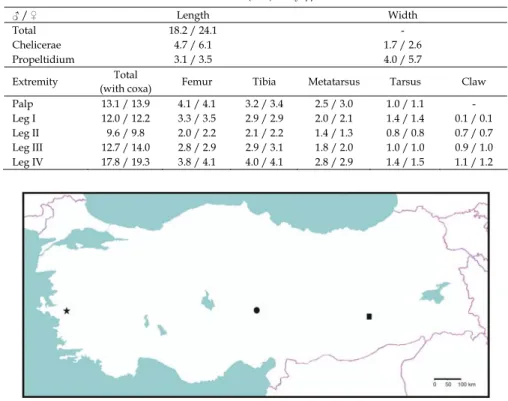
Description: see Werner (1905) and Birula (1913) (Figs. 1-4). Morphological data of male and female specimens are presented in Table 1.
G. monoceros was described based on 7♂♂ and 2♀♀
specimens collected at an altitude of 2200 m in May from Ba-rut foothill which is located 7 km north-northeast of Erciyes Mountain (Werner 1905). After the original description, Roewer examined 5♂♂ and 1♀ from north of Diyarbakır province (Taurus Mountain range).
According to the data from my collection and to those taken from literature sources, it can be concluded that the species is widespread in all Turkey.
Some samples of this species were collected at higher al-titudes such as alpine zones of the mountains from Turkey by author. Recently, I collected six specimens in Bozdağ Mountain at an elevation of 2115 metres. It appears from my observations that gylippids run towards any light source, in-cluding flashlights, campfire and car headlights in the night. The surveys show us that the adults living at high altitudes are active at the end of April, May and at the beginning of June. This species generally prefers clayey habitats (Fig. 5). According to Aliev & Gadzhiev (1983), gylippids are the xe-rophilic dwellers of the typical feature of the habitats.
Koç, H.
120
a.) b.)
Figure 1. Live specimen of male (a) and juvenile (b) Gylippus (Paragylippus) monoceros from Bozdağ Mountain. Scale bar: 6mm.
a.)
♂
♀
b.)Figure 2. Dorsal view of propeltidium and chelicerae. a. Male, b. Female. Scale bar: 3mm.
Figure 3. On the left, two principle spine (outer side), one digital spine (on dorsal side of chelicera and basis of flagellum) and flagellum. On the right, inner view of chelicera, arrow shows the typical flagellum of male Gylippus (Paragylippus) monoceros. Scale bar: 2mm.
♂
♀
Figure 4. Typical pedipalp of male (on the left). Scale bar: 3mm. Typical genital operculum of female (on the right). Scale bar: 2mm.
New record of Gylippus (Paragylippus) monoceros Werner, 1905 (Solifugae: Gylippidae) in Western Anatolia, Turkey 121
Table 1. Measurements (mm) of Gylippus monoceros.
♂ / ♀ Length Width
Total 18.2 / 24.1 -
Chelicerae 4.7 / 6.1 1.7 / 2.6
Propeltidium 3.1 / 3.5 4.0 / 5.7
Extremity (with coxa) Total Femur Tibia Metatarsus Tarsus Claw
Palp 13.1 / 13.9 4.1 / 4.1 3.2 / 3.4 2.5 / 3.0 1.0 / 1.1 - Leg I 12.0 / 12.2 3.3 / 3.5 2.9 / 2.9 2.0 / 2.1 1.4 / 1.4 0.1 / 0.1 Leg II 9.6 / 9.8 2.0 / 2.2 2.1 / 2.2 1.4 / 1.3 0.8 / 0.8 0.7 / 0.7 Leg III 12.7 / 14.0 2.8 / 2.9 2.9 / 3.1 1.8 / 2.0 1.0 / 1.0 0.9 / 1.0 Leg IV 17.8 / 19.3 3.8 / 4.1 4.0 / 4.1 2.8 / 2.9 1.4 / 1.5 1.1 / 1.2
Figure 6. Map showing the previously known and the new records of Gylippus (Paragylippus) monoceros. Circle: Barut Mountain, Erciyes Mountain, Kayseri Province (Werner 1905 [type locality]); square: northern Diyar-bakır Province (Roewer 1933, Zilch 1946); star: new locality (Bozdağ Mountain).
Figure 5. Habitat photo of Gylippus (Paragylippus) monoceros (1.3 km WNW of Bozdağ Ski Center, 1400m a.s.l.).
Biological, ecological and behavioural information are not available for gylippids.
Gylippids were generally found between 22.00-02.00 at night while wandering beside and on the rocks, sitting on the branches, leaves of bushes and under the small bushes and on the ground. The species is nocturnal and prefers low vegetation and bushes in arid biotopes.
Consequently, the present study extends the known dis-tributional range of G. monoceros from Erciyes Mountain, Kayseri Province into the Bozdağ Mountains of İzmir Prov-ince, a distance of about 650 km to the west (Fig. 6). This species was found for the first time in western Turkey. Therefore, this record represents the westernmost distribu-tion point for Gylippus genus in Asia. The distribudistribu-tion and ecology of this endemic species are poorly studied, since G.
monoceros is known only from north of Diyarbakır and from
the type locality. It may possibly occur in the northernmost Anatolia (excluding the coastal part of Black Sea) and in the south, which have not been sufficiently surveyed. As a re-sult, in order to obtain more information about the distribu-tion pattern of G. monoceros, more fieldworks needs to be conducted in the uninvestigated areas of Turkey. However, insufficient inventory surveys have left the known geo-graphical distribution of this species with many gaps (see Fig. 6).
References
Aliev, Sh.I., Gadzhiev, A.T. (1983): Sol'pugi (Arachnida, Solifugae) Azerbaidzhana [Solpugids (Arachnida, Solifugae) of Azerbaidzhan]. Izvestiya Akademii Nauk Azerbaidzhanskoi SSR, Ser. Biologicheskaya 4: 43-46 [in Russian].
Birula, A.A. (1907): Zur Systematik der Solifugengattung Gylippus. Zoologischer Anzeiger 31: 885-893.
Birula, A.A. (1913): Monographie der Solifugen-Gattung Gylippus Simon. Annuaire du Musâee zoologique (St Petersburg) 18: 317-400.
Harvey, M.S. (2003): Catalogue of the Smaller Arachnid Orders of the World: Amblypygi, Uropygi, Schizomida, Palpigradi, Ricinulei and Solifugae. Csiro Publishing, Collingwood, Victoria, Australia. 385 pp.
Karsch, F. (1880): Zur Kenntnis der Galeodiden. Archiv fur Naturgeschichte 46(1): 228-243.
Kraepelin, K. (1901): Palpigradi und Solifugae. Heft 12, Pp. xi + 1-159 in Das Tierreich. Eine Zusammenstellung und Kennzeichnung der rezenten Tierformen.
Moritz, M., Fischer, S.C. (1980): Die Typen der Arachniden-Sammlung des Zoologischen Museums Berlin. II. Uropygi, Amblypygi, Schizomida, Ricinulei, Solifuga. Mitteilung aus dem Zoologischen Museum in Berlin 56: 137-154.
Roewer, C.F. (1933): Solifugae, Palpigradi. In 'Klassen und Ordnungen des Tierreichs. 5: Arthropoda. IV: Arachnoidea'. (Bronns, H.G. ed.). Vol. 5(IV)(4)(2-3): pp.161-480. Akademische Verlagsgesellschaft M.B.H.: Leipzig. Roewer, C.F. (1959): Die Araneae, Solifuga und Opiliones der Sammlungen des
Koç, H.
122
Göteborgs Kungl. Vetenskaps- och Vitterhets-Samhälles Handlingar (ser.B, Band 6) 8(4): 1-47.
Turk, F.A. (1948): On recent additions to the collection of Solifuga belonging to the Hebrew University of Palestine. Annals and Magazine of Natural History 12(1): 263-273.
Werner, F. (1905): Skorpione und Solifugen. pp 113-114. in: Penther, A., Zederbauer, E. (eds.), Ergebnisse einer naturwissenschaftlichen Reise zum
Erdschias-Dagh (Kleinasien). Annalen des Kaiserlich Köninglichen Naturhistorischen Hofmuseums, Wien 20.
Zilch, A. (1946): Katalog der Solifugen (Arach.) des Senckenberg-Museums. Senckenbergiana 27: 119-154.