c
⃝ T¨UB˙ITAK
doi:10.3906/kim-1703-83 h t t p : / / j o u r n a l s . t u b i t a k . g o v . t r / c h e m /
Research Article
Simultaneous determination of copper(II) and zinc(II) via simple acid-base
titrimetry using glass pH electrode
Emine G¨ul CANSU ERG ¨UN1,∗, Adnan KENAR2 1
Department of Electrical and Electronics Engineering, Faculty of Engineering, Ba¸skent University, Ankara, Turkey 2
Department of Chemistry, Faculty of Science, Ankara University, Ankara, Turkey
Received: 30.03.2017 • Accepted/Published Online: 12.09.2017 • Final Version: 27.04.2018
Abstract: The combination of potentiometric methods with multivariate calibration techniques allows complex mixtures
to be analyzed. In this study, a new method was developed and reported for simultaneous determination of copper(II) and zinc(II) cations in a mixture by titrimetric methods. The developed method permits simultaneous cation analysis with low detection limits, just by using a pH electrode. This work has achieved the challenging goal of developing a cost-effective and applicable method that can be applied in most laboratories due to independence of any chemical instruments. Partial least squares 1, one of the multivariate calibration techniques, was used in the analysis of titrimetric data. Copper(II) and zinc(II) were simultaneously determined with approximately 5 ppm detection limits and the developed method was validated by performing the titration with known sample mixtures and a certificated alloy sample.
Key words: Acid base titration, chemometrics, partial least squares 1, simultaneous determination, copper(II), zinc(II)
1. Introduction
Various instrumental analysis techniques, especially atomic spectroscopic methods, are known as rapid and safe methods and have been widely used for the simultaneous determination of cations in a mixture.1−5 On the other hand, these high-tech instruments are quite expensive to buy for most research laboratories or any other small businesses, which makes them dependent on well-equipped laboratories. Moreover, the outside usage of the instruments in these laboratories brings a high cost.
Besides the instrumental techniques, ion-selective electrodes (ISEs) are cheap and effective devices and are also used for the cation analysis.6−8 However, because of some drawbacks, ISEs are not widely used in simultaneous determination of cations. For example, ISEs have limited shelf life of generally less than a year. It is also necessary to select a separate electrode in the analysis of each different cation. Furthermore, any other cations existing in the analyte might have interference effects on a specific ISE.
The pH meter (together with the pH electrode), on the other hand, is a cost-effective device that exists in most research laboratories and has been widely used in all laboratories, especially in analytical fields.9It measures the acidity of solutions in general, but could a pH meter be used for another purpose, such as cation analysis? This could be possible when pH measurement data are combined with another technique such as multivariate calibration. In 1988, Lindberg and Kowalski first used multivariate calibration techniques for evaluating potentiometric acid-base titrations.10 After that, the use of these methods for complex system ∗Correspondence: [email protected]
analysis gained significant acceleration.11−13 Therefore, pH meters would be a simpler and cheaper alternative for cation analysis if a suitable method is optimized.
Although usage of the pH electrode in acid-base titrations allows us to determine the species having acidic or basic features, simultaneous cation analysis in this way has not been reported in the literature so far. The basis of this study depends on the acidity difference of the complexes formed by the different cations together with the ligands. We focused on this acidity difference and specified it by titrimetric methods. Then we processed the collected data by multivariate calibration techniques in order to achieve the simultaneous cation detection in a sample.
Partial least squares 1 (PLS1) is one of the multivariate calibration techniques successfully used for the simultaneous determination of the species having interference effects on each other, and for the separation of the signals affecting each other, as well.14
In this work, a new, simple, and cost-effective method was developed and reported for simultaneous determination of cations by performing a titrimetric study using a pH meter and a pH electrode with the help of the PLS1 technique. PLS1 helped for the separation of effects of the cations and the matrix zone on each other.
Titration experiments can be performed manually or by using an automatic titrator. In this study, an automatic titrator was used for the titration of copper(II) and zinc(II) ions with a standardized acid solution. The cation mixture also includes sodium chloride (NaCl) as an ionic strength adjuster and ethylene diamine as a ligand, and the resulting solution was called “total ionic strength-adjusting ligand of ethylene diamine”, or TISALEN. Complex formation reactions of ethylene diamine (en) with copper and zinc ions are written as:
Cu2++ 2en ↔ Cu(en)2+ 2
Zn2++ 3en ↔ Zn(en)2+3
In this work, the predicted titration reactions during the titration of these complexes with a strong acid can be written as:
For Cu(II) / en complex;
Cu(en)2+2 + H+↔ Cu(en)2++ enH+ Cu(en)2++ H+↔ Cu2++ enH+ enH++ H+↔ enH2+
2 For Zn(II) / en complex;
Zn(en)2+3 + H+↔ Zn(en)2+2 + enH+ Zn(en)2+2 + H+↔ Zn(en)2++ enH+ Zn(en)2++ H+↔ Zn2++ enH+ enH++ H+↔ enH2+
2
The developed method was validated by performing the titration with known sample mixtures and a certificated alloy sample.
2. Results and discussion
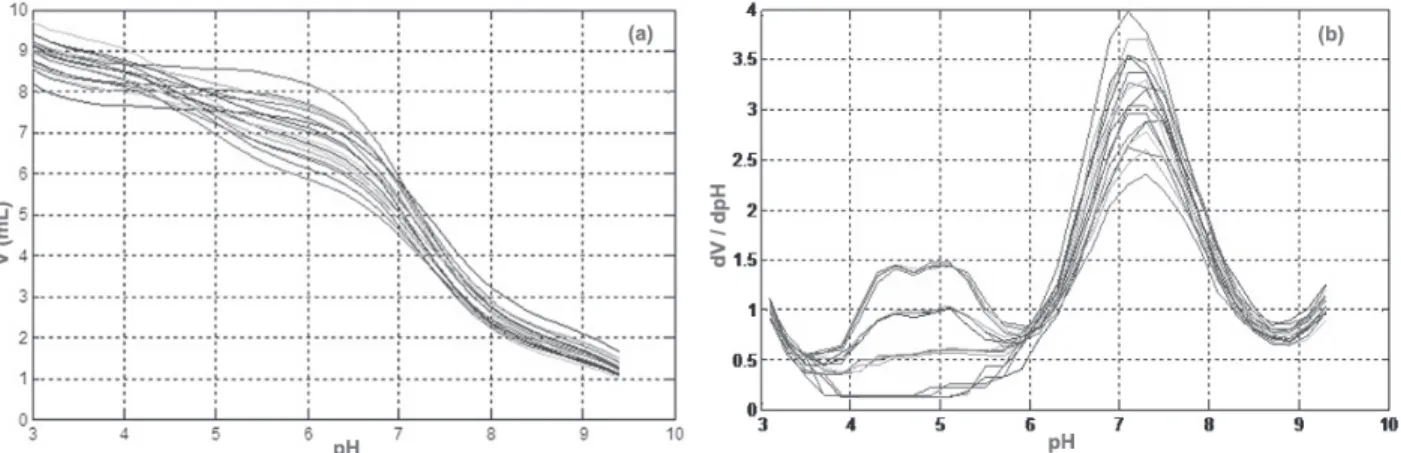
Original V – pH titration graphics and dV/dpH – pH graphics for the selected training set solutions are given in Figures 1a and 1b, respectively. As seen in Figure 1b, the titration pH ranges of copper(II) and zinc(II) appear at about 4–6 for copper(II) and 6–8 for zinc(II).
Figure 1. a) V vs. pH titration curves and b) dV/dpH vs. pH curves of selected training set solutions.
Ethylene diamine, which is added to the TISALEN solution as a ligand, is also titrated in the same pH region as zinc(II). There seems to be an enormous interference effect of ethylene diamine on zinc(II) visually. By cross-validation of the training set solutions with the PLS1 method, these interference effects were not observed (Figure 2). The predicted residual error of sum of squares values and percent recoveries of the cross-validation are 403.109 and 100.15 for copper(II) and 4474.622 and 99.68 for zinc(II), respectively.
Figure 2. Cross-validation of training set solutions for a) copper(II) and b) zinc(II) concentrations.
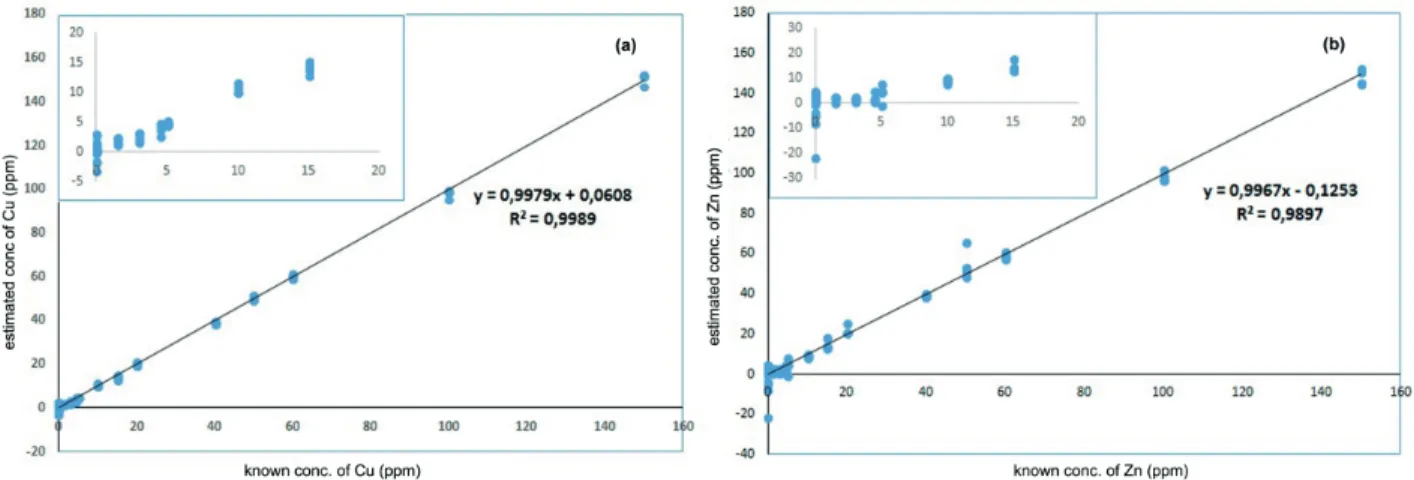
As seen from Figures 2a and 2b, the slope of the regression line is quite close to one and the intercept is very close to zero on both of the plots. Moreover, the R2 value is above 0.99. These values show that applying the PLS1 calibration technique for titration data analysis is a suitable method for simultaneous determination of copper and zinc.
In order to find out the determination limits, four different calibration sets were prepared by making stepwise dilutions of the mixtures as shown in Table 1 and 16 titrations were performed with these solutions within the range of 1.5–150 ppm of the cation concentrations. Concentrations of copper and zinc ions were then calculated by cross-validation via the PLS1 technique. The calculated concentrations were plotted against known concentrations of cations and the resulting graphs are shown in Figure 3.
Table 1. Results for the standard reference sample analysis. Certified composition Estimated composition Recovery Critical t Estimated t
P
of SRM* of SRM % value, P = 0.05 value, P = 0.05
Cu 57.15 56.55± 2.59 (N = 6) 98.95 2.57 0.60 0.575 > 0.05
Zn 30.30 30.76± 3.96 (N = 4) 101.5 3.18 0.37 0.734 > 0.05
*SRM: Standard reference material (Neusilber IV).
Figure 3. Estimated concentration versus known concentration plots of a) copper and b) zinc. Insets: Zoomed images
of the corresponding plots in 0–20 ppm range.
As seen in Figure 3, deviation from linearity and dispersion of data were observed in the plots of both cations below the concentration of 5 ppm (see insets of Figure 3a for Cu and Figure 3b for Zn). In light of this information, determination limits were accepted as 5 ppm for both copper and zinc ions. Interference effects of the possible existence of some other cations were also examined. By fixing the concentrations of copper(II) and zinc(II) to 20 µ g/mL, half, same, and double concentrations of 20 µ g/mL of lead(II), nickel(II), cadmium(II), iron(III), calcium(II) magnesium(II), tin(II), manganese(II), aluminum(III), and cobalt(II) ions were added to the solutions and titrations were performed again. A cation causing at least 10% change in the calculated concentrations of copper(II) and zinc(II) was accepted as possessing an interference effect accordingly. As a result, aluminum(III) showed an interference effect on copper(II) at all concentration levels. Lead(II) and cobalt(II) showed an interference effect on copper(II) when they exist in doubled concentrations according to copper(II) in the mixture. For the remaining cations, no interference effects were observed on copper(II).
For zinc(II), the interference effect was observed for all cations at all concentration levels except nickel(II) and calcium(II). The underlying reason might be that zinc(II) is titrated in the same pH range with ethylene diamine. The ethylene diamine complexes of the other cations change the intensity of the peak that belongs to ethylene diamine itself and zinc(II) is affected by this change.
The proposed method was also performed with a standard reference sample and the results are shown in Table 1.
As seen from Table 1, since the estimated t values are smaller than the critical t values at P = 0.05, or since the P values are bigger than 0.05, it can be concluded that there is no significant difference between the
results obtained from the proposed method and the corresponding values for the standard reference sample at P = 0.05. In other words, the obtained results are consistent with the real values. This shows that the developed method is appropriate for a titrimetric method based on a mixture.
In conclusion, a new method for the simultaneous determination of copper(II) and zinc(II) was presented in this study. Determination limits of copper(II) and zinc(II) are both found to be approximately 5 ppm. The developed method is cost-effective in terms of not requiring the use of expensive chemical instruments. Moreover, the developed method is reliable due to being validated with a standard reference sample. This method can be applied in all laboratories for simultaneous copper and zinc determination in the presence of a pH meter combined with a suitable multivariate calibration program. Furthermore, the proposed method can be modified for simultaneous determination of other cations in the presence of other suitable ligands.
3. Experimental 3.1. Apparatus
Titrations were carried out with an ORION 960 model automatic potentiometric titrator including a module of ORION 940 (pH/ISE-meter). The pH of the solutions was measured by the use of an ORION 940A model pH-ion meter fitted with an Ingold 9823 model combined with a glass pH electrode. The titrant, hydrochloric acid, was added by using the Orion 960 Autochemistry system. Potassium hydrogen phthalate and ammonium acetate were used to calibrate the pH electrode at pH 4.01 and 7.00, respectively. Calibration of the electrode system was refreshed every 4 h. Calibration of the dispenser of the automatic titrator was repeated regularly as advised by the manufacturer. All experiments were performed at 25 ◦C.
PLS1 calibration was performed using the concentration matrix of the training set and the dV/dpH matrix with basic MATLAB codes, written in our laboratory, using Octave 4.0.0, which is best free licensed software compatible with MATLAB, as accordingly described in the literature.15 Concentrations for the validation set and the reference standard sample were calculated by using the calibrated method as above.
3.2. Chemicals
All reagents used were of analytical grade. TISALEN, 0.05 M ethylene diamine, and 1 M NaCl were prepared by dissolving suitable amounts ethylene diamine (Merck) and NaCl (Merck) in double-distilled water. TISALEN was used not only for adjusting the ionic strength of the solution but also for forming a complex with metal ions in the solution to be titrated. Copper(II) and zinc(II) were used from their standard solutions, which are 1000 µ g/mL (Merck). Magnesium(II), lead(II), manganese(II), iron(III), tin(II), cadmium(II), nickel(II), cobalt(II), calcium(II), and aluminum(III) standard solutions of 1000 µ g/mL (Merck) were used to investigate the interferences. A standard hydrochloric acid solution of approximately 0.1 M was prepared using a suitable amount of concentrated hydrochloric acid and double-distilled water and was standardized against primary standard sodium carbonate (Merck). A sodium hydroxide solution of approximately 0.1 M was prepared and used without any standardization.
The standard reference sample, Neusilber IV, was purchased from Dr Hoepfner Substanz and contains 57.15% copper, 30.30% zinc, 10.27% nickel, 1.96% lead, 0.19% iron, and 0.09% manganese.
3.3. Procedure
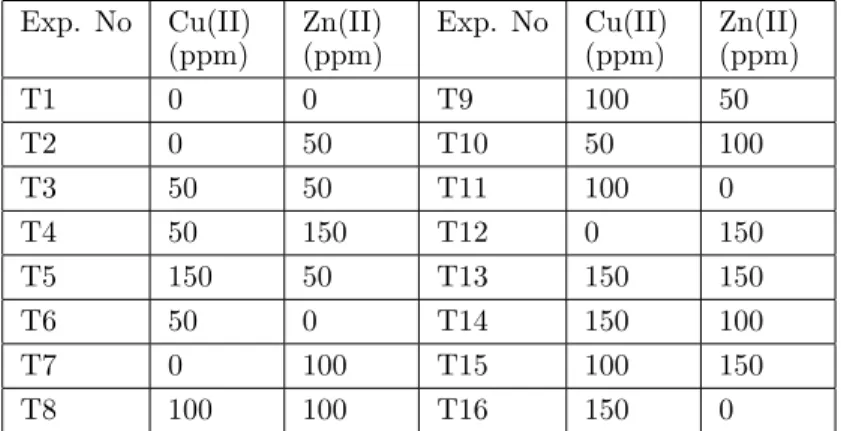
A set of metal ion mixtures with known concentrations for calibration was prepared and titrated. Concentrations of copper(II) and zinc(II) ions in training set solutions were defined as four levels (0, 50, 100, and 150 µ g/mL for
each cation) and two factors for multivariate calibration as given in the literature.16 Training set concentrations are shown in Table 2. A suitable amount of standard cation solution according to Table 2 was placed in a 100-mL vessel, followed by adding 10 mL of TISALEN solution and dilution to 50 mL with double-distilled water. A previously calibrated pH electrode was immersed in the solution and approximately 0.1 M of sodium hydroxide solution was dropped with a Pasteur pipette while stirring until the pH of the solution was over 10. The mixture was then titrated with a standard hydrochloric acid solution with additions of 0.2 mL until the pH of the solution was below 3 by use of the automatic titrator. The titration data were recorded as pH values against titrant volume (V). The collected data were first converted to titrant volume against pH (between pH 10 and pH 3 in intervals of 0.2 pH) using basic interpolation and then dV/dpH against pH values were calculated. Similar titrations, data collection, and conversions were also performed for the standard reference sample.
Table 2. Copper(II) and zinc(II) concentrations of training set solutions. Exp. No Cu(II) (ppm) Zn(II) (ppm) Exp. No Cu(II) (ppm) Zn(II) (ppm) T1 0 0 T9 100 50 T2 0 50 T10 50 100 T3 50 50 T11 100 0 T4 50 150 T12 0 150 T5 150 50 T13 150 150 T6 50 0 T14 150 100 T7 0 100 T15 100 150 T8 100 100 T16 150 0 Acknowledgment
We gratefully acknowledge the financial support of the Ankara University Research Fund (Project No: 97-05-04-03).
References
1. Abbasi-Tarighat, M.; Nabavi, M.; Mohammadizadeh, M. R. Spectrochim. Acta A 2015, 15, 54-62. 2. Moradi, R.; Jameh-Bozorghi, S.; Niazi, A. APCBEE Procedia 2012, 3, 65-59.
3. Abbasi-Tarighat, M.; Shahbazi, E.; Niknam, K. Food Chem. 2013, 138, 991-997. 4. Ghavami, R.; Najafi, A.; Hemmateenejad, B. Spectrochim. Acta A 2008, 70, 824-834. 5. Pei, J.; Tercier-Waeber, M. L.; Buffle, J. Anal. Chem. 2000, 72, 161-171.
6. Otto, M.; Thomas, J. D. R. Anal. Chem. 1985, 57, 2647-2651. 7. Forster, R.; Regan, F.; Diamond, D. Anal. Chem. 1991, 63, 879-882. 8. Forster, R.; Diamond, D. Anal. Chem. 1992, 64, 1721-1728.
9. Skoog, D. A.; Holler, F. J.; Nieman, T. A. Principles of Instrumental Analysis; Brooks/Cole, Thomson Learning: Belmont, CA, USA, 2007.
10. Lindberg, W.; Kowalski, B. Anal. Chim. Acta 1988, 206, 125-135. 11. Ni, Y. N.; Wu, Y. L. Anal. Chim. Acta 1997, 354, 233-240.
12. Ni, Y. N. Anal. Chim. Acta 1998, 367, 145-152.
13. Ni, Y. N.; Wu, A. G. Anal. Chim. Acta 1999, 390, 117-123. 14. Ni, Y.; Kokot, S. Anal. Chim. Acta 2008, 626, 130-146.
15. Brereton, G. R. Chemometrics: Application of Mathematics and Statistics to Laboratory Systems; Ellis Horwood: Chichester, UK, 1990.