AN ANALYTICAL MODEL OF IEEE 802.11 DCF FOR
MULTI-HOP WIRELESS NETWORKS AND ITS
APPLICATION TO GOODPUT AND ENERGY
ANALYSIS
a thesis
submitted to the department of electrical and
electronics engineering
and the institute of engineering and sciences
of b
˙Ilkent university
in partial fulfillment of the requirements
for the degree of
doctor of philosophy
By
Canan Aydo˘
gdu
I certify that I have read this thesis and that in my opinion it is fully adequate, in scope and in quality, as a thesis for the degree of Doctor of Philosophy.
Assoc. Prof. Dr. Ezhan Kara¸san(Supervisor)
I certify that I have read this thesis and that in my opinion it is fully adequate, in scope and in quality, as a thesis for the degree of Doctor of Philosophy.
Prof. Dr. Hayrettin K¨oymen
I certify that I have read this thesis and that in my opinion it is fully adequate, in scope and in quality, as a thesis for the degree of Doctor of Philosophy.
Assist. Prof. Dr. ˙Ibrahim K¨orpeo˘glu
I certify that I have read this thesis and that in my opinion it is fully adequate, in scope and in quality, as a thesis for the degree of Doctor of Philosophy.
Assoc. Prof. Dr. Nail Akar
I certify that I have read this thesis and that in my opinion it is fully adequate, in scope and in quality, as a thesis for the degree of Doctor of Philosophy.
Assoc. Prof. Dr. Elif Uysal Bıyıklıo˘glu
Approved for the Institute of Engineering and Sciences:
Prof. Dr. Levent Onural
ABSTRACT
AN ANALYTICAL MODEL OF IEEE 802.11 DCF FOR
MULTI-HOP WIRELESS NETWORKS AND ITS
APPLICATION TO GOODPUT AND ENERGY
ANALYSIS
Canan Aydo˘
gdu
Ph.D. in Electrical and Electronics Engineering
Supervisor: Assoc. Prof. Dr. Ezhan Kara¸san
November 2010
In this thesis, we present an analytical model for the IEEE 802.11 DCF in multi-hop networks that considers hidden terminals and works for a large range of traffic loads. A goodput model which considers rate reduction due to collisions, retransmissions and hidden terminals, and an energy model, which considers energy consumption due to collisions, retransmissions, exponential backoff and freezing mechanisms, and overhearing of nodes, are proposed and used to ana-lyze the goodput and energy performance of various routing strategies in IEEE 802.11 DCF based multi-hop wireless networks. Moreover, an adaptive routing algorithm which determines the optimum routing strategy adaptively according to the network and traffic conditions is suggested.
Viewed from goodput aspect the results are as follows: Under light traf-fic, arrival rate of packets is dominant, making any routing strategy equivalently optimum. Under moderate traffic, concurrent transmissions dominate and
multi-becomes unstable due to increased packet collisions and excessive traffic conges-tion, and direct transmission increases goodput. From a throughput aspect, it is shown that throughput is topology dependent rather than traffic load dependent, and multi-hopping is optimum for large networks whereas direct transmissions may increase the throughput for small networks.
Viewed from energy aspect similar results are obtained: Under light traf-fic, energy spent during idle mode dominates in the energy model, making any routing strategy nearly optimum. Under moderate traffic, energy spent during idle and receive modes dominates and multi-hop transmissions become more ad-vantageous as the optimum hop number varies with processing power consumed at intermediate nodes. At the very heavy traffic conditions, multi-hopping be-comes unstable due to increased collisions and direct transmission bebe-comes more energy-efficient.
The choice of hop-count in routing strategy is observed to affect energy-efficiency and goodput more for large and homogeneous networks where it is possible to use shorter hops each covering similar distances. The results indicate that a cross-layer routing approach, which takes energy expenditure due to MAC contentions into account and dynamically changes the routing strategy according to the network traffic load, can increase goodput by at least 18% and save energy by at least 21% in a realistic wireless network where the network traffic load changes in time. The goodput gain increases up to 222% and energy saving up to 68% for denser networks where multi-hopping with much shorter hops becomes possible.
Keywords: IEEE 802.11 DCF, distributed coordination function, analytical
model, semi-Markov chain, multi-hop wireless networks, energy-efficiency, good-put, throughgood-put, routing.
¨
OZET
C
¸ OK-SEKMEL˙I TELS˙IZ A ˘
GLAR ˙IC
¸ ˙IN B˙IR ANAL˙IT˙IK IEEE
802.11 DCF MODEL˙I VE MODEL˙IN ULAS
¸TIRILAN ˙IS
¸ ˙ILE
ENERJ˙I ANAL˙IZ˙INE UYGULANMASI
Canan Aydo˘
gdu
Elektrik ve Elektronik M¨
uhendisli˘
gi B¨
ol¨
um¨
u Doktora
Tez Y¨
oneticisi: Do¸c. Dr. Ezhan Kara¸san
Kasım 2010
Bu tezde, ¸cok-sekmeli telsiz a˘glarda saklı d¨u˘g¨umleri g¨oz ¨on¨une alan ve geni¸s bir
trafik y¨uk aralı˘gında ¸calı¸san analitik bir IEEE 802.11 DCF modeli meydana
koy-maktayız. IEEE 802.11 DCF’e dayalı ¸cok-sekmeli telsiz a˘glarda, ¸carpı¸smaların
ve yeniden iletimlerin sebep oldu˘gu hız azalmasıyla saklı terminalleri g¨oz ¨on¨une
alan bir ula¸stırılan i¸s (goodput) modeli; ve ek olarak, ¨ustel geri ¸cekilme, donma
mekanizması ve d¨u˘g¨umlerin kulak misafiri olmalarından kaynaklanan enerji
har-camalarını i¸ceren bir enerji modeli ¨onerilmi¸s ve farklı sekme sayısının ula¸stırılan
i¸s ve enerji performansına etkisinin ara¸stırılmasında kullanılmı¸stır. Dahası, a˘g
ve trafik durumuna g¨ore en uygun yolatama y¨ontemini belirleyen bir uyarlanır
yolatama algoritması ortaya atılmı¸stır.
Ula¸stırılan i¸s a¸cısından bakıldı˘gında sonu¸clar ¸s¨oyledir: Hafif trafik altında
paket ¨uretim hızı baskındır ve herhangi bir sekme y¨ontemi e¸sde˘gerde
uygun-dur. Orta ¸siddette trafikte e¸szamanlı g¨onderimler baskındır ve ¸cok-sekmeli
yolatama daha kˆarlıdır. S¸iddetli trafik varlı˘gında ise artan paket ¸carpı¸smaları ve
bakıldı˘gında, ¨uretilen i¸sin trafik y¨uk¨unden ¸cok a˘g topolojisine ba˘gımlı oldu˘gu,
¸cok-sekmeli iletimin b¨uy¨uk a˘glar i¸cin en uygunken do˘grudan iletimin k¨u¸c¨uk a˘glar
i¸cin ¨uretilen i¸si arttırabildi˘gi g¨osterilmi¸stir.
Enerji a¸cısından bakıldı˘gında benzer sonu¸clar elde edilmektedir: Hafif
trafikte, bo¸s durumda t¨uketilen enerji baskın olup herhangi bir sekme y¨ontemini
yakla¸sık olarak en uygun yapmaktadır. Orta ¸siddette trafik altında, bo¸s ve
alı¸s durumundaki enerji harcaması baskınla¸sıp ¸cok-sekmeli g¨onderim en
uy-gun olmakta en uyuy-gun sekme sayısı ara d¨u˘g¨umlerde harcanan i¸slem g¨uc¨u ile
de˘gi¸smektedir. C¸ ok a˘gır trafik y¨uk durumunda, artan paket ¸carpı¸smaları
ne-deniyle ¸cok-sekmeli iletim kararsız hale gelmekte ve do˘grudan g¨onderim daha
enerji-verimli olmaktadır.
Yolatama y¨onteminde kullanılan sekme sayısının ula¸stırılan i¸s ve enerji
ver-imlili˘gini, herbiri benzer mesafeleri kateden daha kısa sekmelerin kullanılmasının
m¨umk¨un oldu˘gu, b¨uy¨uk ve homojen a˘glarda daha ¸cok etkiledi˘gi g¨ozlenmi¸stir.
Sonu¸clar, MAC seviyesinde kanal kapı¸smasını g¨oz ¨on¨une alan ve sekme y¨ontemini
dinamik olarak de˘gi¸stiren ¸capraz-katmanlı bir yolatama yakla¸sımının, ger¸cek bir
telsiz a˘gda a˘g trafik y¨uk¨u zaman i¸cinde de˘gi¸sirken ula¸stırılan i¸si en az %18
arttırdı˘gını ve en az %21 enerji tasarrufu sa˘gladı˘gını g¨ostermi¸stir. Daha kısa
sekmelerin m¨umk¨un oldu˘gu yo˘gun a˘glarda ula¸stırılan i¸s %222 kadar artmı¸s ve
enerji tasarrufu %68’e ¸cıkmı¸stır.
Anahtar Kelimeler: IEEE 802.11 DCF, da˘gıtık e¸sg¨ud¨um fonksiyonu, analitik
model, yarı-Markov zinciri, ¸cok-sekmeli telsiz a˘glar, enerji verimlili˘gi, ula¸stırılan
ACKNOWLEDGMENTS
I would like to thank my thesis advisor, Assoc. Prof. Dr. Ezhan Kara¸san, especially for his good intentions and understanding throughout my studies. I would like to thank him for letting me act free in choosing the topics of my researches-which motivated me to be passionately fond of my studies for years. And finally, I would like to thank him for the countless hours he spent with me discussing our research. His assistance during my time at Bilkent has been invaluable-my life has been enriched professionally and intellectually by working with him.
I would like to thank my daughters Damla and Duru for joining my life and delighting my studies. My Ph.D. studies would not have been so beautiful -and so organized- if I hadn’t the hope of playing games with them when I returned home. It was just like finding two little rainbows at home... that sweep away all problems.
And finally, I would like to thank my husband ¨Ozg¨u for the past 16 years
Contents
List of Abbreviations and Notations xxi
1 Introduction 1
2 Goodput, Throughput and Energy-Efficiency in Multi-Hop
Wireless Networks 9
2.1 Goodput and Throughput Performance in Multi-Hop Wireless
Networks . . . 10
2.1.1 Goodput and throughput issues at layers of the protocol stack . . . 13
2.1.2 Cross-layer design . . . 16
2.2 Energy Performance in Multi-Hop Wireless Networks . . . 18
2.2.1 Energy-efficiency at layers of the protocol stack . . . 20
2.2.2 Cross-layer design . . . 24
3 An Analytical Model for IEEE 802.11 DCF 28 3.1 Distributed Coordination Function . . . 34
3.2 IEEE 802.11 DCF Models . . . 35
3.3 Major Attributes of the Proposed IEEE 802.11 DCF Model . . . . 36
3.3.1 Semi-Markov chain . . . 36
3.3.2 Joint use of fixed and variable slots . . . 37
3.3.3 From channel state probability towards NAV setting prob-ability . . . 38
3.3.4 Large range of traffic loads . . . 39
3.3.5 Any given topology and traffic pattern . . . 39
3.3.6 Not only RTS collisions . . . 39
3.4 IEEE 802.11 DCF Model for Multi-Hop Wireless Networks . . . . 40
3.4.1 Assumptions . . . 40
3.4.2 Basics of IEEE 802.11 DCF model . . . 42
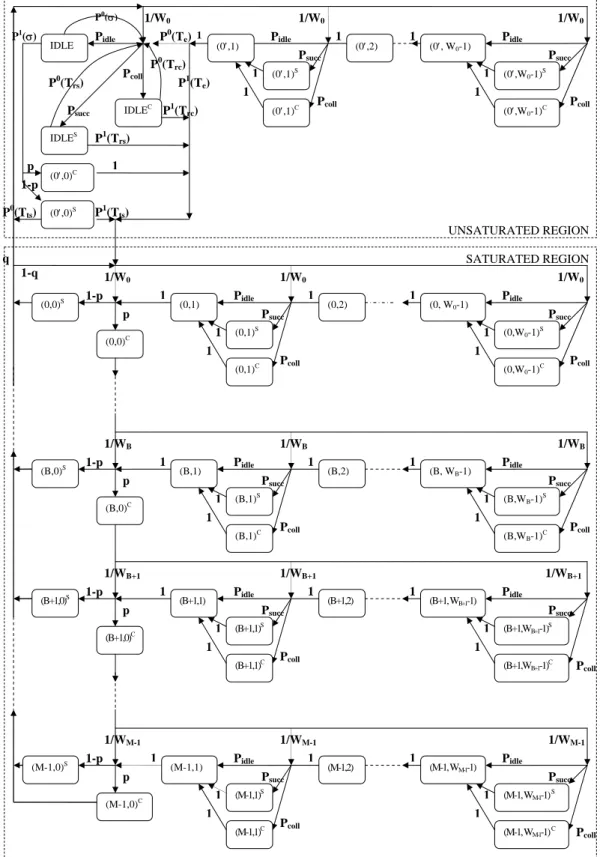
3.4.3 State categories and state transitions . . . 48
3.4.4 State residence times . . . 54
3.4.5 Steady state probabilities . . . 56
3.4.6 Geometry related notations . . . 57
3.4.7 NAV setting probabilities . . . 60
3.4.8 Probability of collision . . . 63
3.5 Numerical Results . . . 72
3.5.2 Probability of collision . . . 78
3.5.3 NAV setting probabilities . . . 81
3.5.4 Average slot duration . . . 85
3.5.5 Effect of contention window size . . . 89
3.5.6 Effect of DATA packet size . . . 91
3.5.7 Effect of maximum retry count . . . 91
3.6 Conclusions . . . 93
4 Goodput and Throughput Analysis of IEEE 802.11 DCF 95 4.1 Literature Review . . . 96
4.2 Proposed Goodput Model . . . 99
4.2.1 Inter-successful-reception time . . . 101
4.3 Throughput Model . . . 108
4.4 Numerical Results . . . 108
4.4.1 Average node goodput . . . 109
4.4.2 Average node throughput . . . 111
4.4.3 Effect of contention window size . . . 114
4.4.4 Effect of DATA packet size . . . 114
4.4.5 Effect of maximum retry count . . . 117
5 Energy Analysis of IEEE 802.11 DCF 121
5.1 Literature Review . . . 123
5.1.1 Effect of routing on energy performance . . . 123
5.1.2 Energy models for the IEEE 802.11 DCF . . . 126
5.2 Proposed Energy Model . . . 127
5.2.1 Assumptions . . . 127
5.2.2 Energy per bit . . . 128
5.2.3 Idle energy per bit . . . 129
5.3 Numerical Results . . . 130
5.3.1 Total EPB . . . 131
5.3.2 Effect of idle energy and sleeping mechanism . . . 134
5.3.3 Components of EPB . . . 134
5.3.4 Effect of processing power . . . 137
5.3.5 Effect of contention window size . . . 139
5.3.6 Effect of DATA packet size . . . 140
5.3.7 Effect of maximum retry count . . . 141
5.4 Conclusions . . . 142
6 LACAR: A Load-Adaptive Contention-Aware Route Selection
6.2 Load-Adaptive Contention-Aware Route Selection Algorithm . . . 148 6.2.1 Initialization phase . . . 150 6.2.2 Adaptive phase . . . 152 6.2.3 An example . . . 152 6.3 Numerical Results . . . 153 6.4 Conclusions . . . 158
7 Conclusions and Future Work 159
Appendix 164
A Derivation of Pif q and q 164
List of Figures
1.1 Advances in wireless technology fit the Edholm’s law of bandwidth
rule and predictions are that wireless data access will exceed
wire-line access in the far future [SOURCE: IEEE Spectrum [1]]. . . . 2
1.2 A multi-hop wireless ad-hoc sensor network, where each heat
sen-sor is responsible of conveying information regarding an increase in the heat to the central office. An energy-efficient routing de-sign in this network requires an answer to the basic question of
“directly transmit or multi-hop?” . . . 3
1.3 Main contributions of the dissertation: i) an analytical IEEE
802.11 DCF model, ii) goodput and throughput models, iii) an energy model and iv) a load-adaptive contention-aware route
se-lection algorithm for IEEE 802.11 DCF based multi-hop networks. 5
2.1 Protocol stack of a generic wireless network, and corresponding
areas of energy efficient research. . . 22
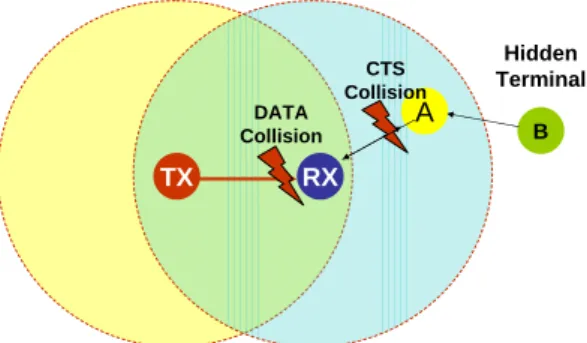
3.1 DATA packet collision due to hidden terminal problem in a
multi-hop wireless network. . . 31
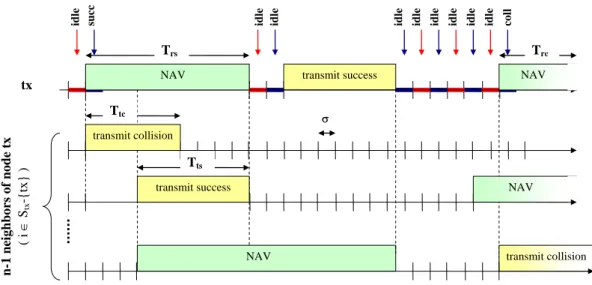
3.3 Time instants at which NAV setting probabilities Pidle, Psucc and
Pcoll are calculated . . . 46
3.4 Illustration of carrier sensing regions a) Srxexc and Srxint, b) Sexctx→i and Sinttx→i, c) StxSrxint and SintSrxint formed by nodes tx, rx and i ∈ Srxint − {tx}, d) StxSrxexc, SrxSrxexc, SintSrxexc and SexcSrxexc formed by nodes tx, rx and j ∈ Srxexc . . . 59
3.5 Calculation of NAV setting probabilities based on fixed-slot notion 63 3.6 Illustration of events for calculation of probability of collision . . . 64
3.7 Illustration of states for calculation of τA0 of PA. . . 67
3.8 Illustration of states for calculation of τA1 of PA. . . 68
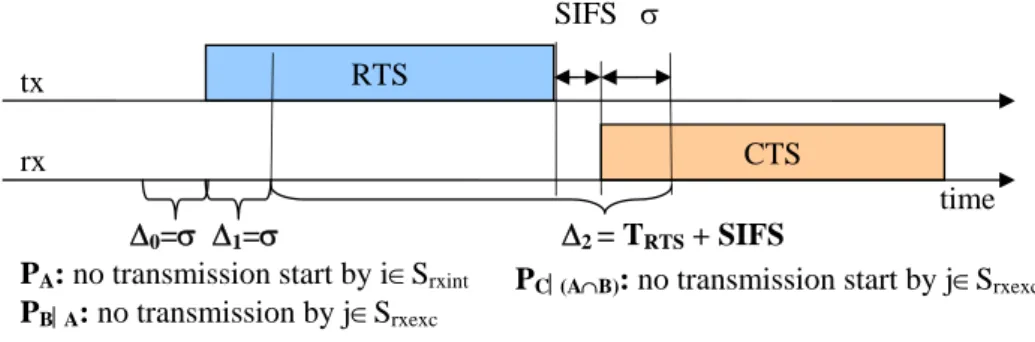
3.9 Illustration of states for calculation of PB|A. . . 70
3.10 Illustration of states for calculation of PC|(A∩B). . . 71
3.11 Flowchart of the solution of the analytical IEEE 802.11 DCF model. 74 3.12 Probability of transmission obtained from analytical model and simulations for: a) 10-node, b) 20-node, c) 50-node, d) 100-node, e) 200-node random topologies and random traffic patterns . . . . 77
3.13 Probability of transmission obtained from analytical model and simulations for: a) 127-node and g) 469-node hexagonal topologies and regular traffic patterns . . . 78
3.14 Probability of collision obtained from analytical model and sim-ulations for: a) 10-node, b) 20-node, c) 50-node, d) 100-node, e) 200-node random topologies and random traffic patterns . . . 79
3.15 Probability of collision obtained from analytical model and simu-lations for: a) 127-node and g) 469-node hexagonal topologies and
regular traffic patterns . . . 80
3.16 Probability of setting the NAV for a long duration, Psucc, obtained
from analytical model and simulations for: a) 10-node, b) 20-node, c) 50-20-node, d) 100-20-node, e) 200-node random topologies
and random traffic patterns . . . 82
3.17 Probability of setting the NAV for a long duration, Psucc, obtained
from analytical model and simulations for: a) 127-node and g)
469-node hexagonal topologies and regular traffic patterns . . . . 83
3.18 Probability of setting the NAV for a short duration, Pcoll, obtained
from analytical model and simulations for: a) 10-node, b) 20-node, c) 50-20-node, d) 100-20-node, e) 200-node random topologies
and random traffic patterns . . . 84
3.19 Probability of setting the NAV for a short duration, Pcoll, obtained
from analytical model and simulations for: a) 127-node and g)
469-node hexagonal topologies and regular traffic patterns . . . . 85
3.20 Probability of not setting the NAV, Pidle, obtained from analytical
model and simulations for: a) 10-node, b) 20-node, c) 50-node, d) 100-node, e) 200-node random topologies and random traffic
patterns . . . 86
3.21 Probability of not setting the NAV, Pidle, obtained from analytical
model and simulations for: a) 127-node and g) 469-node hexagonal
3.22 The average value of slot duration, ¯σn, obtained from analytical model and simulations for: a) 10-node, b) 20-node, c) 50-node, d) 100-node, e) 200-node random topologies and random traffic
patterns . . . 88
3.23 The average value of slot duration, ¯σn, obtained from analytical
model and simulations for: a) 127-node and g) 469-node hexagonal
topologies and regular traffic patterns . . . 89
3.24 Effect of contention window size, obtained from analytical model and simulations, for the 469-node hexagonal topology: a) τ for
h = 1, b) τ for h = 6, c) p for h = 1, d) p for h = 6. . . 90
3.25 Effect of DATA packet size, obtained from analytical model and simulations, for the 469-node hexagonal topology: a) τ for h = 1,
b) τ for h = 6, c) p for h = 1, d) p for h = 6. . . 92
3.26 Effect of maximum retry count, obtained from analytical model and simulations, for the 469-node hexagonal topology: a) τ for
h = 1, b) τ for h = 6, c) p for h = 1, d) p for h = 6. . . 93
4.1 Illustration of number of successful/dropped packets over first hop
of the h-hop path γij: Nsucc(γij, 1), Ndrop(γij, 1) and NdropIF Q(γij, 1)104
4.2 Average node goodput obtained from analytical model and
sim-ulations for a) 10-node, b) 20-node, c) 50-node, d) 100-node, e) 200-node random topologies and random traffic patterns . . . 110
4.3 Average node goodput obtained from analytical model and
simu-lations for a) 127-node and d) 469-node hexagonal topologies and regular traffic patterns . . . 111
4.4 Average node throughput obtained from analytical model and sim-ulations for a) 10-node, b) 20-node, c) 50-node, d) 100-node, e) 200-node random topologies and random traffic patterns . . . 112
4.5 Average node throughput obtained from analytical model and
sim-ulations for a) 127-node and d) 469-node hexagonal topologies and regular traffic patterns . . . 113
4.6 Effect of contention window size, obtained from analytical model
and simulations, for the 469-node hexagonal topology: a) average node goodput for h = 1, b) average node goodput for h = 6, c) average node throughput for h = 1, d) average node throughput for h = 6. . . 115
4.7 Effect of DATA packet size, obtained from analytical model and
simulations, for the 469-node hexagonal topology: a) average node goodput for h = 1, b) average node goodput for h = 6, c) average node throughput for h = 1, d) average node throughput for h = 6. 116
4.8 Effect of maximum retry count, obtained from analytical model
and simulations, for the 469-node hexagonal topology: a) average node goodput for h = 1, b) average node goodput for h = 6, c) average node throughput for h = 1, d) average node throughput for h = 6. . . 118
5.1 EPB obtained from analytical model and simulations without
in-clusion of energy consumed in the idle mode for a) 10-node, b) 20-node, c) 50-node, d) 100-node, e) 200-node random topologies and random traffic patterns . . . 133
5.2 EPB obtained from analytical model and simulations without in-clusion of energy consumed in the idle mode for a) 127-node and f) 469-node hexagonal topologies and regular traffic patterns . . . 134
5.3 EPB obtained from analytical model and simulations with
inclu-sion of energy consumed in the idle mode for a) 10-node, b) 20-node, c) 50-20-node, d) 100-20-node, e) 200-node random topologies and random traffic patterns . . . 135
5.4 EPB obtained from analytical model and simulations with
inclu-sion of energy consumed in the idle mode for a) 127-node, b)
469-node hexagonal topologies and regular traffic patterns . . . . 136
5.5 Idle, overhear, transmit and receive energies per bit in the
469-node hexagonal topology for a) direct transmission and b) multi-hopping with h = 6 . . . 137
5.6 Idle, overhear, transmit and receive energies per bit in the
200-node random topology for a) direct transmission and b) multi-hopping with h = 3 . . . 138
5.7 EPB of analytical results for h = {1, 2, 3, 6} for Pprocess = 10µJ/bit 138
5.8 EPB with idle energy versus processing power for a) λo = 0.5, b)
λo = 4 and c) λo = 60 packets/sec . . . 139
5.9 EPB with idle energy consumption versus minimum contention
window W0, for h = {1, 2, 3, 6} and λo = {0.5, 4, 60} packets/sec . 140
5.10 Effect of contention window size, obtained from analytical model and simulations, for the 469-node hexagonal topology: a) EP B
5.11 Effect of DATA packet size, obtained from analytical model and simulations, for the 469-node hexagonal topology: a) EP B for
h = 1, b) EP B for h = 6. . . 142
5.12 Effect of maximum retry count, obtained from analytical model and simulations, for the 469-node hexagonal topology: a) EP B
for h = 1, b) EP B for h = 6. . . 143
6.1 Comparison of performance of the adaptive route selection
algo-rithm LACAR with non-adaptive cases with h = 1 and h = 3 for the 127-node hexagonal topology for a) probability of trans-mission, b) probability of collision, c) average node goodput, d) average node throughput and e) EP B with ideal sleeping regime . 154
6.2 Comparison of performance of LACAR algorithm with
non-adaptive cases with h = 1 and h = 3 for the 469-node hexagonal topology for a) probability of transmission, b) probability of col-lision, c) average node goodput, d) average node throughput and
List of Tables
2.1 Some representative information that can be exchanged in a
cross-layer architecture and where the information is available. . . 17
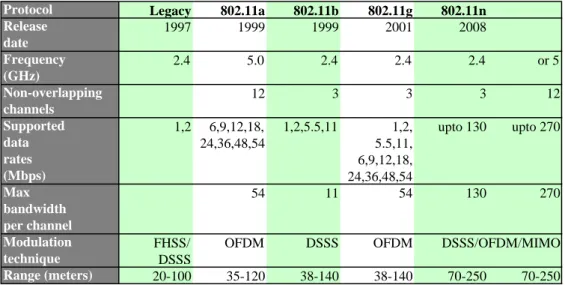
3.1 Summary of the IEEE 802.11a\b\g\n protocols. . . 29
3.2 Parameters used for both the analytical model and simulation runs. 72
3.3 Comparison of run time of calculations of analytical IEEE 802.11
DCF model with simulations. . . 75
5.1 Power consumption values used for both the analytical model and
List of Abbreviations and
Notations
b Backoff stage . . . 34
B Maximum counter value . . . 42
BEB Binary Exponential Backoff . . . 4
CCW Constant Contention Window . . . 37
EDCA Enhanced Distributed Channel Access . . . 29
EP B Energy Per Bit . . . 19
Eidle Idle energy per bit . . . 130
Eoverhear Overhear energy per bit . . . 128
Erx Receive energy per bit . . . 128
Etx Transmit energy per bit . . . 128
¯ G Average node goodput . . . 101
G(i) Node goodput of node i . . . 100
Gn Network goodput . . . 101
h Number of hops of all paths in the network . . . 41
IF Q Interface queue between physical and MAC layers . . . 41
k Backoff counter value . . . 42
LACAR Load-Adaptive Contention-Aware Route selection algorithm . . . 148
M Maximum retry count . . . 41
M CF Mesh Coordination Function . . . 29
n Avg. # of nodes inside the carrier sensing range . . . 57
¯
nM Avg. # retries . . . 103
N Total number of nodes in the wireless network . . . 41
Ndrop
Total number of unsuccessful transmissions per path per successful re-ception . . . 128
Nrxexc Avg. # of nodes inside Srxexc . . . 57
Nrxint Avg. # of nodes inside Srxint, including tx and rx . . . 58
Nsucc
Total number of successful transmissions per path per successful recep-tion . . . 128
N AV Network Allocation Vector . . . 33
p Prob. of collision given transmission occurs . . . 41
Pcoll
Prob. that NAV is set for short duration given that carrier sensing is done with zero NAV . . . 45
pcs Prob. that a node does carrier sensing with zero NAV . . . 45
Pidle
Prob. that NAV is not set given that carrier sensing is done with zero NAV . . . .45
Pif q(i) Prob. of packet drop at interface queue of node i . . . 41
Psucc
Prob. that NAV is set for long duration given that carrier sensing is done with zero NAV . . . 45
P wridle Idle power in Watts . . . .127
P wrtx Transmit power in Watts . . . 127
q(i)
Prob. that the interface queue of node i is empty upon processing a packet . . . 47
Rexc The ratio of # of nodes inside Sexctx→i to n . . . 59
RexcSrxexc The ratio of # of nodes inside SexcSrxexc to n . . . 59
RintSrxexc The ratio of # of nodes inside SintSrxexc to n . . . 59
RintSrxint The ratio of # of nodes inside SintSrxint to n . . . 59
RrxSrxexc The ratio of # of nodes inside SrxSrxexc to n . . . 59
RtxSrxexc The ratio of # of nodes inside StxSrxexc to n . . . 59
RtxSrxint The ratio of # of nodes inside StxSrxint to n . . . 59
rx Receiver . . . 31
Stx→i
exc Carrier sensing area of i ∈ Stx, not exposed to tx . . . 58
Stx→i
int Intersection of carrier sensing areas of tx and i ∈ Stx . . . 58
Srxint Intersection of carrier sensing regions of tx and rx . . . 58
Srxexc Receiver exclusive region . . . 57
Stx The carrier sensing region of the transmitter tx . . . 57
SM C Semi Markov Chain . . . 32
Tbusy Total busy duration per path per successful reception . . . 129
Tdrop Busy duration of one unsuccessful transmission . . . 129
Tdrop+ Duration of one unsuccessful transmission including idle time . . . . 102
Te Avg. time spent during backoff with empty queue . . . 45
Trc State residence time of receive collision states . . . 44
Trs State residence time of receive success states . . . 44
Tsucc The busy duration of one successful transmission . . . 129
Tsucc+ The duration of one successful transmission including idle time . . .102
Ttc State residence time of transmit collision states . . . 44
Tts State residence time of transmit success states . . . 44
W0 Minimum contention window size . . . 34
Wb Maximum backoff counter value at stage b . . . 42
V Set of all nodes in the multi-hop wireless network . . . 101
∆T (i)
The average time between two successive successful DATA packet trans-missions of node i that are successfully received by the intended desti-nation . . . 100
∆T (γkl)
Inter-successful-reception time, i.e. time between two successive suc-cessful DATA packet receptions by the destination node l from the
source node k over the route γkl . . . 100
η Path loss exponent . . . 72
γkl Path from source node k to destination node l . . . 100
Γk Set of paths with source node k . . . 100
πidle Sum of steady state probabilities of idle states . . . 44
πrc Sum of steady state prob. of receive collision states . . . 45
πrs Sum of steady state prob. of receive success states . . . 45
πtc Sum of steady state prob. of transmit collision states . . . 45
πts Sum of steady state prob. of transmit success states . . . 45
λo(i) Average packet generation rate at node i . . . 47
λo(i, j)
Average packet generation rate at node i for packets that are sent to node j . . . 47
λr(i) Average total relay traffic at node i . . . 47
λt(i) Average packet arrival rate at node i . . . 47
λsat
Average packet generation rate after which MAC, energy, goodput or throughput performances become constant . . . 76
τ Prob. of transmission . . . 45
σ The state residence time of idle states, which is equal to a SlotTime 44
¯
σ Average NAV duration . . . .45
¯
Dedicated to my daughters,
Damla and Duru. . .
Chapter 1
Introduction
Advances in wireless technology have led to various appealing networking appli-cations for delivery of data, audio and video. A diverse range of these appliappli-cations include real-time audio and streaming video delivery, remote monitoring through sensor networks, rapidly deployed and reconfigured emergency or military ad-hoc networking applications, under-water group communications, teleconferencing, home networking, etc. The wide span of these wireless networking applications is predicted to grow further and even replace wireline communications in the far future with the advances in technology as depicted by Edholm’s law of band-width [1]. The logarithmic plot given in Fig. 1.1 taken from this study shows the
data rates of wireless, wireline and nomadic1 communications against time.
Applications that run on large wireless networks with limited range necessi-tate multi-hopping functionality, which is the act of transferring data through multiple hops via intermediate nodes. Multi-hopping is used in such wireless networks to extend the coverage when maximum transmit power of the source station is not enough to reach the destination. Multi-hopping becomes optional
1The author uses the term nomadic for communications that are connected to base stations
Figure 1.1: Advances in wireless technology fit the Edholm’s law of bandwidth rule and predictions are that wireless data access will exceed wireline access in the far future [SOURCE: IEEE Spectrum [1]].
in denser wireless networks, or in denser parts of multi-hop networks, where pos-sible intermediate nodes exist in between source and destination stations and the transmit power of the source station is enough to transmit directly to the destination.
The main technical challenge facing multi-hop wireless networks is that the two substantial resources, the energy and bandwidth, are limited. Energy is limited for mobile stations due to battery supplied appliances and bandwidth is limited due to the shared error-prone time-varying wireless nature of the communication channel. Overcoming these limitations requires innovative cross-layer designs for energy and bandwidth efficient protocols, which can be achieved through detailed analyzes of basic principles of multi-hop wireless networks with an extensive consideration of the layers of the protocol stack.
Problem
• A basic question:
Transmit directly or multi-hop?
Figure 1.2: A multi-hop wireless ad-hoc sensor network, where each heat sensor is responsible of conveying information regarding an increase in the heat to the central office. An energy-efficient routing design in this network requires an answer to the basic question of “directly transmit or multi-hop?”
In this dissertation, we focus on routing in multi-hop wireless networks and find an answer to the following basic question: “When should a routing algorithm use a single long hop or multiple short hops in wireless networks for enhancing a particular performance metric such as energy, goodput or throughput?”. Fig. 1.2 illustrates an example of a wireless sensor network where the answer of the above question is important in designing an energy-efficient routing algorithm. Heat sensors are deployed in a forest devoted to signaling start of a fire to a central office so that fire is extinguished before it spreads. The main design challenge in this multi-hop wireless network is to design communication algorithms so as to minimize energy consumption, because the more the batteries of the sensors last the less the annual maintenance cost will be.
This dissertation extends the studies investigating the effect of routing on wireless network performance using a cross-layer approach, where the effects of medium access control (MAC) contention are incorporated. The goal of this
study is to reveal when multi-hopping becomes advantageous and to state guide-lines for energy, goodput and throughput-efficient routing considering MAC con-tention.
In this dissertation we study the random medium access control protocol of the IEEE 802.11 standard [2], since most commercial wireless products are based on this standard. IEEE 802.11 is an open standard developed by the Institute of Electrical and Electronics Engineers (IEEE) and the primary MAC technique of 802.11 is the distributed coordination function (DCF), which is based on the carrier sense multiple access with collision avoidance (CSMA/CA) with binary slotted exponential backoff (BEB).
A more comprehensive statement of the problem studied in this dissertation may be given as follows: investigation of the basic question of whether to “di-rectly transmit or multi-hop?” in order to increase the energy, goodput and/or throughput performance in IEEE 802.11 DCF based wireless networks using a cross-layer approach that considers
• MAC contention including BEB, freezing mechanisms, retransmissions, col-lisions, etc.,
• hidden terminal effect,
and works for
• a large range of traffic loads, • any two-dimensional topology, • any traffic patterns among nodes,
• networks where nodes may have any functionality: any combination of source, sink and relay.
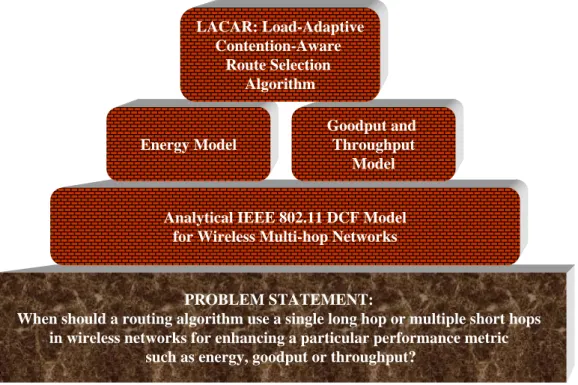
This dissertation, initially inspired by the basic question of how to route in a multi-hop wireless network for enhanced energy/goodput/throughput perfor-mance, makes several contributions to the literature aside from providing an answer to the original starting problem. The main contributions of this disser-tation are illustrated in Fig. 1.3.
Owing to the fact that existing models are inadequate for energy, goodput and throughput performance analysis for IEEE 802.11 DCF based multi-hop networks, an analytical model for IEEE 802.11 DCF is developed in this disser-tation. Hence, the primary contribution of this study is the introduction of an analytical IEEE 802.11 DCF model for multi-hop networks which:
• considers hidden terminals,
• provides fairly accurate results for large range of traffic loads,
PROBLEM STATEMENT:
When should a routing algorithm use a single long hop or multiple short hops in wireless networks for enhancing a particular performance metric
such as energy, goodput or throughput? Analytical IEEE 802.11 DCF Model
for Wireless Multi-hop Networks Energy Model Goodput and Throughput Model LACAR: Load-Adaptive Contention-Aware Route Selection Algorithm
*
Figure 1.3: Main contributions of the dissertation: i) an analytical IEEE 802.11 DCF model, ii) goodput and throughput models, iii) an energy model and iv) a load-adaptive contention-aware route selection algorithm for IEEE 802.11 DCF based multi-hop networks.
• works for any given two-dimensional topology,
• increases the accuracy and scalability of the analytical model by joint use of fixed and variable slots
• allows each node to be both source and/or relay.
The second contribution is an analytical framework for calculation of the average node goodput and the average node throughput for the IEEE 802.11 DCF based multi-hop wireless networks, which considers carrier sensing, hidden terminal effect, non-optimum routing and analyzes the problem for a large range of traffic loads and for different network densities.
The third contribution is an analytical framework for the investigation of the energy-efficiency of routing strategies in IEEE 802.11 DCF based multi-hop wire-less networks. To the best of our knowledge, this is the first study in multi-hop networks that includes the energy consumption due to MAC operations such as collisions, retransmissions, overhearing of nodes, BEB and freezing mechanisms.
Our final contribution is a load-adaptive contention-aware routing strategy for increasing the energy and goodput performance in IEEE 802.11 DCF based multi-hop networks. The results of our research show that traffic load adap-tive cross-layer routing strategy significantly increases the energy and goodput performances of IEEE 802.11 DCF based multi-hop networks.
We demonstrate the effect of routing on the goodput, throughput and energy performance of multi-hop wireless networks. The analytic results obtained via the IEEE 802.11 DCF, the goodput/throughput and energy model, supported by simulations, demonstrate the following main results:
• Throughput is shown to increase for any routing strategy with increased traffic, whereas goodput exhibits a bell-shaped behavior for short hop ing as the traffic increases. The goodput results show that selection of rout-ing strategy based on the traffic load increases goodput significantly. Under light traffic, arrival rate of packets is dominant, making any routing strategy equivalently optimum. Under moderate traffic, concurrent transmissions
dominate and multi-hop transmissions become more advantageous. At
heavy traffic, short hop routing becomes unstable due to increased packet collisions and excessive traffic congestion, and long hop routing becomes more stable and increases goodput. The choice of routing strategy is ob-served to affect goodput more for large and homogeneous networks where it is beneficial to use multiple short hops each covering similar distances. • Energy-efficient routing strategy highly depends on the traffic load: Under
light traffic, energy spent during idle mode is responsible for most of the en-ergy consumed, making any routing strategy equally good. Under moderate traffic, energy spent during idle and receive modes dominates and multi-hop transmissions become more advantageous. At heavy traffic, short multi-hop routing becomes unstable due to increased packet collisions and excessive traffic congestion, and long hop routing becomes more energy-efficient and stable. It is also shown that the processing power at intermediate nodes affects the optimum hop number, but only for a specific range of traffic loads.
• The proposed load-adaptive contention-aware routing algorithm (LACAR), which takes energy expenditure due to MAC contentions into account and dynamically changes the routing strategy according to the network traffic load, increases goodput by at least 18% and saves energy by at least 21% in a relatively less dense wireless network where the traffic load changes with time. The goodput gain increases up to 222% and energy savings
increase up to 68% for a denser network where short hop routing with higher number of hop-counts is possible.
The dissertation begins with a detailed explanation of technical background on multi-hop wireless networks, investigation of performance metrics in wireless networks with emphasis on goodput, throughput and energy, design challenges at layers of protocol stack and cross-layer design. Chapter 3 is devoted to the description of the analytical IEEE 802.11 DCF model for multi-hop wireless net-works. The analytical IEEE 802.11 DCF model, as well as the analytical and simulation results for the model are presented here. Chapter 4 describes the goodput and throughput model for IEEE 802.11 DCF based multi-hop networks and presents corresponding results and conclusions. A theoretical framework to evaluate the energy consumption of IEEE 802.11 DCF based multi-hop networks is introduced in Chapter 5, where the results and conclusions regarding energy are presented. An adaptive routing approach for increasing the energy and good-put performance in IEEE 802.11 DCF based multi-hop networks is presented in Chapter 6, which contains the adaptive routing algorithm and its performance evaluation. This dissertation ends with conclusions and a discussion of future research directions in Chapter 7.
Chapter 2
Goodput, Throughput and
Energy-Efficiency in Multi-Hop
Wireless Networks
During the past decade, wireless services have evolved from basic voice com-munication to broadband multimedia services. However, users demand higher flexibility and higher mobility while requesting services with higher data-rate, lower latency, higher energy-efficiency. The wireless applications and services commercially available around the world today owe their existence to the evolu-tion of the wireless technology advancements, and the technologies not achieved today need more advancements in the quality of service provided by wireless technologies.
Various wireless networking applications have emerged: personal area net-works, distributed control systems and military applications, home netnet-works, and a broad class of ad-hoc and sensor networking applications. The chief utili-ties of wireless networks such as easy deployment and reconfiguration, distributed nature and node redundancy are possible by means of battery powered mobile
devices, which bring together the problem of effective usage of energy resources. Although energy-constraints are not inherent to all wireless networks (for exam-ple, devices may be stationary and attached to a large energy source such as a vehicle), some of the most exciting applications lie in the category where energy-efficiency is an important design issue. Energy management is one of the most important problems in wireless communication and recent studies have addressed this topic [3].
In the next section, we introduce and define two major performance metrics in wireless networks: goodput/throughput and energy consumption. Goodput and throughput issues in multi-hop wireless networks and cross-layering tech-niques for enhancing goodput and throughput performance are examined in the next section. The energy-efficiency at layers of protocol stack is investigated in Sec. 2.2 with a discussion of various cross-layering techniques in increasing energy-efficiency.
2.1
Goodput and Throughput Performance in
Multi-Hop Wireless Networks
Realization of many wireless services depends on delivering information with an acceptable data rate to the users. One factor that limits the data rate in wireless networks is the limited available bandwidth. Federal communications commis-sions in countries regulate which bandwidth particular networks can access with how much maximum power. This limits the amount of bandwidth that can be given to each user of the wireless network.
Providing goodput/throughput adequate for applications becomes compli-cated in wireless networks due to the lack of accurate knowledge of the state of the network, e.g., the quality of the radio links, availability of routers and their
resources [4]. The time varying conditions, error-prone wireless channel are also factors that decrease goodput/throughput in wireless networks. Furthermore, providing an adequate goodput/throughput for applications in a wireless net-work may become impossible when: 1) the size of the netnet-work grows beyond a certain level where network updates cannot be propagated within specific delay bounds, 2) the nodes are too mobile, and 3) when a node loses connectivity with the rest of the network. Thus, goodput/throughput in wireless networks is fundamentally different from traditional networks.
There are several definitions of goodput for different disciplines, that are listed as follows:
• In computer networks, goodput is defined to be the application level throughput, i.e. the number of useful bits per unit of time forwarded by the network from a certain source address to a certain destination, excluding protocol overhead, packet headers and retransmitted data packets.
• In communication systems theory, the typical measure of goodput equals the information transmission rate times the probability of success, assuming that the channel statistics remain unchanged. This calculation of goodput is not any more valid when scheduling decisions on rate and power change over time or when errors appear in an irregular fashion e.g. in bursts [5]. • Goodput may also be defined as the ratio of achieved user data rate over
channel raw data rate [6].
The first definition is more general including the application layer mechanisms. In this dissertation we define goodput to be the network level throughput.
Throughput, on the other hand, is the link layer data rate of successful trans-missions. Goodput is always lower than the throughput, which generally is lower
than throughput are inclusion of the following items in calculation of throughput, which are excluded from goodput calculation:
• Transport layer, network layer and MAC layer protocol overhead due to management packets, control packets and packet headers.
• Retransmission of lost or corrupt packets due to transport layer automatic repeat request (ARQ), network or MAC layer retransmission mechanisms.
Goodput in multi-hop wireless networks is much lower than throughput, com-pared to single-hop networks or wireless local area networks (WLAN), because packets are also dropped at intermediate nodes. For a data packet dropped at some intermediate hop, the successful transmissions of this data packet at prior hops are counted in calculation of throughput, whereas these transmissions are excluded in goodput calculation. Hence, goodput is normally employed to give more accurate performance evaluation than throughput in multi-hop networks.
Both goodput and throughput are vulnerable to variations in channel quality, packet length, lower layer protocol efficiency, network load, inter-frame gaps be-tween packets, packets-per-second ratings of devices that forward packets, hard-ware speeds, network design protocols, network topology, and so forth.
In this dissertation, we are specifically concerned with average node goodput and average node throughput, where average node goodput is defined as the number of data bits per second received successfully by the destination, averaged over all nodes in the wireless network. The average node throughput is defined as the data rate of successful transmissions of a node, including retransmissions due to collisions [7, 8].
2.1.1
Goodput and throughput issues at layers of the
pro-tocol stack
Multi-hop networks are expected to be an important part of future wireless net-work architectures due to their easy deployment, robustness and flexibility. The core idea of multi-hop wireless networks, forwarding of packets over multiple wire-less hops, is a new quality in wirewire-less communications and requires optimization of many research issues in order to meet the high goodput and throughput re-quirements in practical multi-hop wireless deployments. More powerful devices based on multiple radio interfaces that make use of channel diversity, optimized MAC protocols for accessing the multi-hop channel or scheduling links, new rout-ing metrics are needed in order to support necessary improvements. Finally, the cross-layer design is important in order to get better access to the layers in order to enhance goodput and throughput performance. In this section, a review of some technology solutions at the physical, MAC and network layers, together with some cross-layer design examples to improve goodput and throughput per-formance in the literature are provided.
Physical layer
Physical layer has several properties affecting goodput and throughput. The antenna type, the modulation scheme, the rate and complexity of channel cod-ing are physical layer features that impact goodput and throughput directly. Multi-Radio and Multi-Channel (MRMC) is also a means to improve through-put in multi-hop wireless networks. Multi-radio is attractive due to cheap and various hardware devices that can be simultaneously used due to the different sensing range, bandwidth and attenuation characteristics. Interference is re-duced by multi-channel by which non-overlapping channels are used to transmit
or receive simultaneously. This way the use ratio of frequency spectrum is en-hanced by improving the effective bandwidth of the whole network. A centralized static channel assignment in MRMC wireless mesh networks with the objective of maximizing overall end-to-end throughput, which we refer as goodput in this dissertation, is introduced in [9], which assigns the available channels to the bot-tleneck links of multi-hop flows iteratively. Simulation results conducted in ring and grid topologies show that the algorithm is effective in increasing the goodput.
The physical layer properties have also indirect effects on goodput and throughput performance by restraining multiple access and routing decisions through changing the error rate of the channel.
MAC layer
MAC layer is responsible for allocating wireless channels to contending users and scheduling the transmissions among them. It also realizes link error control, by which a destroyed frame on the link is retransmitted. The MAC layer affects goodput and throughput in various ways. The allocation of simultaneous trans-missions affects interference, which in turn affects the error rate of packets, where increased error rate decreases goodput and throughput. Moreover, interference determines the signal to interference and noise ratio that affects the data rate. The link error control scheme at MAC affects the header size, the error rate, the collision probability, number of retransmissions, service time per packet metrics which have a direct effect on goodput and throughput.
Several MAC protocols for increasing goodput or throughput performance are proposed in the literature. A novel high-throughput MAC protocol, called Concurrent Transmission MAC (CTMAC) is presented in [10], which supports concurrent transmissions while allowing the network to have a simple design
with a single channel, single transceiver, and single transmission power archi-tecture. CTMAC inserts additional control gap between the transmission of control packets (RTS/CTS) and data packets (DATA/ACK), which allows a se-ries of RTS/CTS exchanges to take place between the nodes in the vicinity of the transmitting, or receiving node to schedule possible multiple, concurrent data transmissions. To safeguard the concurrent data transmission, collision avoid-ance information is included in the control packets and used by the neighboring nodes to determine to transmit or not. Simulation results show that a significant gain in throughput is obtained by the CTMAC protocol compared to the IEEE 802.11 DCF protocol.
Network layer
Network layer has two main functions: routing and mobility management. Re-garding routing, the network layer determines the path from source to destina-tion, and consequently selects a set of links. Routing protocols play the key role in multi-hop wireless networks since they control the formation, configuration and maintenance of the topology of the network. Routing protocols proposed for optimization of throughput have to consider other metrics depending on the application, mobility, energy, radio characteristics of nodes. For example a rout-ing protocol proposed for optimization of goodput and throughput in an ad-hoc multi-hop wireless network has to consider energy-efficiency and mobility at the same time, whereas a routing protocol in a MRMC wireless mesh network should also select proper channel and radio, so that it can sufficiently make use of the advantage of MRMC.
Certain nodes that are located at critical positions in the multi-hop wireless network form network bottlenecks and are likely to get heavily loaded. Therefore, load balancing is an essential ingredient in improving the achievable throughput and goodput. Load balancing assumes to achieve the efficient traffic allocation,
efficient use of links, maximal use of network capacity, minimal resource con-sumption at the bottleneck nodes. In [11], it is shown that load balanced routing improves performance regardless of the nature of the underlying MAC protocol compared to conventional shortest widest path routing. And also, it is shown that an ideal load balanced routing protocol should take into account both the hop counts and the capacities when computing the optimal path.
2.1.2
Cross-layer design
The design of the OSI protocol stack where each layer operates independently results in poor performance for wireless networks, especially when energy is a constraint, leading to a necessity for a cross-layer design [12–42]. A cross-layer design requires the protocols of each layer to be developed within an integrated and hierarchical framework considering the interdependencies among them. On the other hand, a cross-layer design needs to be modified at all layers of the stack in case of an update and this might produce unintended interactions among layers, adaptation loops and performance degradation resulting in spaghetti-like codes if not maintained efficiently [18]. Furthermore, an efficient, flexible and comprehensive cross-layer signalling scheme is required [19]. The information that can be used in a cross-layer architecture and the layer to get it from are listed in Table 2.1. Some representative properties of each layer have the potential of affecting all the higher layers.
Different approaches for cross-layer design for optimization of throughput are reviewed in [43–45]. A technique to increase the throughput of wireless mesh net-works, based on cooperative communications is introduced in [46], where two co-operative strategies, opportunistic relaying, and partial decoding, are proposed. Simulation results for Rayleigh and Rice fading show remarkable throughput gains of the cooperative strategies with respect to non-cooperative transmission.
Table 2.1: Some representative information that can be exchanged in a cross-layer architecture and where the information is available.
Layer Information
Topology control algorithms
Application Traffic requirements
Logical topology Congestion window
Transport Timeout clock
End-to-end packet loss rate End-to-end delay
Network lifetime
Network Physical topology
Connectivity Link bandwidth Link quality
Data Link/MAC Mac packet delay
Data rate Power control Scheduling policy Node location Movement pattern
Physical Transmit power (radio transmission range)
Antenna type (multiple antennas etc.) (Residual) battery power
In [47], the authors have proposed a LEss remaining hop More Opportunity (LEMO) algorithm for multi-hop networks in order to achieve higher packet
delivery ratio, which is a cross-layer MAC and routing algorithm. Through
simulations, the performance of proposed LEMO algorithm is evaluated and compared with the legacy IEEE 802.11 DCF. Results show that the total packet delivery ratio is increased, which means that the throughput discrepancy among flows is reduced while the total flow throughput is enhanced.
IEEE802.11e is proposed and Additive Increase Multiplicative Decrease (AIMD) mechanism is combined to analyze the quality of service in cross layer in [48]. The combined technique enhanced the throughput by 30 − 40%. IEEE802.11e MAC employs a channel access function called hybrid coordination function. Their results showed that the interaction between transportation and MAC protocol has a significant impact on the achievable throughput in wireless networks.
2.2
Energy Performance in Multi-Hop Wireless
Networks
Another performance goal in wireless networks, as important as providing good-put/thorughput, is energy-efficiency, because realization of many wireless ser-vices depends on battery powered deser-vices. The relative importance of energy and goodput/throuput depends on the application. For example, the primi-tive design constraint for a wireless sensor network used for remote environment monitoring may be energy-efficiency, whereas it is goodput for a wireless mesh network set for a dublex video-conferencing application.
Wireless medium is accessed often by portable, lightweight devices that are supplied by a local battery. This limits the amount of energy available to each
user, requiring energy-efficient protocols in order to maximize node lifetime. It is foreseen that wireless interface will be the primary consumer of energy and energy-efficiency is expected to become the single most important figure of merit in 10 to 20 years time in ad-hoc networks [49].
Energy-efficiency in wireless networks can be defined as effective usage of power resources of nodes in the wireless network so that one of the following objective functions is satisfied:
1. Maximization of the network lifetime
2. Maximization of the lifetime of each individual node 3. Minimization of energy per bit delivered.
The first objective function aims prolonging the network lifetime. In [50], [51] network lifetime is defined as the time of the first node failure due to battery depletion since a single node failure can make the network become partitioned and further services be interrupted. The second objective function aims pro-longing individual node lifetimes. This is achieved by various techniques in the literature: i) maximizing the fraction of surviving nodes in a network [52, 53], ii) maximizing the mean expiration time [54], and iii) maximizing the minimum residual battery energy among nodes [55].
The third objective function for achieving energy-efficiency is minimizing energy per bit (EPB) which is defined as the energy consumed for communi-cating one bit of information per flow. EPB includes the energy consumed at all layers of the protocol stack. The energy consumption is shaped by various modulation techniques, synchronization, header overhead, energy and time ratio of transmission-reception and standby modes, MAC techniques, retransmission strategies, routing, etc.
The first two objective functions regarding lifetime consider residual battery energies of nodes, whereas the last ignores it. The objective function that achieves the most energy-efficient operation is network and application dependent. For example, maximizing the lifetime of a wireless sensor network is generally a more crucial objective in terms of energy-efficiency compared to maximizing the lifetime of individual nodes, since connectivity of the network, compared to indi-vidual nodes, is more important for sustaining operability of the sensor network. On the other hand, in an office network, maximizing the lifetime of each in-dividual node may gain importance since none of the clients may tolerate an unfair energy outage in the middle of a meeting. Furthermore, in an wireless network where throughput is of primary interest, such as data networks, EP B may become more important than the lifetimes of the network or nodes.
2.2.1
Energy-efficiency at layers of the protocol stack
Studies show that the significant consumers of power in typical laptop are the microprocessor (CPU), liquid crystal display (LCD), hard disk, system memory (DRAM), keyboard/mouse, CDROM drive, floppy drive, I/O subsystem, and the wireless network interface card [56, 57]. A typical example from a Toshiba 410 CDT mobile computer demonstrates that nearly 36% of power consumed is by the display, 21% by the CPU/memory, 18% by the wireless interface, and 18% by the hard drive. Consequently, energy conservation has been largely considered in the hardware design of the mobile terminal and in components such as CPU, disks, displays, etc. [58]. Significant additional power savings may result by in-corporating low-power strategies into the design of network protocols used for data communication. Moreover, communication units of a large group of wireless networking applications are simple devices without a display and limited process-ing capabilities, where the power consumed by the wireless interface constitutes a larger fraction of the total power consumption than mentioned above.
Furthermore, authors in [59] showed that accessing local hard drives con-sumes significant power compared to reception of wireless data and thus, periodic broadcast of data over wireless communication channels can be considered as a supplement to a mobile user’s secondary storage. Hence, considerable reduction in the wireless interface power consumption may provide a reduction in memory power consumption if such a method is used for storage.
Although a wireless interface is composed of the data link and the physical layers, energy saving at a wireless interface is not restricted by these layers. Any energy-efficient network or application layer operation reduce power consumption at the wireless interface.
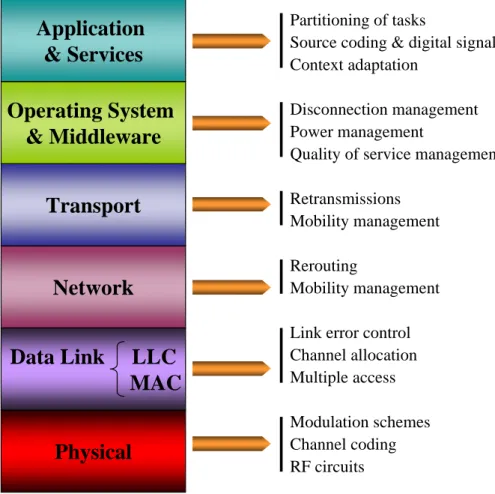
Recent advances in wireless network protocols, the technical challenges to be considered within all layers of the protocol stack for energy-constrained wireless networks and possible approaches for solving them are investigated in [12], [13]. The areas of research for energy-efficient design and the corresponding protocol layers are summarized in Figure 2.1.
Physical layer
Physical layer has several properties affecting energy expenditure. The RF cir-cuit features such as the power required to drive the RF modules, transmit power, transceiver complexity, antenna type and antenna beam coefficients ac-cumulatively impact power consumption in transmit, receive and idle modes of operation. The modulation scheme, the rate and complexity of channel coding are additional physical layer features that impact energy consumption directly. These physical layer properties have also indirect effects on energy- efficiency, by restraining multiple access and routing decisions through changing the error rate of the channel.
Physical
Data Link LLC
MAC
Network
Transport
Operating System
& Middleware
Application
& Services
Partitioning of tasksSource coding & digital signal processing Context adaptation
Disconnection management Power management
Quality of service management Retransmissions
Mobility management Rerouting
Mobility management Link error control Channel allocation Multiple access Modulation schemes Channel coding RF circuits
Figure 2.1: Protocol stack of a generic wireless network, and corresponding areas of energy efficient research.
MAC layer
The MAC layer affects energy expenditure in three ways: 1) The allocation of simultaneous transmissions imposes interference that impacts physical layer per-formance in terms of distinguishing the desired signal from the rest. Briefly, the MAC layer mainly controls interference that may lead to excessive energy consumption for transmit power adaptation at the transmitter or link retransmis-sions. 2) Depending on the scheduling scheme, nodes may switch to power-saving modes of operation. 3) The link error control scheme affects the energy consump-tion per packet. Ineffective maintenance of point-to-point retransmissions at the link layer may initiate end-to-end retransmissions at the transport layer, resulting in excessive energy consumption. Conversely, a strict link error control scheme
that results in frequent link layer retransmissions may also introduce additional power expenditure.
Network layer
Several power-aware routing protocols can be summarized as follows:
1. Minimum total transmission power routing (MTPR) selects the route with minimum sum of link transmission powers. Therefore, the route with more shorter hops and greater end-to-end delay is selected, where load balancing and fairness in energy-consumption are not supplied [14], [15].
2. Minimum battery cost routing (MBCR) selects the route with the maxi-mum sum of residual battery powers. Hence, load balancing is considered and the lifetime of each node together with that of the network is extended. However, routes with nodes that have little energy may still be selected [15]. 3. Min-max battery cost routing (MMBCR) selects the route with the max-imum value of minmax-imum residual battery energies of all possible routing paths. Each node’s lifetime is maximized by this protocol and fairness in the way nodes are used is satisfied. But since, minimum transmission power paths are not necessarily chosen, the lifetime of all nodes may actu-ally reduce [15].
4. Conditional max-min battery capacity routing (CMMBCR) uses the most energy-efficient routes while all modes have residual battery capacity above a threshold. Once nodes’ energies fall below this threshold, routes with the lowest battery capacity are avoided. This routing protocol represents a compromise between MTPR and MMBCR [16].
maxi-the maximum transmission distance, maxi-the more fully connected maxi-the network graph will be. For a given network topology, shortest path routing selects the minimum-energy path. The maximum distance constraint enables a trade-off between transmission energy and overall (source to destination) delay. Potential application of CSPR may be within clusters of target-tracking sensor networks [17].
Different routing strategies select different sets of links that result in different sets of concurrent transmitting links, influencing the MAC layer. For instance, spatially close routes increase interference and make it harder for MAC to re-solve the transmission conflicts. However, none of the above mentioned routing algorithms consider increases in transmission power or degradation in link qual-ity due to these concurrent transmissions, which can only be neglected when all simultaneous links use orthogonal channels without spatial reuse.
Mobility management is another responsibility of the network layer that
affects energy-efficiency. The mobility pattern, the frequency of node
addi-tions/failures and link quality variations impact the amount of control traffic, which is another source of energy dissipation. Transport layer is responsible of end-to-end transmissions and becomes crucial for wireless networks due to er-ror prone nature of the wireless channel. Congestion control mechanisms and retransmissions at this layer may result in energy waste.
2.2.2
Cross-layer design
Energy-efficiency is enhanced by cross-layer designs, some of which are summa-rized in this section with some examples.
Transmit power plays a key role in the development of energy-efficient cross-layer protocols. Wireless terminals capable of varying the transmit power acquire
different radio transmission ranges through power control. The level of transmit power affects all of the upper layer protocols, due to its effect on local neigh-borhood. Increasing radio transmission range may result in larger number of nodes in the neighborhood, affecting link quality, bandwidth, packet delay and scheduling [20–22] at the MAC layer; routing decisions at the network layer; re-transmissions and congestion control mechanisms at the transport layer; logical topology (the users included in the network) and the type of applications at the application layer.
Signal to interference and noise ratio (SINR) determines the performance of the link. In case of a low SINR, power is consumed more either due to increased transmit power or increased number of retransmissions. Also a low SINR may require a reduction in data rate, affecting MAC layer properties such as packet delay and scheduling policies. An example for such cross-layering is given in [23], where SINR information is attached to RREQ packets and PREP packets prop-agate with rate adaptation at each hop providing the selection of the route with minimum MAC delay. A somewhat similar cross-layering is introduced in [24], where the network layer may discard packets in advance based on the chan-nel conditions and link delay information passed from the MAC layer, together with traffic requirements information passed from the application layer. Another cross-layering method that passes the channel conditions and MAC delay in-formation, but this time to the MAC layer scheduler, is proposed in [25]. The scheduler places the packet into the queue according to its estimated delay, where it may place a packet at the end of the queue if its corresponding channel is cor-rupted. Particular to CDMA channels, channel condition information can be used to change the spreading factor to adapt rate [26].
SINR information may also affect power control decisions at the MAC layer that constitutes the basics of the MAC protocol introduced in [27] where a frame format for slotted RTS/CTS structure for CSMA/CA is introduced. The SINR
of the slotted and successive RTS/CTS packets is measured and power control is done accordingly.
Monitoring the interference level and delaying packet transmissions [28], or marking packets indicating wireless channel related losses rather than congestion losses in order to reduce congestion window reductions [29], are methods for saving energy using SINR information.
Mobility pattern is another physical layer property of wireless networks that impacts all layers of the protocol stack. The frequency of link quality changes, node additions and failures depend on the movement pattern and affect power consumption due to additional amount of control packet flows that provide route updates, retransmissions and topology reconfigurations. Moreover, highly mobile systems impact connectivity of the network, requiring an increase in the transmit power [12], that increases power consumption.
Channel coding, multiple antenna techniques are shown to save transmission power. However, they are often highly complex and therefore require significant power for signal processing. This trade-off requires examination to determine if multiple antenna techniques and channel coding result in a net savings in energy [12].
Routing is shown to play a dominant role in reducing power consumption [21]. Cross-layer design of many energy-efficient routing protocols makes use of var-ious physical layer information. A transmit power aware routing protocol that uses transmit power as a metric for shortest path routing to increase node and network lifetime is proposed in [30]. Since this cross-layer routing strategy leads to utilization of the same paths leading to battery depletions, battery power-aware strategy is introduced in conjunction with transmit power and lifetime is shown to increase by 45% in [31]. A cross-layer design for enhancing power-based routing protocols is proposed, where MAC layer information such as the number