Contents lists available atScienceDirect
Performance Evaluation
journal homepage:www.elsevier.com/locate/peva
Dimensioning shared-per-node recirculating fiber delay line
buffers in an optical packet switch
Nail Akar
a,∗,
Yavuz Gunalay
baElectrical and Electronics Engineering Department, Bilkent University, Bilkent 06800, Ankara, Turkey bFaculty of Economic and Administrative Sciences, Bahcesehir University, Besiktas 34353, Istanbul, Turkey
a r t i c l e i n f o
Article history:
Received 16 July 2012
Received in revised form 3 July 2013 Accepted 20 September 2013 Available online 1 October 2013
Keywords:
Optical packet switching Optical burst switching
Markov modulated Poisson process Overflow models
Fiber delay lines
a b s t r a c t
Optical buffering based on fiber delay lines (FDLs) has been proposed as a means for con-tention resolution in an optical packet switch. In this article, we propose a queuing model for feedback-type shared-per-node recirculating FDL optical buffers in asynchronous opti-cal switching nodes. In this model, optiopti-cal packets are allowed to recirculate over FDLs as long as the total number of recirculations is less than a pre-determined limit to meet sig-nal loss requirements. Markov Modulated Poisson Process (MMPP)-based overflow traffic models and fixed-point iterations are employed to provide an approximate analysis pro-cedure to obtain blocking probabilities as a function of various buffer parameters in the system when the packet arrival process at the optical switch is Poisson. The proposed al-gorithm is numerically efficient and accurate especially in a certain regime identified with relatively long and variably-sized FDLs, making it possible to dimension optical buffers in next-generation optical packet switching systems.
© 2013 Elsevier B.V. All rights reserved.
1. Introduction
One of the candidate transport mechanisms for next-generation Internet is based on the optical packet switching paradigm that promises to provide efficient utilization of very high fiber capacities offered by WDM technologies by means of switching at finer granularities. This is in contrast with the current state-of-the-art optical circuit switching paradigm that provides point-to-point connectivity where bandwidth sharing at sub-wavelength levels is costly. The literature in this field comprises two key packet switching-based paradigms: Optical Packet Switching (OPS) and Optical Burst Switching (OBS) [1–4]. OBS does not rely on optical header processing or optical buffers as in OPS but it is possible to deploy optical buffers at OBS nodes to enhance burst blocking performance. Optical packets have fixed or variable sizes that are integer multiples of a time unit, called slot, in synchronous switching [5]. On the other hand, optical packets in asynchronous switching systems are of variable length and therefore packet arrivals need not be aligned. Using a retrial-queuing framework, we analytically study the performance of an asynchronous OPR (Optical Packet Router), referring to an asynchronous OPS or OBS node, that uses FDLs (Fiber Delay Lines) for optical buffering.
Contention is said to occur when there are multiple optical packets on the same wavelength that are simultaneously destined to the same output link. When the incoming packet’s wavelength is busy at the destination link, then wavelength conversion can be used [6]. If all wavelengths are busy, then optical buffering is one of the alternative means to resolve contention [3,7]. Due to the lack of optical random access memory with current technologies, FDLs are often used for optical buffering where an optical packet finding all wavelengths occupied at the destination link is instead sent over a coil of fiber
∗Corresponding author. Tel.: +90 312 2902337; fax: +90 312 2664192.
E-mail addresses:[email protected](N. Akar),[email protected](Y. Gunalay). 0166-5316/$ – see front matter©2013 Elsevier B.V. All rights reserved.
that provides the packet with a deterministic delay with the potential of resolving contention at a later time. For different architectures proposed for FDL buffering, we refer the reader to [3,8,9]. Optical buffers can be single-stage or multi-stage, the latter having multiple blocks of delay lines cascaded together [10]. In a feed-forward architecture, an output port of a switching element at a given stage is connected by an FDL to an input port of a switching element at the next stage. In a feedback architecture, the output port of a switching element at a given stage is connected to an input port of a switching element at the same stage [10]. A packet that is sent over an FDL reserves the output in two different ways [4,11]:
•
If the output link is reserved prior to entering the buffer, this architecture is called Pre-Reservation (PreRes).•
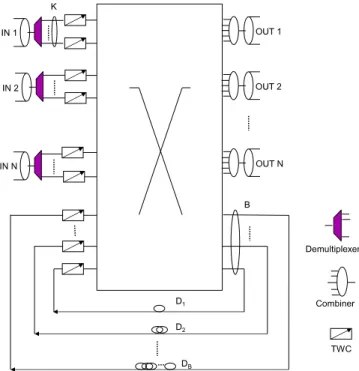
In the Post-Reservation (PostRes) scheme, the packet attempts to reserve the output link once it is about to leave the FDL. With PreRes reservation mechanism, a packet leaving the FDL buffer is guaranteed to find an idle wavelength on the desti-nation link whereas in the PostRes scheme, a packet may still find all wavelengths busy at its destidesti-nation link at the epoch of exit from the FDL. When such a situation arises, this packet will go through multiple but limited number of FDL circulations. The advantage of PostRes buffers is the reduction in state that is maintained at the node since the switch controller only needs to keep track of whether each wavelength channel is busy or idle at a given time for PostRes. In contrast, the Pre-Res reservation mechanism requires the switch controller to keep track of future channel occupancy information. PrePre-Res schemes are generally known to be more efficient in terms of performance since packets would not waste FDL resources in PreRes if they would get blocked eventually. FDL buffers can be shared for all wavelength channels on a given link in which case we have shared-per-link buffering. On the other hand, if FDLs are shared for all wavelength channels for a given node, then we have the so-called shared-per-node FDL buffering in which case we have performance benefits due to economy of sharing.The scope of this article is on shared-per-node feedback-type recirculating FDL buffers using the PostRes reservation model due to its relative implementation simplicity. For this purpose, we consider the OPR architecture inFig. 1with N input and output links (or fibers) where each link comprises K wavelength channels. This architecture is based on the tune-and-select (TAS) architecture with shared FDL buffers and full range tuneable wavelength converters (TWCs) described in [12]. We assume a shared pool of B FDLs which can all be of the same length or variable-length delay lines can be used. To accommodate both cases, we introduce an FDL spreading parameter
α,
0≤
α <
1, and a delay parameter D>
0. In our model, the ith delay line introduces a delay ofDi
=
D(
1−
α) + (
i−
1)
2D
α
B
−
1,
i=
1,
2, . . . ,
B,
if B>
1.
(1)In case B
=
1, we have a single FDL with delay D. Based on the definition above, the minimum (maximum) length delay line provides a delay of Dmin=
D1=
D(
1−
α)
(Dmax=
DB=
D(
1+
α)
) and the average delay of the delay lines is exactly D.Moreover, all the other delay lines are uniformly placed in between the minimum and maximum delay line lengths. When
α =
0, all delay lines are of the same length, i.e., of length D. On the other hand, whenα →
1, the delay line lengths tend to range between 0 and 2D. The spreading parameterα
can therefore be used to study the impact of fixed- or variable-length delay lines. The input signals inFig. 1are first wavelength de-multiplexed and the optical packets are converted to the desired output wavelength using the TWCs in the tune stage. Subsequently, each signal is split up to be sent to all output fibers and FDLs, but only one will be selected by switching on the corresponding semiconductor optical amplifier (SOA) in the select stage. Finally, all selected signals destined to the same fiber are combined. This architecture can be modified for the special caseα =
0 for which we can use B/
W physical FDLs where each FDL accommodates W>
1 parallel WDM channels as in [12,13], as opposed to using B separate physical FDLs. This modification can also be extended for the generalα ̸=
0 case by noting recent FDL buffering technologies that promise to achieve different time delays for different wavelength channels on the same physical FDL [14].We assume an exponentially distributed packet duration with mean set to unity which is equivalent to saying that the time unit we use is the time it takes to transmit a packet with average size. We also assume a symmetric Poisson packet arrival process with intensity
λ
(0)for each destination link. Thus, the total arrival rate to the switch is Nλ
(0). The systemload is denoted by
ρ = λ
(0)/
K . The assumptions of Poisson call arrivals and exponentially distributed call-holding timeshave been successfully used for circuit-switched networks handling call-oriented traffic. Although it is not clear at this point what type of traffic models to be appropriate for use in next-generation OPS networks, we still employ in the current article the same tele-traffic models from the circuit switching literature for gaining insight into the operation of optical buffers.
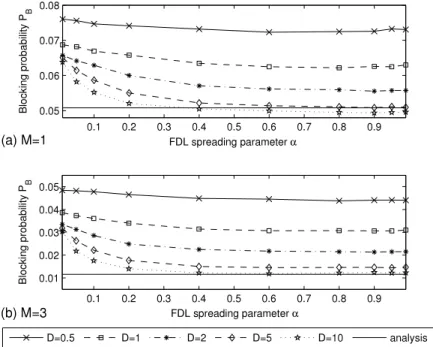
An arriving (fresh) optical packet which finds all K wavelength channels occupied at its destination link is forwarded to the FDL pool comprising B delay lines. Otherwise, it is transmitted on one of the idle wavelength channels randomly. For a packet directed to the FDL buffer, if all FDLs are busy at their entrance points, then this packet is dropped. Otherwise, the packet is transmitted on one of the FDLs that is idle at its entrance point. Motivated by the PostRes model, the FDL selection process is all random. Once the packet completes its journey on the FDL, it becomes a retrial packet as opposed to a fresh packet. A retrial packet again checks if one of the K wavelength channels at its destination link is idle and if so it is randomly transmitted on one of them. If none of the channels is available and the total FDL circulation count of this packet at this switch is less than M, then this packet is forwarded to one of the B FDLs again randomly, upon availability. Otherwise, the retrial packet gets dropped. Based on the PostRes reservation model, the switch controller only needs to keep track of the binary information on whether each wavelength channel and each FDL is idle (at its entrance point) or not. Moreover, we note that void-filling-based channel scheduling is not supported with PostRes.
Fig. 1. An optical packet router with N input and output fibers (links) using B shared-per-node feedback-type recirculating FDLs.
Our goal is to build a stochastic model that accurately captures the behavior of shared-per-node feedback-type FDL optical buffers using the PostRes reservation scheme. Most of the existing work capitalizes on shared-per-link buffers with K
=
1 wavelength channel using the PreRes reservation model. An approximate method is proposed in [15] for this particular case which employs an iterative procedure which is simple to implement for Poisson arrivals and exponential packet lengths whereas Ref. [16] relaxes the assumptions on inter-arrival and service times of [15]. Again, for the same model, closed-form expressions for loss probabilities and expected delays are obtained in [17] for certain sub-cases whereas an exact analysis procedure for the general case of Markovian arrivals has been recently proposed in [18] using the theory of feedback fluid queues. For general N and K , and for PreRes shared buffering, an approximate model is proposed in [10]. For K=
1 but feedback-type shared-per-link FDLs, a queuing model is presented in [19] for the case of limited number of recirculations. A retrial-queuing model for the case K>
1 and for feedback-type shared-per-link FDLs is proposed in [20] but with probabilistic circulations. However, to meet signal loss requirements, a limit is generally imposed on the maximum allowable number of FDL circulations [19]. In [21], a renewal model has been proposed for analyzing OPRs with shared-per-node PreRes FDL buffers. However, variable-length FDLs and recirculations are not employed in this work. This method is then used in [22] to derive the end-to-end burst blocking probability in a network of OPRs using a two-moment-based approximative scheme. On the other hand, we use Markov Modulated Poisson Process (MMPP)-based traffic models based on [23] (also used in [20]) for overflow traffic modeling that allows one to match three moments in addition to the DC value of the power spectrum of the overflow traffic. In the current article, we extend the work in [20] in three directions:•
A more efficient FDL sharing scheme, namely shared-per-node FDL buffering, as opposed to shared-per-link FDL buffering, is employed in the current study.•
In the current study, an optical packet can travel over an FDL at most M≥
1 times as opposed to the less realistic probabilistic recirculation scheme of [20].•
We allow varying FDL lengths using the spreading parameterα >
0 as opposed to fixed-length FDLs proposed in [20], which will be shown later to have significant benefits in terms of blocking performance and amenability to analysis. The motivation behind the introduction of a queuing model for FDL buffers is the need to assess if optical packet-switched networks can be operated at reasonably high levels of utilization using feedback-type recirculating FDLs. By simulations, we specify a range of D andα
values for which the system performance is relatively improved and also our proposed queuing model works acceptably well. Although the queuing model does not take into consideration the particular values of D andα
, it is capable of studying the impact of other FDL parameters on blocking performance such as the FDL buffer size B, recirculation count M, number of wavelength channels K , and number of fibers N. FDLs need to be as short as possible since they increase the delays in the network and the physical size of the buffer. However, statistical multiplexing gains will be reduced with shorter FDLs since then a retrying packet will more likely see an all-occupied system again. Moreover, increased number of FDLs used in the system lead to increased hardware complexity and it is also important to minimize this number without sacrificing from performance. Recirculations are also intuitively useful since they allow multiple opportunities for reserving a channel at the destination link. However, recirculations introduce signal losses and additional delays and theyshould be kept at a minimum. Simulations always provide an answer but using simulations for dimensioning purposes especially in a regime of low loss probabilities is a tedious task. The retrial-queuing model we introduce in this article can help fill this gap so as to be used for engineering and dimensioning purposes in the context of shared-per-node feedback-type recirculating FDL buffers.
The remainder of this article is organized as follows. In Section2, we present an overview of the MMPP and two-state MMPP construction that is crucial for the development of the article. Section3presents the queuing model we propose for feedback-type FDL buffers. In Section4, we provide numerical examples for validating the accuracy of this approach as well as the use of these models for engineering and dimensioning purposes. Finally, we conclude.
2. Markov modulated Poisson process
The following is based on [24]. An MMPP is a point process whose intensity depends on the state of a background process that is an irreducible finite-state continuous-time Markov chain. Let us assume m
>
0 states for the background process. The MMPP is characterized by the infinitesimal generator Q of the underlying Markov chain and byΛ, an m×
m diagonal matrixwith diagonal elements
λ
1, λ
2, . . . , λ
m, i.e.,Λ=
diag(λ
1, λ
2, . . . , λ
m)
. In this case, we simply say the MMPP is characterizedwith the matrix pair
(
Q,
Λ)
. The operation of the MMPP is as follows. When the background process is in state i, the MMPP is said to be in phase i and arrivals occur according to a Poisson process with rateλ
i. Letπ
be the steady-state vector of Q ,i.e.,
π
Q=
0, π
e=
1, where e is a column vector of ones of appropriate size. The rth non-central moment of the arrival rate of the MMPP characterized with the pair(
Q,
Λ)
is denoted byµ
rand is given in [24] asµ
r=
π
Λre,
r≥
1.As opposed to renewal processes, successive inter-arrival times are correlated for MMPPs. This feature of MMPP as well as its amenability to analysis has attracted researchers in the field of telecommunication network traffic modeling. As one of the classical examples, a superposition of packetized voice sources with silence detection is modeled as a two-state MMPP so as to analytically study the performance of a voice multiplexer [25]. The Ref. [26] proposes an MMPP-based model that mimics the real hierarchical behavior of the packet generation process by Internet users. An MMPP model is provided for multimedia traffic in [27]. An Interrupted Poisson Process (IPP) is a two-state MMPP for which one of the two Poisson intensities is zero which amounts to interrupting the arrival process in that particular state of the background process. The most relevant application example to this article is the use of MMPPs and in particular IPPs, in modeling overflow traffic in circuit-switched networks [28,23].
In most cases, using MMPPs with large state-spaces is either computationally infeasible or impractical. Most of the existing research concentrates on two-state MMPP modeling due to its versatility [25]. In this article, we employ a technique from Heffes [29] that approximates a multi-state MMPP with one with two states. The approach of [29] matches the first three non-central moments of the instantaneous arrival rate of the MMPP and in addition an appropriately defined time constant for the process, which is defined in terms of the integral of the covariance function of the instantaneous arrival rate of the MMPP. Note that the above-mentioned integral amounts to the DC value of the associated power spectrum which is very critical as far as queuing performance is concerned [30]. Let the original multi-state MMPP be characterized with the matrix pair
(
Q(m),
Λ(m))
with m>
2 states. Let the two-state approximative MMPP be characterized with the pair(
Q(2),
Λ(2))
. Also let Q(2)=
−
σ
1σ
1σ
2−
σ
2
,
Λ(2)=
λ
1 0 0λ
2
.
Let
π
(m) denote the stationary vector of the modulating Markov chain of the original MMPP(
Q(m),
Λ(m))
such thatπ
(m)Q(m)=
0 andπ
(m)e=
1. Also letµ
r denote the rth non-central moment of the arrival rate of the MMPP
(
Q(m),
Λ(m))
and
v
denote its variance that is given byv = µ
2−
µ
21. The time constantτ
cof the original MMPP is expressed asτ
c=
1v
∞ 0 r(
t)
dt,
(2)where r
(
t)
is the covariance function of the arrival rate. Ref. [23] provides an expression forτ
cthat is easy to obtain:τ
c=
1
v
[
π
(m)Λ(m)(
eπ
(m)−
Q(m))
−1Λ(m)e
−
µ
2 1]
.
Heffes [29] proposes to choose the parameters of the approximating two-state MMPP as follows:
σ
1=
1τ
c(
1+
η)
,
σ
2=
η
τ
c(
1+
η)
,
λ
1=
µ
1+
v/η,
λ
2=
µ
1−
√
vη,
whereδ =
µ
3−
3µ
1v − µ
31v
3/2,
η =
1+
δ
2(δ −
4+
δ
2).
The above choices are shown in [29] to match the first three non-central moments as well as the time constant defined in
pair
(
Q(2),
Λ(2))
using Heffes’ method or mathematically,(
Q(2),
Λ(2)) =
fH(
Q(m),
Λ(m))
where the function fH representsHeffes’ method.
The superposition of independent MMPPs is also an MMPP. Consider the superposition of n not-necessarily identical two-state MMPPs. The state-space, in lexicographic order, can be described by Kronecker calculus [31]. Given A
= {
Aij}
, ap
×
p matrix, and a q×
q matrix B, the Kronecker product of the matrices A and B is denoted by A⊗
B and is given as a matrixwith block elements
{
AijB}
. Therefore, the size of the square matrix A⊗
B is pq. The Kronecker sum of the matrices A andB is denoted by A
⊕
B and is given by A⊗
Iq+
Ip⊗
B, where Ikdenotes an identity matrix with size k. With this notation,the superposition of n independent two-state MMPPs characterized with
(
Qi,
Λi),
1≤
i≤
n, can be represented by thesuperposition MMPP
(
Q,
Λ)
[23] whereQ
=
Q1⊕
Q2⊕ · · · ⊕
Qn=
Q1⊗
I2⊗ · · · ⊗
I2+
I2⊗
Q2⊗
I2⊗ · · · ⊗
I2+ · · · +
I2⊗
I2⊗ · · · ⊗
I2⊗
Qn Λ=
Λ1⊕
Λ1⊕ · · · ⊕
Λn.
The superposition can be handled only with n
+
1 states instead of 2nstates when the individual two-state MMPPs areidentically distributed. In this case, we have
Qi
=
−
σ
1σ
1σ
2−
σ
2
,
Λi=
λ
1 0 0λ
2
,
1≤
i≤
n,
and the superposition MMPP can be represented by
(
Q,
Λ)
whereQ
=
−
nσ
1 nσ
1σ
2−
(σ
2+
(
n−
1)σ
1)
...
...
... σ
1 nσ
2−
nσ
2
,
Λ=
nλ
1(
n−
1)λ
1+
λ
2...
nλ
2
,
since in this case, the state i
,
0≤
i≤
n, keeps track of the number of individual MMPPs which are in their first state and wedo not have to keep track of the states of individual MMPPs.
3. Analytical model
Since there is symmetry among the output links, we concentrate on one single tagged output link that comprises K wavelength channels. This tagged link is associated with the so-called fiber process
{
X(
t) :
t≥
0,
0≤
X(
t) ≤
K}
which keeps track of the number of busy wavelength channels on the tagged link at time t. Recall that the fresh traffic destined to the tagged link is Poisson with intensityλ
(0). Let the retrial process{
Yi
(
t) :
t≥
0,
1≤
i≤
M}
denote the arrivalprocess to the tagged link stemming from optical packets that have already traversed FDLs i times. Note that
{
Yi(
t)}
is acount process that counts up each time a packet (destined for the tagged link) leaves the FDL buffer and this amounts to the ith circulation of the packet over the FDLs. Equivalently, the retrial process
{
Yi(
t)}
has overflown from the tagged link i times and the packet has found an idle FDL at the epoch of overflows. Provided that FDL delays are sufficiently long, i.e., D≫
1, and the spreading parameterα
is relatively large, i.e.,α ≫
0, we conjecture that the retrial process{
Yi(
t)}
can wellbe approximated with a Poisson process with intensity
λ
(i),
1≤
i≤
M. In this operating regime, i.e., D≫
1, α ≫
0, theprocesses
{
(
Y1(
t), . . . ,
YM(
t),
X(
t))}
are also approximated as independent processes. We note that the analytical modelwe propose is based on these two approximations which are valid in the above-mentioned operating regime and therefore does not take into consideration the particular choices of the parameters D and
α
. We will later show the validity of these approximations by simulations in Section4.Furthermore, we define the overflow process
{
Zj(
t) :
t≥
0,
1≤
j≤
M}
that represents the overflow process of thetagged link corresponding to packets that have overflown from the tagged link j times and are in the process of searching for an idle FDL. Obviously, when B
→ ∞
, for 1≤
j≤
M, {
Zj(
t)}
and{
Yj(
t)}
correspond to the same count process since inthis case an overflown packet will always get to find an idle FDL. We do not know
λ
(i),
1≤
i≤
M, yet but we will attemptto find them using an iterative procedure as described below.
Let us assume the quantities
λ
(i),
1≤
i≤
M, are now available. Then the process{
X(
t)}
is a birth–death process with constant birth rateλ =
Mi=0λ
(i)and death rate k when X(
t) =
k,
1≤
k≤
K . Let P denote the generator of this process.Let x denote the stationary vector of P such that xP
=
0,
xe=
1, and partition x=
(
x0,
x1, . . . ,
xK)
. As shown in the classicalcircuit switching literature [23], the overflow process
{
Zj(
t)}
is not Poisson since the inter-event times associated with theprocess
{
Zj(
t)}
are highly correlated due to the way overflows occur. Therefore, there is a need for more elaborate modelingof the overflow traffic taking into consideration such correlation effects. Actually,
{
Zj(
t)}
can exactly be modeled througha
(
K+
1)
-state MMPP characterized with the matrix pair(
P,
Λj),
1≤
j≤
M, whereΛjis an all-zeros matrix exceptfor its single south-east corner entry set to
λ
(j−1). To cope with the state-space explosion problem, we use Heffes’ methoddescribed in the previous section to reduce the
(
K+
1)
-state MMPP to a two-state MMPP. With this method in place, we suggest that the process{
Zj(
t)},
0≤
j≤
M, is to be approximated by a two-state MMPP characterized with the pair(
Pj,
Cj)
defined through
(
Pj,
Cj) =
fH(
P,
Λj)
for 1≤
j≤
M. Let us then write Pj=
−
κ
(j) 1κ
(j) 1κ
(j) 2−
κ
(j) 2
,
Cj=
c(1j) 0 0 c2(j)
,
1≤
j≤
M.
(3)In this particular scenario, due to the wayΛjis structured, the two-state MMPP
(
Pj,
Cj)
is actually an IPP, i.e., c( j)1
=
0, asshown in [23] but we keep the notation more general for the sake of convenience.
Note that
{
Zj(
t)}
is the contribution of overflow traffic due to the single tagged fiber only. Let{ ¯
Zj(
t);
1≤
j≤
M}
bethe overflow process for the entire OPR corresponding to packets that have overflown from any one of the N fiber links j times and which are in the process of finding an idle FDL. The overflow process
{ ¯
Zj(
t)}
is then called the jth parcel using theterminology of [23]. Moreover, this process can approximately be represented by a two-state MMPP characterized with the matrix pair
(
Qj,
Rj)
[23]. Since{ ¯
Zj(
t)}
is obtained through the superposition of N individual overflow processes, this two-stateMMPP model can be obtained by using Heffes’ model reduction method [29] similar to the approach in [23]:
(
Qj,
Rj) =
fH
−
Nκ
1(j) Nκ
1(j)κ
(j) 2−
(κ
(j) 2+
(
N−
1)κ
(j) 1)
...
...
...
κ
(j) 1 Nκ
2(j)−
Nκ
2(j)
,
Nc1(j)(
N−
1)
c1(j)+
c2(j)...
Nc2(j)
.
(4)Let
η
jdenote the mean arrival rate for the jth parcel which is the mean rate of the MMPP(
Qj,
Rj)
. The superposition of Mindependent MMPPs parameterized by
(
Qj,
Rj),
1≤
j≤
M, can be represented by the MMPP(
Q,
R)
withQ
=
Q1⊕
Q2⊕ · · · ⊕
QM,
R=
R1⊕
R2⊕ · · · ⊕
RM.
(5)The MMPP
(
Q,
R)
is offered to B FDLs of varying lengths. An accepted packet into the buffer occupies the entrance point of the FDL for a duration which is equal to the packet transmission time. This observation leads to an MMPP/M/B/B queuing system on the state-space{
(
l,
l′),
1≤
l≤
B,
1≤
l′≤
2M}
[23] where l corresponds to the number of FDLs that are occupied at their entrance points and l′represents the state of the incoming MMPP with infinitesimal generator Q . As in [23], the infinitesimalgenerator of the MMPP/M/B/B system is given by the following matrix:
V
=
Q−
R R I Q−
R−
I R 2 I Q−
R−
2I R...
... ...
BI Q−
BI
,
(6)where I denotes an identity matrix of size 2M. The performance measures of the system can be calculated by studying the
stationary vector
π = (π
0, π
1, . . . , π
B)
of V which satisfiesπ
V=
0,
π
e=
1.
(7)It is clear that V is of size
(
B+
1)
2M, but one can utilize the block-tridiagonal structure of V to obtainπ
with a computationalcomplexity that is linear in B; see for example the block-tridiagonal LU factorization algorithm [32]. When a packet belonging to parcel j finds all the B FDLs occupied, then blocking occurs due to the lack of an idle FDL. In this case, the blocking probability for parcel j, denoted by
γ
j, is given byγ
j=
π
BVjeη
j,
(8) where Vj=
0⊕
0⊕ · · · ⊕
Rj
j th position⊕
0⊕ · · · ⊕
0.
(9)Since
{
Yj(
t)}
is assumed to be Poisson and is obtained from{
Zj(
t)}
by choosing those packets that get to find an idle FDL, wehave
λ
(j)=
η
j(
1−
γ
j)
N
,
1≤
j≤
M.
(10)Once we know the arrival intensities
λ
(i),
1≤
i≤
M, we can obtain the pair(
Q,
R)
that characterizes the MMPP trafficoffered to the B FDL buffers. On the other hand, given the pair
(
Q,
R)
, one can obtainλ
(i),
1≤
i≤
M, as in(10). Therefore,Table 1
Algorithm to find PBgivenλ(0), K,N,B, and M.
1 Setλ(i)=0,1≤i≤M.
2 Form the generator P for the fiber process which is of birth-and-death type. Also form the matricesΛj,1≤j≤M.
3 For 1≤j≤M, using Heffes’ method, reduce the(K+1)-state MMPP(P, Λj)to the two-state MMPP(Pj,Cj)as in(3).
4 For 1≤j≤M, obtain the MMPP(Qj,Rj)(parcel j) as in(4).
5 Calculateηjwhich is the mean arrival rate of the MMPP(Qj,Rj)that is written asηj=yjRje where yjis the stationary vector of Qj, i.e., yjQj=0,yje=1.
6 Obtain the MMPP(Q,R)based on(5).
7 Form the generator V for the buffer process as in(6)and calculate its stationary vectorπsatisfyingπV=0, πe=1. Also partition π = (π0, π1, . . . , πB).
8 Calculate the parcel-j blocking probabilityγjas in(8).
9 For 1≤j≤M, writeλ(j)as in(10).
10 If the successive values forλ(j),1≤j≤M are sufficiently close, convergence is reached. Upon convergence, write the loss probability P
Bas in (11)and exit. Otherwise, go to Step 2.
Upon convergence of the fixed-point procedure, we can find the overall blocking probability PBbased on the expression
below: PB
=
xKλ
(M)N+
M
j=1π
BVje Nλ
(0).
(11)The term xK
λ
(M)in the numerator above amounts to the rate of packets that are blocked due to the lack of an idle wavelengthchannel at the tagged link once the recirculation limit is reached. This term is multiplied with the factor N since there are N such links. On the other hand, the second term in the numerator represents the rate of packets that are blocked due to the lack of an idle FDL at one of the retrial attempts. The denominator gives the rate of fresh packets into the OPR and the ratio gives the packet blocking probability. Similarly, one can find the distribution of the number of FDL recirculations. For this purpose, let H denote the number of retrials required for a successful packet. It is easy to show that
P
(
H=
h) =
λ
(h)(
1−
x K)
λ
(0)(
1−
P B)
,
0≤
h≤
M.
(12) 4. Numerical resultsFor the fixed-point procedure, let
λ
kdenote the vector of retrial ratesλ
(i),
1≤
i≤
M, at the end of the kth iteration. Westop the iterations when
|
λ
k−
λ
k−1|
2/|λ
k|
2< ε
for some tolerance parameterε
which is set to 0.00001 for the numericalexamples of this article. We ran the fixed-point procedure for all combinations involving N
∈ {
4,
8,
16}
,
K∈ {
8,
16,
32}
,
B∈
{
8,
16,
32}
,
M∈ {
1,
2,
3}
andρ ∈ {
0.
5,
0.
7,
0.
9}
. The iterations converged rapidly in all cases; the minimum (maximum) number of iterations required was 4 (27) for this experiment. The number of required iterations appear to increase with increased B andρ
but with decreased N values but convergence was acceptably fast in all cases we tested.We first validate the analytical method proposed in the previous section by simulations inFigs. 2–6. For this purpose, we first fix N
=
1,
K=
16,
B=
16, ρ =
0.
9 and we plot the blocking probability PBobtained using simulations as afunction of the FDL spreading parameter
α
for various values of D and for two values of the recirculation limit parameterM inFig. 2.Fig. 3addresses the same scenario but with load
ρ
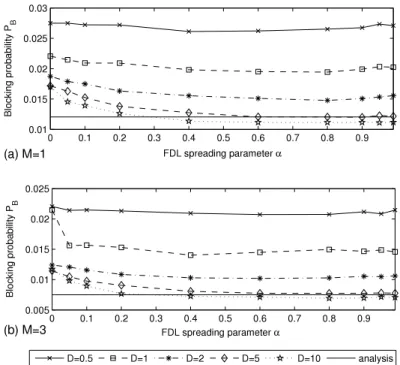
reduced to 0.75 while all other parameters are fixed. We further increase the number of fibers N withρ
fixed at 0.75 to 8 in a new simulation scenario whose results are depicted similarly inFig. 4. The results obtained via the analytical model are also depicted inFigs. 2–4. It is clear that the blocking probability PBdecreases as D increases in all scenarios for fixedα
. This stems from the observation that for low values of D, a retrying optical packet will see a system occupancy positively correlated with the one the same packet had attemptedto join but failed D time units back. Similar observations were made in [11,20]. Using FDLs of varying lengths is generally peculiar to PreRes schemes but it is clear fromFigs. 2–4that such different length FDLs also reduce blocking probabilities in PostRes schemes. The packet blocking probability PBfirst decreases with increasing FDL spreading parameter
α
but beyonda certain value of
α
, it tends to slightly increase asα →
1 for all the three scenarios we tested. This latter behavior is more evident for relatively low values of D and M. To explain this phenomenon, asα →
1, some of the delay lines will induce very small delays compared to the average packet length and consequently retrying packets using such small FDLs will likely get blocked. However, with a proper choice of the FDL spreading parameterα
, for exampleα =
0.
8, such behavior can be avoided. Throughout the rest of the article, we setα =
0.
8.In the second simulation example, we fix N
=
8,
K=
16, and study the accuracy of the analytical model in terms ofB
,
M, andρ
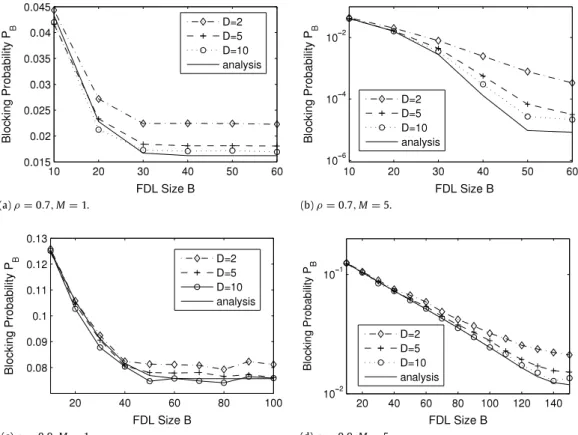
. For this purpose, we plot the blocking probability PBfor various values of D inFig. 5obtained by simulations(recall
α =
0.
8 used throughout all simulations) as a function of the FDL size B for four different scenarios corresponding toρ =
0.
7,
0.
9 and M=
1,
5. This plot also presents the results of the analytical model. We observe that for a given scenario, there is a certain value of D, say Dmax, beyond which there will be no significant performance improvement in terms ofFig. 2. The packet blocking probability PBas a function of the FDL spreading parameterαfor the scenario when N=1,K=16,B=16, ρ =0.9, and for
various values of D and for two values of recirculation limit parameter (a) M=1, (b) M=3.
Fig. 3. The packet blocking probability PBas a function of the FDL spreading parameterαfor the scenario when N=1,K=16,B=16, ρ =0.75, and
for various values of D and for two values of recirculation limit parameter (a) M=1, (b) M=3.
blocking probability. However, Dmaxturns out to depend on the presented scenario. Based on the results provided inFig. 5,
when the average delay length D is chosen so that it is larger than Dmax, then the analytical model captures very well the
blocking performance with respect to the FDL size B.
It is also crucial to choose an absolute value for D to use in the OPR. For this purpose, we design the following simulation experiment. Fixing M
=
5,
K=
16, and for given N and B, for two values of desired blocking probability PB=
0.
01,
0.
001, weFig. 4. The packet blocking probability PBas a function of the FDL spreading parameterαfor the scenario when N=8,K=16,B=16, ρ =0.75, and
for various values of D and for two values of recirculation limit parameter (a) M=1, (b) M=3.
OPR offered with Poisson traffic with intensity
λ
(0)for various values of D. The results of this simulation experiment arepresented inFig. 6. We observe that irrespective of the choice of the switch size N
,
Dmax turns out to depend on B; forlow values of B
,
Dmaxis only a few packet lengths whereas Dmaxincreases beyond a few packet lengths with increased B.However, setting D to a very large value increases the delays despite the blocking performance improvement. Consequently, setting D to around ten packet lengths appears to be an acceptable trade-off between delay and blocking for a wide range of scenarios including the ones given inFigs. 5and6. Moreover, with this choice of D, the analytical procedure we propose in this article appears to capture very well the blocking performance. However, the model can produce an optimistic estimate for blocking probabilities if shorter delay lines are used if the delay requirement is stringent.
The success of the analytical model in the regime of relatively long FDLs and relatively large spreading parameter is now explained. Recall that the processes X
(
t),
Y1(
t), . . . ,
YM(
t)
were assumed to be independent processes in the analyticalmodel. Note that the retrial process Yi
(
t)
is generally not independent from the fiber process X(
t)
. As stated before, thisstems from the observation that a retrying optical packet will see a system correlated with the one the same packet had overflown D time units back when D is small. However, as shown in [20], as D
→ ∞
, the process Yi(
t)
becomes independentfrom X
(
t)
and approximations that are based on this independence turn out to produce acceptable results. In practice, it was shown that D should be at least a few mean packet lengths for this approximation to hold for the shared-per-link case fed with Poisson traffic [20]. With shorter FDLs, the retrial processes and the fiber process cannot be approximated as independent processes and therefore the effectiveness of using FDLs for blocking probability reduction is relatively limited. For the spreading parameter effect on performance, let us assumeα →
0 first. In this case, it is obvious that Yi(
t)
andYj
(
t),
i̸=
j, are not independent. To see this, let us assume severe congestion at the tagged fiber at around time t0. Therewill be retrial traffic that will retry all together at t0
+
D. Since the instantaneous rate of this retrial process will be high, thesystem will continue to be congested at time t0
+
D leading to an increase of instantaneous rate of retrial traffic at t0+
2D,and so on. This shows that X
(
t0)
and Yi(
t0+
iD),
1≤
i≤
M, are not independent. In order to break this dependence, weintroduce in this article the spreading parameter
α
and random FDL selection policy. UsingFigs. 2–4, we show the impact of the choice ofα
on the independence assumption. Therefore, use of long average FDL delays D and relatively large spreading parameterα
(for exampleα =
0.
8) is not only effective in improving blocking performance but also in this regime, an analytical model can be built on the basis of the independence assumption of the processes X(
t),
Y1(
t), . . . ,
YM(
t)
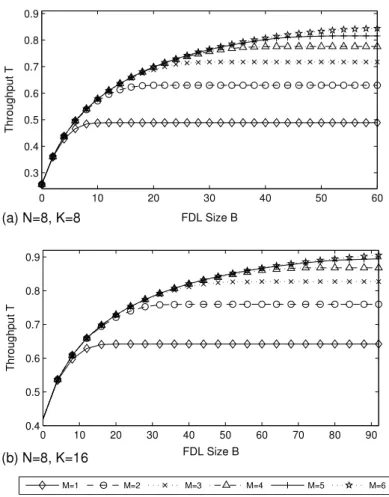
.For the remainder of this article, we provide results obtained only using the analytical model assuming that the average FDL size parameter D is set to a value exceeding ten packet lengths as motivated before. We now define the achievable throughput T as the maximum load the OPR can support under a blocking probability constraint PB. We fix N
=
8 and plotT associated with the blocking constraint PB
<
0.
001 as a function of the FDL size B for various values of M inFig. 7for twodifferent choices of K : (a) K
=
8, (b) K=
16. The results are obtained only through the proposed analytical model. Note that the B=
0 case does not employ FDLs and the corresponding throughput is obtained using the Erlang-B formula for K servers. We observe that there is a certain value of B, say Bmax, beyond which the throughput T cannot further be improved.(a)ρ =0.7,M=1. (b)ρ =0.7,M=5.
(c)ρ =0.9,M=1. (d)ρ =0.9,M=5.
Fig. 5. The packet blocking probability PBas a function of the FDL delay parameter B for various values of D for the scenario whenα =0.8,N=8,K=16:
(a)ρ =0.7,M=1; (b)ρ =0.7,M=5; (c)ρ =0.9,M=1; (d)ρ =0.9,M=5.
Fig. 6. The packet blocking probability PBas a function of the FDL delay parameter D for various values of N and B when M=5,K=16 and for two values
of the desired blocking probability PB=0.01,0.001.
there is limited gain in using multiple circulations M
>
1. However, one can benefit from multiple circulations for larger FDL sizes. Consider the basic case of using one circulation only and using BmaxFDLs. In this case, the throughput is increasedby 88
.
5% and 52.6%, associated with the cases K=
8 and K=
16, respectively, compared with the bufferless scenario. Even with such basic schemes, the throughput can substantially be improved.The final numerical experiment we present is on the provisioning of the FDL size B. Again, for a given blocking probability
Fig. 7. The achievable throughput T under a desired blocking probability PB=0.001 as a function of the FDL size B for various values of M for N=8 and
for two different values of K : (a) K=8, (b) K=16.
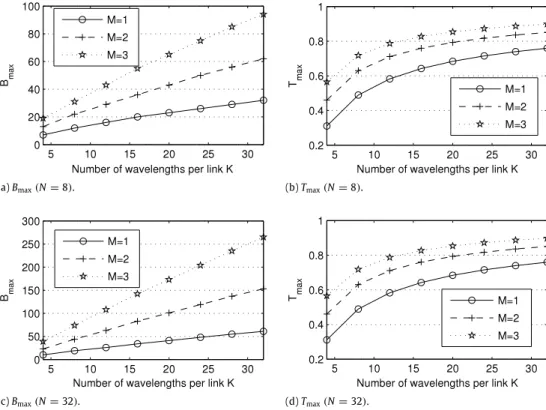
T does not change significantly. In this example, Bmaxis found so that the difference in T values corresponding to FDL sizes
Bmaxand Bmax
+
1 is less than 0.001. Once the targeted FDL size Bmaxis found, the maximum throughput achievable by usingan FDL size of Bmaxis called Tmax. The FDL size requirement Bmaxand the corresponding maximum achievable throughput
Tmaxare plotted inFig. 8. Our observations are as follows.
•
The FDL size requirement Bmaxchanges almost linearly with K and M.•
The FDL size requirement Bmaxincreases with increased switch size N. However, the maximum achievable throughputTmaxobtained using BmaxFDLs does not change much with increased switch size N.
•
Most of the throughput gains stem from one or two circulations with incremental changes with further number of recirculations.5. Conclusion
We propose an MMPP-based queuing model along with fixed-point iterations to accurately evaluate the performance of feedback-type shared-per-node recirculating FDL buffers. Simulation results show that the proposed model allows us to accurately estimate the packet blocking performance in a certain regime of long FDL delay D along with the employment of a relatively large spreading parameter
α
. Benefits of using variable-length FDLs are justified in a feedback architecture using the PostRes reservation scheme, which to the best of our knowledge is novel. Moreover, the retrial-queuing model proposed in this article can effectively be used in dimensioning feedback-type shared-per-node recirculating FDL optical buffers.Acknowledgment
The work of N. Akar is supported in part by the Science and Research Council of Turkey (Tübitak) under project no: EEEAG-111E106.
(a) Bmax(N=8). (b) Tmax(N=8).
(c) Bmax(N=32). (d) Tmax(N=32).
Fig. 8. The FDL size requirement Bmaxand the corresponding maximum achievable throughput Tmaxas a function of K for three values of M and for two values of N.
References
[1]P. Gambini, M. Renaud, C. Guillemot, F. Callegati, I. Andonovic, B. Bostica, D. Chiaroni, G. Corazza, S.L. Danielsen, P. Gravey, P.B. Hansen, M. Henry, C. Janz, A. Kloch, R. Krahenbuhl, C. Raffaelli, M. Schilling, A. Talneau, L. Zucchelli, Transparent optical packet switching: network architecture and demonstrators in the KEOPS project, IEEE Journal on Selected Areas in Communications 16 (1998) 1245–1259.
[2]C. Qiao, M. Yoo, Optical burst switching (OBS)—a new paradigm for an optical Internet, Journal of High Speed Networks (JHSN) 8 (1999) 69–84.
[3]L. Xu, H. Perros, G. Rouskas, Techniques for optical packet switching and optical burst switching, IEEE Communications Magazine 39 (2001) 136–142.
[4]T. Battestilli, H. Perros, An introduction to optical burst switching, IEEE Communications Magazine 41 (2003) S10–S15.
[5]F. Callegati, W. Cerroni, G. Corazza, C. Develder, M. Pickavet, P. Demeester, Scheduling algorithms for a slotted packet switch with either fixed or variable length packets, Photonic Network Communications 8 (2004) 163–176.
[6]R. Barry, P. Humblet, Models of blocking probability in all-optical networks with and without wavelength changers, IEEE Journal on Selected Areas in Communications 14 (1996) 858–867.
[7]I. Chlamtac, A. Fumagalli, L. Kazovsky, P. Melman, W. Nelson, P. Poggiolini, M. Cerisola, A. Choudhury, T. Fong, R. Hofmeister, C.-L. Lu, A. Mekkittikul, D.J.M. Sabido IX, C.-J. Suh, E. Wong, CORD: contention resolution by delay lines, IEEE Journal on Selected Areas in Communications 14 (1996) 1014–1029.
[8]D. Hunter, M. Chia, I. Andonovic, Buffering in optical packet switches, Journal of Lightwave Technology 16 (1998) 2081–2094.
[9]W.D. Zhong, R.S. Tucker, Wavelength routing-based photonic packet buffers and their applications in photonic packet switching systems, Journal of Lightwave Technology 16 (1998) 1737–1745.
[10]T. Zhang, K. Lu, J. Jue, Shared fiber delay line buffers in asynchronous optical packet switches, IEEE Journal on Selected Areas in Communications 24 (2006) 118–127.
[11] C.M. Gauger, Dimensioning of FDL buffers for optical burst switching nodes, in: Proceedings of the 6th IFIP Working Conference on Optical Network Design and Modelling, ONDM 2002.
[12]C. Gauger, H. Buchta, E. Patzak, Integrated evaluation of performance and technology-throughput of optical burst switching nodes under dynamic traffic, Journal of Lightwave Technology 26 (2008) 1969–1979.
[13] C. McArdle, D. Tafani, L. Barry, A. Holohan, T. Curran, Simplified overflow analysis of an optical burst switch with fibre delay lines, in: Sixth International Conference on Broadband Communications, Networks, and Systems, BROADNETS 2009, 2009, pp. 1–8.
[14]A. Chowdhury, Y.-K. Yeo, J. Yu, G.-K. Chang, DWDM reconfigurable optical delay buffer for optical packet switched networks, IEEE Photonics Technology Letters 18 (2006) 1176–1178.
[15]F. Callegati, Optical buffers for variable length packets, IEEE Communications Letters 4 (2000) 292–294.
[16]R.C. Almeida, J.U. Pelegrini, H. Waldman, A generic-traffic optical buffer modeling for asynchronous optical switching networks, IEEE Communications Letters 9 (2005) 175–177.
[17]W. Rogiest, J. Lambert, D. Fiems, B. van Houdt, H. Bruneel, C. Blondia, A unified model for synchronous and asynchronous FDL buffers allowing closed-form solution, Perclosed-formance Evaluation 66 (2009) 343–355.
[18]H. Kankaya, N. Akar, Exact analysis of single-wavelength optical buffers with feedback Markov fluid queues, IEEE/OSA Journal of Optical Communications and Networking 1 (2009) 530–542.
[19]A. Rostami, S. Chakraborty, On performance of optical buffers with specific number of circulations, IEEE Photonics Technology Letters 17 (2005) 1570–1572.
[20]N. Akar, K. Sohraby, Retrial queuing models of multi-wavelength FDL feedback optical buffers, IEEE Transactions on Communications 59 (2011) 2832–2840.
[21]C. McArdle, D. Tafani, T. Curran, A. Holohan, L. Barry, Renewal model of a buffered optical burst switch, IEEE Communications Letters 15 (2011) 91–93.
[22]D. Tafani, C. McArdle, L.P. Barry, A two-moment performance analysis of optical burst switched networks with shared fibre delay lines in a feedback configuration, Optical Switching and Networking 9 (2012) 323–335.
[23]K.S. Meier-Hellstern, The analysis of a queue arising in overflow models, IEEE Transactions on Communications 37 (1989) 367–372.
[24]W. Fischer, K. Meier-Hellstern, The Markov-modulated Poisson process (MMPP) cookbook, Performance Evaluation 18 (1993) 149–171.
[25]H. Heffes, D. Lucantoni, A Markov modulated characterization of packetized voice and date traffic and related statistical multiplexer performance, IEEE Journal on Selected Areas in Communications 4 (1986) 856–868.
[26] L. Muscariello, M. Mellia, M. Meo, R.L. Cigno, M.A. Marsan, An MMPP-based hierarchical model of Internet traffic, in: 2004 IEEE International Conference on Communications, vol. 4, pp. 2143–2147.
[27]S. Shah-Heydari, T. Le-Ngoc, MMPP models for multimedia traffic, Telecommunication Systems 15 (2000) 273–293.
[28]A. Kuczura, The interrupted Poisson process as an overflow process, Bell System Technical Journal 52 (1973) 437–448.
[29]H. Heffes, A class of data traffic processes-covariance function characterization and related queuing results, Bell System Technical Journal 59 (1980) 897–929.
[30]S.-Q. Li, C.-L. Hwang, Queue response to input correlation functions: continuous spectral analysis, IEEE/ACM Transactions on Networking 1 (1993) 678–692.
[31]R. Bellman, Introduction to Matrix Analysis, second ed., Society for Industrial and Applied Mathematics, Philadelphia, PA, USA, 1997.
[32]G.H. Golub, C.F. van Loan, Matrix Computations, third ed., The Johns Hopkins University Press, 1996.
Nail Akar received the B.S. degree from Middle East Technical University, Turkey, in 1987 and M.S. and Ph.D. degrees from Bilkent
University, Ankara, Turkey, in 1989 and 1994, respectively, all in electrical and electronics engineering. From 1994 to 1996, he was a visiting scholar and a visiting assistant professor in the Computer Science Telecommunications program at the University of Missouri—Kansas City. He joined the Technology Planning and Integration group at Long Distance Division, Sprint, Overland Park, Kansas, in 1996, where he held a senior member of technical staff position from 1999 to 2000. Since 2000, he has been with Bilkent University, Turkey, currently as an associate professor at the Electrical and Electronics Engineering Department. His current research interests include performance analysis of computer and communication systems and networks, performance evaluation tools and methodologies, design and engineering of optical and wireless networks, queuing systems, and resource management.
Yavuz Gunalay is a professor of operations management at Bahcesehir University of Istanbul. He obtained his first degree in
Electrical and Electronics Engineering from the Middle East Technical University, Ankara. He earned his M.S. degree in Industrial Engineering from Bilkent University, Ankara, and Ph.D. degree in Management Science from McMaster University, Canada. He taught at Eastern Mediterranean University of Cyprus, Bilkent University of Ankara, and the Ministry of Health in Ankara. His research interests include queuing problems, stochastic modeling in telecommunication and manufacturing systems, as well as green manufacturing.