O
h
r
c
i
r
g
a
in
e
a
s
l
R
e
H. Gül Baytan Yıldız1, Enver Özgencil2, Sanem Çakar2, Feyhan Ökten2, Filiz Tüzüner3 1Department of Anaesthesia, TOBB ETU Faculty of Medicine, 2Department of Anaesthesia, Ankara University Faculty of Medicine, 3Department of Anaesthesia, Ufuk University Faculty of Medicine, Ankara, Turkey
Noise in the Operating Room
Comparison of the Effect of Noise Levels on Stress
Response in Two Different Operation Groups
in an Orthopedic Surgery Room
Ortopedi Ameliyathanesinde Farklı iki Ameliyat
Grubundaki Gürültü Düzeylerinin Stres Yanıt
Üzerine Etkisinin Karşılaştırılması
DOI: 10.4328/JCAM.4752 Received: 19.07.2016 Accepted: 16.08.2016 Printed: 01.03.2017 J Clin Anal Med 2017;8(2): 116-21 Corresponding Author: H. Gül Baytan Yıldız, Department of Anesthesiology, TOBB ETU Hospital, Ankara, Türkiye.
T.: +90 3122929821 GSM: +905326977196 E-Mail: [email protected]
Özet
Amaç: Bu randomize, tek kör çalışmanın amacı, nöroaksiyel anestezi uygula-ması ile gerçekleştirilen diz protezi operasyonlarında ortam gürültü düzeyi-nin ölçümü sağlanarak, hastalarda gürültünün hemodinamik yanıt, stres dü-zeyi ve nöroendokrin yanıt üzerine etkilerini değerlendirmektir. Gereç ve Yön-tem: Nöraksiyal blok uygulanması yapılan 2 grup hastadan, Grup1’de kulla-nılan enstrumantasyonlara bağlı olarak gürültü düzeyinin yüksek olduğu diz protezi operasyonu geçiren hastalar için ve Grup 2’de menüsküs operasyonu geçirecek hastalar için gürültü düzeyi desibel olarak ölçüldü. Hastalara preo-peratif ve postopreo-peratif The State-Trait Anxiety Inventory (STAI-1) Durumlu-luk kaygı ölçeği( Süreksiz); Anxiety test (STAI-2 ( Sürekli Kaygı Ölçeği)) yapıl-dı. Hastalardan bazal, intraoperatif 30.dakika ve derlenme odasında ilk 1.sa-atte 20 ml kan alındı. Bulgular: Hastaların hemodinamik yanıtlarında; sistolik, diyastolik ve ortalama arter basınçları gürültünün yüksek olduğu grupta, daha yüksek olduğu bulundu. Grup 1’de ACTH’da intraperatif erken dönemde arttı-ğı, geç dönemde ise normale döndüğü, Grup 2’de ise ACTH değerlerinin an-lamlı olarak düştüğü bulunmuştur. Kortizol değerlerinde bazal kortizol değer-lerinin anlamlı olarak Grup 2’ye göre yüksek olduğu bulunmuştur. İnflamatuar yanıtın göstergesi olan hCRP düzeylerinde tüm hastalarda her iki grupta da düşüş gözlenmiştir. Grup 1’de erken ve geç dönemdeki glukoz değerleri yük-sek seyretmiştir. Glukoz değerlerinde erken ve geç dönemde Grup 1’de daha fazla artış gözlenmiştir. Postoperatif dönemde daha fazla gürültülü ortamın olduğu hastalarda sürekli kaygı ölçeği (STAI-2) düzeylerinin daha yüksek ol-ması, her ne kadar bu ölçeğin kişilerin içinde bulunduğu durum ve koşullardan bağımsız olarak kendini nasıl hissettiğini belirlese de, bu sonuç bize hastalar-da intraoperatif dönemde maruz kalınan gürültünün stres yanıta neden ola-bileceğini düşündürdü. Tartışma: Sonuc olarak, operasyon odasındaki yüksek gürültü düzeyine neden olan faktörlerin düşürülerek standart gurultu düzeyle-rine ulaşılması gerektiğine inanmaktayız. Bu daha iyi sedasyon , daha az ilaç tüketimi ve daha iyi metabolik kontrol sağlayacaktır.
Anahtar Kelimeler
ACTH; Anksiyete; Kortizol; Nöroendokrin Stres Yanıt
Abstract
Aim: The aim of this randomized, single-blinded study was to evaluate the effects of noise on hemodynamic and neuroendocrine stress response by measuring the level of noise in the surgery rooms of patients undergoing knee operations under neuroaxial anesthesia. Gereç ve Yöntem: We com-pared patient responses from two groups of patients: those undergoing knee operations in a surgery room where the noise level (measured in decibels) is high, and those undergoing meniscus operations in a surgery room with lower noise levels. The STAI, the State-Trait Anxiety Inventory (STAI-1), and the anxiety test (STAI-2)wereperformed at preoperative and postoperative periods. 20 ml of blood sample was taken for basal, intraoperative 30th minute, and postoperative 1st hour measurements. Systolic, diastolic, and mean arterial blood pressures were found to be higher in the high noise level group. ACTH levels were increased during the early postoperative period and became normal during the late postoperative period in the high noise level group whereas ACTH levels were significantly decreased in the low-noise lev-el group. Basal cortisol levlev-els were significantly higher in the high noise levlev-el group. HCRP, an inflammatory response mediator was found to be decreased in both groups. Early and late blood glucose levels were significantly higher in the high noise group. There was a greater increase in early and late blood glucose levels in the high noise group. In the postoperative period, although the state-trait anxiety inventory (STAI-2) levels being higher in patients sub-ject to noisier environment determines how people feel independent of the conditions and state they are in, this result made us consider that the noise the patients were subjected to in the intraoperative period may cause a stress response. Discussion: As a result we believe that standard noise levels should be achieved by reducing the factors causing high noise levels in the operating room. This will provide better sedation, less drug consumption, and better metabolic control.
Keywords
ACTH; Anxiety; Cortisol; Neuroendocrine Stress Response
TARK 2006 (Türk Anestezi ve Reanimasyon Kongresi)’nde sözlü sunu olarak kabul edilip sunulmuştur.
| Journal of Clinical and Analytical Medicine 116
Noise in the Operating Room
Introduction
The operating room is an environment where great care is tak-en to be siltak-ent and avoid noise. However, a noise level which medical staff thinks is not disturbing can be disturbing and even damaging for patients given that it is an unfamiliar environ-ment, along with the stress of the operation and anesthesia. The average noise level for hospitals’ acute care areas has been determined as 45 dBA by the International Noise Council [1,2]. Orthopedics surgery rooms are environments in which there is an especially high level of noise. Due to the instruments used in orthopedic surgery, the noise levels can range between 95 and 105 dBA [3]. It is known that anesthesia applications have direct effects on the physiological functions in the body. In par-ticular, there are numerous studies on the repression of hypo-thalamic and pituitary hormones by opioids [4]. It is also known that etomidate and benzodiazepines reduce cortisol se-cretion. With the use of epidural anesthesia and local anesthetic agents, the endocrine and metabolic stress responses in pelvis and lower extremity surgeries can be inhibited, positively changing the result of the surgical intervention [5]. Various studies have been conducted on how surgical success can be influenced by changing the stress response and in particular its relationship to the anesthesia method. It has been determined that noise levels over 80 decibels are harmful [6]. However, noise pollution in surgery rooms appears as a factor before us in the formation of stress response. Although noise does not always mean loud sound, it is harmful to be subject-ed to very high noise levels, such as orthopsubject-edics surgery rooms, for too long [7]. Anxiety and the resulting increase in the need for sedation causes a change in the meta-bolic, hormonal, cardiovascular, lipid profile, and carbo-hydrate metabolism and can deteriorate the balance of glucose homeostasis and perioperative fluids, especially with the increasing cortisol and catecholamines [8-12]. The purpose of this randomized and single-blind study was to measure the ambient noise levels in knee pros-thesis operations carried out with neuroaxial anesthesia and evaluate the effects of noise on the patients’ hemodynamic re-sponse, stress level, and neuroendocrine response .
Material and Method
Included in this study were a total of 53 patients between the ages of 18-75 who underwent total knee prosthesis or menis-cus operations with the spino-epidural anesthesia method un-der elective conditions with their consent, with ASA physical status I-III (American Anesthesiologists Foundation) between February 2006 and May 2006. This study received approval number 01022006/271 from the ethical board at Ankara Uni-versity’s Anesthesia and Reanimation Department in 2006 [12]. The patients included in this study were informed about the anesthesia method of epidural application a day before the op-eration during the preoperative evaluation and the volunteers who wished to participate in the study were included following the receipt of their patient information form.
Patients with a history of psychiatric illnesses, uncontrolled hypertension or diabetes mellitus; those who used psychiatric medicine and steroids; those with hormonal dysfunctions
(adre-nal, thyroid, hypophysis); those with medicine addictions; those with hearing problems; those who refused the method; those with coagulopathy and those who used anticoagulants; those with neurological deficits, serious aortic stenosis, serious mi-tral stenosis, increased intracranial pressure, infection in the intervention area, and regional anesthesia contradictions such as serious hypovolemia; those who did not cooperate; those whose operation duration exceeded 100 minutes; and those who needed additional analgesic and other medicine (local an-esthetics, opioids, ephedrine, insulin) during the intraoperative period have not been included in the study.
Anesthesia Method
When the patients were taken to the surgery room, 18-22 gauge intravenous catheters were routinely placed in the
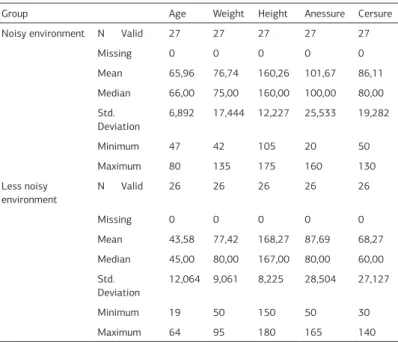
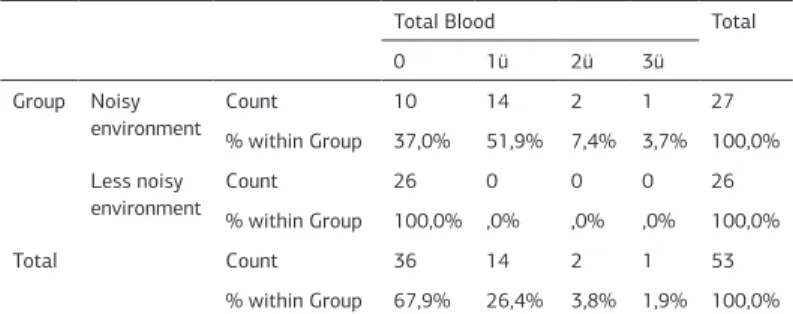
dor-Table 1.1 Demographic Data (age, weight, Height, gender, anesthesia and duration of operations), 1.2 ASA Score (American Society of Anesthesiologists), 1.3 Blood Transfu-sion.
Group Age Weight Height Anessure Cersure
Noisy environment N Valid 27 27 27 27 27
Missing 0 0 0 0 0 Mean 65,96 76,74 160,26 101,67 86,11 Median 66,00 75,00 160,00 100,00 80,00 Std. Deviation 6,892 17,444 12,227 25,533 19,282 Minimum 47 42 105 20 50 Maximum 80 135 175 160 130 Less noisy environment N Valid 26 26 26 26 26 Missing 0 0 0 0 0 Mean 43,58 77,42 168,27 87,69 68,27 Median 45,00 80,00 167,00 80,00 60,00 Std. Deviation 12,064 9,061 8,225 28,504 27,127 Minimum 19 50 150 50 30 Maximum 64 95 180 165 140
Group * Gender Cross Tabulation
Gender Total
Female male Group Noisy
environment Count% within Group 2281,5% 518,5% 27100,0% Less noisy
environment Count% within Group 1246,2% 1453,8% 26100,0%
Total Count 34 19 53
% within Group 64,2% 35,8% 100,0%
Table 1.2 Group * ASA Cross Tabulation
ASA Total
1 2
Group Noisy
environment Count% within Group 1555,6% 1244,4% 27100,0% Less noisy
environment Count% within Group 2596,2% 13,8% 26100,0%
Total Count 40 13 53
Noise in the Operating Room
sum or antecubital fossa and venous blood samples were sent for measurement of preoperative cortisol, adrenocorticotrophic hormone (ACTH), high-sensitive C-reactive protein (hCRP), and glucose level evaluations.
All of the patients were given 0.5 mg atropine as premedication. The gender, age, weight, height, ASA physical status, chronic ill-nesses, and the medications of all the patients were recorded preoperatively. The State-Trait Anxiety Inventory (STAI-1); Anxi-ety test (STAI-2); and stress anxiAnxi-ety test, which evaluates vari-ous measures together with subjective emotions such as ten-sion, anxiety, sadness, and irritability related to the stimulation of the autonomic nervous system [13]. In our study, patients self-evaluated their anxiety levels 5 minutes prior to the op-eration and after the opop-eration. The total score value obtained from the two scales ranges between 20 and 80. The higher the score, the higher the anxiety level [14]. We performed pi-lot measurements of noise levels, with the assumption that the ambient noise levels in the knee prosthesis operations (Group I) are higher than in meniscus operations (Group II). To ensure comparability, we have chosen these two surgical procedures because they are similar in terms of surgery duration, use of regional anesthesia, and level of the area to be operated on. The ambiance decibel level was measured in all of the proce-dures. In the period starting after the basal values were taken, heart rate, systolic, and diastolic blood pressures and ambiance noise level were recorded at 10 minute intervals until the end of the operation. As for standard anesthesia monitoring, heart rate (HR), systolic (SAP), diastolic (DAP) and average (MAP) ar-tery pressures, and peripheral arterial oxygen saturation (SpO2) (Viridia CMS M1166A, Hewlett Packard, Germany) were mea-sured for all patients.
The patients were separated into two groups of 26 according to the type of surgery (high or low noise level) and analyzed separately. The patients in Group I underwent knee prosthesis operation while those in Group II underwent a meniscus opera-tion. Neuroaxial block was performed on both groups. The single space segment technique was performed using Combined Spi-nal Epidural Anesthesia. All patients received an epidural cath-eter at the L4-L5 interval in the preoperative period. We then applied 2% of lidocaine 60 mg as a test dose (Osel, Istanbul, Turkey) and 0.5% heavy marcaine from the spinal space (Astra-Zeneca, İstanbul, Turkey). The sensory blockade level required
for regional anesthesia has been kept at the T5 level. For the measurement of the ambiance noise level, a Lutron SL 4010 (Taiwan) decibel meter device was used. For the measurements of basal, intraoperative on the 30th minute and ACTH, cortisol, hCRP and glucose levels on the 30th minute at the recovery room (MediSenseOptium, 3942), blood samples were taken at these times and STAI test evaluations were performed prior to and after the operation.
Statistical analysis
The statistical analysis has been carried out with an IBM com-patible computer suitable for personal use and Windows SPSS 12 statistics program (Statistical Package for Social Sciences, Chicago, IL, ABD). The obtained data has been used in the two group independent comparison for the Mann-Whitney U Test and in Wilcoxon sign test in dependent intergroup comparisons. The significance level was set as 0.05. Because the data did not have a normal distribution, the Mann-Whitney U Test and Wilcoxon sign tests, which are non-parametric tests, have been preferred.
Findings
Demographic Data
While no difference was observed between the two study groups in terms of weight, height and gender, the mean age of the patients in the noisy environment group (Group I) has been determined as 66±7.29(SD) and in the less-noisy environment group (Group II) as 43±11.9(SD), which represents a significant difference (P<0.05). The durations of the operations were ob-served as 83±15(SD) in Group I and 65±24(SD) in Group II, a significant difference.
Intraoperative Hemodynamic Differences
When the intraoperative heart rate values of the groups were compared, a statistically significant difference was not found. When the intraoperative systolic arterial blood pressure values of the groups were compared, with the exception of 60th-70th minutes the SAP, MAP, and DAP values in Group 1 in measure-ments taken at the other times were significantly higher in comparison to Group II (P<0.05). The comparative MAP values can be seen in Figure 4.1.
Hormonal Differences
a) Blood Glucose Values: When the glucose values between the groups were compared, the glucose values in Group I measured in the basal, 30th minute and recovery time were significantly higher (P<0.05) (Figure 4.2).
b) Blood ACTH Values
When the blood ACTH values between the groups were compared, the basal ACTH values in Group II were signifi-cantly higher (P<0.05). When the difference in the 30th minute in comparison to the basal was compared, the
Table 1.3 Group * Total Blood Cross Tabulation
Total Blood Total
0 1ü 2ü 3ü Group Noisy environment Count 10 14 2 1 27 % within Group 37,0% 51,9% 7,4% 3,7% 100,0% Less noisy
environment Count% within Group 26100,0% ,0%0 0,0% 0,0% 26100,0%
Total Count 36 14 2 1 53
% within Group 67,9% 26,4% 3,8% 1,9% 100,0%
Table 2.1 The noise levels of the groups Basal 0* During the
operation*
5 10* 20* 30* 40* 50* 60* 70* 80* After the
operation*
Group 1 53 69 61,7 64 68 70 68 67 66 67 66 65 65
Noise in the Operating Room
ACTH values in Group I significantly increased, whereas the ACTH values significantly decreased in Group II (P<0.05). In Group I, the increase at the 30th minute in the ACTH values in comparison to the basal was significantly higher than in Group II (P<0.05) (Figure 4.3).
c) Blood Cortisol Values
When the blood cortisol values between the groups were com-pared, the basal cortisol value in Group I was significantly high-er than in Group II (p<0.05). The blood cortisol values of the groups in the basal, 30th minute and recovery periods are given in Figure 4.4.
d) Blood hCRP Values
When the blood hCRP values between the groups were com-pared, no statistically significant difference was observed (p>0,05). The groups’ blood cortisol values in the basal, 30th minute and recovery periods are presented in Figure 4.5. Intraoperative decibel measurement findings
When the noise level between groups was compared, we found that, with the exception of the 5th minute, the decibel measure-ment values were significantly higher in the noisy environmeasure-ment group (P<0.05).
The noise level basal measurements in Group I were signifi-cantly low, whereas no significant difference was observed in the basal values and decibel values measured at other times in Group II. In Group I, decibel levels ranged between 68.4 and 85. In Group II, decibel levels ranged between 54 and 66.7. Preoperative and Postoperative stress test findings
When the State Anxiety Inventory(STAI-1) and the Trait Anxiety Inventory(STAI-2) scores between the groups were compared, no significant difference was observed between preoperative and postoperative values.
When the within-group Trait Anxiety Inventory (STAI-2) scores were compared, a significant difference was found between preoperative and postoperative periods in Group I (p=<0.05), whereas no significant difference was found in Group II. Discussion
Uncontrolled noise is an activator of stress and various physi-ological mechanisms. However, all of its effects have not been clarified yet. Noise can increase systolic blood pressure, diastol-ic blood pressure, and heart rate [15]. Many studies have shown the relationship between uncontrolled noise and cardiovascular diseases. It is considered that the release of stress hormones induced by noise is an important biological mechanism [16]. A blockage of T5 level for the metabolic and endocrine system temporarily suppresses the neuroendocrine response to opera-tions [17-18]. With the appropriate sensorial blockage creat-ed through regional anesthesia, the increase in the levels of plasma catecholamines, cortisol, glucose, ADH, and GH which otherwise emerge from surgical stimulation can be suppressed [19-20]. Thus, the neuroendocrine response based on fear and anxiety can be correlated.
Various studies have analyzed the effect of epidural and spinal anesthesia on suppression of stress responses due to surgical
intervention [18]. It has been determined that epidural analge-sia blocks afferent neural impulses which have been removed from the surgical intervention area and that morphine and diamorphine, particularly when applied with the dural method, are effective in suppressing stress responses which are con-sidered to develop pain after abdominal interventions [19-21]. In abdominal surgical interventions, when regional anesthesia is applied together with general anesthesia, endocrine stress
Noise in the Operating Room
response is suppressed [22].
Our study analyzed the effects of noise on the patients’ anxiety level, hemodynamic, and stress hormone response by measur-ing the ambient noise level in knee prosthesis operations car-ried out with neuroaxial anesthesia application.
Noise is an unsettling phenomenon which appears in our daily life; it causes a person to feel bad and has a negative effect on work performance. Like other work areas, surgery rooms are easily affected by noise pollution. Shapiro and Baland have lik-ened the noise level in surgery rooms to the noise on a highway [23]. In the surgery rooms, the surgical personnel and patients are subject to noise caused by ventilators, screening devices, alarms, aspirator pipes, diathermy devices, mechanical and air devices, heaters, paging devices, intercoms, telephones, metal basins, tools, and trolleys. These kinds of noises can cause lack of concentration and loss of performance and can complicate communication for the surgical personnel. Increasing noise and the surgery itself can cause patients who are anxious during certain parts or for the whole of the surgery to be more irritable and anxious [13-23-15]. In our study, the stress test evaluation STAI levels were higher during noisy surgery than less noisy sur-gery in the preoperative and postoperative periods. This may indicate that anxiety is higher in noisy environments [13]. Hodge et al. in their study have suggested that devices such as earphones can be beneficial in eliminating noise [13-6]. Contrary to this suggestion, while ambient noise levels are measured in our study, there was no attempt to reduce noise. In particular in the patient with lower noise level operations such as men-iscectomy in which noise producing instruments are not used were preferred. The devices used in sound isolation (earphones, earplugs, cotton balls, etc.) are not very effective in method. Note further that some studies state it is not necessary for the patient to be awake to be disturbed by noise and that stress re-sponse can emerge even under general anesthesia. However, it has been observed that by using methods which eliminate noise in noisy environments (for instance, earphones, making patients listen to music) [10-11-24] and creating a noise-free environ-ment, it is possible to decrease the stress response of patients and their need for sedation and analgesia. In our study, we have not used sedation, earphones or similar sound elimination on our patients. Instead, for the low-noise condition (Group II) we have selected meniscus operations, in which the instruments used create an environment with less noise than in unilateral knee prosthesis operations with similar durations (Group I) in which the sound reaching the patients’ ears can be as high as 90 decibels.
In order to communicate with the patients and evaluate stress levels prior to and after operations, we selected the regional anesthesia method in both of our groups. We thought that ambient noise can be perceived variably by the patients and that the source and character of the noise might be impor-tant. Although ambient noise did not exceed basal values, noise caused by hammers, saws and aspirators and heard by patients can cause neuroendocrine and sensory stress response. In our study, we observed that the level of background noise in surgery rooms contributes to the overall noise level measured during the operations. Furthermore, the baseline background noise lev-el was too high to be a satisfactory study environment. When
we evaluated the operation room while it was empty, we found an ambient noise level of 53 decibels. According to Standards Association of Australia, the background noise level should not exceed 30 dB [25].
The average noise level for hospital acute care areas has been determined as 45 dB by the International Noise Council [1-2]. When the noise level is taken into consideration, orthopedics surgery rooms are environments where noise is intense. The noise level when orthopedics instruments are in use ranges be-tween 95 and 106 dB [3]. Outside noise is a particularly impor-tant problem for conscious patients who are given local and re-gional anesthesia. An operation is already a source of stress for most patients. It is possible to be free of stress and anxiety only by reducing noise to the minimum level. Sudden high sounds not only raise the stress level of patients, but they also can cause sudden movements in the body area being operated on. Thompson et al. have suggested that using earphones, playing background music or making patients listen to music with ear-phones can be used in reducing stress by minimizing noise [1]. It has been shown in human studies that noise increases hemo-dynamic response. It has been revealed in short-term laboratory studies that being subject to noise affects the sympathetic and endocrine systems and causes responses in acute physiological heart rate, blood pressure, and stress hormones [26]. Similar to these studies, while a change in the heart rate of patients who are subject to more noise due to the use of orthopedics instru-ments was not observed in our study, an increase was observed in systolic and diastolic blood pressure. When compared with the basal values in all patients, heart rates being lower during the operations can be explained by the choice of high level re-gional anesthesia as the anesthesia method.
Perioperative pain, which is an important stimulant for stress response, causes the activation of the autonomous system through indirect influence and various complications in the systems of the organs [8]. Although numerous methods have been developed to change mediator release and the catabolic hormonal response, it has been stated that, as in our study, the most important are somatic and autonomic afferent neural block and other pain preventing methods.
In our study, when the blood glucose values which are the stress response indicators of patients were analyzed, it has been ob-served that the blood glucose levels in patients subject to more noise were higher. In addition, we found that glucose increase in patients subject to more noise is correlated with the increase in noise during operations. Despite the fact that the high noise patients underwent a more traumatic operation (knee replace-ment), that they did not have diabetes mellitus, and that their stress response was suppressed with a regional nerve block, their blood glucose values were found to be higher. Correspond-ingly, we expect younger patients who were in less noisy group neuroendocrine response was more intense.
In one of his studies, Spreng analyzed the effects of cortisol release related to noise and determined that noise causes CRH and ACTH increase [27]. Similarly, when the ACTH values which are the stress response indicators were taken into consider-ation in our study, especially in periods in which noise increas-es with the operation of instruments, the level of ACTH being higher in patients subject to more noise shows the correlation
Noise in the Operating Room
between the ambient noise level and ACTH level.
Lepage et al. in their study have compared patients who were operated on under spinal anesthesia and who were played mu-sic with patients who were not played mumu-sic. The patients who were played music needed less sedation during the intraopera-tive period and there was no difference between the STAI lev-els [11-24]. This illustrates that the type of noise is important as well. While noise related to the surgical operation increases stress response, being played music decreases it [10-11]). Conclusion
This study was conducted in a surgery room with higher base-line noise levels than those recommended by the International Noise Council. There was a noisy environment condition (knee replacement operation) and a less-noisy environment condition (meniscus operation). Noise levels were measured as the pa-tient would experience them. In the noisy environment group, the hemodynamic responses, mean arterial pressures, meta-bolic, and endocrine responses to surgery were significantly higher. Consequently, we believe that standard noise levels should be achieved by reducing the factors causing high noise in the operating room, both at baseline and during operation. This will provide better sedation, less drug consumption, and better metabolic control.
In our study, surgery duration and age were different between the two groups. This fact, along with the small sample size, may be a limiting aspect of the study. However, even though the average age and surgical trauma level seems to be different in the two groups, the standardization of the ambient noise level was more important for us. Since the stress response related to surgical trauma would begin after it regressed to the T4 level with regional anesthesia, the blood sample follow-ups were car-ried out in an intraoperative manner. Thus, noise was isolated as the stress factor. We stopped our observation time before the nerve block was removed. Although only patients with no significant hearing loss have been included, not determining the hearing level of the patients through audiometry can be listed as another limitation.
Competing interests
The authors declare that they have no competing interests. References
1. B.Hodge, J.F.Thompson. Noise pollution in the operating theatre. Lancet 1990;335:891-4.
2. Eugene, H.C.Liu,FRCA, Consultant and Su-Meng Tan. RegistarPatients’ per-ception of sound levels in the surgical suite. Journal of Clinical Anesthesia 2000;12:298-302.
3. Kam PC, Kam AC, Thompson JF. Noise pollution in the anaesthetic and intensive care environment. Anaesthesia1994;49: 982– 6.
4. Holmes GB Jr, Goodman KL, Hang DW, McCorvey VM. Noise levels of 2. Or-thopedic instruments and their potential health risks. OrOr-thopedics 1996;19:35-7. 5. J.P.Desborough. The stress response to trauma and surgery. Br J Anaesth 2000;85:109-17.
6. Kehlet H. Surgical stress: the role of pain and analgesia. Br J Anaesth 1989;63:189-95.
7. B.C. Kennedy, G. M. Hall. Neuroendocrine and inflammatory aspects of surgery:do they affect outcome?ActaAnaesth. Belg 1999;50:205-9.
8. M.R.Nott, P.D.B.West. Orthopaedic theatre noise: a potential hazard to patients. Anaesthesia 2003;58:775-803.
9. Murthy MD, S.K., Malhotra MD.,BalaBD,Raghunathan Detrimental effects of noise on anaesthetists. Can J Anaesth1995;42:608-11.
10. Ganidagli S, Cengiz M, Yanık M, Becerik C, Ünal B. The effect of music on pre-operative sedation and the bispectral index.AnesthAnalg 2005;101:103-6. 11. Migneault B, Girard F, Albert C et al. The effect of music on the neurohormonal
stress response to surgery under general anesthesia. AnesthAnalg 2004;98:527-32.
12. Sitzman BT, Watson D, Schug AS. Combined general and epidural anesthesia for abdominal aortic aneurysm surgery. Techniques in Regional Anesthesia & Pain Management 2000.
13. STAI Eysenck MW, Derakshan N, Santos R, Calvo MG. Anxiety and cognitive per-formance: attentional control theory. Emotion (Washington, DC) 2007;7(2):336– 353. doi: 10.1037/1528-3542.7.2.336. pmid:17516812
14. Downing R, Davis I, Black J, Windsor Wo. Effect of intrathecal morphine on the adrenocortical andhyperglysemic responses to upper abdominal surgery. Br J Anesth 1986;58:858-61.
15. Mori H, Murata H. A study of noise in operating room. Jap J Anaesthesiol 1979;10:1102-6.
16. Bigert C1, Bluhm G, Theorell T. Salivacortisol--a newapproach in noisere-searchtostudy stresseffects. Int J Hyg Environ Health 2005;208(3):227-30. 17. Ayoub CM, Rizk LB, Yaacoub CI et al. Music and ambient operating room noise in patiens undergoing spinal anesthesia. AnesthAnalg 2005;100:1316-9. 18. Sally ve ark. Chronic effects of workplace noise on blood pressure and heart rate. Archives of Enviromental Health, July-August 2002.
19. Davies JM, Ewen A, Cuppage A, Gilbert D, Winkelear R. Noise levels in the op-erating rooms-a comparison of Canada and England.Anaesthesia Intensive Care 1989;17: 98-9.
20. The pituitary hormones and their control by the hypothalamus. In: Guyton A.C., ed. Textbook of medical physiology. Philadelphia: W.B Saunders 1991:819-30. 21. The adrenocortical hormones. In: Guyton A.C., ed. Textbook of medical physiol-ogy. Philadelphia: W.B Saunders 1991:842-54.
22. Kehlet H. Epidural analgesia and the endocrine-metabolic response to sur-gery. Acta AnaesthesiolScand 1984;28:125-7.
23. Shapiro RA, Baland T. Noise in the operating room. N Engl j Med 1972;287:1236-7.
24. Morgan G. E., Mikhail M. S., Murray M. J., Larson C. P. The Practice of Anesthe-siology, 3th edition, New York: McGraw-Hill 2002:1-14.
25. Ambient sound levels for areas of occupancy within buildings Australian Stan-dard .2107-1977 StanStan-dards Association of Australia 1977.
26. W.Babisch.Stress hormones in the research on cardiovascular effects of noise. Division of
Environment and Health, Federal Environmental Agency 2003;5:1-11.
27. Spreng M. Possible health effects of noise induced cortisol increase. Noise and Health 2000; 12:59-64.
How to cite this article:
Baytan Yildiz HG, Özgencil E, Çakar S, Ökten F, Tüzüner F. Comparison of the Ef-fect of Noise Levels on Stress Response in Two Different Operation Groups in an Orthopedic Surgery Room. J Clin Anal Med 2017;8(2): 116-21.