An Improvement of the Deletion Channel Capacity
Upper Bound
Mojtaba Rahmati
∗and Tolga M. Duman
∗†∗Arizona State University, School of Electrical, Computer and Energy Engineering, Tempe, AZ 85287-5706 †Bilkent University, Dept. of Electrical and Electronics Engineering, TR-06800, Bilkent, Ankara, Turkey
Emails: [email protected], [email protected]
Abstract— In this paper, we offer an alternative look at
channels with deletion errors by considering equivalent models for deletion channels by “fragmenting” the input sequence where different subsequences travel through different channels. The resulting output symbols are combined appropriately to come up with an equivalent input-output representation of the original channel which allows for derivation of new up-per bounds on the channel capacity. Considering a random fragmentation processes applied to binary deletion channels, we prove an inequality relation among the capacities of the original binary deletion channel and the introduced binary deletion sub-channels. This inequality enables us to provide an improved upper bound on the capacity of the i.i.d. deletion channels, i.e., C(d) ≤ 0.4143(1 − d) for d ≥ 0.65. We also consider a deterministic fragmentation process suitable for the study of non-binary deletion channels which results in improved capacity upper bounds.
I. INTRODUCTION
Channels with synchronization errors can be well modeled using symbol drop-outs and/or symbol insertions as well as random errors. There are many models adopted in the literature to describe the resulting channels in different ap-plications. In [1], memoryless channels with synchronization errors are described by a channel matrix allowing for the channel outputs to be of different lengths for different uses of the channel. As proved in the same paper, for such channels, information stability holds and Shannon capacity exists. However, the determination of the capacity remains elusive as the mutual information term to be maximized does not admit a single letter or finite letter form.
In the existing literature, several specific instances of this model are more widely studied, e.g., [2]–[8]. For instance, by a proper selection of the stochastic channel transition matrix, one obtains the i.i.d. deletion channel which represents one of the simplest models allowing for symbol drop-outs which is also the main focus of this paper. In an i.i.d. deletion channel, the transmitted symbols are either received correctly and in the right order, or they are deleted from the transmitted
T. M. Duman is currently with Bilkent University in Turkey, and on leave from Arizona State University, Tempe, AZ.
This research is funded by the National Science Foundation under the contract NSF-TF 0830611. Tolga M. Duman’s work is also funded by the EU grant PC1G12-GA-2012-334213.
sequence altogether with a certain probability d independent of each other. Neither the receiver nor the transmitter knows the positions of the deleted symbols. Despite the simplicity of the model, the capacity for this channel is still unknown and only a few upper and lower bounds are available in the literature [2]–[8].
In this paper, for both binary and non-binary input i.i.d. deletion channels, it is observed that if we define a new channel in which the input sequence is fragmented into subse-quences of smaller lengths where the resulting subsesubse-quences travel through independent i.i.d. deletion channels and the surviving symbols of the deletion channels are combined without changing their order in the original input sequence, then the resulting channel is an i.i.d. deletion channel with parameters which depend on the parameters of the considered subchannels.
This new formulation enables us to prove that the capacity of an i.i.d. binary deletion channel with deletion probability d can be upper bounded in terms of the capacities of i.i.d. binary deletion channels with deletion probabilities d1
and d2 where d is a weighted average of d1 and d2, i.e.,
d= λd1+ (1 − λ)d2for any λ∈ [0, 1]. Thanks to the derived
inequality relation among the deletion channel capacities, we are able to improve upon the existing upper bounds on the capacity of the binary deletion channel for d ≥ 0.65. The improvement is the result of the fact that the currently known best upper bounds [5] are not convex for some range of dele-tion probabilities. More precisely, we are able to prove that for any0 ≤ λ ≤ 1, C2(λd + 1 − λ) ≤ λC2(d) (where C2(d)
stands for the binary deletion channel capacity), resulting in C2(d) ≤ 0.4143(1 − d) for d ≥ 0.65. This result is also a
generalization of the one obtained in [9] which only holds asymptotically as d→ 1.
A different fragmentation idea is employed by the authors in [10] to derive the first non-trivial capacity upper bound for the i.i.d. 2K-ary input deletion channel, and reduce the gap with the existing achievable rates in [10]. In this case, the fragmentation process used is a deterministic one where different subsets of channel inputs travel through different channels. Specifically, it is proved that C2K(d) ≤ C2(d) +
(1 − d) log(K) where C2K(d) denotes the capacity of a
2K-ary deletion channel with deletion probability d. Fifty-first Annual Allerton Conference
Allerton House, UIUC, Illinois, USA October 2 - 3, 2013
The paper is organized as follows. In Section II, we prove a result on the binary deletion channel capacity which relates the capacity of the three different binary deletion channels through an inequality, and generalize it to the case of deletion/substitution channels. In Section III, we provide a discussion on applying a similar fragmentation idea to obtain upper bounds on the capacity of non-binary input deletion channels. In Section IV, we present tighter upper bounds on the capacity of the deletion channel based on previously known best upper bounds, and comment on the limit of the capacity bounds as the deletion probability approaches unity. We conclude the paper in Section V.
II. A NOVELUPPERBOUND ONC2(d)
In this section, we consider a “random” fragmentation for the binary input i.i.d. deletion channel. That is, we show a simple result that the parallel concatenation of two different independent deletion channels with deletion probabilities d1
and d2, in which every input bit is either transmitted over the
first channel with probability of λ or over the second one with probability of ¯λ= 1 − λ, independently of each other, and the surviving output bits are combined without changing the order, is nothing but another deletion channel with deletion probability of d = λd1+ ¯λd2. This formulation allows us
to provide an upper bound on the concatenated deletion channel capacity C2(d) in terms of a weighted average of
C2(d1), C2(d2) and the parameters of the three channels.
Furthermore, we argue that for the special case with d2= 1,
i.e., C2(λd1+ ¯λ) ≤ λC2(d1), and generalize the result to the
case of a binary input deletion/substitution channel.
This new look at the deletion channel and the resulting formulation allows us to prove the main result of this paper which is stated in the following theorem.
Theorem 1. Let C2(d) denote the capacity of the i.i.d. deletion channel with deletion probability d, λ ∈ [0, 1] and d= λd1+ ¯λd2, then by defining ¯d= 1 − d, we have
C2(d) ≤ λC2(d1) + ¯λC2(d2) + ¯dlog( ¯d) − λ ¯d1log(λ ¯d1)
− ¯λ ¯d2log(¯λ ¯d2). (1) Proof: Let us consider two different deletion channels, C1 and C2, with deletion probabilities d1 and d2, input
sequences of bits X1 and X2, and output sequences of bits
Y1and Y2, respectively. Denote their Shannon capacities by
C2(d1) and C2(d2), respectively. Given a specific λ ∈ [0, 1],
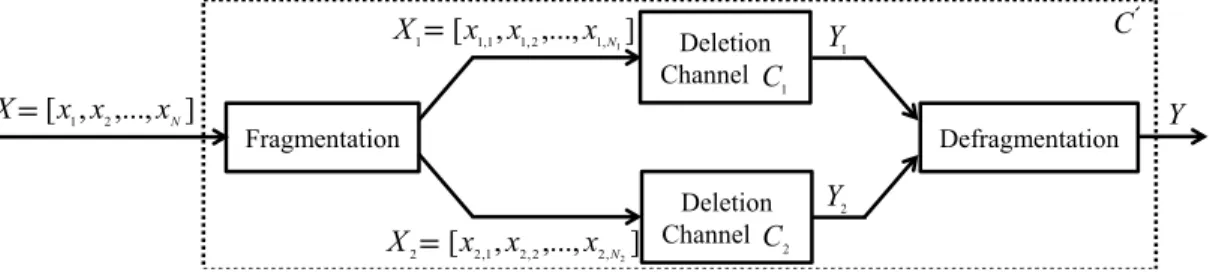
define a new binary input channelC′ (as illustrated in Fig. 1)
with input sequence of bits X and output sequence of bits Y as follows: each channel input symbol is transmitted through C1with probability λ, and throughC2with probability1 − λ,
independently of each other. Neither the transmitter nor the receiver knows the specific realization of the “individual channel selection events,” i.e., they do not know which specific subchannel a symbol is transmitted through, or which specific subchannel each output symbol is received from. Lemmas 1 and 2 (given below) demonstrate that 1) the new channel is an i.i.d. deletion channel with deletion probability
d= λd1+ ¯λd2, 2) the capacity of the i.i.d. deletion channel
with deletion probability d is upper bounded by
λC2(d1) + ¯λC2(d2) + ¯dlog ¯d− λ ¯d1log(λ ¯d1) − ¯λ ¯d2log(¯λ ¯d2).
Combining these two results, the proof of the theorem follows.
The following two lemmas are employed in the proof of the above theorem.
Lemma 1. C′ as defined in the proof of the theorem above is nothing but a deletion channel with deletion probability
d= λd1+ ¯λd2.
Proof: For each use of the channel C′, for any input
symbol x∈ X and channel output y ∈ Y, the transition prob-ability is given by P{C1 is used}d1+ P {C2 is used}d2 =
λd1+ ¯λd2. Noting that the subchannels are memoryless and
the channel selection events are independent of each other, this transition matrix precisely defines a deletion channel with deletion probability d= λd1+ ¯λd2.
Lemma 2. The capacity of the channelC′ as defined in the proof of the theorem above is upper bounded by
λC2(d1) + ¯λC2(d2) + ¯dlog ¯d− λ ¯d1log(λ ¯d1) − ¯λ ¯d2log(¯λ ¯d2). Proof: Define the fragmentation process Fx as an
N -tuple Fx = (fx[1], · · · , fx[N ]), with fx[i] ∈ {1, 2}
where the elements of the vector denotes the index of the channel that ith transmitted bit is going through, and similarly the fragmentation process Fxas an M -tuple Fy=
(fy[1], · · · , fy[M ]), where M denotes the length of the
received sequence Y , i.e., M = |Y |, and fy[i] ∈ {1, 2}
denotes the index of the channel the i-th received bit is coming from. With this definition, clearly by knowing Fx,
X1 and X2, one can retrieve X, and by knowing Fy, Y1
and Y2, one can retrieve Y .
Since X → (X1, X2, Fx) → (Y1, Y2, Fy) → Y form
a Markov chain, we can write
I(X; Y ) ≤ I(X1, X2, Fx; Y1, Y2, Fy) = I1+ I2+ I3, (2) where I1= I(X1, X2, Fx; Y1), I2= I(X1, X2, Fx; Y2|Y1), and I3= I(X1, X2, Fx; Fy|Y1, Y2). For I1, we have
I1= I(X1; Y1) + I(X2, Fx; Y1|X1) = I(X1; Y1), (3)
where we used the fact that P(Y1|X1, X2, Fx) =
P(Y1|X1), i.e., Y1 is independent of X2 and Fx
condi-tioned on X1.
Furthermore, by using the facts that P(Y2|X2, Y1) =
P(Y2|X2) and P (Y2|X1, X2, Fx, Y1) = P (Y2|X2), we
obtain
I2=I(X2; Y2|Y1) + I(X1, Fx; Y2|Y1, X2)
Fragmentation Deletion Channel 1 C Deletion Channel 2 C ] ,..., , [x1 x2 xN X ] ,..., , [ 1 , 1 2 , 1 1 , 1 1 x x xN X ] ,..., , [ 2 , 2 2 , 2 1 , 2 2 x x x N X Defragmentation 1 Y 2 Y Y C = = =
Fig. 1. Illustration of the new channel C′.
On the other hand, for I(Xi; Yi) (i ∈ {1, 2}), we obtain
(see [11] for details)
I(Xi; Yi) ≤ λiN C2(di)+log(λiN+1) + log(N +1). (5)
We are not able to derive the exact value of I3, therefore
we resort to an upper bound which results in an upper bound on I(X, Y ). Namely, we can prove that (see [11] for details) I3 ≤ N(λ ¯d1+ ¯λ ¯d2) log(λ ¯d1+ ¯λ ¯d2) − N λ ¯d1log(λ ¯d1)
−N ¯λ ¯d2log(¯λ ¯d2). (6)
Finally, by substituting (5), (6), (4) and (3) into (2), we obtain
I(X; Y ) ≤ N λC2(d1) + N ¯λC2(d2) − N λ ¯d1log(λ ¯d1)
−N ¯λ ¯d2log(¯λ ¯d2) + N ¯dlog ¯d+ log(¯λN+ 1)
+2 log(N + 1) + log(λN + 1).
Dividing both sides of the above inequality by N , letting N go to infinity, and noting that the inequality is valid for any input distribution P(X), the proof follows.
A. Generalization to the Case of Deletion/Substitution Chan-nels
In a deletion/substitution channel (special case of the Gallager channel model [12] without any insertions) with parameters (d,f ), any transmitted bit is either deleted with probability of d or flipped with probability of f or received correctly with probability of 1 − d − f , where neither the transmitter nor the receiver have any information about the position of the deleted and flipped bits. Another look at the deletion/substitution channel can be as a series concatenation of two independent channels such that the first one is a deletion-only channel with deletion probability of d and the second one is binary symmetric channel with cross error probability of s= f
1−d. It is easy to show that the result of
Theorem 1 can also be extended to the deletion/substitution channel as given in the following corollary.
Corollary 1. Let C2(d, f ) denote the capacity of the dele-tion/substitution channel with deletion probability d and flipping probability f , λ ∈ [0, 1], d = λd1 + ¯λd2 and
f = λf1+ ¯λf2, then we have
C2(d, f ) ≤ λC2(d1, f1) + ¯λC2(d2, f2) + ¯dlog ¯d
−λ ¯d1log(λ ¯d1) − ¯λ ¯d2log(¯λ ¯d2). (7)
Proof:See [11] for details.
Similar to the case of deletion-only channels, this expression provides a tighter upper bound on the deletion/substitution channel capacity compared to the existing bounds in the literature for a wide range of channel parameters (which is discussed further in the numerical examples section).
III. NON-BINARYDELETIONCHANNELS
In this section, we review a recent result reported in [10] where we have considered non-binary input deletion channels using a different fragmentation approach. Loosely speaking, instead of using a random fragmentation, a deterministic fragmentation is used and an arbitrary Q-ary channel is decomposed into parallel deletion channels with smaller al-phabets. For the Q-ary input deletion channel, by choosing an appropriate deterministic fragmentation of the input symbol set it is possible to derive a new upper bound on the Q-ary input deletion channel capacity in terms of the lower order deletion channels.
As a special case, when Q is an even number, i.e., for a 2K-ary input deletion channel, it is proved in [10] that C2K(d) ≤ C2(d)+ (1 − d) log(K). The main idea is that any
2K-ary input deletion channel with deletion probability d can be considered as a parallel concatenation of K independent binary deletion channels Ck (k ∈ {1, . . . , K}) all with the
same deletion probability d, in which the input symbols2k−1 and2k travel through Ck and the surviving output symbols
of the subchannels are combined based on the order in which they go through the subchannels. This is a useful result to come up with improved upper bounds on the capacity of non-binary deletion channels by exploiting already existing results for the binary case. Examples of improved bounds for this setting are provided in [10].
IV. EXAMPLES OF THENEWLYDERIVEDCAPACITY UPPERBOUNDS
In this section, we provide several implications of the results presented in the paper on the binary deletion channel capacity. Namely, we explicitly demonstrate the tightest upper bound on the binary input deletion channel capacity for d≥ 0.65.
An interesting application of the result (1) on the capacity of the binary deletion and deletion/substitution channels is in obtaining improved capacity upper bounds. For instance, the best known upper bound on the deletion channel capacity is
0 0.1 0.2 0.3 0.4 0.5 0.6 0.7 0.8 0.9 1 0 0.1 0.2 0.3 0.4 0.5 0.6 0.7 0.8 0.9 1 d D el et io n C h an n el C ap ac it y U p p er B o u n d d u e to [5 ]
Fig. 2. Previously best known upper bound on the i.i.d. deletion channel capacity. 0.6 0.65 0.7 0.75 0.8 0.85 0.9 0.95 1 0 0.02 0.04 0.06 0.08 0.1 0.12 0.14 0.16 d D el et io n C h an n el C ap ac it y
previous result due to [5] new upper bound
Fig. 3. Improved upper bound on the deletion channel capacity employing C(λd + ¯λ) ≤ λC(d).
not convex for d ≥ 0.65 as shown in Fig. 2 (with values taken from the boldfaced values in Table IV of [5]). As clarified in the table, the best known values for small d are due to [13], for a wide range (up to d ∼ .8) are due to the “fourth version” of the upper bound (named C4 in [5]),
and for large values of d are due to the “second version” named C∗
2 in the same paper. Therefore, the deletion channel
capacity upper bound can be improved for d ∈ (0.65, 1) as C2(1 − 0.35λ) ≤ λC2(0.65) with 0 ≤ λ ≤ 1. That is, we
have C2(d) ≤ 0.4143(1−d) for d ∈ (0.65, 1) as illustrated in
Fig. 3. Clearly, this new version of the i.i.d. deletion channel upper bound is tighter than the previous version, as we are able to “convexify” the existing upper bound.
We note that our result is a generalization of the one in [9] where it was shown that C2(d) ≤ 0.4143(1 − d) as d → 1.
We also note an earlier asymptotic result on a lower bound derived in [2] which states that C2(d) as d → 1 is larger than
0.1185(1 − d).
As another application of the approach proposed in this
pa-0 0.1 0.2 0.3 0.4 0.5 0.6 0.7 0.8 0.9 1 0 0.1 0.2 0.3 0.4 0.5 0.6 0.7 0.8 d C ap ac it y u p p er b o u n d d u e to [7 ] s= 0.03
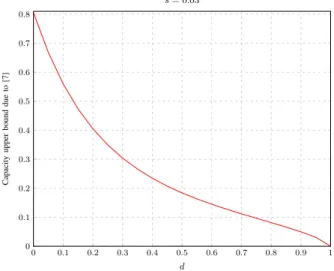
Fig. 4. Previously best known upper bound on the deletion/substitution channel capacity for s= 0.03.
0.55 0.6 0.65 0.7 0.75 0.8 0.85 0.9 0.95 1 0 0.02 0.04 0.06 0.08 0.1 0.12 0.14 0.16 0.18 d D el et io n /S u b st it u ti o n C h an n el C ap ac it y s= 0.03
previous result due to [7] new upper bound
Fig. 5. Improved upper bound on the deletion/substitution channel capacity for s= 0.03.
per, we can consider the capacity of the deletion/substitution channel. The best known capacity upper bound for this case is given in [7], e.g., Fig. 1 of [7] presents several upper bounds for fixed s = 0.03 (see Fig. 4). It is clear that this bound is not a convex function of the deletion probability for d≥ 0.6, hence it can be improved. That is, applying the result in our paper, we obtain, for instance for s = 0.03, Cs(d, 0.03) ≤ 0.3621(1 − d) for d ≥ 0.6 which is a tighter
bound than the existing one as illustrated in Fig. 5.
We conclude this section by noting that examples of improved channel capacity bounds can be given for the case of non-binary deletion channels as well. In particular, it can be shown that for moderate channel alphabet sizes, the bound presented in the previous section exploits the available bounds on the binary deletion channels effectively, and provides significant improvements over the only other alternative bound, namely, the one based on the erasure channel assumption. We omit details of these results here and refer the reader to [10].
V. CONCLUSIONS
In this paper, we considered an alternative look at the i.i.d. deletion channels. Specifically, we assumed that the input of the channel is fragmented into smaller sequences traveling through different (independent) deletion channels, and the outputs are combined without changing their order in the transmitted sequence. We showed that this new look provides a different way to study the capacity of deletion channels. For the binary deletion channel by considering a random fragmentation process, an inequality relating the capacity of a binary deletion channel to two other binary deletion channels is found. For non-binary input deletion channels, considering a deterministic fragmentation of the input and output sequences provides us with a way to upper bound the channel capacity with deletion channel capacities with smaller alphabets. An immediate application of the result for the binary input case is in obtaining improved upper bounds on the capacity of the deletion channel. For instance, for an i.i.d. deletion channel, we proved that C2(d) ≤ 0.4143(1−d)
for all d ≥ 0.65. This is a stronger result than the earlier characterization in [9] which is valid only asymptotically as d→ 1.
REFERENCES
[1] R. L. Dobrushin, “Shannon’s theorems for channels with synchroniza-tion errors,” Probs. Inf. Transm., vol. 3, no. 4, pp. 11–26, 1967. [2] M. Mitzenmacher and E. Drinea, “A simple lower bound for the
capacity of the deletion channel,” IEEE Trans. Inf. Theory, vol. 52, no. 10, pp. 4657–4660, 2006.
[3] E. Drinea and M. Mitzenmacher, “Improved lower bounds for the capacity of i.i.d. deletion and duplication channels,” IEEE Trans. Inf.
Theory, vol. 53, no. 8, pp. 2693–2714, Aug. 2007.
[4] A. Kirsch and E. Drinea, “Directly lower bounding the information capacity for channels with i.i.d. deletions and duplications,” IEEE
Trans. Inf. Theory, vol. 56, no. 1, pp. 86 –102, Jan. 2010.
[5] D. Fertonani and T. M. Duman, “Novel bounds on the capacity of the binary deletion channel,” IEEE Trans. Inf. Theory, vol. 56, no. 6, pp. 2753–2765, June 2010.
[6] S. Diggavi and M. Grossglauser, “On information transmission over a finite buffer channel,” IEEE Trans. Inf. Theory, vol. 52, no. 3, pp. 1226–1237, March 2006.
[7] D. Fertonani, T. M. Duman, and M. F. Erden, “Bounds on the capacity of channels with insertions, deletions and substitutions,” IEEE Trans.
on Communications, vol. 59, no. 1, pp. 2–6, Jan. 2011.
[8] M. Rahmati and T. M. Duman, “Bounds on the capacity of the random insertion and deletion-additive noise channels,” IEEE Trans.
Inf. Theory, vol. 59, no. 9, pp. 5534–5546, Sep. 2013.
[9] M. Dalai, “A new bound on the capacity of the binary deletion channel with high deletion probabilities,” in Proc. IEEE Int. Symp. Inf. Theory
(ISIT), pp. 499–502, Aug. 2011.
[10] M. Rahmati and T. M. Duman, “An upper bound on the capacity of non-binary deletion channels,” presented in ISIT 2013, ArXiv
e-prints:1301.6599[cs.IT], July 2013.
[11] ——, “Some results on the capacity of deletion channels,” submitted
to IEEE Trans. Inf. Theory, Sep. 2013.
[12] R. Gallager, “Sequential decoding for binary channels with noise and synchronization errors,” Tech. Rep., MIT Lincoln Lab. Group Report, Oct. 1961.
[13] S. Diggavi, M. Mitzenmacher, and H. Pfister, “Capacity upper bounds for deletion channels,” in Proceedings of IEEE International