к ¥ T t ц ^!ζ5| κ ε ϋ i T i f í и I § © c s s C Ä ä L d ü i i l feL L ííi 1^ЙЙЙ. ^ İ ö i ö i i І \а ύΰ ^j^^ ¿a ^ І ^ ^’ё ¡¿я L· 8 9 s ΰ ^ ^ s'-U V .; J ' . J ) '¿¿í 'j/ J .^. .
9Й
7 6 Э
■ • 0 3S.9S
/ Й Э ЗAN EXTENDED RELATIONAL ALGEBRA
FOR NESTED RELATIONS
A THESIS SUBMITTED TO
THE DEPARTMENT OF COMPUTER ENGINEERING AND INFORMATION SCIENCE
AND THE INSTITUTE OF ENGINEERING AND SCIENCE OF BILKENT UNIVERSITY
IN PARTIAL FULFILLMENT OF THE REQUIREMENTS FOR THE DEGREE OF
MASTER OF SCIENCE
by
Eser Siikan
fe
чѵ \ H . s
I certify th at I have read this thesis and that in my opinion it is fully adequate, in scope and in quality, as a thesis for the degree of Master of Science.
Prof, (Principal Advisor)
I certify th at I have read this thesis and that in my opinion it is fully adequate, in scope and in quality, as a thesis for the degree of Master of Science.
Assoc. Prof. Varol Akman
I certify th at I have read this thesis and that in my opinion it is fully adequate, in scope and in quality, as a thesis for the degree
Approved by the Institute of Engineering:
Prof. Mehmet B a r,^
Director of the Institute of Engineering
ABSTRACT
AN EXTENDED RELATIONAL ALGEBRA
FOR NESTED RELATIONS
Eser Siikan
M.S. in Computer Engineering and Information Science
Supervisor: Prof. Erol Arkun
January 1993
In this study the database models of Roth-Korth-Silberschatz (RKS) [cf. ACM TODS 13(4): 389—417, 1988] and Abiteboul-Bidoit (AB) [cf. Journal of Computer and System Sciences 33(4): 361—393, 1986] to formalize non-first- normal-form relations are presented along with their extended relational alge bra. We show that the extended set operators union and difference of RKS and AB are not information equivalent Using the model of RKS and restricting ourselves to union and difference, we define our extended set operators and show that these two operators and the extended intersection of RKS are infor mation equivalent.
Keywords: Data models, normal forms, extended algebra, nested relations, non-first-normal-form relations, partitioned normal form
ÖZET
IÇIÇE
il iş k il e r i ç i nGENİŞLETİLMİŞ BİR İLİŞKİSEL
CEBİR
Eser Sükan
Bilgisayar ve Enformatik Mühendisliği Bölümü, Yüksek Lisans
Tez Yöneticisi: Prof. Dr. Erol Arkun
Ocak 1993
Bu çalışmada birinci normal biçimde olmayan ilişkileri formalize etmek için Roth-Korth-Silberschatz (RKS) [cf. ACM TODS 13(4): 389-417, 198% ve Abiteboul-Bidoit (AB) [cf. Journal of Computer System Sciences 33(4): 361- 393, 1986] tarafından geliştirilmiş veritabanı modelleri ve bu modeller için tanımlanmış bir ilişkisel cebir sunulmaktadır. Gerek RKS gerekse AB cebir leri içinde yer alan genişletilmiş küme operatörlerinden birleşim ve farkın, bilgi eşdeğer olmadığı gösterilmektedir. RKS’nin modeli kullanılarak, genişletilmiş küme operatörlerinden birleşim ve fark yeniden tanımlanmaktadır. Ayrıca yeni tanımlanan birleşim, fark ve RKS’nin genişletilmiş Aesiştm operatörlerinin bilgi eşdeğer olduğu gösterilmektedir.
Anahtar Sözcükler: Veri modelleri, normal biçimler, genişletilmiş cebir, içiçe ilişkiler, birinci normal biçimde olmayan ilişkiler, bölümlemeli normal biçim
ACKNOWLEDGEMENTS
I wish to express my deep gratitude to my supervisors Prof. Meral Ozsoyoglu and Prof. Erol Arkun for their invaluable support during the development of this thesis. I also want to thank to Dr. Varol Akman for the time he spent on reading and correcting this thesis.
Contents
1 In tro d u c tio n 1
2 T h e M o d el 3
2.1 The Model of R K S ... 3
2.2 The Verso Model of AB ... 4
3 E x te n d e d R e la tio n a l A lg e b ra 7 3.1 Nest and Unnest O p e r a to r s ... 7
3.2 The Partitioned Normal F o r m ... 9
3.3 Extended Set O p e r a to r s ... 11 3.3.1 Extended U nion... 11 3.3.2 Extended Difference ... 24 3.3.3 Extended Intersection ... 35 4 C onclusions 39 VI
List of Figures
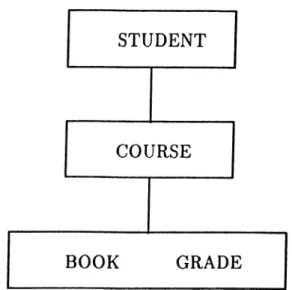
2.1 Tree representation of STUDENT(COURSE(BOOK GRADE)*)* 6
3.1 A sample flat rela tio n ... 8
3.2 An example for nest o p e r a t o r ... 8
3.3 An example for unnest o p e ra to r ... 9
3.4 Examples for ->PNF and PNF re la tio n s... 10
3.5 Purely hierarchical r e la tio n s ... 12
3.6 Extended union of ri and Г2 ... 12
3.7 The desired-result... 13
3.8 Examples for ->purely hierarchical r e la tio n s ... 14
3.9 Extended union of i*i and r ^ ... 14
3.10 The desired-result ... 14
3.11 г\ U* r-2(i) and п U® r-2(2) ... 15
3.12 Flat forms of U' 7*2(1) ^*i G® 7*2(2) ... 15
3.13 Extended difference of 7*i and Г2 ... 26
3.14 The desired-result... 26
3.15 Extended difference of ri and Г2 ... 26
3.16 The desired-result ... 26
3.17 7*1-® 7*2(1) and 7*1-® 7*2(2)... 29
3.18 Flat forms of 7*1 —' r2(i) and 7*1 —®7*2(2) ... 29
3.19 Extended intersection of 7*i and 7 * 2... 36
3.20 The desired-result ... 36
C h a p ter 1
Introduction
The first-normal-form (IN F) assumption of traditional relational model (in which all values are atomic) [8] has been relaxed by the introduction of new applications of databcise systems in areas such as text and image processing, computer-aided design, etc. which require relations within relations. A new class of relations, that of -'IN F (nou-first-normal-form or nested) relations, has been introduced for such applications. The nested relational model represents real world data better by allowing relation-valued attributes.
Nested relations have been an extensive research area since the late seventies. The nested relational model w<is first introduced by Makiuouchi [5]; this was followed by works by others [7, 6, 2, 3, 4, 1]. Among these, Schek and Scholl [7] introduced relations with relation-valued attributes and proposed a recursive relational algebra for these relations in which the standard set operators U,
—, and n are applied to ->1NF relations without any change. Abiteboul and Bidoit (AB) [2] presented the Verso model, which is a data model for ->1NF relations. The nested structure of the Verso model is obtained by the recur sive definition of the Verso instances, i.e., the attributes in a Verso instance may have Verso instances as well as atomic values. Relational algebra oper ators on Verso instances are also defined. (This will be discussed in the sequel.)
Roth, Korth, and Silberschatz (RKS) [6] introduced an extended relational algebra for a proper subset of nested relations which are considered to be in partitioned normal form (PNF). They defined extended set operators which are rather different than the ones in other works. The idea behind extended set operators is that tuples that agree on their atomic attributes are combined to
form a new tuple. Our thesis is bcised on this work and a detailed discussion of these set operators is presented in the third chapter.
G arnett and Tansel [4] proposed an extended relational algebra and showed that this algebra is equivalent in expressive power to relational calculus for nested relations. They used the standard set operators U, —, and D for nested relations without any change.
In this work we restrict ourselves to the set operators union, difference, and in tersection for nested relations in partitioned normal form. Our aim is twofold: to show that the extended set operators, union and difference, defined in [6] and [2], are not information equivalent, and to define information equivalent set operators for nested relations. A set operator is information equivalent if it generates a result which becomes equal to the desired-result when it is flat tened. Here the desired-result is the result obtained by first flattening the two relations and then applying the standard set operator to the flat relations.
CHAPTER 1. INTRODUCTION 2
This thesis is structured as follows. We present the models for nested rela tions introduced by RKS and AB in the second chapter. The third chapter contains the relational algebra of RKS and AB. We show that their extended set operators union and difference are not information equivalent and intro duce infonnation equivalent set operators (U®, —®). Proofs showing that our extended set operators and the extended intersection of RKS are information equivalent are also included in this chapter. Chapter four concludes the thesis.
C h a p ter 2
The Model
We assume that the reader is familiar with the relational model and do not go through well-known concepts such as attribute, domain, etc. We first present the model introduced by RKS. This is the model our work is based on. We then present the Verso model introduced by AB.
2.1
T h e M od el o f R K S
A ->1NF database scheme S is defined as a collection of rules of the form Rj = (R jj, . . . , Rj„), where R j, and 1 < i < n, are names. (The model uses names and attributes interchangeably.) Each of these rules represents a higher- order or a zero-order name. This means that the rules in a ->1NF database scheme may consist of any number of zero-order or higher-order names as long as the scheme is not recursive. A rule Rj is a higher-order name if it appears on the left-hand side of a rule, and is a zero-order name otherwise. The names on the right-hand side of a rule Rj form the set Er·, viz. the elements of Rj.
A zero-order name is an atomic attribute which has an associated domain. A higher-order name is a nested relation scheme whose domain is composed of the related domains of each zero-order name in this scheme.
Example: Consider a database scheme which contains the following rules:
STUDENT = (STUDENTJD, STUDENT_NAME, COURSES) COURSES = (COURSE_NAME, BOOK, GRADE)
The STUDENT database contains student identification (STUDENT-ID), stu dent name (STUDENT-NAME), and the courses taken by the student (COUR SES), for each student. STUDENT and COURSES are higher-order'names and the others are zero-order names. □
A relation scheme R is called a subscheme if no zero-order name appears on the right-hand side of two different rules in the scheme. To define the subscheme of a database S, let Rj appear only on the left-hand side of some rule in S (i.e., Rj is an external name). The rules in 5 that are accessible from Rj form a subscheme of S defined cis follows:
1. Rj = {Rj^ , . . . , Rj„) is in the subscheme, and
2. Whenever a higher-order name Rk is on the right-hand side of some rule in the subscheme, the rule Rk = (R t,, . . . , Rk„) is also in the subscheme. An instance r of a name R is defined as an ordered tuple < R, V r > where
Uyi is a value for R. For zero-order names, U« is an atomic value from the associated domain of /?, while for higher-order names, it is a value composed of the values from the related domains of the names on the right-hand side of R.
A database structure S — < S ,s > is composed of the database scheme S and an instance s of that scheme. A relation structure 7?. = < /?, r > is composed of the relation scheme R and an instance ro f that scheme. Two structures 5 / and S s are equal if their schemes and instances are equal, respectively. (Two relation schemes Rj and Rs are equal if they consist of the same rules.)
NB. In this model (of RKS), null values in ->1NF relations are not consid ered.
CHAPTER 2. THE MODEL 4
2.2
T h e V erso M odel o f A B
Before we define the model, we present the notation of AB. The set of tuples over a relational scheme Kis denoted tup(V), and the set of relations is denoted rel(V). The set of ordered tuples over some string X (i.e., a set of attributes.
CHAPTER 2. THE MODEL 5
X = A; . . . An) is denoted Otup(X) and the corresponding set of attributes in a string X is denoted set(X) (= {A\A € A"}).
The d ata structure of the Verso model is defined by using the concept of for mat. A format is defined as follows:
1. If A is a finite string of attributes with no repeated attribute, then A is a flat format over set(X), and
2. If A is a nonempty finite string of attributes with no repeated attribute and ,/n formats over V/, . . . , respectively, then the string A (/; )* • · · (/n)* is a format over the set set(X) Yi . . . T«, where set(X), Y j, ...,
Yn are pairwise disjoint.
Null values can be represented in the Verso model. The empty string is a for mat which is denoted A. If / = X{fj )* . . . (/n)* is a format, and fi = A for some », I < i < n, then / = A(/, ) · . . . ( /_ ; )’ ... (/„)·.
Example : If we le t/, = STUDENT COURSE GRADE, then // is a format over {STUDENT, COURSE, GRADE}. Now if we let /2 = STUDENT(COURSE-
(BOOK GRADE)·)·, then / 2 is a format over {STUDENT, COURSE, BOOK,
GRADE).
Directed trees are used in [2] to represent formats. Figure 2.1 shows the tree representation of /». The root of the tree is STUDENT (the flat format of /2),
and the only branch of the tree is (COURSE(BOOK GRADE)·)·. □
The set of all instances, inst(f), over a format / is defined as follows:
1. If / = A and set(X) φ 0, then / is in inst(f) iff / is a finite subset of Otup(X), and
2. If / Ξ A(// )· . . . (/n)·, where / / , . . . , / » are nonempty, then I is in inst(f) iff
(a) / is a finite subset of O tup(X )xinst(fj) x . . . x inst[fn), and (b) if < u , > and < u , J i , . . . , J n > are in I for some
CHAPTER 2. THE MODEL
Figure 2.1: Tree representation of STUDENT(COURSE(BOOK GRADE)*)*
Thus, in the light of condition (2), the atomic attributes of a format constitute a key.
Extended Relational Algebra
C h a p ter 3
In this chapter we present the extended relational algebra of RKS, and AB by restricting ourselves to U, —, and n . We also show that the extended operators union and difference are not information equivalent and introduce our own extended set operators which are shown to be information equivalent.
3.1
Nest
and
Unnest
O p era to rs
Two new operators nest(i/) and unnest(fi) are introduced in the extended re lational algebra of RKS. We use these operators in order to show that our extended set operators are information equivalent. These operators modify the relation structures that they act upon.
Nest combines the data values which agree on some of their attributes and is defined as follows in [6]:
Let R be a relation scheme, in database scheme 5, which contains a rule R = ( A / , . . . , An) for external name R. Let { B i , . . . , C Ejt and { C /, . . . , (7*} = Er — { B i, . . . , Bm}· Assume that either the rule B = ( B j B m ) is in S or
that B does not appear on the left-hand side of any rule in S and (B /, . . . , Bm) does not appear on the right-hand side of any rule in S. Then i^B=(Bj,...,Bm)i^) = < R \ r > = 1Z' where:
1. R = (C /, . . . , (B /, . . . , Bto)) — ( C / , . . . , Ci, B) and B — ( B /,. . . , Bto)
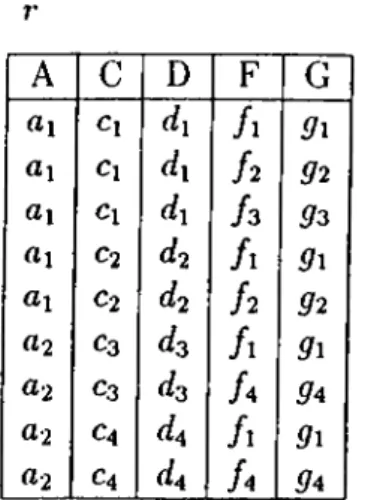
CHAPTER 3. EXTENDED RELATIONAL ALGEBRA A C D F G «1 Cl di f l <7i Cl di / 2 92 ax Cl dx / 3 9 3 ax C2 ¿2 / 1 9\ ax C2 ¿2 / 2 92 «2 C3 ¿3 / 1 9\ a-i C3 ¿3 / 4 94 a-2 C4 (¿4 / 1 9i «2 C4 ¿4 / 4 94
Figure 3.1: A sample flat relation
¡^E=iF,G)it^B={C,D){r)) Fb=(C,D)Í¡^E={F,G)Í‘>')) A B E c D F G «1 Cl dx /1 9\ C2 d-2 / 2 92 a\ Cl dx / 3 9s « 2 C3 ¿3 /1 9i C4 ¿4 / 4 94 A B E C D F G Cl dx / 1 9i / 2 92 / 3 93 «1 C2 <¿2 / 1 9i / 2 92 C2 C3 ¿3 / 1 9i C4 d^ / 4 94
Figure 3.2: An example for nest operator
2. r = {t I there exists a tuple u € r such th at t[C\ . . . Ck] = u[Ci... Ck] At[B] = {v[Bt . . . Bm] I w € r A v[Cj . . . Ct] = t[Cx. . . C*:]}}
Example: Let r b e a relation on the relation scheme R = {A, C, D, F, G) (Fig ure 3.1). Two relations FB={c,D){^E=(F,G){f')) 3-nd t'£;=(F,G)(^'B=(c,D)(^)) (Figure 3.2) with the scheme R' = [A, B, EJ), B = (C, D), E = {F, G) are obtained from rb y applying the nest operators in different orders (i.e., in the first table of Figure 3.2 r is nested with respect to B and in the second table it is nested with respect to B, E.) O
Unnest, on the other hand, flattens a relation on some attributes, and is defined as follows in [6]:
CHAPTER 3. EXTENDED RELATIONAL ALGEBRA A C D E F G Cl di /1 9\ / 2 92 ai C2 d2 / 1 9\ / 2 92 a\ Cl di / 3 <73 (l2 C3 ds /1 <7i / 4 <74 (l2 C4 d. /1 <7i / 4 9a A C D E F G a\ Cl <fi /1 9\ / 2 <72 / 3 <73 a\ C2 dz /1 <7i / 2 <72 02 C3 ^3 /1 <7i / 4 <74 02 C4 d. /1 <7i / 4 <74
Figure 3.3: An example for unnest operator
= ( A ; ,..., An) for external name R. Assume that B is some higher-order name in Er with an associated rule B = { B j , Bm)· Let { C /, . . . , Ct}
= Er — B. Then hb={Bj = < R ■,1' > = TZ where:
1. R' = (C l, . . . , Ck^ B j , . . . ^ Bm) and B = ( R / , . . . , R ^ ) is removed from the set of rules in S if it does not appear in any other relation scheme, and
2. r' = {t I there exists a tuple u € r such that t[Ci . . . Ck] = u[Ci . . . Ck\ A t[B, . . . Bm] 6 «[iS]}.
Example: Let us unnest the relations r/ = ve=(f,g){i'b=(c,d)('>')) and
rs = vb=(c,d)(^e=(F,g){'>')) (Figure 3.2) with B. The results /2 5(7-1) and /2 5(7-2)
are shown in Figure 3.3. If these results are unnested with E, the flat relation r (Figure 3.1) is generated. □
3.2 T h e P a r titio n e d N orm al Form
Since it is possible to obtain different relations by nesting the same relation with respect to the same nest operators in different orders, the class of ->1NF relations are restricted and only the relations in partitioned normal form (PNF) are considered in [6]. The partitioned normal form restriction guarantees that nest is an inverse of unnest and provides a less redundant representation of -»INF relations.
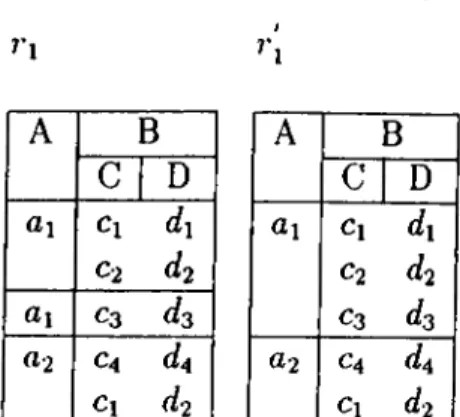
CHAPTER 3. EXTENDED RELATIONAL ALGEBRA 10 »*1 A B c D ax Cl di C2 d2 a\ C3 ds «2 C4 d. Cl (¿2 A B C D Oi Cl di C2 (I2 C3 ds «2 C4 d. Cl d'2
Figure 3.4: Examples for -'PNF and PNF relations
Example: The relation r/ (Figure 3.4) is a ->1NF relation that is not in PNF, while r\ in the same figure is a ->1NF relation in PNF that represents the same information cis r / . □
Now let us introduce the definitions for PNF as presented in [6] :
D efin itio n 5.1 Let X, F C Er for some relation structure 72. = < R ,r >. The functional dependency (FD), X —y holds in riflf for all tuples in r, if ti[X\ = ts[X\ then ti[Y\ = to[Y\. (If X ov F is a higher-order name then we mean set equality.)
D efin itio n 5.2 Let 72 = < /?, r > be a relation structure with attribute set
Er containing zero-order names Ay, . . . , A* and higher-order names Ay, . . . , A/. 72 is in partitioned normal form (PNF) iff
1. Ay, A s ,. . . , At —♦ and
2. For all and for all A,, 1< e < /, 72(. = < A,·, <[A,]> is in PNF. In the light of these definitions, a nested relation without any zero-order at tributes {k = 0) is in PNF iff it contains a single tuple (cf. [6], p. 397).
The work of RKS aims to prove that given a relation in PNF, whenever an operator (nest or unnest) is applied, the result is also in PNF . This is true for unnest in any case, and true for nest in some special cases. These are stated as T h e o re m s 5.1 and 5.2 and proved in [6]. For convenience, we state these
CHAPTER 3. EXTENDED RELATIONAL ALGEBRA 11
theorems now.
T h e o re m 5.1 The class of PNF relations is closed under unnesting.
T h e o re m 5.2 The nesting of a PNF relation is in PNF iff in the PNF relation = < R-,r >, A /, . . . , Ai X i , . . . , Xi where A / A * are the zero-order names iii Er not being nested and X i . ,X i are the higher-order names in Er not being nested.
3.3
E x te n d e d Set O p erators
A common point of extended set operators defined in [6], [2], and our work is
th at they are all recursive formulations. In another approach, two relations are flattened, any standart set operator is applied to these flat relations, and the resultant flat relation is restructured into its original structure. In this approach the property that nest is an inverse operator for unnest is required. (This is not always possible.)
3.3.1 Extended Union
E x te n d e d U n io n of R K S
To be able to take the union of two structures, the schemes R\ and R2 of these structures must be equal. We do not need restructuring, i.e., the scheme of the resultant structure is also equal to Ri and R-z· The extended union is defined by RKS as follows:
Let X range over the zero-order names in ER^ and Y range over the higher- order names in ER^. Then,
n U' T2 = {i I (3<i € ri, 3t-2 e r^:
{ ^ X , Y e Er,: t[X]=t^[X]=h[X] A t[Y] = (i,[r]
V (i 6 7-1 A (Vt' € 7-2 : {VX 6 Er,: t[X] 7^ i'[X])))
V (i G T2 A (Vi' € r, : {WX G Er,: t[X] ji i'[X])))}
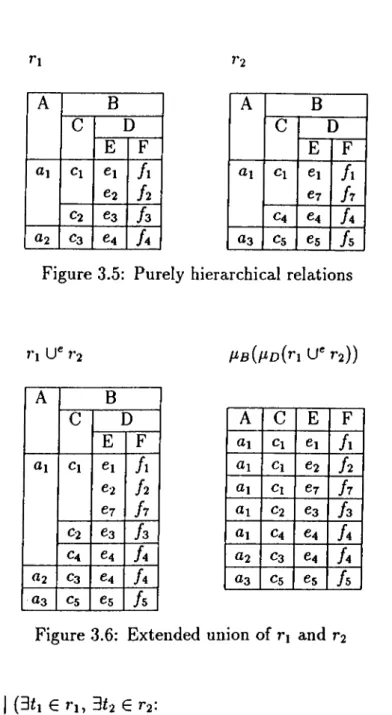
CHAPTER 3. EXTENDED RELATIONAL ALGEBRA 12 ri r2 A B c D E F a\ Cl Cl /1 C2 /2 C2 C3 /3 Ü2 C3 64 /4 A B c D E F Oi Cl Cl /1 C7 /7 C4 64 /4 ^3 C5 Cs /5
Figure 3.5: Purely hierarchical relations
ri U* Í-2 tíB{tíD{r\ U* 7-2)) A B C D E F ai Cl Cl /1 C2 /2 C7 /7 C2 C3 /3 C4 64 /4 Ü2 C3 64 /4 03 C5 Cs /5 A c E F Ol Cl Cl /1 Ol Cl C2 /2 Ol Cl C7 /7 Oi C2 C3 /3 Ol C4 64 /4 02 C3 C4 /4 03 C5 C5 /5
Figure 3.6: Extended union of r-i and T2
ri U' T2 = {< I (3ii 6 ri, 3^2 € T2:
( y X , Y e Eft,: t[X\=h[X\=t2[X] A t[Y] = (ti[r] U' ¿ 2 ^ )))
V (< € r, A (Vi' € r-2 : (3JA € Er,: t[X] / t'[X])))
V (i € 7-2 A (Vi' € ri : (3 X € Er,: t[X] ^ i'[JSf])))}
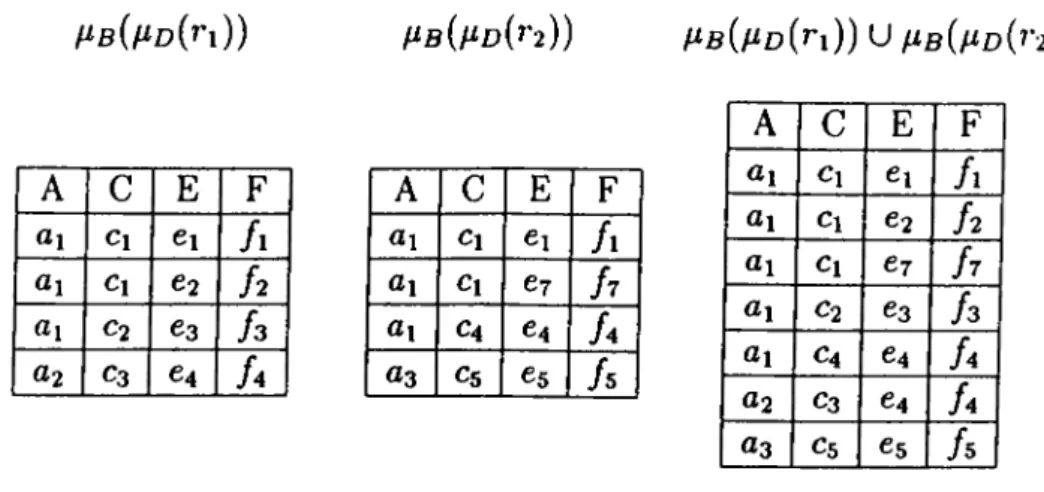
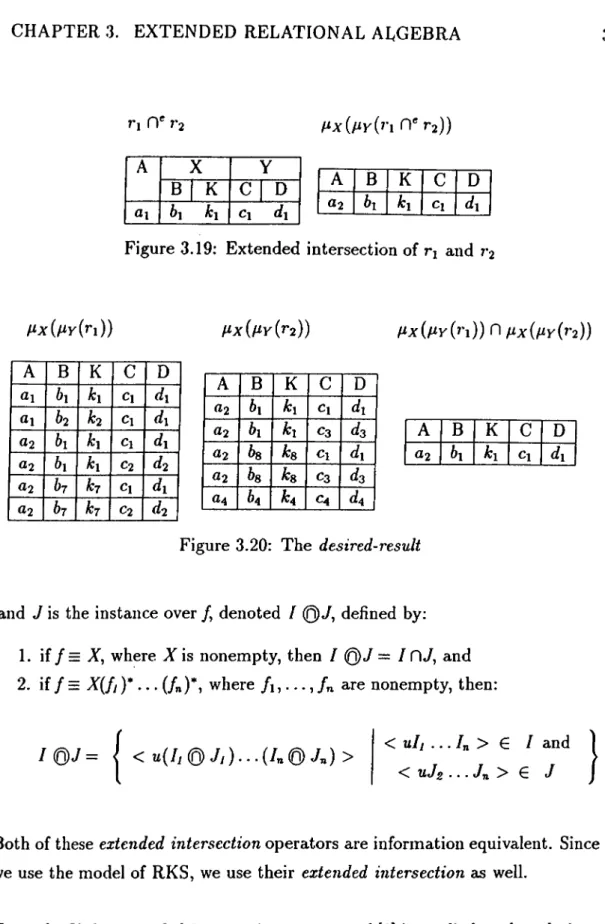
The examples of extended union in [6] are interpreted with respect to this corrected definition. If they were interpreted with respect to the original RKS definition, it would not be possible to obtain the results in [6]. In the following examples the corrected extended union definition is applied to the relations ri and r» in Figure 3.5 . The result r/ U* r® and the flat form of this result O' r®)) are shown in Figure 3.6 . If we compare the flattened result with the desired-result that is found in Figure 3.7, we see that they are equal.
CHAPTER 3. EXTENDED RELATIONAL ALGEBRA 13 ^J-в{í^■D{rı)) ^lв{^l■D{rı)) U /í b(aí£j(í-2)) Ol Oi Ü2 Cl Cl C2 C3 E C l C2 C3 64 h / 2 / 3 / 4 A C E F Oi Cl Cl / 1 O i Cl C7 / 7 a i C4 64 / 4 <13 Cs ^5 / 5 A C E F O i Cl C l /1 «1 C l C2 / 2 ai C l C7 / 7 « 1 C2 C3 / 3 O i C4 64 / 4 02 C3 64 / 4 0 3 Cs Cs / 5
Figure 3.7: The desired-result
Although it is not mentioned in [6], the extended union operator produces correct results for only nested relations that are purely hierarchical. A purely hierarchical relation is a nested relation with n nesting levels, n € N·*", for all nesting depths t, 1 < i < n, \H A i\ = 1, where H A i is the set of higher-order
attributes in the relation structure of the nesting-level. If a nested rela tion is not purely hierarchical (i.e., if it contains more than one higher-order attributes in at least one of the nesting levels), the extended union operator introduces some irrelevant tuples.
Example: Let us show the validity of our last remark with an example, ri, 7-2,
riU * r2, /iA-(/ir(ri U 'ra)), px{pY{ri)), p x{p Y {r2)), and px{pY{r-i))
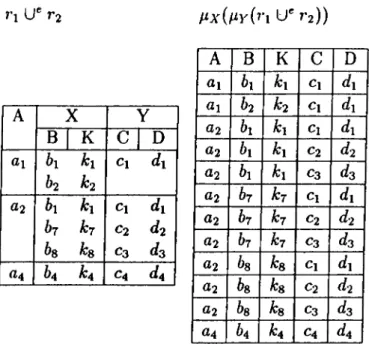
U px{pY {r2)) are shown in Figures 3.8, 3.9, and 3.10. px{pY {r\ U' 7-2)) in
cludes some irrelevant tuples, e.g., < a2hjk7Czdz > and < a2bskgC2d2 >, which are neither in px{pY {r\)) nor in px{pY{r2)). As a result, the extended union operator of [6] is not information equivalent. □
The class of PNF relations is closed under extended union of [6] which is stated as a theorem (T h e o re m 6.1) in [6]. This theorem states that the structure = < R ,rs > is in PNF, given that the structures K i = < R ,r j > and R,2 = < R, rs > are in PNF. We think that the PNF restriction on the resul tant structure makes the extended union definition non information equivalent. Dropping this restriction on the resultant relation structures provides us with a new definition for extended union. The class of PNF relations is not closed under the new extended union.
CHAPTER 3. EXTENDED RELATIONAL ALGEBRA 14
r\
r2
A X Y B K C D a\ bi ki 62 ¿ 2 Cl di Ü2 bi ki bj kj Cl di C2 <¿2 A X Y B K C D Ü2 b i k i bs k s Cl d i C3 ¿ 3 0,4 64 k4 C4 c/4Figure 3.8: Examples for -»purely hierarchical relations
ri U' T2 tix iiiv in U' r2)) A X Y B K C D ai b i C l d i i>2 ^2 0-2 6 1 k i C l d i 67 k 7 C 2 d2 6s k s C3 d3 0 4 64 k 4 C4 d 4 A B K C D Cl bi A:, Cl di Cl ¿2 A.-2 C l d i 0 2 61 k i Cl d i Ü2 61 k i C2 d2 (¡■2 ¿>1 k i C3 ds 0 2 67 k r C l d i O2 67 k j C2 d2 O2 67 k y C3 ds O2 ¿8 k s Cl d, 0 2 k s C2 d2 Q>2 bs k s C3 dz Ü4 64 k4 C4 d4
Figure 3.9: Extended union of ri and T2
H xiliviri)) tíx{fiY{r2)) t i x i l i v i n ) ) ^ tix{tiY{r2))
A B K C D Oi bi k \ Cl d i Oi 62 k2 Cl d i Ü2 bi k i Cl d \ Ü2 bx k i C2 ¿2 Ü2 67 k j Cl d i Ü2 67 ky C2 ¿2 A B K C D 0 2 61 A:i Cl d i Ü2 bi k i C3 d z Ü2 ^8 k s Cl d i Ct2 k s C3 ¿ 3 a A 64 k4 C4 d4 A B K C D « 1 61 kx Cl d i O l b2 k2 C l d i 02 bx kx C l d i bx kx C2 d2 « 2 bx kx C3 d z « 2 67 k j C l dx 0 2 67 k y C2 d2 O2 ^8 k s C l dx « 2 ¿8 k s C3 d z O4 64 k4 C4 d4
CHAPTER 3. EXTENDED RELATIONAL ALGEBRA 15 ri U' 7-2(1) U' T2(2) A X Y A X Y B K c D B K c D «1 61 Cl di « 1 61 kx Cl d\ ¿2 ^2 62 k2 02 bi kr Cl ¿1 «2 61 kx C2 ¿2 C2 ¿2 67 kj C3 02 i>i kx C3 dz 02 67 kj Cl ¿ 1 bs ks C2 ¿2 02 bx kx Cl d\ O2 6s ks Cl ¿1 O2 67 kr C3 ¿3 O2 ¿8 ks a4 64 ¿4 C4 d>4 «4 ¿4 k n C4 (/4 Figure 3.11: ri U' ?’2(i) and ri U' 7*2(2)
Mx(Mr(n O' 7-¿))(j) /^x(/^y(n U '7-2))(2) A B K C D O i bx fcl C l dx a\ 62 ^ 2 C l dx 0 2 A:i C l dx 0 2 61 k x C2 d2 0 2 bx kx C3 d s O 2 b7 k j C l dx O 2 6 7 k j C2 d2 « 2 k s C l dx 0 2 ¿8 k s C3 d z O 4 64 k 4 C4 ¿ 4 A B K C D Ox bx kx Cl d\ Ox b2 k2 Cl dx 02 bx kx C2 d2 02 h h C2 d2 Ü2 bx kx C3 dz 02 bs ks C3 ds «2 bx kx Cl dx 02 67 kr Cl dx 02 bs ks Cl dx 04 64 k4 C4 ¿4
CHAPTER 3. EXTENDED RELATIONAL ALGEBRA 16
E x te n d e d U nion of AB
Before defining the new extended union^ let us go through the extended union of (2).
Let / be a format and I, J two instances over /. Then the union of I and J is the instance over /, denoted /0 7 , defined by:
1. If / = A, where X is nonempty, then / 0 7 = / U7, and 2. If / = X{ft )* . · · (/n )*, where / i , . . . , are nonempty, then:
I ® J = ^ < M ( / y 0 7 / ) . . . ( / n 0 7 „ )> U ^ < « / / . . . / „ > U < < uJi . . . 7„ > < « / / . . . / „ > € I and <C u j / . . . 7n > 6 7 < « / ; . . . / „ > € /, and ^7/ . . . 7 n , ^ Utl ¡ . . . 7n ^ ^ 7 < uJJ . . . Jn > € J and V / ; . . . / „ , < « / , . . . / „ >íé/
The extended union of [2] is similar to th at of [6] and produces the same results with the previous examples; the tuples that agree on their atomic attributes are combined to form a new tuple. It produces correct results only for purely hierarchical relations (and therefore it is not information equivalent).
T h e N ew E x te n d e d U nion
In the following extended union definition, HA is the set of all higher-order names in Er, and HAy. is the set of all higher-order names in Eγ^. X ranges over the zero-order names, while Y ranges over the higher-order names in Er.
Given two relation structures TZi = < R ,r i > and 72.2 = < /?, PNF, the extended union with the structure TZz = < /?, ri U 'r2 > is defined as follows
at the instance level:
Ty U* r« = {i I (3<y 6 r i,3 ts € r® :
(VA, Y 6 Er,,\H A \ < 1 : t[X] = t,[X] = ts[X]
M[ Y ] = ( t , [Y] f j ’ hi Y] )) ) \/( 3 i/ € r i,3 t. € r . :
CHA PTER 3. EXTENDED RELATIONAL ALGEBRA 17
t t [ Y i \ ^ t , [ Y i ] ) M [ X ] = t , [ X ] ^ t , [ X ]
At[Yi] = {í,|( 3í; € < л к ] : t, = Л (v í;; g с л к] = (ЗА € Еу, : Q X ] ф [А]))}
At [ HA- {Yi }] = t , [HA-{Yi }])) \ /( 3 t , е r¡,3 ts € Гг :
(VA,3T,· e E R , , l < i < \НА\,\НА\ > 1 : (ЗУ^ € (Я Л -{Г ,}) : t . m ^ t A y j ] ) ^ t w = ti[x] = t2[x]
At[Yi] = {í,i(3<; € t,[Yi] : í, = Л (v í;; e ■.
(ЗА e Ey, : Q x ] Ф í;'[A]))} At [ HA- {Yi }] = ts[HA-{Yi}]))
\ / ( 3 t j e r i,3 ts e rs :
(VA,3F,· e E R „ l < i < \HAl\ HA\ > 1 : (3K, € (Я Л -{Г .}) : ti[Yj] Ф h[Yi ]) At [X] = U[X] = t,[X] A Xy, =i,¡ {A|A G Ek,}
a í[Ak.] = {í, .i(3í; € í/ [t.-],3í;; g с л ш : (VA G Як. : t j X ] = Q X ] = <;'[А]))} ЛЯЛ = ^ ,/(Я А -{ У .} )и Я Л к ,
Л[(|ЯЛ| > 1 : t[HA] G {tj[HA] U' ts[HA])) Y{\HA\ < 1 : t[HA] = (ti[HA] U' СЛЯЛ]))])) \/( 3 ti G r/,3 Î2 G r* :
(VA G Я д,,1 < ¿ < |Я Л |,|Я Л | > 1 : t[X] = t,[X] = ts[X] A (V n G (ЯЛ - { Y i } ) : t,[Yi] = ¿ЛП] Л t[Yj] = ^Л^^Л) At[Yi] = {t,[Yi] иЧг[Г.·])))
V ( i € Г; Л (Vi' G гг : (ЗА G Яд, : t[X] ф í'[A]))) V ( í € гг Л (Vi' G Г; : (ЗА G Яд, : i[A] ф í'[A])))}
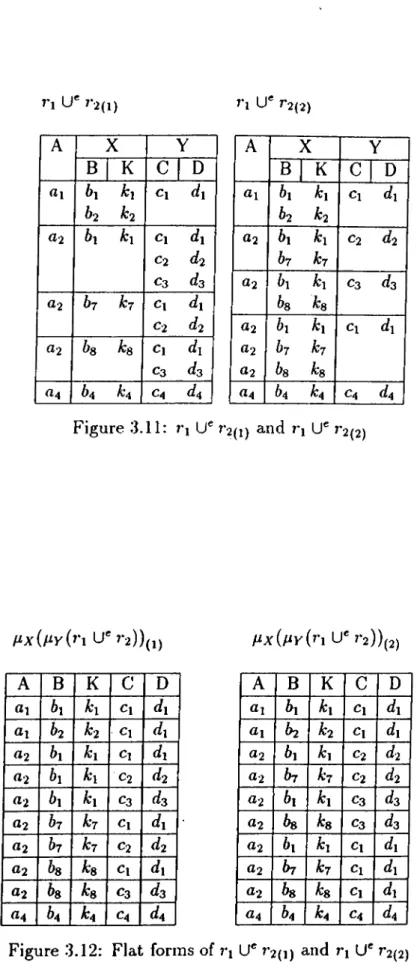
Example: When the new extended union operator is applied to the relations i'i and Г2 (Figure 3.8), it is possible to obtain the results rj U' and ri U* 7*2(2)
(Figure 3.11). If we compare the flattened forms p x { p y { r i U‘ r2))^ı^ and f ixi f i vi ri U® Г2))(2) (Figure 3.11) of ri U' T2(i) and rj U* Г2(2) with the desired-
result (Figure 3.10), we notice that these three are equal. The difference be tween n U* Г2(1) and Г1 U® Г2(2) is because of different permutations of Pi’s in
CHA PTER 3. EXTENDED RELATIONAL ALGEBRA 18
higher-order names in Er. We have npermutations of T. ’s with n higher-order
names (that is, Vi U' r-2 can be represented in n different formats). This is an expected result once we remember that ri U' T2 is not in PNF and nest is not
an inverse operator for unnest in this case. □
T h e o re m 3.1 The extended union operator is information equivalent. Proof The proof has several cases:
1. \HA\ = 0 (flat relations).
2. nesting-depth = n (6 N"*·), for all nesting-depth, ¿, 1 < î < n: \HA\ = I (purely hierarchical relations).
3. \HA\ > 1, and each higher-order attribute Y in Er is a flat relation.
4. \HA\ = n (€ N+) and 3 Y & Er : \HAy\ = m (€ N+).
(1) In this case ri and T2 are flat relations, so we show that ri U' r^ = r*i U T2.
Ç part: If i € ri U' r2, then t satisfies one of the following three disjuncts
of the U® definition:
(a) (t € r, A (Vi' € T2 : (3 X 6 Eri : t[X] i'[X])))
(b) (i e T2 A (Vi' € ri : ( 3 X € ERг : t[X] / i'[J^])))
(c) {3tr e n ,3 t2 € Î-2 : (VX, Y 6 Er i,\HA\ < 1 : t[X] = U[X] = ¿2[X]
Ai[K) = (U[Y\ U' h\Y])))
(since \HA\ = 0, there is no higher-order attribute and there is no i[ Y\)
If t satisfies the first disjunct, then t Ç. r\ only, the second, then i € T2 only,
and the third, then i € ri, or T2, or in both. It is obvious that i 6 ri U T2 in
any of these three cases, therefore ri U® ^2 Ç rj U T2.
D part: Let i € ri U T2, then t is either in: (a) Ti only, or
(b) T2 only, or (c) Ti and T2.
CHAPTER 3. EXTENDED RELATIONAL ALGEBRA 19
Since three disjuncts mentioned in the C part of the proof include all those tuples either only in rj, or only in T2, or in both, a tuple t in rj U r-2 will be in
Ti U* T2. Therefore ri U® T2 3 ri U r2.
(2) In this case we show that
(·.. (/iy, ( n U® T2)) ...) )
= ))···)) U /iy„(/iy„_,(---(My,(r2))...)),
where Yi is the higher-order attribute of the nesting level. The proof is by induction on the nesting-depth n.
Basis: We show that h y{i’\ U® T2) = /^y(^i) U /xi'(r2), where n = 1 and Y
= X l...X m .
D part: We show that if i € /iy(yi) U /iy (r2), then t 6 /iy(ri U® T2). /iy (ri)
and p-Y{r2) are flat relations, so t is either only in ^y'(ri), or only in Py{t2),
or in both, and it’s either unnested from some u\ in ri, or some U2 in T2, or
some U3 in both. We can say that t [ X \ . .. Xm\ € tti[V] V t [ X i . . . X,n] € U2[Y].
In the extended union of i’l and r*2, U\ and will be included either as two
distinct tuples, or as a tuple u, where u[T] = ui[Y] U® U2[Y]. Obviously t will be included in /iy(ri U® T2) in any case.
C part: We show that if t € /iy(ri U® T2), then t € PY{ri) U pY{r2)· If we
partition PY{r\ U® T‘2) on Er—X \ . . . X ^ and obtain the partitions « i , . . . , u^,
then we must show that all tuples i i , . . . /„ in any partition of pY{r\ U® r2) are
in p y(7’i) U p y^tz)· The tuples i i , . . . , are obtained by unnesting the set of
tuples Ui,...,Ufc, each of which is a partition on Er — Y in ri U® T2. This
means that for all ¿, 1 < i < n, 3^, I < j < k, such that ti[X\ . . . Xm] € 7ij\Y], and Ui=i = {U[X\ ■ ■ · Xm] I 1 < i < n). Each Uj is created by the ex tended union of two tuples, Uj^ 6 r\ and € r2. Since K is a flat relation,
€ (U * = in /[^] V Uy=i ni^[^])· When the tuples u / and uj^ are unnested into tuples u/^, (1 < * < pi) and u/^, (1 < / < P2)> we have (J^_i Uj^\Y] = W [ X i . . . I 1 < / < Pi} and UUi · · · ^ - 1 1 1 < ^ < and we can say { U[ Xi . . . A’„i] | 1 < * < «} C . . . X,,,] 11 < / < Pi) U M X l . . . X m ] \ l ^ i ^ P2}· Therefore p y{i’\) U p y (r2) contains all the tuples
CHAPTER 3. EXTENDED RELATIONAL ALGEBRA 20
in Hv{ri U 'r2).
Induction Step: By the induction hypothesis, we know that
.. {pYx (ri U' r j ) ) ...) )
= PYn-i {PYn-ii- · · (PYi (n ) ) · ·.)) O' pγ„_^ (py„_2 (· · · if^Yi {'’2)) · · ·))
for the first (n — 1) nesting levels, where Yi is the higher-order attribute at the nesting level, 1 < i < n — 1. We now show that this is also true for n nesting levels. If we unnest both sides of the previous equation with VJ,, we obtain
PYn{PYn-i (· · · U' r2 ))...) )
= PYn[PYn-ii· · · (PYi ( n ) ) · · ·) O' pγ„_^ ( ... (^K, (»'2)) · · ·)]
Let r[ = ( ... (/iy, ( r i) ) ...) and r'^ = ( ... (/iy, ( r j ) ) ...) ,
now we have
P Y r . i P Y „ - i i - - - { P Y i i r i O ' 7-2))...)) = AiK„(ri'u'r2).
Since r | and Tj are relations whose nesting-depths are 1, PY„{r\ U' r'2) = /iyn(n ) 0 /iy„(r2), which is proved to be true in the basis step. If we substitute
ri and r i by their equivalents, we will have
PYn{PYn-i(· · · (/^n(^ 1 O' 7-2) ) ...) )
= PYn{PYn-ii---{f^Yii^i))···)) O /iy„(^y„_i(. ..(^ n (f2 ))···))
(3) In this case we show that
P Y n ( P Y n - i (· · · if^Yi ( n O' ra)). . . ) )
= MYn(PYn-i (■ · · (MYi (n )) · · ·)) O PYn(PYn-i (· · · (/^n (^2)) · ·.))
The proof is by induction on the number of the higher-order attributes at the first and only nesting level.
CHAPTER 3. EXTENDED RELATIONAL ALGEBRA 21
Basis: We show that /iy,(/iy,(ri U' r2)) = цγ^{цγ^{rı)) U / ^ v , w h e r e
\HA\ = 2 ^ n d Y ^ = X x . . . X ^ , Y 2 = X i . . . Xk^
D part: We show that if t 6 /^Vi(/^rj(n)) O/iy,(/iK,(r2)), then t € pLY^{pY^[r\ U*
r2)). Since pγ^ (/iyj(ri)) and /iy, (/iyj(r2)) are flat relations, t is only in f^γ^ {nY^{r\
)), or only in fiYt{fiY2{r2)), or in both. So t is unnested from some u\ € n , or U2 € T2, or uz in 7’i and T2. Then we can say th at {t[X\. . . AT,,,] € «i[Vi] A
t[Xi...Xk] € Ui[r2]) V {t[Xr...X,n] e U2[ri] e U2[Y2]). in the
extended union of n and T2, Ui and « 2 will be included either as two distinct
tuples, or as a new tuple (formed by Ui and U2)· In any case, t is in the
unnested form of the tuple, therefore t 6 pγ^{pγ^{rı U* 7-2)).
C part: We show that if t € /^K, (^ 1 C® rz)), then t G fiYiifiYiiri)) U
//y, (/xyj(7’2)). In this case, t must be unnested from some u in rj U® T2, and
t G pYi(pYj{u)). Since u G Ti U* 7’2, u satisfies one of the disjuncts in the U' definition. Each of these disjuncts includes those tuples either only in 7’i, or only in T2, or in both. Then ^y, (^yj(tx)) is either:
(i) or
(ii) f^Yiif^vM) ^ /*yi(/^Vj(»’2)), or
(iii) /iy,(/iy,(u)) C /iy,(//yj(r2)), and pY^{pY^{u)) C /iy, (/iy2(r2))
From (i), (ii), and (iii), pY^{pY^{u)) C /iy,(/iyj(ri)) U /¿^,(/^^2(^2))· Since we
know that t G pYi{fiY^{u)), then t G fiYiil^Ytiri)) U fiYiifiY^ir-i))·
Induction Step: By the induction hypothesis, we know that
fiYn-i if^Yn-2i· · · it^Yi (n C® T2)) . - .))
= t^Yn-i if^Yn-ii- · · if^Yi (ri)) · · ·)) U* //y„_, il^Yn-ii- ■ · (/iy, (^2)) · · ·))>
for the first (77— 1) higher-order attributes of Er, where n > S. Now we
show that this is also true for ti:
f^Yn {f^Yn-i (· · · it^Yi (n U® T2)) . . .))
= t^Yn{t^Yn-i (· · · it^Yi (ri)) · · ·)) U* tiY„(/^y„_, (·. · (/iy, (^2)) · · ·))·
CHAPTER 3. EXTENDED RELATIONAL ALGEBRA 22
r2) ) ...) is unnestecl with Yn and j·/ and are substituted as in case (it), we
obtain,
(· · · (/^n (o C' T2)) ...) ) = f^Yniri U' /-2').
Since r / and T2* are relations which have one higher-order attribute and one nesting level, U® Tj) = fiY„(r[) U /iy-„(r2'), which is proved to be true in
the basis of case(2). Therefore
( ... {fiYi (ri U' 7-2) ) ...) )
= fiYnif^Yn-i (· · · (/^r,(n)) · · ·)) O (·.. {fiYt (^2) ) .. .))·
(4) This is the most general case of a nested relation, viz. a nested relation with n higher-order attributes, each of which is also a nested relation with a finite number of higher-order attributes and nesting levels.
We show that the extended union operator is information equivalent with this kind of relation structures in several steps. Using a recursive procedure, we obtain the most general nested structure and show that the extended union operator is information equivalent to this structure.
Now let the relation structures of ri and have n € N'*' higher-order at tributes, where each has a relation structure which is equal to that of (1), (2), or (3) and let this new structure be (4.a). To show that extended union is information equivalent in this case, we show that
/i(v„,K„_,,...,r,)(/^sV„ (· · · (/^sv, (n U' 7-2) ) ...) )
= /i(y„.V„-,,...,n)(/^5K„ (· · · (^’0 ) · · -))C fi{Y„,Y„-u...,Yi){fiSY„ (· · · (n )) · · ·)) where Sy^ is the unnest sequence (a set of higher-order names in Ey;) required
to flatten the higher-order attribute in Er.
The proof is by induction on the number of higher-order attributes in Er.
Basis: In this case, \HA\ = 1 and there’s only one higher-order attribute in Er. The structure of this higher-order attribute is equal to that of (1),
CHAPTER 3. EXTENDED RELATIONAL ALGEBRA 23
(2), or (3). Since we’ve shown th at the extended union operator is information equivalent with the structures of (1), (2), and (3), we conclude that
HvitiSyirx U' ra)) = /XK(/iSy(r,)) U HvitiSyiri)) Induction Step: By the induction hypothesis we know that
... (.. · {flSy^ (ri U' 7*2) ) ...) )
= ... n)(/^5r„_, (· · · (/^5ki (»'1)) · · •))U'' /^(K„_i,...,y,)(/isv„_, (. .. (/^sv, (»‘2)) · · ·))
for the first (ri — 1) higher-order attributes of Er. We now show that this is also true for all the higher-order attributes of Er^ which is stated as follows:
/i(y„,K„_,,....y,)(^sV„ (· · ■ {y-Sy^ (ri U* 7-2) ) ...) )
= № ... Ki)(/^iV„(· · · iysy^ ( n ) ) ·. •))C* y(Y„,...,Yx){ysy^(· · · {ysy^ (y-2)) ·. ·))
If we nest both sides of the equality introduced by the induction hypothe sis with Yn and S\'„, we obtain
yY„{ySy^ {y(Y„-u...,Yi){ysy^_^ ( ... (ysy^ ( n U' r2 ))...)))) = yYn{ysy„ [y(Yn-i... Yi){ysy^_^ (· · · {ysy^ ( n ) ) · · -))C' ... Yx){ysy^_^ (■. · (psy^ (»’2)) · ·.))])
Let 7·,'= P(Y„.,,...,Y,)(ysy„_^ ( · .. (psy^ ( n ) ) ...) ) and
r2 = P(Y„.x... (· · · (PSy, (t'2)) ■ ■.))
If we replace P(Y„.x....,Yx)(pSy^_, (· · · (psy^ ( n ) ) ...) ) and
P(Y„-,... Yı)(psy„_^ (· · · (psy^ (f'2)) · ·.)) with r / and r^' respectively, we have
PYn{PSy„ {P(Y„-x... K.)(/^5y„_, (· · · {PSy, (n U* T i))...)))) = PYn{PSy„ ( n ' U' r-i) The structure of r / and r-i contains one higher-order attribute which is in one of the forms (1), (2), or (3). Since it is shown in the basis step that ex tended union is information equivalent to the structures of (1), (2), and (3), we conclude that
CHAPTER 3. EXTENDED RELATIONAL ALGEBRA 24
Using this equation, we obtain the following equality:
( ... (/isv, (»*1 U' r j ) ) ...))))
= U fiY„(flSyJr2)),
If ri* and r2 are substituted with their equivalents, we obtain
t^Yn{f^SY„ifi{Yn-i,...,Yi){fiSy^_^ ( ... (/i5y, ( n U* r j ) ) ...)))) = f^Ynif^SY„ ifi(Yn-i... (· · · (/^sv, (ri)) ...)))) O f^Ynif^Sy„ (A^(K„_,,....K,)(/i5V„_, (. . · (/i5y, (^2)) . · .))))
By T h e o re m 8 ,l .b of RKS, given a relation structure TZ, the following prop erty holds: fiA ifisi'^ )) = W ith respect to this theorem, the order of urmest is not important, so we can reorganize the previous equality by changing the unnest sequence and obtain the following:
t^(Yn,Yn-i... Ki)(/^^V„ (· · · (/^5y, ( n U' r2 ))...) )
= № ... Yi)(MSy„ (■ ·. (/^5y, (n ) ) ...) ) ^M(Yn....Yi)(MSy„ (■ · · (MSy^ (»’i)) · · ·)) °
3.3.2 E xtended Difference
E x te n d e d D ifferen ce o f R K S
Difference is similar to union in the sense th at it does not need restructuring of the relation structures. To be able to find the difference of two structures %i = < R i,r \ > and IZ2 — < R2-,i'2>1 their schemes Ri and R2 must be equal. The structure of the resultant relation is < R3,r i —® T2 > , where R3 is equal to Ri and R2. The extended difference is defined by RKS as follows.
Let X range over the zero-order names in E^i^ and Y range over the higher- order names in E^i^. Then,
CHAPTER 3. EXTENDED RELATIONAL ALGEBRA 25
{ '^ X ^ Y e E R ,: O T =
Ai[T] = (/,[r] t2[Y]) M[ Y] ^ m))
V (< e ri A {3t' € T2 : { ^ X € Er,: t[X] ^ <'[J»i])))} This definition of [6] should be corrected as follows:
r, T2 = {t I {3ti e r i A 3ti € r 2 A 3 Y € Er : (W X ,Y € Er,: t[X] ^ U[X] = t2[X] At[K] = ( t , [ y ] - 't 2 m ) A t [ T ] ^ 0 ) )
V (t € r, A (Vt' 6 T2 : {3X e Er,: t[X] ^ i ' ^ ) ) ) }
The examples of extended difference in [6] are interpreted with respect to this
corrected definition. If they were interpreted with respect to the original defi nition of RKS, it would not be possible to obtain the results in [6].
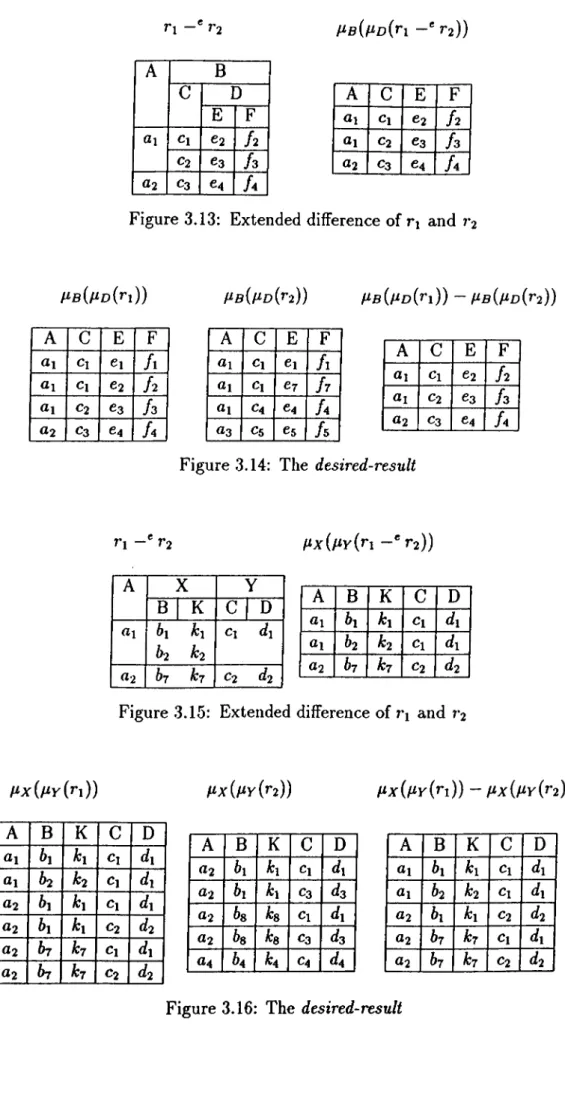
Example: In the following the corrected extended difference definition of [6] is
applied to the relations rj and T2 (Figure 3.5). The result ri —*t’2 and the flat
form of this result ' ^2)) are shown in Figure 3.13. If we compare
the flattened result with the desired-result (Figure 3.14), we see that they ai-e equal. □
Although it is not mentioned in [6], the extended difference operator produces
correct results for only nested relations that are purely hierarchical as the ex tended union operator does. If a nested relation is not purely hierarchical, then the extended difference operator loses some of the tuples that must be in the result.
Example: Now let us illustrate this last claim. Extended difference operator is applied to the relations in Figure 3.8. r*i —' r2,px{pY{ri —*/'2)), Px{p y{i'i)), p x{p Y (r2)), and /xx(/iy(ri)) — p xifiY irz)) are shown in Figures 3.15 and 3.16. ft'xifi'Yi^i ~*^i)) loses some tuples th a t’s in desired-result^ e.g. < a2b\kiC2d2 > and < 0 2 6 7^7 0 1 ^ 1 > which are in px{pY{r\)) but not in px{pY{r2))· As a
result, the extended difference operator of [6] is not information equivalent.□
CHAPTER 3. EXTENDED RELATIONAL ALGEBRA 26 ri T2 /^fl(/íD(ri rj)) A B C D E F ax Cl C2 / 2 C2 C3 / 3 Ü2 C3 64 / 4 A c E F Ol Cl C2 / 2 Oi C2 C3 / 3 02 C3 64 / 4
Figure 3.13: Extended difference of n and
^íв{цD{r\)) llB{tiD{r2)) fJ-B{tÍD{ri)) - ^lв{|J■D{r2)) A c E F «1 Cl Cl /1 «1 Cl C2 / 2 «1 C2 C3 / 3 «2 C3 C4 / 4
A C E
F
Oi Cl Cl /1
ai Cl e? /7
ai C4 64 /4
asC5 C5 /5
A c E F Ol Cl C2 / 2 Ol C2 C3 / 3 0 2 C3 64 / 4Figure 3.14: The desired-result
n - T2 ¡íxilíviri -* r2 )) A X Y B K C D « 1 61 kx 1)2 k2 Cl ¿1 « 2 by ky C2 ¿2 A B K C D a\ 61 ^1 Cl dx ax b2 ¿ 2 Cl dx 02 by Att C2 (¿2
Figure 3.15: Extended difference of and r’2
fix{HY{r\)) lix{liY{r2)) l^xiiiY iri)) - Hx{fiY{r2))
A B K C D Oi 61 ¿1 Cl dx Ol 62 k2 Cl dx d2 61 kx Cl d\ 0 2 61 kx C2 d2 Ü2 bj ky Cl d\ 0 2 by ky C2 ¿2 A B K C D 0 2 61 A:i Cl dx 0 2 61 kx C3 dz CL2 bs ka Cl dx Ü2 bs ka C3 da 0 4 64 k4 C4 d4 A B K C D Oi 61 A:i Cl dx Oi 62 ¿ 2 Cl dx «2 bx A^i C2 ¿2 Ü2 by Arr Cl dx Ü2 by ¿ 7 C2 ¿2
CHAPTER 3. EXTENDED RELATIONAL ALGEBRA 27
is stated «is a theorem (T h e o re m 6.1) in [6]. This theorem states that the structure 72-3 = < 72, r/ — * r® > is in PNF, given that the structures 7^i = < R ,r i > and 7^2 = < 72, > are in PNF. We think that the PN F restric tion on the resultant structure makes the extended difference definition non information equivalent as in extended union. Dropping this restriction on the resultant relation structures provides us with a new extended difference. The class of PNF relations is not closed under the new extended difference.
Extended Difference of AB
Before defining the new extended difference operator, let us go through the extended difference of [2].
Let / be a format and 7, J two instances over f. Then the difference of I and J is the instance over /, denoted /© /, defined by:
1. if / = where X is nonempty, then i Q j = I — J, and 2. if / = X{fj )* . . . (/„)*,where / i , . . . , are nonempty, then :
I Q J = \ < « ( / / © J / ) . . . ( / „ © / „ ) > U < ulj ...In > < « / ; . . . / „ > € / and < uJt . . . Jn > € J and for some t, /,· Q Ji ^ ^ < « / ; . . . / „ > € I and Vt// . . . Jni ^ U«/1 . . . Jn ^ ^ J 7 )
The extended difference of [2] is similar to that of [6] and produces the same results with the previous examples. It produces correct results only for purely hierarchical relations, therefore it’s not information equivalent.
The New Extended Difference
In the following extended difference definition, HA, Ey·, HAy^, and X represent the same things cis they do in the new extended union definition. Given two relation structures 1li = < R ,r j > and l l2 = < R ,r t > in PNF, the extended difference with the structure < R ,ri rg > is defined as follows at the in stance level:
CHAPTER 3. EXTENDED RELATIONAL ALGEBRA 28
(VJÍ, Y \HA\ < 1 : t[X\ = tt [X] = ts[X]
A í[r] = (¿,[K] - ‘ k [ Y ] ) M [ Y ] ^ ^ ) ) € r¡, 3Í2 € Vs :
(V X ,3 Y i e E n , , l < i < \H A l\H A \ > 1 : t[X] = = t2[X] Aí[y.·] = {ty\{3t^. € ti[Yi] : t, = í;. a (Ví;; € hiYi] :
{3X € Ey^ : Q X ] ^ í;'[X])))} A t[H A -{Y i}] = t,[H A -{ Y i} ])) Y(3</ 6 r j,3 ts € : (VA, 3 Yi e E R , , l < i < \H A l\H A \ > 1 : t[X] = tj [X] = t^lX] AXy, = d t f { x \ x e E y , } At[Xy,] = { í,.i(3 4 6 t A Y i i K € ■■
(VA € Ey, : í,,[A] = Q X ] = í;'[A]))}
A H A = i , } { H A - { Y i ) ) y j H A y .
A[(|^A| > 1 : t[HA] € {ti[HA] - * ti[HA\) A{U[HA] -U 2[H A ])^(H )
V(|//A| < 1 : t[HA] = {t¡ [HA] hlHA]) A t[HA] ^ 0)])) V (í e r; A (Vi' € r» : (3A € Er, : í[A] ^ i'[A])))}
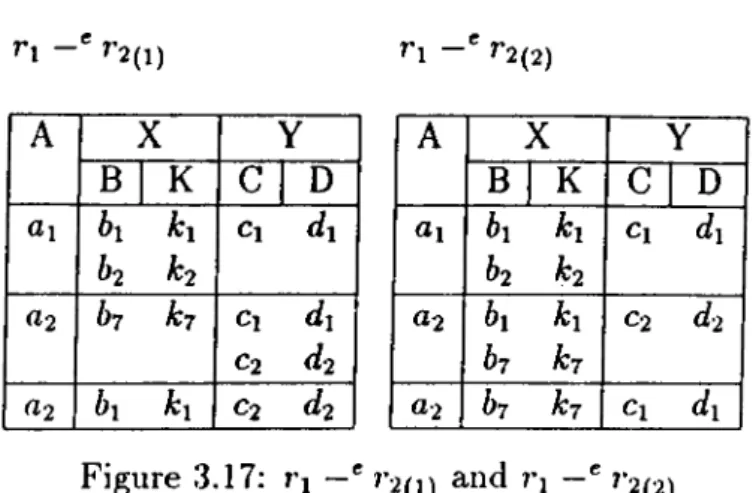
Example: When the newly defined extended difference operator is applied to the relations t'l and r-2 in Figure 3.8, it is possible to obtain the results ri 7*2(1) n ^2(2) i^ Figure 3.17. If we compare the flattened forms
P - x { p Y { r i r2))^i^ and p x { p y { r i r2))^2) (Figure 3.18) of n -* T2(i) and
ri — T2(2) with the desired-result (Figure 3.16), we notice that these three
are equal. The difference between ri —® T2(i) and ri —* T2(2) is because of the
same reason explained for extended union. □
T h e o re m 3.2 The extended difference operator is information equivalent Proof The proof has several cases.
1. \HA\ = 0 (flat relations).
2. nesting-depth = n (6 N"*”), for all nesting-depths i, 1 < i < n: \HA\ (purely hierarchical relations).
CHAPTER 3. EXTENDED RELATIONAL ALGEBRA 29 n r2(i) - ^’2(2) A X Y B K C D Oi 61 ¿1 ¿2 ^2 Cl ¿1 «2 67 A:? Cl ¿1 C2 <¿2 «2 6, C2 ¿2 A X Y B K C D ai ¿1 ki ¿2 k2 Cl ¿1 02 hi ki 67 ¿7 C-2 ¿2 <22 67 A:7 Cl ¿1 Figure 3. 17: i'i r-2(i) and rj 7-2(2)
¡ ix in v in -'»'2))(1) t i x i l i v i n 7-2))(2) A B K C D Oi 61 ^1 Cl di ai ¿2 h Cl di «2 61 ki C2 d2 «2 67 k j Cl di Ü2 67 kr C2 d2 A B K C D Oi 61 ¿*1 Cl di Oi 62 k2 Cl di «2 hi ki C2 d2 <I2 bj k7 C2 ¿ 2 02 hr kr Cl di
CHAPTER 3. EXTENDED RELATIONAL ALGEBRA 30
3. \HA\ > 1, and each higher-order attribute Y in Er is a flat relation. 4. \HA\ = n (6 N"*") and 3 Y € Er : \HAy\ = m N"*”).
(1) In this Ccise ri and V2 are flat relations, so we show that ri —®i'2 = r’l — rj.
C p a r t: Let t e ri T2, then t can only satisfy the following disjunct of
the definition: (i € n A (Vi' 6 T2 : (3A" € Er^ : t[X] i'[A"]))). This disjunct states is th at i is a tuple only in r'l, so t is obviously in rj — r 2.
D part: Let i € f'l — r2, then t is only in rj, and there is at least one atomic
attribute that differentiates t from all the tuples in 7'2. If this statement is for malized, we obtain the disjunct of —® mentioned in the C part. Since t satisfies a disjunct of definition, t € ri —® I'z
(2) In this case we show th at
(· · · (/^n ( n i-2) ) ...))
where Yi is the higher-order attribute of the nesting level. The proof is by induction on the nesting-depth n.
Basis: We show th at ^ ^ (ri —® r2) = Mr(ri) — My(^2)7 where n = 1 and Y = X x ...X r ,..
D part: We show th at if i € /iy (n ) —^My{y2)·, then t 6 My{y\ ''2)· t is
only in m y('''i) unnested from some ui in n . Since t is not in /^>'(/'2),
t cannot be unnested from any U2 in 7'2. We can say th at t[X \ . . . X,n] € tti[T]
and Vit2 6 T2 : t [ X \ . ..X ,n] ^U2\Y]. In the exte7ided difference of rj and T2,ui
will be included either completely as u\ or partially as a new tuple u, where u\Y] = ui[K] —' «2(1^]· In any case t will be included in m y{y\ ^2)·
C part: We show th at if < G My{i'\ ^’2)? fheii i ^ My{'"'i) ~ My{'''2)· If we partition m y{’'\
^2)
on Er — X \ . . . X,n and obtain the partitions U j,. . . , ujt,then we must show th at all tuples i j , . . . in any partition of my{yi ” *^2) are in
CHAPTER 3. EXTENDED RELATIONAL ALGEBRA 31
U i,. . . , Uk, each of which is a partition on Er — Y in n —*r2. This means that for
all I < t < n, 3 j, I < j < k, such that i,[A 'i. . . X,„] 6 Uj[Y], and U^_j Uj[V] = ( ti[ X i.. .Xm] I 1 ^ i < w}. Each Uj is created by the extended difference of two tuples, Uj* € t’l and € r2- Since T is a purely hierarchical relation,
U*=i«j[L^] € When the tuples Uj* and are
unnested into tuples (1 < t < p i) and v/'^, (1 < / < pj), we have Uj=i
= ( v i 'i x , . . . X„1 II < 1 < P , } and u j= , n /(K J = {n,2(A·,. . . .V„.) 11 < i < p ,), and we can say {f,[A'i. . . X,„] | 1 < t < n} C {u/*[Xi. . . A",«] | 1 < / < pi} - {v/^[Xi
...
Xm]I
1 ^ ^ < P2}· Therefore p y (ri) — pY{r2) contains all the tuplesin p y (ri - *7*2).
Induction Step: By the induction hypothesis, we know that
py„_, (Pn.-2(· · · (/^y. (»-1 ^2)) . -.) )
for the first (n — 1) nesting levels, where Yi is the higher-order attribute at the nesting level, 1 < e < n — 1. We now show that this is also true for n nesting levels. If we unnest both sides of the last equation with Yn, we obtain
py„(py„_, (· · · (p y .(n ^2)) · - ·))
= py« [py„-i (· · · (py ( n ) ) · · ·) Py«-! (· · · (py (»’2)) · · ·)]
Let r[ = py„_, ( ... (py, ( n ) ) . ..) and = py„_, ( ... (py, (7-2) ) ...) ,
now we have
Pyn(py„-i (· · · (Py. (n ·■ ·))= Pyn(»’i' ri).
Since r\ and r'2 are relations whose nesting-depths are 1, py„(7’i —* Tj) = py„(yi ) ~ Pyn(^*2)> which is proved to be true in the basis step. If we substitute
r\ and r'2 by their equivalents, we have
py„(pyn-i(**-(pyi(n - * ^2) ) ..· ) )
CHAPTER 3. EXTENDED RELATIONAL ALGEBRA 32
(3) In this case we show that
= (· · · it^Yi (n )) · · · ) ) - (/^y„_, (· · · (/iy, (»*2)) · · ·))
The proof is by induction on the number of the higher-order attributes at the first and only nesting level.
Basis: We show that /ZK,(/iy,(ri r^)) = /^y, (/iyj(ri)) - /iK,(/iy,(r2)), where
|/fA | = 2 a n d Y , = X i . . . X „ , , Y , = X i . . . X k .
D part: We show that if t € ttYiifiY^i^i)) ~ t ‘'Yi{ti’Y2(Y2)), then t € pYi(pY^{ri -* r2)). Since i € HYiitiYi^n))— we know that ¿is only in /iy,(/iy^in))
and it is unnested from some u\ € ri. Then we can say that (i[A^i... A,„] € ui[Vi] A t [Xi . . . Xj^ € ^^1(^2]) A V1Z2 ^ i'2 '■ t ^ «2)· 111 the extended difference
of ui and «2, « 1 will be included either completely as ui, or partially as a new
tuple «. Since Vu2 € i’2,t € ui or t E u. Therefore t E /ly, (/ly jiri—®i’2))·
C part: We show that if i G /ly,(/^y*(n —® r2)), then t E f^Ytif^Yti^i)) ~
//y, (/zyj(r2)). In this case, t is unnested from some u in ri —' r2- u satisfies
one of the disjuncts in the —' definition and all the disjuncts in this definition include those tuples only in r i , so
(Vu € pY^(pYffu)) : u E /ly,(/ly^in)) A (Vt' € /ly,(/xy,(r-2)) : u ^ t')).
The last statement is the definition of the standard set difference, therefore i € /iy,(/iy2(n)) - /iy,(/^y2(i’2)).
Induction Step: By the induction hypothesis, we know that
/iy„_, (/^y„_2 (· · · {t^Yi (»‘1 1'2)) · · ·))
= /iy„_, (/ly„_2 (· · · (/^n ( n )) . · ·)) /^yn-l it^Yn-2 (· · · (/^I'l ('’2)) · · ·))>
for the first (n — 1) higher-order attributes of Er, where n > 3. Now we show that this is also true for n:
/2y „ ( A l y „ - i ( - - ' ( / 2y , ( r i - ' r 2) ) . . . ) )