ScienceDirect
Available online at www.sciencedirect.com
Procedia Computer Science 158 (2019) 772–780
1877-0509 © 2019 The Authors. Published by Elsevier B.V.
Peer-review under responsibility of the scientific committee of the 3rd World Conference on Technology, Innovation and Entrepreneurship 10.1016/j.procs.2019.09.114
10.1016/j.procs.2019.09.114 1877-0509
© 2019 The Authors. Published by Elsevier B.V.
Peer-review under responsibility of the scientific committee of the 3rd World Conference on Technology, Innovation and Entrepreneurship
Available online at www.sciencedirect.com
ScienceDirect
Procedia Computer Science 00 (2019) 000–000
www.elsevier.com/locate/procedia
1877-0509 © 2019 The Author(s). Published by Elsevier B.V.
Peer-review under responsibility of the scientific committee of the 3rd World Conference on Technology, Innovation and Entrepreneurship
3rd World Conference on Technology, Innovation and Entrepreneurship (WOCTINE)
Analysis of The Effect of Innovation Strategy and Technological
Turbulence on Competitive Capabilities and Organizational
Innovativeness in Technology Firms
Kudret Celtekligil
1, Zafer Adiguzel
2,*1Beykent University, Istanbul, Turkey, [email protected] 2Istanbul Medipol University, Istanbul, Turkey, [email protected]
Abstract
The aim of the research is to investigate and analyse how they are successful in industry firms of manifacturing sector in Turkey that is in the order of emerging countries, against rivalry in terms of both technological and innovation strategy. In the industrial sector where technological fluctuations are experienced intensively, it is important how companies make use of these fluctuations and how effective the innovative decisions that they take strategically. Hypothesis testing model for the study covered 344 white-collar employees in 19 companies located in the industrial sector operating in Turkey (engineers) has made a survey covering. In the analysis of hypothesis, sobel test was used for the analysis of regression analysis and mediation effect. When the constraints of the research were examined, only the firms in Istanbul were researched in terms of sample size. It is possible to obtain more reliable results of the study will represent the general case of the Turkey. The obtained empirical results support all hypotheses and show that technological fluctuations are perceived correctly by firms and they are fed by technological developments in the sector. © 2019 The Author(s). Published by Elsevier B.V.
Peer-review under responsibility of the scientific committee of the 3rd World Conference on Technology, Innovation and Entrepreneurship
Keywords:Firm Innovation Strategy; Technological Turbulence; Combinative Competitive Capabilities; Organizational Innovativeness 1. Introduction
Organizational change based on technological developments enables people to learn new things, communicate with other people, make innovations and share innovations with others. Moreover, technological changes cause new goods and services to be produced and everyone feels this change [1]. In particular, Institutional theories assume that organizations take part in a corporate environment and that these organizations improve themselves and bring different meanings to their goals.
* Corresponding author. E-mail address: [email protected]
Although organizations cannot act independently, it is inevitable that they are in the corporate environment and
Available online at www.sciencedirect.com
ScienceDirect
Procedia Computer Science 00 (2019) 000–000
www.elsevier.com/locate/procedia
1877-0509 © 2019 The Author(s). Published by Elsevier B.V.
Peer-review under responsibility of the scientific committee of the 3rd World Conference on Technology, Innovation and Entrepreneurship
3rd World Conference on Technology, Innovation and Entrepreneurship (WOCTINE)
Analysis of The Effect of Innovation Strategy and Technological
Turbulence on Competitive Capabilities and Organizational
Innovativeness in Technology Firms
Kudret Celtekligil
1, Zafer Adiguzel
2,*1Beykent University, Istanbul, Turkey, [email protected] 2Istanbul Medipol University, Istanbul, Turkey, [email protected]
Abstract
The aim of the research is to investigate and analyse how they are successful in industry firms of manifacturing sector in Turkey that is in the order of emerging countries, against rivalry in terms of both technological and innovation strategy. In the industrial sector where technological fluctuations are experienced intensively, it is important how companies make use of these fluctuations and how effective the innovative decisions that they take strategically. Hypothesis testing model for the study covered 344 white-collar employees in 19 companies located in the industrial sector operating in Turkey (engineers) has made a survey covering. In the analysis of hypothesis, sobel test was used for the analysis of regression analysis and mediation effect. When the constraints of the research were examined, only the firms in Istanbul were researched in terms of sample size. It is possible to obtain more reliable results of the study will represent the general case of the Turkey. The obtained empirical results support all hypotheses and show that technological fluctuations are perceived correctly by firms and they are fed by technological developments in the sector. © 2019 The Author(s). Published by Elsevier B.V.
Peer-review under responsibility of the scientific committee of the 3rd World Conference on Technology, Innovation and Entrepreneurship
Keywords:Firm Innovation Strategy; Technological Turbulence; Combinative Competitive Capabilities; Organizational Innovativeness 1. Introduction
Organizational change based on technological developments enables people to learn new things, communicate with other people, make innovations and share innovations with others. Moreover, technological changes cause new goods and services to be produced and everyone feels this change [1]. In particular, Institutional theories assume that organizations take part in a corporate environment and that these organizations improve themselves and bring different meanings to their goals.
* Corresponding author. E-mail address: [email protected]
Although organizations cannot act independently, it is inevitable that they are in the corporate environment and
2 Garah & Audira/ Procedia Computer Science 00 (2019) 000–000
they are dependent on legitimacy and they are in a process to improve themselves and are in an effort to continue their lives [2]. An innovation occurs within the social system, and its characteristics diversify its attributes throughout the propagation period. Organizations may want to adopt each other's strategies, formal structures and behaviors. This gives different dimensions to the spread of innovation. Organizational innovation is expressed as the beginning of a new product, process and system in the enterprise. In other words, organizational innovation is the application of new organizational concepts as an indicator of the diffusion of different organizational practices into the enterprise.
Dynamic capabilities are the processes that create the change in the market or that comply with the changes in the market and utilize the resources within this purpose. These processes enable the integration of resources, reconfiguration, acquisition and release of resources [3-4-5]. Hence, Dynamic capabilities are the providers of reconstructing and developing legacy resources for the formation of new resources used to achieve competitive advantage. Innovation is a dynamic capability, it has been suggested that the resources of the enterprise affect the ability to define external opportunities and the resource capabilities of the enterprise increase the innovation and performance of the enterprise [6]. In this context, innovation allows the company to determine and control the change in the external environment, which is important for the long-term competitiveness of the enterprise.
2
.
Literature Review and Theoretical Framework 2.1.Firm Innovation StrategyInnovations are multifaceted, as innovations are not only about new goods and services introduced to the market, but are addressed together from many different aspects such as management innovation, organizational innovation and financial innovation. For instance, Grouped innovations under different groups as product and manufacturing processes, service innovation, organizational structure and innovations in the management system [7]. Furthermore, Innovations as technical and managerial innovations, defined technical innovations as output based on product, service and production technologies, and administrative innovations as new ideas and initiatives related to control and coordination of the organization [8]. By adhering to the definitions, it can be said that if innovation is to be defined as a process, it is also an effort to plan, implement, eliminate problems and take action. One of the main arguments discussed in the dissemination of innovations; In order for innovation to spread within existing systems, it is necessary for other actors to have the advantages of innovation. Furthermore, trying to adopt innovations as a result of different pressures to other organizations in the organizational field by other actors in the environment (eg government, financial markets, etc.) can mean that propagation continues and the innovation is legitimized and recognized as it spreads [9]. On the other hand, A firm's product innovation strategy plays an important role in developing organizational precedences and supply-chain actions. The strategic, artful and operational alliance of inter-organizational actions often results in new, valuable and frequently introduced innovative products.
2.2. Technological Turbulence
Technological turbulence affects today's advanced technology developers' activities. In this context, initiatives are designed to be more flexible by using product development teams to overcome technological turbulence. Technological turbulence refers to the development of information and technology changes in production areas - out of the direction and in terms of speed - and the irregularity of the emergence and spread of this development [10]. Technological turbulence advocates the short product-life cycle, the formation of a dynamic market structure where rapid entries and exits are experienced, rapid loss of know-how and rapid change in customer expectations. Therefore, it is argued that technology orbital change is the source of environmental velocity, uncertainty, complexity and ambiguity in business life, such as air flow and gap created by turbulence as a geographical term [11]. Conceptually, in this study, technological turbulence (i) is defined as rapid change of technology in the industry in which an enterprise operates, (ii) most of the ideas of new product development are realized through technological developments in the industry, and (iii) technological changes offer important opportunities for the industry. Technological turbulence is a critical context factor for supply chain operations. It covers the rate of technological change, the amount of change in new product, fabrication and process technologies and the unpredictability. Turbulent operating contexts provide rapid innovation conjunctures and require more information on environmental factors [12]. Especially, technology firms
Kudret Celtekligil et al. / Procedia Computer Science 158 (2019) 772–780 773
ScienceDirect
Procedia Computer Science 00 (2019) 000–000
www.elsevier.com/locate/procedia
1877-0509 © 2019 The Author(s). Published by Elsevier B.V.
Peer-review under responsibility of the scientific committee of the 3rd World Conference on Technology, Innovation and Entrepreneurship
3rd World Conference on Technology, Innovation and Entrepreneurship (WOCTINE)
Analysis of The Effect of Innovation Strategy and Technological
Turbulence on Competitive Capabilities and Organizational
Innovativeness in Technology Firms
Kudret Celtekligil
1, Zafer Adiguzel
2,*1Beykent University, Istanbul, Turkey, [email protected] 2Istanbul Medipol University, Istanbul, Turkey, [email protected]
Abstract
The aim of the research is to investigate and analyse how they are successful in industry firms of manifacturing sector in Turkey that is in the order of emerging countries, against rivalry in terms of both technological and innovation strategy. In the industrial sector where technological fluctuations are experienced intensively, it is important how companies make use of these fluctuations and how effective the innovative decisions that they take strategically. Hypothesis testing model for the study covered 344 white-collar employees in 19 companies located in the industrial sector operating in Turkey (engineers) has made a survey covering. In the analysis of hypothesis, sobel test was used for the analysis of regression analysis and mediation effect. When the constraints of the research were examined, only the firms in Istanbul were researched in terms of sample size. It is possible to obtain more reliable results of the study will represent the general case of the Turkey. The obtained empirical results support all hypotheses and show that technological fluctuations are perceived correctly by firms and they are fed by technological developments in the sector. © 2019 The Author(s). Published by Elsevier B.V.
Peer-review under responsibility of the scientific committee of the 3rd World Conference on Technology, Innovation and Entrepreneurship
Keywords:Firm Innovation Strategy; Technological Turbulence; Combinative Competitive Capabilities; Organizational Innovativeness 1. Introduction
Organizational change based on technological developments enables people to learn new things, communicate with other people, make innovations and share innovations with others. Moreover, technological changes cause new goods and services to be produced and everyone feels this change [1]. In particular, Institutional theories assume that organizations take part in a corporate environment and that these organizations improve themselves and bring different meanings to their goals.
* Corresponding author. E-mail address: [email protected]
Although organizations cannot act independently, it is inevitable that they are in the corporate environment and
ScienceDirect
Procedia Computer Science 00 (2019) 000–000www.elsevier.com/locate/procedia
1877-0509 © 2019 The Author(s). Published by Elsevier B.V.
Peer-review under responsibility of the scientific committee of the 3rd World Conference on Technology, Innovation and Entrepreneurship
3rd World Conference on Technology, Innovation and Entrepreneurship (WOCTINE)
Analysis of The Effect of Innovation Strategy and Technological
Turbulence on Competitive Capabilities and Organizational
Innovativeness in Technology Firms
Kudret Celtekligil
1, Zafer Adiguzel
2,*1Beykent University, Istanbul, Turkey, [email protected] 2Istanbul Medipol University, Istanbul, Turkey, [email protected]
Abstract
The aim of the research is to investigate and analyse how they are successful in industry firms of manifacturing sector in Turkey that is in the order of emerging countries, against rivalry in terms of both technological and innovation strategy. In the industrial sector where technological fluctuations are experienced intensively, it is important how companies make use of these fluctuations and how effective the innovative decisions that they take strategically. Hypothesis testing model for the study covered 344 white-collar employees in 19 companies located in the industrial sector operating in Turkey (engineers) has made a survey covering. In the analysis of hypothesis, sobel test was used for the analysis of regression analysis and mediation effect. When the constraints of the research were examined, only the firms in Istanbul were researched in terms of sample size. It is possible to obtain more reliable results of the study will represent the general case of the Turkey. The obtained empirical results support all hypotheses and show that technological fluctuations are perceived correctly by firms and they are fed by technological developments in the sector. © 2019 The Author(s). Published by Elsevier B.V.
Peer-review under responsibility of the scientific committee of the 3rd World Conference on Technology, Innovation and Entrepreneurship
Keywords:Firm Innovation Strategy; Technological Turbulence; Combinative Competitive Capabilities; Organizational Innovativeness 1. Introduction
Organizational change based on technological developments enables people to learn new things, communicate with other people, make innovations and share innovations with others. Moreover, technological changes cause new goods and services to be produced and everyone feels this change [1]. In particular, Institutional theories assume that organizations take part in a corporate environment and that these organizations improve themselves and bring different meanings to their goals.
* Corresponding author. E-mail address: [email protected]
Although organizations cannot act independently, it is inevitable that they are in the corporate environment and
2 Garah & Audira/ Procedia Computer Science 00 (2019) 000–000
they are dependent on legitimacy and they are in a process to improve themselves and are in an effort to continue their lives [2]. An innovation occurs within the social system, and its characteristics diversify its attributes throughout the propagation period. Organizations may want to adopt each other's strategies, formal structures and behaviors. This gives different dimensions to the spread of innovation. Organizational innovation is expressed as the beginning of a new product, process and system in the enterprise. In other words, organizational innovation is the application of new organizational concepts as an indicator of the diffusion of different organizational practices into the enterprise.
Dynamic capabilities are the processes that create the change in the market or that comply with the changes in the market and utilize the resources within this purpose. These processes enable the integration of resources, reconfiguration, acquisition and release of resources [3-4-5]. Hence, Dynamic capabilities are the providers of reconstructing and developing legacy resources for the formation of new resources used to achieve competitive advantage. Innovation is a dynamic capability, it has been suggested that the resources of the enterprise affect the ability to define external opportunities and the resource capabilities of the enterprise increase the innovation and performance of the enterprise [6]. In this context, innovation allows the company to determine and control the change in the external environment, which is important for the long-term competitiveness of the enterprise.
2
.
Literature Review and Theoretical Framework 2.1.Firm Innovation StrategyInnovations are multifaceted, as innovations are not only about new goods and services introduced to the market, but are addressed together from many different aspects such as management innovation, organizational innovation and financial innovation. For instance, Grouped innovations under different groups as product and manufacturing processes, service innovation, organizational structure and innovations in the management system [7]. Furthermore, Innovations as technical and managerial innovations, defined technical innovations as output based on product, service and production technologies, and administrative innovations as new ideas and initiatives related to control and coordination of the organization [8]. By adhering to the definitions, it can be said that if innovation is to be defined as a process, it is also an effort to plan, implement, eliminate problems and take action. One of the main arguments discussed in the dissemination of innovations; In order for innovation to spread within existing systems, it is necessary for other actors to have the advantages of innovation. Furthermore, trying to adopt innovations as a result of different pressures to other organizations in the organizational field by other actors in the environment (eg government, financial markets, etc.) can mean that propagation continues and the innovation is legitimized and recognized as it spreads [9]. On the other hand, A firm's product innovation strategy plays an important role in developing organizational precedences and supply-chain actions. The strategic, artful and operational alliance of inter-organizational actions often results in new, valuable and frequently introduced innovative products.
2.2. Technological Turbulence
Technological turbulence affects today's advanced technology developers' activities. In this context, initiatives are designed to be more flexible by using product development teams to overcome technological turbulence. Technological turbulence refers to the development of information and technology changes in production areas - out of the direction and in terms of speed - and the irregularity of the emergence and spread of this development [10]. Technological turbulence advocates the short product-life cycle, the formation of a dynamic market structure where rapid entries and exits are experienced, rapid loss of know-how and rapid change in customer expectations. Therefore, it is argued that technology orbital change is the source of environmental velocity, uncertainty, complexity and ambiguity in business life, such as air flow and gap created by turbulence as a geographical term [11]. Conceptually, in this study, technological turbulence (i) is defined as rapid change of technology in the industry in which an enterprise operates, (ii) most of the ideas of new product development are realized through technological developments in the industry, and (iii) technological changes offer important opportunities for the industry. Technological turbulence is a critical context factor for supply chain operations. It covers the rate of technological change, the amount of change in new product, fabrication and process technologies and the unpredictability. Turbulent operating contexts provide rapid innovation conjunctures and require more information on environmental factors [12]. Especially, technology firms
774 Garah & Audira/ Procedia Computer Science 00 (2019) 000–000 Kudret Celtekligil et al. / Procedia Computer Science 158 (2019) 772–780 3
must carefully examine the turbulence in the market to answer to rapid and inconstant changes. Therefore, under high technological turbulence, active innovation management is given importance in order to come across the performance needs of a company [13].
2.3. Combinative Competitive Capabilities
The core of defining competitive strategy is interrelating a firm to its environment. Even though the relevant
environment is very wide, surrounding sociable right along with economic impulses, the key feature of the firm’s environment is the business or industries in which it contends [14]. Since bring into competitive advantages, a firm must advance the dynamic ability in order to integrate knowledge into areas of expertise and maintain competitive advantages to learn and in order to protect private knowledge without expropriation and imitation of competitors. Firm competitiveness is defined as the degree to which a firm enters in a marketplace, compared to its major rivals [15]. Within this context, organizations can explain that they achieve a competitive advantage by acquiring valuable, rare, non-substitutable resources from the external environment. Comparing these two theories authorizes a focussed perspective on how organizations specify resource requirements, and allows organizations to examine a focussed perspective of how they can achieve these valuable resources [16]. Others controlling resources can be unreliable, especially when resources are insufficient. Organizations deal with others for necessary resources and control resources by empowering others on the organization [17]. Because industry-based theory emphasizes the uniqueness of in-house resources and firms for this hypothesis and sustainable competitive advantage, it forms the basis known today as resource-based theory [18]. Organizational resources must be compounded to make a splendid innovative implement of “innovation capability” Innovation oriented companies can use their technical skills to advance new resolutions for meeting the new demands of consumers [19].
2.4. Organizational Innovativeness
Beyond creating organizational innovation, products and services, it refers to new models of management such as business models, management techniques and management strategies, and organizational structures and total quality management. Wang and Ahmed (2004) define organizational innovation as a new product or open a new market by combining innovative behavior and strategic orientation [20]. Individual information shared within the organization is organizational knowledge over time and this constitutes the source of organizational innovation [21]. Innovation is seen as a strategy that responds to changes in customer demand, competitiveness and technological skills [22]. Many researchers in the field of strategy and marketing are convinced that a company's innovation is connected with superior performance, as it is the best way to achieve competitive advantage and recommence competitive advantages. According to this perspective, more innovative companies are more: in a timely, creative, new way of introducing new goods or services, and sooner in changing existing offers to supply superior assets to customers. Imitation neutralizes competitors' advantages and knowledge distinctives, and lowers their dependent performance [23]. Drucker (2012) emphasizes that the importance of innovation and emphasizes the neglect of organizational research [24]. Studies on how innovation is spread in most of the studies on organizational innovation [25]. Organizational sense of innovation is explained as the ability of the organization to accept different ideas and to adopt an organizational atmosphere that is open to innovation and encourages thinking by creating brainstorming among employees [26].
3. Methodology
In the scope of the study, survey was conducted of 344 employees (Engineers). Data was obtained by using IBM SPSS 25 Statistical Package Program were evaluated and “descriptive statistical analysis was used in demographic information. Factor analysis and reliability analysis have been done on questions by using a balanced 5-point Likert-type scale. In this study, Regression and sobel test were used for the analysis of hypothesis and regression analysis.
3.1. Research Goal
In this research, on the white collar workers (Engineers) working in the manufacturing sector; Research aim to
4 Garah & Audira/ Procedia Computer Science 00 (2019) 000–000
determine the effects of the firm innovation strategy argument on the relationships between the Technological Turbulence Interchange Variable Effect and Combinative competitive capabilities and Organizational innovativeness. The choice of the manufacturing sector is that the product innovation activities are more active than the service sector. Hence, our research aim is to evaluate and analyse the manufacturing companies both in terms of innovation strategy and also Turbulence, Combinative competitive capabilities and Organizational innovativeness.
3.2. Analyses
344 white-collar employees (Engineers) working in different departments of 25 firms answered our survey in accordance with the criteria. 168 female and 176 male white-collar respondents were included in our survey. 36.7% of the participants were between the 25-30 age group. 49.7% of them are in the age group 31-36. The number of engineers over the age of 36 is 13.1%.
The survey consisting of questions by representing 4 variables. In the first part of the questionnaire, the demographic information of the individuals and the information about the work are given. In the second part of the questionnaire, there are questions representing 4 variables. The scale developed was used to measure the Technological Turbulence sample [27]. The scale developed was used to measure the Combinative competitive capabilities sample [28-29-30-31]. The scale developed was used to measure organizational innovativeness [32-33]. The scale developed was used to measure the Firm Innovation Strategy [34].
3.3. Research Frame
Based on literature review, A research model has been implemented as combinative competitive capabilities and organizational innovativeness. In the study, a quantitative approach was adopted, as the data were analyzed in order to determine the relationship between the statistical concepts. In a quantitative research test, we use the independent variable or independent variables to judge the effect on the dependent variable [35].
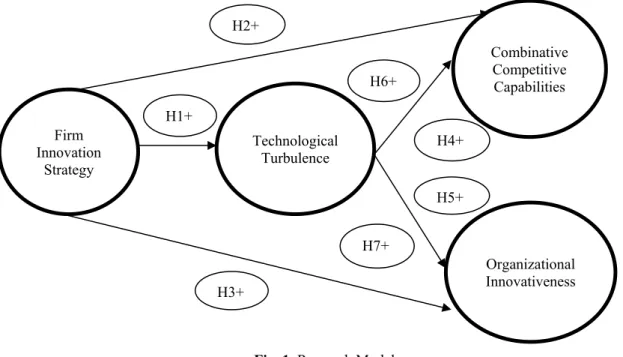
Fig. 1. Research Model
Factor Analysis; Büyüköztürk (2005) defines factor analysis as a multivariate statistical method which aims to
explore a few unrelated conceptually meaningful new variables (factors, dimensions) by combining the interrelated variables [36]. In our study, the variables were prepared according to the 5-point Likert scale were measured by a
23-Firm Innovation Strategy Organizational Innovativeness Combinative Competitive Capabilities Technological Turbulence H2+ H3+ H1+ H5+ H4+ H7+ H6+
must carefully examine the turbulence in the market to answer to rapid and inconstant changes. Therefore, under high technological turbulence, active innovation management is given importance in order to come across the performance needs of a company [13].
2.3. Combinative Competitive Capabilities
The core of defining competitive strategy is interrelating a firm to its environment. Even though the relevant
environment is very wide, surrounding sociable right along with economic impulses, the key feature of the firm’s environment is the business or industries in which it contends [14]. Since bring into competitive advantages, a firm must advance the dynamic ability in order to integrate knowledge into areas of expertise and maintain competitive advantages to learn and in order to protect private knowledge without expropriation and imitation of competitors. Firm competitiveness is defined as the degree to which a firm enters in a marketplace, compared to its major rivals [15]. Within this context, organizations can explain that they achieve a competitive advantage by acquiring valuable, rare, non-substitutable resources from the external environment. Comparing these two theories authorizes a focussed perspective on how organizations specify resource requirements, and allows organizations to examine a focussed perspective of how they can achieve these valuable resources [16]. Others controlling resources can be unreliable, especially when resources are insufficient. Organizations deal with others for necessary resources and control resources by empowering others on the organization [17]. Because industry-based theory emphasizes the uniqueness of in-house resources and firms for this hypothesis and sustainable competitive advantage, it forms the basis known today as resource-based theory [18]. Organizational resources must be compounded to make a splendid innovative implement of “innovation capability” Innovation oriented companies can use their technical skills to advance new resolutions for meeting the new demands of consumers [19].
2.4. Organizational Innovativeness
Beyond creating organizational innovation, products and services, it refers to new models of management such as business models, management techniques and management strategies, and organizational structures and total quality management. Wang and Ahmed (2004) define organizational innovation as a new product or open a new market by combining innovative behavior and strategic orientation [20]. Individual information shared within the organization is organizational knowledge over time and this constitutes the source of organizational innovation [21]. Innovation is seen as a strategy that responds to changes in customer demand, competitiveness and technological skills [22]. Many researchers in the field of strategy and marketing are convinced that a company's innovation is connected with superior performance, as it is the best way to achieve competitive advantage and recommence competitive advantages. According to this perspective, more innovative companies are more: in a timely, creative, new way of introducing new goods or services, and sooner in changing existing offers to supply superior assets to customers. Imitation neutralizes competitors' advantages and knowledge distinctives, and lowers their dependent performance [23]. Drucker (2012) emphasizes that the importance of innovation and emphasizes the neglect of organizational research [24]. Studies on how innovation is spread in most of the studies on organizational innovation [25]. Organizational sense of innovation is explained as the ability of the organization to accept different ideas and to adopt an organizational atmosphere that is open to innovation and encourages thinking by creating brainstorming among employees [26].
3. Methodology
In the scope of the study, survey was conducted of 344 employees (Engineers). Data was obtained by using IBM SPSS 25 Statistical Package Program were evaluated and “descriptive statistical analysis was used in demographic information. Factor analysis and reliability analysis have been done on questions by using a balanced 5-point Likert-type scale. In this study, Regression and sobel test were used for the analysis of hypothesis and regression analysis.
3.1. Research Goal
In this research, on the white collar workers (Engineers) working in the manufacturing sector; Research aim to
determine the effects of the firm innovation strategy argument on the relationships between the Technological Turbulence Interchange Variable Effect and Combinative competitive capabilities and Organizational innovativeness. The choice of the manufacturing sector is that the product innovation activities are more active than the service sector. Hence, our research aim is to evaluate and analyse the manufacturing companies both in terms of innovation strategy and also Turbulence, Combinative competitive capabilities and Organizational innovativeness.
3.2. Analyses
344 white-collar employees (Engineers) working in different departments of 25 firms answered our survey in accordance with the criteria. 168 female and 176 male white-collar respondents were included in our survey. 36.7% of the participants were between the 25-30 age group. 49.7% of them are in the age group 31-36. The number of engineers over the age of 36 is 13.1%.
The survey consisting of questions by representing 4 variables. In the first part of the questionnaire, the demographic information of the individuals and the information about the work are given. In the second part of the questionnaire, there are questions representing 4 variables. The scale developed was used to measure the Technological Turbulence sample [27]. The scale developed was used to measure the Combinative competitive capabilities sample [28-29-30-31]. The scale developed was used to measure organizational innovativeness [32-33]. The scale developed was used to measure the Firm Innovation Strategy [34].
3.3. Research Frame
Based on literature review, A research model has been implemented as combinative competitive capabilities and organizational innovativeness. In the study, a quantitative approach was adopted, as the data were analyzed in order to determine the relationship between the statistical concepts. In a quantitative research test, we use the independent variable or independent variables to judge the effect on the dependent variable [35].
Fig. 1. Research Model
Factor Analysis; Büyüköztürk (2005) defines factor analysis as a multivariate statistical method which aims to
explore a few unrelated conceptually meaningful new variables (factors, dimensions) by combining the interrelated variables [36]. In our study, the variables were prepared according to the 5-point Likert scale were measured by a
23-Firm Innovation Strategy Organizational Innovativeness Combinative Competitive Capabilities Technological Turbulence H2+ H3+ H1+ H5+ H4+ H7+ H6+
776 Garah & Audira/ Procedia Computer Science 00 (2019) 000–000 Kudret Celtekligil et al. / Procedia Computer Science 158 (2019) 772–780 5
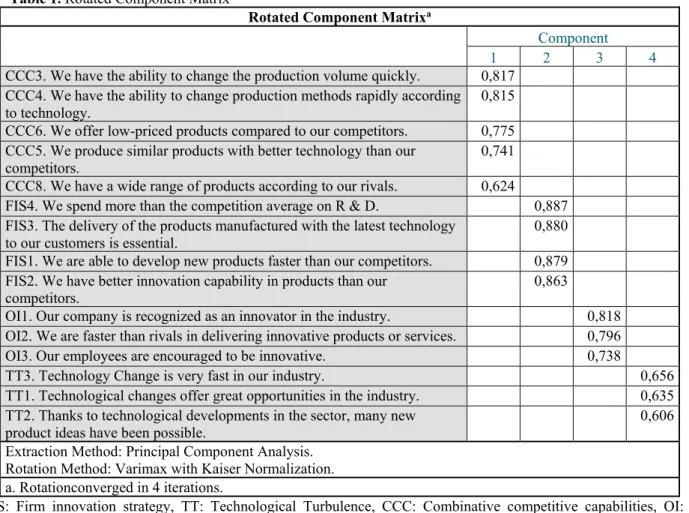
question questionnaire. As the result of factor analysis, 8 questions did not show factor distribution, they were excluded from the scale as they decreased to different factors by decreasing the reliability. The remaining 15 questions are scattered on four factors.
If the KMO value is above 0.70, it is decided that the sample population is suitable for factor analysis. It is concluded that the variables within the scope of the research model are suitable for factor analysis as the KMO value is 0.883 [37].
Table 1. Rotated Component Matrixa
Rotated Component Matrixa
1 Component 2 3 4
CCC3. We have the ability to change the production volume quickly. 0,817 CCC4. We have the ability to change production methods rapidly according
to technology. 0,815
CCC6. We offer low-priced products compared to our competitors. 0,775 CCC5. We produce similar products with better technology than our
competitors. 0,741
CCC8. We have a wide range of products according to our rivals. 0,624 FIS4. We spend more than the competition average on R & D. 0,887 FIS3. The delivery of the products manufactured with the latest technology
to our customers is essential. 0,880 FIS1. We are able to develop new products faster than our competitors. 0,879 FIS2. We have better innovation capability in products than our
competitors. 0,863
OI1. Our company is recognized as an innovator in the industry. 0,818 OI2. We are faster than rivals in delivering innovative products or services. 0,796 OI3. Our employees are encouraged to be innovative. 0,738 TT3. Technology Change is very fast in our industry. 0,656 TT1. Technological changes offer great opportunities in the industry. 0,635 TT2. Thanks to technological developments in the sector, many new
product ideas have been possible. 0,606 Extraction Method: Principal Component Analysis.
Rotation Method: Varimax with Kaiser Normalization. a. Rotationconverged in 4 iterations.
FIS: Firm innovation strategy, TT: Technological Turbulence, CCC: Combinative competitive capabilities, OI: Organizational innovativeness
Reliability analysis is defined as the internal consistency of the measurement that takes into account the average relationship between the questions.In the literature, Nunnally (1978) 's Cronbach Alpha coefficient of 0.50 and above measurements are considered to be sufficient [38-39-40].Reliability Analysis; Firm innovation strategy (4- Questions), .909; Technological Turbulence (3- Questions), .737; Combinative competitive capabilities (5- Questions), .861; Organizational innovativeness (3- Questions), .804.
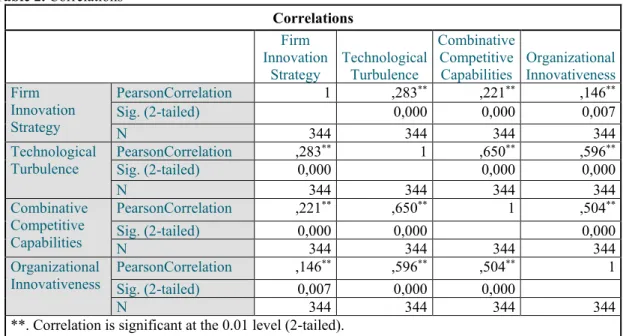
Correlation analysis; The relationship between firm innovation strategy, Technological Turbulence, Combinative
competitive capabilities, Organizational innovativeness is discussed. As mentioned earlier, the analyzes carried out to date (factor analysis, reliability analysis, descriptive analysis) were conducted on 344 questionnaires obtained from the institutions. Correlation analysis is used to determine the direction and level of relationship between variables. In the case of a correlation coefficient of 1.00, there is a perfect positive relationship between the variables; In case of -1.00 there is a perfect negative relationship between the variables; In the case of Pearson Correlation 0.00, there is no
6 Garah & Audira/ Procedia Computer Science 00 (2019) 000–000
correlation between the variables [41].
Table 2. Correlations
Correlations
Firm Innovation
Strategy Technological Turbulence
Combinative Competitive
Capabilities Organizational Innovativeness Firm Innovation Strategy PearsonCorrelation 1 ,283** ,221** ,146** Sig. (2-tailed) 0,000 0,000 0,007 N 344 344 344 344 Technological Turbulence PearsonCorrelation ,283 ** 1 ,650** ,596** Sig. (2-tailed) 0,000 0,000 0,000 N 344 344 344 344 Combinative Competitive Capabilities PearsonCorrelation ,221** ,650** 1 ,504** Sig. (2-tailed) 0,000 0,000 0,000 N 344 344 344 344 Organizational Innovativeness PearsonCorrelation ,146 ** ,596** ,504** 1 Sig. (2-tailed) 0,007 0,000 0,000 N 344 344 344 344
**. Correlation is significant at the 0.01 level (2-tailed).
According to Regression Analysis Results, Supported and Unsupported Hypotheses; Regression analysis was used to test predicted research hypotheses and 5 hypotheses were considered in Table 3 except for the inter-variable effect according to the results of these regression analyzes.
Table 3. Regression Analysis Results of Impact of Independent Variables on Dependent Variables
Hypotheses Standard β Sig.
H1: Firm innovation strategy has an effect on Technological Turbulence. 0.283*** 0.000
H2: Firm innovation strategy has an effect on Combinative competitive capabilities. 0.221*** 0.000
H3: Firm innovation strategy has an effect on Organizational innovativeness. 0.246*** 0.000
H4: Technological Turbulence has an effect on Combinative competitive capabilities. 0.650*** 0.000
H5: Technological Turbulence, has an effect on Organizational innovativeness. 0.596*** 0.000
*: p<0.05 **:p<0.01 ***:p<0.001
Measurement of mediation effect by sobel test; so as to explain the temporary effect, it is necessary to determine whether the indirect effect of the independent variable (through the mediator) on the dependent variable is meaningful in order to mention the mediation effect by Baron and Kenny in 1986 [42]. Several tests have been developed to accomplish this. One of them is the Sobel test [43]. This test is calculated by using uncorrected regression coefficients and standard error values of the respective variables. These criteria are used formally to assess whether there is mediation.
Technological Turbulence, Analysis of the mediation effect by sobel test in the relationship between Firm innovation strategy and Combinative competitive capabilities (Standard β: .639***; Sig: .000);
Input: Test statistic: Std. Error: p-value:
a 0.391 Sobel test: 8.91157824 0.02334177 0 b 0.532 Aroian test: 8.89862286 0.02337575 0 Sa 0.035 Goodman test: 8.92459038 0.02330774 0
question questionnaire. As the result of factor analysis, 8 questions did not show factor distribution, they were excluded from the scale as they decreased to different factors by decreasing the reliability. The remaining 15 questions are scattered on four factors.
If the KMO value is above 0.70, it is decided that the sample population is suitable for factor analysis. It is concluded that the variables within the scope of the research model are suitable for factor analysis as the KMO value is 0.883 [37].
Table 1. Rotated Component Matrixa
Rotated Component Matrixa
1 Component 2 3 4
CCC3. We have the ability to change the production volume quickly. 0,817 CCC4. We have the ability to change production methods rapidly according
to technology. 0,815
CCC6. We offer low-priced products compared to our competitors. 0,775 CCC5. We produce similar products with better technology than our
competitors. 0,741
CCC8. We have a wide range of products according to our rivals. 0,624 FIS4. We spend more than the competition average on R & D. 0,887 FIS3. The delivery of the products manufactured with the latest technology
to our customers is essential. 0,880 FIS1. We are able to develop new products faster than our competitors. 0,879 FIS2. We have better innovation capability in products than our
competitors. 0,863
OI1. Our company is recognized as an innovator in the industry. 0,818 OI2. We are faster than rivals in delivering innovative products or services. 0,796 OI3. Our employees are encouraged to be innovative. 0,738 TT3. Technology Change is very fast in our industry. 0,656 TT1. Technological changes offer great opportunities in the industry. 0,635 TT2. Thanks to technological developments in the sector, many new
product ideas have been possible. 0,606 Extraction Method: Principal Component Analysis.
Rotation Method: Varimax with Kaiser Normalization. a. Rotationconverged in 4 iterations.
FIS: Firm innovation strategy, TT: Technological Turbulence, CCC: Combinative competitive capabilities, OI: Organizational innovativeness
Reliability analysis is defined as the internal consistency of the measurement that takes into account the average relationship between the questions.In the literature, Nunnally (1978) 's Cronbach Alpha coefficient of 0.50 and above measurements are considered to be sufficient [38-39-40].Reliability Analysis; Firm innovation strategy (4- Questions), .909; Technological Turbulence (3- Questions), .737; Combinative competitive capabilities (5- Questions), .861; Organizational innovativeness (3- Questions), .804.
Correlation analysis; The relationship between firm innovation strategy, Technological Turbulence, Combinative
competitive capabilities, Organizational innovativeness is discussed. As mentioned earlier, the analyzes carried out to date (factor analysis, reliability analysis, descriptive analysis) were conducted on 344 questionnaires obtained from the institutions. Correlation analysis is used to determine the direction and level of relationship between variables. In the case of a correlation coefficient of 1.00, there is a perfect positive relationship between the variables; In case of -1.00 there is a perfect negative relationship between the variables; In the case of Pearson Correlation 0.00, there is no
correlation between the variables [41].
Table 2. Correlations
Correlations
Firm Innovation
Strategy Technological Turbulence
Combinative Competitive
Capabilities Innovativeness Organizational Firm Innovation Strategy PearsonCorrelation 1 ,283** ,221** ,146** Sig. (2-tailed) 0,000 0,000 0,007 N 344 344 344 344 Technological Turbulence PearsonCorrelation ,283 ** 1 ,650** ,596** Sig. (2-tailed) 0,000 0,000 0,000 N 344 344 344 344 Combinative Competitive Capabilities PearsonCorrelation ,221** ,650** 1 ,504** Sig. (2-tailed) 0,000 0,000 0,000 N 344 344 344 344 Organizational Innovativeness PearsonCorrelation ,146 ** ,596** ,504** 1 Sig. (2-tailed) 0,007 0,000 0,000 N 344 344 344 344
**. Correlation is significant at the 0.01 level (2-tailed).
According to Regression Analysis Results, Supported and Unsupported Hypotheses; Regression analysis was used to test predicted research hypotheses and 5 hypotheses were considered in Table 3 except for the inter-variable effect according to the results of these regression analyzes.
Table 3. Regression Analysis Results of Impact of Independent Variables on Dependent Variables
Hypotheses Standard β Sig.
H1: Firm innovation strategy has an effect on Technological Turbulence. 0.283*** 0.000
H2: Firm innovation strategy has an effect on Combinative competitive capabilities. 0.221*** 0.000
H3: Firm innovation strategy has an effect on Organizational innovativeness. 0.246*** 0.000
H4: Technological Turbulence has an effect on Combinative competitive capabilities. 0.650*** 0.000
H5: Technological Turbulence, has an effect on Organizational innovativeness. 0.596*** 0.000
*: p<0.05 **:p<0.01 ***:p<0.001
Measurement of mediation effect by sobel test; so as to explain the temporary effect, it is necessary to determine whether the indirect effect of the independent variable (through the mediator) on the dependent variable is meaningful in order to mention the mediation effect by Baron and Kenny in 1986 [42]. Several tests have been developed to accomplish this. One of them is the Sobel test [43]. This test is calculated by using uncorrected regression coefficients and standard error values of the respective variables. These criteria are used formally to assess whether there is mediation.
Technological Turbulence, Analysis of the mediation effect by sobel test in the relationship between Firm innovation strategy and Combinative competitive capabilities (Standard β: .639***; Sig: .000);
Input: Test statistic: Std. Error: p-value:
a 0.391 Sobel test: 8.91157824 0.02334177 0 b 0.532 Aroian test: 8.89862286 0.02337575 0 Sa 0.035 Goodman test: 8.92459038 0.02330774 0
778 Garah & Audira/ Procedia Computer Science 00 (2019) 000–000 Kudret Celtekligil et al. / Procedia Computer Science 158 (2019) 772–780 7
If p is less than <0.05, we can explain that there is an mediation effect.
Technological Turbulence, Firm innovation strategy and Organizational innovativeness in the relationship between sobel test with mediation effect analysis (Standard β: .603***; Sig: .000);
Input: Test statistic: Std. Error: p-value:
a 0.391 Sobel test: 8.5274152 0.03026239 0 b 0.660 Aroian test: 8.51319292 0.03031295 0 Sa 0.035 Goodman test: 8.54170901 0.03021175 0
Sb 0.050
If p is less than <0.05, we can explain that there is an mediation effect. Hypothesis results;
Table 4. Supported/Unsupported status of research hypotheses
Hypotheses Supported /
Unsupported Level(Sig.)
H6: The relationship between firm innovation strategy and
Combinative competitive capabilities has a variable effect on the Technological Turbulence Mediation.
Supported P<0.001 H7: In the relationship between firm innovation strategy and
organizational innovativeness, technological turbulence has an mediation effect.
Supported P<0.001
4. Discussion
The emergence of innovations in time and its expansion in the process reveal the necessity of both innovation and expansion processes [44]. At the same time, they should follow the sector closely and provide rapid adaptation against technological changes. Especially when the top management of the firms in the competitive environment is smart and logical, we can see that they are developing strategies to feed their competitors rather than to defeat their competitors. Therefore, the theory of capability-based competitive advantage argues that companies should have unique capabilities to accomplish a sustainable competitive advantage [45]. Competitive capabilities can become a unique source of competitive advantage for businesses over time. Firms should continue to invest in their current capacity. Companies that are the pioneers in R & D activities can both become leaders of change and the market leader. However, when the emergence of innovation is defined as a process, firms can gain new experiences from their competitors' strategies as well as their learning trends [46]. On the other hand, organizations that seek to benefit from innovation and technological fluctuations should first of all ensure that competitors adopt innovation and create change.
5. Conclusion
Globalization has become an inevitable phenomenon as a result of rapid developments in science and technology in the 1990s. Nowadays, markets are no longer limited to cities or countries, but the world has become a single country. One of the most important reflections of this development on the production of goods and services has been increasing competition. Due to the increasing competition, today's enterprises have begun to look for ways to sustain their economic lives and extend their life span, which is one of the general and main objectives, within the competitive and dynamic business environment in which they operate. The results of the analysis show that firms have innovative strategies and have a positive effect on the development of competitiveness and development of organizational innovation. In the course of time, the changes in the business world and the information age brought about, started to affect all enterprises and their organizational structures, regardless of their scope and activity, and directed the enterprises to different searches. Firms that cannot respond quickly to the technological changes in the sector may
8 Garah & Audira/ Procedia Computer Science 00 (2019) 000–000
have to leave the market. In order to avoid this situation, the purpose of any commercial enterprise is to provide value to its customers by providing the necessary inputs and by producing more valuable products and services. International competition has become inevitable in a world that is rapidly globalizing and has no borders. The way to be successful and survive in this competitive environment is through the importance given to innovation, innovation, research and development.
References
[1] Hesselbein, Frances, and Marshall Goldsmith (2013) “The leader of the future 2” Elex Media Komputindo.
[2] Meyer, John W., and Brian Rowan (1977) "Institutionalized organizations: Formal structure as myth and ceremony." American journal of sociology 83(2): 340-363.
[3] Collis, D. J (1994) “How Valuable Are OrganizationalCapabilities?”, Strategic Management Journal 15, 143-152.
[4] Eisenhardt, Kathleen M., and Jeffrey A. Martin (2000) "Dynamic capabilities: what are they?." Strategic management journal 21(10-11): 1105-1121.
[5] E. Winter, Sidney G (2006) "Toward a neo-Schumpeterian theory of the firm." Industrial and Corporate Change 15(1): 125-141.
[6] E.O'Connor, Gina Colarelli (2008) "Major innovation as a dynamic capability: A systems approach." Journal of product innovation management 25(4): 313-330.
[7] M. Fisher, William (2001) "Intellectual property and innovation: theoretical, empirical, and historical perspectives." Industrial Property, Innovation, and the Knowledge-based Economy, Beleidsstudies Technologie Economie 37.
[8] Damanpour, Fariborz (1988) "Innovation type, radicalness, and the adoption process." Communication research 15(5): 545-567.
[9] DiMaggio, Paul J., and Walter W. Powell (1983) "The iron cage revisited: Institutional isomorphism and collective rationality in organizational fields." American sociological review 147-160.
[10] Didonet, S., Simmons, G., Díaz-Villavicencio, G. and Palmer, M (2012) “Firms with capability to leverage substantial technological resources to come up innovation”, Marketing Inteligence & Planning 30(7): 757-779.
[11] Wu, B., Wan, Z. and Levinthal, D (2014) “Complementary assets as pipes and prisms: innovation incentives and trajectory choices”, Strategic Management Journal 35(9),1257-1278.
[12] Srivastava, Prashant, Karthik NS Iyer, and Mohammed YA Rawwas (2017) "Performance impact of supply chain partnership strategy-environment co-alignment." International Journal of Operations & Production Management 37(7): 927-949.
[13] Jiménez-Jiménez, Daniel, and Raquel Sanz-Valle (2011) "Innovation, organizational learning, and performance." Journal of business research 64.(4): 408-417.
[14] Porter, Michael E (1985) "Competitive Advantage. New York. Ch. 1." 11-15.
[15] Jiang, Xu, et al (2016) "Entrepreneurial orientation, strategic alliances, and firm performance: Inside the black box." Long Range Planning 49(1): 103-116.
[16] Hillman, Amy J., Michael C. Withers, and Brian J. Collins (2009) "Resource dependence theory: A review." Journal of management 35(6): 1404-1427.
[17] Pfeffer, Jeffrey, and Gerald R. Salancik (2003) The external control of organizations: A resource dependence perspective. Stanford University Press.
[18] Barney, Jay B., and William S. Hesterly (2009) Strategic management and competitive advantage. Upper Saddle River, NJ: Pearson Education. [19] Lii, Peirchyi, and Fang-I. Kuo (2016) "Innovation-oriented supply chain integration for combined competitiveness and firm performance."
International Journal of Production Economics 174 : 142-155.
[20] Wang, Catherine L., and Pervaiz K. Ahmed (2004) "The development and validation of the organisational innovativeness construct using confirmatory factor analysis." European journal of innovation management 7(4): 303-313.
[21] Chen, Hsiu-Ju, and Tung-Ching Lin (2009) "Exploring source of the variety in organizational innovation adoption issues–An empirical study of managers’ label on knowledge management project issues in Taiwan." Expert Systems with Applications 36(2): 1380-1390.
[22] Abdallah, Ayman Bahjat, Samer Eid Dahiyat, and Yoshiki Matsui (2019) "Lean management and innovation performance: Evidence from international manufacturing companies." Management Research Review 42(2): 239-262.
[23] Olavarrieta, Sergio, and Roberto Friedmann (2008) "Market orientation, knowledge-related resources and firm performance." Journal of business research 61(6): 623-630.
[24] Drucker, Peter (2012) The practice of management. Routledge.
[25] Rogers, E. M (2001) "Diffusion of Innovations (4th Eds.) ACM The Free Press." New York 15-23.
[26] Lin, Yueh-Ysen (2006) An examination of the relationships between organizational learning culture, structure, organizational innovativeness and effectiveness: Evidence from Taiwanese organizations. University of Minnesota.
[27] Zamor, Robert L (1998) Measuring and improving organizational change readiness in the libertyville fire department. National Fire Academy. [28] Nelson, Richard. "R.; WINTER, Sidney. G." An Evolutionary Theory of Economic Change.(Cambrige, Mass.: Harvard University Press 1982).
Place grat emphasis on ‘routines’ as governing economic interaction (1982).
[29] Danneels, Erwin. (2002) "The dynamics of product innovation and firm competences." Strategic management journal 23(12): 1095-1121. [30] Lichtenthaler, Ulrich, and Eckhard Lichtenthaler (2009) "A capability‐ based framework for open innovation: Complementing absorptive
capacity." Journal of management studies 46(8): 1315-1338.
[31] Verona, Gianmario, and Davide Ravasi (2003) "Unbundling dynamic capabilities: an exploratory study of continuous product innovation." Industrial and corporate change 12 (3): 577-606.
If p is less than <0.05, we can explain that there is an mediation effect.
Technological Turbulence, Firm innovation strategy and Organizational innovativeness in the relationship between sobel test with mediation effect analysis (Standard β: .603***; Sig: .000);
Input: Test statistic: Std. Error: p-value:
a 0.391 Sobel test: 8.5274152 0.03026239 0 b 0.660 Aroian test: 8.51319292 0.03031295 0 Sa 0.035 Goodman test: 8.54170901 0.03021175 0
Sb 0.050
If p is less than <0.05, we can explain that there is an mediation effect. Hypothesis results;
Table 4. Supported/Unsupported status of research hypotheses
Hypotheses Supported /
Unsupported Level(Sig.)
H6: The relationship between firm innovation strategy and
Combinative competitive capabilities has a variable effect on the Technological Turbulence Mediation.
Supported P<0.001 H7: In the relationship between firm innovation strategy and
organizational innovativeness, technological turbulence has an mediation effect.
Supported P<0.001
4. Discussion
The emergence of innovations in time and its expansion in the process reveal the necessity of both innovation and expansion processes [44]. At the same time, they should follow the sector closely and provide rapid adaptation against technological changes. Especially when the top management of the firms in the competitive environment is smart and logical, we can see that they are developing strategies to feed their competitors rather than to defeat their competitors. Therefore, the theory of capability-based competitive advantage argues that companies should have unique capabilities to accomplish a sustainable competitive advantage [45]. Competitive capabilities can become a unique source of competitive advantage for businesses over time. Firms should continue to invest in their current capacity. Companies that are the pioneers in R & D activities can both become leaders of change and the market leader. However, when the emergence of innovation is defined as a process, firms can gain new experiences from their competitors' strategies as well as their learning trends [46]. On the other hand, organizations that seek to benefit from innovation and technological fluctuations should first of all ensure that competitors adopt innovation and create change.
5. Conclusion
Globalization has become an inevitable phenomenon as a result of rapid developments in science and technology in the 1990s. Nowadays, markets are no longer limited to cities or countries, but the world has become a single country. One of the most important reflections of this development on the production of goods and services has been increasing competition. Due to the increasing competition, today's enterprises have begun to look for ways to sustain their economic lives and extend their life span, which is one of the general and main objectives, within the competitive and dynamic business environment in which they operate. The results of the analysis show that firms have innovative strategies and have a positive effect on the development of competitiveness and development of organizational innovation. In the course of time, the changes in the business world and the information age brought about, started to affect all enterprises and their organizational structures, regardless of their scope and activity, and directed the enterprises to different searches. Firms that cannot respond quickly to the technological changes in the sector may
have to leave the market. In order to avoid this situation, the purpose of any commercial enterprise is to provide value to its customers by providing the necessary inputs and by producing more valuable products and services. International competition has become inevitable in a world that is rapidly globalizing and has no borders. The way to be successful and survive in this competitive environment is through the importance given to innovation, innovation, research and development.
References
[1] Hesselbein, Frances, and Marshall Goldsmith (2013) “The leader of the future 2” Elex Media Komputindo.
[2] Meyer, John W., and Brian Rowan (1977) "Institutionalized organizations: Formal structure as myth and ceremony." American journal of sociology 83(2): 340-363.
[3] Collis, D. J (1994) “How Valuable Are OrganizationalCapabilities?”, Strategic Management Journal 15, 143-152.
[4] Eisenhardt, Kathleen M., and Jeffrey A. Martin (2000) "Dynamic capabilities: what are they?." Strategic management journal 21(10-11): 1105-1121.
[5] E. Winter, Sidney G (2006) "Toward a neo-Schumpeterian theory of the firm." Industrial and Corporate Change 15(1): 125-141.
[6] E.O'Connor, Gina Colarelli (2008) "Major innovation as a dynamic capability: A systems approach." Journal of product innovation management 25(4): 313-330.
[7] M. Fisher, William (2001) "Intellectual property and innovation: theoretical, empirical, and historical perspectives." Industrial Property, Innovation, and the Knowledge-based Economy, Beleidsstudies Technologie Economie 37.
[8] Damanpour, Fariborz (1988) "Innovation type, radicalness, and the adoption process." Communication research 15(5): 545-567.
[9] DiMaggio, Paul J., and Walter W. Powell (1983) "The iron cage revisited: Institutional isomorphism and collective rationality in organizational fields." American sociological review 147-160.
[10] Didonet, S., Simmons, G., Díaz-Villavicencio, G. and Palmer, M (2012) “Firms with capability to leverage substantial technological resources to come up innovation”, Marketing Inteligence & Planning 30(7): 757-779.
[11] Wu, B., Wan, Z. and Levinthal, D (2014) “Complementary assets as pipes and prisms: innovation incentives and trajectory choices”, Strategic Management Journal 35(9),1257-1278.
[12] Srivastava, Prashant, Karthik NS Iyer, and Mohammed YA Rawwas (2017) "Performance impact of supply chain partnership strategy-environment co-alignment." International Journal of Operations & Production Management 37(7): 927-949.
[13] Jiménez-Jiménez, Daniel, and Raquel Sanz-Valle (2011) "Innovation, organizational learning, and performance." Journal of business research 64.(4): 408-417.
[14] Porter, Michael E (1985) "Competitive Advantage. New York. Ch. 1." 11-15.
[15] Jiang, Xu, et al (2016) "Entrepreneurial orientation, strategic alliances, and firm performance: Inside the black box." Long Range Planning 49(1): 103-116.
[16] Hillman, Amy J., Michael C. Withers, and Brian J. Collins (2009) "Resource dependence theory: A review." Journal of management 35(6): 1404-1427.
[17] Pfeffer, Jeffrey, and Gerald R. Salancik (2003) The external control of organizations: A resource dependence perspective. Stanford University Press.
[18] Barney, Jay B., and William S. Hesterly (2009) Strategic management and competitive advantage. Upper Saddle River, NJ: Pearson Education. [19] Lii, Peirchyi, and Fang-I. Kuo (2016) "Innovation-oriented supply chain integration for combined competitiveness and firm performance."
International Journal of Production Economics 174 : 142-155.
[20] Wang, Catherine L., and Pervaiz K. Ahmed (2004) "The development and validation of the organisational innovativeness construct using confirmatory factor analysis." European journal of innovation management 7(4): 303-313.
[21] Chen, Hsiu-Ju, and Tung-Ching Lin (2009) "Exploring source of the variety in organizational innovation adoption issues–An empirical study of managers’ label on knowledge management project issues in Taiwan." Expert Systems with Applications 36(2): 1380-1390.
[22] Abdallah, Ayman Bahjat, Samer Eid Dahiyat, and Yoshiki Matsui (2019) "Lean management and innovation performance: Evidence from international manufacturing companies." Management Research Review 42(2): 239-262.
[23] Olavarrieta, Sergio, and Roberto Friedmann (2008) "Market orientation, knowledge-related resources and firm performance." Journal of business research 61(6): 623-630.
[24] Drucker, Peter (2012) The practice of management. Routledge.
[25] Rogers, E. M (2001) "Diffusion of Innovations (4th Eds.) ACM The Free Press." New York 15-23.
[26] Lin, Yueh-Ysen (2006) An examination of the relationships between organizational learning culture, structure, organizational innovativeness and effectiveness: Evidence from Taiwanese organizations. University of Minnesota.
[27] Zamor, Robert L (1998) Measuring and improving organizational change readiness in the libertyville fire department. National Fire Academy. [28] Nelson, Richard. "R.; WINTER, Sidney. G." An Evolutionary Theory of Economic Change.(Cambrige, Mass.: Harvard University Press 1982).
Place grat emphasis on ‘routines’ as governing economic interaction (1982).
[29] Danneels, Erwin. (2002) "The dynamics of product innovation and firm competences." Strategic management journal 23(12): 1095-1121. [30] Lichtenthaler, Ulrich, and Eckhard Lichtenthaler (2009) "A capability‐ based framework for open innovation: Complementing absorptive
capacity." Journal of management studies 46(8): 1315-1338.
[31] Verona, Gianmario, and Davide Ravasi (2003) "Unbundling dynamic capabilities: an exploratory study of continuous product innovation." Industrial and corporate change 12 (3): 577-606.
780 Kudret Celtekligil et al. / Procedia Computer Science 158 (2019) 772–780
Garah & Audira/ Procedia Computer Science 00 (2019) 000–000 9 [32] Wu, Wei‐ ping (2008) "Dimensions of social capital and firm competitiveness improvement: The mediating role of information sharing."
Journal of management studies 45(1): 122-146.
[33] Wu, Lei–Yu, et al. (2008) "Internal resources, external network, and competitiveness during the growth stage: A study of Taiwanese high–tech ventures." Entrepreneurship Theory and practice 32(3): 529-549.
[34] Jajja, Muhammad Shakeel Sadiq, et al. (2017) "Linkages between firm innovation strategy, suppliers, product innovation, and business performance: insights from resource dependence theory." International Journal of Operations &Production Management 37(8): 1054-1075. [35] Thomas, J. R., Silverman, S., & Nelson, J. (2015). Research methods in physical activity, 7E. Human kinetics.
[36] Büyüköztürk, Şener (2005) "Anket geliştirme." Türk Eğitim Bilimleri Dergisi 3(2): 133-151.
[37] Altunışık, Remzi, et al. (2007) Sosyal bilimlerde araştırma yöntemleri: SPSS uygulamalı. Sakarya yayıncılık. [38] Nunnally, Jum C (1978) Psychometric Theory: 2d Ed. McGraw-Hill.
[39] Hair, Joseph F., Robert P. Bush, and David J. Ortinau (2000) Marketing research: A practical approach for the new millennium. Irwin Professional Publishing.
[40] Büyüköztürk, Şener (2007) "Sosyal bilimler için veri analizi el kitabı: İstatistik, araştırma deseni, SPSS uygulamaları ve yorum (9. baskı)." Ankara: Pegem A Yayıncılık 167-82.
[41] Ural, Ayhan, and İbrahim Kılıç (2013) "Bilimsel araştırma süreci ve spss ile veri analizi, Detay Yayıncılık, 4." Baskı, Ankara 31.
[42] Baron, Reuben M., and David A. Kenny (1986) "The moderator–mediator variable distinction in social psychological research: Conceptual, strategic, and statistical considerations." Journal of personality and social psychology 51(6): 1173.
[43] Sobel, Michael E (1982) "Asymptotic confidence intervals for indirect effects in structural equation models." Sociological methodology 13: 290-312.
[44] Kristal, Mehmet Murat, Xiaowen Huang, and Aleda V. Roth (2010) "The effect of an ambidextrous supply chain strategy on combinative competitive capabilities and business performance." Journal of Operations Management 28(5): 415-429.
[45] Luzzini, Davide, et al. "From sustainability commitment to performance: The role of intra-and inter-firm collaborative capabilities in the upstream supply chain." International Journal of Production Economics 165 (2015): 51-63.
[46] Damanpour, Fariborz, and William M. Evan (1984) "Organizational innovation and performance: the problem of" organizational lag"." Administrative science quarterly 392-409.