Full Terms & Conditions of access and use can be found at
http://www.tandfonline.com/action/journalInformation?journalCode=lpte20
Download by: [Bilkent University] Date: 26 October 2017, At: 01:20
Polymer-Plastics Technology and Engineering
ISSN: 0360-2559 (Print) 1525-6111 (Online) Journal homepage: http://www.tandfonline.com/loi/lpte20
Conducting Polymer Composites of Polypyrrole
and a Pqly(Arylene Ether Ketone)
F. Selampinar , U. Akbulut & L. Toppare
To cite this article: F. Selampinar , U. Akbulut & L. Toppare (1998) Conducting Polymer Composites of Polypyrrole and a Pqly(Arylene Ether Ketone), Polymer-Plastics Technology and Engineering, 37:3, 295-302, DOI: 10.1080/03602559808006928
To link to this article: http://dx.doi.org/10.1080/03602559808006928
Published online: 19 Aug 2006.
Submit your article to this journal
Article views: 19
View related articles
P0LYM.-PLAST. TECHNOL. ENG., 37(3), 295-302 (1998)
CONDUCTING POLYMER COMPOSITES
OF
POLYPYRROLE
AND A POLY(ARY1ENE ETHER KETONE)
F. SELAMPINAR and U. AKBULUT*
Department of Chemistly
Middle East Technical University
06531 Ankara, Turkey L. TOPPARE Department of Chemistry Bilkent University 06533 Ankara, Turkey
Abstract
Electrically conducting composites of polypyrrole and a poly(ary1ene ether ketone) were synthesized by electroinitiated polymerization of pyrrole on a poly(ary1ene ether ketone)-coated platinum electrode. The electrolysis medium was water and p-toluene sulfonic acid. The conduc- tivities of the composites were in the range
1-10
Skm. The composites were characterized by scanning electron microscopy, Fourier transform infrared, and thermal analyses. The composites were found to be com- posed of bilayers which can be peeled into two free-standing polymer films. The solution side of the polypyrrole layer of the alloyfilm
con- tains globular structures, whereas the other side is smoother.Key Words: Polypyrrole; Electrochemical blending.
*
To whom correspondence should be sent. E-mail: [email protected]295
Copyright 0 1998 by Marcel Dekker, Inc. www.dekker.com
296 SELAMPINAR, AKBULUT, AND TOPPARE
INTRODUCTION
Over the last decade, conducting polymer films have received a great deal of attention. Indeed, conducting polymers have emerged as a new class of materials to replace the inorganic semiconductors and metals. Potential appli- cations of them lie in their light weight and in the versatility with which their synthesis and fabrication can be accomplished. They may be used as rechargeable batteries ( l ) , gas-separation membranes (2), light-emitting diodes (3), and electrochromic devices (4). Among the various conducting polymers, polypyrrole (PPy) has been extensively investigated because of numerous desirable properties such as good environmental stability, high con- ductivity, and ease of preparation. PPy was prepared either by chemical oxida- tive or electrochemical polymerization methods. The electrochemical po- lymerization of pyrrole produces free-standing conducting films. However, both electrochemically prepared PPy films and chemically prepared PPy pow- ders are difficult to handle and their uses are restricted. In order to improve these mechanical properties, the preparation of composites from a conducting polymer and a conventional insulating polymer has been utilized. The most successful method to form the composite was the electropolymerization of the conducting polymer on an electrode coated with an insulating polymer. As host matrices, polycarbonate
(9,
polyimide (6), poly(viny1 chloride) (7), and polyamide (8) were used previously.Semicrystalline aromatic poly(ary1ene ether ketone)s (PEKs) are engineer- ing thermoplastic resins (9,lO) which have attractive properties for use in structural composites. They possess low flammability and, upon burning, give low levels of smoke and toxic gases. They are solvent resistant and resistant to radiation and chemical attack. PEKs have excellent high-temperature prop- erties because of its stiff backbone chain repeat unit (+-O-+-O-+) and it can be used repeatedly at 200°C.
Modified aromatic PEKs may be produced with alkyl substituents. These polymers are soluble in solvents such as dimethylformamide and chloroform and can be cast as colorless transparent films.
In this study, composite films of PEK and PPy were obtained by electropo- lymerizing pyrrole in a PEK substrate coated on a platinum electrode in an electrolyte solution of water. The characterizations were done via thermal gravimetry analyses (TGA), scanning electron microscopy (SEM), and Four- ier transform infrared (FTIR) analyses.
MATERIALS
Pyrrole (Merck) was distilled before use. p-Toluene sulfonic acid (Aldrich) and chloroform (Merck) were used as-received. Poly(ary1ene ether ketone)
CONDUCTING POLYMER COMPOSITES OF PPy AND A PEK 297
was synthesized at the Research Institute for Material and Chemical Technol- ogies, Turkish Scientific and Technical Research Council. The structure of PEK is
n
EXPERIMENTAL
A PEK-coated electrode was obtained by depositing a 1% solution of PEK in CHC13 onto a platinum (Pt) electrode and allowing the solvent to evaporate. Pyrrole was polymerized on this electrode in a three-compartment cell con- taining 0.03 mol/L pyrrole and 0.1 mol/L p-toluene sulfonic acid (PTSA) by applying a constant potential of 0.5 V versus the Ag/Ag+ reference electrode. The working electrode and the counterelectrode were Pt foils (1.5 cm2 each). The solution of pyrrole and the electrolyte in water were purged with N2 for about 10 min before potential was applied. The electrical conductivity of the composites were measured using a standard four-probe technique. Thermal analyses were performed by a DuPont 2100 instrument. The morphology of the composites was studied by Scanning Electronic Microscope JEOL JSM 6400. A Nicolet 510-P FTIR was used to obtain the spectra of pure polymers and composites. Cyclic voltammetry (CV) was performed by a Wenking POS73 potentiostat (6).
RESULTS AND DISCUSSION
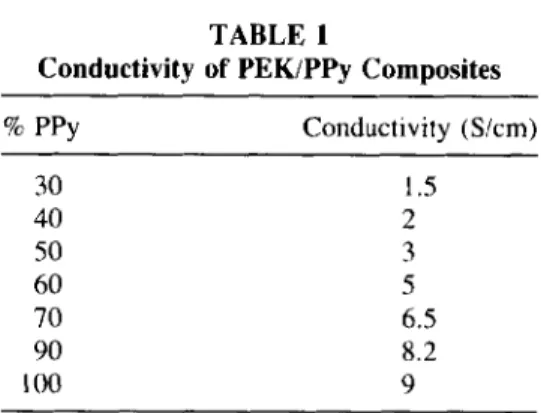
Table 1 shows the conductivities of the composites. The conductivity of the composite PEUPPy films were found to increase as the composition of PPy increased. Pyrrole was polymerized first on the electrode side of the film and grew in the PEK film toward the solution side. In this way, it forms a continu- ous and conductive surface at the solution side, whereas the electrode side is not conducting.
Scanning electron microscopy studies were carried out to investigate the morphologies of the conducting polymer composites. As seen from Fig. 1, the electrode side of the alloy film is rather smooth. At larger magnifications, it was observed that a polymer coated on the electrode contains pores. These holes might constitute the tunnels through which the electrolyte and pyrrole
298
SELAMPINAR, AKBULUT, AND TOPPARE TABLE 1Conductivity of PEK/PPy Composites
% PPy Conductivity ( S k m ) 30 40 50 60 70 90 I00 1.5 2 3 5 6.5 8.2 9
FIG. 1. SEM micrographs of (a) electrode side, (b) solution side, (c) the cross
section of the composite film, and (d) the side of the PPy film that is in contact with the PEK.
CONDUCTING POLYMER COMPOSITES OF PPy AND A PEK 299
-
g
-
60.5
-c 0 .- 20 100- I
penetrate into the insulating polymer. The existence of the disordered region in the PEK film is necessary to form a composite with PPy, providing the swollen part in which pyrrole and the supporting electrolyte are able to diffuse. Morphology studies indicate that the PPy grows on the surface of the insulating polymer emerging in the form of globular projections and forms a continuous layer on top of the PEK film. When we peel the electrolytic film into two layers, one can obtain the PEK layer (next to the metal electrode) and PPy layer (solution side of the composite film). The side of the PPy in contact with the insulating polymer reveals no cauliflower structures, whereas the solution side reflects the usual pure PPy microstructure. As seen from Fig. Id, a layered structure consisting of two different phases was observed. One layer is composed of pure PPy and the other PEK.
In Fig. 2, the thermal gravimetry analyses of pure PEK and the electrolytic film were given. The TGA scan of PEK shows that it is stable to up to 538"C, after which it starts to lose weight suddenly. In comparison, the PEWPPy composite loses weight gradually. The 5% and 30% weight losses were ob- served at 298°C and 538"C, respectively (Fig. 2b). Forty-five percent of the electrolytic film was retained when heated to a temperature of 1030"C, whereas 25% of that of pure PEK remained at that temperature. The thermal gravimetry analysis studies reveal that the electrolytic film has higher heat resistance compared to pure PEK.
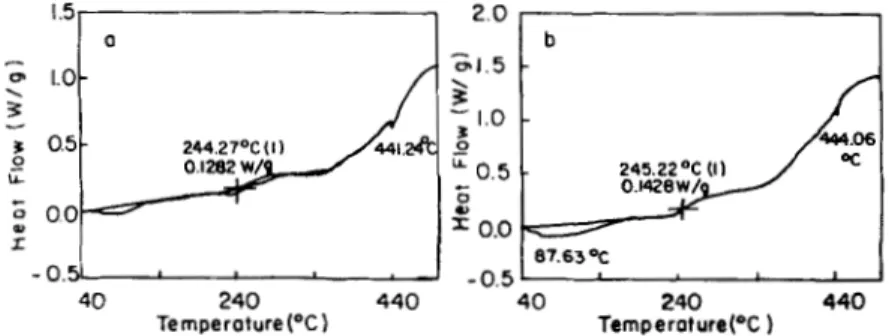
Electrolytic film and a mechanical mixture of the two pure polymers yield glass transition temperatures around 244°C and 245"C, respectively (Fig. 3).
This behavior reveals that there exists no chemical interaction between the two polymers during electrochemical polymerization of pyrrole, contrary to our earlier findings with several insulating polymers (5,8).
300 SELAMPINAR, AKBULUT, AND TOPPARE I .5 0
-
.0 5 -240 440 40 Ternperoture(OC) 2.0 01.5 3-
1.0 LL 0.5 \ 0-
-
0E
0.0 87.63 OC -0.5 1 40 240 440 Temperoture(OC ) FIG. 3. two polymers.DSC curves of (a) electrolytic film and (b) mechanical mixture of the
The CV runs were carried out between - 0.2 and
+
1.1 V on both bare and PEK-coated electrodes (Fig. 4). The electrochemical behavior in CV can be explained in relation to the diffusion of the counteranion. That broad peaks are observed in the voltammograms suggest a complicated redox process, possibly involving a mechanism different from the commonly proposed anion insertion (oxidation)-anion deinsertion (reduction) reaction. The effect of the PPy primary structure on the charging-discharging efficiency can be ascribed to the size of the anion. Small ions can easily diffuse during doping-undopingl , l . a . k * l ~
I. 2 0.8 0.4 0.0 1.2 0 . 8 0.4 0.0
E ( V ) vs Ag/Ag t
FIG. 4. The cyclic voltammograms of PPy on (a) bare Pt and (b) PEK-coated Pt.
CONDUCTING POLYMER COMPOSITES OF PPy AND A PEK 30 1
reactions through the channels formed by the electropolymerization of PPy compared to large ions. Contrary to what is observed for PPy doped with common, low-molecular-weight, inorganic anions, the PTSA does not diffuse out from the matrix. This fact is partially assigned to its size and partially to the compatibility of the polar end with the charged matrix and of the unpolar end with the neutral (reduced) matrix. For that reason the electroactivity de- creases as the runs were continued. In addition to the difficulty of diffusing large anions through the matrix seen in earlier runs, the increase in the film thickness makes the diffusion more difficult.
The spectrum of PPy yields bands around 3400,3110, 1547, 1440, 1310, and 1180 cm-' due to C-N and C-C stretchings. The pure PEK has charac- teristic intense bands at I0 17 and 1243 cm- (symmetric C - 0 - C stretching and asymmetric C - 0 - C stretching, respectively). The electrolytic film shows all the bands of PPy film and PEK; in addition to the analyses men- tioned above, FTIR results confirm that PEK/PPy is physically blended with- out any chemical interaction.
CONCLUSION
Cyclic voltammograms show that the diffusion process in PEK is slow for rather large dopant molecules like PTSA. Still, percolation of aromatic poly (ether ketone)s with PPy is feasible through electrochemical polymerization of pyrrole. The composite is a bilayer instead of a homogeneous, single-layer, polymer blend.
ACKNOWLEDGMENTS
This work was supported by TBAG 1422 and DPTK120498 grants. L. T. acknowledges support from TUBA. We also thank Dr. A. Gungor for the preparation of PEK. REFERENCES 1. 2. 3. 4. 5 . 6 .
R. C. D. Peres and M. A. DePaoli, J . Power Sources, 40, 299 (1992).
J. Pellegrino, R. Radebaugh, and B. R. Mattes, Macromolecules, 29, 4985
(1 996).
D. Braun and A. J. Heeger, Appl. Phys. Lett., 58, 1982 (1991).
A. F. Diaz, J. I. Castillo, T. A. Logan, and W. Lee, J . Electroanal. Cheni., 129,
115 (1981).
H. L. Wang, L. Toppare, and J. E. Femandez, Macromolecules, 23, 1053 (1990). F. Selarnpinar, U. Akbulut, and L. Toppare, Macromol Reptr., A33, 309 (1996).
302 SELAMPINAR, AKBULUT, AND TOPPARE
7. 0. Niwa, M. Hikita, and T. Tamamura, Makromol. Chem., Rapid Commun., 6,
375 (1985).
8. F. Selampinar, U. Akbulut, T. Yalcin, S. Suzer, and L. Toppare, Synth. Met.,
62, 201 (1994).
9. R. N. Johnson, A. G. Famham, R. A. Cledinning, W. F. Hale, and C. N. Memam,
J . Polym. Sci. A , 5 , 2375 (1967).
10. B. M. Marks, U.S. Patent, 3,441,538 (1969): Chem. Abstr., 67, 44371 (1967).