JHEP07(2020)115
Published for SISSA by SpringerReceived: April 1, 2020 Revised: May 26, 2020 Accepted: May 29, 2020 Published: July 17, 2020
Measurement of quark- and gluon-like jet fractions
using jet charge in PbPb and pp collisions at 5.02 TeV
The CMS collaboration
E-mail: [email protected]
Abstract: The momentum-weighted sum of the electric charges of particles inside a jet, known as jet charge, is sensitive to the electric charge of the particle initiating the parton shower. This paper presents jet charge distributions in√sNN = 5.02 TeV lead-lead (PbPb) and proton-proton (pp) collisions recorded with the CMS detector at the LHC. These data correspond to integrated luminosities of 404 µb−1and 27.4 pb−1for PbPb and pp collisions, respectively. Leveraging the sensitivity of the jet charge to fundamental differences in the electric charges of quarks and gluons, the jet charge distributions from simulated events are used as templates to extract the quark- and gluon-like jet fractions from data. The modification of these jet fractions is examined by comparing pp and PbPb data as a function of the overlap of the colliding Pb nuclei (centrality). This measurement tests the color charge dependence of jet energy loss due to interactions with the quark-gluon plasma. No significant modification between different centrality classes and with respect to pp results is observed in the extracted quark- and gluon-like jet fractions.
Keywords: Hadron-Hadron scattering (experiments), Heavy-ion collision, Jets ArXiv ePrint: 2004.00602
JHEP07(2020)115
Contents
1 Introduction 1
2 The CMS detector 2
3 Event selection and simulated event samples 3
4 Jet and track reconstruction 4
5 Jet charge measurement 5
6 Corrections for background and detector effects 5
7 Template fitting 6
8 Systematic uncertainties 7
9 Results 10
10 Summary 12
A Jet charge measurements 15
The CMS collaboration 22
1 Introduction
High-momentum partons produced by hard scatterings in heavy ion collisions undergo en-ergy loss as they traverse the quark-gluon plasma (QGP) created in these interactions [1]. The mechanisms by which these partons lose energy to the medium, as well as their color dependence, are still not fully understood [2, 3]. The particles resulting from the frag-mentation and hadronization of these partons can be clustered into jets. Jets are used as parton proxies to examine the properties of the QGP. Parton energy loss manifests itself in various experimental observables including the suppression of high transverse momen-tum (pT) hadrons and jets [4–8], as well as modifications of parton showers [9,10]. These phenomena are collectively referred to as jet quenching [1].
At leading order in quantum chromodynamics, the type of parton that initiates a jet can be distinguished. The resulting jet can therefore be labeled as a quark, antiquark, or gluon jet. Several recent measurements indicate that the fractions of quark and gluon jets in a sample may be modified as they are expected to suffer different energy loss in the QGP due to their different color charges [11, 12]. This analysis explores the extraction of the fractions of quark and gluon jets from an inclusive jet sample in lead-lead (PbPb) and proton-proton (pp) collisions. This is achieved with a template-fitting method using
JHEP07(2020)115
the “jet charge” observable. Jet charge, defined as the momentum-weighted sum of the electric charges of particles inside a jet, is sensitive to the electric charge of the particle initiating a parton shower and can be used to discriminate between gluon- and quark-initiated jets. This observable was initially suggested as a way of measuring the electric charge of a quark [13] and was first measured in deep inelastic scattering experiments at Fermilab [14,15], CERN [16–19], and Cornell University [20].
More recently, jet charge was measured at the LHC in pp collisions by the ATLAS [21] and CMS [22] collaborations, characterizing the contributions of quark and gluon fragmen-tation to jet production. At LHC energies, gluon contributions dominate jet production at lower transverse momenta, while the valence quark contributions overtake at higher jet pT [23]. According to predictions from the pythia event generator (version 6.424 [24], tune Z2 [25]) for pp collisions at 5.02 TeV, gluon jets are expected to constitute about 59% of a sample of jets with transverse momenta above 120 GeV. Similarly, up and down (anti)quark jets are predicted to make up about 32% of the sample with the other 9% arising from charm, strange and bottom (anti)quark jet contributions. A detailed investi-gation of jet charge and its applications in heavy ion collisions is motivated by extensive theoretical calculations [23, 26, 27]. The dependence of the mean and width (standard deviation) of the jet charge distribution on both jet energy and size, can be calculated independently of Monte Carlo (MC) fragmentation models despite the large experimental uncertainty in fragmentation functions [28]. This makes jet charge a suitable variable for the determination of quark and gluon jet fractions.
This paper presents the first jet charge measurements in heavy ion collisions along with pp jet charge results at the same center-of-mass energy per nucleon pair (√s
NN). The analysis uses PbPb and pp data at√sNN = 5.02 TeV, both collected in 2015 with the CMS detector at the CERN LHC. The data correspond to an integrated luminosity of 404 µb−1 (27.4 pb−1) for PbPb (pp) collisions [29]. In heavy ion collisions, the discrimination be-tween jet and background constituents is not straightforward and often impossible on a per-particle basis. In this work, “background” is defined as uncorrelated and long-range correlated contributions [30], as measured at least 1.5 units of relative pseudorapidity (∆η) away from the jet axis [10,31,32], which do not arise from the jet-initiating parton shower. Any short-range modifications to either the medium or the jet structure are thus included in the jet “signal”. The measurements are corrected for detector and background effects using an unfolding procedure, and are presented as a function of the overlap of the col-liding Pb nuclei (centrality). The jet charge distributions of light (anti)quark and gluon jets from MC generators are used as templates to fit the inclusive jet charge distribution measured in data. The fractions of quark- and gluon-initiated jets are extracted from this fitting procedure and are referred to as quark- and gluon-like jet fractions. The results are presented as a function of the minimum pTthreshold of the particles used in the jet charge
measurement and also as a function of a pT weighting factor, κ [26].
2 The CMS detector
The central feature of the CMS apparatus is a superconducting solenoid of 6 m internal diameter, providing a magnetic field of 3.8 T. Within the solenoid volume are a silicon
JHEP07(2020)115
pixel and strip tracker, a lead tungstate crystal electromagnetic calorimeter (ECAL), and a brass and scintillator hadron calorimeter (HCAL), each composed of barrel and endcap sections. Two hadron forward (HF) steel and quartz-fiber calorimeters complement the barrel and endcap detectors, extending the calorimeter from the range |η| < 3.0 provided by the barrel and endcap out to |η| < 5.2. Events of interest are selected using a two-tiered trigger system [33].
In this analysis, jets are reconstructed within the range |η| < 1.5. In the region |η| < 1.74, the HCAL cells have widths of 0.087 in both η and azimuth φ. Within the central barrel region corresponding to |η| < 1.48, the HCAL cells map onto 5 × 5 ECAL crystal arrays to form calorimeter towers projecting radially outwards from the nominal interaction point. Within each tower, the energy deposits in ECAL and HCAL cells are summed to define the calorimeter tower energies, which are subsequently clustered to reconstruct the jet energies and directions [34]. The silicon tracker measures charged-particle tracks within |η| < 2.5. It consists of 1440 silicon pixel and 15 148 silicon strip detector modules. For charged particles with 1 < pT < 10 GeV in the barrel region, the track resolutions
are typically 1.5% in pT and 25–90 (45–150) µm in the transverse (longitudinal) impact parameter [35]. A detailed description of the CMS detector, together with a definition of the coordinate system used and the relevant kinematic variables, can be found in ref. [36].
3 Event selection and simulated event samples
The PbPb and pp data are selected with a calorimeter-based trigger that uses the anti-kT
jet clustering algorithm with a distance parameter of R = 0.4 [37]. The trigger requires events to contain at least one jet with pT> 80 GeV. This trigger is fully efficient for events containing jets with reconstructed pT > 100 GeV. The data selected by this trigger are
referred to as “jet-triggered”, and corresponds to 3.35 (2.6) million PbPb (pp) collision events. Vertex and noise filters are applied to both PbPb and pp data to reduce con-tamination from noncollision events (e.g., beam-gas interactions), as described in previous analyses [10,38]. Additionally, a primary vertex with at least 2 tracks is required to be re-constructed and have a z position (vz) within 15 cm of the center of the nominal interaction region along the beam axis. In PbPb collisions, the shapes of clusters in the pixel detector are required to be compatible with those expected from a PbPb collision event. The PbPb events are also required to have at least three towers in each of the HF calorimeters with energy deposits of more than 3 GeV per tower.
Simulated MC samples are used to evaluate the performance of the event reconstruc-tion, in particular the track reconstruction efficiency and the jet energy response and reso-lution. The MC samples use the pythia (version 6.424 [24], tune Z2 [25]) event generator to describe the hard scattering, parton showering, and hadronization of the partons and are referred to as the pythia6 sample. To account for the soft underlying PbPb event, the hard pythia6 interactions are embedded into simulated minimum-bias PbPb events produced with hydjet (version 1.383 [39]). This minimum-bias event generator is tuned to reproduce global event properties such as the charged-hadron pT spectrum and particle multiplicity. The combined sample of hard pythia6 interactions and soft hydjet
underly-JHEP07(2020)115
ing event is referred to as the pythia6+hydjet sample. The Geant4 [40] toolkit is used to simulate the CMS detector response.
The scalar pT sum of the HF calorimeter towers (3.0 < |η| < 5.2) is used to define the event centrality in PbPb events and to divide the event sample into centrality classes, each representing a percentage of the total inelastic hadronic cross section [41]. Events in PbPb collisions are divided into four centrality intervals corresponding to 0–10% (most central), 10–30%, 30–50%, and 50–100% (most peripheral).
Because of the large number of nucleon-nucleon interactions in head-on PbPb colli-sions, jets are more likely to be reconstructed in more central events. Requiring a jet to be present in an event, therefore, biases the data sample toward more central collisions. In comparison, the pythia6+hydjet sample consists of a flat distribution of jets (from pythia6), as a function of centrality. Thus, a centrality-based reweighting is applied to this MC sample to match the centrality distribution of the jet-triggered PbPb data. An additional reweighting procedure is performed to match the simulated vz distributions to data for both the PbPb and pp samples. The contribution of pile-up in both PbPb and pp collisions is negligible [29].
4 Jet and track reconstruction
The jet reconstruction in PbPb and pp events is performed with the anti-kT jet algorithm
with a distance parameter of R = 0.4, as implemented in the FastJet framework [42]. Individually calibrated calorimeter towers are used as inputs to the algorithm. Only cal-orimeter information is used in the jet reconstruction to minimize the bias of the tracking efficiency on the reconstruction of jets. In PbPb collisions, the contributions of the under-lying event are subtracted using a two-iteration variant of the “noise/pedestal subtraction” technique described in refs. [43, 44]. In this method, only calorimeter towers outside of the jet area are used in the background estimation after identifying and excluding the jets in the first iteration. The underlying event and pile-up contribution is negligible in pp collisions and therefore do not require any subtraction. In both PbPb and pp events, jet energy is calibrated and the calorimeter response is verified as a function of jet pT and η. To account for the variation in detector response with the total number of jet con-stituents, additional corrections are applied in both collision systems based on the number of charged-particle tracks with pT > 2 GeV within the jet cone (relative angular distance from the jet axis ∆r =p(∆η)2+ (∆φ)2 < 0.4), the jet pT, and the collision centrality [10]. This corrects for a difference in the simulated calorimetric jet energy response between quark and gluon jets and reduces the difference in response between the two jet flavors from 10% to around 3%. After reconstruction and offline jet energy calibration, jets are required to have pT > 120 GeV and |η| < 1.5. In this kinematic range, the jet trigger is observed to be fully efficient and the jet energy response and resolution is optimized. Within this selection, it is possible for multiple jets to be selected from the same event.
For pp collision events, charged-particle tracks are reconstructed using an iterative tracking method [35] that finds tracks within |η| < 2.4 down to pT = 0.1 GeV. For the PbPb data an alternative iterative reconstruction procedure is employed because of the large track
JHEP07(2020)115
multiplicities [45,46]. It is capable of reconstructing tracks down to pT = 0.4 GeV. The charge of the particle is measured based on the direction of curvature of the reconstructed track. Tracks used in this measurement are required to have a relative pT uncertainty of less than 10% (30%) in PbPb (pp) collisions and also satisfy the standard track quality requirements [38]. For both collision systems, it is required that the significance of the distance of closest approach to at least one primary vertex in the event be less than 3 standard deviations, in order to decrease the likelihood of counting nonprimary charged particles originating from secondary decay products. Tracks with pT > 20 GeV are
re-quired to have an associated energy deposit [47] of at least half their momentum in the calorimeters to reduce the contribution of misreconstructed tracks with very high pT. In
PbPb collisions, tracks must additionally be associated with at least 11 hits and satisfy a fit quality requirement that the χ2, divided by both the number of degrees of freedom and the number of tracker layers hit, be less than 0.15 [38]. The tracking efficiency in pp col-lisions is approximately 90% for pT > 1 GeV. Track reconstruction is more difficult in the heavy ion environment because of the large track multiplicity, and so the tracking efficiency ranges from approximately 60% at pT = 1 GeV to about 70% at pT= 10 GeV [38].
5 Jet charge measurement
The jet charge is defined as:
Qκ = 1
(pjetT )κ X
i∈jet
qipT,iκ. (5.1)
The variable pjetT is the transverse momentum of the calorimeter jet. The qiand pT,isymbols
refer to the electric charge (in terms of the proton charge e) and transverse momentum of the i-th particle in the jet cone, respectively. The κ parameter controls the weighting of the jet charge variable to low- and high-pT particles in the jet cone. Low values of κ enhance the contribution from low-pT particles to the jet charge, and vice versa.
Tracks with pT > 1 GeV that are located within the jet cone (∆r < 0.4) are used
in the jet charge measurement. The track pT threshold of 1 GeV ensures that the MC templates for different flavors used in the fitting procedure are well resolved and also reduces the contributions of uncorrelated and long-range correlated background to the jet charge. Theoretical predictions suggest that a parameter value pT-weighting factor κ ≈ 0.5 is the most sensitive to the electric charge of the parton initiating the jet in vacuum [26]. In this analysis, measurements are shown for κ values of 0.3, 0.5, and 0.7, and with different selections on the minimum track pT of 1, 2, 4, and 5 GeV to retain a broad sensitivity to both hard and soft radiation inside jets.
6 Corrections for background and detector effects
To allow for a comparison with future measurements from other experiments or theoretical predictions, the jet charge distributions are unfolded from the detector to the final-state hadron particle level. The jet charge measurements at the detector level are broadened by track reconstruction inefficiencies, and this effect increases with decreasing κ values. In
JHEP07(2020)115
PbPb collisions, there is additional smearing that is caused by the background from the underlying event and long-range correlations [30]. The unfolding is performed to account for these effects using the D’Agostini iterative method [48–50], as implemented in the RooUnfold software package [51]. Response matrices are derived from pythia6 and pythia6+hydjet simulation samples for pp and PbPb collisions, respectively.
Response matrices in the unfolding procedure are constructed using jet charge distribu-tions measured with reconstructed tracks, and that measured with generator-level particles originating from the hard scattering. To account for the background effects in PbPb colli-sions, the reconstructed tracks used in constructing the response matrices includes contri-butions from both the hard scattering and background as modeled by pythia6+hydjet. As a cross check of the background estimation procedure, a data-driven technique is also used to measure the uncorrelated and long-range correlated contributions, as further dis-cussed in section 8. No background correction is required in pp collisions because of the negligible underlying event and pile-up contribution [29].
The number of iterations in the unfolding procedure trades off bias towards MC with statistical fluctuations. To obtain an optimal number of iterations, reconstructed jet charge distributions from modified samples of pythia6 and pythia6+hydjet are unfolded using the nominal response matrices. Quark and gluon jet fractions are varied by 50% in the modified simulation samples, which is expected to give a good bound on the potential modification of the jet charge distribution in data [23]. Based on these studies, three to four iterations are used in the unfolding procedure for different selections of threshold track pT and κ.
7 Template fitting
The flavor-tagged jet charge distributions from pythia6 at the generator-level are used as templates to fit the unfolded jet charge measurement to estimate the fractions of quark and gluon jets. Measurements from pythia6 simulations for jets initiated by up quarks (mean = 0.254e, width = 0.341e), down quarks (mean = −0.150e, width = 0.335e), and gluons (mean = 0.001e, width = 0.364e) are well separated and make up the dominant fractions of the sample. The quoted mean and width values for the different-flavor jets are from measurements at the generator-level, with a minimum track pT threshold of 1 GeV
and a κ value of 0.5. They have statistical uncertainties of less than 0.1%. The average jet charge for jets initiated by quarks and gluons varies by less than 1% as a function of the jet pT in pythia6, allowing for the stable extraction of the respective jet fractions
in the pT range examined here. In the fitting procedure, the fractions of up antiquark jets (u ) and down antiquark jets (d ), are varied along with the up and down quark jets, respectively. Jets initiated by charm, strange, and bottom (anti)quarks (c , c, s , s, b , and b, respectively) are categorized as “other flavor” jets and their fractions are fixed during the fitting procedure to reduce the number of degrees of freedom. The fitting procedure takes into consideration the total systematic uncertainty in the jet charge measurements from all sources combined with the statistical uncertainty.
JHEP07(2020)115
A small fraction of jets have no reconstructed tracks inside the jet cone above the threshold track pTused in the jet charge measurement. This fraction is negligible for a track
pTthreshold of 1 GeV in both collision systems but goes up to 10 (6)% in central PbPb (pp) collisions for a track pT threshold of 5 GeV. Such jets, with no reconstructed tracks inside the jet cone, are excluded in the fitting procedure, and the fractions of quarks and gluons for such jets are assigned directly from simulation. The related systematic uncertainty is discussed in section 8. Previous CMS results have shown a large excess of soft particles in PbPb events relative to pp events up to ∆r ∼ 1 from the jet axis, compensated by a relative depletion of higher-pT tracks [10, 52]. Consequently, the fraction of jets with no high-pT tracks is observed to be 50% higher in PbPb data compared to pythia6+hydjet
predictions for the most central collisions.
For a given jet energy, jets with a harder constituent pT spectrum are more likely to
be reconstructed because the calorimeter response does not scale linearly with the incident particle energy, resulting in a bias toward the selection of jets with fewer associated tracks. On average, quark jets have harder fragmentation than gluon jets and are therefore pref-erentially reconstructed. Jet energy corrections based on the number of jet constituents are applied to reduce the difference in the response between quark and gluon jets from 10 to around 3% (see section 4). To compensate for the residual difference, an extra correc-tion factor, based on the deviacorrec-tion from unity in the response, is applied to the extracted fractions of quark- and gluon-like jets [10].
8 Systematic uncertainties
A number of sources of systematic uncertainty are considered, including effects from the unfolding, tracking efficiencies, background correction, jet reconstruction, and the contri-butions from “other flavor” jets. To estimate most systematic uncertainties, a quantity is varied by an appropriate amount in the construction of the response matrix and prop-agated through the full analysis chain. The fitting procedure is repeated on the varied distributions and the deviation from the nominal results are assigned as systematic un-certainties. The systematic uncertainties from all sources are added in quadrature. The relative uncertainties in the measured jet charge distributions vary for different selections of pT-weighting factor κ and track pT threshold.
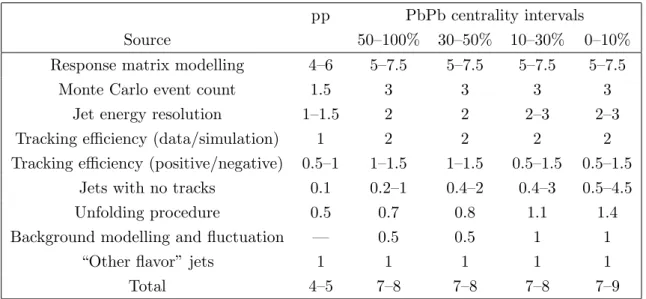
An uncertainty of 5 (4)% in PbPb (pp) data is considered to account for possible differences in track reconstruction between data and simulation, including reconstruction of misreconstructed tracks [38]. The reconstruction efficiency is varied by this amount when populating the response matrices used in the data unfolding. The resulting jet charge distributions are fit with the generator-level templates and the differences in the extracted fractions of quark- and gluon-like jets, observed to be 1–2%, are quoted as a source of systematic uncertainty.
From simulation studies, the difference in the tracking efficiencies for positively and negatively charged particles is found to be 0.5% in both PbPb and pp collisions regardless of the particle pT. This uncertainty is propagated to the final result in a way similar to what is used for the tracking reconstruction difference between data and simulation,
JHEP07(2020)115
i.e., the unfolding response matrices are modified and any differences after applying the template fitting procedure are taken as systematic uncertainties.
To study the systematic effect arising from the choice of the MC event generator to produce the response matrix used in the unfolding procedure, a response matrix is formed using a modified pythia6 sample with varied quark and gluon jet fractions, and both of these matrices are used to unfold the data. In this study, quark and gluon jet fractions are varied by 50% from their nominal MC values while populating the modified response matrices. The fitting procedure is repeated on the resulting varied unfolded distributions and the deviation from the nominal fitting results are then assigned as a systematic un-certainty. Other sources of uncertainty in the unfolding procedure include effects from bin-to-bin correlations in the unfolded distribution and the statistical uncertainty in the MC simulation of the response matrix elements. They are propagated using covariance matrices constructed with the RooUnfold software package. These studies result in a relative uncertainty of 4–7% on the extracted jet fractions. Additional studies are per-formed using pythia8 v212 [53] tune CUETP8M1 [54] and herwig++ 2.7.1 [55] tune EE5C [56] event generators, neither of which are observed to describe the jet spectra in pp data very well. After reweighting the jet spectra in these MC samples to match data, while jet charge distributions from pythia8 are in very good agreement with those from pythia6 and data, herwig++ overestimates the width of the data jet charge distributions and are hence not used in systematic uncertainty studies.
The systematic uncertainty due to the jet energy resolution is estimated by changing the jet energy resolution by 5% to cover the corresponding uncertainty [34], followed by a comparison of the modified spectra with the nominal spectrum. The corresponding differences in the extracted quark- and gluon-like jet fractions, estimated from repeating the fitting procedure on the smeared jet charge distributions, are 1–3% and are included as systematic uncertainties. The effects of the angular resolution of the jet axis are negligible in the jet charge measurements.
To study the background modelling uncertainty in PbPb collisions, the response matri-ces are also built using a data-driven reference event technique to estimate the uncorrelated and long-range correlated background contributions. The jet charge is measured using jets in a jet-triggered “signal” event and tracks from a separate minimum-bias “reference” event which is required to have a vzwithin 1 cm and collision centrality within 2.5% of the signal event. The signal and reference events must also have similar charged particle multiplicities outside of the jet cone. The background obtained from the reference event technique is observed to be in close agreement with that for hydjet and the resulting uncertainty is less than 1%. No background subtraction is performed in pp due to its negligible effect, and hence no corresponding systematic uncertainty is assigned.
The contribution from jets with no tracks in the jet cone above a pT threshold, which
are excluded in the fitting procedure, to the gluon-like jet fraction measurements is assigned from MC. The difference in the fraction of such jets between data and MC increases with increasing track pT threshold and with more central collisions because of the observed
depletion of high-pT tracks in PbPb collisions [10, 52]. This difference is less than 1% in pp collisions but can reach 4.5% in PbPb collisions. It is assigned as a systematic uncertainty.
JHEP07(2020)115
pp PbPb centrality intervals
Source 50–100% 30–50% 10–30% 0–10%
Response matrix modelling 4–6 5–7.5 5–7.5 5–7.5 5–7.5
Monte Carlo event count 1.5 3 3 3 3
Jet energy resolution 1–1.5 2 2 2–3 2–3
Tracking efficiency (data/simulation) 1 2 2 2 2
Tracking efficiency (positive/negative) 0.5–1 1–1.5 1–1.5 0.5–1.5 0.5–1.5
Jets with no tracks 0.1 0.2–1 0.4–2 0.4–3 0.5–4.5
Unfolding procedure 0.5 0.7 0.8 1.1 1.4
Background modelling and fluctuation — 0.5 0.5 1 1
“Other flavor” jets 1 1 1 1 1
Total 4–5 7–8 7–8 7–8 7–9
Table 1. Relative systematic uncertainties in percentage for the measurements of gluon-like jet fractions in pp and PbPb events. The PbPb results are given in intervals of centrality. When an uncertainty range is given, the range of the values are the maximum variation in the fractions for different selections on κ and track pTthreshold values.
In PbPb data, there is an additional bias toward selecting jets that are reconstructed on upward fluctuations in the underlying event. Since the jet spectrum is steeply falling, more jets on upward fluctuations are included in the sample than jets on downward fluc-tuations are excluded resulting in an uncertainty of up to 10% in the measured particle multiplicity in central PbPb events [10]. This effect is observed to be included in the re-constructed jet charge measurements in simulation as well, so the difference in this bias between data and MC is used to calculate the corresponding systematic uncertainty. To calculate this difference, distributions of the particle multiplicities within cones (∆r < 0.4), chosen randomly in detector η and φ, are compared between minimum-bias data and MC events [10,52] and are found to be in very good agreement with each other. The difference is propagated through the analysis chain and the resulting deviation from the nominal results are observed to be negligible.
To assess the effects of the statistical uncertainties from the MC templates on the final results, 1000 pseudo-experiments are performed by generating smeared jet charge templates based on its statistical uncertainty and repeatedly fitting the data measurements using these templates. The distributions of extracted gluon-like jet fractions from the pseudo-experiment fits have a variance of 3% or less, which is assigned as a systematic uncertainty due to limited MC event count.
Finally, the effect of fixing the “other flavor” jet fractions in the fitting procedure is analyzed. The “other flavor” jets, comprising c (2.9%), s (4.7%) and b (1.7%) (anti)quarks, are each varied by their total amount in the fitting procedure and the resulting deviation from the nominal fitting result is propagated as a systematic uncertainty.
A summary of the range of systematic uncertainties for results is shown in table 1for different selections of κ and track pT threshold values.
JHEP07(2020)115
1 − −0.5 0 0.5 1 [e] =0.5 κ Q 0.8 1 1.2 1 − −0.5 0 0.5 1 [e] =0.5 κ Q 0.8 1 1.2 1 − −0.5 0 0.5 1 [e] =0.5 κ Q 0.8 1 1.2 1 − −0.5 0 0.5 1 [e] =0.5 κ Q 0.8 1 1.2 1 − −0.5 0 0.5 1 [e] =0.5 κ Q 0.8 1 1.2 1 − −0.5 0 0.5 1 0 0.5 1 1.5 2 pp Data Fitting results Gluon Up quark Down quark Other flavors 1 − −0.5 0 0.5 1 0 0.5 1 1.5 2 50-100% PbPb 1 − −0.5 0 0.5 1 0 0.5 1 1.5 2 30-50% PbPb 1 − −0.5 0 0.5 1 0 0.5 1 1.5 2 10-30% PbPb 1 − −0.5 0 0.5 1 0 0.5 1 1.5 2 0-10% PbPb (5.02 TeV) -1 b µ , PbPb 404 -1 pp 27.4 pb CMS | < 1.5 jet η > 120 GeV, | jet T R = 0.4 jets, p T anti-k > 1 GeV T = 0.5, track p κ (dN/dQ) [1/e] jets 1/N Data / FitFigure 1. (Upper) Unfolded jet charge measurements shown for inclusive jets in data along with the extracted fractions of up, and down quark jets, gluon jets, and the “other flavor” jets. The systematic and statistical uncertainties in the distributions are shown by the shaded regions and vertical bars, respectively. The jet charge measurements shown here are for the pT-weighting factor
κ = 0.5 and a minimum track pT of 1 GeV. (Lower) Ratio of the jet charge measurements to the
results of template fits.
9 Results
The unfolded jet charge measurements, normalized to the total number of jets in the sample (Njets), are shown in the upper panels of figure 1 with solid black points for a sample
selection with a minimum track pT of 1 GeV and pT-weighting factor κ = 0.5. The results are shown for pp and different event centrality bins in PbPb. The extracted fraction of quark- and gluon-initiated jets is displayed as a set of stacked histograms. Figure 1 also shows the ratio of the data over the template fit results in the lower panels, and no significant deviation from unity is observed in the entire fitting range. The fractions of up and down quarks are observed to be significantly different between pp and PbPb collisions, as expected from an enhanced contribution of valence down quarks in lead collisions (having 126 neutrons and 82 protons in each nucleus). The jet charge measurements and fit results for other minimum track pT and κ selections are shown in figures 5–7 in the appendix.
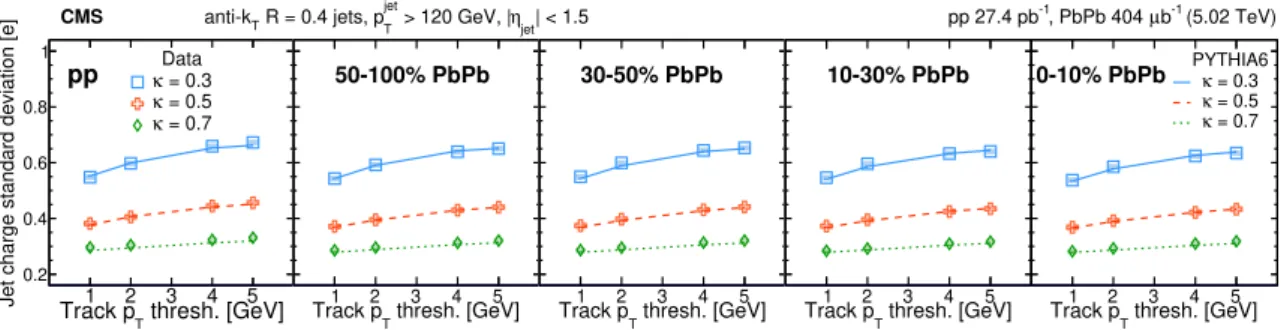
The widths (standard deviations) of the unfolded data jet charge distributions in dif-ferent PbPb event centrality bins and in pp, with various track pT thresholds and κ values,
are shown in figure2. They are also compared to generator-level predictions from pythia6 with matching track pT and κ selections in figure 2. The data (simulation) results for κ = 0.3, 0.5, and 0.7, are shown by the blue squares (solid lines), red crosses (dashed lines), and green diamonds (dotted lines), respectively. The measured standard deviations tend to increase as a function of the minimum track pT and decrease with increasing κ value. Theoretical predictions incorporating color-charge dependence into jet energy loss calculations predict that stronger quenching of gluon jets will result in a reduced frac-tion of gluon-initiated jets in the observed jet sample from PbPb collisions compared to that in pp data [27]. The mean of the jet charge distribution for gluon-initiated jets is consistently predicted to be zero in various MC simulations, while that of quark jets is nonzero. A decrease in the fraction of gluons in a quenched jet sample would hence lead to an effective increase in the standard deviation of the measured jet charge distribution.
JHEP07(2020)115
1 2 3 4 5 thresh. [GeV] T Track p 0.2 0.4 0.6 0.8 1 pp κData = 0.3 = 0.5 κ = 0.7 κ 1 2 3 4 5 thresh. [GeV] T Track p 0.2 0.4 0.6 0.8 1 50-100% PbPb 1 2 3 4 5 thresh. [GeV] T Track p 0.2 0.4 0.6 0.8 1 30-50% PbPb 1 2 3 4 5 thresh. [GeV] T Track p 0.2 0.4 0.6 0.8 1 10-30% PbPb 1 2 3 4 5 thresh. [GeV] T Track p 0.2 0.4 0.6 0.8 1 0-10% PbPb PYTHIA6κ = 0.3 = 0.5 κ = 0.7 κ (5.02 TeV) -1 b µ , PbPb 404 -1 pp 27.4 pb CMS | < 1.5 jet η > 120 GeV, | jet T R = 0.4 jets, p T anti-kJet charge standard deviation [e]
Figure 2. The standard deviation of the jet charge distributions with different track pTthresholds and κ values for pp collisions and in the various event centrality bins for PbPb collisions compared with the pythia6 prediction. The systematic and statistical uncertainties in the standard deviation measurements are shown by the shaded regions and vertical bars, respectively.
1 2 3 4 5 thresh. [GeV] T Track p 0.4 0.6 0.8 pp Data PYTHIA6 1 2 3 4 5 thresh. [GeV] T Track p 0.4 0.6 0.8 50-100% PbPb 1 2 3 4 5 thresh. [GeV] T Track p 0.4 0.6 0.8 30-50% PbPb 1 2 3 4 5 thresh. [GeV] T Track p 0.4 0.6 0.8 10-30% PbPb 1 2 3 4 5 thresh. [GeV] T Track p 0.4 0.6 0.8 0-10% PbPb (5.02 TeV) -1 b µ , PbPb 404 -1 pp 27.4 pb CMS | < 1.5 jet η > 120 GeV, | jet T R = 0.4 jets, p T anti-k κ = 0.5
Gluon-like jet fraction
Figure 3. Fitting results for the extraction of gluon-like jet fractions in pp and PbPb data shown for different track pTthreshold values and event centrality bins in PbPb collisions. The systematic and statistical uncertainties are represented by the shaded regions and vertical bars, respectively. The predictions for the gluon jet fractions from pythia6 are shown in dashed red lines.
Figure2summarizes standard deviations measured for all track pT selections and κ values studied. The generator-level pythia6 predictions agree with the measured widths for pp events. No strong modifications are observed in the widths of the jet charge distributions in central PbPb collisions compared to the peripheral events. While the PbPb width re-sults cannot be directly compared to the pp reference due to different up and down quark contents in protons and Pb nuclei, generator-level pythia6 predictions adjusted for this difference reproduce the observed widths of jet charge measurements for all PbPb collision centralities.
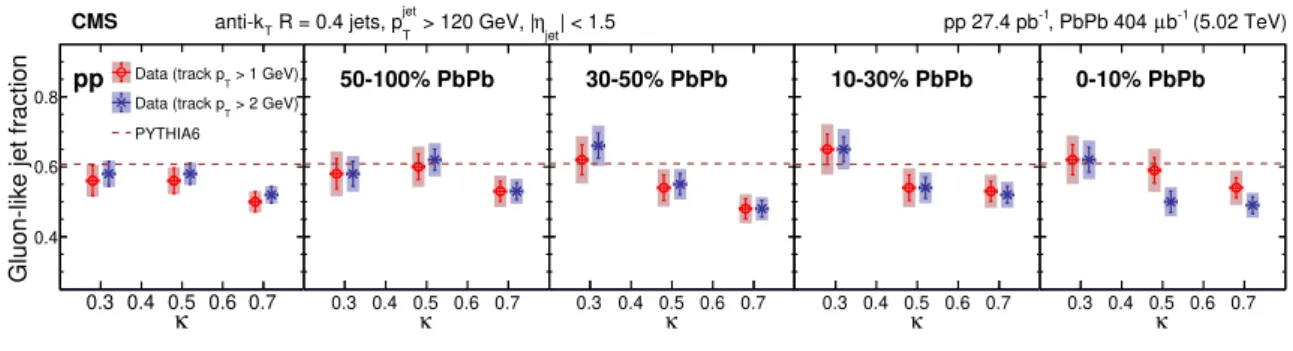
The results for the quark- and gluon-like jet fractions in an inclusive sample are shown in figure3as a function of the track pT threshold. Figure4 shows the same quantities as a function of κ for track pT > 1 and >2 GeV, with red circles and blue crosses, respectively.
The systematic uncertainties are shown by the shaded regions while the statistical uncer-tainties, combined with the fit unceruncer-tainties, are shown by the solid vertical bars. Only the gluon jet fitting results are shown in figures 3 and 4 for clarity but it should be inferred that the quark jets make up the rest of the inclusive sample.
Previous CMS measurements have shown a strong modification in the distribution of low-pTtracks relative to the jet axis in PbPb collisions with respect to pp collisions [10,52].
JHEP07(2020)115
0.3 0.4 0.5 0.6 0.7 κ 0.4 0.6 0.8 pp > 1 GeV) T Data (track p > 2 GeV) T Data (track p PYTHIA6 0.3 0.4 0.5 0.6 0.7 κ 0.4 0.6 0.8 50-100% PbPb 0.3 0.4 0.5 0.6 0.7 κ 0.4 0.6 0.8 30-50% PbPb 0.3 0.4 0.5 0.6 0.7 κ 0.4 0.6 0.8 10-30% PbPb 0.3 0.4 0.5 0.6 0.7 κ 0.4 0.6 0.8 0-10% PbPb (5.02 TeV) -1 b µ , PbPb 404 -1 pp 27.4 pb CMS | < 1.5 jet η > 120 GeV, | jet T R = 0.4 jets, p T anti-kGluon-like jet fraction
Figure 4. Fitting results for the extraction of gluon-like jet fractions in pp and PbPb data shown for pT-weighting factor κ values of 0.3, 0.5, and 0.7 in different event centrality bins in PbPb. The
markers for track pT> 1 and >2 GeV have been separated horizontally for clarity. The systematic
and statistical uncertainties are represented by the shaded regions and vertical bars, respectively. The predictions for the gluon jet fractions from pythia6 are shown in dashed red lines.
are two of the proposed explanations for this modification [57], neither of which are expected to modify the jet charge considerably. From figures 3 and 4, no significant modification is observed in the relative fractions of the quark- and gluon-like jets in central PbPb collisions compared to peripheral PbPb and pp collisions. The relative jet fractions are also observed to be unmodified when calculated using a range of different track pT thresholds or κ values.
10 Summary
Jet charge, defined as the momentum-weighted sum of the electric charges of particles inside a jet, is measured for the first time in heavy ion collisions and is presented along with pp results at the same energy. The analysis uses lead-lead (PbPb) and proton-proton (pp) collision data collected with the CMS detector at a nucleon-nucleon center-of-mass energy of 5.02 TeV. The unfolded jet charge distributions, measured using the jet constituents with transverse momentum pT > 1 GeV for jets having pT > 120 GeV and pseudorapidity
|η| < 1.5, are presented. The widths of the jet charge distributions for pp collisions are in good agreement with predictions from the event generator pythia6 and are shown to be independent of PbPb collision centrality. The jet charge distributions for quark-and gluon-initiated jets from pythia6 events are used as fitting templates to estimate the respective contributions in the measured jet samples. The gluon-like jet fractions extracted from these template fits are found to be similar between pp data and all studied PbPb centrality ranges. These are the first measurements in heavy ion collisions which exploit the electric charge of the initiating parton to discriminate between quark and gluon jets. No evidence is seen for a significant decrease (increase) in gluon-like (quark-like) prevalence in a sample of jets with pT > 120 GeV in PbPb collisions. These observations do not support recent interpretations of other heavy ion results [11,12], which are based on a decreased (increased) gluon (quark) fraction caused by color-charge dependent jet quenching.
Acknowledgments
We congratulate our colleagues in the CERN accelerator departments for the excellent per-formance of the LHC and thank the technical and administrative staffs at CERN and at
JHEP07(2020)115
other CMS institutes for their contributions to the success of the CMS effort. In addition, we gratefully acknowledge the computing centers and personnel of the Worldwide LHC Computing Grid for delivering so effectively the computing infrastructure essential to our analyses. Finally, we acknowledge the enduring support for the construction and operation of the LHC and the CMS detector provided by the following funding agencies: BMBWF and FWF (Austria); FNRS and FWO (Belgium); CNPq, CAPES, FAPERJ, FAPERGS, and FAPESP (Brazil); MES (Bulgaria); CERN; CAS, MoST, and NSFC (China); COL-CIENCIAS (Colombia); MSES and CSF (Croatia); RPF (Cyprus); SENESCYT (Ecuador); MoER, ERC IUT, PUT and ERDF (Estonia); Academy of Finland, MEC, and HIP (Fin-land); CEA and CNRS/IN2P3 (France); BMBF, DFG, and HGF (Germany); GSRT (Greece); NKFIA (Hungary); DAE and DST (India); IPM (Iran); SFI (Ireland); INFN (Italy); MSIP and NRF (Republic of Korea); MES (Latvia); LAS (Lithuania); MOE and UM (Malaysia); BUAP, CINVESTAV, CONACYT, LNS, SEP, and UASLP-FAI (Mexico); MOS (Montenegro); MBIE (New Zealand); PAEC (Pakistan); MSHE and NSC (Poland); FCT (Portugal); JINR (Dubna); MON, RosAtom, RAS, RFBR, and NRC KI (Russia); MESTD (Serbia); SEIDI, CPAN, PCTI, and FEDER (Spain); MOSTR (Sri Lanka); Swiss Funding Agencies (Switzerland); MST (Taipei); ThEPCenter, IPST, STAR, and NSTDA (Thailand); TUBITAK and TAEK (Turkey); NASU (Ukraine); STFC (United Kingdom); DOE and NSF (U.S.A.).
Individuals have received support from the Marie-Curie program and the European Research Council and Horizon 2020 Grant, contract Nos. 675440, 752730, and 765710 (Eu-ropean Union); the Leventis Foundation; the A.P. Sloan Foundation; the Alexander von Humboldt Foundation; the Belgian Federal Science Policy Office; the Fonds pour la Forma-tion `a la Recherche dans l’Industrie et dans l’Agriculture (FRIA-Belgium); the Agentschap voor Innovatie door Wetenschap en Technologie (IWT-Belgium); the F.R.S.-FNRS and FWO (Belgium) under the “Excellence of Science — EOS” — be.h project n. 30820817; the Beijing Municipal Science & Technology Commission, No. Z191100007219010; the Ministry of Education, Youth and Sports (MEYS) of the Czech Republic; the Deutsche Forschungsgemeinschaft (DFG) under Germany’s Excellence Strategy — EXC 2121 “Quan-tum Universe” — 390833306; the Lend¨ulet (“Momentum”) Program and the J´anos Bolyai Research Scholarship of the Hungarian Academy of Sciences, the New National Excellence Program ´UNKP, the NKFIA research grants 123842, 123959, 124845, 124850, 125105, 128713, 128786, and 129058 (Hungary); the Council of Science and Industrial Research, India; the HOMING PLUS program of the Foundation for Polish Science, cofinanced from European Union, Regional Development Fund, the Mobility Plus program of the Min-istry of Science and Higher Education, the National Science Center (Poland), contracts Harmonia 2014/14/M/ST2/00428, Opus 2014/13/B/ST2/02543, 2014/15/B/ST2/03998, and 2015/19/B/ST2/02861, Sonata-bis 2012/07/E/ST2/01406; the National Priorities Re-search Program by Qatar National ReRe-search Fund; the Ministry of Science and Education, grant no. 14.W03.31.0026 (Russia); the Tomsk Polytechnic University Competitiveness En-hancement Program and “Nauka” Project FSWW-2020-0008 (Russia); the Programa Es-tatal de Fomento de la Investigaci´on Cient´ıfica y T´ecnica de Excelencia Mar´ıa de Maeztu, grant MDM-2015-0509 and the Programa Severo Ochoa del Principado de Asturias; the
JHEP07(2020)115
Thalis and Aristeia programs cofinanced by EU-ESF and the Greek NSRF; the Rachada-pisek Sompot Fund for Postdoctoral Fellowship, Chulalongkorn University and the Chu-lalongkorn Academic into Its 2nd Century Project Advancement Project (Thailand); the Kavli Foundation; the Nvidia Corporation; the SuperMicro Corporation; the Welch Foun-dation, contract C-1845; and the Weston Havens Foundation (U.S.A.).
JHEP07(2020)115
A Jet charge measurements
1 − −0.5 0 0.5 1 [e] =0.5 κ Q 0.8 1 1.2 1 − −0.5 0 0.5 1 [e] =0.5 κ Q 0.8 1 1.2 1 − −0.5 0 0.5 1 [e] =0.5 κ Q 0.8 1 1.2 1 − −0.5 0 0.5 1 [e] =0.5 κ Q 0.8 1 1.2 1 − −0.5 0 0.5 1 [e] =0.5 κ Q 0.8 1 1.2 1 − −0.5 0 0.5 1 0 0.5 1 1.5 2 pp Data Fitting results Gluon Up quark Down quark Other flavors 1 − −0.5 0 0.5 1 0 0.5 1 1.5 2 50-100% PbPb 1 − −0.5 0 0.5 1 0 0.5 1 1.5 2 30-50% PbPb 1 − −0.5 0 0.5 1 0 0.5 1 1.5 2 10-30% PbPb 1 − −0.5 0 0.5 1 0 0.5 1 1.5 2 0-10% PbPb (5.02 TeV) -1 b µ , PbPb 404 -1 pp 27.4 pb CMS | < 1.5 jet η > 120 GeV, | jet T R = 0.4 jets, p T anti-k > 2 GeV T = 0.5 , track p κ (dN/dQ) [1/e] jets 1/N Data / Fit 1 − −0.5 0 0.5 1 [e] =0.5 κ Q 0.8 1 1.2 1 − −0.5 0 0.5 1 [e] =0.5 κ Q 0.8 1 1.2 1 − −0.5 0 0.5 1 [e] =0.5 κ Q 0.8 1 1.2 1 − −0.5 0 0.5 1 [e] =0.5 κ Q 0.8 1 1.2 1 − −0.5 0 0.5 1 [e] =0.5 κ Q 0.8 1 1.2 1 − −0.5 0 0.5 1 0 0.5 1 1.5 2 pp Data Fitting results Gluon Up quark Down quark Other flavors 1 − −0.5 0 0.5 1 0 0.5 1 1.5 2 50-100% PbPb 1 − −0.5 0 0.5 1 0 0.5 1 1.5 2 30-50% PbPb 1 − −0.5 0 0.5 1 0 0.5 1 1.5 2 10-30% PbPb 1 − −0.5 0 0.5 1 0 0.5 1 1.5 2 0-10% PbPb (5.02 TeV) -1 b µ , PbPb 404 -1 pp 27.4 pb CMS | < 1.5 jet η > 120 GeV, | jet T R = 0.4 jets, p T anti-k > 4 GeV T = 0.5, track p κ (dN/dQ) [1/e] jets 1/N Data / Fit 1 − −0.5 0 0.5 1 [e] =0.5 κ Q 0.8 1 1.2 1 − −0.5 0 0.5 1 [e] =0.5 κ Q 0.8 1 1.2 1 − −0.5 0 0.5 1 [e] =0.5 κ Q 0.8 1 1.2 1 − −0.5 0 0.5 1 [e] =0.5 κ Q 0.8 1 1.2 1 − −0.5 0 0.5 1 [e] =0.5 κ Q 0.8 1 1.2 1 − −0.5 0 0.5 1 0 0.5 1 1.5 2 pp Data Fitting results Gluon Up quark Down quark Other flavors 1 − −0.5 0 0.5 1 0 0.5 1 1.5 2 50-100% PbPb 1 − −0.5 0 0.5 1 0 0.5 1 1.5 2 30-50% PbPb 1 − −0.5 0 0.5 1 0 0.5 1 1.5 2 10-30% PbPb 1 − −0.5 0 0.5 1 0 0.5 1 1.5 2 0-10% PbPb (5.02 TeV) -1 b µ , PbPb 404 -1 pp 27.4 pb CMS | < 1.5 jet η > 120 GeV, | jet T R = 0.4 jets, p T anti-k > 5 GeV T = 0.5, track p κ (dN/dQ) [1/e] jets 1/N Data / Fit
Figure 5. (Upper row of each figure) Unfolded jet charge measurements shown for inclusive jets in data along with the extracted fractions of up, and down quark jets, gluon jets, and the “other flavor” jets. The systematic and statistical uncertainties in the distributions are shown by the shaded regions and vertical bars, respectively. The jet charge measurements shown here are for κ = 0.5 and a minimum track pT of 2, 4, and 5 GeV (top, middle, and bottom, respectively).
JHEP07(2020)115
1 − 0 1 [e] =0.3 κ Q 0.8 1 1.2 1 − 0 1 [e] =0.3 κ Q 0.8 1 1.2 1 − 0 1 [e] =0.3 κ Q 0.8 1 1.2 1 − 0 1 [e] =0.3 κ Q 0.8 1 1.2 1 − 0 1 [e] =0.3 κ Q 0.8 1 1.2 1 − 0 1 0 0.5 1 1.5 2 pp Data Fitting results Gluon Up quark Down quark Other flavors 1 − 0 1 0 0.5 1 1.5 2 50-100% PbPb 1 − 0 1 0 0.5 1 1.5 2 30-50% PbPb 1 − 0 1 0 0.5 1 1.5 2 10-30% PbPb 1 − 0 1 0 0.5 1 1.5 2 0-10% PbPb (5.02 TeV) -1 b µ , PbPb 404 -1 pp 27.4 pb CMS | < 1.5 jet η > 120 GeV, | jet T R = 0.4 jets, p T anti-k > 1 GeV T = 0.3, track p κ (dN/dQ) [1/e] jets 1/N Data / Fit 1 − −0.5 0 0.5 1 [e] =0.5 κ Q 0.8 1 1.2 1 − −0.5 0 0.5 1 [e] =0.5 κ Q 0.8 1 1.2 1 − −0.5 0 0.5 1 [e] =0.5 κ Q 0.8 1 1.2 1 − −0.5 0 0.5 1 [e] =0.5 κ Q 0.8 1 1.2 1 − −0.5 0 0.5 1 [e] =0.5 κ Q 0.8 1 1.2 1 − −0.5 0 0.5 1 0 0.5 1 1.5 2 pp Data Fitting results Gluon Up quark Down quark Other flavors 1 − −0.5 0 0.5 1 0 0.5 1 1.5 2 50-100% PbPb 1 − −0.5 0 0.5 1 0 0.5 1 1.5 2 30-50% PbPb 1 − −0.5 0 0.5 1 0 0.5 1 1.5 2 10-30% PbPb 1 − −0.5 0 0.5 1 0 0.5 1 1.5 2 0-10% PbPb (5.02 TeV) -1 b µ , PbPb 404 -1 pp 27.4 pb CMS | < 1.5 jet η > 120 GeV, | jet T R = 0.4 jets, p T anti-k > 1 GeV T = 0.5, track p κ (dN/dQ) [1/e] jets 1/N Data / Fit 0.5 − 0 0.5 [e] =0.7 κ Q 0.8 1 1.2 0.5 − 0 0.5 [e] =0.7 κ Q 0.8 1 1.2 0.5 − 0 0.5 [e] =0.7 κ Q 0.8 1 1.2 0.5 − 0 0.5 [e] =0.7 κ Q 0.8 1 1.2 0.5 − 0 0.5 [e] =0.7 κ Q 0.8 1 1.2 0.5 − 0 0.5 0 0.5 1 1.5 2 pp Data Fitting results Gluon Up quark Down quark Other flavors 0.5 − 0 0.5 0 0.5 1 1.5 2 50-100% PbPb 0.5 − 0 0.5 0 0.5 1 1.5 2 30-50% PbPb 0.5 − 0 0.5 0 0.5 1 1.5 2 10-30% PbPb 0.5 − 0 0.5 0 0.5 1 1.5 2 0-10% PbPb (5.02 TeV) -1 b µ , PbPb 404 -1 pp 27.4 pb CMS | < 1.5 jet η > 120 GeV, | jet T R = 0.4 jets, p T anti-k > 1 GeV T = 0.7, track p κ (dN/dQ) [1/e] jets 1/N Data / FitFigure 6. (Upper row of each figure) Unfolded jet charge measurements shown for inclusive jets in data along with the extracted fractions of up, and down quark jets, gluon jets, and the “other flavor” jets. The systematic and statistical uncertainties in the distributions are shown by the shaded regions and vertical bars, respectively. The jet charge measurements shown here are for a minimum track pTof 1 GeV and a κ value of 0.3, 0.5, and 0.7 (top, middle, and bottom, respectively).
JHEP07(2020)115
1 − 0 1 [e] =0.3 κ Q 0.8 1 1.2 1 − 0 1 [e] =0.3 κ Q 0.8 1 1.2 1 − 0 1 [e] =0.3 κ Q 0.8 1 1.2 1 − 0 1 [e] =0.3 κ Q 0.8 1 1.2 1 − 0 1 [e] =0.3 κ Q 0.8 1 1.2 1 − 0 1 0 0.5 1 1.5 2 pp Data Fitting results Gluon Up quark Down quark Other flavors 1 − 0 1 0 0.5 1 1.5 2 50-100% PbPb 1 − 0 1 0 0.5 1 1.5 2 30-50% PbPb 1 − 0 1 0 0.5 1 1.5 2 10-30% PbPb 1 − 0 1 0 0.5 1 1.5 2 0-10% PbPb (5.02 TeV) -1 b µ , PbPb 404 -1 pp 27.4 pb CMS | < 1.5 jet η > 120 GeV, | jet T R = 0.4 jets, p T anti-k > 2 GeV T = 0.3 , track p κ (dN/dQ) [1/e] jets 1/N Data / Fit 1 − −0.5 0 0.5 1 [e] =0.5 κ Q 0.8 1 1.2 1 − −0.5 0 0.5 1 [e] =0.5 κ Q 0.8 1 1.2 1 − −0.5 0 0.5 1 [e] =0.5 κ Q 0.8 1 1.2 1 − −0.5 0 0.5 1 [e] =0.5 κ Q 0.8 1 1.2 1 − −0.5 0 0.5 1 [e] =0.5 κ Q 0.8 1 1.2 1 − −0.5 0 0.5 1 0 0.5 1 1.5 2 pp Data Fitting results Gluon Up quark Down quark Other flavors 1 − −0.5 0 0.5 1 0 0.5 1 1.5 2 50-100% PbPb 1 − −0.5 0 0.5 1 0 0.5 1 1.5 2 30-50% PbPb 1 − −0.5 0 0.5 1 0 0.5 1 1.5 2 10-30% PbPb 1 − −0.5 0 0.5 1 0 0.5 1 1.5 2 0-10% PbPb (5.02 TeV) -1 b µ , PbPb 404 -1 pp 27.4 pb CMS | < 1.5 jet η > 120 GeV, | jet T R = 0.4 jets, p T anti-k > 2 GeV T = 0.5 , track p κ (dN/dQ) [1/e] jets 1/N Data / Fit 0.5 − 0 0.5 [e] =0.7 κ Q 0.8 1 1.2 0.5 − 0 0.5 [e] =0.7 κ Q 0.8 1 1.2 0.5 − 0 0.5 [e] =0.7 κ Q 0.8 1 1.2 0.5 − 0 0.5 [e] =0.7 κ Q 0.8 1 1.2 0.5 − 0 0.5 [e] =0.7 κ Q 0.8 1 1.2 0.5 − 0 0.5 0 0.5 1 1.5 2 pp Data Fitting results Gluon Up quark Down quark Other flavors 0.5 − 0 0.5 0 0.5 1 1.5 2 50-100% PbPb 0.5 − 0 0.5 0 0.5 1 1.5 2 30-50% PbPb 0.5 − 0 0.5 0 0.5 1 1.5 2 10-30% PbPb 0.5 − 0 0.5 0 0.5 1 1.5 2 0-10% PbPb (5.02 TeV) -1 b µ , PbPb 404 -1 pp 27.4 pb CMS | < 1.5 jet η > 120 GeV, | jet T R = 0.4 jets, p T anti-k > 2 GeV T = 0.7 , track p κ (dN/dQ) [1/e] jets 1/N Data / FitFigure 7. (Upper row of each figure) Unfolded jet charge measurements shown for inclusive jets in data along with the extracted fractions of up, and down quark jets, gluon jets, and the “other flavor” jets. The systematic and statistical uncertainties in the distributions are shown by the shaded regions and vertical bars, respectively. The jet charge measurements shown here are for a minimum track pTof 2 GeV and a κ value of 0.3, 0.5, and 0.7 (top, middle, and bottom, respectively).
JHEP07(2020)115
Open Access. This article is distributed under the terms of the Creative Commons Attribution License (CC-BY 4.0), which permits any use, distribution and reproduction in any medium, provided the original author(s) and source are credited.
References
[1] J.D. Bj¨orken, Energy loss of energetic partons in QGP: possible extinction of high pT jets in
hadron-hadron collisions, FERMILAB-PUB-82-059-THY (1982) and online pdf version at
http://lss.fnal.gov/archive/preprint/fermilab-pub-82-059-t.shtml[INSPIRE].
[2] J. Casalderrey-Solana and C.A. Salgado, Introductory lectures on jet quenching in heavy ion collisions, in Cracow School of Theoretical Physics, proceedings of the 47th Course 2007: New Developments in Astrophysics and Astroparticle Physics, Zakopane, Poland, 14–22 June 2007, Acta Phys. Polon. B 38 (2007) 3731 [arXiv:0712.3443] [INSPIRE].
[3] A. Majumder and M. Van Leeuwen, The Theory and Phenomenology of Perturbative QCD Based Jet Quenching,Prog. Part. Nucl. Phys. 66 (2011) 41 [arXiv:1002.2206] [INSPIRE].
[4] STAR collaboration, Direct observation of dijets in central Au + Au collisions at √
sNN= 200 GeV,Phys. Rev. Lett. 97 (2006) 162301[nucl-ex/0604018] [INSPIRE].
[5] ATLAS collaboration, Observation of a Centrality-Dependent Dijet Asymmetry in Lead-Lead Collisions at√sNN= 2.77 TeV with the ATLAS Detector at the LHC,Phys. Rev. Lett. 105
(2010) 252303[arXiv:1011.6182] [INSPIRE].
[6] CMS collaboration, Observation and studies of jet quenching in PbPb collisions at nucleon-nucleon center-of-mass energy = 2.76 TeV,Phys. Rev. C 84 (2011) 024906
[arXiv:1102.1957] [INSPIRE].
[7] PHENIX collaboration, Suppressed π0 production at large transverse momentum in central Au + Au collisions at√sNN= 200 GeV,Phys. Rev. Lett. 91 (2003) 072301
[nucl-ex/0304022v1] [INSPIRE].
[8] ALICE collaboration, Measurement of jet suppression in central Pb–Pb collisions at√ sNN= 2.76 TeV,Phys. Lett. B 746 (2015) 1[arXiv:1502.01689] [INSPIRE].
[9] ATLAS collaboration, Measurement of jet fragmentation in P b + P b and pp collisions at√ sNN= 5.02 TeV with the ATLAS detector,Phys. Rev. C 98 (2018) 024908
[arXiv:1805.05424] [INSPIRE].
[10] CMS collaboration, Jet properties in PbPb and pp collisions at √sNN= 5.02 TeV,JHEP 05
(2018) 006[arXiv:1803.00042] [INSPIRE].
[11] M. Spousta and B. Cole, Interpreting single jet measurements in P b + P b collisions at the
LHC,Eur. Phys. J. C 76 (2016) 50[arXiv:1504.05169v1] [INSPIRE].
[12] ALICE collaboration, Exploration of jet substructure using iterative declustering in pp and Pb–Pb collisions at LHC energies,Phys. Lett. B 802 (2020) 135227[arXiv:1905.02512] [INSPIRE].
[13] R.D. Field and R.P. Feynman, A parametrization of the properties of quark jets,Nucl. Phys.
B 136 (1978) 76.
[14] Fermilab-Serpukhov-Moscow-Michigan collaboration, Net Charge in Deep Inelastic Antineutrino-Nucleon Scattering,Phys. Lett. B 91 (1980) 311[INSPIRE].
JHEP07(2020)115
[15] J.P. Berge et al., Quark Jets from Antineutrino Interactions 1: Net Charge and Factorizationin the Quark Jets,Nucl. Phys. B 184 (1981) 13[INSPIRE].
[16] Aachen-Bonn-CERN-Munich-Oxford collaboration, Multiplicity Distributions in Neutrino-Hydrogen Interactions,Nucl. Phys. B 181 (1981) 385[INSPIRE].
[17] Aachen-Bonn-CERN-Munich-Oxford collaboration, Charge Properties of the Hadronic System in νp and νp Interactions,Phys. Lett. B 112 (1982) 88 [INSPIRE].
[18] European Muon collaboration, Quark Charge Retention in Final State Hadrons From Deep Inelastic Muon Scattering,Phys. Lett. B 144 (1984) 302[INSPIRE].
[19] Amsterdam-Bologna-Padua-Pisa-Saclay-Turin collaboration, Charged Hadron Multiplicities in High-energy νµn and νµp Interactions,Z. Phys. C 11 (1982) 283[Erratum
ibid. C 14 (1982) 281] [INSPIRE].
[20] R. Erickson et al., Charge Retention in Deep Inelastic Electroproduction,Phys. Rev. Lett. 42
(1979) 822[Erratum ibid. 42 (1979) 1246] [INSPIRE].
[21] ATLAS collaboration, Measurement of jet charge in dijet events from √s = 8 TeV pp collisions with the ATLAS detector,Phys. Rev. D 93 (2016) 052003[arXiv:1509.05190] [INSPIRE].
[22] CMS collaboration, Measurements of jet charge with dijet events in pp collisions at√ s = 8 TeV,JHEP 10 (2017) 131[arXiv:1706.05868] [INSPIRE].
[23] H.T. Li and I. Vitev, Jet charge modification in dense QCD matter,Phys. Rev. D 101
(2020) 076020[arXiv:1908.06979] [INSPIRE].
[24] T. Sj¨ostrand, S. Mrenna and P.Z. Skands, PYTHIA 6.4 Physics and Manual, JHEP 05
(2006) 026[hep-ph/0603175] [INSPIRE].
[25] R. Field, Early LHC Underlying Event Data — Findings and Surprises, in proceedings of the 21st Hadron Collider Physics Symposium, Toronto, Canada, 23–27 August 2010,
arXiv:1010.3558[INSPIRE].
[26] W.J. Waalewijn, Calculating the Charge of a Jet,Phys. Rev. D 86 (2012) 094030
[arXiv:1209.3019] [INSPIRE].
[27] S.-Y. Chen, B.-W. Zhang and E.-K. Wang, Jet charge in high energy nuclear collisions,Chin.
Phys. C 44 (2020) 024103[arXiv:1908.01518] [INSPIRE].
[28] D. Krohn, M.D. Schwartz, T. Lin and W.J. Waalewijn, Jet Charge at the LHC, Phys. Rev.
Lett. 110 (2013) 212001[arXiv:1209.2421] [INSPIRE].
[29] CMS collaboration, CMS Luminosity Calibration for the pp Reference Run at √
s = 5.02 TeV,CMS-PAS-LUM-16-001(2016) [INSPIRE].
[30] CMS collaboration, Long-range and short-range dihadron angular correlations in central PbPb collisions at√sNN= 2.76 TeV,JHEP 07 (2011) 076[arXiv:1105.2438] [INSPIRE].
[31] CMS collaboration, Decomposing transverse momentum balance contributions for quenched jets in PbPb collisions at√sNN= 2.76 TeV,JHEP 11 (2016) 055[arXiv:1609.02466]
[INSPIRE].
[32] CMS collaboration, Correlations between jets and charged particles in PbPb and pp collisions at√sNN= 2.76 TeV,JHEP 02 (2016) 156[arXiv:1601.00079] [INSPIRE].
[33] CMS collaboration, The CMS trigger system,2017 JINST 12 P01020[arXiv:1609.02366] [INSPIRE].
JHEP07(2020)115
[34] CMS collaboration, Determination of Jet Energy Calibration and Transverse MomentumResolution in CMS,2011 JINST 6 P11002[arXiv:1107.4277] [INSPIRE].
[35] CMS collaboration, Description and performance of track and primary-vertex reconstruction with the CMS tracker,2014 JINST 9 P10009[arXiv:1405.6569] [INSPIRE].
[36] CMS collaboration, The CMS Experiment at the CERN LHC,2008 JINST 3 S08004
[INSPIRE].
[37] M. Cacciari, G.P. Salam and G. Soyez, The anti-kt jet clustering algorithm,JHEP 04 (2008)
063[arXiv:0802.1189] [INSPIRE].
[38] CMS collaboration, Charged-particle nuclear modification factors in PbPb and pPb collisions at√sNN= 5.02 TeV,JHEP 04 (2017) 039[arXiv:1611.01664] [INSPIRE].
[39] I.P. Lokhtin and A.M. Snigirev, A Model of jet quenching in ultrarelativistic heavy ion collisions and high-pT hadron spectra at RHIC,Eur. Phys. J. C 45 (2006) 211
[hep-ph/0506189] [INSPIRE].
[40] GEANT4 collaboration, GEANT4: A Simulation toolkit, Nucl. Instrum. Meth. A 506
(2003) 250[INSPIRE].
[41] CMS collaboration, Jet momentum dependence of jet quenching in PbPb collisions at √
sNN= 2.76 TeV,Phys. Lett. B 712 (2012) 176[arXiv:1202.5022] [INSPIRE].
[42] M. Cacciari, G.P. Salam and G. Soyez, FastJet User Manual,Eur. Phys. J. C 72 (2012)
1896[arXiv:1111.6097] [INSPIRE].
[43] M. Cacciari and G.P. Salam, Pileup subtraction using jet areas,Phys. Lett. B 659 (2008) 119
[arXiv:0707.1378] [INSPIRE].
[44] O. Kodolova, I. Vardanyan, A. Nikitenko and A. Oulianov, The performance of the jet identification and reconstruction in heavy ions collisions with CMS detector,Eur. Phys. J. C
50 (2007) 117[INSPIRE].
[45] CMS collaboration, Study of high-pT charged particle suppression in PbPb compared to pp collisions at √sNN= 2.76 TeV,Eur. Phys. J. C 72 (2012) 1945[arXiv:1202.2554]
[INSPIRE].
[46] CMS collaboration, Modification of Jet Shapes in PbPb Collisions at √sNN= 2.76 TeV,
Phys. Lett. B 730 (2014) 243[arXiv:1310.0878] [INSPIRE].
[47] CMS collaboration, Particle-flow reconstruction and global event description with the CMS detector,2017 JINST 12 P10003[arXiv:1706.04965] [INSPIRE].
[48] G. D’Agostini, A Multidimensional unfolding method based on Bayes’ theorem,Nucl.
Instrum. Meth. A 362 (1995) 487[INSPIRE].
[49] W.H. Richardson, Bayesian-based iterative method of image restoration,Opt. Soc. Am. 62
(1972) 55.
[50] L.B. Lucy, An iterative technique for the rectification of observed distributions,Astron. J. 79
(1974) 745[INSPIRE].
[51] T. Adye, Unfolding algorithms and tests using RooUnfold, in proceedings of the PHYSTAT 2011 Workshop on Statistical Issues Related to Discovery Claims in Search Experiments and
Unfolding, CERN, Geneva, Switzerland, 17–20 January 2011, pp. 313–318
JHEP07(2020)115
[52] CMS collaboration, Measurement of transverse momentum relative to dijet systems in PbPband pp collisions at√sNN= 2.76 TeV,JHEP 01 (2016) 006[arXiv:1509.09029] [INSPIRE].
[53] T. Sj¨ostrand et al., An introduction to PYTHIA 8.2,Comput. Phys. Commun. 191 (2015)
159[arXiv:1410.3012] [INSPIRE].
[54] CMS collaboration, Event generator tunes obtained from underlying event and multiparton scattering measurements,Eur. Phys. J. C 76 (2016) 155[arXiv:1512.00815] [INSPIRE].
[55] M. Bahr et al., HERWIG++ Physics and Manual,Eur. Phys. J. C 58 (2008) 639
[arXiv:0803.0883] [INSPIRE].
[56] M.H. Seymour and A. Siodmok, Constraining MPI models using σeff and recent Tevatron
and LHC Underlying Event data,JHEP 10 (2013) 113[arXiv:1307.5015] [INSPIRE].
[57] J. Casalderrey-Solana, D. Gulhan, G. Milhano, D. Pablos and K. Rajagopal, Angular Structure of Jet Quenching Within a Hybrid Strong/Weak Coupling Model,JHEP 03 (2017)
JHEP07(2020)115
The CMS collaboration
Yerevan Physics Institute, Yerevan, Armenia A.M. Sirunyan†, A. Tumasyan
Institut f¨ur Hochenergiephysik, Wien, Austria
W. Adam, F. Ambrogi, T. Bergauer, M. Dragicevic, J. Er¨o, A. Escalante Del Valle, M. Flechl, R. Fr¨uhwirth1, M. Jeitler1, N. Krammer, I. Kr¨atschmer, D. Liko, T. Madlener, I. Mikulec, N. Rad, J. Schieck1, R. Sch¨ofbeck, M. Spanring, W. Waltenberger, C.-E. Wulz1, M. Zarucki
Institute for Nuclear Problems, Minsk, Belarus V. Drugakov, V. Mossolov, J. Suarez Gonzalez
Universiteit Antwerpen, Antwerpen, Belgium
M.R. Darwish, E.A. De Wolf, D. Di Croce, X. Janssen, A. Lelek, M. Pieters, H. Rejeb Sfar, H. Van Haevermaet, P. Van Mechelen, S. Van Putte, N. Van Remortel
Vrije Universiteit Brussel, Brussel, Belgium
F. Blekman, E.S. Bols, S.S. Chhibra, J. D’Hondt, J. De Clercq, D. Lontkovskyi, S. Lowette, I. Marchesini, S. Moortgat, Q. Python, S. Tavernier, W. Van Doninck, P. Van Mulders Universit´e Libre de Bruxelles, Bruxelles, Belgium
D. Beghin, B. Bilin, B. Clerbaux, G. De Lentdecker, H. Delannoy, B. Dorney, L. Favart, A. Grebenyuk, A.K. Kalsi, L. Moureaux, A. Popov, N. Postiau, E. Starling, L. Thomas, C. Vander Velde, P. Vanlaer, D. Vannerom
Ghent University, Ghent, Belgium
T. Cornelis, D. Dobur, I. Khvastunov2, M. Niedziela, C. Roskas, K. Skovpen, M. Tytgat, W. Verbeke, B. Vermassen, M. Vit
Universit´e Catholique de Louvain, Louvain-la-Neuve, Belgium
O. Bondu, G. Bruno, C. Caputo, P. David, C. Delaere, M. Delcourt, A. Giammanco, V. Lemaitre, J. Prisciandaro, A. Saggio, M. Vidal Marono, P. Vischia, J. Zobec
Centro Brasileiro de Pesquisas Fisicas, Rio de Janeiro, Brazil G.A. Alves, G. Correia Silva, C. Hensel, A. Moraes
Universidade do Estado do Rio de Janeiro, Rio de Janeiro, Brazil
E. Belchior Batista Das Chagas, W. Carvalho, J. Chinellato3, E. Coelho, E.M. Da Costa, G.G. Da Silveira4, D. De Jesus Damiao, C. De Oliveira Martins, S. Fon-seca De Souza, H. Malbouisson, J. Martins5, D. Matos Figueiredo, M. Med-ina Jaime6, M. Melo De Almeida, C. Mora Herrera, L. Mundim, H. Nogima, W.L. Prado Da Silva, P. Rebello Teles, L.J. Sanchez Rosas, A. Santoro, A. Sznajder, M. Thiel, E.J. Tonelli Manganote3, F. Torres Da Silva De Araujo, A. Vilela Pereira
JHEP07(2020)115
Universidade Estadual Paulistaa, Universidade Federal do ABCb, S˜ao Paulo, Brazil
C.A. Bernardesa, L. Calligarisa, T.R. Fernandez Perez Tomeia, E.M. Gregoresb, D.S. Lemos, P.G. Mercadanteb, S.F. Novaesa, SandraS. Padulaa
Institute for Nuclear Research and Nuclear Energy, Bulgarian Academy of Sciences, Sofia, Bulgaria
A. Aleksandrov, G. Antchev, R. Hadjiiska, P. Iaydjiev, M. Misheva, M. Rodozov, M. Shopova, G. Sultanov
University of Sofia, Sofia, Bulgaria
M. Bonchev, A. Dimitrov, T. Ivanov, L. Litov, B. Pavlov, P. Petkov, A. Petrov Beihang University, Beijing, China
W. Fang7, X. Gao7, L. Yuan
Department of Physics, Tsinghua University, Beijing, China M. Ahmad, Z. Hu, Y. Wang
Institute of High Energy Physics, Beijing, China
G.M. Chen8, H.S. Chen8, M. Chen, C.H. Jiang, D. Leggat, H. Liao, Z. Liu, A. Spiezia, J. Tao, E. Yazgan, H. Zhang, S. Zhang8, J. Zhao
State Key Laboratory of Nuclear Physics and Technology, Peking University, Beijing, China
A. Agapitos, Y. Ban, G. Chen, A. Levin, J. Li, L. Li, Q. Li, Y. Mao, S.J. Qian, D. Wang, Q. Wang
Zhejiang University, Hangzhou, China M. Xiao
Universidad de Los Andes, Bogota, Colombia
C. Avila, A. Cabrera, C. Florez, C.F. Gonz´alez Hern´andez, M.A. Segura Delgado Universidad de Antioquia, Medellin, Colombia
J. Mejia Guisao, J.D. Ruiz Alvarez, C.A. Salazar Gonz´alez, N. Vanegas Arbelaez
University of Split, Faculty of Electrical Engineering, Mechanical Engineering and Naval Architecture, Split, Croatia
D. Giljanovi´c, N. Godinovic, D. Lelas, I. Puljak, T. Sculac University of Split, Faculty of Science, Split, Croatia Z. Antunovic, M. Kovac
Institute Rudjer Boskovic, Zagreb, Croatia
V. Brigljevic, D. Ferencek, K. Kadija, B. Mesic, M. Roguljic, A. Starodumov9, T. Susa University of Cyprus, Nicosia, Cyprus
M.W. Ather, A. Attikis, E. Erodotou, A. Ioannou, M. Kolosova, S. Konstantinou, G. Mavromanolakis, J. Mousa, C. Nicolaou, F. Ptochos, P.A. Razis, H. Rykaczewski, H. Saka, D. Tsiakkouri
JHEP07(2020)115
Charles University, Prague, Czech Republic M. Finger10, M. Finger Jr.10, A. Kveton, J. Tomsa Escuela Politecnica Nacional, Quito, Ecuador E. Ayala
Universidad San Francisco de Quito, Quito, Ecuador E. Carrera Jarrin
Academy of Scientific Research and Technology of the Arab Republic of Egypt, Egyptian Network of High Energy Physics, Cairo, Egypt
M.A. Mahmoud11,12, Y. Mohammed11
National Institute of Chemical Physics and Biophysics, Tallinn, Estonia
S. Bhowmik, A. Carvalho Antunes De Oliveira, R.K. Dewanjee, K. Ehataht, M. Kadastik, M. Raidal, C. Veelken
Department of Physics, University of Helsinki, Helsinki, Finland P. Eerola, L. Forthomme, H. Kirschenmann, K. Osterberg, M. Voutilainen Helsinki Institute of Physics, Helsinki, Finland
F. Garcia, J. Havukainen, J.K. Heikkil¨a, V. Karim¨aki, M.S. Kim, R. Kinnunen, T. Lamp´en, K. Lassila-Perini, S. Laurila, S. Lehti, T. Lind´en, H. Siikonen, E. Tuominen, J. Tuominiemi Lappeenranta University of Technology, Lappeenranta, Finland
P. Luukka, T. Tuuva
IRFU, CEA, Universit´e Paris-Saclay, Gif-sur-Yvette, France
M. Besancon, F. Couderc, M. Dejardin, D. Denegri, B. Fabbro, J.L. Faure, F. Ferri, S. Ganjour, A. Givernaud, P. Gras, G. Hamel de Monchenault, P. Jarry, C. Leloup, B. Lenzi, E. Locci, J. Malcles, J. Rander, A. Rosowsky, M. ¨O. Sahin, A. Savoy-Navarro13, M. Titov, G.B. Yu
Laboratoire Leprince-Ringuet, CNRS/IN2P3, Ecole Polytechnique, Institut Polytechnique de Paris
S. Ahuja, C. Amendola, F. Beaudette, P. Busson, C. Charlot, B. Diab, G. Falmagne, R. Granier de Cassagnac, I. Kucher, A. Lobanov, C. Martin Perez, M. Nguyen, C. Ochando, P. Paganini, J. Rembser, R. Salerno, J.B. Sauvan, Y. Sirois, A. Zabi, A. Zghiche
Universit´e de Strasbourg, CNRS, IPHC UMR 7178, Strasbourg, France J.-L. Agram14, J. Andrea, D. Bloch, G. Bourgatte, J.-M. Brom, E.C. Chabert, C. Collard, E. Conte14, J.-C. Fontaine14, D. Gel´e, U. Goerlach, C. Grimault, M. Jansov´a, A.-C. Le Bihan, N. Tonon, P. Van Hove
Centre de Calcul de l’Institut National de Physique Nucleaire et de Physique des Particules, CNRS/IN2P3, Villeurbanne, France
JHEP07(2020)115
Universit´e de Lyon, Universit´e Claude Bernard Lyon 1, CNRS-IN2P3, Institut de Physique Nucl´eaire de Lyon, Villeurbanne, France
S. Beauceron, C. Bernet, G. Boudoul, C. Camen, A. Carle, N. Chanon, R. Chierici, D. Contardo, P. Depasse, H. El Mamouni, J. Fay, S. Gascon, M. Gouzevitch, B. Ille, Sa. Jain, I.B. Laktineh, H. Lattaud, A. Lesauvage, M. Lethuillier, L. Mirabito, S. Perries, V. Sordini, L. Torterotot, G. Touquet, M. Vander Donckt, S. Viret
Georgian Technical University, Tbilisi, Georgia A. Khvedelidze10
Tbilisi State University, Tbilisi, Georgia Z. Tsamalaidze10
RWTH Aachen University, I. Physikalisches Institut, Aachen, Germany
C. Autermann, L. Feld, K. Klein, M. Lipinski, D. Meuser, A. Pauls, M. Preuten, M.P. Rauch, J. Schulz, M. Teroerde
RWTH Aachen University, III. Physikalisches Institut A, Aachen, Germany M. Erdmann, B. Fischer, S. Ghosh, T. Hebbeker, K. Hoepfner, H. Keller, L. Mastrolorenzo, M. Merschmeyer, A. Meyer, P. Millet, G. Mocellin, S. Mondal, S. Mukherjee, D. Noll, A. Novak, T. Pook, A. Pozdnyakov, T. Quast, M. Radziej, Y. Rath, H. Reithler, J. Roemer, A. Schmidt, S.C. Schuler, A. Sharma, S. Wiedenbeck, S. Zaleski
RWTH Aachen University, III. Physikalisches Institut B, Aachen, Germany G. Fl¨ugge, W. Haj Ahmad15, O. Hlushchenko, T. Kress, T. M¨uller, A. Nowack, C. Pistone, O. Pooth, D. Roy, H. Sert, A. Stahl16
Deutsches Elektronen-Synchrotron, Hamburg, Germany
M. Aldaya Martin, P. Asmuss, I. Babounikau, H. Bakhshiansohi, K. Beernaert, O. Behnke, A. Berm´udez Mart´ınez, A.A. Bin Anuar, K. Borras17, V. Botta, A. Campbell, A. Cardini, P. Connor, S. Consuegra Rodr´ıguez, C. Contreras-Campana, V. Danilov, A. De Wit, M.M. Defranchis, C. Diez Pardos, D. Dom´ınguez Damiani, G. Eckerlin, D. Eckstein, T. Eichhorn, A. Elwood, E. Eren, E. Gallo18, A. Geiser, A. Grohsjean, M. Guthoff, M. Haranko, A. Harb, A. Jafari, N.Z. Jomhari, H. Jung, A. Kasem17, M. Kasemann, H. Kaveh, J. Keaveney, C. Kleinwort, J. Knolle, D. Kr¨ucker, W. Lange, T. Lenz, J. Lidrych, K. Lipka, W. Lohmann19, R. Mankel, I.-A. Melzer-Pellmann, A.B. Meyer, M. Meyer, M. Missiroli, J. Mnich, A. Mussgiller, V. Myronenko, D. P´erez Ad´an, S.K. Pflitsch, D. Pitzl, A. Raspereza, A. Saibel, M. Savitskyi, V. Scheurer, P. Sch¨utze, C. Schwanenberger, R. Shevchenko, A. Singh, R.E. Sosa Ricardo, H. Tholen, O. Turkot, A. Vagnerini, M. Van De Klundert, R. Walsh, Y. Wen, K. Wichmann, C. Wissing, O. Zenaiev, R. Zlebcik University of Hamburg, Hamburg, Germany
R. Aggleton, S. Bein, L. Benato, A. Benecke, T. Dreyer, A. Ebrahimi, F. Feindt, A. Fr¨ohlich, C. Garbers, E. Garutti, D. Gonzalez, P. Gunnellini, J. Haller, A. Hinz-mann, A. Karavdina, G. Kasieczka, R. Klanner, R. Kogler, N. Kovalchuk, S. Kurz, V. Kutzner, J. Lange, T. Lange, A. Malara, J. Multhaup, C.E.N. Niemeyer, A. Reimers,
JHEP07(2020)115
O. Rieger, P. Schleper, S. Schumann, J. Schwandt, J. Sonneveld, H. Stadie, G. Steinbr¨uck, B. Vormwald, I. Zoi
Karlsruher Institut fuer Technologie, Karlsruhe, Germany
M. Akbiyik, M. Baselga, S. Baur, T. Berger, E. Butz, R. Caspart, T. Chwalek, W. De Boer, A. Dierlamm, K. El Morabit, N. Faltermann, M. Giffels, A. Gottmann, F. Hartmann16, C. Heidecker, U. Husemann, M.A. Iqbal, S. Kudella, S. Maier, S. Mitra, M.U. Mozer, D. M¨uller, Th. M¨uller, M. Musich, A. N¨urnberg, G. Quast, K. Rabbertz, D. Sch¨afer, M. Schr¨oder, I. Shvetsov, H.J. Simonis, R. Ulrich, M. Wassmer, M. Weber, C. W¨ohrmann, R. Wolf, S. Wozniewski
Institute of Nuclear and Particle Physics (INPP), NCSR Demokritos, Aghia Paraskevi, Greece
G. Anagnostou, P. Asenov, G. Daskalakis, T. Geralis, A. Kyriakis, D. Loukas, G. Paspalaki, A. Stakia
National and Kapodistrian University of Athens, Athens, Greece
M. Diamantopoulou, G. Karathanasis, P. Kontaxakis, A. Manousakis-katsikakis, A. Pana-giotou, I. Papavergou, N. Saoulidou, K. Theofilatos, K. Vellidis, E. Vourliotis
National Technical University of Athens, Athens, Greece
G. Bakas, K. Kousouris, I. Papakrivopoulos, G. Tsipolitis, A. Zacharopoulou University of Io´annina, Io´annina, Greece
I. Evangelou, C. Foudas, P. Gianneios, P. Katsoulis, P. Kokkas, S. Mallios, K. Manitara, N. Manthos, I. Papadopoulos, J. Strologas, F.A. Triantis, D. Tsitsonis
MTA-ELTE Lend¨ulet CMS Particle and Nuclear Physics Group, E¨otv¨os Lor´and University, Budapest, Hungary
M. Bart´ok20, R. Chudasama, M. Csanad, P. Major, K. Mandal, A. Mehta, G. Pasztor, O. Sur´anyi, G.I. Veres
Wigner Research Centre for Physics, Budapest, Hungary
G. Bencze, C. Hajdu, D. Horvath21, F. Sikler, V. Veszpremi, G. Vesztergombi† Institute of Nuclear Research ATOMKI, Debrecen, Hungary
N. Beni, S. Czellar, J. Karancsi20, J. Molnar, Z. Szillasi
Institute of Physics, University of Debrecen, Debrecen, Hungary P. Raics, D. Teyssier, Z.L. Trocsanyi, B. Ujvari
Eszterhazy Karoly University, Karoly Robert Campus, Gyongyos, Hungary T. Csorgo, W.J. Metzger, F. Nemes, T. Novak
Indian Institute of Science (IISc), Bangalore, India S. Choudhury, J.R. Komaragiri, P.C. Tiwari