A NOVEL APPROACH FOR STIGLER’S DIET PROBLEM IN
GENETIC ALGORITHM
Metecan Cakrak Republic of
Turkey Ministry of Interior, the
General Command of
Gendarmerie
Patnos, Agri
[email protected]
Egemen Berki Cimen
Dogus University
Kadikoy, Istanbul
[email protected]
ABSTRACT
The supply chain in the military is not only vital in the perspective of rough conditions and rules, but it also is important since human life is on the front line. Thus, this research was focused on the food supply chain, as it is one of the crucial requirements for a well-functioning military as an optimization of 360 days (1 year) production (menu) plan. Outcomes for this study are the minimum cost of raw material order quantity and one-year production (menu) plan. Two goals are considered, which include minimizing the total cost of the supply chain and the variety of planned dishes. One hundred dishes are distributed among 360 days according to calorie, carbohydrate, fat and protein needs and the result of these selected dishes determines the optimum order quantities of 107 raw materials for preparation as a cost. The problem was considered for a battalion (400 men). This problem was solved with a genetic algorithm in MATLAB R2012a.
CCS Concepts
•Mathematics of computing➝ Discrete mathematics➝ Combinatorics➝ Combinatorial optimization
• Applied Computing➝ Business Process Management➝ Enterprise information systems➝ Enterprise resource planning.
Keywords
Food Supply Chain; Stigler Diet Problem; Goal Programming; Genetic Algorithm;
1. INTRODUCTION
The supply chain has become today's most important strategic tool, especially since human life is at the front. Therefore, the food supply chain in terms of military applications is becoming more critical in terms of effectiveness and efficiency. If this study is approached as an ordinary supply chain, this may lead to dangerous errors. Specifically, food plays a critical role in human health, as well as in the quality of work delivered and the amount of time needed to perform tasks. Hunger leads to tardiness and mistakes that could cause danger to others or put others in danger. In one study, a decrease in an individual's learning and focusing abilities was observed under starvation or malnutrition, independent of age [1]. If these mentioned effects were observed in soldiers in an ineffective food supply chain, it could pose a danger to everyone. Therefore, menu planning becomes an important tool to have better control in the food supply as well as preparation against any failure, should one occur.
Hence, the problem gets the scope as menu planning, which can be seen by following models. First of all, the most basic model is considered as a multidimensional knapsack problem, which naturally can turn into a model that satisfies dietary restrictions for cost problems. One of the studies on multidimensional knapsack
problems was solved based on a genetic algorithm [2]. In this study, it was observed that meal restrictions have been taken into account rather than production planning. Thus, an intense fixed plan has been considered. This study has demonstrated the complexity of the problem and the significance of evolutionary algorithms. However, this paper showed weakness in applicability, as there is not any function to evaluate diversity in choices. This situation provides only narrow views of the application and only evaluates the cost and need, which could result in producing the same solution repeatedly. Thus, this feature shows the importance and need for our suggested method. However, there are other applications that can be used and one of them is the traveling salesmen problem. In this problem, nodes can be seen as days for menu planning, and connections between nodes can be seen as dish combinations. Similar to the previous application, the hybrid particle regiment optimization method has been applied especially in multi-locations [3]. Similar to other problems, this study does not suggest goal-programming optimization, which illustrates the difference and importance of this study.
Meanwhile, another research study demonstrated that the reverse supply chain is more successful when the yields between the reverse supply chain and forward supply chain are compared [4]. Another paper has successfully solved the same problem using particle management in the supply chain at an energy company [5]. While the compatibility of this circumstance with real life demonstrates the model’s success, evolutionary algorithms have also shown their significance with respect to information processing.
When the perspective of the problem is considered, the inability to manage the budget and capacity easily turns into ineffective supply chain management. Moreover, random need leads to malnutrition as a result of unbalanced resource management. This becomes more difficult to estimate and comprehend the expenditures; as a matter of fact, abrupt expenditures or large inventory costs are observed under some circumstances for the supplier [6]. This demonstrates that the problem has many factors to consider.
One of the views for cost goal is the inventory. Especially in the food sector, where the extension of a route and processes such as packing, additives, and freezing are already damaging the food, holding inventory is an extra burden with respect to foodstuff. The inventory costs especially arise as a result of storage and are composed of leasing or electricity and labor costs [7]. When observed from certain perspectives, inventory is quite costly and becomes an unnecessary burden on companies and institutions. In addition, the fact that the products in the food sector are time-dependent also leads to the lack of any turnaround. This actually creates a time limit with respect to inventory. The order quantities,
in general terms, are similar to the economic order model when examined according to the fixed demand models. Since the inability to meet the demand for foodstuff poses a threat in terms of health, the option to postpone the demand is not available either. Therefore, the significance of planning is vital in the supply chain.
All other models and solutions show similar complications and restrictions, but it was the Stigler diet problem that could be viewed as the first unsuccessful method; the research has been accepted as the earliest research performed on linear planning [8]. George Stigler has intuitively eliminated 66 of the 77 meal options and its solution to satisfy a person’s needs was $39.93 as the minimum cost [9]. The same problem has been solved with the Simplex method. The optimum result was determined as $39.69 and there is only a difference of $0.24 from Stigler's result, which is quite close to the optimal result [9]. Although Stigler's solution method is accepted as the first intuitive method in history, the results have not been found to be acceptable. This is similarly observed in Dantzig's research [9]. Therefore, in order to review the applicability of the model, it has been modeled by reviewing the knapsack problem, scheduling and production planning and assignment methods.
There are actually a lot of similarities between this problem, which in the literature is referred to as the knapsack, and the Stigler diet problem. The main purpose is the selection of the objects that are the most beneficial or profitable, depending on the capacity of the knapsacks [10]. In the Stigler diet problem, the aim is to meet the daily needs of a person with the least cost in the selection of food choices. [9]. Although the knapsacks do not appear to be too complicated from a classical perspective, it becomes more difficult as the number of objects (options) increases. It should be noted that the single-dimensional knapsack problems are generally deemed to be manually solvable due to their simplicity. It is possible to solve a single-dimensional knapsack problem especially by arranging George Stigler’s elimination method based on nutritional values according to the capacity weights [8]. However, Dantzig and Stigler did not apply any filter on available food or the maximum amount for consumption, so there is not any applicability in these solutions because materials divided into raw material and food, as well as the size of tables, are fixed in this study. Therefore, this study shows the importance of adjusting to the environment as well. Scheduling problems show a similarity to basic job-employee assignment problems as fairness in workload among employees as diversity in dishes’ selection [11]. Due to the necessity to give a break for a certain period of time in order to reassign an employee to the job, menu plans that offer the same food over and over again are actually not an ideal solution. This condition is seen as variety, which is our first goal, and human psychology leads us to place variety as the first goal. Actually, a goal based on the use of the employees in an equal way, with logic similar to the Thompson model [12] in particular, is ideal for this study. The employee in this study can be seen as foods in our research. This leads us to consider cost as the second goal, which is the most basic goal, as it gives the opportunity to manage suppliers in a better way. In another example, menu planning may be thought of in a workshop type production, where there is production planning such as assigning classical jobs to the machines as the foods and the demand as the daily required nutrition amount. In this case, a typical production-planning model is actually possible [13]. Unlike the current study, this application does not suggest any technique or need to present other goals to achieve.
Similarly, the assignment problem in production planning may also be adapted for the menu-planning problem when calculating the cost. Thus, it is necessary to assign meals for each day. Still, this is not possible in an environment where the options do not change, as the sequencing logic might prove to be inadequate with respect to satisfying the required amount [14]. Therefore, the assignment models in production planning are actually the most similar problems. Assignment problems have been modeled using bus journeys, machine-workers, and computer networks (cloud informatics, etc.), even mate selection problems [14]. Despite the fact that it is a widely used and simple model, the major part actually lies in the intended function because every worker and every job will be assigned [15].
From the modern intuitive methods, the genetic algorithm appears to be an ideal solution method. It is more effective than many other methods with respect to its success in many studies and its applicability [16]. According to Darwin's theory of evolution, the genetic algorithm is expected to evolve over randomly selected or strategically developed solutions at the beginning, and the solutions generated during this process are expected to evolve into the strongest individual (global optimum) [16].
The size of the model and the quantity of data to be processed are the most important restrictions. To summarize, this problem was selected because it has a higher effect to show the importance of big data and the opportunities that it might bring in supply chain management. In the following section, an applied mathematical model is described, which is followed by the description of the genetic algorithm and its features. After the solution method, results and conclusion about a problem are given.
2. MATHEMATICAL MODEL
This section is meant to evaluate the mathematical model in all directions, based on the observations that have emerged during the literature reviews and the requirements of the problem. This problem considers a menu plan for 400 persons for 360 days, with 100 meals and its 107 raw materials, based on the nutrition values determined by North Atlantic Treaty Organization (NATO).
The developed mathematical model assumptions are as follows.
Order quantities in the model are designed for 400
people.
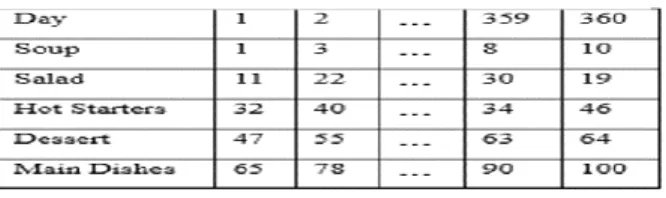
107 raw materials are considered for 100 meals, but salt and spices in the raw material have been ignored because it is not necessary to make an optimization on spices since they do not differ from meal to meal. Furthermore, their usage amount is too low. Therefore, a difference from previous years could not be determined. An example assignment is shown in Table 1.
In particular, any constraint is not defined in terms of suppliers and in the basic model is not regarded as budget or capacity constraints.
Calorie, fat, carbohydrate and protein lower and upper limits are used as nutritive value requirements thatTable 1. Example Assignment.
NATO determined. (Table 2) [17].
Material cost values in Istanbul in 2013, which is the price set by the State and Migros, are used and the food is modeled as being composed of 5 parts.
Mathematical models prepared for this problem are as follows:
Model notation:
k=Food or meal number (1,2, 3…, m). h=Number of days (1,2, 3…, n). i=Raw material number (1,2, 3…, g). j=Number of months (1,2, 3…,12). t=Nutritional value number (1,2,3,4).
dik= Amount of raw material-i is used in food-k for 400
people.
ci= The unit cost of raw materials i.
f=Interest rate (%10).
hi= Raw material-i’s inventory cost per unit (hi =ci*f).
K=Order costs (100 TL).
BDk=Food-k’s value.
ALt=Food value-t’s lower bound.
ULt= Food value-t’s Upper bound.
APunisht=Punishment for food value-t down.
UPunisht= Punishment for food value-t up.
Inventory= Inventory capacity Budget= Budget capacity.
𝑀 ≫ 0 is a large number.
V=Diversity rate (Goal-1).
Akh=If food-k is consumed at day-h, 1. Otherwise 0.
Nk=Food-k consumption number.
Xij=Raw material-i is ordered at month-j (Goal-2).
Iij=Raw material-i at month-j inventory amount (Goal-2).
Ui=Raw material-i order number (Goal-2).
bij=If raw material-i is ordered at month-j, 1. Otherwise, 0.
(Goal-2).
cnth= Amount for food value-t below.
cpth= Amount for food value-t below.
Min. 𝑍 = [(∑ ∑ 𝑋𝑖 𝑗 𝑖𝑗∗ 𝑐𝑖+ ∑ ∑ 𝐼𝑖 𝑗 𝑖𝑗∗ ℎ𝑖+ ∑ 𝑈𝑖 𝑖∗ 𝐾)/𝑉 + ∑ ∑ 𝐴𝑃𝑢𝑛𝑖𝑠ℎℎ 𝑡 𝑡∗ 𝑐𝑛𝑡ℎ+ ∑ ∑ 𝑈𝑃𝑢𝑛𝑖𝑠ℎℎ 𝑡 𝑡∗ 𝑐𝑝𝑡ℎ] (1) Subject to: 𝑁𝑘= ∑ 𝐴ℎ 𝑘ℎ ∀𝑘 (2) 𝑉 = (∑ 𝑁𝑘 𝑘/𝑚𝑎𝑥(𝑁𝑘))/100 (3) ∑9𝑘=1𝐴𝑘ℎ= 1 ∀ℎ (4) ∑16𝑘=10𝐴𝑘ℎ= 1 ∀ℎ (5) ∑31𝑘=17𝐴𝑘ℎ= 1 ∀ℎ (6) ∑46𝑘=32𝐴𝑘ℎ= 1 ∀ℎ (7) ∑63𝑘=47𝐴𝑘ℎ= 1 ∀ℎ (8) ∑100𝑘=64𝐴𝑘ℎ= 1 ∀ℎ (9) 𝑋𝑖𝑗+ 𝐼𝑖,𝑗−1− 𝐼𝑖𝑗 = ∑ ∑ 𝐴𝑘 𝑘ℎ∗ 𝑑𝑖𝑘 30∗𝑗 ℎ=1+30∗(𝑗−1) ∀𝑖, 𝑗 (10) 𝑋𝑖𝑗 ≤ 𝑀 ∗ 𝑏𝑖𝑗∀𝑖, 𝑗 (11) 𝑈𝑖= ∑ 𝑏𝑗 𝑖𝑗∀𝑖 (12) ∑ 𝑋𝑖 𝑖𝑗∗ 𝑐𝑖≤ 𝑏𝑢𝑑𝑔𝑒𝑡∀𝑗 (13) ∑ 𝐼𝑖 𝑖𝑗≤ 𝑖𝑛𝑣𝑒𝑛𝑡𝑜𝑟𝑦∀𝑗 (14) 𝑐𝑛𝑡ℎ = 𝑚𝑎𝑥(0, 𝐴𝐿𝑡− ∑ 𝐴𝑘 𝑘ℎ∗ 𝐵𝐷𝑘) ∀𝑡, ℎ (15) 𝑐𝑝𝑡ℎ= 𝑚𝑎𝑥(0, ∑ 𝐴𝑘 𝑘ℎ∗ 𝐵𝐷𝑘− 𝑈𝐿𝑡) ∀𝑡, ℎ (16) 𝑉, 𝑋𝑖𝑗, 𝐼𝑖𝑗, 𝑐𝑛𝑡ℎ, 𝑐𝑝𝑡ℎ ≥ 0 ∀𝑖, 𝑗, 𝑡, ℎ (17) 𝑁𝑘, 𝑈𝑖≥ 0 and integer ∀𝑖, 𝑘. (18) 𝐴𝑘ℎ, 𝑏𝑖𝑗 = 1 𝑜𝑟 0 ∀𝑖, 𝑗, 𝑘, ℎ. (19)
Equations (1-19) in this study are used to design the mathematical model. The objective function in model equation (1) is actually composed of penalties and goals, which are diversity and cost. Mainly, goals contradicting each other, in terms of cost, are a minimization problem while diversity is a maximization problem. For this reason, it is modeled in equation (1).
In the constraints, if the target-1 calculation is observed first, equations (2 and 3) will be evaluated. In addition, the foods have been classified into groups with respect to problem demonstration and equations (4-9) have actually been arranged to select one of each variety for each day. The dish groups are respectively: soups, olive oil dishes, salads, warm starters, desserts and the main dish.
The required restrictions for target-2 are actually included in equations (10-14). Equation (10) is the determination of the monthly inventory and procurement quantities by transforming the demand to raw materials as based on the dishes. In other words, it is the balance restriction. Equations (11 and 12) are required for order quantity because the economic order quantity is necessary for the total cost to be calculated according to model-1. In addition, although equations (13 and 14) are not used in the basic model (have been used for scenario analysis), these equations have been designed for the restrictions that may exist in some circumstances.
The common restriction for both targets, equations (15 and 16), is the nutrition value limits as soft constraints. Finally, the equations (17-19) appear as the basic restriction. The model, prior to being solved by the genetic algorithm, has been tested on the GAMS 21.6 program first, but it was only able to generate a meal plan for 2 days as based on 13 dishes. This result is not suitable with respect to variety (Figure 1).
3. GENETIC ALGORITHM
A genetic algorithm is based on the following suggestions:
The ideal presentation style of the chromosome for this study is the main decision variable. We can think of it as the nutrients that are appointed to the days.
Solutions consist of 360 daily food options divided Figure 1. GAMS result.
. Table 2. NATO has determined the nutritional value limits.
into 5 categories. The initial solution generation consists of three stages. In the first stage, a number is given to all days in an order. A cyclical structure is then formed. Other solutions are started using the previous solution. The second stage takes the first solution and mixes the orders of solution-identity numbers randomly. In the third stage, all days are controlled according to the calorie lower limit and inappropriate ones are changed randomly with warm starters, desserts and main course until they are appropriate. The initial population consisted of 100 individuals.
• One Bit Crossover and Two Bits Crossover are evaluated for crossover.
• Random Mutation, Insert Mutation, and Swap Mutation are considered for the Mutation.
• Tournament selection method is used for the parent selection.
• 5% of the new population is referring to elitism.
4. RESULTS
The most important part of the result is time as speed and good improvement qualities are expected. Therefore, parallel programming and code optimization methods are applied. The best combination of the model and evaluation of the results are determined according to 10 runs of the basic model's features. In the comparison part of the operator of a genetic algorithm (mutation and crossover), the compared feature is different from the basic model. However, only swap mutation shows improvement and other mutations with two crossover methods show no change in the state of the initial solution.
If the example run result is analyzed, the improvement
rate of goal-1 is considered as
(0.2727-0.2535)/0.2535=0.0757. Approximately 8%
improvement is observed and the improvement over time for goal-1 is shown in Figure 2.
(𝑖𝑚𝑝𝑟𝑜𝑣𝑒𝑚𝑒𝑛𝑡 𝑟𝑎𝑡𝑒 =𝑖𝑛𝑖𝑡𝑖𝑎𝑙 𝑏𝑒𝑠𝑡 𝑣𝑎𝑙𝑢𝑒−𝑓𝑖𝑛𝑎𝑙 𝑏𝑒𝑠𝑡 𝑣𝑎𝑙𝑢𝑒
𝑖𝑛𝑖𝑡𝑖𝑎𝑙 𝑏𝑒𝑠𝑡 𝑣𝑎𝑙𝑢𝑒 )
If goal-2 is considered, 9,613 TRY profit is seen. Also, this result over 10 iterations was obtained in a very short time (approximately 20 minutes). The genetic algorithm earns 96.1 TRY per iteration and the improvement is shown in Figure 3 (improvement rate is 9.61%). It may seem like a small adjustment, but this result suggests better leadership in a supply chain with diversity in offers as well as better cost.
Punishment for lower and upper bound is 4391 units but if daily punishment is 4391/360=12.1972, the solution is considered as acceptable.
However, the improvement rate is lower than the goals, as it is 3.31% for the genetic algorithm. Figure 4 shows improvement over time. The soft constraint of protein, carbohydrate, and fat needs might be one of the most difficult parts in this model as cost and diversity (the main objectives) tend to improve but the state of the offer becomes easily over and under the limit of the need.
Generally, change of objective function is seen in
Figure 5 and the improvement rate for the genetic
algorithm is 15.53%. However, the model easily enters the state of genetic drift as no improvement was
observed after the 10th iteration.
Table 3. Example chromosome structure.
Figure 2. Goal-1’s (Diversity) improvement over time in a basic model (example run).
.
Figure 3. Goal-2’s (Cost) improvement over time in a basic model (example run).
.
Figure 4. Penalty over time in a basic model (example run).
Figure 5. Fitness function improvement over time in a basic model (example run).
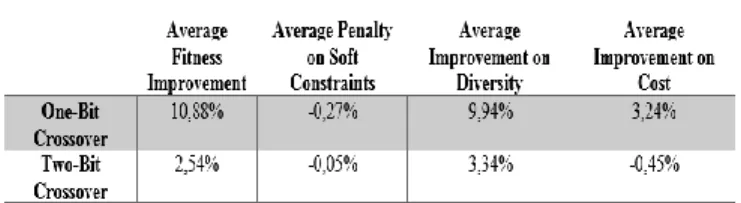
Methods were tested against each other and Table 4 and Table 5 show the basic model as the best method. The result of the crossover evaluation is displayed in Table 4 and shows that there is a significant difference between one-bit and two-bit crossover.
Ten runs for each crossover technique are plotted in Figure 6, which shows that there is a rare contradiction between goals. This proves our modeling approach for goals is useful in an environment of unknown relationships or superiority of goals.
5. CONCLUSION
This problem consists of the features from many problems. Therefore, the success of the study is very important for strategic planning and serves as an opportunity as it shows the importance of big data management.
Moreover, these successful results can be viewed as a solution example for other problems because it means there is a way to find quality solutions without making unrealistic assumptions to find useable and better solutions without wasting too much time. Also, our approach in goal programming suggests a novel methodology against unknown relationships, as there are few methods for these kinds of problems.
To summarize, this study is significant for discovering opportunities, improving strategies and controlling the supply chain with modern heuristics. Specifically, this genetic algorithm offers big opportunities and its simple use offers an opportunity to model real life.
6. ACKNOWLEDGMENTS
Our thanks to Tufan Demirel from Yildiz Technic University for guiding us to develop this model.
7. REFERENCES
[1] Word Press, The 40-hr Famine, Word Press, 1 January 2013. [Online]. Available: http://40hrfamine.wordpress.com/how- hunger-hurts/. [26 June 2013].
[2] Seljak, B. K. Dietary Menu Planning Using an Evolutionary Method, INES 2006- 10th International Conference on Intelligent Engineering Systems, 2006.
[3] Marinakis, Y., Marinaki, M., Dounias, G. A hybrid particle swarm optimization algorithm for the vehicle routing problem, Engineering Applications of Artificial Intelligence, 23, 4, 463–472, 2010.
[4] Kannan, G., Haq, A. N., Devika, M. Analysis of closed loop supply chain using genetic algorithm and particle swarm optimisation, International Journal of Production Research, 47, 5, 2009.
[5] Izquierdo, J., Minciardi, R., Montalvo, I., Robba, M., Tavera, M. Particle Swarm Optimization for the biomass supply chain strategic planning, International Congress on Environmental Modelling and Software, 2008.
[6] Lee, C. V. Multi-Echelon Inventory Optimization, EVANT paper series, 1-13, 2003.
[7] Ryzin, G. J. V. Analyzing Inventory Cost and Service in Supply Chains, Columbia Business School, 1-13, 2001. [8] Stigler, G. J. The Cost of Subsistence, Journal of Farm
Economics, 27, 2, 303-314, 1945.
[9] Dantzig, G.J. The diet problem, The Practice of Mathematical Programming, 20, 4, 43-47, 1990.
[10] Chu, P.C., J. E. Beasley, J. E. A Genetic Algorithm for the Multidimensional Knapsack Problem, Journal of Heuristics, 4, 63-86, 1998.
[11] Dantzig, G. J. Discrete Variable Problems, Operations Research, 5, 266–277, 1957.
[12] Dano, G. Workforce scheduling with logical constraints: theory and applications in call centers, Amsterdam: Vrije Universiteit, 2004.
[13] Graves, S. C. Manufacturing Planning and Control, 1 November 1999. [Online]. Available:
http://web.mit.edu/sgraves/www/ProdPlanCh.PDF. [4 July 2013].
[14] Swann, J. The Assignment Problem: A Math Programming Case Study, 1 January 2013. [Online]. Available: http://www2.isye.gatech.edu/~jswann/casestudy/assign.html. [4 July 2013]
[15] Tang, G. Assignment Problems, 21 November 2012. [Online]. Available:
http://webhome.cs.uvic.ca/~wendym/courses/445/12/1notes/ GuomingTang.pdf. [4 July 2013].
[16] Weingartner, H., Ness., D. N. Methods for the Solution of the Multidimensional 0/1 Knapsack Problem, Operations Research, 15, 83–103, 1967.
[17] RTO/NATO, Nutrition Science and Food Standards for Military Operations, RTO/NATO, 2010. Table 4. Comparison of crossover methods over
10 runs.
Figure 6. Fitness, goals, and penalties of soft constraints for 10 runs for each crossover
technique.
View publication stats View publication stats