C O M M U N I C A T I O N S
DE LA FACULTE DES SCIENCES FACULTY OF SCIENCES DE L’UNIVERSITE D’ANKARA UNIVERSITY OF ANKARA
Series B: Chemistry and Chemical Engineering
VOLUME: 54 Number: 2 YEAR: 2008
Faculty of Sciences, Ankara University 06100 Tandoğan, Ankara – TURKEY
C O M M U N I C A T I O N S
DE LA FACULTE DES SCIENCES FACULTY OF SCIENCES DE L’UNIVERSITE D’ANKARA UNIVERSITY OF ANKARA
Series B: Chemistry, Chemical Engineering
Owner MUAMMER CANEL Editor-in-Chief (Publishing Manager)
ÖNER ÇAKAR Assoc. Editor CAFER COŞKUN Editor ATİLLA ÖKTEMER Managing Editor MUSTAFA GÜLLÜ ADVISORY BOARD
E.ALPAY Ege Univ. M.SAÇAK Ankara Univ. Z.KILIÇ Ankara Univ. R.TÜRKER Gazi Univ.
A.KENAR Ankara Univ. C.ÜNALEROĞLU Hacettepe Univ. M.OBALI Ankara Univ. A.YAŞAR Gazi Univ.
Ş.PEKYARDIMCI Ankara Univ. B.PEYNİRCİOĞLU METU
This Journal is published two issues in a year by the Faculty of Sciences, University of Ankara. Articles and any other material published in this journal represent the opinions of the author(s) and should not be construed to reflect the opinions of the Editor(s) and the Publisher(s).
Correspondence Address:
COMMUNICATIONS DERGİ BAŞEDİTÖRLÜĞÜ Ankara Üniversitesi Fen Fakültesi, 06100 Tandoğan, ANKARA – TURKEY
Tel: (90) 312-212 67 20 Fax: (90) 312-223 23 95
e-mail: [email protected]
Print:
Ankara Üniversitesi Basımevi İncitaş Sokak No:10 06510 Beşevler ANKARA – TURKEY
Tel: (90) 312-213 65 65 Basım Tarihi:
C O M M U N I C A T I O N S
DE LA FACULTE DES SCIENCES FACULTY OF SCIENCES DE L’UNIVERSITE D’ANKARA UNIVERSITY OF ANKARA
Series B: Chemistry and Chemical Engineering
VOLUME: 54 Number: 2 YEAR: 2008
Faculty of Sciences, Ankara University 06100 Tandoğan, Ankara – TURKEY
C O M M U N I C A T I O N S
DE LA FACULTE DES SCIENCES FACULTY OF SCIENCES DE L’UNIVERSITE D’ANKARA UNIVERSITY OF ANKARA
Volume : 54 Number : 2 Year : 2008
Series : B
S. DERMİŞ and B. DOĞRU, Gas chromatographic analysis of PS, PI, LPC and SPH fatty acids in red blood cell membrane of rat, rabbit, human and dog ………..1
Commun. Fac. Sci. Univ. Ank. Series B V.54 (2). pp. 1- 16 (2008)
1
GAS CHROMATOGRAPHIC ANALYSIS OF PS, PI, SPH AND LPC FATTY ACIDS IN RED BLOOD CELL MEMBRANE OF RAT, RABBIT, HUMAN
AND DOG
SAADET DERMİŞ *, BİLGEHAN DOĞRU**
* Department of Analytical Chemistry, Faculty of Pharmacy, University of Ankara, 06100 Tandoğan, Ankara-TURKEY
** Department of Biochemistry, Faculty of Pharmacy, University of Ankara, 06100 Tandoğan, Ankara-TURKEY
(Received Sept. 16 , 2007; Accepted Dec. 23, 2007)
ABSTRACT
Fatty acid analysis of red blood cell (RBC) membrane PS, PI, LPC and SPH were examined in species like rat, human, dog and rabbit by GC. C16:0 and C18:0 were the prominent SFA (saturated fatty acids) in species phospholipids studied. C16:0 was higher in LPC and SPH whereas C18:0 was higher in PS and PI in all species and in dog LPC.
Although evenly spread in phospholipids, MUFA (monounsaturated fatty acid) in PS, PI and LPC seamed to be higher than in SPH. Among MUFA C16:1 and C18:1 were the prominent ones in the species, C18:1 being considerably higher than C16:1. PUFAs (polyunsaturated fatty acids) were relatively high in PS and PI compared to LPC and SPH in each species. Arachidonate was one of the most abundant fatty acids in human, rat and dog. Rabbit possessed very low levels of arachidonate in each phospholipid compared to that of other species phospholipids. By contrast linoleic acid was high in rabbit RBC membrane phospholipids. While C18:2 , C20:4 and C22:6 were the major PUFAs of human RBC membrane phospholipids studied, C18:2 and C20:4 were the major ones in the others. 22-Carbon fatty acids were present in small amounts in most species. C22:6 was present in rabbit, rat and human RBC membrane phospholipids but very little was present in dog.
KEYWORDS: fatty acids, gas chromatography, analysis, RBC membrane, PS, PI,
S. DERMİŞ and B. DOĞRU 2
Abbreviations: SFA, Saturated fatty acid; MUFA, monounsaturated fatty acid;
PUFA, polyunsaturated fatty acid; LCPUFA, long chain polyunsaturated fatty acid; LCMUFA, long chain monounsaturated fatty acid; RBC, Red blood cell; PS, phosphatidylserine; PI, phosphatidylinositol; LPC, lysophosphatidylcholine; SPH, sphingomyeline; BHT, butylated hydroxy toluene; SDS, sodium dodecyl sulphate; RBC, red blood cell; HPLC, high performance liquid chromatography; GC, gas chromatography
1. INTRODUCTION
There are numerous phospholipids in mammalian cells having different polar head groups such as phosphatidylethanolamine (PE), phosphatidylcholine (PC), phosphatidylinositol (PI), sphingomyeline (SPH) , lysophosphatidylcholine (LPC) and phosphatidylserine (PS).The most important phospholipids are SPH, PC, PE, and PS which make up 95 % of the total phospholipids [1].
In RBC membrane, phospholipids have a structural role containing a variety of fatty acids varying in chain length and in the number of double bonds[2-9]. They are commonly enriched with polunsaturated fatty acids (PUFA)s having a critical role in regulation of cellular functions and fluidity of cell membranes [10-12] and also function as precursors of oxygenated derivatives called eicosanoids [13,14].
PUFAs are obtained both from the diet and hepatic metabolism. It is also known that PUFA mainly linoleic acid (C18:2 n-6) have been recommended for
treatment [15,16] and prevention of some diseases [17,18] such as hearth disease[19] and atherosclerosis[20-22] whilst saturated fatty acids increase atherosclerotic tendency . It has also been observed that mainly docosahexaenoic acid (C22:6 n-3)
and eicosapentaenoic acid (C20:5 n-3) have triglyceride lowering effect [22-24].
Specific fatty acid alterations have been determined in the blood and tissues of patients with cystic fibrosis[25]. The two major alterations include decreased levels of linoleic acid and docosahexaenoic acid. Changes in arachidonic acid, other monounsaturated and polyunsaturated fatty acids (PUFA) levels have also been described in cystic fibrosis. Increased arachidonic acid release from membrane phospholipids has also been observed. These changes may have an important role in the progression of the disease.
The studies on fatty acids have been performed mostly on RBC membrane and plasma total fatty acids [5, 6, 26-35] but the data concerning the fatty acid of some spesific phospholipids is lacking. The RBC membrane fatty acids of different phospholipids can be compared to find out whether particular phospholipids are rich in particular fatty acids.
The fatty acids of different species could also be compared. Therefore the aim of this study was to compare the relative amounts of fatty acids of PS, PI, LPC and SPH in RBC membrane in different species like rabbits, dogs humans and rats.
GAS CHROMATOGRAPHIC ANALYSİS OF PS, PI, SPH AND LPC FATTY ACIDS 3
2. MATERIALS AND METHODS
2.1. EXPERİMENTAL
2.1.1. Preparation of tissues
Blood samples were collected from male rats (3 months old), male rabbits (10 months old), male humans (30 year old) and male dogs (6 years old). All the species were given the nutrients and energy for a balanced diet to ensure a healthy and active life.
The plasma was separated from RBCs immediately by sentrifugation at 1000 g for 10 min after collecting the blood into a heparinized plastic beaker.
RBC membranes were prepared by modifying the method of Burton et al, [35] and Steck and Kant. [36]. The packed RBCs were washed three times with 3 volumes of 0.89 % NaCl, pH 7.4 solution and haemolyzed by mixing with chilled 5 mM pH 8.0 phosphate buffer. 5 mM Ascorbic acid was added as an antioxidant. The supernatant was removed after centrifugation of the mixture at 22,000 g for 20 min. The pellet was then washed by resuspending in 2.5 mM phosphate buffer, pH 8.0 and centrifuged as before. The pellet became colourless after washing second time with 1.25 mM phosphate buffer, pH 8.0, showing that no haemoglobin remained.
RBC membrane was then extracted immediately.
2.1.2. Lipid extraction and analysis
RBC membranes were extracted twice by the method of Verdon and Blumberg's by modifying the concentrations of SDS, BHT, solvents and avoiding the day light.
RBC membrane was mixed with an equal volume of 0.02 % aqueous SDS in a large volumetric tube. 0.002 % BHT in ethanol (two volumes) containing pentamethyl-6-chromanol (α-tocopherol with no side chain,internal standart, synthesized [25]) was added and mixed. All the procedure was performed on ice. 0.00025 % BHT in 50 % diethylether / hexane (5 volumes) was added, mixed and centrifuged for 3 min at 10,000 x g. The upper layer was removed for washing with glass-distilled water and drying by passage through a filter containing Na2SO4. Then it was evaporated to dryness on a rotary evaporator. It was transferred to a vial after dissolving in ether/hexane and evaporated to dryness with nitrogen. Finally it was dissolved in 50 % ether/hexane. The extract was analysed by HPLC for extraction recovery determination. It was 95-100 %. Another portion of the extract was transmethylated for the analysis of phospholipid fatty acids.
S. DERMİŞ and B. DOĞRU 4
2.1.3. Transmethylation of fatty acids
The transmethylation of lipids was carried out by the method of Christie. Lipid sample (1-2 mg) mixed with 2.5% H2SO4 in anhydrous methanol (v/v) (2 volume) was incubated for 2 hours at 700C. 5 vol of 5% NaCl saturated with
NaHCO3 was added, then the mixture was extracted with 3 volume of petroleum ether for three times. After evaporating to dryness it was dissolved in a small volume of HPLC grade hexane.
2.1.4. Purification of fatty acids
The methylated sample extracts and the standards (meythyl esters of fatty acid standards) were applied to Silicagel 60 GF254 TLC plates (0.5 mm thick). The developing solvent was petroleum ether : diethyl ether : acetic acid (90 : 10 : 1 by volume) [26]. Various kinds of methylated fatty acid esters were separated from more polar compounds and cholesterol that remain at or near the origin. It was also separated from hydrocarbons and any BHT added as an antioxidant, which migrated ahead. Only the standard fatty acids were made visuable using dodecamolybdophosphoric acid in ethanol spray and by heating which developes a blue colour. Petroleum ether / hexane (50 %) containing 0.01 % BHT was used as an eluent for the elution of the methyl esters of fatty acids from the silicagel. The elution solvent was then evaporated by using a rotary evaporator and dissolved in a small volume of HPLC grade hexane and kept in the deep before the analysis.
2.1.5. Fatty acid analysis by GC
Methyl esters of fatty acid analysis were analysed by using a Hewlett Packard 5890 A gas chromatography with an x-meter Carbowax 20 m capillary column. Carrier gas Helium was used (50 mL/min). The oven temperature rising from 50oC to 230o C at 12oC/min was programmed. The detector temperature was 230o C. Retention times and peak areas were measured with a reporting integrator Hewlett Packard model, SP 4270. Fatty acids were identified by comparing their retention time with those of standard methyl fatty acid esters. Extraction recovery of fatty acids was determined by adding a known amount of PC with two C15 saturated fatty acids attached to the mixture to be transmethylated.
GAS CHROMATOGRAPHIC ANALYSİS OF PS, PI, SPH AND LPC FATTY ACIDS 5
2.1.6. Species diet
Friskies Go-Dog pellets, (Friskies Pet Care, U. K.) (diets of dogs) contained fats and oils, meat and animal derivatives, cereals, derivatives of vegetable origin,, vegetable protein extracts and minerals as ingredients (vitamin E 60 mg/kg, vitamin A 5400 iu/kg, vitamin D 450 iu/kg, copper 11 mg/kg, oil 9 %, protein 24 %, ash 9 %, fibre 5 %).
Rabbits diet were a high fibre diet (Beekay, Bantin and Kingman Ltd, U.K.) contained fats and oils, grass meal, wheatfeed, barley meal, ground oats, linseed meal, fish meal, minerals, vitamins and trace elements (nitrogen free extract 50 %, dry matter 88 %, crude protein 18 %, crude oil 4 %, crude fibre 9 %, ash 7 %,). Saturated fatty acids were were also present as 0.75 %, unsaturated fatty acids as 1.84 % and linoleic acid as 1.24 %. Vitamin A 36000 iu/kg, vitamin D3 2000 iu/kg, vitamin E 130 mg/kg were added.
Rats had a high quality and a low protein diet (Rat and Mouse No. 1 Modified, SDS Ltd., Witham, Essex) organised to keep rats in good health over a long time of period. Diet of rats were the pellets made up of crude crude fibre 4.3 %, protein 14.6 %, crude oil 2.6 %, ash 5.8 % and nitrogen free extract 62.7 %, palmitoleic acid (C16:1) 0.07 %, oleic acid (C18:1) 0.74 %, linoleic acid (C18:2) 0.56 %, linolenic acid (C18:3) 0.05 %, arachidonic acid (C20:4), 0.13 %, palmitic acid (C16:0), 0.31 % and stearic acid (C18:0) 0.04 %. Retinol 1922 µg/kg (1 µg retinol : 3.3 iu vitamin A activity), α-tocopherol 68.3 mg/kg, cholecalciferol 15.1 µg/kg (1 µg cholecalciferol : 40 iu vitamin D3 activity) were added as vitamins.
Humans had a healthy diet.
3. RESULTS AND DISCUSSION
SFA
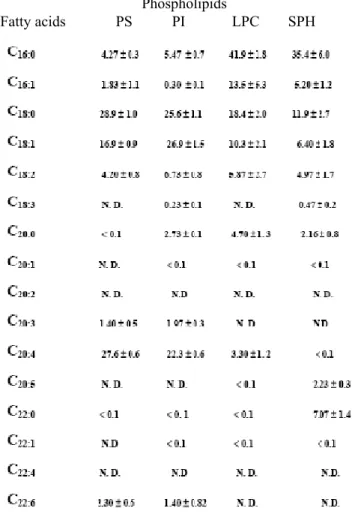
Each species had the same major fatty acids in the phospholipids of RBC membrane (Tables 1- 4). C16:0 was higher in LPC and SPH in each species. C18:0
was higher in PS and PI in all species and in dog LPC as well (tables 2 and 5). Among SFA C16:0 and C18:0 were the prominent ones. C20:0 was found to be high in
rat and rabbit LPC and SPH and rabbit PI. Among LCMUFA C22:0 was not present
S. DERMİŞ and B. DOĞRU 6
MUFA
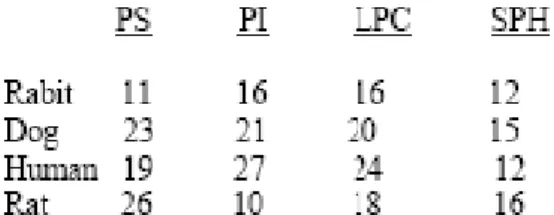
In the RBC membrane MUFA were fairly evenly spread but MUFA in PS, PI and LPC seamed to be higher than in SPH (Table 5). Among MUFA C16:1 and
C18:1 were the prominent ones in the species (Tables 1- 4). C18:1 was found to be
considerably higher than C16:1 in all species of RBC membrane phospholipids
studied. PUFA
PS and PI had relatively high concentrations of PUFAs compared to LPC and SPH in each species (Tables 1- 5). These results show that PS and PI are important for the membrane fluidity. In terms of arachidonate it was clear that rabbit posessed very low levels in each phospholipid compared to that of other species phospholipids (Table 1). It was one of the most abundant fatty acids in human, rat and dog (tables 2- 4). Conversely linoleic acid was high in rabbit RBC membrane phospholipids (82 %) (Table 1) compared to other species. This probably points to the lower activities of elongase and Δ5
- desaturase in the rabbit to generate
arachidonic acid from linoleic acid. C18:2 , C20:4 and C22:6 were the major PUFAs of
human RBC membrane phospholipids studied (Table 3). C18:2 and C20:4 were the
main ones in the other species. They are probably the major fatty acids contributing to the physicochemical structure or fluidity of the membrane. High levels of C18:2
and C20:4 in rat RBC membrane phospholipids (Table 4) make rat a convenient
candidate for the metabolic study of linoliec and arachidonic acid.
22-Carbon fatty acids were present in small amounts in most species. Some phospholipids of rat RBC membrane had a higer C22:4 content (table 4) compared to
other species. Rats may have a higher capacity for converting C20.4 to C22:4 by the
elongase enzyme than the others. C22:6 was present in rabbit, rat and human RBC
membrane phospholipids but very little was present in dog (table 2), showing that the enzymes capable of synthesizing C22:6 (elongase and 4- desatures) were lower
in dog than other species. C22:4 was also found to be in very small amounts. This
could be the reflection of the diet. 22 Carbon fatty acids are found in oil of fish and of some vegetables. C22:6 is high in fish oil. Dogs and rats had very little % of 22 C
fatty acids in their RBC phospholipids (Tables 2 and 4) because of not consuming food containing appreciable amounts of that fatty acids.
Other workers presented the data that RBC fatty acid composition reflects the type of fat in the diet[37]. Feeding fish oil induces changes in the fatty acid
GAS CHROMATOGRAPHIC ANALYSİS OF PS, PI, SPH AND LPC FATTY ACIDS 7 pattern of rabbit RBC membrane and serum phospholipids. An increase is observed in amounts of C20:5, C22:5 and C22:6 with fish oil[3].These results are in accordance
with monkeys [38] , humans [39]and rats [26].
There were similarity between the data of human RBC phospholipids and the data reported by Hsio et al [40]. Their values for C18:0 in PS, C16:0, C18:1 and
C20:4 in PI and C18:2 in SPH were higher. The percentage fatty acids of rat RBC
membrane PI were in agreement with those of Williams and Maunder [41] with the exception of C18:0 that was found to be a little bit higher than our values, they also
found C22:5 and C22:6 fatty acids in PI. Rat values agreed with those reported by
Ghosal et al [27] with the exceptions of C16:1, C18:1 being a little bit higher in SPH
than their values, they found higher percentage of C16:0 compared to our data. C16:0,
C16:1 and C20:4 in PS were also found to be higher in our study compared to those of
Ghosal et al. Rabbit RBC membrane SPH fatty acid levels were in agreement with those of van Den Boom et al[42]. They dedected C24:1 fatty acid in RBC
membrane SPH. Comparison on this fatty acid can not be made due to the fact that C24:1 was not present unfortunately in the standard fatty acid mixture used in this
study.
4. CONCLUSION
Each species had the same major fatty acids in the phospholipids of RBC membrane Among MUFA C16:1 and C18:1 were the prominent ones in the species
studied. PS and PI had relatively high concentrations of PUFAs compared to LPC and SPH in each species showing that PS and PI are important for the membrane fluidity. In terms of arachidonate rabbit posessed very low levels in each phospholipid compared to that of human, rat and dog phospholipids. By contrast linoleic acid was high in rabbit RBC membrane phospholipids.
This probably points to the lower activities of elongase and Δ5- desaturase
in the rabbit. C18:2 , C20:4 and C22:6 were the major PUFAs of human RBC membrane
phospholipids studied. C18:2 and C20:4 were the main ones in the other species
probably the major fatty acids contributing to the physicochemical structure or fluidity of the membrane. 22-Carbon fatty acids were present in small amounts in most species.
C22:6 was present in rabbit, rat and human RBC membrane phospholipids
but very little was present in dog, showing that the enzymes capable of synthesizing C22:6 (elongase and Δ4- desaturase) were lower in dog than other species. It could
S. DERMİŞ and B. DOĞRU 8
ÖZET
İnsan, tavşan, köpek ve sıçan gibi farklı türlerin RBC membranında PS, PI, LPC ve SPH fosfolipidlerinin gaz kromatografik yağ asiti analizleri yapılmıştır. Çalışılan fosfoliliplerde doymuş yağ asitleri içinde en fazla C16:0 ve C18:0 göze
çarpmaktadır. Bütün türlerde C16:0 LPC ve SPH de, C18:0 ise PS and PI de yüksek
düzeyde ve köpekde LPC de yüksek düzeyde bulunmuştur. Türlerde oldukça eşit dağılımış olmasına karşın MUFA PS, PI ve LPC de SPH e göre daha fazladır. Türlerde MUFA içinde de C18:1 , C16:1 den daha fazla olmak kaydıyla C16:1 veC18:1
en göze çarpanlarıdır. Bütün türlerde PUFA, PS ve PI de LPC ve SPH e kıyasla daha fazladır. PUFA içinde arachidonat insan, köpek ve sıçanda en çok bulunan PUFA dır. Tavşan RBC membranı fosfolipidlerinde ise arakidonat diğer türlere göre çok düşük düzeydedir. Tersine linoleik asit tavşan fosfolipidlerinde fazla bulunmuştur. C18:2 , C20:4 ve C22:6 insan RBC membranı fosfolipidlerinde esas PUFA iken
çalışılan diğer türlerde C18:2 ve C20:4 dır. 22- Karbon yağ asitleri çoğu türde az
miktarlarda bulunmuştur. C22:6; tavşan, sıçan ve insan RBC membranı
fosfolipidlerinde bulunmuşken; köpekte oldukça az miktarda bulunmuştur.
REFERENCES
[1] Roelofsen, B., Van Meer, G.,& Op Den Kamp, J.A.F., Scand.J.Clin.Lab.Invest.,156: (1981), 111-117.
[2] Mikirova N., Riordan H. D., Jackson J. A., Wong K., Miranda-Massari J. R., Gonzalez M. J., P. R. Health Sci. J., 23(2):(2004),107-113.
[3] Van den Boom, M.A.P., Groot wassink M., Roelefsen, B., de Fouw N.J. & Op den Kamp, j.A.F., Lipids, 31:(1996), 285-293.
[4] Rao, C.V., Zang, E. & Reddy, B.S., Lipids 28:(1993), 441-447.
[5] Folsom, A.R., Ma, J., Eckfeldt, J.H., Shahar, E. & Wu, K.K., Atherosclerosis III, (1994), 199-207.
[6] Giron, M.D., Mataix, F.J., & Suarez, M.D.,Comp. Biochem. Physiol. 1002 A (1) (1992), 197-201.
GAS CHROMATOGRAPHIC ANALYSİS OF PS, PI, SPH AND LPC FATTY ACIDS 9
[7] Holub, B.J. & Kuksis, A., Adv. Lipid Res., 16:(1978), 1-125. [8] Nakagawa, Y. & Waku, K, Prog. Lipid Res., 28:(1989), 205-243.
[9] Mac Donald, J.I.S. & Sprecher, H., Biochim. Biophys. Acta., 1084:(1991), 105-121.[10] Saikh, S. R. and Edidin M., Am. J. Clin. Nutr., 84(6):(2006),1277-1289.
[11] Kinsella, J.E, JPEN 14(Suppl 2) (1990), 200S-218S.
[12] Spector, A.A. and Yorek, M.A., J.Lipid Res.,26: (1985), 1015-1035. [13] Barret, K.E. & Bigby, T.D., News in physiol. Sci., 10; (1995), 153-159. [14] Lewis, R. A. and Austen K.F. , J. Clin. Invest., 73:(1984), 889-897.
[15] De Lorgeril, M. and Salen, P., J. Cardiovasc. Med (Hagerstown), 8: (2007), 38-41.
[16] Sijben, J.W. and Calder, P.C., Proc. Nutr. Soc., 66: (2007), 237-259.
[17] Tziomalos, K., Athyros, V.G., Mikhailidis, D.P., Curr. Med. Chem., 14;(2007), 2622-2628.
[18] Marchioli, R., Levantesi, G., Macchia, A., Maggioni, A.P. et al., J. Membr. Biol.,206; (2005), 117-128.
[19] Svensson, M., Schmidt, E.B., Jorgensen, K.A., Christensen, J.H., OPAH study group, Clin. J. Am. Soc.Nephrol., 1: (2006), 780-786.[20] Goodnight, S.H., Harris, E.S., Connor, W.E. & Illingworth D.R.,Atherosclerosis 2:(1982), 87-113.
[21] Grundy, S.M. & Denke, M.A, J.Lipid Res., 31:(1990), 1149-1172. [22] Zöllner, N. & Tato, F,Clin. Invest., 70:(1992), 968-1009.
[23] McKenney J. M. And Sica D., Pharmacotherapy, 27(5): (2007), 715-728.
[24] Gamez R., Mazr., Arruzazabala M. L., Mendoza S. And Castano G., Drugs, 6(1):(2005),11-19.
S. DERMİŞ and B. DOĞRU 10
[25] M. Rabie Al-Turkmani, Steven D. Freedman and Michael Laposata, leukotrienes and essential fatty acids, 77(5–6):(2007), 309–318.
[26] Christie, W.W., in High Performance Liquid Chromatography and Lipids, [1] Pergamon Press, Oxford, 133:(1987).
[27] Ghosal, J., Biswas, T., Ghosh, A., & Datta,A.G., Biochem. Med.,32: (1984), 1– 14.
[28] Nelson, G.J., Schmidt, P.C., Bartolini, G.L., Kelley, D.S. & Kyle, D., Lipids , 32: (1997), 1137-1146.
[29] Narasimhamurty, K., & Raina, P.L., Mol. Cell. Biochem., 195: (1999) ,143-153.
[30] Pita, M-L., & Delgado, M-J., Thromb. Haemost., 84: (2000), 420-423. [31] Cleland, L. G., Neumann, M.A., Gibson, R.A., Hamazaki, T., Akimoto, K. & James, M.J., Lipids 31: (1996), 829-837.
[32] Tichelaar, H.Y., Smuts, C.M., Gross, R., Jooste, P.L. Faber, M. & Benade, A.J.S. Prostaglandins Leukotrienes and Essential Fatty Acids, 56: (1997), 229-233.
[33] Hoffman, D.R., Uauy, R. & Birch, D.G., Exp. Eye Res., 57: (1993), 359-368. [34] Hodge, J., Sanders, K. & Sinclair, A.J., Lipids, 28:(1993), 525-531.[35] Burton, G.W., Ingold, K.U. & Thompson, K.E., Lipids, 16: (1981), 946. [36] Steck, T.L. and Kant, J.A. ‘‘Biomembranes Part A’’ in Methods in
Enzymology, vol. 31, eds. S. Fleischer and L. Packer,Academic Press, New York, (1974), 168-173.
[37] Santos,M. J., Llopis J., Mataix F. J., Urbano G. And Jurado M. Int. J. Vitam. Nutr. Res., 66(4):(1996), 378–385.
[38] Carman, M.A. and J.L. Beare-Rogers, Lipids, 23: (1988), 501–503.
[39] Brown, A.J., E. Pang and D.C.K. Roberts, Am. J. Clin. Nutr., 54:(1991), 668-673.
GAS CHROMATOGRAPHIC ANALYSİS OF PS, PI, SPH AND LPC FATTY ACIDS 11 [40] Hsio, L.L., Howard, R.J., Aikawa, M. And Tarachi, T.F., Biochem J.,
274:(1991), 121-132.
[41] Williams, C.M. and Maunder, K., Brit. J. Nutr., 68:(1992), 183-193. [42] van deen Boom, M.A.P. , M. Groot Wassink, J. Westerman, N.J. de Fouw, B. Roelofsen, J.A.F. op den Kamp and L.L.M. van Deenen, Biochim. Biophys. Acta, 1215: (1994), 314-320.
S. DERMİŞ and B. DOĞRU 12
Table1. Fatty acid content of the phospholipids of rabbit red blood cell
membrane Phospholipids Fatty acids PS PI LPC SPH
GAS CHROMATOGRAPHIC ANALYSİS OF PS, PI, SPH AND LPC FATTY ACIDS 13 Table 2. Fatty acid content of the phospholipids of dog red blood cell membrane
Phospholipids
S. DERMİŞ and B. DOĞRU 14
Table 3. Fatty acid content of the phospholipids of human red blood cell
membrane
Phospholipids
GAS CHROMATOGRAPHIC ANALYSİS OF PS, PI, SPH AND LPC FATTY ACIDS 15 Table 4. Fatty acid content of the phospholipids of rat red blood cell membrane
Phospholipids
S. DERMİŞ and B. DOĞRU 16
Table 5. Percentage of Monounsaturated Fatty Acids in RBC Membrane
Percentage of PUFA in RBC Membrane
C O M M U N I C A T I O N S
DE LA FACULTE DES SCIENCES FACULTY OF SCIENCES DE L’UNIVERSITE D’ANKARA UNIVERSITY OF ANKARA
Volume : 54 Number : 2 Year : 2008
Series : B
S. DERMøù and B. DOöRU, Gas chromatographic analysis of PS, PI, LPC and SPH fatty acids in red blood cell membrane of rat, rabbit, human and dog ………..1