SEEKING THE HAPPINESS AGENTS IN RURAL JAPAN
THROUGH THE CASE STUDY IN KYUSHU REGION
Tolga ÖZŞEN
AbstractEven though rural Japan have mostly same infrastructural conditions as urban sides have, due to the aging and depopulation, Japanese rural communities have still been facing the issue of sustainability. There are many projects and studies, which aim economic and material development for the rural community. However, those studies or projects, which aim “happy community”, are mostly carried out without questioning what happiness is for the rural community. Thus, this paper is going to attempt firstly to expose what is the happiness for the rural community, secondly to see the relationship between rural problems and happiness/unhappiness actors that are pointed out as most important, and ultimately to discuss the possibility of the perspective that includes non-material happiness factors as much as material ones by considering the field data which were taken at Ukeguchi village in Oita Prefecture, Japan.
Keywords: Japanese Society, Rural Revitalization, Japanese Modernization, Happiness, Rural Sustainability
Öz
Japon Kırsalında Mutluluk Algısı: Kyushu Bölgesi kırsalı saha verileri üzerinden bir değerlendirme
Her ne kadar son yıllarda kırsal ve kent arasındaki altyapısal ve niceliksel eşitsizlik azalmış olsa da, göç ve demografik yapıdaki değişime bağlı olarak Japon kırsalı halen hem üretsel hem de sosyal yaşam açısından derin sorunlarla karşı karşıyadır. Japon kırsalının bu sorunlarını çözebilmek amacıyla pek çok farklı proje gerek yerel yönetimler gerekse merkezi yönetim tarafından hayata geçirilmiştir. Ancak sorunların kökten çözümü noktasında net bir gelişme henüz elde edilebilmiş değildir. Dahası, kırsalın mutlu olması amacıyla yapılan bu çalışmalarda, kırsalın mutluluk algısının ne olduğu, hangi faktörlerin mutluluk kaynağı olarak görüldüğü çoğunlukla ortaya konulmamaktadır. İşte bu noktada, hem kırsalın mutluluk algısını genel hatlarıyla özetleyebilmek, hem de ileride uygulanacak sosyal politikalara bir
Yrd. Doç. Dr., Çanakkale Onsekiz Mart Üniversitesi, Japon Dili Eğitimi Anabilim Dalı,
perspektif temeli oluşturmak amacıyla bu çalışmada Japon kırsalında mutluluk kavramının nasıl algılandığı, mutlu ve mutsuz köyü belirlemede ne tür enstrümanların daha öne çıktığı yapılan saha çalışmasında toplanan veriler üzerinden tartışılacaktır. Bu tartışma ile, merkezi sosyal politikaların material merkezli oluşturmaya çalıştıkları ‘mutlu ve sürdürülebilir’ kırsal resminin sahada ne kadar karşılık bulduğu sorusuna da yanıt aranmış olacaktır.
Anahtar Kelimeler: Japon Toplumu, Kırsal Kalkınma, Japon Modernleşmesi, Mutluluk, Kırsal Sürdürülebilirlik
1. Introduction
As it is generally known, one consequence of urbanization and industrialization has been that the community has started to lose its social and production functions, including basic agents of community, such as rituals and/or ceremonial occasions (Adachi 1981; Matanle et al. 2011). Today, Japanese rural communities have been dealing with various social and economic issues that most likely impact the future of the community. Since then, the development algorithm has been based on the material approaches, such as infrastructural investments and economic development. The happy community has also been considered mostly from the viewpoint of material wealth. However today, the rural community in Japan still faces the issue of sustainability. On the other hand, happiness for the rural dwellers has not been taken into consideration during recent approaches in development.
The term of sustainable development or sustainability in this paper will be defined as meeting the needs of the present without compromising the ability of future generations to meet their own needs (WCED 43). In order to meet the needs of the next generation, problems regarding the family (ie), community daily life, and income must be considered and solved. In conjunction with this definition, this paper considers the term of sustainability issues as the problems regarding the family, community daily life, and economic income.
This paper discusses what happiness means to the future of the rural community, particularly which agents are the primary causes of happiness at the community level. The following questions will be the starting point for this discussion: What kinds of agents are the primary drivers of happiness in rural communities? Is the material-oriented approach the only way to consider happiness in the rural community?
Guided by these questions, I am going to attempt firstly to expose the meaning of happiness for the rural community, secondly to see the relationship between rural problems and happiness/unhappiness factors that are pointed out as most important, and ultimately to discuss the possibility of framework that includes both material and non-material happiness factors by considering the field case.
In the first part of this paper, previous studies and approaches on happiness in the rural community will be summarized and scrutinized. Afterwards, I will consider how the studies and projects on rural development in Japan address happiness by using the following guiding questions: Do those studies and projects take future happiness in rural communities into consideration? Are those studies and projects mostly focusing on material factors when considering the future happiness of the community?
After establishing this foundation by reviewing the literature on happiness and rural issues, I will focus on the case study at Ukeguchi village in Ōita Prefecture, Japan. At the findings section, firstly I am going to discuss whether rural dwellers are happy or not in the daily life. Then, I will outline the 20 different material/non-material oriented happiness and unhappiness agents that are related to the rural community issues. Then, by using those agents, meaning of happiness for the future of the rural community will be discussed. It is believed that this paper will have an opportunity to make some criticisms on social policies concerning the future of rural communities.
2. Literature Review on Happiness and Rural Issues in Japan 2.1 Previous Studies on Happiness
Today, happiness is a keyword for the modern world. People set and strive to achieve goals, with the ultimate aim of becoming happy. Despite the fact that there are many words that express the situation of being happy, today happiness could be an “umbrella term for anything positive for an individual or group” (Veenhoven 2012: 334). Up to this time, scholars in various disciplines have conducted considerable research on happiness. Some focus on the meaning of the happiness in different cultures using cross-cultural and cross-national perspectives (Uchida, Norasakkunkit and Kitayama 2004; Uchida and Ogihara 2012; Hommerich and Klien 2012; Thin 2012). Others take an economic approach to the happiness issue (Binswanger 2006; Frey and Stutzer 2002).
However, it is already known that the term of happiness is not defined only by economic conditions (Easterlin 1974), and that it differs by cultures, societies (Diener and Suh 2000) and even by language. Moreover, studies on happiness show us the importance of social relations (Ram 2010; Winkelman 2009). In some cases, happiness is an ideal that individuals and families pursue, while in some cases it can be defined as an ideal that the State pursues (Nandy et al. 2003). Additionally, some happiness studies seek to determine how regional perspective associate with self-related health and happiness (Oshio and Kobayashi 2011).
Undoubtedly, people mostly prefer the good to the bad, the desirable over the undesirable (Uchida, Norasakkunkit and Kitayama 2004: 223). However, as many researchers have shown, there is not only one way to measure the good. As Uchida and colleagues have pointed out, “Asians may be strongly motivated to seek more communal and inter subjective forms of happiness” (230). Recently in Japan, researchers have increasingly been conducting cross-cultural and cross-national studies on happiness, mostly in the realms of cultural psychology, social psychology, and psychological anthropology fields (Kitayama, Markus and Kurokawa 2000; Novin, Tso and Konrath 2014; Sato, Demura, Kobayashi and Nagasawa 2002; Piccolo, Judge, Takahashi, Watanabe and Locke 2005). However, this does not mean that the study of happiness should be limited to these fields. There are other studies from the gender viewpoint (Oshio 2011; Patrick, Cottrell and Barnes 2001) or worth living (ikigai) perception (Mathews 1996), or gerontology viewpoint (Kayano, Hashimoto, Fukawa, Shibata and Gunji 1994; Wada et. al.2003).
On the other hand, in western societies, some studies assess the association between rural communities and happiness (Berry and Okulicz-Kozaryn 2009), and attempt to create a base for social policies concerning rural society issues. Moreover, some works suggest that regional similarities and differences are important factors to consider when assessing the happiness or life satisfaction in rural communities (Mollenkopf and Kaspar 2005; Shucksmith, Cameron, Merridew and Pichler 2009). Similarly, the numbers of happiness studies on Asian rural communities have also increased recently, including some that consider the viewpoint of economy (Knight and Gunatilaka 2010a), social capital (Berry and Okulicz-Kozaryn 2011), and migration (Knight and Gunatilaka 2010b). Moreover, as it can be understood from previous works, happiness in rural communities and the possibility of association of the happiness and community future has been rarely taken into account. In this sense, it is believed that reviewing the studies on rural community issues from the viewpoint of happiness will strengthen the base of this paper.
2.2 Rural Sustainability and Perceptions of Happiness in Rural Japan
During this postwar period, happiness in urban communities was often evaluated by whether an individual had the 3C (Car, Color TV, Air
Conditioner), and the pace of infrastructural investments completed by
government. As an example of the latter, next to Tokyo Tower, one of the impressive symbols at the national level has been the Tokyo Metropolitan Government Building 1, which was completed during early 1990s.
On the contrary, rural areas across Japan suffered from severe depopulation. Since the late 1970s, in order to maintain the social and production system, rural communities attempted various approaches. For example, local governments and authorities established village revival movements (Mura Okoshi Undō), town making (machi zukuri) (Knight 1994b), and the One Village One Product Movement (OVOP) (Isson Ippin
Undō) (Knight 1994a). Local authorities also designed some programs and
projects to spur economic development such as Green Tourism (Takeuchi, Namiki and Tanaka 1998; Ikuta, Yukawa and Hamasaki 2007; Arahi 2008; Chakraborty and Asamizu 2014), and some brand policies (Rausch 2008a, 2008b, 2009).
Specifically, OVOP was one of the most popular of rural revitalization activities. This movement, created in the Ōita Prefecture in the late 1970s, was intended to revitalize the prefecture’s economy. The concept of this movement, which lasted until 2003, was to encourage rural communities to select an agricultural product of the region and develop it for national and global consumption (Savitri 2008; Kurokawa 2009). Another popular development/revitalization project is the Rice Terrace Ownership System (Tanada Ōnāshippu seido). By this system, “weekend farmers” (Raymond 260) experience rural life during their leisure time and owners of tanada receive a new source of income. Therefore, many consider this effort to be a
win-win model. However, despite its popularity, field data suggests it does
not work in practice (Matanle and Sato 2010: 206). Those activities contribute to the region economy partially. However, do not provide any opportunity to support the daily life of the community such as caring the elderly, being successor to family or farmlands (Tokuno 44-49). Yet, reversing the trend – that is increasing the rural population by pulling urban dwellers and focusing on only economic revitalization by positioning the rural community’s natural resources and culture as a leisure resource, should not be prevailing way to sustain the rural community (Tachigawa, Yabe, Doi, Taniguchi and Ichida 2005).
As a matter of fact, today, Japanese rural society has the infrastructure and quantitative life standards as nearly same much as urban side has. For example in 2008, during a field survey in Yamato Town Kumamoto Prefecture, I had a brief conversation with one of the village elders. During the conversation I asked about the most important issue for the village, and his answer was beyond the stereotype. He claimed that the most primary issue to be addressed was the Internet. The village had an Internet network, but it was not a fiber connection at that time. Though this is just an example, this conversation also may represent how the material conditions of rural-urban communities are close to each other in Japan.
Moreover, as some case studies (Ishizaka and Midorikawa 2005; Tokuno 2007; Tokuno and Kashio 2014) demonstrate, there is no significant intention on economic or material support to the rural community from the children who live in urban side. This situation also might be one of the tangible examples that rural community might not depend on material urban sources as much as it has been considered.
3. Survey Field and Methodology 3.1. Survey Field
As it can be understood from the discussions above, today material-based approaches do not perfectly meet the needs of the people in terms of happiness. Moreover, the meaning of the happiness or happy community for the people who are struggling with the problems in real terms is not clear either. Therefore, in this part of the paper, firstly I would like to consider the meaning of happiness in the rural community through field data taken from Ukeguchi Village in Ōita Prefecture, and then attempt to find the possible association of happiness with sustainability issues.
Ukeguchi is one of the villages in Kitsuki Town. Kitsuki Town is composed of old Kitsuki, Yamaga, and Ōta, which all merged into the Kitsuki Town in 2005. The travel time between Ukeguchi village and the Ōta town office is 15 minutes, and then another 30 minutes to Kitsuki by car. According to town data, total population of Ukeguchi is 47, though in practice the figure is actually 36. Ukeguchi village has two kinds of households. First, approximately one-third of households are composed of a couple over 60 with children over 30. The young members in these households make them stable. The second household type is composed of elderly people who either live alone or with an elderly spouse, which makes the household unstable and unsustainable.
Less than 10 percent (8.3 percent) of the village population is under 18. Less than 30 percent (27.7 percent) of Ukeguchi residents are between 18 and 65. Nearly 65 percent of the population is over 65, which makes caring for the elderly a serious issue for Ukeguchi. On the other hand, in terms of income sources, since most of the population is elderly, approximately two-thirds (21 out of 30) households have pension-based income. Only six households have a primarily salary-based income. There are only three households that depend on agriculture-based income, and all are over 70 years old. All households are still doing farm works not for commercial purpose, but for homegrown production. Moreover, annual incomes of 60 percent of households are less than 3 million JPY. Of course, it is quite difficult to define all communities in one criterion. However, when the characteristics and conditions such as source of income, the aging rate, household structure, geographical conditions are considered, they are mostly similar with the mountainous rural communities in Kyūshū region. Moreover, according to Ono’s evaluation framework, Ukeguchi village can be positioned as Marginal Village1. On the other hand, arguing the community
happiness by analyzing the happiness perception on individual level can be seen as unperformable. However, the survey population covers at least one member from each households of entire village. Thus, it might be said that even it is not perfectly representative for all in the strict academic understanding of that term, results of this fieldwork may show us the tendency of the village in terms of happiness, and those results may be relevant to assessing happiness in rural communities in Kyūshū Island.
There are two main reasons for the selection of this field. The first reason is the Ukeguchi’s socio-demographic, economic, and geographical conditions, which allows us to discuss about not only about Ōita region, but also the Kyūshū region. On the other side the second reason is as follow. Particularly in rural areas in Japan, it is sometimes difficult to perform a survey without the cooperation of local administration and residents, particularly when the researcher is foreigner. Therefore, in some cases, non-academic backgrounds should also be taken into account when conducting this type of research.
1 Marginal Village (Genkai Shūrakuron) is one of the most popular discussion topics
concerning rural community recently. Ōno Akira (2008) has changed the aspect concerning rural future and proposed his framework in the middle of 1990s. This framework basically analyzes the extinction process of village on the basis of demographic indicators such as aging ratio and attempt to classify hamlets/villages into four types. “Marginal Village” is defined as a village in which 50% of the total population is aged 65 and community cannot maintain daily life by just internal sources. Additionally, if over aged 55 population is more than 50% of the total population, village becomes “Semi-Marginal Village”, and on the contrary, population of over aged 55 is less than 50% of total population of village, than it is “Sustainable Hamlet” according to Ōno’s framework.
Finally, before discussing the data, I would like to briefly describe some survey implementation challenges. As outsiders working in rural communities in Japan, there is always a possibility of being seen as suspicious, even though the local authorities announced the survey. Additionally, residents in most rural communities use a local dialect, which can make it difficult to understand survey respondents, particularly the elderly. Therefore, in most cases I made an effort to administer the survey with another Japanese colleague or student.
3.2. Survey Methodology
In the case of Ukeguchi village research, I participated in the field survey of the Regional Sociology Department at Kumamoto University, which allowed me to collect the data discussed in this paper. The survey was performed in August 2014. In practice, I appealed to the Kumamoto University group to add my questionnaire to the Kumamoto University survey sheet. Five main questions were applied. The first question is whether residents are happy or not in their life in the village. And the second question is whether the respondents are satisfied with their life in the community or not. In the third question, a four-point Likert scale was implemented to expose the agreement level of the respondents. The sentences in third question are as follow. 1) In most ways my life in this region (community) is close to my ideal. 2) The conditions of my life in this region (community) are excellent. 3) I am satisfied with life in this community. 4) So far I have gotten the important things I want in life. 5) If I could live my life over, I would live in this region again.
Fourth question as it is discussed in section 4 is … is the most important
thing to make the community happy. Twenty agents, which refer to social,
cultural, economic, and infrastructural sides of the community in terms of happiness were asked to the respondents to mark their thoughts for each agent by using four-point Likert scale from “very important” to “not at all important”. The fifth question is …makes the community definitely unhappy. Here also, same twenty agents were determined for this question. The implementation was done the same as the fourth question (Table 1 and 2).
Administering the questionnaire took approximately 60 minutes for each respondent and we administered the survey to all residents over 18. Since this is a case study, it can be considered small-scale study. However, since the survey includes at least one person from each household, it is qualitatively considered that the survey covers the entire village. Additionally, Japanese was used as survey language both in questionnaire and conversations, and then it was translated to English by the author.
4. Findings: Reconsidering the Happiness and the Future of the Community
According to first and second questions performed in the survey, there is a positive attitude towards life in the Ukeguchi village. Through the data, it can be said that one third (37 percent) of Ukeguchi people are very happy and very satisfied (30 percent) with their life in the community, and more than half of residents are partially happy (53 percent) and satisfied (53 percent). 70 percent of residents (7 percent strongly agree, 63 percent agree) in Ukeguchi say that life in the community is close to his/her ideal. On the other hand, 67 percent of residents (20 percent strongly agree, 47 percent agree) in Ukeguchi say that the conditions of his/her life in the community are excellent. The term of condition (Jōtai in Japanese) in this survey mostly states physical environment conditions. Accordingly, the “excellent conditions” here should be understood as related to infrastructural, and material environmental condition. Moreover, 70 percent of respondents (10 percent strongly agree, 60 percent agree) say that they got what they wanted during their life in this community. Therefore, we can at least assume that the Ukeguchi village used to have enough physical, social, and natural resources to give residents what they want, and make them happy in their daily life.
So far in this paper, basic picture of how Ukeguchi people think about happiness in the community life was drawn. However, in order to discuss happiness in rural communities, we need more concrete evidence. Hence, in Tables 1 and 2, the specific components of community life that affect happiness in rural areas will be outlined.
As it was mentioned above, in fourth and fifth questions (table 1 and 2) each question has four-point Likert scale from very important to not at all important. However, it can be understood from table 1 and 2, only one choice (very important) was used in this paper. It is of course possible to conduct this paper by using whole choices and show the distributions of all four choices that were obtained from those questions. Moreover, in some cases, some answers such as “not at all important” may give us different perspectives as well. However, since the main point of this paper is to discuss what “the most important” agents are for rural community dwellers in terms of rural happiness, the argument and analyze framework were also needed to be focus on single choice. Therefore, I attempted to focus on the most important actor(s) to perform the discussion.
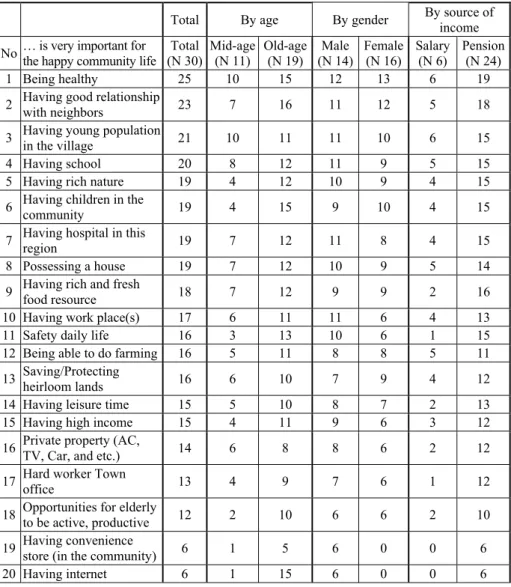
Table 1. What is the most important for the happy community life (By age, gender, and source of income)
Total By age By gender By source of income
No … is very important for the happy community life (N 30) Total Mid-age (N 11) Old-age (N 19) (N 14) Male Female (N 16) Salary (N 6) Pension (N 24)
1 Being healthy 25 10 15 12 13 6 19
2 Having good relationship with neighbors 23 7 16 11 12 5 18 3 Having young population in the village 21 10 11 11 10 6 15
4 Having school 20 8 12 11 9 5 15
5 Having rich nature 19 4 12 10 9 4 15
6 Having children in the community 19 4 15 9 10 4 15
7 Having hospital in this region 19 7 12 11 8 4 15
8 Possessing a house 19 7 12 10 9 5 14
9 Having rich and fresh food resource 18 7 12 9 9 2 16
10 Having work place(s) 17 6 11 11 6 4 13
11 Safety daily life 16 3 13 10 6 1 15
12 Being able to do farming 16 5 11 8 8 5 11
13 Saving/Protecting heirloom lands 16 6 10 7 9 4 12
14 Having leisure time 15 5 10 8 7 2 13
15 Having high income 15 4 11 9 6 3 12
16 Private property (AC, TV, Car, and etc.) 14 6 8 8 6 2 12
17 Hard worker Town office 13 4 9 7 6 1 12
18 Opportunities for elderly to be active, productive 12 2 10 6 6 2 10
19 Having convenience store (in the community) 6 1 5 6 0 0 6
20 Having internet 6 1 15 6 0 0 6
As it seen from table 1 and 2, there are 20 different agents which have the potential to impact community happiness/unhappiness. These are mostly referring to social, cultural, economic, and infrastructural sides of the community in terms of happiness. 10 of those agents are mostly related to infrastructural side, or in the other word, “hardware” perspective, and while the rest 10 agents are mostly related to “soft” ware perspective. Detailed categorization of those agents is as follow.
1) Material (Mono/Kane2) agents in terms of happy/unhappy community
It is certain that the rural community still needs better physical conditions. In order to attract and retain a young population and secure the life conditions of elderly population, some basic (infrastructural) material agents as follows will be necessary. Moreover, some physical instruments that symbolize material affluence, such as private property, having a convenience store in the region, or having Internet might be important to some individuals as well. Even tough, some of those agents might not be primarily related to the issues in daily life or farmlands (agriculture), those are still the material agents that might affect the happiness/unhappiness of community. Thus in this paper, the following is list of agents will be considered as material instruments in this respect.
Happiness agents: Having a school (no. 4), Having hospital in the region (no. 7), Possessing a house (no. 8), Having rich and fresh food resources (no. 9), Having work places (no. 10), Being able to farm (no. 12), Having high income (No. 15), Private property (TV, car, etc) (no. 16), Having convenience store in the village (no. 19), Having Internet in the house (no. 20)
Unhappiness agents: Having a low income (no. 4), Not having a hospital (no. 5), Not having work places (no. 10), Not having a school (no. 11), Not having enough food resources (no. 13), not being able to farm (no. 14), Not possessing a house (no. 15), Not possessing TV, car, and etc. (no. 18), Not having convenience store in the village (no. 19), Not having Internet in the house (no. 20).
2) Non-material (Hito/Kurashi) agents in terms of happy/unhappy community:
Today in rural communities in Japan, despite the fact that infrastructural conditions of the rural community are not insufficient, due to the aging and depopulation, maintaining the daily life and revitalizing the (agricultural) production system is getting harder. At this point, factors concerning human resource, social ties, nature, values, and the “atmosphere of the place” (Ba) needs to be considered as factors that are necessary for the happy/unhappy community. Thus the following is a list of agents that will be considered in this respect.
2 Mono/Kane is the Japanese words, which simply imply the “hardware” side of the term of
happiness. In this paper, the term of Mono symbolizes “material and/or equipment that the individual possesses”, and Kane should be translated as “money”. On the other side, the terms Hito/Kurashi basically symbolize the “software” side of the term of happiness. In this paper, the term of Hito symbolizes “social relations, networks”, and Kurashi should be understood as “the lifestyle of individual”.
Happiness agents: Being healthy (no. 1), Having good relationships with neighborhood (no. 2), Having young population in the village (no. 3), Having rich nature (No. 5), Having children in the community (no. 6), Safety daily life (No. 11), Saving/Protecting heirloom lands (No. 13), Leisure time (No.14), Hard worker Town office (No. 17), Opportunities for the elderly population (no. 18).
Unhappiness agents: Not being healthy (no. 1), Not having good relationships with neighborhood (no. 2), Bad public order (No. 3), having no children in the community (no. 6), Not having leisure time (No. 7), Disregarding (not protecting) heirloom lands (no. 8), Lazy town office (no. 9), Not having young population in the village (no. 12), No opportunities for the elderly to be active and productive (No. 16), Not having rich nature (no. 17).
As it can be understood from table 1, in general, 83 percent of Ukeguchi people say that the most important agent to make the community happy is “being healthy”. Since most residents in the community are elderly, health problems are the most frequently encountered problems in daily life. Therefore, it can be understandable why “being healthy” is the most important agent. When we look at the material conditions of the Ukeguchi, it can be understood that material conditions are available at the minimum level. The nearest town office (Ōta town office) is about 10 to 15 minutes by a car from Ukeguchi. Most of households have a car. In case of some elderly residents, they cannot drive anymore. In that case, children or neighbor take them to where they are supposed to go. Besides, there are a few buses from village to next town. On the other hand, there is a small shop in the village. However, I was told that it closes by noon. A big shopping center in Kitsuki town is about 20 to 30 minutes (15 km) from Ukeguchi. There are hospitals in Ōta, Yamaga, and Kitsuki towns. The distances from Ukeguchi are about 20 to 30 minutes. Thus, among the most important factors that make Ukeguchi happy, material oriented agents such as hospital, school, and income are still important. However, as it is clearly seen from table 1 those agents are not ranked as high as non-material factors, such as social relationships, networks, human resources and nature. Moreover, residents of Ukeguchi give less importance to the factors that symbolize material affluence, such as private property, convenience store in the region, or having Internet. From this point of view, it can be said that non-material agents are also primarily preferred at least as much as material oriented agents in terms of happiness of the community. However, it is obvious that priorities in terms of happiness vary by age, gender and source of income.
In terms of middle age population (50-60 years old) of Ukeguchi, the most preferred factors are ‘being healthy’ and ‘having a young population in
the community’ (90.9 percent). On the other hand, among the elderly population (over 70 years old) majority of the respondents (about 80 percent) say that the most important thing to be happy in this community is having good relationship, being healthy, having children in the community, and safety daily life. Additionally, primary preferences in terms of happiness are predominantly non-material agents. Eventually, from the viewpoint of the criteria given above, both middle age and elderly population more or less have the same tendencies in defining community happiness.
In terms of gender, we did not identify a notable difference in the definition of happiness. The only minor difference is that male respondents comparatively define happiness as a means of both material and non-material perspective, while female respondents define it from the viewpoint of non-material oriented factors. In terms of source of income, all of the salary-based income population says that the most important factors are being healthy and having young people in the community. Besides, some material agents such as stable income, easy accessibility, and possessing a house are also being considered as important factors too. Thus, it can be thought that they are giving more importance to the material oriented agents than the respondents who have pension as an income. That might be because they play a more central role in terms of economic sustainability and development in the community compared to the portion of the population that relies on pension-based income. Therefore, “the good” for them might be material factors. The pension-based income populations mostly prefer non-material agents that make the community happy.
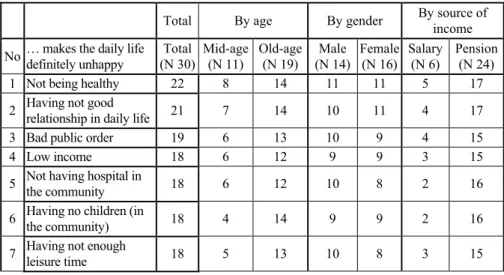
Table 2. What makes the daily life unhappy (By age, gender, and source of income)
Total By age By gender By source of income
No … makes the daily life definitely unhappy (N 30) Total Mid-age (N 11) Old-age (N 19) (N 14) Male Female (N 16) Salary (N 6) Pension (N 24) 1 Not being healthy 22 8 14 11 11 5 17 2 Having not good relationship in daily life 21 7 14 10 11 4 17 3 Bad public order 19 6 13 10 9 4 15
4 Low income 18 6 12 9 9 3 15
5 Not having hospital in the community 18 6 12 10 8 2 16
6 Having no children (in the community) 18 4 14 9 9 2 16
8
Disregarding (not protecting) heirloom lands
17 5 12 8 9 3 14
9 Lazy town office 16 5 11 9 7 4 12
10 Not having work place in the region 16 3 13 9 7 2 14
11 Not having school in the region 16 4 12 8 8 3 13
12 Not having enough young population in the community
15 5 10 9 6 3 12
13 Not having enough food resource 14 5 9 6 8 2 12
14 Not being able to do farm works 14 3 11 7 7 2 12
15 Not possessing house 14 3 11 7 7 2 12
16
No opportunities for elderly to be active,
productive 11 4 7 7 4 2 9
17 Not having rich nature 10 4 6 4 6 2 8
18 Not possessing car, tv, ac, and etc. 10 4 6 6 4 1 9
19 Not having convenience store in the region 7 3 4 5 2 1 6 20 Not having internet 4 1 3 3 1 0 4
In terms of the opposite question – that is, what factor makes the community unhappy – the ranking of the factors that make community unhappy is slightly different from the ranking of happiness factors. Additionally, it can be seen that material instruments are being ranked more higher than happiness ranking. The majority of the middle age population considers that problems of individual health and social relationship are the factors that most contribute to community unhappiness. On the other hand, the majority of the elderly population referred to the actors that mostly refer social relationship and population issues (human resources). Furthermore, the elderly population considers social and cultural actors, such as bad public order, disregarding the heirloom lands, and scantiness of leisure time, as factors that contribute to community unhappiness as much as material agents, such as not having a school, not having a hospital, and having low income.
Unlike the factors affecting “happiness”, there are no big differences between respondents based on gender when it comes to factors that make the community unhappy. Both male and female respondents think that
non-material agents may make the community unhappy as much as non-material agents. Both salary and pension based income populations think material and non-material agents have possible importance to make the community unhappy. Consequently, these results demonstrate that people mostly consider happiness and unhappiness agents to be directly related to the future of the community. Moreover, people in Ukeguchi ascribe particular importance to the non-material agents as much as material factors, which can make the community happy or unhappy.
To this point, through the Ukeguchi case, I have attempted to explain what people in rural community in Kyūshū region think about happiness. On the other side, it should be noted that Japanese rural community has its social world not spatial but relational (i.e., the migrated population is also a natural member of the rural community). Therefore, while discussing the happiness of the community, discussing what those migrated population (Tashutshushi) think about happiness should also be taken into account as well. Through this discussion, I will attempt to develop a picture of urban migrated children, which will yield a more robust representation of happiness and sustainability for the rural community. There are some researches on children who have migrated from rural Japanese communities to more urban areas, but most of it focuses on the association with elderly parents and the potential for the revitalization of rural communities. However, there are some findings about this population’s expectations and thoughts about returning back to their hometown (Kumamoto University, 2007; 2009). By reviewing these findings, it may be possible to infer how the migrated children evaluate their current and “near” future of the community. In most studies concerning rural issues in Japan, migrated population is mostly middle-aged people, which can be defined as second generation. Therefore, the content of relationship between “migration population and rural dwellers” is actually a relationship between child-parents. However, when we start to discuss “far” future of the community, leading actor will change and grandchildren population will take leading role. Correspondingly, the content, meaning and even maybe the methodology of relationship between “new migrated population and rural dwellers” will possibly change as well. And this point is mostly being overlooked in rural studies in Japan.
In this sense, a previous study (Ozsen 2009) shows us that in Kyūshū region the majority parts (89.7 percent) of migrated children, which partially includes “third generation” still have a tight tie with their hometown, and commonly live to very close to her or his parents (Traphagan 39). In general, migrated children evaluate their hometown positively because it has many positive non-material characteristics, such as rich nature and warm
relationships. On the other hand, it is mostly considered that most of the migrated children do not plan to return to their hometown, mostly due to the work and convenience conditions. However, this does not mean that migrated children have completely internalized the urban lifestyle. According to the Kumamoto University survey (2007) only two percent of migrated children say that the urban lifestyle fits them.
Based upon those results, it can be possibly said that people who moved to urban areas are giving an importance to the material affluence, and that is why they are relatively satisfied with their life away from their hometown. On the other hand, since they evaluate non-material factors as a fascinating point of their hometown, there is a possibility that those people still seek these kinds of affluences, and eventually position their hometown as a source of non-material satisfaction. However, due to the lack of research on this element of the larger situation, I cannot analyze the happiness of migrated children in great detail, but these results indicate that urban dwellers are at least positioning their rural hometowns as a source of non-material wealth. And if they seek the non-non-material satisfaction and happiness that the rural community affords, there is a very real possibility that they will return to their hometowns in the future and become the successors to the community.
5. DISCUSSION
This paper mainly attempted to understand what does happiness mean to the rural residents in Japanese mountainous area with the help of Ukeguchi case study. Moreover, this paper tried to seek what kind of agents are being considered primarily in terms of happiness of the rural community. In the case of Ukeguchi village, it can be at least assumed that Ukeguchi people give importance non-material happiness agents not less than material agents. In depth, in terms of understanding of the happiness, some differences were seen. From the viewpoint of the age, both middle age and elderly population more or less have the same tendencies in defining community happiness. Additionally, primary preferences in terms of happiness are predominantly non-material agents. In terms of gender, the only minor difference is that male respondents comparatively define happiness as a means of material perspective, while female respondents define it from the viewpoint of non-material oriented factors. In terms of source of income, all of the salary-based income population gives more importance to the material oriented agents than the respondents who have pension as an income.
In conclusion, it can be assumed that there is a tendency to evaluate the happiness not only with material affluence, but also with non-material affluence. And, I could confirm that Ukeguchi people do not consider the happiness apart from the community issues. This study was a case study and the first attempt to understand the happiness in the rural community. I believe widening this kind of discussions is important to comprehend the meaning of happy community. Besides, increase on numbers of this kind of studies may also help to the policies and strategies concerning rural sustainability to build up a new perspective, one that is compatible with today’s realities.
Since the social policy makers who work on rural community issues are also an intended audience of this paper (next to the academics), here I would like to take this opportunity and make some criticisms on social policies by discussing the possibility of a new framework from the viewpoint of non-material affluence in rural sustainability issues. That is why, in some parts of this section, the expressions might be little normative.
Since the postwar era, Japan’s strategies and policies have focused on growth in production and population, which has created a material oriented affluence ideology. Today, rural and urban Japanese communities have many kinds of limits in terms of production and social life. As demonstrated in this paper, most of the policies concerning rural revitalization are based on the former development perspectives and methods. However, if we briefly look at the condition of the rural society, it can be clearly seen that applying the former economic growth algorithm is not realistic for today’s rural Japan.
At this point, it is necessary to build up a perspective, one that is compatible with today’s realities. In the “post-growth society” debates, first and foremost, policies need to take into consideration the needs and the reality of the community, and moreover, concentrate on the balance between the economy, the well-being of the community and the sustainability of the natural environment (Hamilton and Denniss 50). Recent research suggests that material oriented quality of life cannot be measured nor provided just by economic indicators (Switalski 29). Considering the findings in this paper and field studies in Japan (Feldhoff 2013), it can be confirmed that rural society in Japan considers non-material agents to be substantially important for future happiness. Therefore, in order to foster happiness in rural communities and address issues of rural sustainability, policies also should focus on the non-material actors that were not previously taken into account. Obviously policy makers and governments already know that depopulation is a pressing issue for rural communities, and that the social capital is
irrevocable for the daily life of the community. However, the problem for rural communities is not just the declining workforce. If so, urban-rural interchange projects, which aim to increase rural population by pulling from the urban population, would have solved the problem, or at least improved it. I think that the basic problem is with the approach. Until this time, rural communities and the relationship structures of these communities were perceived within physical borders. However, it is difficult to analyze the association between non-material affluence and rural issues unless we reconstitute the understanding of relationships in the community.
People used to establish social relationship and product relationships in villages (Suzuki 1940). Social, cultural, and physical borders, role divisions, and the content of relationships were very clear in the daily life. However, particularly since the 1950s, this paradigm has changed. Due to social and physical mobility, the range and content of relationships have expanded and become more varied. In this sense, to utilize those non-material factors to create happier and more sustainable communities, some actors that have not been taken into account as much as material ones, should be reconsidered. As I discussed above, studies concerning rural sustainability have already shown that the migrated population has an economic potential for the future of the community. In order to strengthen the community and make it more resilient, migrated populations may have things to contribute as well. In this sense, the migrated population might be considered a natural member of the community, no matter the physical distance between them and their hometown. In this case, for example giving them an administrative responsibility as far as the laws permit might be one way to internalize the membership identity.
Additionally, though not the focus of this paper, recent research in Japan has shown that women play a very important role in economic growth and coordination of daily life for families (Tsuru 2007; Kawate 2010; Morifuji 2010; Tsutsumi 2000, 2002). Moreover, elderly population in rural areas are not just a target group for the health care anymore. They compose a majority of the population. In practice, they are active and efficient both in the workforce and daily life. In this respect, the position of rural women and elderly, and their role in reinforcing non-material affluences and fostering economic growth should also be reconsidered in the community`s future framework with material actors.
In conclusion, the evidence clearly points to a non-material side of happiness for the rural community, which, in most cases is directly related to the community’s future issues. From now on, policies should be developed to reconstitute the development framework by utilizing the actors and their
potentials that can make those non-material affluences more efficient. Furthermore, future studies concerning community future should revise the previously used framework and instead focus on the balance of the material growth (Mono/Kane) and non-material (Hito/Kurashi) well-being.
Acknowledgment
This paper is made possible through the help and support of some colleagues from Japan. Here, first and foremost, I would like to thank Dr. Sadao TOKUNO for letting me to participate to the research team, and for his guidance. Second, I would like to thank Dr. Atsushi MAKINO and the students of Kumamoto University Community Sociology Department for their precious supports during the Ukeguchi field study. Third, I would like to thank Dr. Takafumi MATSUMOTO for his guidance during the field interviews, and precious opinions concerning this paper.
Finally, this paper was totally supported by Nippon Foundation Japanese Language Education Program (NF-JLEP-2014). Conclusions or recommendations stated in this paper are of the author’s and do not necessarily reflect official positions of NF-JLEP.
Reference List
Adachi, Ikutsune. Kasochi Saisei no Michi [The Way of Revitalization of Depopulated Area]. Tōkyo: Nihon Keizai Hyōronsha, 1981
Arahi, Yutaka. Rural Tourism in Japan: The Regeneration of Rural Communities. 2008. http://www.agnet.org/htmlarea_file/library/20110726130209/eb457.pdf (accessed in 10 January 2015)
Berry, Berry J. L. and Okulicz-Kozaryn, Adam. “Dissatisfaction with the City Life: A New Look at Some Old Questions.” Cities. 32 (2009): 117-124
Berry, Berry J. L. and Okulicz-Kozaryn, Adam. “An Urban-Rural Happiness Gradient.” Urban Geography 32.6 (2011): 871-883
Binswanger, Mathias. “Why does income growth fail to make us happier? Searching for the treadmills behind the paradox of happiness.” Journal of Socio-Economics 35 (2006): 366–381
Chakraborty, Abhik and Asamizu Munehiko. “Revitalizing Japan`s Mountanious Areas through Green Tourism: A Human Geographical Perspective.” Issues in Social Science 2.1 (2014): 58-77
Diener, Edward and Suh, M. Eunkook. (2000). Culture and Subjective Well-Being. Cambridge MA: MIT
Easterlin, A. Richard. “Does Economic Growth Improve the Human Lot? Some Empirical Evidence.” Nations and Households in Economic Growth: Essays in Honor of Moses Abramowitz. Eds. Paul A. David and Melvin W. Reder. New York: Academic, 1974.
Feldhoff, Thomas. “Shrinking communities in Japan: Community ownership of assets as a development potential for rural Japan?” Urban Design International 18 (2013): 99-109
Frey, Bruno and Stutzer, Alois. Happiness and economics. Princeton, NJ: Princeton University, 2002
Hamilton, Clive & Denniss, Richard. “The transition to a post-growth society.” Search of Sustainability. Eds. Jenny Goldie, Bob Douglas and Iryan, Furnass. Australia: CSIRO, 2005
Hommerich, Carola and Klien, Susanne. “Happiness: Does Culture Matter?” International Journal of Wellbeing 2.4 (2012): 292-298
Ikuta Takafumi, Yukawa Kou and Hamasaki, Hiroshi. “Regional branding measures in Japan: Efforts in 12 major prefectural and city governments.” Place Branding and Public Diplomacy 3. 2 (2007): 131–143.
Ishizaka, Tokunori and Midorikawa, Nana. “The Aged and `Living-Apart Children` in Underpopulated Area.” Mie University Bulletin of the Faculty of Humanities and Social Sciences 22 (2005): 111-128
Kumamoto University Community Sociology Department. Hoshino Mura Chīki Shakai Chōsa. Kumamoto, 2009.
Kumamoto University Sociology Department. Yamato-chō Chīki Chōsa. Kumamoto, 2006.
Kumamoto University Sociology Department. Yamato-chō Tashutsushi Chōsa. Kumamoto, 2007.
Kawate Tokuya. “Change and Problems Regarding Women Farmers in Japan.” A Turning Point of Women Families and Agriculture in Rural Japan. Ed. Tsutsumi Masae. Tokyo: Gakubunsha , 2010. 22-35
Kayano Wataru, Hashimoto Michio, Fukawa Tetsua, Shibata Hiroshi, and Gunji, Atsuaki. “The Social Support System of the Japanese Elderly.” Journal of Cross-Cultural Gerontology 9 (1994): 323-333
Kitayama, Shinobu, Markus Hazel Rose, and Kurokawa Masaru. “Culture, emotion, and well-being: Good feelings in Japan and the United States.” Cognition and Emotion 14.1 (2000): 93–124.
Knight, John and Gunatilaka, Ramani. “The Rural-Urban Divide in China: Income but Not Happiness?” The Journal of Development Studies 46.3 (2010a): 506-534
Knight, John and Gunatilaka, Ramani. “Great Expectations? The Subjective Well-being of Rural-Urban Migrants in China.” World Development 38.1 (2010b): 113-124
Knight, John. “Rural Revitalization in Japan: Spirit of the Village and Taste of the Country.” Asian Survey 34.7 (1994a): 634-46
Knight, John. “Town-making in rural Japan: An example from Wakayama.” Journal of Rural Studies 10.3 (1994b): 249-261
Kurokawa, Kiyoto. “Effectiveness and Limitations of the One Village One Product (OVOP) Approach as a Government-led Development Policy: Evidence from Thai ‘One Tambon One Product’ (OTOP).” Studies in Regional Science 39.4 (2009): 977-989.
Matanle, Peter and Satō, Yasuyuki. “Coming soon to a city near you! Learning to live ‘beyond growth’ in Japan’s shrinking regions.” Social Science Japan Journal 13.2 (2010): 187-210.
Matanle, Peter, Rausch Anthony and The Shrinking Regions Research Group. Japan's Shrinking Regions in the 21st Century: Contemporary Responses to Depopulation and Socioeconomic Decline. Cambria, 2011.
Mathews, Gordon. What Makes Life Worth Living? How Japanese and Americans Make Sense of Their Worlds. Berkeley: University of California, 1996. Mollenkopf, Heidrun and Kaspar, Roman. “Ageing in Rural Areas of East and West
Germany: Increasing Similarities and Remaining Differences.” European Journal of Ageing 2 (2005): 120-130
Morifuji, Kyoko. “The Characteristics and the Challenges of Rural Women`s Entrepreneurial Activities in Japan.” A Turning Point of Women Families and Agriculture in Rural Japan. Ed. Tsutsumi Masae. Tōkyo: Gakubunsha, 2010. 35-4
Nandy, A., Yalman, N., Aoki, T., Inuhiko, Y. (2003). “Ajia wa 21-seiki ni Donoyouna Koufuku wo Tsuikyuu Suru no ka?” Ajia Shin-seiki. Vol. 4. Tokyo: Iwanami, 2003.
Novin Sheida, Ivy F. Tso. Konrath H. Sara. “Self-Related and Other-Related Pathways to Subjective Well-Being in Japan and the United States.” Journal of Happiness Studies 15 (2014): 995-1014
Ōno Akira. Genkaishūraku to Chiiki Saisei. Takachi Shinbun, 2008.
Oshio, Takashi and Kobayashi, Miki. “Area-Level Income Inequality and Individual Happiness: Evidence from Japan.” Journal of Happiness Studies 12 (2011): 633-649
Oshio, Takashi. “Gender Differences Among Elderly Japanese: Importance of Family and Social Relations for Life Satisfaction.” 2011. RIETTI Discussion Paper Series. Series no: 11-E-051 http://www.rieti.go.jp/jp/publications/ dp/11e051.pdf (accessed 10 January 2015)
Ozsen, Tolga. “The Rural Future from the viewpoint of Living-Apart Adult Children: What do they mean to the future of their hometown? A case study on Kumamoto Metropolitan area.” Kumamoto University Studies in Social and Cultural Sciences 7 (2009): 139-153
Patrick Julie Hicks, Cottrell Lesley Eepperly and Barnes A. Kristy. “Gender, Emotional Support, and Well-Being Among the Rural Elderly.” Sex Roles 45.1-2 (2001): 15-29
Piccolo F. Ronald, Judge A. Timothy, Takahashi Koji, Watanabe Naotaka, Locke A. Edwin. “Core self-evaluations in Japan: relative effects on job satisfaction, life satisfaction, and happiness.” Journal of Organizational Behavior 26.8 (2005): 965-984.
Ram, Rati. “Social capital and happiness: Additional cross-country evidence.” Journal of Happiness Studies 11. 4 (2010): 409–418.
Rausch, Anthony. “Japanese Rural Revitalization: The Reality and Potential of Cultural Commodities as Local Brands.” Japanstudien 20 (2008a): 223-245. Rausch, Anthony. “Place Branding in Rural Japan: Cultural Commodities as Local
Brands.” Place Branding and Public Diplomacy 4.2 (2008b): 136-146.
Rausch, Anthony. “Capitalizing on Creativity in Rural Areas: National and Local Branding in Japan.” Journal of Rural and Community Development 4.2 (2009): 65-79.
Raymond, A. Jussaume. Jr. “Quality-of-life perceptions of Japanese part-time farmers.” Journal of Rural Studies 6.3 (1990): 259–268.
Satō Susumu, Demura Shinichi, Kobayashi Hidegetsu, Nagasawa Yoshinori. “The Relationship and Its Change with Aging between ADL and Daily Life Satisfaction Characteristics in Independent Japanese Elderly Living at Home.” Journal of Physiological Anthropology and Applies Human Sciences 21.4 (2002): 195-204
Savitri, D. “Sustainable Development of Rural Revitalization: The Pioneer of OVOP Movement.” Journal of OVOP Policies 1.7 (2008): 21-30
Shucksmith Mark, Cameron Stuart, Merridew Tanya and Pichler Florian. “Urban– Rural Differences in Quality of Life across the European Union.” Regional Studies 43.10 (2009): 1275-1289.
Suzuki, Eitaro. Nihon nōson shakaigaku no genri. Tokyo: Nihon Hyoronsha. 1940. Switalski, A. Piotr. Europe and the Spectre of Post-Growth Society. Strasbourg:
Council of Europe, 2014.
Tachigawa M., Yabe K., Doi Y., Taniguchi Y., Ichida T. “Shōhi Sareru Nōson: Posutoseisanshugika no `aratana nōson mondai`”. Nenpo Sonrakushakai Kenkyuu. 41, Nôsangyoson Bunka Kyōkai: 2005.
Takeuchi Kazuhiko, Namiki Yutaka and Tanaka Hiroyasu. “Designing Eco-Villages for Revitalizing Japanese Rural Areas.” Ecological Engineering 11 (1998): 177-197.
Thin, Neil. “Counting and Recounting Happiness and Culture: On Happiness Surveys and Prudential Ethnobiography.” International Journal of Wellbeing 2.4 (2012): 313-332.
Tokuno, Sadao and Kashio Tamaki. T gata shūraku tenken to raifu hisutorī de mieru kazoku, shūraku, josei no teiryoku: Genkaishūrakuron o koete. Tokyo: Rural Culture Association, 2014.
Tokuno, Sadao. Mura no Shiawase, Machi no Shiawase: Kazoku, Shoku, Kurashi. Tokyo: NHK, 2007.
Tokuno, Sadao. “Nōsanson Shinkō ni okeru Toshi-Nōson Kōryū, Gurīn Tsūrizumu no Genkai to Kanōsei.” Nenpo Sonrakushakai Kenkyuu 43 (2008): 44-95. Traphagan, W. John. The Practice of Concern: Ritual, Well-Being, and Aging in
Rural Japan. North Carolina: Carolina Academic, 2004. Tsuru, Reiko. Nōkajosei no Shakaigaku. Tokyo: Comons, 2007.
Tsutsumi, Masae . (Eds.). Women and Families in Rural Japan. Tokyo: Tsukuba Shobo, 2000.
Tsutsumi, Masae. “Succession of Stem Families in Rural Japan: Cases in Yamanashi Prefecture.” International Journal of Japanese Sociology 10.1 (2002): 69-79. Uchida Yukiko, Norasakkunkit Vinai and Kitayama Shinobu. “Cultural
Constructions of Happines; Theory and Emprical Evidence.” Journal of Happiness Studies 5 (2004): 223-239.
Uchida, Yukiko and Ogihara, Yuji. “Personal of Interpersonal Construal of Happiness: A Cultural Psychological Perspective.” International Journal of Wellbeing 2.4 (2012): 354-369.
Veenhoven, Ruut. “Cross-national Differences in Happiness: Cultural Measurement Bias or Effect of Culture.” International Journal of Wellbeing 2.4 (2012): 333-353. Wada T., Ishine M., Sakagami T., Okumiya K., Fujisawa M., Murakami S., Ōtsuka
K., Yano S., Kita T., Matsubayashi K. “Depression in Japanese community-dwelling elderly—prevalence and association with ADL and QOL.” Archives of Gerontology and Geriatrics 39.1 (2003): 15-23.
Winkelmann, Rainer. “Unemployment, social capital, and subjective well-being.” Journal of Happiness Studies 10.4 (2009): 421-430
World Commission on Environment and Development. Our Common Future. Oxford: Oxford University, 1987.