A N E X A C T A L G O R I T H M
; C·
T. li'viv’^te of Ex-gkiSe.!
, . .p 'p‘ 1 i . T T .
MINIMIZING SCHEDULE LENGTH ON
IDENTICAL PARALLEL MACHINES:
AN EXACT ALGORITHM
A THESIS
SUBMITTED TO THE DEPARTMENT OF INDUSTRIAL ENGINEERING AND THE INSTITUTE OF ENGINEERING AND SCIENCE
OF BILKENT UNIVERSITY
IN PARTIAL FULFILLMENT OF THE REQUIREMENTS FOR THE DEGREE OF
DOCTOR OF PHILOSPHY
By
H. Cemal Akyel
June 1991
c f ß , ; ) i l 4
dissertation for the degree of Doctor of Philosophy.
Assoc. Prof. Dr. Ömer S. Benli (Supervisor)
I certify that I have read this thesis and that in my opinion it is fully adequate, in scope and in quality, as a dissertation for the degree of Doctor of Philosophy.
PrOTT Dr. Halim Doğrusöz
I certify that I have read this thesis and that in my opinion it is fully adequate, in scope and in quality, as a dissertation for the degree of Doctor of Philosophy.
I certify that I have read this thesis and that in my opinion it is fully adequate, in sco^De and in quality, as a dissertation for the degree of Doctor of Philosophy.
Prof. Dr. M. Akif Eyler
I certify that I have read this thesis and that in my opinion it is fully adequate, in scope and in quality, as a dissertation for the degree of Doctor of Philosophy.
Assoc. Prof. Dr. Nesim Erkip
Approved for the Institute of Engineering and Science:
Prof. Dr. MehmeliiBaray,
MINIMIZING SCHEDULE LENGTH ON
IDENTICAL PARALLEL MACHINES:
AN E X A C T ALGORITHM
H. Cemal Akyel
Ph. D. in Industrial Engineering
Supervisor: Assoc. Prof. Dr. Ömer S. Benli
June 1991
The primary concern of this study is to investigate the combinatorial aspects of the single-stage identical parallel machine scheduling problem and to develop a computationally feasible branch and bound algorithm for its exact solution. Although there is a substantial amount of literature on this problem, most of the work in this area is on the development and performance analysis of approximation algorithms. The few optimizing algorithms proposed in the literature have major drawbacks from the computer implementation point of view. Even though the single-stage scheduling problem is known to be unary A/’P-hard, there is still a need to develop a computationally feasible optimizing algorithm that solves the problem in a reasonable time. Development of such an algorithm is necessary for solving the multi-stage parallel machine scheduling problems which are currently an almost untouched issue in the deterministic scheduling theory.
In this study, a branch and bound algorithm for the single-stage identical parallel machine scheduling problem is proposed. Promising results were obtained in the empirical analysis of the performance of this algorithm. Furthermore, the procedure that is developed to determine tight bounds at a node of the enumeration tree, is an approximation algorithm that solves a special class of identical parallel machine scheduling problems of practical interest. This algorithm delivers a solution that is arbitrarily close to 4/3 times the optimum. To our knowledge this is the best result obtained for this problem so far.
K e y w o r d s : Deterministic Machine Scheduling, Identical Parallel Machines, Minimizing Makespan, Computational Complexity Theory, Approximation Algorithms, Optimizing Algorithms, Perfor mance Bounds.
ÖZDEŞ PARALEL M A KİN ALAR D A
ÇİZELGE UZUNLUĞUNUN ENAZLANM ASI:
BİR KESİN ÇÖZÜM ALGORİTM ASI
H. Cemal Akyel
Endüstri Mühendisliği Doktora
Tez Yöneticisi: Doç. Dr. Ömer S. Benli
Haziran 1991
Tek aşamalı özdeş paralel makinalı çizelgeleme problemlerinin kombinatoryel özelliklerinin incelenmesi ve hesap zamanı açısından uygulanabilir bir dal- sınır yönteminin geliştirilmesi bu çalışmanın ana içeriğini oluşturmaktadır. Çizelgeleme literatüründe bu problemle ilgili pek çok çalışma olmakla beraber, bu çalışmaların çoğu yaklaşık algoritmalar geliştirilmesi ve yaklaşık algoritmaların performans analizi ile ilgilidir. Literatürde önerilen kesin çözüm algoritmaları ise bilgisayar uygulamaları açısından bir takım problemleri içerir. Tek-aşamalı çizelgeleme problemleri için, MV-zox olmalarına rağmen, eniyi çözüm veren, çalışma zamanı açısından uygulanabilir algoritmalara ihtiyaç vardır. Zira böyle bir algoritma çok-aşamalı paralel makinalı çizelgeleme problemlerinin çözümü için gereklidir ki bu son sınıftaki problemler çizelgeleme kuramında hemen hiç dokunulmamış bir alanı belirlerler.
Bu çalışmada, tek aşamalı özdeş paralel makinalı çizelgeleme problemleri için bil in
dal-smır algoritması önerilmiştir. Algoritmanın deneysel performans analizinden elde edilen sonuçlar ümit vericidir. Buna ek olarak dal-smır ağacındaki bir düğümdeki alt ve üst sınırları bulmak için geliştirilen algoritmanın kendi başına uygulanabileceği pratik durumlar da söz konusudur. Bu algoritma eniyi çözüm çarpı 4 /3 ’e istenen ölçüde yakın sonuçlar verebilmektedir. Bu da adı geçen problem için bildiğimiz en iyi sınırdır.
A n a h ta r
S ö zcü k le r: Deterministik Makina Çizelgelemesi, Özdeş Paralel Maki- nalar, Çizelge Uzunluğunun Enazlanması, Hesap Karmaşıklığı Teorisi, Yaklaşık Algoritmalar, Kesin Çözüm Algoritmaları, Performans Sınırları.
I would like to express my gratitude to Professor Ömer S. Benli for his supervision to my graduate study. He introduced me the fascinating world of the parallel machine scheduling theory at the beginning of my Master’s study eight years ago. Since then, I have had the utmost pleasure playing with machines, jobs and schedules. Professor Benli helped me through this playground in an enthusiastic and friendly way. His encouraging and patient guidance allowed me to complete this work in contentment. Moreover, I benefited a lot from his wisdom and invaluable advices, which I believe will be useful in the rest of my life.
I am grateful to Professor Nesim Erkip for his support and encouragement in all phases of this study. Chatting and discussing with him always gave me relief in times of discomfort.
I owe a lot to Ceyda “ Countess” Oğuz with whom I had many fruitful discussions. She always gave me a hand in times of desperation. Especially, her efforts in typing the draft copy of this thesis rescued me from missing the deadline.
Special thanks are due to my comrade Dr. Erkan Tekman for his understanding and stimulating attention. We spent many sleepless nights discussing issues ranging from the War in the Gulf to problems in dynamic programming. It seems we should talk more on why our destinies are determined by stars.
I wish to thank to Dr. Ülkü Gürler for her help in the statistical analysis part of this study.
Last but not the least, my sincere thanks are due to my family for their continuous morale support.
Contents
Abstract i Ozet iii Acknowledgement v Contents vi List of Figures ix List of Tables . x List of Procedures xi 1 Introduction 11.1
Problem D e fin itio n ...2
2 A Single-Stage Identical Parallel Machine Scheduling Problem 6 2.1 Problem C h a ra cteristics... 7
2.2
Optimizing A lg orith m s...1.3
2
.2.2
Dynamic Programming A p p roa ch es... 182
.2
.2.1
Dynamic Programming Formulations for the General C a s e ... 182.
2
.2.2
A Dynamic Programming Formulation for the Special Case ...21
2.3 Approximation A lgorithm s... 23
2.3.1 List Scheduling Algorithm s... 23
2
.3.2
Bin Packing Based A lgorithm s... 262.3.2
.1
Primal A lg orith m s... 262
.3.2.2
Dual A lg o rith m s... 283 A Branch and Bound Algorithm 34 3.1 Branching Scheme ... 36
3.2
Bounding S ch em e... 46 3.2.1 A1
/3
-Relaxed Decision P r o c e d u r e ... 51 3.2.2 Initial B o u n d s... 61 3.2.3 Bound Computations at a N o d e ... 64 3.3 Search S tr a te g y ... 673.4 Computational E xp erien ce...
68
4 Conclusions 76
References 84
Appendix A : A Classification Scheme for Machine Scheduling
Problems 89
A .l Examples ... 93 A
.2
Reducibility Among Scheduling P roblem s...94
Appendix B: Terminology 96
Appendix C: Computational Results in Tabular Form 101
Vita 123
2.1
A list schedule for the 7-job \\P^\\Cmax instance for L ={J1 1J2·, · · · 5 Jt) ... 25
2.2
An optimal schedule for the 7-job l\PZ\\Cmax instance for L = (Ji, J2j · · ·, «/7) ... 253.1
A schedule represented as an onto fu n c tio n ...34
3.2 The enumeration tree for a6
-job l|P3||C'maa; p r o b le m ... 433.3
A partial schedule for a three-identical parallel machine problem . 64 4.1 \\P\\Cmax with one or more jobs fix e d ... 83 A .l Reducibility among scheduling problems (excerpted from [Lawleret al. 1982]... 94
List of Tables
2.1
Number of leaf nodes in the enumeration tree proposed by [Bratleyet al. 1975]... 17
3.1 The Stirling number of the second k i n d ... 36
3.2 Factors and related levels considered in the experimental design . 70 3.3 A sample o u t p u t ... 71
3.4 The percentage of the standardized residuals that fall within the lim its... 73
C .l First encountered time and total t im e ...
102
C
.2
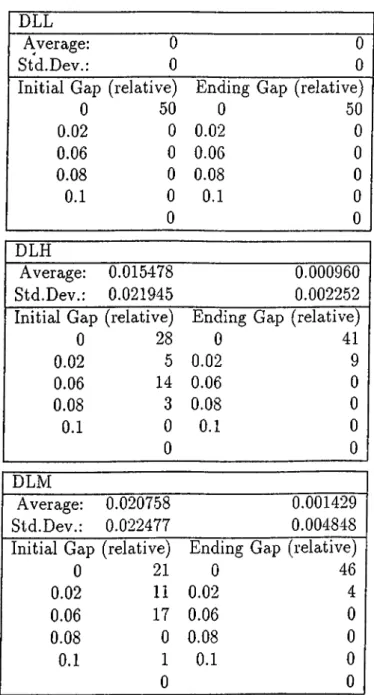
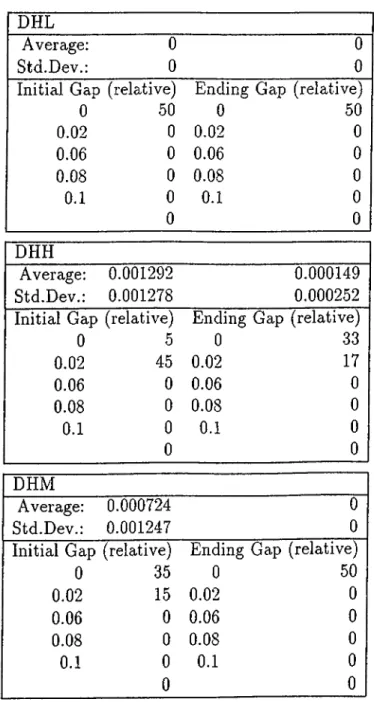
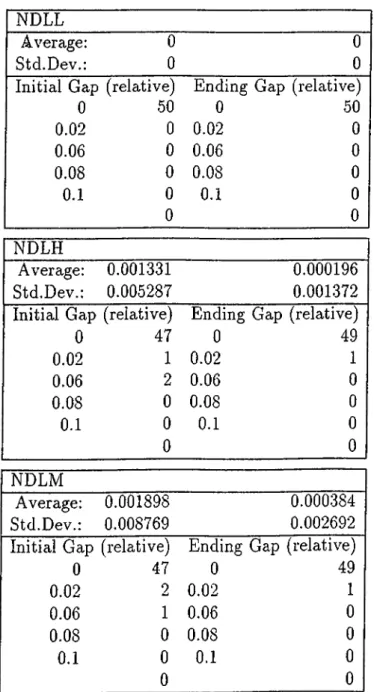
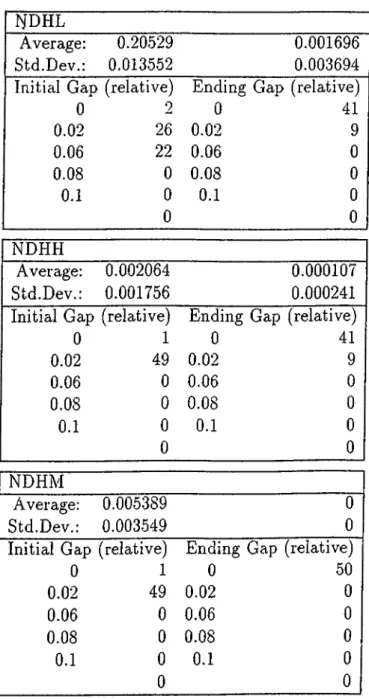
Initial gap and ending g a p ... 108C.3 First encountered node and total number of n o d e s ...114
C.4 The Analysis of Variance Table for the Three-Factor Fixed Effects Model: CPU T i m e ...
120
C.5 The Analysis of Variance Table for the Three-Factor Fixed Effects Model: G a p ...
121
C
.6
The Analysis of Variance Table for the Three-Factor Fixed Effects Model: Number of N od es...122
2.1
An exact binary search procedure for \\P\\Cmax...9
2.2
A solution procedure for 3-PARTITION ...11
2.3 A solution procedure for the bin packing problem П ^р...12
2.4 An exact binary search procedure for solving l\\rj,dj\Lmax . . . . 152.5 A list scheduling heuristic for l\P\\Cmax 24
2.6 A primal bin packing based approximation algorithm for
11
^11
(7^01
27 2.7 F E D heuristic for the bin packing problem, П ^ р ... 282.8
A dual bin packing based approximation algorithm for 1|P|[Стах 30 3.1 The proposed branch and boupd procedure for 1\Р\\СтЛах... 45 3.2 An approximate binary search procedure for solving the schedulingproblem encountered at a node
49
3.3 A 1/3-relaxed decision procedure for the bin packing problem with variable bin s i z e s ... 52 3.4 A 1/3-relaxed decision procedure for the ordinary bin packing
problem, П^р ...
59
3.5 A recursive procedure which packs large pieces of the ordinary binpacking problem ll^p, fe a s ib ly ... 60
3.6 The bounding procedure used at a node of the enumeration tree 65
Introduction
The theory of deterministic scheduling is concerned with the development and analysis of mathematical models which are useful in real life. In practice, scheduling problems may arise in a variety of situations. For example, consider a production system in which a set of jobs, each requiring a sequence of operations
(routing) is to be performed by using a number of machining centers (stages). To perform a job, each of its operations must be processed in the order given by the routing. The processing of an operation requires the use of a particular stage for a given duration. Each machine of a stage can process only one operation at a time. Given a criterion to measure the quality of each possible (feasible)
schedule, the problem is to find a processing order on each machine.
From the practical point of view, it can be argued that most deterministic scheduling models developed in the literature have certain restrictive assump tions. The crucial assumption that is usual in these models is related with the configuration of a production environment. In multi-stage scheduling problems availability of several parallel machines at each stage of production increases the routing flexibility and hence allows the greater possibility of generating “better” schedules. Unfortunately, scheduling models developed for these problems frequently assume the availability of a single machine at each stage of production.
Although the above assumption is unrealistic, it is enough to make most of the scheduling problems MV-hard. A recent study due to [Lawler et al. 1989] showed that over 4,536 scheduling problems (class of problems) defined in the literature, only 416 were solvable in polynomial-time. 3,817 problems were shown to be A7'P-hard (3,582 of them were unary MV-hard). The status of 303 was unknown at the time the study was done. Perhaps these complexity results are the primary reason why more general models without this assumption are not well-studied in the literature. Nevertheless, these latter class of problems does exist and requires solutions.
The purpose of this study is to investigate the combinatorial aspects of a single-stage identical parallel machine scheduling problem, and develop a computationally feasible branch and bound algorithm for its exact solution. Undoubtedly, such an efficient algorithm is a basic requirement in solving the general class of multi-stage parallel machine scheduling problems.
The following section formally defines the class of problems that is the main concern of this study.
Chapter 1. Introduction 2
1.1
Problem Definition
Scheduling independent and nonpreemptable jobs on identical parallel machines so as to minimize schedule length (makespan) is one of the fundamental problems in deterministic scheduling theory. In an instance Ipms = (<7, M ) of this problem, we are given
• a set of independent jobs, each job Jj having a processing time pj € 2'^, and
• a set A f = {Ml., M2, , Mm} of identical parallel machines.
In an instance Ipms, we assume that m >
2
and m < n since otherwise the problem is trivial (if m =1
, the makespan is equal to for any sequenceof n jobs and if m > n, the makespan is equal to the processing time of the longest job).
As described in [Coffman et al. 1978], a feasible (nonpreemptive) schedule is a
partition V = { . . . , ) oi J into m disjoint sets, one for each machine. The machine M,· (i =
1
,2
, . . . , m) processes jobs in V\ The total completion time of jobs in V' (i =1
,2
, . . . , m ) is /( P ‘ ) where 1{X) — X C V(for an empty set, /(0) = 0). Such a completion time is possible since we assume that jobs are independent and thus a machine can process them consecutively without any idle time. The makespan for the schedule P is then given by
CmaxiV) — max /( P ‘ ) l<i<m
This abstract problem can be used to model a variety of problems in the real world [Garey and Johnson 1981]. In a television station, machines could stand for commercial breaks and jobs could stand for commercials themselves. Given the duration of each commercial, the aim is to allocate the commercials into breaks such that the durations of breaks are as equal as possible. This objective can equivalently be stated as to minimize the maximum break-length that is, the schedule length. In a computer system, machines could be identical parallel processors and jobs could be independent tasks. Given the processing time of each task, the aim is to distribute the load among the processors as uniformly as possible. In the plumber’s pipe-cutting problem, a plumber needs a collection of pipes of lengths pi ,...,pn, which can be obtained by cutting up purchased pipes with a standard length C. The plumber wishes to buy minimum number of these G-length pipes. Given an upper bound, ub, and a lower bound, lb, on the number of pipes that are to be purchased, the plumber can form a related single-stage identical parallel machine scheduling problem by treating pipes to be cut as jobs and the midpoint of lb and ub as the number of identical parallel machines. If the optimal makespan for the latter problem turns out to be greater than C, then the current number of purchased pipes is not enough to cut the needed pipes and hence lb is updated to the midpoint. If else ub is updated. This way, in a binary search the plumber determines the minimum number of
purchased pipes. The same strategy can be used to solve several other problems. In a classroom scheduling problem, given the duration of each class and the total availability time, C of each room, the aim is to determine minimum number of rooms required to schedule all of the classes. In a truck loading problem, items with given weights have to be packed into minimum number of trucks each having a finite capacity C.
Although the above interpretations are possible, we will be using the production terminology throughout this study. The problem of determining an optimal m- machine schedule P , with minimum = Cmax{V^) is denoted by \\P\\Cmax·,
using a notation similar to the one in [Graham et al. 1979]. In this notation (see Appendix A for details) each scheduling problem is represented by a
4
-tuple a|^|7
|i, where• a identifies the production environment, such as single stage (
1
),• ¡3 identifies the machine environment at each stage of production, such as identical parallel machines (P ),
•
7
identifies further assumptions of the scheduling problem, such as “job preemption (pmtn) allowed” , “each job must be completed by its deadline dj'\ etc.• 8 identifies the optimality criterion of the scheduling problems, such as makespan [Стах)·
Chapter 1. Introduction
4
In Chapter
2
, the characteristics of an optimum solution to l\P\\Cmax are analyzed and the previous approaches to solve this problem are reviewed. A discussion on the major drawbacks of these approaches concludes that there is a lack of an exact algorithm which solves \\P\\Cmax
in a reasonable time. The main chapter. Chapter 3, presents a detailed development of the branch and bound algorithm, including the computational results. In Chapter 4, the significance and the importance of the results of this study and possible directions for future research are discussed. In Appendix A, the details of the classification scheme fordeterministic scheduling problems are presented. Appendix B provides a glossary of basic complexity theoretic concepts used in the study. Finally, the detailed computational results are given in Appendix C in tabular format.
Chapter 2
A Single-Stage Identical Parallel
Machine Scheduling Problem
It is not difficult to be deceived by the apparent simplicity of the class of scheduling problems
\\P\\Cmax·,
thus underestimating the complexity of the problem. The scheduling of n independent jobs on m identical parallel machines is among the hardest problems in the scheduling theory. A few number of optimizing efforts, each failing to solve the problem, reported in the literature can be considered as an indicator of this fact. However some of the characteristics of the problem makes the development of “good” algorithms possible. In Section2
.1
, these characteristics will be discussed and the complexity class of the problem will be identified. Section2.2
reviews the optimizing algorithms developed to solve^\P\\Cmax and discusses their major drawbacks. In Section 2.3, we will briefly review one of the promising research areas of the deterministic scheduling theory, development of approximation algorithms for \
\P\\Cmax
with “good” performance guarantees.2.1
Problem Characteristics
An analysis of problem characteristics provides an insight which may be useful in developing efficient solution procedures. For l\P\\Cmax·, even the trivial property stated in the following lemma leads to a substantial reduction in the computational burden of the proposed implicit enumeration algorithm (see Chapter 3).
L e m m a 2.1 There exists an optimal schedule for l\P\\Cmax in which at least one job is assigned on machine M,· V f =
1
,2
, . . . , m.P r o o f: Suppose the contrary, that is, there is an optimal schedule P , in which no job is assigned on machine Af,j for some ii =
1
,2
, . . . , m . Without loss of generality, assume that C^^x — CmaxiV^) = for some¿2
=1
,2
, . . . , m , is the makespan of this schedule. By scheduling job Jj6
Vp on machine M,·, we obtain another schedule P ,. in which 1{VI\) < l{Vp). Furthermore, V £ ^ ii,^ — CmaxiV*)· Thus we obtain a contradiction that Cmax{P»^) <
^max·
The following lemma provides a necessary condition that an optimal schedule for
l\P\\Cmax satisfies.
L e m m a 2.2 In an optimal schedule to \\P\\Craax> the earliest start time of job Jj on machine Mi, E STji < \ = (l/m )/(j7 ’) V
7
=1
,2
, . . . ,n and i =1,2
. . . ,m.P r o o f; Suppose for a contradiction that there is an optimal schedule in which jFS'TjjVj > A for some job Jjj {ji =
1
,2
, . . . , n ) and some machine M,·,(¿1
= l ,2
, . . . , m ) . Then there exists at least one other machine Mi^(¿2
7
^ ¿1
) withESTj^i^ < ESTj^i, since ESTj^^ < l( J) = mA. Thus by scheduling job Jj,
on machine we obtain a contradiction. ■
The well-known A/"P-hardness result due to [Garey and Johnson 1979] rules out the possibility of finding necessary and sufficient conditions which can be used to
Chapter 2. A Single-Stage Identical Parallel Machine Scheduling Problem
8
determine an optimal schedule for llPIIC^aa: in polynomial-time (since otherwise
V = AfV, which is extremely unlikely). In the remainder of this section, the above complexity result will be discussed in detail. In this discussion (and in the remainder of this study) we will use the relationship between the single-stage identical parallel machine scheduling problem and the bin packing problem. In an instance I^p = [J^m) of the bin packing problem, II^p, we are given
• a set
^7
= {7 i, J2
, . . . , 7 „} of jobs (or, pieces) of size pj for each Jj G J^and
• a set B = {B i, Bii - · ·, Bm] of bins with unit bin sizes.
The aim is to decide whether or not there exists a feasible packing. A feasible packing can be considered as a feasible schedule V which finishes at (or, before) time one (that is, the size of each bin). Such a packing may exist since we assume that in a nontrivial instance I^p, Pj < 1 V Jj € J . Otherwise, the answer for the above decision problem is always “no feasible packing” since at least one job cannot fit into a bin.
\\P\\Cmax can now be viewed as determining minimum bin size r*, for which a feasible packing exists. Suppose that we have a procedure exacthinpack which given an instance I^p either outputs “no feasible packing” or determines a feasible packing (that is, the procedure outputs “yes” ) for the decision problem IT^p. Procedure 2.1 uses the procedure exactbinpack in a binary search to determine a minimum makespan schedule for the problem l\P\\Cmax· It is initialized with lower {lb) and upper {ub) bounds on the optimum schedule length, For the midpoint r of the current range of possible optimum makespan values, related bin packing problem is exactly as defined before, except that the bin sizes r >
1
. Therefore, the binary search procedure determines the scaled instance I^p/r· after dividing job and bin sizes by r. Clearly such a scaling does not affect the essential structure of the original instance. The procedure exactbinpack is called for the scaled instance if s. feasible packing (schedule) is determined, then the upper bound is updated to the midpoint, otherwise the lower bound is updated.P r o c e d u r e
2
.1
: An exact binary search procedure for\\P\\Cmax
argu m en tsIpms: an instance of
\\P\\Cmax
lb: a lower bound for
l\P\\Cmax
ub: an upper bound for \\P\\CTnax
p r o c e d u r e ca lled
exactbinpack: a hypothetical procedure that solves the bin packing problem II^p
p r o c e d u r e exactbinarysearch (lpms,lb,ub)
b e g in
w h ile ub — lb >
1
b e g inr := {ub + lb)/2
if exactbinpack (I^p/i") outputs “no feasible packing”
lb := r else
ub := r end
o u tp u t and the schedule related with ub
en d
Thus at each packing attempt ( “iteration” ) lb and ub are still lower and upper bounds on the problem, respectively. Moreover, [lb] and [u
6
J are also respective lower and upper bounds since all of the processing times are integer. Hence the search can be terminated whenever ub—lb <1
with C^^x ~ since [u6
J < f/6
] is a lower boundThis search interval is called the interval of uncertainty. After £ iterations of a binary search, the size of this interval is reduced by a factor of 2“ ^. Thus
O (log \ub — lb~\) iterations are required to satisfy the stopping condition of Procedure 2.1, ub — lb < 1. The initial lower and upper bounds are described in the following lemmas.
Chapter 2. A Single-Stage Identical Parallel Machine Scheduling Problem
10
L e m m a 2.3 [McNaughton 1959] A lower bound on \\P\\Cmax is max{/(i7)/m, max pj}
J j G JT"
P r o o f: is at least maxj^^jpj since each job has to be processed in any schedule for l\P\\Cmax· Furthermore the inequality 1{J) < must hold since otherwise there is no way to finish all of the jobs by the time ■ The above lower bound is also an optimal makespan value for llPlpm^njCTOai:·
L e m m a 2.4 [Graham 1966] An upper hound on \\P\\Cmax is
2
/6
.P r o o f: Due to Lemma 2.2, in an optimal schedule, a job starts its processing on a machine before ( l /m ) /( J ’) < lb. Hence — lb ^ naaxj^ejrPj < lb. Thus
C* max < 2/6. — ■
As it will be discussed in Section 2.3, it is possible to improve these bounds. Nevertheless, it is sufficient to show that Procedure
2.1
is polynomial in the binary encoding of the input provided that the procedure exactbinpack is polynomial. Unfortunately, the latter possibility is extremely unlikely since the bin packing problem H^pis unary A/’P-complete as shown in the following theorem.T h e o r e m
2.1
[Garey and Johnson 1979] The bin packing problem H^p/s unary MV-complete.P r o o f: Without loss of generality, we assume that in the bin packing problem the size of each bin is r > 1. Consider the following unary A/’P-com plete recognition problem [Garey and Johnson 1979]:
3-PARTITION:
INSTANCE: A finite set S of 3m elements, a bound r G and a “size” Pj G for each Jj G such that each pj satisfies r /4 < pj < r /2 and such that Y,j.^jPj = mr.
QUESTION: Can ¿1 be partitioned into m disjoint sets . . . , such that, for
1
< f < m, /(P ') = r?An instance of the
3
-PARTITION is a special case for the bin packing problem in which piece sizes and the number of pieces are so restricted that in a feasible packing each bin must contain exactly three pieces. Hence, we can directly use the procedure exactbinpack to solve an instance of 3-PARTITION (see Procedure2
.2
). Clearly if exactbinpack were a (pseudo) polynomial-time procedure then3-P r o c e d u r e
2
.2
: A solution procedure for 3-PARTITION argu m en tI: an instance of
3
-PARTITION p r o c e d u r e calledexactbinpack: a hypothetical procedure that solves the bin packing problem H^p
p r o c e d u r e 3 — partition ( / ) b e g in
call exactbinpack t)
if 1{V') < T V i =
1
,2
, . . . , m or “no feasible packing” is output th en o u tp u t “no”else
o u tp u t “yes” en d
PARTITION would be solved in (pseudo) polynomial time which is not possible unless V=AfV. Therefore the bin packing problem is unary A/'P-complete. ■
T h e o r e m
2.2
[Garey and Johnson 1979] The general problem class l\P\\Cmax, is unary AfV-hard.P r o o f: Without loss of generality, we assume that in the bin packing problem the size of each bin is r >
1
. Suppose that we have a hypothetical subroutine,Ipcmax, which solves l\P\\Cmax to optimality in (pseudo) polynomial-time. Using Ipcmax we can solve the bin packing problem H^pas shown in Procedure 2.3.
Chapter 2. A Single-Stage Identical Parallel Machine Scheduling Problem
12
P r o c e d u r e 2.3: A solution procedure for the bin packing problem IIl bp a rgu m en t
I^p: an instance of the bin packing problem, IT^p p r o c e d u r e called
Ipcmax: a hypothetical subroutine that solves llPUGn
p r o c e d u r e exactbinpack (I^p) b e g in
call Ipcmax (Ipms) if Стах >
1
th eno u tp u t “no feasible packing” else
o u tp u t “yes” and the packing (schedule) en d
This shows bin packing problem is Turing-reducible to
l\P\\Cmax·
Hence the latter problem is unary A/'P-hard since the former is unary W P-hard due toTheorem 2.1. ■
Above complexity result provides a formal justification to use an implicit enumeration algorithm to determine an optimal solution for the problem.
2.2
Optimizing Algorithms
A quick review of the scheduling literature suggests that there is a lack of efficient optimizing algorithms for
l\P\\Cmax
(See for example [Lawler et al. 1982; Lawleret al. 1989; Cheng and Sin 1990]). In the following sections we will analyze the algorithms based on the two approaches: Branch and Bound and Dynamic Programming.
2.2.1
A Branch and Bound Algorithm
In [Lawler et al. 1982] the only branch and bound algorithm for \\P\\Cmax is reported as the algorithm due to [Bratley et al. 1975]. However this algorithm is developed to solve l|P|rj, dj\Cmaxi a general case of \\P\\Cmax· In this section we argue that the above algorithm, when applied to the special case fails to provide an efficient solution procedure.
Consider a related scheduling problem \\P\rj,dj\Cmax· In an instance of this problem we are given a set = { Ji, ^
2
» · · ·, of independent jobs and a set M — {M l, M2
, . . . , of identical machines (m < n). Each job Jj (j =1
,2
, . . . , n ) becomes available for processing at a ready time rj >0
; has a processing time pj € and must be completed by a deadline dj (in a nontrivial instance dj > rj + Pj)· The aim is to determine a feasible schedule (if any) that minimizes makespan. In this problem, if we let rj = 0 anddj = ub V y =
1
, 2 , . . . ,n, where ub is an upper bound on the optimal schedule length, the problem reduces to l\P\\Cjnax· The implication of this observation is twofold. First, \\P\rj^dj\Cmax is unary MV-haxd since its restricted version (i.e. l\P\\Cmax) is unary A7P-hard (see Theorem2
.2
). Second, an optimizing algorithm for l\P\rj,dj\Cmax can be used to solve l\P\\Cmax·In l\P\rj,dj\Cmaxi a feasible schedule can be considered as a partition V = ( ) of J into m disjoint sets, one for each machine M,· [i =
1
,2
. . . , m ), such that the completion time of a job Jj € V\ Cj{V') < dj. In otherwords, a feasible schedule corresponds to an assignment of jobs to machines such that (i) no job is processed on more than one machine, and (ii) the jobs assigned on a machine must be completed before their deadlines. It is the second property that makes the sequencing of jobs on a machine necessary. For instance, consider jobs Jjj and Jjj that are somehow assigned on a machine M{ with = 2, Tj-j = 3, pji = 1, pj^ — 2, djj = 6 and dj^ = 5 . In a feasible schedule, the sequence of these jobs has to be Jjj — Jj, is processed before J j,” ). The problem of determining a feasible sequence of jobs on a machine (i.e. a sequence that results in a feasible schedule) is denoted by \\\rj,dj\Cmax·, using the notation in Appendix A. In this feasibility problem, although there is no need to specify an objective, we arbitrarily choose Стах in order to be consistent with the overall objective in 1|Р|г^, dj\Cmax· The sequencing problem l||rj, dj\Cmax is unary M V-
hard (complete) due to the following proposition.
P r o p o s itio n 2.1 The sequencing problem \\\rj,dj\Cmax is unary MV-hard.
Chapter 2. A Single-Stage Identical Parallel Machine Scheduling Problem
14
P r o o f: Suppose for a contradiction that there exists an (optimizing) algorithm
Irjdjcm ax which solves l\\rj.,dj\Cmax in polynomial-time. In an instance I of this problem we are given a set J oi n jobs. Each Jj € J becomes available for processing at a ready time ry > 0; has a processing time pj G Z'^·, and must be completed by a deadline dj. Consider another sequencing problem \ \\rj,dj\Lmax which is known to be unary A/'P-hard [Lenstra 1977; Rinnooy Kan 1976]. An instance I' of this latter problem is same as / , except that a job Jj G J may not be completed by its due date dj. The objective is to minimize the maximum of the differences between the job completion times and their due dates (i.e.
Lmax)· Let lb and ub denote lower and upper bounds on the minimum Lmax-
Clearly lb = —dmax — —maxjj^j dj (none of the jobs are scheduled) and ub =
rmax + Y2jj€jPi ~ Scheduled after
maximum ready time rmax and dj = 0 V J j E ¿1) are the simple bounds on
this problem. Procedure 2.4 uses the procedure Irjdjcmax in a binary search to determine a schedule which minimizes Lmax for the problem l\\rj.,dj\Lmax·
P r o c e d u r e 2.4: An exact binary search procedure for solving l\\rj,dj\Lj,
argu m en ts
F: an instance o f l\\rj^dj\Lmax lb: a lower bound for l\\rj,dj\L uh: an upper bound for \\\rj,dj\L.
max max p r o c e d u r e ca lled
Irjdjcm ax: a hypothetical procedure that solves
1
||г^, djlCnp r o c e d u r e lrjdjlm ax{I',lb,ub) b e g in w h ile ub — lb >
1
b e g in Lmax := {ub + /6)/2
dj := dj + Lmax V Jj E Jif Irjdjcmax (I) outputs no feasible schedule
lb := Lmax
else
u b L m a x
end
o u tp u t and the schedule related with ub
en d
Procedure 2.4 determines in О {u b -lb ) = О {J2jjeJPi dmax) calls of the procedure Irjdjcmax. Therefore, it would be polynomial in the binary encoding of the input provided that the procedure Irjdjcmax were a polynomial time subroutine for l\\rj.,dj\Cmax· Thus l||rj,djlTmax is Turing reducible to
l\\'’'j-,dj\Cmax· Thus the latter problem is unary A/^P-hard since the former is
known to be unary AfV-havd. ■
The above complexity result justifies the enumeration of all possible arrangements of n jobs on m machines. The number of arrangements of n jobs on exactly m
Chapter 2. A Single-Stage Identical Parallel Machine Scheduling Problem
16
machines is
(2.1) This number can be verified as follows: suppose we have fixed a job on a machine
\
(say Ji on M l). Then there are ( ) different ways to assign the remaining n —
1
jobs (selected from a given list) to m machines. Since there are (n —1
)!• 72 __ \
different ways of forming a list of remaining jobs, we obtain ( )(n —
1
)! 771— 1distinct schedules provided that the job Ji is fixed on machine Mi. Each time fixing one job Jj (j = 2 ,... ,n) on machine Mi we obtain ( )(n —
1
)! distinct schedules provided that the job Jj is fixed on machine Mi. Since there are m! different ways to arrange m identical machines, the number of distinct schedules that uses exactly m machines will be (2
.1
).To the best of our knowledge the only (optimizing) algorithm for l\P\rj,dj\Cmax
is due to [Bratley et al. 1975]. In their branch and bound algorithm, leaf nodes of the enumeration tree correspond to all possible arrangements of n jobs on m
or less machines. Using (2.1), it is easy to see that the total number of leaf nodes is
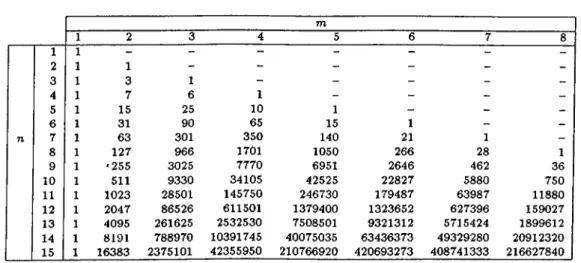
Table 2.1 shows how this number changes as n and m changes.
As opposed to the situation in l\P\f'j,dj\Cmaxi the ordering of the jobs that are assigned on the same maclxine is immaterial in l\P\\Cmax· Therefore, the set of schedules that the branch and bound algorithm of [Bratley et al. 1975] enumerates is much larger than what is required for l\P\\Cmax· Moreover, the computational results presented in [Bratley et al. 1975] suggest that the performance of the algorithm is poor even for l\ P \rj,d j\Cm a x· The problem instances that were generated in their empirical analysis are small and easy problems. In the largest problem instance generated, n = 25 and m = 3. When the processing time variability increases slightly, the branch and bound algorithm fails to solve 40% of the generated problems to optimality. This failure is partly due to the redundant
T a b le
2
.1
: Number of leaf nodes in the enumeration tree proposed by fBratley et al 1975] m 1 2 3 4 1 1 - - -2 2 3 - -3 6 12 13 -4 24 60 72 73 5 120 360 480 500 6 720 2520 3720 4020 n 7 5040 20160 32760 36960 8 40320 181440 322560 381360 9 362880 1814400 3507840 4354560 10 3628800 19958400 41731200 54432000 11 39916800 239500800 538876800 738460800 12 479001600 3113510400 7504358400 10797494400 13 6227020800 43589145600 112086374400 169167398400 14 87178291200 653837184000 1787154969600 2826029606400 15 1307674368000 10461394944000 30294456192000 50127517440000 m 5 6 7 8 1 - - - -2 - - - -3 - - - -4 - - - -5 501 - - -6 4050 4051 - -n 7 37590 37632 37633 -8 393120 394296 394352 394353 9 4566240 4594464 4596480 4596552 10 58242240 58877280 58937760 58941000 11 808315200 822286080 823949280 824068080 12 12114748800 12422108160 12466016640 12469937040 13 194853859200 201703582080 202845202560 202967519040 14 3345466924800 3501298120320 3530980252800 3534690519360 15 61035701126400 64671762355200 65450918332800 65562226329600enumeration of schedules in which no job is assigned on at least one machine. It is trivial to show that in l\P\rj^,dj\C^nax■ı there exists an optimal schedule (if there exists a feasible solution) in which at least one job is scheduled on every machine Mi (i =
1
,2
, . . . , m). Furthermore the branch and bound algorithm does not use an effective bounding scheme to cut the size of the tree.Chapter 2. A Single-Stage Identical Parallel Machine Scheduling Problem 18
2.2.2
Dynamic Programming Approaches
In the literature there are several dynamic programming formulations for the general problem l\P\\Cmax or its restricted version in which the number of jobs with distinct processing times is fixed. Dynamic programming formulations that solve the general J.|i’ llC'mo® problem are due to [Rothkopf 1966; Lawler and Moore 1969; Blazewicz 1987]. First two of these formulations, [Rothkopf 1966; Lawler and Moore 1969], were not originally developed to solve l\P\\Cmax but for more general class of scheduling problems. The last formulation, [Blazewicz 1987], was developed specifically for the l\P\\Cmax· In Section
2
.2
.2
.1
, these formulations will be discussed. The algorithm due to [Sahni 1976] solves l\P\\Cmax by using the above formulations in a straightforward manner and will not be discussed in this section. In Section2
.2
.2
.2
, we will present the work due to [Hochbaum and Shmoys 1988], a polynomial-time dynamic programming formulation for the special case of \ \P\\Cmax· This formulation plays an important role in developing a polynomial e-approximation scheme for the problem (see Section 2.3.2).2.2.2.1 Dynamic Programming Formulations for the General Case
The formulations due to [Rothkopf 1966; Lawler and Moore 1969] are quite general providing a dynamic programming technique for a variety of scheduling problems including
l\P\\Cmax
as a special case. As mentioned in [Rothkopf 1966; Lawler et al. 1989], the technique is applicable to any parallel machine scheduling problem (where the machines may not be identical and the objective may be of the general form f j or fmax) if following condition is satisfied: it is possible to index the jobs in such a way that the jobs assigned on a given machine can be assumed to be processed in the order of their indices. Inl\P\\Cmax
this assumption is certainly valid for any indexing of jobs since order of the jobs scheduled on a machine is immaterial. However, the technique when applied for a particular problem (in our casel\P\\Cmax)
has some computer implementation problems that makes it impractical (such as large space requirements, averagerun-time being close to the time-complexity of an algorithm). In what follows we first state the formulations developed for
l\P\\Cmax
by using this technique.D y n a m ic p ro g ra m m in g fo rm u la tio n fo r
l\P\\Cmax
[R o th k o p f 1966] LetF j(ti,t2, . . . ,tm) denote the minimum makespan for the scheduling problem in which jobs J i,. . . ,Jj are to be scheduled nonpreemptively on m machines without an idle time such" that none of these jobs start on a machine M,· (i =
1
,2
, . . . ,m) before the time i,·. Then the recursive equation becomes:F j{h ,t2, . . . , t m ) = mm {max{i,· -f p j ,. . . , i ^ ) } } where Fo{ti, ¿
2
, · · ·, tm) =0
.F j(ti,t2,...,tm ) is computed for ;■ =
0
,1
, . . . ,n; =0
,1
, . . . , t/; i =1
,2
, . . . , m, where U is an upper bound on the minimum makespan. The problem is solved by the calculation of T’n(O)0
, . . . ,0
).D y n a m ic p ro g ra m m in g fo rm u la tio n fo r
\\P\\Cm.ax
[Lawler and M o o r e 1969] Let F j(ti,t2, ... itm) denote the minimum makespan for the scheduling problem in which jobs are to be scheduled nonpreemptively on mmachines without an idle time such that no job is completed later than time
ti on machine Af,· (i =
1
,2
, . . . ,m). Then the recursive equation becomes:F j(ii,i2,...,t m ) = mm {max{i,·, . . . , t,· - py,. . . , i ^ ) } }
K i< m
where
To( i i , t2) · · · , tjn) —
0
if
ti = 0 for i = 1 ,2 ,..., m
-|-oo otherwise
F j{ti,i2, t m ) is computed for ; =
0
,1
, . . . , n; i,· =0
,1
, . . . , C/; i =1
,2
, . . . , m. The problem is solved by the calculation of Fn{U, U ,.. . , U).Although there is a slight difference between the above formulations, the time required to solve the related recursive equations is the same. In each of these
formulations, we have O (U^) different states in a stage (simply each for some
Mi may take a value between 0 and U). For each state we spend O (m) time to compute the outer minimization in , tm)· Then for n stages the total effort is bounded by O [mnU'^).
D y n a m ic p ro g ra m m in g form u la tion fo r \\P\\Cma.x [B la zew icz 1987] In this formulation the computational effort is reduced. Let
Chapter 2. A Single-Stage Identical Parallel Machine Scheduling Problem
20
Fj{t\ , ¿
2
) · · · 1 tm) — ^true if jobs J i ,... ,Jj can be scheduled on machines M i, M
2
, ■ ■ ■, Mmin such a way that M,· is busy in time interval [
0
, i,·] f =1
,2
, . . . , mfa lse otherwise where
Fo{tl,t2, . . . , tm) — true if =
0
for i =1
,2
, . . . , m fa lse otherwiseThen the recursive relation is
m
^jit\i ¿2) · · · itm) — \J Fj^ilfi^ . . . ,t{ P j j ..., tm)
t = l
After F j(ti,t2, ... ,tm) is computed for j =
0
,1
, . . . , n; ¿,· = 0 , 1 , . . . , 17; i = 1 ,2 ,... ,m , the minimum makespan is determined as= m in {m a x {ii,t
2
, |Fn{ti,t2, . . . , t m ) = true}Time complexity of the above procedure is O inU'^) (effort spent in determining the outer minimum of the recursive equations in the previous formulations is eliminated since the value of Fj(ii, ¿
2
, · · ·, tm) can immediately be determined astrue whenever F } _ i ( i i , ¿
2
, · · · i t i —p j ,. . . , tm) turns out to be true at the previous stage).Observing that only m —
1
of the values t\,t2,...,t m in the equationsis determined for m —
1
machines, the schedule on the m-th machine can be determined by simply scheduling the remaining jobs on this machine), we improve the time bound to O (or to O in the formulation of [Blazewicz 1987]). This bound can further be reduced to O (mn2^U).In l|P||a,„a^, schedules V = ( V \ V \ . . . ... ,V ^ ,... ) and P " = ( P ^ P ^ . . . , P ^ . . . , P ^ . . . , P ' " ) (i = l ,
2
, . . . , m ; ^ = l ,2
, . . . , m ) have the same makespan yalue since the machines are identical. This type of schedules are referred as symmetric schedules. Consider the dynamic programming formulation of [Lawler and Moore 1969]. At any stage j of the dynamic programming, the (redundant) enumeration of symmetric schedules can be avoided in O (t/m2
") time as follows: (i) select a subset of the set { J j , . . . , Jj} (a subset has a length between0
and U), (ii) select m subsets one for each machine (the outer minimum can be updated during this selection) and (iii) check whether or not the selected subsets are distinct by searching O (2
” ) sets in the set of all subsets. Since the above steps are repeated for each stage, the total effort becomes O (mn2"17). Such a procedure has a storage requirement of at least O (2
" ) (to store all subsets of the set {J i,· - ■ ,Jj}· This number excludes the storage requirement for intermediate solutions at a stage). Clearly such a procedure is impractical considering realistic problem instances. Furthermore any attempt to reduce the storage requirement increases the computation time.2
.2
.2.2
A Dynamic Programming Formulation for the Special CaseIn this section we present a dynamic programming formulation for the bin packing problem II^p, in which there is a fixed number Â; >
0
of piece sizes. An algorithm that uses this formulation is polynomial if k is fixed. As we discussed in Section2
.1
, an optimizing algorithm for this problem can be called polynomial number of times to determine an optimal solution for\\P\\Cmax
(see Procedure2
.1
). Consider an instance of the bin packing problem H^pin which we are given UjChapter 2. A Single-Stage Identical Parallel Machine Scheduling Problem
22
an instance, a packing V' of a bin Bi (i — 1 , 2 , , m) can be uniquely described by an array of the distribution of piece sizes that are packed in that bin. Such an array is called a configuration [Hochbaum and Shmoys 1987; Hochbaum and Shmoys 1988]. In a configuration (xi,X2, ... ,Xk), an entry xj {j = 1,2, ...,A:) shows the number of pieces with size pj that are packed in a bin. A configuration is called feasible if each Xj >
0
and xjpj <1
(the bin size).Let the state vector F, = {un,Ui2, . . . ,Uik) be the distribution of the unpacked pieces of each size before we pack the bin Bi. Then Uij (i = 1,2, . . . , m —
1
;j =
1
,2
, . . . , Â;) is the number of unpacked pieces of size pj before we pack the bin B{. Since each entry can take a value between 0 and n, total number of possible state vectors when packing a bin is n*'. Consider a directed layered graph where the nodes correspond to state vectors. Let Vo,. . . , Kn be the nodes in the 0-th through m-th layers, respectively. V, {i = 1,2, . . . , m —1
) contains a vertex Fi for each possible state vector. Vo and Vm are the dummy nodes; the former corresponding to the initial distribution of piece sizes and the latter corresponding to the “success” node where all the pieces are packed feasibly (that is, Fm = ( 0 , 0 , . . . , 0)). From each node F{, there is an arc directed towards the node F’.+i if and only if there is a feasible configuration {xi,X2, · · ·, ^k) such that(^(t-l-l)lî ^(i+l)2) · · · > ^(¿+1)/:) (^tlj '^^¿2) · · · > Uii · ■ · ■> ’^ik) ^ 1,2, ... ,k
In the directed layered graph, there exists a path from Vo to if and only if there exists a feasible packing. The complexity of the algorithm is determined as follows: at a layer of the graph we have O (n*) nodes for which O {n^)
configurations (arcs) have to be constructed. Since the feasibility of each node is checked in O (n) time, time bound of an algorithm is O (n^^+^) for each layer. Thus for O (m) layers, the complexity of the algorithm is O which is polynomial when k is fixed.
As far as the real life scheduling problems are concerned, there may be cases where the assumptions on the problem instance become realistic. Consider a shop for example, where items are similar to each other and require almost the same amount of processing. In this case the above formulation has practical
importance. Moreover, as it will be presented in next section, it can be used to develop approximation algorithms with as small performance guarantees as we wish to solve the general problem.
2.3
Approximation Algorithms
In the deterministic scheduling literature the most studied scheduling problem from the viewpoint of approximation algorithms is
l\P\\Cmax
[Lawler et al. 1989]. The focus of the research is on the development of an approximation algorithm and/or on the performance analysis of an approximation algorithm. In general these algorithms can be classified as(i). list scheduling algorithms, and
(ii). bin packing based algorithms, the algorithms that are using the relation between l\P\\Cmax and the bin packing problem II^p(see Section
2
.1
).In this section, we present the approximation algorithms which play a pioneering role by giving rise to the development of several other algorithms in the same category. Although we state the performance guarantee of each algorithm, the details of their derivation are not presented. See [Coffman et al. 1988; Fisher 1982; Friesen 1978; Garey et al. 1978] for a review of the related research.
2.3.1
List Scheduling Algorithms
The motivation behind these algorithms is the observation that it is always possible to find a (sorted) list L of jobs using which we can determine an optimal schedule as in Procedure 2.5 in Ö (n) time.
Chapter 2. A Single-Stage Identical Parallel Machine Scheduling Problem 24
P r o c e d u r e 2.5: A list scheduling heuristic for lIPIIC,, argu m en ts
Ipms: an instance of
\\P\\Cmax
L: a list of jobs p r o c e d u r e ca lled
list schedule: a recursive call
p r o c e d u r e listschedule (Ip ms, L)
b e g in
b egin
pick job Jj from the top of the list L
assign Jj to the first available machine Mi
call listschedule {Ipmzi L)
end else
o u tp u t makespan and the related schedule en d
Consider the following 7-job
l\P'i\\Cmax
instance1
2 3 4 56
7Pj
1
1 1 1 1
1
3Calling the procedure listschedule (L) for L = (Ji, J2, ■ ■ ■, Jr) we obtain the schedule depicted in Figure
2
.1
. An optimal schedule is as shown in Figure2
.2
. It can easily be verified that interchanging the places of the jobs J7
and Ji in the above list and calling the procedure listschedule {L) for this list we obtain the schedule depicted in the Figure 2.2. If we let Cmax{LS) denote the makespan value that can be determined by the procedure listschedule (L), then for the above problem CmaxiLS)/C^^j. = 5/3 =2
— (1/3). [Graham 1966] showed that theMl M o Mo J i Ja J2 Jz 1 , 1 Jz Jz Jj
F ig u re
2
.1
: A list schedule for the 7-job l\P“i\\Cmax instance for L(Ji, J2,... ,/7) Ml Mo M o Js Js J7 Ja Jz Jz J i
F ig u re
2
.2
: An optimal schedule for the 7-job l\P'i\\Cmax instance for L =(J i, J
2
, . . . ,«^7
)above result can be generalized as a list scheduling algorithm that uses arbitrary list of jobs has the performance guarantee Cmax{LS)/C^^^ < 2 — (
1
/m ). As it is shown in the above example this bound is tight. This work was the first worst-case analysis of a heuristic. Later [Graham 1969] showed that if the list is constructedaccording to descending order of processing times, the list scheduling heuristic, known as the Longest Processing Time (LPT) heuristic, has the performance guarantee Cmax(LPT)IC*^^^ < § -
5
^ . The computational effort required by theL P T heuristic is dominated by the effort required to form a list (sorting) which is O (n log n).
2.3.2
Bin Packing Based Algorithms
The relation between the bin packing problem fl^pand l\P\\Cmax allows us to solve the latter by using a procedure for the former in a binary search (see Procedure 2.1). This principle can be used to determine an approximate solution for \\P\\Cmax if we Call an approximation algorithm for H^pat each iteration of the binary search. In this section we will present two approaches developed to solve l\P\\Cmax based on this scheme.
Chapter 2. A Single-Stage Identical Parallel Machine Scheduling Problem
26
2.3.2.1 Primal Algorithms
[Coffman et al 1978] were the first who have used the above principle. Their
M U L T I F IT algorithm is given in Procedure 2.6. At an iteration of the binary search, the procedure F E D (First Fit Decreasing Algorithm) is called by M U L T IF IT to pack a bin (if it can). For a sorted list L of piece sizes (in nonincreasing order of sizes), F F D works as shown in Procedure 2.7.
At each packing attempt if the procedure F F D outputs a feasible packing, then the current bin size, r , becomes an upper bound for the minimum makespan problem. Thus each time uh is updated, the new uh is still an upper bound on the problem. On the other hand, if the procedure outputs “no feasible packing” , then for a particular bin size, t, a feasible packing may exist. Therefore lb may not be a lower bound on the problem. But upon a termination of the binary seaich procedure M U L T IF IT , we have a valid upper bound on the minimum makespan for l\P\\Cmax· The time complexity of M U L T IF IT is O (n log n + nk log m)
P r o c e d u r e
2
.6
: A primal bin packing based approximation algorithm forl\P\\C^ar
a rgu m en ts
Ipms: an instance of
\\P\\Cmax
lb: a lower bound for
\\P\\Cmax
ub: an upper bqund for l|P||Cma®· p r o c e d u r e called
F F D : First Fit Decreasing heuristic for the bin packing problem (see Procedure 2.7). p r o c e d u r e M U L T IF IT (lpmsTub,lb) b e g in w h ile ub — lb >
1
b eg in T := (ub + lb)/2if F F D (I^p/r, i ) outputs “no feasible packing”
lb := T
else
ub := r end
o u tp u t [u
6
J and the schedule related with uben d
time for k iterations of thé binary search. With the development of this algorithm the question of “What is the worst-case performance bound of the MU L T IF IT ?”
motivated many researchers. Although [Coffman et al. 1978] were able to show that the bound is at most 1.22Cj^axf they could not show that this is the tightest bound. After a decade and several attempts, [Minyi 1989] have proved (in thirty seven pages) that the bound is exactly 13/11.
Chapter 2. A Single-Stage Identical Parallel Machine Scheduling Problem
28
P r o c e d u r e 2.7: F F D heuristic for the bin packing problem, IT^bp a rgu m en ts
I^p: an instance of the bin packing problem, ll^p
L: list of pieces sorted in nonincreasing order of their sizes p r o c e d u r e ca lled F F D : a recursive call p r o c e d u r e F F D b e g in if I ^
0
b eginpick job Jj from the top of the list L
find the first bin Bi that Jj fits (assume bins are indexed) if none
b e g in
I := 0
o u tp u t “no feasible packing” en d else b e g in assign Jj to Bi call F F D { l i ^ , L ) en d end else o u tp u t the packing en d 2.3.2.2 Dual Algorithms
[Hochbaum and Shmoys 1987] have used the same principle of solving the bin packing problem in a binary search to solve l\P\\Cmax· However their approach
differs from that of [Coffman et al. 1978] in the procedure they have used to solve the underlying bin packing problem. An e-relaxed decision procedure, as termed in [Hochbaum and Shmoys 1988], is a polynomial time procedure which, given an instance I^p = (^
7
,^ ) of the bin packing problem H^p, either(i). produces an e-relaxed packing, that is a feasible packing for the original instance in which size of each bin 5,·, e =
1
,2
, . . . , m is extended to1
-f e; or(ii). outputs “no feasible packing” indicating that there is no feasible packing.
Consider Procedure 2.8. At a packing attempt if the procedure e — relaxed
outputs “no feasible packing” then due to the definition of an e-relaxed decision procedure there will be no feasible packing. Hence each time lb is updated, the new lb is still a lower bound on the problem. On the other hand, if the procedure e — relaxed does not output “no feasible packing” , then given a particular bin size T a feasible packing may not exist. In such a case the only thing that an £-relaxed decision procedure provides is an e-relaxed packing. Therefore, after an update of ub, newly found ub may not be an upper bound on the problem. But given a ub, the procedure e — relaxed computes an upper bound.
Since all of the processing times are integer, it is clear that [/fe] is a lower bound. Hence the search can be terminated whenever ub—lb <
1
. However, the procedure£ — relaxed should be called once more, with bin sizes scaled by r = f/
6
]. If the output is “no feasible packing” then [”/6
]-|-1
will be a lower bound on the optimum makespan and the schedule produced b y u6
< [ /6
] - f - l can be used to determine an upper bound on the minimum makespan. Otherwise [/6
] will be a lower bound and the schedule produced by \lb~\ can be used to determine an upper bound on the minimum makespan. Thus at the termination of the binary search we obtain a schedule whose length (1 + e) times the lower bound. Therefore the algorithm has a worst case bound of1
-|- e.As mentioned before, the stopping condition of the binary search is satisfied in