PaPer
Keywords: chicken döner, contamination, meat processing, microbiological quality, readytoeat
-DeTerMINaTION OF CONTaMINaTION STaGeS
OF FrOZeN CHICKeN DÖNer
N. DeĞİrMeNCİOĞLU1*, r. IrKIN2 and a. DeĞİrMeNCİOĞLU2
1Balıkesir University, Bandırma Vocational School, Bandırma, Balıkesir, Turkey 2Balıkesir University, Susurluk Vocational School, Susurluk, Balıkesir, Turkey
*Corresponding author: Tel. +90 266 7149302, Fax +90 266 7149304, email: [email protected]
AbstrAct
“Döner” is a traditional food product generally produced with beef, lamb, and/or chicken meat, and is a very popular product in turkey. the aim of this study was to investigate the possible con-tamination sources during the processing stages of chicken Döner. total viable psychrotrophs, to-tal lactic acid bacteria, Enterobacteriaceae spp., Escherichia coli, toto-tal yeast and mold, Salmonel-la spp., and Staphylococcus aureus counts were determined at 13 processing points. At the freez-ing stage, lactic acid bacteria and Enterobacteriaceae counts can decrease, but at this point the elimination of E. coli and S. aureus contaminations is also very important.
INtrODUctION
“Döner” (sometimes known by other names, such as gyro, donair, dona kebab, and shawar-ma) is generally made of beef, lamb, veal, and/ or poultry meat and is a traditional meat prod-uct in the Middle East (tODD et al., 1986; KILIÇ,
2003; KAYAArDI et al., 2005). the
tradition-al “Döner” is made from intact muscle, ground muscle, or slices of meat interleaved with layers of raw meat resembling minced meat (tODD et al., 1986; KILIÇ, 2003; VAZGEÇEr et al., 2004). Meat pieces (thickness ranging from 1-6 mm) or ground meat is marinated (for 3-6 h) according to the producers’ preferences with red or black pepper, salt, diced onion, onion juice, or onion powder; diced tomatoes or tomato sauce; olive oil; lemon juice or vinegar; white sugar; cumin; allspice; thyme; grape juice; milk or milk pow-der; yoghurt, and egg at 4°c for 12 h (KAYAHAN
and WELZ, 1992; ANONYMOUs, 1995; VAZGEÇEr
et al., 2004; KAYAArDI et al., 2005). then, döner dough is impaled on a vertical stainless steel dön-er stick. the döndön-er is grilled in a vdön-ertical position in front of heating equipment (open gas or electric oven to cook the surface). When the meat surface is cooked, it is shaved off, and the cooked döner is thinly sliced. “Döner” slices are served either on a plate or on bread with sliced tomato, onions, and
lettuce (ANONYMOUs, 1995; KAYIŞOĞLU et al., 2003).
recently, the use of chicken and turkey breast meat in “Döner” production has become very popular because of the low cost of production, the high nutritional value, and the ease of di-gesting the product (cHOULIArA et al., 2007). When chicken breast meat is used to manu-facture döner as described above, it is called “chicken Döner” (KILIÇ, 2003). In recent years, Döner has become a ready-to-eat food product that is prepared in meat processing plants. After preparation, it is packaged in a plastic tray and held in refrigerated (+4°c, 24 h) or frozen con-ditions (-18°c, 6 months) until it is ready to be cooked. the aim of freezing is to control
micro-biological activity (KILIÇ, 2003; ErGÖNÜL and
KUNDAKÇI, 2007).
the purpose of this study was to investigate the hygienic conditions and possible contamina-tion sources in the processing stages of “chick-en Döner” that limit its shelf-life.
MAtErIALs AND MEtHODs
Material
sampling procedures
“chicken Döners” were prepared four times in a local meat factory in balıkesir, turkey, at different times, and each sample from collect-ed processing stages was analyzcollect-ed twice (n = 4 x 2). Fresh, deboned chicken breast meat was obtained from another company, and all bone,
skin, and subcutaneous fat were removed be-fore use. chicken breast fillets were marinated in sauce (tomato paste, yoghurt, vegetable oil, water, garlic, onion) for 12 h at 4°c. Immediate-ly after, the fillets were massaged for 25 min at 10°c, after which they were given a cone shape and placed on a stainless steel döner spit. Plas-tic stretch film was used as the packaging ma-terial. the döner samples were frozen at -40°c, and subsequently stored at -18°c.
the microbiological analyses were conducted for the various stages of chicken döner produc-tion on the day of producproduc-tion. A sample of 100 g was collected from each stage of the produc-tion process, placed in a sterile stomacher bag, and stored in a cooler for transportation to the laboratory, where the analyses were conducted within 2 h. the stages of sampling were as fol-lows: 1) raw chicken breast meat (with bone), 2) the hands of the employees who were chopping the meat, 3) the meat cutting board and knife, 4) the meat collecting tray, 5) the fillets, 6) sauce, 7) marinated fillets, 8) fillets in sauce before mas-saging, 9) fillet in sauce after masmas-saging, 10) the board used to skewer the fillets, 11) the hands of the employees who skewered the fillets, 12) the pre-frozen ready-to-eat chicken döner, and, 13) the post-frozen product.
Methods
Microbiological analysis
For the microbiological analyses, 25-g samples of chicken döner were weighed out aseptically, 225 mL of a sterile buffered peptone water (Oxoid cM0509) were added, and the mixture was homog-enized in a stomacher blender (Masticator, IUL In-struments, spain) for 60 s at room temperature (20° ± 1°c). Decimal dilutions of the buffered pep-tone water solution were prepared and duplicated, and 1 or 0.1 mL of at least three appropriate dilu-tions were mixed or spread on the following agar media: Plate count Agar (PcA; Oxoid cMO325) for total viable (tV) and psychrotroph counts, in-cubated at 35°c for two days and at 7°c for seven days, respectively (bErrUGA et al., 2005); de Man-rogosa-sharp medium (Mrs; Oxoid cM0361) for lactic acid bacteria, overlaid with the same medi-um and incubated at 37°c for 48 h and rose ben-gal chloramphenicol Agar (rbc; Oxoid cM 549 supplemented with sr 78) for yeasts and molds, incubated at 25°c for five days (cOULIArA et al., 2007); Violet red bile Glucose Agar (VrbGA; Mer-ck 1.10275) for Enterobacteriacea counts, incubat-ed at 37°c for 24 h (GOVArIs et al., 2007); tryptone bile X-glucuronide Agar (tbX - Oxoid, cM0945) medium for E. coli counts (ÇOLAK et al., 2008), in-cubated at 37°c for 48 h; streptomycin thallous Acetate Actidione Agar (stAA, Oxoid cM0881 sup-plemented with sr0151) for Brochothrix thermos-phacta, incubated at 22°-25°c for 48-72 h (LIN and LIN, 2002). Presumptive Staphylococcus au-reus were determined on baird-Parker Agar base
(Oxoid cM0275) enriched with Egg Yolk tellur-ite (sr0054) and plates were incubated aerobi-cally at 35°c for 2 d. For the detection of Salmo-nella spp., 25 g of sample was inoculated for pre-enrichment in 225 mL of buffered peptone water, and homogenized in a stomacher blender and in-cubated at 35°-37°c. After 16-20 h, the pre-enrich-ment culture was transferred into rappaport Vas-siliadis Enrichment broth (Oxoid cM0669), and tetrathionate broth (Oxoid cM0029) base media with a ratio of 0.1/10 and 1/10, incubated at 42°-43°c for 24 h, and 37°c for 24 h, respectively. A loopful of these two enrichments were streaked onto Xylose Lysine Desoxycholate Agar, (Oxoid cM0469) and Macconkey Agar (Oxoid cM0007) for selective growth, and were incubated at 35°-37°c for 18-24 h. the plates were examined for the presence of typical suspect colonies of Salmo-nella, i.e. pink colonies with or without black cent-ers on XLD Agar, and colorless colonies on Macco-nkey Agar. Presumptive Salmonella colonies were then subjected to initial screening tests using tri-ple sugar Iron Agar (Oxoid cM0277), Lysine Iron Agar (Merck, 1.11640.0500), Urea broth (Merck, 1.08483.0500), and Lysine Decarboxylase broth (Oxoid, cM308). All biochemical tests were
per-formed at 37oc for 18-24 h. Positives were
con-firmed serologically utilizing Salmonella O group-ing antisera (tEMELLI et al., 2006; ÇOLAK et al., 2008). swab methods were used for the micro-biological analyses of the meat collection tray, the cutting board and knife (EIsEL et al., 1998). Glove methods were used for the employees’ hands (DE WIt and KAMPELMAcHEr, 1988). All samples were analyzed in duplicate, and the results were aver-aged for statistical analysis. Analyses were con-ducted separately on the materials from each package. All microbial counts were expressed as base-10 logarithms of colony forming (log cFU,
g-1 or mL or swabbed sample), except
Salmonel-la spp. In this study, the presence of
Salmonel-la spp. was assessed using 25-g samples and the minimum detectable level from presence/absence test is typically one organism in a 25-g sample.
statistical analysis
the sPss 16.0 Professional statistics pack-age (sPss Inc., chicago, IL, UsA) was used to determine mean ± standard deviation values of the microbiological counts.
rEsULts AND DIscUssION
the results of the microbiological analysis showed: 4.45, 5.04, and 3.89 log cFU/g total vi-able count (tVc); 3.35, 3.61, and 3.88 log cFU/g psychrotrophs; 5.33, 4.12, and 3.50 log cFU/g total yeast and mold; 2.79, 3.67, and 2.68 log cFU/g Enterobacteriaceae for the raw chick-en breast meat, the fillets, and the ready-to-eat
frozen “chicken Döner,” respectively (table 1). table 1 -
r
esults of the micr
obiological analyses of the
c
hicken Döner Kebab samples and sauce (
n = 4 x 2) collected fr om pr oduction stages. Samples Total Ps yc hr otr ophs Lactic acid B. ther mosphacta Ent er obact er iaceae E. coli Total S. a ur eu s viab le count a, b bact er ia yeast-mold R aw chic ken br east meat-bone 4.45±0.07 3.35±0.02 2.96±0.07 2.26±0.09 2.79±0.1 7 2.1 1±0.07 5.33±0.02 3. 79 ±0 .1 7 Fillet 5.04±0.02 3.61±0.06 2.66±0.06 2.1 3±0.1 5 3.67±0.1 2 2.34±0.06 4.1 2±0.41 3. 75 ±0 .2 4 Sauce 6.35±0.09 2.80±0.09 6.04±0.1 3 1.00±0.00 2.79±0.1 7 2.41±0.1 5 4.44±0.05 1.0 0± 0. 00 Mar inat ed fi llet 4.83±0.06 3.07±0.1 2 4.23±0.21 3.1 2±0.07 2.70±0.25 2.47±0.1 0 3.44±0.1 9 3. 69 ±0 .3 2 Fillet in sauce pr e-massaging 4.89±0.06 3.24±0.05 4.23±0.1 8 3.24±0.32 3.83±0.21 2.73±0.02 3.26±0.32 3. 29 ±0 .0 5
Fillet in sauce post-massaging
4.97±0.04 3.49±0.09 4.26±0.04 3.37±0.1 6 3.92±0.05 2.90±0.09 3.29±0.45 3. 32 ±0 .0 9 R eady -to-eat döner pr e-fr oz en 3.95±0.05 2.86±0.09 5.1 2±0.05 3.34±0.09 2.77±0.08 2.65±0.21 2.96±0.1 6 2. 98 ±0 .0 3 R eady
-to-eat döner post-fr
oz en 3.89±0.07 3.88±0.1 6 3.46±0.02 3.29±0.05 2.68±0.04 2.46±0.26 3.50±0.02 2. 80 ±0 .2 3 a Mean (± st andar d de
viation) counts det
er
mined samples;
b log CFU/g f
or chic
ken döner k
ebab samples and sauce
Also, the tVc in fillets with sauce after marina-tion (4.83 log cFU/g) were similar to raw chick-en breast meat, although the sauce had a tVc that was considered high (6.35 log cFU/g). It was thought that because the marination was con-ducted in cold conditions (+4°c), this restricted the increase of tVc.
According to OKONKWO et al. (1994),
un-hygienic processing conditions and/or recon-tamination due to poor post-processing han-dling are usually responsible for the high viable counts of organisms in meat products. the in-fluence of environmental sanitation on the mi-crobial population is a highly significant factor that affects the quality of meat products. “chick-en Döner” have higher aerobic plate counts and psychrotrophic bacteria counts than beef dön-ers, therefore, these could be a potential hazard for public health because of low hygienic qual-ity (KAYIŞOGLU et al., 2003). bacterial counts (aerobes, Salmonella spp., E. coli) are higher on the breast area of broiler carcasses than on the thigh and drum areas. In addition, some mi-croorganisms, particularly Salmonella spp., at-tach to the skin of the poultry and they are
dif-ficult to remove (KOtULA and DAVIs, 1999). A
great risk may be incurred from these patho-gens if chicken skin is added to the chicken dön-ers (VAZGEÇEr et al., 2004). Also, hygienic qual-ity is expected because of the normal prevailing conditions in the processing sites and the per-sonal hygiene of the processors. this situation was explained by ELMALI et al. (2005), and Ab-DULLAHI et al. (2006), indicating that contami-nation of meat products can occur due to inad-equate cleaning of processing equipment, such as the meat chopping board, knife, and the meat collecting tray, infected or unhygienic status of the handlers, and contamination from raw beef, among others.
Lactic acid bacteria (LAb) and Brochothrix thermosphacta are found to be significant com-ponents of the microflora of products stored at refrigeration temperatures, and both have been associated with the spoilage of meat and meat
products (stOLLE et al., 1993; sAMELIs et al.,
2000; cAYrE et al., 2005). stOLLE et al. (1993) reported that LAb counts ranged from less than 2.30 log cFU/g to 7.32 log cFU/g in döner. In this study herein, the LAb count in raw meat (2.96±0.07 log cFU/g) was approximately two log units lower than marinated fillet (4.23±0.21 log cFU/g). It was thought that the use of sauce that contained yoghurt was responsible for in-creasing the count of LAb in the fillets with sauce after marination. Also, LAb counts were increased in the ready-to-eat, pre-frozen chick-en döner due to cross-contamination caused by the staff, and the board that was used to skew-er the fillets. Howevskew-er, thskew-ere was no change in the counts of B. thermosphacta in the stages of the process. Nevertheless, it was identified that LAb counts were decreased after freezing. It is
thought that LAb were subjected to adverse con-ditions, such as water crystallization and low temperatures, producing a degree of protein de-naturation and bacterial membrane injury, with consequent decrease in viability and loss of re-productive capability, similar to that reported by DE GIULIO et al. (2005)
species of Enterobacteriaceae, such as Salmo-nella spp. and E. coli, as well as gram-positives such as Staphylococcus aureus, may be found in considerable numbers in “Döners” and may cre-ate a high potential risk of foodborne diseases
for consumers (KAYIsOGLU et al., 2003;
VAZGEc-Er et al., 2004; ELMALI et al., 2005; ArUN et al., 2007). Among these, the presence of E. coli in both raw and cooked döners is a matter of
par-ticular concern (JOcKEL and stENGEL, 1984;
EL-MALI et al., 2005). Ensuring the microbial safe-ty of meat and meat products is based on ap-plication of proper process hygiene, managed through a HAccP-based system.
the results of the microbiological analyses showed: 2.11, 2.34, and 2.46 log cFU/g E. coli counts, and 3.79, 3.75, and 2.80 log cFU/g S. aureus for the raw chicken breast meat, fillet, and ready-to-eat frozen chicken döners, respec-tively (table 1). Among the investigated bacte-ria, the maximum counts calculated from [log cFU/g], i.e., 3.70 for E. coli, and 3.70 for S. au-reus for the raw meat used for various types of döners were in compliance with the turkish Food codex (ANONYMOUs, 2006) and, therefore, the meat samples tested in this study could be considered to have good hygienic quality. Nev-ertheless, it is widely known that humans are the primary sources of contamination in most of the poisonings caused by S. aureus, where its growth is inhibited at temperatures under 5°c. In the EU, verification of the hygienic function-ing of the manufacturfunction-ing process for meat/meat products is done through microbiological test-ing to determine whether process hygiene indi-cator organisms (‘‘aerobic colony count’’ and/or E. coli count) are within given acceptable rang-es (ANONYMOUs, 2005). the detection of thrang-ese bacteria in raw chicken meat is a very important indicator of the cross-contamination caused by staff during the production process.
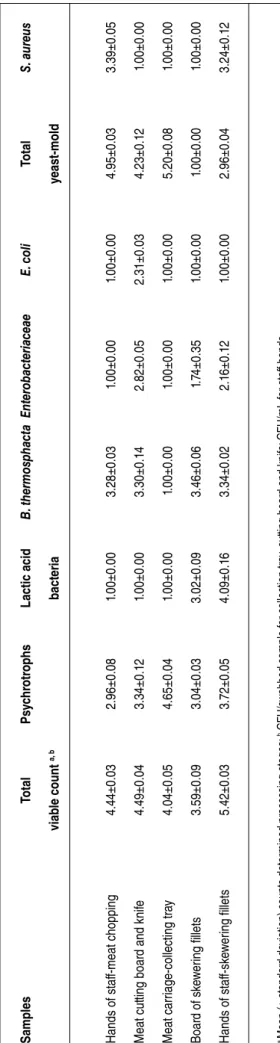
results of the microbiological analysis of sam-ples collected from equipment and the hands of personnel revealed that counts were notably high from the aspect of total viable count, E. coli, and S. aureus (table 2). this may be an indication of insufficient sanitary applications in the plant.
Salmonella spp., which can cause infections even with low counts (1-10 cell/g), have been reported to form the natural microflora in poul-try farms, where they are raised, and therefore, can be a risk factor for humans and animals. In our study, all samples taken from the vari-ous stages of production were assumed to have Salmonella colonies, but these were not detect-ed in the samples by serological tests. similar
t
able 2 -
r
esults of the micr
obiological analyses of possible contamination stages (
n
= 4 x 2) collected fr
om
c
hicken Döner Kebab pr
oduction stages. Samples Total Ps yc hr otr ophs Lactic acid B. ther mosphacta Ent er obact er iaceae E. coli Total S. aur eus viab le count a, b bact er ia yeast-mold Hands of st af f-meat chopping 4.44±0.03 2.96±0.08 1.00±0.00 3.28±0.03 1.00±0.00 1.00±0.00 4.95±0.03 3.39±0.05 Meat cut ting boar d and knif e 4.49±0.04 3.34±0.1 2 1.00±0.00 3.30±0.1 4 2.82±0.05 2.31±0.03 4.23±0.1 2 1.00±0.00 Meat carr iage-collecting tr ay 4.04±0.05 4.65±0.04 1.00±0.00 1.00±0.00 1.00±0.00 1.00±0.00 5.20±0.08 1.00±0.00 Boar d of sk ew er ing fi llets 3.59±0.09 3.04±0.03 3.02±0.09 3.46±0.06 1.7 4±0.35 1.00±0.00 1.00±0.00 1.00±0.00 Hands of st af f-sk ew er ing fi llets 5.42±0.03 3.72±0.05 4.09±0.1 6 3.34±0.02 2.1 6±0.1 2 1.00±0.00 2.96±0.04 3.24±0.1 2 a Mean (± st andar d de
viation) counts det
er mined pr ocessing st ages; b CFU/s w ab bed sample f or collection tr ay , cut ting boar d and knif e; CFU/mL f or st af f hands .
results were reported for “Döners” by
VAZGEc-Er et al. (2004).
In this study, yeast and mold count, which were at high levels, had decreased from 5.33 to 3.44 log cfu/g after marination. After this processing stage, the population of yeast-mold occurred steadily throughout the frozen periods (tables 1 and 2). the high levels of yeast and mold counts before marination, can be related to contamination from the raw material, and poor hygiene applied in the plant. It was also thought that yeast and mold contamination is a prob-lem in meat production and to avoid probprob-lems with these, it is important to monitor the hygi-enic quality of the environmental air and equip-ment, and follow up with corrective actions to prevent further contamination.
cONcLUsIONs
based on the critical appraisal of the chicken döner production process, some of the poten-tial safety and quality hazards should be appro-priately controlled. Potential hazards associat-ed with the production line and considerations include: i) the raw material could contribute to the possible growth of pathogenic bacteria, so it should be purchased only from reliable suppli-ers; and ii) the production process is subjected to significant contamination from both human and environmental sources, such as the cutting board and knife, the meat collecting tray, and the hands of the staff; therefore strict compli-ance with hygienic regulations, such as those required by the HAccP (Hazard Analytical crit-ical control Points) and GMP (Good Manufac-turing Practice) programs is very important at all stages, from the production to the consump-tion of chicken döner.
rEFErENcEs
Abdullahi I.O., Umoh V.J., Ameh J.b. and Galadima M. 2006. some hazards associated with the production of a popular roasted meat (tsire) in Zaria, Nigeria. Food con-trol. 17: 348.
Anonymous. 1995. raw Doner Meat (ts 11859), Institute of turkish standards (türk standardları Enstitüsü), Anka-ra, turkey (in turkish).
Anonymous. 2005. regulation (Ec) N. 2073/2005 o of 15 November 2005 on microbiological criteria 2005. Offi-cial Journal of the European communities 22.12.2005. L 338. p1.
Anonymous. 2006. Çiğ Kırmızı Et ve Hazırlanmış Kırmızı Et Karışımları tebliği. türk Gıda Kodeksi, 2006/31 (in turkish).
Arun O.O., Aydın A., Vural A., ciftcioglu G. and Aksu H. 2007. Determination of E. coli O157 in raw and cooked Döner kebabs by using IMs technique. Medycyna Wet. 63: 1181. berruga M.I., Vergara H. and Gallego L. 2005. Influence of
packaging conditions on microbial and lipid oxidation in lamb meat. small ruminant research. 57: 257. cayré M., Garro O. and Vignolo G. 2005. Effect of storage
the growth of lactic acid bacteria and Brochothrix
ther-mosphacta in cooked meat emulsions. Food
Microbiol-ogy. 22: 505.
chouliara E., Karatapanis A., savvaidis I.N. and Kontomi-nas M.G. 2007. combined effect of oregano essential oil and modified atmosphere packaging on shelf-life exten-sion of fresh chicken breast meat, stored at 4°c. Food Microbiology. 24: 607.
Çolak H., Hampikyan H., bingöl E.V. and Aksu H. 2008. the effect of nisin and bovine lactoferrin on the microbio-logical quality of turkish-style meatball (tekirdağ Köfte). Journal of Food safety. 28: 355.
De Giulio b., Orlando P., barba G., coppola r., de rosa M., sada A., de Prisco P.P. and Nazzaro F. 2005. Use of al-ginate and cryo-protective sugars to improve the viabili-ty of lactic acid bacteria after freezing and freeze-drying. World Journal of Microbiology and biotechnology 21:739. De Wit J.c. and Kampelmacher E.H. 1988. some aspects of
bacterial contamination of hands of workers in food serv-ice establishments. Zentralblatt fur bakteriologie, Mikro-biologie und Hygiene b. 186: 45.
Eisel W.G., Linton L.H. and Muriana E.H. 1998. A survey of microbial levels for incoming raw beef, environmental sources and ground beef in a red meat processing plant. Food Microbiology. 14: 273.
Elmali M., Ulukanli Z., tuzcu M., Yaman H. and cavli P. 2005. Microbiological quality of beef döner kebabs in tur-key. Archiv für Lebensmittelhygiene. 56: 32.
Ergönül b. and Kundakcı A. 2007. changes in quality at-tributes of turkey döner during frozen storage. Journal of Muscle Foods. 18: 285.
Govaris A., Florou-Paneri P., botsoglou E., Giannenas I., Amvrosiadis I. and botsoelou N. 2007. the inhibitory po-tential of feed supplementation with rosemary and/or al-pha-tocopheryl acetate on microbial growth and lipid oxi-dation of turkey breast during refrigerated storage. LWt-Food science and technology. 40: 331.
Jockel J. and stengel G. 1984. Döner Kebab: Untersuchung und beurteilung einer turkischen spezialitat. Fleischwirt-schaft. 64: 527.
Kayaardı s., Kundakçı A., Kayacıer A. and Gök V. 2005.
sen-sory and chemical analysis of doner kebab made from turkey meat. Journal of Muscle Foods. 17: 165. Kayahan M. and Welz W. 1992. Zur üblichkeit der
speziali-tat döner kebab erhebungen in bremen. Archiv für Leb-ensmittelhygiene. 43: 121.
Kayışoglu s., Yılmaz I., Demirci M. and Yetim H. 2003. chem-ical composition and microbiologchem-ical quality of the doner kebabs sold in tekirdag market. Food control. 14: 469. Kılıç b. 2003. Effect of microbial transglutaminase and so-dium caseinate on quality of chicken doner kebab. Meat science. 63: 417.
Kotula K.L. and Davis M.E. 1999. broiler skin sampling for optimum recovery of Salmonella spp. Journal of Food Protection. 62: 284.
Lin K.W. and Lin s.N. 2002. Effects of sodium lactate and trisodium phosphate on the physicochemical properties and shelf life of low-fat chinese-style sausages. Meat sci-ence. 60: 147.
Okonkwo t.M., Obanu Z.A. and Onwuka N.D. 1994. Qual-ity characteristics, amino acids and fatty acid profile of some Nigerian traditional hot smoked meat product. Ni-gerian Food Journal. 12: 46.
samelis J., Kakouri A. and rementzis J. 2000. selective ef-fect of the product type and the packaging conditions on the species of lactic acid bacteria dominating the spoil-age microbial association of cooked meats at 4°c. Food Microbiology. 17: 329.
stolle A., Eisgruber H., Kerschhofer D. and Krausse G. 1993. Doner kebab untersuchungen zur verkehrsauffassung und microbiologischen-hygienischen beschaffenheit im raum München. Fleischwirtschaft. 73: 834.
temelli s., Dokuzlu c. and sen M.K.c. 2006. Determina-tion of microbiological contaminaDetermina-tion sources during fro-zen snail meat processing stages. Food control. 17: 22. todd E.c.D., szabo r. and spiring F. 1986. Donairs (gyros)-potential hazards and control. Journal of Food Protec-tion. 49: 369.
Vazgeçer b., Ulu H. and Öztan A. 2004. Microbiological and chemical qualities of chicken doner kebab retailed on the turkish restaurants. Food control. 15: 261.