FIGURAL MOTIFS ON HALAF POTTERY: AN
ICONOGRAPHICAL STUDY OF LATE NEOLITHIC
SOCIETY IN NORTHERN MESOPOTAMIA
A Master’s Thesis
by
BAHATTİN İPEK
Department of Archaeology
İhsan Doğramacı Bilkent University Ankara August 2019 B A H A TT İN İ PE K FIGU R A L MO TIFS O N H A LA F P O TT ER Y : A N IC O N O G R A PH IC A L S TU D Y O F L A TE N EO LITH IC SO C IET Y I N N O R TH ER N MESO PO TA MI A B ilke nt U n ive rsi ty 2 019
FIGURAL MOTIFS ON HALAF POTTERY: AN ICONOGRAPHICAL STUDY OF LATE NEOLITHIC SOCIETY IN NORTHERN MESOPOTAMIA
The Graduate School of Economics and Social Sciences of
Ġhsan Doğramacı Bilkent University
by
BAHATTĠN ĠPEK
In Partial Fulfillment of the Requirements for the Degree of MASTER OF ARTS IN ARCHAEOLOGY
THE DEPARTMENT OF ARCHAEOLOGY ĠHSAN DOĞRAMACI BĠLKENT UNIVERSITY
ANKARA
iii ABSTRACT
FIGURAL MOTIFS ON HALAF POTTERY: AN ICONOGRAPHICAL STUDY OF LATE NEOLITHIC SOCIETY IN NORTHERN MESOPOTAMIA
Ġpek, Bahattin
M. A., Department of Archaeology
Supervisor: Assoc. Prof. Dr. Marie-Henriette Gates August 2019
Information about the lifestyles of ancient cultures, their daily activities, religious beliefs, close or long distance trade relations, or cultural interactions come from their products. Ancient material productions can be briefly mentioned by examples such as stone tools, pottery, and secular or religious buildings. Thanks to excavations or socio-cultural surveys, we are able to make comments on the ancient societies' materials. Wall paintings, motifs or scenes on pottery provide us important information about the lifestyles or religious beliefs of ancient cultures. The aim of this thesis is to give information about the motifs on Halaf pottery, which belongs to the Late Neolithic period and spread over a wide area in Northern Mesopotamia. First, the socio-cultural structure of the Halaf culture will be examined. It will turn to animal motifs, human motifs or narrative scenes on Halaf pottery for the information about Halaf culture that it presents to us. It also examines the role of dancing figures and feasting in the Halaf culture.
Keywords: Halaf Culture, Halaf Iconography, Halaf Painted Pottery, Late Neolithic Society.
iv ÖZET
HALAF ÇANAK-ÇÖMLEĞĠ ÜZERĠNDEKĠ FĠGÜREL MOTĠFLER: KUZEY MEZOPOTAMYA'DA ĠKONAGRAFĠK (BETĠMSEL) ÇALIġMALAR
Ġpek, Bahattin
Yüksek Lisans, Arkeoloji Bölümü Tez DanıĢmanı: Doç. Dr. Marie-Henriette Gates
Ağustos 2019
Yazıdan önceki kültürlerin yaĢan tarzları, günlük aktiviteleri, dini inanıĢları, yakın veya uzak mesafe ticari iliĢkileri veya kültürel etkileĢimleri hakkındaki bilgiler o dönem kültürlerinin ürettiği ürünlerden gelmektedir. Üretilen malzemeler kısaca: taĢ aletler, çanak-çömlekler, gündelik veya dini amaçlı yapılar ve benzeri Ģeyler örnek olarak söylenebilir. Kazılar veya sosyo-kültürel araĢtırmalar sayesinde geçmiĢ dönemlere ait toplumların ürettiği malzemeler veya toplumlar hakkında yorumlar yapabilmekteyiz. Duvar resimleri, çanak-çömlekler üzerindeki motifler veya sahneler bizlere eski kültürlerin yaĢam tarzları veya dini inanıĢları hakkında önemli bilgiler sunmaktadır. Bu tezin amacı, Kuzey Mezopotamya'da geniĢ bir alana yayılan Geç Neolitik döneme ait Halaf kültürüne ait üretilen kaplar üzerindeki motifler veya sahneler hakkında bilgi vermektir. Ġlk önce Halaf kültürünün sosyo-kültürel yapısı incelenecektir. Daha sonra Halaf kültürüne ait kapların özerinde olan hayvan motifleri, insan motifleri veya bir olayı anlatan sahnelerin bize Halaf kültürü hakkında ne tür bilgi sunulacağı araĢtırılacaktır. Ayrıca dans eden figürlerin ve Ģölenin/ziyafetin Halaf kültürü için ne anlam taĢıdığını incelemektir.
Anahtar Kelimeler: Geç Neolitik Kültürü, Halaf Boyalı Kapları, Halaf Ġkonografisi, Halaf Kültürü.
v
ACKNOWLEDGEMENTS
First of all, I would like to give my endless thanks to all my teachers and friends who cannot count their names that helped me to finish my thesis. I would like to thank my thesis supervisor Assoc. Prof. Dr. Marie-Henriette Gates for her endless patience and advice. I would like to thank Assoc. Prof. Dr. Thomas Zimmermann and Assoc. Prof. Dr. Çiğdem Atakuman who are the jury members who devoted their precious time to my thesis.
I also thank, as a debt of gratitude, to my family (my mother, father, brothers and sister), my wife (Medine) and my children (Abdurrahman and Tümay Elf), and my wife's sister. I would like to thanks to my teachers and my friends (especially Haluk Sağlamtimur) from Ege University Archaeology Department, my teachers and my friends from Bilkent University Archaeology Department and my teachers and my friends from Artuklu University. Luckily there are good people like you in this world. Thank you all. Yours truly.
vi TABLE OF CONTENTS ABSTRACT ... iii ÖZET... iv ACKNOWLEDGEMENTS ... v TABLE OF CONTENTS ... vi LIST OF TABLES ... ix LIST OF FIGURES ... x CHAPTER 1 INTRODUCTION ... 1
CHAPTER 2 CHRONOLOGY AND PERIODISATION OF THE HALAF CULTURE ... 6
2.1 First Excavations and Studies on the Halaf Culture... 6
2.2 Geographic Distribution of the the Halaf Culture ... 7
2.3 Chronology and Periodisation of the Halaf Culture ... 8
2.3.1 Chronology of the Halaf Culture ... 8
2.3.2 Phasing the Halaf Culture ... 10
2.4 Origin of the Halaf Culture ... 11
2.5 Conclusion ... 13
CHAPTER 3 CULTURAL FEATURES AND LIFESTYLE OF HALAF CULTURE ... 14
3.1 Halaf Environment and Subsistence Economy ... 14
3.2 Halaf Settlement Pattern ... 15
3.2.1 The "Mega Halaf Sites"-Really Big or Segmented? ... 16
3.2.2 Short-Lived Halaf Sites ... ..17
3.3 Halaf Architecture ... 17
3.4 Halaf Burial Practices ... 19
3.4.1 Mass Burials ... 19
3.4.2 Cremation ... 21
3.4.3 Skull Burials ... 21
3.5 Social and Political Organization of Halaf Culture... 22
3.6 Conclusion ... 25
CHAPTER 4 HALAF PAINTED POTTERY ... 26
4.1 General Features of Halaf Pottery ... 26
4.2 Recent Archaeological Studies and Archaeometric Studies on Halaf Pottery ... 28
4.2.1 Previous Studies on Stylistic Evolution of Halaf Pottery ... 28
4.2.2 Recent Archaeometric Research ... 30
4.3 The Emergence of Halaf Pottery and Its Diagnostic Features ... 31
4.4 Conclusion ... 33
CHAPTER 5 NORTH MESOPOTAMIAN SITES WITH FIGURAL HALAF POTTERY ... 34
vii
5.1 The Northern Tigris Valley ... 34
5.1.1 The North Iraq Jezirah ... 34
5.1.1.1 Kharabeh Shattani ... 34
5.1.1.2 Tell Arpachiyah ... 35
5.1.1.3 Tepe Gawra ... 35
5.1.1.4 Yarim Tepe I-II-III. ... 36
5.1.1.5 Tell Hassan ... 37
5.1.2 The Tigris-Eastern Habur Valley ... 37
5.1.2.1 ġırnak Survey Halaf Sites ... 37
5.1.3 The Upper Tigris Region ... 37
5.1.3.1 Boztepe... .. 38
5.1.3.2 Karavelyan ... 38
5.1.3.3 Girikihaciyan ... 38
5.1.4 The Botan River Region ... 39
5.1.4.1 Türbe Höyük ... 39
5.2 The Habur-Jaghjagh Triangle ... 39
5.2.1 Chagar Bazar ... 39 5.2.2 Tell Aqab ... 40 5.2.3 Tell Brak ... 40 5.2.4 Tell Halaf ... 41 5.2.5 Umm Qseir ... 41 5.2.6 KerküĢti ... 42
5.3 The Balikh Valley ... 42
5.3.1 Khirbet esh-Shenef ... 42
5.3.2 Tell Damishliyya ... 43
5.3.3 Tell Mefesh ... 43
5.3.4 Tell Mounbateh ... 43
5.3.5 Tell Sabi Abyad ... 44
5.3.6 Tell Tawila ... 44
5.4 The Middle Euphrates Valley ... 45
5.4.1 Tell Amarna ... 45 5.4.2 Tell Yunus ... 45 5.4.3 Tell Halula ... 45 5.4.4 Tell Turlu ... 46 5.4.5 Fıstıklı Höyük ... 47 5.4.6 Gentare ... 47 5.4.7 Kazane Höyük ... 47 5.4.8 Kılıçlı (Tel Seyf) ... 48
5.5 The MaraĢ and Amuq Plains ... 48
5.5.1 Sakce Gözü ... 48
5.5.2 Tell Kurdu ... 48
5.5.3 Domuztepe ... 49
5.6 Distribution Patterns of Figural Halaf Motifs (Tables 1-6) ... 50
viii
CHAPTER 6 FIGURAL REPRESENTATIONS ON HALAF PAINTED POTTERY
... 52
6.1. Botanical Motifs ... 53
6.2 Animal Motifs on Halaf Pottery. ... 53
6.2.1 Four-Legged Animals ... 53
6.2.2 Other Creatures ... 53
6.2.3 Winged Creatures ... 54
6.3 Human Representations on the Halaf Pottery ... 54
6.4 Narrative Scenes on the Halaf Pottery ... 56
6.4.1 Domuztepe Narrative Scenes on Pottery ... 56
6.4.2 Fıstıklı Höyük Narrative Scenes on Pottery ... 57
6.4.3 Karavelyan Narrative Scenes on Pottery ... 58
6.4.4 Tell Arpachiyah Narrative Scenes on Pottery ... 58
6.4.5 Tell Halaf Narrative Scenes on Pottery ... 60
6.5 Conclusion ... 60
CHAPTER 7 CONCLUSION ... 61
REFERENCES ... 76
TABLES ... 93
ix
LIST OF TABLES
Table 1. Proto-Halaf Figures ... 93
Table 2. Early Halaf Figures... ... 93
Table 3. Middle Halaf Figures... ... 94
Table 4. Late Halaf Figures... ... 94
Table 5. Halaf-Ubaid Transitional (HUT) Figures... ... 95
x
LIST OF FIGURES
Figure 1. Geographic distribution of the Halaf culture in the Near East... 96
Figure 2. The Late Neolithic Upper Mesopotamian chronology for northern Iraq and northeastern Syria ... 96
Figure 3. Bernbeck and Nieuwenhuyse provisional Late Neolithic chronology of Upper Mesopotamia ... 97
Figure 4. Halaf settlement patterns ... 98
Figure 5. The cluster of Neolithic mounds at Tell Sabi Abyad ... 98
Figure 6. Reconstructions of Arpachiyah tholoi in TT 7-8 ... 99
Figure 7. Various types of tholoi from Halaf Sites ... 100
Figure 8. Different types/functional categories of round structures (tholoi) in Halaf villages ... 100
Figure 9. Beehive structure examples from northern Mesopotamia ... 101
Figure 10. Different types/functional categories of rectangular structures in Halaf villages ... 102
Figure 11. Tholoi and Rectangular structures from Yarimtepe II ... 102
Figure 12. The Red Terrace and the Death Pit at Domuztepe ... 103
Figure 13. Chronology of Domuztepe Operation I ... 103
Figure 14. Skulls burials from Grave No 2 at Tell Arpachiyah ... 104
Figure 15. Skull burials from the Death Pit at Domuztepe ... 104
Figure 16. Different firing system (surface or bonfire firing, pit kiln firing, and kiln firing) ... 105
Figure 17. Updraught and Downdraught Kilns ... 105
Figure 18. Reconstruction of single-chamber updraught kiln at Tell Ziyada ... 106
xi
Figure 20. Plan and section of level 2 Kiln AK from Sabi Abyad ... 106
Figure 21. Tell Arpachiyah Halaf pottery types by Hijara... 107
Figure 22. Basic Halafian vessel shapes by Watson and LeBlanc ... 107
Figure 23. Halafian painted pottery motifs by Watson and LeBlanc ... 108
Figure 24. Halafian painted pottery motifs by Davidson ... 108
Figure 25. Watson and LeBlanc recombination of Hijara's pottery forms from Tell Arpachiyah ... 108
Figure 26. The relationships among seven Halaf sites indicated by statistical analysis of painted pottery ... 109
Figure 27. Regional boundaries indicated by Late Neolithic pottery diversification in the Jezirah and the Northern Levant ... 109
Figure 28. Innovations in ceramic technology, morphology and decorative style and rapidly rising proportion of Fine Ware in the ceramic assemblage ... 109
Figure 29. Changes in decorative style at Tell Sabi Abyad during the Transitional and Early Halaf periods ... 110
Figure 30. Various stages in the development of the cream bowl in the Balikh valley ... 110
Figure 31. Increasing morphological complexity of serving vessels at Tell Sabi Abyad ... 110
Figure 32. Animal motifs from Kharabeh Shattani ... 111
Figure 33. Plant motifs from Tell Arpachiyah ... 112
Figure 34. Bucrania and mouflon motifs from Tell Arpachiyah ... 114
Figure 35. Undated bucrania and mouflon motifs from Tell Arpachiyah ... 116
Figure 36. Various animal motifs from Tell Arpachiyah ... 117
xii
Figure 38. Narrative scene from Tell Arpachiyah and anthropomorphic vessel from
Yarim Tepe II ... 119
Figure 39. Animal motifs from Tepe Gawra ... 120
Figure 40. Flower, bovine and human motifs from Yarim Tepe II ... 122
Figure 41. Winged-animal motifs from Yarım Tepe II ... 124
Figure 42. Animal motifs from Yarım Tepe II ... 125
Figure 43 Animal motifs from Yarım Tepe III ... 126
Figure 44. Animal motifs from Tell Hassan ... 127
Figure 45. Figural motifs from ġırnak Survey ... 128
Figure 46. Figural motif from Boztepe ... 129
Figure 47. Various figural motifs from Early Halaf period from Karavelyan ... 130
Figure 48. Stylized vertical bucrania on bowl from Girikihaciyan ... 130
Figure 49. Figural motifs from Türbe Höyük ... 131
Figure 50. Flower, bucranium and mouflon motifs from Chagar Bazar ... 133
Figure 51. Animal motifs from Chagar Bazar ... 134
Figure 52. Stylized 'Dancing Ladies' and human representation from Chagar Bazar ... 135
Figure 53. Figural motifs from Tell Aqab ... 135
Figure 54. Figural motifs from Tell Brak ... 136
Figure 55. Plant (flower and tree) motifs from Tell Halaf ... 137
Figure 56. Bovine motifs from Tell Halaf ... 139
Figure 57. Various animal motifs from Tell Halaf ... 141
Figure 58. Human representation and narrative scene from Tell Halaf ... 143
xiii
Figure 60. Plant motifs from KerküĢti ... 144
Figure 61. Bovine motifs from KerküĢti ... 146
Figure 62. Various animal and human representation motifs from KerküĢti ... 147
Figure 63. Figural motifs from Khirbet esh-Shenef ... 148
Figure 64. Figural motifs from Tell Damishliyya ... 149
Figure 65. Figural motifs from Tell Mefesh ... 149
Figure 66. Figural motifs from Tell Mounbateh ... 150
Figure 67. Plant motifs from Tell Sabi Abyad ... 151
Figure 68. Bucranium, mouflon and deer motifs from Tell Sabi Abyad ... 152
Figure 69. Animal motifs from Tell Sabi Abyad ... 153
Figure 70. Stylized 'Dancing Ladies', human, structure representation from Tell Sabi Abyad ... 155
Figure 71. Figural motifs from Tell Tawila ... 157
Figure 72. Figural motifs from Tell Amarna ... 159
Figure 73. Bucrania and mouflon motifs from the kilns at Tell Yunus ... 161
Figure 74. Animal and human representations from the kilns at Tell Yunus ... 162
Figure 75. Bucrania, mouflon and bull motifs from Tell Halula.. ... 163
Figure 76. Flower, animal, stylized 'Dancing Ladies' and human representation from Tell Halula ... 164
Figure 77. Figural motifs from Tell Turlu ... 165
Figure 78. Bucrania, mouflon and narrative scene from Fıstıklı Höyük ... 166
Figure 79. Figural motif from Gentare ... 167
xiv
Figure 81. Animal motif from Kılıçlı (Tell Seyf) ... 167
Figure 82. Figural motifs from Sakce Gözü ... 168
Figure 83. Figural motifs from Tell Kurdu ... 168
Figure 84. Flower and various animal (some animals with structure) motifs from Domuztepe ... 169
Figure 85. Various human representations from Domuztepe ... 170
Figure 86. Narrative scene and structure (with animal and tree) from Domuztepe 171 Figure 87. Animal species ... 172
Figure 88. Figural motifs on Samarran deep plates ... 173
Figure 89. Plant motifs (tree and flower) from Halaf sites ... 173
Figure 90. Bucrania and mouflon motifs from Halaf sites ... 174
Figure 91. Four-legged animal motifs from Halaf sites ... 174
Figure 92. Other animal motifs from Halaf sites ... 175
Figure 93. Some example of winged-animal motifs from Halaf sites ... 175
Figure 94. Simple human representations from Halaf sites ... 176
Figure 95. Human representations in the action from Halaf sites ... 176
Figure 96. Some example of stylized 'Dancing Ladies' motifs from Halaf sites ... 177
Figure 97. Weaving patterns ... 177
Figure 98. Dancing figures from Halaf sites ... 177
Figure 99. Narrative scenes from Halaf sites ... 178
Figure 100. Figural representations from Near East Sites ... 179
Figure 101. Indications for PPNB and PN ritual practices in the Levant, Syria and South-East Anatolia ... 179
xv
Figure 103. Location of the Çatalhöyük Neolithic site, Hasan Dağı, and other Holocene volcanoes in Anatolia ... 181 Figure 104. Çatalhöyük wall painting ... 181
1
CHAPTER 1
INTRODUCTION
The prehistoric periods in the Near East are examined in three eras: the Paleolithic, Neolithic and Chalcolithic periods. The Neolithic period has been termed as a 'revolution' period from thousands of years hunter-gather life to new subsistence and production of food economy which included agriculture activities, domestication of wild animals, new settlement patterns, new burial traditions, and new material culture (Akkermans, 2013b: 63; Özdoğan, 1999: 234; Özdoğan, 2004: 44-45). Since the first Neolithic nomenclature was proposed, the meaning of this word has changed constantly since 1865 (Özdoğan, 2004: 44). The beginning of this process started with Thomson's division of Stone, Bronze and Iron Ages (the Three-Age system) and the subdivision of the Stone Age into "new" and "old" terms (Atakuman, 2015a: 54; Özdoğan, 2004: 44). The milestone of the theories defining prehistory began with the theories of Gordon Childe after the 1920s (Atakuman, 2015a: 47-48; Özdoğan, 2004: 45; Tekin, 2015: 99). He introduced the terms „Neolithic Revolution‟ and „Urban Revolution to archaeology (Atakuman, 2015a: 48) His concept of a Neolithic Revolution was used and affected scholars for long time (Tekin, 2015: 99). In the archaeological sense, according to him, if no metal finds were found in a settlement and no sign of painted pottery was used in this layer, it should be considered as a Neolithic settlement (Tekin, 2015: 101). On the other hand, if there was evidence for the use of copper, if the majority of the tools were made of stone and painted ceramics had a traditional stone age, then it should have been described as the Chalcolithic settlement (Tekin, 2015: 101). It is only necessary to look at two important materials in order to understand whether a settlement for Childe is Neolithic or Chalcolithic; copper and painted pottery (Tekin, 2015: 101).
Until the 1950s, Neolithic communities were thought to be simple farmers struggling for survival (Özdoğan, 2004: 47; Özdoğan, 2007: 448). With the increase in the new
2
excavations in Anatolia, a very intensive flow of information about the Neolithic period has started and a new and very different picture has been formed (Özdoğan, 2007: 441). Braidwood`s studies in Iraq, Iran and later studies in southeastern Anatolia with naturalists and scientists give new information about prehistoric Near East (Özdoğan, 2004: 47; Tekin, 2015: 97). Braidwood and his colleagues began interdisciplinary research with the attempt to answer the questions of where, under what conditions, and how the Pre-Pottery Neolithic first developed as one of their primary goals (Esin, 1999: 16). Also, F. Hole, and K. Flannery have focused all their work on the Neolithic Revolution and beyond (Tekin, 2015: 89). Uncovered Pre-Pottery sites such as Jericho, Çayönü, Göbeklitepe, Jerf el-Ahmar, with their enormous finds such as the temples, statues, prestige and ornaments found in the Pre-Pottery Neolithic settlements led us to reinterpret the Neolithic period (Özdoğan, 2004: 49). At sites of the the Pre-Pottery Neolithic period such a Göbeklitepe, Nevali Çori, Çayönü, Aşıklı Höyük, we see that sacred edifies were distinct from residences of the inhabitants in both architecture and location (Esin, 1999: 19). Also recovered new sites for example Göbeklitepe, where there is no data indicating the existence of agriculture or animal husbandry, have revealed the necessity of new definitions for Neolithic period (Özdoğan, 2007: 448). New findings have shown that in some Neolithic settlements, feeding tradition was almost exclusively based on hunting, and in others, hunting, agriculture and animal husbandry were performed together (Özdoğan, 2007: 448-449). It was understood that food production was not a prerequisite for permenant settlements, and food production was not very important for the Neolithic Age (Özdoğan, 2004: 50). It is clear that when describing the Neolithic period, we can talk about unequal, stratified communities, an active and complex commercial system between distant regions, an efficient transfer of knowledge and technology, and expert craftsmen (Özdoğan, 2004: 49-50). We also see the presence of craftsmen specializing in different industries, for example in plastic arts, stone tools from the beginning of Neolithic to the end (Özdoğan, 2007: 452). The Chalcolithic definition was first mentioned by F. von Pulski at the archaeological symposium held in Budapest, the capital of Hungary in 1876 and used in Hungary (Tekin, 2015: 104). The use of the term Chalcolithic or Copper Age became widespread and this period was set between the Neolithic and the Early Bronze Age (Urban Revolution), where urbanization emerged (Atakuman, 2015a: 51; Özbal 2011: 174). This period was dated to the sixth, fifth, and fourth millennia
3
BC (Özbal 2011: 174). These subdivisions of prehistoric periods or cultural phases are based on differentiations in lithic industry and pottery technology (Yakar, 2011: 58) or metal technology. For Mesopotamia, the Neolithic and Chalcolithic phases are referred to as a sequence of cultures: Hassuna, Samarra, Halaf and Ubaid cultures where their names come from type sites in modern northern Syria, central and northern Iraq. These prehistoric Mesopotamian cultural identities or subdivisions are based on changes in ceramic technology, shapes, decorations (Campbell, 2007: 104-105) or diagnostic features in their ceramic tradition (Cruells, 2008: 672). Therefore, they do not necesserly indicate "cultures" in the anthropological sense of the word, but varieties of communities that use similar elements of material culture. For the ease of communication, I will continue to use the term "Halaf Culture" throughout this thesis.
One of the most important of these cultures in northern Mesopotamia1 is Halaf. Halaf culture is known for its fine and elaborate decorated or painted pottery, round buildings (so-called tholoi) (Akkermans, 1991: 121; Hijara, 1997: 1), stamp seals (Nieuwenhuyse, 2008: 692), figurines (Akkermans, 1991: 121) and long-distance exchange trade in obsidian. The beginning of this culture was associated with a spread of elaborated painted pottery across both northern Iraq and Syria, and also into southeastern Turkey around 6100-5300/5100 BC. In general, Halaf sites are small and ranging from under 1 hectare to 6 to 8 hectares in area. However, there are exceptional sites such as Domuztepe, ca. 20 ha, and Takyan Höyük, ca. 12 ha, in modern Turkey2 (Campbell, Carter, Healey, Anderson, Kennedy, & Whitcher, 1999: 396-397) or Kazane Höyük and Tell Mounbateh. The Halaf economy is based on dry-farming activities (Hijara, 1997: 82, 85). The Halafians were both farmers and pastoralists. Their consumption is based on both cultivated cereals and wild plants (Hijara, 1997). In addition, they exploited domesticated and wild animals (Hijara, 1997). On the other hand, there are many questions about this culture such as setting Halaf into the Chalcolithic or Late Neolithic period, its origin, its social structure, Halafian religion/ritual activities, pottery classification and trade. Setting Halaf in a prehistoric period and its origin are two major issues for previous scholars. The Halaf
1 Scholars use both terms of Upper or northern Mesopotamia for the geographic distribution of Halaf
culture. In my thesis I will use northern Mesopotamia.
2 The question is whether these Halafian sites are really more than 10 ha in size, I will discuss this issue in Chapter 3.
4
culture was considered Chalcolithic by researchers in the past, and to some extent is still considered so today in Near Eastern archaeology. However, in the last decades excavations such as, especially, at Tell Sabi Abyad (in northern Syria) and at Domuztepe (in Anatolia), and surveys with new studies and conferences have reclassified this culture into the late Neolithic period ca. 6100-5300/5100 BC by some specialists3. The origin of the Halaf culture and its social and political organization are still subject to speculation. For the origin of Halaf arguments are made for southeastern Anatolia, northern Iraq or northern Syria. Was this culture a result of local development in the core area in northern Mesopotamia or a result of non-local people who dispersed over different regions?
My thesis will discuss the Halaf culture, its origin, its social structure, and focus on figural representations on the Halaf pottery. Chapter 2 will introduce the general context of my thesis, such as the history of excavations at Halaf sites, the geographic distribution of Halaf culture, Halaf chronology and its subdivision, and finally the origin of the Halaf culture. Chronological issues to be addressed include when the Halaf period began, why this culture, in the last decades, was moved from the Chalcolithic period to the Late Neolithic period and where the roots of the Halaf culture are.
The Late Neolithic subsistence economy was varied exploiting both cultivated cereals and wild plants, and consuming domesticated and wild animals. Geographic conditions affected the settlement patterns, burial practices, economy and life style of ancient cultures. In Chapter 3, I will discuss Halaf culture and its lifestyle, such as their environment and their subsistence economy, its structure types and settlement tradition, burial practices and social and political organization.
The early industry of firing plain or fine pottery at the beginning of the Late Neolithic period presented many challanges: to find suitable clay deposits, to give shape to pottery, to paint pottery or to heat pottery in a simple fire pit or complex pottery kilns. Chapter 4 will discuss general features of Halaf pottery, Halaf pottery techniques such as clay, temper, firing, painting techniques. In addition, I will discuss, briefly, studies on Halaf pottery and its distinctions.
3 See Akkermans & Schwartz, 2003; Bernbeck & Nieuwenhuyse, 2013; Cruells, Gòmez, Bouso, Guerrero, Tornero, Saña, ... & Tunca, 2013; Gessner, 2011.
5
In Chapter 5 I will turn to my actual thesis topic, figural motifs with their depiction on Halaf pottery. The Halaf culture, generally, is known for its elaborately painted and decorated pottery. The majority of the decoration during the Halaf period is geometric. On the other hand, some decorations on the pottery are very different, with more naturalistic depictions of people, animals, structures and artifacts in scenes. These figural representations are occasionally arranged in scenes consisting of headless bodies; dancing ladies; houses with trees standing between them and birds perching on the roofs; and naturalistic human scenes. For this chapter, I will roughly divide Halaf culture into five regions: Northern Tigris Valley, Habur-Jaghjagh Triangle, Balikh Valley, Middle Euphrates Valley and Maraş and Amuq Plains. Especially, I will look at key Halaf sites which have yielded pottery decorated with figural scenes.
Chapter 6 will be about the classification of figurative scenes on the Halaf pottery. The classification will present plants, animals, people and building motifs. I will briefly describe these figural motifs.
Chapter 7 will be a general conclusion of my thesis and about the Halaf culture, their origin, economy, trade, social hierarchy, pottery, figural scenes and their meaning or purpose in the Halaf world. And, finally, I will consider whether these figural designs in the Halaf world are meaningful. Generally, figurative designs carry important social or ritual meanings. I will try to explain whether there is a correlation between these scenes and daily life of Halaf culture, and whether or not they have social/hierarchical or ritual meanings. Especially, I will summarize new excavations, new data, and new approaches about the Halaf world and figural scenes on the pottery.
6
CHAPTER 2
CHRONOLOGY AND PERIODISATION OF THE HALAF
CULTURE
"The answer to the popular question 'when did the Halaf start as a cultural phenomenon?' should probably be in the 20th century." (Campbell, 2007: 105).
Since the first identification of the Halaf culture in the archaeological world at the beginning of the 20th century, with its elaborately painted pottery, many questions have risen about this culture until recent decades. Where is the origin of this culture based? What are the differences between previous or contemporary cultures (Hassuna and Samarra cultures) and Halaf culture? In this chapter, I will consider early excavations and studies on the Halaf culture, its geographic distribution, its chronological problems and subdivisions, and finally, its origins.
2.1 First Excavations and Studies on the Halaf Culture
As I mentioned in the previous chapter, the Mesopotamian Neolithic and Chalcolithic chronological frame is based on type site excavations such as Hassuna, Samarra, and Ubaid, key sites in Iraq, and Tell Halaf in northern Syria (Campbell, 2007: 104; İpek, 2018: 31). These chronologies or terminologies were based on ceramic typology and were created by archaeologists in the early 20th century (Atakuman, 2015a; Campbell, 1999: 575; Campbell, 2007: 104-105; Tekin, 2015: 89, 99, 104) for prehistoric Mesopotamia.
When we consider the Halaf culture4, the first information about it comes from three prehistoric sites excavated in the beginning of the 20th century (Frankel, 1979: 2): in Turkey at Sakce Gözü/Coba Höyük by John Garstang in 1908, and at Tell Yunus by C.L. Woolley in 1913; and in northern Syria at Tell Halaf in 1911-1913 and 1927-1929 by Max von Oppenheim (Frankel, 1979: 2-3; Gessner, 2011: 780-781; İpek, 2018: 31; Tekin, 2015: 96). In the 1930s, Tell Arpachiyah, excavated by Max
4 Tell Halaf had been designated as the eponymous site for this cultural phase by 1930 (Akkermans &
7
Mallowan, became another important Halafian site for the Halaf world in northern Iraq (Campbell, 1992: 182; Gessner, 2011: 781). Tell Arpachiyah gives the first long sequence of Halaf culture for the early, middle and late periods. Its chronological sequences were used for a long time by archaeologists for stratigraphy at other Halaf sites and for setting Halaf chronology (Davidson, 1977: 8, 25; Gessner, 2011: 781; Tekin, 2015: 97). Since the 1960s however, other sites such as Yarım Tepe I-II, and Banahilk in northern Iraq, Tilkitepe, Girikihaciyan, and Kazane Höyük in southeastern Anatolia, and Tell Halula, Tell Sabi Abyad, and Tell Aqab in northern Syria are among the many which supply significant new information about the Halaf culture, its distribution and its origin in northern Mesopotamia (Gessner, 2011: 782).
2.2 Geographic Distribution of the Halaf Culture
Mesopotamia roughly can be separated into two major geographic areas: Upper Mesopotamia (northern part of Great Mesopotamia, which is based on rain-fed agriculture) and Lower Mesopotamia (southern part of Great Mesopotamia, based on irrigation for agriculture) (Wilkinson, 2000: 222); or south and north Mesopotamia which are based on different material culture (Alizadeh, 2008: 57). The Northern/Upper Mesopotamia artificial border is roughly associated with the Taurus Mountains in the north (Bernbeck & Nieuwenhuyse, 2013: 19; Gessner, 2011: 778), the Euphrates below Tabqa in the south, the Mediterranean coast in the west (Bernbeck & Nieuwenhuyse, 2013: 19) and, finally, the Zagros in the east (Bernbeck & Nieuwenhuyse, 2013: 19; Gessner, 2011: 778).
The Halaf cultural border is related to Upper Mesopotamia (Bernbeck & Nieuwenhuyse, 2013: 19) or the northern Mesopotamian region (Gessner, 2011: 777). Halaf cultural materials were recovered from the Zagros mountains in western Iran in the east (Becker, 2013: 455; Gessner, 2011: 778; Hijara, 1997: 91; Sarıaltun, 2013: 504), to the Mediterranean Sea (Becker, 2013: 455), and south of the Taurus Mountains in the west (Gessner, 2011: 778), in southeastern Anatolia (Akkermans, 2013a: 22; Özdoğan, 2013: 380) to the Lake Van region (Gessner, 2011: 778; Sarıaltun 2013: 504) the Muş-Elazığ plain in the north (İpek, 2018: 31-32; Özdoğan, 2013: 380; Sarıaltun, 2013: 504) and, finally, the foothills of the Hamrin in eastern central Iraq (Gessner, 2011: 777) to northern Syria in the south (Figure 1) (Watson, 1983: 232). In addition to these regions, Halafian pottery was
8
reported from Transcaucasia by Merpert and Munchaev (Davidson, 1977: 9; Merpert & Munchaev, 1993b: 129; Watson, 1983: 232, 238).
2.3 Chronology and Periodisation of the Halaf Culture
The chronology and phasing of the Halaf culture are other issues to be considered. After the excavations and surveys of the last decades, new chronological frames and phases have been formulated by archaeologists. However, there is no agreed terminology accepted by researchers. This created a major problem for the field (Tekin, 2015: 92). I will briefly summurize recent modifications to Halaf chronology and their proponents.
2.3.1 Chronology of the Halaf Culture
The foundation for chronology and information about the Halaf culture is based on painted pottery studies from key Halaf sites (Cruells, 2008: 679; Gessner, 2011: 783), old and new surveys and excavations at Halaf sites in the northeastern Syria and surrounding regions (Cruells, Gòmez, Bouso, Guerrero, Tornero, Saña, ... & Tunca, 2013: 467) and recent analytical studies. The chronological dates have been transformed by recent contributions of radiocarbon dating. In general, the Neolithic period for Syria and Levant is ca. 9600-5300 cal. BC (Akkermans, 2013b: 63). The Late Neolithic phase is distinguished by making pottery with clay and firing. This phase is called Pottery Neolithic5 and started ca. 7000 cal. BC in the northern Mesopotamia world (Bernbeck & Nieuwenhuyse, 2013: 18; Gallet, Montaña, Genevey, García, Thébault, Bach, Goff, Robert, & Nachasova, 2015: 90). Dating Late Neolithic chronology in Upper Mesopotamia varies among researchers from ca. 6900 to 5300 cal. BC (Nieuwenhuyse & Cruells, 2004: 47; Nieuwenhuyse, 2008: 691-692) or from ca. 6800 to 5300/5200 cal. BC (Akkermans, 2013a: 17; Akkermans & Schwartz, 2003: 99).
As mentioned above, setting up a framework of the chronological periods in northern Mesopotamia is problematic. According to some researchers, the Chalcolithic period starts from the beginning of the sixth to fourth millennium cal. BC (Özbal, 2011:
5 The Pottery Neolithic is also reffered to as the Late Neolithic period (Bernbeck & Nieuwenhuyse, 2013: 18; Gallet et al., 2015: 90).
9
174). In addition, until the last decades Halaf culture was incorporated into the Early Chalcolithic period (Hijara, 1997: 1). Some scholars, when comparing the Early Chalcolithic regional chronology, put Halaf culture into their Early Chalcolithic period. For example, according to Özbal, the beginning of the Chalcolithic period in the southeast of Anatolia is parallel with the beginning of Halaf culture in northern Mesopotamia and started ca. 6000 or 5900 cal. BC (Özbal, 2011: 177). Abdi compares the Early Chalcolithic period (J-Ware) of the Central Zagros with Halaf culture (Abdi, 2003: 418). Yakar's chronology of Early Chalcolithic Anatolia corresponds to the Halaf culture in Mesopotamia or Amuq C in Syria (Yakar, 1991: 28). The idea of placing the Halaf culture in the Chalcolithic period was based on relative stratigraphic dating and early radiocarbon analysis, before improvements in calibration techniques revised all prehistoric Mesopotamian chronologies upwards by 1,000 or more years. By the 1980s, new radiometric results were transforming Neolithic phasing throughout Mesopotamia, beginning with Tell Oueili (Tekin, 2015: 106) and the earliest presence of Ubaid culture in southern Iraq. In consequence, at ICAANE conferences from 2000 onwards, researchers began to prefer the term “Late Neolithic” in place of the cultural labels Hassuna, Samarra and Halaf (Tekin, 2015: 106). A 2009 conference at the National Museum of Archaeology in Leiden and 46 papers presented at the conference later published as Interpreting the Late Neolithic
of Upper Mesopotamia (2013), made a significant contribution towards bringing
together these many new results and synthesizing them. Today, it is very clear that the criteria for the Neolithic and Chalcolithic foundations at the beginning of the last century remain completely changed (Atakuman, 2015a: 51; Tekin, 2015: 103). Perhaps foremost among them, the claim that painted pottery was only seen in the Chalcolithic Age is no longer valid (Tekin, 2015: 103). This is because almost all Near East prehistoric sites yielded a few painted fragments during the Early Pottery Neolithic period (Tekin, 2015: 104). However, it is interesting that the use of copper (beads or similar objects produced by a raw-copper forging method) has been seen from the beginning of the settled lifestyle (Atakuman, 2015a: 51; Tekin, 2015: 104). Thus, to use “Chalcolithic” for the Halaf period is wrong, because it is difficult to find data on advanced mining activity in this period (Atakuman, 2015a: 51). Recent studies show that the time period between 6000-5000 B.C. is in fact the Neolithic period and many researchers claim that this period should be studied as Late Neolithic (Atakuman, 2015a: 51).
10
To conclude, comparing new information and recent studies such as Akkermans & Schwartz (2003), Bernbeck & Nieuwenhuyse (2013), Cruells et al. (2013), and if the Proto-Halaf/Transitional period started ca. 6100 cal. BC (Cruells, 2008: 680; Nieuwenhuyse & Cruells, 2004: 47, 48), we can place Halaf culture into the Late Neolithic period from ca. 6100 to 5300/5100 cal. BC in the northern Mesopotamia region. So, the life span for this culture is about 900-1000 years.
2.3.2 Phasing the Halaf Culture
The Halaf chronology was firstly divided by Mallowan into Early, Middle and Late Halaf periods based on his Tell Arpachiyah excavations (Bernbeck & Nieuwenhuyse, 2013: 23; Campbell, 2007: 106; Gessner, 2011: 783; İpek, 2018: 32; Nieuwenhuyse & Cruells, 2004: 49; Sarıaltun & Özdoğan, 2011: 39; Sarıaltun, 2013: 505). This tripartite division was very popular for long time (Bernbeck & Nieuwenhuyse, 2013: 23; Nieuwenhuyse & Cruells, 2004: 49) and continues to be used by some specialists. In the 1970s, excavations by Davidson at Tell Aqab in northern Syria (Gessner 2011: 783) led him to add the Halaf-Ubaid Transitional Period (HUT) into the threefold Halaf chronology (Bernbeck & Nieuwenhuyse, 2013: 23; Campbell, 2007: 106; Gessner, 2011: 783; Sarıaltun & Özdoğan, 2011: 39; Sarıaltun, 2013: 505)
In the last decades, research on Late Neolithic chronology has increased (Nieuwenhuyse, 2000: 155). S. Campbell proposed a modified Halaf sequence in 1992 (Bernbeck & Nieuwenhuyse, 2013: 23; Gessner, 2011: 783). This chronology is Halaf Ia (earlier than Mallowan's original Early Halaf), Halaf Ib (traditional Early Halaf), Halaf IIa (traditional Middle Halaf) and Halaf IIb (traditional Late Halaf) (Bernbeck & Nieuwenhuyse, 2013: 23; Campbell, 2007: 106; Gessner, 2011: 783; Sarıaltun & Özdoğan, 2011: 39; Sarıaltun, 2013: 505). Walter Cruells more recently added a new phasing for the Halaf culture: 'Formative phase,' or Halaf A, and a 'Developed phase,' or Halaf B (Figure 2) (Bernbeck & Nieuwenhuyse, 2013: 23; Cruells et al., 2013: 467).
New excavations, such as at Tell Sabi Abyad and surveys in the northern Syria, added an earlier phase to the Halaf called the 'Transitional Period'/ or the
Proto-11
Halaf period between Pre-Halaf and the Early Halaf period6, ca. 6100-5900 BC (Bernbeck & Nieuwenhuyse, 2013: 26; Nieuwenhuyse, 2007: 10; Nieuwenhuyse, 2009: 83; Nieuwenhuyse & Cruells, 2004: 47, 48). The most recent model for Halaf chronology is a 'six-stage' chronology (Campbell, 2007: 106; Gessner, 2011: 783; Nieuwenhuyse, 2000: 156; Nieuwenhuyse & Cruells, 2004: 49). Finally, for their provisional Late Neolithic chronology of Upper Mesopotamia, Bernbeck and Nieuwenhuyse divided this period into 7 stages (Figure 3) (Bernbeck & Nieuwenhuyse, 2013: 27; Tekin, 2015: 106). According to Bernbeck and Nieuwenhuyse, the Halaf culture is placed in Late Neolithic stages 4 to 5 (Bernbeck & Nieuwenhuyse, 2013: 27).
2.4 Origin of the Halaf Culture
Another question about the Halaf culture is its origin. Mallowan first proposed, in the 1930s, an Anatolian origin, in the mountains of southern Anatolia (Akkermans, 2000: 49; Hijara, 1997: 97) or the Khabur and Jaghjagh steppes (Hijara, 1997: 97). His argument was based on relationships of decoration with burnished wares which were found along the Taurus range (Akkermans, 2000: 49) and in northern Syria (Hijara, 1997: 97). Ann Perkins (in the 1940s) suggested northern Iraq, especially the Mosul region for the root of Halaf culture (Akkermans, 2000: 49; Davidson, 1977: 243; Hijara, 1997: 97). She considered that this culture spread from there to neighboring regions (Akkermans, 2000: 49). Another of the Mosul origin supporters is Dabbagh7 (in 1950s and 1960s) (Davidson, 1977: 243; Hijara, 1997: 97). In the 1970s, the Anatolian origin was revived by J. Mellaart (Akkermans, 2000: 49; Davidson, 1977: 245, 248; Hijara, 1997: 97) and Bogoslavskaja, too (Akkermans, 2000: 49). Mellaart, firstly, put the Halaf origin into the Khabur triangle or areas between the Euphrates and Jaghjagh rivers to south of the Taurus Mountains (Hijara, 1997: 97). Later, he put the Halaf roots in the mountains between the Assyrian steppe and Lake Van area (Hijara, 1997: 97). According to Mellaart, Halaf originated in Anatolia, not Mesopotamia (Hijara, 1997: 97). However, finally, he changed his
6 "The term of 'Proto-Halaf/or Transitional Period' means a distinct ceramic assemblage characterised by the introduction of painted Fine Ware within the later Pre-Halaf ceramic assemblage. Although these new wares represent changes in ceramic technology and production, other cultural aspects continue without abrupt change." (Cruells, 2008: 671).
7 See Dabbagh, T., 1958: Pottery of Early Prehistoric Iraq. (Unpublished PhD Thesis) Harvard
12
source to the site of Umm Dabaghiyah in northern Iraq (Hijara, 1997: 97). In the 1970s, Davidson also placed the Halaf origin in the Upper Jezirah between the Tigris and Khabur rivers (Davidson, 1977: 341; Hijara, 1997: 4, 98).
Recent surveys and excavations, such as by the University of Amsterdam at Tell Sabi Abyad in the Balikh valley of northern Syria, surveys by the British School of Archaeology in Iraq in the northern plains of the Iraq (Nieuwenhuyse, 2000: 153) and surveys by Gülriz Kozbe and her team in the 1990s and 2000s in the Şırnak region in southeastern Anatolia (Cruells, 2008: 678; Erdalkıran, 2008: 756; Kozbe, 2013) show that the origin of Halaf culture is very different from previous proposals. The first noteworthy evidence about the origin of Halaf culture came from the Tell Sabi Abyad excavations in the 1980s (Campbell, 1992: 183; Cruells, 2008: 674; Le Miére & Picon, 2008: 729). Excavations at this site show that it was inhabited from the Pre-Halaf to Proto-Halaf/'Transitional Period' and Early Halaf periods (Akkermans, 1991: 123; Akkermans, 2000: 44-45; Nieuwenhuyse & Cruells, 2004: 49-50). After the Transitional stage level was identified at Tell Sabi Abyad, this stage was recognized at many Halaf sites in both northern Syria and Iraq, and in southeastern Anatolia (Cruells, 2008: 674, 679). Other sites include Tell Halula, Tell Boueid II, Tell Chagar Bazar and Tell el-Kerkh in northern Syria (Cruells, 2008: 674; Nieuwenhuyse & Cruells, 2004: 49); Takyan Höyük, Grike Keşe, and Gizers in Şırnak region surveys (Cruells, 2008: 678; Erdalkıran, 2008: 756; Kozbe, 2013); and Domuztepe, Sakce Gözü (Cruells, 2008: 679) Kazane Höyük, and Hakemi Use (Nieuwenhuyse & Cruells, 2004: 49) in southeastern Anatolia; and at Yarım Tepe I, Tell es-Sawwan (Cruells, 2008: 680), Khirbet Garsour, and NJP 72 in northern Iraq (Akkermans, 2000: 51; Campbell, 1992: 183; Nieuwenhuyse, 2000: 155). Until the recovery of a Proto-Halaf/Transitional archaeological phase in northern Mesopotamia, it was thought that the Halaf culture, especially its pottery, was entirely distinct from its contemporaries or previous cultures such as Hassuna and Samarra cultures (Nieuwenhuyse, 2009: 83), or from local regional cultures. However, the Transitional period documented a gradual cultural transition from local Pre-Halaf to Early Halaf in northern Mesopotamia (Nieuwenhuyse, 2000: 153; Nieuwenhuyse, 2009: 83). Changes between Mesopotamia cultures, such as Hassuna, Samarra, Halaf or Ubaid, were not abrupt, but were instead gradual (Campbell, 1999: 575; Campbell, 2007: 105). The whole evidence shows that this culture evolved from
13
Hassuna/Samarra predecessors (Hijara, 1997: 96), as a gradual process of local culture and development in northern Mesopotamia (Akkermans & Schwartz, 2003: 116; Le Miére & Picon, 2008: 729). The Halaf culture was not a new culture introduced by newcomers (Akkermans & Schwartz, 2003: 116). According to Nieuwenhuyse, in northeast Syria (northern Jezirah), southeastern Anatolia and northern Iraq, we can follow the gradual emergence of the Halaf culture (Nieuwenhuyse, 2008: 692). He claims that, "there was no singular locus of origin of Halaf [...] Halaf emerged gradually from a variety of earlier groups, known with terms such as the Proto-Halaf, Pre-Halaf and Proto-Hassuna." (Nieuwenhuyse, 2013: 136).
2.5 Conclusion
Excavations, surveys or analytical studies show Halaf cultural materials recovered over a very broad region in northern Mesopotamia. This culture is roughly dated between ca. 6100 and 5300/5100 cal. BC in northern Mesopotamia. We can say that it is a Late Neolithic culture in northern Mesopotamia. Recent fieldwork shows that the Halaf culture resulted from a gradual transformation of local traditions from previous cultures. It was not introduced from the outside. The Halaf culture instead produced and disseminated a ceramic tradition of higher quality throughout northern Mesopotamia.
14
CHAPTER 3
CULTURAL FEATURES AND LIFESTYLE OF HALAF
CULTURE
Chapter 3 is aimed to focus on aspects of Halaf culture such as environment and subsistence economy, settlement patterns, architecture, and burial practices, as well as social/political organizations.
3.1 Halaf Environment and Subsistence Economy
Environmental conditions are important for prehistoric societies. For example, prehistoric economy, lifestyle, architecture, and religious activities were, directly or indirectly, based on environmental conditions. As I mentioned previously, in contrast to southern Mesopotamia, the northern Mesopotamian economy was based on rain-fed agriculture (Wilkinson, 2000: 222). Nearly all Halaf sites were situated on the deep brown Mediterranean soils or on the alluvial plains where self-renewing soils for agriculture are available in Iraq, Syria and Southern Turkey (Davidson, 1977: 12). Halaf sites lie in areas where annual rainfall is sufficient for farming activities without irrigation (Campbell, 1992: 184). In addition, Halaf mounds are generally close to water sources (Akkermans, 2013a: 22; Gessner, 2011: 778) or close to natural resources (Hijara, 1997: 85, 109). Sites, generally, lay in areas above 200/2508 mm isohyets where cereals grow without any irrigation (Gessner, 2011: 778; Watson, 1983: 238; Yakar, 1991: 96).
When we consider Halaf subsistence economy, Halafian societies were consuming both cultivated cereals and wild plants, and exploiting domesticated and wild animals (Gessner, 2011; Hijara, 1997; İpek, 2018: 32; Yakar, 1991). They were consuming cultivated wheat (emmer, einkorn), barley or lentils, vetch and flax (Akkermans, 2013a: 24; Davidson, 1977: 14; Gessner, 2011: 779; Hijara, 1997: 92, 94, 110; Watson, 1983: 238; Yakar, 1991: 96). As supplements, they were collecting wild
8 In general, the ratio of 200 mm rainfall is very low for successful farming activities in a dry area like the Near East (Davidson, 1977: 11).
15
pistachios, almonds, plums, raspberries and figs as well as many other wild plants (Akkermans, 2013a: 24). They were consuming domesticated animals such as cattle, sheep, goats and pigs (Akkermans, 2013a: 24-25; Gessner, 2011: 779; Hijara, 1997: 92, 110; Watson, 1983: 238). Besides, they hunted wild animals such as aurochs, onager, boars, birds, fish, foxes and hares (Akkermans, 2013a: 25; Gessner, 2011: 779; Hijara, 1997: 92, 110). On the other hand, some Halaf sites were settled in marginal regions (Akkermans, 2013a: 22). Their subsistence economy was different from other Halaf sites. For example, exploitation of wild animals, especially onager and gazelle, were dominant at Umm Qseir (on the Khabur), Shams-ed-Din (on the Euphrates) (Akkermans & Schwartz, 2003: 127; Akkermans, 2013a: 25; Frangipane, 2007: 160; Frangipane, 2013: 91) or at Khirbet esh-Shenef (on the Balikh) and Boued II (on the middle Khabur) (Akkermans & Schwartz, 2003: 127; Akkermans, 2013a: 25). At these Halafian sites, exploitation of wild animals was higher than other Halaf sites. For examples, at Umm Qseir, the percentage of wild fauna and flora species is very high compared to other Halaf sites (Gessner, 2011: 787). At Khirbet esh-Shenef, Shams ad-Din or Umm Qseir, the ratio of wild animals is higher than at other Halaf sites, for instance up to 40 to 60% of the faunal remains (Akkermans, 2013a: 25).
3.2 Halaf Settlement Pattern
The densities of Halaf sites varied from region to region. Although there were permanent settlements during the Halaf period, there were short-lived sites too. Halaf settlement patterns consist of less planned and scattered structures with open areas around the villages (Figure 4) (Frangipane, 2013: 95). There were no exact boundaries for the inhabited areas of Halaf sites (Frangipane, 2013: 95). The accumulated height of Halaf sites ranged from 6 to 8 m (Hijara, 1997: 85, 109). In addition, many sites accumulated no more than 4 m of deposit, representing seasonal or semi-permanent occupations (Hijara, 1997: 85, 93). Finally, short-lived sites consist of less than one or two meters of deposit. During the Halaf period, there are both long sequence and short-lived occupations (Akkermans, 2013a: 22-24). In this part, I discuss short-lived and permanent Halaf settlement patterns.
16
3.2.1 The "Mega Halaf Sites"- Really Big or Segmented?
Most Halaf sites are very small, 1 ha or less (Akkermans & Schwartz, 2003: 119; Akkermans, 2013a: 22), to 3 ha (Gessner, 2011: 778; Hijara, 1997: 85, 109). In contrast to these, some Halaf sites such as Mounbatah (in northeastern Syria), Nisibis Höyük, Kazane Höyük or Domuztepe (in southeastern Anatolia) have been considered much larger centers (Akkermans, 2013b: 71). Among them, Domuztepe (ca. 20 ha) (Campbell et al., 1999: 396-397; Gessner, 2011: 778-779), Takyan Höyük (ca. 18 ha) (Campbell et al., 1999: 396-397) or Kazane Höyük (between 15-20 ha) (Gessner, 2011: 778-779) have been thought exceptional Halaf sites because of their size. Such regionally important sites were associated with the emergence of social hierarchy in the Near East (Akkermans, 2013b: 71), consequently 'megasites' or 'anchor' sites (Bernbeck, 2013: 57). However, it has yet to be determined whether the entire site area was occupied at one time, or whether residents shifted from one part of the area to another during the occupational period.
Recent research shows that during the Late Neolithic period, these big sites were not densely occupied (Gessner, 2011: 779) and did not extend more than 10 ha. Instead, there were 'intra-site movements' over various mounds or from one mound to another mound in the course of time, after one settlement phase or the span of a single generation (Akkermans, 2013b: 69). According to Akkermans, 'segmentation' is one of the key features of Late Neolithic communities (Akkermans, 2013b: 72). People were shifting to other parts of settlements (Akkermans, 2013b: 69; Gessner, 2011: 779). Excavations and studies show that most of these mega sites occurred as a result of dispersed or shifting of occupation from closer mounds (Akkermans, 2013b: 71). For example, Tell Sabi Abyad consisted of four small sites from Tell Sabi Abyad I to IV (Figure 5) (Akkermans, 2013b: 65). Tell Sabi Abyad I is ca. 5 ha, but consists of 4 small prehistoric mounds (two mounds are from early 7th millennium cal. BC and one dates ca. 6200 cal. BC) (Akkermans, 2013b: 66; Bernbeck, 2013: 57). These four mounds give an illusion of a single site, but are ca. 0.5 ha to 1 ha each (Akkermans, 2013b: 66). The cluster of mounds at Tell Sabi Abyad was used continually for many hundreds of years (Akkermans, 2013b: 69). Other large Halaf sites show similar problems: Tell Mounbatah (ca. 20 ha) consisted of at least six individual mounds, and Kazane Höyük (ca. 15 to 20 ha) is a similarly dispersed settlement (Akkermans, 2013b: 71). Akkermans claims that these big dispersed sites
17
were formed as a result of replacement, relocation or reuse throughout long periods of time, and did not occur as a result of single or stable big unchanged occupations (Akkermans, 2013b: 71; Bernbeck & Nieuwenhuyse, 2013: 31). Frangipane agrees with these assessments (Frangipane, 2007: 155). Evidence shows that during the Halaf period, the movement of settlements was cyclical between abandoment and resettlement (Bernbeck, 2013: 57). This type of movement occurred at small Halafian sites, as well as in big settlements (Bernbeck, 2013: 57).
3.2.2 Short-Lived Halaf Sites
Some short-lived Halaf sites in northern Syria (such as Khirbet esh-Shenef, Damishliyya, Umm Qseir) (Akkermans & Schwartz, 2003: 127; Akkermans, 2013a: 25; Özbal, 2011: 178), and some southeastern Anatolian Halaf sites (such as Çavi Tarlası, Girikihaciyan, Fıstıklı Höyük) show evidence of semi-nomadic, seasonal or short seasonal life (Özbal, 2011: 178-179). Umm Qseir is a good example for a short-term Halaf site (Gessner, 2011: 787). Khirbet esh-Shenef is a single level site dating to c. 5600-5500 BC with simple architecture (Akkermans & Schwartz, 2003: 119). Fıstıklı Höyük is another short lived site. At Fıstıklı Höyük, Halaf occupation lasted about 100 years with more or less 30 to 35 years per phase (Bernbeck, 2013: 52-53). The site is not more than 0.5 ha large, and its depth is 1.4m with five phases (Bernbeck, 2013: 52). Except for a few residential and storage structures, the site is like a small hamlet or a camp place (Bernbeck, 2013: 52-57). General thought about these small Halafian sites is that Halaf settlements less than one or two meters high were seasonal or semi-permanent settlements used by a few dozen people (Akkermans, 2013a: 22; Hijara, 1997: 85, 93). According to Akkermans and Schwartz, cultural features at Umm Qseir or Damishliyya sites in northern Syria show that the sites were used as camp sites which were visited recurrently over a number of years (Akkermans & Schwartz, 2003: 120).
3.3 Halaf Architecture
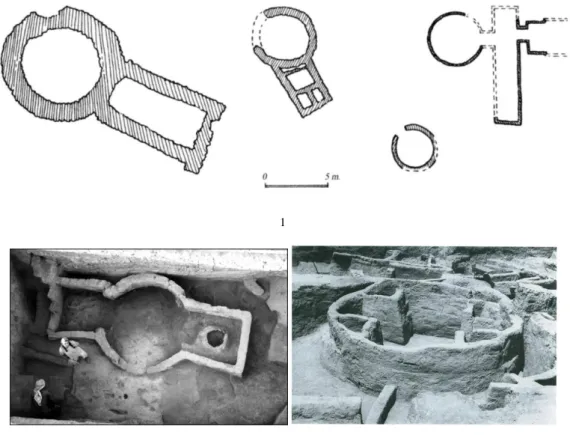
Buildings with a circular shape and sometimes with rectangular annexes are the best known Halaf structural types (Figure 6) (Frangipane, 2007: 155). This type is referred to as "tholos" (in plural tholoi), but has no connection with Mycenaean tombs of similar plan (Akkermans & Schwartz, 2003; Akkermans, 2010: 22;
18
Akkermans, 2013a; Campbell, 1992: 182; Hijara, 1997: 16; İpek, 2018: 32). The tholos derives from pre-and Proto-Halaf architecture (Nieuwenhuyse & Cruells, 2004: 51; Nieuwenhuyse, 2008: 694; Tekin, 2015: 105), but characterises the full Halaf period.
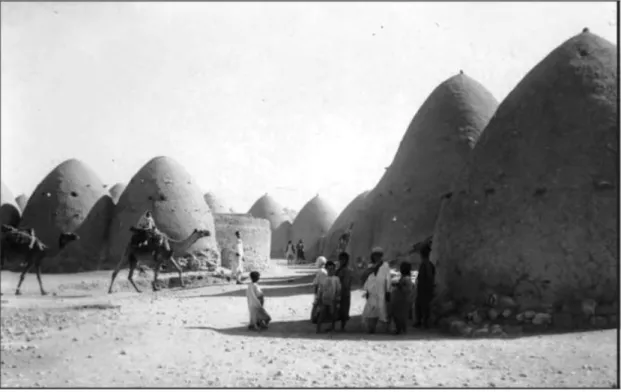
The size and function of circular structures varied (Figures 7) (Hijara, 1997: 17-18; Frangipane, 2007: 155; Frangipane, 2013: 96). Structures were used for different activities such as housing, storing foods (with thick layers of plaster on the floors and walls) and cooking (Figure 8) (Akkermans, 2010: 26; Frangipane, 2007: 155; Gessner, 2011: 779; Hijara, 1997: 17-18). Residential tholoi could only house a single person or small family (Akkermans & Schwartz, 2003: 151; Akkermans, 2010: 27). Their size varies from 1.5 to 4 m (Frangipane, 2013: 96) or even 10 m (at Tell Arpachiyah) in diameter (Hijara, 1997: 17). They were made of mudbrick or pise with or without stone foundations (Akkermans, 2010: 22; Gessner, 2011: 780). Generally, Halaf circular structures have only one circular room, but there are examples where the circular room was enlarged by a rectangular annex (Akkermans & Schwartz, 2003: 105; Akkermans, 2010: 22; Akkermans, 2013a: 19). The round roof may have been beehive-shaped (Akkermans & Schwartz, 2003: 103; Akkermans, 2010: 22; Akkermans, 2013a: 19), domed (Campbell, 1992: 182) or flat (Akkermans, 2013a: 19; Campbell, 1992: 182). The vaulted roof, made with mudbricks, would resemble beehive buildings of villages in northern Syria and southeastern Anatolia (Figure 9) (Akkermans, 2010: 26). However, Tell Sabi Abyad examples had roofs made of timber and reeds, instead of a beehive shaped mud brick cover (Akkermans, 2010: 26).
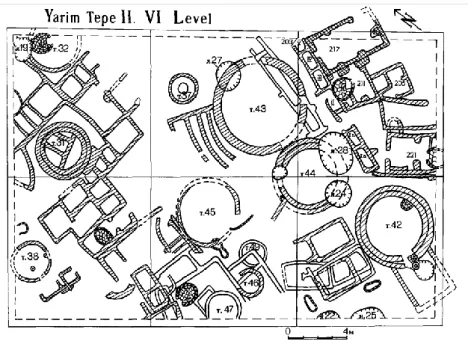
Although circular buildings were most popular during the Halaf periods, rectangular structures also were present (Akkermans, 2013a: 22; Frangipane, 2013: 96). Their size and finds show that they were used for different purposes such as communal activities (large rectangular structures with series rooms), dwellings (multi-roomed structures with small rooms), and small rectangular structures for auxiliary functions generally attached to tholoi (Figures 10-11) (Frangipane, 2013: 96). The elongated multi-chambered type was used for grain storage (Munchaev, 1997: 70). Large rectangular structures with a series of rooms are understood to be a chief's building or pottery workshop or storage buildings, such as, the 'Burnt House' at Tell Arpachiyah with its elaborate contents (Frangipane, 2007: 157; Frangipane, 2013:
19
96; Hijara, 1997: 19). A big structure subdivided into small rooms at Tell Sabi Abyad is interpreted as a community storage building (Frangipane, 2007: 157; Frangipane, 2013: 96). Rectangular buildings became more prevalent during the Late Halaf period (Hijara, 1997: 18-19).
3.4 Halaf Burial Practices
There was no common burial custom in the Halaf communities. Halafian burial practices varied from single and double pit inhumations, mass burials, single and multiple skull burials to individual or mass cremations (Akkermans, 1989a: 83; Akkermans & Schwartz, 2003: 145; Campbell, 2008b: 134; Campbell, Kansa, Bichener, & Lau, 2014: 30; İpek, 2018: 32; Pollock, 2011: 36). The first Halaf burial examples were recovered at the Tell Arpachiyah excavations in the 1930s (Akkermans, 1989a: 75). Later excavations at many sites uncovered cemeteries which give information about Halaf mortuary practices9. My discussion will focus on general Halaf mortuary practices such as mass burials, cremation and skull treatments.
3.4.1 Mass Burials
Mass burials have been recovered at Tepe Gawra, Yumuktepe (Mersin) (Akkermans, 1989a: 84; Pollock, 2011: 40) and recently at Domuztepe in the referred so-called Death Pit. At Tepe Gawra, a well or cistern was reused as a burial pit for some 24 individuals, deposited in four separate episodes (A-D) (some with burial gifts) (Akkermans, 1989a: 76, 84; Akkermans & Schwartz, 2003: 148; Hijara, 1997: 77). These dead bodies were, simply and without any attention, thrown down the well (Akkermans, 1989a: 76-77, 84; Akkermans & Schwartz, 2003: 148; Campbell, 2008b: 134). At Mersin level XIX, there are mass cremations of unknown numbers of adults (Akkermans, 1989a: 81, 86). Whether these mass burials at Yumuktepe were the result of disease (epidemic or famine) or warfare is not clear (Akkermans & Schwartz, 2003: 148).
Domuztepe is another site which has yielded information about mass burial practices in the Halaf world. In Operation I, there is a terrace which occurred as a result of
9 For more details about Halaf burial practices see Akkermans, 1989a; Hijara, 1997; Campbell, 2008b;
20
filling with white lime plaster and a reddish clay matrix (Campbell, 2008b: 127; Gauld et al., 2003: 118). This terrace took shape as a result of long phases of a series of repeated acts of construction and deposition (Atakuman & Erdem, 2015: 145; Campbell, 2008b: 127; Campbell, 2012: 315; Campbell et al., 2014: 47; Gauld et al., 2003: 118-119). Because of its red color, excavators of Domuztepe termed this area the 'Red Terrace' (Campbell, 2008b: 127). This terrace lies east-west across the southern part of Domuztepe (Campbell et al., 2014: 38), and has been dated between ca 6100 (beginning of Halaf period) to around 5500 cal. BC (Atakuman & Erdem, 2015: 145; Campbell, 2012: 316; Campbell et al., 2014: 50). The deposition period of the terrace was about six hundred years, and its deposit is about 2m high (Campbell, 2012: 315; Campbell et al., 2014: 50). Until now, about 50m has been excavated, but its total length is near 100m (Campbell, 2012: 316; Campbell et al., 2014: 38). The architecture of the site was concentrated during the first periods to the north and later to the south of the exterior line of the terrace (Campbell, 2008b: 127). The terrace was annually refurbished and renewed (Campbell et al., 2014: 50).
On the other hand, around 5.575 BC, a pit was dug on the southern edge of the Red Terrace, and this place was used for a massive funerary deposit which is called the 'Death Pit' by the Domuztepe team (Atakuman & Erdem, 2015: 146; Campbell, 2008b: 128; Campbell, 2012: 316). The large mass burial “Death Pit” was cut into the red clay terrace 10(Gauld et al., 2003: 119). Funerary activities were carried out in and around the Death Pit (Campbell et al., 2014: 31). About 3000 identifiable human bone fragments have been found (Carter, 2012: 99), and mass burials of 35 or 40 individuals were recovered (Atakuman, 2015a: 52; Atakuman & Erdem, 2015: 146; Campbell, 2008a: 69; Erdal & Erdal, 2012: 79; Gauld et al., 2003: 117, 120). The processes in the Death Pit are different (Gauld et al., 2003: 121) The Death Pit is not a one phase pit or a simple hole for disposal of human remains (Campbell et al., 2014: 31). For example, for early periods (Phase I), there are only deposits of animal bones such as cattle, dogs, etc., in the pit (Campbell et al., 2014: 31; Gauld et al., 2003: 121). Especially, amount of cattle bones suggests feasting or other activities occurred (Campbell et al., 2014: 31). Then in the other phases, burials of disarticulated and heavily processed human bones in the initial pit were recovered
10 For more details about Red Terrace and Death Pit see Gauld et al. 2003: 121; Campbell, 2008b;
21
(Campbell, 2008b: 128; Gauld et al., 2003: 121). About 35 disarticulated individuals were buried in phases 5a and 6 (Campbell et al., 2014: 31). Large amounts of disarticulated and heavily treated human bones were placed between ash and patches of mud (Campbell, 2008b: 129). In addition, the large quantities of artifacts such as sherds, litchis, stamp seals, and bone tolls were recovered at Death Pit, especially in the Phase 5a and 5b (Campbell et al., 2014: 31). In the final phase, Phase 7, the whole Death Pit was covered by a thick layer of ash (Campbell et al., 2014: 31).
3.4.2 Cremation
Examples of cremation come from Yarım Tepe II, Yumuktepe (Akkermans, 1989a: 85; Campbell, 2008b: 134) Chagar Bazar, Tell el-Kerkh and Tell Kurdu (Akkermans & Schwartz, 2003: 148). At Yarım Tepe II, about seven cremation burials were recovered either in open fire-places or in specially built ovens, sunk into lower levels (Akkermans, 1989a: 78, 85). At Yarım Tepe II, some pottery and stone vessels were intentionally broken and thrown into the fire, and during the cremation (Akkermans, 1989a: 78, 85; Akkermans & Schwartz, 2003: 149). The most interesting example of a cremation was found at Yarım Tepe II, for a 12 or 13 year old girl (Hijara, 1997: 78). It took place in a special oven (Akkermans, 1989a: 78; Hijara, 1997: 78). Different objects such as beads, pendants, and shells were intentionally thrown into the burial, as well as clay and stone vessels, found smashed and burnt (Akkermans, 1989a: 78; Hijara, 1997: 78). After cremation, the burnt bones were put into a jar, which was put in the northwestern corner of the oven with some miniature vessels (Akkermans, 1989a: 78; Hijara, 1997: 78). Another mass cremation of an unknown number of adults with broken pottery fragments was recovered at Yumuktepe (Akkermans, 1989a: 81). They include a child cremation without any grave goods (Akkermans, 1989a: 81).
3.4.3 Skull Burials
Skull burials were found at Tell Arpachiyah and Yarım Tepe II (Akkermans, 1989a: 76, 79, 86; Akkermans & Schwartz, 2003: 146; Pollock, 2011: 40). Besides, several decapitated skeletons were recovered in a tholos at Tell Azzo I (Akkermans, 1989a: 80, 86; Akkermans & Schwartz, 2003: 146), Tell Sabi Abyad (Pollock, 2011: 40) and at Domuztepe in the Death Pit. At Tell Arpachiyah, Burial Grave 1 is a skull burial in a large globular and tall-collared jar placed in pit. Two painted pottery bowls and one