A New Effective Side Length Expression Obtained
Using a Modified Tabu Search Algorithm for
the Resonant Frequency of a Triangular
Microstrip Antenna
Dervis
¸
Karaboga, Kerim Guney, Ahmet Kaplan, Ali Akdagliˇ
¨
ˇ
Department of Electronic Engineering, Erciyes University, 38039 Kayseri, Turkey; e-mail: [email protected]
Recei¨ed 2 August 1996; re¨ised 2 December 1996
ABSTRACT: A new, very simple curve-fitting expression for the effective side length is presented for the resonant frequency of triangular microstrip antennas. It is obtained using
( )
a modified tabu search algorithm, and is useful for the computer-aided design CAD of microstrip antennas. The theoretical resonant frequency results obtained using this new effective side length expression are in very good agreement with the experimental results available in the literature. Q 1998 John Wiley & Sons, Inc. Int J RF and Microwa©e CAE 8: 4–10,
1998.
Keywords: microstrip antenna; triangular; resonant frequency; optimization; effective side length; tabu search algorithm
INTRODUCTION
Microstrip antennas are among the most popular antenna types, because they are lightweight, have simple geometries, are inexpensive to fabricate, and can easily be made conformal to the host
w x
body 1]5 . The majority of the studies proposed in this area have concentrated on rectangular and circular microstrip antennas. However, it is known that the triangular patch antenna has radiation properties similar to those of the rectangular antenna, with the advantage of being physically smaller. Triangular microstrip antennas present a particular interest for the design of periodic ar-rays because triangular radiating elements can be arranged in a manner that allows the designer to reduce significantly the coupling between adja-cent elements of the array. This significantly sim-plifies array design. In triangular microstrip an-tenna designs, it is important to determine the resonant frequencies of the antenna accurately
Correspondence to: K. Guney¨
because microstrip antennas have narrow band-widths and can only operate effectively in the vicinity of the resonant frequency. As such, a theory to help ascertain the resonant frequency is helpful in antenna designs.
The resonant frequency of such antennas is a function of the side length of the patch, the permittivity of the substrate, and its thickness. A
w x
number of methods 1, 6]14 are available to determine the resonant frequency of an equilat-eral triangular microstrip patch antenna, as this is one of the most popular and convenient shapes. The experimental resonant frequency results of w this antenna have been reported elsewhere 7,
x
11 . The theoretical resonant frequency values
w x
presented in the literature 1, 6]14 are not in very good agreement with the experimental re-sults. For this reason, a new, very simple effective side length expression is presented in this article for an equilateral triangular patch antenna. The resonant frequencies of this antenna are then obtained by using this new effective side length
Q 1998 John Wiley & Sons, Inc. CCC 1096-4290r98r010004-07
expression and the relative dielectric constant of the substrate.
In this work, first, a model for the effective side length expression is chosen, then the un-known coefficient values of the expression are obtained by a modified tabu search algorithm. The tabu search algorithm is a very efficient and flexible optimization technique developed
espe-w cially for combinatorial optimization problems 15,
x
16 . But, it has also produced very good solutions
w x
for numerical optimization problems 17]19 . The tabu search algorithm used here employs an adaptive neighbor production mechanism. There-fore, this algorithm is different from the tabu
w x
search algorithms in the literature 15, 16 . The theoretical resonant frequency results ob-tained using the new, simple effective side length expression presented here are in very good
agree-w x
ment with the experimental results 7, 11 . Guney
¨
w20]22 also proposed very simple expressions forx accurately calculating the resonant frequencies of rectangular and circular microstrip antennas.Most of the previous theoretical resonant fre-quency results for triangular microstrip antennas were compared only with the experimental results
w x
reported by Dahele and Lee 7 . In this work, the theoretical results obtained using the formulae available in the literature are compared with the experimental results reported by Dahele and Lee w x7 , and also Chen et al. 11 .w x
FORMULATION
For a triangular microstrip antenna, the resonant frequencies obtained from the cavity model with perfect magnetic walls are given by the formula w x6 : 2 c 2 2 1r2 w x Ž . fm ns 1r2 m q mn q n 1 Ž . 3a er
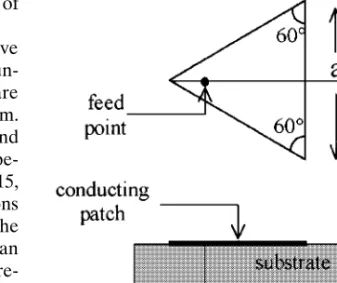
where c is the velocity of electromagnetic waves in free space,e is the relative dielectric constantr of the substrate, subscript mn refers to TMm n modes, and a is the length of a side of the triangle, as shown in Figure 1.
Ž .
Eq. 1 is based on the assumption of a perfect magnetic wall and neglects the fringing fields at the open-end edge of the microstrip patch. To account for these fringing fields, there are a
num-w x
ber of suggestions 1, 6]14 . The most common Ž . suggestion is that side length a in eq. 1 be replaced by an effective value a . The sameeff
suggestion is also used in this study. The effective
Figure 1. Geometry of equilateral triangular mi-crostrip antenna.
side length, a , which is slightly larger than theeff
physical side length a, takes into account the influence of the fringing field at the edges and the dielectric inhomogeneity of the triangular mi-crostrip patch antenna. It is clear from all of the
w x
formulae proposed 1, 6]14 that the effective side length of a triangular microstrip antenna is determined by the relative dielectric constant of the substrate, e , the physical side length, a, andr the thickness of the substrate, h. Therefore, the effective side length expression, a , to be foundeff must be larger than a and depend on e , a,r
and h.
The problem in the literature is that an expres-sion that is as simple as possible for the effective side length should be obtained, but the theoreti-cal results obtained by using the expression must be in good agreement with the experimental re-sults. In this work, a new technique based on the tabu search algorithm for solving this problem efficiently is presented. First, a model for the effective side length expression is chosen, then the unknown coefficients of the model are deter-mined by a modified tabu search algorithm.
To find the proper model for the effective side length expression, many experiments were carried out in this work. After many trials, the following model, depending on e , a, and h, which pro-r
duces good results, was chosen: a2
Ž . aeffs a q h
ž
a q1 a3/
2er
where the unknown coefficients a , a , and a1 2 3
algo-Ž .
rithm. It is evident from eq. 2 that the effective side length, a , is larger than the physical sideeff
length, a, provided a , a , and a are greater1 2 3
than zero.
The tabu search algorithm, which is based on intelligent problem solving tenets, is an optimiza-tion technique developed especially for combina-torial optimization problems, but it has also pro-duced efficient solutions for numeric problems. It is a form of iterative search and does not use derivative-based transition rules.
The tabu search starts with an arbitrary solu-tion created by a random number generator. In this particular problem, it is equivalent to starting with randomly generated values for the effective side length expression coefficients. A solution is
Ž represented with a vector of real numbers
coef-.
ficient values and an associated set of neighbors. A neighbor is reached directly from the present solution by an operation called ‘‘move.’’ A succes-sion of moves is carried out to transform the arbitrary solution to an optimal one. The new solution is the highest evaluation move among the neighbors in terms of the performance value and tabu restrictions which exist to avoid new moves that were evaluated in earlier iterations.
The tabu search used in this work employs an adaptive mechanism for producing neighbors. The neighbors of a present solution are created by the following procedure.
Ž . Ž .
If aeff t s a , a , a is the solution vector1 2 3
Ž Ž ..
at the t th iteration, two neighbors aeff n , n1 2 of this solution of which the element a is not ink
the tabu list are produced by: Ž .
a q D tk for odd neighbors
Ž .
aeff n , n1 2 s
½
Ž .
a y D tk for even neighbors Ž .3
Ž . Ž Ž . . Ž .
aeff n , n1 2 s Remain aeff n , n1 2 ,amax 4 with k3 LatestImprovementIteration Ž . D t sk1 Iterationk2qLatestImprovementIteration Ž .5 where Iteration stands for the current iteration number and LatestImprovementIteration is the iteration number at which the latest improvement was obtained. The value of ama x, which is larger than zero for each coefficient, is determined after
several experiments by the designer, and which is Ž . taken as 5 in this work. The index, t, in D t represents the iteration number. The Remain
Ž .
function in eq. 4 keeps the elements of the solution within the desired range. While k in eq.1
Ž .5 determines the magnitude of D t , k and kŽ . 2 3
Ž .
control the change of D t . The proper values for Ž . the parameter k , k , and k1 2 3 in eq. 5 are determined by experience on the tabu search. In the present work, the values taken for k , k , and1 2 k are 10, 2, and 2, respectively.3
Tabu restrictions used here are based on the recency and frequency memory storing the infor-mation about the past steps of the search. The recency-based memory prevents cycles of length less than or equal to a predetermined number of iterations from occurring in the trajectory. The frequency-based memory keeps the number of change of solution vector elements. If an element of the solution vector does not satisfy the follow-ing tabu restrictions, then it is accepted as tabu:
Tabu Restrictions Ž .
¡
recency k ) restriction period~
Ž .s
¢
or 6Ž .
frequency k - frequency limit To select the new solution from the neighbors, evaluation values of the neighbors are calculated using their recency, frequency, and performance values.
The formula used for the evaluation of a solu-tion is: Ž . evaluation i Ž . Ž . s a)improvement i q b)recency i Ž . Ž . y c)frequency i 7
where a, b, and c are the improvement, recency, and frequency factors, and equal to 4, 2, and 1,
Ž .
respectively, in this study. In eq. 7 the improve-ment is the difference between the performance of the best solution found so far and that of the ith neighbor. The performance of a neighbor can be computed using various formulas. In our work, the following is employed:
N
Ž . Ž . Ž . Ž .
P i s A y
Ý
f j m ey f j c a 8js1
where A is a positive constant selected to be Ž .
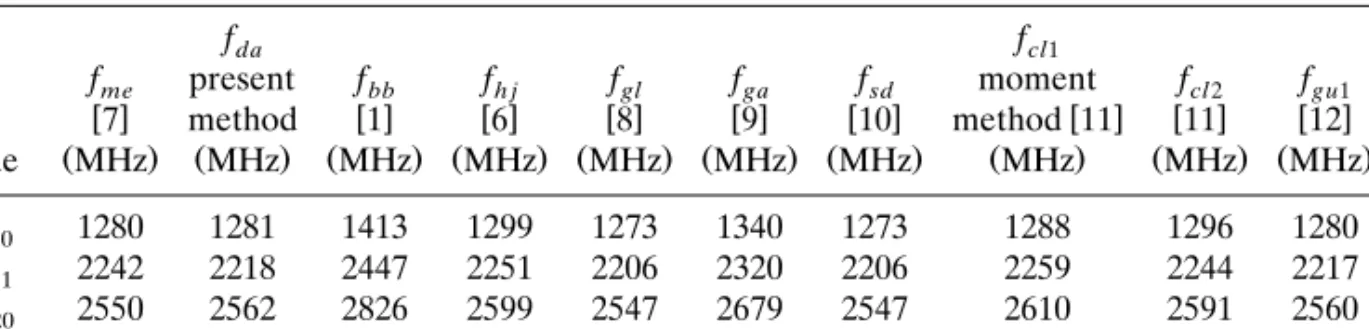
TABLE I. Comparison of Measured and Calculated Resonant Frequencies of the First Five Modes of an Equilateral Triangular Microstrip Antenna with as 10 cm, « s 2.32, and h s 0.159 cmr
fda fcl1 fme present fbb fh j fg l fg a fsd moment fcl2 fg u1 fk k fg u2 w x7 method w x1 w x6 w x8 w x9 w x10 method 11w x w x11 w x12 w x14 w x13 Ž . Ž . Ž . Ž . Ž . Ž . Ž . Ž . Ž . Ž . Ž . Ž . Mode MHz MHz MHz MHz MHz MHz MHz MHz MHz MHz MHz MHz TM10 1280 1281 1413 1299 1273 1340 1273 1288 1296 1280 1289 1280 TM11 2242 2218 2447 2251 2206 2320 2206 2259 2244 2217 2233 2218 TM20 2550 2562 2826 2599 2547 2679 2547 2610 2591 2560 2579 2561 TM21 3400 3389 3738 3438 3369 3544 3369 3454 3428 3387 3411 3387 TM30 3824 3842 4239 3898 3820 4019 3820 3875 3887 3840 3868 3841
all possible solutions, which is taken as 1000 in the present work, and fm e and fc a represent, respectively, the measured resonant frequency values and the calculated resonant frequency val-ues by using effective side length expression con-structed by the modified tabu search algorithm. The measured data sets used for the optimization and evaluation process have been obtained from the previous works, which are given in Tables I]III. The fourth entries in these tables are used for the evaluation process to demonstrate the accuracy of the model and the remainder 12 data
w Ž .x
sets Ns 12 in eq. 8 are used for the optimiza-tion process. Only three measured data sets are used for the evaluation process because of the limited measured data available in the literature. The unknown coefficient values of the model
Ž .
given in eq. 2 are optimized by the modified tabu search algorithm just described. The opti-mum values found are:
Ž . a s 0.1,1 a s 8,2 a s 23 9 The following effective side length expression, a , is obtained by substituting the coefficienteff
Ž . Ž .
values given by eq. 9 into eq. 2 . 8
Ž . aeffs a q h 0.1 q
ž
2/
10er
The resonant frequencies are then calculated by the formula
2 c w 2 2x1r2 Ž .
fm ns 1r2 m q mn q n 11
Ž . 3aeff er
RESULTS AND DISCUSSION
To determine the most appropriate suggestion given in the literature, we compared our
com-puted values of the resonant frequencies for the first five modes of the different equilateral trian-gular patch antennas with the theoretical and experimental results reported by other scientists, which are all given in Tables I]III. The entries of fm e, f , f , f , f , f , f , fd a b b h j g l g a s d c l1, fc l 2, fg u1, f ,k k
and fg u2 represent, respectively, the values
mea-w x
sured 7, 11 , calculated by this method, calcu-w x
lated by Bahl and Bhartia 1 , calculated by Hel-w x
szajn and James 6 , calculated by Garg and Long w x8 , calculated by Gang 9 , calculated by Singhw x
w x
et al. 10 , calculated by using moment method w x11 , calculated by using the curve-fitting formula
w x
proposed by Chen et al. 11 , calculated by Guney
¨
w x12 , calculated by Kumprasert and Kiranon 14 ,w xw x
and calculated by Guney 13 . In Table I, the
¨
resonant frequencies were measured by Dahelew x
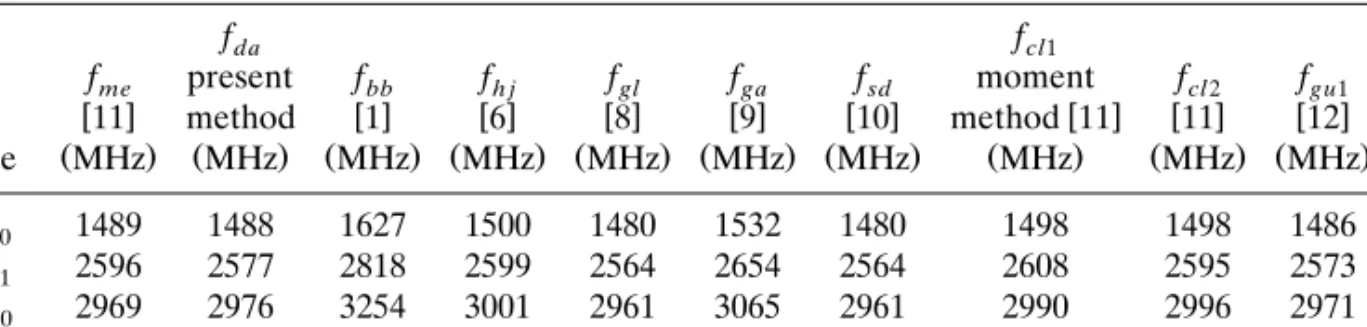
and Lee 7 . In Tables II and III, the resonant w x frequencies were measured by Chen et al. 11 . The total absolute errors between the theoretical and experimental results in Tables I]III for every suggestion are also listed in Table IV.
The theoretical results predicted by Garg and
w x w x
Long 8 , and Singh et al. 10 are the same, because the analytical formulas proposed by these scientists are the same.
In ref. 11, the moment method full-wave analy-sis and also the curve-fitting formula based on the data set obtained from this moment method full-wave analysis were presented for the resonant frequency of a triangular patch antenna. How-ever, it is apparent from Tables I]IV that the theoretical resonant frequency results calculated from this curve-fitting formula and the moment method full-wave analysis are not in very good agreement with the experimental results. It is also evident from Tables I]IV that the theoretical resonant frequency results calculated from the
w x
theories available in the literature 1, 6]14 are also not in very good agreement with the experi-mental results. For these reasons, the data set
TABLE II. Comparison of Measured and Calculated Resonant Frequencies of the First Five Modes of an Equilateral Triangular Microstrip Antenna with as 8.7 cm, « s 2.32, and h s 0.078 cmr
fda fcl1 fme present fbb fh j fg l fg a fsd moment fcl2 fg u1 fk k fg u2 w x11 method w x1 w x6 w x8 w x9 w x10 method 11w x w x11 w x12 w x14 w x13 Ž . Ž . Ž . Ž . Ž . Ž . Ž . Ž . Ž . Ž . Ž . Ž . Mode MHz MHz MHz MHz MHz MHz MHz MHz MHz MHz MHz MHz TM10 1489 1488 1627 1500 1480 1532 1480 1498 1498 1486 1493 1481 TM11 2596 2577 2818 2599 2564 2654 2564 2608 2595 2573 2585 2565 TM20 2969 2976 3254 3001 2961 3065 2961 2990 2996 2971 2985 2962 TM21 3968 3937 4304 3970 3917 4054 3917 3977 3963 3931 3949 3918 TM30 4443 4464 4880 4501 4441 4597 4441 4480 4494 4457 4478 4443
obtained from the moment method and the exist-ing theories are not used in this work. The mea-sured data set is used only for the optimization process.
We observe that our results calculated by using aeff presented here are better than those pre-dicted by other scientists. This is clear from Ta-bles I]IV. The very good agreement between the measured values and our computed resonant fre-quency values supports the validity of the simple curve-fitting effective side length expression ob-tained using the modified tabu search algorithm, even with the limited data set. We expect that the modified tabu search algorithm will find wide
Ž .
application in computer-aided design CAD of microstrip antennas and microwave-integrated circuits. The results obtained demonstrate the versatility, robustness, and computational effi-ciency of the algorithm.
The effective side length expression, a , pro-eff posed in this study has good accuracy in the range
Ž .
of 2.3-e - 10.6 and 0.005 - hrl - 0.034,r d
where l is the wavelength in the substrate.d
It is seen from Tables I]IV that the theoreti-w x cal results reported by Garg and Long 8 ,
w x w x
Kumprasert and Kiranon 14 , and Guney 12 are
¨
also close to the experimental results. However, the formulae given in this work is simpler thanw x
the formulae given elsewhere 8, 12, 14 and also provides the best results.
Because the formula presented in this work has good accuracy and requires no complicated mathematical functions, it can be very useful for the development of fast CAD algorithms. This CAD formula, capable of accurately predicting the resonant frequencies of triangular microstrip antennas, is also very useful to antenna engineers. Using this formula, one can calculate accurately, using a hand calculator, the resonant frequency of triangular patch antennas, without possessing any background knowledge of microstrip anten-nas. It takes only a few milliseconds to produce the resonant frequencies on a 486 personal com-puter. Results predicted by the curve-fitting for-mula obtained using the modified tabu search algorithm agree well with the measured results. The advantages of the formula given here are simplicity and accuracy.
It needs to be emphasized that better and more robust results can be obtained by using the
TABLE III. Comparison of Measured and Calculated Resonant Frequencies of the First Five Modes of an Equilateral Triangular Microstrip Antenna with as 4.1 cm, « s 10.5, and h s 0.07 cmr
fda fcl1 fme present fbb fh j fg l fg a fsd moment fcl2 fg u1 fk k fg u2 w x11 method w x1 w x6 w x8 w x9 w x10 method 11w x w x11 w x12 w x14 w x13 Ž . Ž . Ž . Ž . Ž . Ž . Ž . Ž . Ž . Ž . Ž . Ž . Mode MHz MHz MHz MHz MHz MHz MHz MHz MHz MHz MHz MHz TM10 1519 1501 1725 1498 1494 1577 1494 1522 1509 1511 1490 1541 TM11 2637 2600 2988 2594 2588 2731 2588 2654 2614 2617 2581 2669 TM20 2995 3002 3450 2995 2989 3153 2989 3025 3018 3021 2980 3082 TM21 3973 3971 4564 3962 3954 4172 3954 4038 3993 3997 3942 4077 TM30 4439 4503 5175 4493 4483 4730 4483 4518 4528 4532 4470 4623
TABLE IV. Total Absolute Errors between the Measured and Calculated Resonant Frequencies fcl1 fda moment present fbb fh j fg l fg a fsd method fcl2 fg u1 fk k fg u2 w x w x w x w x w x w x w x w x w x w x method 1 6 8 9 10 11 11 12 14 13 Errors 273 5124 424 326 1843 326 472 408 314 349 590 ŽMHz.
modified tabu search algorithm if more experi-mental data are supplied for the optimization process.
CONCLUSION
A new, very simple curve-fitting expression for the effective side length was proposed for the resonant frequency of triangular microstrip an-tennas. This expression was optimally obtained by using a modified tabu search algorithm and is very useful to antenna engineers for accurately predicting the resonant frequencies. The theoreti-cal resonant frequency results theoreti-calculated by using this new side length expression are in very good agreement with the experimental results available in the literature.
REFERENCES
1. I. J. Bahl and P. Bhartia, Microstrip Antennas. Artech House, Dedham, MA,1980.
2. J. R. James, P. S. Hall, and C. Wood, Microstrip Ž
Antennas}Theory and Design IEE Electromagnetic
.
Wa¨e Series No. 12 . London, Peter Peregrinus
Ltd., 1981.
3. J. R. James and P. S. Hall, Handbook of Microstrip
Ž .
Antennas IEE Electromagnetic Wa¨e Series No. 28
ŽVols. 1 and 2 . London, Peter Peregrinus Ltd.,. 1989.
4. Y. T. Lo, S. M. Wright, and M. Davidovitz, ‘‘Micro-Ž .
strip Antennas,’’ in K. Chang ed. , Handbook of Ž .
Microwa¨e and Optical Components Vol. 1 . New
York, Wiley, 1989, pp. 764]889.
5. J. F. Zurcher and F. E. Gardiol, Broadband Patch¨
Antennas. Artech House, Dedham, MA, 1995.
6. J. Helszajn and D. S. James, ‘‘Planar Triangular Resonators with Magnetic Walls,’’ IEEE Trans.
Mi-crowa¨e Theory Tech., Vol. MTT-26, No. 2, 1978,
pp. 95]100.
7. J. S. Dahele and K. F. Lee, ‘‘On the Resonant Frequencies of the Triangular Patch Antenna,’’
IEEE Trans. Ant. Propagat., Vol. AP-35, No. 1, Jan.
1987, pp. 100]101.
8. R. Garg and S. A. Long, ‘‘An Improved Formula for the Resonant Frequency of the Triangular Mi-crostrip Patch Antenna,’’ IEEE Trans. Ant.
Propa-gat., Vol. AP-36, 1988, p. 570.
9. X. Gang, ‘‘On the Resonant Frequencies of Mi-crostrip Antennas,’’ IEEE Trans. Ant. Propagat., Vol. AP-37, No. 2, 1989, pp. 245]247.
10. R. Singh, A. De, and R. S. Yadava, ‘‘Comments on ‘An Improved Formula for the Resonant Fre-quency of the Triangular Microstrip Patch An-tenna,’ ’’ IEEE Trans. Ant. Propagat., Vol. AP-39, No. 9, Sept. 1991, pp. 1443]1445.
11. W. Chen, K. F. Lee, and J. S. Dahele, ‘‘Theoretical and Experimental Studies of the Resonant Fre-quencies of the Equilateral Triangular Microstrip Antenna,’’ IEEE Trans. Ant. Propagat., Vol. AP-40, No. 10, Oct. 1992, pp. 1253]1256.
12. K. Guney, ‘‘Resonant Frequency of a Triangular¨ Microstrip Antenna,’’ Microwa¨e Opt. Technol. Lett., Vol. 6, No. 9, July 1993, pp. 555]557.
13. K. Guney, ‘‘Comments on ‘On the Resonant Fre-¨ quencies of Microstrip Antennas,’ ’’ IEEE Trans.
Ant. Propagat., Vol. AP-42, No. 9, Sept. 1994, pp.
1363]1365.
14. N. Kumprasert and W. Kiranon, ‘‘Simple and Ac-curate Formula for the Resonant Frequency of the Equilateral Triangular Microstrip Patch Antenna,’’
IEEE Trans. Ant. Propagat., Vol. AP-42, No. 8,
Aug. 1994, pp. 1178]1179.
15. F. Glover, ‘‘Tabu Search Part I,’’ ORSA J. Comput., Vol. 1, No. 3, 1989, pp. 190]206.
16. F. Glover, ‘‘Tabu Search Part II,’’ ORSA J.
Com-put., Vol. 2, No. 1, 1990, pp. 4]32.
17. D. Karaboga and A. Kaplan, ‘‘Optimising Multi-variable Function Using Tabu Search Algorithm,’’
The Tenth International Symposium on Computer
Ž .
and Information Sciences ISCIS X , Kusadasi,
Turkey, Vol. 2, 1995, pp. 793]799.
18. D. Karaboga, ‘‘Design of Fuzzy Logic Controllers Using Tabu Search Algorithm,’’ Biennial Confer-ence of the North American Fuzzy Information
Ž .
of California, Berkeley, CA, June 19]22, 1996, pp. 489]491.
19. D. Karaboga and A. Kalinli, ‘‘Tuning PID Con-troller Parameters Using Tabu Search Algorithm,’’ IEEE International Conference on Systems, Man
Ž .
and Cybernetics IEEE-SMC ’96 , Beijing, China, October 14]17, 1996, Vol. 1, pp. 134]136.
20. K. Guney, ‘‘A New Edge Extension Expression for¨ the Resonant Frequency of Electrically Thick
Rectangular Microstrip Antennas,’’ Int. J. Electron., Vol. 75, No. 4, 1993, pp. 767]770.
21. K. Guney, ‘‘Resonant Frequency of a Tunable¨ Rectangular Microstrip Patch Antenna,’’
Micro-wa¨e Opt. Technol. Lett., Vol. 7, No. 12, Aug. 20,
1994, pp. 581]585.
22. K. Guney, ‘‘Resonant Frequency of Electrically-¨ Thick Circular Microstrip Antennas,’’ Int. J.
Elec-tron., Vol. 77, No. 3, 1994, pp. 377]386.
BIOGRAPHIES
Dervis¸Karaboga was born on April 24,ˇ
1962, in K. Maras¸, Turkey. He received the BS degree from Erciyes University, Kayseri, in 1983, and the MS degree from
˙Istanbul Technical University, in 1988, both in electronic engineering. He re-ceived the PhD degree in systems engi-neering from the University of Wales College of Cardiff, UK, in 1994. He is now an assistant professor at the Department of Electronic Engineering, Erciyes University. His research interests include
Ž
modern heuristic optimization techniques genetic algorithms, .
tabu searches, and simulated annealing , fuzzy systems, neural networks, digital filters, and antenna design.
Kerim Guney was born in Isparta, Turkey,¨
on February 28, 1962. He received the BS degree from Erciyes University, Kayseri,
˙
in 1983, the MS degree from Istanbul Technical University, in 1988, and the PhD degree from Erciyes University, in 1991, all in electronic engineering. From 1991 to 1995 he was an assistant profes-sor and now is an associate profesprofes-sor at the Department of Electronic Engineering, Erciyes University, where he is working in the areas of microstrip antennas, antenna synthesis, and optimization techniques.
Ahmet Kaplan was born in Kayseri,
Turkey, on March 25, 1969. He received the BS degree from Bilkent University, Ankara, in 1992, and the MS degree from Erciyes University, Kayseri, in 1995, both in electronic engineering. Currently, he is a PhD student and research assistant at the Department of Electronic Engineer-ing, Erciyes University. He is a student member of the IEEE computer society. His current research activities include optimization techniques, artificial intelli-gence, and their applications to signal processing and control.
Ali Akdagli was born in Malatya, Turkey,ˇ
on March 1, 1974. He received the BS degree in electronic engineering from Er-ciyes University, Kayseri, Turkey, in 1994. He is now a research assistant and MS student at the Department of Electronic Engineering of Erciyes University, where he is working with microstrip antennas and antenna synthesis.