CERN-EP-2018-309 2018/12/18
CMS-HIG-18-011
Search for an exotic decay of the Higgs boson to a pair of
light pseudoscalars in the final state with two muons and
two b quarks in pp collisions at 13 TeV
The CMS Collaboration
∗Abstract
A search for exotic decays of the Higgs boson to a pair of light pseudoscalar particles a1 is performed under the hypothesis that one of the pseudoscalars decays to a pair
of opposite sign muons and the other decays to bb. Such signatures are predicted in a number of extensions of the standard model (SM), including next-to-minimal su-persymmetry and two-Higgs-doublet models with an additional scalar singlet. The results are based on a data set of proton-proton collisions corresponding to an inte-grated luminosity of 35.9 fb−1, accumulated with the CMS experiment at the CERN LHC in 2016 at a centre-of-mass energy of 13 TeV. No statistically significant excess is observed with respect to the SM backgrounds in the search region for pseudoscalar masses from 20 GeV to half of the Higgs boson mass. Upper limits at 95% confidence level are set on the product of the production cross section and branching fraction,
σhB(h → a1a1 → µ+µ−bb), ranging from 5 to 36 fb, depending on the pseudoscalar
mass. Corresponding limits on the branching fraction, assuming the SM prediction for σh, are(1–6) ×10−4.
Submitted to Physics Letters B
c
2018 CERN for the benefit of the CMS Collaboration. CC-BY-4.0 license
∗See Appendix A for the list of collaboration members
1
Introduction
The discovery of the particle now identified as the Higgs boson by the ATLAS and CMS exper-iments [1–3] at the CERN LHC [4] has opened a new era in the history of particle physics. So far, precise measurements of the Higgs boson spin, parity, width, and couplings in production and decay have been consistent with the expectations for the standard model (SM) Higgs bo-son [5–9]. However the possibility of exotic Higgs bobo-son decays to new lighter bobo-sons is not excluded. The LHC combination of the SM Higgs boson measurements at 7 and 8 TeV allows Higgs boson decays to states beyond the SM (BSM) with a rate of up to 34% [7] at 95% confi-dence level (CL). The LHC data at 13 TeV have been used to place an upper limit of about 40% for the Higgs boson branching fraction (B) to BSM particles at 95% CL [10].
Several searches for exotic decays of the Higgs boson have been performed at the LHC, using the data at 8 TeV [11–14] and 13 TeV [15–20]. Such decays occur in the context of the next-to-minimal supersymmetric standard model, NMSSM, and other extensions to two-Higgs-doublet models (2HDM) where the existence of a scalar singlet is hypothesised (2HDM+S) [21– 24]. The 2HDM, and hence 2HDM+S, are categorised into four types depending on the interac-tion of SM fermions with the Higgs doublet structure [14]. All SM particles couple to the first Higgs doublet, Φ1, in type I models. In type II models, which include the NMSSM, up-type
quarks couple toΦ1while leptons and down-type quarks couple to the second Higgs doublet,
Φ2. Quarks couple to Φ1 and leptons couple to Φ2 in type III models. In type IV models,
leptons and up-type quarks couple to Φ1, while down-type quarks couple toΦ2. After
elec-troweak symmetry breaking, the 2HDM predicts a pair of charged Higgs bosons H±, a neutral pseudoscalar A, and two neutral scalar mass eigenstates, H and h. In the decoupling limit the lighter scalar eigenstate, h, is the observed boson with mh ≈ 125 GeV. In 2HDM+S models, a complex scalar singlet SR+iSI that has no direct Yukawa couplings is introduced. Hence, it
is expected to decay to SM fermions by virtue of mixing with the Higgs sector. This mixing is small enough to preserve the SM-like nature of the h boson.
In this Letter we consider the Higgs boson decay to a pair of a1 particles where a1 is a
pseu-doscalar mass eigenstate mostly composed of SI. We perform a search for the decay chain
h → a1a1 → µ+µ−bb. The gluon gluon fusion (ggF) and the vector boson fusion (VBF)
production mechanisms are considered, with production cross sections of 48.58±1.89 pb (at next-to-next-to-next-to-leading order) and 3.93±0.08 pb (at next-to-next-to-leading order), re-spectively [25]. As a benchmark, the branching fraction of h→a1a1is assumed to be 10%. The
branching fractions of a1to SM particles depend on the type of 2HDM+S, on the pseudoscalar
mass ma1, and on tan β, defined as the ratio of the vacuum expectation values of the second
and first doublets. The tan β parameter is assumed to be 2 which implies 2B(a1 →bb)B(a1 →
µ+µ−) = 1.7×10⁻³ for ma1 = 30 GeV in type-III 2HDM+S [21]. For the set of parameters
under discussion and with 20 ≤ma1 ≤ 62.5 GeV, no strong dependence on ma1 is expected for B(a1 →bb)andB(a1 → µ+µ−)[21]. The product of the cross section and branching fraction
is therefore approximated to be about 8 fb for all ma1 values considered in this analysis.
The present search for the exotic a1 particle in the µ+µ−bb final state is sensitive to the mass
range of 20 ≤ ma1 ≤ 62.5 GeV. The sensitivity of the search largely decreases towards ma1 ≈
20 GeV and lower because a1 gets boosted and the two b quark jets tend to merge [26]. The
upper bound is imposed by the Higgs boson mass. The analysis is performed using the proton-proton collision data at 13 TeV collected with the CMS detector during 2016, corresponding to an integrated luminosity of 35.9 fb−1. Though the signal selection is optimised for the h → a1a1 → µ+µ−bb process, decays of h → a1a1 → µ+µ−τ+τ− can contribute to the selected
is found to be negligible using the benchmark scenario, although in some parts of the parameter space the enhancement inB(a1 → τ+τ−)can lead to a nonnegligible fraction of these events
surviving the selection. This is taken into account in the scan over the (ma1, tan β) plane in
the type III 2HDM+S, as for certain values, the increase in µ+
µ−τ+τ− signal can affect the
sensitivity. The signal from a1a1 →bbτ+τ−with τ→µleads to mµµsignificantly smaller than ma1 and is not considered in the search.
The CMS detector is briefly described in Section 2. The data and simulated samples are intro-duced in Section 3. Section 4 is devoted to the event selection and categorisation. The signal and background modelling is discussed in Section 5, while in Section 6, different sources of systematic uncertainties are described. Results are presented in Section 7, and the paper is summarised in Section 8.
2
The CMS detector
The central feature of the CMS apparatus is a superconducting solenoid of 6 m internal diame-ter, providing a magnetic field of 3.8 T. Within the solenoid volume are a silicon pixel and strip tracker, a lead tungstate crystal electromagnetic calorimeter, and a brass and scintillator hadron calorimeter, each composed of a barrel and endcap sections. Forward calorimeters, made of steel and quartz-fibres, extend the pseudorapidity coverage provided by the barrel and endcap detectors. Muons are detected in gas-ionisation chambers embedded in the steel flux-return yoke outside the solenoid. They are measured in the pseudorapidity range|η| <2.4, with
de-tection planes made using three technologies: drift tubes, cathode strip chambers, and resistive plate chambers. The efficiency to reconstruct and identify muons is greater than 96%. Matching muons to tracks measured in the silicon tracker results in a relative transverse momentum (pT)
resolution, for muons with pT up to 100 GeV, of 1% in the barrel and 3% in the endcaps [27].
A more detailed description of the CMS detector, together with a definition of the coordinate system used and the relevant kinematic variables, can be found in Ref. [28].
3
Simulated samples
The NMSSMHET model [21] is used to generate signal samples with the Monte Carlo (MC) event generator MADGRAPH5 aMC@NLO [29] at leading order (LO). Background processes with dominant contributions are the Drell–Yan production in association with additional b quarks and tt in the dimuon final state. Simulated samples for background processes are used in this analysis to optimise the selection and for validation purposes in those selection steps that yield reasonable statistical precision. The contribution of backgrounds to the selected sam-ple is directly extracted from data with no reference to simulation. The Drell–Yan process, Z/γ∗(→ `+`−) + jets with a minimum dilepton mass threshold of 10 GeV, is modelled with the same event generator at LO, exclusive in number of additional partons (up to 4). The refer-ence cross section for the Drell–Yan process is computed usingFEWZ3.1 [30] at next-to-next-to-leading order. The top quark samples, tt and single top quark production, are produced with
POWHEG2.0 [31–34] at next-to-leading order (NLO). Backgrounds from diboson (WW, WZ, ZZ)
production are generated at NLO with the same program and settings as that of the Drell–Yan samples. The only exception is the WW process that is generated at LO. The set of parton distribution functions (PDFs) is NLO NNPDF3.0 for NLO samples, and LO NNPDF3.0 for LO samples [35]. For all samples,PYTHIA 8.212 [36] with tune CUETP8M1 [37, 38] is used for the modelling of the parton showering and fragmentation. The full CMS detector simulation based on GEANT4 [39] is implemented for all generated event samples. In order to model the effect of
additional interactions per bunch crossing (pileup), generated minimum bias events are added to the simulated samples. The number of additional interactions are scaled to agree with that observed in data [40].
4
Event selection and categorisation
Events are filtered using a high-level trigger requirement based on the presence of two muons with pT >17 and 8 GeV. For offline selection, events must contain at least one primary vertex,
considered as the vertex of the hard interaction. At least four tracks must be associated with the selected primary vertex. The longitudinal and radial distances of the vertex from the centre of the detector must be smaller than 24 and 2 cm, respectively. The vertex with the largest sum of p2
Tof the physics objects is chosen for the analysis. The physics objects are the jets, clustered
using the jet finding algorithm [41, 42] with the tracks assigned to the vertex as inputs, and the associated missing transverse momentum, taken as the negative vector sum of the pT of
those jets. Extra selection criteria are applied to leptons and jets, reconstructed using the CMS particle-flow algorithm [43].
The selection requires two muons with opposite electric charge in|η| < 2.4, originating from
the selected primary vertex. Events with the leading (subleading) muon pT > 20(9)GeV are
selected. A relative isolation variable Irel is calculated by summing the transverse energy de-posited by other particles inside a cone of size∆R= √(∆η)2+ (∆φ)2 =0.4 around the muon
with φ being the azimuthal angle measured in radians, divided by the muon pT,
Irel=
Ich. h+max((Iγ+In. h−0.5 IPU ch. h), 0)
pT
, (1)
where Ich. h, Iγ, In. hand IPU ch. hare, respectively, the scalar p
Tsums of stable charged hadrons,
photons, neutral hadrons, and charged hadrons associated with pileup vertices. The contri-bution 0.5 IPU ch. h accounts for the expected pileup contribution from neutral particles. The neutral-to-charged particle ratio is taken to be approximately 0.5 from isospin invariance. Only muons with the isolation variable satisfying Irel < 0.15 are considered in the analysis. The ef-ficiencies for muon trigger, reconstruction, and selection in simulated events are corrected to match those in data. In case more muons in the event pass the selection requirements, the two with the largest pTare chosen.
Jets are reconstructed by clustering charged and neutral particles using the anti-kTalgorithm [41]
with a distance parameter of 0.4. The reconstructed jet energy is corrected for effects from the detector response as a function of the jet pT and η. Contamination from pileup, underlying
event, and electronic noise are subtracted [44, 45]. Extra η-dependent smearing is performed on the jet energy in simulated events as prescribed in Refs. [44, 45].
Events are required to have at least two jets with|η| < 2.4 and pT > 20 (leading) and 15 GeV
(subleading), with both jets separated from the selected muons (∆R > 0.5). A combined sec-ondary vertex algorithm is used to identify jets that are likely to originate from b quarks. The algorithm uses the track-based lifetime information together with the secondary vertices inside the jet to provide a multivariate discriminator for the b jet identification [46]. Working points “loose” (L), “medium” (M), and “tight” (T) are defined. They correspond to thresholds on the discriminator, for which the misidentification probability is around 10, 1, and 0.1%, respec-tively, for jets originating from light quarks and gluons [46]. The misidentification probability for jets originating from c quarks is around 30, 10, and 2%, respectively, for the loose, medium, and tight working points. The efficiencies for correctly identifying b jets are≈80% for the loose,
≈60% for the medium, and≈40% for the tight working point. The jet with maximum discrim-inator value must pass the tight working point of the algorithm, while the second is required to pass the loose one. The correction factors for b jet identification are applied to simulated events to reproduce the data distribution of the b tagging discriminator. In events with more jets passing the selection criteria, the two with the largest pTare taken.
The imbalance in the transverse momentum in signal events is not expected to be large, as the contribution from neutrinos from semileptonic decays in b jets is typically small. The miss-ing transverse momentum, pmissT is defined as the magnitude of the negative vector sum of the transverse momenta of all reconstructed particles. The jet energy calibration introduces corrections to the pmissT measurement [45]. Events are required to have pmissT <60 GeV.
Assuming the b quark jets and muons are the decay products of the pseudoscalar a1, it is
expected to have mbb≈mµµ≈ma1 in signal events. Moreover, the system of muons and b quark
jets is expected to have an invariant mass close to 125 GeV. A χ2 variable is introduced as
χ2bb+χ2h, where χbb = (mbb−mµµ) σbb and χh= (mµµbb−125) σh . (2)
Here σbb and σh are, respectively, the mass resolutions of the di-b-quark jet system and the
Higgs boson candidate, derived from simulation. The mass resolution of the di-b-quark jet system increases linearly with ma1. It is evaluated on an event-by-event basis, where mµµ is assumed to be equal to ma1. The distribution of χ
2 in the signal sample with m
a1 = 40 GeV is
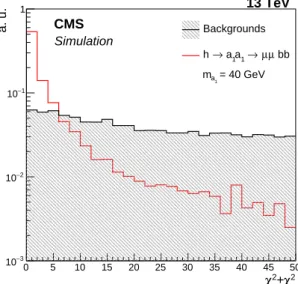
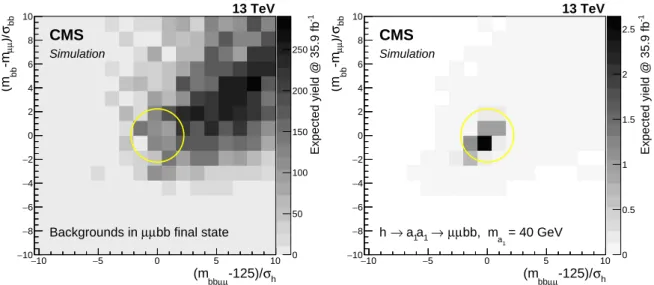
compared with that in backgrounds in Fig. 1. Events are selected with χ2 < 5. In Fig. 2, χbb
and χh are shown in 2D histograms for backgrounds and for the signal with ma1 = 40 GeV,
where the contour of χ2 <5 is also presented. This selection has a signal efficiency up to 64% while rejecting more than 95% of backgrounds. Events with mµµ values not in [20, 62.5]GeV are discarded. 0 5 10 15 20 25 30 35 40 45 50 b 2 χ + h 2 χ 3 − 10 2 − 10 1 − 10 1 a. u. 13 TeV CMS Simulation = 40 GeV 1 a m Backgrounds bb µ µ → 1 a 1 a → h
Figure 1: The distribution of χ2in simulated background processes and the signal process with
ma1 =40 GeV. The samples are normalized to unity.
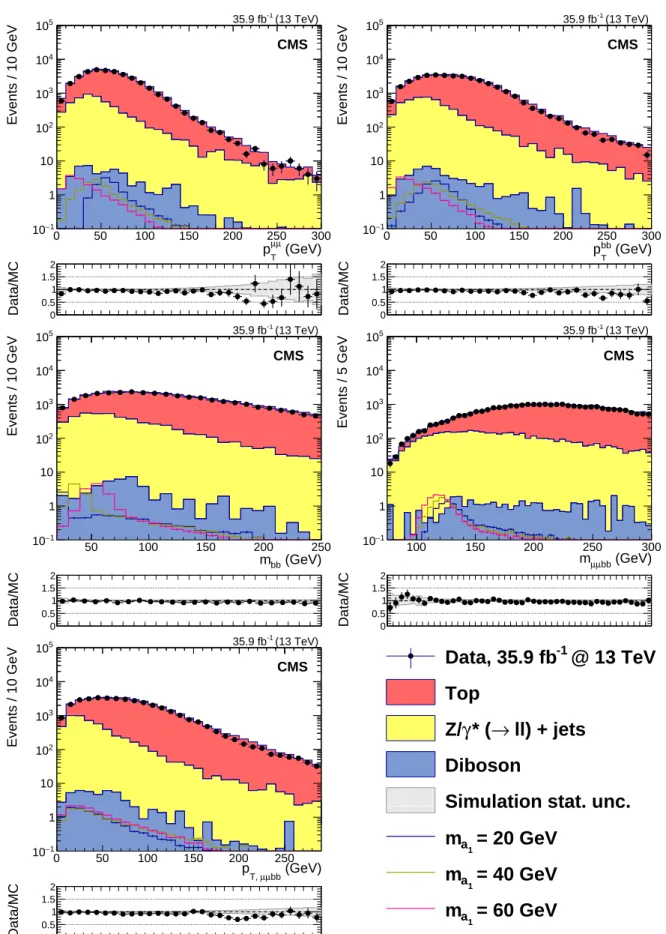
A method that fully relies on data is used to estimate the background, as described in Sec-tion 5. Simulated background samples are however used to optimise the selecSec-tion. Figure 3 shows distributions, in data and simulation, for events passing the selection requirements ex-cept those of pmissT and χ2. In this figure, expected number of simulated events is normalised
10 − −5 0 5 10 h σ -125)/ µ µ bb (m 10 − 8 − 6 − 4 − 2 − 0 2 4 6 8 10 bb σ )/ µµ -m bb (m 0 50 100 150 200 250 -1 Expected yield @ 35.9 fb CMS Simulation 13 TeV bb final state µ µ Backgrounds in 10 − −5 0 5 10 h σ -125)/ µ µ bb (m 10 − 8 − 6 − 4 − 2 − 0 2 4 6 8 10 bb σ )/ µµ -m bb (m 0 0.5 1 1.5 2 2.5 -1 Expected yield @ 35.9 fb CMS Simulation 13 TeV = 40 GeV 1 a bb, m µ µ → 1 a 1 a → h
Figure 2: The distribution of χbbversus χhas defined in Eq. (2) for (left) simulated background processes and (right) the signal process with ma1 =40 GeV. The contours encircle the area with
χ2 <5. The grey scale represents the expected yields at 35.9 fb−1.
to the integrated luminosity of 35.9 fb−1. Data and simulation are compared for the pT of the
dimuon system, and the mass and pTof the di-b-jet system. Using the same selected muon and
jet pairs, Fig. 3 also illustrates the distributions of the invariant mass mµµbband the transverse momentum pµµT bbof the four-body system. The distributions for simulated events follow rea-sonably those in the data, within the statistical uncertainties presented in the figure. The yield in data and the expected yields in simulation are presented in Table 1. The expected yield from a signal of h→a1a1→µ+µ−τ+τ−is found to be around 0.01 with the model parameters used
in this table.
Table 1: Event yields for simulated processes and data after requiring two muons and two b jets (µ+
µ−bb selection) and after the final selection. The expected number of simulated events
is normalised to the integrated luminosity of 35.9 fb−1. Uncertainties are only statistical.
Process µ+µ−bb selection Final selection
Top (tt, single top quark) 33 730±120 198±9
Drell–Yan 5237±77 399±21
Diboson 51±4 1±0.1
Total expected background 39 015±140 598±23
Data 36 360 610
Signal for σhB ≈8 fb
ma1 =20 GeV 14.0±0.1 6.0±0.1
ma1 =40 GeV 14.8±0.1 7.5±0.1
ma1 =60 GeV 16.7±0.1 10.1±0.1
To enhance the sensitivity, an event categorisation is employed: different categorisation schemes are tried, and the one resulting in the highest expected significance is chosen. The data in a side-band region are used to determine the categorization that is most sensitive for this analysis. The sideband region is constructed using the same selection as that for the signal region except that 5 < χ2 < 11. In simulated background samples, the correlations between χ2 and mµµ and the variables used for categorisation are found to be small. The best sensitivity is found with categorisation according to the b tagging discriminator value of the loose b-tagged jet. The tight-tight (TT) category contains events with both jets passing the tight requirements of the b
0 50 100 150 200 250 300 (GeV) µ µ T p 1 − 10 1 10 2 10 3 10 4 10 5 10 Events / 10 GeV (13 TeV) -1 35.9 fb CMS 0 0.5 1 1.5 2 Data/MC 0 50 100 150 200 250 300 (GeV) bb T p 1 − 10 1 10 2 10 3 10 4 10 5 10 Events / 10 GeV (13 TeV) -1 35.9 fb CMS 0 0.5 1 1.5 2 Data/MC 50 100 150 200 250 (GeV) bb m 1 − 10 1 10 2 10 3 10 4 10 5 10 Events / 10 GeV (13 TeV) -1 35.9 fb CMS 0 0.5 1 1.5 2 Data/MC 100 150 200 250 300 (GeV) bb µ µ m 1 − 10 1 10 2 10 3 10 4 10 5 10 Events / 5 GeV (13 TeV) -1 35.9 fb CMS 0 0.5 1 1.5 2 Data/MC 0 50 100 150 200 250 (GeV) bb µ µ T, p 1 − 10 1 10 2 10 3 10 4 10 5 10 Events / 10 GeV (13 TeV) -1 35.9 fb CMS 0 0.5 1 1.5 2 Data/MC
@ 13 TeV
-1Data, 35.9 fb
Top
ll) + jets
→
* (
γ
Z/
Diboson
Simulation stat. unc.
= 20 GeV
1 am
= 40 GeV
1 am
= 60 GeV
1 am
Figure 3: The distribution of the pT of the (top left) dimuon and (top right) di-b-jet system, the
mass of the (middle left) di-b-jet and (middle right) µµbb system, and (bottom left) the pT of
the µµbb system, all after requiring two muons and two b-tagged jets in the event. Simulated samples are normalised to an integrated luminosity of 35.9 fb−1 using their theoretical cross sections.
jet identification algorithm. Events in which the loose b-tagged jet passes the medium b tag-ging requirements but fails the tight conditions fall into the tight-medium (TM) category. The remaining events with the loose b-tagged jet failing the medium requirements of the b jet iden-tification algorithm belong to the tight-loose (TL) category. On average, 41% of signal events pass the TL selection, while 32% fulfil the TM requirements and 27% belong to the TT category. According to the data in the sideband region, the majority of background events (≈70%) fall into the TL category whereas about 20% pass the TM requirements and less than 10% can meet the TT criteria.
5
Signal and background modelling
The search is performed using an unbinned fit to the mµµ distribution in data, simultaneously in the TT, TM, and TL categories. The signal shape is modelled with a weighted sum of Voigt profile [47] and Crystal Ball (CB) functions [48], where the mean values of the two are bound to be the same. The initial values for the signal model parameters are extracted from a simultane-ous fit of the model to a number of simulated signal samples, spanning the ma1search region in
5 GeV steps. All parameters in the signal model are found to be independent of ma1, except for
the resolution parameter of the Voigt profile and CB functions, σvand σcb, respectively. These
parameters depend linearly on ma1 and only their slopes, respectively α and β, float in the final
fit within their uncertainties,
σv = σv,0+α mµµ,
σcb = σcb,0+β mµµ.
(3) The mµµ distribution in data is used to evaluate the contribution of backgrounds. The uncer-tainty associated with the choice of the background model is treated in a similar way as other uncertainties for which there are nuisance parameters in the fit. The unbinned likelihood func-tion for the signal-plus-background fit has the form
L(data|s(p, mµµ) +b(mµµ)), (4)
where s(p, mµµ)is the parametric signal shape with the set of parameters indicated by p, and b(mµµ)is the background model. The shape for the background is modelled, independently in each category, with a set of analytical functions using the discrete profiling method [49– 51]. In this approach the choice of the functional form of the background shape is considered as a discrete nuisance parameter, for which the best fit value can vary as the trial value of the parameter of interest (mµµ) varies. The background parameter space therefore contains multiple models, each including its own parameters.
To provide the input background models to the discrete profiling method, the data are mod-elled with different parametrisations of polynomials. The degrees of the polynomials are de-termined through statistical tests (F-test) [52] to ensure the sufficiency of number of parameters and to avoid over-fitting the data. The input background functions are tried in the minimisation of the negative logarithm of the likelihood with a penalty term added to account for the num-ber of free parameters in the background model. The discrete profiling method can choose a different best-fit functional form for the background as the physics parameter of interest varies, thus effectively incorporating the systematic uncertainty on the background functional form: in the present analysis the result is to yield expected upper limits that are about 10% less strin-gent than those obtained with a single functional form for the background. The likelihood ratio for the penalised likelihood function eLcan be written as
−2 lnL(e data|µ, ˆθµ, ˆbµ) e
L(data|µˆ, ˆθ, ˆb)
where µ is the measured quantity. The numerator is the maximum penalised likelihood for a given µ, at the best fit values of nuisance parameters, ˆθµ and of the background function, ˆbµ. The denominator is the global maximum for eL, achieved at µ = µˆ, θ = ˆθ and b = ˆb. A confidence interval for µ is obtained with the background function maximising eLfor any value of µ [49].
6
Systematic uncertainties
The statistical interpretation of the analysis takes into account several sources of systematic uncertainties related to the accuracy in the signal modelling and uncertainties in the signal acceptance. The imprecise knowledge of the background contributions is taken into account by the discrete profiling method described in Section 5.
Theoretical uncertainties: to evaluate the upper limit on B(h → a1a1 → µ+µ−bb), the Higgs
boson production cross section is set to the SM prediction where an uncertainty of 3.6% is considered for the sum of the ggF and VBF production cross sections, accounting for PDF and
αsuncertainties [25].
Uncertainties in signal shape and acceptance modelling: an uncertainty of 2.5% is assigned to the integrated luminosity of the CMS 13 TeV data collected in 2016 [40]. The uncertainty in the number of pileup interactions per event is estimated by varying the total inelastic ppcross sec-tion by±4.6% [53]. The simulation-to-data correction factors for the trigger efficiency, muon reconstruction, and selection efficiencies are estimated using a “tag-and-probe” method [54] in Drell–Yan data and simulated samples. These uncertainties include the pileup dependence of the correction factors. For the jet energy scale (JES), the variations are made according to the η- and pT-dependent uncertainties and propagated to the pmissT of the event. An additional
uncertainty, arising from unclustered energies in the event, is assessed for pmissT . For the jet en-ergy resolution, the smearing corrections are varied within their uncertainties [44]. Systematic uncertainty sources that affect the simulation-to-data corrections of the b tagging discrimina-tor distribution are JES, the contaminations from light flavor (LF) jets in the b-jet sample, the contaminations from heavy flavor (HF) jets in the light-flavor jet sample, and the statistical fluctuations in data and MC. The uncertainties due to JES and light-flavor jet contamination in b-jet samples are found to be dominant [46]. Finally, uncertainties arising from the limited understanding of the PDFs [55] are taken into account. These uncertainties have a negligible effect on the shape of the signal. Their effects on the yield are taken into account by introducing nuisance parameters with log-normal distributions into the fit.
7
Results
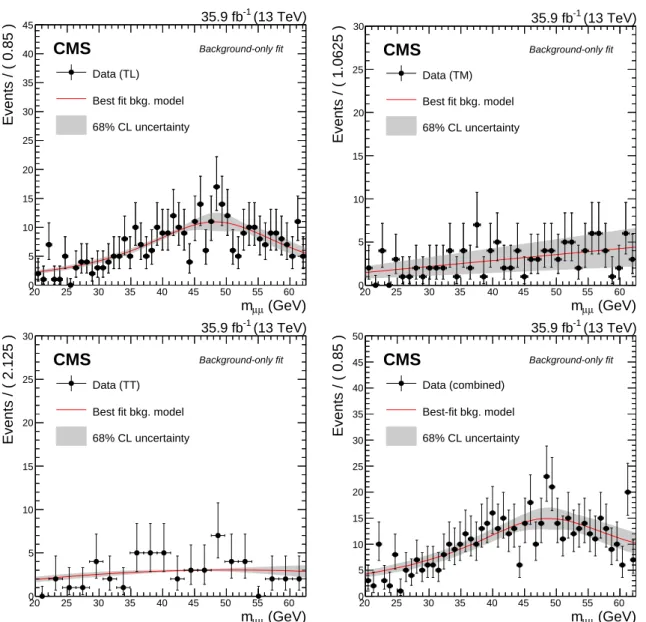
The analysis yields no significant excess of events over the SM background prediction. Figure 4 shows the mµµ distribution in the data of all categories together with the best fit output for the background model, including uncertainties.
The upper limit on σhB(h→a1a1→µ+µ−bb)is obtained at 95% CL using the CLscriterion [56,
57] and an asymptotic approximation to the distribution of the profiled likelihood ratio test statistic [58]. Assuming the SM cross sections for the Higgs boson production processes within the theoretical uncertainties, an upper limit is placed onB(h → a1a1 → µ+µ−bb)using the
same procedure. Limits are evaluated as a function of ma1. The observed and expected limits
are illustrated in Fig. 5 for both cases. Dominant systematic uncertainties are those associated with the b jet identification. For ma1 = 40 GeV, the b tagging uncertainties arising from LF
20 25 30 35 40 45 50 55 60 (GeV) µ µ m 0 5 10 15 20 25 30 35 40 45 Events / ( 0.85 ) Data (TL) Best fit bkg. model 68% CL uncertainty (13 TeV) -1 35.9 fb CMS Background-only fit 20 25 30 35 40 45 50 55 60 (GeV) µ µ m 0 5 10 15 20 25 30 Events / ( 1.0625 ) Data (TM) Best fit bkg. model 68% CL uncertainty (13 TeV) -1 35.9 fb CMS Background-only fit 20 25 30 35 40 45 50 55 60 (GeV) µ µ m 0 5 10 15 20 25 30 Events / ( 2.125 ) Data (TT) Best fit bkg. model 68% CL uncertainty (13 TeV) -1 35.9 fb CMS Background-only fit 20 25 30 35 40 45 50 55 60 (GeV) µ µ m 0 5 10 15 20 25 30 35 40 45 50 Events / ( 0.85 ) Data (combined) Best-fit bkg. model 68% CL uncertainty (13 TeV) -1 35.9 fb CMS Background-only fit
Figure 4: The best fit output to the data under the background-only hypothesis for the (top-left) TL category, (top right) TM category, (bottom left) TT category and (bottom right) all categories, presented together with 68% CL uncertainty band for the background model.
contamination and JES amount to 17 and 14%, respectively. Other uncertainties are below 5%. At 95% CL, the observed limits onB(h→a1a1 →µ+µ−bb)are(1–6) ×10−4for the mass range
20 to 62.5 GeV, whilst the expected limits are(1–2) ×10−4. A similar search from CMS in Run I [14] led to observed upper limits of(2–8) ×10−4at 95% CL, considering the ggF Higgs boson production and the mass range 25 ≤ ma1 ≤ 62.5 GeV. The corresponding expected limits on
the branching fraction at 95% CL are(3–4) ×10−4. At 13 TeV, the ggF Higgs boson production cross section has increased by a factor of about 2.3 over that at 8 TeV, while the production cross section of main backgrounds, Drell–Yan and tt, has increased by a factor of 1.5 and 3.3, respectively. Despite the relative increase in backgrounds, better sensitivity is achieved using improved analysis techniques in Run II.
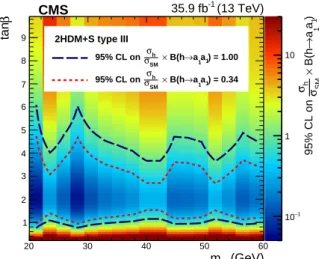
Observed limits onB(h→a1a1)are shown in Fig. 6 in the plane of (ma1, tan β) for type-III and
type-IV 2HDM+S, using only the µ+µ−bb signal. The allowed ranges forB(h→a1a1) ≤1 and B(h→a1a1) ≤0.34 are also presented. Constraints from Run I Higgs boson measurements at
25 30 35 40 45 50 55 60 (GeV) 1 a m 0 20 40 60 80 100 bb) [fb] µµ →1 a 1 a → B(h ×h σ CMS (13 TeV) -1 35.9 fb 95% CL upper limits Median expected 95% expected 68% expected Observed 25 30 35 40 45 50 55 60 (GeV) 1 a m 0 0.5 1 1.5 2 3 − 10 × bb) µµ →1 a 1 a → B(h × h,SM σ h σ CMS (13 TeV) -1 35.9 fb 95% CL upper limits Median expected 95% expected 68% expected Observed
Figure 5: Observed and expected upper limits at 95% CL on the (left) product of the Higgs boson production cross section andB(h→a1a1→µ+µ−bb)and (right) the branching fraction
as a function of ma1. The inner and outer bands indicate the regions containing the distribution
of limits located within 68 and 95% confidence intervals, respectively, of the expectation under the background–only hypothesis.
the LHC allowB(h→BSM)up to 0.34 [7]. 20 30 40 50 60 (GeV) 1 a m 1 2 3 4 5 6 7 8 9 β tan 1 − 10 1 10 )1 a 1 a → B(h × SM σ h σ 95% CL on CMS 35.9 fb-1 (13 TeV) 2HDM+S type III ) = 1.00 1 a 1 a → B(h × SM σσh 95% CL on ) = 0.34 1 a 1 a → B(h × SM σσh 95% CL on 1 − 10 1 10 2 10 3 10 )1 a 1 a → B(h × SM σ h σ 95% CL on 20 30 40 50 60 (GeV) 1 a m 0.5 1 1.5 2 2.5 3 3.5 4 4.5 5 β tan CMS 35.9 fb-1 (13 TeV) 2HDM+S type IV ) = 1.00 1 a 1 a → B(h × SM σσh 95% CL on ) = 0.34 1 a 1 a → B(h × SM σσh 95% CL on
Figure 6: Observed upper limits at 95% CL onB(h→a1a1)in the plane of (ma1, tan β) for (left)
type-III and (right) type-IV 2HDM+S, using only the µ+µ−bb signal.
The effect of including the µ+µ−τ+τ− signal is studied in the(ma1, tan β)plane for the four
types of 2HDM+S. For a given (ma1, tan β)the relevance of µ+µ−τ+τ− depends on the ratio
B(a1 → ττ)esel.µµττ/B(a1 → bb)esel.µµbb as well as the sensitivity of the analysis. Here esel. refers
to the acceptance and the selection efficiency of the process. The ratio esel.µµττ/esel.µµbbis about 1% in the TL category while it reduces to 0.3 and 0.1% in the TM and TT categories, respectively. However, because of the increase in the relative branching fraction, the contribution of the
µ+µ−τ+τ− signal becomes nonnegligible in the type-III 2HDM+S with tan β ≈ 5. Figure 7
shows the observed limits onB(h→a1a1)in the (ma1, tan β) plane, including the contribution
of µ+µ−τ+τ−signal for type-III 2HDM+S. The observed limit contours ofB(h→a1a1) =1.00
20 30 40 50 60 (GeV) 1 a m 1 2 3 4 5 6 7 8 9 β tan 1 − 10 1 10 )1 a 1 a → B(h × SM σ h σ 95% CL on CMS 35.9 fb-1 (13 TeV) 2HDM+S type III ) = 1.00 1 a 1 a → B(h × SM σσh 95% CL on ) = 0.34 1 a 1 a → B(h × SM σσh 95% CL on
Figure 7: Observed upper limits at 95% CL on B(h → a1a1) in the plane of (ma1, tan β) for
type-III 2HDM+S, including µ+µ−τ+τ−signal that is misidentified as µ+µ−bb.
8
Summary
A search for the Higgs boson decay to a pair of new pseudoscalars h → a1a1 → µ+µ−bb,
motivated by the next-to-minimal supersymmetric standard model and other extensions to two-Higgs-doublet models, is carried out using a sample of proton-proton collision data corre-sponding to an integrated luminosity of 35.9 fb−1 at 13 TeV centre-of-mass energy. No statisti-cally significant excess is found in data with respect to the background prediction. The results of the analysis are presented in the form of upper limits, at 95% confidence level, on the product of the Higgs boson production cross section and branching fraction, σhB(h→a1a1→µ+µ−bb)
as well as on the Higgs boson branching fraction assuming the SM prediction of σh. The former ranges between 5 to 36 fb, depending on ma1. The corresponding limits on the branching
frac-tion are(1–6) ×10−4for the mass range of 20 ≤ ma1 ≤ 62.5 GeV. In an analysis performed by
ATLAS [18], the limits on the branching fraction range between 2×10⁻⁴and 10−3. Compared with the similar analysis in Run I [14], the expected upper limits on the branching fraction are improved by more than a factor of two.
Acknowledgments
We congratulate our colleagues in the CERN accelerator departments for the excellent perfor-mance of the LHC and thank the technical and administrative staffs at CERN and at other CMS institutes for their contributions to the success of the CMS effort. In addition, we gratefully acknowledge the computing centres and personnel of the Worldwide LHC Computing Grid for delivering so effectively the computing infrastructure essential to our analyses. Finally, we acknowledge the enduring support for the construction and operation of the LHC and the CMS detector provided by the following funding agencies: BMBWF and FWF (Austria); FNRS and FWO (Belgium); CNPq, CAPES, FAPERJ, FAPERGS, and FAPESP (Brazil); MES (Bulgaria); CERN; CAS, MoST, and NSFC (China); COLCIENCIAS (Colombia); MSES and CSF (Croa-tia); RPF (Cyprus); SENESCYT (Ecuador); MoER, ERC IUT, and ERDF (Estonia); Academy of Finland, MEC, and HIP (Finland); CEA and CNRS/IN2P3 (France); BMBF, DFG, and HGF (Germany); GSRT (Greece); NKFIA (Hungary); DAE and DST (India); IPM (Iran); SFI (Ireland); INFN (Italy); MSIP and NRF (Republic of Korea); MES (Latvia); LAS (Lithuania); MOE and UM (Malaysia); BUAP, CINVESTAV, CONACYT, LNS, SEP, and UASLP-FAI (Mexico); MOS (Mon-tenegro); MBIE (New Zealand); PAEC (Pakistan); MSHE and NSC (Poland); FCT (Portugal);
JINR (Dubna); MON, RosAtom, RAS, RFBR, and NRC KI (Russia); MESTD (Serbia); SEIDI, CPAN, PCTI, and FEDER (Spain); MOSTR (Sri Lanka); Swiss Funding Agencies (Switzerland); MST (Taipei); ThEPCenter, IPST, STAR, and NSTDA (Thailand); TUBITAK and TAEK (Turkey); NASU and SFFR (Ukraine); STFC (United Kingdom); DOE and NSF (USA).
Individuals have received support from the Marie-Curie programme and the European Re-search Council and Horizon 2020 Grant, contract No. 675440 (European Union); the Leventis Foundation; the A.P. Sloan Foundation; the Alexander von Humboldt Foundation; the Belgian Federal Science Policy Office; the Fonds pour la Formation `a la Recherche dans l’Industrie et dans l’Agriculture (FRIA-Belgium); the Agentschap voor Innovatie door Wetenschap en Tech-nologie (IWT-Belgium); the F.R.S.-FNRS and FWO (Belgium) under the “Excellence of Science – EOS” – be.h project n. 30820817; the Ministry of Education, Youth and Sports (MEYS) of the Czech Republic; the Lend ¨ulet (“Momentum”) Programme and the J´anos Bolyai Research Schol-arship of the Hungarian Academy of Sciences, the New National Excellence Program ´UNKP, the NKFIA research grants 123842, 123959, 124845, 124850, and 125105 (Hungary); the Council of Science and Industrial Research, India; the HOMING PLUS programme of the Foundation for Polish Science, cofinanced from European Union, Regional Development Fund, the Mo-bility Plus programme of the Ministry of Science and Higher Education, the National Science Center (Poland), contracts Harmonia 2014/14/M/ST2/00428, Opus 2014/13/B/ST2/02543, 2014/15/B/ST2/03998, and 2015/19/B/ST2/02861, Sonata-bis 2012/07/E/ST2/01406; the National Priorities Research Program by Qatar National Research Fund; the Programa Estatal de Fomento de la Investigaci ´on Cient´ıfica y T´ecnica de Excelencia Mar´ıa de Maeztu, grant MDM-2015-0509 and the Programa Severo Ochoa del Principado de Asturias; the Thalis and Aristeia programmes cofinanced by EU-ESF and the Greek NSRF; the Rachadapisek Sompot Fund for Postdoctoral Fellowship, Chulalongkorn University and the Chulalongkorn Aca-demic into Its 2nd Century Project Advancement Project (Thailand); the Welch Foundation, contract C-1845; and the Weston Havens Foundation (USA).
References
[1] ATLAS Collaboration, “Observation of a new particle in the search for the standard model Higgs boson with the ATLAS detector at the LHC”, Phys. Lett. B 716 (2012) 1, doi:10.1016/j.physletb.2012.08.020, arXiv:1207.7214.
[2] CMS Collaboration, “Observation of a new boson at a mass of 125 GeV with the CMS experiment at the LHC”, Phys. Lett. B 716 (2012) 30,
doi:10.1016/j.physletb.2012.08.021, arXiv:1207.7235.
[3] CMS Collaboration, “Observation of a new boson with mass near 125 GeV in pp collisions at√s = 7 and 8 TeV”, JHEP 06 (2013) 081,
doi:10.1007/JHEP06(2013)081, arXiv:1303.4571.
[4] L. Evans and P. Bryant, “LHC machine”, JINST 3 (2008) S08001, doi:10.1088/1748-0221/3/08/S08001.
[5] ATLAS Collaboration, “Measurement of the Higgs boson coupling properties in the H→ZZ∗→4`decay channel at√s = 13 TeV with the ATLAS detector”, JHEP 03 (2018) 095, doi:10.1007/JHEP03(2018)095, arXiv:1712.02304.
[6] CMS Collaboration, “Measurements of properties of the Higgs boson decaying into the four-lepton final state in pp collisions at√s=13 TeV”, JHEP 11 (2017) 047,
[7] ATLAS and CMS Collaborations, “Measurements of the Higgs boson production and decay rates and constraints on its couplings from a combined ATLAS and CMS analysis of the LHC pp collision data at√s=7 and 8 TeV”, JHEP 08 (2016) 045,
doi:10.1007/JHEP08(2016)045, arXiv:1606.02266.
[8] ATLAS Collaboration, “Measurements of the Higgs boson production and decay rates and coupling strengths using pp collision data at√s=7 and 8 TeV in the ATLAS experiment”, Eur. Phys. J. C 76 (2016) 6, doi:10.1140/epjc/s10052-015-3769-y, arXiv:1507.04548.
[9] CMS Collaboration, “Study of the mass and spin-parity of the Higgs boson candidate via its decays to Z boson pairs”, Phys. Rev. Lett. 110 (2013) 081803,
doi:10.1103/PhysRevLett.110.081803, arXiv:1212.6639.
[10] CMS Collaboration, “Combined measurements of Higgs boson couplings in
proton-proton collisions at√s=13 TeV”, (2018). arXiv:1809.10733. Submitted to EPJC.
[11] ATLAS Collaboration, “Search for Higgs bosons decaying to aa in the µµττ final state in pp collisions at√s =8 TeV with the ATLAS experiment”, Phys. Rev. D 92 (2015) 052002,
doi:10.1103/PhysRevD.92.052002, arXiv:1505.01609.
[12] CMS Collaboration, “A search for pair production of new light bosons decaying into muons”, Phys. Lett. B 752 (2016) 146, doi:10.1016/j.physletb.2015.10.067,
arXiv:1506.00424.
[13] CMS Collaboration, “Search for a very light NMSSM Higgs boson produced in decays of the 125 GeV scalar boson and decaying into τ leptons in pp collisions at√s=8 TeV”, JHEP 01 (2016) 079, doi:10.1007/JHEP01(2016)079, arXiv:1510.06534. [14] CMS Collaboration, “Search for light bosons in decays of the 125 GeV Higgs boson in
proton-proton collisions at√s=8 TeV”, JHEP 10 (2017) 076, doi:10.1007/JHEP10(2017)076, arXiv:1701.02032.
[15] ATLAS Collaboration, “Search for the Higgs boson produced in association with a W boson and decaying to four b-quarks via two spin-zero particles in pp collisions at 13 TeV with the ATLAS detector”, Eur. Phys. J. C 76 (2016) 605,
doi:10.1140/epjc/s10052-016-4418-9, arXiv:1606.08391.
[16] ATLAS Collaboration, “Search for Higgs boson decays to beyond-the-Standard-Model light bosons in four-lepton events with the ATLAS detector at√s =13 TeV”, JHEP 06 (2018) 166, doi:10.1007/JHEP06(2018)166, arXiv:1802.03388.
[17] ATLAS Collaboration, “Search for Higgs boson decays into pairs of light (pseudo)scalar particles in the γγjj final state in pp collisions at√s=13 TeV with the ATLAS detector”, Phys. Lett. B 782 (2018) 750, doi:10.1016/j.physletb.2018.06.011,
arXiv:1803.11145.
[18] ATLAS Collaboration, “Search for Higgs boson decays into a pair of light bosons in the bbµµ final state in pp collision at√s=13 TeV with the ATLAS detector”, (2018). arXiv:1807.00539. Submitted to Phys. Lett. B.
[19] CMS Collaboration, “Search for an exotic decay of the Higgs boson to a pair of light pseudoscalars in the final state with two b quarks and two τ leptons in proton-proton collisions at√s=13 TeV”, Phys. Lett. B 785 (2018) 462,
doi:10.1016/j.physletb.2018.08.057, arXiv:1805.10191.
[20] CMS Collaboration, “Search for an exotic decay of the Higgs boson to a pair of light pseudoscalars in the final state of two muons and two τ leptons in proton-proton
collisions at√s=13 TeV”, JHEP 11 (2018) 018, doi:10.1007/JHEP11(2018)018,
arXiv:1805.04865.
[21] D. Curtin et al., “Exotic decays of the 125 GeV Higgs boson”, Phys. Rev. D 90 (2014) 075004, doi:10.1103/PhysRevD.90.075004, arXiv:1312.4992.
[22] M. Dine, W. Fischler, and M. Srednicki, “A simple solution to the strong CP problem with a harmless axion”, Phys. Lett. B 104 (1981) 199,
doi:10.1016/0370-2693(81)90590-6.
[23] J. E. Kim and H. P. Nilles, “The µ-problem and the strong CP-problem”, Phys. Lett. B 138 (1984) 150, doi:10.1016/0370-2693(84)91890-2.
[24] U. Ellwanger, C. Hugonie, and A. M. Teixeira, “The next-to-minimal supersymmetric standard model”, Phys. Rep. 496 (2010) 1, doi:10.1016/j.physrep.2010.07.001, arXiv:0910.1785.
[25] D. de Florian et al., “Handbook of LHC Higgs cross sections: 4. Deciphering the nature of the Higgs sector”, CERN Report CERN-2017-002-M, 2016.
doi:10.23731/CYRM-2017-002, arXiv:1610.07922.
[26] D. Curtin, R. Essig, and Y.-M. Zhong, “Uncovering light scalars with exotic Higgs decays
to bbµ+µ−”, JHEP 06 (2015) 025, doi:10.1007/JHEP06(2015)025,
arXiv:1412.4779.
[27] CMS Collaboration, “Performance of the CMS muon detector and muon reconstruction with proton-proton collisions at√s=13 TeV”, JINST 13 (2018) P06015,
doi:10.1088/1748-0221/13/06/P06015, arXiv:1804.04528.
[28] CMS Collaboration, “The CMS experiment at the CERN LHC”, JINST 3 (2008) S08004, doi:10.1088/1748-0221/3/08/S08004.
[29] J. Alwall et al., “The automated computation of tree-level and next-to-leading order differential cross sections, and their matching to parton shower simulations”, JHEP 07 (2014) 079, doi:10.1007/JHEP07(2014)079, arXiv:1405.0301.
[30] Y. Li and F. Petriello, “Combining QCD and electroweak corrections to dilepton production inFEWZ”, Phys. Rev. D 86 (2012) 094034,
doi:10.1103/PhysRevD.86.094034, arXiv:1208.5967.
[31] E. Re, “Single-top Wt-channel production matched with parton showers using the
POWHEGmethod”, Eur. Phys. J. C 71 (2011) 1547,
doi:10.1140/epjc/s10052-011-1547-z, arXiv:1009.2450.
[32] S. Alioli, P. Nason, C. Oleari, and E. Re, “A general framework for implementing NLO
calculations in shower Monte Carlo programs: thePOWHEGBOX”, JHEP 06 (2010) 043,
[33] S. Alioli, P. Nason, C. Oleari, and E. Re, “NLO single-top production matched with shower in POWHEG: s- and t-channel contributions”, JHEP 09 (2009) 111,
doi:10.1088/1126-6708/2009/09/111, arXiv:0907.4076. [Erratum: doi:10.1007/JHEP02(2010)011].
[34] S. Frixione, P. Nason, and C. Oleari, “Matching NLO QCD computations with parton
shower simulations: thePOWHEGmethod”, JHEP 11 (2007) 070,
doi:10.1088/1126-6708/2007/11/070, arXiv:0709.2092.
[35] NNPDF Collaboration, “Parton distributions for the LHC Run II”, JHEP 04 (2015) 040, doi:10.1007/JHEP04(2015)040, arXiv:1410.8849.
[36] T. Sj ¨ostrand et al., “An introduction toPYTHIA8.2”, Comput. Phys. Commun. 191 (2015) 159, doi:10.1016/j.cpc.2015.01.024, arXiv:1410.3012.
[37] P. Skands, S. Carrazza, and J. Rojo, “TuningPYTHIA8.1: the Monash 2013 tune”, Eur.
Phys. J. C 74 (2014) 3024, doi:10.1140/epjc/s10052-014-3024-y, arXiv:1404.5630.
[38] CMS Collaboration, “Event generator tunes obtained from underlying event and multiparton scattering measurements”, Eur. Phys. J. C 76 (2016) 155,
doi:10.1140/epjc/s10052-016-3988-x, arXiv:1512.00815.
[39] GEANT4 Collaboration, “GEANT4—a simulation toolkit”, Nucl. Instrum. Meth. A 506
(2003) 250, doi:10.1016/S0168-9002(03)01368-8.
[40] CMS Collaboration, “CMS luminosity measurements for the 2016 data taking period”, CMS Physics Analysis Summary CMS-PAS-LUM-17-001, 2017.
[41] M. Cacciari, G. P. Salam, and G. Soyez, “The anti-kTjet clustering algorithm”, JHEP 04
(2008) 063, doi:10.1088/1126-6708/2008/04/063, arXiv:0802.1189.
[42] M. Cacciari, G. P. Salam, and G. Soyez, “FastJet user manual”, Eur. Phys. J. C 72 (2012) 1896, doi:10.1140/epjc/s10052-012-1896-2, arXiv:1111.6097.
[43] CMS Collaboration, “Particle-flow reconstruction and global event description with the CMS detector”, JINST 12 (2017) P10003, doi:10.1088/1748-0221/12/10/P10003, arXiv:1706.04965.
[44] CMS Collaboration, “Jet algorithms performance in 13 TeV data”, CMS Physics Analysis Summary CMS-PAS-JME-16-003, 2017.
[45] CMS Collaboration, “Determination of jet energy calibration and transverse momentum resolution in CMS”, JINST 6 (2011) P11002,
doi:10.1088/1748-0221/6/11/P11002, arXiv:1107.4277.
[46] CMS Collaboration, “Identification of heavy-flavour jets with the CMS detector in pp collisions at 13 TeV”, JINST 13 (2018) P05011,
doi:10.1088/1748-0221/13/05/P05011, arXiv:1712.07158.
[47] G. Pagnini and R. K. Saxena, “A note on the Voigt profile function”, (2008). arXiv:0805.2274.
[48] M. J. Oreglia, “A study of the reactions ψ0 →γγψ”. PhD thesis, Stanford University,
[49] P. D. Dauncey, M. Kenzie, N. Wardle, and G. J. Davies, “Handling uncertainties in background shapes: the discrete profiling method”, JINST 10 (2015) P04015, doi:10.1088/1748-0221/10/04/P04015, arXiv:1408.6865.
[50] CMS Collaboration, “Observation of the diphoton decay of the Higgs boson and measurement of its properties”, Eur. Phys. J. C 74 (2014) 3076,
doi:10.1140/epjc/s10052-014-3076-z, arXiv:1407.0558.
[51] ATLAS and CMS Collaborations, “Combined measurement of the Higgs boson mass in pp collisions at√s =7 and 8 TeV with the ATLAS and CMS experiments”, Phys. Rev. Lett. 114 (2015) 191803, doi:10.1103/PhysRevLett.114.191803,
arXiv:1503.07589.
[52] F. James, “Statistical methods in experimental physics”. World Scientific, Singapore, 2nd edition, 2007. ISBN 9789812567956,
[53] CMS Collaboration, “Measurement of the inelastic proton-proton cross section at√s =13 TeV”, JHEP 07 (2018) 161, doi:10.1007/JHEP07(2018)161, arXiv:1802.02613. [54] CMS Collaboration, “Measurements of inclusive W and Z cross sections in pp collisions
at√s=7 TeV”, JHEP 01 (2011) 080, doi:10.1007/JHEP01(2011)080,
arXiv:1012.2466.
[55] J. Butterworth et al., “PDF4LHC recommendations for LHC Run II”, J. Phys. G 43 (2016) 023001, doi:10.1088/0954-3899/43/2/023001, arXiv:1510.03865.
[56] T. Junk, “Confidence level computation for combining searches with small statistics”, Nucl. Instrum. Meth. A 434 (1999) 435, doi:10.1016/S0168-9002(99)00498-2,
arXiv:hep-ex/9902006.
[57] A. L. Read, “Presentation of search results: the CLstechnique”, J. Phys. G 28 2693.
[58] G. Cowan, K. Cranmer, E. Gross, and O. Vitells, “Asymptotic formulae for likelihood-based tests of new physics”, Eur. Phys. J. C 71 (2011) 1554,
doi:10.1140/epjc/s10052-011-1554-0, arXiv:1007.1727. [Erratum: doi:10.1140/epjc/s10052-013-2501-z].
A
The CMS Collaboration
Yerevan Physics Institute, Yerevan, Armenia
A.M. Sirunyan, A. Tumasyan
Institut f ¨ur Hochenergiephysik, Wien, Austria
W. Adam, F. Ambrogi, E. Asilar, T. Bergauer, J. Brandstetter, M. Dragicevic, J. Er ¨o, A. Escalante Del Valle, M. Flechl, R. Fr ¨uhwirth1, V.M. Ghete, J. Hrubec, M. Jeitler1, N. Krammer, I. Kr¨atschmer, D. Liko, T. Madlener, I. Mikulec, N. Rad, H. Rohringer, J. Schieck1, R. Sch ¨ofbeck,
M. Spanring, D. Spitzbart, W. Waltenberger, J. Wittmann, C.-E. Wulz1, M. Zarucki
Institute for Nuclear Problems, Minsk, Belarus
V. Chekhovsky, V. Mossolov, J. Suarez Gonzalez
Universiteit Antwerpen, Antwerpen, Belgium
E.A. De Wolf, D. Di Croce, X. Janssen, J. Lauwers, A. Lelek, M. Pieters, H. Van Haevermaet, P. Van Mechelen, N. Van Remortel
Vrije Universiteit Brussel, Brussel, Belgium
S. Abu Zeid, F. Blekman, J. D’Hondt, J. De Clercq, K. Deroover, G. Flouris, D. Lontkovskyi, S. Lowette, I. Marchesini, S. Moortgat, L. Moreels, Q. Python, K. Skovpen, S. Tavernier, W. Van Doninck, P. Van Mulders, I. Van Parijs
Universit´e Libre de Bruxelles, Bruxelles, Belgium
D. Beghin, B. Bilin, H. Brun, B. Clerbaux, G. De Lentdecker, H. Delannoy, B. Dorney, G. Fasanella, L. Favart, A. Grebenyuk, A.K. Kalsi, T. Lenzi, J. Luetic, N. Postiau, E. Starling, L. Thomas, C. Vander Velde, P. Vanlaer, D. Vannerom, Q. Wang
Ghent University, Ghent, Belgium
T. Cornelis, D. Dobur, A. Fagot, M. Gul, I. Khvastunov2, D. Poyraz, C. Roskas, D. Trocino, M. Tytgat, W. Verbeke, B. Vermassen, M. Vit, N. Zaganidis
Universit´e Catholique de Louvain, Louvain-la-Neuve, Belgium
H. Bakhshiansohi, O. Bondu, G. Bruno, C. Caputo, P. David, C. Delaere, M. Delcourt, A. Giammanco, G. Krintiras, V. Lemaitre, A. Magitteri, K. Piotrzkowski, A. Saggio, M. Vidal Marono, P. Vischia, J. Zobec
Centro Brasileiro de Pesquisas Fisicas, Rio de Janeiro, Brazil
F.L. Alves, G.A. Alves, G. Correia Silva, C. Hensel, A. Moraes, M.E. Pol, P. Rebello Teles
Universidade do Estado do Rio de Janeiro, Rio de Janeiro, Brazil
E. Belchior Batista Das Chagas, W. Carvalho, J. Chinellato3, E. Coelho, E.M. Da Costa,
G.G. Da Silveira4, D. De Jesus Damiao, C. De Oliveira Martins, S. Fonseca De Souza,
H. Malbouisson, D. Matos Figueiredo, M. Melo De Almeida, C. Mora Herrera, L. Mundim, H. Nogima, W.L. Prado Da Silva, L.J. Sanchez Rosas, A. Santoro, A. Sznajder, M. Thiel, E.J. Tonelli Manganote3, F. Torres Da Silva De Araujo, A. Vilela Pereira
Universidade Estadual Paulistaa, Universidade Federal do ABCb, S˜ao Paulo, Brazil
S. Ahujaa, C.A. Bernardesa, L. Calligarisa, T.R. Fernandez Perez Tomeia, E.M. Gregoresb, P.G. Mercadanteb, S.F. Novaesa, SandraS. Padulaa
Institute for Nuclear Research and Nuclear Energy, Bulgarian Academy of Sciences, Sofia, Bulgaria
A. Aleksandrov, R. Hadjiiska, P. Iaydjiev, A. Marinov, M. Misheva, M. Rodozov, M. Shopova, G. Sultanov
University of Sofia, Sofia, Bulgaria
A. Dimitrov, L. Litov, B. Pavlov, P. Petkov
Beihang University, Beijing, China
W. Fang5, X. Gao5, L. Yuan
Institute of High Energy Physics, Beijing, China
M. Ahmad, J.G. Bian, G.M. Chen, H.S. Chen, M. Chen, Y. Chen, C.H. Jiang, D. Leggat, H. Liao, Z. Liu, S.M. Shaheen6, A. Spiezia, J. Tao, E. Yazgan, H. Zhang, S. Zhang6, J. Zhao
State Key Laboratory of Nuclear Physics and Technology, Peking University, Beijing, China
Y. Ban, G. Chen, A. Levin, J. Li, L. Li, Q. Li, Y. Mao, S.J. Qian, D. Wang
Tsinghua University, Beijing, China
Y. Wang
Universidad de Los Andes, Bogota, Colombia
C. Avila, A. Cabrera, C.A. Carrillo Montoya, L.F. Chaparro Sierra, C. Florez,
C.F. Gonz´alez Hern´andez, M.A. Segura Delgado
University of Split, Faculty of Electrical Engineering, Mechanical Engineering and Naval Architecture, Split, Croatia
B. Courbon, N. Godinovic, D. Lelas, I. Puljak, T. Sculac
University of Split, Faculty of Science, Split, Croatia
Z. Antunovic, M. Kovac
Institute Rudjer Boskovic, Zagreb, Croatia
V. Brigljevic, D. Ferencek, K. Kadija, B. Mesic, M. Roguljic, A. Starodumov7, T. Susa
University of Cyprus, Nicosia, Cyprus
M.W. Ather, A. Attikis, M. Kolosova, G. Mavromanolakis, J. Mousa, C. Nicolaou, F. Ptochos, P.A. Razis, H. Rykaczewski
Charles University, Prague, Czech Republic
M. Finger8, M. Finger Jr.8
Escuela Politecnica Nacional, Quito, Ecuador
E. Ayala
Universidad San Francisco de Quito, Quito, Ecuador
E. Carrera Jarrin
Academy of Scientific Research and Technology of the Arab Republic of Egypt, Egyptian Network of High Energy Physics, Cairo, Egypt
A.A. Abdelalim9,10, S. Elgammal11, S. Khalil10
National Institute of Chemical Physics and Biophysics, Tallinn, Estonia
S. Bhowmik, A. Carvalho Antunes De Oliveira, R.K. Dewanjee, K. Ehataht, M. Kadastik, M. Raidal, C. Veelken
Department of Physics, University of Helsinki, Helsinki, Finland
Helsinki Institute of Physics, Helsinki, Finland
J. Havukainen, J.K. Heikkil¨a, T. J¨arvinen, V. Karim¨aki, R. Kinnunen, T. Lamp´en, K. Lassila-Perini, S. Laurila, S. Lehti, T. Lind´en, P. Luukka, T. M¨aenp¨a¨a, H. Siikonen, E. Tuominen, J. Tuominiemi
Lappeenranta University of Technology, Lappeenranta, Finland
T. Tuuva
IRFU, CEA, Universit´e Paris-Saclay, Gif-sur-Yvette, France
M. Besancon, F. Couderc, M. Dejardin, D. Denegri, J.L. Faure, F. Ferri, S. Ganjour, A. Givernaud, P. Gras, G. Hamel de Monchenault, P. Jarry, C. Leloup, E. Locci, J. Malcles, G. Negro, J. Rander, A. Rosowsky, M. ¨O. Sahin, M. Titov
Laboratoire Leprince-Ringuet, Ecole polytechnique, CNRS/IN2P3, Universit´e Paris-Saclay, Palaiseau, France
A. Abdulsalam12, C. Amendola, I. Antropov, F. Beaudette, P. Busson, C. Charlot,
R. Granier de Cassagnac, I. Kucher, A. Lobanov, J. Martin Blanco, C. Martin Perez, M. Nguyen, C. Ochando, G. Ortona, P. Paganini, J. Rembser, R. Salerno, J.B. Sauvan, Y. Sirois, A.G. Stahl Leiton, A. Zabi, A. Zghiche
Universit´e de Strasbourg, CNRS, IPHC UMR 7178, Strasbourg, France
J.-L. Agram13, J. Andrea, D. Bloch, G. Bourgatte, J.-M. Brom, E.C. Chabert, V. Cherepanov, C. Collard, E. Conte13, J.-C. Fontaine13, D. Gel´e, U. Goerlach, M. Jansov´a, A.-C. Le Bihan, N. Tonon, P. Van Hove
Centre de Calcul de l’Institut National de Physique Nucleaire et de Physique des Particules, CNRS/IN2P3, Villeurbanne, France
S. Gadrat
Universit´e de Lyon, Universit´e Claude Bernard Lyon 1, CNRS-IN2P3, Institut de Physique Nucl´eaire de Lyon, Villeurbanne, France
S. Beauceron, C. Bernet, G. Boudoul, N. Chanon, R. Chierici, D. Contardo, P. Depasse, H. El Mamouni, J. Fay, L. Finco, S. Gascon, M. Gouzevitch, G. Grenier, B. Ille, F. Lagarde, I.B. Laktineh, H. Lattaud, M. Lethuillier, L. Mirabito, S. Perries, A. Popov14, V. Sordini, G. Touquet, M. Vander Donckt, S. Viret
Georgian Technical University, Tbilisi, Georgia
A. Khvedelidze8
Tbilisi State University, Tbilisi, Georgia
Z. Tsamalaidze8
RWTH Aachen University, I. Physikalisches Institut, Aachen, Germany
C. Autermann, L. Feld, M.K. Kiesel, K. Klein, M. Lipinski, M. Preuten, M.P. Rauch, C. Schomakers, J. Schulz, M. Teroerde, B. Wittmer
RWTH Aachen University, III. Physikalisches Institut A, Aachen, Germany
A. Albert, M. Erdmann, S. Erdweg, T. Esch, R. Fischer, S. Ghosh, T. Hebbeker, C. Heidemann, K. Hoepfner, H. Keller, L. Mastrolorenzo, M. Merschmeyer, A. Meyer, P. Millet, S. Mukherjee, T. Pook, A. Pozdnyakov, M. Radziej, H. Reithler, M. Rieger, A. Schmidt, D. Teyssier, S. Th ¨uer
RWTH Aachen University, III. Physikalisches Institut B, Aachen, Germany
G. Fl ¨ugge, O. Hlushchenko, T. Kress, T. M ¨uller, A. Nehrkorn, A. Nowack, C. Pistone, O. Pooth, D. Roy, H. Sert, A. Stahl15
Deutsches Elektronen-Synchrotron, Hamburg, Germany
M. Aldaya Martin, T. Arndt, C. Asawatangtrakuldee, I. Babounikau, K. Beernaert, O. Behnke, U. Behrens, A. Berm ´udez Mart´ınez, D. Bertsche, A.A. Bin Anuar, K. Borras16, V. Botta, A. Campbell, P. Connor, C. Contreras-Campana, V. Danilov, A. De Wit, M.M. Defranchis, C. Diez Pardos, D. Dom´ınguez Damiani, G. Eckerlin, T. Eichhorn, A. Elwood, E. Eren, E. Gallo17, A. Geiser, J.M. Grados Luyando, A. Grohsjean, M. Guthoff, M. Haranko, A. Harb, H. Jung, M. Kasemann, J. Keaveney, C. Kleinwort, J. Knolle, D. Kr ¨ucker, W. Lange, T. Lenz, J. Leonard, K. Lipka, W. Lohmann18, R. Mankel, I.-A. Melzer-Pellmann, A.B. Meyer, M. Meyer, M. Missiroli, G. Mittag, J. Mnich, V. Myronenko, S.K. Pflitsch, D. Pitzl, A. Raspereza, A. Saibel, M. Savitskyi, P. Saxena, P. Sch ¨utze, C. Schwanenberger, R. Shevchenko, A. Singh, H. Tholen, O. Turkot, A. Vagnerini, M. Van De Klundert, G.P. Van Onsem, R. Walsh, Y. Wen, K. Wichmann, C. Wissing, O. Zenaiev
University of Hamburg, Hamburg, Germany
R. Aggleton, S. Bein, L. Benato, A. Benecke, T. Dreyer, A. Ebrahimi, E. Garutti, D. Gonzalez, P. Gunnellini, J. Haller, A. Hinzmann, A. Karavdina, G. Kasieczka, R. Klanner, R. Kogler, N. Kovalchuk, S. Kurz, V. Kutzner, J. Lange, D. Marconi, J. Multhaup, M. Niedziela, C.E.N. Niemeyer, D. Nowatschin, A. Perieanu, A. Reimers, O. Rieger, C. Scharf, P. Schleper, S. Schumann, J. Schwandt, J. Sonneveld, H. Stadie, G. Steinbr ¨uck, F.M. Stober, M. St ¨over, B. Vormwald, I. Zoi
Karlsruher Institut fuer Technologie, Karlsruhe, Germany
M. Akbiyik, C. Barth, M. Baselga, S. Baur, E. Butz, R. Caspart, T. Chwalek, F. Colombo, W. De Boer, A. Dierlamm, K. El Morabit, N. Faltermann, B. Freund, M. Giffels, M.A. Harrendorf, F. Hartmann15, S.M. Heindl, U. Husemann, I. Katkov14, S. Kudella, S. Mitra, M.U. Mozer, Th. M ¨uller, M. Musich, M. Plagge, G. Quast, K. Rabbertz, M. Schr ¨oder, I. Shvetsov, H.J. Simonis, R. Ulrich, S. Wayand, M. Weber, T. Weiler, C. W ¨ohrmann, R. Wolf
Institute of Nuclear and Particle Physics (INPP), NCSR Demokritos, Aghia Paraskevi, Greece
G. Anagnostou, G. Daskalakis, T. Geralis, A. Kyriakis, D. Loukas, G. Paspalaki
National and Kapodistrian University of Athens, Athens, Greece
A. Agapitos, G. Karathanasis, P. Kontaxakis, A. Panagiotou, I. Papavergou, N. Saoulidou, K. Vellidis
National Technical University of Athens, Athens, Greece
K. Kousouris, I. Papakrivopoulos, G. Tsipolitis
University of Io´annina, Io´annina, Greece
I. Evangelou, C. Foudas, P. Gianneios, P. Katsoulis, P. Kokkas, S. Mallios, N. Manthos, I. Papadopoulos, E. Paradas, J. Strologas, F.A. Triantis, D. Tsitsonis
MTA-ELTE Lend ¨ulet CMS Particle and Nuclear Physics Group, E ¨otv ¨os Lor´and University, Budapest, Hungary
M. Bart ´ok19, M. Csanad, N. Filipovic, P. Major, M.I. Nagy, G. Pasztor, O. Sur´anyi, G.I. Veres
Wigner Research Centre for Physics, Budapest, Hungary
G. Bencze, C. Hajdu, D. Horvath20, ´A. Hunyadi, F. Sikler, T. ´A. V´ami, V. Veszpremi, G. Vesztergombi†
Institute of Nuclear Research ATOMKI, Debrecen, Hungary
Institute of Physics, University of Debrecen, Debrecen, Hungary
P. Raics, Z.L. Trocsanyi, B. Ujvari
Indian Institute of Science (IISc), Bangalore, India
S. Choudhury, J.R. Komaragiri, P.C. Tiwari
National Institute of Science Education and Research, HBNI, Bhubaneswar, India
S. Bahinipati22, C. Kar, P. Mal, K. Mandal, A. Nayak23, S. Roy Chowdhury, D.K. Sahoo22, S.K. Swain
Panjab University, Chandigarh, India
S. Bansal, S.B. Beri, V. Bhatnagar, S. Chauhan, R. Chawla, N. Dhingra, R. Gupta, A. Kaur, M. Kaur, S. Kaur, P. Kumari, M. Lohan, M. Meena, A. Mehta, K. Sandeep, S. Sharma, J.B. Singh, A.K. Virdi, G. Walia
University of Delhi, Delhi, India
A. Bhardwaj, B.C. Choudhary, R.B. Garg, M. Gola, S. Keshri, Ashok Kumar, S. Malhotra, M. Naimuddin, P. Priyanka, K. Ranjan, Aashaq Shah, R. Sharma
Saha Institute of Nuclear Physics, HBNI, Kolkata, India
R. Bhardwaj24, M. Bharti24, R. Bhattacharya, S. Bhattacharya, U. Bhawandeep24, D. Bhowmik, S. Dey, S. Dutt24, S. Dutta, S. Ghosh, M. Maity25, K. Mondal, S. Nandan, A. Purohit, P.K. Rout, A. Roy, G. Saha, S. Sarkar, T. Sarkar25, M. Sharan, B. Singh24, S. Thakur24
Indian Institute of Technology Madras, Madras, India
P.K. Behera, A. Muhammad
Bhabha Atomic Research Centre, Mumbai, India
R. Chudasama, D. Dutta, V. Jha, V. Kumar, D.K. Mishra, P.K. Netrakanti, L.M. Pant, P. Shukla, P. Suggisetti
Tata Institute of Fundamental Research-A, Mumbai, India
T. Aziz, M.A. Bhat, S. Dugad, G.B. Mohanty, N. Sur, RavindraKumar Verma
Tata Institute of Fundamental Research-B, Mumbai, India
S. Banerjee, S. Bhattacharya, S. Chatterjee, P. Das, M. Guchait, Sa. Jain, S. Karmakar, S. Kumar, G. Majumder, K. Mazumdar, N. Sahoo
Indian Institute of Science Education and Research (IISER), Pune, India
S. Chauhan, S. Dube, V. Hegde, A. Kapoor, K. Kothekar, S. Pandey, A. Rane, A. Rastogi, S. Sharma
Institute for Research in Fundamental Sciences (IPM), Tehran, Iran
S. Chenarani26, E. Eskandari Tadavani, S.M. Etesami26, M. Khakzad, M. Mohammadi
Na-jafabadi, M. Naseri, F. Rezaei Hosseinabadi, B. Safarzadeh27, M. Zeinali
University College Dublin, Dublin, Ireland
M. Felcini, M. Grunewald
INFN Sezione di Baria, Universit`a di Barib, Politecnico di Baric, Bari, Italy
M. Abbresciaa,b, C. Calabriaa,b, A. Colaleoa, D. Creanzaa,c, L. Cristellaa,b, N. De Filippisa,c, M. De Palmaa,b, A. Di Florioa,b, F. Erricoa,b, L. Fiorea, A. Gelmia,b, G. Iasellia,c, M. Incea,b, S. Lezkia,b, G. Maggia,c, M. Maggia, G. Minielloa,b, S. Mya,b, S. Nuzzoa,b, A. Pompilia,b, G. Pugliesea,c, R. Radognaa, A. Ranieria, G. Selvaggia,b, A. Sharmaa, L. Silvestrisa, R. Vendittia, P. Verwilligena
INFN Sezione di Bolognaa, Universit`a di Bolognab, Bologna, Italy
G. Abbiendia, C. Battilanaa,b, D. Bonacorsia,b, L. Borgonovia,b, S. Braibant-Giacomellia,b, R. Campaninia,b, P. Capiluppia,b, A. Castroa,b, F.R. Cavalloa, S.S. Chhibraa,b, G. Codispotia,b, M. Cuffiania,b, G.M. Dallavallea, F. Fabbria, A. Fanfania,b, E. Fontanesi, P. Giacomellia,
C. Grandia, L. Guiduccia,b, F. Iemmia,b, S. Lo Meoa,28, S. Marcellinia, G. Masettia, A. Montanaria, F.L. Navarriaa,b, A. Perrottaa, F. Primaveraa,b, A.M. Rossia,b, T. Rovellia,b, G.P. Sirolia,b, N. Tosia
INFN Sezione di Cataniaa, Universit`a di Cataniab, Catania, Italy
S. Albergoa,b, A. Di Mattiaa, R. Potenzaa,b, A. Tricomia,b, C. Tuvea,b
INFN Sezione di Firenzea, Universit`a di Firenzeb, Firenze, Italy
G. Barbaglia, K. Chatterjeea,b, V. Ciullia,b, C. Civininia, R. D’Alessandroa,b, E. Focardia,b,
G. Latino, P. Lenzia,b, M. Meschinia, S. Paolettia, L. Russoa,29, G. Sguazzonia, D. Stroma, L. Viliania
INFN Laboratori Nazionali di Frascati, Frascati, Italy
L. Benussi, S. Bianco, F. Fabbri, D. Piccolo
INFN Sezione di Genovaa, Universit`a di Genovab, Genova, Italy
F. Ferroa, R. Mulargiaa,b, E. Robuttia, S. Tosia,b
INFN Sezione di Milano-Bicoccaa, Universit`a di Milano-Bicoccab, Milano, Italy
A. Benagliaa, A. Beschib, F. Brivioa,b, V. Cirioloa,b,15, S. Di Guidaa,b,15, M.E. Dinardoa,b, S. Fiorendia,b, S. Gennaia, A. Ghezzia,b, P. Govonia,b, M. Malbertia,b, S. Malvezzia, D. Menascea, F. Monti, L. Moronia, M. Paganonia,b, D. Pedrinia, S. Ragazzia,b, T. Tabarelli de Fatisa,b, D. Zuoloa,b
INFN Sezione di Napolia, Universit`a di Napoli ’Federico II’b, Napoli, Italy, Universit`a della
Basilicatac, Potenza, Italy, Universit`a G. Marconid, Roma, Italy
S. Buontempoa, N. Cavalloa,c, A. De Iorioa,b, A. Di Crescenzoa,b, F. Fabozzia,c, F. Fiengaa, G. Galatia, A.O.M. Iorioa,b, L. Listaa, S. Meolaa,d,15, P. Paoluccia,15, C. Sciaccaa,b, E. Voevodinaa,b
INFN Sezione di Padova a, Universit`a di Padova b, Padova, Italy, Universit`a di Trento c,
Trento, Italy
P. Azzia, N. Bacchettaa, D. Biselloa,b, A. Bolettia,b, A. Bragagnolo, R. Carlina,b, P. Checchiaa,
M. Dall’Ossoa,b, P. De Castro Manzanoa, T. Dorigoa, U. Dossellia, F. Gasparinia,b, U. Gasparinia,b, A. Gozzelinoa, S.Y. Hoh, S. Lacapraraa, P. Lujan, M. Margonia,b, A.T. Meneguzzoa,b, J. Pazzinia,b, M. Presillab, P. Ronchesea,b, R. Rossina,b, F. Simonettoa,b, A. Tiko, E. Torassaa, M. Tosia,b, M. Zanettia,b, P. Zottoa,b, G. Zumerlea,b
INFN Sezione di Paviaa, Universit`a di Paviab, Pavia, Italy
A. Braghieria, A. Magnania, P. Montagnaa,b, S.P. Rattia,b, V. Rea, M. Ressegottia,b, C. Riccardia,b, P. Salvinia, I. Vaia,b, P. Vituloa,b
INFN Sezione di Perugiaa, Universit`a di Perugiab, Perugia, Italy
M. Biasinia,b, G.M. Bileia, C. Cecchia,b, D. Ciangottinia,b, L. Fan `oa,b, P. Laricciaa,b, R. Leonardia,b, E. Manonia, G. Mantovania,b, V. Mariania,b, M. Menichellia, A. Rossia,b, A. Santocchiaa,b, D. Spigaa
INFN Sezione di Pisaa, Universit`a di Pisab, Scuola Normale Superiore di Pisac, Pisa, Italy
K. Androsova, P. Azzurria, G. Bagliesia, L. Bianchinia, T. Boccalia, L. Borrello, R. Castaldia,
M.A. Cioccia,b, R. Dell’Orsoa, G. Fedia, F. Fioria,c, L. Gianninia,c, A. Giassia, M.T. Grippoa, F. Ligabuea,c, E. Mancaa,c, G. Mandorlia,c, A. Messineoa,b, F. Pallaa, A. Rizzia,b, G. Rolandi30, P. Spagnoloa, R. Tenchinia, G. Tonellia,b, A. Venturia, P.G. Verdinia
INFN Sezione di Romaa, Sapienza Universit`a di Romab, Rome, Italy
L. Baronea,b, F. Cavallaria, M. Cipriania,b, D. Del Rea,b, E. Di Marcoa,b, M. Diemoza, S. Gellia,b, E. Longoa,b, B. Marzocchia,b, P. Meridiania, G. Organtinia,b, F. Pandolfia, R. Paramattia,b, F. Preiatoa,b, S. Rahatloua,b, C. Rovellia, F. Santanastasioa,b
INFN Sezione di Torino a, Universit`a di Torino b, Torino, Italy, Universit`a del Piemonte
Orientalec, Novara, Italy
N. Amapanea,b, R. Arcidiaconoa,c, S. Argiroa,b, M. Arneodoa,c, N. Bartosika, R. Bellana,b, C. Biinoa, A. Cappatia,b, N. Cartigliaa, F. Cennaa,b, S. Comettia, M. Costaa,b, R. Covarellia,b, N. Demariaa, B. Kiania,b, C. Mariottia, S. Masellia, E. Migliorea,b, V. Monacoa,b, E. Monteila,b, M. Montenoa, M.M. Obertinoa,b, L. Pachera,b, N. Pastronea, M. Pelliccionia, G.L. Pinna Angionia,b, A. Romeroa,b, M. Ruspaa,c, R. Sacchia,b, R. Salvaticoa,b, K. Shchelinaa,b,
V. Solaa, A. Solanoa,b, D. Soldia,b, A. Staianoa
INFN Sezione di Triestea, Universit`a di Triesteb, Trieste, Italy
S. Belfortea, V. Candelisea,b, M. Casarsaa, F. Cossuttia, A. Da Rolda,b, G. Della Riccaa,b, F. Vazzolera,b, A. Zanettia
Kyungpook National University, Daegu, Korea
D.H. Kim, G.N. Kim, M.S. Kim, J. Lee, S. Lee, S.W. Lee, C.S. Moon, Y.D. Oh, S.I. Pak, S. Sekmen, D.C. Son, Y.C. Yang
Chonnam National University, Institute for Universe and Elementary Particles, Kwangju, Korea
H. Kim, D.H. Moon, G. Oh
Hanyang University, Seoul, Korea
B. Francois, J. Goh31, T.J. Kim Korea University, Seoul, Korea
S. Cho, S. Choi, Y. Go, D. Gyun, S. Ha, B. Hong, Y. Jo, K. Lee, K.S. Lee, S. Lee, J. Lim, S.K. Park, Y. Roh
Sejong University, Seoul, Korea
H.S. Kim
Seoul National University, Seoul, Korea
J. Almond, J. Kim, J.S. Kim, H. Lee, K. Lee, K. Nam, S.B. Oh, B.C. Radburn-Smith, S.h. Seo, U.K. Yang, H.D. Yoo, G.B. Yu
University of Seoul, Seoul, Korea
D. Jeon, H. Kim, J.H. Kim, J.S.H. Lee, I.C. Park
Sungkyunkwan University, Suwon, Korea
Y. Choi, C. Hwang, J. Lee, I. Yu
Riga Technical University, Riga, Latvia
V. Veckalns32
Vilnius University, Vilnius, Lithuania
V. Dudenas, A. Juodagalvis, J. Vaitkus
National Centre for Particle Physics, Universiti Malaya, Kuala Lumpur, Malaysia
Z.A. Ibrahim, M.A.B. Md Ali33, F. Mohamad Idris34, W.A.T. Wan Abdullah, M.N. Yusli,