758
http://journals.tubitak.gov.tr/medical/
Turkish Journal of Medical Sciences Turk J Med Sci
(2015) 45: 758-761 © TÜBİTAK
doi:10.3906/sag-1406-61
Sexuality and sexual dysfunction in spinal cord-injured men in Turkey
Ramazan Yavuz AKMAN1,*, Evrim COŞKUN ÇELİK2, Metin KARATAŞ2 1Department of Urology, Faculty of Medicine, Başkent University, İstanbul, Turkey
2Department of Physical Medicine and Rehabilitation, Faculty of Medicine, Başkent University, İstanbul, Turkey
* Correspondence: [email protected]
1. Introduction
A spinal cord injury (SCI) affects a male’s sexuality psychologically, physiologically, and emotionally. The level and completeness of the lesion determine the extent to which SCI affects the patient’s sexual functioning (1). In the last decades, as a result of the reduction of mortality rates in patients with SCI, the treatment goal has shifted from survival to enhancing the quality of life (2).
In a study on quality of life it was found that regaining sexual function was the highest priority for paraplegics, while it was second after regaining hand and arm functions in quadriplegic patients (3).
The aim this study was to provide a comprehensive evaluation of sexual function, dysfunction, and sexual education status in men with SCI based on self-reports of patients.
2. Materials and methods 2.1. Patient selection
This study was carried out with the cooperation of the Spinal Cord Paralytics Association of Turkey (Turkish: Türkiye Omurilik Felçlileri Derneği, TOFD).
Subjects to be included in this study were identified either from the Başkent University İstanbul Hospital database or from among member database of the TOFD. Of the screened patients, 13 were enrolled from our outpatient clinic and 34 were from the TOFD database.
A total of 47 men with injured spinal cords who were out of the spinal shock period and had had the injury for more than 6 months were enrolled in the study.
2.2. Data collected
All enrolled patients attended a training about sexuality and sexual functions after SCI at the TOFD facilities in İstanbul.
All the patients were asked to complete a questionnaire after training. The questionnaire included questions about demographics, sexual experience, sexual desire, erectile abilities, and erection type. Patients were also asked if they had any sexual health consultation after SCI, as well as by whom and when they would prefer to be offered such consultation.
2.3. Disease severity classifications
The International Index of Erectile Function-5 (IIEF-5) was used to assess erectile dysfunction (ED). The IIEF-5 Background/aim: To provide a comprehensive evaluation of sexual function and dysfunction in spinal cord-injured men based on
self-reports of patients.
Materials and methods: Forty-seven spinal cord-injured men who completed the spinal shock and rehabilitation period were included.
Patients were asked to complete a questionnaire developed to assess social status, sexual activities, abilities, and sexuality education after injury. Neurologic levels of patients were classified according to American Spinal Cord Injury Association protocol. Erectile function was evaluated by International Index of Erectile Function-5 (IIEF-5) questionnaire.
Results: Patients were aged between 20 and 62 years (mean: 35.2). Twenty-eight patients had T10 and above, 15 between T11 and L2,
and 4 cauda conus injury. While 61.7% of the patients declared sexual activity, 93.6% declared some degree of erection. Mean IIEF-5 score was 5.3 and 87.3% of the patients had moderate to severe erectile dysfunction.
Conclusion: Continuation of sexual activity after injury is very important and has a great impact on quality of life and interpersonal
relationships for spinal cord-injured men. More attention must be given to sexuality after spinal cord injury. A very high rate of sexual dysfunction in spinal cord-injured patients was found and the importance of sexual education was emphasized in this study.
Key words: Spinal cord injury, erectile dysfunction, sexuality, education
Received: 14.06.2014 Accepted/Published Online: 06.09.2014 Printed: 30.07.2015
759 AKMAN et al. / Turk J Med Sci
questionnaire was validated in the Turkish language (4). ED severity is classified based on IIEF-5 scores as no ED (score: 22–25), mild ED (score: 17–21), mild-moderate ED (score: 12–16), moderate ED (score: 8–11), or severe ED (score: 5–7) (5).
Spinal cord injury severity was classified according to the American Spinal Injury Association assessment protocol.
2.4. Ethical issues
The study protocol and all the procedures included in the study were approved by the ethics committee of the Başkent University School of Medicine. All enrolled patients provided signed informed consent before any study-related procedures.
2.5. Statistical analysis
Results were summarized by using mean ± standard deviation or median (minimum–maximum) for continuous variables and counts (percentages) for categorical variables, as appropriate. Subgroups were compared by Mann–Whitney U test or Kruskal–Wallis test as appropriate.
3. Results
Mean age and time from spinal injury of the patients in the study was 35.2 ± 10.6 (range: 20–62) years and 6.3 ± 4.0 (range: 1–18) years, respectively. Of the patients, 28 (59.6%) had lesions located above T10, whereas 15 (31.9%) had lesions between T11 and L2 and 4 (8.5%) had lesions at the cauda equina.
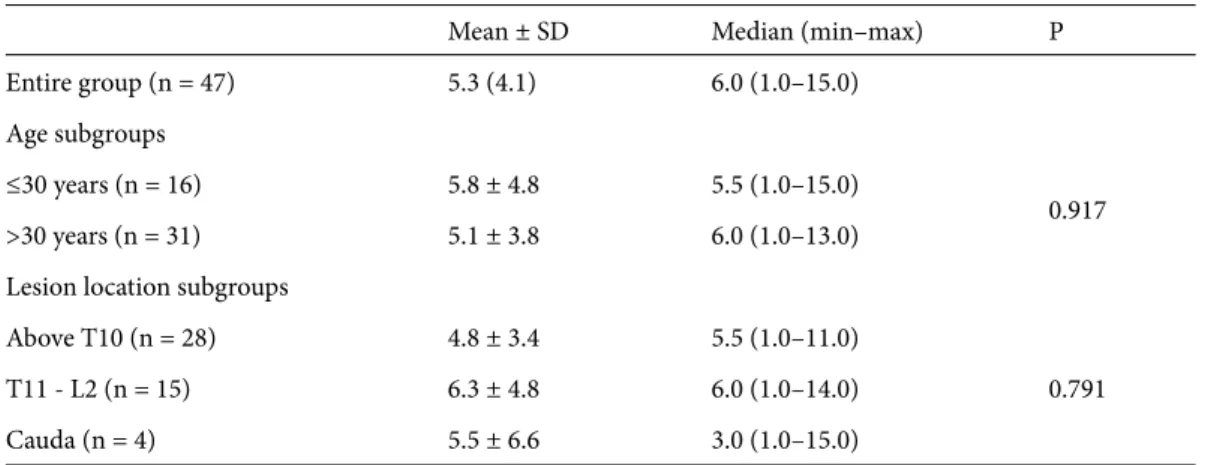
The mean IIEF-5 score of the entire group was 5.3 ± 4.1. IIEF-5 scores of patients based on age and lesion location subgroups are summarized in Table 1. There were no significant differences in the IIEF-5 scores between age and lesion location subgroups (Table 1).
Two-thirds (61.7%) of the patients were sexually active and almost all patients (93.6%) reported some type of erection. Among these patients, 44.7% were using PDE5 inhibitors, whereas 17.0% were using papaverine injection.
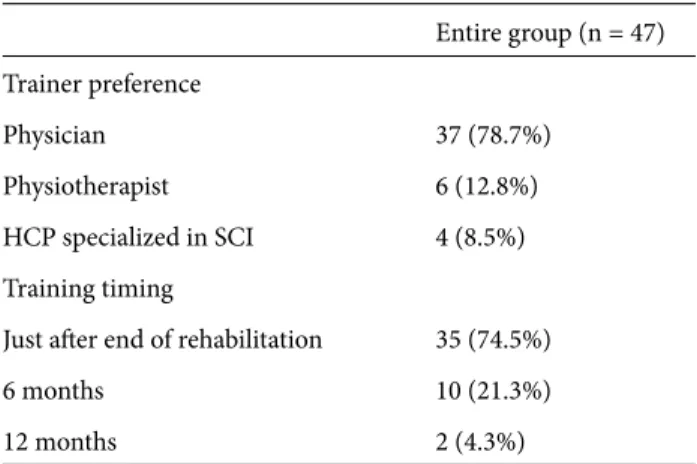
Only 8.5% of the patients were previously trained about sexuality and fertility after the trauma. Most patients preferred to be trained just at the end of the rehabilitation period (74.5%) and by physicians (78.7%). Details of education preferences are summarized in Table 2.
4. Discussion
SCI may cause serious troubles in quality of life and in self-perception. These patients may experience difficulties in social interactions with able-bodied people (6). Turkey has customs originating both from eastern and western cultures. Men with SCI are judged as “half-men” in this country. Most people believe that men with SCI are impotent and infertile. In a prior study, it was emphasized that Asian male patients might experience accommodation problems after rehabilitation more often due to the traditional nature of male dominancy in the family in Asian society (7). Addition of sexual dysfunction may lead to a poor outcome for these patients (8). The aim of this study is to represent the sexual functions and sexual educational status of male SCI patients in Turkey.
ED is a common complication in men with SCI. However, in various studies conducted to evaluate this situation, it was reported that 80%–95% of these patients can achieve some type of erection, whether psychogenic, reflexogenic, or mixed (9). In the present study 93.6% of patients reported some type of erection, mean IIEF-5 score was 5.3, and 87.3% of the patients had moderate to severe erectile dysfunction. We found no significant correlation between age and IIEF-5 score (P = 0.917).
Table 1. IIEF-5 scores in age and lesion location subgroups.
Mean ± SD Median (min–max) P
Entire group (n = 47) 5.3 (4.1) 6.0 (1.0–15.0)
Age subgroups
≤30 years (n = 16) 5.8 ± 4.8 5.5 (1.0–15.0)
0.917
>30 years (n = 31) 5.1 ± 3.8 6.0 (1.0–13.0)
Lesion location subgroups
Above T10 (n = 28) 4.8 ± 3.4 5.5 (1.0–11.0)
0.791
T11 - L2 (n = 15) 6.3 ± 4.8 6.0 (1.0–14.0)
Cauda (n = 4) 5.5 ± 6.6 3.0 (1.0–15.0)
760
AKMAN et al. / Turk J Med Sci
Treatment for ED includes orally active vasoactive drugs such as PDE5 inhibitors, injections of vasoactive substances, vacuum constrictive devices, and penile prosthesis implants (10,11). The type of method used depends on the patient’s comfort, preferences, and type of dysfunction. Studies have demonstrated PDE5 inhibitors to be safe in men with SCI (12,13). In this present study, 44.7% of the patients used PDE5 inhibitors and 17% used papaverine injections.
Several decades ago the idea of addressing sexual and fertility issues during rehabilitation was controversial and rarely carried out. Besides, there were no treatment modalities for these problems. Although many treatment
modalities have now been developed for erectile dysfunction and infertility, many professionals are still uncomfortable providing information about sexuality after SCI. People with SCI have always had questions about their sexuality, and these questions cannot be ignored. Short after injury, people with SCI often ask questions about their body image, relationships, and ability to have children. It was shown that ED is the main determinant of psychological distress in men with SCI (14). Most of the patients (91.5%) in our study also emphasized the importance of sexual education.
Nowadays most clinicians are aware of the importance of discussing sexuality and fertility issues. However, there has been no consensus as to when, how, and who should be answering questions related to sexuality and fertility. In the first months following a SCI, it is natural for individuals to be focused on physical recovery and rehabilitation. However, coming to terms with sexuality after SCI is an important step towards making a healthy adaptation. In the present study, 74.5% of the patients preferred having sexual education just after the rehabilitation period. Most of our patients (78.7%) preferred to receive that education directly from a clinician instead of a nurse or psychologist. Sexual expression is a fundamental part of being human. It is obvious that life does not end after a SCI, nor does the ability to have fulfilling intimate relationships, fertility, and a satisfying sexual life. After SCI, people have a choice to be sexually active or not. Clinicians have to inform SCI patients accurately about sexuality and fertility.
Acknowledgement
We thank the Spinal Cord Paralytics Association of Turkey for their collaboration.
Table 2. Preferences of patients for sexual education.
Entire group (n = 47) Trainer preference Physician 37 (78.7%) Physiotherapist 6 (12.8%) HCP specialized in SCI 4 (8.5%) Training timing
Just after end of rehabilitation 35 (74.5%)
6 months 10 (21.3%)
12 months 2 (4.3%)
HCP: Health care professional, N: patient count, SCI: spinal cord injury.
References
1. Tarabulcy E. Sexual function in the normal and in paraplegia. Paraplegia 1972; 10: 201–208.
2. Smith EM, Bodner DR. Sexual dysfunction after spinal cord injury. Urol Clin North Am 1993; 20: 535–542.
3. Anderson KD. Targeting recovery: priorities of the spinal cord-injured population. J Neurotrauma 2004; 21: 1371–1383. 4. Turunç T, Deveci S, Güvel S, Peşkircioğlu L. The assessment
of Turkish validation with 5 question version of International Index of Erectile Function (IIEF-5). Türk Üroloji Dergisi 2007; 33: 45–49.
5. Rosen RC, Cappelleri JC, Smith MD, Lipsky J, Pena BM. Development and evaluation of an abridged, 5-item version of the International Index of Erectile Function (IIEF-5) as a diagnostic tool for erectile dysfunction. Int J Impot Res 1999; 11: 319–326.
6. Hammell KR. Psychosocial outcome following spinal cord injury. Paraplegia 1994; 32: 771–779.
7. Pan AW, Chern JS, Chung L, Lai JS. Inter-rater and test-retest reliability of the Taiwanese Rehabilitation Functional Scale. Occup Ther Int 2001; 8: 168–183.
8. Chung L, Pan AW, Wang YH. A causal model of rehabilitation resource use for subjects with spinal cord injury in Taiwan. J Rehabil Med 2003; 35: 208–212.
9. Moemen MN, Fahmy I, AbdelAal M, Kamel I, Mansour M, Arafa MM. Erectile dysfunction in spinal cord-injured men: different treatment options. Int J Impot Res 2008; 20: 181–187. 10. Bodner DR, Lindan R, Leffler E, Kursh ED, Resnick MI.
The application of intracavernous injection of vasoactive medications for erection in men with spinal cord injury. J Urol 1987; 138: 310–311.
761 AKMAN et al. / Turk J Med Sci
11. Deforge D, Blackmer J, Garritty C, Yazdi F, Cronin V, Barrowman N, Fang M, Mamaladze V, Zhang L, Sampson M et al. Male erectile dysfunction following spinal cord injury: a systematic review. Spinal Cord 2006; 44: 465–473.
12. Maytom MC, Derry FA, Dinsmore WW, Glass CA, Smith MD, Orr M, Osterloh IH. A two-part pilot study of sildenafil (VIAGRA) in men with erectile dysfunction caused by spinal cord injury. Spinal Cord 1999; 37: 110–116.
13. Soler JM, Previnaire JG, Denys P, Chartier-Kastler E. Phosphodiesterase inhibitors in the treatment of erectile dysfunction in spinal cord-injured men. Spinal Cord 2007; 45: 169–173.
14. Barbonetti A, Cavallo F, Felzani G, Francavilla S, Francavilla F. Erectile dysfunction is the main determinant of psychological distress in men with spinal cord injury. J Sex Med 9: 830–836.