Factors Influencing the Preference of Regional Anaesthesia in the
Obstetric Population: A Survey Study
Obstetrik Hastalarda Bölgesel Anestezi Tercihini Etkileyen Faktörler: Anket Çalışması
Address for Correspondence/Yazışma Adresi: Dr. Pelin Karaaslan, Department of Anaesthesiology and Reanimation, Medipol University, İstanbul, Turkey Phone: +90 505 765 75 50 E-mail: [email protected]
©Telif Hakkı 2014 Türk Anesteziyoloji ve Reanimasyon Derneği - Makale metnine www.jtaics.org web sayfasından ulaşılabilir. ©Copyright 2014 by Turkish Anaesthesiology and Intensive Care Society - Available online at www.jtaics.org
Received / Geliş Tarihi : 15.06.2013 Accepted / Kabul Tarihi : 16.09.2013 Available Online Date /
Çevrimiçi Yayın Tarihi : 29.05.2014 Pelin Karaaslan1, Coşkun Aydın2, Tarık Aksu2
1Department of Anaesthesiology and Reanimation, Medipol University, İstanbul, Turkey 2Department of Obstetric and Gynecology, HRS Obstetric Hospital, Ankara, Turkey
O
riginal Ar
ticle / Ö
zgün Araştırma
176
Amaç: Obstetrik hastalarda herhangi bir kontrendikasyonu
yok-sa, bölgesel anestezi ilk tercih edilmesi gereken ve en güvenilir yöntemdir. Bu anket çalışmamızda obstetrik hastalarda bölgesel anesteziyi reddetme nedenlerini, iyi bir bilgilendirme sonrasındaki görüş değişikliklerini ve ameliyat sonrasındaki memnuniyet dü-zeylerini ölçmeyi amaçladık.
Yöntemler: Etik kurul onayıyla preoperatif değerlendirme
sıra-sında anestezi polikliniğine gelen gebelerden iki aşamalı bir anket formu doldurmaları istendi. Anketin ilk bölümünde anestezi ter-cihleri ve bölgesel anesteziyi reddetme nedenleri sorgulandıktan sonra hastalara standart bir bilgilendirme broşürü okutuldu. Bilgi-lendirme sonrası anketin ikinci aşamasına geçilerek seçim değişik-likleri ve nedenleri sorgulandı. Girişim sonrasında tüm hastaların anestezi seçimleriyle ilgili memnuniyetleri ve komplikasyonlar kaydedildi.
Bulgular: Doğum öncesi anestezi polikliniğinde değerlendirilen
150 ASA I veya II gebe verilen anket formunu doldurdu. Altmış dört gebe (%42,7) herhangi bir ön bilgilendirme yapmadan böl-gesel anesteziyi tercih etti. Yetmiş iki gebe (%48) bölböl-gesel anes-teziyi reddetti. Bu gebelerin 16’sı (%11,1) daha önceki bölgesel anestezi deneyimlerinde yaşadıkları komplikasyonları neden ola-rak gösterdiler. Tüm gebeler standart bilgilendirilmeye tabi tutul-duktan sonra 48 (%66,6) gebe bölgesel anesteziyi kabul etti ve bu hastaların tamamının ameliyat sonrası memnuniyet değerlendir-mesi ‘çok iyi’ şeklindeydi.
Sonuç: Bu anket çalışması; etkin ve doğru bir bilgilendirmeyle
hastaların yöntem seçimlerini değiştirebileceklerini göstermiştir. Sonuçta hastaların ameliyat öncesi anestezistler tarafından bilgi-lendirmesinin önemi bir kez daha ortaya çıkmıştır.
Anahtar Kelimeler: Obstetrik anestezi, bölgesel anestezi, anket
Objective: Most patients in Turkey still prefer general anaesthesia
(GA) and are somehow afraid of regional blocks. Receiving ade-quate information is likely to increase patients’ awareness about regional anaesthesia (RA). We aimed to determine the current preferences of parturients, the reasons for refusal of RA techniques, and how detailed information about the type of anaesthesia affect a patient’s preference for anaesthesia among obstetric cases.
Methods: One hundred fifty patients, scheduled for elective
cae-sarean section (C/S), were surveyed before and after the C/S. The survey included three parts: the first part involved demographic features, anaesthesia preferences, prior opinions and experiences related to RA, and assessment of preoperative fears and reasons, and the second part involved persuasion of patients after reading the information sheet about RA. The final part was composed of postoperative satisfaction and complications related to the RA or GA depending on the patients’ preferences. Complications were recorded on the anaesthesia chart.
Results: Of all patients, 42.7% (n=64) approved and 48% (n=72)
refused RA at the first preoperative anaesthesia visit. The remain-ing patients (n=14) had no idea of which anaesthesia type to choose. After being informed about RA in detail, 48 (66.6%) of the patients who previously refused RA and all patients who had no idea approved the procedure, and all of them were satisfied with the anaesthesia following the procedure.
Conclusion: Our study revealed exactly that particularly obstetric
anaesthetists should inform their patients about the advantages and disadvantages of all alternative types of anaesthesia. Effective and correct information is the major point.
Key Words: Obstetric anaesthesia, regional anaesthesia, survey
Abstract / Ö
zet
Introduction
A
lthough regional anaesthesia (RA) is considered to be the most suitable anaesthesia type in obstetrics and has been increasingly preferred by both surgeons and anaesthesiologists (1, 2), most patients in Turkey still prefer general an-aesthesia (GA) and are somehow afraid of regional blocks. In order to increase the parturient preference for RA, all patients, especially the misinformed and anxious ones, should be informed objectively (3). Receiving adequate information is likely to increase patients’ awareness about RA.Anaesthesiologists should discuss the anaesthesia strategy with the patient; types of anaesthesia appropriate for the surgery; how these procedures would be performed; and the advantages, disadvantages, and estimated risks of each al-ternative anaesthetic type, so that patients could choose the most suitable one (4, 5). The most common side effects of each alternative should be discussed reliably. Also, it should be emphasized that RA is safe in the hands of an expert and has many advantages, especially for the baby.
In this study, we aimed to determine the current preferences of parturients, the reasons for refusal of RA techniques, sources of risk information for women about RA, and how detailed information about the type of anaesthesia affects ob-stetric patients’ preferences.
Methods
This survey study was approved by the ethics commit-tee of our institution (Health Research System Hospi-tal-01.12.2007-EK001). One hundred fifty patients, scheduled for elective caesarean section (C/S), were surveyed before and after elective C/S. Because of the non-invasive study protocol and no need to change any type of treatment, only informed consents for anaesthesia were taken from the patients. Inclusion criteria were pregnant patients aged between 18 to 42 years, ASA I or II, and undergoing elective C/S. Exclusion criteria were emergency cases, patient refusal to answer questions, cog-nitive dysfunction, or failure to understand Turkish or English. The survey was conducted between June 2008 and June 2009. The survey included three parts: the first part involved the age, parity, education level, status of the patients, anaesthesia prefer-ences, early opinions and experiences related to RA, and assess-ment of preoperative fears and reasons (Appendix 1), and the second part involved persuasion of patients after reading the information sheet about RA (Appendix 2). The final part was composed of postoperative satisfaction and complications re-lated to the RA or GA, depending on the patients’ preferences (Appendix 3). Before considering the second part of the ques-tionnaire (Appendix 2), all patients were asked to read an in-formation sheet explaining the potential advantages and dis-advantages associated with RA and GA and were allowed to ask questions on anything they were curious about related to anaesthesia to their anaesthesiologist. In order to optimize the survey’s quality and to exclude variability, a standardized def-inition and explanation for both general and regional anaes-thesia were given, and the same anaesthesiologist performed all procedures. All parturients were interviewed 24 hours after the caesarean delivery for the third part of the questionnaire (Appendix 3) and asked about their global satisfaction with the anaesthesia care. Complications were recorded on the an-aesthesia chart. Accidental dural puncture, total spinal block, neurological complications, and infections were deemed as major complications. Nausea, vomiting, headache, backache, and discomfort were minor complications.
Statistical analysis
Data are presented as mean±SD after performing descriptive statistics and expressed as relative percentages of all the se-lected choices of questions. Nonparametric data were ana-lyzed using chi-square test. A p value <0.05 was considered statistically significant.
Results
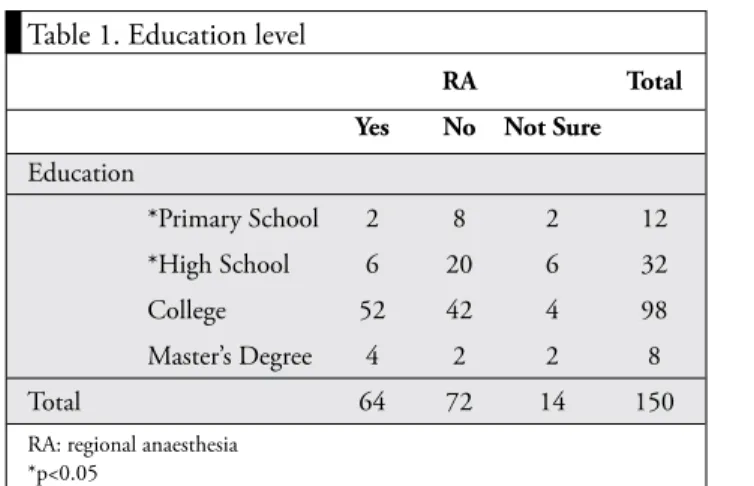
One hundred fifty ASA I or II parturients (RA, n=126/GA, n=24) answered the questionnaire. Of all patients, 42.7% (n=64) approved and 48% (n=72) refused RA at the first pre-operative anaesthesia visit. The rest of the parturients (n=14) had no idea of which anaesthesia type to choose. The edu-cation level significantly affected the preferences of patients (Table 1).
Forty-six percent (n=30) of the patients approving RA had experienced RA at least once before, and they suggested that their previous satisfaction with this type of anaesthesia was their reason for approval. The regional anaesthesia techniques used were epidural anaesthesia (18.6%) and combined spinal epidural anaesthesia (65.3%).
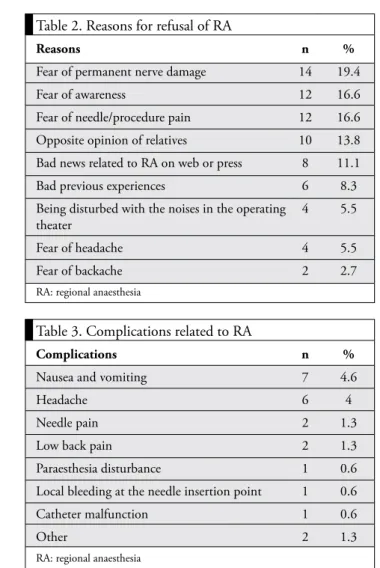
Seventy-two (48%) patients refused RA at the first preop-erative anaesthesia visit. Eight of them indicated that the reasons for their refusal were their previous RA experiences, which resulted in minor/major complications. Other reasons for patients’ refusals were fear of nerve damage (9.3%), being aware of what happens during surgery (8%), fear of needle/ injection (8%), fear of head/backache (4%), and likelihood of discomfort during the procedure (3%) and others (Table 2). The main information sources of patients about the risks of RA, like awareness, headache, and backache, were friends and family members.
After being informed about RA in detail, 48 (66.6%) of the patients who initially refused RA and all patients who had no idea approved the procedure, and all of them were satis-fied with the anaesthesia following the procedure. All patients pointed out that they were clearly informed about both GA and RA.
Table 1. Education level
RA Total
Yes No Not Sure
Education *Primary School 2 8 2 12 *High School 6 20 6 32 College 52 42 4 98 Master’s Degree 4 2 2 8 Total 64 72 14 150
RA: regional anaesthesia *p<0.05
Complications during epidural catheter placement included dural puncture (2%), epidural vascular damage (1.3%), and paresthesia (0.6%). Postoperative complications and side ef-fects were composed of nausea/vomiting (4.6%), headache (4%), local bleeding at the catheter insertion point (0.6%), and catheter malfunction (0.6%) (Table 3). No permanent neurological sequela, cardiac arrest, or maternal mortality was detected during the study period. Only 6.3% of the RA group patients stated that they were not satisfied with re-gional blocks due to headache (n=6), nausea/vomiting (n=7), and being aware of what was happening (n=2).
Discussion
The present information approved by most of anaesthesiolo-gists is that RA should be the method of choice in obstetric patients unless a contraindication is present. Katircioglu et al. (1) concluded in their study that epidural block success rates, low complication rates, extremely low morbidity rates, and absence of mortality are crucial points about RA. Low com-plication rates of our study and high satisfaction rates of our patients correlated with the safety results about RA.
Pelinka et al. (3) made a similar survey study among ortho-paedic patients. In this study, they showed that orthoortho-paedic patients preferred regional anaesthesia for arthroscopic
op-erations, since they were curious about the surgery. Other reasons for preferring RA were fear of GA and postopera-tive pain control. In our study, only obstetric patients were asked about their preferences and reasons for their choices. The most common reasons for the approval of RA were be-ing affected by the suggestion of their obstetricians and their previous experiences.
Some patients were indecisive about what type of anaesthesia is proper for the surgery. Effective preoperative information and correct selection of the type of anaesthesia may increase such patients’ preferences on behalf of RA. This was entirely observed in our study. After reading our information sheet and discussing all the questions they were curious about, all indecisive patients approved RA, and all of them were satis-fied with their preferences.
The results of the second part of our questionnaire (Appen-dix 2) pointed out that choices were likely to be changed by adequate information about regional anaesthesia. Our study revealed exactly that particularly obstetric anaesthetists should inform their patients about the advantages and disad-vantages of all alternative types of anaesthesia. Fortescue (6) and colleagues indicated that women actually benefit from receiving adequate information and being involved in the de-cision-making process. Especially, obstetric anaesthesiologists should be more insistent about informing pregnant patients. A better antenatal education is likely to eliminate unintended and incorrect information gained from social circles (7). Pa-tients should be given a chance to ask questions related to their fears and anxieties.
In a recent study, the most frequent risks of regional anaes-thesia that anaesthetists talked to the obstetric patients about were postdural puncture headache, block failure, permanent neurological injury, temporary leg weakness, and hypoten-sion (8). So, it is obvious that the anaesthtetists consider headache, paralysis, nerve damage, and inadequate block to be the most important risks of regional anaesthesia in ob-stetrics (9). The most common side effects of any kind of anaesthesia that would be performed should be presented in detail. All of the risks about both RA and GA were included in our information sheet.
The surveys pointed out that families or friends were the main sources of the risk information, especially about nerve damage and paralysis (4, 10, 11). Our patients indicated that the main information sources of patients about the risks of RA, such as awareness, headache, and backache, were their friends and family members.
Matthey et al. (12) presented that the public does not really understand the advantages, disadvantages, and risks of RA. Another important point of view was the patients’ previous experiences (13). If a patient experienced any kind of dis-turbing complication once, he/she would hesitate to approve RA again.
Table 2. Reasons for refusal of RA
Reasons n %
Fear of permanent nerve damage 14 19.4
Fear of awareness 12 16.6
Fear of needle/procedure pain 12 16.6
Opposite opinion of relatives 10 13.8
Bad news related to RA on web or press 8 11.1
Bad previous experiences 6 8.3
Being disturbed with the noises in the operating 4 5.5
theater
Fear of headache 4 5.5
Fear of backache 2 2.7
RA: regional anaesthesia
Table 3. Complications related to RA
Complications n %
Nausea and vomiting 7 4.6
Headache 6 4
Needle pain 2 1.3
Low back pain 2 1.3
Paraesthesia disturbance 1 0.6
Local bleeding at the needle insertion point 1 0.6
Catheter malfunction 1 0.6
Other 2 1.3
RA: regional anaesthesia
Resistance to RA may sometimes be observed among sur-geons. If a patient’s surgeon is against RA, the anaesthesiol-ogist will not be able to persuade him/her about RA. The health care personnel should be the pioneer of informing pa-tients about it and mainstreaming it in public.
Conclusion
Effective and correct information is the major point of view. All patients have the right to be informed about what might happen. Especially, obstetric patients benefit from RA; how-ever, patients themselves would have no idea about advan-tages and disadvanadvan-tages of the anaesthesia types unless their doctors inform them correctly.
Ethics Committee Approval: Ethics committee approval was
re-ceived for this study from the ethics committee of Health Research System Hospital.
Informed Consent: Written informed consent was obtained from
patients who participated in this study.
Peer-review: Externally peer-reviewed.
Author Contributions: Concept - P.K.; Design - P.K.; Supervision
- C.A.; Funding - P.K.; Materials - T.A.; Data Collection and/or Pro-cessing - P.K.; Analysis and/or Interpretation - P.K., T.A.; Literature Review - P.K.; Writer - P.K., C.A.; Critical Review - T.A.
Conflict of Interest: No conflict of interest was declared by the authors.
Financial Disclosure: The authors declared that this study has
re-ceived no financial support.
Etik Komite Onayı: Bu çalışma için etik komite onayı Health
Re-search System Hastanesi’nden alınmıştır.
Hasta Onamı: Yazılı hasta onamı bu çalışmaya katılan hastalardan
alınmıştır.
Hakem değerlendirmesi: Dış bağımsız.
Yazar Katkıları: Fikir - P.K.; Tasarım - P.K.; Denetleme - C.A.;
Kay-naklar - P.K.; Malzemeler - T.A.; Veri toplanması ve/veya işlemesi - P.K.; Analiz ve/veya yorum - P.K., T.A.; Literatür taraması - P.K.; Yazıyı yazan - P.K., C.A.; Eleştirel İnceleme - T.A.
Çıkar Çatışması: Yazarlar çıkar çatışması bildirmemişlerdir.
Finansal Destek: Yazarlar bu çalışma için finansal destek
almadıkla-rını beyan etmişlerdir.
References
1. Katircioglu K, Hasegeli L, Ibrahimhakkioglu HF, Ulusoy B, Damar H. A retrospective review of 34109 epidural anesthetics for obstetric and gynecologic procedures at a single private
hos-pital in Turkey. Anesth Analg 2008; 107: 1742-5. [CrossRef]
2. Shibli KV, Russell IF. A survey of anesthetic techniques used for cesarean delivery in the UK in 1997. Int J Obstet Anaesth
2000; 9: 160-7. [CrossRef]
3. Pelinka LE, Hartmut P, Leixnering M, Mauritz W. Why pa-tients choose regional anesthesia for orthopedic and trauma surgery. Arch Orthop Trauma Surg 2003; 123: 164-7. 4. Saunders TA, Stein DJ, Dilger JP. Informed consent for labor
epidurals: a survey of Society for Obstetric Anesthesia and Per-inatology anesthesiologists from the United States. Int J Obstet
Anesth 2006; 15: 98-103. [CrossRef]
5. Waisel DB, Truog RD. Informed consent. Anesthesiology
1997; 87: 968-78. [CrossRef]
6. Fortescue C, Wee MYK, Malhotra S, Yentis SM, Holdcroft A. Is preparation for emergency obstetric anaesthesia adequate? A maternal questionnaire survey. Int J Obstet Anesth 2007; 16:
336-40. [CrossRef]
7. Rooney KD, Young SJ. Better antenatal education is a good idea, but does not reduce maternal anxiety regarding anaesthe-sia for emergency caesarean delivery. Int J Obstet Anesth 2009;
18: 97-8. [CrossRef]
8. Black JDB, Cyna AM. Issues of consent for regional analgesia in labour: a survey of obstetric anaesthetists. Anaesth Intensive Care 2006; 34: 254-60.
9. Cheng WYC, Cyna AM, Osborn KD. Risks of regional an-aesthesia for caesarean section: women’s recall and information sources. Anaesth Intensive Care 2007; 35: 68-73.
10. Paech MJ, Gurrin LC. A survey of parturients using epidural an-algesia during labour. Considerations relevant to antenatal
edu-cators. Aust NZ J Obstet Gynaecol 1999; 39: 21-5. [CrossRef]
11. Sakala C, Declercq ER, Corry MP. Listening to mothers: the first national US survey of women’s childbearing experiences. J
Obstet Gynecol Neonatal Nurs 2002; 31: 633-4. [CrossRef]
12. Matthey PW, Finegan BA, Finucane BT. The public’s fears about and perceptions of regional anesthesia. Reg Anesth Pain
Med 2003; 29: 96-101. [CrossRef]
13. Birnbach D. The public’s perception of regional anesthesia: why don’t they get ‘the point’? Reg Anesth Pain Med 2004; 29:
86-9. [CrossRef]
Appendix 1 Questionnaire Part 1
1. Date: 2. Age:
3. Occupation: employee worker
teacher engineer
medical staff housewife
student other
4. Parity: None 1 2 >2
5. Education: Primary school
High school
College
Master’s Degree
6. Would you prefer regional anaesthesia for your operation?
Yes No
(if yes, do not answer question ≠ 13)
7. What is your reason for approval of regional anaesthesia? Fear of general anaesthesia
Safer than general anaesthesia My previous experiences
My surgeon recommended me to do so
Other ……… 8. Have you ever been operated with regional anaesthesia?
Yes No
9. If yes, what type of anaesthesia?
Spinal Epidural Combined spinal+epidural Peripheral block
10. Was it comfortable?
Yes No
11. Have any of your relatives or friends been operated with regional anaesthesia?
Yes No
12. Did they complain about anything related to regional anaesthesia?
Yes No
13. What is the reason for your refusal of regional anaesthesia? Being disturbed by environmental factors in operating theater Permanent neurological damage
Risk of headache Risk of low back pain Local pain
Fear of injection and needle Internet cons
Bad experiences of relatives or friends Previous experiences
Risk of infection Fear of feeling pain Fear of nausea and vomiting
Other……….
After a patient reads the information form, proceed to the second part of the questionnaire.
Appendix 2 Questionnaire Part 2
3. Are you satisfied with the information about regional anaesthesia?
Yes No
4. Have you changed your mind about your preference?
Yes No
Appendix 3 Questionnaire Part 3
3. Are you pleased and satisfied with regional anaesthesia?
Yes No
4. If not, the reason is
Being disturbed by the environmental factors in operating theater
Headache Low back pain Pain during operation Needle pain
Nausea and vomiting Paresthesia disturbance
Other………...….
181
View publication stats View publication stats