Bull Vet Inst Pulawy 51, 361-364, 2007
ISOLATION AND ANTIBIOTIC SUSCEPTIBILITY
OF
AEROMONAS HYDROPHILA
IN A CARP
(
CYPRINUS CARPIO
) HATCHERY FARM
DILEK OZTURK RAMAZAN ADANIR1, AND HULYA TURUTOGLU
Department of Microbiology, 1Department of Parasitology, Faculty of Veterinary Medicine, Mehmet Akif Ersoy University, 15100 Burdur, Turkey
Received for publication February 26, 2007
Abstract
The aim of this study was to describe a case of skin lesions with haemorrhaging in a carp (Cyprinus carpio) hatchery farm and to determine effective antibiotic treatments. In the macroscopic examinations of nine carp with haemorrhagic skin lesions, brown or red spotted skin changes of a varying degree were found, along their bodies. No lesions were observed in the internal organs. Pure cultures of
Aeromonas hydrophila were isolated from the skin, kidney,
heart, and liver of the carp. All of the isolates were found to be susceptible to danofloxacin, enrofloxacin, gentamicin, ciprofloxacin, neomycin, and trimethoprim-sulphamethoxazole and resistant to ampicillin, amoxicillin, amoxicillin/clavulanic acid, oxytetracycline, and streptomycin. Treatment of A.
hydrophila infection was carried out by applying
trimethoprim-sulphamethoxazole for 3 d at 10 g/ton of pool water.
Key words: carp, Aeromonas hydrophila, antibiotic susceptibility.
Aeromonas hydrophila is the causative agent of
the disease known as “haemorrhagic septicaemia”, “ulcer disease” or “red-sore disease” (7, 16). A.
hydrophila is generally found in the gastrointestinal tract
of fish and is considered an opportunistic pathogen (16, 19). Most of bacteria, which are termed “opportunistic” usually, do not cause disease unless other factors are involved. A. hydrophila is always capable of producing disease if given the chance (19). Outbreaks of the disease are usually associated with a change in environmental conditions, such as stress, overcrowding, a sudden change of temperature, transfer of fish, mishandling, poor water quality, high nitrite and carbon dioxide levels (2, 5, 6, 12, 19). In Turkey A. hydrophila had been reported in eels (Anguilla anguilla), reptiles (crocodile) and grass carp (Ctenopharyngodon idella) (17-19).
The aim of this case report is to describe a case of skin lesions with haemorrhaging in a carp (Cyprinus
carpio) hatchery farm in the Burdur province of Turkey
and to determine an effective antibiotic treatment.
Material and Methods
Environmental conditions at the fish
hatchery farm. Because of haemorrhages with dermal
ulcers along their bodies, nine carp were selected for the investigations. The disease history was obtained from their owner. At the farm, there was not any mortality observed, but there was 20% morbidity. The fish hatchery farm covered an area of 22 960 m2. In three of
12 pools, the fish were kept at the weight of 600 g, 800 g, and 2 kg, and the capacity was 10-ton of fish per year. Environmental conditions were found rather suitable for a carp hatchery. The water, as required for carp hatchery farm, was supplied from a stream and the quality of water was stable during the year. The temperature of water was 10-20°C, and the pH was 8.77.
Sampling and microbiological examination.
The samples of the liver, gill, kidney, heart, and skin of each of the fish were collected. The samples were placed on 5% sheep blood agar plates (Oxoid) and MacConkey agar (Oxoid) plates and then incubated at 25ºC and 37ºC for 3-4 d under aerobic conditions. After incubation, the pure haemolytic yellow colonies were isolated from skin and internal organs of all the carp. The bacteria were identified as A. hydrophila on the basis of colony morphology, Gram-staining, and biochemical characteristics (3, 10). Wet mounts of skin, fin, and gill smears were also examined microscopically as well as a macroscopic examination for parasites.
Antibiotic susceptibility test. The
susceptibility of the isolates to the following antibiotics: ampicillin (10 µg, Oxoid), amoxicillin (25 µg, Oxoid), amoxicillin/clavulanic acid (30 µg, Oxoid), oxytetracycline (30 µg, Oxoid), enrofloxacin (5 µg, Oxoid), danofloxacin (5 µg, Pfizer), streptomycin (10 µg, Oxoid), trimethoprim-sulphamethoxazole (25 µg,
362
Oxoid), neomycin (30 µg, Oxoid), gentamicin (10 µg, Oxoid), and ciprofloxacin (5 µg, Oxoid) (4) were tested using disc diffusion methods.
Results
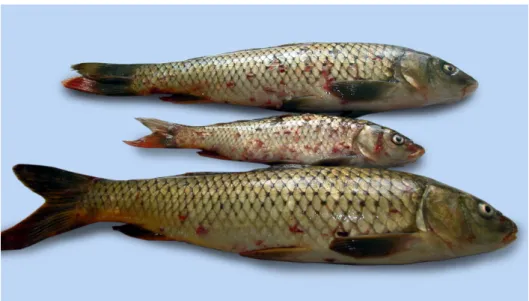
In the macroscopic examinations of the carp, brown or red spotted skin lesions of a varying degree were found along their bodies (Fig.1). These lesions were mostly scattered over the abdomen, operculum, head, fins, and gills. No lesions were observed in the visceral organs. Gram-negative bacilli were seen in Gram-stained smears, taken from the skin, liver, and kidney. No parasites in the skin, fin, gills, and internal organs were found. A. hydrophila was isolated from the liver, gill, kidney, heart, and skin of each fish. A
biochemical characteristic of A. hydrophila was given in Table 1.
A. hydrophila isolates were found to be
susceptible to danofloxacin, enrofloxacin, gentamicin, ciprofloxacin, neomycin, and trimethoprim-sulphamethoxazole, and to be resistant to ampicillin, amoxicillin, amoxicillin-clavulanic acid, oxytetracycline, and streptomycin. In the treatment of A.
hydrophila infection, trimethoprim-sulphamethoxazole
was chosen, based on results from an antibiotic susceptibility test. After the fish had been kept in saltwater for30 min, they were removed and placed in water with trimethoprim-sulphamethoxazole. The antibiotic was used for 3 d in pool water at 10 g/ton. The infection in the carp was treated with trimethoprim-sulphamethoxazole.
Fig. 1. The appearance of the brown or red spot lesions on the skins of the carp, from which A. hydrophila was isolated.
Table 1
Biochemical features of A. hydrophila isolates
Biochemical features Reactions Biochemical features Reactions
Gram-staining - ß-haemolysis +
Catalase + H2S -
Oxidase + Motility +
Lactose + Methyl red +
Glucose, acid + ONPG + Glucose, gas - Lysine decarboxylase - Mannitol, acid + Growth at:
Indol production + 24ºC + Urea hydrolysis - 37°C + Esculin hydrolysis + Growth on:
Nitrate reduction + Blood agar + Casein hydrolysis + MacConkey agar +
363
Discussion
As it was mentioned in the introduction, A.
hydrophila causes a disease known as haemorrhagic
septicaemia or ulcer disease in fish, and belongs to the most common bacteria present in aquatic environments throughout the world. The bacterium is naturally found in the intestinal tract of the fish, and does not cause the disease under natural conditions (16). The disease caused by A. hydrophila is one of the major disease problems for farmed carp (5, 7). Outbreaks of the disease are usually caused by stress and changes in environmental conditions. Overcrowding, handling, transportation, poor water quality, a sudden change of temperature, low dissolved oxygen, and high CO2,
nitrite, and ammonia levels are the most common predisposing factors associated with this disease (2, 5, 16, 19). In this study, environmental conditions in the hatchery farm were found rather suitable for a carp hatchery. The most common predisposing factors that increase the pathogenicity of A. hydrophila were not determined in the carp hatchery farm.
The parasites, such as Lernaea, Argulus, and A.
salmonicida may also be a cause of ulcerative lesions on
the skins of carp (1, 13). But, in this study, at the level of macroscopic and microscopic examinations, no parasites were observed. In this study, it is considered that the disease of the fish may be related to A. hydrophila, as the same bacteria in a pure culture were isolated from skin lesions and internal organs. It has been reported by several researchers that A. hydrophila causes haemorrhagic skin lesions in cultured and fresh water fish (2, 7, 14, 16). In this study, carp is determined as susceptible to A. hydrophila infection. Similarly, some researchers reported that most cultured and fresh water fish, such as eel, goldfish, catfish, rainbow trout, ayu, tilapia, were susceptible to A. hydrophila infection (2, 11, 19).
A. hydrophila isolated from fish, displays a
high degree of resistance to antibiotics (2, 7, 14). Consequently, we performed the antibiotic susceptibility test, in order to determine the susceptibility of A.
hydrophila to different antibiotics that are used in
veterinary medicine in Turkey. A. hydrophila strains have been reported to be intrinsically resistant to ampicillin by many researchers (1, 7, 14). In this study,
A. hydrophila strains were resistant to ampicillin, as
predicted. The strains were also found to be resistant to other ß-lactam antibiotics, such as amoxicillin and amoxicillin/clavulanic acid. Resistance of Aeromonas sp. to ß-lactam antibiotics was determined by other researchers (7-9, 17, 20). Although some researchers (7, 8) reported that Aeromonas sp. were susceptible to streptomycin, the A. hydrophila strains isolated in this study were resistant to streptomycin, as found out in several other studies (12, 14). Oxytetracycline is frequently used as an antimicrobial agent in cultured fish hatcheries in Turkey. Therefore, it was expected that the isolated strain was resistant to oxytetracycline.
Turkey has a great potential for carp hatcheries because of its location (8). Economical losses caused by
A. hydrophila infections have great importance in carp
farms (7). At present, the most widely used method of controlling A. hydrophila infection in cultured fish is the use of antimicrobial drugs (2, 7, 15). The widespread antibiotic use is associated with an increased antibiotic resistance in aquatic bacteria. Thus, antimicrobial susceptibility tests are important for an effective treatment. The treatment of A. hydrophila infection in this study was carried out using trimethoprim-sulphamethoxazole for 3 d, at 10 g/ton pool water. The choice of the antibiotic was based on the results from a susceptibility test.
In conclusion, this case report has exhibited that
A. hydrophila may cause haemorrhages with dermal
ulcers in carp. Uncontrolled and extensive use of antimicrobial agents may cause the frequent occurrence of multiple antimicrobial resistances. Therefore, an antimicrobial susceptibility test in A. hydrophila infection, as well as in other bacterial infections, has to be certainly made in cultured fish hatcheries. To prevent the infection water should be regularly changed and overcrowding and stress in the fish population should be avoided.
References
1. Arda M., Secer S., Sarieyyupoglu M.: Balik Hastaliklari, Medisan Yayinevi, Ankara, Turkey, 2002, pp.115-116. 2. Aoki T.: Motile aeromonads (Aeromonas hydrophila). In:
Fish diseases and disorders. Woo PTK, Bruno D.W. (ed.)
CABI Publishing, Wallingford, UK, 1999, pp.427-453. 3. Brenner D.J., Krieg N.R., Staley J.R.: Bergey’s manual of
systematic bacteriology, Springer, USA, vol. 2, part B, 2005, pp.557-578.
4. Bauer A.W., Kirby W.M.M., Sherris J.C., Turck M.: Antibiotic susceptibility testing by a standardized single disk method. Am J Clin Pathol 1966, 45, 493-496.
5. Cipriano R.C.: Aeromonas hydrophila and motile Aeromonad septicemias of fish. Fish Dis Leaflet 68, United States Department of the Interior fish and wildlife service, Division of Fishery research. Washington, DC 2001, pp.1-25.
6. Dixon B.A., Issvoran G.: Antibacterial drug resistance in
Aeromonas spp. isolated from domestic goldfish and koi
from California. J World Aqua Soc 1993, 24, 102-104.
7. Guz L., Kozinska E.: Antibiotic susceptibility of
Aeromonas hydrophila and A. sobria isolated from
farmed carp (Cyprinus carpio L). Bull Vet Inst Pulawy 2004, 48, 391-395.
8. Kirkan S., Goksoy E.O., Kaya O.: Isolation and antimicrobial susceptibility of Aeromonas salmonicida in rainbow trout (Oncorhynhus mykiss) in Turkey hatchery farms. J Vet Med 2003, 50, 339-342.
9. Ko W.C., Wu H.M., Chang T.C., Yan J.J., Wu J.J.: Inducible ß-lactam resistance in Aeromonas hydrophila: therapeutic challenge for antimicrobial therapy. J Clin Microbiol 1998, 36, 3188-3189.
10. Koneman E.W., Allen S.D., Janda W.M., Schreckenberger P.C, Winn J.R.: Color atlas and textbook of diagnostic microbiology. JP Lippincott, Philadelphia, 1992, pp.267-272.
11. Kozinska A., Figueras M.J., Chacon M.R., Soler L.: Phenotypic characteristics and pathogenicity of
364
(Cyprinus carpio L). J Appl Microbiol 2002, 93, 1034-1041.
12. Lakshmanaperumalsamy P, Thayumanavan T., Subashkumar R.: Aeromonas hydrophila: A remerging pathogen, In: Marine Microbiology. Facets &
Opportunities; Ramaiah, N (Ed.), 2005, pp. 115-119. 13. Lester R.J.G., Roubal F.R.: Protozoan and Metazoan
Infections. In: Fish diseases and disorders. Woo P.T.K. (ed.), CABI Publishing, Wallingford, UK, 1999, pp. 486-550.
14. Radu S., Ahmad N., Ling, F.H., Reezal A.: Prevalence and resistance to antibiotics for Aeromonas species from retail fish in Malaysia. Int J Food Microbiol 1997, 81, 261-266.
15. Son R., Rusul G., Sahilah A.M., Zaınuri A., Raha A.R., Salmah I.: Antibiotic resistance and plasmid profile of
Aeromonas hydrophila isolates from cultured fish Telapia
(Telapia mossambica). Lett Apple Microbiol 1997 24, 479-482.
16. Swann L., White M.R.: Diagnosis and treatment of
Aeromonas hydrophila infection of fish. Aquaculture
extension- Illinois-Indiana Sea Grant Program 1989, pp.91-92.
17. Turutoglu H., Ercelik S., Corlu M.: Aeromonas
hydrophila-associated skin lesions and septicaemia in a
Nile crocodile (Crocodylus niloticus). J S Afr Vet Ass 2005, 76, 40-42.
18. Uzbilek M.K., Yildiz H.Y.: A report on spontaneous diseases in the culture of grass carp (Ctenopharyngodon
idella), Turkey. Turk J Vet Anim Sci 2002, 26, 407-410.
19. Yildiz H., Bekcan S., Karasu Benli A.C., Akan M.: Some blood parameters in the eel (Anguilla anguilla) spontaneously infected with Aeromonas hydrophila, Israel J Vet Med 2005, 60, 91-92.
20. Yucel N., Aslim B., Beyatli Y.: Prevalence and resistance to antibiotics for Aeromonas species isolated from retail fish in Turkey. J Food Quality 2005, 28, 313-324.