SHORT RESEARCH AND DISCUSSION ARTICLE
Tourist arrivals in four major economies: another side of economic
policy uncertainty and fear
Gizem Uzuner1&Seyi Saint Akadiri2&Andrew Adewale Alola3,4
Received: 8 July 2019 / Accepted: 7 May 2020
# Springer-Verlag GmbH Germany, part of Springer Nature 2020 Abstract
In this paper, we examine the direction of causal relationships among migration-related fear, economic policy uncertainty, tourism, and economic growth in the panel economies of France, Germany, the UK, and the USA. To the best of our knowledge, this study is the first to examine the interaction and interrelationship between these variables in a multivariate causality study, using a quarterly data over the period 1985Q1–2017Q4 via time-series causality approach as advanced by Emirmahmutoglu and Kose (Econ Model 28:870–876,2011) that produces country-specific causality statistic and also captures slope heterogeneity in panel data. Empirical results show that migration-related fear is linked with EPU, tourism arrivals, and real income. Thus, we suggest fear-induced economic policy uncertainty, fear-induced tourism, and economic policy uncertainty–induced growth hypotheses with credible policy suggestions for tourist destinations.
Keywords Fear . Economic policy uncertainty . Tourism arrivals . Economic growth . 4 major economies
Introduction
In order to further understand the link between migration and tourism, the United Nations World Tourism Organization (UNWTO2017) noted certain effects arising from the migra-tory mobility of tourism. Earlier, Williams and Hall (2000) noted the interconnectedness between tourism and migration and at the same time affirmed the existence of tourism-related
migration patterns to include labor, return, entrepreneurial, and retirement migration. Thus, the relevance of tourism to economic activities has continued to necessitate the need to further harness tourism opportunities in medical tourism, reli-gious tourism, sport tourism, among other forms of tourism. But achieving the underlying opportunities in the tourism in-dustry could be unattainable without decoupling the potential challenges associated the migration-related tourism. For in-stance, since the September 2011 terrorist attack in the USA by radical and self-acclaimed Islamic group, the aftermath of the impact soon resulted to migration/immigration-related problems. In the USA and many of the European countries (such as the UK, France, and Germany), the September 2011 attack has since increased backlash against the Muslim com-munity and a spike in hate-related crimes, thus compounding migration-related fear and impeding tourism development (Gould and Klor2016; Donadelli et al.2018).
Insight from the tourism performance of the three of Europe’s largest economies and the USA is an indication that the countries concerned are tourist destination countries. Specifically, in 2017, the contribution of tourism to total GDP in France, Germany, the UK, and the USA is respective-ly given as 8.9%, 10.7%, 10.5%, and 7.7%. In the same report of the World Travel and Tourism Council (WTTC), the per-formance of the tourism sector (total percentage of contribu-tion to the GDP) in France, Germany, UK, and the USA is Responsible Editor: Philippe Garrigues
* Gizem Uzuner
[email protected] Seyi Saint Akadiri [email protected] Andrew Adewale Alola [email protected]
1 Department of Economics, Eastern Mediterranean University, via
Mersin 10, Famagusta, North Cyprus, Turkey
2
Research Department, Central Bank of Nigeria, Abuja, Nigeria
3
Faculty of Economics, Administrative and Administrative and Social Sciences, Istanbul Gelisim University, Istanbul, Turkey
4 Department of Financial Technologies, South Ural State University,
Chelyabinsk, Russia
https://doi.org/10.1007/s11356-020-09219-9
respectively expected to be 9.4%, 11.2%, 10.8%, and 8.4% by 2028 (WTTC2018). Similarly, the WTTC indicated that trav-el and tourism have contributed (in total) to the employment and investment of the aforementioned countries. In France, 10% of total employment in 2017 was from the sector and it is expected to increase to 11.2% in 2028. For Germany, 13.8% of total employment in 2017 is from the sector and it is ex-pected to increase to 14.8% in 2028. In the UK, total employ-ment amounts to 11.6% in 2017 and is expected to increase to 12.1% in 2028. Meanwhile, 8.9% of total employment is gen-erated by the sector and could possibly increase to 10.1% by 2028.
Importantly, the factors associated with the tourism perfor-mance and otherwise for the aforementioned countries could either be country-specific or a spillover of events from other countries. This is an indication that a certain level of (economic) uncertainty resulting from certain factors could significantly dictate the performance of the tourism sector. In recent time, studies have widely demonstrated the link be-tween tourism and economic growth or the investigation of the tourism-led growth hypothesis (Rasekhi et al. 2016; Akadiri et al.2017, Fahimi et al. 2018; Roudi et al. 2018; Usman et al.2019), and the link between tourism and other factors (Katircioğlu2014; Katircioğlu et al.2014; Alola and Alola2018a,2018b). Notwithstanding, the tourism outlook of France, Germany, the UK, and the USA (and the global per-spective) indicates the justification for the examination of the relationship between tourism and uncertainty parameters. This is necessary considering the unexpected risk associated with the ripple effects of the global financial crisis (GFC) that spread from the USA subprime mortgage market to other sec-tors of the economy.
On this note, the current study employs the economic pol-icy uncertainty (EPU)1and the migration-related index2that has not been used in the extant literature and in the context of tourism. This is because of the degree of uncertainty associat-ed with fiscal policies and the fear-inducassociat-ed factors in destina-tion countries. Hence, the study hypothesizes that economic policy uncertainty and migration-related fear Granger cause tourism arrival in France, Germany, the UK, and the USA. The use of migration-related fear is responsible for the restric-tion to the 4 major economies (France, Germany, the UK, and the USA). To an extent, the result of the investigation is ex-pected to offer direction to the implementation of economic-related policies in the examined countries. It will potentially
guide on how to address potential factors that induce fear in the destination countries, in this case, 4 major economies.
The remaining sections are structured as follows. The “Tourist inflows: the economic uncertainty-fear dilemma” section presents the underlying concept of fear, EPU, and tourism arrivals while the“Data and methodology” section highlights data description and the empirical methodologies. The empirical findings and implications for policy decision-making are reported in the“Results and discussion” section. Lastly, the concluding remarks are provided in the “Conclusion” section.
Tourist inflows: the economic
uncertainty-fear dilemma
In addition to the effect of the USsubprime mortgagemarket crash on the financial sector, the circumstance of the global financial crisis (GFC) of 2008–2009 on the international tour-ist arrivals globally is observed to be significant (Central Bureau Voor de Statistiek 2018). In reality, a high level of economic or financial risk is associated with low and effective predictability of the policy dynamics and such that character-izes the GFC. Hence, the fiscal policies, especially the uncer-tainty in the economic policy of the destination countries, are potential determinants of tourist inflows. For instance, as the world’s primary tourism destination, the European Union (EU)’s tourism sector generates 10% of the region’s GDP. Subsequently, this has since triggered environmental and socio-economic policies from the member countries (European Environment Agency2016).
In addition to the impact of the economic uncertainty on the inbound tourists’ decision-making, the role of fear (migration-related fear) on the tourists is obviously important. Although fear is the feeling of a perceived threat, in this context (a migration-related fear), the threat is associated with the event within or round the destination country. As developed by Baker et al. (2016), the migration-related fear is characterized by anxiety, panic, bomb, fear, crime, terror, worry, concern, and violence. As such, these determinants of fear have been linked with tourism in previous studies (Wachowiak 2016; Bassil et al.2019). For instance, transnational terrorism and domestic terrorism are primarily associated with migration-related fear. Nowadays, the new coronavirus (SARS-CoV2) has generated an unprecedented impact in most countries of the world. The virus has affected almost every country on the planet (138 in total), spread to more than 2 million people, and caused around 140,000 deaths (WHO2020). The fear of the COVID-19 outbreak created a huge whirlpool of uncertainty. The results of this fear created the quarantine economy which affects consumer/tourist psychology. Therefore, this negative effect can be spread to travel industries.
1
The Policy Uncertainty index (EPU) which was developed from the news-paper coverage of events (such as war, terrorist attacks, financial crisis, and fiscal policy) (Baker et al.2016). Further information on economics can be read fromhttp://www.policyuncertainty.com/.
2Baker et al. (2016) developed the migration fear index for four countries
(France, Germany, UK, and the USA). The details can be read fromhttp:// www.policyuncertainty.com/immigration_fear.html.
Theoretical concept
As previously indicated, evidence has shown that there exists a significant linkage between migration and tourism, thus is the migration-related fear and tourism (Gould and Klor2016; Donadelli et al.2018). For reason of“sentiment” or “mood,” the decision to tour or not of a tourist (tourism consumer) is believed to change over time, thus affecting the outbound tourism and tourism demand of a destination (Schwarz and Clore2003; Dragouni et al.2016). Moreover, the study of Dragouni et al. (2016) and many others further established the link between tourism performance and the EPU. In specif-ic, the consumer spending behavior (of a tourist) is believed to be a function of EPU (Gozgor and Ongan2017; Alola et al. 2020). Thus, the concept of international tourism arrivals is further modified according the aforementioned studies to ac-commodate migration-related fear, EPU, and income as deter-minants and illustrated accordingly as ITA = f (EPU, FEAR, RGDP).
Data and methodology
Data
In the current study, data availability (migration-related fear data only available for the sampled countries) restricted to four (4) major economies which include: France, Germany, UK, and the USA. The series employed covers the period 1997Q1– 2016Q4. The EPU and the migration-related fear index devel-oped by Baker et al. (2016) for the aforementioned countries and the real GDP per capita are the independent variables employed. In addition, international tourism arrivals (ITAs) are employed as the dependent variable. Baker et al. (2016) developed the EPU and the migration fear indices from the newspaper captions as illustrated in detail fromhttp://www. policyuncertainty.com/immigration_fear.html. The World Development Indicators (WDI 2018) is the source of the ITAs and real GDP per capita. All the variables are used in their logarithmic forms in the estimations.
Methodology
It has been well-established in the literature that the standard asymptotic theory cannot be used to test for hypothesis in a level VAR model if the series are nonstationary (Sims et al. 1990; Toda and Phillips 1993). To avoid this problem, Emirmahmutoglu and Kose (2011) proposed an alternative method to test coefficient restrictions of a level VAR model. This method is based on the modified Wald test in the lag-augmented VAR (LA-VAR) approach with the asymptotic chi-square (χ) distribution for the estimated VAR (p + dmax) model. Emirmahmutoglu and Kose (2011) extended the
LA-VAR approach to test panel causality for heterogeneous mixed panels.
zi;t¼ δziþ ∑kr¼1iþdmaxiD11;irxi;t−rþ ∑kr¼1iþdmaxiD12;irzi;t−rþ εzi;tð1Þ
xi;t¼ δxi þ ∑kr¼1iþdmaxiD21;irxi;t−rþ ∑kr¼1iþdmaxiD22;irzi;t−r
þ εx
i;t ð2Þ
where i stands for individual cross-sectional units and t is time period, kidenotes the lag structure, and dmaxiis the maximal order of integration. In this study, zi, t, i = 1,2, …N represents ITA while xi, t, i = 1,2, …N refers to EPU, FEAR, and RGDP. Three different results can be generated for the individual country from the Granger causality output, such as (i) unidi-rectional Granger causality from z (ITA) to x (EPU, FEAR, and/or RGDP) if all D11, irare zero, but not all D22, irare zero, (ii) unidirectional Granger causality from x EPU, FEAR, and/ or RGDP) to z (ITA) if all D22, irare zero, but not all D11, irare zero, (iii) bidirectional Granger causality relation between z and x if some of the D11, irand D22, irare non-zero.3
Results and discussion
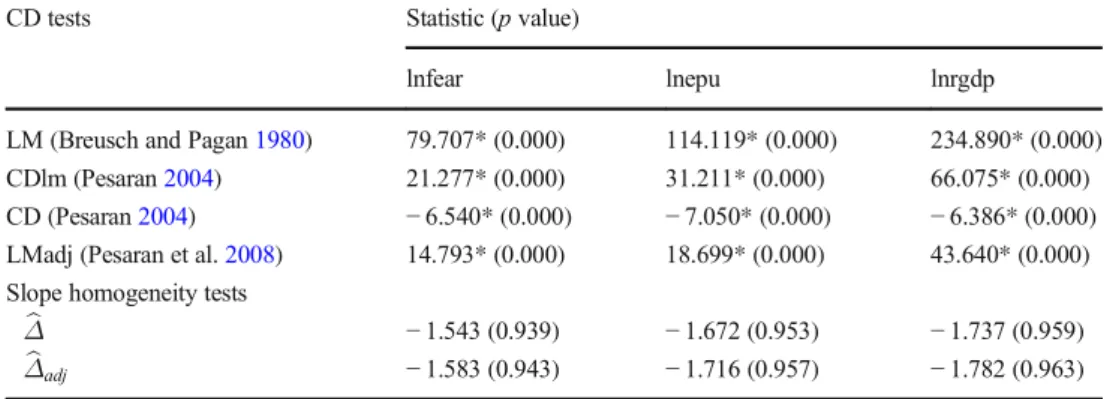
This section deals with empirical results and discussion. For sound and robust empirical estimations, we test for the existence of CSD using panel unit root tests as advanced by Pesaran et al. (2008) bias-adjusted LM test, Pesaran (2004), Pesaran (2004) Scaled LM test, and Breusch and Pagan (1980) LM test. Using, Pesaran and Yamagata (2008) which is a standardized version of the Swamy (1970) we test for slope homogeneity as shown in Table1. CSD results as re-ported in Table1show non-rejection of the null hypothesis of the existence of CSD at p < 0.01 significance level for the paneled data. Similarly, results as reported in Table 1 also show non-rejection of the null hypothesis of the existence of a slope homogeneity among the variables at p < 0.01 signifi-cance level. For the stationarity test, we used the CIPS unit root test approach as advanced by Pesaran (2007). CIPS unit root test results as reported in Table2show that the variables under observation are all stationarity at the first difference, i.e., I (1). Finally, for long-run cointegration estimation, we make use of Westerlund and Edgerton (2007) bootstrap cointegration techniques. Cointegration results as reported in Table3show support for the existence of a long-run equilib-rium relationship for both individuals and across the panel.
In order to achieve our research objectives, we carry out the Granger causality test to examine the direction of causality relationship between the variables and whether they have pre-dictive power over one another or not. We capture omitted
3For detailed information, interested reader should see Emirmahmutoglu and
variable bias in our empirical analysis by employing the real GDP per capita (a proxy for economic growth) as an addition-al variable for control purposes using the LA-VAR that gen-erates country-specific causality method as suggested by Emirmahmutoglu and Kose (2011). Table4reveals the rejec-tion of the null hypothesis of no causality nexus from fear to real income. Results show two-way causality nexus from fear and real income in Germany at p < 0.10 and p < 0.05 signifi-cance level. Thus, we infer that fear has predictive power over real income and vice versa. However, we could not reject the null of no causality nexus between fear and real income in France, the UK, and the USA respectively. This indicates that migration-related fear does not necessarily influence the increase/decrease in the level of income and vice versa. Thus, we suggest a fear-induced growth hypothesis in the case of Germany. These findings are consistent with the findings of Alola et al. (2020).
In addition, results, as reported in Table4, show one-way causality nexus from fear and tourism in France, Germany, the UK, and the USA at p < 0.10, p < 0.05, and p < 0.05 signifi-cance level respectively. Thus, we infer that fear predicts tourist arrivals. However, we could not reject the null of no causality
nexus from tourism to fear in all countries. The findings evi-dently indicate that the historical values of migration-related fear do influence the present tourist decisions in choosing po-tential tourist destinations. It further implied that the causative circumstances of fear and especially the migration-related fear concerns in the examined economies are potentially linked with the tourism performance of the economies. Thus, we suggest a fear-induced tourism hypothesis for 4 major economies. These findings are consistent with the findings of Dragouni et al. (2016), Wachowiak (2016), Akadiri et al. (2019), Alola et al. (2020), and Bassil et al. (2019).
Results also show two-way causality from fear to EPU in the USA at p < 0.05 and p < 0.01 and one-way causality from EPU to fear in the UK at p < 0.01 significance level. We thus infer that fear predicts EPU. However, we could not reject the null of no causality nexus between fear and EPU, as migration-related fear does not necessarily influence EPU in France and Germany. Similarly, we found neutrality hypothesis between real income and tourism in all countries. Findings indicate that tourism does not necessarily predict an increase/decrease in real income within the 4 major countries and vice versa. These results suggest fear-induced policy uncertainty and economic policy uncertainty–induced fear hypotheses respectively.
Finally, results, as reported in Table4, show one-way cau-sality nexus from EPU to real income in Germany, the UK, and the USA. These results imply that EPU is a useful Table 1 Cross-sectional
dependence and homogeneity test results
CD tests Statistic (p value)
lnfear lnepu lnrgdp
LM (Breusch and Pagan1980) 79.707* (0.000) 114.119* (0.000) 234.890* (0.000)
CDlm (Pesaran2004) 21.277* (0.000) 31.211* (0.000) 66.075* (0.000)
CD (Pesaran2004) − 6.540* (0.000) − 7.050* (0.000) − 6.386* (0.000) LMadj (Pesaran et al.2008) 14.793* (0.000) 18.699* (0.000) 43.640* (0.000) Slope homogeneity tests
b Δ − 1.543 (0.939) − 1.672 (0.953) − 1.737 (0.959) b Δadj − 1.583 (0.943) − 1.716 (0.957) − 1.782 (0.963) **Significance at 0.05 *Significance at 0.01
Table 2 CIPS panel unit
root test results Variables Statistics
lnta − 2.225 (0.571) Δlnta − 3.161** (0.027) lnfear − 2.130 (0.700) Δlnfear − 5.017** (0.000) lnepu − 2.806 (0.139) Δlepu − 4.710* (0.000) lnrgdp − 1.462 (0.983) Δlnrgdp − 3.223** (0.019) **Significance at 0.05 *Significance at 0.01 Table 3 Cointegration
test Tests Statistic (p value)
g_tau − 0.380 (0.501)
g_alpha 2.224 (0.957)
p_tau 0.217 (0.718)
p_alpha 0.217 (0.946)
Critical values for CIPS statistics are− 3.030, − 2.830, and − 2.720 for 0.01, 0.05, and 0.10, respectively
Table 4 Emirmahmutoglu and Kose ( 2011 ) G rang er ca usa lity te st lnf ≠ > lnrgdp lnrgdp ≠ >l n f ln f≠ > lta lta ≠ >l n f ln f≠ > lnepu lnepu ≠ >l n f L ags Wal d stat isti cs p val u e W ald st ati stic s p valu e L ag s W ald sta tis tic s p va lue W al d sta tist ics p va lue L ags W al d stat isti cs p val u e W ald st ati stic s p value France 1 2 .256 0.110 1.769 0.18 3 1 3.295** * 0 .069 0.031 0.860 1 0 .812 0.367 2.11 4 0 .146 German y 1 3.137 0.077 4.932** 0.02 6 1 5.235** 0. 022 1.355 0.244 3 0 .987 0.804 5.70 2 0 .127 UK 1 1 .806 0.179 0.686 0.40 8 1 4.987** 0.026 0.334 0.563 3 5 .348 0.148 12.0 78** 0.007 USA 1 2.483 0.115 2.099 0.14 7 1 7.363** 0.007 0.065 0.799 3 10.265* 0.004 21.4 06** 0.001 Λ 17.324*** 0.076 16.288 0.89 2 30.314 0.183 4.717 0.987 17.319 0.921 32.4 5 5 0 .754 lne p u ≠ > lnrgdp lnrgdp ≠ > ln epu lnta ≠ > lnrgdp lnrgdp ≠ >l n ta ln ta ≠ > lnepu lnepu ≠ >l n ta L ags Wal d stat isti cs p val u e W ald st ati stic s p value L ag s W al d sta tis tic s p va lue W al d stat ist ics p va lue L ags W al d st ati sti cs p valu e W ald sta tis tic s France 1 2 .593 0.107 0.001 0.97 8 1 0.032 0.858 1 .268 0.260 1 1 .060 0.3 0 3 1 .887 German y 1 6.815** 0.009 0.154 0.69 4 1 0.045 0.832 1 .270 0.260 1 1 .448 0.2 2 9 0 .942 UK 1 7 .154** 0.007 0.012 0.91 3 1 0.043 0.835 1 .266 0.260 1 1 .704 0.1 9 2 0 .400 USA 1 6.699** 0.010 0.221 0.63 8 1 0.048 0. 827 1 .262 0.261 1 3 .825 0.5 0 0 0 .480 Λ 32.949** 0.027 1.855 1.00 0 1 .416 0.998 1 0 .764 0.984 14.611 0.1 4 1 8 .472 The symbol “≠ >” de notes th at the re is n o G rang er ca usa lity The A kaike information criteria (AI C) is us ed for lag se lec tion ***S ignificance at 0 .10 **Significance at 0 .05 *Significance at 0 .01 Λ indi cat es fi sher te st st ati sti c
predictor of economic growth. From the policy standpoint, heighten EPU would hamper economic growth, although we could not reject the null of no causality nexus between EPU and real income in France. Lastly, we found the neutrality hypothesis between EPU and tourism in France, Germany, and the UK respectively. Findings indicate that tourism does not necessarily predict an increase/decrease in EPU and vice versa. However, we found weak one-way causality nexus from EPU to tourism in the USA at p < 0.10 significance level. This result resonates with the findings of Akadiri et al. (2019); Saint Akadiri et al. (2019); Alola et al. (2019a,2019b).
Conclusion
In this paper, we examine the direction of causality relation-ship among fear, EPU, and tourism. We employ real income as an additional variable for control purposes. To achieve research goals, we use the LA-VAR that generates country-specific causality statistics as introduced by Emirmahmutoglu and Kose (2011) for France, Germany, the UK, and the USA, using quarterly frequency data over the period 1995Q1– 2016Q4. Empirical results show that migration-related fear is linked with EPU, tourism arrivals, and real income, imply-ing that increase in the level of perceived fear influences tour-ists’ decision-making, enhances policy uncertainty, and, hence economic growth. In specific, the study posited a sta-tistically significant evidence that the past history of migration-related fear is effective at explaining the trend of tourism performance vis-à-vis the international tourism ar-rivals of the world’s four major economies.
From the policy perceptive, the study posits an implication that policymakers in tourism-dependent states (both small and large) should consider the potential factors that are associated with the migration-related fear and economic policy uncer-tainty as among the policy concern of the state. The states could incorporate tourism-related and economic growth poli-cies that have the potential of positively influencing the tour-ists’ decision-making. For instance, to mitigate the increasing sentiments arising from racial, hate, xenophobic or homopho-bic, and other fear-related attacks, there should be more drastic and effective policy changes to address such concerns in des-tinations. Thus, this finding provides a basis for policymakers to minimize and control fear-related attitude that potentially hampers tourist consumers’ decision-making (such as invest-ment in tourism) toward a destination. Such policy is impor-tant because it is capable of re-branding the destination coun-try from the perspective of socio-economic, political, security, and cultural situation that controls the tourists’ sentiment to embark on a tour. Also, considering the economic effect of emigration through the skill migration programs of some of t h e O r g a n i z a t i o n f o r E c o n o m i c C o o p e r a t i o n a n d Development (OECD) countries such as Australia and
Canada, other advanced economies can reap the benefits of migration-related tourism if impediments that are fear-related are discouraged in their society. Importantly, the current study can be extended in future attempt to address more economies such as the OECD.
References
Akadiri SS, Akadiri AC, Alola UV (2017) Is there growth impact of tourism? Evidence from selected small island states. Curr Issue Tour 22:1480–1498 1-19
Akadiri SS, Lasisi TT, Uzuner G, Akadiri AC (2018) Examining the causal impacts of tourism, globalization, economic growth and car-bon emissions in tourism island territories: bootstrap panel Granger causality analysis. Curr Issue Tour 23:470–484 1–15
Akadiri SS, Alola AA, Uzuner G (2019) Economic policy uncertainty and tourism: evidence from the heterogeneous panel. Curr Issue Tour:1–8
Alola AA, Alola UV (2018a) The dynamics of tourism—refugeeism on house prices in Cyprus and Malta. J Int Migr Integr 20:521–536 1-16
Alola AA, Alola UV (2018b) Agricultural land usage and tourism impact on renewable energy consumption among coastline Mediterranean countries. Energy Environ
Alola UV, Cop S, Adewale Alola A (2019a) The spillover effects of tourism receipts, political risk, real exchange rate, and trade indica-tors in Turkey. Int J Tour Res 21(6):813–823
Alola UV, Alola AA, Avci T, Ozturen A (2019b) Impact of corruption and insurgency on tourism performance: a case of a developing country. Int J Hosp Tour Adm 1-17
Alola AA, Uzuner G, Akadiri SS (2020) Modeling tourism and fear nexus in G4 countries. Curr Issue Tour:1–7
Baker SR, Bloom N, Davis SJ (2016) Measuring economic policy uncer-tainty. Q J Econ 131(4):1593–1636
Bassil C, Saleh AS, Anwar S (2019) Terrorism and tourism demand: a case study of Lebanon, Turkey and Israel. Curr Issues Tour 22(1): 50–70
Breusch TS, Pagan AR (1980) The Lagrange multiplier test and its ap-plications to model specification in econometrics. Rev Econ Stud 47(1):239–253
Centraal Bureau Voor de Statistiek (2018) National and international tourism booming.https://www.cbs.nl/en-gb/news/2017/47/
national-and-international-tourism-booming. (Accessed 28 January
2019)
Donadelli M, Gerotto L, Lucchetta M, Arzu D (2018) Migration fear, uncertainty, and macroeconomic dynamics (No. 2018: 29) Dragouni M, Filis G, Gavriilidis K, Santamaria D (2016) Sentiment,
mood and outbound tourism demand. Ann Tour Res 60:80–96 Emirmahmutoglu F, Kose N (2011) Testing for Granger causality in
heterogeneous mixed panels. Econ Model 28(3):870–876 European Environment Agency (2016) Tourism.https://www.eea.
europa.eu/soer-2015/europe/tourism. (Accessed 28 January 2019)
Fahimi A, Saint Akadiri S, Seraj M, Akadiri AC (2018) Testing the role of tourism and human capital development in economic growth. A panel causality study of micro states. Tour Manag Perspect 28:62– 70
Gould ED, Klor EF (2016) The long-run effect of 9/11: terrorism, back-lash, and the assimilation of Muslim immigrants in the west. Econ J 126(597):2064–2114
Gozgor G, Ongan S (2017) Economic policy uncertainty and tourism demand: empirical evidence from the USA. Int J Tour Res 19(1): 99–106
Katircioğlu ST (2014) Testing the tourism-induced EKC hypothesis: the case of Singapore. Econ Model 41:383–391
Katircioğlu ST, Feridun M, Kilinc C (2014) Estimating tourism-induced energy consumption and CO2 emissions: the case of Cyprus. Renew Sust Energ Rev 29:634–640
Migration Fear (2019)http://www.policyuncertainty.com/immigration_
fear.html. Accessed Aug 2019
Pesaran MH (2004). General diagnostic tests for cross section depen-dence in panels. Cambridge Working Papers in Economics No. 435, University of Cambridge, and CESifo Working Paper Series No. 1229
Pesaran MH (2007) A simple panel unit root test in the presence of cross‐ section dependence. J Appl Econom 22(2):265–312
Pesaran MH, Yamagata T (2008) Testing slope homogeneity in large panels. J Econ 142(1):50–93
Pesaran MH, Ullah A, Yamagata T (2008) A bias-adjusted LM test of error cross-section independence. Econ J 11(1):105–127
Rasekhi S, Karimi S, Mohammadi S (2016) Environmental impacts of tourism, a case study of selected developing and developed coun-tries. J Tour Plan Dev 5(16):71–94
Roudi S, Arasli H, Akadiri SS (2018) New insights into an old issue– examining the influence of tourism on economic growth: evidence from selected small island developing states. Curr Issues Tour 1–21 Saint Akadiri S, Eluwole KK, Akadiri AC, Avci T (2019) Does causality between geopolitical risk, tourism and economic growth matter? Evidence from Turkey. J Hosp Tour Manag
Schwarz N, Clore GL (2003) Mood as information: 20 years later. Psychol Inq 14(3–4):296–303
Sims CA, Stock JH, Watson MW (1990) Inference in linear time series models with some unit roots. Econometrica: Journal of the Econometric Society, 113–144
Swamy PA (1970) Efficient inference in a random coefficient regression model. Econometrica: Journal of the Econometric Society 38:311– 323
Toda HY, Phillips PCB (1993) Vector autoregression and causality. Econometrica 61:1367–1393
United Nation World Tourism Organization (UNWTO) (2017) Tourism highlights 2017 Edition
Usman O, Elsalih O, Koshadh O (2019) Environmental performance and tourism development in EU-28 countries: the role of institutional quality. Curr Issue Tour:1–6
Wachowiak H. (Ed.). (2016). Tourism and borders: contemporary issues, policies and international research. Routledge
Westerlund J, Edgerton DL (2007) A panel bootstrap cointegration test. Econ Lett 97(3):185–190
WHO (2020)
https://www.who.int/emergencies/diseases/novel-coronavirus-2019(2020) Accessed date: 30 April 2020
Williams AM, Hall CM (2000) Tourism and migration: new relationships between production and consumption. Tour Geogr 2(1):5–27 World Development Indicators (WDI) (2018)https://data.worldbank.org/
indicator. Accessed Aug 2019
World Travel and Tourism Council (WTTC) (2018)https://www.wttc.
org/publications/. Accessed Jul 2019
Publisher’s note Springer Nature remains neutral with regard to jurisdic-tional claims in published maps and institujurisdic-tional affiliations.