Review Article
Pesg PNH diagnosis, follow-up and treatment guidelines
Fahri Sahin1, Olga Meltem Akay2, Mesut Ayer3, Mehmet Sinan Dal4, Sehmus Ertop5, Osman Ilhan6, VolkanKarakus7, Mehmet Ali Ozcan8, Vildan Ozkocaman9, Hayri Ozsan8, Ozan Salim10, Mahmut Tobu1, Anil
Tombak11, Tulin Firatli Tuglular12, Mehmet Yilmaz13, Ali Unal14, Mustafa Nuri Yenerel12, Guray Saydam1* 1Department of Hematology, Ege University, Izmir, Turkey; 2Department of Hematology, Koc University, Istanbul,
Turkey; 3Department of Hematology, Haseki Training and Research Hospital, Istanbul, Turkey; 4Department
of Hematology, Dr. Abdurrahman Yurtaslan Ankara Oncology Training and Research Hospital, Ankara, Turkey;
5Department of Hematology, Bulent Ecevit University, Zonguldak, Turkey; 6Department of Hematology, Ankara
University, Ankara, Turkey; 7Department of Hematology, Mugla Sıtkı Kocman University, Mugla, Turkey;
8Department of Hematology, Dokuz Eylul University, Izmir, Turkey; 9Department of Hematology, Uludag University,
Bursa, Turkey; 10Department of Hematology, Akdeniz University, Antalya, Turkey; 11Department of Hematology,
Mersin University, Mersin, Turkey; 12Department of Hematology, Marmara University, Izmir, Turkey; 13Department
of Hematology, Gaziantep University, Gaziantep, Turkey; 14Department of Hematology, Erciyes University, Kayseri,
Turkey. *On behalf of PNH Education and Study Group (PESG)
Received May 1, 2016; Accepted June 28, 2016; Epub August 5, 2016; Published August 15, 2016
Abstract: PNH Education and Study Group (PESG) have been established in December 2013 as a non-profit, in-dependent, medical organization www.pesg.org. Paroxysmal Nocturnal Hemoglobinuria (PNH) is a multi-systemic disease that should be treated with a multidisciplinary approach. Patients may apply to the clinics other than the hematology due to variability and diversity of clinical findings which lower the rate of diagnosis due to low awareness about PNH. PNH might be overlooked and diagnosis might be delayed. Regarding these, PESG was established with the collaboration of Immunology, Cardiology, Thorax Diseases (Pulmonology), Neurology, Gastroenterology, General Surgery and Urology specialists in addition to hematologists dealing with PNH. The PESG study group aims to in-crease the awareness about PNH, including training activities about PNH, strengthening the relations between clinics and planning of clinical studies as a goal. It is the first professional organization focusing on PNH, in Turkey. In this guideline, we want to facilitate the diagnosis attributes of physicians from all specializations that deal with PNH and its systemic complications. One can perceive this as a tailor made guideline of international guidelines but not a compilation.
Keywords: PNH, guideline, diagnosis, treatment
Introduction to the disease
Paroxysmal Nocturnal Hemoglobinuria (PNH) is a chronic, progressive, life-threatening, rare, multi-systemic disease, developing as a result of somatic mutation of hematopoietic stem cell, and characterized by clonal, complement-mediated intravascular hemolysis.
Large-scaled epidemiological studies have shown that 35% of PNH patients lose their lives within 5 years from the date of diagnosis and their 10 years mortality reaches approximately 50% [1].The clinical case that is actually res- ponsible for mortality is thrombosis. Thrombotic events are responsible for 40-67% of deaths
[2-5]. Other causes of morbidity and mortality can be listed as renal failure, pulmonary hyper-tension, erectile dysfunction and dysphagia [5-8].
PNH is a disease whose diagnosis may be delayed due to variable clinical findings and this delay increases the risk of mortality and mor-bidity. Therefore, early diagnosis is important for both to prevent morbidity and to reduce the risk of mortality.
There are few data regarding the prevalence and incidence of PNH, because it is a rare dis-ease. In the most large-scaled UK study, its prevalence was published as 15.9/1 million, its
incidence has been published as 1.3/1 million [1, 9]. There is not yet available epidemiological data on the prevalence and incidence of PNH in Turkey.
PNH is classified into three different clinical forms [10, 11]:
Classic PNH (Hemolytic PNH): Classic type PNH that consists of clinical and laboratory findings of intravascular hemolysis, does not include conditions associated with bone marrow defi-ciency such as Aplastic Anemia (AA) or Myelo- dysplastic Syndrome (MDS).
PNH on the base of AA, MDS (PNH/AA, PNH/ MDS): PNH that consists of clinical and/or labo-ratory findings of intravascular hemolysis in the presence of conditions associated with bone marrow deficiency such as AA, MDS.
Subclinical PNH (Non-Hemolytic PNH): Patients with PNH have no clinical or laboratory evi-dence of hemolysis. Small populations of GPI-AP-deficient hematopoietic cells (peripheral
blood erythrocytes, granulocytes, or both) are
detected by very sensitive flow cytometric an- alysis.
Diagnosis of PNH
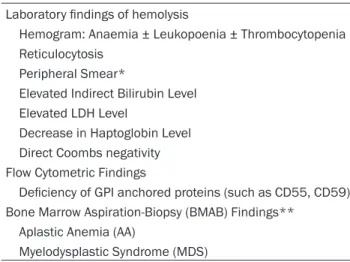
Following the clinical evaluation, the laboratory findings for the diagnosis of PNH can be grouped under 3 main titles (Table 1):
but it is necessary for elaborating whether there is bone marrow deficiency (such as AA,
MDS, IMF) or not (with bone marrow aspiration and biopsy) [8].
The fundamental diagnostic criteria that con-firms the presence of PNH clone is High Precision Flow Cytometry. As antibodies associ-ated with GPI are connected to GPI, FLAER which is fluorescently labeled with inactive bac-terial toxin targets GPI binders on cell surface [10, 13-16]. Flow cytometry is the most sensi-tive and reliable diagnostic method for the diag-nosis of PNH. Test and monitoring should be conducted according the International Clinical Cytometry Society (ICCS) guide in 2010. All the technical details are described in the relevant literature [13].
At least 2 different GPI protein deficiencies within 2 different cell lines from granulocytes, monocytes or erythrocytes are need to be shown with flow cytometry for diagnosis (2 × 2
rule) [10, 13, 17]. Leucocytes (granulocytes
and monocytes) denote more reliable results
than the erythrocytes because of previous transfusions or massive hemolysis may reveal incorrect results [12].
PNH erythrocytes are named according to char-acteristics of bearing GPI anchored proteins [10, 13, 18, 19]:
Table 1. PNH Laboratory Findings
Laboratory findings of hemolysis
Hemogram: Anaemia ± Leukopoenia ± Thrombocytopenia Reticulocytosis
Peripheral Smear*
Elevated Indirect Bilirubin Level Elevated LDH Level
Decrease in Haptoglobin Level Direct Coombs negativity Flow Cytometric Findings
Deficiency of GPI anchored proteins (such as CD55, CD59) Bone Marrow Aspiration-Biopsy (BMAB) Findings**
Aplastic Anemia (AA)
Myelodysplastic Syndrome (MDS)
*There is not any finding specific to PNH in peripheral smear, how-ever, as well as hemolysis is observed as non-schistocytic, indirect findings that will remind MDS or IMF might be observed. **BMA is not necessary for PNH diagnosis. However, it is recommended to be performed in order to investigate association with diseases such as MDS, AA or IMF and to give direction to the treatment.
Laboratory findings of hemolysis: Hemo- gram, peripheral blood smear, absolute reticulocyte count, indirect bilirubin, LDH, Haptoglobin, Direct and Indirect Coombs tests.
Displaying lack of Glycosyl Phosphatidyl Inositol (GPI) protein with Flow Cytometry: It is demonstrated by showing lack of GPI anchored proteins (CD55, CD59) in peri- pheral blood sample with flow cytometry method. High Precision Flow Cytometry is a Golden Standard in PNH diagnosis. FLAER (fluorescently labeled aerolysin) which binds directly to the GPI anchor pro-tein and is consequently reliably absent from GPI anchor deficient granulocytes and monocytes, has become the best way for determining leukocyte PNH clones [10, 12, 13].
Bone Marrow Analysis: Bone marrow anal-ysis (BMA) is not a direct indicator of PNH
Type I Erythrocytes: Erythrocytes bearing GPI anchored proteins in a normal way.
Type II Erythrocytes: Erythrocytes bearing de- creased proportion of GPI anchored proteins. Type III Erythrocytes: Erythrocytes not bearing GPI anchored proteins.
A certain threshold value has been identified for CD55 and CD59 expression level in PNH. Determination of PNH clone is sufficient for diagnosis.
Sampling for flow cytometry
Flow cytometric analysis should be done with peripheral blood samples taken into EDTA tubes within 24-48 hours. These samples should be kept in room temperature for 24 hours (+4°C for 48 hours) however, it is recom-mended to process at the shortest possible time interval for accurate results. As the expres-sion of GPI anchored proteins in hematopoietic
should be considered that LDH activity may increase in a small amount or may be within ref-erence values [10, 13, 21-23].
PNH screening for all patients with AA is ne- cessary even without hemolysis [10]. Indivi- duals with AA and MDS that are considered as low risk in terms of PNH should be screened for PNH with high sensitivity flow cytometry [13].
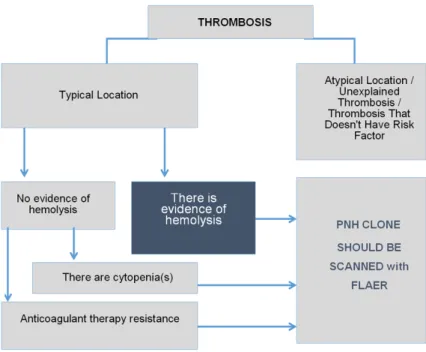
Thrombosis is the most common complication of PNH [1, 2] and 7% of patients experiencing thrombotic events is diagnosed with PNH [11]. For this reason, in the presence of atypical location of thrombosis (Budd Chiari Syndrome, Cerebral vein thrombosis, dermal vein throm-bosis, intra-abdominal thrombosis), thrombosis and intravascular hemolysis and/or cytopenia, PNH screening is highly recommended. In addi-tion, PNH screening is performed for thrombo-sis that can’t be explained with general reasons (Figure 1). Also one should bear in mind that Table 2. Clinical indications for PNH Screening [13, 22,
23]
Intravascular Hemolysis
Hemolysis accompanied by any of the following items Abdominal Pain
Esophageal Spasm Cytopenia
Iron Deficiency Coombs negativity
Non-schistocytic, non-infectious hemolytic anemia
Thrombosis presence having any of the following characteristics Young patient (especially younger than 45 y.o.)
Unusual localization
Hepatic vein (Budd-Chiari Syndrome)
Other intra-abdominal veins (portal, splenic, etc.) Cerebral sinus
Dermal veins
If it is accompanied by hemolysis If it is accompanied by cytopenia
If there is resistance to anticoagulation therapy Bone Marrow Deficiency Findings
Aplastic/Hypoplastic Anemia MDS-with any of the followings:
any subtype showing evidence of hemolysis hypoplastic
refractory cytopenia Unexplained cytopenia (s)
cells is low, bone marrow examination is not recommended.
Screening for PNH?
Clinical recommendations for PNH screening are elaborated in Table 2. Some particular points should be em- phasized:
At the beginning of the disease, hemo-globinuria can be observed approxi-mately in 25% of patients therefore all individuals with this finding should be examined. However, absence of hemo-globinuria cannot be a predictive rea-son to eliminate PNH. Almost all pa- tients with classic PNH develops hemo-globinuria in a period of their lives how-ever due to the small PNH clones, they might be AA/PNH and MDS/PNH patients.
Intravascular hemolysis is typical for PNH and blood tests almost always show an increased activity of LDH (LDH > 1.5 ULN). For this reason, examina-tion of PNH should begin with intravas-cular hemolysis findings and increased LDH level for each patient. Patients with high PNH clone size and especially with a majority of type II PNH cells
should be monitored. For patients with clone size of less than 1% and do not manifest clini-cal symptoms of hemolysis, test relating to determine GPI anchored protein from peripher-al blood should be performed every year. As clone size may be increased in time, for patients with clone size of more than 1%, test should be performed at least once in 6 months.
PNH clone size may decrease or become unde-tectable within time, for this reason, in case of deterioration of clinical symptoms, thromboem-bolic event and increase in hemolysis, immedi-ate testing is recommended [10, 13, 20, 24]. There are no clinical symptoms associated with hemolysis and laboratory findings for subclini-cal patients with PNH. Taking this into consider-ation one can say that 15-17% of patients with AA/subclinical PNH develop hemolytic anemia in a certain time interval and close follow-up should be carried out in order to determine hemolysis findings and clonal expansion of PNH cells [20, 25].
Clone analysis with flow cytometry is recom-mended for patients diagnosed with AA or MDS-RA in the time of diagnosis and annually, follow-up should be performed once in every 6 months for patients with positive results, whereas annual follow-up is recommended for patients with negative results [10].
Figure 1. Characteristics of Thrombosis for which PNH Clone is Recommend- PNH Clone is Recommend-PNH Clone is Recommend-ed (AdaptRecommend-ed from www.pesg.org).
During diagnosis, 10% to 20% of patients with PNH present abdominal pain and other ga- strointestinal disorders (dys-phagia). These symptoms are more common for classical PNH patients and its rate re- aches 33% [11]. Routine PNH screening is not mandatory for all patients with these symptoms, unless clinical and laboratory intravascular he- molysis findings are observed in patients with abdominal pain, dysphagia, chest pain, dyspnea and erectile dysfun- ction.
Flow cytometric follow-up Patients with full or partial GPI anchored protein defi-ciency together with the PNH clone size of more than 0.01% Table 3. Risk Assessment in PNH Patients
Hemolysis findings LDH ≥ 1.5 × ULN Reticulocyte count Hemoglobin value Haptoglobin level
Direct and Indirect Bilirubin Hemoglobinuria
Symptoms of kidney dysfunctions Glomerular Filtration Rate Serum creatinine level
Signs and symptoms of thrombosis Thromboembolism history D-dimer Platelet count Abdominal pain Chest pain Dyspnea Neurological symptoms Pulmonary Hypertension Increased NT-proBNP Echocardiography Factors of Quality of Life Fatigue/Weakness Pain
Dysphagia Erectile dysfuntion
PNH screening is not indicated for thrombosis other than these [10, 13].
Risk assesment for progression/complica-tions of PNH
Risk classification at the time of diagnosis and clinical and laboratory parameters used in fol-low-up are both elaborated in Table 3. Disease risk assessment is important to determine whether there is high disease activity or not in order to determine treatment options and fre-quency of follow-up.
High disease activity
PNH Registry study (M07-001) evaluated the effectiveness of Soliris® (Alexion Pharmaceu-
ticals, Cheshire, CT) in PNH patients with no
history of transfusion and clinical symptoms associated with increased hemolysis (LDH >
1.5 ULN). These symptoms were determined
as; weakness, fatigue, hemoglobinuria, abdom-inal pain, dyspnea, anemia (Hb < 10 g/dl), major vascular event (such as thrombosis), dysphagia or erectile dysfunction. European
Folic acid, vitamin B12 support: It can be used
in order to support increased erythropoiesis in the bone marrow [27].
Oral Iron supplementation: If eculizumab
treat-ment is initiated effectively, ferritin and hemoly-sis will be controlled and iron deficiency will also be prevented. Due to this transferrin satu-ration analyzed and intravenous iron therapy should be avoided as it may cause hemolytic crisis [28].
Steroids: Utilization of steroids in modern PNH
treatment can only be considered in hemolytic episodes, and only for a short time. Long-term steroid treatment is not recommended [29].
Anticoagulant treatment: Anticoagulant
treat-ment alone is not sufficient to prevent progres-sive thrombotic events. In patients who are not treated with eculizumab, consideration of pri-mary prophylaxis should be given to reduce the risk of thrombosis if there is no
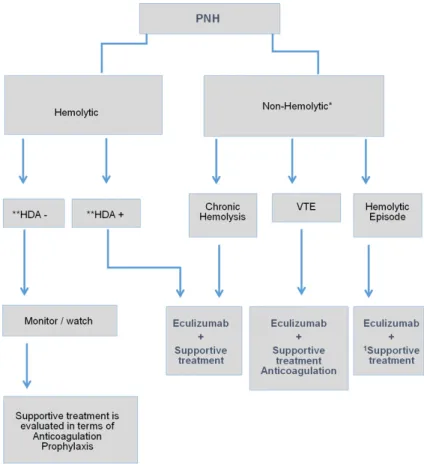
contraindica-Figure 2. PNH Treatment Algorithm. VTE: Venous Thromboembolism. *In case of bone marrow deficiency in non-hemolytic PNH, treatment of the un-derlying disease has priority. **High Disease Activity. Supportive treatment: folic acid, iron replacement and transfusion. 1Short-term steroid therapy.
Medicine Agency defined high disease activity in PNH based on this data in March 2015. According to this, LDH which is equal to one and a half of the normal limit and more than this and presence of at least one or more of the above-defined symptoms at the same time indicate High Disease Activity (HDA) [26]. Treatment
PNH treatment algorithm is shown in Figure 2. PNH treat-ment can be grouped under three main titles:
Supportive Treatments; Treat- ment changing the course of the disease; Potential Cur- ative Treatment.
Supportive treatments and immunosuppressive treat-ments
Blood/erythrocyte suspensi- on transfusion: It should be
considered in the presence of symptomatic anemia [7].
tion, such as thrombocytopenia or other bleed-ing risk. It has been shown that eculizumab treatment decreases thrombotic events at the rate of 92% and also eculizumab use in patients with thrombosis has a protective effi-cacy against recurrent thrombotic events [30]. Long-term (lifetime) anticoagulation (coumarin derivatives and heparin) can be considered in the course of life-threatening thrombotic events.
Immunosuppressive treatment: It doesn’t have
indication for PNH treatment apart from cases such as PNH/AA accompanied by bone marrow deficiency findings.
Treatment changing the course of the disease Eculizumab: Eculizumab (Soliris®, Alexion Ph- armaceuticals, Cheshire, CT) is a humanized
monoclonal antibody which blocks decomposi-tion of C5 into C5a and C5b by binding to C5-complement [31-33].
Previous research on eculizumab proved that it reduces the risk of organ damages in PNH caused by hemolysis, transfusion dependence, incidence of thrombosis, renal failure and pul-monary hypertension. Eculizumab significantly heals symptoms such as weakness, dyspnea at the same time, improves renal functions and quality of life.
Long-term use of eculizumab increases survival up to the level of general population in the same age group [32-35]. Eculizumab is not a curative treatment but increases survival [35]. Long-term eculizumab treatment has also a good safety profile and reduces complications and the risk of death significantly [8].
For patients diagnosed with PNH, Eculizumab treatment indications are available in following cases [4, 35]:
Presence of thrombotic event, Presence of organ damage due to chronic hemolysis, If PNH patient is pregnant, (only if clearly needed, the
pregnancy category is C and risk benefit ratio should be analyzed), Transfusion dependence, For patients with high LDH activity (one and a half of the normal limit), PNH complications including life-threatening cases increased sig-nificantly. For this reason, eculizumab should be used in treatment of patients having in- creased LDH activity, which is associated with chronic hemolysis-for example; thrombosis, anemia, acute and chronic renal failure, pulmo-nary hypertension, smooth muscle dystonia (for example; abdominal pain, dysphagia, erec-tile dysfunction etc.) - and clinical symptoms [8, 26].
Eculizumab administration: Eculizumab should
be administered within 25-45 minutes of intra-venous infusion. A dose of 600 mg/week dose is given in the first 4 weeks, 900 mg in 5th week and then it is continued with 900 mg dose once in 14 days (Figure 3) [26]. Com- plement mediated hemolysis can be inhibited in > 90% of patients with this treatment scheme [32].“Break-through-hemolysis” might be seen
in some patients before the next dose of eculi-zumab (12th-14th Days). Eculieculi-zumab dosage intervals can be reduced to 12 days in these patients and/or can be increased to 1200 mg [35].
Including patients with spontaneous remis-sions, eculizumab treatment should be contin-ued throughout lifetime [1, 35, 37].
Meningococcal prophylaxis: The risk of men-
ingococcal infection (Neisseria meningitidis) increases in association with blockage of termi-nal portion of the complement by eculizumab. For this reason, all patients should be vaccinat-ed against meningococcus at least 2 weeks before initiating eculizumab treatment. At the same time, H. influenza type b and pneumococ-cal vaccines are recommended [26]. If eculi-zumab is to be started immediately and there is no 2 weeks period, antibiotic prophylaxis can be initiated and continued for the next two weeks after vaccination.
Pretreatment Induction Period Maintenance Period
≥ 2 weeks before induction
treat-ment: Neisseria meningitidis vaccine Week 1 2 3 4 5 6 7 8 Once in two weeks
Eculizumab dose 600 mg 600 mg 600 mg 600 mg 900 mg x 900 mg x 900 mg
Potential curative treatment
Allogeneic bone marrow transplantation: Allo-
geneic bone marrow transplantation is the only potential curative treatment for PNH. However, it should be considered in selected patient groups due to high morbidity and mortality. It is especially recommended for PNH/AA, PNH/ MDS patients with prominent bone marrow deficiency and patients resistant to thrombo-prophylaxis and eculizumab treatment, experi-encing recurrent thromboembolic events. After allogeneic bone marrow transplantation from donors having full HLA compatibility, 2-year sur-vival rate is 56% and 10-year sursur-vival rate is 42%. The average incidence of graft versus host disease has been observed as 40-50%. Venous-occlusive disease was observed in half of the patients [38-40]. Bone marrow trans-plantation and its complications also effects quality of life of patients negatively [41, 42]. Retrospective analysis by the French group has shown that survival rate of PNH patients with thrombosis history after allogeneic bone mar-row transplantation is significantly lower than the group without thrombosis [43]. In the light of all this data, one can say that allogeneic bone marrow transplantation for classic PNH is not the first choice and it should be brought into question for mentioned special patient groups.
In patients that allogeneic bone marrow trans-plantation is planned, reported eculizumab use is very low with a small number of case exam-ples. Eculizumab treatment can be used to con-trol hemolysis concomitantly with transplanta-tion and is to be ceased within 2-4 weeks before stem cell transplantation. In case of post-transplant hemolytic attacks additional dose of eculizumab is appropriate. However, since there are no comprehensive studies, pro-cess should be initiated with individual deci-sion by considering the high morbidity and mor-tality risks. After allogeneic stem cell transplan-tation for PNH, testing should be done once in every 3 months until GPI anchor deficient cell population is not determined, and then, remis-sion should be checked annually [44, 45]. Pregnancy and PNH
The risk of pregnancy complications such as thrombotic events, maternal and fetal mortality increases in patients with PNH. For this reason,
eculizumab treatment is indicated for all PNH patients considering pregnancy (only if clearly
needed, the pregnancy category is C and risk benefit ratio should be analyzed) For low
dis-ease activity patients it is recommended to start eculizumab before pregnancy, continue treatment during pregnancy and post-partum at least 3 months. Treatment termination deci-sion should be made by performing risk assess-ment again.
Although few, there are case reports related to the use of eculizumab treatment without occur-rence of teratogenicity during successful preg-nancy. When pregnancy is detected, eculizum-ab treatment should not be stopped. (Eculi- zumab does not pass into milk and umbilical blood).
Eculizumab dose should be increased in third trimester of pregnancy and in case of
“break-through hemolysis” (Up to 900 mg in a week).
Preventive anticoagulant treatment (LMWH) might be used when folic acid and iron supple-ments, erythrocyte and platelet transfusions are needed [46, 47].
Address correspondence to: Dr. Fahri Sahin, Department of Hematology, School of Medicine, Ege University, 6th Floor Room: 20, Bornova Izmir 35100, Turkey. Tel: +90 232 3904293; E-mail: [email protected]
References
[1] Hillmen P, Lewis SM, Bessler M, Luzzatto L, Dacie JV. Natural history of paroxysmal noctur-nal hemoglobinuria. N Engl J Med 1995; 333: 1253-58.
[2] Socié G, Mary JY, de Gramont A, Rio B, Leporrier M, Rose C, Heudier P, Rochant H, Cahn JY, Gluckman E. Paroxysmal nocturnal haemoglobinuria: long-term follow-up and prognostic factors. French Society of Hae- matology. Lancet 1996; 348: 573-577. [3] Kelly R, Richards S, Hillmen P, Hill A. The
patho-physiology of paroxysmal nocturnal hemoglo-binuria and treatment with eculizumab. Ther Clin Risk Manag 2009; 5: 911-21.
[4] Hillmen P, Muus P, Dührsen U, Risitano AM, Schubert J, Luzzatto L, Schrezenmeier H, Szer J, Brodsky RA, Hill A, Socié G, Bessler M, Rollins SA, Bell L, Rother RP, Young NS. Effect of the complement inhibitor eculizumab on thrombo-embolism in patients with paroxysmal noctur-nal hemoglobinuria. Blood 2007; 110: 4123-8.
[5] Hill A, Richards SJ, Hillmen P. Recent develop-ments in the understanding and management of paroxysmal nocturnal haemoglobinuria. Br J Haematol 2007; 137: 181-192.
[6] Lee JW, Jang JH, Yoon S, Kim JS, Cho DY, Sohn SK, Chung JS. High prevalence and mortality associated with thromboembolism in Asian pa-tients with paroxysmal nocturnal hemoglobin-uria (PNH). Haematologica 2010; 95: 205-206.
[7] Nalcaci M, Yenerel MN, Yılmaz S. Paroksismal Noktürnal Hemoglobinüri. Türk Hematoloji Derneği, Kemik İliği yetersizlikleri Tanı ve Tedavi Kılavuzu, 2011; pp. 17-25.
[8] Sahin F, Ozkan MC, Mete NG, Yilmaz M, Oruc N, Gurgun A, Kayikcioglu M, Guler A, Gokcay F, Bilgir F, Ceylan C, Bilgir O, Sari IH, Saydam G. Multidisciplinary clinical management of par-oxysmal nocturnal hemoglobinuria. Am J Blood Res 2015; 5: 1-9.
[9] Hill A, Platts PJ, Smith A, Richards SJ, Cullen MJ, Hill QA, Roman E, Hillmen P. The Inciden- ce and Prevalence of Paroxysmal Nocturnal Hemoglobinuria (PNH) and Survival of Patients in Yorkshire. British Journal of Haemotology 2007; 137: 31-31.
[10] Parker C, Omine M, Richards S, Nishimura J, Bessler M, Ware R, Hillmen P, Luzzatto L, Young N, Kinoshita T, Rosse W, Socié G. Diagnosis and management of paroxysmal nocturnal hemoglobinuria. Blood 2005; 106: 3699-3709.
[11] de Latour RP, Mary JY, Salanoubat C, Terriou L, Etienne G, Mohty M, Roth S, de Guibert S, Maury S, Cahn JY, Socié G; French Society of Hematology; French Association of Young Hematologists. Paroxysmal nocturnal hemo-globinuria: natural history of disease subcate-gories. Blood 2008; 112: 3099-3106.
[12] Richards J, Barnett D. The Role of Flow Cytometry in the Diagnosis of Paroxysmal Nocturnal Hemoglobinuria in the Clinical Laboratory. Clin Lab Med 2007; 27: 577-590. [13] Borowitz MJ, Craig FE, Digiuseppe JA,
Illingworth AJ, Rosse W, Sutherland DR, Wittwer CT, Richards SJ, Clinical Cytometry Society. Guidelines for the diagnosis and moni-toring of paroxysmal nocturnal hemoglobinuria and related disorders by flow cytometry. Cytometry B Clin Cytom 2010; 78: 211-230. [14] Brodsky RA, Mukhina GL, Li S Nelson KL,
Chiurazzi PL, Buckley JT, Borowitz MJ. Improved detection and characterization of paroxysmal nocturnal hemoglobinuria using fluorescent aerolysin. Am J Clin Pathol 2000; 114: 459-466.
[15] Brodsky RA, Mukhina GL, Nelson KL, Lawrence TS, Jones RJ, Buckley JT. Resistance of pa- roxysmal nocturnal hemoglobinuria cells to
the glycosylphosphatidylinositol-binding toxin aerolysin. Blood 1999; 93: 1749-1756. [16] Mukhina GL, Buckley JT, Barber JP, Jones RJ,
Brodsky RA. Multilineage glycosylphosphati-dylinositol anchor-deficient haematopoiesis in untreated aplastic anaemia. Br J Haematol 2001; 115: 476-482.
[17] Nebe T, Schubert J, Schrezenmeier H. Flow cy-tometric analysis of GPI-deficient cells for the diagnosis of paroxysmal nocturnal hemoglo-binuria (PNH). J Lab Med 2003; 27: 257-265. [18] Rosse WF. Variations in the red cells in
parox-ysmal nocturnal haemoglobinuria. Br J Hae- matol 1973; 4: 327-342.
[19] Rosse WF, Hoffman S, Campbell M, Borowitz M, Moore JO, Parker CJ. The erythrocytes in paroxysmal nocturnal haemoglobinuria of in-termediate sensitivity to complement lysis. Br J Haematol 1991; 79: 99-107.
[20] Movalia MK, Weitz I, Lim SH, Illingworth A. Incidence of PNH clones by diagnostic code utilizing high sensitivity flow cytometry. Blood (ASH Annual Meeting Abstracts) N 2011; 118: 1033.
[21] Brodsky RA. How I treat paroxysmal nocturnal hemoglobinuria. Blood 2009; 113: 6522-6527.
[22] Bessler M, Hiken J. The pathophysiology of dis-ease in patients with paroxysmal nocturnal he-moglobinuria. Hematology Am Soc Hematol Educ Program 2008; 104-110.
[23] Hill A, Kelly RJ, Hillmen P. Thrombosis in parox-ysmal nocturnal hemoglobinuria. Blood 2013; 121: 4985-96.
[24] Madkaikar M, Gupta M, Jijina F, Ghosh K. Paroxysmal nocturnal haemoglobinuria: diag-nostic tests, advantages, & limitations. Eur J Haematol 2009; 83: 503-511.
[25] Wanachiwanawin W, Siripanyaphinyo U, Piyawattanasakul N, Kinoshita T. A cohort study of the nature of paroxysmal nocturnal hemoglobinuria clones and PIG-A mutations in patients with aplastic anemia. Eur J Haematol 2006; 76: 502-509.
[26] SmPC: Soliris® (eculizumab) summary of product characteristics. Alexion Europe SAS, 2015.
[27] DGHO Deutsche Gesellschaft für Hämatologie und Medizinische Onkologie, Paroxysmal Noc- turnal Hemoglobinuria Guideline, 2012. [28] Röth A, Schubert J, Hock Ch, Christoph S,
Dührsen U. Effect of reducing intravascular he-molysis on ferritin homeostasis in eculizumab treated paroxysmal nocturnal hemoglobinuria (PNH) patients. Blood 2008; 112: 3437. [29] Issaragrisil S, Piankijagum A, Tang-naitrisorana
Y. Corticosteroids therapy in paroxysmal noc-turnal hemoglobinuria. Am J Hematol 1987; 25: 77-83.
[30] Hall C, Richards S, Hillmen P. Primary prophy-laxis with warfarin prevents thrombosis in par-oxysmal nocturnal hemoglobinuria (PNH). Blood 2003; 102: 3587-3591.
[31] Parker CJ. Bone marrow failure syndromes: paroxysmal nocturnal hemoglobinuria. Hema- tol Oncol Clin North Am 2009; 23: 333-346. [32] Hillmen P, Hall C, Marsh JC Marsh JC, Elebute
M, Bombara MP, Petro BE, Cullen MJ, Richards SJ, Rollins SA, Mojcik CF, Rother RP. Effect of eculizumab on hemolysis and transfusion re-quirements in patients with paroxysmal noc-turnal hemoglobinuria. N Engl J Med 2004; 350: 552-559.
[33] Hillmen P, Young NS, Schubert J Brodsky RA, Socié G, Muus P, Röth A, Szer J, Elebute MO, Nakamura R, Browne P, Risitano AM, Hill A, Schrezenmeier H, Fu CL, Maciejewski J, Rollins SA, Mojcik CF, Rother RP, Luzzatto L. The com-plement inhibitor eculizumab in paroxysmal nocturnal hemoglobinuria. N Engl J Med 2006; 355: 1233-1243.
[34] Brodsky RA, Young NS, Antonioli E Risitano AM, Schrezenmeier H, Schubert J, Gaya A, Coyle L, de Castro C, Fu CL, Maciejewski JP, Bessler M, Kroon HA, Rother RP, Hillmen P. Multicenter phase 3 study of the complement inhibitor ec-ulizumab for the treatment of patients with paroxysmal nocturnal hemoglobinuria. Blood 2008; 111: 1840-1847.
[35] Kelly RJ, Hill A, Arnold LM Brooksbank GL, Richards SJ, Cullen M, Mitchell LD, Cohen DR, Gregory WM, Hillmen P.Long-term treatment with eculizumab in paroxysmal nocturnal he-moglobinuria: sustained efficacy and improved survival. Blood 2001; 117: 6786-6792. [36] Hillmen P, Muus P, Röth A, Elebute MO,
Risitano AM, Schrezenmeier H, Szer J, Browne P, Maciejewski JP, Schubert J, Urbano-Ispizua A, de Castro C, Socié G, Brodsky RA. Long-term safety and efficacy of sustained eculizumab treatment in patients with paroxysmal noctur-nal haemoglobinuria. Br J Haematol 2013; 162: 62-73.
[37] Sahin F, Yilmaz AF, Comert M, Ozdemirkiran F, Gokmen NM, Saydam G. Spontaneous remis-sion of Paroxysmal Nocturnal Hemoglobinuria during eculizumab treatment. J of Hematology 2014; 3: 50-53.
[38] Santarone S, Bacigalupo A, Risitano AM Tagliaferri E, Di Bartolomeo E, Iori AP, Rambaldi A, Angelucci E, Spagnoli A, Papineschi F, Tamiazzo S, Di Nicola M, Di Bartolomeo P. Hematopoietic stem cell transplantation for paroxysmal nocturnal hemoglobinuria: long-term results of a retrospective study on behalf of the Gruppo Italiano Trapianto Midollo Osseo (GITMO). Haematologica 2010; 95: 983-988.
[39] Saso R, Marsh J, Cevreska L, Szer J, Gale RP, Rowlings P, Passweg J, Nugent M, Luzzatto L, Horowitz M, Gordon-Smith E. Bone marrow transplants for paroxysmal nocturnal haemo-globinuria. Br J Haematol 1999; 104: 392-396.
[40] Armitage JO. Bone marrow transplantation. N Engl J Med 1994; 330: 827-838.
[41] Fraser CJ, Bhatia S, Ness K Francisco L, Arora M, Parker P, Forman S, Weisdorf D, Gurney JG, Baker KS. Impact of chronic graft-versus-host disease on the health status of hematopoietic cell transplantation survivors: a report from the Bone Marrow Transplant Survivor Study. Blood 2006; 108: 2867-2873.
[42] Bieri S, Roosnek E, Helg C Verholen F, Robert D, Chapuis B, Passweg J, Miralbell R, Chalandon Y. Quality of life and social integra-tion after allogeneic hematopoietic SCT. Bone Marrow Transplant 2008; 42: 819-827. [43] de Latour RP Schrezenmeier H, Bacigalupo A,
Blaise D, de Souza CA, Vigouroux S, Willemze R, Terriou L, Tichelli A, Mohty M, de Guibert S, Marsh JC, Passweg J, Mary JY, Socié G. Allogeneic stem cell transplantation in parox-ysmal nocturnal hemoglobinuria. Haemato- logica 2012; 97: 1666-73.
[44] Goker H, Uz B, Buyukasik Y, Aksu S, Haznedaroglu I, Sayınalp N, Karacan Y, Tekin F, Ozcebe OI. Eculizumab before and after alloge-neic hematopoietic stem cell transplantation in a patient with paroxysmal nocturnal hemo-globinuria: Case report. Turk J Hematol 2011; 28: 223-7.
[45] Taniguchi K, Okada M, Yoshihara S, Sawada A, Tokugawa T, Ishii S, Kaida K, Ikegame K, Minagawa K, Matsui T, Ogawa H. Strategy for bone marrow transplantation in eculizumab-treated paroxysmal nocturnal hemoglobinuria. Int J Hematol 2011; 94: 403-407.
[46] Fieni S, Bonfanti L, Gramellini D, Benassi L, Delsignore R. Clinical management of paroxys-mal nocturnal hemoglobinuria in pregnancy: a case report and updated review. Obstet Gynecol Surv 2006; 61: 593-601.
[47] Kelly R, Arnold L, Richards S, Hill A, Bomken C, Hanley J, Loughney A, Beauchamp J, Khursigara G, Rother RP, Chalmers E, Fyfe A, Fitzsimons E, Nakamura R, Gaya A, Risitano AM, Schubert J, Norfolk D, Simpson N, Hillmen P. The management of pregnancy in paroxys-mal nocturnal haemoglobinuria on long term eculizumab. Br J Haematol 2010; 149: 446-450.