Gender Heterogeneity in Ease of Access to Credit:
The Case of a Ghanaian MFI
James Atta Peprah
iDepartment of Economics, University of Cape Coast Cape Coast, Ghana
Abstract
Microfinance has been proposed as a way of bridging the gender gap in access to finance but the question that still remains is whether the gap is really closed or not. It is on record that in the formal financial sector, one of the causes of the gap is educational characteristics of households and owners of micro and small enterprises (MSEs) especially those in developing countries like Ghana. The question of whether education is an issue of easing access to credit in the informal sector has not been answered. The paper examines the effects of reading ability and level of schooling on ease of access to micro-credit among 485 women and men entrepreneurs in two districts in Ghana. The econometric estimation methods adopted in the study are probit and IV probit which corrects for possible endogeneity. Results show that controlling for other household covariates and enterprise characteristics, education of enterprise owners eases access to credit in the informal sector and there is significant difference in access to credit among men and women borrowers. Other sources of differences in access to micro-credit are past credit relationship of borrowers, location of borrowers and their businesses and household size. The paper offers recommendations from the supply side to promote sustainable micro-financing of SMEs in the informal sector.
Key Words: Ease of credit access, micro-credit, small scale businesses, education
© 2013 Beykent University
1. Introduction
Access to finance by enterprises and households is of increasing concern to policy makers across Africa and the rest of the developing world. Recent data collection efforts on both at the enterprise and household levels have enabled a more rigorous analysis of how to improve access among the unbanked (World Bank, 2007). In most cases, female
i
owned enterprises lack financing as compared to male owned businesses. Even though quite a number of papers have been published on gender gap in access to finance, there is more to be done in terms of easiness or otherwise of the access. Specifically, it has often been argued that lack of access to finance impedes growth of female businesses and prevents women from participating in the modern financial market. Given the overall lack of financial service provision, with fewer than one in five households having access to formal financial services, this problem is potentially more pressing in Sub-Saharan Africa than in other developing regions of the world (Honohan & Beck, 2007). The situation is a cause for concern in Ghana especially in typical rural communities where more than 50% of the population dwell (GSS, 2008). From the supply side, financial institutions are all over the country providing financial services but the demand side does not easily permit all to access credit even among microfinance clients. Up till now the factors that determine access to credit have much been researched into but what is missing is whether the access is easy or difficult. Credit may be available but might not be easy for existing and potential clients to access it. This paper attempts to find out those factors that ease access to micro-credit as well as those factors that are likely to cause gender disparity in ease or otherwise of access to credit. The motivation is that microfinance is expected to make credit easily accessible to clients that have been left out by the formal banking system. This will test the efficacy of microfinance as a tool for the inclusive financial policy claimed by the proponents of microfinance.
Results of the study indicate that past credit record, reading ability, level of education, type of economic activity, location of business enterprise are factors that are likely to influence ease of access to credit. There is also gender disparity in ease or otherwise of access to credit. Women are credit constrained because even though access is available they are likely to encounter difficulties in accessing credit. The rest of the paper is structured as follows: the next section reviews relevant literature followed by methods of the study in section three. Section four discusses results and findings and section five concludes.
2. Literature Review
Gender explains the social construct of what an individual is expected to do and behave in society. Gender does not usually refer to sex as it is normally thought of. According to Food and Agricultural Organization (FAO) gender is defined as the relations between men and women, both perceptual and material. Gender is not determined biologically, as a result of sexual characteristics of either women or men, but is constructed socially. It is a central organizing principle of societies, and often governs the processes of production and reproduction, consumption and distribution (FAO, 1997). The term gender therefore, refers to the economic, social, political and cultural attributes and opportunities, associated with being male or female. In most societies, men and women differ in the activities they undertake, in access to and control of resources, and in participation in decision-making. And in most societies, women as a group have less access than men to resources, opportunities and decision-making (Desprez-Bouanchaud et al. 1987).
Despite this definition, gender is often misunderstood as being the promotion of women only. However, gender issues focus on women and the relationship between men and women, their roles, access to and control over resources, division of labour, interests and needs. Gender relations affect household security, family well-being, planning, production and many other aspects of life (Bravo-Baumann, 2000). One important issue of concern is that, access to finance creates disparity among men and women owned enterprises. This is because in all countries men differ in all aspects of endeavours so it is by no chance that they also differ in access to financial resources. This phenomenon has the potency of pulling back the effort of achieving the MDGs by 2015. It also has been articulated that access to finance is key to alleviating poverty through the creation of microenterprises especially in the informal sector. If access to credit widens the gender gap then it is also a factor that could widen the poverty gap. Empirical evidence from recent studies show that across gender, women owned enterprises lack formal financial and informal financial resources as compared to men owned businesses. Recent study has shown that lack of access to credit has been identified as the second most important constraint to doing business in some African countries such as Tanzania, falling only marginally behind access to infrastructure (World Bank, 2004). The same study reports that gender gap in access to credit in Tanzania shows that men are twice as likely to be bankable as women and only 6 percent of female business owners have any type of banking relationship, compared to 11 percent of male business owners and the most common type of banking service used by males and females is savings account.
Across gender, financing new businesses differs widely in terms of start-up capital. For example, Gajigo and Hallward-Driemeier (2010) find that in four African countries, there is a gender gap in capital at the start up of a business. When it comes start-up capital, although gender difference is higher along sector than by gender, the median capital for male entrepreneurs is more than twice that of the female entrepreneurs. This is an indication that female entrepreneurs face larger entry barriers than their male counterparts, but that as they progress they are not constrained with top-up capital in subsequent years.
The literature documents a host of factors that cause gender differences in access to credit. For example Bigsten and Söderbom (2011) explain how entrepreneur capabilities are likely to be correlated with both the ability to obtain credit and general firm performance. The gender disparity in access to credit will have to be revisited by way of making finance more accessible to women entrepreneurs because the notion that they (female business operators) are not productive does not hold, assuming the neo-classical theory of efficiency-augmenting argument holds. According to Amendariz and Morduch (2007), theoretically, lending to women IS advantageous to the institution and may enhance economic efficiency taking into account the fact that they are poor, less mobile and are risk averse.
There are however, several factors that have been identified as causing gender gap in access to credit. Socio-economic variables such as the borrower’s sex, age, household wealth and/or asset values (Zeller, 1994), educational level and access to network information (Vaessen, 2001) can influence the probability of a borrower’s credit being rationed. Men may be perceived by lenders as more credit-worthy than women because they generally control household resources. Household wealth and/or asset values are important as collateral and male control of these can reduce the probability of credit rationing. Educational attainment enhances human capital in the form of skills, which is
associated with effective utilization of credit and minimization of default risk. Access to network information enables the screening of potential clients and reduces default risk, as only those with good reputations are likely to be recommended for credit (Okurut & Schoombee, 2007).
Geographically, entrepreneurs in urban areas are likely to have easy access to credit than rural counterparts. For example, Kumar and Francisco (2005), report that there is a large variation in branch density across different regions in Brazil and argued that well branched regions in Brazil would be expected to ease physical access and also lower information asymmetry problems as a consequence of greater ratios of banks per firm and they argued that the firms located in these regions have easy access to credit.
Byiers et al (2010), using data from Mozambican manufacturing firms, also found that the manufacturing sector seems important for having credit access. The results of their research indicated that both metal-mechanic and wood-furniture sectors have significantly lower credit access than the food processing sector. Their interpretation for this was that banks attach a lower risk premium to food processing sector compared to the other two sectors. On the other hand some industries are more likely to depend on external financing than others, depending upon project scale, and cash flows. Firms in certain sectors will require more credit to invest in equipment, machinery, buildings, labour and raw materials than firms in other industry sectors. For instance, the industries with more capital requirements may face proportionately greater constraints (Kumar & Francisco, 2005). In another research by Silva and Carreira (2010), they argue that, for most services, the main input is human and not physical capital and therefore service sector firms find it hard to use this physical capital as collateral when resorting to external finance. The implication is that credit concentration of financial institutions is a function of economic activities, therefore, profitable economic activities attract more financing than others.
3. Research Methodology 3.1 Study areas and data
The study areas are Yamoransa and Takoradi in the Central and Western regions of Ghana respectively. Takoradi is an urban community whereas Yamoransa is a peri-urban community because it is close to Cape Coast the regional capital. The main economic activities in these two communities are trading and fishing. The two communities are far apart with about 80 kilometres distance. Yaalex Microfinance Limited (YML) operates the head office at Takoradi with a branch at Yamoransa. The branch was opened in August, 2011. The policy at YML is that after four months of savings, clients qualify for loans depending on their total saving and daily contributions.
Questionnaires were used for collecting the data. The questionnaires were designed in English and interpreted in the local language, Akan, to the respondents because most of them could either not read at all or find it difficult to read. Graduate students from the Department of Economics were engaged and trained for a week for effective administration of the instruments. Before the actual survey, a pre-test was done in Cape Coast which did not form part of the study areas.
The questionnaires sough to find out from clients whether they could obtain credit with ease or otherwise. In the first instance clients were asked if they had accessed credit before. If the answer is yes, they are further asked to whether they obtained the credit with ease or encountered some difficulty. A value of 1 was assigned to easy access whereas 0 was assigned to difficulty in accessing credit. This means that all the clients sampled had obtained credit at different levels.
3.2 Population and sample
The total number of clients of YML is estimated at 10,000. There are more women (70%) than men (30%) that do business with the company. In all 500 (5% of the population) clients comprising 180 men and 320 women small scale business operators of YML were interviewed. In effect 485 questionnaires were used for the analysis due to inconsistencies in some of the responses obtained. Respondents were randomly selected from the client register in order to give each client equal opportunity of being selected.
3.3 The case institution
Incorporated in 2004, Yaalex Microfinance Limited (YML) is one of the microfinance companies in Ghana with its head office at Takoradi in the Western region of Ghana. The company operates a branch at Yamoransa in the Central region. YML’s main objective is to extend financial services to the low income people in its operational areas in Western and Central regions. The company also aims at making micro-credit easily accessible by its clients. This is one of the few MFIs that seek to ease financial access among poor women. YML offers several products including loans, savings, business training and advisory services to its clients. The company targets women in trading as major clients. About 80% of the clients are women. YML adopts individual and group lending techniques and is also actively involved in daily ‘susu’ mobilization. At YML individual lending is more popular than group because of strategic default. Strategic default usually occurs in group lending where a client will intentionally default because he or she was compelled to contribute towards the payment of a loan that group member could not pay. This kind of behaviour that cannot be determined ex-ante continues to make group loans unpopular in spite of numerous advantages associated with group lending. Loans granted to clients are repayable on daily basis for a period of four months. To qualify for loan, a client must have saved with the institution for a period of at least four months. Prospective clients are made to fill loan application forms and they are to ensure that they read and understand all the terms of the contract including interest rate, repayment schedule, guarantors, as well as any other information that has to be completed.
What makes the institution interesting to be used as a case study is manifold. YML is one of the largest MFI in Ghana and the biggest microfinance institution in the Western Region of Ghana. The company is also backed by a seven member board of directors with diverse specialization. YML is research oriented in that the company has been partnering with some foreign research institutions to conduct research in microfinance impact assessment. It is one of the few MFIs in Ghana that adopts best practices in delivering microfinance services. For example, the company offers non-collaterized loans to its members. What makes the company more unique is its focus on women clients. YML
does not depend on external funds or subsidized funds thus its products are offered at market interest rates which reflect full cost of operations.
3.4 Variables used in the models
Past credit record was used to measure the credit worthiness of the clients. It also measures the business relationship that the client has with the company. To capture this, clients were asked if they had taken loan during the past 12 months of the survey. A follow up question captured the ease of access to credit. Clients were asked if it was easy or difficult in obtaining the credit. Economic activity was captured at four levels comprising trading, processing, services and others. Education measures two things: reading ability and level attained. Reading ability was captured as ‘cannot read at all=1’, ‘difficulty in reading=2’ and ‘easy to read=3’. Household size was measured as the number of persons that eat from the same pocket.
4. The Research Model and Its Application 4.1 The probit model
In this paper, ease of access to micro-credit is defined as whether business owners have difficulty or otherwise in accessing credit from MFIs. This is captured as 1=for easy access and 0=if otherwise. The novelty of this variable is the fact that much of the literature focuses on access to credit by asking if business owner has access (=1) to credit or not (=0) but this focuses on whether access is difficult or easy. Thus, ease of access to credit combines both access and the level of difficulty or otherwise in accessing credit. In this model also, both household and enterprise as well as community level characteristics are considered. Again, gender difference characteristics such as age, education, household size, are also introduced into the model to determine the ease or otherwise of access to micro-credit. Ease of access to credit does not imply that the demand for credit will be satisfied. Lenders determine how much credit is allocated based on the probability of loan default, often resulting in credit rationing. Thus, the probability of receiving micro-credit may be influenced by a number of factors that include borrower characteristics and enterprise characteristics. Again, since the dependent variable, ease of access to micro-credit, is a dichotomous variable there is the need to use the cumulative distribution function (CDF). We assume in general a binary outcome y and a continuous unobservable variable y* that:
y* = x’β + U
Although y* is unobserved it could be realized that:
y = 1
0 if y*>0 or otherwise
Given the latent variable model we obtain:
= Pr(−μ < x β) =F(x β)
Where F(.) is the cumulative distribution frequency of –μ and the marginal effects / therefore becomes ∅( ) . In an empirical form, the probit equation to be estimated is of the form:
Pr( = 1| ) = β0+β1(Pastcrediti)+β2(Locationi)+β3(Ecoacti)+β4(Hsizei)+
β5(Educ) + β6 (Hhsizesqi) +μi ……… (2)
Where EaseCred= ease of access to credit
Pastcredit = ever accessed credit within the past 12 months of the survey Location = location of client business
Ecoact = type of economic activity Hsize = household size
Hhsizesq = the square of household size
Educ= education level and reading ability of clients
4.2 The IV probit model
Estimating equation (2) with probit model is tantamount to assuming that all explanatory variables are exogenous. However, this may not be the case for one of the main independent variables, level of education. In view of this the probit model may lead to inconsistent estimates of the parameters of the model (Wooldridge, 2003). Following Cameron and Trivedi (2010) we formulate the linear characterisation of the observed variables ( , ) as:
∗ = + + ………..(3)
= + + ………..(4)
Where expression (3) is the structural equation and ∗ is the unobservable latent variable. However we observe if
∗> 0, and if ∗≤ 0. Equation (4) is the reduced form equation of which is the suspected endogenous variable
and is the exogenous variables whiles is the set of instrument(s). Given that we expect education to be endogenous the first stage equation is estimated as
Educ =β0+β1(Pastcrediti)+β2(Locationi)+β3(Ecoacti)+β4(Hsizei)+β5Hsizesqi +Vi(Numbsch)……….. (5)
where Numbsch which measures number of schools in the selected communities is used as instrument for ability to read. After estimating first stage equation we plug the predicted values of Education into the structural equation:
= + + + + + +
5. Results and Discussion
Table 1 shows the distribution of economic activities by gender in the study areas. At all levels of economic activities, women (66.9% and 72.0%) are relatively more than men except services (49.7%). Services include tailoring, motor repairs, hairdressing and taxi work. There are more traders in microfinance because microfinance loans are for short-term between 1-6 months. Women engage in processing than men. Processing includes fish processing, gari processing, and palm oil processing. Traditionally this is one of the main activities women usually engage in some parts of Ghana.
Table 1: Economic activity by gender
Activity Trading Processing Services Others Total
Female 105 (45.7) 72 (31.3) 40 (17.4) 13 (5.6) 230 Male 52 (40.6) 28 (21.9) 38 (29.7) 10 (7.8) 128
Total 157 100 78 23 358
Source: Calculated from Field Survey, 2011
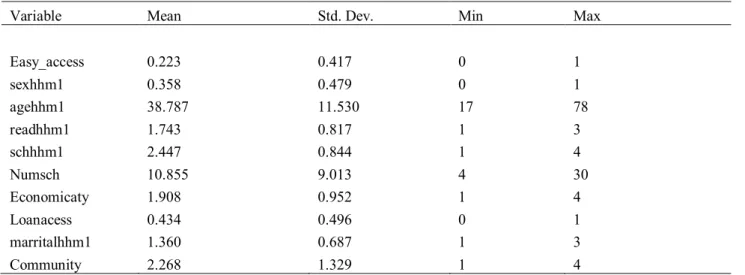
Table 2 presents the summary statistics used in the regression models. Easy access, sex of household member operating the enterprises and ever accessed loan within the past 12 months are dummy variables. Age of business owner is a continuous variable whereas the rest of the variables are categorical. The mean age of respondents is 38 years whiles the minimum and maximum ages are 17 and 78 respectively.
Table 2: Descriptive statistics
Variable Mean Std. Dev. Min Max
Easy_access 0.223 0.417 0 1 sexhhm1 0.358 0.479 0 1 agehhm1 38.787 11.530 17 78 readhhm1 1.743 0.817 1 3 schhhm1 2.447 0.844 1 4 Numsch 10.855 9.013 4 30 Economicaty 1.908 0.952 1 4 Loanacess 0.434 0.496 0 1 marritalhhm1 1.360 0.687 1 3 Community 2.268 1.329 1 4
Source: Computed from field survey, 2011
5.1 Empirical evidence of ease of access to micro-credit
In this thesis, ease of access to credit is defined as whether business owners have difficulty or otherwise in accessing credit from financial institutions. According to Diagne, Zeller & Sharma (2000), there are two methodologies for measuring household access to credit and credit constraints. The first and indirect method infers the presence of credit
constraints from violations of the assumptions of the life-cycle or permanent income hypothesis, while the second collects information directly from household surveys on whether households perceive themselves to be credit constrained. The latter is what was adopted in this thesis. Further, the thesis adopts the methodology by the World Economic Forum (2009). The global competitive index is made up of 12 pillars of which eighth pillar which is about financial market development with one of its indicators as ease of access to credit. According to the Global Competitive Index Report of 2010-2011, Ghana ranks 106 out of 139 in terms of ease of access to credit meaning ease of credit access is a problem (World Economic Forum, 2009)..
Ease of access to credit does not imply that the demand for credit will be satisfied. Lenders determine how much credit is allocated based on the probability of loan default, often resulting in credit rationing. Thus, the probability of receiving the credit may be influenced by a number of factors that include borrower and enterprise characteristics. The most important and the focus of this paper is how education of household business operators eases access to micro-credit. Again, ease of access to credit takes into account number of days credit is approved and disbursed. If it takes more than 30 working days to obtain the approved amount after submission of loan application forms, access is said to be difficult (0). However, all loans approved before 30 working days are assigned a value of 1 indicating easy access. Loan applications that are queried and referred back to the applicants are classified as difficult applications. Such applications may be re-submitted for fresh processing. The limitation of measuring ease of access to credit needs to be acknowledged. The measurement is arbitrary but the intuition is that at Yaalex Microfinance Limited if a loan is not approved within 30 days then it is likely to be rejected.
Model I: Probit regression
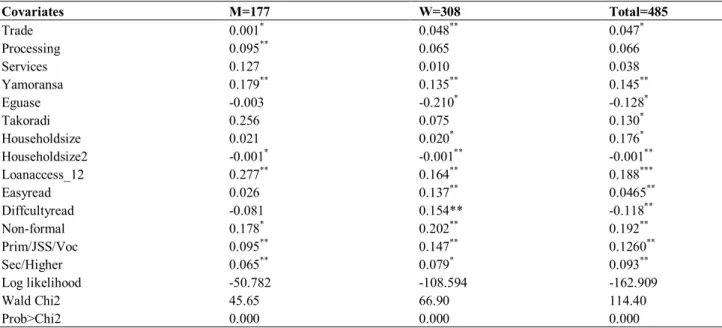
Table 3 presents the probit estimation results after controlling for some household and enterprise characteristics. Enterprise and household characteristics included in the probit regression are type of economic activity, ever accessed loan within the past 12 months (GSS, 2008), location of respondents (community), reading ability, level of education, number of persons in household (household size), and the square of household size. The unit of analysis is at the household or the enterprise level because the owner of the business is the same as the business since he or she owns the business alone. Table 6 shows three levels of analysis: male sample, female sample and the total sample. The rationale is to identify the male-female differences in ease of access to credit. Trading activity eases access to credit in the informal sector. For both men and women, trading activity significantly determines the likelihood of easing access to credit at 10% and 5% respectively. However, women are (4.8%) more likely to access credit easily than men (0.01%). Engaging in trading is significant at 10% for both men and women and the probability that either male or female business operator will access credit easily is (4.65%). One reason that might be attributed to the significance of trading activity in easing access to credit is that those in trading are able to repay their loans on regular basis because they have regular cash flow.
Processing includes gari, palm oil, kenkey, and fish. This activity predicts ease of access to credit for men (9.5%) at 5% level of significance but not women. Men in processing activity are (9.5%) likely to access credit with ease than women. For women, processing is not significant in obtaining credit easily. This confirms Diagne, Zeller & Sharma
(2000) in a study in selected developing countries that female borrowers are constrained in most sectors of the economy as compared to their male counterparts. A plausible reason might be that processing activity by men is more profitable than that of women (Diagne, Zeller & Sharma, 2000). Again, processing activities engaged by women (for example kenkey and gari) are usually on small scale as compared to men who engage in palm oil processing on larger scale. Service activities do not influence the likelihood of ease of access to credit at all levels. Household size is measured as the number of equivalent adults (GSS, 2007) that eat from the same bowl and under the same care. This measure recognizes that the consumption requirements of babies or young children are less than that of adults. Again, since in the credit market only people of more than 18 years can participate, setting the age of household to 18 makes economic sense. Household size enters the total sample model with a positive sign whereas square of household size appears to be negative. Women business operators with larger households sizes are about (2%) more likely to access credit without difficulty. Theoretically larger household size means high dependency ratio and high dependency ratio implies households will have many dependents to take care of thus, increasing their household per capita expenditure and therefore reducing the amount of money that can be invested in business activities. Larger household size therefore limits access to credit holding other factors constant. For men business owners, household size does not influence ease or otherwise of credit access. The result is inconsistent with Nguyen (2007) that household characteristics including number of household members, education level of household head influences ease of access to credit.
Table 3: Probit regression results (Marginal Effects)
Covariates M=177 W=308 Total=485 Trade 0.001* 0.048** 0.047* Processing 0.095** 0.065 0.066 Services 0.127 0.010 0.038 Yamoransa 0.179** 0.135** 0.145** Eguase -0.003 -0.210* -0.128* Takoradi 0.256 0.075 0.130* Householdsize 0.021 0.020* 0.176* Householdsize2 -0.001* -0.001** -0.001** Loanaccess_12 0.277** 0.164** 0.188*** Easyread 0.026 0.137** 0.0465** Diffcultyread -0.081 0.154** -0.118** Non-formal 0.178* 0.202** 0.192** Prim/JSS/Voc 0.095** 0.147** 0.1260** Sec/Higher 0.065** 0.079* 0.093** Log likelihood -50.782 -108.594 -162.909 Wald Chi2 45.65 66.90 114.40 Prob>Chi2 0.000 0.000 0.000
***, **, * significant at 1%, 5% and 10% respectively.
Source: Computed from field survey, 2011
This means that men are not constrained by credit with reference to household size. There is natural discrimination in access to credit as far as household size is concerned. It is not surprising because women usually cater for household
activities and may sometimes assume the responsibility of major household expenses. The likelihood that women might use commercial loans for household expenses is high as compared to men. Thus, institutions may be very reluctant in granting loans to female business owners with large household sizes.
In both the developing and developed world, small firms have been found to have limited access to external finance and are more constrained in their operations and growth (Galindo & Schantiarelli, 2003). Many households and businesses in developing countries are said to face credit constraints which limit their ability to undertake investments in various production-enhancing economic activities required to reduce poverty. This limited access to credit is often attributed to the lack of `acceptable' collateral, resulting from the absence of formally registered land titles (Domeher & Raymond, 2012). In the same manner business registration documents are often used as collateral for both formal and informal credit and lack of it is likely to serve as a credit constraint.
One of the borrower characteristics that ease access to credit in the informal financial market is previous business relationships. In this study respondents were asked to indicate if they have received credit within the past twelve months preceding the survey. This is used as a proxy for previous business relationship and credit worthiness. Again, clients who have ever accessed loans within the past 12 months are perceived as having established business rapport with the MFI and thus access will be easier for future credit demand. Received knowledge has it that clients with past favourable credit record easily have access to progressive loans.
Ever accessed loan in the past 12 months (Loanaccess_12) is positively related with ease of access to credit. On the basis of intuition, this is correct. Practically also, this sounds reasonable. However, there is need for theory to support this assertion. For men business operators, previous loans obtained is more likely to ease credit access by (27.72%) whereas the probability for women is (16.38%). This implies that assuming males and females have good credit records, male are more likely to have their loans approved without difficulty than females. The usual notion that microfinance favours women can therefore be challenged on this ground.
The total sample also indicates that controlling for other factors, past credit record eases access to further credit with probability of (18.79%). In support of the above finding is that of Aleem (1990), in a study of informal market lenders and their clients in Chambar, Pakistan. He argued that informal lenders mainly used their established relationship with borrowers as a screening mechanism. Our result is also consistent with another study by Fatoki and Chigamba (2011) of SMEs in South Africa, in which they found that SMEs that have accessed credit in the past 12 months found it easier to access subsequent loans as compared with those who had not. This may imply that lenders did not generally entertain loan requests from people who had not had previous dealings with them either in the form of the sale of harvested output through them or purchase of farm inputs. The longer the period of the previous business relationship, the higher will be the probability of the borrower having access to future loans.
MFIs have therefore become more formalized in their operations like traditional commercial banks. Some of the transformations include application and processing of loans. Currently, MFIs in Ghana sell application forms to clients as first step in accessing loans. Hitherto, MFIs used not to follow any formal procedures in initiating loan contracts.
From the demand side firms’ level of education influences their probability of accessing credit (Isaksson, 2002). For example, the level of education of the business owner is important in obtaining credit not only from formal financial institution but also from informal financial institutions. The supply side also shows how MFIs staff ability may influence credit screening and monitoring of loan applicants but the former is the focus of the discussion in this section.
First the study captures education outcome which comprises reading ability and level of schooling of respondents. This variable is important because it determines, to a large extent, clients’ ability to read and understand the terms of loan contract in the application form. Reading ability is a rank variable (3=highest to 1=lowest) and is captured as 3= can read without difficulty, 2=can read but with difficulty and 1= cannot read at all. The base variable is can read with some difficulty. The level of education is also captured as non-formal, lower (primary, junior high school and vocational) and higher (secondary or tertiary). At all levels of the analysis level of education is significant in influencing ease of access to micro-credit in the probit model. The implication is that even in microfinance education cannot be taken for granted as is often thought of. In spite of the fact that education is an important factor that affects ease of credit access, the magnitude is different.
Women have higher probability of accessing credit with ease at all levels of education. Women with non-formal education are more likely (20.2%) to access credit with ease relative to men (17.83%). In the case of lower education, women are more likely (14.71%) to obtain credit without difficulty as compared with men (9.5%). Again, secondary/higher education offers women 7.88% chance of accessing credit with ease as compared with men (6.48%). The implication is that at least non-formal education is enough for women to close the access gap in the financial market. This confirms Gemmelt (1996) that at most primary education is one of the most important drivers for economic growth that promotes participation in market activities in low income and developing countries.
Model 2: IV Probit regression results
Intuitively, endogeneity of an individual’s loan activity could occur if individuals with higher unobserved ability are more likely to obtain a loan from a bank and are also more likely to engage in entrepreneurial activities. Endogeneity problem was observed after using the Hausman test to check for possible endogeneity. The Hausman Test is used to determine whether or not one of the explanatory variables in a regression suffers from omitted variable bias, measurement error, or reverse causality. The need to use the endogenous model in this case is as a result of causality. The null hypothesis that the coefficient on the residuals is zero is rejected at the 5%. In other words, there is overwhelming evidence that reading ability and educational levels of clients are endogenous and that endogeneity comes from the causality of number of schools in the different communities. Instrument used for the endogenous variable in the model is number of schools present in each of the locations of the study.
The variable should satisfy the exclusion restriction and it should not be correlated with the error term through unobservable characteristics, conditional on observable household and enterprise level attributes. It is within this context that intuitively, we use the number of schools in the various communities as instrument for the IV Probit
model. This is because it is expected that reading ability and level of schooling are positively correlated with number of schools in a particular locality but does not influence the ease of access to credit.
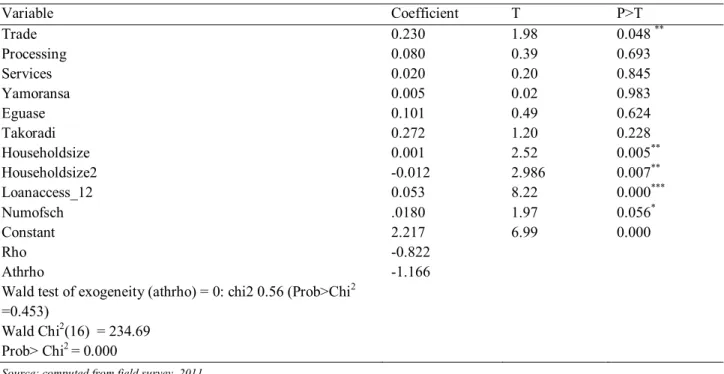
A reliability test using the Durbin-Wu-Hausman is performed. The null hypothesis that there is no endogeneity is rejected since the χ2 =11. 41 with p > 0.57. This gives the indication that the coefficients of the two estimates (probit and IV-probit are significantly different) thus use of the IV-probit will provide more reliable results. The structural form of the IV-probit model is presented on Table 4. The rationale for presenting the table 4 is to show that the instrument is significant.
Once it is significant then we are convinced that the instrumented variables (reading and level education) are endogenous. Table 4 shows that number of schools is significant at 5% and it predicts reading ability and level of education. The predicted residuals are plugged into the reduced form equation (Table 5) to estimate the final model.
Table 4: Structural IV Probit model
Variable Coefficient T P>T Trade 0.230 1.98 0.048 ** Processing 0.080 0.39 0.693 Services 0.020 0.20 0.845 Yamoransa 0.005 0.02 0.983 Eguase 0.101 0.49 0.624 Takoradi 0.272 1.20 0.228 Householdsize 0.001 2.52 0.005** Householdsize2 -0.012 2.986 0.007** Loanaccess_12 0.053 8.22 0.000*** Numofsch .0180 1.97 0.056* Constant 2.217 6.99 0.000 Rho Athrho -0.822 -1.166 Wald test of exogeneity (athrho) = 0: chi2 0.56 (Prob>Chi2
=0.453)
Wald Chi2(16) = 234.69 Prob> Chi2 = 0.000
Source: computed from field survey, 2011 **, *** significant at 5% and 10% respectively.
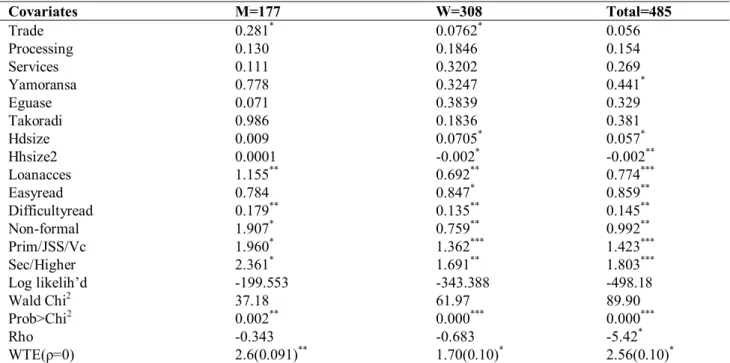
The remaining of the discussion focuses on Table 5 which reports the reduced form of the model. The variable reading is significant in the models for men and women. With reference to those who cannot read at all, difficulty in reading significantly influences ease of credit access for men and women. Women who can read with difficulty are 13.5% likely to access credit easily as compared with men (17.9%). For women, an increase in the level of reading ability is more likely to make access to credit more easily by (71.5%), (6.1%) for men and (47.9%) for both men and women (table 5). The implication is that reading ability is likely to be a constraint to access to credit for women than men. The
result is consistent with previous studies. For example Kozan, Oksoy and Ozsoy (2006) found a positive relationship between higher educational qualifications and business growth which enhances access to credit.
Furthermore, education helps to enhance the exploratory skills, improve communication abilities and foresight (Dobbs & Hamilton, 2007) and these enhanced skills are positively related to present a plausible case for a loan to a banker at the time of preparing a loan proposal and convincing the banker during the client interview. The result is consistent with Zeller (1994). He concluded that the higher the educational level of customers the more likely they are able to obtain loans. In the wake of Bank of Ghana’s tight supervision of MFIs, institutions were required to operate more formal by ensuring that customers go through all the necessary documentations before loans are granted. Thus, customers with little reading ability or cannot read at all are not likely to benefit from micro-loans.
Ability to read provides vital sources of information to households. Households that have limited access to information or face high cost in accessing information may fail to allocate their resources efficiently, may forego income-enhancing opportunities, or may bear unnecessarily high levels of risk. This would be the case if, for example, individuals are unaware of several forms of information, including the requirements for obtaining loans with favourable conditions. In the specific context of financial markets, inadequate access to information can lead producers to choose a sub-optimal loan, savings, or insurance strategy despite the options available to them, or to simply abstain from participating in a typical financial market (Stango & Zinman 2008).
Type of economic activity engaged by households is an important determinant of access to credit. This is because financial institutions usually define their credit concentration. For example in Ghana most MFIs do not lend to the agricultural sector possibly because agricultural activities are risky and are rain fed such that once there are no rains there is no harvest. Again, micro-loans in Ghana for example are for short period of time usually not exceeding six months. In the IV models, engaging in trading activities (buying and selling) enhances women access to credit whereas other economic activities do not. Table 5 shows that men are more likely (28.10%) to access micro-credit easily as compared to women with a probability of 0.0763. This means men who are in trading are better off than women in trading in terms of access to micro-credit.
Processing activity is part of the manufacturing sector. Previous studies have shown that the manufacturing sector attracts credit relative to say the services sector. In this regard this finding is line with Silva and Carreira (2010) who argue that, for most services, the main input is human and not physical capital and therefore service sector firms find it hard to use this physical capital as collateral when resorting to external finance. According to them those in the processing sector can even use their equipment as collateral for loans. This might not be possible in the case of the service activity.
Table 5: IV Probit regression results (Marginal Effects) (Dependent variable: Ease of access to credit)
Covariates M=177 W=308 Total=485 Trade 0.281* 0.0762* 0.056 Processing 0.130 0.1846 0.154 Services 0.111 0.3202 0.269 Yamoransa 0.778 0.3247 0.441* Eguase 0.071 0.3839 0.329 Takoradi 0.986 0.1836 0.381 Hdsize 0.009 0.0705* 0.057* Hhsize2 0.0001 -0.002* -0.002** Loanacces 1.155** 0.692** 0.774*** Easyread 0.784 0.847* 0.859** Difficultyread 0.179** 0.135** 0.145** Non-formal 1.907* 0.759** 0.992** Prim/JSS/Vc 1.960* 1.362*** 1.423*** Sec/Higher 2.361* 1.691** 1.803*** Log likelih’d -199.553 -343.388 -498.18 Wald Chi2 37.18 61.97 89.90 Prob>Chi2 0.002** 0.000*** 0.000*** Rho -0.343 -0.683 -5.42* WTE(ρ=0) 2.6(0.091)** 1.70(0.10)* 2.56(0.10)* Source: computed from field survey, 2011. ***, **, * significant at 1%, 5% and 10% respectively.
In comparison with the other activities, those in trading and processing activities are able to access credit with ease than service activities.
Across samples (men, women and total) service activity does not influence ease or otherwise of access to credit. However, processing activity is significant (1%) for men whereas trading activity is significant (7.6%) for women in determining ease of access to credit. The implication is that women in processing activity are more likely to face difficulty in accessing credit likewise men in trading. In fact, in the context of the Ghanaian economy, commercial activities attract more credit as compared with processing even among the SMEs.
Previous credit record is an important factor in determining the approval or otherwise of current loan. For both men and women, ‘ever accessed credit in the past 12 months’ significantly eases access to credit. However, the differences across gender are significant. For men, any extra loan taken during the past 12 months eases credit access (116%) whereas that of women is about 69.2%. This means women are almost thrice less likely to access credit than men. This finding implies that the notion that microfinance targets women does not mean that men clients are not to be served. When men take loans and they pay back, they are likely to be equally better clients like women. It should be noted that most MFIs seem to have shifted from social mission to commercialization where the focus is on profitability instead of
outreach. If the mission is to target poor women it does not also mean that only women qualify to be clients. Credible male business operators are also targets of commercialized MFIs.
Household size is an important determinant of access to micro-credit. In microfinance also household size seems to be very significant. For example Okurut (2006) in a study in South Africa confirms this. The current study also finds a positive and significant relationship between ease of access to credit and household size for all except male sample. Women are about 7.05% likely to source credit easily and across location, household size influences credit access by 5.65% (10% level of significance) for both men and men. The square of household size is positive over time. This means as household size increases, credit access becomes difficult. Increase in household size makes access to credit difficult by 0.20%. Traditionally, women are caretakers of the home and they may be tempted to use business loans for consumption purposes thus when the MFI is suspicious of this access may be delayed or denied. In terms of access to credit men are not constrained by household size. An increase in household size does not affect access to micro-credit by men.
5.2 Male-Female differences in access to micro-credit
The main hypothesis is that in terms of ease of access to credit, there are no differences across gender. The seemingly unrelated estimation (SUE) test was used to test the differences in the coefficients of interest (Table 6).
Table 6: Differences in ease of access to credit
Variable Chi2 Prob>Chi2 Decision
Loan access_12 4.03 0.045* Reject null hypothesis Reading ability 4.00 0.043* Reject null hypothesis Schooling 4.15 0.042* Reject null hypothesis *significant at 5%
Source: Computed after regression estimates
One advantage of the SUE estimator is that it is always admissible, so the resulting test is always well defined. A second advantage of the SUE approach is that we can estimate the (co)variance matrix of the multivariate normal distribution of the estimators of the models and test that the common coefficients are equal.
Gender differences in ease of access to credit emanate from different sources. Past credit history measured by whether a client has received credit in the past 12 months or not shows that differences in credit access at 5% level of significance. It is therefore concluded that clients who have accessed credit in the past 12 months are advantaged and are able to access further credits without any hindrance.
Level of education is a source of gender difference in accessing informal credit. This debunks the view that within the informal financial sector, level of education is not relevant. This is probably so because as alluded to earlier, MFIs are now aspiring to be fully regulated by Bank of Ghana and as such need to document all credit procedures. Thus, MFIs that hitherto were not formalizing loan application procedures have to do so. In this regard, clients are to go through
formal procedures of loan application which includes writing of request for loans, filling of loan application forms, keeping of financial records, cash flow projections and so on. Thus, more educated clients are likely to access loans without difficulty.
Reading ability is an outcome of education. The assumption is that at higher levels of education, reading ability is high. However, this might not always be so. Testing the differences between coefficients shows that there is significant difference between males and females’ level of reading ability at 5% thus reading ability is a source of gender difference that eases credit access.
6. Conclusions
This paper sought to examine the factors that are likely to ease access to micro-credit among small scale business operators in selected communities in Western and Central regions of Ghana. In terms of education, Human capital development is an important factor in easing access to micro-credit. By implication, education of enterprise owners is very crucial in determining how difficult or otherwise in accessing micro-credit. This is because most MFIs are now becoming formal institutions such that they are also adopting pure formal banking methodologies that the traditional commercial banks adopt. Thus, MFIs that used to be purely informal sometime back will no longer remain informal especially in Ghana where the Central Bank has taken full responsibility of regulating all MFIs.
The onus is therefore on MFIs to educate their clients. This calls for educational programmes that will help clients to read and write and not just education on the use of loans. Thus the concept of credit with education is fundamental in ensuring that access to credit is enhanced among female clients. This will not only enhance credit access but also ensure good use of loans. As a way of ensuring that clients make good use of loans, lending on the basis of past credit record is very important. MFIs need to select clients who have credible credit history.
Acknowledgement
I wish to thank the University of Cape Coast for providing me funding for my Ph.D field work from which this paper is published. I also wish to thank the anonymous referees for their insightful comments. All errors remain mine
References
Aleem, I. (1990). Imperfect information, screening, and the costs of informal lending: A study of a rural credit market in Pakistan” The World Bank Economic Review, Vol.4 No.3 pp.329 - 349
Bravo-Baumann, H. (2000). Capitalization of experiences on the contribution of livestock projects to gender issues. Working Document. Bern, Swiss Agency for Development and Cooperation.
Cameron, C.A & Trivedi, P.K (2010). Microeconomics using STATA, revised edition, STATA Press Publications Desprez-Bouanchaud, A., Doolaege, J. & Ruprecht, L., (1987). Guidelines on gender-neutral language, Paris: UNESCO.
Diagne, A. & Zeller, M. (2000). Access to credit and its impact on Welfare in Malawi Research Report 116 International Food Policy Research Institute Washington, D.C.
Domeher, D & Raymond, A (2012). Access to Credit in the Developing World: does land registration matter? Third
World Quarterly, Volume 33, Number 1, pp. 161-175(15)
Fatoki, O & Chigamba, C (2011). Factors influencing the choice of commercial banks by university students in South Africa, International Journal of Business and Management Vol. 6, No. 6; pp.66-76
Galindo, A & Schantiarelli, F (2003). Credit constraints and investment in Latin America. Inter-American Development Bank, Washington D.C.
Gemmel, N. (1996). Evaluating the impacts of human capital stocks and accumulation on economic growth: Some new evidence. Oxford Bulletin of Economics and Statistics, 58(1), pp.9-28.
Ghana Statistical Service (2008). Report on Ghana Living Standard Survey Round 5, GSS: Accra. Honohan, P & Beck, T (2007), Making Finance Work for Africa, World Bank, Washington, D.C.
Isaksson, A (2002), Trade credit in Kenyan manufacturing: Evidence from plant-level data, SIN Working Paper No 4, May 2002
Kongolo, M (2012). An empirical assessment of women’s access to land and credit in North West Province, South Africa: A probit analysis, African Journal of Agricultural Research Vol. 7(3), 352-357.
Kozan, M. K., Oksoy, D., & Ozsoy, O (2006). Growth plans in small businesses in Turkey: Individual and environmental influences. Journal of Small Business Management, 44 (1), 114-129.
Kumar, A., & Francisco, M (2005). Enterprise size, financing patterns and credit constraints in Brazil: Analysis of
data from the investment climate assessment survey. World Bank Working paper No.49.
Nguyen, C.H. (2007). Determinants of credit participation and its impact on Household Consumption: Evidence from rural Vietnam, Discussion paper 2007/03
Okurut, N.( 2006). Access to credit by the poor in South Africa: Evidence from household survey data 1995 and 2000 Department of Economics, University of Botswana Stellenbosch, Economic Working Papers: 13/06
Okurut, F.N., & Schoombee, A. (2007). Credit market access in Uganda: Evidence from household survey data 1999/2000. South Africa. Journal of Economics and Management Science, 10 (3): pp.371-383.
Omonona, B. T, Lawal J. O & Oyinlana, A. O (2010). Determinants of Credit Constraint Conditions and Production Efficiency Among Farming Households in South western Nigeria, The Social Sciences Vol.5 Issue: 4, 326-331. Peachey, S., (2004). Comment: Government of Kenya stakeholders’ forum on financial sector reforms,
Mombassa.Kenya
Roe, A. R., (2004). Key issues in the future development of Kenyan banking, Paper to Government of Kenya stakeholders’ forum on Financial Sector Reforms, Mombassa, Kenya
Schreiner, M. & Woller, G. (2010). A Simple Poverty Scorecard for Ghana, Consultative Group to Assist the Poorest. Silva, F & Carreira, C (2010). Financial constraints: Are there differences between manufacturing and services. viewed 01 November 2010, http://gemf.fe.uc.pt.
Stango V & Zinman, J. (2008). The price is not right (not even on average): Exponential growth bias, present-biased
World Bank (2007). Uganda: Moving beyond recovery, investment and behaviour change for growth. Country Economic memorandum: Summary and Recommendations. The World Bank: Washington D.C.
World Bank (2004). Investment climate assessment: Improving enterprise performance and growth in Tanzania. Private Sector Development Unit, Africa Region,Washington, DC.
World Economic Forum. (2009). The Global Competitiveness Report 2009–2010. Geneva: World Economic Forum Zeller, M. (1994). Determinants of credit rationing: a study of informal lenders and formal credit groups in