ISTANBUL BILGI UNIVERSITY INSTITUTE OF SOCIAL SCIENCES
ORGANIZATIONAL PSYCHOLOGY MASTER’S DEGREE PROGRAM
HOW LONG CAN YOU HOLD YOUR BREATH UNDERWATER? A QUALITATIVE STUDY OF WHITE-COLLAR PROFESSIONALS’
EXPERIENCES OF LEAVING CORPORATE LIFE
Elif AYAZ 114632005
Doç. Dr. İdil IŞIK
İSTANBUL 2020
ACKNOWLEDGEMENTS
First of all, I would like to thank my thesis supervisor Doç. Dr. İdil Işık, who tirelessly supported and motivated me through the process of writing this thesis. Her valuable contributions made this thesis possible.
I would like to thank all of the participants of this research who were willing to share their experiences of leaving corporate life. Their perspectives not only made this thesis possible but also taught me a lot as a person.
I would like to thank my dearest friends Çağla Altıntaş and Çağrı for their valuable feedback and support.
My mother and my husband who supported me through this thesis and all through my graduate studies. I can not thank them enough.
Also, I would like to thank Tarçın, my dog, who slept next to me the whole time I was writing this thesis. She was okay spending less time outside and receiving fewer tummy rubs so that I can finish my thesis.
TABLE OF CONTENTS
ACKNOWLEDGEMENTS --- iii
LIST OF FIGURES --- viii
LIST OF TABLES --- ix
ABSTRACT --- x
ÖZET --- xi
CHAPTER 1 --- 1
INTRODUCTION --- 1
1.1. CAREER TRANSITION AND MIDLIFE CAREER CHANGE--- 4
1.1.1. Mid-Life Career Change --- 4
1.1.1.1. Early Footsteps --- 5
1.1.1.2. Reasons and Results of Mid-life Career Change in the Literature --- 9
1.2. CAREER DEVELOPMENT THEORIES --- 11
1.2.1. Sociological Perspective --- 12
1.2.2. Developmental and Postmodern Theories --- 12
1.2.2.1. Gottfredson’s Theory of Circumscription, Compromise, and Self-Creation --- 12
1.2.2.2. Career Construction: A Developmental Theory of Vocational Behavior --- 13
1.2.2.3. Contextualist Approach --- 14
1.2.3. Career Development Theories Anchored in Learning Theory --- 16
1.2.3.1. Social Cognitive Career Theory --- 16
1.2.3.2. Cognitive Information Processing Approach to Career Problem Solving and Decision Making --- 17
1.2.4. Trait-Factor Theories --- 19
1.2.4.1. Holland’s Theory of Personalities in Work Environments --- 19
1.2.4.2. Person-Environment-Correspondence Theory --- 20
1.4. LEAVING CORPORATE LIFE --- 26
1.5. RESEARCH OBJECTIVES --- 29
1.6. RESEARCH IMPORTANCE --- 30
1.7. ABOUT THE RESEARCHER --- 31
CHAPTER 2 --- 34
METHOD --- 34
2.1. PARTICIPANTS --- 34
2.2. METHODOLOGY --- 37
2.3. PROCEDURES AND DATA COLLECTION --- 37
CHAPTER 3 --- 39
RESULTS --- 39
3.1. MODEL FOR LEAVING THE CORPORATE WORLD --- 39
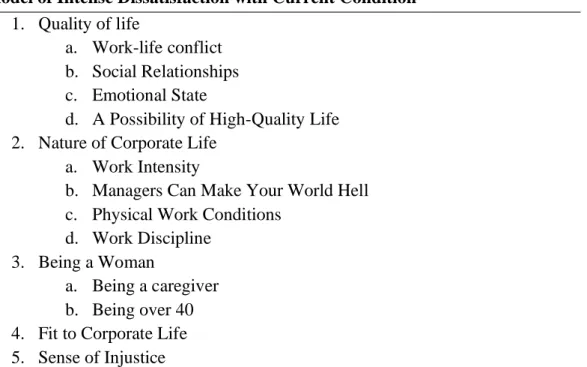
3.1.1. Intense Dissatisfaction with Current Condition --- 40
3.1.1.1. Quality of life --- 42
3.1.1.1.1. Work-Life Conflict --- 42
3.1.1.1.2. Social Relationships --- 45
3.1.1.1.3. Emotional State --- 46
3.1.1.1.4. A Possibility of High-Quality Life --- 48
3.1.1.2. Nature of Corporate Life --- 49
3.1.1.2.1. Work Intensity --- 49
3.1.1.2.2. Managers Can Make Your World Hell --- 50
3.1.1.2.3. Physical Work Conditions --- 51
3.1.1.2.4. Work Discipline --- 52
3.1.1.3. Being a Woman --- 53
3.1.1.3.1. Being a Caregiver --- 54
3.1.1.3.2. Being over 40 --- 56
3.1.1.5. Sense of injustice --- 60
3.1.2. Feeling of Imprisonment --- 61
3.1.3. Facing the Critical Event and Awareness About the Burden of Corporate Life ---- 63
3.1.4. Search for Alternatives and Preparation for Change --- 66
3.1.4.1. Financial Readiness --- 66
3.1.4.2. Emotional Readiness --- 67
3.1.4.3. Planning and Trial --- 69
3.1.5. Implementing the Plan for Leaving the Corporate Life --- 69
3.1.5.1. Formalities --- 70
3.1.5.2. Relief --- 71
3.1.5.3. Facing Realities: “How long can you hold your breath under water?” --- 72
3.1.5.4. Sustaining New Way of Life --- 73
3.1.6. Experience in New Life and Emotions about Their Decisions --- 74
3.1.6.1. Village and Farm Life --- 75
3.1.6.2. Entrepreneur Life --- 77
3.1.6.3. Change in Life Standard --- 78
3.2. SUMMARY --- 78
CHAPTER 4 --- 80
DISCUSSION --- 80
4.1. COMPARISON OF TWO RESEARCH --- 80
4.1.1. Frustration with One’s Situation vs. Intense Dissatisfaction with Current Condition 81 4.1.1.1. Similarities between Frustration with One’s Situation and Intense Dissatisfaction with Current Condition --- 82
4.1.1.2. Complete and Partial Differences between Frustration with One’s Situation and Intense Dissatisfaction with Current Condition --- 83
4.1.2. Some Preconditions Relating to Career Change --- 84
4.1.3. Constraints on Entering a New Career --- 88
4.2.1. Sociological Perspective --- 90
4.2.2. Developmental and Post-Modern Theories --- 91
4.2.3. Career Theories Anchored in Learning Theory --- 92
4.2.4. Trait-Factor Theories --- 93
4.3. MIDLIFE CAREER CHANGE PERSPECTIVE --- 94
4.3.1. Gender --- 95
4.4. SATISFACTION VS. DISSATISFACTION --- 96
4.5. LEAVING CORPORATE LIFE --- 97
4.5.1. Big Cities vs. Small Towns --- 98
4.6. IMPLICATIONS --- 98
4.6.1. Organizational Level Implications --- 99
4.6.1.1. Quality of Life--- 99
4.6.1.2. Nature of Corporate Life --- 99
4.6.2. Individual Level Implications --- 100
4.7. LIMITATIONS --- 101
4.8. FURTHER STUDIES--- 102
4.9. LAST NOTE --- 103
References --- 105
LIST OF FIGURES
Figure 3.1 Summary for Model for Leaving the Corporate World 39 Figure 3.2 Themes of Intense Dissatisfaction with Current Condition 40 Figure 3.3 Subthemes of Intense Dissatisfaction with Current Condition 41 Figure 3.4. Life Style Choices of the Participants 75
LIST OF TABLES
Table 1.1 Roberts’s Model of Mid-Career Change 8
Table 1.2 A Process Model of the Relationship between Work-Related Antecedents and Life Satisfaction
25
Table 2.1 Demographics of the Participants 36
Table 3.1 Aspects of Quality of Life 42
Table 3.2 Nature of Corporate Life 49
Table 3.3 Model of Leaving the Corporate World 79
Table 4.1 Roberts’s Step of Frustration with One’s Situation 81 Table 4.3 Roberts’s Step of Some Preconditions Relating to Career Change 85
ABSTRACT
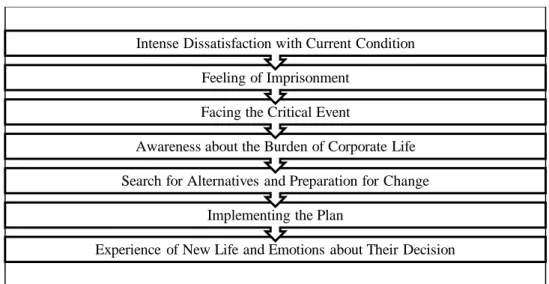
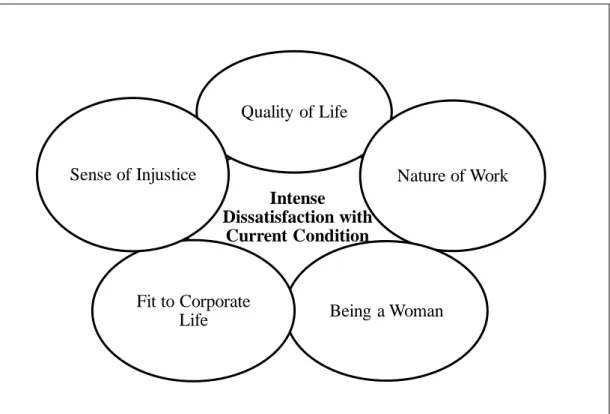
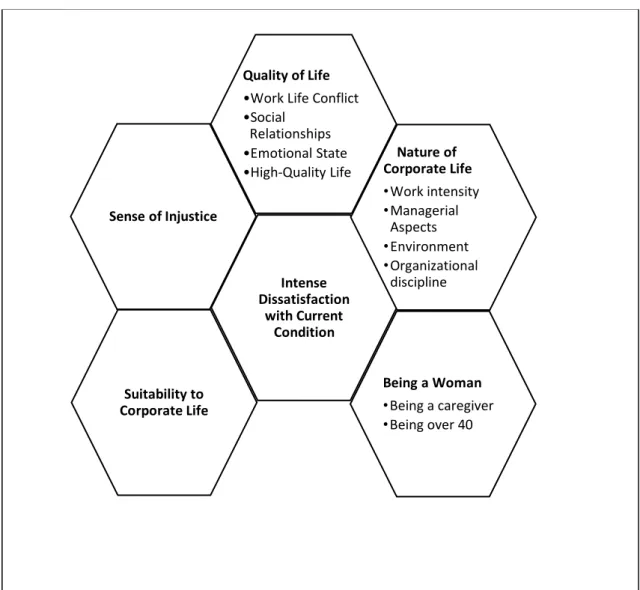
The goal of this thesis is to understand the process of leaving corporate life. Questions of the researcher are; (a) How people decide to leave corporate life?, (b) How the process continues once the individual makes a decision?, (c) What kind of changes occur in people’s lives?, (d) How does the end result make them feel?, and (e) Which characteristics of corporate life people consider when leaving? Taking the grounded theory approach, we conducted semi-structured interviews with 9 participants who left the corporate life after working for at least ten years and who were satisfied with their choice. The research resulted in a Model for Leaving Corporate Life. The process starts with “Intense Dissatisfaction with Current Condition”. These feelings grow out to become a “Feeling of Imprisonment”. Along with “Facing the Critical Event and Awareness About the Burden of Corporate Life”, individuals start “Searching for Alternatives and Prepare for Change”. The model suggests that “Implementing the Plan for Leaving Corporate Life” follows. The model ends with explaining the “Experiences in New Life and Emotions About the Decisions”. The model is discussed in terms of career development theories and mid-life career change.
Keywords: Leaving Corporate Life, Career Development, Mid-Life Career
ÖZET
Bu çalışma bireylerin kurumsal hayattan ayrılma deneyimini incelemektedir. Araştırmacı yola çıkarken şu soruları sormuştur: (a) bireyler kurumsal hayatı bırakmaya nasıl karar veriyor?, (b) bireyler karar verdikten sonra süreç nasıl işliyor?, (c) bireylerin hayatında nasıl değişiklikler oluyor?, (d) sonuç bireylere nasıl hissettiriyor?, (e) bireyler kurumsal hayattan ayrılırken onun hangi karakteristik özelliklerini göz önünde bulunduruyorlar? Araştırma için gömülü teori yöntemi kullanılmış, 9 katılımcı ile yarı yapılandırılmış görüşmeler gerçekleştirilmiştir. Bu katılımcılar kurumsal bir işte en az on yıl çalışmış ve kurumsal hayatı bıraktıktan sonra tercihlerinden tatmin olmuş kişiler arasından seçilmiştir. Araştırma, bir kurumsal hayatı bırakma modeli ile sonuçlanmıştır. Bu modele göre, süreç kişilerin yoğun bir tatminsizlik duygusu yaşaması ve bunun sonucunda kendilerini kapana kısılmış hissetmeleriyle başlamaktadır. Bunun ardından yaşanan kritik bir olay ve kurumsal hayatın getirdiği yükün farkına varılmasıyla, bireylerin alternatifler aramaya başladığı ve değişim için hazırlandıkları görülmüştür. Bir sonraki adım, bireylerin planlarını gerçekleştirmesidir. Model, bireylerin yeni tecrübeleri ve verdikleri karar hakkındaki duyguları ile sona ermektedir. Bu tezde kurumsal hayatı bırakma modeli kariyer gelişim teorileri ve orta yaş kariyer değişimi kavramları üzerinden tartışılmıştır.
Anahtar Kelimeler: Kurumsal Hayatı Bırakmak, Kariyer Gelişimi, Orta Yaş
Kariyer Değişimi, Kariyer Danışmanlığı, İş Yaşam Çatışması, İş Tatmini, Yaşam Tatmin
CHAPTER 1
INTRODUCTION
What is a career? Is it a journey in which there is no turning back? Is it only made up of work-life, or is it something that is influenced by everything else in our lives? Researchers tried to clarify this for years. Some think it is a linear path, while others believe it is a more fluid phenomenon.
According to Collin and Watts, we are moving into a post-industrial phase of economic development (Collin & Watts, 1996). Twenty-four years after Collin and Watts’s paper was published, the industry is now talking about Industry 4.0, and how many of the jobs will be under the threat of digitalization. It is foreseen in the mass media that this will also bring many new jobs that did not exist before (Caldwell, 2019).
Career is a term that came into use with industrialization. There was a concentration of work in large organizations and an increase in the division of labor (Collin & Watts, 1996). To understand how definitions of work, vocation, and career evolved, we need to go back to the beginning of the 20th century. In 1909 Frank Parsons published his book “Choosing a Vocation”. Looking at only the contents of this book, one can see that Parsons put importance on “The Personal Investigation”, “The Industrial Investigation”, and “The Organization and the Work” (Parsons, 1909).
He starts his book “Choosing a Vocation” (1909) by;
“No step in life, unless it may be the choice of a husband or wife, is more important than the choice of a vocation. The wise selection of the business, profession, trade, or occupation to which one’s life is to be devoted and the development of full efficiency in the chosen field are matters of the deepest moment to young men and to the public. These vital problems should be solved in a careful, scientific way, with due regard to each person’s aptitudes, abilities,
ambitions, resources, and limitations, and the relations of these elements to the conditions of success in different industries.” (p. 3)
In his work, Parsons puts importance on scientific methods. In summary, he proposes to measure personality traits, and traits of the vocations and match the right people with the right vocations (Parsons, 1909). This is in line with how Kanter (1989) defines the bureaucratic career; as upward progression within a hierarchical organization (as cited in Collin & Watts, 1996). Hence, the vocational choice and upward progress were at the core of the conceptualization of career in the 20th century.
The meaning of work continued to evolve in the 20th century in the United States. The type of work one is engaged became the determinant of that person’s status (Niles & Harris-Bowlsbey, 2002). Occupation rather than work became the means of determining one’s status. There was an emphasis on climbing the corporate ladder, getting ahead, and making self more marketable (Niles & Harris-Bowlsbey, 2002). However, Savickas (1993) states that with recent developments, there are fewer ladders to climb, organizational structures are flatter. Employees are less willing to sacrifice everything for the employer since they are easily let go by their employers (as cited in Niles & Harris-Bowlsbey, 2002). These developments led people to seek self-fulfillment; personal and professional growth. People started to search work that does not deny involvement in family, community, and other life roles (Niles & Harris-Bowlsbey, 2002). Henceforth, the term career should be considered along with economic, social, cultural, technological, political, and historical changes (Niles & Harris-Bowlsbey, 2002). In today’s context, boundaryless careers are growing in recognition rather than bureaucratic paths. The likelihood of dynamic, multi-directional, and fluid career paths are increasingly being acknowledged (Collin & Watts, 1996).
There are many career development theories, each has a different look on the definition of career. Super’s career development theory (1980) takes into account many other roles people take on in life. Super (1980) defines the career as;
“…the combination and sequence of roles played by a person during the course of a lifetime. These roles include those of child, pupil or student, leisure, citizen,
worker, spouse, homemaker, parent, and pensioner, positions with associated expectations that are occupied at some time by most people, and other less common roles such as those of criminal, reformer, and lover.” (p. 282)
Career construction theories make distinctions between career, vocation, and occupation (Brown, Career Choice and Development, 2002). Crites (1969) states that vocational behavior is different than other types of behavior (as cited in Brown, 2002). When talking about the requirements of becoming a lawyer, one should refer to these as “occupational information” however if an individual is making a choice to become a lawyer, that means that individual is making a “vocational choice” (Brown, Career Choice and Development, 2002). Brown (2002) further explains “The term vocational refers to the responses an individual makes in choosing and adapting to an occupation.” (p. 151).
Contextualists base the term career on action theory (Young, Valach, & Collin, 2002). Action is simply the human intention, process, and change; and career is a construct that allows people to construct connections amid actions (Young et al., 2002). That means career makes plans, goals, effort, and consequences more sensible; also, career lets people frame their emotions and internal cognitions (Young et al., 2002).
Moving further, what should we understand from the term career change? According to Feldman (2002), career change occurs when a person enters a new occupation, and when that occupation requires fundamentally different skills, daily routines, and work environments from the previous one (as cited in Barclay, Stoltz, & Chung, 2011). Heppner, Multon, and Johnston (1998), approach career change as a change of duties, which may include a new work setting. Donohue (2007) takes on the issue from Holland’s categorical approach, which categorizes each occupation’s characteristic requirements by using the first letters of three of the following characteristics: “Realistic”, Investigative”, “Artistic”, “Social”, “Enterprizing”, and “Conventional”. Donohue (2007) states that career change occurs when an individual is changing from one three-letter vocation to another (as cited in Barclay, Stoltz, & Chung, 2011).
The goal of the current research is to investigate the experience of leaving corporate life. Questions of the researcher are; (a) How people decide to leave corporate life?, (b) How the process continues once the individual makes a decision?, (c) What kind of changes occur in people’s lives?, (d) How does the end result makes them feel?, and (e) Which characteristics of corporate life people consider when leaving? Proposed model for leaving corporate life aims to cover proposed questions.
There is a lack of literature on leaving corporate life. Therefore, I will discuss the results from the career theories and mid-life career change perspectives.
1.1. CAREER TRANSITION AND MIDLIFE CAREER CHANGE
1.1.1. Mid-Life Career Change
When does midlife start? While some think middle adulthood or mid-life is between 40 years to 65 years of age (Capuzzi & Stauffer, 2016), upper and lower age limits of midlife may change as long as ten years (Guindon, 2010). This phase is characterized by a desire to reach for goals previously delayed or foreclosed upon. New targets may emerge that are more in line with the individual’s current state and interests (Guindon, 2010). Levinson’s Midlife Transition has the developmental task of individuation (Levinson, 1986). Levinson (1986) states that individuals become more compassionate, reflective and judicious. They are less tyrannized by their inner conflicts and external demands and also more loving towards themselves and others (Levinson, 1986).
Considering these theoretical approaches on midlife, it is not a coincidence that researchers are looking at the career change from a developmental – mid-life point of view.
1.1.1.1. Early Footsteps
I will start this topic with Roberts’ report on mid-life career change. She wrote her report in 1973. This report has very interesting facts that can change our popular perspectives of leaving corporate life. Even though it is popularly perceived that the emergence of the internet made it easier for people to set up their own business or created opportunities for people to work as freelancers, leaving corporate life probably existed long before the internet was widely used. Forty-seven years ago, Roberts started her report with the examples of the Harvard economist who turns to opera singing as a career, an executive from New York City who left his job and opened up a restaurant in Wyoming. An article in life magazine shows us the perceptions were changing since the 1970ies (Bayer, 1970). The article suggests;
“In the old days, there was almost no way for a man to change direction. He had invested too much time and talent getting where he was, and he stood to lose too much if he started at the bottom somewhere else. Today, the switch is easier and there are even some incentives.” (p. 50)
The Time essay (Second Acts in American Lives, 1968) states;
“American males are suffering from what Sociologist Leon Bramson calls the "Charley Gray syndrome," after the hero of John Marquand's novel Point of No Return. Having finally won his bank vice-presidency, Gray finds it meaningless—and far worse, he has no alternatives. As Sociologist Bramson sees it: "We have made it virtually impossible for people to try different kinds of careers in middle life without extraordinary risks." With depressing finality, Novelist F. Scott Fitzgerald declared: "There are no second acts in American lives." Scott may have been right in his time. But no more. Now a noteworthy and increasing number of Americans are beginning second acts with verve and purpose.” (p. 1)
Considering the Times article, Roberts’s report, and Life magazine essays we can conclude that this phenomenon may have started long before than we realize. An article that can navigate us to a narrower time frame is called “Understanding Midlife Renewal” (Beijan & Salomone, 1995). Beijan and Salomone (1995) stated that during the 1950s and 1960s, people did not frequently change careers after the age of 30. They link the midcareer reevaluation and change to social changes in America, such as automation and corporate downsizings. Many people had to look for new jobs, and this may have led people to believe that midlife career change is more acceptable (Beijan & Salomone, 1995). The 1970s and 1980s were a time when women were entering the workforce, and this may have also reduced the financial strain on families, which in return makes it easier to look for second careers (Beijan & Salomone, 1995). I would add the movie released in 2007, "Revolutionary Road" as an artistic example and an indicative of this trend. The story takes place in the 1950s, in which Leonardo DiCaprio's character Frank Wheeler tries to get out of corporate life.
It is necessary to note that most research, including Roberts’s report, consider male white-collar employees. Roberts included male white-collar employees between the ages of 35 to 60 in her report and explains that women were either going into the workforce from domestic work or going to get university degrees; therefore, she will not include women in her report.
Roberts states two concerns about the mid-life career change. First, how this loss of skilled resources will affect the US economy? The second, how the government can provide resources for the career changers? According to Roberts (1973), some keywords for mid-life career change were: career blues”, “mid-career crisis”, “occupational menopause”, and ““mid-career obsolescence”. She also states that the topic interested sociologists, economists, psychologists, and gerontologists. The psychological view suggests that when the person faces reality and that reality doesn’t measure up to his dreams, career change interest occurs (Levinson H. , 1969).
Roberts proposes a short model for a mid-life career change by using the previous research on the area. She gathers “push and pulls” of old careers and the
new ones. Table 1.1 is a summary of her model. I will refer to her model in detail on the discussion part and make comparisons to the model suggested by my research (Roberts B. H., 1973).
Table 1.1 Roberts’s Model of Mid-Career Change
Roberts’s Model of Mid-Career Change 1. Frustration with One’s Situation
a. Performance inability b. Career completion c. Mid-career blues d. Identity crisis
e. Discrepancy between aspirations and achievement f. Work alienation
g. Dissatisfaction with pay, status, or security h. Quest for exciting or socially useful work 2. Some Preconditions Relating to Career Change
a. Early retirement
b. Availability of mid-career clinics c. Dislocation by external forces d. Family crises
e. Availability of finances f. Access to alternative careers g. Word of mouth
h. Leisure time
i. Association with career changers
j. Career mobility and occupational expansion 3. Constraints on Entering a New Career
a. Risks
b. Familial obligations
c. Requirements of new career
d. Non-transferable status and seniority Source: Roberts, 1973
If we come closer to today, mid-career changes symposium editorial (2015) suggests that instability of the market is increasing. The paradigm of lifelong employment is no longer the reality; therefore, managing career transitions is becoming a part of the individuals’ lives (Mid-career Changes Symposium, 2015). With this new paradigm comes the need for upskilling or reskilling, which is assumed to be one of the biggest challenges that individuals will face (Editorial: Mid-career Changes Symposium, 2015).
In this new paradigm, there can be two types of career change; voluntary and involuntary. An involuntary career change may occur because of the events that are out of the control of the individual such as layoffs or limited employment opportunities. Voluntary career change occurs when an individual willingly changes his or her occupation. For this study, I will only include the voluntary mid-life career change.
1.1.1.2. Reasons and Results of Mid-life Career Change in the Literature
There are many research papers concerning mid-life career change published more recently. I should remind you that these researches do not solely focus on leaving corporate life, even though some participants in the research did leave corporate life, most only changed occupations. A paper published in 2005 suggests that career change is becoming more common amongst those who are in their thirties, and it is expected to rise due to increased multi-directional, dynamic, and fluid career paths (Wise & Millward, 2005).
Wise and Millward (2005) conducted their research with participants who changed their careers voluntarily in mid-life. They propose that three themes emerged from the interviews; continuity-discontinuity, values directing change, and influence of context. During the transition, they state that participants expressed positive emotions such as “relief”, “sense of openness”, and they felt like it was a beginning of a journey, full of possibilities (Wise & Millward, 2005). The results state that participants had a time-out period, where they took time from life’s pressures and demands. It was a time when participants made decisions before
moving forward (Wise & Millward, 2005). Wise and Millward (2005) claim that participants needed a continued sense of professional identity, achievement levels, rewards, and recognition. Voluntary mid-life career changers value growth, learning, and self-fulfillment (Wise & Millward, 2005). The motivations for career change for those participants were self-awareness about the need to be honest with oneself, finding work that truly reflected their identity, wanting a sense of purpose and direction, a chance to do something for the society. Majority of the participants stated that they would like to achieve greater work-life balance (Wise & Millward, 2005). For many participants, researchers reported, the change resulted in benefits such as better personal relationships, enhanced body image, self-development, maturity, confidence, a more balanced life, and greater happiness (Wise & Millward, 2005).
Donohue’s (2006) research on adult career attitudes suggest that people who do not want to change their careers score higher on job satisfaction than those who express intend to leave. Value misfit between the workplace and the individual may result in dissatisfaction and career transition (Brown, 1995).
Individuals who change careers during mid-life are no longer interested in their current work or learning about it (Power & Rothausen, 2003). Beijan and Salomone (1995) state that midlife clients express anxiety concerning death, lower self-esteem, dissatisfaction with their lives, desire for change, and fear of the unknown and uncertainty to their counselors. Perosa and Perosa (1984) state that when this period is severe enough to be called “crisis”, the individual is compelled to choose among the various vocational, religious, and political alternatives (as cited in Beijan & Salomone, 1995).
When it comes to a midlife crisis, research is mostly on men (Beijan & Salomone, 1995). Women go through developmental stages similar to men with differences in how they work on their developmental tasks and their goals (Roberts & Newton, 1987). Roberts and Newton (1987) state that women experience more inner turmoil and conflict between family and career than men do. They often experience dissatisfaction with their careers or their relationships. Beijan and Salomone (1995) suggest that one-third of 25 career women in midlife in Lieblich’s
(1986) study stated that their transition to age 40 was so severe that they called it a “crisis”. Her study is available online in Hebrew. Gallos (1989) states that women go through a period of reevaluation as well, and often chose to plateau in their career (as cited in Beijan & Salomone, 1995). She states they do this to give more attention to develop intimate relationships (as cited in Beijan & Salomone, 1995).
1.2. CAREER DEVELOPMENT THEORIES
One may ask, why there was a need for career theories. Even though the phenomenon seems new, people wanted to find appropriate careers since the fifteenth century (Brown, Career Choice and Development, 2002). The world has gone through difficult times in terms of production, economy, and human resource during the First and Second World War. The need for placing people into occupations that they can show their best performance became important (Brown, Career Choice and Development, 2002).
In his book Career Choice and Development, Brown (2002) suggests:
“Vocational psychologists have been primarily concerned with the degree of ‘fit’ between person and job. If there is a closer fit, in terms of the interests, needs, and personalities of the person and the experiences, rewards, and challenges that a job has to offer, it is expected that there will be greater job satisfaction and fulfillment and a lesser tendency to change jobs over the course of the career.” (p. 38)
We can conclude that career theories are both aim to improve the individual’s life as well as the society. Therefore, the knowledge produced by these theories is used in career counseling.
Parson’s trait and factor theory mentioned earlier was the first step towards the emergence of career development theories (Brown, Career Choice and Development, 2002). His theory consisted of three steps: understanding the self, understanding different lines of work, and understanding the relations of these two groups of facts (Parsons, 1909). There have been many theories evolved from Parsons’s trait and factor theory, and many others differed from it. In his book
“Career Choice and Development” Duane Brown (2002) proposes four main categories to ease the understanding of career theories. He explains that career theories can be grouped according to; sociological perspective, developmental and post-modern theories, career development theories anchored in learning theory, and trait and factor theories (Brown, Career Choice and Development, 2002). In this literature review, I decided to use his grouping because the terms used in this categorization is highly relevant to research results.
1.2.1. Sociological Perspective
Sociologists study career choice because it has consequences for mobility and socioeconomic inequality. Their interest is focused on intergenerational mobility, meaning how vocational choices affect a person’s status and to what extent a person can escape from disparities that were present for their parents by their vocational choice (Kirkpatrick Johnson & Mortimer, 2002). They look at the structures such as educational institutions and the labor market that influence the occupational options from which individuals choose. They claim interests and preferences are subject to structural influences (Kirkpatrick Johnson & Mortimer, 2002). Family, adolescent work experience, and community also influence career decision making in the context of the status attainment (Kirkpatrick Johnson & Mortimer, 2002).
1.2.2. Developmental and Postmodern Theories
1.2.2.1.Gottfredson’s Theory of Circumscription, Compromise, and Self-Creation
Linda Gottfredson’s theory (2002) mainly focuses on gender and class differences in career decision making and barriers that individuals face during the process. This theory highlights power of creating a public self. The public self resonates with the unique internal self, even when power is not exercised. The
theory assumes that individuals are actively creating themselves and shaping their destiny (Gottfredson, 2002).
There are three major concepts of the theory; self-concept, circumscription, and compromise. Concepts such as social space, cognitive map of occupations, and images of occupations also hold a prominent place.
Self-concept refers to how individuals view themselves publicly, as well as privately. Place in society, personality, values, and gender are some elements included in the self-concept (Gottfredson, 2002).
People have occupational stereotypes. If you are talking about a lawyer, there are certain assumptions in every culture about personalities of lawyers, lives they live, prestige, and so on. These stereotypes are called images of occupations. These images are organized on a cognitive map of occupations (Gottfredson, 2002). Linda Gottfredson (2002) suggests that people distinguish occupations according to dimensions such as masculinity-femininity, occupational prestige level, and field of work. This map can be seen as a map of the larger social world where different occupations have a different place (Gottfredson, 2002). When people identify themselves with different occupations, they use the cognitive map and assess the compatibility of the options (Gottfredson, 2002). While doing that, people tend to guard public presentations of masculinity-femininity, protect social standing among others, and ensure fulfillment in terms of activities and personality needs (Gottfredson, 2002).
1.2.2.2. Career Construction: A Developmental Theory of Vocational Behavior
Career is defined as the development of vocational behavior over time (Savickas, 2002). This theory is not interested in occupational information like trait and factor theories do, but is interested in vocational choice. Its focus is on the change of the vocational behavior of an individual over time (Savickas, 2002). Savickas (2002) proposes that his developmental theory of career construction is a newer version of Super’s (1953) theory of vocational development (as cited in
Savickas, 2002). The theory proposes that individuals have a life structured by social processes, which bring them different roles, such as being a father and a teacher. Balance among core roles brings individual stability, but imbalance results in strain (Savickas, 2002). The theory bases occupational success on individuals’ work roles. When they find adequate outlets for their vocational characteristics, occupational success is achieved (Savickas, 2002). Job satisfaction occurs if an individual establishes a work situation in which one can attend to roles that his or her experiences led to (Savickas, 2002). The theory also suggests the self-concept and vocational preferences change over time (Savickas, 2002).
According to Savickas (2002), there are five developmental tasks in career construction. The journey starts with growth, in which the individual is forming a vocational self-concept. This happens between the ages of 4 and 13. Exploration starts around the age of 14 and continues until the age of 24. During exploration, individuals fit themselves into society by their inner world. The establishment is the implementation of self-concept in an occupational role and happens between the ages of 25 to 44. After those years, individuals may come to ask themselves whether they would like to keep doing what they do for the next 25 years. This period is defined by the re-finding the self. Individuals may change their organization, field or occupation during this process. The decision of staying in the current occupation results in entering the stage of career maintenance. If a change occurs, individuals go through exploration and establishment again. Lastly, there is disengagement when an individual is focused on retirement planning. This starts around the age of 65 and continues throughout the rest of life (Savickas, 2002).
1.2.2.3. Contextualist Approach
Contextualist approach was developed by Young and Valach to reconceptualize the nature of career, to offer an explanation of career based on action theory (Young, Valach, & Collin, 2002). According to Young, Valach, and Collin (2002), there are 3 properties of context; a multiplicity and complexity of
parts, the complex working together of these parts, and the meaning of events or phenomena.
Young and Valach’s contextualist approach is focused on the construction of action. Action is a goal-directed behavior; it is intentional (Young, Valach, & Collin, 2002). As you can imagine, career is also full of actions we take, however Young, Valach, and Collin (2002) believe that it is meaningless without any context. They consider action from three perspectives. They look at the manifest behavior, internal processes, and social meaning. Manifest behaviors are the behaviors that can be observed by others, such as going door to door to sell a certain product. Internal processes are more of the feelings of the individual. For instance, one can feel anxious about not being able to hit the sales target. Social meaning can be found when the individual tries to visit more houses to hit the sales target, to be considered successful. Thus, when we try to make sense of one’s actions, we need to be able to see its context.
To make sense of the actions, Young, Valach, and Collins (2002) propose three constructs; joint action, project, and career. Joint action is when we consider individuals with others in their environment. For instance, a person may have particular career aspiration, but may discuss it with his or her partner and act differently. Joint action may shape the process for a particular project. Actions and plans lead to the goal. Career, on the other hand, extends over longer than project and includes more actions (Young, Valach, & Collin, 2002). Action is organized into three levels: elements, functional steps, and goals (Young et al., 2002) Physical and verbal behaviors are the elements of the action. The same words can be interpreted differently according to the individual who is involved. The functional step is when an element of action is contextualized by seeing it as one of a series of behaviors. Goals are the representations of general intentions (Young et al., 2002). This theory is essential for the current study because it considers emotions. Young, Valach, and Collin (2002) state that many vocational counseling texts do not index emotion, but emotion and cognition are central to their theory. They claim that emotion and cognition regulate and guide action, they are motivational and energizing. Why is the emotion connected to context? Their answer is because
emotion arises out of context (Young, Valach, & Collin, 2002). Positive emotions can lead to growth and social connections for individuals (Fredrickson, 2001). If it is a motivating factor, they claim that emotion should also be connected to the goals and plans of an individual. Averill and More (1993) suggest that happiness is related to an individuals’ ability to form a sense of what their life should be (as cited in Young, Valach, & Collin, 2002). Young, Valach and Collin state three reasons why emotion is vital in a career. First is the motivational factor. Without the emotion to sustain it, a career or project can not be attained in the long run. Second, emotions have a regulating effect. They control actions, projects, and careers, and the last reason is the emotion provides important narratives of project and career (Young, Valach, & Collin, 2002). They finally conclude that emotions regulate our actions and emotions are constructed by our actions, projects, and careers at the same time (Young, Valach, & Collin, 2002). Besides emotions, culture and gender are other contexts mentioned in the contextualist explanation of career.
1.2.3. Career Development Theories Anchored in Learning Theory
1.2.3.1. Social Cognitive Career Theory
Social cognitive theory focuses on cognitive variables. It assumes that these variables may govern career behavior (Lent, Brown, & Hackett, 2002). Social Cognitive Career Theory (SCCT) is inspired by Bandura’s social learning theory.
Central concepts of the theory consist of person-environment interactions. SCCT assumes that people have a potential for self-regulation, and they are products as well as producers of their environment (Lent, Brown, & Hackett, 2002). Self-efficacy, outcome expectations, and personal goals are considered as the building blocks of career development.
In his book Self-efficacy: The exercise of control, Bandura (1997) states that self-efficacy refers to people’s beliefs about their capabilities. Personal performance accomplishments, vicarious learning, social persuasion, and physiological and affective states can modify our self-efficacy.
Bandura (1997) states outcome expectations are what an individual believes what an outcome will be of a particular behavior. Goals are defined as the determination to engage in a particular activity to affect a particular future outcome. SCCT brings forward three models that organize career-related interest, choice, and performance: interest development model, choice model, and performance model (Lent, Brown, & Hackett, 2002). The interest development model claims that individuals are exposed to different activities throughout their childhood and adolescence. If they see themselves competent in an activity and believe performing that activity will produce valuable outcomes, they keep doing it. If their self-efficacy is weak, or they receive negative outcomes they tend to not develop an interest in that area (Lent, Brown, & Hackett, 2002). The choice model assumes that if everything else is equal, people tend to choose occupations, they are interested in, but choices are affected by contextual influences and by other people. The model states that if people cannot attain to their area of interest because of limited opportunities and barriers, they choose less interesting occupational paths that are available to them in which they can feel like they perform adequately (Lent, Brown, & Hackett, 2002). Performance model claims that if people’s self-efficacy beliefs underestimate or exaggerate, their performance can be affected (Lent, Brown, & Hackett, 2002).
1.2.3.2.Cognitive Information Processing Approach to Career Problem Solving and Decision Making
The cognitive information processing (CIP) approach is crucial for this research because it focuses on the decision making and problem-solving processes. The theory brings together Parsons’s theory with cognitive information processing. The goal of this merger of ideas is to make clients more independent in their career decision making processes. Instead of using Parsons’s exact terms, the theory prefers using the terms self-knowledge, occupational knowledge, and career decision making (Peterson, Sampson Jr., Lenz, & Reardon, 2002).
The theory proposes a new way of addressing career problems. Therefore, the question arises, what is a career problem? It is defined as the gap between an existing state of indecision and a more desired state (Peterson, Sampson Jr., Lenz, & Reardon, 2002). The theory states that career indecision may bring confusion, anxiety, and depression (Peterson, Sampson Jr., Lenz, & Reardon, 2002). Peterson, Sampson Jr., Lenz, and Reardon (2002) define career problem solving as;
“A complex set of thought processes involving the acknowledgment of a state of career indecision, an analysis of the causes, the formulation and clarification of alternative courses of action, and the selecting of one of these alternatives to achieve a more integrated state of decidedness.” (p. 316)
Career decision making includes not only making a choice but a commitment to the actions necessary to implement the option (Peterson, Sampson Jr., Lenz, & Reardon, 2002). The theory also suggests that a person should be ready to make an appropriate career decision, despite the complexity of family, economic, social, and organizational factors (Peterson et al., 2002). Their definition of lifestyle is vital for this research. Peterson, Sampson Jr., Lenz, and Reardon (2002) define lifestyle as, “the integration of decisions in the realms of career, personal, and family relationships, spirituality, and leisure that result in a guiding purpose, meaning, and direction in one’s life” (p.316).
According to Peterson et al. (2002) application of the CIP theory carries four key assumptions. The first one is “career problem solving and decision making involve the interaction of both affective and cognitive processes” (p. 318). When individuals are aware that there is a problem, they may experience depression, anxiety, or confusion. When analyzing the problem, they may feel puzzled or curious. Options may make individuals intrigued or frightened. When they arrive at a choice, they may feel relief. The application of the solution may bring anticipation and excitement (Peterson, Sampson Jr., Lenz, & Reardon, 2002).
Second assumption Peterson et al. (2002) states “the capability for a career problem solving depends on the availability of cognitive operations as well as knowledge” (p. 318). The third assumption states that career development is not a state that has an end, it involves growth and change in knowledge structures
continually (Peterson et al., 2002). The fourth assumption is that career counseling should aim to enhance the information processing skills of the clients (Peterson et al., 2002).
CIP approach is detailed on how career counselors can help their clients, however, for this research, I will not go into detail of those processes. In this approach, it is important to note that it takes emotions into account and their definitions of career decision making, problem solving, and lifestyle. These are essential concepts that relate to my research.
1.2.4. Trait-Factor Theories
1.2.4.1. Holland’s Theory of Personalities in Work Environments
I will start explaining Holland’s theory by quoting from one of his early works from 1958. In his work, he explains what the choice of occupation means (Holland, 1958). He states;
“The choice of an occupation is an expressive act which reflects the person’s motivation, knowledge, personality, and ability. Occupations represent a way of life, an environment rather than a set of isolated work functions or skills. To work as a carpenter means not only to use tools but also to have a certain status, community role, and a special pattern of living. In this sense, the choice of an occupational title represents several kinds of information: the S’s motivation, his knowledge of the occupation in question, his insight and understanding of himself, and his abilities. In short, item responses may be thought of as limited but useful expressive or projective protocols.” (p. 336)
The choice of an occupation being an expressive act is the reason why I decided to include Holland’s theory in this literature review. In the discussion part of this thesis, I will discuss further how this view of “expressive act” can be related to leaving corporate life.
Holland defines six types of personality-interest and classifies the work environments accordingly (Spokane, Luchetta, & Richwine, 2002). If the
personality-interest fits the environment, this predicts satisfaction, stability, and performance (Spokane, Luchetta, & Richwine, 2002). What is relevant to my thesis is that the person is viewed as a rational individual who moves from one environment to another when there is no fit (Costa, McCrae, & Holland, 1984).
Holland’s six types of personalities are; realistic, investigative, artistic, social, enterprising, and conventional. He also categorizes the environment with the same labels. The theory assumes that people seek environments where they can express their attitudes and values, exercise their skills and abilities, and take on acceptable roles. Lastly, Holland assumes that the behavior of the individual is determined by the interaction between his or her personality and environment (Spokane, Luchetta, & Richwine, 2002).
For this thesis, I will not go into detail about the personality types. What matters for us here is how people interact with their work environments. According to Spokane (2001), if the environment resembles the individual’s personality patterns, the individual finds the environment satisfying and his or her behavior is reinforced (as cited in Spokane, Luchetta, & Richwine, 2002). He also states that if there is incongruence, the individual seeks a new and congruent environment or changes his or her behavior and perceptions (as cited in Spokane, Luchetta, & Richwine, 2002).
1.2.4.2. Person-Environment-Correspondence Theory
Dissatisfaction is a significant topic of this thesis. I decided to include Person-Environment-Correspondence Theory (PEC) because it offers insight on satisfaction. This theory assumes that the person (P) and the environment (E) is in interaction (Dawis, 2002). According to PEC theory, P and E have requirements that have to be filled. The interaction should result in filling some of these requirements (Dawis, 2002). If the requirements are filled, satisfaction occurs, otherwise, the interaction creates dissatisfaction (Dawis, 2002). If there is satisfaction, the behavior is maintained, if there is dissatisfaction, there is either
adjustment of behavior or one of the parties give up on the interaction (Dawis, 2002).
According to PEC theory, needs are Person’s requirements, and skills are Person’s capabilities (Dawis, 2002). Needs can be physical things such as the need for water and food or psychological such as the need for comfort. Skills are behavior sequences in response to a task. A person can acquire needs and skills through experience and training (Dawis, 2002). Needs and skills become stable over time and they become the characteristics of the person, but they are also open to change in certain conditions (Dawis, 2002).
PEC theory defines satisfaction as something that is achieved by P when his or her needs are filled. The desired outcome for P-E interaction is satisfaction. Both P and E need to be satisfied through the interaction (Dawis, 2002). Dawis (2002) points out that when there are changes in E or P, P tries to achieve satisfaction and maintain it. When the perception of P comes into the equation, it may be not this easy to explain satisfaction. E may be filling P’s needs in actual, but if P perceives his or her needs are not fulfilled, dissatisfaction may occur (Dawis, 2002). The theory also suggests that there may be as many satisfactions as needs. Some needs may be satisfied, when some others are not, and this can be apart from the overall satisfaction of P. Dawis (2002) states that single-need satisfaction and overall satisfaction is still a problem unsolved in PEC theory. You can view overall satisfaction as separate from single-needs, or as the sum of single-need satisfactions. Sometimes a surplus for one need can compensate for the lack of another. This is called compensatory. If there is no surplus, all needs have to be minimally satisfied (Dawis, 2002).
1.3. SATISFACTION vs. DISSATISFACTION
As you may have noticed, satisfaction and dissatisfaction have come up many times, in career development theories as well as the reasons for a mid-life career change. This term may need some special attention since it is also the first step of
leaving the corporate life model this thesis proposes. For this thesis, I will also include some research that has been conducted in Turkey.
I have explained in the career development theories section that the person-environment correspondence theory emphasizes the satisfaction of the needs of the person and the environment (Dawis, 2002). The theory suggests that the interaction between the person and the environment should lead to satisfaction, otherwise either the need will be adjusted or the relationship will be over (Dawis, 2002). This explanation can be carried to career change. If a person’s needs are not satisfied, the person can adjust his or her needs, adjust the environment or finish all relationships with that environment and move on. However, it should be kept in mind that more contemporary approaches focus on cognitive processes rather than needs (Spector, 1997).
One of the most important purposes of career counseling is to enhance people’s job satisfaction and lower the chances of dissatisfaction (Jepsen & Sheu, 2003). Is it simple to separate job satisfaction from life satisfaction? Do they influence each other? Let’s look at the definitions and the previous research starting with job satisfaction.
The degree to which an individual enjoys his or her job is referred to as job satisfaction (Spector, 1997). It is an attitude we have towards our jobs. Because job satisfaction or dissatisfaction has a lot of consequences for the organizations, as well as the individuals, there is a lot of research devoted to this phenomenon (Spector, 1997). According to Spector (1997), common job satisfaction facets are; appreciation, communication, coworkers, fringe benefits, job conditions, nature of the work, the organization itself, policies and procedures, pay, personal growth, promotion opportunities, recognition, security, and supervision.
A study from Turkey looked at 249 Turkish workers in different occupations and found that monthly payment was the best predictor of overall satisfaction; different measures of tenure, education, age, sex, and the number of children were predictors of different aspects of job satisfaction (Bilgiç, 1998).
Vast amount of research shows that there is a relationship between life and job satisfaction (Erdogan, Bauer, Truxillo, & Mansfield, 2012). A recent longitudinal
study found that if the effects of core self-evaluations and nonwork satisfaction are considered, there is no significant relationship between job satisfaction and life satisfaction (Rode, 2004). Rechner (1993) analyzed responses from 8000 participants from 10 different countries and found that job satisfaction explained only 1% of the variance in life satisfaction ( as cited in Erdogan, Bauer, Truxillo, & Mansfield, 2012). The reasons for these inconsistent outcomes may be that job satisfaction is not the only indicator of satisfaction with the work domain and some work events may affect life satisfaction through non-work events (Erdogan et al., 2012). A study conducted in Turkey with 131 participants who work for the government looks at job satisfaction, life satisfaction, and their relationship. The results suggest that job and life satisfaction levels of the employees are higher than average and there is a positive relationship between these two variables (Kolbaşı & Bağcı, 2019). Another study looking at the relationship between life satisfaction and job satisfaction among social workers found a positive relationship as well (Keser, Öngen Bilir, & Aytaç, 2019).
A thorough multidisciplinary literature review on the relationship between life satisfaction and work domain is conducted by Erdogan, Bauer, Truxillo, and Mansfield (2012). They proposed a model for the relationship between work-related antecedents and life satisfaction. They reviewed 193 studies. According to their model, work-related antecedents are; need satisfaction, mindful activity, and job-related tension. Need satisfaction is made up of financial, interpersonal need and power and status. Mindful activity is made up of challenge, growth, and meaning. Job-related tension includes work-nonwork conflict, work context stressors, and role stressors. Proximal mediators of the model are quality of work-life, quality of nonwork work-life, and feelings of self-worth. Quality of work life is made up of job satisfaction, career satisfaction and perceived job stress. Quality of nonwork life is made up of family satisfaction, leisure satisfaction and health. Feelings of self-worth come from perceived control and perceived competence. These proximal mediators mediate the relationship between work-related antecedents and the outcomes. The outcomes are life satisfaction, performance,
commitment, turnover intentions and turnover (Erdogan, Bauer, Truxillo, & Mansfield, 2012). Table 1.2 is a summary of their model.
Table 1.2
A Process Model of the Relationship between Work-Related Antecedents and Life Satisfaction
Work Related Antecedents Proximal Mediators Outcomes
Need Satisfaction • Financial needs • Interpersonal needs • Power and Status
Quality of Work Life • Job satisfaction • Career satisfaction • Perceived job stress
Life Satisfaction • Performance • Commitment • Turnover Intentions • Turnover Mindful Activity • Challenge • Growth • Meaning
Quality of nonwork life • Family satisfaction • Leisure satisfaction • Health
Job Related Tension
• Work-nonwork conflict • Work context stressors • Role stressors
Feelings of Self-Worth • Perceived Control • Perceived Competence
When reviewing the literature on satisfaction, “career satisfaction” is another term that comes up often. How do we differentiate “career satisfaction” from “job satisfaction”? Career satisfaction is not solely about work, it is the general feeling about overall accomplishments, skill development and income expectations (Erdogan, Bauer, Truxillo, & Mansfield, 2012). In this sense, it is a much broader term. Erdogan, Bauer, Truxillo, and Mansfield (2012) conducted a meta-analysis on the studies that investigate the relationship between career and life satisfaction. They found that the correlation between career and life satisfaction is slightly larger than job and life satisfaction.
1.4. LEAVING CORPORATE LIFE
When we are talking about leaving corporate life, the first question that comes to mind is “What is corporate life?” or “How do people generally perceive corporate life?”. To have an idea about this, I searched on google to examine how people perceive corporate life, however, the idea for this thesis comes from the general comments made, pages of blogs written and people I met in person that chose to leave corporate life. Therefore, I find it important to include some general perceptions of the corporate life. Also, there is no academic definition of corporate life.
When you search the keywords of “what is corporate life” or “corporate life” on google, some common themes emerge. If you have a corporate job that means hours of work are pre-set and usually between 8.00 am to 5.00 pm or 9.00 am to 6.00 pm. You have an office, open or close and mostly at a plaza. You have lunch breaks. You arrive and leave work by a shuttle provided by the company. You are not expected to do physical work, work is usually on a desk, and done through a laptop, which you take home and keep working if needed. Most of the time, there is no over-time payments for that work. Sometimes you go to the office during holidays, which do not count as over-time as well. Some corporate jobs offer private health insurance. People also state financial security when they are talking about corporate jobs.
As I stated at the beginning of this literature review, I could not find a study that only focused on leaving corporate life. The goal of this section of the literature review is to provide some examples of how this topic is discussed in public. Even though this topic could easily be a subtopic under “Mid-life Career Change”, people may be perceiving this beyond a simple career change activity. I will provide examples from Turkey.
As of April 27, 2020, if you simply type “Kurumsal Hayatı Bırakmak” (Leaving Corporate Life) on google, ten million and three hundred thousand results come up. Some of the topics on the first page are; “leaving the corporate life for my own enterprise”, “why did I leave the corporate life”, “I left the corporate life”, “ten things I learned after I quit my job”, “let’s listen from the ones who had courage to do it: leaving corporate life”… When you conduct the same search in English, three hundred and sixty million results come up. Some topics that come up in the first page are; “two years after leaving my corporate job”, “five things I wish I knew before leaving the corporate life”, “10 things you need to know before leaving your corporate job”, “burned out and want a big life reset?”, “drop out and stay out!”, “Leaving the corporate America for good”… There are also many podcasts on this topic. Some people who left corporate life became famous figures on social media. For instance, Mehmet Genç who calls himself “Rotasız Seyyah” has 421K followers on Instagram as of April 27, 2020. On his Facebook page, he explains how he left corporate life;
“In 2010, the electronics company I work for gave me a chance to get some education seminars about my profession in Taiwan. All my story started with this travel. After I am all done with this seminar, I also visited Hong Kong on the same trip. After these start-up experiences, I felt like I need to discover what the world offers me all around. My future plans also started to change, and life thoughts also have been changed. After I flew back to Turkey from Taiwan, I decided to end up my business career. And I started working as a freelance photographer. I also slowly kept traveling to new destinations. Now I try to travel so often and I wanna make it all lifestyle. This passion is spreading so fast into my all body cells. Now I know that I can’t stop it. It is a travel bug!!!”
(https://www.facebook.com/pg/rotasizseyyah/about/?ref=page_internal, 09.08.2019; 27.04.2020)
He wrote two books; his photography projects were shown on TV, and he is followed by thousands of people, but this is not the reason I include him on this thesis. It is the comments to his posts that took my attention. One of his followers left this comment on his website;
“I envy what you are doing. You have been to journeys I could never go to. You probably feel more alive than those of us who go to work and come back home every day. Sometimes I feel like I can do it too, but then I tell myself not to be crazy. I have a spouse, I have children. What you did crosses everyone’s mind, but no one can really dare to do it.” (http://www.rotasizseyyah.com/kimim, 15.08.2015; 27.04.2020)
Another follower adds;
“Just like you, I have been working like an ant in the IT department. But my situation is alarming, I am burned-out. Let’s assume we choose the path you have chosen; we need to have good financial resources? Isn’t it the most important thing? How could you achieve it? Please tell me it can be done without money so I can save myself from here, I want to live.”
(http://www.rotasizseyyah.com/kimim, 01.09.2015; 27.04.2020)
There are many other comments similar to those I just quoted. Many people indicate their desire to leave the corporate life. Many mention that they are not really “living”.
There is also Kaan Sekban, a Turkish comedian whose fame is beyond social media now. He left corporate life and became a comedian. His jokes are mostly about corporate life and white-collar employees. He ridicules the corporate environment. He has over 371K followers as of April 27, 2020, on Instagram, and he has an active Youtube account where you can find interesting comments from the viewers. To his video where he ridicules budget performance meetings, a viewer commented;
“I worked in different sectors. The first sector I worked at was banking and I spent eight years there. After that, wherever I worked, I heard the same thing: “How could you leave banking? Are you crazy?” Everyone thinks we sit on a desk from 9.00 to 6.00 and leave. You can’t explain what it really is, they don’t understand. I started having panic attacks, I lost my temper most of the time. I had to use medicine for years. I had to work. The company had a shuttle, meals, and bonus, it was hard to find such a job. How could I leave, I had years of compensation. I was a bank employee; it was my job, what would people say? They’d think I was fired, who would leave on their own? You are at the headquarters, in a plaza, lunches are great, there is a shuttle. Everything seems so nice, right? No! Banking is a terrible sector; it is a terrible job.”
(https://www.youtube.com/watch?v=VHG3th6lkKw, 2018 ; 27.04.2020)
There are many other comments about mobbing, burn-out, and wanting to leave corporate life. It is possible to include examples like these for many pages, but I only wanted to take a small sample here for this thesis.
In sum, I started my literature review with career development theories, and I am ending it with the perceptions of corporate life. The results of my thesis are related to almost every topic in this literature review. I will make comparisons and connections in the discussion part.
1.5. RESEARCH OBJECTIVES
The main focus of this research is the process of leaving the corporate life. This research aims to answer following questions; (a) How do people decide to leave corporate life?, (b) How does the process continues once the individual makes a decision?, (c) What kind of changes occur in people’s lives?, (d) How does the end result makes them feel?, and (e) Which characteristics of corporate life people consider when leaving? Using grounded theory allowed us to come up with a model that explains the phenomenon of leaving the corporate life and the questions we aimed to answer.
1.6. RESEARCH IMPORTANCE
From the lack of literature, one can deduce there is not enough focus on only leaving corporate life. The career change theories take this phenomenon as a part of a mid-life career change. However, people who leave corporate life do not only aim to get a different career, but they try to avoid jobs that are by definition in line with “corporate jobs”. They change careers and even become “careerless” to avoid working at a corporate job.
Since this phenomenon became a popular one, it is vital to understand how the process works. Its implications for the individuals, as well as the corporations and society are essential to understand. This research also provides us clues about what makes corporate life unbearable for people with the intentions to leave and how to form a work environment to keep talent. There are no statistics available of people who leave corporate life. However, people who would like to leave corporate life, but cannot for reasons such as finances, lack of confidence, or family obligations may be experiencing the same negative consequences of corporate life. If this is the case, organizations may take precautions to prevent their employees to be intensely dissatisfied with their conditions, which may affect productivity.
For the individuals, this research can provide information on what to expect when leaving corporate life. Small individual differences aside, there is a model that shows common themes that arise during the process. There is also useful information on the issues arised during the process and how people overcame them or at least attempted to.
Mid-life career consultants can consider taking this model into account when they are providing consulting service to clients that would like to leave corporate life. A stage by stage approach on what to expect during the process can be a guideline for those consultants who are interested in mid-life career change.