T. R.
KADIR HAS UNIVERSITY
INSTITUTE OF SOCIAL SCIENCES
M.A. PROGRAM IN COMMUNICATION SCIENCES
LANDSCAPES OF GLOBALIZATION:
ANIMANGA OTAKU CULTURE
IN ISTANBUL AND BERLIN
M.A. in Communication Sciences
ZEYNEP ALTUNDAĞ
T. R.
KADIR HAS UNIVERSITY
INSTITUTE OF SOCIAL SCIENCES
M.A. PROGRAM IN COMMUNICATION SCIENCES
LANDSCAPES OF GLOBALIZATION:
ANIMANGA OTAKU CULTURE
IN ISTANBUL AND BERLIN
M.A. in Communication Sciences
ZEYNEP ALTUNDAĞ
Advisor
Associate Professor LEVENT SOYSAL
Istanbul, 2009
ABSTRACT
LANDSCAPES OF GLOBALIZATION: ANIMANGA CULTURE IN ISTANBUL AND BERLIN
Zeynep Altundağ
M.A. Program in Communication Studies Advisor: Assoc. Prof. Dr. Levent Soysal
June 2009
Anime, manga and otaku culture, which drew considerable attention from the world youth culture in the 1990s, was formed within the popular culture wave that emerged in Japan especially after the 1970s, and has achieved its own market internationally within the new world policy of Japan after World War II. The
alternative types, colorful and ideal characters and worlds provided has attracted the attention of world youth, academicians, and researchers. As this study focuses on the effects of anime, manga, and otaku cultures on the youth living in Istanbul, it aimed to evaluate this effect within the context of the boundaries of globalization. The fundamental problematic of this study is to evaluate and present this culture with its new, exclusive form of locality as a result of the interactions in each locality. This study was conducted as comparative one, with field studies performed in Istanbul and Berlin within the scope of anime and manga culture, and explains the existence and characteristics of manga and otaku cultures in Istanbul and Berlin through global culture, and to some academicians and researchers, it is a critical perspective on some views as to the problem of belonging related to different cultural formations in the world, in-betweenness, cultural schizophrenia, and being the other.
ÖZET
KÜRESELLİK MANZARALARI: İSTANBUL VE BERLİN’DE ANİMANGA OTAKU KÜLTÜRÜ
Zeynep Altundağ
İletişim Bilimleri Bölümü Yüksek Lisans Programı Danışman: Doç. Dr. Levent Soysal
Haziran 2009
1990’lı yılarda dünya gençlik kültürleri içerisinde hatrı sayılır bir ilgiye ulaşan anime, manga ve otaku kültürü özellikle 1970’li yıllardan itibaren Japonya’da yeşeren popüler kültür dalgası içerisinde oluşturulmuş, Japonya’nın II. Dünya savaşı sonrasında yeni dünya politikası kapsamında uluslararası alanda kendi pazarını elde etmiştir. Dünya gençleri aracılığıyla sunduğu alternatif türler, renkli, ideal karakter ve dünyalarla akademisyen ve araştırmacıların da dikkatini çekmiş, görmezden gelinmemiştir. Bu çalışma anime, manga otaku kültürünün, İstanbul’da yaşamakta olan gençler üzerindeki tesiri üzerine yoğunlaşırken, bu tesiri küreselleşme sınırları içerisinde tutup, küresel dolaşım bağlamında değerlendirmeyi hedeflemiştir. Bu kültürü ulaştığı her bir lokalde karşılaştığı etkileşimler sonucu yeni özgün biçimi ile değerlendirmek ve bunun sunumunu yapmak bu çalışmanın temel sorunsalıdır. Anime ve manga otaku kültürü bağlamında, İstanbul ve Berlin’de yapılan saha araştırmaları ile karşılaştırmalı olarak yapılan bu çalışma, anime, manga ve otaku kültürünün İstanbul’da ve Berlin’de ne şekilde, ne gibi özelliklerle varolduğunu küresel kültürler üzerinden açıklarken, bazı akademisyen ve araştırmacılar tarafından dünyadaki farklı kültürel oluşumlara yönelik iletilen arada kalmışlık, kültürel
şizofreni, ötekilik gibi bazı görüşlere eleştirel bir bakış niteliğindedir.
ACKNOWLEDGEMENTS
I would like to express my deepest appreciation to my thesis advisor, Associate Professor Levent Soysal, who continually and convincingly conveyed a spirit of adventure in regard to research, and an excitement in regard to teaching. Without his guidance and persistent help, this dissertation would not have been possible.
I would like to thank Professor Michi Knecht of Humboldt University, for giving me the opportunity to work in Berlin, for introducing me to the main themes of conducting fieldwork, and for her support and guidance throughout my research in Germany.
I would like to thank my committee members, Associate Professor Başak Şenova, Dr. Melis Behlil, and Eylem Kaftan whose original ideas and contributions will always be very special and valuable for me. I thank Yavuz Bilgiözü, Onur Tümer, Ayça Kırgız, and Kaya Tabanlı for their invaluable help during the survey research part of this study. I thank Anthony Pavlik for his editorial help. In addition, I thank all of the anime and manga fans around the world. With the help of their patient, and very enthusiastic souls, I believe the world youth culture will reach the most ideal form with the help of the global flows.
Finally, I thank my flatmates; Gülten Güler and Özenç Güvenç, my brother Mehmet Altundağ and all the friends I have met over my three years during my studies both in Istanbul and in Berlin. I learned a great deal from each of you, none of which I can remember now. I want to dedicate this to my mom and dad who always supported me and encouraged me to get my Masters degree. Thank you.
TABLE OF CONTENTS LIST OF TABLES ………. Page Number vi
LIST OF FIGURES………. vii
GLOSSARY………. viii
1. INTRODUCTION: CHOOSING A RESEARCH SUBJECT IN THE AGE OF GLOBALIZATION
1.1. Theoretical Framework………... 1.2. Methodology………... 1.3. Chapter Outline………... 1.4. Two Otaku Portraits: Notes from Istanbul and Berlin………
1
4 8 11 13 2. INTRODUCTION TO THE WORLD OF ANIME AND
MANGA
21
2.1. Anime and Manga as Universal Visual Narrative Art…………... 23 2.2. Anime and Manga in Japanese Popular Culture………. 28
3. THE WORLD OF OTAKUS 29
3.1. Otaku’s Room and Akihabara Design……….. 31 4. ANIME AND MANGA IN ISTANBUL AND BERLIN: FIRST
IMPRESSIONS
34
4.1. Public Outlets for Anime and Manga in Istanbul……….. 4.2. Public Outlets for Anime and Manga in Berlin……….
35 41
5. NOTES FROM FIELDWORK 45 5.1. Notes from Istanbul………..
5.2. Notes from Berlin………. 5.3. Survey Analyses………... 45 54 67 6. CONCLUSION 83 APPENDIXES……….. 1. Photo Documentation………... 2. Graphics………. 3. Survey Questions……….. 87 87 107 115 BIBLIOGRAPHY……… 119
LIST OF TABLES
Table 1:Anime andManga preferences among otakus in Istanbul and
Berlin……… 75 Table 2:Preferences for items of Japanese popular culture among otakus
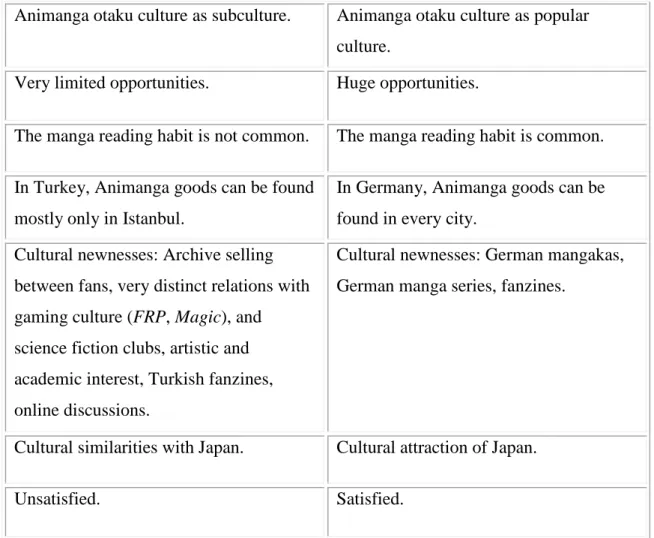
in Istanbul and Berlin………. 77 Table 3: Comparative Table of Animanga Fandom in Istanbul and Berlin 80
LIST OF FIGURES
Figure 1: Shikamaru Avatar……… 13
Figure 2: Shikamaru……… 14
Figure 3: Chiyo- Chan Avatar……… 17
Figure 4: A group of otaku in the Berlin Lustgarten ………. 18
Figure 5: Cosplayers at a subway station in Berlin……… 18
Figure 6: Kawaii characters and the scenes from Totoro and Hello Kitty 25
Figure 7: Hello Kitty……….. 27
Figure 8: A drawing example of an Anime and Manga style character 27
Figure 9: Pandapple……… 27
Figure 10:Cosplaying otakus in Tokyo, Japan……… 30
Figure 11:Cosplaying otaku in Berlin, Germany……….. 30
Figure 12: The similarities between an otaku room and Akihabara….. 33
Figure 13: Reyhan Yıldırım while drawing a Manga character……… 43
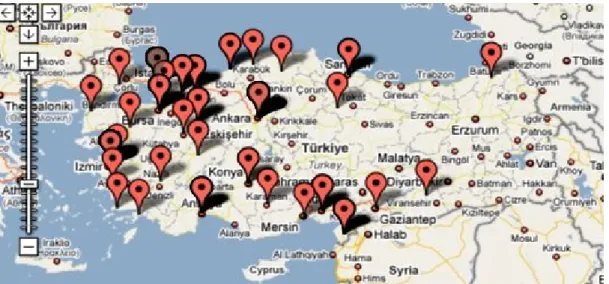
Figure 14: The distribution of Turkish respondents marked on the map according to the cities in Turkey……… 69
Figure 15:The respondents who answered the survey in Turkish from Japan, Bosnia Herzegovina, Austria, Germany, England and Ireland… 70
Figure 16:The distribution of German respondents marked on the map according to the cities in Germany………. 70
Figure 17:The respondents who answered the survey in German from Denmark, Switzerland, Ireland, the United Arab Emirates and Austria.. 71
GLOSSARY
Amecomi: Shortened Japanese way of saying American comics.
Anime: “Anime, as defined by common non-Japanese fan usage, is any animation made in Japan. In Japan, the word simply means animation” (Poitras 2001:7).
Chara: Shortened Japanese way of saying character.
Comiket: Short form for Comic Market. It is also the name of a festival held once a year in Tokyo, for Japanese cosplay and doujinshi.
Cosplay: Short form for Costume Play. “It is the practice of fans dressing up in the costumes of their favorite characters. Most of the costumes are homemade…. Anime fans can choose from dozens of popular chara, and not just those from anime but from manga and video games as well” (Poitras 2001: 81).
Doujinshi: “Not all manga in Japan is produced by commercial artists and publishers. Fans also produce their own works and gather them in what might be called Japanese zines, or doujinshi, a word that suggests the idea of publications among friends” (Poitras 2001: 67).
Ecchi: Anime that has some light sexual themes (animenewsnetwork).
Fansub: Fan-produced translated, subtitled version of anime. Fansubs are a tradition that began with anime clubs in the 1980s, although with the advent of cheap computer software and subbing equipment, they really took off in the mid 1990s. Gekiga: Dramatic pictures.
Hentai: Perverted or pornographic Manga/Anime. Ikebana: The art of flower arrangement.
Kawaii: The Japanese word for cute. It is the best adjective to describe Hello Kitty which is only one of many Japanese kawaii characters and the most known.
Kendo: Modern Japanese martial art of sword-fighting based on traditional Japanese swordsmanship.
Kodomo manga: Manga for children.
Kyouyou Manga: Academic or educational manga. Mecha: Mechanical, in other words machinery. Manga: The term used for Japanese comic books. Mangaka: Manga artist.
Manhua: The term used for Chinese comic books. Manhwa: The term used for Korean comic books. Origami: The art of paper folding.
Otaku: Diehard fan in Japanese. In the world literature, it has been used mostly in anime and manga culture to describe the anime and manga fan.
Redikomi Manga: Manga for adult women. Rental Manga: Mangas which can be rented.
Scanlation Manga: The mangas which are translated into other languages by its fans outside Japan.
Sensei: Japanese word for teacher.
Shoujo Manga: Mangas produced for young girls. Shounen Manga: Mangas produced for young boys.
Tankoubon: Book version of manga series which were published in the magazines by an artist or a group.
1. INTRODUCTION: CHOOSING A RESEARCH SUBJECT IN THE AGE OF GLOBALIZATION
Since my childhood, I have been strongly influenced by anime films. I now realize that certain cartoons shown on Turkish TV during my childhood, such as Heidi, Captain Tsubasa, Candy Candy, Sailor Moon, Daddy Long Legs, Orange Road, Hime-chan's Ribbon, Lady Oscar: The Rose of Versailles, and Transformers, 1
were actually anime. In fact, even then, when talking with friends about these cartoons, I would refer to them as anime to distinguish them from the standard western style of animation.
A lot has changed since 1994 when I was ten years old. Now, my friends and I are all grown, but still, when we come together, we are able to talk about these films under the name of anime, and now we are aware of the existence of a culture surrounding them: anime and manga (hereafter, I will refer to it as animanga) otaku culture. In addition, when I think about how strongly attached we felt to those films, how influenced we were by them, and how much we believed in these films when we were children; we were in fact almost little otakus. We could not do Cosplay, of course, but we memorized Candy Candy’s Japanese generic music and sang out, “Watashi wa! Watashi wa Candy!”. When we went to school, we wore our hair like Judy, 2 in raised bunches on each side. Daichi Kobayashi 3 with his big black eyes, straight long hair, sporty style, and skateboard was probably the first love of our
1 Dir: Atsuji Hayakawa, Masao Kuroda, Isao Takahata, 1974, Dir: Mitsunobu Hiroyoshi, 1983 , Dir: Hiroshi Shidara, 1976, Dir: Junichi Sato, 1995, Dir: Kazuyoshi Yokota, 1990, Dir: Osamu Kobayashi, Tomomi Mochizuki, Takeshi Mori, Kôichirô Nakumura, Naoyuki Yoshinaga, 1987-1988, Dir: Hiroaki Sakurai, 1992, Dir: Osamu Dezaki, 1979, Dir: Peter Wallach, 1984
2 Judy is the main character of Daddy Long Legs (Kazuyoshi Yokota, 1990) series. She is known for her long legs and stylish hair.
3
childhood. We ran after the ball like Captain Tsubasa 4 or, in every rural adventure we had, while running through the grass, we remembered Heidi 5 the moment our cheeks reddened. Today, through the medium of global circulation of goods (Tsing 2002), the situation is changing, and the Japanese animanga otaku culture has becomes so pervasive in the world that, today, I am in Istanbul, investigating and discussing the existence of this culture, its forms and features.
This study was motivated by the curiosity and interest aroused in me when I first watched Spirited Away by Hayao Miyazaki, in 2003. Until I watched this movie, I had not noticed how much the products of animanga culture and other Japanese audiovisual popular cultural forms had achieved an active circulation in the markets of the world. Thus, I started to research this culture through this study.
The story of modern anime and manga started in 1960s, postwar Japan. Referred to as the ‘god of manga’, Ozamu Tezuka pioneered many innovations in style, form and genre that are common to this day in animanga productions. Japanese Pop culture continued to evolve and blossom not only at home, but also abroad. Tezuka produced so many masterpieces that opened paths for anime and manga throughout the world’s markets. First, the Japanese manga and anime entered the United States in the 1960s, with early examples such as, Panda and the Magic Serpent, Alakazam the Great, and Astro Boy. 6 Subsequently, in the 1970s, anime gained its first global popularity, and, in the 1980s, the first anime fandom began to
4 Captain Tsubasa is the legend character of Captain Tsubasa (Mitsunobu Hiroyoshi, 1983) series. 5 Heidi is the main character of the Alps (Atsuji Hayakawa, Masao Kuroda, Isao Takahata, 1974) television series. She is one of the most well known anime heroes all around the world.
6
Dir: Kazuhiko Okabe, Taiji Yabushita, 1961,Dir: Lee Kresel, Daisaku Shirakawa, Osamu Tezuka, Taiji Yabushita, 1960, Dir: Lee Kresel, Daisaku Shirakawa, Osamu Tezuka, Taiji Yabushita, 1960, Dir: Noboru Ishiguro, Osamu Tezuka, 1963, Dir: Ishiro Honda, 1954, Dir: Tatsuo Yoshida, 1967- 1968, Dir: Mitsuteru Yokoyama, 1964, Dir: Toru Iwatani, 1980.
grow in the United States. Thus, Japanese animanga culture, which comes from Japanese popular culture, achieved a degree of international importance and global interest, and, by the 1990s, anime and manga, with its otaku culture, had spread throughout the world.
For many years, Americans, Europeans, Russians, Asians and Africans have loved Japanese Pop Culture, from monster movies like Godzilla, and TV Shows like Speed Racer and Gigantor, to videogames like Pac-Man and Space Invaders as well as intricate toys like Voltron and Transformers, and of course Power Rangers. Today, animanga otaku culture has become one of the most important forms that has developed with sure steps within global youth culture, with a presence in almost every country, and it has been one of the most important areas of Japan's connection with the outside world.
Since the start of the 1990s, Japan’s animanga culture has become
increasingly beloved in Turkey-Istanbul and also in Germany-Berlin, with anime series shown on television and with websites run by the fans, especially by internet users. However, in both cities in the 1980s, there had also been anime broadcasts such as, Heidi, Pollyanna, the Wonderful Adventures of Nils, Mock and Sweet, Dragon Ball. 7
How has this been possible? More interestingly, how can we explain the animanga culture coming from Asia-Far East that has existed for years in Germany-Berlin, in the middle of Europe and the West? In this study, while answering these
7 Dir: Kôzô Kusuba, 1986, Dir: Yûji Fukawa, Masami Anô, Mitsuo Kamiri, Mamoru Oshii, Motosuke Takahashi, Hisayuki Toriumi, 1980, Dir: Hiroyuki Yokoyama, Masahiko Fukutomi, Takajuki Kaneko, 1986, Dir: Daisuke Nishio, 1986.
questions, I will try to show with examples and notes how the animanga culture both in Istanbul and in Berlin is possible.
1.1. Theoretical Framework
Many western scholars and interpreters have criticized in astonishment the entry of Japan into the economic and cultural face of the world as a leading and shaping country. These scholars have interpreted the popularity of animanga culture from their own western perspectives. As Susan Napier (2007) stresses, within the concept of Orientalism, these scholars have again tried to understand all of the animanga visual items as just remakes of, inspired by, or imitations of western comic forms.
An Iranian philosopher and professor of sociology, Daryush Shayegan (2002), has criticized eastern culture and tradition from a modern perspective and presented “the Wounded Consciousness: Cultural Schizophrenia in Traditional Societies”. In explaining what he calls the cultural schizophrenia of non-western cultures, Shayegan suggests that, at the base of this split identity lies the backward traditional, religious and non-modernist traditions. According to Shayegan, this in-betweenness of characteristics creates schizophrenia for the people living in underdeveloped and Muslim countries; they try to be members of a culture which takes its origins from western modernism, yet they could not be real participants in it.
While explaining the Japanization of European and American youth, Sharon Kinsella (1997) asserts that, since the 1990s, the social structures and the youth cultures of western societies which have been invaded by Japanese popular culture have been abandoned and have become confused and increasingly similar to Japan.
Kinsella relates this confusion to the attraction of the Japanese cute (Kawaii) style, which represents childlike, adorable, innocent, simple, gentle, and vulnerable, as seen in design and in media such as anime and manga. Under the heading, “Kawaii Style,” she says:
In the 1990s, weakness, dependence, passivity, and childlikeness, have been key themes in Western youth culture and fashion. They are new themes in Western youth culture which have a strong connection and similarity to the themes of Japanese youth culture from the mid 1970s. The best example of this connection is the case of cute (Kinsella 1997).
At the same time, Koichi Iwabuchi (2002) explores how Japanese popular culture circulates in Asia. He assumes that Japan has a superior power within the borders of Asia, and its power (which derives from the west) is dominated by the Japanese culture; that, Iwabuchi says, makes Japanese culture without identity and culture (2) because Japan represents the developed west in underdeveloped Asia. The western assimilation of Japan creates its own self orientalism. Iwabuchi locates Japan in-between Japanese Self Orientalization and Western-Orientalization, and it is this situation of in-betweenness that makes Japan faceless. Iwabuchi adds:
As a Japanese, I had implicitly accepted the idea of Japan as a faceless economic superpower: Japan has money and technology but does not have a cultural influence on the world…No matter how strong its economy becomes, Japan is culturally and psychologically dominated by the West (2).
While debates on in-betweenness have been continuing, some scholars have, on the other hand, been putting forward their own global analyses that confront the in-between and discriminatory interpretations.
First, Susan Napier (2007) comments on the Japanese cultural phenomenon throughout the west and beyond by referring to historical frameworks on the level of culture and art. She assumes that Japanese influences are not new in western cultures as is written in many articles; on the contrary, she says, it has been happening for centuries. All of the popular cultural themes of Japan that have spread throughout the world are an extension of the history that has been fascinating western people for centuries. Susan Napier’s idea is that, instead of seeing anime, manga and the other Japanese products as oriental, distant and inferior, we should experience all of the Japanese cultural themes that allow participants to interact and participate in the landscape of globalization (214).
Second, Roland Kelts (2007), who is part American, part Japanese, assumes that there was a Japanese-American model which he calls Japanamerica, which means a hybridization of America with the Japanese culture through global flows. Kelts suggests that, in the global era, the concept of east- west is not important anymore, nor are geographical distances, and he depicts the story of the cultural interactions between Japanese and American cultures as a union that will continue to grow and draw the two very different worlds together.
Third, in his project Against in-betweenness, Levent Soysal (2004) argues about the migrant Turks in Berlin not as being in-between, in a state of
schizophrenia, or without identity; rather, he confronts all of the in-between
interpretations and portrays the migrant Turkish youth in Kreuzberg, Berlin, as active enactors in the public spaces of Berlin within a theme of cultural diversity and
enrichment, and as a part of social and cultural life (41). He frames his study against in-betweenness with the following words:
I write against in-betweenness. Anchored in daily rhythms of school, work, and street, the condition of migrant youth defines assertions of
in-betweenness. They are not located in shadows of precarious NoWhere as the model dictates. On the contrary, as Berlin’s migrant youths, they inhabit the (un)familiar of NowHere in Berlin, Germany, Turkey, and the transnational spaces of youth culture. They confidently conduct their daily life in the social spaces of Berlin, negotiate tensions and anticipations inscribed in lifecourse narratives, and engage in the (in)tangible civic and cultural projects of their times (73).
Similarly, Anna Tsing (2000) argues that globalization and its economic, political, and cultural dimensions have emerged in the world, and she therefore proposes undertaking global assessments, not (as is commonly done in the modern era) to find the other or the in-between, but in order to study the landscape of the global
circulation as well as the flow (472) and to find out what kind of newnesses local cultures add to the global.
In this research, instead of interpreting the situation by questioning the relative value of western and Japanese manners —who is in front, who is in behind, who is superior, who is not— I suggest evaluating it in terms of both the great big melting pot (Sardar 2001: 123) of globalization that has been created through the global flows since the beginning, and, using examples of the patterns of global forms of animanga culture, Roland Kelts’ notion of Japanamerica which proposes that the concept of east- west is no longer relevant in a globalized world.
I also evaluate the time and place that is created within local cultures by global circulation through cultural diversity, style and form (Tsing 2002). In addition, I hope to improve new ideas through the items of cultural taste and selectivity, and, using this animanga example, I undertake a case study of the landscape of circulation as well as the flows (Tsing 2002).
In this research, in opposition to Shayegan’s theory of cultural schizophrenia (which relates terms such as cultural, traditional and religious stagnancy to the
modern newness of the Muslim societies), Iwabuchi’s view of Japan without identity, and Kinsella’s theory of confused and abandoned children of Europe acting
Japanese, I will follow Anna Tsing’s theoretical model of global circulation of goods, peoples and styles, Susan Napier’s historical views regarding Japanese influences having already existed in the west for centuries and the global analyses of Japanese pop which she assumes as liberating for global youth, as well as Levent Soysal’s (2004) arguments against in-betweenness.
Thus, the main task I have undertaken in this comparative research is to fit the Turkish otaku into its place in the puzzle of the global literature on animanga culture. I am of the opinion that Global circulation has primary importance in animanga otaku culture and other similar forms, and, depending on consumption patterns, can find themselves any place in which to occur.
1.2. Methodology
In this study, I aim to make a comparative research between Istanbul and Berlin. By using qualitative research methods such as fieldwork, web research, personal interviews and survey, I study the otakus of animanga culture itself together
with the culture and the products that flow across national and cultural borders in terms of how they are enacted, remade, used and discursively situated both in the places of cultural circulation and production.
Before I started to conduct fieldwork in Istanbul, I first searched on how animanga culture was born in Japan, and how it has started to circulate through the global channels. After I thought about the global affects on the local cultures, I found myself trying to determine the main features of the otakus of Istanbul. One of the points that I considered in this section was the methods of enactments of the Turkish otakus. After I completed that pre-research, I had set a very strict otaku view in my head. I observed a huge internet community which can be said to be enacting an animanga (sub) culture in their own (generally cyber) spaces. This Turkish otaku community was quite separated, calm and aware about the culture which they are in.
All the observations in this study have been conducted in anime and manga fan-clubs, on the websites, and at the festivals and conventions chosen both in Istanbul and in Berlin. First, I searched on the internet for the otakus of Istanbul, and I visited many Turkish websites relevant to anime and manga. Then, to continue my research, I specifically chose the most active Turkish websites such as
www.anime.gen.tr, www.mtv.com.tr, www.animanga.gen.tr, www.soulofanime.com, and atlab.aceboard.com. These are the most visited and the biggest websites on animanga culture in Turkey. I conducted fieldwork in some meetings such as Atlantis Anime Screenings 2008, KHas Anime Screenings 2008, Japanese Culture Fest 2009, and in the stores selling anime and manga products such as Gerekli Şeyler comic store in Nişantaşı, Dreamers in Kadıköy, Remzi Bookstore, and D&R. I wrote field notes at every event that I attended.
While I was continuing my research in Istanbul, I took an opportunity to study in Berlin in Germany as an Erasmus exchange student, starting in March 2008, for a period of six months. For me, Berlin was a city where the young, colorful population exists, where artistic activities get people’s attention, and where cultural dynamics are active and open to different lifestyles. Thanks to the Erasmus exchange program, I had the opportunity to observe animanga otaku communities in Berlin, in independent clubs and in internet virtual communities, and to research in libraries.
My research program for the Berlin fieldwork was almost the same as that which I had scheduled in Istanbul. First, I found the biggest websites for animanga culture in Germany (www.animexx.net, www.animagic-online.de, and
www.tokyopop.de are the most active websites in Germany). Then, I conducted fieldwork at some meetings such as Anime Daisuki– Hanami (Kirschblütenfest) 2008, Manga Matsuri- MMC 2008, Bonn Animagic’08, and in Modern Graphics Stores (Oranienstrasse/Kreuzberg, Europacenter/Kudamm) selling anime and manga goods in Berlin. In Anime Daisuki! Club meeting I had some friends. After a period of time I interviewed them about their otaku life. In order for them to be able to express themselves more comfortably, I conducted all of the interviews in German. Each was asked the same questions and answers were translated into English.
I prepared two surveys using the same set of questions, one in Turkish another one in German. I included age, gender, living place, and occupation in the surveys. With the questions asked, I aimed to learn about these individuals’ lives as animanga fans, and their relations with animanga media such as anime, manga, websites, and fan communities. Moreover, to identify their particularities, I specifically asked about their animanga knowledge such as the first anime movies
they had watched, the age when their enthusiasm started, the genres of anime and manga they most liked, and (if there are any) the problems that they have
experienced in their countries. I also asked if they had ever been to Japan, if they knew Japanese, and which other items from Japanese popular culture had had an effect on them. Some questions were to learn about their local praxis of animanga culture, such as how they watched anime (in the original language, in their own language as a dubbed version, or with the subtitles), and whether or not the resources and opportunities in Turkey/Germany were enough for organizing anime and manga conventions, and for obtaining products such as DVDs and manga.
1.3. Chapter Outline
There are five main chapters in this study. In chapters 2 and 3, I review the main features of animanga culture in general and, to explore its possibilities in Turkey, I introduce its perception from its Japanese origins to the American, European and Asian enactments.
The main theme of chapter 2 is to introduce the formation of animanga culture in Japan, before considering its spread throughout the world. The origin of anime in Japanese cultural life is based on manga history. Concerning animanga culture, which has been accepted as the one of the main elements of Japan’s opening to the world, I introduce a brief history and discussion of the place of animanga culture in Japanese life today. I also mention how animanga culture has existed in Japanese popular culture, the kind of places and processes that are behind its formation, and how it has joined the global flows of the youth culture, and I also present a view of an Akihabara as the global temple of animanga culture with its
spatial dimensions and cultural layers. In this chapter, I also discuss the products of animanga culture that are presented in the form of visual narrative art, and its position as a world market power with its own particular features. I also refer to the Kawaii (cute) style, which is also an aesthetics style at the same time.
Chapter 3 is a further exploration of such terms as otaku, animanga otaku, otaku room and their global dimensions and representations. Following Takao Ota, who interprets Akihabara as the place from where Japanese otaku (sub) culture derives its power and, at the same time, proposes that the origin of the urban landscape of Akihabara is in the private rooms of otaku (2007), in this chapter I discuss the similarities between Akihabara and otaku rooms, and I write on both spaces, full of animanga products as they are, as the temples of the animanga otakus.
In Chapter 4, I write about the public outlets for anime and manga in Istanbul and Berlin, and I discuss how Turkish and German anime and manga enthusiasts engage with this cultural formation in Istanbul and Berlin, and in what way they perceive and invigorate the cultural form with the help of the available public outlets.
Chapter 5 considers the form of animanga culture created by the global flows in Istanbul and Berlin. In order to show this, I present here a comparative study of the fieldwork which I have conducted amongst otaku youth both in Istanbul and Berlin. With the help of a survey conducted in both cities, I am looking for the answer to the question, ‘How does the local Turkish/ German otaku scene (animanga otakus’ culture in Turkey/ Germany) add newness to the global animanga culture?’
The conclusion returns to Anna Tsing’s theoretical model of global
circulation (2000) and aims to draw a general view of the globalization of animanga culture independent of any country, any city, or any geography of the world. To
obtain a general perspective of the globalizing animanga culture, I attempt to combine the other missing parts of the puzzle instead of excluding their contributions.
Thus, with this research, I aim to answer how it was possible that Japan’s animanga culture has become so beloved in Turkey-Istanbul, to explain how the animanga culture that comes from Asia-Far East has existed for years in Germany-Berlin, in other words in the middle of the Europe-West. I wonder if that is strange or not?
Before starting the chapters, as an introduction to the otaku world, below I would like to present two otaku portraits, one from Istanbul and one from Berlin:
1.4. Two Otaku Portraits: Notes from Istanbul and Berlin Shikamaru
Shikamaru is a 24 years old Turkish Anime Otaku and living in Istanbul. He calls himself Shikamaru because of the name of a character from the Naruto 9 series. He has a tattoo of Shikamaru on his right arm and has a coat with “Japan” written on the back. He always wears special t-shirts which sometimes represent his animanga passion or sometimes dancing. I interviewed him and asked when his interest in anime had started, what kind of anime/ manga genre he liked, and whether he would describe and discuss his otaku room. He answered in the following way:
9 Naruto is a manga series written and illustrated by manga artist Masashi Kishimoto with an anime adaptation. It is one of the most well known series around the world.
Since high school I got an incredible interest in anime and now my curiosity that about ten years, gradually increasing became a habit. I have totally made it my lifestyle. When my hair was long I gathered them up like samurai. I ordered some products from the internet about anime which I liked and I have done a tattoo of a character which I loved too much. All of the key mascots are from anime characters which I have been using for a long time. There is a very comprehensive folder in my Mp3 player which is of only Anime songs. I sometimes equip my clothes with the anime
accessories I bought.
I kind of like most shonen anime which is for male children and young people in the anime world. The reason of my interest in this genre that much may be I loved action and excitement. In many of the shonen animes, characters are very original and interesting. This means more reasons to watch them. The long and exciting stories chasing each other offer me to wait in excitement the new episodes each week. I guess I will never get bored of watching shonen anime.
I have designed my room in parallel to my admiration of anime. I have a serious anime archive. I add all the animes I watched into my archive. There are anime posters hanged on walls of my room and wherever possible and as I find I continue to add more. There are toys of my favorite anime characters on the shelves and they stand where I can see. There are also Figure 2 Shikamaru
mangas in my comics collection and, on occasion I am adding the new ones into my archive. In Playstation 2, I have such games which treat animes that I liked. The most dramatic part for me is finding too much products about animes on the internet. I would like to have all of them would be my own, but I do not trust too much shopping from the internet. There are only two stores in Istanbul that import products of anime. I sometimes go shopping there. As I always said, I wish I had more opportunities.
I have put Shikamaru here as a clue about Turkish otakus living in Istanbul. He is only one example of an anime otaku in Istanbul, and there are many otakus like him. All of the otakus always like to use the Japanese names of the animanga characters they love. As can be seen above, the main characteristics of the otakus are more or less the same throughout the world, as much as the global flows allow.
Unlike Berlin, I particularly observe the animanga formation in Istanbul mostly on the internet, which is the platform where all of these Turkish youngsters meet, discuss and share their thoughts on the matter. I have also encountered lots of animanga websites, discussion boards and web blogs which thousands of Turkish otaku use. Undoubtedly, the most popular and the biggest website among the
animanga otakus in Turkey is Anime.gen.tr. 10 It has 14,240 members as active users. When I started this research in January 2007, the number of the members was about 7,500; so, in just two years, the membership has almost doubled.
10 Anime.gen.tr is the biggest and the first anime and manga website established from Turkey, and it was set up by Ankara’s Bilkent University Anime and Manga Club in 2002,.
When I conducted general research about the products related to Japanese animanga culture in Turkey (most of them can be only found in Istanbul), I obtained the information that follows.
At the very beginning of my study, in 2007, I could only count three anime and manga fan clubs. Instead of web clubs, all of these anime and manga fan clubs are established at universities such as Bilkent University Anime and Manga Club, Sakarya University FRP and Anime Club, and Bilgi University Anime and Manga Club. All of these clubs have been organizing anime screenings, Japanese culture events, and cosplay parties. In addition, there are lots of FRP (fantasy role playing), cinema and science fiction clubs which have been organizing anime screenings. Today, the numbers of anime and manga fan clubs has increased to seven.
In Turkey, almost all of the national TV channels have screened anime at some point in their broadcast history. These TV channels are the national ones, which are watched by the majority of the population in Turkey.
Although, in Turkey, the anime and manga publication is currently
increasing, there are only twenty two animes, eight manga, and only s few translated research books, and some magazines which have been publishing articles, anime or manga reviews. At one time, an independent group published a monthly magazine in Turkish named Manganime, but, because of the problem of copyright for the images, they could not continue publishing it. Currently, some magazines on gaming, culture and art such as Doğan Kardeş and Oyungezer have been including some anime reviews or manga, and there are also monthly e-magazines such as Gölge and Anime Türkiye.
The lack of manga publications is one of the most debated matters by otakus in Istanbul. They are always concerned about this deficiency, and they generally identify the reading habit of Turkish people as the reason for it. All the otakus who I have interviewed and surveyed in Istanbul explain this issue very simply by making a self-criticism: ‘We don’t have the needed manga and anime sources because we as Turks do not like reading and so normally do not demand them. Also the
corporations are not interested enough with this media.’
Although the amount of copyrighted anime and manga or related publications available in Turkey is very small, Turkish otakus find ways to access most of the desired items through the internet. They usually watch the animes with English subtitles and read the mangas in English. If necessary, they also translate the animes’ subtitles from English to Turkish and, rarely, from Japanese to Turkish. In short, they create their own alternative channels (including piracy) to carry on this culture.
Chiyo-Chan
My encounter with Chiyo-Chan was just a coincidence. It was 24th of April in Berlin. I was on the bus and sleepy. I saw a large group of otakus lying on the grass of
Lustgarten. 11 They were all in their costumes, cosplaying. I had thought there was an animecon
somewhere around there, and the meeting point was Lustgarten. An hour before it, I had seen two cosplayers in the subway and, before they took the subway, I had taken their photos. Like a usual cosplayer otaku, they were very happy to give me poses of
11
Lustgarten is a park on Museum Island in central Berlin. Figure 3 Chiyo-Chan Avatar
the characters they enacted. I also took their e-mail addresses to send them the photograph later.
That same evening, I sent the photograph along with one of the cosplayers in Lustgarten. Jennifer, one of the cosplayer girls who I had photographed in the subway station, answered my e-mail using her nickname Chiyo-Chan, which is the name of a character in the manga and anime series Azumanga Daioh;
Ah, you took that pic in a park named "Lustgarten" where we were there a few minutes ago. That was a fan-meeting!
In the following days, Jennifer also helped me with my research project. She gave me an interview about her life as an animanga otaku in Berlin. She introduced herself:
Hi, my name is Jennifer, but everyone calls me Chiyo-Chan. Like most of the fans in Germany, my anime and manga enthusiasm have started with Sailor Moon. I have to say that with this TV series I have become aware of the Figure 4 group of otaku in the Berlin Lustgarten. Figure 5 Cosplayers at a subway
existence of this culture and I observed that anime and manga culture has increasingly grown in Germany for many years, and the first real explosion was in 1996.
There are too many aspects in animanga culture to admire. Especially I am in love with their drawing style and the cosplay acting. I draw some manga characters and I really like it. First, I create a manga character in my mind, I sketch it and give a style and then load the features fit for it, but I guess that will be only as a hobby. For the big cosplay activities, we are usually getting touch in Animexx.de 12 and regularly visiting and deciding the dates and places to cosplay from this website which I am also a member of it. I have been cosplaying for a long time as a member of Final Hearts cosplay and show group. We are coming together with the friends, sewing our costumes and rehearsing spontaneously before every show. Sometimes, I attend the club activities. We are all friends sitting together and having talks, buying some properties for otakus and enjoying being together. I guess, meeting my otaku friends was the best thing I have ever had. I am glad they exist.
Like my first encounter with Jennifer, I have to say that I have never experienced such a thing in Istanbul before because, in Istanbul, the animanga culture is being lived mostly in the cyber world with the help of the internet, websites and the discussion blogs. However, there are many anime and manga related websites in Germany, too, and obviously fans in Berlin are living this culture at a different level
12 The biggest website on animanga in Germany, Animexx, has 135,000 members. It has an English version too and an international network.
as a result of the opportunities these allow. These opportunities, such as manga publications, active clubs, common DVD and VCD facilities, free circulation in Europe, and easy access to the goods all make animanga culture visible, and, as a result, it can be said that the otaku profile in Berlin is in a form that anyone could easily communicate with and get in touch with in daily life.
Although Istanbul is closer to Japan than Berlin, and even though Turkish culture has many points in common with Japanese culture in terms of Asian origins, why is the animanga culture in such a visible form in Berlin while it is not yet in Istanbul? Is that not strange? If we think about the global flows circulating around us, the answer would be ‘No. It is not strange! But something is missing.’ Could it be that, in some points, the global flows are fragmented in terms of the process of circulating the products of animanga culture?
2. INTRODUCTION TO THE WORLD OF ANIME AND MANGA
The popularity of manga today began in the 1960s with the strengthening of the Japanese media. During this period, Tokyo became the center of manga
production, and hundreds of manga studios opened. Monthly magazines began running weekly, and the first adaptations from mangas to animes began to emerge. After a while, with the curiosity for the manga having been aroused, the readers became separated according to their age and gender such that the manga has varied according to this distinction. For example, gekigas (manga for young people) began to be published. The extreme seriousness accorded to the gekigas caused the children to stay away from this style, but founded in 1968, the Jump magazine publications have been prepared only for children and even drawn specifically on the demands of that age group. As a result of these efforts, the decreasing interest of children for mangas has been halted.
In the 1970s, manga became a serious media, and, with anime entering into this business, this media has increasingly become widespread, has become included in the international movement, has created its own market, and, ultimately, it has created a culture with transnational dimensions. Today, animanga otakus derive their power from a particular location, named Akihabara and Akihabara design in Tokyo, the central area populated by clothing, manga-anime, record, game, toy, electronics, manga publishers and anime production companies. Akihabara is a major shopping area in Tokyo for electronic, computer, anime, and otaku goods, including new and used items. Akihabara is also known as the center of Japanese popular, youth and (sub) cultures. Otakus in Tokyo spend their time in Akihabara and also perform some
activities there such as dancing (parapara dancing13), cosplaying and singing. In other words, Akihabara is the temple of Japanese sub-cultures, hosting all opportunities for Japanese youth and sub-cultures.
Undoubtedly, animanga culture has the products to nourish its fans’ hunger all around the world. As with all sub-culture and popular culture forms, the objects are very important in representing the culture in everyday life. The objects, such as anime DVDs, manga series, t-shirts, manga models, dolls, posters, key-rings, cups, postcards and so on, can be seen at every anime-convention and festival.
In the words of Gilles Poitras (2007), “The early 1990s saw a rise in both the number of companies producing anime in Japan and the number of the companies distributing anime in the rest of the world” (25). Poitras adds that,
The existing of anime fan in the English- speaking world had been growing slowly since 1970s. But in the 1990s the number of fans dramatically increased. Fans organized into more clubs, started more conventions, and launched several English language magazines devoted to anime and manga. (30).
It seems to me that, after this increase in the number of fans in the English- speaking world, and in the number of products translated into English, the animanga otaku culture has come a long way and spread throughout the world as one of the most famous elements of Japanese popular culture. As a result of its migration and subsequent expansion, animanga culture has a remarkable power among the global youth of today.
13 A synchronised group dance inspired by the sexy and colorful Ganguro girls in Japanese popular culture.
2.1. Anime and Manga as Universal Visual Narrative Art
In animanga culture, in addition to very popular TV anime and manga series, there are lots of products such as plastic models of the anime and manga characters, and other little objects and accessories to use in everyday life, all of which deserve to be accepted as art works as well. However, even though each of these products is just the remade and fabric versions of the animanga characters or the objects have been drawn, each of these products represents the unique and creative style of anime and manga.
We see the anime and manga artists working like bricoleurs, who create and recreate the characters and, at the same time, the fashion of every brand new story. As with every visual culture, animanga culture has its collective style to encourage its own enactors (fans, consumers or otakus) to consume the cultural goods and style. Consequently, while the otakus are cosplaying or designing their private life, they just decide the characters they want to be and to act, then they get the costumes and the objects of the imaginary world of the anime and manga artists; in other words, the objects of the imaginary world of the bricoleurs.
As Hebdige (2004) emphasizes while referring to Levi Strauss’ Bricolage and its emphasis on the fact that all those cultural forms encourage their members to an excessive consumption. Animanga goods are fun and ideal to consume, but also, in terms of aesthetics, they can be seen as much debated art products as well. The manga and anime drawing style has particularly been a focus of interest for the students of art, scholars and interpreters from all over the world. Most of the animanga works are often presented, in terms of art, as perfect examples of the product of great effort, and they are also very respected for their imaginative
qualities. While telling the unlimited stories unceasingly through the series, all these art works are establishing a fan following of their own.
In her article “Japonisme from Monet to Van Gogh”, Susan Napier (2007) discusses the influence of the arts of Japan upon the art and industry of Europe in the ninetieth and twentieth centuries. She refers to the term Japonisme, which was coined by the French writer Jules Claretie, to describe the influence of Japanese art and culture on the West after Japan ended a long period of isolation in the mid-1800s. At first, Napier defines Japonisme as a positive and pure invention of Japanese art, design and aesthetic by the Japanisants (western artists, writers and intellectuals),
who more than anyone else were responsible for not only the discovery of Japan by the West but also for the remarkably positive attitude toward Japan during the period. The Japonisants’ Japan was important and influential, and they wrote, painted, and discussed on it in a largely positive fashion. (31). Napier also criticizes Ernest Chesneau’s suggestion in order to counter all of the Japanisants’ attitudes on the matter which evoke a form of belittling Japan as childlike, and which are expressed through words such as playful and sweet, and which is reminiscent of a return to Orientalism back from Japanisme. For Napier, this is just a typical insulting characterization on the part of westerners (32). However, during the period of Japanisme, significant aesthetic movements like Art Nouveau and Cubism are both indebted to the ubiquitous Japanese woodblock print, though today anime, samurai movies, and sushi have become Japan’s best known cultural exports.
Napier asserts that Japan has been considered as a country worthy of admiration for years, and a country which has been affecting western art for
centuries. She refers to specific details from the daily life of the French and English women inspired by Japanese culture since the 1870s, and the Japanese effects on western art by referring to Jean Claude Monet and Vincent Van Gogh. She also mentions that the art critic Phillip Burty’s use of the term ‘Japonisme’ means specifically the admiration that westerners have for Japanese art and culture. For Napier, Japonisme has been continuing with anime, manga and other cultural items from Japanese popular culture (30).
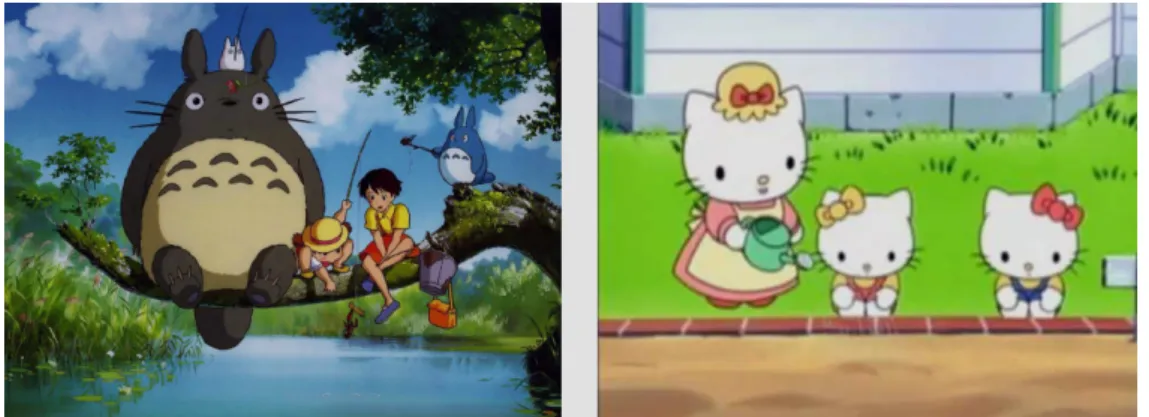
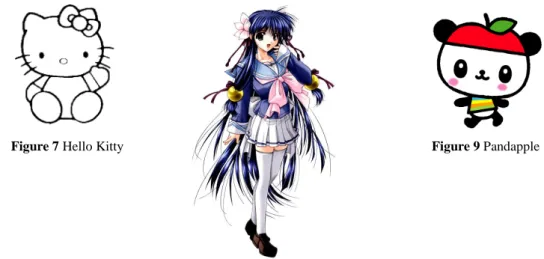
Today, there is a kawaii style that has been exported from Japan as an extension of the Japonisme influence, and which has been created in Japan by the young designers (most of them were women) since the 1970s, and the first kawaii starts with hand drawing of childlike characters (see Figure 6, 7, 8, 9) and drawings. The kawaii style can be seen in every part of the Japanese popular culture such as TV series, video clips, gaming, clothing, music and mostly in the anime and manga style of aesthetics.
In the 1990s, the popularity of kawaii style increased throughout the world, and the fashion of kawaii has formed the basis of fashion styles such as punk,
preppy, skater, folk and French, although, for Sharon Kinsella, both the kawaii style and the animanga style have created the abandoned and in-between children of Europe with its charm (Kinsella 1995).
The term kawaii has came from the style of kawaii aesthetics which contains such items as the childlike, the pure, and an attractive manner. With the discovery outside Japan of the kawaii style, all the other items of Japanese popular culture such anime, and manga have entertained people when circulated and encountered. A new Turkish idiom was even coined, inspired by the kawaii effects; “being like Japanese cartoons (anime)” which means “being super cute with big weepy eyes”, and is used for a person when the little, sweet situations occur. Consequently, even despite Chesneau’s belittling approach, it seems that the kawaii style such as anime, manga, plush and plastic dolls, video game characters, the childlike, the playful and the sweet (Napier 2007) has been affecting youths all around the world.
In animanga drawing style, including kawaii features and aesthetics, one of the most routinely argued things by scholars and critics is their stylized characters created by the magical drawing techniques. Consequently, at this point, I would like to point out some of their 14 features:
· Almost all of them have to be terribly cute (super kawaii). If they are not, they are most probably sexy, beautiful and irresistible (see Figures 7, 8, 9). · The eyes have to be set low on the face and very big and round.
14 We should consider these rules by also regarding all of the fantastic figures and genders created in manga and anime series.
· The mouth has to be a small line or triangle, sometimes they are not even in place (see Figure 7), but, if they are open, generally they are very big just like a horizontal “D”, or round like a warped “O”.
· Their hair colors are saturnalian and colorful, and the hair-cuts are as spry and lively as possible.
· For a typical anime girl, the legs and arms are long and resemble those of a supermodel (see Figure 8).
According to the features of animanga style, it can be said that all the figures belonging to animanga culture are such objects that people like to see and/or want to be. In fact, all those fans are each art consumers watching, admiring, buying and imitating them. This is not to say that all anime and manga products made in Japan are objects to admire or to be in love with, but, if we consider their power on the fans throughout the world, we first find that there is a respect for the major works. If we reconsider more closely the reasons behind this, we find some masterpieces which have some particularities such as narrating very deep stories represented by stylized drawing manner in one work, and on the backstage we find quite crowded artist
Figure 7 Hello Kitty Figure 9 Pandapple
teams and the studios to create them. Anime and manga both illustrate the real and fantasy while storytelling in a perfect style which has been attracting the people all over the world.
2.2. Anime and Manga in Japanese Popular Culture
Manga has been in Japanese culture for centuries from woodblocks to hardcopy manga series, and, in 1962, with the release in Japan of Osaku Tezuka’s first animation, The Story of a Certain Street Corner, the story of modern anime has started. Meanwhile, the development of media, and technology such as television, video, computer, and the other entertainment systems has created a new potential market for Japanese popular culture. Thus, the increasing spread of anime and manga continued throughout the 1970s, 80s, and 90s.
In the 1970s, the terms anime, manga, and otaku became so popular in the Japanese media that they no longer need to be explained or defined as sub-cultural items. All of these media are considered as parts of daily life for Japanese people. It can be observed that, in Japan, anime and manga still occupy the center, feeding the rest of the media system, and, of course, it is also feeding the soul of Japanese people of all ages. They are reading manga everywhere (in the subway, on the bus, in the airplane, and in the parks), and they are watching manga aired on the TV channels all the time.
Anime and manga cannot be considered without other popular culture goods in Japan. In Akihabara, in the heart of the youth cultures in Tokyo, electronics, computer, anime, and otaku goods are located all together in the same area.
3. THE WORLD OF OTAKUS
A YouTube Video entitled Akihabara Otaku Paradise: a Feint Operation starts with a speech given by an otaku, in which he talks about anime and being an otaku:
That animated cartoons and figures is a hobby that Japan boasts to the world. We want to tell people all over the Japan with this in confidence. This is our mission. We are proud to be otaku. It is proud to be otaku. Yes. It is not a shame to be otaku. It is proud to be otaku.
Then they shout together: ‘The otaku spirit is we are immortal’. In the video, we also see manga and anime otakus dancing in costumes to j-pop, in Akihabara and making cosplay, acting out the anime figures by dancing in their costumes.
The scene above just shows a section from the otaku life in Tokyo. The otaku activists in the video represent how anime and manga is an affective and passionate part of their lives. Although otakus are dependent on the nations, countries, localities and cultures, the influence of animanga media has more or less the same
characteristics. They just believe, act, enact and consume their opportunities which they have as animanga otaku.
If we describe a typical otaku of animanga culture, it can be said that he or she wants to be a part of everything which is a part of anime, manga, and the PC and video game culture. This means wanting to design magazines, websites, draw manga, dress up in costumes, create manga fanzines as dojinshis (non-professional and self-published mangas), attend screenings, conventions, and festivals, and interact with each other on the internet, at meetings, and in every way that opportunity permits.
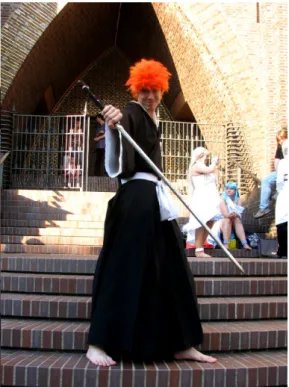
Figure 10 Cosplaying animanga otakus in Tokyo Figure 11 Cosplaying otaku in Berlin
Sometimes, they just enjoy the products of anime and manga culture as fans by watching anime, reading manga, and playing games. It is possible to see each of these particularities being practiced in different forms by the otakus all around the world.
One of the main elements for animanga otaku culture is the style of dressing, with charming colors and thousands of styles inspired by the anime and manga characters. Each of the many characters allows otakus to choose their own favorites to dress up as and to act out.
The large range of dressing styles in anime and manga makes the animanga otaku culture more liberalized in terms of individuals being able to make their own decisions. In their costumes, while cosplaying, they forget real life for a while and start to enact their favorite fantastic characters. They sing songs, dance, make shows,
shout and speak out Japanese. In their lifetime, they just enjoy their young days in an alternative space.
3.1. Otaku’s Room and Akihabara Design
In animanga culture, otakus care very much about their private rooms. They usually want to express their otaku spirit through their rooms, so they decorate them with anime DVDs, manga series, technological systems for music, plastic and plush dolls, maquettes, computers, game equipments, costumes, and animanga posters. Archive collecting is one of the main elements for animanga fans who also want to have an otaku room. Because of that, getting the products of anime and manga at the cheapest prices is the biggest advantage for them.
They also like to exhibit their rooms in videos that are shared on YouTube. An otaku nicknamed Animagicfreak writes on YouTube about her otaku room like this:
Sometimes I need some time only for myself and my hobbies. And that’s why I have such an Otaku Room. I’m collecting Anime/Manga stuff for 7 years, but I’m not that rich, if you think. I buy the most of my stuff neither at Conventions nor at comics stores, but at Ebay where I get it for a good price. Of course new and not second hand.
It can be said that, much like Animagicfreak, many otakus decorate their rooms with products which they get from the conventions, festivals, stores, or just from shopping on websites.
In “Thinking Akihabara Design”, Takao Ota (2007) discusses postwar Japanese design and one of the is Akihabara design, which derives its power from
Japanese otaku (sub) culture. For Ota, ‘the power of otaku’s taste takes an active role in forming the cityscape. The origin of the urban landscape of Akihabara is in the private rooms of otaku’ (2007). Ota points out that the shops located in Akihabara are also one of the expanded spaces of the private rooms of otaku:
A new form of commercial space is appearing in Akihabara. This is “rental showcase” shops, similar to used bookstores. These “rental showcase” shops are lined with shelves of strange transparent boxes like coin lockers, which otaku people rent by month, fill with things they want to sell. Each case serves as both an individual store in miniature and a concentrated private display of personal taste ( 2007).
This idea is interesting because, in the globalizing world, we see otaku rooms in countries like Japan, America, Singapore, France, Turkey, Italy, Russia, and so on. 15 All of these rooms have been inspired by Akihabara, and, given Ota’s claim about the inspiration or Akihabara coming from the room of Japanese otaku, perhaps, in the future, other cityscapes like Akihabara will appear in other otaku nations too.
However, most of the Turkish or German otakus who I know still aspire to owning products of animanga culture, and they are concerned about the lack of products needed in terms of completing their otaku rooms. These otakus outside Japan mostly collect all the things belonging to Japanese culture, and they decorate their own otaku rooms in their own ways.
In time, when the products of animanga become more accessible, perhaps Takao Ota’s claim about Akihabara design will be experienced in other spaces all
15 They can easily be seen by googling the words “otaku room” on the internet, and a search through the images brings up many photographs of otaku rooms uploaded by otakus from all around world, but mostly by Americans.
around the world, and thus many cityscapes in different countries in the world will be designed by drawing on the inspiration of Akihabara and otaku rooms.
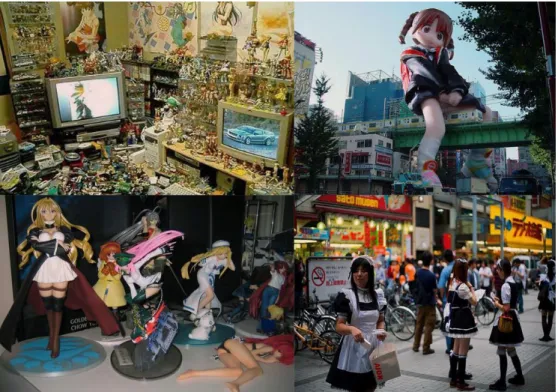
Figure 12 shows the similarities between an otaku room (top and bottom left) and
Akihabara (top and bottom right). Cosplayers in Akihabara resemble the plastic dolls on the shelf of the otaku room, and the big sculpture on the train station as well.
4. ANIME AND MANGA IN ISTANBUL & BERLIN: FIRST IMPRESSIONS Like their counterparts around the world, Turkish and German anime and manga fans have websites, university clubs, discussion forums, blogs, and group activities. Although with some differences, all of them are enacting their own unique animanga culture.
However, despite their enthusiasm, Turkish otakus do not yet have big
organizations such as manganime expos, conventions, parades or cosplay festivals on the scale of American and European otakus. In Turkish animanga discussion forums, we see otakus copiously discussing and voicing their concerns about their source of materials and connectedness issues.
Any anime or manga otaku’s opportunity of easily having the original manga or anime series from any sale points directly affects his or her style of enacting otaku culture. This is because an otaku room belonging to a typical otaku is a personal temple where the objects of their passion are existing all together. Associated with easily availability of some products, many other similar examples can be given such as the festivals of anime, cosplay events and so on.
In Istanbul, other than some popular anime ones such as Studio Ghibli Productions (Miyazaki Collections and the other selections), or some examples from masterpiece animes (Ghost in the Shell, Memories, and Metropolis etc.), we cannot find many anime in a typical store which sells DVDs, books and so on. However, recently some popular mangas such as Naruto, Basilisk, Tsubasa Clamp, Case Closed, Yu Gi Oh, and Rurouni Kenshin can be found along with magazines such as Shonen Jump, which is exported in English. However, the animanga fans in Istanbul have some hopes with the publications and DVDs recently distributed in Turkey.
4.1. Public Outlets for Anime/Manga in Istanbul
Although the anime and manga culture has not yet achieved an evident form in daily life, it may be conveniently observed through the Internet. Especially when using basic search words such as “anime”, “manga”, “Turkey”; it is possible to see many websites and personal blogs. In addition, many students continue this culture with activities such as film shows, small fan meetings, parties, and festivals through the anime-manga clubs established in the universities.
Clubs related to anime and manga:
In Turkey, most of the animanga fans live in Istanbul, and the majority of them are students. These fans are also members of some communities, which are generally virtual (and rarely social) university clubs. Just in the websites in which I conducted an observation, I counted more than 50,000 online community members. Almost all of these members (some of whom I have also surveyed) are agreed that, in Turkey, the formation of animanga culture is not visible and lively because of the lack of animanga products in Turkey to feed their hungry otaku souls, and also because of certain corporate policies which prevent the entry of animanga products into Turkey. Nonetheless, this culture is developing in Turkey with some animanga related goods, fan clubs and the virtual communication media such as the internet.
Although they are not very many in number, as we see the existing and increasing anime and manga clubs, we may say that Turkish otaku considers anime and manga as cultural formation and a socializing environment in Istanbul and other cities. The anime and manga clubs having more than 100 members established in Turkish universities since 2002 are as follows: Kadir Has University Anime Club;
Istanbul; Bilgi University Anime and Manga Club Istanbul; Boğaziçi University Anime and Manga Board, Istanbul; Bilkent University Anime and Manga Club Ankara; Çanakkale (18th March) University Anime and Manga Community,
Çanakkale; Izmir University of Economics Anime and Manga Club, Izmir; Sakarya University FRP and Anime Club, Sakarya.
All of these clubs above have been organizing anime screenings, Japanese culture events, and cosplay parties. Additionally, there are lots of FRP (fantasy role playing), cinema and science fiction clubs which have also been organizing anime screenings.
TV channels which have also been screening anime:
Anime examples have been aired on different TV channels especially since 1980. Certainly, the first samples of these broadcasts are Heidi, Pollyanna, Candy Candy, and Clementine (a French anime). These animations were specially produced as the co-production of Japan and European countries, and they are unforgettable examples remembered by different generations. The most popular animations and the TV channels in Turkey are given below:
TRT- Orange Road, Voltron, Future Boy Conan (Hayao Miyazaki, 1978), Kimba the White Lion (Osamu Tezuka, 1994), Calimero (Yugo Serikawa, 1972), Daddy Long Legs, Sailor Moon, Lost Universe (Charles Campbell, 1997), Show TV- Magic Knight and Rayearth, SlamDunk (Nobuto Sakamoto, 1993), Kanal D-
Captain Tsubasa, Yu-Gi-Oh! (Kazuki Takahashi, 1998), Hello Kitty, Candy Candy, Rurouni Kenshin (Kazuhiro Furuhashi, 2000), Digimon (Keiji Hayakawa, Minoru Hosoda, Takahiro Imamura, Tetsuo Imazawa, Hiroyuki Kakudo, Takenori Kawada,