T.C.
ISTANBUL KULTUR UNIVERSITY INSTITUTE OF SOCIAL SCIENCES
THE US AND AFGHANISTAN RELATIONS AFTER 9/11 EVENT
Master of Arts Thesis by Mohammad Feroz YAQOOBI
1600005198
Department: International Relations Programme: International Relations
Supervisor: Associate. Prof. Dr. Çağla Gül YESEVİ December 2018
T.C
ISTANBUL KULTUR UNIVERSITY INSTITUTE OF SOCIAL SCIENCES
THE US AND AFGHANISTAN RELATIONS AFTER 9/11 EVENT
Master of Arts Thesis by Mohammad Feroz YAQOOBI
Department: International Relations Programme: International Relations
Supervisor: Associate. Prof. Dr. Çağla Gül YESEVİ December 2018
T.C.
ISTANBUL KULTUR UNIVERSITY INSTITUTE OF SOCIAL SCIENCES
THE US AND AFGHANISTAN RELATIONS AFTER 9/11 EVENT Master of Arts Thesis by
Mohammad Feroz YAQOOBI (1600005198)
Department: International Relations Programme: International Relations
Supervisor: Associate. Prof. Dr. Çağla Gül YESEVİ Members of Examining Committee: Associate. Prof. Dr. Nazlı Çağın BİLGİLİ
Associate. Prof. Dr. Özge ZIHNIOGLU
i PREFACE
First, I would like to thank Doç. Dr. Çağla Gül YESEVİ for her support and guidance throughout writing this thesis.
I would like to also thank my dear parents who have always been by my side not only in my education life but in every aspect of my life.
Finally, I owe the Istanbul Kultur University for offering the great kind of education and all the facilities
ii CONTENTS PREFACE ... i CONTENTS ... ii LIST OF ABBREVIATIONS ... iv LIST OF TABLES ... v ABSTRACT ... vi
KISA ÖZET ... viii
INTRODUCTION ... 1
1. WHAT IS TERORISM ... 7
1.1. Definition of Terrorism ... 7
1.1.1. The Historical Background of Terrorism ... 13
1.1.2. Objectives of Terrorist Activities ... 14
1.2. Ideological Patterns of Terrorism ... 17
1.2.1. Marxist-Leninist Ideologies ... 19
1.2.2. Religious Ideologies ... 20
2. THE GENERAL SITUATION OF AFGHANISTAN BEFORE THE US INTERVENTION IN 2001 ... 23
2.1. An Overview of the History of Afghanistan ... 23
2.2. Afghanistan's Geographical Position and Its Strategic Importance in Central Asia ... 27
2.3. Demographics of Afghanistan ... 31
2.4. Soviet Invasion and Resistance ... 31
2.5. Taliban Period in Afghanistan ... 33
2.6. The Establishment of Al Qaeda ... 35
3.THE SITUATION OF AFGHANISTAN AFTER THE INTERVENTION OF US IN 2001 ... 39
iii
3.2. The Consequences of the US Intervention in the Relationship between Afghanistan and
the rest of the World ... 43
3.3. Post-2001 Afghanistan Political System ... 46
3.4. Afghanistan Parliament after 2001 ... 47
4. AFGHANISTAN POLICIES OF THE US ADMINISTRATIONS ... 49
4.1. The Importance of Afghanistan for the United States ... 49
4.2. Afghanistan Policies of George W. Bush Administration ... 52
4.3. Afghanistan Policies of Barack Obama Adminstration ... 62
4.4. Afghanistan Policies of Donald Trump Adminstration ... 67
4.5. Evaluation of Afghanistan Policies of the US after 9/11 Event ... 70
5. CONCLUSION ... 75
iv LIST OF ABBREVIATIONS
USA: The United States of America
US: United States
NATO: North Atlantic Treaty Organization
AfPak: Afghanistan- Pakistan
AfPakIndia: Afghanistan – Pakistan – India
UN: The United Nations
IRA: Irish Republican Army
ISIS: Iraq Sham Islamic State
ISAF: International Security Assistance Force
SIGAR: Special Inspector General for Afghanistan Reconstruction
OEF: Operation Enduring Freedom
USSR: The Union of Soviet Socialist Republics
CIA: Central Intelligence Agency
SCO: Shanghai Cooperative Organization
TAPI: Trans-Afghan Natural Gas Pipeline Project
NSC: National Security Council
ITFR: Independent Task Force Report
v LIST OF TABLES
vi
University : Istanbul Kultur University Institute : Institute of Social Sciences Department : International Relations Programme : International Relations
Supervisor : Associate. Prof. Dr. Çağla Gül YESEVİ Degree Awarded and Date : MA – December 2018
ABSTRACT
The US and Afghanistan Relations after 9/11 Event
Mohammad Feroz YAQOOBI
The history of the Afghanistan could be described as the history of invasions. Due to its geographical location, Afghanistan, which is considered as the heart of Asia, has been the scene of attempts of invasions from all over the world not just today but throughout the history.
Afghanistan is a country located at the crossroads between central and south Asia, the Middle East and the Caucasus. It has borders with strategically important countries such as Iran, Pakistan, China, Turkmenistan, Uzbekistan, and Tajikistan, which have rich energy resources. Due to this important geographical location, Afghanistan is geographically, historically, culturally and strategically a key country in Central Asia.
Terrorism is the main problem of all the countries in the world. Today in many part of the world terrorist attacks are causing great sorrow not only in the target country but also in other countries. Because terrorist attacks result in many innocent people death. It also causes countries to suffer great economic, social and cultural destructions.
vii
Afghanistan is a country, which is affected adversely from Terrorism. The most
significant terrorist group occurred in the Middle East is Al-Qaeda, which is established in Pakistan in 11 August 1988. Al-Qaeda terrorist organization carried out many
terrorist attacks throughout the world. The most important of these attacks is 9/11/2001 attacks, which killed many innocent people.
The terrorist attack of 9/11 was the main cause of the US intervention in Afghanistan. US has been as the superpower of the world, changed its whole polices which effected and still affects the whole world politics, especially Middle East. The 9/11 attacks resulted in the United States to do military operations in different parts of the world under the name of fighting with terrorism. As a result this settlement of US in
Afghanistan in the framework of the war against terrorism took place in 2001, deeply affected the geopolitics of Central Asia.
The US set two main strategic goals for Afghanistan when it started its operation and tried to act on the axis of these strategic goals during the George W. George W. Bush administration. These were the elimination of the Taliban administration in
Afghanistan, which provided a safe zone for Al-Qaeda, and the stabilization of the region until the establishment of a legitimate Afghan government. The US and NATO implemented a strategy related to Afghanistan. They have provided economic aid, dealt with security, trained Afghanistan army and rehabilitated military. In addition, they carried out anti-smuggling activities and anti-terrorism operations against Taliban and Al Qaeda.
President Barack Obama administration revised the US Afghanistan policy in terms of America’s interests. However, the Obama’s Afghanistan Policy is not only a policy that is just for Afghanistan but also it deals with Pakistan. The reason for this was that the administration realized that the stability in Afghanistan was inseparably connected to the developments in Pakistan. Therefore, Obama’s Afghanistan Policy was named as Obama’s AfPak Policy, which was a new term used in Obama’s period for US foreign policy in order to describe Afghanistan and Pakistan as a single threat of operations. Donald Trump rejected approaches such as the complete withdrawal of US forces from Afghanistan or the transfer of Afghanistan's mission to fully private war companies, Donald Trump thus virtually embraced America's longest-running war in Afghanistan. When Donald Trump assessed the problems that President Barack Obama had before him, he had a similar result: more training and support had to be given to Afghan forces to eliminate Taliban.
The purpose of this study is to make a comparative analysis of the George W. Bush, Barak Obama and Donald Trump administration’s foreign policy of Afghanistan. Keywords: Afghanistan, George W. Bush, Barack Obama, Donald Trump.
viii Enstitüsü : Sosyal Bilimler Enstitüsü Anabilim Dalı : Uluslararası İlişkiler
Anabilim Dalı Programı : Uluslararası İlişkiler Programı Tez Danışmanı : Doç. Dr. Çağla Gül YESEVİ Tez Türü ve Tarihi : Yükseklisans – Aralik 2018 Degree Awarded and Date : MA – December 2018
KISA ÖZET
9/11 Olayı sonrası Amerika-Afganistan İlişkileri
Mohammad Feroz YAQOOBİ
Afganistan tarihi istilalar tarihi olarak tanımlanabilir. Asya’nın kalbi olarak da görülen edilen Afganistan, sahip olduğu coğrafi konumu sebebiyle tarihte birçok kez istilalara uğramıştır.
Afganistan, Orta ve Güney Asya, Orta Doğu ve Kafkaslar arasındaki kavşakta yer alan bir ülkedir. Zengin enerji kaynaklarına sahip olan İran, Pakistan, Çin, Türkmenistan, Özbekistan ve Tacikistan gibi stratejik öneme sahip ülkeler ile sınırları vardır. Bu önemli coğrafi konumu nedeniyle, Afganistan coğrafi, tarihsel, kültürel ve stratejik olarak Orta Asya'da kilit bir ülkedir.
Terörizm, dünyadaki bütün ülkelerin ana sorunudur. Bugün dünyadaki birçok terörist saldırıları sadece hedef ülkede değil, başka ülkelerde de büyük üzüntülere neden olmaktadır. Çünkü terörist saldırılar birçok masum insanın ölümüne sebep olmakta ve
ix
ayrıca ülkelerin büyük ekonomik, sosyal ve kültürel yıkımlara maruz kalmasına neden olmaktadır.
Afganistan, Terörizm ‘den olumsuz etkilenen bir ülkedir. Orta Doğu'da meydana gelen en önemli terörist grup, 11 Ağustos 1988'de pakistan'da kurulan El Kaide'dir. El Kaide terör örgütü, dünya çapında birçok terörist saldırı gerçekleştirmiştir. Bu saldırıların en önemlisi, birçok masum insanı öldüren 9.11.2001 saldırılarıdır.
11 Eylül terörist saldırısı, Afganistan'daki ABD müdahalesinin temel sebebidir. Çünkü 1812 savaşından beri, ABD kendi topraklarında ilk defa saldırıya uğramıştır. Böylece, dünyanın süper gücü olarak kabul edilen ABD, tüm dünya politikasını, özellikle Ortadoğu'yu etkileyen ve hala etkilemeye devam eden tüm politikasını değiştirmiştir. 11 Eylül saldırıları, ABD'nin terörle mücadele adı altında dünyanın farklı yerlerinde askeri operasyon yapması ile sonuçlandı. ABD 2001 yılında gerçekleşen terör olayından sonra başlattığı terörizmle mücadele çerçevesinde Afganistan'daki ABD yerleşimi Orta Asya'nın jeopolitiğini derinden etkilemiştir.
ABD, faaliyete başladığında Afganistan için iki ana stratejik hedef belirlemiştir ve George W. Bush yönetimi boyunca bu stratejik hedeflerin ekseninde hareket etmeye çalışmıştır. Bu stratejilerin amacı Afganistan’daki El Kaide terör örgütüne güvenli bir bölge sağlayan Taliban yönetiminin yok edilmesi ve meşru bir Afgan hükümetinin kurulmasına kadar bölgenin istikrarının sağlanmasıydı. Zamanla ABD bu stratejik hedefleri genişletmiştir. Bu bağlamda, 2002 ve 2009 yılları arasında ABD ve NATO tarafından uygulanan strateji ile Afganistan’a ekonomik yardım, ülkenin güvenliği, Afganistan ordusunun eğitimini, askeri iyileştirme ve ülkede istikrarı sağlamak, kaçakçılık karşıtı faaliyetlerini yürütmek ve Taliban unsurlarına ve El Kaide teröristlerine karşı terörle mücadele operasyonlarını devam ettirmekti.
Başkan Barack Obama yönetimi Amerika'nın Afganistan politikasını Amerika'nın çıkarları açısından tekrar gözden geçirmiştir. Ancak Obama'nın Afganistan Politikası sadece Afganistan için değil, aynı zamanda Pakistan'ı da ilgilendiren bir politikadır. Bunun nedeni, yönetimin Afganistan'daki istikrarın Pakistan'daki gelişmelere ayrılmaz bir şekilde bağlı olmasıydı. Bu nedenle Obama'nın Afganistan Politikası, Obama'nın ABD dış politikası için Afganistan ve Pakistan'ı tek bir operasyon tehdidi olarak tanımlamak için kullandığı yeni bir terim olan Obama'nın "AfPak Politikası" olarak adlandırılmıştır.
x
Donald Trump, ABD kuvvetlerinin Afganistan'dan tamamen çekilmesi veya Afganistan'ın misyonunun tamamen özel savaş şirketlerine devri gibi yaklaşımları reddetmiştir, Donald Trump böylece Amerika'nın Afganistan'daki en uzun soluklu savaşına sahip çıkmıştır. Donald Trump Başkan Barack Obama'nın kendisinden önce gördüğü sorunları değerlendirdiğinde, benzer bir sonuca ulaşmıştır. Taliban'ı ortadan kaldırmak için Afgan güçlerine daha fazla eğitim ve destek verilmesi gerekmektedir. Bu çalışmanın amacı, 9/11 olayından sonra Amerika – Afganistan ilişkilerinin incelenmesi ve George W. Bush, Barack Obama ve Donald Trump yönetimlerinin Afganistan’ın dış politikalarının karşılaştırılmalı bir analizini yapmaktır.
Anahtar Kelimeler: Afganistan, Terörle Savaş, George W. Bush, Barack Obama, Donald Trump.
INTRODUCTION
The history of Afghanistan could be described as the history of invasions. Due to its geographical location, Afghanistan, which considered as the heart of Asia, has been the scene of attempts of invasions from all over the world not just today but throughout the history. Afghanistan is a country located at the crossroads between central and South Asia, the Middle East and the Caucasus. It has borders with strategically important countries such as Iran, Pakistan, China, Turkmenistan, Uzbekistan and Tajikistan, which have rich energy resources. Due to this important geographical location, Afghanistan is geographically, historically, culturally and strategically a key country in Central Asia.
Terrorism is the main problem of all the countries in the world. Today, in many part of the world, terrorist attacks are causing great sorrow not only in the target country but also in other countries. Because terrorist attacks result in many innocent people death. It also causes countries to suffer great economic, social and cultural problems. Afghanistan is a country, which is affected adversely from terrorism. The most significant terrorist group occurred in the Middle East is Qaeda, which is established in Peshawar Pakistan in 11 August 1988. Al-Qaeda terrorist organization carried out many terrorist attacks throughout the world. The most important of these terrorist actions is September 11 attacks, which killed many innocent people. The terrorist attack of 9/11 was the main cause of the US intervention in Afghanistan. The US, being superpower of the world, changed its whole foreign policy, which effected, and still affects the whole world politics, especially Middle East.
The collapse of the twin towers of the World Trade Center had been considered as one of the greatest events in American history. It changed world political, economy and ideology order. Following these attacks, the US intervened in Afghanistan and Iraq. As a consequence of these interventions, Taliban regime was ended in Afghanistan, and Iraqi Saddam regime collapsed and the leader Saddam Hussein was executed in 2006.
The US intervention in Afghanistan was a turning point for the future of Central Asia. Attacks against the US Al-Qaeda brought all attention to Central Asia and Afghanistan. The region could not reach a certain level of stability since the collapse of the Soviet Union. The 9/11 attacks resulted in the US to do military operations in various parts of the world under the name of fighting with terrorism. For this purpose, the US cooperated with many countries.
2
The US set two main strategic goals for Afghanistan when it started its operation and tried to act on the axis of these strategic goals during the George W. Bush administration. These were the elimination of the Taliban administration in Afghanistan, which provided a safe zone for Al-Qaeda, and the stabilization of the region until the establishment of a legitimate Afghan government. They have provided economic aid, dealt with security, trained Afghanistan army, rehabilitated military. In addition, they carried out anti-smuggling activities and anti-terrorism operations against Taliban and Al Qaeda terrorists.
In the period of President Barack Obama, the United States policy regarded Afghanistan was revised according to national interests. Obama’s Afghanistan Policy was not only a policy that is just for Afghanistan but also Pakistan because in Obama period it was realized that the stability in Afghanistan was inseparably connected to the developments in Pakistan. Therefore, Obama’s Afghanistan Policy was named as Obama’s AfPak Policy, which was a new term used in Obama’s period for United States foreign policy to describe Afghanistan and Pakistan as a single threat of operations.
Donald Trump rejected the complete withdrawal of the US forces from Afghanistan or the transfer of Afghanistan's mission to fully private war companies, Donald Trump thus virtually embraced America's longest-running war in Afghanistan. When Donald Trump assessed the problems that President Barack Obama had before him, he had a similar result: more training and support had to be given to Afghan forces to eliminate Taliban. He also stated that US would no longer use its military to build democracies or to reconstruct other countries, which are far away from their lands.
Donald Trump administration announced the commitment for an open-ended war and ordered the deployment of additional troops rather than a gradual withdrawal of troops, and eventually, ending the war in Afghanistan. Moreover, as Stephen D. Krasner noted, there are two fundamental ways to study the national interest: "logical-deductive" – assumes that states will pursue certain objective in particular, preserving territorial and political integrity. This approach is powerful but limited in range, especially when a hegemonic state with secured national interests is considered. However, the other one, which is adopted in this study is "empirical-inductive” assumes that national interest is induced from the statements and behavior of central decision makers. Hence, it understood that the US withdrawal of troops would create a power vacuum and deployment of additional troops would ensure safe havens for terrorists including ISIS and Al Qaeda in Afghanistan.
3
In the period of Barack Obama administration, Barack Obama gave a great importance to Pakistan and his one of Afghanistan strategy was AfPak policy. However, in the Donald Trump administration, Obama's AfPak strategy was replaced with Donald Trump’s AfPakIndia. Because according to Donald Trump, Pakistan's role in ensuring a safe harbor for Taliban and al-Qaida was often a thorn in the side of US military. For this reason, Donald Trump threated to cut off US support to Pakistan. Donald Trump mentioned India’s importance and its significant role in stabilizing Afghanistan. In this context, Donald Trump's strategies differ from Obama's strategies.
The purpose of this thesis is to make a comparative analysis of the George W. Bush, Barack Obama and Donald Trump administration’s foreign policies of Afghanistan taking realism theory as a guiding model, The US policy of Afghanistan is profoundly influenced by realist theories. These realist theories could be considered as an explanation for intervention. Therefore, this thesis will demonstrate that the George W. Bush, Barack Obama and Donald Trump Administration’s policy, strategy, and objectives match the principles of realism, and this strategy supports the US-Afghanistan fundamental national interests.
Realism is an approach to the study and practice of international politics. Realism highlights the role of the nation-state and makes a broad assumption that all nation-states are motivated by national interests. National interest can be defined that all states try to protect their political autonomy and their territorial integrity. When these two interests are secured, however, national interests can take various forms. For example, some states may have an interest in securing more resources or land; other states may wish to expand their own political or economic systems into other areas; some states may only wish to be left alone. National interest can also be defined in terms of power. National power has an absolute meaning because it can be defined in terms of military, economic, political, diplomatic, or even cultural resources. However, for a realist, power is primarily a relative term: does a state have the ability to defend itself against the power of another state? Does a state have the ability to coerce another state to change that state's policies? Realists claim that they deal with the world as it actually functions. Realist theories emphasis on the state and national security issues. The concept of balance of power has played a dominant role in realist theory.
Realism is a comprehensive model ranging from the classical realism to the structural realism of Kenneth Waltz. Hans J. Morgenthau, as a classical realist, had the greatest impact on the realism. In his book "Politics among Nations”, Morgenthau deal with the roots of the war and
4
international conflicts in human nature. Morgenthau emphasizes the effects of nationalism, ideologies, the diplomatic skills, and domestic as well as international popular support on state's behavior.
The study will investigate the US and Afghanistan relations after 9/11. In the study there will be a comparative analysis of Afghanistan policies of the George W. Bush, Barack Obama and Donald Trump administrations considering realism theory as a guiding model. The US Strategy of Afghanistan is profoundly influenced by realist theories. These realist theories about terrorism could be considered as an explanation for intervention. Therefore, this thesis will demonstrate that the George W. Bush, Barack Obama and Donald Trump Administration’s policies, strategies and objectives in conformity with the principles of realism, and this strategy supports the US fundamental national interests.
In this study, I am taking Morgenthau's classical theories as a model to conduct this research. Therefore, explaining Hans J. Morgenthau's Six Principles of Political Realism from his book ‘Politics among Nations, The Struggle for Power and Peace’ is necessary.
Morgenthau proposed six fundamental principles of realism to reflect the tenets of political realism:
1- “Political realism believes that politics, like society in general, is governed by objective laws that have their roots in human nature.
2- “The main signpost that helps political realism to find its way through the landscape of international politics is the concept of interest defined in terms of power.
3- “Realism assumes that its key concept of interest defined as power is an objective category that is universally valid, but it does not endow that concept with a meaning that is fixed once and for all.”
4- “Political realism is aware of the moral significance of political action. It is aware of the ineluctable tension between the moral command and the requirements of successful political action.”
5
5- "Political realism refuses to identify the moral aspirations of a particular nation with moral laws that govern the universe. As it distinguishes between truth and opinion, so it distinguishes between truth and idolatry."
6- “The difference, then, between political realism and other schools of thought is real, and it is profound. However much of the theory of political realism may have been misunderstood and misinterpreted, there is no gainsaying its distinctive intellectual and moral attitude to matters political.”
Taking these realist theories into consideration, It can be said that the three President of the US (George W. Bush, Barack Obama, Donald Trump) have applied realistic theories after the 9/11 attacks.
This study also aims to reveal the political economic and strategic implications of the United States' intervention in Afghanistan. The questions are “How did US intervention with the coalition forces effect political and economic situation in Afghanistan? In addition, “What are the impacts of the US on Afghanistan's security, development, and democracy?
The targets of the US intervention in Afghanistan can be listed as follows:
Eliminating of the Taliban regime in Afghanistan, which provided a safe zone for Al-Qaeda and fighting against terrorism
Protecting of territorial integrity and independence of Afghanistan,
Establishing a political and economic system that can meet the expectations of the people of Afghanistan,
Building democratic government for Afghanistan,
Constructing powerful Afghanistan to prevent the pressure and effects of neighboring countries.
The importance of this thesis can be classified as follows:
Revealing the historical and strategic importance of Afghanistan, Seeing how the political system formed after 2001 in Afghanistan,
The position of Afghanistan after the American invasion and its relations with other countries.
6
The comparison of George W. Bush, Barack Obama and Donald Trump’s policies and speeches on Afghanistan.
In the first chapter various meanings of terrorism will be examined from various points of views. Historical process of terrorism, its emergence and development, objectives and ideologies will be analyzed in details. Terrorism definitions will also be analyzed according to principles of realist theories as Kenneth Waltz, Hans Morgenthau, John Mearsheimer. In the second chapter, the general situation of Afghanistan before the US intervention in 2001 will be analyzed. In this chapter, there will be details about Afghanistan history, geographical position and its strategic importance in the Central Asia. I will also explain Soviet period and its effects in Afghanistan, Taliban period and establishment of Al-Qaeda & Osama Bin Laden. The third chapter will be about the September 11 attack. In this chapter, there will be explanations about consequences of American intervention in Afghanistan and how this intervention affected the relationship between Afghanistan and the rest of the World. In the last chapter I will analyze Afghanistan policies of George W. Bush, Barack Obama and Donald Trump administration. The importance of Afghanistan for the United States will also be examined.
Secondary data was used in this dissertation. Data was collected from different sources. The analysis of this thesis is based on books, articles, speeches of some political figures during Summits. To collect and adopt data, screening and comparative methods were used. Information was obtained from the sources, notes and publications that are collected from media and internet researching. Data was also collected from the library, both written and online, in Istanbul Kultur University through academic journals. Other sources of up-to-date information were collected through well respected professional articles related to my topic. As a result, the speeches of three US presidents related to Afghanistan are main sources.
7 1. WHAT IS TERORISM
Since the 9/11 attacks, terrorism has been on the agenda of the world. As the aim of this study is to investigate the US intervention in Afghanistan after 9/11 terrorist attacks, it will be useful to begin this study by explaining various definitions of terrorism. Therefore, terrorism will be defined from different perspectives in this chapter. This chapter will also examine the historical process of terrorism, its ideologies and its objectives.
1.1. Definition of Terrorism
Since the dawn of the history, terrorism has been a significant issue that regards all nations in the world. Many leaders were assassinated; groups or individuals have committed acts of violence. There has been an ongoing debate in the literature trying to explain what terrorism is, what kind of threats it poses and what problems it creates. In the literature, there are many definitions of terrorism.
According to White, there is not a common definition of terrorism because it is a “social construct.” He states that terrorism can be defined by various people according to their social and political realities. The definition of any social structure varies with the social reality of the group who provides it. Therefore, he defines terrorism as a problem (White, 2011, p. 4). According to Laqueur, although finding a common definition as to what terrorism is might be impossible, the vast majority of people are able to know it when they see it (Laqueur, 2003, p.10).
Martin defines terrorism as ‘grey areas’. This means that ‘political violence can be interpreted either as acts of unmitigated terrorist barbarity or as freedom fighting and national liberation’, all depending on whom is defining the term (Martin, 2010, p.3). Whittaker defines terrorism as the use or threat, for the aim of advancing political, religious or ideological cases, which includes serious violence against person or property (Whittaker, 2001, p.1). Gurr describes terrorism as the use of unexpected violence against people in the pursuit of political or social objects (Gurr and Ted Robert, 1989, p.15). Gibbs describes terrorism as an illegal violence or threatened violence against human or nonhuman objects (Gibbs, 1989, p.111).
8
According to Kiras, terrorism is a ‘complex phenomena and it is open to a subjective interpretation. He states that there is not a common definition of terrorism because of the difference on ‘the legitimacy of terrorist means and methods (Kiras, 2001, p. 480).
In International Relations theory, realism is a school of thought, theorizing world politics as a field of conflict among actors pursuing power. Moreover, the core realist theories describe international relations "as it is, not as it ought to be" (Jorgensen, 2010, p. 78). In other words, it is an "empirical" rather than a normative paradigm (Morgenthau, 2005, p. 3). Nonetheless, Realism is a broad paradigm that varies from the classical realism to Kenneth Waltz’s structural realism, which was introduced in 1979. Although the intellectual roots of realism goes back to Thucydides' classical record of the Peloponnesian war in the 5th century B.C., the study of realism as an institutional academic discipline begun with the emergence of classical realists nearly 25 centuries later (Riotti and Kauppi, 1993, p. 35). In that matter, as a classical realist, Hans J. Morgenthau has a significant impact on the field. In his book ‘Politics Among Nations’ Morgenthau considered the roots of war and international conflicts in human nature (Morgenthau, 2005, p. 15). In contrast to Morgenthau, Kenneth Waltz, the founding father of neorealism, developed a systemic theory of realism in his book ‘Theory of International Politics' that has given importance to the causes of international conflicts and the war in an anarchic international system . Thus, this school of thought was divided into two main blocks: Classical Realism and Neorealism (or structural realism). In general, as Morgenthau also wrote the ‘will to power' was unlimited, all realists believe in the struggle for power to be the main motivator in international politics.
Realism highlights the role of the nation-state and makes a broad assumes that all nation-states are motivated by national interests. National interest can be defined that all states try to protect their sovereignty, political autonomy and their territorial integrity. National interest can also be defined in terms of power. National power has an absolute meaning because it can be defined in terms of military, economic, political, diplomatic, or even cultural capabilities. But, for a realist, power is primarily a relative term: does a state have the ability to defend itself against the power of another state? Does a state have the ability to coerce another state to change its policies?
9
Realism highlights the role of the nation-state and assumes that all nation-states are motivated by national interests (Morgenthau, 2005, p. 15). National interest can be defined that all states try to protect their sovereignty and their territorial integrity. When these two interests are secured, however, national interests can take various forms. For example, some states may have an interest in securing their resources or their territories; other states may wish to expand their own political or economic systems into other areas; some states may only wish to be self-sufficient. National interest can also be defined in terms of power (Riotti and Kauppi, 1993, p.61-64). National power has an absolute meaning because it can be defined in terms of military, economic, political, diplomatic, or even cultural capabilities. But, for a realist, power is primarily a relative term: does a state have the ability to defend itself against the power of another state? Does a state have the ability to coerce another state to change that state's policies? Realists claim that they deal with the world as it actually functions (Smith and Steve, 1993, p.109). Realist theories emphasis that states deal with national security issues. The concept of balance of power has played dominant role in realist theory (Viotti and Kauppi, 1993, p.67). Realists point out that state leaders have ‘monopoly on legitimate use of force (Shimko, 1992, p. 297). From a realist perspective, war is a necessary to preserve power and ensure stability and safety. From this perspective, there are no limits in principle to the exercise of power. The US policy of Afghanistan is profoundly influenced by realist theories. This theory explains the US intervention.
Alternatively, terrorism is regarded as legitimate if its methods in conformity with principles. As it can be seen that there are various interpretations and disagreement on the issue of legitimacy. The term, in general, suggest the use of violence as a main characteristic of terrorism to instill fear and terror in nations. Terrorism has been considered a weapon of the weak used by small groups of individuals who conduct such violent attacks because they feel that terrorism is the only way to realize their views. Such violence is employed to bring about change in the government and society. Consequently, a key feature of terrorism, which distinguishes it from other types of violence, is political because the use of violence is employed to succeed political aims (Kiras, 2001, p. 480).
Öktem states that between 1936 and 1981, total of 109 definitions of terrorism were laid down at international level (Öktem, 2007, p. 34). As mentioned above, although there are many different definitions of terrorism, states or international organizations should define this concept. According to Bal, practitioners and academics define terrorism as the killing of
10
civilians or security officers with propaganda-oriented, spontaneous actions in order to achieve certain purposes (Bal, 2006, p. 7).
Defining terrorism is difficult, because it has many aspects. Terrorism stems from various parties that resorted to violence. In addition, there are many different grounds for the use of this violence, and there have been many different parties involved in terrorism, each having their own views and in many cases having interests in a certain way to define terrorism. Thus, it is not much surprising that many various definitions of terrorism emerge (Record, 2003, p. 6).
To define ‘terrorism’ for the purposes of this study, it will be useful to begin with a brief historical insight. The use of violence for creating fears in a wider audience to prevent various parties from doing something, or, on the contrary, to coerce them into a certain behavior is as old as mankind. Such use of violence has served states and various regimes over a long period. The Roman Empire applied violence ranging from crucifixion of individuals to full-scale genocide to force individuals and nations into submission. The French Revolution sent more than 20,000 people to the guillotine over a period of a few months. Modern examples of drastic State terrorism include Nazi Germany, Stalinist Soviet Union, communist China of the Mao period, Pol Pot’s Cambodia, and several other dictatorships and totalitarian regimes (Mockaitis, 2007, p. 19-21). These examples enable only a glimpse of the very wide spectrum of actors and goals that have been related to the use of violence in a way named ‘terrorism’. Hence, it is not surprising that the United Nations Organization (UN) still does not have an official definition for terrorism.
The United States faced with similar problems in defining terrorism. According to the US Department of Defense, terrorism is the calculated use of unlawful violence or the threat of violence to instill fear; In general, terrorism aimed to force or threaten governments or societies in the pursuit of political, religious or ideological goals. The problem with the definition of the Ministry of Defense is that it involves any act of terrorism, it does not discern it clearly enough from other forms of violence. The European Union considers terrorism as acts as seriously weakening or terminating the essential political, constitutional, economic or social structures of a country or an international organization (Rapoport, 2004, p. 45).
11
David Rapoport pointed out four key waves of international terrorism in his seminal work on the history of international terrorism. The first wave of modern terrorism which he calls as anarchist, originated in Russia in the 1880s and continued until the 1920s. The second wave that he calls as “anti-colonial” arose in the 1920s and ended in the 1960s. The third wave which he calls as new left, arose in the 1980s, and the fourth wave which he calls as religious, appeared in 1979 and continued until this day (Rapoport, 2004, p. 47). The first wave of terrorism, which began in1890s, continued until 1940. This period was called as the "Age of Assassination" and throughout that period, an important European ministers or heads of states were assassinated every 18 months (Wofendale, 2007, p. 78)
The first period of international terrorism witnessed the first attempt by states to combat with terrorism internationally after assassination of US President William McKinley in 1901. States failed to form a consensus for joint action. The Anti colonial terror wave arose by signing the Treaty of Versailles. The principle of self-determination used to destroy the renewed empires, provided a basis for the aspirations of a new kind of terrorist organization such as the Irish Republican Army and various Jewish organizations working against the British forces in Palestine.
The second wave of terrorism received broad support from various diasporas abroad and applied less to assassinations. The strategy of the second wave of terrorism was more complex. Because the primary objective of the terrorists was the elimination of the local police force, and replacing the military forces, which were too incompetent to deal with the terrorists, but powerful enough to cause grievance among the population through their disproportionate responses to the actions of terrorists (Rapoport, 2004, p. 53-4).
The target selection of the third terrorist wave was quite similar to that of the first wave of international terrorism in that there were seen some 700 hijackings, 409 international kidnapping incidents, including 951 hostages from 1968–1982. Moreover, high-ranking officials including the prime ministers of Spain and Jordan, the former prime minister of Italy Aldo Moro were assassinated. The 'new left' wave of terrorism created nearly 700 deaths, between 1968 and 1982. The emergence of the "new left” terrorism was witnessed during the Vietnam War, which proved that the modern states were vulnerable to the relatively lethal weapons and tactics. Many young people were not deeply pleased with the current system and led to terrorist organizations such as the Red Army Faction in West Germany, the Italian Red Brigades and the Director of French Action. It is important that 1/3 of the third wave of terror
12
targets were the US targets. International co-operation in counter-terrorism activities against third wave terrorism was witnessed. The United Nations adopted the main treaties in which the abduction, pledge and financing of the terrorist organizations were accepted illegal. The term “Freedom Fighter" was no longer a popular concept in the UN (Wofendale, 2007, p. 81; Rapoport, 1999, p. 55).
The end of Soviet occupation of Afghanistan and the Gulf War resulted in a change in the main enemy of Islamic terrorists. Osama bin Laden stated that since the 1991 Gulf War; there were large numbers of US troops in Saudi Arabia whom he feared would stay there. He wanted to destroy American targets. The most terrible terrorist act committed was on 11 September 2001. The international community's response to the 11 September 2001 attack was as astounding as the attack itself. More than 100 countries participated directly or indirectly in the attack on Taliban-led Afghanistan. Despite such a huge international support in attacking the Taliban and al-Qaeda leaders, success was only partial (Cronin, 2006, p.15-22).
Terrorism is also defined as a type of fear or violence. However, not every type of fear or violence can be defined as terrorism because terrorism has different meanings and strategies. Violent incidents are not products of terrorism unless they have a political purpose, ideology, and strategy. If necessary, legal sanctions can be applied under the Anti-Terror Law against terrorist activities (Topal, 2005, p. 7).
Before examining the historical background of terrorism, it could be better to know what new terrorism is. A form of terrorism that is more radical and devastating than traditional terrorism because of the nature its organization, political characters, motivations and strategies (Heywood, 2011, p.286).
Heywood emphasizes on four type of terrorism
1. Insurrectionary anarchism aims to revolutionary change of a state, as anarchist, and revolutionary communist terrorism.
2. Loner terrorism aims to promote a single cause. The bombing of abortion clinics in the US and 1995-sarin nerve gas attack in Tokyo can be given as examples.
3. Nationalist terrorism aims to overthrow colonial rule or occupation, to gain independence for an ethnic, religious or national group, like FLN in Algeria, the Liberation Tigers of Tamil Eelam in Sri Lanka and Hezbollah in Lebanon, Hamas in Israel and occupied territories.
13
4. Global terrorism aims to inflict damage and humiliation on a global power or at transforming global civilizational relations, like Al-Qaeda and other forms. (Heywood, 2011, p. 285-286)
1.1.1. The Historical Background of Terrorism
In many societies, the common idea was that terrorism initially appeared in Islamic countries, however it was later seen that this was not correct. The first terrorist organization was Zealot Siccari during the era of Roman Empire. The Zealots and the Siccaris are dual formation with separate races and enemies. The Sicarii was a well-organized religious sect, which was founded by the religious clergy in Palestine. The Siccaris attacked their enemies with small swords called sicarii in Jerusalem. They attacked people when it was crowded during the day or on holidays. These organizations assassinated the Romans in the southern part of Palestine to end Roman rule. Jews were forbidden to live in Jerusalem and their chapels were destroyed. Laqueur reported that the Sicariis was a social protest movement trying to encourage the poor to rise up against the rich. (Laqueur, 2003, p. 15-18).
The first terrorist movement for political purposes was "Hashishi", which was emerged in the 11th century and was destroyed by the Mongols in the 13th century. This organization, under the leadership of Hasan Sabbah, aimed to destroy the Seljuk Empire with a religion-motivated organization. Hasan Sabbah realized that they were inadequate in number to fight an open war against the enemy, but they could achieve an effective political weapon power with a systematic long-term terrorist act carried out by a small, disciplined force. (Laqueur, 2003, p. 21). It is stated by Kışlalı that the founder of terrorism is Hassan Sabbah (Kışlalı, 1998, p. 39).
Terrorist actions were seen in Europe since the second half of the 19th century. In the 20th century, the Russian revolutionaries rebelled against a ruling party that considers the form of government as tyranny. The other type is radical nationalists; groups such as Irish (the most concrete example of the IRA terrorist organization), Macedonians, Serbs, Armenians (e.g. Asala terrorist organization) continued terrorism with various attacks for independence (Bilgiç, 2009, p. 34).
Systematic terrorism in the Middle East emerged in 1930-1940 with the fundamentalist Muslim Brotherhood and Jewish underground organizations Hashomer, Haganah, Irgun and Lehi who
14
were fighting against Arabs in Egypt, and in Palestine. The most important terrorist group formed in the Middle East is Al-Qaeda, which was established on 11 August 1988. Al-Qaeda was formed at a meeting attended by Bin Laden, Zawahiri and Dr Fadl in Peshawar, Pakistan. Many terrorist attacks were carried out by Al-Qaeda not only in the Middle East but also in the West. The most important of these attacks is the 9/11 event (Wright, 2013, p. 22). Following 9/11 event, many terrorist actions were carried out consecutively in different parts of the world. In 2002, terrorist actions were seen in Tunisia, Pakistan, Indonesia and Kenya. In 2003, terrorist actions carried out in Saudi Arabia, Morocco, Indonesia and Iraq, and in the same year, terrorist attacks occurred in Istanbul against two synagogues, the British Embassy and the HSBC Bank. In 2004, a terrorist attack against a passenger train in Madrid was carried out. All these-global events show that terrorism has threatened and is still threatening the whole globe. These terrorist attacks have also been a painful experience for governments and international organizations in terms of perceiving the effects and dimensions of global terrorism (Wright, 2013, p. 23).
1.1.2. Objectives of Terrorist Activities
According to Sedgewick and Abrams, five goals were pursued with terrorist activities. These include regime change, regional change, policy change, social control and status quo maintenance. These objectives were followed by five common strategies. These strategies are attrition, intimidation, provocation, spoiling and outbidding. Suicide terrorism has also been used to follow these strategies (Sedgewick, 2007, p. 110; Abrams, 2006, p. 72). In order to achieve these goals, they resort to a number of tactics. Kuyaksil collects these tactics under the headings of propaganda, destroy authoritarianism, directing authoritarianism, raising the morale of the members of the organization, intimidating and undermining the morale of the people (Kuyaksil, 2004, p. 517-519).
According to Beşe, terrorism has two main purposes. The first one is defined as short-term aim, which includes violence, algebra, threat, intimidation, violation of public order in a fundamental way. The second one and the ultimate goal is to divide the country into parts and establish a separate state. He also states that another goal that terrorism adopts is to break the resistance of the society by paving the way to the turmoil and to weaken the public support behind the
15
established social and political order through violence. It will be easier to remove the state authority from the scene, which lacks public support. Thus, with the acts of violence against the masses, terrorism intends to eliminate the public's sense of trust and to cause people to suffer and to be unresponsive to the events. As a result, the masses lose their sensitivity to terrorism and there exists a big gap in terms of trust between the state and society. Therefore, the ultimate goal will be achieved (Beşe, 2002, p. 26).
Another aim of terrorism is to prevent the use of the resources of the country in productive areas. Therefore, it affects the country’s economy adversely because a country that already has scarce resources uses a great deal of its national income for struggling against terrorism instead of using it on the development of the country. Moreover, economic problems can emerge. Thus, those countries having problem of terrorism have also faced with economic problems. Afghanistan is one of these countries. Even though Afghanistan has many resources such as major deposits of chrome, coal, copper, iron, and salt, as well as lesser amounts of a wide variety of minerals including gold, silver, and uranium, these resources are not being used as tools for the development of the country. A great amount of these resources have been used to prevent terrorism in the country (Signorino, 2003, p. 325).
According to Keeney, the main aim of terrorism is to pay attention to a case or political dispute. This is provided by the fear and threat. According to Keeney, there are two main goals of terrorism. These two goals are defined as short term and long term goals. In short term, terrorism aims to:
destroy the moral power of the target nation, dismantle the groups that constitute it,
reduce authority, its protectors and important people in public, neutralize the masses,
reduce the situation to their own desperation.
In long run; the aims of the terrorism are to: weaken the political power,
undermine the spiritual authority of the state
16
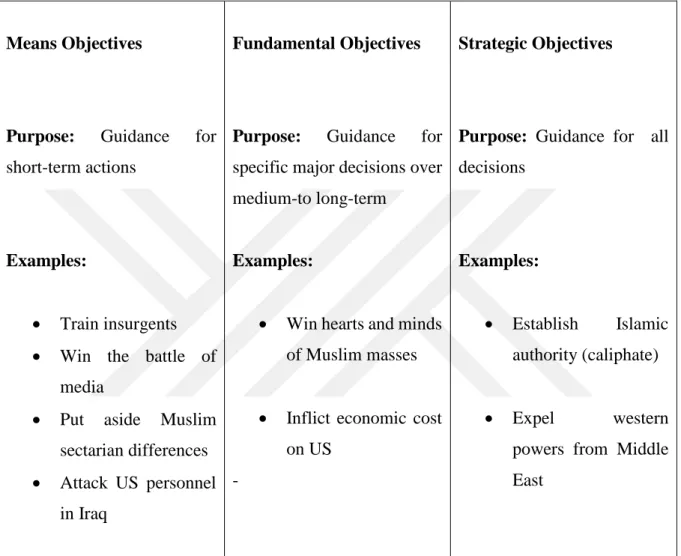
In his article named “Identifying and Structuring the Objectives of Terrorists” Keeney states that the attacks on New York, Madrid, and London, along with other attacks in several countries demonstrate the intent of Islamic terrorist groups is to conduct violent attacks on the populations of the Western World. According to Keeney, the basic aims of terrorists are to kill large numbers of people in Western countries, to disrupt and destabilize their economies, and instill fear and insecurity in their populations. He also states that the most visible and prominent terrorist group threatening the Western World is Qaeda. He classifies the objectives of Al-Qaeda terror organization into three basic categories. These are strategic, fundamental and mean objectives. Strategic objectives supply guidance for all decisions. They provide a mechanism with which leaders conduct decisions made by different individuals and groups within an organization. As Keeney states, if strategic objectives are not carefully defined and communicated, the guidance becomes minimal and some separate decisions simply will not make sense in the larger context of the organization’s affairs. Fundamental objectives serve guidance for particular decisions that are generally carried out over the medium to long-term. If fundamental objectives are routinely accomplished, this can give way to the eventual achievement of the strategic objectives. Means objectives are the short term, day-to-day actions, which promote the achievement of fundamental and strategic objectives. Some means objectives pertain directly to strategic objectives, but most of them are meant to achieve fundamental objectives. With the case study of Al-Qaeda, he shows the objectives as shown in Table 1 (Keeney, 2009, p. 1810-1812).
17
Table 1: Overview of the Interrelationships among Al Qaeda Objectives
Means Objectives
Purpose: Guidance for short-term actions
Examples:
Train insurgents Win the battle of
media
Put aside Muslim sectarian differences Attack US personnel
in Iraq
Fundamental Objectives
Purpose: Guidance for specific major decisions over medium-to long-term
Examples:
Win hearts and minds of Muslim masses
Inflict economic cost on US
-
Strategic Objectives
Purpose: Guidance for all decisions
Examples:
Establish Islamic authority (caliphate)
Expel western powers from Middle East
Source: Keeney, “Identifying and Structuring the Objectives of Terrorists”
1.2. Ideological Patterns of Terrorism
Wright defines ideology as a political, legal, scientific, philosophical, religious, moral, aesthetic thinking that constitutes a political or social doctrine, which directs the behavior of a government, a party. Thus, it is a system of ideas and opinions that bring about a political or social doctrine and directs the actions of a government, a party, a social class, or an organization (Wright, 2013, p.4).
18
Ideology is the guide of the movement. The types and targets of the violent incidents to be implemented are determined by ideology. It is only through ideological acceptance that an organization can base itself on and gain members within the society in which it operates (Cragin, 2007, p. 4).
According to Stepanova, ideology can be defined as a set of ideas, doctrines and theories that describe the thought of an individual or a group and may turn into political and social plans, actions or systems. Although the ideological views and beliefs of those involved in terrorist activities are defined as extremist, this is possibly the only aspect of ideological basis.
The author also states that there is no agreement about whether there is a special “ideology of terrorism” (i.e. whether terrorism itself is an ideology or whether terrorists are driven by various extremist ideologies and exploit them to provide grounds for the use of terrorist means). In addition, he adds that there is not a separate, specific ideology for terrorism and terrorism is not in itself an ideology in the way that socialism, fascism and anarchism are. According to Stepanova, terrorism cannot be seen as an ideology, instead, it is a particular hyper-extreme tactic of using or threatening violence and terrorists justify this tactic with different ideological frameworks (Stepanova, 2008, p. 28-29).
On the other hand, Herman and O’Sullivan define terrorism as an ideology and cultural industry (Herman and O’Sullivan, 2007, p. 117). According to Aksoy and David, ideology is the most important factor of an organization. Thanks to ideology, the terrorists can easily risk their life, The terrorists who are the prisoners of an ideology have been serving for the ideology. Thus, ideologies settled at the center of all social experiences by destroying individual’s own selves, their families, relatives, freedoms, destiny, and all relations. Terrorists aim to dominate their ideology primarily in a specific geography and then spread the same ideology to the whole world.as a point of action ideology is protected by strict rules, and all kinds of propaganda for the adherence of the supporters are maintained by the organization (Aksoy and Carter, 2012, p. 196-197).
According to Wright, in order to be able to talk about the existence of terrorism, it is necessary to have an ideological sub-structure. This is the point of terror. This infrastructure is also the basis for the behavior of terror organization, because the organization behaves in the direction of this sub-structure. Therefore, ideology considered an "indispensable" element (Wright, 2013, p. 10).
19
As various forms of terrorism have developed over the time, the necessity to justify the use of terrorist tools and the role of ideology as a provider of this justification has increased. Even though political terrorism was still widely selective in the second half of the 19th century and terrorists preferred to kill specific people who were high-profile political leaders such as government ministers, presidents, at the beginning of the 20th century terrorism became a less selective and ultimately violence against civilians. Therefore, ensuring ideological justification became more difficult for terrorists (Asal et. al., 2007, p. 32).
In sum, ideology is the important key of terrorist organizations' actions and organizational structure (organization member selection, cell organization etc.) and the determinant of how action will take place. In addition, terrorist organizations have developed ideology by taking into account the ideological elements that occurred in previous years and the events that followed.
1.2.1. Marxist-Leninist Ideologies
Many ideologies have been influential in the establishment of terrorist organizations. One of the reasons of the establishment of ethnic and political terrorist organizations in Europe is Marxism-Leninism theory. The production, which came with mechanization, entered into an effort to create new areas of consumption, which led to the formation of a group of bourgeoisie who carried out production. The basic condition of production is capital. One of the basic elements of monopolization and production of capital is poor working conditions of the workers and the unfair distribution of wages, which resulted in the emergence of the working class. Karl Marx and his friend Friedrich Engels indicated that the problem is universal and all labor classes should be united (Sofronov, et al., 2008, p. 367).
The source of Marxism's practice of violence and the basis of its actions was the Communist Manifesto of Marx. In the Communist Manifesto of 1848, "Initially individual workers against the bourgeois person, who exploits them directly, then workers of a factory, then all the workers in a branch of a division participated in conflicts. Attacks are not only against bourgeois relations of production, but also against the means of production. They destroyed foreign
20
commodities, machines, burned factories.” They also formed the belief that violence can also be considered inevitable (Sofronov, et al., 2008, p. 370-72).
The ideologies of the groups, who were involved in terrorist acts in the 19th and mostly in 20th centuries, were dominated by various radical revolutionists, leftists and anarchists. The ideologies of many left-wing terrorist groups, including socio-revolutionary organizations, had heterogeneous views that combined elements from various concepts and ideologies. They varied from the anarchist slogan of ‘propaganda by deed’ (Sofronov, et al., 2008, p. 375).
During the last decade of the 20th century and after the end of the cold war, communist, radical socialist and other leftist ideologies experienced a general weakening. This was largely due to the disintegration of the Soviet bloc, the end of the East-West ideological struggle and the breakdown of the bipolar world system. The role of these ideologies as a basis for groups, who were involved in terrorist activity, decreased. Though the communist and other left-wing terrorism were noteworthy or even rose in 1998 and 2006, the significance of the movement was severely diminished compared to rising nationalist and religious terrorism. This relative decrease coincided over time and linked to the slow decrease in the state support of terrorism in the direction of the bipolar division. For most of the Cold War era, various radical groups, led by communist and other leftist ideologies, attained some political and financial support from the states dominated by these ideologies (Sofronov, et. al., 2008, p. 370-372).
1.2.2. Religious Ideologies
Religious ideologies emerge when terrorist organizations use people's religious feelings. Religious people can easily sacrifice their life. Terrorist organizations use this situation by exploiting religious beliefs of people. Thus, religious sentiment used by terrorist organizations as a means of reaching their goals (Cragin, 2007, p. 23).
Organizations with this ideology use religion as a means of terrorist actions. Some have a vision of a management system to be established in line with their religious beliefs. Most of these organizations exploit religion and aim to use it as a tool in line with their goals. Therefore, when these organizations are deeply examined neither the ideologies they defend nor the actions they conduct are compatible with the religion they defend. It seems that people and organizations,
21
which carry Islamic identity in the globe, prefer violent acts as an indirect means. Religious terrorist groups do not restrict themselves to the use of sacred texts. They use and regulate religion and religious rituals and cults, such as self-sacrifice and martyrdom cults for their goals. (Ekici et al., 2010, p. 49).
During the 1990s, a global vacuum emerged in the secular protest ideology because of the collapse of the Soviet bloc, the end of the cold war and the decline of leftist movements. This gap began to be filled with radical currents, clearly extremist ethnic-nationalist or religious ideologies. Religious terrorism can be associated with any religion and religious categories that have been executed by various religious groups to justify terrorist activities. At the end of 20th and at the beginning of the 21st centuries, the foremost terrorist threat to international security and to the security of many states, such as the US and its Western allies, such as India, Russia, China and many Muslim countries has been posed either by Islamist terrorism or by ethno-nationalist terrorism which has been Islamized to varying degrees (Barton, 2005, p. 26)
At the beginning of 21st century, the rise of militant Islamism, which includes Islamist terrorism, indicates the full power of religious extremism as an ideological source for terrorism both at international and local levels. Moreover, the ideology of militant Islamist groups that include those using terrorist means, apply the radical interpretation of the concept of jihad. Jihad has included combination of some principal concepts and the extremist interpretations of Islamic rules. The concept of faith is evoked by skepticism by the proponents of the manipulative interpretation of the relationship between religious extremism and terrorism (Bokhari et. al., 2006, p. 10-11).
Transformation of the phenomenon of religion into a purpose instead of a tool causes the emergence of oppression and terror. According to Schmid, in some countries in the Middle East such as Iraq, Egypt, Libya, Algeria and Sudan, the army seized the power of ruling leaders. These countries have long been governed by a rigid dictatorship (Schmid, 1992, p. 8-12).
Religious terrorism is often associated with Islam, however Hitler’s action against Jews, considering the events in Northern Ireland, the Bosnian genocide and Muslim massacre in Myanmar could be stated that religion based actions cannot be associated with Islam. For whatever purpose and ideology, the acts of terror should be considered as acts against humanity. Although, terrorism has based on ideological grounds, terrorism has no religion. Some terrorist
22
groups, such as, al-Qaeda and ISIS have been using religious beliefs for their own interests. They motivate their members to be "activists” and persuade them to be accepted as “martyr" by removing the real concept of "martyrdom". Because, according to Quartermaine, no other justification will make death and massacre so charming and encouraging (Quartermaine, 2016, p. 21-25).
23
2. THE GENERAL SITUATION OF AFGHANISTAN BEFORE THE US INTERVENTION IN 2001
It could be stated that the clash of interests between foreign powers in Afghanistan has played a very significant role in the modern, recent and contemporary history of the country. In the 19th century, Afghanistan became part of a colonial order and the “Great Game” between Tsarist Russia and British Empire. In the second half of 20th century, Afghanistan was a victim of the cold war between the SU and US currently in the 21st century; Afghanistan is suffering from clashing interests of Pakistan and India. Therefore, in this chapter it was aimed to give a general description of Afghanistan before the US intervention in 2001. For this purpose, a general description of Afghanistan history will be given. This chapter will also examine Soviet and Taliban periods in Afghanistan.
2.1. An Overview of the History of Afghanistan
The history of Afghanistan could be described as the history of invasions. Due to its geographical location, Afghanistan, which has been considered as the heart of Asia, has been the scene of attempts of invasions throughout the history. The Iranians carried out the first invasion movement of the region in 500 BC. The Iranian emperor Dara's armies ruled Afghanistan for nearly 200 years. Persian sovereignty in Afghanistan ended when Macedonian King Alexander the Great began the eastern route in 300s B.C. After this, the Bahtari State established by the Greeks. It was destroyed in 50 A.D. due to the pressures coming from the north. The Afghan land, which was divided into two as Khorasan and Sistan had conquered by Turks (Scythians, Seljuks, Ghaznevids, Babur, Karakhanids). Islam spread in Afghanistan with khalifa Osman who sent Basra’s governor Abdurrahman bin Semure to Afghanistan. Later, the country had been ruled by tribal chiefs. In the second half of the 9th century, the Ghaznavids kingdom was established in Afghanistan, where a large part of it handed over by the Samanians (Rasanayagm, 2003 p. 29-35). After the Ghaznevid kingdom, the Seljuks dominated the country. Islamic armies organized conquest campaigns in Afghanistan. During the conquests, the people in control of Khalaj Turks easily adopted Islam. Thus, in the end of the 7th century, Afghanistan come across with the Islamic tradition (Roy, 2010, p. 547). In some sources, it
24
stated that Islamic armies came to Afghanistan via two important cities (Harat, Balkh) of Khorasan (Barfield, 2010, p. 158-160).
Following the Arabs, local administrators called "Shah" ruled the country because there was not a central authority in Afghanistan. Then Muslim-Turkish states such as Samani, Ghaznevid, Great Seljuk State and Kharazem Shah States became dominant in the region. In the late 10th century, a century-old domination of the Samani state ended. Ghaznevid Mahmud, the largest Sultan of Asia until 1030, conquered India and established a base in Lahore. After the death of Sultan Saljuk Sanjar in 1157, Ghurids who came from the Šansabānī family and Kharazems ruled Afghanistan for a while (Rasanayagm, 2003, p. 45-47).
Afghanistan was divided into three parts in the 16th-17th and 18th centuries. The northern part has ruled by Uzbeks, the western part by Persians and the eastern part by Mongolian Empire. The Persian army was defeated and the Afghans took over the whole Persian Empire in the following years. Later, Gilzay Pashtuns disguised by Durrani Pashtuns and Durans became the new rulers of Afghanistan. After Ahmad Shah Durrani killed in 1747 by the Iranian Shah Nadir, who ruled Afghanistan, took over Kandahar and expanded his dominance over time (Norling, 2011, p. 12).
In 1747 Nadir Shah Afshar killed by Ahmad Durrani who was one of his servants in his palace. Ahmad made Kandahar his capital, the capital of his own region, and founded today's Afghanistan. In the first, Loya Jirga (National Assembly of Afghanistan) Ahmad Shah Durrani elected as the king of the country. All ethnic groups in Afghanistan accepted him as leader. Ahmad Shah Durrani succeeded in consolidating the small states, tribes, and divided provinces during his rule. Although Ahmad Shah who seized Uzbekistan Bukhara Emirates and Afghan Turkestan which was known as the broad region, sent armies on the Bukhara Emirate in India. These two armies did not wage war because they were Muslims. After the death of Durrani in 1772, Afghanistan lost its power and tribal division has seen again. The country ruled by Dost Muhammad Khan (1826-1863) Abdurrahman Khan (1880-1901) and Habibullah Khan (1901-1919) respectively. In 1839, the Britain invaded Afghanistan in cooperation with the Sikhs. However, Afghan Emperor Dost Muhammad succeeded to remove them, the Britain invasion led to the destruction of the unity in the country. Moreover, internal disturbances were seen in the following years. The Britain occupied the country for the second time in 1878 with Russians cooperation. This second occupation finalized in 1880, Abdurrahman Khan came to the power. Abdurrahman Khan had to leave his throne to his son Habibullah Khan in 1901 because of his poor health (Downing, 2008, p. 20).