Observation of efficient transfer from Mott–Wannier to Frenkel excitons
in a hybrid semiconductor quantum dot/polymer composite at room
temperature
Sedat Nizamoglu,a兲Xiao Wei Sun, and Hilmi Volkan Demirb兲
Department of Electrical and Electronics Engineering, Department of Physics, UNAM- Institute of Material Science and Nanotechnology, Bilkent University, Ankara 06800, Turkey; School of Electrical
and Electronics Engineering and School of Physical and Mathematical Sciences, Nanyang Technological University, Singapore 639798
共Received 11 October 2010; accepted 22 November 2010; published online 29 December 2010兲 Efficient conversion from Mott–Wannier to Frenkel excitons is observed at room temperature. The time-resolved photoluminescence shows that the energy transfer rate and efficiency reach 0.262 ns−1 and 80.9%, respectively. The energy transfer is enabled by strong dipole-dipole coupling in a hybrid inorganic/organic system of CdSe/ZnS core/shell heteronanocrystal and poly关2-methoxy-5-共3,7-dimethyl-octyloxy兲-1,4-phenylenevinylene兴 homopolymer composite, and the measured energy transfer efficiencies are consistent with the analytical model. © 2010 American Institute of Physics.关doi:10.1063/1.3529450兴
The Mott–Wannier and Frenkel excitons are the funda-mental Coulomb-correlated light-generation tools in dielec-tric medium. The interactions of Mott–Wannier and Frenkel excitons provide opportunities in inorganic/organic compos-ite devices.1,2These interactions can be achieved either in a coherent or incoherent way.3For coherent coupling, the elec-tron and hole wave functions in separate systems should strongly interact. However, this condition requires a high de-gree of structural order. Alternatively, the other interaction channel is the incoherent coupling of Mott–Wannier and Frenkel excitons via Förster-type nonradiative energy trans-fer共NRET兲. Such NRET between organic/inorganic hybrids leads to a nonradiative conversion of Mott–Wannier excitons to Frenkel excitons. In a recent study, Blumstengel et al.1 showed this kind of exciton conversion process. However, this process was observed only up to a maximum tempera-ture of 100 K with a moderate energy transfer efficiency level of 50%; the energy transfer was terminated above 100 K because the excitons were reported to dissociate. To make an efficient system, though, this migration should have a high energy transfer efficiency of ⬎50% preferably at room temperature for potential optoelectronic applications. But, efficient exciton conversion at room temperature has not been shown to date. To address this issue, in this letter, we investigate and demonstrate a highly efficient conversion from Mott–Wannier to Frenkel excitons at room temperature. This opens up possibilities for high-efficiency hybrid inorganic/organic devices.
To compose a hybrid organic/inorganic system with high NRET efficiency, NCs and polymers are favorable candi-dates with their advantageous properties.4–14 For this, we choose cyan-emitting CdSe/ZnS core/shell heteronanocrystal with Mott-Wannier excitons serving as the donor and orange-emitting poly共2-methoxy-5-共3,7-dimethyl-octyloxy兲-1,4-phenylenevinylene兲 共MDMO-PPV兲 homopolymer with Fren-kel excitons serving as the acceptor. Here it is worth
mentioning that a true Mott–Wannier exciton refers to a hydrogen-like bound state intrinsically with its Bohr radius exceeding the crystal lattice constant; however, in our NCs investigated in this work, such a hydrogen-like bound state cannot truly exist because the exciton Bohr radius is compa-rable to the nanocrystal radius. Nevertheless, the bound electron-hole pair state in these quantum dots is character-ized by strong Coulomb interaction, and the notion of exci-ton can be applied. The character of this Mott–Wannier-like exciton is still fundamentally different than that of a Frenkel exciton. This was previously discussed at length by Gaponenko.15,16 Throughout this paper, with the term of Mott–Wannier exciton, we refer to Mott–Wannier-like exci-ton in a quantum dot. The emission peak of the heteronanoc-rystals overlaps the absorption peak of the homopolymer beneficial for efficient exciton migration共shown in Fig. S1 in the supplementary information兲.17
We prepared thin films of hybrid inorganic/organic blends by spin-coating at 2000 rpm on quartz substrates 共with an acceleration of ca. 700 rpm/s兲. The homopolymer concentration was controlled with great care; the polymer concentrations were approximately 1.5 ⫻1017, 2.9⫻1017, 4.4⫻1017, and 5.3⫻1017 cm−3 in samples 1, 2, 3, and 4, respectively, and the heteronanocrys-tal concentration in all the samples was around 1018 cm−3.
To study the exciton migration, we utilized time-resolved spectroscopy described in Ref 5, with a spectrom-eter which has an instrument response function共IRF兲 shown in the inset of Fig. 1. It is worth mentioning that the ho-mopolymer also emits at around 495 nm 共overlapping the NC emission兲, which could possibly affect the time-resolved behavior, but at the wavelength of 495 nm, the emission of the NCs is much stronger compared to the emission of the homopolymer共see the inset of Fig.2兲. So the lifetime of the
heteronanocrystals can be clearly distinguished. In the pro-cess of fitting, a multiexponential least square error model was adopted, which is convoluted with the IRF, as shown in Eq. 共S1兲 共Ref.17兲.
Figure 1 shows the time-resolved spectroscopy of our hybrid homopolymer-heteronanocrystal composites along with that of NC-only solids on quartz substrates at the nano-a兲Author to whom correspondence should be addressed. Electronic mail:
b兲Electronic addresses: [email protected] and [email protected].
APPLIED PHYSICS LETTERS 97, 263106共2010兲
0003-6951/2010/97共26兲/263106/3/$30.00 97, 263106-1 © 2010 American Institute of Physics
crystal donor emission 共495 nm兲. For the NC-only sample, we fit the photoluminescence decay using Eq.共S2兲 共Ref.17兲
with a single lifetime component of 16.16 ns at room tem-perature 共Table SI兲,17which is the general lifetime of nano-crystals at room temperature共around tens of nanoseconds兲.16 This serves as the reference decay to distinguish the migra-tion of excitons in the hybrid systems, which corresponds to a decay rate of 0.061 ns−1共i.e., ⌫NC= 0.061 ns−1兲. In sample 1, when the NCs are blended with MDMO-PPV homopoly-mers, the photoluminescence of NCs starts to quench be-cause of the exciton migration from NCs to polymers. Thus, in addition to the interband recombination process, an extra decay component begins to be observed, as shown in Eq.共1兲, as a result of the nonradiative energy transfer in the hybrid inorganic-organic sample, where Ai, i = 1 , 2, are the fitting
amplitudes for lifetime components of NCandNRET. Isample共t兲 =
冕
−⬁
t
IRF共t
⬘
兲兵A1e−共t−t⬘兲/NC+ A2e−共1/NC+1/NRET兲共t−t⬘兲其dt
⬘
. 共1兲 For sample 1, this additional lifetime component共i.e.,2兲 is 7.00 ns, which is faster than the recombination lifetime of heteronanocrystals alone. This fast decay rate for sample 1 共i.e., ⌫sample1兲 becomes 0.142 ns−1 because of the energy transfer from NCs to homopolymers. We thus deter-mine NRET rate as ⌫NRET=⌫sample1−⌫NC= 0.142− 0.061 = 0.081 ns−1. Furthermore, as the acceptor concentration in-creases in samples 2–4, the resulting quenching inin-creases as well. Thus, this fast lifetime component compared with the recombination of heteronanocrystals is shifted from 7.00 to 5.87, 4.15, and 3.08 ns for samples 2, 3, and 4 at room temperature as a result of the increased NRET from hetero-nanocrystals to homopolymers, respectively. The corre-sponding decay rates for samples 2 and 3 are 0.170 and 0.241 ns−1 and we extract their NRET rates of 0.108 and 0.179 ns−1, respectively. Finally, for sample 4, the decay rate reaches a level of 0.324 ns−1, achieving a NRET rate of 0.262 ns−1. Furthermore, the relative amplitude A2 arisingfrom the energy transfer increases in comparison to that of the recombination component A1, showing that the NCs with NRET become more dominant over the NCs without NRET 共see Table SI in the supplementary information17兲. However, although we observe quenching in nanocrystals here, a pos-sible question is whether the energy is really transferred to polymers or to the surface traps due to the defect states of nanocrystals. Therefore, one also needs to investigate the de-cay behavior of polymers.
Figure 2 shows the time-resolved spectroscopy of our hybrid heteronanocrystal-homopolymer samples 共from sample 1 to sample 4兲 and the case of only homopolymers at the polymer acceptor emission 共585 nm兲. In the reference group, the lifetime decay of the MDMO-PPV homopolymers can be represented as biexponentials18with1= 0.228 ns and 2= 1.079 ns because of their Frenkel-type excitonic behav-ior. Here the ultrafast recombination of polymers with life-times even shorter than 1 ns is mainly because of the strong electron and hole coupling. This enables the localization of their Frenkel-type exciton in one molecule, in contrast to the case of Mott–Wannier excitons where they can spread 共delo-calize兲 over many unit cells of the crystal in the quantum dot, so that their lifetimes are around tens of nanoseconds be-cause of the weaker Coulomb attraction 共⬍0.1 eV兲. As the acceptor homopolymer concentration increases in the com-posite, their lifetime increases in contrast to the decreasing lifetime of donor heteronanocrystals.
Moreover, in our hybrid system, this lifetime modifica-tion cannot be due to the charge transfer 共i.e., Dexter-type transfer兲 because ZnS barriers 共about three monolayers兲 in the core/shell heteronanocrystals provide full electronic iso-lation and prevent tunneling of the electron and hole wave functions.19 Furthermore, in the inset of Fig. 2, the steady-state luminescence of the heteronanocrystal-homopolymer composite is shown and the transfer is also visible in the luminescence spectra. From samples 1 to 4, the emission above the wavelength of 550 nm coming from the ho-mopolymer is increasing, which is consistent with the
de-FIG. 2. 共Color online兲 Time-resolved spectroscopy measurement at the peak homopolymer emission wavelength共585 nm兲 for the hybrid composite sys-tem consisting of heteronanocrystals and homopolymer together共samples 1–4兲, only homopolymer on quartz substrate, and IRF of the laser diode at 375 nm using a TCSPC system of PicoHarp 300 with a time resolution of 4 ps at room temperature and the steady-state photoluminescence from samples 1 to 4 is given in the inset. The black lines are the fits as described in the text.
FIG. 1.共Color online兲 Time-resolved spectroscopy measurement at the peak heteronanocrystal emission wavelength共495 nm兲 for the hybrid composite system consisting of heteronanocrystals and homopolymers together 共samples 1–4兲, only nanocrystals on quartz substrate 共only NCs兲, and IRF of the laser diode at 375 nm using a TCSPC system of PicoHarp 300 with a time resolution of 32 ps at room temperature. The black lines are the fits as described in the text.
263106-2 Nizamoglu, Sun, and Demir Appl. Phys. Lett. 97, 263106共2010兲
creasing donor lifetime and increasing acceptor lifetime. Thus, we can undoubtedly conclude that this is the result of nonradiative Förster-type energy transfer from heteronanoc-rystals to homopolymers at room temperature.
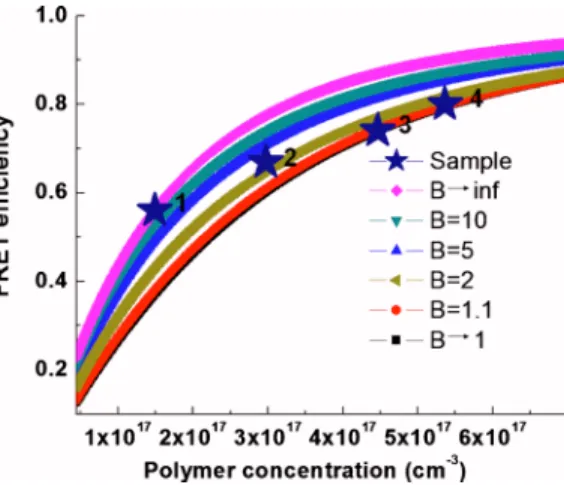
Here the energy transfer efficiency was calculated as =共⌫sample−⌫NC兲/⌫sample=⌫NRET/⌫sample.20 The efficiency for sample 1 corresponds to 56.6%. As we increase the acceptor concentration for samples 2, 3, and 4, the energy transfer efficiencies increase to 63.6%, 74.3%, and finally 80.9%, respectively, and for all samples more than half of the exci-tation energy of heteronanocrystals is transferred to ho-mopolymers at room temperature. Therefore, in our hybrid inorganic/organic structure, the energy is efficiently trans-formed from the weak Coulomb coupled carriers 共Mott– Wannier excitons兲 to strong Coulomb coupled carriers 共Fren-kel excitons兲 at room temperature.
To investigate NRET efficiency 共兲 in our hybrid sys-tem, we applied an analysis. In a previous work, Zapunidi et al.21studied quenching of steady-state photoluminescence of donors for varying donor concentrations via NRET. Using both NRET among heteronanocrystals and NRET between heteronanocrystal and homopolymer in our case, we derived the equation for given in Eq.共2兲.
= 1 − 1 B2− 1
冉
B2+共Cq兲2 1 +共Cq兲2exp再
Cq冉
1 B− 1冊
+ 2Cq冋
arctan共Cq兲 −arctan共Cq/B兲 B册
冎
− 1冊
, 共2兲where C = 4rF3/3
冑
Q, rF is the Förster radius for theheteronanocrystal-homopolymer interaction, q is the ho-mopolymer concentration, Q is the quantum efficiency of the heteronanocrystal, and B is the parameter showing the NRET between heteronanocrystals共i.e., if NRET among het-eronanocrystals is weak, then B→1 and if NRET between heteronanocrystals is strong, then B→⬁兲. The quantum efficiency of heteronanocrystals is 0.4 and the Förster radius between heteronanocrystal and homopolymer is 9 ⫻10−7 cm. Figure 3 shows the calculated and measured NRET efficiencies for different B values, which shows the strength of NRET among NCs. As shown in the figure as the polymer concentration increases, the NRET efficiency
be-comes closer to B→1 because the intradot energy transfer becomes weaker due to the increased polymer concentration and it can be observed that the experimental results are con-sistent with the calculated NRET efficiencies, confirming the measured efficiencies and analytical model.
In conclusion, efficient conversion from Mott–Wannier to Frenkel excitons at room temperature has been demon-strated by NRET using a hybrid composite system composed of CdSe/ZnS core/shell heteronanocrystals and MDMO-PPV homopolymers. A nonradiative NRET rate of 0.262 ns−1and an efficiency of 80.9% were realized. These experimental demonstrations undertaken at room temperature indicate that efficient excitonic interactions of Mott–Wannier and Frenkel excitons are possible in such inorganic/organic hybrids and hold great promise for future hybrid solid state devices.
We acknowledge support from ESF EURYI, EU FP7 Nanophotonics4Energy NoE, TUBITAK EEEAG 共107E088, 109E002, 109E004 and 110E010兲, TUBA-GEBIP and NRF-RF 2009-09.
1S. Blumstengel, S. Sadofev, C. Xu, J. Puls, and F. Henneberger,Phys. Rev.
Lett. 97, 237401共2006兲.
2V. M. Agranovich, D. M. Basko, G. C. La Rocca, and F. Bassani,J. Phys.:
Condens. Matter 10, 9369共1998兲.
3S. A. Crooker, J. A. Hollingsworth, S. Tretiak, and V. I. Klimov,Phys.
Rev. Lett. 89, 186802共2002兲.
4D. M. Basko, V. M. Agranovich, F. Bassani, and G. C. La Rocca,Eur.
Phys. J. B 13, 653共2000兲.
5S. Nizamoglu and H. V. Demir,Opt. Express 16, 13961共2008兲. 6V. I. Klimov, A. Mihkailovsky, S. Xu, A. Malko, J. Hollingsworth, C.
Leatherdale, and M. Bawendi,Science 290, 314共2000兲.
7S. Nizamoglu and H. V. Demir,Opt. Express 16, 3515共2008兲. 8M. Achermann, M. A. Petruska, S. A. Crooker, and V. I. Klimov,J. Phys.
Chem. B 107, 13782共2003兲.
9T. Franzl, A. Shavel, A. L. Rogach, N. Gaponik, T. A. Klar, A.
Eych-müller, and J. Feldmann,Small 1, 392共2005兲.
10S. V. Gaponenko, V. N. Bogomolov, E. P. Petrov, A. M. Kapitonov, A.
Eychmueller, A. L. Rogach, I. I. Kalosha, and U. Woggon, J. Lumin. 87–89, 152共2000兲.
11S. Nizamoglu, T. Ozel, E. Sari, and H. V. Demir, Nanotechnology 18,
065709共2007兲.
12G. Heliotis, E. Gu, C. Griffin, C. W. Jeon, P. N. Stavrinou, M. D. Dawson,
and D. D. C. Bradley,J. Opt. A, Pure Appl. Opt. 8, S445共2006兲.
13H. Sirringhaus, N. Tessler, and R. H. Friend,Science 280, 1741共1998兲. 14A. A. Chistyakov, I. L. Martynov, K. E. Mochalov, V. A. Oleinikov, S. V.
Sizova, E. A. Ustinovich, and K. V. Zakharchenko,Laser Phys. 16, 1625 共2006兲.
15S. Gaponenko and U. Woggon, Phys. Status Solidi B 189, 286共1995兲. 16S. V. Gaponenko, Optical Properties of Semiconductor Nanocrystals
共Cambridge University Press, Cambridge, England, 1998兲.
17See supplementary material at共http://dx.doi.org/10.1063/1.3529450兲 for
Fig. S1 exhibiting absorption and photoluminescence 共PL兲 spectra of MDMO-PPV homopolymer along with the PL spectrum of CdSe/ZnS core/shell heteronanocrystals and also transmission electron microscopy 共TEM兲 image of the heteronanocrystal and chemical structure of the ho-mopolymer, for Eq.共S1兲 fitting multiexponential decays, for Eq. 共S2兲 fit-ting NC-only sample with a single exponential decays, and for Table S1 exhibiting the fitting parameters to the hybrid composite system decays.
18M. Anni, L. Manna, R. Cingolani, D. Valerini, A. Cretí, and M.
Lomas-colo,Appl. Phys. Lett. 85, 4169共2004兲.
19A. R. Clapp, I. L. Medintz, and H. Mattoussi, ChemPhysChem 7, 47
共2006兲.
20M. Achermann, M. A. Petruska, S. Kos, D. L. Smith, D. D. Koleske, and
V. I. Klimov,Nature共London兲 429, 642共2004兲.
21S. A. Zapunidi, Yu V. Krylova, and D. Yu. Paraschuk,Phys. Rev. B 79,
205208共2009兲. FIG. 3. 共Color online兲 Calculated NRET efficiencies using the analytical
model for different B values and measured NRET efficiencies.
263106-3 Nizamoglu, Sun, and Demir Appl. Phys. Lett. 97, 263106共2010兲