МУШШ
ут. лт^.^^ -5»-Í»·. Ï«;, -я ÇÎ fi·- iq '■ ^.7*^,:T^/'jЯ» ? • ·'■ I / Æ.·' . "f ^ ’^•'/‘»■'a/« J ·* лаі>^Яѵ‘4>'’ѵ Ч, *»**(«<<· ;, > **ИЦ.* ^ *1· .^· Μ’ ’ " . >· · · , ·/:·/; : - «Іі«'4»>' ■·' у w - f l i ■!i ; ; ^ Я. «■ »4·.···’ <·' ·»*»·· у «>ч ^· . і.· ; І<. · ·-» ді .· .; /V. g ■· j ,íf ■, ·· ·>'·';«î ki ί ¿ «i «Ч»·*» · --· ···*-*» 'VÖ ¥ «li * # y W U V.*/ 43íC, C6S
\ і Э Э ЗNUMERICAL STUDY OF PLANE WAVE
SCATTERING FROM CYLINDRICAL
CAVITY-BACKED APERTURES WITH OUTER OR
INNER MATERIAL COATING
A THESIS
SUBMITTED TO THE DEPARTMENT OF ELECTRICAL AND ELECTRONICS ENGINEERING
AND THE INSTITUTE OF ENGINEERING AND SCIENCES OF BILKENT UNIVERSITY
IN PARTIAL FULFILLMENT OF THE REQUIREMENTS FOR THE DEGREE OF
MASTER OF SCIENCE
By
Dilek Çolak
July 1993
QC
Ó6S
I certify that I have read this thesis and that in my opinion it is fully adequate, in scope and in quality, as a thesis for the degree of Master of Science.
Assoc. Prof. Dr. Ayhan Altıntaş(Principal Advisor)
I certify that I have read this thesis and that in my opinion it is fully adequate, in scope and in quality, as a thesis for the degree of Master of Science.
Assoc. Prof. Dr. Alexander I. Nosich
I certify that I have read this thesis and that in my opinion it is fully adequate, in scope and in quality, as a thesis for the degree of Master of Science.
Assis. Prof. Dr. Gönül (Turhan) Sayan
I certify that I have read this thesis and that in my opinion it is fully adequate, in scope and in quality, as a thesis for the degree of Master of Science.
Assoc. Prof. Dr. Merih Büyükdura
Approved for the Institute of Engineering and Sciences:
Pr6t. Dr. Mehmet Ba(i^y
ABSTRACT
NUMERICAL STUDY OF PLANE WAVE SCATTERING
FROM CYLINDRICAL CAVITY-BACKED APERTURES
WITH OUTER OR INNER MATERIAL COATING
Dilek Çolak
M.S. in Electrical and Electronics Engineering
Supervisors: Assoc. Prof. Dr. Ayhan Altıntaş
July 1993
In this thesis, a dual-series-based solution is obtained for the scattering of a time harmonic plane wave from a cavity-backed aperture(CBA) which is formed by a slitted infinite circular cylinder coated with absorbing material. The material coating can be done on the inner or outer surface of the cylinder. For both cases, numerical results are presented for the radar cross section (RCS) and comparisons of the suppression of RCS are given for two different realistic absorbing materials. Finally, the dependence of RCS on the thickness of the absorbing layer and on the aspect angle of the screen are presented numerically. To the best of our knowledge, this is the first study made so far to solve the problems of CBAs with material coating inside or outside with this approach.
Keywords : Radar Cross Section (RCS), cavity-backed aperture (CBA),
Riemann-Hilbert problem (RHP), Electromagnetic Scattering, Dual-Series Equations.
ÖZET
DUVARLARI İÇTEN VEYA DIŞTAN KAPLANILMIŞ
MAĞARALI AÇIKLIKLARDAN ELEKTROMANYETİK
SAÇINIM PROBLEMİNİN NÜMERİK ANALİZİ
Dilek Çolak
Elektrik ve Elektronik Mühendisliği Bölümü Yüksek Lisans
Tez Yöneticisi: Doç. Dr. Ayhan Altıntaş
Temmuz 1993
Bu tezde, iki boyutlu ve yüzleri yalıtkan maddeyle kaplı, yanı açık iletken silindirden elektromanyetik saçınım problemi, Riemann-Hilbert yöntemiyle in celendi. Radar kesit sonuçları, kovuk duvarlarının içerden ya da dışardan kaplanmasına göre, değişik malzemelere göre elde edildi, ve sonuçlar kendi aralarında karşılaştırıldı. Ayrıca, değişik silindir yarıçapları, kaplama malzemesinin kalınlığı, gelen dalganın frekansı, değişik gelme açıları gibi parametrelerin sonuca etkileri araştırıldı. Riemann-Hilbet problemi yöntemi ile, içerisi veya dışarısı malzeme kaplı kovuklu açıklıklardan saçınım problemi nin çözümüne literatürde daha önce rastlanmamıştır.
Anahtar Kelimeler : Radar kesidi, kovuklu açıklık, Riemann-Hilbert problemi
(RHP), Elektromanyetik Saçınım, ikil seri denklemleri.
ACKNOWLEDGEMENT
I would like to express my sincere gratitude to my supervisor, Dr. Ayhan Altıntaş and to Dr. Alexander I. Nosich, for their stimulating suggestions, guidance and supervision of this entire study.
I would also like to thank to Dr. Gönül (Turhan) Sayan and Dr. Merih Büyükdura for their thorough review of this thesis.
I also wish to thank Dr. Prabhakar Pathak, Dr. Irşadi Aksun, Dr. Kazuya Kobayashi and Dr. Dimitri Korotkin for their helpful suggestions and discus sions.
I am also grateful to all my friends and to my family for their encouragement during all stages of this thesis.
Finally, the partial support by NATO-SFS, TU-MIMIC and the Scientific and Technical Research Council of Turkey (TÜBİTAK) is greatly acknowl edged.
TA BLE OF C O N T E N T S
1 INTRODUCTION 1
2 MATHEMATICAL PRELIMINARIES FOR THE METHOD 4
2.1 Riemann-Hilbert Problem in the Complex Variable Theory . . . 5
2.2 Solution of the Riemann-Hilbert Problem 6 2.3 Solution of Canonical Dual Series E q u a tio n s ... 8
3 SCATTERING FROM CAVITY-BACKED APERTURES W^ITH MATERIAL COATING 12 3.1 Formulation of the P r o b le m ... 12
3.2 Derivation of Dual Series E q u atio n s... 15
3.3 Dual-Series-Based S olution... 17
3.3.1 E-polarized Plane Wave Incidence... 17
3.3.2 H-polarized Plane Wave Incidence... 21
4 NUMERICAL RESULTS and DISCUSSION 26 4.1 Radar Cross Section versus Frequency 27 4.1.1 E-Polarized C a s e ... 27
4.1.2 H-polarized C a s e ... 34
4.2 RCS versus Aspect Angle of the S c re e n ... 42
4.2.1 Erpolarized C a s e ... 42
4.2.2 H-polarized C a s e ... 43
4.3 RCS versus Relative Thickness of the Absorbing L a y e r... 46
4.3.1 E-polarized C a s e ... 46
4.3.2 H-polarized C a s e ... 48
4.4 RCS for Various Aperture S i z e s ... 50
4.4.1 E-Polarized C a s e ... 50 4.4.2 H-Polarized C a s e ... 55 5 CONCLUSION 60 Appendix A 62 Appendix B 65 Vll
LIST OF F IG U R E S
2.1 Simple closed curve on the complex p lan e... 6
3.1 Plane wave scattering by an inner-coated cavity-backed aperture 13
3.2 Plane wave scattering by an outer-coated cavity-backed aperture 14
4.1 The normalized RCS of an uncoated and outer-coated CBA for E-pol. incidence for two different absorbing materials with CBA having 60° aperture size, (fo = 180° and the coating radius b = l.la ; solid line: Cr = 7.3, Ht = 0.91 -f 0.32f; dashed line:
tr = 3.45 -t- 0.252, = 1; dotted line: uncoated cylinder, i.e. Cr = 1, /ir = 1... 28 4.2 The normalized RCS of an unslitted cylinder, uncoated and
inner-coated CBA for E-pol incidence for two different absorbing materials with CBA having 60° aperture size, ifo = 180° and the coating radius b=0.9a; solid line: Cr = 7.3, Ht = 0.91 -f- 0.322; dashed line: Cr = 3.45 4- 0.252, /2^ = 1; dotted line: uncoated cylinder, i.e. Cr = 1) = 1; dot-dashed line: unslitted cylinder. 29
4.3 The normalized RCS of an uncoated and outer-coated CBA for E-pol. incidence for two different absorbing materials with CBA having 60° aperture size, = 90° and the coating radius b = l.la ; solid line: Cr = 7.3, = 0.91 -t- 0.32i; dashed line: Cr = 3.45 4- 0.252, /2r = 1; dotted line: uncoated cylinder, i.e. Cr = 1, /2r = 1... 30
4.4 The normalized RCS of an uncoated and inner-coated CBA for E-pol. incidence for two different absorbing materials with CBA having 60° aperture size, ifo = 90° and the coating radius b=0.9a; Solid line: = 7.3, Hr = 0.91 + 0.32f; dashed line: Cr = 3.45 + 0.25f, pL-r = dotted line: uncoated cylinder, i.e.
4.5 4.6 4.7 4.8 4.9 (•T — 1, Hr — I · 31
The normalized RCS of an uncoated and outer-coated CBA for E-pol incidence for two different absorbing materials with CBA having 60° aperture size, ipo = 0° and the coating radius b = l.la ; solid line: Cr = 7.3, ¡ir = 0.91 -}- 0.32f; dashed line: Cr = 3.45 + 0.25f, fir = I ] dotted line: uncoated cylinder, i.e. = T /^r = 1· 32
The normalized RCS of an uncoated and inner-coated CBA for E-pol incidence for two different absorbing materials with CBA having 60° aperture size, ipo = 0° and the coating radius b=0.9a; solid line: = 7.3, /Zr = 0.91 -|- 0.32f; dashed line: Cr = 3.45 -f-0.25z, Hr = I', dotted line: uncoated cylinder, i.e. Cr = 1, = 1· 33
The normalized RCS of an uncoated and outer-coated CBA for H-pol. incidence for two different absorbing materials with CBA having 60° aperture size, tpo = 180° and the coating radius b = l.la ; solid line: = 7.3, fir = 0.91 -f 0.32z; dashed line:
€r = 3.45 -|- 0.25z, fir = 1; dotted line: uncoated cylinder, i.e.
— 1) /^r — 1·
The normalized RCS of an unslitted, uncoated and inner-coated CBA for H-pol. incidence for two different absorbing materials with CBA having 60° aperture size, ipo = 180° and the coating radius b=0.9a; solid line: = 7.3, fir — 0.91 -f 0.32f; dashed line: €r = 3.45 -t- 0.25i, /Zr = 1; dotted line: uncoated cylinder, i.e. Cr = 1? /^r = 1, dot-dashed line: unslitted cylinder... ..
34
37
The normalized RCS of an uncoated and outer-coated CBA for H-pol. incidence for two different absorbing materials with CBA having 60° aperture size, c/Pq = 90° and the coating radius b = l.la ; solid line: Cr = 7.3, fir = 0.91 -|- 0.32z; dashed line:
€r — 3.45 -f 0.25z, Hr = 1; dotted line: uncoated cylinder, i.e.
— 1» Hr — 1... 38
4.10 The normalized RCS of an uncoated and inner-coated CBA for H-pol. incidence for two different absorbing materials with CBA having 60° aperture size, (fo = 90° and the coating radius b=0.9a; solid line: = 7.3, ¡ir = 0.91 + 0.32i; dashed line:
Cr = 3.45 + 0.25f, /ir = 1; dotted line: uncoated cylinder, i.e.
— 1 ? /^r — 1... 39 4.11 The normalized RCS of an uncoated and outer-coated CBA for
H-pol incidence for two different absorbing materials with CBA having 60° aperture size, ipo = 0° and the coating radius b = l.la ; solid line: Cr — 7.3, fir = 0.91 -f 0.32f; dashed line: tr = 3.45 -{-0.25«, fir = I ; dotted line: uncoated cylinder, i.e. Cr = 1, //r = 1· 40
4.12 The normalized RCS of an uncoated and inner-coated CBA for H-pol incidence for two different absorbing materials with CBA having 60° aperture size, (po = 0° and the coating radius b=0.9a; solid line: = 7.3, fir = 0.91 -f 0.32t; dashed line: = 3.45 -|-0.25f, fir = 1; dotted line: uncoated cylinder, i.e. tr = 1, fir = 1· 41
4.13 The normalized RCS versus aspect angle of the screen, i.e. (po, for E-pol. incidence for the magnetic absorbing material with
er = 7.3, fir = 0.91 -|- 0.32f at koO = 8; solid line: Inner-coated
CBA, dashed line: Outer-coated CBA, dotted line: uncoated cylinder, i.e. = 1, /Xr = 1... 42
4.14 The normalized RCS versus aspect angle of the screen, i.e. (po, for E-pol. incidence for the magnetic absorbing material with
€r = 7.3, fir = 0.91 -f 0.32г at кой = 8.5; solid line: Inner-coated
CBA, dashed line: Outer-coated CBA, dotted line: uncoated cylinder, i.e. Cr = 1, /Хг = 1... 43
4.15 The normalized RCS versus aspect angle of the screen, i.e. (po, for H-pol. incidence for the magnetic absorbing material with 6r = 7.3, fir = 0.91 -|- 0.32x at kgO = 6.94; solid line: Inner- coated CBA, dashed line: Outer-coated CBA, dotted line: un coated cylinder, i.e. Cr = 1, /Хг = 1... 44
4.16 The normalized RCS versus aspect angle of the screen, i.e. for H-pol. incidence for the magnetic absorbing material with
€r = 7.3, — 0.91 + 0.32i at koa = 7.54; solid line:
Inner-coated CBA, dashed line: Outer-Inner-coated CBA, dotted line: un coated cylinder, i.e. €r = 1, fir = I ...
4.22 The normalized RCS of an uncoated and outer-coated CBA for E-pol. incidence for two different absorbing materials with CBA having 10° aperture size, ipo = 180° and the coating radius b = l.la ; solid line: = 7.3, Hr = 0.91 -f- 0.32i; dashed line: e,, = 3.45 -f- 0.25i, = 1; dotted line: uncoated cylinder, i.e. - 1 1 /^r - 1...
45
4.17 The normalized RCS of an outer-coated CBA versus relative thickness of the layer, for E-pol incidence; CBA has 60° aperture size, (po = 180° and = 7.3, Цт = 0.91 -1- 0.32г; solid line:
кой = 9.39; dashed line: k^a = 8.5; dotted line: kgU = 1.71. . . . 46
4.18 The normalized RCS of an inner-coated CBA versus relative thickness of the layer, for E-pol incidence; CBA has 60° aperture size, ipo = 180° and Cr = 7.3, pr — 0.91 -f 0.32г; solid line:
kgO = 9.39; dashed line: кой = 8.5; dotted line: kgU = 1.71. . . . 47
4.19 The normalized RCS of an outer-coated CBA versus relative thickness of the layer, for H-pol incidence; CBA has 60° aperture size, (fo = 180° and = 7.3, fir = 0.91 -t- 0.32г; solid line:
кой = 9.39; dashed line: koa = 8.5; dotted line: kga = 1.71. . . . 48
4.20 The normalized RCS of an inner-coated CBA versus relative thickness of the layer, for H-pol incidence; CBA has 60° aperture size, (fo — 180° and 6^ = 7.3, fir — 0.91 -|- 0.32i; solid line:
кой = 9.39; dashed line: kga = 8.5; dotted line: кой =1.71. . . . 49
4.21 The normalized RCS of an uncoated CBA having three different aperture sizes, ¡po — 180°, for E-pol incidence; solid line: 0 = 5°; dashed line: 0 = 30°; dotted line: 0 = 60°. 50
51
4.23 The normalized RCS of an uncoated and inner-coated CBA for E-pol. incidence for two different absorbing materials with CBA having 10° aperture size, (po = 180° and the coating radius b=0.9a; solid line: = 7-3, Ht = 0.91 + 0.32i; dashed line:
tr = 3.45 + 0.25i, /ir = 1; dotted line: uncoated cylinder, i.e.
— T — 1... 52 4.24 The normalized RCS of an uncoated and outer-coated CBA for
E-pol. incidence for two different absorbing materials with CBA having 120° aperture size, ¡po = 180° and the coating radius b = l.la ; solid line: tr = 7.3, Hr = 0.91 -|- 0.32z; dashed line:
Cr = 3.45 -|- 0.25e, Hr — I ] dotted line: uncoated cylinder, i.e.
€r = 1, /Xr = 1... 53 4.25 The normalized RCS of an uncoated and inner-coated CBA for
E-pol. incidence for two different absorbing materials with CBA having 120° aperture size, ipo = 180° and the coating radius b=0.9a; solid line: Cr = 7.3, /x^ = 0.91 -f 0.32x; dashed line: 6r = 3.45 -f 0.25x, /Xr = 1; dotted line: uncoated cylinder, i.e. Cr = 1, Hr — ^... 54 4.26 The normalized RCS of an uncoated CBA having three different
aperture sizes, (po = 180°, for H-pol incidence; solid line: 9 = 5°; dashed line: 9 = 30°; dotted line: 9 = 60°. 55
4.27 The normalized RCS of an uncoated and outer-coated CBA for ri-pol. incidence for two different absorbing materials with CBA having 10° aperture size, p>o = 180° and the coating radius b = l.la ; solid line: = 7.3, /Xr = 0.91 0.32x; dashed line: Cr = 3.45 -|- 0.25x, /Xr = 1; dotted line: uncoated cylinder, i.e. £r = 1, /Xr = 1... 56
4.28 The normalized RCS of an uncoated and inner-coated CBA for H-pol. incidence for two different absorbing materials with CBA having 10° aperture size, p>o = 180° and the coating radius b=0.9a; solid line: Cr = 7.3, /Xr = 0.91 -|- 0.32x; dashed line:
tr = 3.45 -f 0.25x, /Xr = 1; dotted line: uncoated cylinder, i.e.
Cr = I , /Xr = 1 ... 57
4.29 The normalized RCS of an uncoated and outer-coated CBA for H-pol. incidence for two different absorbing materials with CBA having 120° aperture size, = 180° and the coating radius b = l.la ; solid line: = 7-3, /^r = 0.91 -|- 0.32i; dashed line:
tr — 3.45 -f 0.25f, /Xr = 1; dotted line: uncoated cylinder, i.e.
— 1, Hr — 1 · 58
4.30 The normalized RCS of an uncoated and inner-coated CBA for H-pol. incidence for two different absorbing materials with CBA having 120° aperture size, ipo = 180° and the coating radius b=0.9a; solid line: = 7.3, ¡Xr = 0.91 -|- 0.32f; dashed line: 6r = 3.45 4- 0.25f, /ir = 1; dotted line: uncoated cylinder, i.e.
f r --- 1 1 l^r --- 1 ... 59
C hapter 1
IN T R O D U C T IO N
Cavity-backed apertures (CBA) are encountered as parts of any airborne or spaceborne radar targets. Most familiar of them are, probably, air inlets and engine tubes, known to contribute a great deal to radar cross section of jet aircraft. What is even more dangerous, the CBAs are famous for the internal resonances, which can easily result in recognizing the shape of a target. More often than not, these effects are considered as undesired and are to be suppressed. To this end, the walls of the cavity are covered with some lossy material.
The problem of electromagnetic wave scattering from partially open cylin drical and spherical cavities have been studied extensively in the literature. To simulate the scattering from these CBA geometries, two dimensional (2- D) and three dimensional (3-D) models of open-ended waveguide-type cavities are usually employed. Absorption for thin coatings is generally modeled by introducing boundary conditions of impedance type. In the papers [1-6], the scattering from such cavities is treated by various approximate asymptotic approaches, such as Geometrical Theory of Diffraction (GTD), Uniform The ory of Diffraction (UTD), bouncing ray and hybrid methods (modal and ray approaches). The simplicity and physical appeal of these high frequency ap proaches are not complemented by the clear limits of accuracy. Besides, it is principally difficult to take into account various parts of the scatterer and their interaction with uniform accuracy. Also, the mentioned high frequency approaches fail for cavities with dimensions comparable to the wavelength. A Wiener-Hopf-based approach to solve similar 2-D problems for unloaded and
loaded rectangular CBA [7] is free of these difficulties. But, it becomes cum bersome if the walls of the cavity are covered with absorbers. In a recent study [8], the multiple parameter perturbation analysis has been applied to the slit- ted loaded cavity problem comprising two eccentric circular cylinders. Mautz and Harrington proposed a generalized network formulation [9] and applied this method to solve circular cylindrical shell with an infinitely long slot [10]. The same problem has also been treated in [11] by using characteristic mode theory and in [25] by using three different methods, i.e., aperture field integral equation, H-field and E-field integral equation. The discussion on the compar ative advantages of different techniques is still continuing (see [11] and the list of references).
For certain canonical geometries, there exists an accurate approach of an alytical numerical nature which ensures any desired accuracy of the obtained results. This is the dual-series-based Riemann-Hilbert Problem (RHP) ap proach of complex variable theory. It has been under intensive study in the former US.SR since the 1960’s [12]. In the 70’s and 80’s large amount of results have been obtained on free-space scattering from open screens and collections of screens (see [13] and the cited literature). This approach has been utilized to solve the problem of plane wave scattering from an infinitely long circular cylin der with a longitudinal slot by Nosich [14]. In the West the dual-series-based approach was exploited by Ziolkowski [16]-[15]. It was unfortunate that a nu merical error was present in [17] for E-case (reported in [20]), which obviously should not discredit the method. Actually, correct RHP-based RCS analysis results were published in [21], but remained unknown for Western readers.
The main advantage of the dual-series-based approach is that it is based on the idea of partial analytical inversion of the scattering operator. Final matrix equations are proven to be of the Fredholm 2nd kind, so the solution exists and it can be approximated through truncation.
In present study, the dual-series-based RHP technique has been extended to solve the problems of CBAs with material coating inside or outside. Our canonical geometry is a circular shell formed by a zero-thickness, perfectly- conducting screen having an opening. An arbitrarily-thin lossy homogeneous material can be introduced as a concentric layer on either inner or outer surface of the shell, [22]. We do realize that this 2-D model geometry is far from a real jet inlet. Nevertheless such a scatterer exhibits resonant behavior of quite a general nature. Studying this behavior and the effect of absorber in details, one
can judge about more realistic geometries. Another important thing is that, the method is equally effective for any angular width of the shell from 0 to 2tt.
The size of the matrix is determined by the electrical radius of curvature, and fairly large structures can be treated accurately.
E-wave and H-wave excitation results are considered. Unlike the E- polarized case, there appear a low frequency spike in RCS for the H-polarized case which does not correspond to any interior resonance of the closed cavity. This resonance is called quasi-static or slot-mode, as the corresponding elec tric field is concentrated at the slot. Nosich has shown that this resonance is similar to the Helmholtz resonance known in acoustics [19]. The location of this spike is found from approximate solution of exact eigenfrequency equation in [19], and also from an equivalent LC circuit in the vicinity of the slot in [17], [19], [23], and [24]. Since the wall current in H-polarized case flows in circumferential direction, there appears oscillations in RCS pattern even for closed cylinder case, which is not case in E-polarized excitation.
Although we have considered only circular cylindrical cavities, the numeri cal data obtained can obviously bring a better understanding of the scattering behavior of loaded cavities. It can also serve as a reference data for checking numerical codes for more complicated scatterers, e.g. solved by method of moments [23], [24], [25].
The outline of this thesis as follows: In Chapter 2, a brief explanation of the theory of analytical functions of complex variable and Cauchy type integrals are given, and then the method of solution for canonical dual series equations is presented. In the third Chapter, the problem is formulated, and then solved via RHP technique for both polarizations. Sample numerical results and dis cussions on the results are presented in Chapter 4. Finally, some conclusions are given in Chapter 5.
C hapter 2
M A TH EM A TIC AL
PR E L IM IN A R IE S FO R TH E
M E T H O D
The Riemann-Hilbert problem technique of complex variable theory makes it possible to obtain analytical solutions to canonical wave scattering and diffraction problems. Examples of canonical problems solvable with this technique include a plane wave incidence on a circular cylinder with an infinite axial slot and with multiple infinite axial slots, on diffraction grating of plane strips and on a slitted cone. Due to periodicity of boundaries, all the problems can be rearranged in the form of dual series equations with the set of functions
n = 0, · · · as the kernel.
In this chapter, a brief explanation on the theory of analytical functions of complex variable and Cauchy type integrals is given, since Riemann-Hilbert problem is concerned with finding an analytical function that satisfies a pre scribed transition condition on an open or closed curve. And, the method of solution for canonical dual series equations is presented in the last section of this chapter.
2.1
R iem an n -H ilb ert P rob lem in th e C om
p lex Variable T heory
Consider a simple closed, smooth curve L which divides the complex plane into two domains such that — extL and Q~ = intL. Let X(z)
be a sectionally analytic function such that X{z) = X ^ ( z ) for z € Q^. If we assume that X(z) vanishes at infinity, and also satisfies the transition condition
X + ( Z o ) - X - i Z o ) = B { Z o ) , Z ^ e L (2.1)
with at least Holder continuous function of position on that contour, and B(zo) is a known function usually denoted as the free term, then the Cauchy integral
X{z) = 7 ^ / 7^ 2m Jl(zo — B M , / \ d,ZQ [ Zo - Z) (2 .2 )
gives the solution. For such integrals, the Plemelj-Sokhotskii formulas [29] are valid
(2.3)
The RHP is a generalized version of this problem. Another known function
A{zo) is also introduced which is also Holder continuous function on the curve
L, such that X(z) satisfies the following transition condition
X+{z„) - A{z,) X-{ z, ) = B{z,) . (2.4)
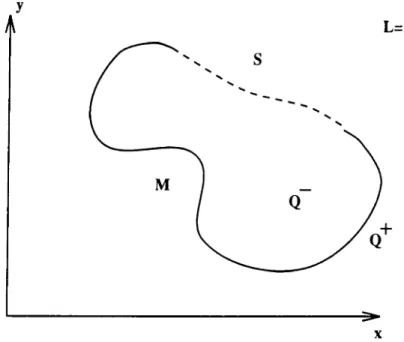
A further generalization of this problem is possible by introducing discon tinuous coefficients, A(zo) and B{zo) in (2.4). In addition, the behavior of X(z) at infinity can also be modified. For instance, it may also be described by a polynomial function of z. Let, the curve L be divided into two sets, M and S, such that MU*? = L, as shown in Figure 2.1. Consider a boundary value problem of finding an analytic function X(z) with the boundary expressions
x+(zo) + x -{z o) = Biz,), z ^ e M , x + { z o ) - x - { z , ) ^ 0 z , e s .
The two equations in (2.5) can be rearranged as a single one as
X+iz„) - A{z,)X-{zo) ^ B{zo)
(2.5)
L=MUS
Figure 2.1: Simple closed curve on the complex plane
by introducing discontinuous coefficient and free term functions
M z, ) =
I
" , B ( z ,) =I
"
[ +1, \ 0, Z , e sNote that equation (2.6) is valid on the whole closed contour L.
(2.7)
To make further derivations, it is necessary to specify the behavior of the unknown function X(z) at infinity and at the end points of the open curve M where A(z) and B{z) becomes discontinuous. It is assumed that X(z) has singularities of order 1/2 at each of the end points and is zero at infinity, which is a typical behavior for the electromagnetics problems of wave scattering and diffraction by perfectly conducting zero thickness slitted cylinders. However, the RHP technique can actually handle solutions with other singularities of the order less than 1, with nonzero behavior at infinity, [29].
2.2
S olu tion o f th e R iem an n -H ilb ert P ro b
lem
By making the assumptions introduced in the previous section, we can define a function R(z), which is also called characteristic function, such that the
multiplication of R(z) with X(z) becomes nonsingular everywhere, i.e. regular on the whole complex plane [29]. It is given as
(2.8) where z = ai ^2 are the endpoints, and the branch is chosen such that brunch- cut is from a i to «2 along S. Then the limit values as z —>■ Zg E S of R(z) differ
by sign, i.e. R(z) -4 R'<'(zg) = :^R-'-(zg).
By introducing functions Y(z) and D(zg) such that
Y { z ) = X ( z ) R ( z )
D(2.) = (2.9)
we come to a RHP with continuous coefficient function on the closed curve L
K + ( - - ,) - r - ( 2 .) = D(2<,) . (2.10)
Since the characteristic function has a simple pole at infinity, the solution of (2.10) is given as [29]
Y(z) = ± J ^ A z . + C .
ZTTI J L ( Zo — z ) (2.11)
The equation (2.11) can be written for the function X(z)
X ( z ) = ± ^ i
c
27tz Riz) JM (zo — z) Ii{z) (2.12)
which is the exact solution of the initial Riemann-Hilbert problem (2.5) with the restricted behavior of X(z) at the infinity and at the endpoints of the curve M. Because of the singular character of the integral on the right hand part of (2.12), this solution is not much effective computationally. The unknown constant C on the right hand can usually be obtained due to certain additional conditions from the physical nature of the initial problem which is converted to RHP.
2.3
S olu tion o f C anonical D u al Series Equa
tion s
Consider the dual series equations with trigonometric kernel for the infi nite sequence of coeflficients a:„, n = 0, =f=l, · · · is given as
OO
^ a : „ |n |e ‘"'" = F (e'‘"), >peS= \<p \<e (2.13)
n = — OO
OO
^ = 0, ip e M = {0 <\(f\< tt) . (2.14)
n = — OO
These dual series equations can be solved by converting the problem into a Riemann-Hilbert problem. Assuming that the series in (2.14) is term-by-term differentiable, we replace it with the derivative with respect to tp. Then we have the following equations
¿ 1 n | e”‘^ = f ’(e·'"), on S l = — OO OO ^ ;c„ne'"‘" = 0, on M (2.15) n = — OO OO E •rne‘”" = 0 .
The last equation is obtained by substituting (p = ir into (2.14) to account for the elimination of the constant term due to differentiation.
By introducing functions X ^{ z) of complex variable such that
OO
X~^iz) = x^nz"', analytic in Q'*’, and \ z\< \
n = l - 1
X (z) = — E analytic in Q , and | z |> 1 (2.16)
7l= z — OO
we obtain a functional equation valid on the whole unit circle | z |= 1 X+(,,‘V) _ AX-{e''^) = B (2.17)
with known, however, discontinuous coefficient and free term functions i 7-,/ \ i c>n S
, , .7 n «
P·'*)
[ +1, on M 0, on M
To arrive at the exact solution of (2.17), it is necessary to restrict the behavior of the unknown function X{z) at the infinity and at the end points of the screen. By assuming that X{z) vanishes as | z |—> oo, and has a square root singularity at the endpoints, z = the solution is given by the equation (2.12). By using Plemelj-Sokhotskii formulas [29] for the limiting values of the X(z), we obtain
X^{U) - X - { Q = ^ + ‘^CQ{to) (2.19) Z7T JS [t — to)
where t,to E L and
Q{to) = [/2+(io)]-\ t o e s
0, t o e M
The definition in (2.16) yields
X ^ { t o ) - X - { t o ) = ' £ n x J
( n )
uup (2.20)
By taking the Fourier inversion of (2.20), we obtain
mx,n = Vm {F,6) + 2CRm{0), m = 0 ,T l, (2.21) where 1 /•2’T 1 r V „ (F ,0 ) = —
/ i J ( e * ) y ( F , e ' * » ) c ^ /
Z7T Jo ZTT JA 1 f K (F ,e‘^'')e-‘”*^° M R+{e''t'o) (ilpo V (F y *‘) = -P.V . j (itThe constant term in (2.19) can be found by setting m = 0 in (2.21) as
v;
c =
2Ro (2.22)
Assuming that the free term function has the Fourier expansion as
one can obtain
where (2.23) (n) (2.24) (n) 27T Jm i7+(e‘’/'°) (2.25) Vnito^O) = - P . V . j . Z7T Jm t — to (2.26)
Therefore, the equation in (2.19) can be reduced to
Xm-m = Y^fn VZ ( n ) where R _ ^71 _ T/^__L ILq m 771
From the last equation in (2.15), one can find as
yn ^o = - J 2 f n E ( - 0 (ri) (m^io) 771 771 m (2.27) (2.28)
The calculation of u„, and requires a fine technique of integration in the complex plane and it was performed by Agranovich et. al. [12]. In terms of Legendre polynomials Pn[cosO) the results are as follows
v,:(co so ) = - m + 1 2(m — n) R,n(cos0) = y„^(cosO), V^ZlicosO) [Pm(cOs0)P„+i(<Xls0) - Pm+l{ws0)P„{cOs0)]
E ( - ‘)
771:^0 yn _ yn-\ 771 ^771— 1 (2.29) 771 I 1+cosg 2 n — 0 10The final solution to the Riemann-Hilbert problem is found as Xm = fnTmnicOS 6) (n) (2.30) where
r„,n(cos^) =
mK^-i(cos6>), m ^ O ^ V~\ (cos 0), m = 0, n 7^ 0 m = n = 0 (2.31) _ I n 1 1 1 2 5 11C hapter 3
SC A T T E R IN G FROM
C A V IT Y -B A C K E D
A P E R T U R E S W IT H
M ATERIAL COATING
The problem of electromagnetic scattering of a time harmonic plane wave from a thin, perfectly conducting, slitted infinite cylinder which is coated with absorbing material either from inside or from outside is analyzed in this chapter. The formulation of the problem is given in the first section. The dual-series equations are derived and then solved via RHP approach in the following two sections. The time dependence has been assumed and suppressed.
3.1
Form ulation o f th e P rob lem
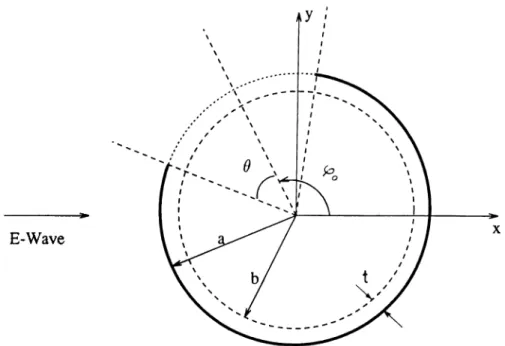
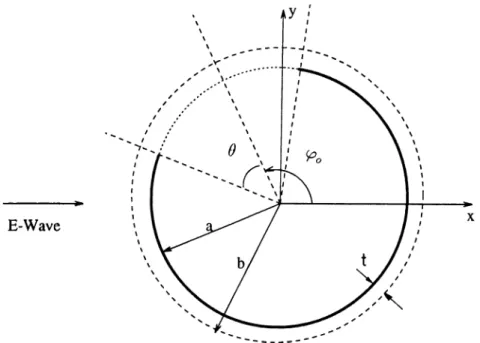
The geometries analyzed in this thesis are shown in Figures 3.1 and 3.2. The co ordinate system is coaxial with the cylinder. The plane wave is assumed to be normally incident on the cylinder; hence the problem is two dimensional. Two types of polarization for the incident plane wave are considered separately. For the transverse magnetic polarization (E-polarization), the incident E-field is parallel to the axis. For the transverse electric polarization (H-polarization),
E-Wave
Figure 3.1: Plane wave scattering by an inner-coated cavity-backed aperture
the incident H-field is parallel to the axis. The screen which has a radius of ”a” is taken to be in the interval of 0 <\ if — ifo |< tt. Angular width of the slit is 29, and the angle between the center of the slit and the x axis is ipo- The cylindrical cavity is coated with absorbing material with a thickness t. The radius ”6” is at either a —t ov a-[-t depending on whether the coating is on the inside or on the outside, respectively. The relative permittivity and permeabil ity of the absorbing material are tr and ^ri respectively. Our objective is to analyze the radar scattering behavior of this geometry for various frequencies. The problem is scalar, so the total field can be characterized by the single Uz component.
First, consider the geometry shown in Figure 3.1. The total field can be expressed as follows U z i n
= {
-I- f / f ( r ) , r > a b < r < a t / f ( r ) , r < h (3.1)where Ui"' and stand for incident and scattered fields, respectively.
The scattered field satisfies the 2-D Helmholtz equations: (V^ + ) t / f ( r ) = 0 , r > a , r < b
E-Wave
Figure 3.2: Plane wave scattering by an outer-coated cavity-backed aperture
where ko = is the free-space wave number and is the Laplacian operator in 2-D.
In addition, we impose the boundary conditions: Uz and its radial deriva tives should satisfy
[U,\ = 0, (3.3) = 0 (3.4) dr respectively, with 8 = ^ for E-pol I for H-pol
on the closed contour r = b. The square brackets in (3.3) and (3.4) denote the jump of the field function on the specified contour. The electric field is continuous on the clo.sed contour r = a which imposes either (3.3) for E-pol. or (3.4) for H-pol. to be valid. In addition, magnetic field is continuous at the aperture, | ip — (po\< 0, implies that (3.4) for E-pol and (3.3) for H-pol. are to be employed. Besides, the electric field must vanish on the screen, i.e., depending on the type of the polarization of the incident field, either Uz (for E-pol) or its derivative with respect to r (for H-pol) vanishes on the screen.
Because of the sharp edges of the screen, the field should satisfy certain edge conditions. The total electrical and magnetic energy stored inside any
finite neighborhood of the edge is limited, i.e.,
j ( k l I i / f p + I V t / f R d r <oo (3.5) where B is any bounded domain around the edge. Finally, the Sommerfeld radiation condition
inkaV
1/2
JkoT (3.6)
should be satisfied far from the scatterer as r ^ oo.
3.2
D erivation o f D ual Series E quations
The scattered field expansions in three regions of Figure 3.1 are assumed to be
E
AnHniKr) r > a BnJn{kr) + CnHn{kr) b < r < a DfiJn.lko'r) T h
eITUp (3.7)
where k = koy/fh^. Jn «^nd //„ represent the Bessel and Hankel functions of first kind and order n, respectively.
The incident plane wave of unit amplitude has the Fourier expansion as
OO
I j i n ^ ^ i k o x ^ ^ x k o r c o s ^ ^ ( 3 . 8 )
The number of unknown coefficients in (3.7) can be reduced by applying boundary conditions that are valid on the closed contours at r = 6 and at r = a
and where py _ ^ Jui^kgU) -(- Hjl(^kod^An ^ " " Jn{ka)U - H4ka)r)n ’ py _ * Jni^od^ T Hn(^kg<X^An " " " Jn{ka)^n - IUka)r^n
2z
l Dn ='Kkobf-Lj- Jni^kci^^Yi Mjii^hct^Tjji
(3.9) (.3.10) (3.11) f„ = . - H ' , ( k h ) U K b ) - U„(kb)j:XKb) V ßr 15
Vn = '■r j!J'^{kb)Jn{Kh) - Ukh)J'^{kob)
for E-poIarized case, and for the other polarization with the corresponding boundary conditions we obtain
Bn = Hr J'n{ka)^n - H!^{ka)Hn [e7-i^Jn{koa) + Hl,{koa)An Hr Jn{f^a)^n - H'^{ka)T]n Vn and where now, 2i + H:{k,a)A, “ M J',(ka)U - K(ka)ri„ (3.12) (3.13) (3.14) i„ = J ^ H ' J k b ) J n ( K b ) - H4kb)j;,(k.b) y Vn = ^^J'n{kb)Jn{kob) - J'nikob)
and prime denotes derivative with respect to the argument.
The boundary conditions that are continuity of the magnetic field at the aperture and vanishing electric field on the screen lead to dual series equations for the expansion coefficients
^ a:„7„e n = —oo %rnp - - X] dn& n = — oo n = — oo X = 0 , ^< |< ^ — where
-- i^Jn(koa) + Hn{koa)An , for E-pol
i^Jn^koo) + H'^{koo)An , for H-pol 2t”+> dn — TTko(iHn(koa) 7Γ^·oα//4(^·oα) for E-pol for H-pol and I n = <
tVAkpa) _ l 7 7 J'A ka)in-H '„ {ka)v n
Hn{ko(i) y Mr *^n{kd)^n~^in{k(i)Tin Hni^kpa) __ / Cy <Jn{k(i)^Ti~i^fn{kci)7}n //'(^·oα) V Mr J;,{ka)^n-H;,(ka)rjn for E-pol for H-pol . (.3.15) (3.16) (3.17) (.3.18) (3.19) 16
3.3
D u al-S eries-B ased S olution
3.3.1 E-polarized Plane Wave Incidence
Investigating the asymptotic behavior of 7„ as ( n |^ o o , based on the corresponding expressions for cylindrical functions [26], we find
I n
H
+
ko^i' \ fJ'r / where/9« — 1 + 2
+ 1
\Cij 2n 1-/^r - 1 /
b' Hr + 1 \a^ 2n1- 1 (3.20) (3.21)For b ^ a, the dominant term in (3.21) is the first term, which is 1. The remaining terms decrease very fast as n increases. To have a fast convergence of the solution, we add and subtract the asymptotic expression (3.20) from 7„ in (3.15), and get the following result
E
7l = — OC where x„. n eintp = t (x .A „ + e-nir'oo V
Hr + l J
^ ^ I 1 ^ 1 — . 7nT 1^1 > (p-( po i<0 (3.22) Hr+ 1
Xn and dn are given in (3.17) and (3.18), respectively.
Equation (3.22) and (3.16) form canonical dual series equations. This dual series system can be solved by converting into the Riemann-Hilbert problem which is explained in the previous chapter. Assuming that the series (3.16) is term-by-term differentiable, we replace it with the derivative with respect to
(f. The termwise differentiation can be justified as described in [13]. Denoting xj) = ip — poi we have the following equations
l= —oo oo \ i , \ < 0 (3.23o) . = —OO ^X) 0 <\ xl)\< TT (3.236) E ( - u “i» = o (3.23c) 17
where £·„ = The last equation is obtained by substituting (/? = tt +
into (3.16) to account for the elimination of the constant term due to differen tiation. The function on the right-hand side of (3.23a) has a Fourier expansion as
OO
F (e '^ )= X: (3.24)
where the coefficients are given as
fn ~ “t"
Hr “h 1 (3.25)
By introducing functions of complex variable a = | z | e‘'^ such that
X (z) =
H
Xnnz'^, n > 0 X~(z) = XnUz’' n < 0 k l < i Ul > 1 (3.26) A(ip) =and using (3.23a) and (3.236), the functional equation valid on the whole unit circle I z 1= 1
X+ie''^) -b AA"-(e‘^) = B (3.27) is obtained with
+ 1, IV’|< 0 IV 'I<« — 1, ^ < | ^ | < ; r ’ I 0, 9<\^l)\<n .
This is the equation which is known to constitute RHP. To arrive at the exact solution of (3.27), it is necessary to restrict the behavior of the unknown func tion X{z) at the infinity and at the end points of the screen. One may .see from (3.23), (3.2.5) that the frequency dependence is contained only in F(e*’^) term. Assuming that F{e''^) is known, (3.27) forms a static problem {k = 0) for X{z). However, at static limit, the incident plane wave constitutes a superposition of two cross polarized constant fields: electric and magnetic Hy. Perfectly conducting cylinder does not perturb axial electric field, but it does perturb transverse magnetic one. So, function X{z) corresponds to the perturbation of Hy by the presence of the screen which then vanishes as | ^ ^ oo. From (3.5), the field behavior at the edges for and will be like (I V’ l
and
(I
î/>| —61)“ */^, respectively. So, A^(z) must have a square root singularity at the edges of the screen.Further, following the Riemann-Hilbert solution technique described in the previous chapter, we arrive the solution in the form
= X] fnT,nn(cosO)
7 l = — OO
18
where fn is the Fourier expansion coefficient given in (3.25). Tmn{u) is related to the Legendre polynomials ( Pm and P„) and is given in Appendix A.
This form of the solution of the dual series equations is simpler than the one in [12], [16]-[15], since it does not require the separation of equations for m = 0 and m ^ 0 parts.
By defining
Pn — ^ n ! )
one can write (3.28) as
OO P m 'y ] P m n P n "h S m i ^ ~ 0, i l , . . . n = —oo where A T J/
— TT 77 ry 77
P mykoQJ Jm(koO,j Sm = and 1___ I___ + _______ _______ Y] J rt (^'oa)/^n 2ifj.r{pr + 1) *
TTHniKa) (3.29) (3.30) (3.31) W m n (3.32) Wmn = e^^^-^’^^‘^°Tmn(cos9) . (3.33) The coefficients Wmn contain all the information about the angular geometry of the screen, as functions of 0 and ¡po· Expression (3.30) can be written as a single operator equation
( / - K)p = S (3.34) where p = {pn)n=-oo^ ^ identity matrix and K = {Kmn}m,n=-oo· Operator K can be shown (see [13]) to be compact in the Hilbert space of /2 {p € h if
OO
< 00). Besides, vector S = {Sm}m--oo ^ ^2 as well. It means that
n = — OO
(3.34) is a regularized operator equation, and therefore well known Fredholm’s theorems are valid [30]: solution p does exist and is unique. Moreover, any solution of (3.34) can be shown (see [1.3]) to satisfy
n z = — OO
n + 1 |< OO (3.35)
iis pn decay as 0{n~^l^) when | n ( ^ 00. Hence, (3.35) ensures the validity of the edge condition (3.5), [13]. Further, this solution can be approximated with any desired accuracy by means of truncation of the matrix K = {i^mn}m,n=-ooi
and vector S = {>5'm}m=-oo l^l> 1^1 > ^tr- The sequence of ap proximate solutions is guaranteed to converge to the exact solution for any
koa^bj a^€r, ^ir,0^ipo as Ntr —*■ oo, which is not the general case in the method of moments. In practice, simple numerical rule has been verified. To provide an accuracy of 0.1 %, we had to take NtT = integer part of {koo) -f 15. It is noted that, all the field coefficients in (3.7), namely y4„, 5„, Cn and Dn are calculated using equations (3.29), (3.9), (3.10) and (3.11), respectively.
We treat the second problem (for outer covering) in a similar way. In (3.7), we replace a ’s with 6’s; afterwards the same procedure is followed. The resultant infinite system of linear equations is formally the same as in the previous problem (3.30). ft is rewritten below for convenience
P m — ^ ] I ^ m n P n “b Sm·, TTl — 0, dll, . . .
where now
( n )
_ Jn{,kooi) Hn{kd)^n Jn{k(i^Tjn . Jm{ko(i) Hm^kd^i^YYi Jjn(ko?jTlyy
and the coefficients are
= Ukb)H'^kob) - ^¡^J'^{kb)Hn{kob) P-r (3.36) (3.37) and where = H,{kb)H',{kob) - J^H',{kb)Hn{kob) y /^r A P r k o d I I , , 7n+ I «I l^r I i
J'Xkoa) flZH'^{ka)^n ~ JL{f^a)Vn
I n —
(3.38)
Coefficient Sm in (3.36) is now given by
Sm ~ Jjri ^ [^m
+ m * ” {[//n(^’«)'5'2n -
J n { k a ) s 4 n ] A n+ 8fa“ *[//„(Â;a)<f„ - J„(A;a)77„]~*|
Wmn) (n) (3.39) wherenr =
Tr'^{kobY Hr{pr+ 1)
= jjkb)j:xkob) - .i ^. r , {k b ) U k o b )V
2054„ = H^{kb)J'^{Kb) - ^¡-^K{kb)J^{Kb)
fj>r
The second problem has the same type of operator equation as the previous one.
3.3.2 H-polarized Plane Wave Incidence
Investigating the asymptotic behavior of 7„ as | n |—>oo, based on the corresponding expressions for cylindrical functions [26], we find
I n ko(^ (■.
R l
R
where — 1 + 2€r — I i b 2n 67. -f" 1 \cL1
-Cr — 1
i b 2n C7· -f- 1 \cL -1 (3.40) (3.41)For b ^ a, the dominant term in (3.41) is the first term, which is 1. The remaining terms decrease very fast as n increases. To reduce the problem into canonical dual series equations, we make the following transformation
(3.42)
(3.44)
' ' » - - r ' l — T Ti ■KqCL V 67. -|- 1 /
Adding and subtracting the asymptotic expression (3.45) from 7„ in (3.44), we get the following result
E
Vn I « I =E
[ y n ^ n + (I n I - A „ ) d „ ] 0 < \ ^ - < p , \ < ^ (3.46)(71) ( n )
J/71 — '^n'yn "i" dji which leads to the following dual series equations
E 2 /n e‘”^ = 0 ,
in)
0 <\(p -ipo\<T^
(”) ('0
where 7,1 is equal to l / 7„ and its large index behavior is given as
n\ 1
where
A „ — A.f,u(cr “b l) ^ n T I I i
21
y„ and dn are given in (3.42) and (3.18), respectively.
Equation (3.46) and (3.43) form canonical dual series equations. This dual series system can be solved by converting the problem into Riemann-Hilbert problem [13], [16], described in the previous chapter. Assuming that the series (3.43) is term-by-term differentiable, we replace it with the derivative with respect to 9?. Denoting ip = (p — ipo n and a = tt — 0, we have the following
equations
I n)
= F(e'^),
\ i p \ < a in) (X <\ ip\< IT (3.48) = 0, (n) Y v n = o in)where = ?/„( —l)"e'"''^°. The last equation is obtained by substituting 9? = 7T 9>o into (3.43) to account for the elimination of the constant term due to differentiation. The free-term function on the right-hand side of (3.48) has a Fourier expansion as
F{e''^') = Y f n e ' ^ ^ (.3.49) (")
where the coefficients are given as
/„ = (-l)"[y „ A „ + d J l n j - A „ ) ] e - '" ° . (.3..50) By introducing functions of complex variable z =\ z\ such that
x* (~ ) = |i| < 1
X (z) = n > 0
(~) = - E ^nnz'\ \z\ > 1
n < 0
(3.51)
we transform the first two equations of (3.48) to functional equation valid on the whole unit circle 1 2 ]= 1
with
A+(e'·'^) AX~{e''^) = B (3..52)
— I , i , V < ] i / ) | < 7 r ) 0 , Q ; < | 0 ) < 7 r .
The exact solution of (3..52) is given by the RHP solution subject to neces sary restrictions, that is the behavior of the unknown function X{z) at infinity
and at the end points of the screen. In this problem, function X(z ) corresponds to the perturbation of static electric field by the presence of the screen. That is why it is clear that X (z ) vanishes as | 2: |—> 00, and has a square root singu larity at the edges of the screen. The field behavior at the edges, from Meixner edge condition, for and Hz, will be like (| tp \ and (| -tp | — respectively.
Hence the solution is obtained as
Vm
—
'P ] fn Tmn(
COS( n )
(3.53)
where /„ is the Fourier expansion coefficient given in (3.50). Tmn is related to Legendre polynomials, and is given in Appendix A. By defining
fin — An/i/n(^o^) )
one can write (3.53) as
flm — Anin/^n T S m , — 0. i 1, . . . where ( n ) fr,^{koa)j;^{Ka) 7n ^ //,'n(U)j;(A:<,a)7n. " " (3.54) (3.55) (3.56) — 7, 2i and wkoaH'^{koa) W,nn = e‘("-”*)‘"°(-l)'"+ "T ,„„(-cos0) . Wr r rr, (3.57) (3.58)
The coefficients Wmn contain all the information about the angular geom etry of the screen.
Expression (3.55) can be written as a single operator equation
{ l - K ) ^ ı = S (3.59)
Similar to E-pol. case, one can show that (3.59) is a regularized operator equation which satisfies the well known Fredholm’s theorems: solution n does
exist and is unique. Moreover, any solution of (3.59) can be shown to satisfy
/z„p| n + 1 1< oo (3.60)
H
Hence, (3.60) ensures the validity of the edge condition (3.5). Finally, this solution can be approximated with any desired accuracy by means of truncation of the matrix K = {Kmn}m,n=-ooJ vector S - for all |m|, |n| > Ntr- The sequence of approximate solutions is guaranteed to converge to exact solution for any koa,b/a,er,fJ’r , 0 , ‘po as Ntr oo, which is not the general case in the method of moments. The field coefficients in (3.7), namely, An·, Bn, Cn, and Dn are calculated by using equations (3.54), (3.12), (3.13) and (3.14), respectively.
The outer covering case is also treated in a similar way. In (3.7), we replace a ’s with b’s; afterwards the same procedure is followed. The resultant infinite system of linear equations is formally the same as in the previous problem (3.55) fhn — 'y ^ B'mnf^n T S,yi, 7 T l = 0, Ü , . . . where now (") _ J ' n i k o a ) H ^ { k a ) ^ n ~ J n ( k a ) r ] n 7 n ^ m.n.
—
V __ y,
V
and the coefficients are
(3.61) (3.62) and where
6
. = Jn{kh)H'n{koh) - J!^J'^{kb)Hn{kob) rjn = IUkb)H[Xkob) - J^H'^{kb)Hniky,b) A n = \ n koCii^ 1 4“ ^r) I nI n = ,Jn{ko(l) I Cr HniJ^^'j^n '-^n(^’ö)7'i
■^niha) y ^tr H'^{ka%, - Jn{ka)T]n Coefficient S,n in (3.61) is now given by
(3.63)
Sny = - i ”'[Hln{ka)s2m - J'n{fi:a)s4m] + Sia *[//^.(¿a).^,^ ~ J'„yika)j},n] ^7,,/ JL{f^oa)[H^n{f^a)^rn - JL{f^a)r},n]
( n )
{[//'(^·α)52„ - J'(fca)54n]A„7n + 8ia ^[H'^{ka)^n ~ Jn{ka)r)n]
where (3.64) J'm{koa)[H'^{ka)U - J'm[ka)r]mhn a = ir^{koa){kob)^ fir^T S2n = J n { k b ) J ' , { k o b ) - , f ^ J ' ^ { k b ) U K b ) s , n = H n { k b ) J ' ^ k o b ) - J ^ i r , { k b ) U k o b ) 6-r
The second problem has the same type of operator equation as the previous one.
C hapter 4
N U M E R IC A L RESULTS and
D ISC U SSIO N
In this chapter numerical results are obtained for the radar cross section (RCS) behavior of a CBA which is coated either from inside or from outside with absorbing materials. The associated formula for RCS for E-pol incidence is given as
which can be written in terms of expansion coefficients as
2
^hs —
N t r
^ ^ Pn ^ *^n ( ^’o O' )
-N.r
We have normalized RCS with respect to tto which is the geometrical op
tics value for the perfectly conducting closed circular cylinder. The normalized RCS results are presented with respect to frequency, aspect angle of the screen, thickness of the absorbing layer and different aperture sizes for both polariza tions.
If otherwise not stated, 0 is taken as .30° (aperture size of 60°), and the materials used for coating are shellac, natural XL (e^ = 3.45 -|- 0.25f, /Zr = 1) [28] (dashed curves) and poly-2.5-dichlorostyrene (cr = 7-3, Pr = 0.91 -|-0.32i) [5] (solid curves). The thickness of the absorbing layer is 10% of the radius of the screen. For comparison, dotted curves represent the RCS calculated for the same CBA without any coating.
4.1
R adar Cross Section versus Frequency
4.1.1 E-Polarized Case
The normalized RCS results are presented in Figures 4.1 to 4.6 as a function of frequency for different coating materials and different orientations of the aperture.
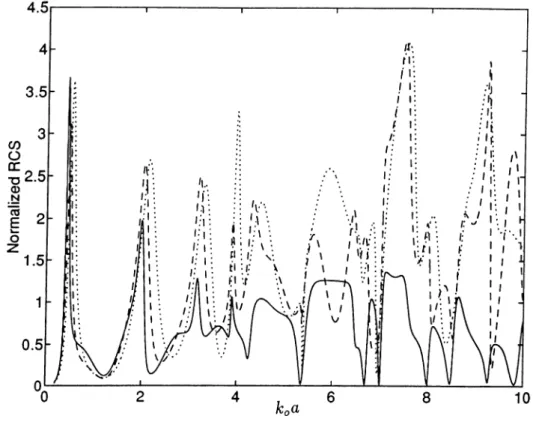
It is noted that for ipo = 180° case, the average level of RCS of uncoated CBA is much higher than that of closed uncoated circular cylinder of the same radius (dash-dotted curve in Figure 4.2). In addition, strong resonances are observed in the RCS. The resonances are due to the excitation of the damped natural modes of the screen as a cavity-backed aperture. The damped modes originate from the eigenmodes of the closed cylinder, Emn·, being shifted in frequency and splitted into even/odd pairs, due to cutting of the slot.
The shifted frequency locations have been calculated previously [14] for uncoated CBA. Iterative-perturbation analysis of the characteristic equation
det{I — K) = 0, under assumption that r = sin(^/2) —> 0, had been carried
out due to the strongly-diagonal shape of the matrix. The natural frequencies are complex-valued with real parts smaller than the corresponding zeros of the Bessel functions. They are found as asymptotic series
7 + ^ 2
1 + ( 2 ~ + O(r^), for the even modes (m = 0,1,2,...), and
Knn(>· = ''m n - ( l + -I- 0 {t^°)
(4.1)
(4.2)
for the odd modes (m = 1,2,...) of the empty circular slitted cavity. In (4.1) and (4.2),
Cmn = 7T ' ^ Sslfisil/mn)] ^ mn = ‘
X )
•S^|//,(i-.5=0,
and So = l,¿í = 2 for s ^ 0, and Vrnn is the n-th zero of
1 -2 (4.3)
The shifted frequency locations show good agreement with the minima of RCS in the mimerical results for uncoated CBA at ipo = 180°. Note that, for the symmetrical position of the slitted cylinder, i.e. when (po = 0° or 180°,
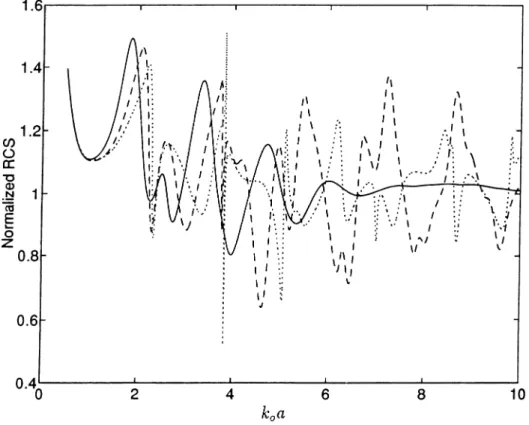
Figure 4.1: The normalized RCS of an uncoated and outer-coated CBA for E-pol. incidence for two different absorbing materials with CBA hav ing 60° aperture size, ipo = 180° and the coating radius b = l.la ; solid line: Cr = 7.3, /ir = 0.91 -|-0.32z; dashed line: Cr = 3.45 -f 0.25f, = 1; dotted line: uncoated cylinder, i.e. = 1, /x^ = 1.
there may exist only even modes, i.e. however for unsymmetrical cases both resonances, even and odd modes, i.e and do appear. The excited modes corresponding to the first four resonance frequencies for (fo = 180° case are known as 1 ^ t \ i ^02i [17].
The effect of the presence of the absorbing material on the outer and inner wall of CBA are demonstrated in Figures 4.1 and 4.2, respectively for the case of aperture in the illumination region. As observed in these figures, the lowest order peak cannot be reduced by using absorbing dielectric material. However when the frequency increases, the resonance peaks are reduced. It is due to the fact that low frequency E-field has zero value on the screen and has a maximum on the axis of the cylinder, as zeroth harmonic is dominating. But when the frequency is increased, the number of azimuthal harmonics of
Figure 4.2: The normalized RCS of an unslitted cylinder, uncoated and in- ner-coated CBA for E-pol incidence for two different absorbing materials with CBA having 60® aperture size, ipo = 180° and the coating radius b=0.9a; solid line: Cr = 7.3, [ir = 0.91 + 0.32i; dashed line: = 3.45 + 0.25f, = 1; dotted line: uncoated cylinder, i.e. = 1, = 1; dot-dashed line: unslitted cylinder.
comparable amplitude also increases and the location of the maximum of E- field moves away from the axis. Therefore, resonances of higher order modes can be suppressed by coating the screen with the absorbing material from inside. To reduce the lowest order resonance peak, one needs to use magnetic absorbing material as seen in Figures 4.1 and 4.2. Since the magnetic field has an azimuthal component, which is not zero on the screen, it can be suppressed by using lossy magnetic material which results in a lower back scattered power. Coating from outside has no effect on the internal resonances but it helps only to decrease the amplitude of the incident field entering into cavity. Therefore, the sharp minima cannot be suppressed, but the average level of RCS is reduced as seen in Figure 4.1. So the resonances are still sharp which may cause the target to be easily identified.
Figure 4.3: The normalized RCS of an uncoated and outer-coated CBA for E-pol. incidence for two different absorbing materials with CBA hav ing 60° aperture size, ipo = 90° and the coating radius b = l.la ; solid line:
tr = 7.3, fir — 0.91 -f 0.32f; dashed line: = 3.45 -J- 0.25f, /Xr = 1; dotted line: uncoated cylinder, i.e. Cr = 1, =
1-As an example of nonsymmetrical excitation, we examine the case of 90° orientation, i.e. when the aperture is looking up. Coating from outside is much effective for reducing the average level of the RCS, but there are still sharp resonances (See Figure 4.3). If the coating is from outside, some of the energy is absorbed by the coating material. So, the amplitudes of the resonance peaks are reduced. On the other hand, as seen in Figure 4.4, coating from inside is again effective for suppressing the resonances, except the lowest one. The resonance phenomena are greatly reduced if the frequency is increased and magnetic coating is used.
In Figures 4.5 and 4.6, the results are obtained for the case when the aper ture is in the shadow region. Coating from outside is more effective as seen in Figure 4.5. There is no effect of coating from inside, simply because there are almost no resonances in RCS as seen in Figure 4.6. The results are very
Figure 4.4: The normalized RCS of an uncoated and inner-coated CBA for E-pol. incidence for two different absorbing materials with CBA hav ing 60° aperture size, ipo = 90° and the coating radius b=0.9a; solid line: Cr = 7.3, /ir = 0.91 -|- 0.32z; dashed line: tr = 3.45 + 0.25z, fir = 1; dotted line: uncoated cylinder, i.e. tr = 1, fir = I·
Figure 4.5: The normalized RCS of an uncoated and outer-coated CBA for E-pol incidence for two different absorbing materials with CBA hav ing 60° aperture size, (/?<, = 0° and the coating radius b = l.la ; solid line:
tr — 7.3, /Xr = 0.91 -1- 0.32x; dashed line: tr — 3.45 -|- 0.25t, /Xr = 1; dotted
line: uncoated cylinder, i.e. Cr = 1, /Xr = 1·
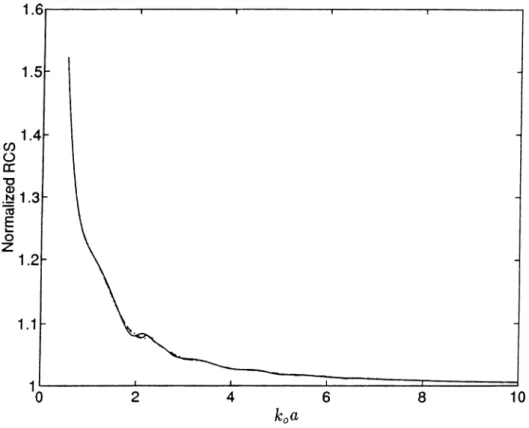
similar to the closed cylinder case (see Figure 4.2, dash-dotted curve). This happens because the E-polarized excitation induces only longitudinal current on a cylindrical scatterer, hardly reaching the shadow part of surface, and hence, not exciting the interior of CBA. It is also noted that the solid curve in Figure 4.5 is similar to the one in Figure 4.3. The frequency value at which RCS has a broad minimum in those figures corresponds to the frequency at which the reflection coefficient is minimum for quarter-wavelength magneto-dielectric coating on a perfectly conducting plane.
Figure 4.6: The normalized RCS of an uncoated and inner-coated CBA for E-pol incidence for two different absorbing materials with CBA hav ing 60° aperture size, ipo = 0° and the coating radius b=0.9a; solid line: e,. = 7.3, fir = 0.91 -f-0.32z; dashed line: tr = 3.45 + 0.25?, fir = 1; dotted line: uncoated cylinder, i.e. = 1, /?r = 1·