REFLECTIONS ON RECENT TRENDS IN DEPOSIT DOLLARIZATION
IN TURKEY
A Master’s Thesis
by
NECMİYE DAMLA KESİMAL
Department of Economics İhsan Doğramacı Bilkent University
Ankara February 2021
REFLECTIONS ON RECENT TRENDS IN DEPOSIT DOLLARIZATION
IN TURKEY
The Graduate School of Economics and Social Sciences of
İhsan Doğramacı Bilkent University
by
NECMİYE DAMLA KESİMAL
In Partial Fulfilment of the Requirements for the Degree of MASTER OF ARTS
DEPARTMENT OF ECONOMICS
İHSAN DOĞRAMACI BİLKENT UNIVERSITY ANKARA
I certify that I have read this thesis and have found that it is fully adequate, in scope and in quality, as a thesis for the degree of Master of Economics.
Prof. Dr. Refet S. Gürkaynak Supervisor
I certify that I have read this thesis and have found that it is fully adequate , in a
,
thesis lor the degree of Master ol Economics.
Asst. Prof. Dr. Sang Seok Lee Examining Committee Member
I certify that I have read this thesis and have found that it is fully adequate, in scope and in quality, as a thesis for the degree of Master of Economics.
Asst. e nep Kantur
Examining Committee Member
Approval of the Graduate School of Economics and Social Sciences
Prof. Dr. Refet S. Gürkaynak Director
ABSTRACT
REFLECTIONS ON RECENT TRENDS IN DEPOSIT DOLLARIZATION IN TURKEY
Kesimal, Necmiye Damla M.A., Department of Economics Supervisor: Prof. Dr. Refet S. Gürkaynak
February 2021
Deposit dollarization is high in Turkey with more than half of all banking sec-tor deposits denominated in foreign currency. While a rising trend in deposit dollarization has been in place during the last ten years, this has gained further momentum recently. The objective of this study is to analyze the recent trends in deposit dollarization in Turkey within the framework of policies undertaken and investigate its potential drivers that are under the influence of monetary policy. Estimation results obtained using the deposit dollarization shares that are and are not adjusted for the mechanical impact of the exchange rate changes provide different assessments of the drivers of dollarization in Turkey. In this sense, some estimation results obtained using the unadjusted deposit dollarization share sug-gesting that it has been associated with the exchange rate and exchange rate expectations might be misleading regarding the changes in the demand for for-eign currency over domestic currency deposits to the extent what these results capture is the mechanical impact of exchange rate movements on the deposit dollarization share.
ÖZET
TÜRKİYE’NİN MEVDUAT DOLARİZASYONUNDAKİ GÜNCEL EĞİLİMLER
Kesimal, Necmiye Damla Yüksek Lisans, İktisat Bölümü
Tez Yöneticisi: Prof. Dr. Refet S. Gürkaynak
Şubat 2021
Türkiye’nin mevduat dolarizasyonu yüksek olup, bankacılık sektörü mevduat-larının yarısından fazlası döviz cinsindendir. Dolarizasyonda son on yılda artış eğilimi gözlenmiş ve bu artış son dönemlerde ivme kazanmıştır. Bu çalışmanın amacı, Türkiye’de mevduat dolarizasyonunun son dönemdeki eğilimini uygula-nan politikalar çerçevesinde analiz etmek ve mevduat dolarizasyonuna etki eden ve para politikasının kontrolü altında olan potansiyel faktörleri araştırmaktır. Hem kur etkisi için düzeltilmemiş mevduat dolarizasyon payını hem de mevduat dolarizasyonundaki değişimin yalnızca mevduatlardaki değişimden kaynaklanan kısmını kullanarak elde edilen tahmin sonuçları Türkiye’de mevduat dolarizasyo-nunu etkileyen faktörlere ilişkin farklı değerlendirmeler sunmaktadır. Bu anlamda kur etkisi için düzeltilmemiş seri kullanılarak elde edilen ve mevduat dolarizayo-nunun döviz kuru ve döviz kuru beklentileri ile ilişkili olduğunu gösteren tahmin sonuçları döviz talebindeki değişimin nedenleri hakkında, tahmin sonuçlarının kurdaki değişimlerin mevduat dolarizasyonu üzerindeki mekanik etkisini yansıt-tığı ölçüde, yanıltıcı olabilir.
Anahtar Kelimeler: mevduat dolarizasyonu, döviz kuru, para politikası güvenilir-liği.
ACKNOWLEDGMENTS
I am and will always be incredibly grateful to my supervisor Professor Refet Gürkaynak for his constant support and patience. In every interaction I had with him, I was not only impressed by his brilliance as an academic, but also as a terrific human being. I feel blessed to have known him.
I would like to thank Professor Sang Seok Lee for his support and willingness to help me. He was always generous with his time and there when I needed. I would also like to thank Professor Burçin Kısacıkoğlu for his support and always being available to help me. I would also like to thank Professor Zeynep Kantur for taking the time to review my thesis.
Finally, my most heartfelt thanks go to my mother, grandmother and Sıla for their love and support.
TABLE OF CONTENTS
ABSTRACT . . . iii
ÖZET . . . v
ACKNOWLEDGMENTS . . . vii
TABLE OF CONTENTS . . . viii
LIST OF FIGURES . . . x
LIST OF TABLES . . . xi
CHAPTER 1: INTRODUCTION . . . 1
1.1 LITERATURE REVIEW . . . 3
CHAPTER 2: RECENT TRENDS IN DEPOSIT DOLLARIZATION . . 8
2.1 On the measurement of dollarization . . . 8
2.2 Insurance value of dollarization . . . 13
2.3 On the relationship between inflation, monetary policy credibility and dollarization . . . 14
2.4 The role of the deposit rate (spread) on dollarization . . . 17
2.5 The nature of foreign currency deposits and banks’ foreign cur-rency liquidity . . . 19
2.6 Credit expansions and dollarization . . . 24
2.7 Deposit dollarization of non-financial corporations . . . 29
CHAPTER 3: THE EMPIRICAL ANALYSIS . . . 31
3.2 The Estimation Results . . . 31 CHAPTER 4: CONCLUSION . . . 36 REFERENCES . . . 37
LIST OF FIGURES
1. Unadjusted vs Adjusted Deposit Dollarization Ratios . . . 12
2. Banking System FX and TL deposits . . . 12
3. The Decomposition of the Change in the Deposit Dollarization Share 12 4. Dollarization Ratio for Residents vs Inflation . . . 15
5. Inflation and Inflation Expectations . . . 15
6. FX Deposits of Residents vs Real Expected Returns . . . 17
7. FX Deposits (US$ billion) vs USD Deposit Rates (percent) . . . . 18
8. The interest rate differential . . . 19
9. Deposits by Type . . . 20
10. Deposits by Maturity . . . 21
11. Cumulative Change in FX Domestic Deposits . . . 21
12. Non-Resident and Resident Deposit Outflows . . . 23
13. CBRT Funding (TL bn) . . . 24
14. Sources of Funding . . . 27
15. State-Owned Banks Net FX Position . . . 28
LIST OF TABLES
1 Unit Root Tests . . . 32 2 Estimation Results . . . 35
CHAPTER 1
INTRODUCTION
De-facto deposit dollarization is high in Turkey with more than 55 percent of all bank deposits denominated in foreign currency, and the most recent data show that the upward trend in deposit dollarization has continued. While Turkey has managed to de-dollarize during 2000s following the adoption of the inflation targeting regime, a rising trend in dollarization, measured as the share of foreign currency deposits in total deposits in this study, has been firmly in place during the last ten years, and this has gained further momentum in 2020 with the share of bank foreign currency deposits reaching a peak of 58 percent in November 2020 from about 51 percent at the beginning of the year.
The objective of this study is to analyze the recent trends in deposit dol-larization in Turkey and get a sense of its potential drivers. While unfavourable macroeconomic conditions have apparently contributed to the recent trend in the degree of dollarization and there is ample evidence in the literature suggesting that episodes of high exchange rate volatility and inflation have been among the main reasons behind deposit dollarization for many countries including Turkey (Metin Ozcan & Us, 2009), understanding the relative contribution of drivers of dollarization is still crucial to inform appropriate de-dollarization policies
(Ko-kenyne et al., 2010), given the risks associated with it.
Building on earlier studies explaining dollarization as driven by policies and institutions, and in this context having in mind Turkey’s dollarization experience which had been shaped not only by high and volatile inflation, but also lack of prudent financial measures as well as fiscal dominance in financial markets (Basci, 2011), this study turns to the analysis of the recent drivers of dollarization in Turkey. In particular, it analyzes the recent trends in dollarization with a focus and reflection on the impact of policies undertaken, exchange rate movements as well as the monetary policy credibility, asking in the background the question of what would have happened to dollarization absent such policies, or to put it another way, if the recent surge in dollarization has been partly a response to these policies that would have been muted otherwise. More specifically, this study looks into the drivers of deposit dollarization based on several observations – many boiling down to Turkey’s demand-driven growth model that has become increasingly dependent on credit stimulus – to inform the variables of interest that will be included in the empirical analysis. In this sense, judging by the relatively recent trends, this study also tries to get a sense of how deeply rooted the underlying causes of dollarization are with a view to understanding if a quick reversal is possible.
In doing so, this study also reflects on the appropriate measure of dollarization to be used in the empirical analysis. In particular, following studies using a mea-sure of deposit dollarization that adjusts for the mechanical impact of exchange rate movements on the deposit dollarization share, it tries to understand what was behind the changes in the deposit dollarization share stemming from changes in agents’ behaviour only, and hence better assess the impact of exchange rate movements on the demand for foreign currency deposits through the expectations channel.
Taking into account in the estimation the change in the deposit dollariza-tion share that is attributable to changes in deposits only provides a different assessment of the drivers of dollarization in Turkey. In particular, the use of this alternative dependent variable implies that the estimation results showing the significance of the relationship between the deposit dollarization share and the exchange rate movements might be mainly capturing the mechanical impact of exchange rate changes on the dollarization ratio rather than the impact of these changes on the dollarization ratio through agents’ behaviour.
1.1 LITERATURE REVIEW
The literature on dollarization, considering this phenomenon as a response to a suboptimal policy environment in very broad terms, focuses on understanding the drivers of dollarization, risks it may constitute for the economy as well as its impact on the conduct of monetary policy.
The initial focus of the literature analyzing the drivers of dollarization was on the currency substitution angle, explaining it as economic agents’ response to an unstable macroeconomic environment characterized by high and volatile exchange rate and inflation (Savastano (1996); Bennett et al. (1999); Honohan et al. (2005)), leading to a loss in the real value of financial assets. Studies (Ko-kenyne et al., 2010) drawing attention to country experiences and showing that dollarization remained elevated even when the level and volatility of inflation and the exchange rate decreased considerably in these countries, however, constituted a challenge for the currency substitution view, and led to the emergence of alter-native views explaining dollarization from an asset substitution angle (Corrales & Imam, 2019).
per-sistence in dollarization into three categories. While the portfolio view falls into the category explaining the dollarization as a response to macroeconomic insta-bility manifesting itself in high and volatile exchange rate and inflation in very general terms, more precisely, it explains the phenomenon as an optimal portfolio choice. According to this view, when the spread between domestic and foreign currency deposit rates increases in favor of domestic currency deposits, agents are expected to switch to local currency deposits, all else being equal. In this so called minimum variance portfolio optimization framework, and in line with the findings of the literature suggesting that deposit dollarization is associated with episodes of large exchange rate depreciations and high inflation, agents choose the composition of their optimal portfolio in a way to minimize the variance of ex-pected returns by taking the relative volatility of inflation and the exchange rate into consideration (Ize & Yeyati (2003); Kiguel et al. (2005)). Accordingly, an important implication of this view is that expectations, and hence the credibility of policies have an important role to play (Levy-Yeyati, 2006).
In an alternative view, Ize & Yeyati (2003) and Feige (2003) argue that shal-low domestic financial markets with lack of enough investment opportunities are partly the reason of the high degree of dollarization. The so-called market devel-opment view, hence, explains dollarization as a suboptimal response to market imperfections.
The institutional view, on the other hand, argues that institutional failures can amplify the degree of dollarization by contributing to the channels underlined by the portfolio and market development views. The quality of institutions, for instance, affects the monetary policy credibility, which in turn affects the degree of dollarization through its impact on expectations. The persistence of dollarization in an environment where the monetary policy credibility is lacking even after the initial cause triggering dollarization is reversed sheds light on how
this channel might strenghten the impact of other channels.
Relatedly, Ize & Parrado (2002), for instance, emphasize that agents’ prefer-ences for holding foreign currency are shaped by the expectations regarding the conduct of monetary policy in the event of a collapse of a fixed exchange rate regime, regardless of the probability of this occurring. Within the framework of the institutional view, the findings of the literature suggest that central banks may contribute to increasing dollarization when – being biased to depreciation – they build their credibility on a stable exchange rate rather than strong insti-tutions (Reinhart et al., 2003). Motivated by these arguments, several studies in the literature have found that dollarization is associated with weak economic institutions (Honohan et al. (2005); (Levy-Yeyati, 2006)).
Building on studies explaining dollarization on the basis of institutions and policies, the literature focusing on monetary determinants of deposit dollariza-tion have found the exchange rate and exchange rate volatility as well as the spread between domestic and foreign currency deposit rates among the most important variables explaining dollarization (Tkalec, 2013). Specifically, Rus-lan (2003) shows that the interest rate differential on deposits has a significant effect on the degree of dollarization with the higher wedge in favor of domes-tic currency tending to decrease deposit dollarization (Civcir (2005); (Basso et al., 2011)). Furthermore, Kokenyne et al. (2010) also show that exchange rate depreciations increase the degree of dollarization. More specifically, studies fo-cusing on exchange rate movements argue that when exchange rate fluctuations during periods of macroeconomic instability translate into economic agents’ hav-ing, one-way, entrenched expectations regarding exchange rate movements, the deposit dollarization emerges as a way to hedge against expected exchange rate depreciations. This reaction to exchange rate fluctuations has, in fact, been found to be among the most important drivers of deposit dollarization (Reinhart et al.,
2003).
Among the studies focusing on monetary determinants of deposit dollarization in Turkey, and closest to this study in terms of the variables considered in the estimation, Civcir (2005) looks into the interest rate differential between foreign and domestic currency deposits, expected change in the exchange rate and the credibility of policies as potential drivers of dollarization and finds the interest rate spread and the expected change in the exchange rate as the most important determinants of dollarization.
On another strand of literature focusing on the impact of dollarization and its implications for the conduct of monetary policy, while a number of studies view dollarization as a natural consequence of financial market liberalization (Bennett et al., 1999) and a couple of these, though small in number, also raise the possibility that there might be some advantages of dollarization – through supporting greater financial development (Honohan et al. (2005); Levy-Yeyati (2006)), for instance – the majority of studies have mainly focused on risks the high degree of dollarization may pose to the economy (Levy-Yeyati, 2006).
While there is a consensus in the literature on dollarization weakening the monetary policy transmission mechanism, making it harder to use countercyclical monetary policy (Levy-Yeyati, 2006), and constituting challenges in regard to the central bank’s ability to stem a potential liquidity crisis – as the central bank’s role as the lender of last resort in foreign currency is limited by the foreign currency reserves it has (Mwase & Kumah, 2015) – the evidence on the impact of dollarization on the probabilities of adverse scenarios or the severity of crisis is mixed. On the one hand, drawing attention to the exchange rate-related risks stemming from currency mismatches in balance sheets (Bennett et al., 1999), several studies in the literature have found that partial dollarization was a major
As the volatility of the exchange rate constitutes significant risks for banks with net open FX positions and although banks in Turkey are not allowed to carry a net open FX position beyond twenty percent of their regulatory capital by regulation, this has become a relevant consideration for Turkey in 2020, at least for some time. In particular, state-owned banks increased reliance on FX funding later than other banks, but have let their FX position open since then. In January 2020, the net FX position of state-owned banks started turning negative with the gap widening during August when it breached the treshold. In the same vein, De Nicolo et al. (2004) also find that dollarization is associated with weakening financial stability by leaving banks dangerously exposed to losses in the event of a large exchange rate depreciation. Likewise, emphasizing the balance sheet channel, Levy-Yeyati (2006) also finds that devaluation increases the banking crisis risk in partially dollarized economies. Similarly, several studies in the literature argue that the large share of foreign-currency deposits in the banking system could increase solvency risks. This is a relevant consideration for Turkey as banks have increasingly covered their funding needs with foreign currency deposits in recent periods (IMF, 2019). Honig (2006) and Arteta (2003), on the other hand, have found weak evidence of a positive relationship between the degree of dollarization and crises.
CHAPTER 2
RECENT TRENDS IN DEPOSIT DOLLARIZATION
2.1 On the measurement of dollarization
While some studies in the literature focus on the ratio of foreign currency deposits to broad money, the dollarization ratio employed in this paper uses total deposits in the denominator. While it is also an issue if the dollarization ratio calculated using broad money suffers from likely measurement errors, the rationale behind this choice is that this measure is considered to better capture agents’ relative demand for holding domestic currency deposits over foreign currency deposits (Mwase & Kumah, 2015).
While most of the studies analyzing the determinants of dollarization in the literature use the dollarization ratio in nominal terms in conducting their analy-sis, it is argued in Mwase & Kumah (2015) and the CBRT’s May 2019 Financial Stability Report (CBRT (2019)) as well as in Honohan (2007) that the dollariza-tion measure should be adjusted for valuadollariza-tion effects with a view to capturing changes in FX deposits due to changes in agents’ demand for holding FX de-posits for a myriad of possible reasons only, and hence – better assessing the actual demand for FX deposits. In other words, the idea behind using a real
dollarization measure according to these studies is to remove the mechanical im-pact of exchange rate movements on the degree of dollarization. Since changes in the exchange rate affect the domestic currency value of FX deposits even when the actual demand for holding FX deposits does not change, they could bias any measure of dollarization if not adjusted for valuation effects, these studies argue, emphasizing the concern that large swings in the value of the exchange rate may exacerbate this potential bias. As this may be a relevant concern for the measurement of dollarization in Turkey, especially considering the recent pe-riod characterized by exchange rate depreciations, in this part, I briefly reflect on different measures of dollarization.
While the approach adopted by some studies, which effectively boils down to calculating the dollarization ratio using a base year exchange rate to be chosen, provides a way of removing the dollarization ratio from the mechanical impact of exchange rate movements, it has its shortcomings too – for one thing, when the base year exchange rate used is higher than the exchange rate of the period of calculation, the dollarization ratio would be higher or vice versa with the ratio not being comparable in the long-run (CBRT (2019)). If, in fact, the dollarization ratio adjusted for valuation effects in this way truly captures the actual demand for FX deposits, it would be ideal to use in the analysis as, especially considering country experiences providing evidence on de-dollarization taking time, what is potentially more of an interest and will likely have a long-lasting impact on the demand for foreign currency is the impact of exchange rate movements on expectations of future exchange rate movements.
With these considerations in mind, following Mwase & Kumah (2015), I made some observations on adjusted and non-adjusted deposit dollarization ratios to decide on which measure of dollarization to use in the empirical analysis.
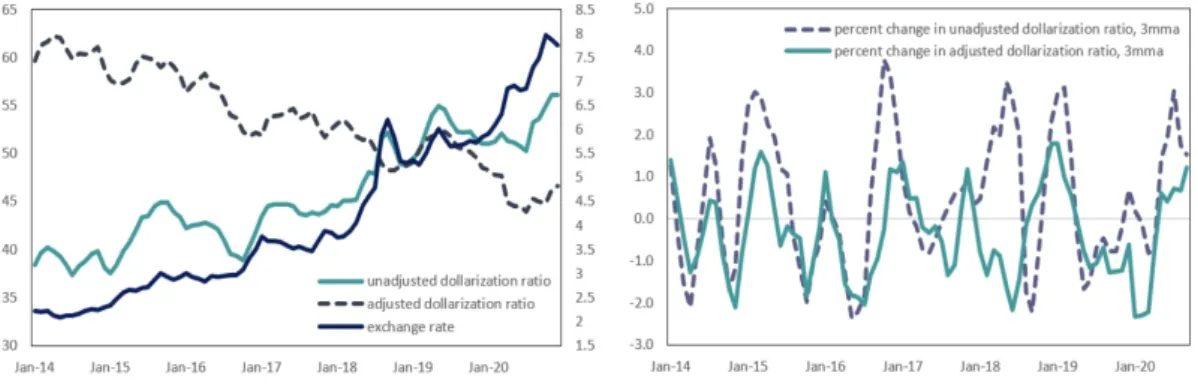
versus unadjusted deposit dollarization ratios is that they have been moving in opposite directions. This observation is important as it makes it even more important to appropriately choose the measure of dollarization that will be used in the estimation, especially considering the recent exchange rate developments.
The observation that the unadjusted deposit dollarization ratio has been higher compared to the adjusted one for the recent period, coupled with the large depreciation of the exchange rate implies at the first glance that the dif-ference between the two measures might be due to exchange rate movements. In other words, the exchange rate remaining more depreciated when compared with the period prior to 2018, for instance, and being lower than that of the base year imply that the increase in unadjusted dollarization ratio might have been driven by exchange rate depreciations. Furthermore, Figure 1 showing the adjusted dollarization ratio having smaller swings compared to the unadjusted one also supports the idea that the unadjusted deposit dollarization share might have been shaped by the exchange rate fluctuations.
While the argument suggesting that an ideal dollarization measure should be removed from valuation effects is well taken, it is not clear from the data (see Figure 2), however, if the real deposit dollarization ratio calculated in this manner truly captures the demand for FX deposits. While the idea behind using a real dollarization ratio is that large exchange rate fluctuations might lead to a bias in measuring the actual demand for holding FX deposits through their mechanical impact on the dollarization ratio, the chart showing the steady increase in FX deposits suggests that it was not only the mechanical impact of the exchange rate fluctuations that has driven the unadjusted deposit dollarization ratio, but also likely its impact on actual demand for holding foreign currency through the expectations channel. In this sense, the trend in adjusted deposit dollarization ratio does not seem to be squaring with the momentum FX deposits has gained
recently. Also, comparing both the adjusted and unadjusted deposit dollarization ratios to the “dollarization index” constructed in the CBRT’s May 2019 Financial Stability Report that accounts for valuation effects shows that the unadjusted deposit dollarization ratio was the one following the index relatively more closely. Hence, based on these observations and following the convention used in most studies in the literature, I decided to use the unadjusted deposit dollarization ratio in the baseline estimation. This choice was partly based on the fact that banks have also seen a significant increase in their TL deposits, especially recently.
To be able to properly assess the extent of the potential bias the exchange rate depreciations might have led to and understand the relative importance of the factors driving the deposit dollarization, however, I decompose the total change in the deposit dollarization share into the change stemming from the mechanical impact of exchange rate movements and the change occurring due to changes in deposits only. While this decomposition suggests that the movements in the exchange rate might have in fact driven the recent increase in the deposit dollarization share through their mechanical impact, it is also seen from the chart that these changes have been partly offset by the changes in local currency deposits. In other words, it does not seem to be the case that the mechanical impact has affected the deposit dollarization share disproportionately.
F Xtet F Xtet+ T Lt
− F Xt−1et−1 F Xt−1et−1+ T Lt−1
| {z }
total change in the deposit dollarization share
= F Xtet F Xtet+ T Lt − F Xtet−1 F Xtet−1+ T Lt ! | {z }
the change due to the mechanical impact
+ F Xtet−1 F Xtet−1+ T Lt − F Xt−1et−1 F Xt−1et−1+ T Lt−1 ! | {z }
Figure 1: Unadjusted vs Adjusted Deposit Dollarization Ratios
Source: BRSA, CBRT
Figure 2: Banking System FX and TL deposits
Source: BRSA, CBRT
Figure 3: The Decomposition of the Change in the Deposit Dollarization Share
2.2 Insurance value of dollarization
An important consideration regarding deposit dollarization in Turkey, especially in the context of de-dollarization, is the insurance value attributed to foreign currency deposits that contributes to the impact of any exchange rate movements may have on the durability of dollarization. Relevant for Turkey, the idea is that once agents experience the exchange rate having high volatility with large swings and start holding foreign currency, even when there are periods of exchange rate stability, they continue dollarizing or holding their foreign currency deposits as they think keeping these deposits have an insurance value against possible adverse scenarios, however unlikely they might be (Uribe (1997); Feige & Dean (2004)). As pointed out by several studies in the literature, this observation is also very much along the lines of what had been observed regarding inflation developments across many dollarized economies. In particular, even when inflation decreased considerably and financial conditions settle down in these countries, the expected de-dollarization did not happen quickly, partly due to the persistence of memories of past volatility increasing the insurance value of deposits as economic agents only gradually reassess the likelihood of an adverse scenario (Honohan & Shi (2002); della Valle et al. (2018)).
Furthermore, even when the insurance value attributed to foreign currency holdings decreases over time, deposit dollarization becomes triggered by portfolio optimization this time, as suggested by Ize & Yeyati (2003). This is an important consideration regarding the deposit dollarization in Turkey, especially considering the recent developments, as the literature has made it clear that de-dollarization never happens quickly, even if the initial impetus triggered it is reversed. So, while a stand-alone high deposit rate, for instance, might not be sufficient to see the large stock of deposits unwind in a short period of time, these findings
based on country experiences give us an idea regarding why Turkey has not seen a quick accompanying reversal of dollarization with the improvement in the exchange rate as well as increasing local deposit rates, and why, on the contrary, dollarization has even regained momentum – as the most recent data show that while these positive developments have gained traction with foreign investors, they seem to have left domestic depositors unconvinced, judging by the weekly inflows into the FX deposits. Regarding these observations, however, it is also important to note that understanding if de-dollarization has started might not be as straightforward, especially looking at the stock data. In this sense, understanding if dollarization has stopped at the first place might be more important.
2.3 On the relationship between inflation, monetary policy credibility and dollarization
While part of this study’s aim – especially considering the recent developments – is to understand if it was indeed developments regarding the exchange rate and its expectations that have driven the increase in dollarization or the extent of the contribution of the exchange rate movements to deposit dollarization, anecdotal evidence suggests that, whatever might seem to be driving the dollarization, the monetary policy credibility was the key.
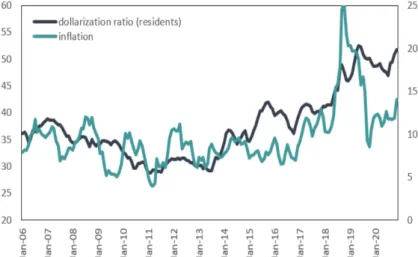
While Turkey’s negative real interest rates alongside high inflation and the accompanying exchange rate volatility seems to have led to the speed-up in dol-larization, Figure 4 showing the deposit dollarization share for residents and inflation suggests, judging by the historical data, that the recent increase in deposit dollarization has been beyond what the inflation rate would imply. In other words, this trend suggests that the strength of the relationship between
inflation and the dollarization has weakened over time, which is telling about the developments regarding confidence and credibility.
Figure 4: Dollarization Ratio for Residents vs Inflation
Source: BRSA, TurkStat
Figure 5: Inflation and Inflation Expectations
Source: CBRT, TurkStat
Figure 4 provides evidence supporting the findings suggesting that disinflation does not have a clear impact on the degree of dollarization. More specifically, in-creasing trend in deposit dollarization despite the disinflation observed following the 2018 financial turmoil gives some insights as to how addressing issues related to confidence and restoring credibility is the key for central banks – after all what led to the disinflation in this period was the recovery of the exchange rate as well
as the base effect, but not the improvement in inflation expectations as the data show that inflation expectations remained above the target during this period, although displaying a downtrend (see Figure 5). In this sense, this chart provides evidence on the drivers of dollarization in Turkey. This observation, hence, is in line with the findings suggesting that achieving low inflation is, in general, not a sufficient condition for a quick de-dollarization. Although looking at a very short period of time is not enough to reach such a conclusion, Reinhart et al. (2003), suggesting that “a country with a poor inflationary history will need to main-tain inflation at low levels for a long period before it can significantly reduce the probability of another inflation bout” also gives us an idea regarding how quickly the de-dollarization may happen in Turkey to the extent inflation is among the main determinants of the deposit dollarization.
Relatedly, to inform our expectations regarding the relationship between the deposit dollarization and inflation and inflation expectations, it is worth noting that inflation expectations have been on the optimistic territory most of the time in the last decade. Specifically, inflation has performed better than consensus expectations only in 2010, 2012 and 2019 during this period. This observation is important in thinking how/if the deviation of inflation from expectations might have affected dollarization.
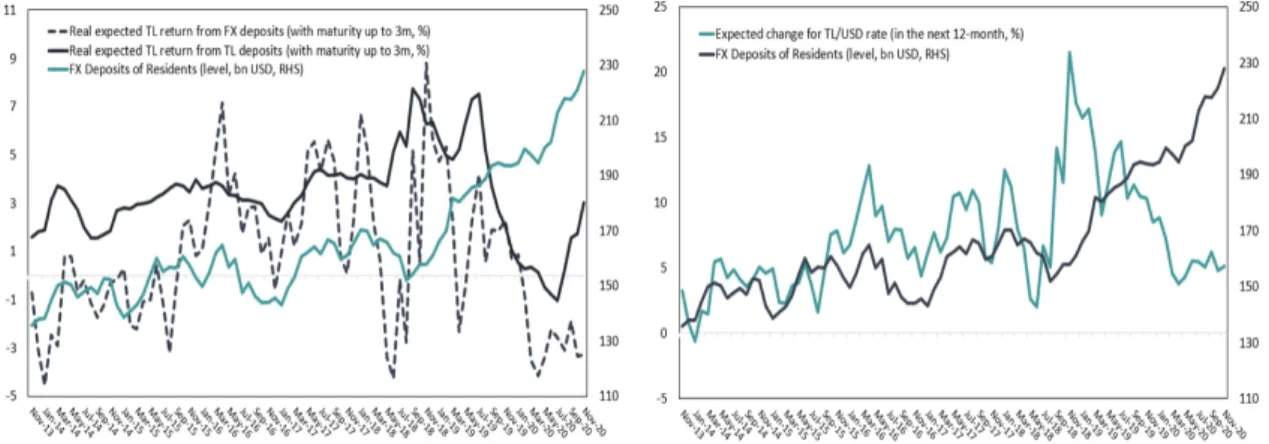
In a similar vein, it can be seen from the chart showing the real expected do-mestic currency returns on foreign currency as well as dodo-mestic currency deposits against residents’ foreign currency deposits how the steady increase in residents’ FX deposits continued despite decreasing real TL returns on FX deposits. Al-though low real TL returns on TL deposits seems to have also contributed to this trend, this observation provides further evidence on the role played by the confidence and credibility channels in the increasing deposit dollarization trend. Furthermore, as it is also seen from the chart that even though the real TL
re-turn on TL deposits have recovered recently, this does not seem to help stem the increase in dollarization. Notably, this situation is similar to what happened during post-2018 market turmoil.
Another observation regarding the trend in FX deposits is that although the size of the expected exchange rate depreciation has been on a downtrend since the 2018 shock when it increased sharply, residents’ FX deposits have been on a steady increase. Notably, it can also be seen from the chart that despite the exchange rate depreciations experienced recently, the exchange rate expectations have not deteriorated as much compared to 2018, while it seems that the level of the exchange rate might have played a role in this.
Figure 6: FX Deposits of Residents vs Real Expected Returns
Source: BRSA, CBRT
2.4 The role of the deposit rate (spread) on dollarization
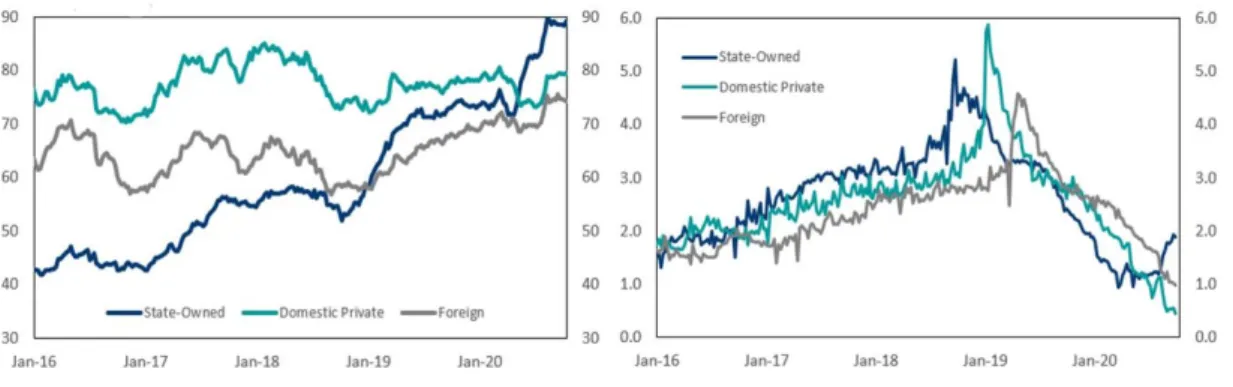
Building on observations regarding returns on TL and FX deposits in the previous section, among the natural candidates will likely have an impact on the change in FX deposits, in this section, I looked into the dynamics of deposit rates to see if they might have had played a role in increasing deposit dollarization recently. The data for the most recent period show that when the USD deposit rates offered by state-owned banks compared with that of the domestic private and foreign banks
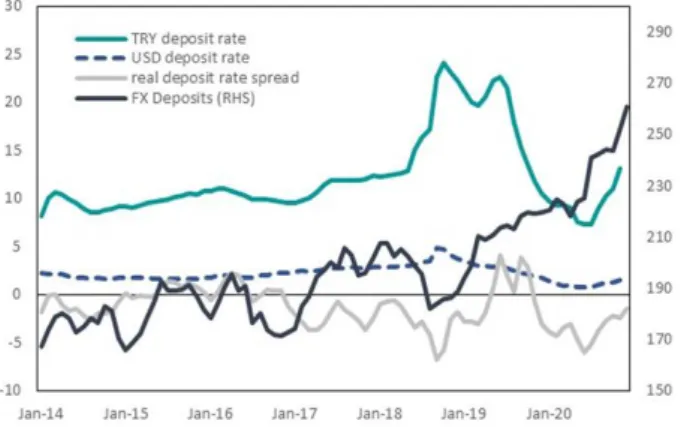
started to increase, this was accompanied by an increase in state-owned banks’ FX deposits (see Figure 7). This is not surprising, and one would expect to see this happening all else being equal. However, looking at such a short time span is clearly not enough to enable us to establish a conclusion between USD deposit rates and the change in FX deposits, for one thing, the broader trend draws quite a different picture regarding their relationship. Along the lines of previous examples – on the relationship between the deposit dollarization and inflation as well as decreasing TL returns on FX deposits against still-increasing FX deposits – it can be seen from Figure 7 that the increase in FX deposits realized despite a steady decrease in USD deposit rates since end-September 2018.
Figure 7: FX Deposits (US$ billion) vs USD Deposit Rates (percent)
Source: BRSA, CBRT
While the deposit rate by itself might be an important factor driving the recent increase in deposit dollarization or not, following studies in the literature focusing on short-run drivers of dollarization and considering the portfolio view angle of deposit dollarization, another variable that is worthy of consideration is the relative return on foreign and local currency deposits. In particular, if the deposit rate spread between domestic and foreign currency deposits is high, deposit dollarization should be lower, all else being equal. More precisely, demand for foreign currency is a function of the insurance cost, expressed in terms of the interest rate spread between local and foreign currency deposits – representing the
extra return foregone when insurance is sought through foreign currency deposits – as well as the perceived likelihood of adverse scenarios (della Valle et al., 2018). Taking into the fact that the probability attached to a likely adverse scenario decreases only gradually – considering once again the highly dollarized economies continuing to be highly dollarized even after inflation decreased considerably and exchange rate fluctuations faded away as an example – the main variable that influences the demand for foreign currency deposits becomes the deposit rate spread. In this sense, by reducing the premium paid, the declining deposit rate spread since May 2019 might have contributed to higher deposit dollarization. Furthermore, along the lines of the previous observations, the recent data show that although the deposit rate differential between the lira and dollar deposits has been increasing lately following the rate hike, the deposit dollarization remained near the highs.
Figure 8: The interest rate differential
Source: BRSA
2.5 The nature of foreign currency deposits and banks’ foreign cur-rency liquidity
Apart from considerations regarding which measure of deposit dollarization is best to use or what has driven the recent increase, and along with considerations regarding the dollarization being high, given the risks associated with it, a couple
of characteristics of deposits are worth taking a look as over time, the composition of banks’ FX funding has changed with FX external debt being increasingly replaced by FX domestic deposits. While banks have long had more FX deposits than loans and these deposits should offer a more stable source of funding than other types of debt while supporting banks’ FX liquidity positions, given the risks they may also constitute in terms of liquidity, looking into some characteristics of FX deposits briefly might be useful to be able to properly assess their likely impact on banks’ FX liquidity.
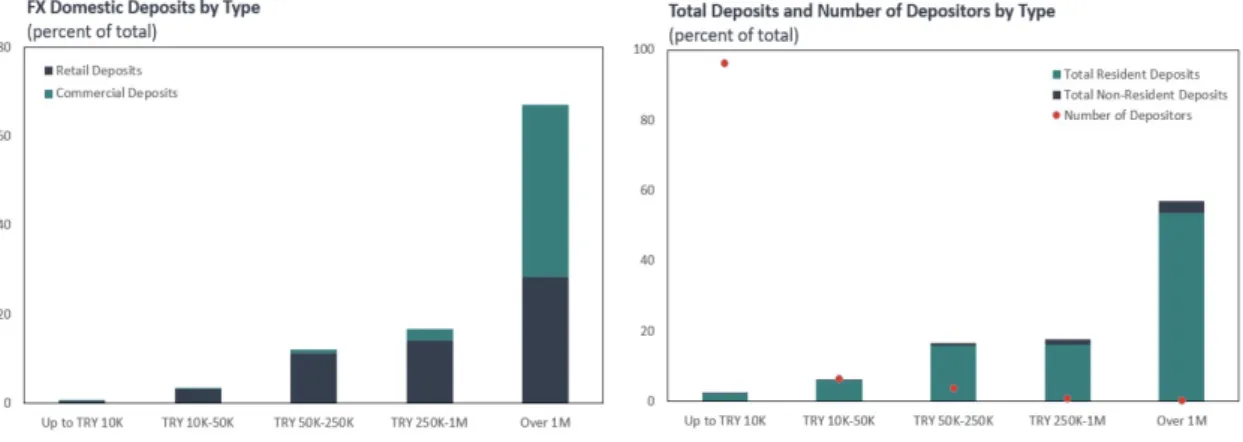
An important characteristic of deposits that is of interest is their distribu-tion. The data from the banking regulator BRSA’s monthly bulletin show that deposits are highly concentrated with 96.1 percent of all depositors holding 2.4 percent of the total deposits while 0.2 percent of depositors holding more than 57.1 percent of total deposits as of November 2020. While this high degree of concentration is even more pronounced in FX domestic deposits due to the large volume of commercial deposits with a balance of over TL 1 million, 83.9 percent of FX domestic deposits are also in accounts with a balance of larger than TL 250.000. Importantly, the data show that these large deposits have driven the recent increase in dollarization (see Figure 9).
Figure 9: Deposits by Type
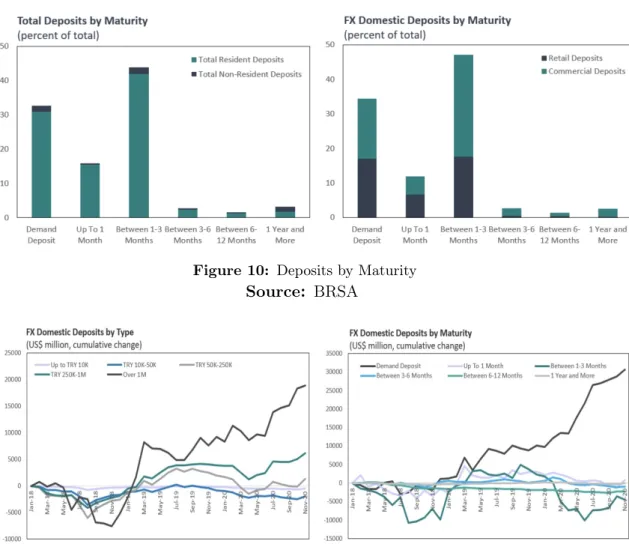
The short-term nature of FX domestic deposits in Turkey is also an impor-tant consideration, which also partly explains Turkey’s presence in the currency swap market. The data show that 92.5 percent of all deposits in Turkey are either demand or term deposits of up to three months, with retail FX domes-tic deposits being even more markedly skewed towards the short-term. It can be seen from the chart below that the demand deposits have driven the recent increase in dollarization (see Figure 10). This development is in line with the finding that the main determinant of domestic currency deposit maturities is the real interest revenue expectations with inflation expectations and exchange rate developments being other factors affecting the maturity structure (CBRT, 2019).
Figure 10: Deposits by Maturity
Source: BRSA
Figure 11: Cumulative Change in FX Domestic Deposits
Deposit dollarization is an important consideration for Turkey in terms of its implications for FX liquidity conditions of banks as “banks’ funding is increasingly short term and concentrated in FX deposits” (IMF, 2019). As the high degree of dollarization alongside the highly concentrated FX deposits with short-term maturity may raise questions regarding possible risks that may arise in an adverse scenario, it might be useful to have a look at the findings of studies analyzing the impact of the degree of dollarization on the likelihood or severity of crises.
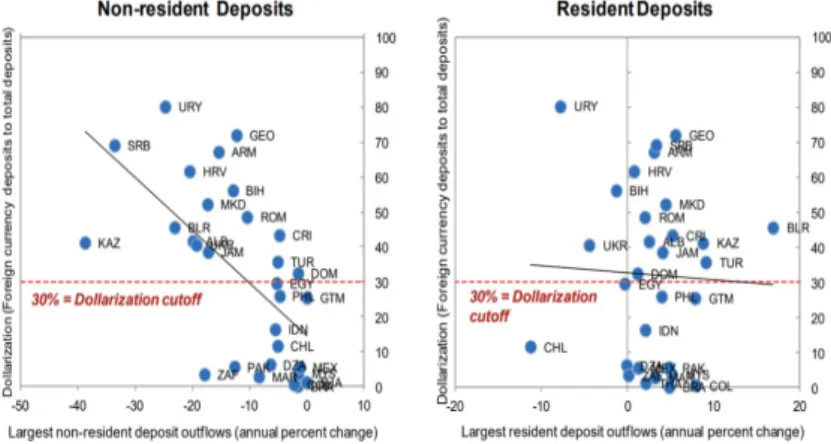
While these characteristics of FX domestic deposits may potentially pose risks to banks’ FX liquidity conditions, the findings of the literature on the association between dollarization and the likelihood or severity of crises do not have a consensus on the relationship between the two. Importantly, the findings of the literature do not suggest that dollarized emerging market economies have experienced larger outflows during market turmoil than their peers, “although this is thought to partly reflect higher buffers held by banks in these economies” (IMF, April, 2015). Furthermore, Figure 12 suggests that non-resident deposits seem more likely to leave during stress periods in highly dollarized economies (Goncalves, 2007). This is an important observation that help gauge risks the banking system may face in an adverse scenario, especially given the relatively low share of non-residents FX deposits in Turkey. On a related note, evidence suggests moderate to heavy outflows for FX domestic deposits during periods of market stress, although these episodes were not as severe as for FX external liabilities.
Together with these observations on deposits, touching upon the net FX posi-tions of depositors could also be helpful in assessing banks’ FX liquidity dynamics as well as the implications of these dynamics for the gross financing needs.
Figure 12: Non-Resident and Resident Deposit Outflows
Source: IMF Staff Report on Assessing Reserve Adequacy - Specific Proposals, 2015.
Despite deleveraging over the last two years, corporates have a large negative FX position, compared to the sector’s foreign currency deposits. This implies that whatever foreign currency deposits corporates have are likely to be used for meeting foreign currency obligations which are, at worse, neutral in terms of gross financing needs. The data showing that corporates’ net FX position has been positive but small also suggest that their deposits are primarily allocated for repayment of liabilities. In this context, while there may be corporates with strong balance sheets whose foreign currency deposits could represent a capital flight risk, corporate deposits can be considered as safe while being likely to meet a gross financing need instead of giving rise to a new one. Households, on the other hand, have a large positive FX position as they are prohibited from borrowing in foreign currency. As the literature suggests that the probability of a capital flight, judging by the historical data, is low, these deposits can also be viewed as safe.
These observations suggest how some characteristics of deposits may exac-erbate volatility at times of market turmoil and hence how important it is to identify what has driven the increase in deposits to be able to get a sense of ways in which they may behave during periods of market stress.
2.6 Credit expansions and dollarization
While developments regarding the exchange rate and inflation – and hence weaker domestic confidence – have seemingly played a role in the increase in dollariza-tion, expansionary monetary and credit policies seem to be the main reasons behind increasing dollarization – after all, the exchange rate deprecations and high inflation were also the results of this policy mix. In other words, it seems that it was not only residents’ demand for holding FX deposits for one rea-son or another that has driven the increase in deposit dollarization, but also, and more fundamentally, the credit-driven growth model by creating an envi-ronment in which agents would prefer to dollarize, in light of earlier studies.
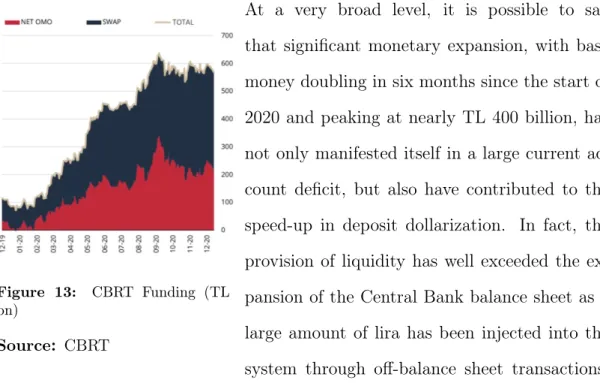
Figure 13: CBRT Funding (TL bn)
Source: CBRT
At a very broad level, it is possible to say that significant monetary expansion, with base money doubling in six months since the start of 2020 and peaking at nearly TL 400 billion, has not only manifested itself in a large current ac-count deficit, but also have contributed to the speed-up in deposit dollarization. In fact, the provision of liquidity has well exceeded the ex-pansion of the Central Bank balance sheet as a large amount of lira has been injected into the system through off-balance sheet transactions, as can be seen from the Figure 13.
A closer look at the recent dynamics of M2, which, in addition to currency in circulation and sight deposits, also includes time deposits, by breaking down its annual growth rate into the percentage contributions of its various components
reveals that as much as 50 percent of M2 growth has been driven by sight and time deposits of state-owned banks while domestic private and foreign banks have accounted for significantly smaller contributions. These dynamics seem to have translated into a sharp increase in loan growth by state-owned banks and in turn, the deposit dollarization. So, state-owned banks seem to have played a significant role in the transmission of monetary policy.
Two additional points worth noting regarding these developments are that during the 2018 market turmoil, the contribution of state-owned banks to the transmission of monetary policy was not as dominant as in the current shock. Moreover, while state-owned banks appear to have played a countercyclical role during recent recessions, they have not reined in credit during the period of economic expansion. According to OECD’s January 2021 Economic Surveys Turkey Report (OECD, January 2021), “the correlation between credits and the business cycle in Turkey was, in fact, the highest among all countries reviewed by the IIF in 2019.”
This is important as the recent data on credit growth developments, espe-cially through state-owned banks, show how they might have contributed to the increasing deposit dollarization, and from a broader view – set an example of how policies undertaken on one front may hurt something else on another. In particu-lar, the data show that significant credit expansions after 2017 were accompanied by increases in residents’ FX deposits. In fact, the data show how strongly the latest – and also the most significant – credit expansion may have translated into increasing dollarization while we did not see this happening in previous episodes of rapid credit expansions immediately, suggesting that the relationship between the two may have strengthened recently, although establishing such a conclusion is not straightforward partly due to the extent of the latest credit expansion. Importantly, this observation leads to the question of what would have happened
to deposit dollarization absent these significant credit expansions or to put it another way, to what extent these credit expansions facilitated the speed-up in dollarization.
In more detail, while repeated periods of credit expansions after 2017 have rendered growth possible, they seem to have also contributed to the speed-up in deposit dollarization. In particular, to support growth following the 2018 market turmoil, for instance, state-owned banks started lending rapidly below the average cost of the Central Bank funding. As banks were also trying to prevent the deterioration in their net interest margins, they started decreasing the interest paid on lira deposits sharply starting from mid-2019 and this, coupled with high inflation, seems to have contributed to the significant increase in deposit dollarization. This observation is not only important as it provides evidence on the drivers of dollarization, but also in terms of shedding light on how growth has been attained with economic imbalances growing. In this context and as a side note, it is also important to note that while the drivers of growth are an important consideration, it is as important how the credit expansions have been utilized. For instance, “it is likely the case that the resource allocation to more productive firms has been limited while credit provided to corporates that are highly leveraged had been likely used for refinancing” (IMF, 2019). So, in this sense, the kind of trade-off one may think of might not even be in place at the first place.
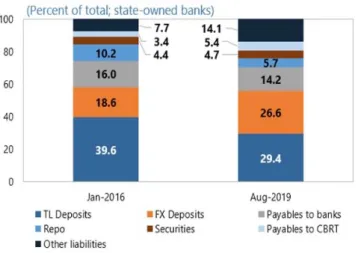
On the other hand, while credit expansions have contributed to increasing deposit dollarization, increasing deposit dollarization, in turn, has allowed state-owned banks to cover their funding needs (see Figure 14) arising from credit expansions as the dollars swapped into lira through the offshore market initially, and once the restrictions on offshore swaps were introduced, mainly through the Central Bank. In other words, the build-up in dollar deposits has been significant
Figure 14: Sources of Funding Source: (IMF, 2019)
enough to fund not only FX assets, but also a strong credit expansion. This, in fact, seems to have become a cycle amplifying the degree of dollarization with agents increasing their foreign currency holdings, banks swapping these foreign currency deposits into lira through the Central Bank, the Central Bank creating lira and lira finding its way back to foreign currency deposits.
Another important aspect regarding these developments is that significant credit expansions have not only led to higher deposit dollarization, but also re-sulted in state-owned banks building up a large on-balance sheet open FX posi-tion. Regarding this balance sheet development, it is worth noting that it is not new for banks in Turkey to finance part of their TL lending by swapping foreign currency into lira – as it is not uncommon among banks in advanced and emerg-ing market economies, with this practice constitutemerg-ing what has been called “the missing global debt” (Borio et al., 2017). Given the maturity structure of FX de-posits, with banks having difficulty building up long-term deposits from domestic depositors, this has been, in fact, a way for banks to create long-term lira funding for quite a long time. While this practice has resulted in banks having a negative on-balance sheet FX position over time, it has not been constituting a problem in the sense that it was not creating an overall negative open FX position as this
Figure 15: State-Owned Banks Net FX Position Source: BRSA
position has been offset by a positive off-balance sheet FX position since swaps are recorded off-balance sheet. As the increase in FX funding, reflecting periods of significant deposit dollarization realized and an increasingly negative balance sheet position has stopped being met by a comparable positive off-balance sheet FX position, however, this has resulted in an overall negative position. In other words, the deterioration of the balance sheet position seems to have been partly driven by the deposit dollarization through its impact on on-balance sheet FX position at the first place. This is important, especially given the risks pointed out by earlier studies regarding balance sheet dynamics, although “the banking system balance sheet is effectively protected from the direct valuation effects as banks are not allowed to carry net open FX positions beyond a certain limit by regulation” (IMF, 2019).
Among the reasons of why the banking system has seen very high loan growth rates recently was the “asset ratio” regulation the BRSA introduced. Designed in a way to shift banks’ assets in favour of loans, local securities and swaps with the Central Bank, the asset ratio regulation entered into force in April 2020. The minimum threshold needs to be achieved – which was monitored on a weekly basis with non-compliance resulting in banks paying a penalty – for the new as-set ratio, calculated by adding the value of loans, 75% of local bonds and 50%
of swaps with the Central Bank and dividing this amount by the sum of 100% of TL and 125% of FX deposits, was first set at 100% (80% for participation banks). While the ratio as well as the minimum threshold were tweaked a couple of times since their inception and the ratio ceased to exist as of end-December 2020, it seems to have contributed to the speed-up in dollarization. Even though the asset ratio was penalizing higher FX deposits by construction, to the extent higher lira lending translated into higher FX deposits with depreciation pressures on the exchange rate, the initial boost to the asset ratio from lending growth was also likely dampened by the amplified increase in FX deposits. In fact, there is evidence in the data suggesting that this might have happened.
2.7 Deposit dollarization of non-financial corporations
Another observation regarding the possible impact of the strong credit expansion on dollarization concerns the non-financial corporations. In particular, external rollover ratios below 100%, calculated using the Central Bank’s Financial Ac-counts data, suggest that a continued deleveraging of non-financial corporations in external loans has been taking place since October 2019. The data show that non-financial corporations were not only able to deleverage their foreign currency loans, but also capable of accumulating foreign currency deposits with domestic banks, despite weaker export receipts. One possible explanation regarding this development is that the credit expansion and looser lending standards may have acted like a substitute for a loan restructuring scheme as they seem to have helped firms deleverage foreign currency loans through the restructuring of foreign cur-rency loans by domestic curcur-rency ones. What is worth noting regarding this observation, as pointed out, is that TL credit provision seems to have not only funded the restructuring of foreign currency loans, but also helped accumulation of foreign currency deposits, thereby contributing to higher deposit dollarization.
Motivated by this observation, the loan-deposit rate spread, which is consid-ered as an indicator of monetary and financial conditions, is also included in the empirical analysis to get a sense of the ease with which loans might have been converted into deposits by households and corporations. Regarding non-financial corporations’ deposit dollarization, however, it is important to make a distinc-tion with respect to its drivers. While households’ deposit dollarizadistinc-tion might have been driven by various reasons related to confidence, corporates’ demand for foreign currency may not necessarily represent demand due to the same kind of reasons as it is generally the case that non-financial corporations accumulate foreign currency deposits due to precautionary reasons regarding their future foreign currency obligations.
Figure 16: Cumulative NFC FX Deposit Accumulation (US$ bn) Source: CBRT
CHAPTER 3
THE EMPIRICAL ANALYSIS
3.1 Testing for Stationarity
In this section, I started the empirical analysis by testing stationarity. Table 1 presents the unit root test results for the variables of interest discussed in the previous sections. According to the results of both the Augmented Dickey-Fuller (ADF) and Phillips-Perron (PP) unit root tests, series except for the exchange rate volatility, the deviation of inflation from end-year inflation expectations, the real return spread and the loan-deposit rate spread are found to be non-stationary at level and integrated of order 1 (i.e. I(1)). For the variables that are non-stationary at level, various specifications are estimated using the least squares with differences. To minimize potential endogeneity, these models are estimated with all regressors lagged by one period.
3.2 The Estimation Results
In this section, drawing on observations presented in the previous sections, var-ious specifications are estimated with the exchange rate/expectations/volatility,
Table 1: Unit Root Tests
inflation/expectations, the deviation of inflation from end-year inflation expec-tations (as a measure of monetary policy credibility), the (real) deposit rates on domestic and foreign currency deposits, the real return spread (the differ-ence between the real return on domestic currency deposits with a maturity of three months and that of the foreign currency deposits to be obtained in lira at the maturity) and the loan-deposit rate spread as explanatory variables. As the dollarization is affected by its persistence in general, the lagged dollariza-tion share is also taken into account across all specificadollariza-tions in the estimadollariza-tion. The dollarization ratio used in the baseline estimations excludes gold deposits to deal with valuation concerns. While the sample period in the baseline scenario covers the period 2006-20 – as this period spans sub-periods during which both an increasing and a decreasing trend in deposit dollarization has been observed, and hence is considered to contain relevant information to study the dynamics of dollarization properly – further tests are considered with different sub-samples to check the robustness of the benchmark results. Further robustness checks are also conducted using the deposit dollarization share/change calculated including
While prior to 2000s among the main reasons behind the deposit dollarization in Turkey was the high and volatile inflation, estimation results (Table 2) suggest that the unadjusted deposit dollarization share is mainly associated with the exchange rate movements while inflation is also found to be significant.
Following the discussion in the previous section on the measurement of dollar-ization, to test if what these estimation results capture is the mechanical impact of exchange rate movements on the deposit dollarization share, various specifica-tions considered in the baseline scenarios are estimated with the change in the deposit dollarization share stemming from changes in deposits only – computed using the decomposition of the total change in the dollarization share presented in the section on the measurement of dollarization – as the dependent variable. Notably, estimation results show that the exchange rate loses significance when the change in the deposit dollarization share adjusted for the valuation impact is added in the estimation as the dependent variable. The estimation results, hence, suggest that the use of the deposit dollarization share not adjusted for valuation effects may not be informative about the impact of exchange rate movements on the dollarization share through the expectations channel. Hence, looking at the unadjusted deposit dollarization ratio as the standard measure of dollarization tendency may also be misleading in terms of assessing the demand for foreign currency deposits. However, regarding this observation, no final conclusion has been reached as the exchange rate and/or exchange rate expectations becoming (in)significant depends on the specification.
Alongside the observations on estimation results regarding the exchange rate and its expectations, estimations conducted with the change in the deposit dollar-ization ratio adjusted for the impact of the valuation as the alternative dependent variable lead inflation to lose significance while the real return spread to become significant.
While these results are robust with respect to different sub-samples considered in the estimation, they are not – with respect to the alternative dependent vari-able, which is the deposit dollarization share calculated including gold deposits. For instance, to take into consideration the fact that the asset ratio regulation has dampened the relationship between the dollarization and returns, the sub-sample covering the period ending with the introduction of the asset ratio is considered, but the significance of the variables does not change as a result. The use of the deposit dollarization share calculated including gold deposits as the dependent variable, on the other hand, lead some of the variables to lose significance.
Estimation results also suggest that there is inertia in the deposit dollarization in Turkey, which constitutes a challenge for de-dollarization, especially in the short-term, as it implies that agents do not tend to quickly adjust their foreign currency holdings in response to changes in factors affecting their dollarization behaviour.
The low goodness of fit measures imply that there is a large portion of varia-tion in the deposit dollarizavaria-tion remains to be explained. Observavaria-tions regarding the recent trends in the deposit dollarization for the most recent period (e.g. the significant increase in non-financial corporations’ foreign currency deposits), however, may give us an idea as to why the low explanatory power of various models may not be stemming from the lack of inclusion of some other traditional variables in the estimation only, especially in the context of this study where no differentiation has been made with respect to households’ and corporates’ deposit dollarization, and considering the fact that corporates have a myriad of reasons to build-up foreign currency deposits like imports payables and loan repayments.
CHAPTER 4
CONCLUSION
In this study, motivated by its rapid increase especially in the recent period, I analyzed the trends in deposit dollarization in Turkey with a focus on its po-tential drivers under the influence of the monetary policy as well as the policies undertaken with a view to understanding if these policies translated into higher deposit dollarization than otherwise would have taken place. While estimation results obtained using an unadjusted deposit dollarization measure suggest that the changes in the deposit dollarization share is mainly related to exchange rate movements, the results of the estimations conducted using an alternative depen-dent variable which adjusts for valuation effects imply what is captured using an unadjusted dollarization measure might be the mechanical impact of the exchange rate movements as opposed to the change in agents’ dollarization behaviour in response to these movements.
REFERENCES
Arteta, C. O. 2003. Are financially dollarized countries more prone to costly crises? International Finance.
Basci, E. 2011. De-dollarization in turkey, developing local cur-rency finance and local capital markets conference. Retrieved from https://www.tcmb.gov.tr/wps/wcm/connect/8853c160-634e-4b53-b44e
-0788fca77c23/Basci_dedollarization.pdf?MOD=AJPERES&CACHEID= ROOTWORKSPACE-8853c160-634e-4b53-b44e-0788fca77c23-m3fxBmh Basso, H., Calvo-Gonzalez, O., & Jurgilas, M. 2011, 04. Financial dollarization:
The role of foreign-owned banks and interest rates. Journal of Banking & Finance, 35 , 794-806. doi: 10.1016/j.jbankfin.2010.11.018
Bennett, M. A., Borensztein, M. E., & Baliño, M. T. J. 1999. Monetary policy in dollarized economies. International Monetary Fund.
Borio, C., McCauley, R. N., & McGuire, P. 2017, September. FX swaps and forwards: missing global debt? BIS Quarterly Review. Retrieved from https:// ideas.repec.org/a/bis/bisqtr/1709e.html
Cayazzo, J., Pascual, A., Gutierrez, E., & Heysen, S. 2006. Towards the effective supervision of partially dollarized banking systems. InArmas a., ize a., yeyati e.l. (eds) financial dollarization. procyclicality of financial systems in asia. Pal-grave Macmillan, London. doi: https://doi.org/10.1057/9780230380257_8 CBRT. 2019, May. Financial stability report (Vol. 28; Tech. Rep.). Central Bank
of the Republic of Turkey. Retrieved from https://www.tcmb.gov.tr/wps/ wcm/connect/8b5d6ae9-b387-479d-9d6d-7c3beeecf927/F%C4%B0Rv%408 .7.2019%4015.54.pdf?MOD=AJPERES&CACHEID=ROOTWORKSPACE -8b5d6ae9-b387-479d-9d6d-7c3beeecf927-mLi3kwZ
Civcir, I. 2005, 1. Dollarization and its long-run determinants in turkey.Research in Middle East Economics, 6 . doi: 10.1016/S1094-5334(05)06010-3
Corrales, J.-S., & Imam, P. A. 2019. Financial dollarization of households and firms: How does it differ by level of economic development? Review of Inter-national Economics. Retrieved from https://onlinelibrary.wiley.com/doi/abs/ 10.1111/roie.12528 doi: https://doi.org/10.1111/roie.12528
della Valle, G., Kota, V., Veyrune, R., Cabezon, E., & Guo, S. 2018, 01. Eu-roization drivers and effective policy response: An application to the case of albania. IMF Working Papers, 18 , 1. doi: 10.5089/9781484338728.001
De Nicolo, G., Gulde, A.-M., Hoelscher, D., Ize, A., & Marston, D. 2004, 07. Financial stability in dollarized economies. IMF Occasional Papers.
Feige, E. 2003, 02. The dynamics of currency substitution, asset substitution and de facto dollarization and euroization in transition countries. SSRN Electronic Journal, 358-383. doi: 10.2139/ssrn.3400232
Feige, E., & Dean, J. W. 2004. Dollarization and euroization in the transition countries: Currency substitution, asset substitution, network externalities and irreversibility. Oxford Scholarship Online. doi: 10.1093/0199271402.001.0001 Goncalves, F. 2007, 01. The optimal level of foreign reserves in financially
dollar-ized economies: The case of uruguay. Revista de economía, ISSN 0797-5546, Vol. 15, Nº. 1, 2008, pags. 35-66 , 07 , 35-66. doi: 10.5089/9781451868289.001 Honig, A. 2006. Is there a link between dollarization and banking crises? Journal
of International Development, 18 (8), 1123-1135. Retrieved from https://ideas .repec.org/a/wly/jintdv/v18y2006i8p1123-1135.html doi: 10.1002/jid.1285 Honohan, P. 2007. Dollarization and exchange rate fluctuations. World Bank
Policy Research Working Paper No. 4172 . Retrieved from https://papers.ssrn .com/sol3/papers.cfm?abstract_id=972705
Honohan, P., De Nicolo, G., & Ize, A. 2005. Dollarization of bank deposits: Causes and consequences. Journal of Banking & Finance, 29 , 1697-1727. doi: 10.1016/j.jbankfin.2004.06.033
Honohan, P., & Shi, A. 2002. Deposit dollarization and the financial sec-tor in emerging economies. The World Bank. Retrieved from https:// elibrary.worldbank.org/doi/abs/10.1596/1813-9450-2748 doi: 10.1596/1813 -9450-2748
IMF. 2019. Turkey: 2019 article iv consultation (Tech. Rep.). International Monetary Fund. Retrieved from https://www.imf.org/en/Publications/CR/ Issues/2019/12/26/Turkey-2019-Article-IV-Consultation-Press-Release-Staff -Report-and-Statement-by-the-48920
IMF. April, 2015. Assessing reserve adequacy- specific proposals (Tech. Rep.). Retrieved from https://www.imf.org/external/np/pp/eng/2014/121914.pdf Ize, A., & Parrado, E. 2002. Dollarization, monetary policy, and the
pass-through. USA: INTERNATIONAL MONETARY FUND. Retrieved from https://www.elibrary.imf.org/view/IMF001/01857-9781451859577/ 01857-9781451859577/01857-9781451859577_A001.xml
Economics, 59 (2), 323 - 347. Retrieved from http://www.sciencedirect.com/ science/article/pii/S002219960200017X doi: https://doi.org/10.1016/S0022 -1996(02)00017-X
Kiguel, M., Ize, A., & Yeyati, E. 2005, 10. Managing systemic liquidity risk in financially dollarized economies. IMF Working Papers, 05 . doi: 10.5089/ 9781451862072.001
Kokenyne, A., Ley, J., & Veyrune, R. 2010, 07. Dedollarization. IMF Work-ing Papers(10/188). Retrieved from https://papers.ssrn.com/sol3/papers.cfm ?abstract_id=1662261
Levy-Yeyati, E. L. 2006. Financial dollarization: Evaluating the consequences. Economic Policy, 21 (45), 61-118. doi: https://dx.doi.org/10.1111/j.1468-0327 .2006.00154.x
Metin Ozcan, K., & Us, V. 2009, 10. What drives dollarization in turkey? Journal of Economic Cooperation and Development., 30 , 29-50.
Mwase, N., & Kumah, F. 2015, 01. Revisiting the concept of dollarization: The global financial crisis and dollarization in low-income countries. IMF Working Papers, 15 . doi: 10.5089/9781484366912.001
OECD. January 2021. Oecd economic surveys turkey (Tech. Rep.). Organisation for Economic Co-operation and Development. Retrieved from https://www.oecd-ilibrary.org/economics/oecd-economic-surveys-turkey -2021_2cd09ab1-en
Reinhart, C. M., Rogoff, K. S., & Savastano, M. A. 2003. Addicted to dollars (Working Paper No. 10015). National Bureau of Economic Research. Retrieved from http://www.nber.org/papers/w10015 doi: 10.3386/w10015
Ruslan, P. 2003, May. Dollarization, inflation volatility and underdeveloped financial markets in transition economies (EERC Working Paper Series No. 03-02e). EERC Research Network, Russia and CIS. Retrieved from https:// ideas.repec.org/p/eer/wpalle/03-02e.html
Savastano, M. 1996. Dollarization in latin america : Recent evi-dence and some policy issues. USA: INTERNATIONAL MONETARY FUND. Retrieved from https://www.elibrary.imf.org/view/IMF001/01851 -9781451841992/01851-9781451841992/01851-9781451841992.xml
Tkalec, M. 2013. Monetary determinants of deposit euroization in euro-pean post-transition countries. Panoeconomicus, 60 (1), 89–101. Retrieved from https://panoeconomicus.org/index.php/jorunal/article/view/105 doi: 10.2298/PAN1301089T
Uribe, M. 1997. Hysteresis in a simple model of currency substitution. Journal of Monetary Economics, 40 (1), 185 - 202. doi: https://doi.org/10.1016/S0304 -3932(97)00038-X