CORPUS-BASED ACTIVITIES AT LOWER LEVELS OF EFL PROFICIENCY: THE EFFECTIVENESS OF USING CONCORDANCE LINES ON GRAMMAR LEARNING
A Master’s Thesis
By
UFUK GĠRGĠN
THE PROGRAM OF
TEACHING ENGLISH AS A FOREIGN LANGUAGE
BILKENT UNIVERSITY
ANKARA
CORPUS-BASED ACTIVITIES AT LOWER LEVELS OF EFL PROFICIENCY: THE EFFECTIVENESS OF USING CONCORDANCE LINES ON GRAMMAR
LEARNING
The Graduate School of Education of
Bilkent University
by
UFUK GĠRGĠN
In Partial Fulfillment of the Requirements for the Degree of Master of Arts
in
The Program of
Teaching English as a Foreign Language Bilkent University
Ankara
BĠLKENT UNIVERSITY
THE GRADUATE SCHOOL OF EDUCATION MA THESIS EXAMINATION RESULT FORM
June 30, 2011
The examining committee appointed by The Graduate School of Education for the thesis examination of the MA TEFL student
Ufuk GĠRGĠN
has read the thesis of the student.
The committee has decided that the thesis of the student is satisfactory.
Thesis Title: Corpus-Based Activities at Lower Levels of EFL Proficiency: The Effectiveness of Using Concordance Lines on Grammar Learning
Thesis Advisor: Vis. Asst. Prof. Dr. JoDee Walters Bilkent University, MA TEFL Program Committee Members: Asst. Prof. Dr. Philip Durrant
Bilkent University, MA TEFL Program Dr. Simon Phipps
ABSTRACT
CORPUS-BASED ACTIVITIES AT LOWER LEVELS OF EFL PROFICIENCY: THE EFFECTIVENESS OF USING CONCORDANCE LINES ON GRAMMAR
LEARNING Ufuk Girgin
MA. Program of Teaching English as a Foreign Language Supervisor: Asst. Prof. Dr. JoDee Walters
June 2011
This study investigated the effectiveness of using corpus-based activities on lower level EFL students’ learning of English grammar. The purpose of the study was to determine whether lower level EFL learners would be able to use corpus-based activities effectively in order to learn five target grammar structures of English. This study also explored the attitudes of those students towards using corpus-based activities in English grammar learning.
Six intact lower level EFL classes at Erciyes University School of Foreign Languages participated in the study. The quantitative data were collected through the administration of three tests and an attitude questionnaire. The qualitative data were obtained through semi-structured interviews.
The statistical analysis of the test results revealed that the students were able to use corpus-based activities effectively in the learning of the target grammar structures. Additionally, it was found that using corpus-based activities in the
learning of the target grammar structures produced similar results when compared to using a course book. The analysis of the attitude questionnaire showed that the
students held somewhat neutral attitudes towards using corpus-based activities in the learning of the five target grammar structures. However, the analysis of the student interviews revealed more positive attitudes towards using these sources in English grammar learning.
Key words: Corpus-based activities, Concordance lines, English grammar learning, lower level EFL students, student attitudes.
ÖZET
CORPUS DESTEKLĠ AKTĠVĠTELERĠN DÜġÜK SEVĠYELERDEKĠ ĠNGĠLĠZCE ÖĞRENCĠLERĠNĠN ĠNGĠLĠZCE DĠL BĠLGĠSĠNĠ ÖĞRENMEDEKĠ
ETKĠLERĠ Ufuk Girgin
Yüksek Lisans, Yabancı Dil Olarak Ġngilizce Öğretimi Program Tez Yöneticisi: Yrd. Doç. Dr. JoDee Walters
Haziran 2011
Bu çalıĢma, corpus destekli aktivitelerin düĢük seviyeye sahip Ġngilizce öğrencilerinin Ġngilizce dil bilgisini öğrenmedeki etkilerini araĢtırmak için
yapılmıĢtır. Bu çalıĢmanın amacı, düĢük seviyeye sahip Ġngilizce öğrencilerin beĢ gramer yapısını öğrenmede corpus destekli aktiviteleri etkili bir Ģekilde kullanıp kullanamayacaklarını belirlemektir. Bu çalıĢmanın diğer bir amacı da, öğrencilerin gramer eğitiminde bu tür corpus destekli alıĢtırmalar kullanımına karĢı olan
tutumlarını anlayabilmektir.
Bu çalıĢmada Erciyes Üniversitesi Yabancı Diller Yüksekokulu’nda eğitim gören düĢük seviyede Ġngilizce bilgisine sahip altı sınıf yer almıĢtır. Bu çalıĢmadaki veri öğrencilere uygulanan üç gramer testi ve öğrenci tutumunu ölçen anket
uygulamasından gelmektedir. Bu çalıĢmadaki diğer veri ise öğrencilerle yapılan görüĢmelerden elde edilmiĢtir.
Uygulama sonrasında elde edilen test skorlarının istatistiksel analizi
göstermiĢtir ki düĢük seviyedeki Ġngilizce öğrencileri, corpus destekli aktiviteleri, beĢ gramer yapısını öğrenmede etkili bir Ģekilde kullanabilmiĢlerdir. Katılımcı
öğrencilerin tutum anketine verdikleri yanıtların analizi ise öğrencilerin gramer eğitiminde corpus destekli aktiviteler kullanımına karĢı tarafsız kaldıklarını
göstermiĢtir. Lakin katılımcı öğrencilerin görüĢmelerde verdikleri yanıtların analizi göstermiĢtir ki görüĢmeye katılan öğrenciler gramer eğitimlerinde corpus destekli aktiviteler kullanımına karĢı daha olumlu tutumlar sergilemiĢlerdir.
Anahtar kelimeler: Corpus destekli aktiviteler, Ġngilizce dil bilgisi, düĢük seviyedeki öğrenciler, öğrenci tutumları.
ACKNOWLEDGEMENTS
I would like to express my deepest gratitude to my thesis advisor, Asst. Prof. Dr. JoDee Walters for her invaluable guidance, feedback and continuous support in the process of writing this thesis. Without her invaluable instructions, rigorous academic coaching and endless assistance, this thesis would have been far weaker. I would also like to thank her for all the patience she showed.
I would like to thank Asst. Prof. Dr. Julie Mathews-Aydınlı, Asst. Prof. Dr. Phil Durrant and Visiting Prof. Dr. Maria Angelova for their contributions to my professional development.
Special thanks to Assoc. Prof. Dr. Mustafa Zülküf Altan and Prof. Dr. Abdullah Saydam for allowing me to attend this program.
I would like to express my profound gratitude to Alison J. Kademoğlu in the School of Foreign Languages at Erciyes University for her invaluable cooperation and support in the process of conducting this study. I would also like to thank her for all the patience she showed. Special thanks to Erciyes University School of Foreign Languages instructors who cooperated with me in the process of conducting this study.
Last but not least, many thanks also go to my classmates for their support, encouragement, understanding during the years of my studying at Bilkent University.
TABLE OF CONTENTS
ABSTRACT ... iv
ÖZET... vi
ACKNOWLEDGEMENTS ... viii
TABLE OF CONTENTS ... ix
LIST OF TABLES ... xii
LIST OF FIGURES ... xiii
CHAPTER 1- INTRODUCTION ... 1
Introduction ... 1
Background of the Study ... 2
Statement of the Problem ... 6
Research Questions ... 8
Significance of the Study ... 8
Conclusion ... 9
CHAPTER 2- LITERATURE REVIEW ... 10
Introduction ... 10
History of Corpus Linguistics ... 10
Corpora in Language Teaching ... 13
Indirect Applications of Corpora in Language Teaching ... 18
Direct Applications of Corpora in Language Teaching ... 21
Using Corpora in Vocabulary Instruction ... 21
Using Corpora in Writing Instruction ... 28
Conclusion ... 37
CHAPTER 3- METHODOLOGY ... 39
Introduction ... 39
Setting ... 39
Participants ... 41
Instruments and Materials ... 42
Tests ... 43
Scoring ... 44
Attitude questionnaire ... 44
Student interviews ... 48
The course book and Corpus of Contemporary American English (COCA)... 50
Data Collection Procedure ... 51
Data Analysis ... 54
Conclusion ... 55
CHAPTER 4- DATA ANALYSIS ... 56
Introduction ... 56
Data Analysis Procedure ... 57
Results ... 58
The effects of using corpus-based activities on grammar learning ... 58
Comparison of pre-test scores, experimental and control groups ... 61
Comparison of pre-test and immediate post-test scores, experimental group 62 Comparison of pre-test and immediate post-test scores, control group ... 63
Comparison of retention scores ... 67
Attitudes towards using corpus-based activities in grammar instruction... 70
Analysis of the attitude questionnaire and student interviews ... 70
Conclusion ... 80
CHAPTER 5 – CONCLUSION ... 82
Introduction ... 82
Findings and Discussion ... 82
The effects of corpus-based activities on grammar learning ... 83
Attitudes towards using corpus-based activities in grammar instruction... 88
Limitations of the Study ... 95
Pedagogical Implications ... 98
Suggestions for Further Research ... 100
Conclusion ... 102
REFERENCES ... 103
APPENDICES ... 107
APPENDIX A: Grammar Tests (Pre-test, Immediate post-test, Delayed post-test) 107 APPENDIX B: Attitude Questionnaire (English and Turkish Versions) ... 110
APPENDIX C: Student Interview Questions (English and Turkish Versions) ... 114
APPENDIX D: A Sample of the Mini Grammar, grammar bank, gap-filling exercise sections from the Course book ... 116
APPENDIX E: A Screen Shot of Some Concordance Lines from COCA ... 119
APPENDIX F: Corpus-Based Activities (Concordance Lines, Leading Questions, Exercises) ... 120
LIST OF TABLES
Table 1 – Pre-test medians, all groups ... 59
Table 2 – Pre-test medians, experimental and control groups ... 61
Table 3 – Pre- and immediate post-test medians, experimental group ... 62
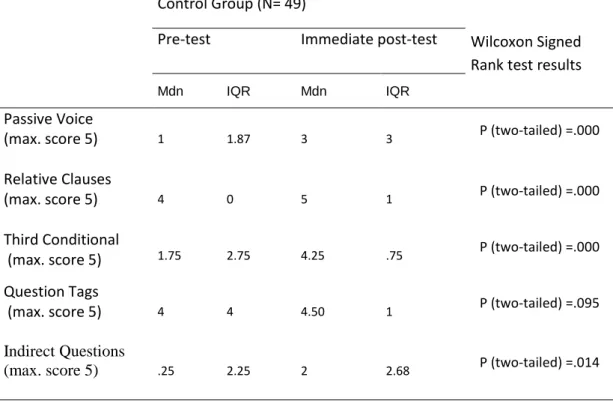
Table 4 – Pre-test and immediate post-test medians, control group ... 64
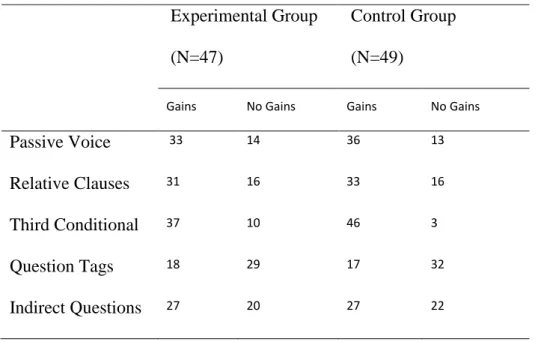
Table 5 - Student numbers, gains vs. no gains ... 66
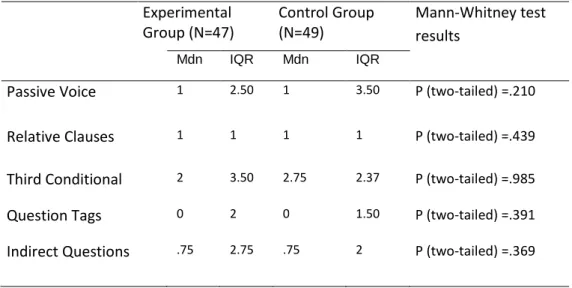
Table 6 – Gain score medians, experimental and control groups ... 67
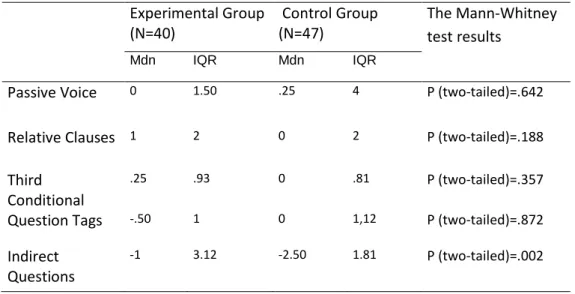
Table 7 – Retention score medians, experimental and control groups ... 68
LIST OF FIGURES
CHAPTER 1- INTRODUCTION Introduction
Corpus linguistics is one of the fastest-growing areas in contemporary linguistics. A corpus is a collection of texts which is used for linguistic analysis. These texts are generally assumed to be representative of a given language, dialect, or other subset of a language. Even though there has been an on-going debate among linguists whether to use corpora in language classes or not, corpora have been
acknowledged as a valuable resource in describing language for language learners (Hunston, 2002). As a result, corpora have been applied to teaching either indirectly through dictionaries, textbooks, and course books or directly through
corpus-based/corpus-oriented activities in language classes.
The use of corpora or corpus-based activities in language classes is very beneficial for EFL learners to get familiar with real authentic language. Language teachers also benefit from corpora to increase the meaningful input that is provided to learners. It is also to the advantage of textbooks writers to exploit corpora in order to gain an accurate reflection of the language actually used by speakers and writers in natural situations, rather than relying on their beliefs and intuitions while preparing materials in the field (Biber and Reppen, 2002).
Some language teachers and researchers encourage learners to make use of corpora in language learning and they care about learners’ feelings, attitudes, and perceptions towards using corpus-based sources in language teaching. Some of them also have some concerns about the effectiveness of corpora on learners’ performance on L2 learning. This study will try to examine the effectiveness of corpus-based
activities on lower level EFL students’ performance on grammar learning, and their attitudes towards using these sources in their grammar learning will also be explored.
Background of the Study
Corpus linguistics is the study of language as expressed in samples (corpora) of ‘real world’ texts. A corpus is a collection of texts which is exploited in linguistic analysis. The role of corpora in EFL teaching is not to ‘tell us what we should teach, but to help us make better-informed decisions, and motivate those decisions more carefully’ (Gavioli & Aston, 2001, p. 239). Some scholars claim that a corpus approach provides meaningful and contextual input into the language side of L2 instruction (Chambers, 2007; Tao, 2001), and a corpus has its own ‘potential to make explicit the more common patterns of language use’ (Tao, 2001, p. 116). According to Yoon and Hirvela (2004), in order to promote teachers’ and learners’ pedagogical use of corpora, it is important to examine how and in what ways a corpus component is beneficial to the development of the L2 knowledge of EFL learners.
Some studies which have been conducted in the context of using corpus-based sources in L2 have targeted EFL learners’ attitudes towards these sources in writing / reading instruction or in vocabulary instruction. The findings of some of these studies suggest that students have positive attitudes towards vocabulary learning through using corpus-based activities (Cobb, 1997; Thurstun & Candlin, 1998). Thurstun and Candlin (1998), for example, found that learners reacted
positively towards using corpus-based sources in vocabulary learning. However, they also reported that some students reacted negatively because of the difficulty of the authentic academic texts. Sun’s (2000) study aimed to explore how EFL students
reacted to a lesson in which corpus-based activities were used. In the study,
Taiwanese college EFL students’ feedback towards web-based concordancing was investigated via a questionnaire. He found that the majority of students felt positively towards web-based concordancing, generally because it allowed them to experience authentic language use. The students also indicated that the approach was mostly helpful in learning about the real usage of individual words as well as phrases, and in reading comprehension. Yoon and Hirvela (2004) examined the use of corpora in an ESL setting by studying intermediate and advanced proficiency level ESL students’ attitudes towards using corpora in L2 writing instruction. The researchers also investigated how ESL learners perceived the use of corpora in second language writing instruction by asking the students what they thought the strengths and weaknesses of using corpora were. They found that corpus instruction was regarded as advantageous to the students’ improvement of L2 writing, thereby increasing their confidence in this skill.
Some other studies have attempted to determine the effectiveness of corpus-based sources on EFL learners’ performance on L2 learning in writing/reading or in vocabulary instruction. Sun and Wang (2003), for example, studied the effectiveness of inductive and deductive teaching on learning collocations by using a
concordancer. They studied 81 senior high school students, who had been studying English for four years in Taiwan, by dividing them into two groups, an inductive group, and a deductive group. The study found that there was no significant
difference between the groups in terms of learning collocations, but it was revealed that concordancers were beneficial tools to help learners develop their own effective learning strategies for language learning. Koosha and Jafarpour (2006) conducted a
study which tried to define the role of DDL (Data-Driven Learning) in the teaching of collocation of English prepositions to Iranian EFL adult learners. They aimed to find out whether concordancing materials which were introduced via data-driven learning (DDL) would have any effect in the instruction of collocation of
prepositions. They studied 200 Iranian EFL adult learners by dividing them in two groups. One group received data-driven instruction whereas the other group received instruction in the conventional approach. The study showed that the participants who received data-driven instruction outperformed those who received conventional instruction in the learning of collocation of prepositions. Gilmore’s (2009) study aimed to determine whether training learners in the use of online corpora would have any effect on helping students revise their essays. Forty-five second-year
intermediate level Japanese university students’ errors on their first writing drafts were highlighted, and then they were asked to revise their second writing drafts by exploiting online corpora, after receiving training in using online corpora. The study revealed that students’ second writing drafts seemed to be more natural after the changes that they had made to their first writing drafts with the support of online corpora.
Studies that have been conducted in the context of grammar teaching through corpus-based sources are relatively rare. There are very few studies which have attempted to examine EFL learners’ attitudes towards using corpus-based sources in grammar instruction. Vannestal and Lindquist (2007), for example, examined EFL students’ attitudes towards grammar and how the use of concordancing would affect their existing attitudes. They studied advanced proficiency level EFL learners at Växjö University in Sweden, exploring the effects of using corpora on learners’
motivation to learn grammar. The study revealed that studying with corpora was perceived as a beneficial approach in grammar instruction by some students, whereas others, who were particularly weak students, found studying with corpora too
challenging. The researchers also found that many students did not find corpora useful in the context of learning grammar rules; however, learners realized that using corpora could help them when writing texts in English.
Similarly, very few empirical studies have attempted to investigate the effectiveness of corpus-based sources on EFL learners’ performance on grammar learning. Boulton (2009), for example, conducted a study with 132 first-year intermediate and lower levels of English students, looking at the use of corpora to deal with linking adverbials in English. In the study, the participants were randomly divided into groups, and four different groups dealt with linking adverbials in
English by using either one of two traditional sources, bilingual dictionary entries (BD) or grammar/usage notes (GU), or one of two corpus sources, KWIC (Key Word in Context) concordances or short contexts (SC). The researcher found that the corpus groups (KW and SC) used the information more effectively than the traditional info group (GU and BD), but on a recall test, the differences were not significant among the groups. The researcher concluded that corpus data could be consulted by learners for reference purposes, and lower level learners could also benefit from data-driven learning.
In Boulton’s (2009) study, it was also found that a wider range of learners could benefit from DDL (Data-Driven Learning), in contrast to the common assumption that corpus data was only appropriate for advanced learners. The study also suggests that more empirical studies need to be conducted in order to investigate
the effectiveness of using a DDL approach on lower level students’ performance on L2 learning, and to determine whether the conclusions coming from previous corpus studies hold true for other learners at different levels.
Although many studies have been conducted in order to investigate the attitudes of L2 learners towards corpus-based sources in writing/reading or in vocabulary instruction and the effectiveness of these sources on L2 learners’ performance on writing/reading or on vocabulary learning, very few studies have been conducted in the context of teaching grammar through corpus-based activities and exploring EFL learners’ attitudes towards using these activities in grammar instruction. Moreover, these studies on corpus-based activities (Gilmore, 2009; Granath, 1998; Kennedy & Miceli, 2001; Sun, 2000; Sun, 2007; Sun &Wang, 2003) have mainly focused on intermediate or advanced level EFL learners’ attitudes or language learning rather than on those of lower proficiency EFL learners. For this reason, empirical studies should be conducted in order to determine whether corpus-based sources can be used in grammar instruction and whether the conclusions coming from previous corpus studies hold true for students at different levels of learning proficiency, and whether students, regardless of level, feel that studying with corpus-based activities is effective in L2 learning.
Statement of the Problem
Research in second/foreign language teaching recognizes that corpora are widely acknowledged as a valuable resource in defining language but there is an on-going debate on ‘its value in defining language for learners of English or its use in language classrooms’ (Hunston, 2002, p. 192). Many studies (see Chan & Liou, 2005; Chujo, Utiyama & Miura, 2006; Gaskel & Cobb, 2004; Sun & Wang, 2003)
have attempted to examine whether corpus-based activities are effective with EFL learners in writing/reading or in vocabulary instruction. Students’ attitudes towards using corpus-based sources in writing/reading or in vocabulary learning have also been explored in many studies (see Sun, 2000; Yoon & Hirvela, 2004). Most of these studies have attempted to use corpus-based sources at intermediate and advanced levels (Gilmore, 2009; Granath, 1998; Kennedy & Miceli, 2001; Koosha & Jafarpour, 2006; Sun, 2000; Sun, 2007; Yoon & Hirvela, 2004); however, to the knowledge of the researcher, there is no empirical study that has been conducted in the EFL context that examines either the effectiveness of corpus-based activities on lower level EFL learners’ performance in L2 grammar or their attitudes towards using these resources in grammar learning. Hence, this study intends to examine the effects of corpus-based activities on lower proficiency level EFL learners’
performance in grammar. The study also aims to explore their attitudes towards learning grammar through these activities.
In English preparatory schools in Turkey, instructors mostly use course book exercises to teach grammar at all proficiency levels. A special method to use corpus-based activities in grammar teaching has not been investigated or introduced yet to EFL learners or instructors. Instructors of English recognize that grammar is accepted as a set of rules by EFL learners and they also claim that learners want to be taught these rules explicitly. EFL students may need to be supported with corpus-based activities to help them become professional users of these resources so that they can make use of them throughout their following language learning processes. Therefore, the study aims to look at whether corpus-based activities are effective with Turkish EFL learners in the context of grammar teaching. It also examines
Turkish EFL learners’ attitudes towards using these resources in their grammar learning.
Research Questions
The present study aims to address the following research questions: 1. What are the effects of using corpus-based activities on Turkish lower
proficiency level EFL learners’ performance in grammar learning? 2. What are the attitudes of Turkish lower proficiency level EFL learners
towards learning grammar through corpus-based activities? Significance of the Study
The data collected in this study will contribute to the literature on determining whether EFL learners at the early stages of language learning can be taught grammar through corpus-based activities. Corpus-based studies that can be found in the literature (see Gilmore, 2009; Granath, 1998; Kennedy & Miceli, 2001; Koosha & Jafarpour, 2006; Sun, 2000; Sun, 2007; Yoon & Hirvela, 2004) have focused on advanced or intermediate proficiency level EFL learners’ performance on L2 learning in writing/reading or in vocabulary instruction, or their attitudes towards these resources in writing/reading or in vocabulary teaching; this study will provide evidence for whether corpus-based sources can be used in grammar instruction and whether those conclusions coming from previous corpus studies hold true for students at different levels of learning proficiency. This study will also provide evidence for whether students, at the early stages of language learning, feel that using corpus-based activities in L2 learning is an effective approach.
The findings of this study will also have a practical use in English preparatory programs at Turkish universities. In the English preparatory programs in Turkey, neither the effectiveness of corpus-based resources on EFL learners’ performance on grammar learning nor their attitudes towards using these resources in grammar learning have been investigated yet. Therefore, the study will provide evidence for teachers questioning whether to use corpus-based activities with lower level students, and for curriculum designers considering incorporating such materials and activities for lower level EFL learners in English preparatory programs at Turkish Universities.
Conclusion
This chapter discussed the rationale for the present study. In the first part, the topic of the study was introduced, and then the background of the study was
presented. The problems that the study aimed to solve were discussed. Following this, the significance of the study was revealed.
The next chapter reviews the literature on corpus linguistics and the role corpora play in language teaching, as well as synthesizing the literature on the indirect and direct applications of corpora in language teaching. In the third chapter, the research methodology, including the participants, materials and instruments, data collection and data analysis procedures, is presented. The fourth chapter presents the data analysis procedures and the findings of the study. In the fifth chapter, the findings, pedagogical implications, limitations of the study, and suggestions for further research are discussed.
CHAPTER 2- LITERATURE REVIEW Introduction
In this study, the effectiveness of corpus-based activities on lower level EFL learners’ performance on grammar learning will be investigated. These learners’ attitudes towards using corpus-based activities in their grammar learning will also be explored. In this chapter, a brief description of corpus linguistics will be introduced to readers as a starting point. Then, the controversy among linguists about whether to make use of a corpus-based approach in linguistics will be discussed in detail. In the following section, the role that corpora play in language teaching will be covered. Then, the debate that corpora have inspired among linguists in the context of language teaching will be presented to readers. After that, indirect applications of corpora in language teaching will be summarized. In the final section, previous empirical studies related to direct applications of corpora in language teaching (e.g., the effectiveness of corpora on language learners’ vocabulary, writing, and grammar learning, and the attitudes of language learners towards using corpora in language teaching) will be summarized and synthesized.
History of Corpus Linguistics
The term corpus was first used in the 6th century to refer to a collection of legal texts, ‘Corpus Juris Civilis’, after it had evolved from the Latin word for body (Francis, 1992). A corpus basically consists of natural texts which are scrupulously collected and organized (Biber, Conrad & Reppen, 1998). Moreover, Hunston (2002) defines the term ‘language corpus’ as written, or spoken linguistic data collections, which are organized, or compiled with an aim to describe a specific pattern of a language, or present some varieties of a language. The definitions above can imply
that the term ‘corpus linguistics’ is the study of a language which presents ‘real life’ language use examples as well as using them to study that language (McEnery & Wilson, 1996).
Since the 1950s, when corpus linguistics started to develop, it has been amazing to see the debates it has created among linguists. Firstly, linguists started to question whether corpus linguistics was a branch of linguistics or a kind of
methodology. McEnery and Wilson (1996, p. 2), for example, stated that ‘corpus linguistics is not a branch of linguistics in the same sense as syntax, semantics, sociolinguistics and so on’, and they claimed that corpus linguistics was a
methodology that could be used in every area of linguistics. Secondly, a series of criticisms has been made of the corpus-based approach to linguistics. Chomsky (1988), for example, suggested that the corpus could never be a beneficial tool for a linguist because a linguist should model language competence rather than
performance. He also claimed that corpus data could not distinguish wrong sentences from sentences which had not occurred yet, but intuition could distinguish which sentences were grammatically incorrect. Chomsky tried to emphasize that a corpus was a collection of natural utterances which were externalized, so a corpus would be a poor guide to model linguistic competence (McEnery & Wilson, 1996). Chomsky (1988) also suggested that because language was infinite, a corpus, which was always finite, could not be representative of an infinite language.
The debate Chomsky created in linguistics was actually related to the distinction between empirical and rationalist theories, which left the decision to linguists whether to choose to look at natural data, or to look at artificial data in their study of language (McEnery & Wilson, 1996). A rationalist theory is basically a
theory in which linguists make conscious judgments about artificial data in drawing conclusions about linguistics, whereas an empiricist theory of language relies on natural data by mainly using a corpus (McEnery & Wilson, 1996). According to McEnery and Wilson (1996), Chomsky suggested that linguistics should be more rationalist and less empiricist. Another linguist who argued against the corpus-based approach to linguistics was Hockett (1948, as cited in McEnery & Wilson, 1996). Hockett claimed that a linguist working in the structuralist tradition should aim to explicate all utterances which were included in his corpus as well as explicating all utterances which were not included in his corpus, and non-corpus-based utterances should test corpus-based grammars to demonstrate their predictive power.
Even though corpora were neglected for nearly two decades because of the debates they created in linguistics, important advances were made in the use of corpora during this time, the most important of which was the linking of the corpus to the computer (McEnery & Wilson, 1996). Furthermore, COBUILD project in lexical computing has shed light on many linguistic issues using corpus linguistic techniques and resulted in the creation of the largest corpus of English language texts in the world (Stuart, 2005). Therefore, the organization and collection of linguistic data (spoken, or written) in the computer have resulted in an increased number of corpus studies in the field since 1980. In the next section, the controversy among linguists about whether to make use of corpora in language teaching will be
discussed. The role of corpora in language teaching will be presented in detail with an aim to understand how corpora, either directly or indirectly, have influenced the language teaching environment.
Corpora in Language Teaching
After Tim Johns(1986, 1991) suggested that the use of corpora in language learning could have numerous positive effects on EFL/ESL students’ and teachers’ way of describing a language, the potential of corpora for language pedagogy was widely acknowledged (Hunston, 2002). The contribution of corpora to the language learning environment had not developed for the last 50 years because until the 1980s, researchers did not start to emphasize that corpora could have a beneficial influence on foreign or second language teaching and learning (Chambers, 2007). However, the use of corpora has also inspired heated debates among linguists since it was introduced into the field of foreign/second language teaching. Widdowson (1991), for example, took issue with both the usefulness of corpora and the effectiveness of descriptions of corpora on language pedagogy. He also claimed that corpora in language teaching could provide language learners, teachers and researchers with important information about how language should be used; however, it should be more important to think about how useful the language emerging from corpora could be to language learners, teachers and researchers. He suggested that language
learners, teachers and researchers should regard language descriptions arising from corpora as factors to be considered rather than facts to be uncritically incorporated into language teaching. According to him, language teaching should be informed by the descriptions that are emerging from corpus linguistics, rather than determined by it. Sinclair (1991) approved Widdowson’s claims by stating that
‘Corpus linguistics has no direct bearing on the way languages may be presented in a pedagogical context. Corpus linguistics makes no demands on the methodology of language teaching. It is not geared to serving any
particular method, and the current software is quite neutral’ (Sinclair, 1991, p. 489-99).
Controversy among linguists about whether to apply corpora to language teaching or not took another form after the article titled ‘Spoken grammar: what is it and how can we teach it?’ by McCarthy and Carter (1995) had been published. In the article, McCarthy and Carter (1995) argued that some choices related to written and spoken grammars needed to be presented to learners in order to let them make decisions between these two kinds of grammars. The researchers also claimed that the teaching of correct English was based on traditionally written examples;
however, it was crucial to be informed about the interpersonal implications of spoken grammars, rather than only adopting the 3Ps (Presentation-Practice-Product) in traditional grammar books. They suggested that examples of informal spoken English were more appropriate for designing classroom materials than the spoken English encountered in textbooks (McCarthy & Carter, 1995). In opposition to what McCarthy and Carter (1995) suggested, Prodromou (1996) expressed some concerns about the instant transferability of research conducted in the context of corpora to language classes without being sure whether they really met language learners’ and language teachers’ needs and expectations, and he also emphasized that collaboration between researchers and teachers/materials developers was initially crucial before moving from the laboratory to the classroom. The controversy in the context of using corpora in language teaching later continued with Carter (1998) and Cook (1998). Carter (1998) stated that corpus linguistics was not a revolution, but the evolution of language teaching, and there should be more corpus description, particularly in international contexts. According to him, language description was not language teaching, but language teaching could benefit from better language descriptions. However, Cook (1998) argued that a corpus was a record of language behaviors and
these patterns of behaviors could not lead us to see how language was organized in the mind, and how it should be organized for language teaching. He also claimed that it was not well known whose language was recorded, and why such recording should be a model for language learners and teachers.
Despite the heated debates among linguists about whether to apply corpora to language teaching, some EFL teachers and researchers strongly claim that the use of corpora is very beneficial for EFL learners because corpora bring the natural and authentic real life language to the classroom to help the students to understand the descriptions of a language (Hunston, 2002). Especially since digital computers and corpus linguistics were introduced, new trends (e.g., concordancing, DDL (Data-Driven Learning), and corpus-based/corpus-oriented/corpus-driven approaches) have started to occur in the field of EFL/ESL with an aim to help language teachers and learners see real language descriptions and benefit from those descriptions in language learning and teaching. One of those trends, concordancing, has taken its place in language teaching as a new method. Concordancing is basically a kind of method which deals with language analysis, and studies structures and lexical patterns found in digital databases (Gaskell & Cobb, 2004). This method helps language learners study corpora with a computer program (i.e., a concordancer). A selected word and portions of sentences including that word, called the Key-Word-In Context (KWIC), can be found via a concordancer. A concordance of a search can present many concordance lines for language learners to read and analyze. This format also lets users see the lexical or grammatical items that collocate with the key word. EFL learners and teachers can benefit from this information on lexical or grammatical patterns of real language(Gaskell & Cobb, 2004).
DDL (Data Driven Learning) has also taken its place in language teaching. The idea of DDL was actually first proposed by Johns (1991) with an aim to implement concordancing materials in the field of second language acquisition (SLA). It is an approach which differs from traditional learning approaches in that it requires students to observe a particular phenomenon of a language presented by concordance lines and hypothesize how this phenomenon of a language works, and then see whether the hypothesis is correct (Payne, 2008). DDL is the application of concordancing in language learning, and learners exploit corpora by using
concordancing while dealing with a language phenomenon (Payne, 2008). Thus, a language learner who uses this approach is indeed a researcher who has access to authentic linguistic data (Koosha & Jafarpour, 2006). Learners are not seen simply as gainers of knowledge, but as researchers studying the regular patterns of the language, and teachers should encourage learners to search without knowing in advance what patterns they will discover (Hadley, 2002). DDL is indeed a pedagogic continuity from a product approach, which presents the specific aspects of language to the learners by exposing them to contexts, to a process approach in which DDL stimulates creativity and self-discovery learning among learners (Batstone, 1995). The teaching of grammar through DDL seems to rely on both product and process approaches, and it is suggested that grammar learning should mainly include activities which can raise language learners’ consciousness rather than activities which try to focus on the teaching of rules (Hadley, 2002).
Corpus-based /corpus-oriented/corpus-driven approaches have taken their place in the field of EFL/ESL. Teubert (2010) distinguishes a corpus-based approach from a corpus-driven approach by stating that linguistic findings can be considered as corpus-based findings if everything that is included is validated by corpus
evidence, whereas linguistic findings can be considered as corpus-driven findings if they are directly taken from corpora. Additionally, a corpus-based approach differs from concordancing or a DDL approach in that learners make use of concordancing (i.e., a concordancer) to search corpus data in the DDL approach in order to observe a language phenomenon, whereas in a corpus-based approach, they use corpus data in order to test their existing ideas (Tognini-Bonelli, 2001). Tognini-Bonelli (2001) also defines the corpus-driven/corpus-based/corpus-oriented approach as a
methodology in which the corpus serves as an empirical basis where language researchers, learners and teachers see real linguistic data prior to their assumptions and expectations. The researcher also claimed that a corpus is an inventory of language data, and appropriate materials, for which the corpus-driven/corpus-based/corpus-oriented approach was taken into consideration while being prepared, could support intuitive knowledge, and verify expectations. The
corpus-driven/corpus-based/corpus-oriented approach is apparently a method where data is used to confirm linguistic pre-set explanations and assumptions (Tognini-Bonelli, 2001).
An increasing number of corpus-based analyses in language teaching has led language teachers and learners to see empirical descriptions of language use, identify the frequent patterns, and understand the usage of particular forms and words in different registers (Biber & Reppen, 2002). The combination of corpora and
concordancers shows that a promising future in the field of language teaching and learning is offered to language teachers and researchers by letting learners discover specific patterns and change their minds by observing extensive naturally occurring examples in real texts (Hill, 2000). By using the information based on corpora, materials developers and teachers can also increase the meaningful input that is provided to learners (Biber & Reppen, 2002).
There are two ways in which corpora can influence language teaching. The indirect approach centers upon the researchers who are the provider of corpora for language teachers, materials designers, and course developers, all of which use the evidence derived from corpora while designing courses for language classes or developing teaching materials for the field (Hunston, 2002). On the other hand, the direct approach centers upon language learners and teachers who search and use corpora themselves in order to discover the specific patterns of language or the behavior of words (Bernardini, 2002). The next section will focus on the indirect applications of corpora in language teaching.
Indirect Applications of Corpora in Language Teaching
Even if most language teachers and learners have not heard of a corpus, they have been using the products of many corpus-based studies (McEnery, Xiao, & Tono, 2006). Taking the needs of language teachers and learners into consideration, the COBUILD dictionaries, grammars, usage guides, and concordance samplers (Capel 1993; Carpenter 1993; Goodale 1995; Sinclair et al. 1990; Sinclair et al. 1992; Sinclair et al. 2001) also present a variety of reliable information about the real use of English when compared to more traditional reference works and teaching
how a corpus can raise their awareness to provide meaningful input to language learners, a corpus can have some crucial effects on the design of dictionaries, textbooks, course books, and grammar books, all of which are used in language classes. Language learning can be informed by linguistic descriptions that rely on the results that a corpus-based study reveals, and benefit from these results to provide input for language learners (Barlow, 1996). Teaching materials, and even course design can be affected by the results of a corpus-based investigation, and language teachers can make new decisions while introducing structures and new items to language learners (Romer, 2005).
According to Sinclair (2004), previous pedagogical descriptions which had not emerged from a corpus-based investigation can be evaluated in the light of ‘new evidence’, which is provided by corpus-based investigation (p. 271). In addition, in CLT (Communicative Language Teaching), the use of corpora can be a valuable source when language teaching syllabi are being designed; those items which will be most likely encountered can be introduced to the learners in order to help them come face to face with real communicative situations (Hymes, 1992). In addition, many corpus studies (see Biber & Reppen, 2002; Knoch, 2004) have also indirectly affectedcommunicative language teaching syllabi by presenting the most common items in actual language use, and comparing these most common patterns found in the corpus with the same items in traditional teaching materials (e.g., course books, textbooks, and grammar books). Knoch (2004), for example, conducted a study to determine which comparative constructions in English were most commonly used by native speakers, by collecting data from the BNC (British National Corpus), and whether most comparisons were followed by an explicit basis of comparison. The
study compared the data from the BNC with textbooks, and the results showed that most textbooks did not present the full range of structures used by native speakers to compare or contrast. Biber and Reppen (2002) conducted a study which contrasted the presentation of information in six ESL grammar textbooks with empirical frequency findings based on corpus research done for the LGSWE (Longman Grammar of Spoken and Written English). They defined three case studies, each reflecting one of three major issues: grammatical features to include or exclude; the order of the grammatical topics; and specific words to include when illustrating a grammatical feature. The priorities of six ESL textbooks were compared to the frequency findings of the three case studies. In terms of including or excluding grammatical features, corpus-based analysis showed that the adjective role of nouns (e.g., glass window, patrol car) was less commonly acknowledged in textbooks than in the corpus, and textbooks seemed to include adjectives and participial adjectives for noun modification, considering nouns as less important in their adjective roles. In terms of the order of grammatical topics, they found that textbooks considered progressives as more important than they actually were in the corpus. In terms of including specific words to illustrate a particular grammar feature, they found that there was little consistency across textbooks guiding the selection of illustrative vocabulary, and most common lexical verbs (e.g., try, put, use, leave) were neglected by all textbooks. This study’s results suggest that corpus-based analysis may inform language teachers and course book writers in the development of materials and in the choices that teachers make in language classrooms. In the next section, direct applications of corpora in language teaching will be discussed in detail with an aim to understand how corpora have been directly integrated into language classes.
Direct Applications of Corpora in Language Teaching
In this section, the direct applications of corpora in language teaching will be presented. Specific language skills will be dealt with in turn. Several previous empirical studies which have directly attempted to determine the effectiveness of corpora on language learners’ L2 (Second Language) learning will be summarized. The attitudes, perceptions, reactions, and the feelings of language learners towards using corpora in their L2 learning will also be discussed in detail.
Using Corpora in Vocabulary Instruction
Some previous empirical studies conducted in the context of using corpus-based activities, DDL, and concordances in L2 have attempted to determine the effectiveness of these sources and activities on EFL/ESL learners’ performance on vocabulary learning. These studies have mainly aimed to investigate their
effectiveness on language learners’ learning of only one aspect of vocabulary
learning, which was collocation learning. Sun and Wang (2003), for example, studied the effectiveness of inductive and deductive approaches on the learning of
collocations by using a concordancer. They also aimed to examine the relationship between the difficulty of collocation patterns and learner performance. Eighty one senior high school students, who had been studying English for four years in Taiwan, were divided into two groups, an inductive group, and a deductive group. The
participants were given a pre-test at the beginning of the study, and then they were taught how to search via concordancers. Students in the deductive group were given grammatical rules, and were required to correct the sentences through studying the rules and the examples presented, whereas students in the inductive group were required to search for five instances of use of the keyword on a web-based
concordancer, and then they were asked to understand the underlying patterns through those five instances. The researchers, then, asked the students in the
inductive group to correct the sentences according to their own induced rules. After treatment, an immediate posttest was administered to all students to evaluate the students’ performance on collocation learning. The findings showed that the inductive group performed significantly better than the deductive group on the learning of easy collocation patterns. The researchers concluded that the two teaching approaches only differed significantly in the learning of easy collocation patterns, and there was no significant difference between the two teaching
approaches for the difficult patterns. This study’s results revealed that
concordancers could help language learners to become efficient self-discoverers of target language collocations for collocation learning.
Another empirical study’s results (Chao, 2010), which also looked at the effectiveness of corpus-based activities on high school students’ collocation learning, were similar to the results of Sun and Wang’s (2003) study in terms of language learners’ collocation learning. In the study, Chao (2010) aimed to investigate the effectiveness of concordancing on Taiwanese junior high school students’ learning of receptive and productive collocations. Two classes of 71 second-grade junior high school students, who had been learning English formally for three years, participated in the study, and they were randomly divided into two groups, an experimental group and a control group. All students received 15 weeks of instruction. The
concordancer, IWiLL, which was adapted by the researcher, was introduced to the students in the experimental group, and they were taught how to use it during their collocation learning, whereas the students in the control group used the regular
textbook to deal with the same target collocations. The students were given a pre-test and a post-test to examine the effects of using the concordancer on their collocation learning. The results of the pre-test revealed that there was no difference between the scores of the experimental group and those of the control group; however, the results of the post-test revealed that the students in the experimental group significantly outperformed the students in the control group, particularly in terms of learning productive collocations. The results of both studies (Chao, 2010; Sun & Wang, 2003) revealed significant differences between experimental and control groups in terms of the students’ learning of collocations.
The results of the two studies above suggest very promising results for language teachers who question whether to use concordancing while teaching collocations to high school students. The effectiveness of concordancer on the students’ learning of collocations in these studies shows that the students who have been learning English for three or four years can benefit from consulting a
concordancer while learning English collocations.
Some empirical studies have investigated the possible effects of corpus-based activities, DDL, and concordancing on college, or university adult language learners’ collocation learning. Koosha and Jafarpour’s (2006) study, for example, tried to define the role of DDL in the teaching of collocation of English prepositions to 200 Iranian EFL adult learners, who were in three proficiency levels. The students were randomly assigned to experimental and control groups, all of which comprised totally six groups, and went through a fifteen-session treatment which was one hour per week in a fifteen-week semester. A completion test on collocations of
collocational knowledge. The three control groups then received conventional instruction in which prepositions and their collocational patterns were explicitly taught to the participants in English or Farsi, whereas the three experimental groups received data driven-based instruction that was based on concordance lines taken from the Brown Corpus Online (2005), and presented in KWIC (Key-Word-In Context) format. After the instruction, a completion test on collocation of
prepositions was administered as a post-test in order to determine the impact of the specific instruction the participants received. The results of the study showed that the students who received data-driven instruction outperformed the students who
received conventional instruction in the use of prepositions in collocations. The researchers interpreted these results as indicating that the DDL approach proved to be highly effective in the teaching and learning of collocation of prepositions, and learners' proficiency levels had a great influence on their performance on collocation learning.
Some studies have investigated the effectiveness of using bilingual parallel corpora on language learners’ collocation learning. Chan and Liou (2005), for example, conducted a study to investigate the possible effects of using five web-based practice units on learners’ English verb-noun collocation learning with the help of a web-based Chinese-English bilingual concordancer (keyword retrieval program). The researchers gave 32 college EFL students in Taiwan a pre-test and two post-tests to examine whether a web-based Chinese-English bilingual
concordancer would help EFL students to learn verb-noun collocations. The study revealed that students showed a significant level of learning from the five online units, thereby increasing their knowledge of verb-noun collocations. However,
delayed post-tests revealed that students’ knowledge of verb-noun collocations declined after two and a half months but this knowledge was higher when compared to their initial verb-noun collocation knowledge.
Another study which tried to determine the effects of bilingual parallel corpora was Chujo, Utiyama and Miura’s (2006) study, which aimed to investigate the effectiveness of Japanese-English bilingual parallel corpora on beginner level EFL learners’ vocabulary learning. However, this study differs from the studies summarized above, by examining the effects of corpora on language learners’ vocabulary learning, rather than collocation learning. Additionally, this study’s findings differ from those of the other studies in that it reveals that lower proficiency level learners can also use a corpus effectively. In the study, the researchers
combined a Japanese-English parallel corpus to produce corpus-based vocabulary activities, and then found a multilingual concordancer so that they could investigate the equivalences and contrasts between the two languages. The study aimed to determine whether learners would get used to using the bilingual parallel concordance tool, and whether the concordancing activity would be useful for learners. Seventy two beginning level students, who were studying engineering in three Japanese universities, took part in the study. The participants had one 90-minute class per week for four or five weeks in the study. DDL (Data-Driven Learning) activities were integrated into CALL (Computer Assisted Language Learning) activities, and some target words were provided for students in several tasks. The researchers wanted students to compare the vocabulary and language patterns between the two languages to understand patterns and usage in both
lesson, they gave a CALL-CD-ROM quiz to check the knowledge of the vocabulary that students had been exposed to that day. The study revealed that the beginning level EFL learners were able to use the concordancing tool for learning English vocabulary, and the bilingual concordancing tool resulted in successful vocabulary learning material for beginning level EFL students. The researchers also concluded that the bilingual parallel corpus was effective with beginning level EFL students in the context of discovering many relationships between the two languages, and exploring the lexicogrammatical and collocational patterns of English.
These studies’ results suggest that bilingual parallel corpora seem to have positive effects on students’ learning of vocabulary and collocations of English. College and university adult learners can benefit from bilingual parallel corpora in their vocabulary learning, and language teachers can adapt bilingual parallel corpora with an aim to help EFL learners compare and contrast the relationships between students’ native language patterns and those of the target language.
Previous empirical studies have also explored the attitudes, perceptions, reactions, and feelings of language learners towards using corpus-based activities, DDL, and concordancing mostly in the context of collocation learning. Chan and Liou’s (2005) study (described above), for example, aimed to find out what kinds of feedback students would give to a bilingual concordancer. The researchers also aimed to find out to what extent the students thought that the bilingual examples in the concordancer could help their learning of English verb-noun collocations. Questionnaires revealed that students felt positively towards learning English verb-noun collocations through the online practice units, and the majority of the students
enjoyed using the bilingual concordancer while trying to learn verb-noun collocations.
Another study which explored language learners’ attitudes in the context of collocation learning was that of Chao (2010). The researcher explored 71 second-grade junior high school students’ attitudes towards using a concordancer in their collocation learning. The results of a questionnaire showed that the students felt positively while learning collocations, and the students mostly agreed that concordancing was indeed effective with their collocation learning.
In Chujo, Utiyama and Miura’s (2006) study, 72 beginner level EFL learners’ reactions towards using concordance-based teaching activities in their vocabulary learning were explored. The researcher also tried to reveal what learners thought about the ease of using the concordancing tool. The students were required to write down their responses to using concordancing tools daily. They were also required to complete a final questionnaire in order to determine whether they were able to get used to using the concordancing tool, and whether they had learned anything from the concordancing activities. The results of the daily evaluations revealed that 63% of the participants got used to using the concordancing tool. The results of the final questionnaire revealed that 62% of the participants felt positively towards using a DDL approach in learning English vocabulary, and 40% of the participants stated that using the concordancing tool was easy for them.
There has been a growing interest in conducting studies investigating the effectiveness of corpus-based activities, DDL, and concordancers on EFL learners’ performance on vocabulary learning, and exploring their attitudes towards these resources in vocabulary instruction. The findings of these studies mostly suggest that
students perceive corpus-based activities, DDL, and concordancing as beneficial for their knowledge of English words , particularly for learning the common usage and collocation of words. However, even though all of the studies summarized above suggest promising results for the realm of ELT, language teachers and learners in the field, these studies have mostly attempted to reveal some results for language
learners’ collocation learning rather than vocabulary learning in a general sense. Therefore, more empirical studies should be conducted in order to determine whether these conclusions coming from previous empirical studies which have been
conducted in the context of language learners’ collocation learning hold true for their general vocabulary learning, as well.
Using Corpora in Writing Instruction
Many previous studies have attempted to determine the effectiveness of corpus-based activities, DDL, and concordances in EFL/ESL learners’ performance in writing, with an emphasis on the use of concordancers. Gilmore (2009), for example, conducted a study in which 45 second-year intermediate proficiency level Japanese university students were required to use the British National Corpus (BNC) and the COBUILD Concordance and Collocations Sampler in revising their writings. The study aimed to find out whether these tools could be effective tools for language learners to write second drafts of their writings. Initially, the students were required to write a report, on which the teacher highlighted sentence-level, lexical, and
grammatical problems. After the students had been trained for about 30 minutes, they were asked to use the BNC and COBUILD corpora while correcting the problems in their writings. After that, they were required to write the second drafts of their
writings accordingly. The results of the study revealed that 61% of the students’ revised writings included more natural language.
Another study which investigated the possible effects of using concordancers on language learners’ revision of their writings was that of Gaskell and Cobb (2004). The researchers conducted a study to determine whether 20 adult Chinese students, who were intermediate level English learners, would be able to use concordancers to correct their writing errors, and whether there would be any decrease in students’ errors in free writing after they had corrected their errors in their writings with the support of concordancers. The researchers also aimed to find out whether learners would be able to use concordancers independently after the training. Initially, the students were given written assignments. The instructor gave feedback to each
learner’s assignment by presenting online concordance links for selected errors. After that, the instructor asked the students to resubmit the writings. The results of the study showed that an accurate correction was found in the majority of the revised writings, and seven students out of the 20 students became persistent users of the online concordancer. The study also revealed that learners improved their writing by making use of concordancing to correct their errors.
The studies described above mainly suggest useful results for language learners to make use of concordancers to revise their written texts. According to findings of the studies above, if language teachers pay enough attention to lead language learners to use concordancers to correct the errors of their written texts after the necessary training, language students can effectively use these tools to improve their writing skills in English.
Some studies have also explored the reactions of language learners towards using concordancers in writing instruction. Gaskell and Cobb’s (2004) study
(described above), for example, also aimed to determine whether students found the concordancing activities beneficial for correcting their writing errors. The students were asked via a questionnaire whether they had liked using the concordancing activities while correcting the errors of their written texts, and they were also asked whether they had learned anything from concordancing. According to the results of the questionnaire, all of the 20 students stated that they had learned a great deal of information from concordancing, and they had thought that concordancing improved their English writing skills. In addition, eight students out of the 20 students stated that their grammar knowledge also improved while using concordancing.
Another study which also explored intermediate proficiency level language learners’ reactions towards concordancers in writing was that of Gilmore (2009). The researcher aimed to explore the students’ reactions towards using BNC and
COBUILD online corpora for revising their written texts. The results of the study revealed that 95% of the students gave positive feedback on the activities, mostly agreeing that online corpora were beneficial for them to revise their essays.
The studies summarized above generally targeted EFL (English as Foreign Language) learners’ reactions towards concordancers, and the findings of these studies revealed that EFL learners mostly felt positively towards using concordancers for improving their writing skills. Some studies in the literature also targeted ESL (English as Second Language) learners’ reactions towards using corpora for improving their writing skills. Yoon and Hirvela’s (2004) study, for example,
classroom. This study also differs from the studies summarized above, in that it explores language learners’ attitudes towards using corpora for improving their writing skills in the classroom, rather than their attitudes towards using
concordancers for correcting the errors in their written texts. In other words, the study aims to explore language learners’ reactions towards using corpora in writing instruction rather than using them in error correction. In the study, the researchers aimed to find out whether ESL students found the use of corpora for learning L2 writing beneficial, and how they felt about using corpora in writing instruction. In a ten-week term, eight students participated in an intermediate level ESL writing course and 15 students participated in an advanced level ESL writing course at an American university. All of the students in both classes used the Collins COBUILD Corpus, and received instruction in conducting a concordance search from an
instructor. The instructor also helped them to interpret the results of the concordance search. The researchers used a questionnaire and semi-structured interviews to explore the attitudes of the students towards using corpora in writing instruction. The study revealed that the students in both classes mostly agreed that using a corpus was helpful and beneficial for them to learn the usage of vocabulary and phrases, and the students mostly felt positively towards using corpora in L2 writing instruction. More specifically, the study revealed that the students who participated in the intermediate level ESL writing course were more satisfied with the information that they gained via corpus searches than the students who participated in the advanced level ESL writing course. The researchers suggested that the teacher’s different type of emphasis on the corpus work in the advanced level ESL writing course might have affected the students’ perceptions of the corpus use, and it may have been difficult
for the students who took the advanced level ESL writing course to express positive feelings if they were not satisfied with what their corpus searches produced. The researchers concluded that the use of corpora was especially beneficial for ESL students for learning word patterns in the target language, thereby improving their L2 writing skills.
The studies described above investigated the effectiveness of concordancers on language learners’ performance on writing skills. The findings of these studies suggest that language learners are able to use concordancers to correct the errors in their written texts, and concordancers help language learners to revise their writing texts, thereby supporting them to produce more natural language in their writings. Some of these studies also explored how language learners reacted towards using concordancers for correcting the errors in their written texts or revising their written texts. The findings of the studies indicated that the language learners felt positively towards using concordancers for improving their writing skills. Most of the language learners also believed that they learned a great deal of information for improving their writing skills through using concordancers.
Using Corpora in Grammar Instruction
From the two corpus-based studies that have been conducted in grammar instruction from the two perspectives (i.e., investigating the effectiveness of corpus-based activities on grammar instruction and exploring attitudes towards these sources in grammar instruction), only one empirical study has directly centered upon the effectiveness of corpus-based activities on EFL learners’ learning of English grammar. Boulton’s (2009) study investigated whether a DDL approach, using a concordance print-out, could be beneficial for 132 first-year intermediate and lower
level English students , and whether the learners could benefit from a DDL approach without having training. In the study, the participants, who were studying English for specific purposes, were randomly divided into groups. In an experimental design , four different groups dealt with linking adverbials in English by using either the following traditional sources: bilingual dictionary entries (BD) or grammar/usage notes (GU), or using the following corpus sources: KWIC (Key Word in Context) concordances or short contexts (SC). The researcher assigned the students into one of the four groups in order to test them in terms of their ability to interpret, apply and recall different information types. The WebCorp, an integrated system for web-text search, was used in order to include five short contexts for each test item in the short context sheets, and eight concordance lines for each test item in the keyword in context sheets. The Collins-Robert Senior dictionary, a large desk dictionary, was used for each test item in the bilingual dictionary entries. As for the grammar/usage notes, Swan’s Practical English Usage, which includes everyday language, was used for each test item. A first test (a pre-test) was given to the participants in order to know about the participants’ existing knowledge and ability before the experiment. A second test (a test where the students could consult the information sheets) was given to the participants in order to see how the learners progressed in using DDL for reference purposes. Lastly, a third test (a recall test), ten days later, was given in order to see the recall of the different information types. There were two exercises in each test (ten questions about ten target items, and multiple-choice gap-filling). The same testing instrument was given to all students without taking their group into consideration. The researcher analyzed the data in terms of test results (the changes among the three tests), level (the scores among three bands of proficiency in