ISTANBUL BILGI UNIVERSITY ENSTITUTE OF SOCIAL SCIENCE
FINANCIAL ECONOMICS MASTER’S DEGREE PROGRAM
CRYPTOCURRENCY INVESTMENT DECISIONS AND BEHAVIORAL BIAS EFFECT
Master Thesis by Nilay YANARDAĞ
116620017
Thesis Supervisor Assoc. Prof. Ender Demir
ISTANBUL 2019
iii
ACKNOWLEDGEMENTS
I’m so thankful to support me in my survey study, that they are Altcointurk members, Bitcoin Türkiye members, Bull, and Bear members. Additionally, I would like to especially express my thanks to Burak Bayoğlu for his support and guidance, moreover, I'm thankful for Volkan Korkmaz and Erkan Can to support me in my survey study.
Finally, I would like to express my thanks to Assoc. Prof. Ender Demir, for all support and guidance during the study.
iv TABLE of CONTENTS ACKNOWLEDGEMENTS ... iii TABLE of CONTENTS ... iv LIST of TABLES ... v LIST of FIGURES ... v ABSTRACT ... vi ÖZET ... viii INTRODUCTION ... 1 1. CRYPTOCURRENCY ... 3
1.1 Evolution of the Money as a Payment System... 3
1.2 Digital Currencies ... 4
1.3 History of Bitcoin ... 6
1.4 Bitcoin Stock Market ... 7
1.5 Altcoins ... 11
1.6 Blockchain... 13
2. LITERATURE REVIEW ... 18
3. DATA AND METHODOLOGY ... 27
3.1 Data ... 27
3.2 Methodology ... 35
4. FINDINGS ... 37
5. CONCLUSION ... 44
v
LIST of TABLES
Table 3.1. Cryptocurrency trading volume... 34
Table 3.2. Bitcoin trading volume ... 35
Table 4.1. Cryptocurrency Ownership Regression Model ... 39
Table 4.2. Number of Altcoins Ownership Regression Model ... 42
LIST of FIGURES Figure 1.1. 2017 Prices of Bitcoin ... 9
Figure 1.2. Cumulative Prices of Bitcoin ... 10
Figure 1.3. Top Ten List of Cryptocurrencies in April 2019 ... 13
Figure 1.4. The Bitcoin Blockchain Network ... 15
Figure 1.5. How Blockchain Works to Create an Agreement ... 16
vi ABSTRACT
CRYPTOCURRENCY INVESTMENT DECISIONS AND BEHAVIORAL BIAS EFFECT
The cryptocurrency market is an evolving area which has its own dynamics in terms of investors and market conditions. Besides the well-known market leader Bitcoin, plenty of altcoins also exist in the market which are somehow related but still has an independent market cycle than Bitcoin. Although many traditional finance practices apply, the potential of the next way of economics deserves to be understood by its own dynamics. Since it's still the people trading and investing in this market, demographics and behavioral biases are a good source of information to examine the characteristics. This study aims to examine the determinants of both cryptocurrency ownership and willing to invest in altcoins, using people’s demographic information and the tendency of behavioral biases which are overconfidence, risk-seeking, ambiguity aversion, and loss aversion. The data has been collected by an internet survey conducted between April 22, 2019, and May 7, 2019, with 304 attendees. The determinants of cryptocurrency ownership are categorized in two models that the first model consists of the discrete dependent variable and the second model continuous dependent variable. The first model analyzed using LRM which is a logistic regression model, while the second model analyzed using OLS which is ordinary least squares as a linear regression model. The main findings in this paper are: (1) the cryptocurrency ownership is positively associated with financial literacy and high-income status, while it is negatively associated with gender, age, and low education level. (2) the number of altcoins ownership is positively associated with financial literacy, high-income status, and high risk-seeking, while it is negatively associated with ambiguity averse and low experience.
vii
KEYWORDS: Financial literacy, Ambiguity aversion, Risk seeking, Education level, Income status, Overconfidence, Gender, Experience level
viii ÖZET
KRİPTO PARA YATIRIM KARARLARI VE DAVRANIŞSAL YANILGILARIN ETKİSİ
Kripto para pazarı, yatırımcı ve pazar şartları açısından özgün dinamiklerini barındırmakta olan gelişen bir alandır. Yaygın bilinen pazar lideri Bitcoin yanında, bir şekilde Bitcoin ile ilişkili olmakla birlikte kendi bağımsız pazar döngülerine sahip alt kripto paralar da bulunmaktadır. Birçok geleneksek finans pratikleri halen geçerli olsa da, geleceğin ekonomisi olma potansiyeli taşıyan kripto paralar kendi dinamikleriyle anlaşılmayı hak etmektedir. Halen bu pazarda yatırım ve ticaret yapanların insanlar olduğu düşünüldüğünde, demografik bilgiler ve davranışsal önyargı eğilimleri, pazar karakteristiğini incelemek için iyi birer bilgi kaynağıdır. Bu çalışmada, insanların demografik bilgileri ve aşırı güven, risk arama, belirsizlikten kaçınma ve zarardan kaçınma şeklinde sınıflandırılan davranışsal önyargı eğilimleri kullanılarak, hem kripto para sahipliğinin hem de alt kripto para yatırım iştahının bileşenlerini / belirleyicilerini incelemek amaçlanmıştır. Veriler, 22 Nisan 2019 ile 7 Mayıs 2019 tarihleri arasında internet platformu üzerinden 304 katılımcı ile gerçekleştirilen anket çalışması ile toplanmıştır. Kripto para sahipliğinin belirleyicileri, birinci modelde ayrık bağımlı değişken ve ikinci modelde sürekli bağımlı değişkenden oluşan iki model ile sınıflandırılmıştır. İlk model lojistik regresyon modeli (LRM) kullanılarak analiz edilirken, ikinci model doğrusal regresyon modeli olarak kullanılan en küçük kareler (OLS) kullanılarak analiz edilmiştir. Bu çalışmada ulaşılan temel bulgular: (1) kripto para birimi sahipliği, finansal okuryazarlık ve yüksek gelir durumu ile pozitif, cinsiyet, yaş ve düşük eğitim düzeyi ile negatif ilişkilidir. (2) altcoin sahipliğinin sayısı, finansal okuryazarlık, yüksek gelir durumu ve yüksek risk arayışı ile pozitif, belirsizlikten uzak ve düşük deneyim ile negatif ilişkilidir.
ix
ANAHTAR SÖZCÜKLER: Finansal okuryazarlık, Belirsizlikten kaçınma, Riskten kaçınma, Eğitim seviyesi, Gelir durumu, Aşırı özgüven, Cinsiyet, Deneyim
1
INTRODUCTION
Wherefrom appearing the structured financial systems in our lives, it is one of the most curious about how people decide to invest in any assets as much as how money systems work. For years, researchers examine the determinants and the effects of the investment decision-making process in any asset and the effects of stock market participation.
Gao (2019) investigates the determinants of success affect households’ stock market participation decision, by using national survey data from China such as Chinese households’ family social connections, aptitude and so on. The results indicated that households’ investment decisions are influenced by their beliefs about gains. On the other hand, it is found that agricultural households prefer to invest less in the stock market, while workplace-affiliated households prefer to invest much more.
Gao, Meng, and Zhao (2019) work on stock market participation decisions’ determinants. The study used compiled aggregate stock account opening data in China. Gao et al. (2019) examine relative on the level and also the change of the participation rate which are effected by disposable personal income, demographic information, economic factors such as macroeconomic factors, financial factors such as stock market conditions, and social communication. As a result, it is found that the level of participation rate on the stock market is affected by the income, while the effects are more significant during the bull market period, in high-income, education level, and population density groups.
Zhou (2019) examines American households’ stock market participation in a period of financial crisis which is between 2007 and 2009, by using the Panel Study of Income Dynamics. It is found that the financial crisis has little effect on the stock
2
ownership, in spite of Zhou (2019) estimates dropping from 7% points to 3.5% on the stock ownership, during the period of the financial crisis. On the other hand, it is observed that household stock ownership decreases significantly during the period.
Rao, Mei, and Zhu (2016) investigate the relation between happiness and stockholding in 2011, by using The China Household Finance Survey. As a result, it is found that happiness strongly associated with household asset shares invested in stocks or mutual funds. Furthermore, it is observed that this relation is driven by mostly trust (or social capital), instead of households’ risk preferences or optimism levels.
To our knowledge, this is the first study in terms of examining the determinants of cryptocurrency/altcoins ownership. The first section covers the evolution of the money, and history of both bitcoin and cryptocurrency market, the second section represents the literature review, the third section gives the data and the methodology, the fourth section gives the findings and the conclusion section concludes the study.
3 CHAPTER 1
1. CRYPTOCURRENCY
1.1 Evolution of the Money as a Payment System
From the beginning existence of humanity, there was a lot of way of using money. Our antecedents, even at Stone Age, have used money as accounting, a payment method and so on. When we look at archeological discoveries, the sites going back into the Stone Age have revealed the presence of money in the form of shells and feathers and beads. In the early ages, money had no value and it had just forms of communication for people. They use this form of communication to express the value of their products or services. So, money meant an important social structure in those years.
After all business with barter products such as 100 shells for a chicken, humans needed to use money in an abstract way. It’s the transition from barter to precious metals. Precious metals divided by three categories which are using money as abstract form-most important characteristics of money- which are;
i. a scarce thing,
ii. easy to transfer (compared to a giant stone) and, iii. easily dividable.
People used these abstractions to express value instead of barter. Thus, writing ledgers or evaluating a product or service was getting easy. But that wouldn't be enough.
4
The next evolution of the money was an incredible transformation to paper! Using paper as money required trustworthiness. Because when they started to use paper, there was no precious metal or any barter products for their trade, only paper. It was hard to accept the paper as money, but the paper money provided a contribution to carry money easily during the trade. Even so, the paper has no real value like gold or another precious metal, as we use it along the ages. However, when the money we earned didn’t compensate our expenses and needs which are increasing through the years and the money was becoming a non-fulfilling device, so we needed much more technological evolution for the money. The transition from paper to plastic came true at this point. Thereafter, we could spend more than we earn. Banks provided us to get some loan and chance to pay next month by using credit cards.
And finally, the last evolution was Bitcoin. It’s so radical transformation to us. Now, we are going to use digital money more which consists of 0s and 1s, instead of physical money. Anytime, anywhere, even you can do mining by yourself. It looks so useable, practical and advantageous.
1.2 Digital Currencies
In conjunction with the invention of money, personal privacy has been becoming a problem, especially in banking services. Chaum (1981) examined a new payment system which is encrypted and untraceable. According to Chaum (1983), “on the other hand, anonymous payments systems like banknotes and coins suffer from lack of controls and security. For example, consider problems such as lack of proof of payment, theft of payments media, and black payments for bribes, tax evasion, and black markets.” For these problems, Chaum offered in his paper that a new payment system which has blind signature cryptosystems. Chaum has been introducing the blind signature systems in his white paper that all personal privacy could be protected in the banking processes. Those systems also offer auditability and control compared to current systems such as untraceable systems.
5
Chaum also introduced DigiCash which is the first electronic currency as a predecessor of cryptocurrencies in 1989. Chaum developed the DigiCash, which was on the grounds of cryptographic protocols. He has used “Blind Signature” technology in DigiCash. DigiCash allowed people to make untraceable electronic payments.
Szabo (2005), the inventor of the intelligent contract that designed business agreements according to e-commerce protocols created a decentralized digital currency between 1998 and 2005 which name was Bit Gold. Szabo (2005), designed Bit Gold based on the economic properties of gold to provide a more trustworthy model of transacting. On the strength of similarity between Bit Gold and Bitcoin, in spite of the fact that Bit Gold was never actually implemented, Bit Gold was considered a precursor of Bitcoin.
Back (1997) who was British cryptographer, has proposed Hashcash as a mechanism. Back has proposed the mechanism as a “mechanism to throttle systematic abuse of un-metered internet resources such as email.” In 2002, Back published a paper about Hashcash entitled “Hashcash - A Denial of Service Counter-Measure”. Back (2002) explained the Hashcash as “The hashcash CPU cost-function computes a token which can be used as a proof-of-work. Interactive and noninteractive variants of cost-functions can be constructed which can be used in situations where the server can issue a challenge (connection-oriented interactive protocol), and where it cannot (where the communication is store–and– forward, or packet-oriented) respectively.” Satoshi Nakamoto who had written the Bitcoin’s white paper, referenced Hashcash paper as saying “to implement a distributed timestamp server on a peer-to-peer basis, we will need to use a proof-of-work system similar to Adam Back’s Hashcash”.
6
Finally, in 1998, Wei Dai who was a computer engineer created B-money. Dai described the B-money as an “anonymous, distributed electronic cash system”. Dai explained that Usenet-style broadcast channel which was participants’ money account details to verify the message has been received and processed by a randomly selected subset of the servers. Using that protocol, a subset of network participants (servers) were used to keep track of how much money owned by each account. And also in 2002, Satoshi Nakamoto mentioned about Wei Dai’s B-money and Nick Szabo’s Bit Gold in one of his posts.
According to previous studies about the electronic/digital currency, we could say that from past to now those studies laid the foundations of Bitcoin.
1.3 History of Bitcoin
Satoshi Nakamoto who devised the first blockchain database and Bitcoin published a white paper in 2008 about Bitcoin. In addition, he has continued to develop Bitcoin to 2010. Nakamoto wrote the first Bitcoin code in 2007, thereafter he earned reputation with the white paper in which Bitcoin protocol was described.
Nakamoto mentioned in his paper “Bitcoin: A Peer-to-Peer Electronic Cash System” that Bitcoin is a solution for online payments using peer to peer network without any financial institution. Nakamoto provided a reference to Ralph C. Merkle’s paper “Protocols For Public Key Cryptosystems” which he represented the network timestamps transactions by hashing them into an ongoing chain of hash-based proof-of-work, forming a record that cannot be changed without redoing the proof-of-work. And briefly, Bitcoin is a decentralized network which is controlled via protocols of cryptographic systems.
7
Nowadays, Bitcoin is known and used as a currency, on the other hand, it is not just a currency. Basically, Bitcoin is a technology, so it can be used as a distributed consensus system too, like notarization, fair voting, stock ownership, asset registration and so. Through emerging technologies, most of the people use the internet, use e-commerce for their needs. From all of these changes in our lives, people do not want to carry cash or credit card. Thus Bitcoin creates advantages for people to buy or pay for anything, anytime and anywhere. Also making payment with Bitcoin provides a trusted transaction. Bitcoin has a neutrality that it does not differ for any country, sender or recipients; therefore eliminating all that foreign exchange rate complexity and expenses.
There is another feature about Bitcoin that it is a cryptocurrency, not a digital currency. Antonopoulos (2016) explained these two concepts “The Internet of Money” that digital currency exists from the physical forms such as Euro or Dollar and it is controlled by centralized organizations. On the other hand, cryptocurrency such as Bitcoin, has a decentralized organization and an open network. So, Antonopoulos (2016) called Bitcoin as network-centric money in his book and he explained these network that allows you to replace trust in institutions, trust in hierarchies, with trust on the network.
1.4 Bitcoin Stock Market
Nakamoto mined the first Bitcoin and released an open source project community to bitcoin project in 2009, the name was SourceForge.net. Nakamoto has mined the first block of bitcoins which consisted of 50 bitcoins, and that block also known as the genesis block in 2009. In the same year, the first transaction on Bitcoin was actualized by Hal Finney who was a supporter, adopter, and contributor to Bitcoin. Finney received 10 bitcoins from Nakamoto. Also, creator of B-money Wei Dai and inventor of Bit Gold Nick Szabo were early supporters too.
8
Bitcoin was published as a rate to exchange dollar. It was equal to 1 USD = 1,309.03 BTC. In 2010, Bitcoin launched the first cryptocurrency stock market, bitcoinmarket.com. At the same year, Mt. Gox was launched too. In May, the first online purchase recorded, paid with 10.000 bitcoins by Laszlo Hanyecz who bought two pizzas from Papa John’s. (At those purchase, it was 1 BTC = 0.0025 cents)
In October 2011, BTC share capital reached 1 million USD dollars. In the same year, BTC hit 0.125 USD for the first time, while Mt. Gox reached 0.50 USD per BTC. On the other hand, for the first time, the price of BTC reached the same USD rate on Mt Gox, in February 2011. In 2011, Mt. Gox exchange was hacked and the hacker transferred approximately 2,000 bitcoins from customer accounts of Mt. Gox. Also in 2014, Mt. Gox reported that approximately 740,000 bitcoins had been stolen which was valued $460,000,000. This was recorded as the largest theft in Bitcoin history.
Bitcoin depends on the open source code, so many products of cryptocurrencies created, called altcoins in 2011. Those altcoins were, especially Litecoin, GeistGeld, I0coin, Fairbrix, Namecoin, and SolidCoin. In the sequel, XRP (Ripple) altcoin created in 2013 which has been the major crypto asset. And in 2014, the Ethereum network was launched. Ethereum provided to use smart contracts which are known as ERC-20 tokens.
In 2014, the first bitcoin safe storage Elliptic Vault opened in London. In the same year, Bitcoin was starting to oust Euro in Ireland. Also, many corporate like Zynga accepted to test and use Bitcoin in their online payment systems. Depends on those advancements, Bitcoin also became to payment method, instead of just being an asset.
9
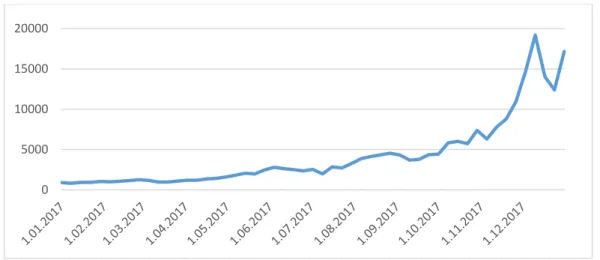
In retrospect price history of Bitcoin, when it launched in the stock market, the value of bitcoin almost tracked between $0 and $1 during the year 2010. In 2011, the price of bitcoin reached $31 for the first time, which was its first major bubble. The price was stable until April 2013, then the price of bitcoin reached $266, the value was growing by 5-6% daily. Also in April, when the price reached $233, it decreased to $67 in 12 hours. Due to the fact that the FBI shut down online market Silk Road, the value of bitcoin decreased 71% in 12 hours. Because Silk Road had been using Bitcoin as a primary payment method. Towards the end of 2013, the price of Bitcoin started to increase to $1,000. 2017, it was a golden year for Bitcoin and Bitcoin investor. The price reached $19,000 which was the highest value of Bitcoin heretofore in 2017, not to mention the coincidence that CBOE and CME futures trading platforms had just announced the very first Bitcoin contracts. The 2017 prices of Bitcoin are presented cumulatively in Figure 1.1.
Figure 1.1. 2017 Prices of Bitcoin
Source: Investing.com
Although Bitcoin had a strong view supported with high trading volume and price in early 2018, the bear market had suddenly shown itself fed by many fear facts one after the other; such as crypto related advertisement bans announced by the biggest
0 5000 10000 15000 20000
10
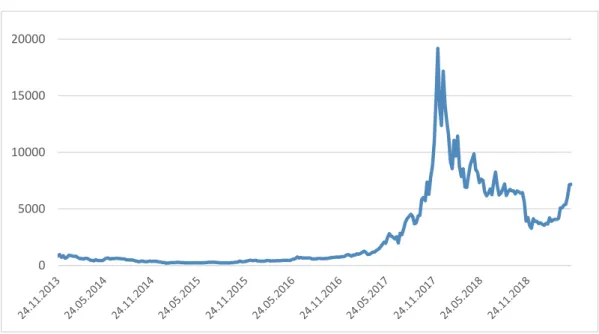
social media and internet platforms Google, Facebook, and Twitter. The rest followed while South Korea based exchange pairs removed by CoinMarketCap platform as well. In 2018, the price of Bitcoin fell down below $4000. The volatility of prices is stable between $3,500 and $8,000, nowadays in 2019.
Bitcoin price is shown cumulatively in Figure 1.2 for range 2013 and 2019.
Figure 1.2. Cumulative Prices of Bitcoin
Source: Investing.com
On the other hand, the market capitalization of Bitcoin has is increasing in time and reached the highest market cap in 2018 as seen in Figure 1.2 above. Similarly, the number of bitcoin transaction got closer to 10,000,000 transactions from 2009 to 2017. After the launch of Ethereum, Bitcoin faced the first rival challenge in 2014. In one way or another, Bitcoin is the leader of the cryptocurrency stock market since 2011. 0 5000 10000 15000 20000
11 1.5 Altcoins
Altcoins are alternative cryptocurrencies to Bitcoin. Many altcoins either forked or copied the idea of Bitcoin Whitepaper, which tied them on to basics of Bitcoin. However all altcoins are not the same, they have differences in terms of different proof-of-work algorithms, transactions speed and so on. There are thousands of altcoins (approximately 2133 cryptocurrency are listed on CoinMarketCap) and this number is increasing day by day. Barely a few of altcoins are successful enough to survive at the cryptocurrency stock market.
Altcoins claim to contribute to blockchain technology where Bitcoin was not seen effective, such as Ripple network provides an inter-currency payment to users which serves as a protocol. Users/investors have alternative options through altcoins and this provides developers to Bitcoin continue developing and stay innovating. Thus, there is a kind of healthy but not fair competition between altcoins and Bitcoin. Altcoins are risky and more volatile than Bitcoin, because of that low market caps and prone to manipulation. Manipulation in altcoins is realized by wealthy traders to cause the price to skyrocket or dive in ground zero. They accumulate a sizeable amount of low-price altcoins then pump the prices up to sell for high profit. On the other hand, noob investors who invest those altcoins at the wrong time, suffer a high loss. Furthermore, those manipulation cause that lifespan of those altcoins reducing. To recognize a strong and healthy altcoin, there are three features to mention. If an altcoin has high liquidity, possess a strong community and have developers who proactively improve the coin’s source code, it is usually strong and healthy when compared to scam sisters.
12
Namecoin was the first altcoin, which was launched in April 2011 and its primary purpose was to decentralize domain-name registration. Although Namecoin had a short lifespan, it was a successful altcoin at the stock market. At the same time in 2011, Litecoin was launched. It has differed from Bitcoin by using a hashing algorithm and has much more supply than Bitcoin. Therefore, Litecoin is known as “silver to Bitcoin’s gold”. Furthermore, Litecoin is one of the most successful and assertive competitors to Bitcoin, moreover, Litecoin was second in the market cap in 2018. Then Ethereum got into the market, and Bitcoin has obtained another strong competitor.
There were just 15 cryptocurrencies in the stock market when the total market cap worth was approximately $1.5 billion in 2013. On the other hand in 2018, the total market cap of cryptocurrency exceeded $200 billion with 1960 cryptocurrencies listed in major exchanges. Between 2013 and 2018, Bitcoin was the leader of the stock market. Its worth reached to $112,051,104,549 in 2018. On the other hand, the market cap of Litecoin reached $1 billion in 2013. It was the second in the stock market until Ethereum was launched. Then, Litecoin was ranked the seventh place and the market cap of $3,269,333,322 in 2018. Novacoin has a market cap of $1,198,172 in 2013 which declared unique block generations. It was ranked in 434 positions in 2018 which is known as a “scamcoin”. EOS was the new fifth popular cryptocurrency instead of Novacoin in 2018. Terracoin was launched in 2012 and in the same year it was hacked and its reputation just disappeared. After the hacking, the worth of Terracoin did not recover again. It was ranked in 680 positions in 2018. Frecoin reached $669,208 market cap in 2013 which went after Satoshi Nakamoto’s model of recording — the proof-of-work blockchain adopted in the creation of Bitcoin. In 2018, Frecoin disappeared from the list of CoinMarketCap.
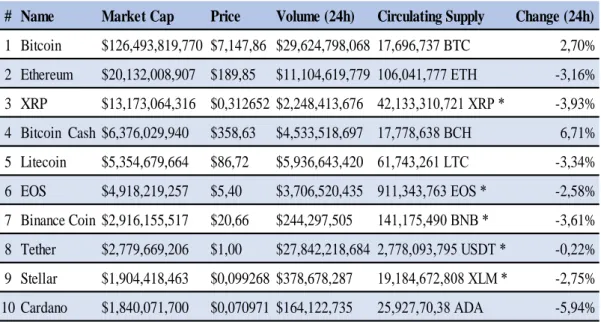
Nowadays, there are approximately 2133 cryptocurrencies and total market cap is $184,187,740,180. From 2018 to 2019, the ranking of cryptocurrencies changed.
13
The top ten list of cryptocurrencies, their market cap and prices are presented in Figure 1.3 below.
Figure 1.3. Top Ten List of Cryptocurrencies in April 2019
Source: Coin Market Cap
1.6 Blockchain
Blockchain is a peer-to-peer system and it is a data structure which is a secure and transparent, decentralized digital ledger. It provides features to share data and keep it safe. Blockchain depends on timestamps and cryptographic hash (which is known as an SHA-256) thence Blockchain is secure. Three types of blockchain where all types use a decentralized authority to manage ledger in a secure way are: i) Public Blockchains which are open-source and large distributed networks which run through a native token such as Bitcoin. ii) Permissioned Blockchains which are not always open-source, it needs to take permission but still, they are large distributed networks which use native token such as Ripple. They provide roles that individuals # Name Market Cap Price Volume (24h) Circulating Supply Change (24h) 1 Bitcoin $126,493,819,770 $7,147,86 $29,624,798,068 17,696,737 BTC 2,70% 2 Ethereum $20,132,008,907 $189,85 $11,104,619,779 106,041,777 ETH -3,16% 3 XRP $13,173,064,316 $0,312652 $2,248,413,676 42,133,310,721 XRP * -3,93% 4 Bitcoin Cash $6,376,029,940 $358,63 $4,533,518,697 17,778,638 BCH 6,71% 5 Litecoin $5,354,679,664 $86,72 $5,936,643,420 61,743,261 LTC -3,34% 6 EOS $4,918,219,257 $5,40 $3,706,520,435 911,343,763 EOS * -2,58% 7 Binance Coin $2,916,155,517 $20,66 $244,297,505 141,175,490 BNB * -3,61% 8 Tether $2,779,669,206 $1,00 $27,842,218,684 2,778,093,795 USDT * -0,22% 9 Stellar $1,904,418,463 $0,099268 $378,678,287 19,184,672,808 XLM * -2,75% 10 Cardano $1,840,071,700 $0,070971 $164,122,735 25,927,70,38 ADA -5,94% * Not Mineable
14
could play within the network. iii) Private Blockchains which are not open-source and the membership is closely controlled. Because of that, they are smaller networks which do not utilize a token.
Blockchain consists of three core parts which are listed and explained: i) Block which is a list of transaction which records the data into a digital ledger in a given period. It records the movements of all cryptocurrency or token which use blockchain structure. ii) Chain, where each block within the blockchain is identified by a hash and the hash connects blocks to each other. Each block references the previous block that the hash is created which is known as the parent block. iii) Network which is explained by Tiana Laurence as a third core part of the blockchain as “The network is composed of “full nodes.” Each node contains a record of all transactions that were ever recorded in that blockchain. The nodes are located all over the world and can be operated by anyone.” Most people operate the nodes to earn/mine cryptocurrency such as Bitcoin.
The genesis block is known as the first created block by Satoshi Nakamoto in 2009. Below is the hash of the famous Genesis Block.
000000000019d6689c085ae165831e934ff763ae46a2a6c172b3f1b60a8ce26f
Furthermore, it is known as the block hash of the first Bitcoin block. Figure 1.4 depicts a visualization of the Bitcoin blockchain network structure.
15 Figure 1.4. The Bitcoin Blockchain Network
Source: http://dailyblockchain.github.io/
Most of the popular cryptocurrencies such as Bitcoin, Ripple, Ethereum, Factom and so on, use the blockchain protocol as a software. Bitcoin network consists of approximately 5,000 full nodes and it is used to trade since 2009 in the cryptocurrency stock market. Furthermore, Ethereum network consists of approximately 5,000 full nodes too. However, Ethereum differs from Bitcoin by adding a programming language into the blockchain structure. Making smart contracts and creating Decentralized Autonomous Organizations (DAOs) are the primary reasons of Ethereum popularity. Bitcoin and Ethereum are globally distributed. On the other hand, the Factom network composes to federated and unlimited nodes. The Factom which built for secure data and system utilizes a more basic consensus system, incorporates voting, and stores a lot more information.
16
The consensus in blockchain means to provide the process of an agreement among mistrusting shareholders. Each entry is created by blockchain to create an agreement. These entries could be in different types such as storing data, securing system and so on.
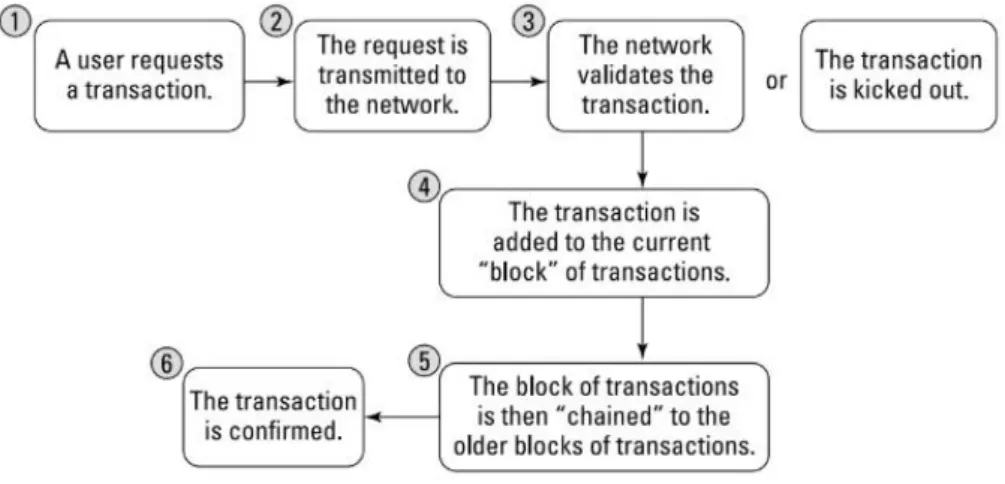
In Figure 1.5, a flow diagram of creating a blockchain agreement is shown step by step:
Figure 1.5. How Blockchain Works to Create an Agreement
Source: Laurence (2017)
For example, tokens have a market value and they are used for trading in the network in the Bitcoin, therefore tokens need requirement such as performance, scalability, threat model and so on. Laurence explains Bitcoin as “Bitcoin operates under the assumption that a malicious attacker may want to corrupt the history of trades in order to steal tokens. Bitcoin prevents this from happening by using a consensus model called “proof of work” that solves the Byzantine general’s problem: “How do you know that the information you are looking at has not been changed internally or externally?” Because changing or manipulating data is almost always possible, the reliability of data is a big problem for computer science.”
17
Likewise, blockchain has a similar assumption and this inherent vulnerability may be exploited by hackers or users. Therefore, the blockchains determine the types of consensus algorithms in the nodes which are used in the ledgers to state the threat or trust degree.
18 CHAPTER 2
2. LITERATURE REVIEW
Beginning existence of cryptocurrency in the stock market, so many economists or researcher curious about effects of cryptocurrencies over the investors and their investment choices. In other respects, they also study about volatility, return and main drivers of cryptocurrencies, especially Bitcoin. When we reviewed the literature, we encounter with so many research about the effect of indexes on Bitcoin such as economic policy uncertainty, geopolitical risk and such on.
Demir, Gozgor, Lou and Vigne (2018) analyze the prediction power of the economic policy uncertainty (EPU) index on the daily Bitcoin returns the period from July 18, 2010, to November 15, 2017, by using the Bayesian Graphical Structural Vector Autoregressive model. The study shows that the EPU has predictive power on Bitcoin returns which is a negative relationship between Bitcoin returns and EPU index. Depends on the result of the study, it is found that Bitcoin could serve as a hedging tool against uncertainty.
Wang, Xie, Wen, and Zhao (2018) provide an extended study about risk spillover effect from EPU to Bitcoin. They investigate risk spillover effect by using a multivariate quantile model and the Granger causality risk test which used the US EPU index, equity market uncertainty index, and VIX as proxies for EPU. Wang et al. (2018) were used for data the period from 18 July 2010 to 31 May 2018, they realized the tests. In this context, the risk spillover effect from EPU to Bitcoin is negligible in most conditions. Under those findings, Bitcoin could be a safe-haven or o diversifier under EPU shocks for investors who have investment strategies in Bitcoin.
19
Bouri, Gupta, Tiwari, and Roubaud (2017) examine whether Bitcoin can hedge global uncertainty by measuring of the first component of Volatility Indexes (VIXs) of developed 14 country and developing equity markets. In the study between 17th March 2011 and 7th October 2016, Bouri et al. (2017) find that Bitcoin reacts positively to uncertainty at both higher quantiles and shorter frequency movements of Bitcoin returns which acts such as a hedge against the uncertainty. Furthermore, Bouri et al. (2017) observe by using quantile-on-quantile regression at shorter investment periods that Bitcoin could hedge both global uncertainty and lower and upper ends of Bitcoin returns.
Fang, Bouri, Gupta, and Roubaud (2019) publish an extended study about global economic policy uncertainty effects on the long-run volatilities of Bitcoin, global equities, commodities, and bonds. Fang et al. (2019) examine further global economic policy uncertainty effects on the correlation between Bitcoin and global equities, commodities, and bonds by using GARCH-MIDAS model, using daily and monthly data which were expressed in USD, between 21st September 2010 and 26th January 2018. The findings are revealed that there is a negatively significant relation between global economic policy uncertainty and impact on the Bitcoin-bonds correlation, on the other hand, there is also a positive significant relation between global economic policy uncertainty and impact on both Bitcoin-equities and Bitcoin-commodities correlations. Therefore, Fang et al. (2019) reveal that there is a possibility of using Bitcoin as a hedging tool against economic uncertainty. Associated with the level of global economic uncertainty, it was observed the hedging effectiveness of Bitcoin causes a little increasing to both global equities and global bonds. Nevertheless, Fang et al. (2019) conclude that these effect of global economic uncertainty was weak for investors to increase the hedging capabilities of Bitcoin against economic uncertainty.
20
Aysan, Demir, Gozgor, and Lau (2019) investigate the power of geopolitical risk index on Bitcoin in terms of daily returns and volatility. Their study covers data starting from July 2010 to May 2018 and using a Bayesian based approach. According to the results, Aysan et al. (2019) conclude that Bitcoin returns and volatility is predictively affected by GPR. On the other hand, the results of the Ordinary Least Squares (OLS) estimations show price volatility of Bitcoin and GPR related positively and returns of Bitcoin and GPR related negatively. Furthermore, the Quantile-on-Quantile results show positive effects at the higher quantiles of Bitcoin returns and volatility, as well as GPR. Depends on the result of the study, Aysan et al. (2019) find that Bitcoin could serve as a hedging tool against geopolitical risks.
Koutmos (2018) studies a novel measure of liquidity uncertainty for Bitcoin using bid-ask spread data from Bitfinex which is one of the largest and most liquid Bitcoin Exchange. Koutmos (2018) measure part of high and low liquidity uncertainty of Bitcoin between October 2013 and March 2018 by using the Markov regime switching model. This study revealed that the novel measure of liquidity uncertainty could be used to analyze liquidity developments in Bitcoin exchanges or to gauge the immediacy associated with buying or selling Bitcoin.
Chaim and Laurini (2018) investigate the dynamics of Bitcoin daily returns and volatility by using firstly a standard log-normal stochastic model and then formulations of incorporate discontinuous jumps to volatility and returns. In the results of the study, Chaim and Laurini (2018) find two high volatility periods which are Mt Gox incident between 2013 and 2014, and the peak of Bitcoin in 2017. It is concluded that big jumps (which means return) negatively associated with formative events such as hacks which is relevant to capture large price variations in the cryptocurrency markets.
21
Kristoufek (2015) examines the potential drivers of Bitcoin prices and the potential influence of Chinese market, by using methods such as analyzing speculative and technical drivers of the exchange rate between the Bitcoin (BTC) and the US dollar (USD) between September 2011 and February 2014. Depends on the results of analyzes, Kristoufek (2015) find that the Bitcoin forms a unique asset possessing properties of both a standard financial asset and a speculative one.
Blau (2017) tests the unusual level of Bitcoin’s volatility was speculative trading for attributable, or not, by using price and volatility data the period from July 2010 to June 2014. The study could not conclude that the findings speculative trading was related to the unprecedented rise and subsequent crash in Bitcoin’s value during 2013, further directly associated with Bitcoin’s unusual level of volatility.
MacDonell (2014), over the period from July 2010 to August 2013 by using initial data set, explains trading volume using autoregressive moving average (ARMA) model and then attempting to predict crash using log-periodic power law (LPPL) model. As a result of studies, it is found that Bitcoin values are speculated by investors looking outside traditional markets based on ARMA modeling. Furthermore, MacDonell (2014) finds that LPPL models could be used as a valuable tool for understanding bubble behavior in digital currencies when LPPL models predicted accurately ex-ante the crash in December 2013.
Cheung, Roca, and Su (2015) taking advantage of the gap of literature, they investigate the existence of bubbles in Bitcoin market by using a technique which was developed by Philips et al. (2013a). Cheung et al. (2015) find that three huge bubbles in the latter part of the period 2011–2013 lasting from 66 to 106 days which were one of the numbers of short-lived bubbles between 2010 and 2014.
22
Corbet, Lucy, and Yarovaya (2018) examine the existence and dates of pricing bubbles in Bitcoin and Ethereum by using fundamental drivers of the price, over the period for Bitcoin from January 2009 to July 2010, for Ethereum from July 2015 to November 2017. Corbet et al. (2018) analyze totally 3327 observation of Bitcoin and 826 observation of Ethereum on those periods. It is concluded that there were periods of clear bubble behavior and Bitcoin was in a bubble phase.
Chaim and Laurini (2019) estimate by using non-parametric methods, the volatility function of Bitcoin daily and high-frequency prices. As a continuation of the study, Andersen and Piterbarg’s (2007) estimated model as stochastic volatility. The parameter space, which is in the model, has a specific subset under which the asset’s price was a strict local martingale. The finding of the study is concluded that despite found the existence of a bubble in Bitcoin prices from early 2013 to mid-2014, there is not a bubble in Bitcoin in late 2017.
Garcia, Tessone, Mavrodiev, and Perony (2014) examine the effect of social interactions in the creation of price bubbles, especially on Bitcoin. Depends on the periods of rapid fluctuations in exchange rates on Bitcoin, it is hypothesized that those fluctuations were largely driven by the interplay between different social phenomena on this study. Garcia et al. (2014) analyze four socio-economic signals about Bitcoin from large datasets by using vector autoregression, which are the price on online exchanges, the volume of word-of-mouth communication in online social media, the volume of information search and user base growth. It is observed that price bubbles are driven by word of mouth and the new Bitcoin users in the absence of exogenous stimuli which were positive loops. It is concluded that it could occur to applications beyond cryptocurrencies to other phenomena that leave digital footprints, such as online social network usage which is measured to understanding the interplay between socio-economic signals.
23
Cheah and Fry (2015) demonstrate to exhibit the Bitcoin speculative bubbles by undertaking economic and econometric modeling of Bitcoin prices using daily closing prices between the periods from July 18th, 2010 to July 17th, 2014. The finding of the study is concluded that the fundamentals of Bitcoin prices are zero based on empirical evidence and Bitcoin exhibited as speculative bubbles like other assets.
Craggs (2017) questions the people’s ability to select and correctly evaluate the information they might rely upon to make decisions within the domain of Bitcoin speculation. It is concluded that human trust affected by loss and media exposure, further those study exposed a model of informational trust for a sub-community of users who claim expertise yet exhibit a number of biases which suggests that they do not actually utilize that expertise when making risky investment decisions.
Poyser (2018) tests herding behavior under the symmetric and asymmetric conditions that the prices of cryptocurrency are driven by herding. The prices tested using by Markov-Switching approach which has different herding regimes. Poyser (2018) uses 1801 observation which consists of Bitcoin and Litecoin, over the period from April 2013 to April 2018. It is concluded that the study was the first of analysis of price puzzle from herding behavior and it is shown that there were the informed people who insensitive to large price fluctuations in the cryptomarkets.
Gonzalez-Igual, Corzo-Santamaría, and Vieites (2018) study investors’ irrational biases and their level of confidence by using survey data of 106 professional investors from Spain and Portugal. As a result of research, it is observed that the female investors’ driven by more realistic analysis and be more risk-averse. On the other hand, it is observed that younger investors more affected by cognitive and
24
emotional bias. It is the most important point of study which was observed that CFA Charterholders admitted to affected by herding behavior who have a higher level of education.
Lam (2018) examines the existence of Bitcoin anchoring price in the trading decision of investors’ by dataset collecting from Kraken exchange which including ask prices and bid prices. As a result of the study is concluded that investors’ valuation of price affected by differently anchoring bias when investors placed bid or ask orders, which is the same both bull and bear market situations. As a conclusion, Lam (2018) suggests that investors should be aware of anchoring bias when making trading decisions.
El Jebari and Hakmaoui (2019) analyze the effect of investors’ overconfidence behavior on excess volatility in the Bitcoin market by adopting a new ARMA(p,q)-FIEGARCH(1,d,k,1) parametrization. During the analysis, it is used daily closing prices which were daily exchange volume of Bitcoin over the period from January 1, 2012, to May 31, 2018. The results of the analysis are proven that both long memory and overconfidence has an impact on Bitcoin volatility. Therefore, El Jebari and Hakmaoui (2019) assert this study could be enabled to predict investors’ behavior and irrational exuberances.
Eisl, Gasser, and Weinmayer (2015) disclose the impact of Bitcoin on a well-diversified investment portfolio by using Conditional Value-at-Risk approach. For this study, it is used Bitcoin USD price index over the period from July 18, 2010, to April 30, 2015. The results are concluded that Bitcoin should be included in optimal portfolios to equilibrate the risk of portfolios.
25
Briere, Oosterlinck, and Szafarz (2015) analyze the Bitcoin investment with a diversified portfolio which was including both traditional assets and alternative investments by using weekly data in the period between 2010 and 2013. It is confirmed that Bitcoin investment offered significant diversification benefits to a portfolio, even a small portion of Bitcoin could provide to increase the risk-return trade-off of well-diversified portfolios.
Bouri, Molnár, Azzi, Roubaud, and Hagfors, (2017) examine whether Bitcoin could act as a hedge and safe haven for major world stock indices, bonds, oil, gold, the general commodity index, and the US dollar index. For this study, it is used daily and weekly data the period between July 2011 and December 2015 which depends on a dynamic conditional correlation model. As an empirical result, it is concluded that Bitcoin was suitable for diversification purposes in portfolios, however, it is a poor hedge. On the other hand, Bitcoin could only serve as a safe haven against weekly extreme down movements in Asian stocks.
Guesmi, Saadi, Abid, and Ftiti (2018) investigate the conditional cross effects and volatility spillover between Bitcoin and financial indicators by using the GARCH model. In this analysis based on eight variables of data which are used stock markets such as MSCI Emerging Markets Index and MSCI Global Market Index, both Euro and Chinese exchange rate, gold and oil (gold bullion and West Texas Intermediate (WTI)), Bitcoin (Bitstamp), and the implied volatility index (VIX). The daily data are used over the period between January 1, 2012, and January 5, 2018. It is concluded that Bitcoin market provided hedging the risk of investment for all different financial assets in a short position, further, the hedging strategies which is including of Bitcoin besides gold, oil, equities are more successful to reduce the risk of the portfolio.
26
Liu (2018) examines the role of the ten major cryptocurrencies (such as Bitcoin, Ethereum, Ripple and so on) in portfolio diversification and the intestability. Based on the comparison between the ten major cryptocurrencies, it is concluded that different cryptocurrencies could improve the investment results in a diversified portfolio.
27 CHAPTER 3
3. DATA AND METHODOLOGY
Exton and Doidge (2018) propose a survey method to capture how people spend, save, invest and feel about money, especially cryptocurrencies (such as Bitcoin). In their study, it is observed that 66% of Europeans have heard cryptocurrency and 32% of Europeans agree about cryptocurrency is the future of investing. Exton and Doidge (2018) also state that less than 10% of people indicate owning cryptocurrency currently, however almost 25% say they see themselves buying cryptocurrency in the future. On the basis of Exton and Doidge (2018) study, we designed a survey study to determine cryptocurrency investor profile and effects of personal characteristics and behavioral bias on Bitcoin/altcoin ownership. In this part, we try to explain the method and data of this study.
3.1 Data
We investigate investors’ profile and ownership, especially in the cryptocurrency market and examine the effect of behavioral and psychological perceptions on their investment. Our dataset is both the first study and has unique determinants when compared to previous studies examining the cryptocurrency stock market, especially in Turkey.
Between April 22, 2019, and May 7, 2019, the survey study was accomplished with 304 attendees via the internet platform. The survey contained 34 questions in Turkish, which aimed to capture target investors’ personal information such as age, monthly salary and so on, habitual investment preferences, risk perception, financial literacy and disposition to behavioral bias.
28
We focused on three main behavioral biases which were ambiguity aversion, overconfidence aversion, and loss aversion to examining disposition to behavioral bias. Loss aversion was explained by Kahneman and Tversky (1979) as “losses loom larger than gains”. It was observed about loss aversion by Schindler and Pfattheicher (2016) that people be disposed to take risks to avoid a loss than gain. Within the scope of loss aversion, we measured to attendees’ disposition on their investment decisions. As an example, we asked two questions below and answers of these questions based on four scales which are I sell all my assets, Sell some of my assets and keep some, I do nothing, Buy some more from the same asset:
Example 1: What do you do if an asset in your portfolio doubles in six months after you buy it?
Example 2: There is no apparent reason, but the value of your assets suddenly fell by 8 percent, so what are you going to do now?
The results explain how much disposition to loss aversion do attendees have. For Example 1, choices on “I sell all my assets” or “I sell some of it” indicate that attendees’ prefer to avoid loss possibilities. Further for Example 2, choices on “I don't sell” or “I try to get some more from the same assets” indicate that attendees’ prefer to avoid loss possibilities.
The ambiguity (uncertainty) is defined as a risk which is a gamble with a precise probability distribution. Furthermore, ambiguity aversion (uncertainty aversion) is a known disposition to choose known risks over unknown risks. We measured to attendees’ disposition to ambiguity aversion which is similar to Ellsberg (1961) ball experiment which is known Ellsberg Paradox with a question below:
29
Example: There are two boxes, Box K and Box U below. In both boxes, there is a total of 100 balls, Box K contains an equal amount of purple and orange balls. Box U also contains a mixture of purple and orange balls, but the ratios are known. If a purple ball is drawn in the selected box, you win $15. Which box do you choose?
Based on the Ellsberg Paradox, the results indicate that attendees’ prefer to choose the bag which is known contains 50-50 mixture. The results show that these attendees’ have ambiguity aversion bias according to Ellsberg, 1961.
On the other hand, our third focus which is overconfidence bias (effect), known as exaggerating to people's own predictive ability. Generally, people think their information level and predictive abilities are good than others. In the cryptocurrency stock market, we examine investors’ disposition to overconfidence on their decisions with a question below which have four scales as Easy, Somewhat easy, Somewhat difficult and Difficult:
30
Example: How easily do you think it was to predict the collapse of the mortgage market in the USA?
The result that investor recalls that predicting seems easy and somewhat easy will be likely to indicate the prediction of investor overconfidence.
For measure attendees’ the financial literacy and risk perception, we asked seven questions which were five questions about financial literacy level and two questions about risk perception (to measure how much investors' tendency to risk-seeking or risk-avoiding). We categorized questions of financial literacy in five contexts according to the OECD/INFE International Survey which researches adult’s financial literacy competencies in 2016. The following questions of context are shown:
Example 1: Supposing that five brothers are to share equally a gift of 1,000USD in total. How much does each one get? This question was used to measure attendees’ simple mathematics abilities desired for financial context.
Example 2: Supposing someone put 100USD into a tax-free and fee free savings account. It has a guaranteed interest rate of 2% / year. No more payment or withdrawal is done on the account. How much would there be in the account at the end of the one year period after the interest payment is made? This question was used to measure attendees’ ability to calculate simple interest on savings.
Example 3: A high return investment is likely to be high risky, in other words if someone you do not know offers you the chance of making lots of money, it is likely to experience the opposite by losing lots of money. This question was used
31
to measure attendees’ ability to understand the standard relation between risk and return. We accepted the attendee have the ability, who choose the option of true.
Example 4: The term "cost of living increases rapidly" means high inflation. This question was used to measure attendees’ ability to know the meaning of the term of inflation. We accepted the attendee have the ability, who choose the option of true.
Example 5: Buying a extensive range of stocks and shares usually makes it is possible to reduce risk of investing in stock market or if you save your money in more place, it is less likely that you will lose all of your money. This question was used to measure attendees’ ability to aware of the benefit of the diversification. We accepted the attendee have the ability, who choose the option of true.
On the other hand, we measured attendees’ risk perceptions with two questions according to Veld and Merkoulova (2008) study about the risk perception below:
Example 1: Suppose that you are planning to invest your own 1,000 EUR money in an investment fund, and you can choose between two. Both funds are to be liquidated after 1 year and they pay out 1,100 EUR on average (which makes 10% return, equal to the stock market’s average return). End of the year, the payment is not known. Following are the probabilities of different payments to receive from funds. What would be your choice?
A. Fund A: 10% chance of 200 euro, and 90% chance of 1,200 euro B. Fund B: 40% chance of 920 euro, and 60% chance of 1,220 euro C. Both choices are equally attractive (or unattractive) to me
32
In this question, risk perception measured by the expected value of loss in the market return. Hereunder, Fund A riskier than Fund B. So, if the attendee chooses A, it indicates that attendee probably prefers risk seeking, or if the attendee chooses B, it indicates that attendee probably prefers risk avoidance.
Example 2: Suppose that you are planning to invest your own 1,000 EUR money in an investment fund, and you can choose between two funds again. Both funds are to be liquidated after 1 year and they pay out 1,100 EUR on average (which makes 10% return). Interest on a savings account is less than this return. On the other hand, a savings account will pay guaranteed 1,040 EUR (return of 4%). Interest on the savings account can be used to make a comparison. 1,000 EUR cannot be put in a savings account. What would be your choice?
A. Fund A: 10% chance of 680 euro, 5% chance of 1,050 euro, and 85% chance of 1,150 euro
B. Fund B: 5% chance of 730 euro, 70% chance of 1,050 euro, and 25% chance of 1,310 euro
C. Both choices are equally attractive (or unattractive) to me D. The question is not clear for me
In this question as the same method in example 1, if the attendee chooses A, it indicates that attendee prefers risk avoidance, or if the attendee chooses B, it indicates that attendee prefers risk-seeking, If the attendee chooses A in example 1, and B in example 2, it indicates that attendee definitely prefers risk-seeking. On the other hand, if the attendee chooses B in example 1 and A in example 2, it indicates that attendee definitely prefers risk avoidance.
33
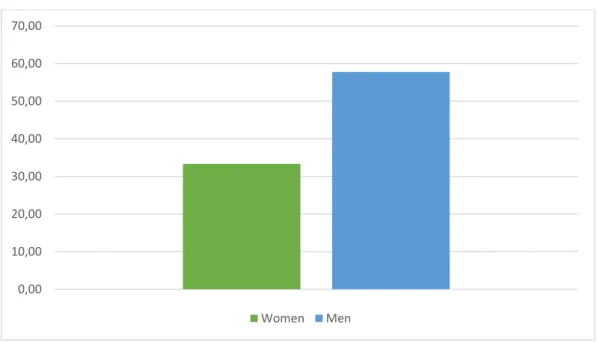
When we examine of results of the survey, 99.7% of attendees say that they heard cryptocurrency or Bitcoin before. 87.5% of attendees have own cryptocurrency. 12.5% of attendees don’t have own cryptocurrency, however, 97.37% of these attendees say that they heard cryptocurrency. 5.64% of attendees are women, while, 94.36% of attendees are men, who have own cryptocurrency. 91% of attendees who have own cryptocurrency disagree with the assumption which cryptocurrency or Bitcoin is a balloon. 95.48% of attendees have own altcoins. When we investigate the attendees’ education level, who own cryptocurrency, it is observed that 58.27% of attendees have a bachelor degree and 28.57% of attendees have a master’s degree or more. Those attendees’ total rate is 86.84% among all attendees. It indicates they prefer to invest cryptocurrency who have high-level education within all attendees. Figure 3.1 shows that 33.33% of women who own cryptocurrency, invest to altcoins. On the other hand, 57.77% of men who own cryptocurrency, invest to altcoins.
Figure 3.1. Altcoin Ownership by gender
0,00 10,00 20,00 30,00 40,00 50,00 60,00 70,00 Women Men
34
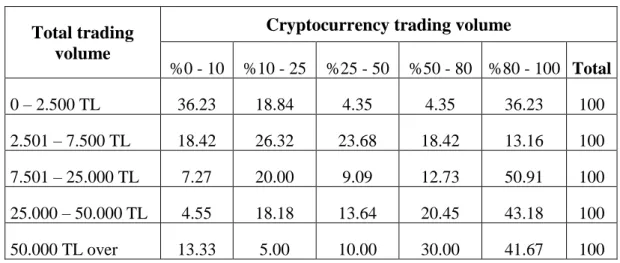
It is observed that 71,80% of attendees invest in between 1 and 10 different altcoins, and secondly, 20,30% of attendees invest in between 10 and 25 altcoins, amongst who own cryptocurrency. Examining data of monthly average trading volume, it is indicated that approximately 24% of attendees have a trading volume between 1 TL and 2.500 TL, and secondly, 23% of attendees have a trading volume more than 50.000 TL, thirdly 21% of attendees have a trading volume between 7.500 TL and 25.000 TL. When we comb through attendees’ total trading volume, we found that 50,91% attendees using between 7.501 TL and 25.000 TL of their total trading volume to invest in altcoins using 80% to 100% of their funds, as seen in Table 3.1. It is the biggest investment rate between attendees’ cryptocurrency trading volume.
Table 3.1. Cryptocurrency trading volume
Total trading volume
Cryptocurrency trading volume
%0 - 10 %10 - 25 %25 - 50 %50 - 80 %80 - 100 Total 0 – 2.500 TL 36.23 18.84 4.35 4.35 36.23 100 2.501 – 7.500 TL 18.42 26.32 23.68 18.42 13.16 100 7.501 – 25.000 TL 7.27 20.00 9.09 12.73 50.91 100 25.000 – 50.000 TL 4.55 18.18 13.64 20.45 43.18 100 50.000 TL over 13.33 5.00 10.00 30.00 41.67 100
For the sake of comparing differences of investment rate between altcoins and Bitcoin, we questioned attendees’ Bitcoin trading volume. Depending on the survey results, it is shown that the 52,17% of attendees using between 0 TL and 2.500 TL of their total trading volume to invest in Bitcoin using 0% to 10% of their funds, as seen in Table 3.2. Exclusively, 25,45% of attendees using between 7.501 TL and 25.000 TL of their total trading volume to invest in Bitcoin with 80% to 100%. This comparison between cryptocurrency and Bitcoin trading volume could indicate that the attendees prefer altcoins more than Bitcoin to invest.
35 Table 3.2. Bitcoin trading volume
Total trading volume
Bitcoin trading volume
%0 - 10 %10 - 25 %25 - 50 %50 - 80 %80 - 100 Total 0 – 2.500 TL 52.17 21.74 8.70 5.80 11.59 100 2.501 – 7.500 TL 42.11 28.95 23.68 2.63 2.63 100 7.501 – 25.000 TL 38.18 18.18 12.73 5.45 25.45 100 25.000 – 50.000 TL 18.18 27.27 25.00 13.64 15.91 100 50.000 TL over 30.00 11.67 21.67 15.00 21.67 100 3.2 Methodology
In this section, the models and analysis followed in the creation of the model are described. Two models are used; logistic regression model (LRM) and ordinary least squares (OLS) as a linear regression model. When our dependent variable changes between 0 and 1, so we used the LRM model. The LRM is used to analyze the significance between cryptocurrency ownership as y variable, and financial literacy, gender, income status, education level, age, ambiguity bias as x variables, which consist of four analysis. The general formula of LRM indicates in formula (1) below:
𝑙𝑜𝑔𝑖𝑡 (𝑝) = 𝑏0+ 𝑏1𝑋1+ 𝑏2𝑋2+ ⋯ + 𝑏𝑛𝑋𝑛 (1)
On the other hand, when our dependent variable is a continuous variable, we used OLS model to analyze the significance between number of altcoin types as y variable, and financial literacy, female, income status, education level, age, ambiguity bias, risk-seeking, experience level as x variables, which consist of three analysis. The general formula of OLS indicates in formula (2) below:
36
𝑌 = 𝛽0+ 𝛽1𝑋1+ 𝛽2𝑋2+ ⋯ + 𝛽𝑛𝑋𝑛+ 𝜀 (2)
The x variables as independent variables, classified to use in our regression analyses are identified below:
If x variable is Female equals 1, Male equals 0. Financial literacy as x variable changes between 0 and 5. If income status over 5,000 TL, it is identified as a high income, if not, it is identified as a low income. If education level is pre-high school or equal to high school it is identified as low education if not, it is identified as high education. If the answer of x variable about overconfidence is somewhat easy or easy equals to 1, difficult or somewhat difficult equals to 0. If the answer of x variable about ambiguity bias Box K equals to 1, Box U equals to 0. If attendees choose B in example 1 and A in example 2, it is identified as high risk seeking. If experience level is more than 4 years, it is identified as high experience, if attendees didn’t invest to cryptocurrency yet, it is identified as low experience.
37 CHAPTER 4 FINDINGS
Financial literacy helps people to understand money and finance such as budgeting, debt, taxes and so on. Therefore, it is especially important about an individual’s personal finance. On the other hand, financial literacy provides people to understand how interest rate works, how to make financial planning or how to invest and so on.
When we searched the studies on the stock market about financial literacy, Rooij, Lusardi, and Alessie (2011) investigate financial literacy and its effect on the stock market participation by using Household Survey. As a result of research, it is observed that the attendees have basic financial literacy and have a comprehension about inflation, interest rate and so on. On the other hand, it is observed that the attendees don’t know the differences between stocks and bonds, the relationship between bond prices and interest rates, and the basics of risk diversification. Depend on these results, it is indicated that financial literacy affects financial decision-making, hence the attendees who have low financial literacy, much less invest in the stock market.
Almenberg and Dreber (2015) explore the relation between the gender gap in stock market participation and financial literacy. It is used survey data on a random sample of 1300 attendees from the Swedish population. As a result of research, it is observed that women have a much lower score on financial literacy and hence, women participate much less in the stock market. This differences indicated that the gender gap is significant in the stock market participation.
38
Barber and Odean (2001) analyze the common stock investments of men and women from February 1991 through January 1997 by using the data for over 35,000 households from a large discount brokerage. As a result of this analyze, it is found that men trade 45% more than women.
Arti, Julee, and Sunita (2011) investigate the effects of gender in the investment decision-making process. The study realizes with 200 questionnaires in India. As the findings of this study, it is indicated that the female investors act more deliberate in equity shares if the availability of funds low, furthermore female investor have less confidence to take investment decisions.
Li and Hu (2019) investigate the role of a prestigious university in peer-to-peer lending. The data is used from a lending platform from Renrendai.com in China. As a result of this study, it is observed that borrowers who graduated from a prestigious university, have a possibility of loan default and a lower ratio of loan default. Furthermore, the role of a prestigious university in peer-to-peer lending is important as it could predict lenders’ and borrowers’ behaviors.
Tatoğlu (2010) examine the investment choices and effects of determinated seven categories on investment choices which are social, personal and economic factors. The investment choices analyzed by using multinomial logit model that the data collected from 1300 public survey from Istanbul, Turkey. As a result of the analysis, it is indicated that women choose to invest in safer instruments who have a low level of education. Furthermore, it is observed that the positive relationship between education level, income and investment instruments, such as the education level increases, income and the probability of the investment in high-value assets also increases.
39
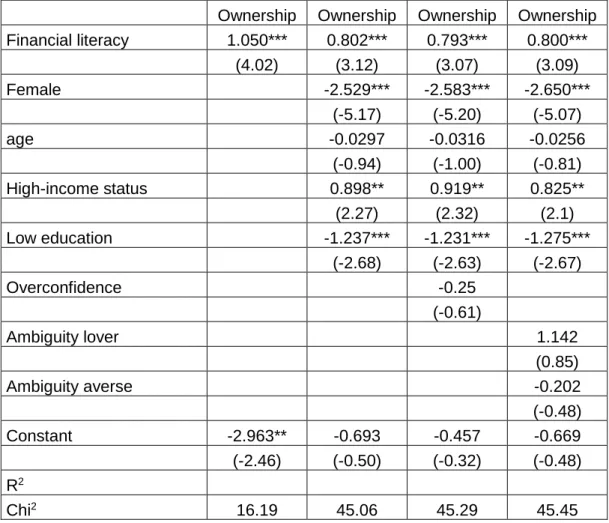
In the light of these studies about relation effects of the determinants in the stock market, we try to analyze effects of participation in the cryptocurrency market such as age, female, education level and so on. In this study, we expect that the determinants of cryptocurrency ownership are parallel with the determinants in the stock market. Using logit regression model, we analyzed the determinants of cryptocurrency ownership which is demonstrated Table 0.1 below:
Table 0.1. Cryptocurrency Ownership Regression Model
Ownership Ownership Ownership Ownership Financial literacy 1.050*** 0.802*** 0.793*** 0.800*** (4.02) (3.12) (3.07) (3.09) Female -2.529*** -2.583*** -2.650*** (-5.17) (-5.20) (-5.07) age -0.0297 -0.0316 -0.0256 (-0.94) (-1.00) (-0.81) High-income status 0.898** 0.919** 0.825** (2.27) (2.32) (2.1) Low education -1.237*** -1.231*** -1.275*** (-2.68) (-2.63) (-2.67) Overconfidence -0.25 (-0.61) Ambiguity lover 1.142 (0.85) Ambiguity averse -0.202 (-0.48) Constant -2.963** -0.693 -0.457 -0.669 (-2.46) (-0.50) (-0.32) (-0.48) R2 Chi2 16.19 45.06 45.29 45.45
In Table 4.1, the analysis indicates that financial literacy and high-income status have a statistically significant positive relationship with cryptocurrency ownership. On the other hand, gender by female, age and low education level have a statistically
40
significant negative relationship with cryptocurrency ownership. Such as the education level decreases, the ownership of cryptocurrency also decreases.
Embrey and Fox (1997) explore gender differences in the investment decision making the process by using a sample of the 1995 Survey of Consumer Finances. As a result of the study, it is found that women are more likely to hold risky assets if expecting an inheritance, employed and holding higher net worth; while men are investing in risky assets if they were risk seekers, divorced, older, and college educated.
Delis and Mylonidis (2015) investigate the effect of happiness on financial assets and insurance products by using survey data from a sample of Dutch households. In previous studies, there is a relation between trust and invest in financial assets and insurance products. Delis and Mylonidis (2015) are found that happiness has a negative effect on both risky financial assets and insurance products, while trust has a positive effect.
Gao, Meng, and Zhao (2019) work on stock market participation decisions’ determinants. The study used compiled aggregate stock account opening data in China. Gao et al. (2019) examine relative on the level and also the change of the participation rate which are effected by disposable personal income, demographic information, economic factors such as macroeconomic factors, financial factors such as stock market conditions, and social communication. As a result, it is found that the level of participation rate on the stock market is affected by the income, while the effects are more significant during the bull market period, in high-income, education level, and population density groups.