EXAMINING THE RELATIONSHIP BETWEEN PROJECTIVE IDENTIFICATION, GENDER ROLES, CONFLICT RESOLUTION STYLES AND MARITAL
SATISFACTION
FATMA GÖKÇE YÜCEL 110629016
İSTANBUL BİLGİ ÜNİVERSİTESİ SOSYAL BİLİMLER ENSTİTÜSÜ
KLİNİK PSİKOLOJİ YÜKSEK LİSANS PROGRAMI
YRD. DOÇ. DR. AYTEN ZARA 2013
Abstract
This thesis explored the relationship between projective identification, gender roles, conflict resolution styles and marital satisfaction. This thesis provides an integrative view to understand marital satisfaction by examining various determinants which come from different perspectives. The data was collected from 123 married people: 54 of them male and 69 of them female. Their ages ranged from 23 to 44 and the mean of their age was 32, 5. Firstly, correlation analysis was run for examining the relationship between projective
identification, conflict resolution style and marital satisfaction. Secondly, series of 2X2X2 ANOVA were conducted to explore the effect of sex and gender roles; having feminine characteristics and having masculine characteristics, on marital satisfaction and conflict resolution styles. The results showed that there was a positive correlation between persecuting projective identification and negative conflict resolution styles whereas there was a positive correlation between idealizing projective identification and subordination behaviors. Similar to previous studies, there was a positive correlation between idealizing
projective identification and marital satisfaction whereas there was negative correlation between persecuting projective identification and marital satisfaction. On the other hand, having feminine characteristics has a significant main effect on marital satisfaction and subordination behaviors. The results were discussed according to socio-cultural perspective and psychodynamic perspectives.
Özet
Bu tez çalışmasında yansıtmalı özdeşim, cinsiyet rolleri, çatışma çözme stilleri ve evlilik doyumu arasındaki ilişki incelenmiştir. Bu tez, evlilik doyumunu etkileyen ve farklı bakış açılarından gelen faktörlerin ilişkisini inceleyerek entegratif bir bakış açısı sunmaktadır. Veriler evli, 54’ü erkek ve 69’u kadın olan 123 kişiden toplanmıştır. Katılımcıların yaşları 23 ile 44 arasındadır ve yaşlarının ortalaması 32,5’tur. Yansıtmalı özdeşim, çatışma çözme stilleri ve evlilik doyumu arasındaki ilişkiyi incelemek için korelasyon analizi
kullanılmıştır. Cinsiyetin ve cinsiyet rollerinin; kadınsı özelliklere sahip olma ve erkeksi özelliklere sahip olma, evlilik doyumu ve çatışma çözme stilleri
üzerindeki etkisini incelemek için 2X2X2 ANOVA analizleri kullanılmıştır. Sonuçlar tehdit edici/zulmedici yansıtmalı özdeşim ve olumsuz çatışma çözme stilleri arasında pozitif bir ilişki olduğunu göstermiştir. Diğer bir yandan, idealleştiren yansıtmalı özdeşim ve boyun eğici davranışlar birbiriyle pozitif bir ilişki içerisindedir. Buna ek olarak, tehdit edici/zulmedici yansıtmalı özdeşim evlilik doyumuyla negatif bir ilişki içerisindeyken, idealleştirilen yansıtmalı özdeşimle pozitif bir ilişki içerisindedir. Kadınsı özelliklere sahip olmanın itaatkar davranışlar ve evlilik doyumu üzerinde etkisi vardır. Araştırmanın sonuçları psikodinamik ve sosyo-kültürel bakış açıları doğrultusunda tartışılmıştır.
Acknowledgements
Firstly, I would like to express my gratitude to my thesis advisor Assist. Prof. Ayten Zara. She encouraged and trusted me in each step of my thesis process. The thesis process would be much more difficult without her academic guidance and emotional support. Secondly, I would like to thank Assist. Prof. Ümit Akırmak for his valuable, accurate and constructive feedbacks about statistics, methodology and results of the study. In addition, I would like to thank Assist. Prof. Nilüfer Kafesçioğlu for accepting to be the third reader of this thesis and her support. Also, I am grateful for her interest in the subject of this research.
I would like to thank all my friends who helped me during the graduate years. Special thanks to my close friends Elif, Gülay and Gülsah for their support and companionship. It would be hard to complete this graduate program without them. I would like to thank Elif for her endless support in statistical analysis and collecting the data. Also, thanks to Elif for her patience and encouragement which make me peaceful whenever I feel anxious. In addition, I would like to thank Gülay for her valuable contributions in this thesis. Her emotional support, enthusiasm and efficient solutions helped me to continue this thesis whenever I felt overwhelmed. I would like to thank Gülsah for her endless emotional support, trusting and believing in me throughout my life.
I would like to thank my close friend Tuğba. With her companionship and support, completing this program was much easier for me. Also, I would like to thank my friend Cansu for helping me in statistical analysis with patience in her busy days. In addition, I would like to thank all participants who joined my study.
This thesis is dedicated to my family; my mother, Serap and my father, İsmail and my fiancé, Cenan. I would like to give my greatest appreciation to my family in trusting and believing me through my life. My mother’s unconditional love and support helped me to continue this process whenever I felt overwhelmed. Last, but never least, I would like to thank Cenan for his ongoing love, endless support and patience. He always trusted and encouraged me in this thesis process. His presence made me a happier and more peaceful person which helped me a lot in completing this master program.
Table of Contents
1. Introduction...…...1
1.1. Background Information for the Topic...………..1
1.2. Marital Studies in Turkey………....3
1.3. Aims of the Study………...4
1.4. Significance and Implications of the Study...………..5
2. Literature Review...………...6
2.1. Marital Satisfaction...6
2.1.1. Individual Factors that Affect Marital Satisfaction.………...……...6
2.1.1.1. Cognitions, Schemas, Attributions………...7
2.1.1.2. Personality Characteristics... 8
2.1.1.3 Gender Roles………...9
2.1.2. Interpersonal Dynamics and Marital Satisfaction………....9
2.1.2.1. Attachment Style………...9
2.1.2.2. Projective Identification………....10
2.1.2.3. Interaction Patterns………10
2.2. The Definition of Projective Identification………...10
2.2.1. Projective Identification and Couple Relationship ………...15
2.2.2.1. Projective Identification and Marital Satisfaction………..18
2.3. Conflict Resolution Styles……...………...21
2.3.1. Individual Factors that Affect Conflict Resolution Style....……….23
2.3.1.1. Gender……….23
2.3.1.2. Needs………...24
2.3.1.4. Psychological Distress………...25
2.3.2. Relational Dynamics and Conflict Resolution Style………....25
2.3.3. Conflict Resolution Style, Couple Dynamics and Satisfaction…………....27
2.4. Explanations for Gender Roles and Gender Identity…………..………...32
2.4.1. Socio-cultural Definition of Gender Roles………...32
2.4.2. Psychoanalytic Explanations of Gender Identity………...34
2.4.2.1. Ego Defenses and Gender Roles………...35
2.4.3. Integrative Explanation of Gender Identity……….36
2.4.4. Gender Roles and Marital Processes………....38
3. Method... ………...40
3.1. Participants...………...40
3.2. Measures………...42
3.2.1. Marital Life Scale (MLS)... ………...42
3.2.2. Paulson Daily Living Inventory (PDLI)...………... 42
3.2.3. Conflict Resolution Style Scale (CRSS)………..44
3.2.4. BEM Sex Role Inventory ………...44
3.3. Procedure... 46
4. Results……….47
4.1. Overview………..………...47
4.2. Correlations among Projective Identification, Conflict Resolution Styles and Marital Satisfaction……….…………...49
4.3. The Main Effect of Sex and Gender Roles on Conflict Resolution Styles and Marital Satisfaction………51
4.5. Multiple Regression Analysis for the Relationship among Gender Roles,
Projective Identification, Conflict Resolution Styles and Marital Satisfaction……..56
4.6. The Relationship among Socio- demographic Variables and Marital Satisfaction………...58
5. Discussion………...59
5.1. Study Findings……….59
5.2. On the Relationship between Projective Identification and CRSS……….59
5.3. On the Relationship between Projective Identification and Marital Satisfaction………...61
5.4. On the Relationship between CRSS and Marital Satisfaction……….63
5.5. On the Relationship among Feminine, Masculine Characteristics, CRSS and Marital Satisfaction……….63
5.6. On the Relationship among Feminine, Masculine Characteristics and Projective Identification………...66
5.7. The Relationship among Demographic Variables and Marital Satisfaction……66
5.8. Contributions and Limitations………..68
6. References...71
Appendices A. Informed Consent Form……..………...85
B. Demographic Information Form…...86
C. Paulson Daily Living Inventory…...88
D. Conflict Resolution Style Scale...91
E. Bem, Sex Role Inventory………...92
List of Tables
Table 1 Socio-Demographic Characteristics of the Participants………....41 Table 2 Reliability Analysis of the Scales………..48 Table 3 Correlations among Projective Identification, Conflict Resolution Styles and Marital Satisfaction……….50 Table 4 Multiple Regression Analysis of the Variables for Marital Satisfaction…...57
List of Figures
Figure 1. Main effect of feminine characteristics on subordination for males……….52
Figure 2. Main effect of feminine characteristics on subordination for females…...52
Figure 3. Main effect of feminine personality characteristics on NCRS for males…..53
Figure 4. Main effect of feminine personality characteristics on NCRS for females...53
Figure 5. Main effect of feminine characteristics on marital satisfaction for males….54
Figure 6. Main effect of feminine characteristics on marital satisfaction for
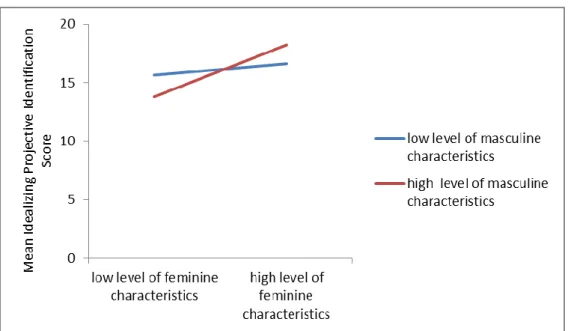
females……….54 Figure 7. Interaction effect of masculine and feminine characteristics on idealizing projective identification………...55
1. Introduction
Unresolved marital conflicts and marital problems make couples unhappy, lead distress and cause psychological problems. On the other hand, satisfying relationship maintains social support for couples and brings a better quality of life. Nowadays, increasing divorce and domestic violence rates have been leading researchers to
reconsider the concept of marriage. Especially, searching for the determinants of marital adjustment and marital satisfaction and defining the factors which make couples happy has gained more importance (Baumeister & Leary, 1995; Ottu & Akpan, 2011).
Most of the researches explain marital conflict, marital adjustment and marital satisfaction based on one perspective. Marriage comprises complex relational dynamics. At this point, explaining determinants from one perspective without examining their interaction is not enough to understand this concept. In the present study, the effect of projective identification, conflict resolution style, gender roles on marital satisfaction were examined by exploring their relationship with each other. These concepts come from different perspectives. Projective identification belongs to object relations
perspectives while gender roles are related to socio- cultural view. The aim of the study was to examine different views together and understand marital satisfaction from an integrative perspective.
1.1. Background Information for the Topic
Marital satisfaction means how people happy and satisfied about their marital life (Ottu & Akpan, 2011). Communication patterns, needs, personality characteristics, values, attachment styles, schemas were important determinants of marital satisfaction (Ottu & Akpan, 2011; Dumitrescu & Rusu , 2012, Blum & Mehrabian, 1999).
Projective identification was introduced by Melanie Klein (1946), one of the innovators of object relations perspective. According to Klein, a person wants to get rid of a part of self which may be destroying and threatening for the self therefore the person projects it on another person. Another reason for getting rid of the part is that the person may want to protect the part from other threatening parts of the self. In projective identification, the person feels connected with other person and feels as a unit with that person. The recipient behaves in a similar way to projective fantasy of the projector therefore; the projector experiences the unwanted part through recipient’s identification. This experience takes place in the first years of life, between the object (mother) and the baby. Some researchers suggest that people experience these similar relational dynamics in their romantic relationship (e.g., Kernberg, 1991). They claim that marriage is a cycle in which these dynamics repeat. At this point, projective identification is a very crucial concept that needs to be examined to understand couple’s unconscious relational dynamics.
According to gender schema theory, introduced by Bem (1981), children develop cognitive schemas about gender roles, being affected from their cultures, therefore they learn gender roles. Some researchers emphasize sex differences on marital processes. At this point, how people define themselves according to gender role expectations is also important to understand the effect of gender on marital processes.
Conflict resolution style is a very important concept for determining marital quality, marital satisfaction and marital adjustment. Positive, constructive conflict resolution styles increase marital adjustment and marital satisfaction. On the other hand, negative, destructive conflict resolution styles increase distress level and psychological problems of couples (e.g., Christensen & Shenk, 1991).
1.2. Marital Studies in Turkey
In Turkey, there were limited empirical studies which examined the role of conflict resolution styles, gender roles and projective identification on marital life. Göral-Alkan (2010) examined both interpersonal and intrapersonal factors which were related to projective identification. She found that there was a positive correlation between idealizing projective identification and relationship satisfaction whereas there was a negative correlation between persecuting projective identification and relationship satisfaction.
Malkoç (2001) examined the relationship between marital adjustment and communication patterns and found that people with high marital adjustment scores use destructive communication strategies less than people with low marital adjustment scores. In addition, Bahadır (2006) explored the relationship between attachment styles and conflict resolution styles of couples and found that avoidance dimension was the predictor of accommodating, compromising and avoiding conflict resolution styles. Also, Çelenoğlu (2011) examined coping efforts of married couples and concluded that men use avoidance coping style more than women do whereas women use self- blaming coping efforts more than men do.
Anar (2011) studied the relationship between gender roles and marital
satisfaction and found that people with androgen role have higher marital satisfaction level than people with undifferentiated gender role. Similar to Anar, Çınar (2011) examined the relationship between gender roles and marital satisfaction. Çınar found that people with feminine and androgen role have higher marital satisfaction scores than people with masculine and undifferentiated gender role. Lastly, Bal (2007) claimed that gender roles have very crucial role in predicting marital adjustment. In her study, she
concluded that femininity score of men and marital adjustment score were positively correlated to each other. In addition, it was found that marital adjustment scores and femininity scores of women were positively correlated to each other.
1.3. Aims of the Study
In the light of past research and literature, the main goal of the present study was to explore the relationship among projective identification, gender roles, conflict
resolution styles and marital satisfaction. By examining the relationship among different variables, it was aimed to integrate different concepts to understand marital satisfaction. In the present study, conflict resolution styles were considered as couples’ behavioral patterns. Projective identification was explored to understand the couples’ unconscious dynamics whereas gender roles were examined to understand the couples’ socio- cognitive schemas which are defined by family and culture.
The hypotheses are;
1) To explore the relationship between projective identification and conflict resolution styles
a) A positive correlation between persecuting projective identification and negative conflict resolution styles was expected.
2) To explore the relationship between projective identification and marital satisfaction. a) A positive correlation between marital satisfaction and idealizing projective
identification was expected.
b) A negative correlation between marital satisfaction and persecuting projective identification was expected.
3) To explore the effects of sex and gender roles on conflict resolution styles and marital satisfaction level
4) To explore the effects of gender roles on projective identification 1.4. Significance and Implications of the Study
The present study is one of the few empirical studies which explored the
relationship between marital processes and projective identification. Also, this study is the first empirical study which examined the relationship between projective
identification and conflict resolution styles. Exploring the association between unconscious and behavioral patterns of couple may provide an integrative view to couple therapists.
The present study examined the relationship between projective identification, gender roles, marital satisfaction and conflict resolution styles. The results were explained according to socio-cultural and psychodynamic perspectives therefore, the study provides an integrative view to understand the marital processes.
In addition, demographic variables were explored in relation to couples’
interactions. This information provides socio- cultural information on Turkish couples which is very important in working with Turkish couples.
To conclude, the present study helps us to understand marital processes in a multidimensional way and provides an integrative perspective for couple and marriage studies which has been a recently developing area in Turkey.
2. Literature Review 2.1. Marital Satisfaction
Marital satisfaction comprises complex relational dynamics and various
determinants therefore it is hard to explain marital satisfaction by a simple definition. Baumeister (2007) stated that marital satisfaction is a concept in which couple
reconsider the benefits and cost of their marriages and decide how satisfied they are. If people think that their marriages bring more cost than benefits, they will be unsatisfied. In other words, the perceived benefits and costs of marriage define the level of marital satisfaction and happiness.
Similar to Baumeister (2007), Brockwood (2007), stated that marital satisfaction is an examination of one’s marriage based on different areas and making evaluations about how satisfied and happy one is (Ottu & Akpan, 2011).
Plenty of study examined different predictors of marital satisfaction to define and understand this concept in a better way. The quality of communication, leisure interactions, compatibility among couple’s values, beliefs, needs and the agreement in some basic subjects which are related to relationship such as child rearing, finances, households are important factors in defining marital satisfaction (e.g., Ottu & Akpan, 2011; Dumitrescu & Rusu , 2012, Blum & Mehrabian,1999).
2.1.1. Individual Factors that Affect Marital Satisfaction
Various variables that researchers examined about marital satisfaction are related to individual factors such as cognitive structures, personality characteristics, gender roles (Abedi, Bahrami, Etemadi, Fatehizadeh, & Ghasemi, 2012).
2.1.1.1. Cognitions, Schemas, Attributions
Some researchers emphasized the importance of cognitive factors in marital satisfaction. Ellis (1986) proposed that high level of irrational beliefs such as illogical, rigid, exaggerated thoughts lead disturbance such as marital distress. Similarly in a study in Turkey, Hamamci (2005) explored the relationship between dysfunctional relationship beliefs and marital conflict. He stated that there was a positive correlation between dysfunctional beliefs and marital conflict.
Several studies emphasized the importance of causal attributions that couples make about their marital problems and their effects on emotional distress (Bradbury, Finchman, & Grych, 1990; Tilden & Dattilio, 2005). Also, Baucom, Epstein, Sayers, and Sher, (1989) pointed out the significance of attributions, expectations and standards of couples’ about marital life.
According to Beck (1979), schemas comprise basic beliefs about human nature and relationships. They are usually stable. Some schemas which are associated to relationships are formed early in life based on family relationships, culture and mass media (Beck, 1979; Tilden & Dattilio, 2005). When the schemas about relationship and partner are negative, the individual tends to explain the relationship and the behavior of the partner in a negative way. This may lead negative interactions between couples (Chatao & Whisman, 2009; Dumitrescu & Rusu, 2012)
According to Early Maladaptive Schemas Model, the maladaptive schemas are usually associated with marital conflict and distress. Maladaptive schemas are formed during adolescence or childhood and are dysfunctional in the individual’s personal relationship. These schemas are related to unmet emotional needs and activated in daily
life when a situation similar to negative past event occurs (Young, Klosko, & Weishaar, 2003).
In a study conducted by Dumitrescu & Rusu (2012), the relationship between early maladaptive schemas and the level of marital satisfaction were examined. A negative relationship between the scores of early maladaptive schemas and marital satisfaction level was found. The results of the study indicated that early negative schemas were the predictors of dysfunctional relationship and marital dissatisfaction. Early maladaptive schemas are related to abandonment, instability, emotional
deprivation, social isolation, incompetence, vulnerability to harm and pessimism. According to these early schemas, a person thinks that her/his partner may abandon her/him, give not enough support and do not love her/him. All in all, according to these early maladaptive schemas, people construct negative evaluations about their present relationship and these negative evaluations lead decreasing marital satisfaction.
2.1.1.2. Personality Characteristics
Blum and Mehrabian (1999) explored the relationship between temperament and marital satisfaction. They defined temperament in three categories; pleasantness, arousability and dominance. According to the results, the, individuals who had higher score on pleasantness and dominance and those who had mates with higher score of pleasantness were happier in their marriages. The wives with higher submissiveness and lower unpleasantness scores had lower scores on marital satisfaction.
Dumitrescu and Rusu (2012) examined the relationship between emotional expressivity and couple satisfaction. Emotional expressivity is a crucial factor in couple’s wellbeing. Emotional expressivity is a persistent pattern and related to expressing different emotions verbally and nonverbally. There was a positive
correlation between positive emotional expressivity and couple satisfaction
(Halberstadt, Cassidy, Stifter, Parke, & Fox, 1995; Rauer & Volling, 2005). In addition to this, marital satisfaction was positively related to expressing agreement, humor, approval, caring and empathy (Feeney, 1998; Dumitrescu, & Rusu, 2012).
2.1.1.3. Gender Roles
In a study in Turkey, Bal (2007) indicated that women who had high score in androgen type have highest marital adjustment score. Bal explained that androgynous women may show more tolerance and empathy therefore, this leads increase in their marital adjustment. Similar to this, in another study, it was found that women who had undifferentiated gender role had lower marital satisfaction than women who had androgynous role (Çınar, 2008).
On the other hand, another study results demonstrated that couples who had gender stereotyped roles were more likely to increase in their relationship satisfaction score than couples who had nonstereotyped roles (Heavey, Layne& Christensen, 1993).
2.1.2. Interpersonal Dynamics and Marital Satisfaction
Past researchers focused on the effects of interpersonal dynamics such as attachment style, projective identification and interaction patterns on marital satisfaction.
2.1.2.1. Attachment Style
Feeney (1996) explored the relationship between caregiving, attachment styles and marital satisfaction. He measured attachment styles by two categories; secure and insecure and caregiving in two dimensions; responsive and compulsive caring. According to the results, there was a positive relationship between secure attachment and beneficial caregiving which is low in compulsive and high in responsive caring. In
addition, positive relationship was found between secure attachment, beneficial caregiving of spouse and marital satisfaction.
2.1.2.2. Projective Identification
Some studies examined the relationship among projective identification, marital satisfaction and marital adjustment. Most of them indicated that there was a positive correlation among the marital adjustment, marital satisfaction and idealizing projective identification while there was a negative correlation among persecuting projective identification, marital satisfaction and marital adjustment (Catherall, 1992; Göral-Alkan, 2010; Kissen, 1996; Kovacs 1996; Middelberg, 2001; Rosegrant, 1981; Scharff & Scharff, 1997).
2.1.2.3. Interaction Patterns
There are different studies which examined the relationship between conflict resolution strategies of the spouses and the marital satisfaction. Most of these studies showed that there was a positive correlation between marital satisfaction and
constructive conflict resolution strategies such as agreement, humor while there was a negative correlation between marital satisfaction and destructive strategies; withdrawal and conflict engagement (Gottman & Krokoff, 1989; Heavey, Layne, & Christensen, 1993).
2.2. The Definition of Projective Identification
Projective identification is a very complex concept which was explained by different perspectives.
Melanie Klein (1946) examined the relationship between projection and identification and she introduced the term “projective identification”. Freud (1896) defined identification as “a repressed desire to be like another, to act like another”.
Identification is related to subjective psychical reality. According to Freud, a person identifies with what s/he imagines about the other person. Klein (1946) stated that projection is accompanied by identification.
Klein (1946) claimed that projective identification takes place in the phantasy of the infant. She stated two stages in the development of the infant; Paranoid-Schizoid and Depressive Positions. Klein indicated that projective identification belongs to paranoid- schizoid position. At this stage, aggressive drives, which increase with some negative experiences such as bodily pain and hunger, make infant anxious. This anxiety is hard to deal with therefore the infant splits off this unwanted, irritating part and projects it to another object, especially to mother. As a result of this, infant perceives his mother as “persecuting”. On the other hand, the infant may project his/ her libidinal instincts to mother. At this point the infant experiences his/ her mother as “ideal”. Both of them lead splitting between good and bad parts of self and object representations.
In depressive position, the infant starts to separate self from other and combines good and bad part object representations. In this stage, the infant has an increasing capacity to tolerate anxiety. People may experience both two stages during their lifetime occasionally (Segal, 2004; Spillius, 1988). Persecutory anxieties occur at paranoid- schizoid stage while guilty feelings appear at depressive stage. Destructiveness,
jealousy, hate are more obvious in paranoid-schizoid position while love, empathy and constructiveness are more apparent in depressive position. Although swing from one position to another continue during life time based on different life events, infants’ transition to depressive position is related to psychological health. By attaining depressive position, the infant relieves from his/her destructive anxieties.
Some theories emphasized the importance of intrapsychic processes in projective identification but through time interpersonal view gained importance. Nowadays,
researches have been focusing on integrating intrapsychic and interpersonal perspectives (Chescheir, 1995; Ogden, 1979).
Göka et al. (2006) described projective identification based on three different perspectives. The first one defines projective identification as a defense mechanism which is mostly seen in personality disorders in which the integrity of self is damaged. This view is mostly related to the pathological meaning of projective identification. The second perspective sees projective identification as an interpersonal mechanism in which transference and countertransference take place. The third perspective claims that projective identification can be observed in each interaction with other person.
Similar to this, Brunet and Casoni (2000) made classification of projective identification and they examined this concept in three categories. One of them is “Intrusive Projective Identification”. It is seen as a defensive fantasy which is defined by Melanie Klein. It is related to a “fantasy of omnipotent penetration of the object”. Second one is “Communicative Projective Identification”. This type is related to Bion’s term. According to this, projective identification has a communicative function. Last one is “Empathic Projective Identification”. It includes strong links with others to understand what others feel or think. It is related to love and libidinal impulses (Brunet & Casoni, 2000).
According to Bion (1962), projective identification has a nonpathological function. He emphasized the importance of containment in this process. He stated that when the infant’s unwanted thoughts cannot be contained and integrated, the infant uses projective identification. It has two instances. One of them is that an infant may want to
get rid of anxiety provoking content. Because in the phantasy the mother is responsible for this unwanted content, the mother needs to suffer. In the second one, the infant wants to communicate with mother about his stress therefore she can transform it for him. In both two processes, mother’s containing function is very important to decrease the infant’s anxiety, transform the unwanted anxiety provoking content and integrate it for the child. This function is very important for the infant to identify with mother’s containing function. All in all, Bion (1962) defined projective identification with its containment function. He claimed that therapist needs to be open for projections and contain them and give the contained material to the patients. This is very important for the psychological development of the patient.
Ogden (1979) explained projective identification in three phases. In the first stage, a person wants to get rid of a part of self. This part may be destroying and threatening for the self therefore, the person projects it on another person. Another reason for getting rid off this part is that the person may want to protect it from other threatening parts of the self. In the projection, a person simply wants to rid of the unwanted part of himself/herself therefore there is a psychological distance from the other person. On the other hand, in projective identification the person feels connected with other person and feels as a unit with that person. In the second stage, there is a real pressure to recipient person who receive projection. As a result of this pressure, the recipient feels himself to feel and behave in a way similar to projective fantasy of the projector. This pressure is formed by interactions between projector and recipient. Through these interactions, the projector feels that he can be understood by the
recipient. In this part there is a wish to control the projected part in other person. In the last stage, the recipient processes the projected part of the projector. Because the
recipient is a different person, he may process the experiences different than the projector. These differences make projector to see alternative psychological process to handle with anxiety provoking part of himself therefore he re-internalize the projected part of himself. At this point the psychological maturity of the recipient gains
importance. If the recipient is more mature than projector, he can take the projections, metabolize and process them therefore the projector can see more efficient way to handle with unwanted part and integrate the metabolized, contained (Bion, 1959) the part to the self. With all of these characteristics, projective identification has a function of defence, communication, primitive form of object relationship and a way to
psychological change (Ogden, 1979).
According to Segal (2008), projective identification has two aims. Firstly, the ideal object can be preserved by avoiding separation. Secondly, the danger of bad object can be controlled. Some parts of the self can be destructive for other parts therefore; these parts are projected to maintain safety for other parts. With these properties, projective identification can be seen as an adaptive mechanism in some circumstances.
Mendelsohn (2009) explained projective identification as a process of communication which takes place between two people in intimate contact. He
emphasized the importance of projective identification in working with marital couple. He stated that projective identification is malignant only when it is used with other primitive defenses (Mendelsohn, 2009).
McWilliams (1994) defined projective identification as a mature psychological process which includes empathy and intuition. According to him, projective
person’s motives, feelings and ideas to other people. On the other hand, introjection is related to integrating these feelings and motives. In other words, by projective
identification, projections of a person may turn real. He emphasized that there is a misconception that empathy is only related to the feeling of warm, sympathy and acceptance. He stated that empathy is a “capacity to feel with”. The feelings can be negative such as hate, anger, and sadness or warm and loving. He indicated that empathy is a mode of projection. Mother tries to understand her baby and guess her feelings by using projection. She uses nonverbal cues, her own hunches. Mendelsohn (2009) claimed that early mother- infant bond is established through projective mechanism. This early relationship is a very crucial dynamic for future close relationship.
2.2.1. Projective Identification and Couple Relationship
Childhood experiences and relationship with parents have very important role in shaping couple relationships. Children are both consciously and
unconsciously affected by their parents’ marital relationship. Siegel (2004) claimed that the reason distressed couple look for help is mostly related to their unconscious identification process. By using splitting and projective identification, couples turn their internal conflict to marital conflict. Past relationship of each couple is reenacted in their own marital relationship. Marital conflict in that sense is viewed as the “re-creation of conflict” couples have with their parents. Also, Dick (1963) stated that the mate selection is mostly affected by unconscious processes. According to Dick, people choose their partners according to their “fitness” to recreate the same conflict which is similar to their parents (Gabbard, 2005).
According to Siegel (2004), “introjected couple” includes fantasies, drives about childhood experiences with parents, but it also includes real aspects of the relationship. Children are unconsciously affected by this internalized construct. They may identify or disidentify with this construct. If the child rejects similar aspects, he/she may disown it and this may be ego- dystonic. Partners’ some behaviors such as conflict resolution styles, respect, dependency, trust can be shaped by these identification or
disidentification. They may identify with “introjected couple” and repeat the similar behaviors or they may disidentify and avoid doing similar behaviors as their parents did (Siegel, 2004).
According to Cognitive Analytic Theory, child encodes his early interactions as “schemas” (Benjamin & Friedrich, 1991). These schemas include memories
about self and the object. Activation of the schema shapes the perception and interpretation of the present events. These schemas are important in establishing and maintaining intimate relationship. Reactivation of a schema, which is related to hurtful aspect of past experiences, may lead distress in marital relationsh ip.
Projective identification is “an unconscious conflict from the representational world
which is reenacted in the marital relationship” (Benjamin & Friedrich, 1991, p.408). Projective identification leads both positive and negative experiences in marriages. It can be negative and traumatic for the couple who repeat an unresolved dynamic in which is related to “punitive, rejecting or neglecting object”. On the
other hand, projective identification may provide empathy and tenderness for couple (Solomon, 1997).
In addition to this, Ruszczynski (1992) indicated that the concept of projective identification, with its defensive and its developmental potential, has crucial role in a
way of thinking and understanding interaction between couple. The couple relationship offers the possibility of the expression of the more mature aspects of the personality, possible self-expression and integration. In which degree this integration is achieved may change from couple to couple. If a partner unconsciously contains the projected elements and enables the other partner to reintroject these same elements in a modified form, the partner, who projects, may move towards a greater degree of integration (Ruszczynski, 1992).
In a couple relationships, there is an unconscious wish to repair the pathogenic past relationship therefore; the unfulfilled aggressive needs are repeated by
reenactments with loved partner. With projective identification, the partner puts other partner in the characteristic of the past oedipal and pre oedipal object. Kernberg (1991) claimed that partners coming from different nonorganic pathologies; neurotic,
borderline, narcissistic, and psychotic categories create varying degrees of equilibrium that stabilize their relationship. The boundaries which set apart the couple from the social environment protect the couple’s equilibrium. On the other hand, extreme social isolation damages the sexual and emotional development of the couple. They may lose the capacity to metabolize the aspect of their aggression in the social context (Kernberg, 1991).
Furthermore, according to Dick (1967), individuals need to have both
dependence and personal identity for a successful marriage. He stated that in disturbed couples, the hateful parts are split and projected to the other partner. Kernberg (1975) also agreed with Dick in this claim. On the other hand, Mendelsohn (2009) sees projective identification as a mode of communication rather than a disturbance or pathological process. He stated that the malignant form of projective identification can
be occurred when partners use primitive defense mechanism such as denial and splitting and mostly projecting the negative, bad parts of the self. On the other hand, normal- neurotic, high functioning couple may also use projective identification. This form of projective identification may become an empathic linkage between couples and a good way to analyze couple interpersonal dynamics. The neurotic couple may tend to regress under any stressful and conflictual condition. Projective identification may have a containing function for couples. The partner who has a containing experience with his caregiver is able to take and contain the unwanted and disowned thoughts and feelings of other partner (Mendelsohn, 2009).
Couples who have mature relationship can meet each other’s split and projected parts and these parts can be integrated or repressed. On the other hand, in couples who have unhealthy marriages, these unwanted parts cannot be contained and they maintain disintegrated. At this point, the couple use projective identification as a defense
mechanism while in the first one as a communication (Kissen, 1996; Scharff & Scharff, 1997; Mones & Patalano, 2000; Middelberg, 2001).
2.2.2.1. Projective Identification and Marital Satisfaction
Some empirical studies examined the relationship between projective identification and marital satisfaction. “Paulson Daily Living Inventory” (Paulson, 1979) was used to measure projective identification. Paulson Daily Living inventory consist of five subscales. “Persecuting Mother to Infant”, “Infant to Persecuting
Mother”, “Ideal Mother to Infant” and “Infant to Ideal Mother” belong to the paranoid- schizoid position. These four subscales define the types of projective identification that are used. The total score of four subscales show the projective identification level. The fifth subscale is related to being in a depressive position and not being in a
paranoid-schizoid position. High scores for this subscale are related to be not likely to use projective identification in an intimate relationship. If a person is on “Ideal mother to infant position”, it means that she/he sees herself/himself as mother and her/his spouse as infant who is weak and unprotected and needs her mother’s care. In this type, the self sees herself/himself more powerful than her/his spouse and owns positive and protective attitudes toward her/his partner. Similar to ideal mother to infant position, if a spouse is in a “persecuting mother to infant position”, she/he sees herself/himself as having a mother role and sees her/his spouse as having an infant role. She/he thinks herself/himself is more powerful than her/his spouse. But the difference is at this position; she/he owns negative attitudes toward her/his spouse. If person is on the “infant to ideal mother position”, the partner sees himself/herself as infant and his/her partner as “ideal mother”. Opposite to ideal mother to infant position, at this time, self sees herself/himself as weak, unprotected infant and her/his spouse as “powerful and protective mother”. At this position, the person has a positive attitude toward her/his spouse. Similar to infant to persecuting mother position, if a spouse is on “infant to persecuting mother position”, she/he sees herself/himself as infant and sees her/his spouse as mother. She/he thinks her/his spouse is more powerful than herself/himself. But the difference is at this position; she/he owns negative attitudes toward her/his spouse. In “depressive position”, the person perceives herself/himself and her/his spouse in an equal position. This may be also assumed that this relationship is a mature relationship (Göral-Alkan, 2010).
Based on Paulson Daily Living Inventory, the researchers defined two categories; idealizing and persecuting projective identification and examined their relationship with marital satisfaction and marital adjustment. The sum of ideal mother
to infant and infant to ideal mother scores compose idealizing projective identification. On the other hand, the sum of persecuting mother to infant and infant to persecuting mother subscales form persecuting projective identification. In persecuting projective identification, one of the spouses projects his /her unwanted, irritating part of
himself/herself to other partner, therefore he/she tries to get rid off his/her unwanted anxiety provoking part. In phantasy, he/she attributes the responsibility of this anxiety to the other partner therefore she/he also needs to suffer about it. On the other hand, in idealizing projective identification, a partner projects a part of himself/herself to other partner to protect it from threating parts of himself/herself.
Göral-Alkan (2010) claimed that in persecuting projective identification, main motivations of couples’ interaction are associated with fear, anxiety, power struggles, conflict and ambivalence. Persecuting projective identification is associated with selfish, abusive, instable parenting behaviors. On the other hand, in idealizing projective identification, main issues are associated with need for closeness, protectiveness, inhibition of conflict, self-sacrificing and dependence. Idealizing projective identification is related to overprotective and anxious parenting behaviors. Couples who use idealizing projective identification give importance to nurturing in their relationship. Overprotective parents may prevent their children’s gaining autonomy therefore the children may feel dependent to other people (Göral-Alkan, 2010).
Rosegrant (1981) examined the relationship between projective identification and marital satisfaction. It was found that there was a negative correlation between persecuting projective identification and marital satisfaction whereas; there was a
Similar to Rosegrant’s findings, Kovacs (1996) found that there was a positive correlation among idealizing projective identification, marital adjustment and marital satisfaction. On the other hand, there was a negative correlation between persecuting projective identification and marital satisfaction, marital adjustment. These results may show that if partners perceive each other and their relationship in a good way; this may lead to increased marital satisfaction. On the other hand, if partners perceive each other and their relationship in a bad way, this may lead decreased marital satisfaction. Göral-Alkan (2010) found similar results for idealizing and persecuting projective identification but she found different results for depressive position. There was no significant relationship between depressive position and relationship
satisfaction. She concluded that it can be explained by cultural differences of Turkish couples. They may think depressive position as a detachment rather than being individual (Göral-Alkan, 2010).
Also, various researchers suggested that relationship satisfaction can be related to idealizing projective identification or lack of malignant projective identification. In malignant form of projective identification, couple may see each other as an extension of themselves therefore this may distort the autonomy of individuals and leads
relationship dissatisfaction (Catherall, 1992; Middelberg, 2001; Scharff & Scharff, 1997; Kissen, 1996).
2.3. Conflict Resolution Styles
Based on behavioral observations, Gottman and Krokoff (1989) defined some communication patterns used by couples. They emphasized some dysfunctional communication patterns which lead marital distress and deficit in conflict resolution. They defined three interaction styles as destructive for marital satisfaction in the long
run. These are defensiveness including whining, withdrawal from interaction and stubbornness. They used Marital Interaction Coding System’ (MICS; Weiss &
Summers, 1983) codes to define problem solving and communication patterns. Positive problem solving includes accepting responsibility, compromising, paraphrasing, and reflection. Positive verbal solving includes agreeing, approval and humor. Assent, attends, smiles are considered as positive nonverbal style. The sum of the scores of assent, agreement and approval is called compliance. On the other hand, there are some negative problems solving subscales. These are defensiveness, conflict engagement, stubbornness, withdrawal from interaction. Defensive subscale includes denying responsibility, “mind reading by partner followed by disagreement”, negative solution codes and excuses. Sum of the disagreement and criticism codes is called conflict engagement. This includes disliking other partner’s some behaviors, becoming angry and irritated about these behaviors. Stubbornness includes behaviors of noncompliance, command, and complaint and put down. Complaint is related to being “inconvenienced, wronged or deprived either through the partner’s action or nonaction or because of external circumstances.” This subscale also includes whining. Lastly, the sum of no response, not tracking, turn off and incoherent talk codes defines as withdrawal from interaction.
Kurdek (1994) defined some problem solving types based on Gottman’s and Krokoff’s (1989) behavioral observations. Kurdek’s Conflict Resolution Inventory (1994) has four categories; positive problem solving, conflict engagement, withdrawal and compliance. Positive style includes compromise and negotiation. Conflict
engagement is related to personal attacks and losing control. Withdrawal includes avoiding engage in a discussion and disregarding the partner. Compliance is related to
complying other partners’ wish and not defending own ideas. These types are very important for predicting relationship satisfaction and relationship dissolution (Gottman, 1994). It was found that high conflict engagement predicted dissolution for both
homosexual and heterosexual couples. On the other hand, there were inconsistent results about withdrawal, compliance and positive problem solving in predicting relationship dissolution. According to the results, the couples who had high scores in positive problem solving and low scores in conflict engagement and withdrawal had high relationship satisfaction. Compliance scores have a little effect on relationship satisfaction (Kurdek, 1994).
2.3.1. Individual Factors that Affect Conflict Resolution Styles There are plenty of individual factors that affect the choice of conflict management; such as gender, type of needs, personality characteristics and level of psychological distress.
2.3.1.1. Gender
Christensen and Heavey (1990) found that there was a significant effect of gender. They found that women usually made criticism and emotional request whereas; men usually took passive in action and retreated through defensiveness. In other words, women have demanding role whereas men have withdrawing role. Previous studies showed that dissatisfied wives were unhappy about their husbands' withdrawal while dissatisfied husbands were unhappy about their wives’ criticisms, complaints, and emotionality (Christensen & Heavey, 1990; Terman, Buttenweiser, Ferguson, Johnson, & Wilson, 1938). Two explanations about demand /withdraw interaction in marriages were defined. One of them; individual differences perspective, emphasizes stable differences between men and women such as biological differences. This theory
suggested that men have more physical arousal during a conflictual situation therefore men avoid from the situation to decrease this arousal (Gottman & Levenson, 1986). Another individual difference is related to attributions of different social roles to men and women. Need for intimacy and relationship -orientation are usually attributed to women whereas independence and achievement- orientation are attributed to men (Gilligan, 1982; Rubin, 1983). Another view, conflict structure perspective, claims that women see conflict engagement as a way to gain control and power because they have little power and control whereas men preserve their control and power statue by avoiding conflictual situations (Christensen & Heavey, 1990; Kurdek, 1995).
In another study, it was found that there was a gender differences in the preference of conflict management style. Men were usually use avoidance and
competition while women were inclined to use accommodation (Greeff, & Debruyne, 2000).
2.3.1.2. Needs
Schneer and Chanin (1987) examined the relationship between needs and conflict resolution styles. They found that need for dominance and competing
resolution style were positively correlated to each other. However, need for dominance and accommodating style were negatively related to each other. Also, there was a positive correlation between need for affiliation and accommodating style. On the other hand, need for affiliation and competing style were negatively correlated to each other. These results indicated that people’s needs have an effect on how they solve their problems and how they interact with each other. If a person has high level of
dominance need, she/he may behave in an assertive and uncooperative way, whereas if a person has high level of affiliation need, she/he may behave in a harmony with other
people. Similar to this, Wood and Bell (2008) found that when need for affiliation increases smoothing style increases and forcing styles decreases.
2.3.1.3. Personality Characteristics
Wood and Bell (2008) examined the relationship among two dimensions of the ‘‘Big Five Personality Traits”; extraversion and agreeableness and the conflict
resolution styles; competing, collaborating, accommodating, and avoiding. Collaborating style is related to finding creative solutions, confronting with
disagreement. On the other hand, competing is power oriented. Accommodating style is related to smoothing other person, looking for harmony. It was found that extraversion and agreeableness were significant predictors of the conflict resolution styles. They indicated that the level of agreeableness was positively correlated with using
accommodation style and negatively correlated with competing style (Wood & Bell, 2008). In addition to this, Graziano, Jensen-Campbell, and Hair (1996) found that the levels of agreeableness was positively correlated with using compromising while it was negatively correlated with using power assertion tactics in conflict resolution.
2.3.1.4. Psychological Distress
Papp, Goeke-Morey, and Cummings (2007) examined the relationship between conflict strategies and psychological distress level of the each couple. They found that couples who had higher levels of symptoms use negative strategies such as withdrawal and pursuit. The authors concluded that psychological distress level was the predictor of negative conflict expression at home (Papp et al., 2007).
2.3.2 Relational Dynamics and Conflict Resolution Style
Shi (2003) explored the relationship between adult attachment style, conflict resolution behaviors and relationship satisfaction. He examined adult attachment style
in two dimensions; anxiety and avoidance and four category; Secure (low on Anxiety and Avoidance); Fearful (high on Anxiety and Avoidance); Dismissing (low on Anxiety and high on Avoidance); and Preoccupied (high on Anxiety and low on Avoidance). Avoidance is related to feeling discomfort about intimacy and self-disclosure. On the other hand, anxiety is related to fear of rejection. They defined conflict resolution behaviors in two dimensions; concern for others and concern for self and five category; Integrating (high on self, high on others), Dominating (high on self, low on others), Obliging (low on self, high on others), Avoiding (low on self, low on others), and Compromising (medium on self, medium on others). The results showed that there was a negative correlation between both anxiety and avoidance dimensions and relationship satisfaction. These results indicated that avoidance was a predictor of all type of conflict resolution behaviors while anxiety was a predictor of obliging and dominating behaviors. In addition to this, there was a positive correlation between conflict
resolution behavior of dominating and both anxiety and avoidance dimensions. The author claims that because avoidant people have difficulties in engaging a relationship they do not use constructive strategies such as compromising and integrative. On the other hand, they prefer to use avoiding strategies which are more close to them. The findings showed that securely attached people use more integrative and compromising strategies then insecurely attached people. There were no gender differences in the use of Compromising, Dominating, and Obliging conflict resolution strategies. It was found that male used avoidance behaviors more than females did whereas female used more integrative conflict resolution behaviors more than males did. It was emphasized that attachment style is more powerful factor in predicting conflict resolution style than gender (Shi, 2003).
2.3.3. Conflict Resolution Style, Couple Dynamics and Satisfaction Attributing imaginary power to partner, thinking that he can deal with everything, being afraid of intimacy, being too much dependent or being too much independent, having inflexible gender roles are important factors that lead conflict among married couples. Conflict can be beneficial or destructive. At this point, conflict resolution style gains importance. If couples deal with the conflict with positive conflict resolution style, this can be strengthening and enriching for couples’ relationship. Positive resolution styles emphasize ideas, principles, values and issues. By using positive resolution styles, couple can understand each other’s feeling; define new goals which are satisfying for both of the couple members’ needs and wishes. On the other hand, negative resolution styles emphasize personality attacks, revenge and power struggles between the spouses. Negative resolution styles lead destructive effects on couple relationship in different ways. It may be destructive for the self-concepts of each partner. It may lead hostility and rage. It may lead insecurity, stress and confusion between spouses. Sometimes couples have difficulties in defining common goals to solve their conflict. These difficulties may be related to the differences in couple’s values, personality dynamics, fear of rejection, fear of disrespect, fear of intimacy.
Matthews (1914) defined three types of relational styles based on their conflict resolution style. One of them is “conflict excluding style” in which one of the spouses takes the responsibility for making decision. The spouse who makes the decision has the dominant role and the other spouse has the subordinating role. They together form one identity. In the “conflict avoiding style”; both of the spouses avoid conflict. On the other hand, in “conflict resolving style” spouses give importance to both each other’s needs and the sake of their relationship. Confrontation is very important in
conflict management. Trust, cooperation, empathy, respect are crucial factors in effective, beneficial conflict management (Matthews, 1914).
Özen (2006) emphasized that conflict management is a very crucial factor in understanding marital process. She examined the relationship between value similarities and conflict resolution styles of couples and its effect on marital adjustment and marital process. She examined values in ten different areas; power, achievement, hedonism, stimulation, self-direction, universalism, benevolence, tradition, conformity and security. In addition to this, she examined marital adjustment of wives, husbands and couples. She found that spouses who had high scores in positive conflict resolution style and low scores in negative conflict resolution style showed higher marital adjustment than spouses who had low scores in positive conflict resolution style and high scores in negative conflict resolution style. She emphasized that negative conflict resolution styles have more contribution on marital adjustment therefore they have more predictive effect on marital adjustment. Özen (2006) stated that this can be explained by Baumeister, Bratslavsky, Finkemauer and Vohs’s assumption (2001), “bad is stronger than good.” According to the researchers, bad life experiences of people have more impact on people’s actions and decisions than good life experiences. This makes people more careful about harmful situations. On the other hand, Gaelick, Bodenhause and Wayer (1985) claimed that people pay more attention to negative situations and remember negative behaviors and feelings of their partner more than positive behaviors and feelings. Özen (2006) found that value similarities as a whole was a significant predictor for marital adjustment of wives. According to the results, there was a positive relationship between the value similarities in hedonism, stimulation and marital
emotional interest and life pleasure which are associated with well- being and life satisfaction of people which may also lead couple satisfaction. On the other hand, there was a negative relationship between the similarities in power value and adjustment of wives and couples marital adjustment (Özen, 2006). If both of the spouses give
importance to power value, this may lead increasing conflict between spouses. If one of them gives less importance to power value, this may prevent increasing arguments and conflict.
Destructive conflict management style is related to threat, coercion, avoidance, retaliation, inflexibity and rigidity, competitive pattern of dominance and subordination (Bacciocchi, 1997). When partners try to solve conflict in a destructive way, this may lead negative affect such as anger and resentment (Christensen & Shenk, 1991; Özen, 2006). On the other hand, constructive conflict management is associated with being flexible, cooperative and relationship focused (Hocker & Wilmot, 1995). Previous researches show that there was a positive correlation among constructive conflict management, relationship stability and marital satisfaction (Brehm, 1992; Fincham, 2003; Gottman, 1993; Gottman, Markman, & Notarius, 1977; Gottman & Krokoff, 1989; Greeff & Bruyne, 2000; Heavey, Layne, & Christensen, 1993; Straus, 1979). Similar to these findings, most of the studies which examined conflict management style and marital satisfaction showed that there was a positive correlation between marital satisfaction and constructive conflict resolution strategies such as agreement, humor while there was a negative correlation between marital satisfaction and
destructive strategies; withdrawal and conflict engagement (Gottman & Krokoff, 1989; Heavey, Layne, & Christensen,1993). Some people claim that there is a causation that by using constructive strategies people gain rewards and this leads marital satisfaction
(Rusbult, 1983). On the other hand, others think that this process is related to self-fulfilling prophecy which means that the people behave in a consistent way with their initial behavior and this leads marital satisfaction (Kurdek, 1995; Snyder, Tanke, & Berscheid, 1977).
Kurdek (1994) studied marital satisfaction and conflict resolution strategies in a longitudinal study and examined how they predict each other. They used CRSI (Kurdek, 1994) to measure conflict resolution strategies. Kurdek found that wife demand-
husband withdraw conflict resolution strategies were related to low marital satisfaction. Another study which examined the relationship between marital satisfaction and conflict management styles showed that collaborative style had the highest correlation with marital satisfaction. On the other hand, competitive style had the lowest correlation with marital satisfaction (Hocker & Wilmot, 1995).
Koren, Carlton, and Shaw (1980) examined the relationship between conflict resolution behaviors and marital distress. In the first part, the couples were tested with Locke-Wallace Marital Adjustment scale. Secondly, they participated video sessions and interaction tasks which stimulate conflict were assigned. They had role plays for these tasks. Lastly, the couples were applied a questionnaire which asked the
representativeness of their behavior in each situation. The videotaped interactions were transcribed and coded. They were coded according to seven parts; responsiveness; acknowledgment, agreement, and acceptance, inquiry; solution proposal, criticism. Koren et al. (1980) found that “distressed couples were more critical of each other and less responsive other's influence efforts than were nondistressed couples”. They emphasized that although distressed couple were not different in proposing solution than nondistressed couple, they were different in the propensity to reach agreement on
the solutions. They claim that nondistressed couples were more likely to achieve conflict management (Koren et al., 1980).
Christensen and Shenk (1991) studied with two different couple groups which were distressed couples; divorcing group and clinical couples and nondistressed couples. They examined communication patterns and the level of conflict.
Nondistressed couples were assigned according to their dyadic adjustment scale scores. Communication Pattern Questionnaire and Relationship Issues Questionnaire (RIQ) were applied to the participants. RIQ was used to measure desire for intimacy and satisfaction with power distribution in the relationship. Christensen and Shenk (1991) found that nondistressed couples had more mutual constructive communication; less avoidance communication and less demand/withdraw communication patterns than distressed couples. Also, distressed couples had more conflict over psychological distance in their relationships. Compared to clinic group, divorcing group used less mutual constructive communication and they experienced more conflict. In addition to this, distressed couple displayed greater discrepancy in their desired closeness than did the nondistressed couples. Furthermore, they found that there was a positive correlation between the discrepancy in desired closeness and negative communication patterns. Christensen and Shenk (1991) claimed that distressed couples have poorer
communication patterns because distressed couples are experiencing deeper incompatibility.
In Billings’ study (1979), both distressed and non-distressed couple’s
communicational interactions, while they were engaging in a conflict resolution task were examined. They found that distressed couple made significantly fewer positive and more negative cognitive and problem solving acts (Billings, 1979). Birchler and Webb
(1977) stated that distressed couple had much more conflicts and unresolved problems than nondistressed couple have. Billings (1979) claimed that failure in finding effective conflict resolution style may lead decrease in marital satisfaction. Billings mentioned about the evidence that distressed couple and nondistreesed couple displayed different communication patterns in a conflictual situation. Among distressed couple, hostile communication may increase during unresolved conflict (Billings, 1979).
Rusbolt et al. (1986) examined the effects of couple’s problem solving patterns on distressed and nondistressed couples. They used “Rusbult and Zembrodt’s (1983) Theory of Couple Pattern of Problem Solving”. According to this model, there are constructive problem solving patterns; voice and loyalty and deconstructive problem solving pattern such as exit and neglect. Rusbolt et al. concluded that “destructive problem-solving responses (exit and neglect) were more powerfully predictive of couple distress/nondistress than were constructive problem-solving behaviors (voice and
loyalty)”. They claimed that if one partner perceives his partner’s possible reaction as neglecting or exiting, distress will be greater. Also, it was claimed thatcouples’ distress level was higher to the degree that couples behaved in a destructive way and failed to find constructive solutions to their partners’ destructive problem solving patterns (Rusbolt et al., 1986).
2.4. Explanations for Gender Roles and Gender Identity 2.4.1. Socio-cultural Definition of Gender Roles
Bem (1975) stated that through developmental process, society expects boys and girls to gain some sex specific skills, self-concepts and personality attributes which are defined by culture. This process is called “sex typing”. A child learns these sex specific characteristics and she/he generates gender schema. A child uses the gender schema to
evaluate process and organize new information. Child gives meaning to the incoming stimuli based on this preexisting schema. This selective cognitive processing is called “gender schematic processing” (Bem, 1981).
Bem (1975) defined four types of gender roles; sex typed role, cross sex typed role, androgynous and undifferentiated role. In androgynous role, people have the properties of both femininity and masculinity and behave according to the situation. On the other hand, a person who behaves according to sex typed, owns the properties of his/her gender roles and behaves according to that role. A person, who has high score on cross- sex typed category, behaves according to opposite gender roles. Lastly, the person who is in the category of undifferentiated has low levels of properties of both femininity and masculinity.
Femininity characteristics are related to being childlike, compassionate,
flatterable, gentle, loyal, and sensitive to the needs of others, shy, understanding, warm and yielding. On the other hand, masculinity characteristics are related to being
aggressive, ambitious, assertive, competitive, dominant, independent, individualistic and willing to take a stand (Bem, 1975).
Furthermore, Garcia, Calcaneo, Soto and Lara (2007) defined femininity and masculinity characteristics in four categories; positive masculinity- negative masculinity and positive femininity -negative femininity. Positive masculinity characteristics are related to achievement motivations such as giving importance to work performance, being intelligent, successful, skilled and hardworking. On the other hand, negative masculinity characteristics are associated with “instrumental-like traits” such as being dominant, rude, arrogant, abusive and selfish. Positive femininity characteristics are related to favoring interpersonal relations such as being kind, warm, thoughtful and