Media, Politics and Slanted News
Coverage During The Election Periods:
Case Study of News On AKP
iletiim : arat›rmalar› • © 2007 • 5(2): 63-95 Eda Çağlayan
Abstract
This study aims to study the attitude of media towards AKP (Adalet ve Kalkınma Partisi - Justice and Development Party) during the 2002 and 2007 general legislative elections in Turkey. Three national newspapers were selected in the scope of analysis: Hürriyet, Sabah and Yeni Şafak in two months period before 2002 General Elections and 2007 General Elections (September, 1- October, 31 2002, June, 1 –July, 21 2007). Media are assumed to have a defining role on the formation of opinions due to the fact that the events of the external world to our immediate experiences is continuously interpreted and disseminated through them. Under these considerations, it is frequently claimed that world of politics is one of the most effected realms. So, during the election periods campaigns are designed and carried out to direct opinions by means of media. Main question of the study is whether national daily newspapers were favorable to AKP, both before 2002 general elections when it was elected as first political party and before 2007 general elections when it was the ruling party. AKP news coverage of the selected newspapers in the defined periods were examined through qualitative content analysis. Selected newspapers’ news slant are revealed by way of reading AKP news critically to determine their dominant tone, gauging how much space they occupied in the newspapers and considering attitudes of the newspapers towards other political parties. Keywords: Media, Liberal Media Theory, News Slant, Qualitative Content Analysis
Medya, Siyaset ve Seçim Dönemlerinde Yanlı Haber İçeriği: AKP Haberleri Örnek Olay İnceleme
Özet
Bu çalışmanın temel amacı 2002 ve 2007 Genel Seçimlerinden önce medyanın AKP‘ye (Adalet ve Kalkınma Partisi) yönelik tavrını çözümlemektir. Çalışma kapsamında üç ulusal gazete incelenmiştir: Hürriyet, Sabah ve Yeni Şafak. 1 Eylül- 31 Ekim 2002 ve 1 Haziran- 21 Temmuz 2007 seçim öncesi dönemlerinde, bu üç gazetede yayınlanan AKP haberleri üzerinde çalışılmıştır. Dış dünyaya ilişkin fikirlerimiz, medya tarafından, olayların sürekli olarak yorumlanarak sunulması ile şekillendiğinden, medyanın kanı oluşturma sürecinde belirleyici rol oynadığı düşünülmektedir. Bu durum göz önüne alınarak, sıklıkla siyaset alanının en çok etkilenen alan olduğu iddia edilmektedir. Öyle ki, seçim kampanyaları fikir ve kanıları medya yardımıyla yönlendirmek amacıyla planlanmaktadır. Çalışma, AKP’nin birinci parti olarak çıktığı 2002 Genel Seçimleri ve iktidarda olduğu 2007 Genel Seçimleri’nden önce ulusal gazetelerin AKP’yi destekleyici bir tutum içinde olup olmadıkları sorusuna cevap aramaktadır. Seçilen gazetelerde seçim dönemlerinde yayınlanan AKP haberleri niteliksel içerik analizi yöntemiyle incelenmiştir. Gazetelerin haber içeriklerinin yanlılığı; haber metinlerindeki baskın tonun eleştirel okumayla belirlenmesi, haberlere gazetelerde ne kadar yer ayırıldığının hesaplanması ve gazetelerin diğer partilere ilişkin tutumu da dikkate alınarak ortaya çıkarılmaya çalışılmıştır.
This study aims to study the attitude of the media towards the AKP (Adalet ve Kalkınma Partisi-Justice and Development Party) dur-ing the 2002 and 2007 general legislative elections in Turkey. Main question this study seeks to answer is whether national daily newspa-pers were favorable to AKP both before 2002 general elections when it was elected as first political party and before 2007 general elections when it was the ruling party. Three national newspapers were selected in the scope of analysis considering their specific characteristics:
Hür-riyet, Sabah and Yeni Şafak in two months period before 2002 General
Elections, 2007 General Elections (September, 1-October, 31 2002, June, 1-July, 21 2007).
As universally accepted, media have effects on the opinions and attitudes of those who are exposed to it. Again, there is an agreement that by the development of modern means of communications, one of the most effected institutions is the world of politics. Indeed, the events of the external world to our immediate experiences is continu-ously interpreted/defined and disseminated through media. There-fore, media are assumed to have a defining role on the formation of opinions even during the normal course of the societal life. Moreover, during the election periods specific campaigns are designed and car-ried out in order to mould and direct opinions through the operations
of the means of mass communications.This is why there is almost an
agreement that today it is very difficult, if not completely impossible, to be successful in the elections without a fair media support.
Media, Politics and Slanted News Coverage
During The Election Periods:
This being the case, after the victory of the AKP in the 2002 legisla-tive elections it is claimed that this newly founded political party had not enjoyed the backing of the media. Even, some observers pushed the claim to assert that AKP had won the elections despite the hostile attitude of the principal media. This claim is also used to support the idea that the effects of mass media on the political life are not as sig-nificant as it is defended in the critical scholarly work.
This study, inspired by such debates and discussions, chose the subject matter of the study as the media’s attitude to AKP during the electoral campaigns and attempted to critically analyze the content of three daily newspapers’ coverage of the electoral campaigns during
the chosen time periods1. Political news published in front pages or
inside pages have been examined to reveal their slant to AKP using qualitative content analysis techniques.
Before introducing the findings of this content analysis, a brief theoretical framework is tried to be drawn to shed some light to the role of media in politics in the countries with a broadly liberal demo-cratic basis.
1 One of the major studies on national newspapers’ news coverage prior to 2002 Elec-tions is 2002 Seçim Kampanyalarında Ulusal Basın (Köker and Kejanlıoğlu, 2004). This study analyses two national newspapers, Hürriyet and Sabah, focusing on national press’ construction itself as power centre. Main premise of this study is that national press presents politics as a spectacle and a technical matter for particular economic interests. This causes questioning of liberal-pluralist democratic theory and its comp-rehension of the media (Köker and Kejanlıoğlu, 2004: 39).
Media and Politics
The Role of Media in Democratic Societies
As a matter of fact, the relationship between politics and mass media must be understood in terms of the institutions which manage the flow of power: The systems of regulation and patterns of control that organize media. Regulation systems that control media are pro-duced inherently by the present political and economic order. Corre-spondingly, the role of media in society has been changing according to changes in types of production, forms of regime and hence in soci-ety. In the same vein, the demands of ‘free flow of information’ and ‘free press’ have arisen from economic, social and political changes. The increase of capital and evolution of capital accumulation patterns related production processes brought about arise of two new classes: Bourgeoisie and labour classes. Thus, bourgeoisie consolidated due to industrial revolution and led to collapse of monarchies and new political formation. This meant a new political system in which pow-ers of execution and legislation were separated, jurisdiction became independent and natural rights and liberties were guaranteed under the juridical system, legislation could check execution, people from wider range of social origins could be represented. “As this new sys-tem foresees the participation of all the people coming from different stratum of the society to the political competition, and as the legal foundations of such participation is assured, one of its essential fea-tures is esteemed to be ‘pluralism’ ” (Kaya, 2009a: 39). Kaya discerns, among others, “free flow of information” and “free entrepreneurship” as the basic principles of a true “liberal” system of mass communica-tions. But, again according to him these two principles are naturally exclusive and create a theoretical conflict and tension in practice since free flow rises against any move towards monopolization whereas entrepreneurial capitalism lays grounds for monopolistic tendencies (Kaya, 2009a: 71-80). Operation of mass media systems in accordance with free market principles or liberalization of markets, as Curran points out rightly, gave rise not to independent watchdogs serving the “public interest” but to corporations and conglomerates which adjust
their critical scrutiny to suit their private commercial and political interest (Curran, 2002: 221). Media organizations have grown into con-glomerates that are among the largest corporations in the world. This is not that media are compromised by their links to big business; the media are themselves big business (McChesney 1997 cited in Curran, 2002: 222). In effect, media structures and the actual function fulfilled by the media outlets display outcomes fairly contradictory with those stipulated in the ‘theory’.
Liberal theory assumes that the principal democratic role of the media is to act as a check on the state. The media should watch the full range of state activity, and fearlessly expose abuses of official author-ity. This watchdog role is said to be the most important function of the media in comparison to other functions. In order to achieve watchdog role, media must be independent from government. In other words, it is important to establish a critical distance between media and govern-ment through private media ownership. However media organiza-tions have become more profit oriented and since the sphere of gov-ernment has been enlarged greatly, political decisions more often affect their profit ability. Consequently, on one hand governments need the media more than ever, because they now have to maintain electoral support to stay in office (Curran, 2002: 220). On the other hand, media organizations are today profit seeking business enterprises and turned into huge corporate conglomerates in time. Media conglomerates reduced ‘public’ to mere ‘mass of consumers’ however, explaining media solely in terms of market theory is inadequate. Such an approach disregards many other influences which can shape media, including the political commitments and private interests of media shareholders, and the influence exerted through news management and the ideological power of leading groups in society. As Curran points out rightly, it fail to take into account the wider relations of power in which media are situated (Curran, 2002:222). Under these considerations, it could be inferred that media could not accomplish “the forth estate” role which liberal theory charge.
Media Politics Linkage
In these societies with a broadly liberal-democratic basis the political function of the media is proclaimed as “the voice of the public and of interest groups, and as the source of (public) information on which choices and decisions could be made by a mass electorate and by politicians” (McQuail, 1983: 210). In effect, a country’s political agenda, its stock of sociopolitical knowledge, its style of political debate, all are largely shaped by the news media but as stated by Hal-lin “there is no reason to suppose that they will be ‘optimized’ by profit-seeking programmes and advertisers” (2000: 234).
Media professionals would claim that they adopt and exercise the neutral and objective model of journalism which performs a “watch-dog” function, it is hard to claim that journalism anywhere in the world is completely neutral and stands apart from particular interest. As a matter of fact, development of commercialization decreased the degree of political parallelism in media institution in many countries, but it increased the instrumentalization of the media by the business interests. Consequently, news organizations began relaying interpre-tive frameworks consonant with the interests of the owners. Especially, in the countries where there are weak consensus on journalistic stand-ards with very limited development of professional self-regulation and where there is no formal legal basis to protect the journalistic autonomy, the level of instrumentalization of the media increases. Although, liberal approach to journalistic practice requires that the news columns of a newspaper not be administrated according to political allegiances, it is still possible to discover the political tone of a newspaper in the news columns.
Although the wave of liberalization and deregulation of the 1980s have diminished the role of the state in most parts of the world as an owner, funder, and regulator of the media, but the role of state in the capital accumulation process did not decrease. Therefore, the business dealings of the owner rendered the media contents more open to pres-sures coming from the external world. It simply meant the increased instrumentalization of the media by the political actors.
Advocacy journalism genre operates discounting ‘neutral’ and ‘objective’ model of journalism even in theory. Since ‘advocacy jour-nalism’ that believe serving for more ‘sacred ideals’ is less concerned with the traditional ideals of ‘objectivity’, political slant of the advo-cate media outlets are easy to scrutinize. The case of the mainstream media is somewhat different since it is generally more oriented toward informational and narrative styles of writing and often contains com-mentaries of different columnists with different viewpoints.
Representation of AKP in the Media During
the Period Before 2002 and 2007 Elections
The Scope of Analysis and Research Method
This research has been conducted to answer the question whether national daily newspapers were favorable to AKP both before 2002 general elections when it was elected as first political party and before 2007 general elections when it was the ruling political party. Answer-ing such a question entails a research examinAnswer-ing “slant” of the news about AKP and its leader on selected national daily newspapers. A news outlet is defined as being slanted if it gives more favorable cover-age to one side of politics than the other. Three national newspapers were selected in the scope of analysis considering they would exhibit specific characteristics: Hürriyet, Sabah, Yeni Şafak are analyzed in two months period before 2002 General Elections, 2007 General Elections (September-October 2002, June - July 2007). Hürriyet and Sabah are two examples of the most widely circulated newspapers. They could be marked as representatives of mainstream media. Hürriyet is the daily newspaper of Doğan Media Group and one of the most widely circu-lated newspaper in Turkey. In both General Elections period, Hürriyet was owned by Doğan Media Group. On the contrary, Sabah had changed owner and had been sold to Çalık Group, which effected the general tendency of the newspaper. While in 2002 both of them could be defined as holding newspapers. In 2007 Sabah was a newspaper under control of government body; TMSF due to its owner financial deficiencies. Since publication policy of the newspapers is determined in dependence on newspapers owners, it is assumed that editorial
slant and policies adopted also change in accordance with every change in who control the newspaper. Based on this assumption, it is also expected that in 2007 Sabah offered different news coverage than one in 2002, before seizing of TMSF. Yeni Şafak could not be marked as an example of mainstream media in terms of both its circulation and its ideological stance. So it could be marked as an example of advocacy journalism. Further, it could be rather marked as a pro-Islamist and conservative newspaper. The main differences between the selected newspapers could help us making comparisons, bringing efficient results about media’s attitude to AKP.
It is generally claimed that in the 2002 elections, AKP has man-aged to win a decisive victory despite the hostile attitude of the main-stream press to the party. Again, there is almost general agreement that during the electoral campaign period of 2007 general elections, AKP succeeded to win the mainstream press over to its side. This study is designed to empirically test these claims which are taken for granted in almost all recent analysis of the Turkish politics.
Main topics for political news that are categorized for analysis, include daily political issues, election polls, policy proposals suggest-ed by opposition parties, government policies, speeches of political leaders, meeting news, election manifestos, candidate lists, discussions from parliament, conversations with political leaders, conversations with people on their voting behavior and etc.
There appears to be evidence of newspapers reproducing per-ceived reality in different ways. Presentation of the same issues differ in slant by expressing in different tones, locating on first or inner pages, presenting with questioning headlines or absolute headlines, giving with photographs or by covering a huge space. Regarding these different ways of representations the political news, especially on AKP have been analyzed by content analysis techniques. Content analysis is a quantitative data examination method offering distribu-tion of news in newspapers with different characteristics. Tradidistribu-tional content analysis techniques generally focus on counting words, not
meanings. This could cause to isolate object of inquiry from its context. Thus, an analysis resting upon such a technique could be inadequate to comprehend object of inquiry with all aspects. This research avoid-ed the risk of content analysis to reach shallow results, focusing on qualitative evaluation also by reading critically news stories. Numeri-cal data collected with qualitative concerns provide relatively reliable inferences bringing answers to the main questions of this study.
AKP political news were marked as in positive, negative and neu-tral tones through content analysis and reading critically. The news heads and news texts were marked as “negative” if they express fear, unease, problem definition of AKP and its leader. They were marked as “positive” if they use affirmative expressions like pride. Political news were marked as “neutral” if they do not include any value judg-ments.
There are questions guiding qualitativecontent analysis through
the political news:
• How political leaders and political parties are defined? • Which words have been chosen by reporters?
• Do these words reflect prejudices, slandering or pride? • And thus how political parties or leaders have been presented? • How issues have been presented?
• Which sides of political issues have been emphasized? • Which sides of political issues have been neglected? • Which issues have been presented as important or useless? • Have the newspapers presented same issues in different ways? • If they have, what are the main differences between their
pres-entations?
• What are their tones in news texts?
Other than the tones defined above, the location of the news on newspaper provides us salient inferences. The order and level of importance of the news is determined by its location in which page, in
which part of the page, what amount of space is dedicated to it and whether it has a headline or a banner headline.
The data of this study will be used together with the tones of the news from the chosen newspapers to define their news slant. Drawing from Entman’s definition, slant characterizes individual news reports and editorials in which the framing favors one side over the other in a current or potential dispute (2007: 3). That is why the study focuses on defining tones of the news about specific entity.
2002 General Election Analysis
Historical Background of 2002 Election Period
The most prominent debates in the period before 2002 General Election were legal position of Recep Tayyip Erdoğan, pro-Islamist, anti-secularist image of AKP and closure case of AKP opened by Chief Public Prosecutor Sabih Kanadoğlu.
Legal position of Recep Tayyip Erdoğan had been at stake even after AKP won the election. Recep Tayyip Erdoğan had been banned from political life due to the fact that he had been judged and sen-tenced to ten months on the grounds that he agitated public for hostil-ity by way of discrimination in religious faith and race according to article 312/2 of Turkish Penal Code.
Findings
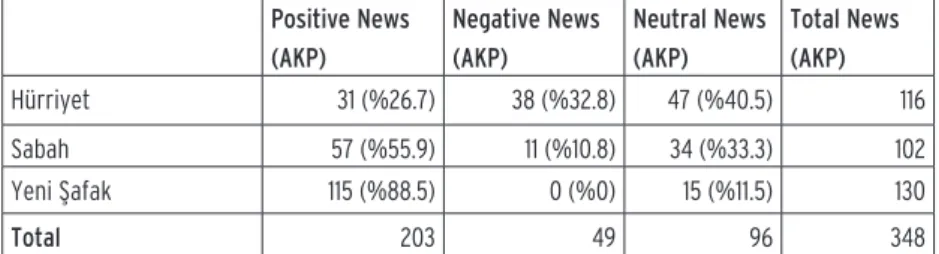
Distribution of News in Positive, Negative and Neutral Tones
Positive News (AKP) Negative News (AKP) Neutral News (AKP) Total News (AKP) Hürriyet 31 (%26.7) 38 (%32.8) 47 (%40.5) 116 Sabah 57 (%55.9) 11 (%10.8) 34 (%33.3) 102 Yeni Şafak 115 (%88.5) 0 (%0) 15 (%11.5) 130 Total 203 49 96 348
Table 1. 2002 Election, September- October 2002, AKP news tones of newspapers
Total News About AKP Total Political News Ratio Hürriyet 116 330 35.15%
Sabah 102 416 24.52%
Yeni Şafak 130 562 23.13%
Table 2. 2002 Election, September-October 2002, Comparison of total political news and AKP news
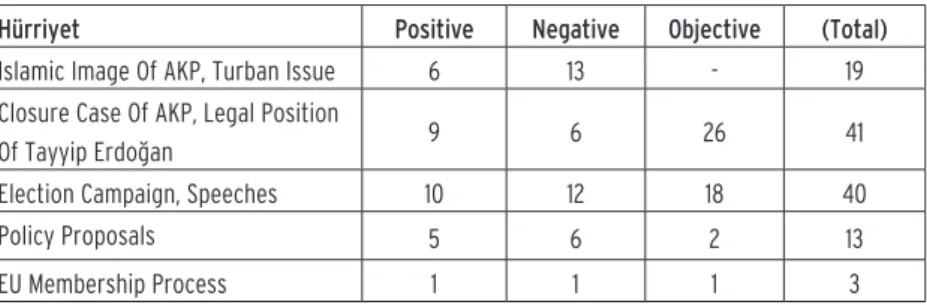
Main Issues in AKP News
Hürriyet Positive Negative Objective (Total) Islamic Image Of AKP, Turban Issue 6 13 - 19 Closure Case Of AKP, Legal Position
Of Tayyip Erdoğan 9 6 26 41 Election Campaign, Speeches 10 12 18 40 Policy Proposals 5 6 2 13 EU Membership Process 1 1 1 3
Table 3. 2002 Election, September-October 2002, Hürriyet, The distribution of main issues in AKP news
Sabah Positive Negative Objective (Total) Islamic Image Of AKP, Turban Issue 5 4 2 11 Closure Case Of AKP, Legal Position
Of Tayyip Erdoğan 21 2 14 37 Election Campaign, Speeches 19 3 14 36 Policy Proposals 11 2 2 15 EU Membership Process 1 - 2 3
Table 4. 2002 Election, September-October 2002, Sabah, The distribution of main issues in AKP news
Yeni Şafak Positive Negative Objective (Total) Islamic Image Of AKP, Turban Issue 3 - 0 3 Closure Case Of AKP, Legal Position
Of Tayyip Erdoğan 33 - 4 37 Election Campaign, Speeches 67 - 9 76 Policy Proposals 10 - 1 11 EU Membership Process 2 - 1 3
Table 5. 2002 Election, September-October 2002 Yeni Şafak, The distribution of main issues in AKP news
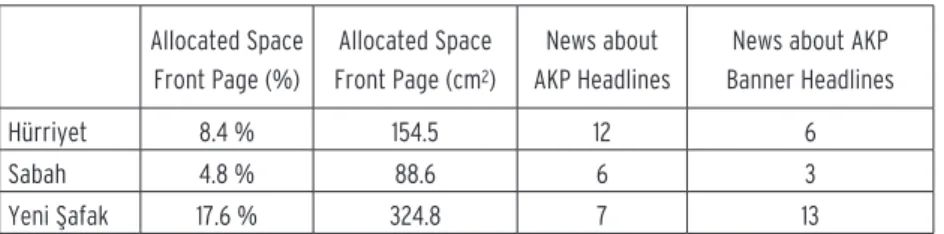
The Space Allocated to AKP on Front Pages
Allocated Space Front Page (%) Allocated Space Front Page (cm2) News about AKP Headlines
News about AKP Banner Headlines Hürriyet 8.4 % 154.5 12 6
Sabah 4.8 % 88.6 6 3
Yeni Şafak 17.6 % 324.8 7 13
Table 6. 2002 Election, The space allocated to AKP on front pages Evaluation
Evaluation of AKP coverage, 2002 General Election
Figure 1. 2002 Election, AKP news tones of newspapers
31 38 47 57 11 34 115 0 15 0% 10% 20% 30% 40% 50% 60% 70% 80% 90% 100% NEUTRAL NEGATIVE POSITIVE
Hürriyet Sabah Yeni Şafak
Figure 2. 2002 Election, Percentage of AKP and other political news in Hürriyet
As seen in Figure 2, in Hürriyet, the number of the news about AKP is approximately one third of all political news, which is 116 out of 330. This shows us that Hürriyet highlighted AKP as the prominent political party. Hürriyet treated AKP as the most important item of agenda. Having examined news texts, news heads, headlines, banner headlines together, 31 news in positive tone, 38 news in negative, and 47 news in neutral tone are determined as seen in Table 1 and Figure 1. The closeness of numbers of news in each tone could be explained with
Hürriyet giving different points of view and trying to be at equal
dis-tance. In other words, Hürriyet does not put forward any extreme dominant slant. This reminds us Entman’s views on mainstream media “Mainstream news organizations contend that they treat competing frames equivalently, ensuring that their reports do not slant” (Entman, 2007:165).
Having examined news, news headlines, banner headlines on
Sabah newspaper for the same period, it could be seen that there are
more political news than on Hürriyet. There are 416 political news, both on front and inside pages of Sabah. 102 out of 416 news are about AKP as can be seen in Figure 3. Sabah deemed AKP as an important subject to be highlighted. Drawing from these numerical findings, it could be argued that Sabah had positive attitude toward AKP before 2002 gen-eral elections.
Hürriyet
Other Political News % 65
AKP News % 35
Figure 3. 2002 Election, Percentage of AKP and other political news in Sabah
Figure 4. 2002 Elections, Percentage of AKP and other political news in Yeni Şafak
Yeni Şafak newspaper published 562 political news in mentioned
period. 130 of them are related to AKP as in Figure 4. 115 are in positive tone, a few of them, 15 are in neutral tone, none of them are in negative tone. All the statistical data and graphs clearly display that Yeni Şafak is quite supportive to AKP and very positive in AKP news slant.
Examining these three newspapers (Sabah, Hürriyet, Yeni Şafak) in the period previous 2002 general elections showed that Hürriyet is the only newspaper with dominant number of neutral toned news about AKP. All of three newspapers highlighted AKP as an important subject of political agenda.
As Table 2 shows, Yeni Şafak has the highest number of political news. This finding shows that Yeni Şafak covered political agenda in great scale. However, when analyzed, it is seen that all these news consist of positive AKP news and negative other political party news. A striking point is that, Yeni Şafak forms its discourse of the political
Sabah
Other Political News % 75
AKP News % 25
Yeni Şafak
Other Political News % 77
AKP News % 23
news on other parties, in accordance with Recep Tayyip Erdoğan’s point of view, judgments, evaluations, expressions embedded in his speeches. Yeni Şafak also covers quite an amount of news mentioning what type of positive developments will be under probable AKP rule, with headlines and banner headlines. More than being positive, all these show that Yeni Şafak is acting like a representative of AKP.
Figure 5. 2002 Election, Headline – Banner Headline distribution through newspapers
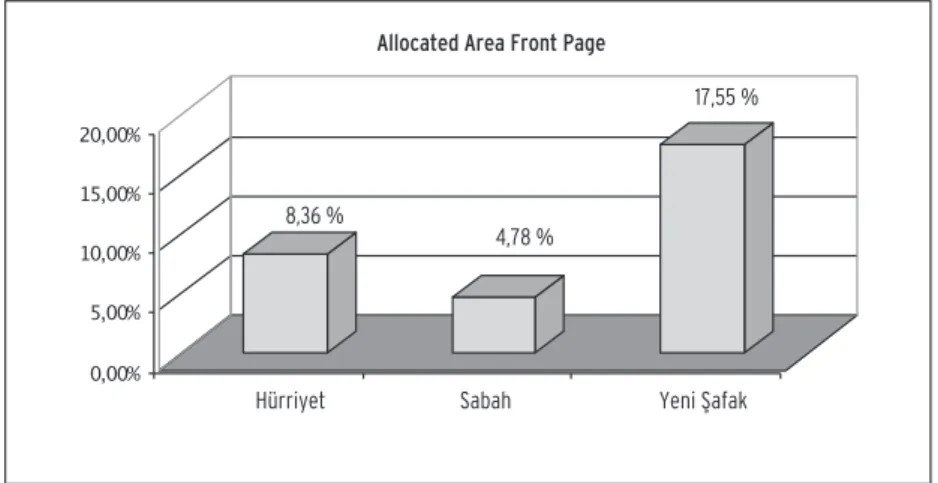
Figure 6. 2002 Election, Allocated space percentages on front page In 2002 September-October, average of 154.5 square centimeters of front page of Hürriyet and 88.6 square centimeters of front page of
Sabah covered AKP news which give 8.4% and 4.8 % of the front pages
by area.
Hürriyet Sabah Yeni Şafak
0 2 4 6 8 10 12 14 HEADLINE BANNER HEADLINE
Hürriyet Sabah Yeni Şafak
0,00% 5,00% 10,00% 15,00% 20,00% 8,36 % 4,78 % 17,55 % Allocated Area Front Page
The reason why although Sabah provides mostly positive coverage to AKP, AKP has not been dominant on front pages of Sabah compared to other newspapers is that Sabah’s ANAP coverage is much more positive than AKP coverage. Sabah predominantly gives more space, headlines and banner headlines to ANAP than AKP on the front pages. In 2002 September-October, average 324.8 square centimeters of political news about AKP has been allocated on Yeni Şafak front page which results 17.6% of the front page by area.
2007 General Election Analysis
Historical Background of 2007 Election Period
The debates on Presidency Elections, proposal of amendment in provisions of Constitution related to Presidency Elections, increasing terrorist attacks marked the period before 2007 General Elections. These issues were prominent in the election campaigns and speeches of political leaders. Prime Minister Recep Tayyip Erdoğan has mostly been charged by failing against terror.
Findings
Distribution of News in Positive, Negative and Neutral Tones
AKP Positive News Negative News Neutral News Total News Hürriyet 56 (% 65.1) 8 (% 9.3) 22 (% 25.6) 86 Sabah 77 (% 80.2) 0 (% 0) 19 (% 19.8) 96 Yeni Şafak 108 (% 97.3) 0 (% 0) 3 (% 2.7) 111
Total 241 8 44 293
Table 7. 2007 Election, June–July, AKP news tones of newspapers
Total News About AKP Total Political News Ratio
Hürriyet 86 227 37.9%
Sabah 96 229 41.9%
Yeni Şafak 111 189 58.7%
Table 8. 2007 Election, June–July, Comparison of total political news and AKP news
Main Issues in AKP News
Hürriyet Positive Negative Objective (Total) Islamic Image Of AKP, Turban Issue 3 - 1 4 Presidential Election 10 1 4 15 Election Campaign, Speeches 33 6 17 56 Policy Proposals 10 1 - 11
Table 9. 2007 Election, June – July 2007, Hürriyet, The distribution of main issues about AKP
Sabah Positive Negative Objective (Total) Islamic Image Of AKP, Turban Issue 2 - - 2 Presidential Election 7 - 2 9 Election Campaign, Speeches 52 - 11 63 Policy Proposals 16 - 6 22
Table 10. 2007 Election, June – July 2007, Sabah, The distribution of main issues about AKP
Yeni Şafak Positive Negative Objective (Total) Islamic Image Of AKP, Turban Issue 0 - - 0 Presidential Election 15 - - 15 Election Campaign, Speeches 85 - 2 87 Policy Proposals 8 - 1 9
Table 11. 2007 Election, June – July 2007, Yeni Şafak, The distribution of main issues about AKP
The Place Allocated to AKP on Front Pages
Allocated Space Front Page (%)
Allocated Space Front Page (cm2)
News about AKP Headlines
News about AKP Banner Headlines Hürriyet 2.7 % 50.7 4 0 Sabah 8.1 % 111.7 7 0 Yeni Şafak 9.4 % 173.5 4 5
Table 12. 2007 Election, June – July 2007, the space allocated to AKP on front page
Evaluation
Evaluation of AKP Coverage, 2007 General Election
Figure 7. 2007 Election, AKP news tones of newspapers
Figure 8. 2007 Elections, Percentage of AKP and other political news in Hürriyet
Figure 9. 2007 Election, Percentage of AKP and other political news in Sabah
Attitudes of Newspaper on Presentation of AKP News
56 8 22 77 0 19 108 03 0% 10% 20% 30% 40% 50% 60% 70% 80% 90% 100% NEUTRAL NEGATIVE POSITIVE
Hürriyet Sabah Yeni Şafak
Attitudes of Newspaper on Presentation of AKP News
Political News in Hürriyet 2007
Other Parties % 62
AKP % 38
Political News in Sabah 2007
Other Parties % 58
AKP % 42
Figure 10. 2007 Election, Percentage of AKP and other political news in Yeni Şafak
Generally evaluating the above graphs and the collected data for the period before 2007 General Elections, the most significant finding is, no negative toned news are presented by Sabah or Yeni Şafak about AKP in this specific period. These two newspapers very dominantly press positive toned news about AKP. Hürriyet is also very positive to AKP and negative toned news of this newspaper in this specific period is less then %10.
Hürriyet and Sabah covered 40% of their political news about AKP,
which is quite normal for AKP being the ruling party. Yeni Şafak is mostly neglecting the other parties and mostly pressing about AKP.
Figure 11. 2007 Election, Allocated space percentages on front page Political News in Yeni Şafak
2007
Other Parties % 41
AKP % 59
Allocated Area, Daily Average, Front Page
Hürriyet Sabah Yeni Şafak 2.74% 6.18% 9.41% 0.00% 2.00% 4.00% 6.00% 8.00% 10.00%
Figure 12. 2007 Election, Headline – Banner Headline distribution through newspapers
Comparison of 2002 and 2007
General Elections Analysis
The comparison between three newspapers’ AKP coverage and AKP news slant in each period –the period before 2002 General Elec-tions and before 2007 General ElecElec-tions- in terms of the issues newspa-pers paid attention most and their tones, provides us some salient results. Such a comparison made between two period’s coverage could make us analyze newspapers news slants considering probable effects of the period, changes in media ownership, government interferences. There are questions which would be asked to obtain meaningful results from such a comparison. These are; did issues, the newspapers concentrated on differ from 2002 to 2007? How did newspapers’ atti-tudes to AKP and the issues related to AKP changed? Have Newspa-pers’ AKP news slant changed dramatically from 2002 to 2007? If it does, what are the reasons for the changes in AKP news slants of the newspapers? How could we link historical conditions of the period to the changes in newspapers’ AKP news slant?
The comparison between the numerical data from the newspapers in the period before 2002 General Elections and 2007 General Elections display some important changes in attitudes of the two newspapers.
0 1 2 3 4 5 6 7 8 HE ADLINE S BANNE R HE ADLINE S
Figure 13. Change in Total Political News from 2002 to 2007 Elections
Bringing together the numerical data of each General Elections period; as shown in Figure 13 it is significant that there is a dramatic decrease in the number of total political news on each newspaper from 2002 to 2007.
Figure 14. Change in the number of AKP news from 2002 to 2007 Elections 2002 2002 2002 2007 2007 2007 0 100 200 300 400 500 600
Hürriyet Sabah Yeni Şafak
Total Political News
2002 2002 2002 2007 2007 2007 0 20 40 60 80 100 120 140
Hürriyet Sabah Yeni Şafak
Figure 13 underlines the decrease of newspapers’ attention to political issues, but bringing the data of Figure 13 and Figure 14 togeth-er, as AKP News change %15 from 2002 to 2007 in total and the political news are down by %50, this clearly shows that actually it is more than the lessened political interest, but the increasing dominance of AKP news on the political news, and the ignorance to the other parties.
Figure 15. Change in the number of negative toned AKP news from 2002 to 2007 Elections
Figure 16. Change in the number of positive toned AKP news from 2002 to 2007 Elections 2002 2002 2002 2007 2007 2007 0 5 10 15 20 25 30 35 40
Hürriyet Sabah Yeni Şafak
Negative Toned News (AKP)
2002 2002 2002 2007 2007 2007 0 20 40 60 80 100 120 140
Hürriyet Sabah Yeni Şafak
As seen from Figure 15 and Figure 16 there is a dramatic decrease in the number of negative news of Hürriyet about AKP and significant increase in the number of the positive news of Hürriyet about AKP. In other words there is an increase in the percentage ratio of the news in positive tone on AKP and a decrease in the percentage ratio of the news in negative tone on AKP in comparison to the period before 2002 General Elections. Hürriyet covered relatively balanced distribution of all tones over AKP political news in the period before 2002 General Elections. But in 2007 Hürriyet’s coverage of AKP political news were constituted predominantly by positive toned AKP news. The issue of “Islamic image of AKP and turban issue” appears in both periods, but it could be seen that Islamic image of AKP and turban issue received much more attention in 2002 than in 2007. Hürriyet, which made dominantly negative toned news in on this issue in 2002, made no news in negative tone. This is a very significant result in the change of
Hürriyet’s attitude. It could be argued that Hürriyet was convinced in
favor of AKP on Islamic image and turban issue. Generally, for
Hürri-yet, the neutral and equal distance to all parties image in 2002 seems to
change in favor of AKP in 2007.
Sabah had drastically changed in 2007. There is quite an increase
in the percentage ratio of positive news in from 2002 to 2007. The num-ber of negative toned AKP news on Sabah was 11 in 2002 General Elec-tions, in the period before 2007 General Elections there were no nega-tive toned news on AKP. When the other statistical figures are exam-ined together, Sabah’s AKP news slant became much more positive comparing 2002 coverage with 2007 coverage. Having no negative toned news in 2007 period is pretty significant. The comparison gives the result that Sabah had gone through quite a change from 2002 to 2007 periods. Situation can be summarized as changing from being mildly supportive to unconditionally supportive.
Examining news texts, amount of the spaces allocated to AKP news front pages; headlines and banner headlines it is seen that in 2002, Yeni Şafak’s AKP news slant is dominantly positive and Yeni Şafak treats AKP is the solely political party to win General Elections.
According to Yeni Şafak, AKP and Recep Tayyip Erdoğan were guar-antees of democracy and AKP policies were the most beneficial policies for the country. In 2007 Yeni Şafak’s AKP coverage is still very positive. The main difference in Yeni Şafak’s 2007 political news coverage from 2002 political coverage is the number of total political news. It decreased from 562 to 189, which is quite significant. This drop indirectly brings another difference when comparing two peri-ods; as number of AKP news nearly stayed same in two periods with the drastical drop of political news, it shows that other political par-ties are totally neglected and Yeni Şafak’s political news coverage became totally devoted to AKP both in number and in tone.
Generally speaking, newspapers ignored other political issues which are not related to AKP and the other political parties’ activi-ties, at the same time, they paid more attention to the issues related to AKP in favor of it. The salient difference between the coverage of the period before 2002 General Elections and the coverage of the period before 2007 General Elections is that each of three newspa-pers paid much less attention to the ruling parties of pre-period 2002 compared to AKP, the ruling party before entering the 2007 General Elections.
Generally speaking in both election periods, in three selected newspapers, all political news coverage tend to focus on individuals, political leaders, candidates, especially -the coverage on Kemal Derviş as a representative example- and their conflicts with each other, life styles, strong or weak sides to their private life instead of policy proposals and ideological stance of the political parties. This could be explained by the dominance of ‘entertainment’ element to ‘information’ element in news coverage. In proceeding analysis this is product of ‘tabloidization’ process stimulated by high degree of ownership, concentration and neo-liberal policies. Newspapers gen-erally use public opinion polls news and feuilletons to support their news slant.
As a summary, analyzing 2002 and 2007 statistical data and exam-ining all the graphs shows remarkable and increasing support to AKP. While Yeni Şafak consistently carry supporting AKP unconditionally,
Sabah had a significant change after TMSF seize and Hürriyet increased
support and changed its slant from being mostly neutral to positive.
Assessment
Bringing together all data collected on total political news cover-age of selected newspapers in the periods before 2002 General elec-tions, these conclusions were reached: The ratio of AKP news to total political news is relatively very high in all three newspapers. Hürriyet tried to be neutral in news on AKP, except the turban and Islamic image issue, which was mostly negative toned. This issue was mostly covered by Hürriyet among three newspapers. Except turban issue,
Hürriyet sought to be neutral in the news about legal position of Recep
Tayyip Erdoğan, closure case and election campaign. Sabah’s AKP news slant is rather positive on news coverages. There is no specific issue that Sabah covered dominantly negative or neutral about AKP. It is evident that Yeni Şafak predominantly gave favorable coverage to AKP.
Examining the selected newspapers’s news coverage on other parties in the period before 2002 General Elections. Although Hürriyet meant to cover most of the political parties, it did not allocate equal space to all political party news. Hürriyet predominantly allocated most of the space to the political parties which are strong candidates to rule. AKP and CHP were ranked as the first and the second parties in public opinion polls. Sabah mostly covered the political parties which were likely to rule after the election and the parties already were incumbent. So, there were political news about ANAP, DYP, YTP, MHP and DSP in addition to AKP. Examining the news, headlines and banner headlines on the front page and the news inside pages, it could be seen that Sabah was supportive to ANAP, ANAP’s policies and incumbent deputy prime minister and chairman of the party, Mesut Yılmaz’s practices about European Union membership process at
most. Other than ANAP issues, Sabah generally reported government’s practices in negative manner in that period. Sabah adjusted its dis-course and slant on the other parties including AKP in respect to the quarrels between Mesut Yılmaz and them. Yeni Şafak also adjusts its discourse and slant considering the relation between other parties and AKP. There are many political news about all political parties joining general elections although the places allocated to them are much smaller than AKP news in total. Yeni Şafak’s coverage of the other par-ties is generally in neutral tone except CHP, which is seen as the big-gest rival of AKP.
It appears that Hürriyet columnists’ AKP slant was mostly tive. There were columnists whose almost every article were in nega-tive tone. In Sabah, AKP news slant is more posinega-tive compared to AKP editorial slant. Percentage rate of articles in negative tone is much more than the news in negative tone. Yeni Şafak’s both editorial slant and news slant are in positive tone. It is prominent that Yeni Şafak col-umnists did not write directly about AKP or its leader anymore. They rather wrote about abstract and religious issues relating it to everyday life.
The false belief of AKP winning the General Elections in 2002 in spite of media has to be corrected. The statements of some mainstream media columnists declaring that they would not vote for AKP, defi-nitely does not hide the fact of mainstream media supporting AKP in an indirect, but more effective way. In the period before elections, the three party coalition government was under strong criticism by the media about economic crisis, poverty and corruption. Instead of push-ing CHP forward as a strong alternative, media also were strongly criticizing them for their unconstructive policies, internal conflicts and problems. So, all these facts together show nothing but highlighting AKP indirectly as only alternative (Kaya, 2009b).
AKP had been ruling party for five years before 2007 General Election. Devotion of large amount of space to ruling party news by the newspapers is anticipated. The issues at stake in the two months
period before 2007 General Election were; Presidential Election, Islam-ic Image of AKP and terrorist attacks. It should be stated that IslamIslam-ic image of AKP was on particular media’s agenda, but not on selected newspapers’ mostly. In other words, the selected newspapers, espe-cially Hürriyet did not consider turban issue and Islamic image of AKP as an important issue anymore as they did in 2002 Election period. Instead, the other parties’ moderate attitude to turban occupied cal news coverage. Bringing together all data collected on total politi-cal news coverage of selected newspapers in the periods before 2007 General Election, these conclusions were reached: While the number of total political news were very low compared to 2002 period, the share of the AKP news seriously increased considering ratio. All selected national newspapers gave quite favorable coverage to AKP.
Hürriyet, which had been more critical than the others before 2002
General Election, offered much more favorable coverage to AKP.
Hür-riyet’s support to AKP was prominent especially in the news related to
election campaign and speeches. Sabah supported AKP giving domi-nantly positive news coverage. Sabah’s AKP news coverage was much more favorable from it had been before in 2002 General Election as there is no political news about AKP in negative tone. Yeni Şafak’s political news coverage almost was devoted to AKP, completely in positive tone.
Examining editorials and columnists’ articles before 2007 General Elections, it is seen that although Hürriyet’s AKP slant was positive in the period, except editor in chief’s articles, the other articles’ dominant tone was negative. Ertuğrul Özkök’s all articles are in positive tone and 5 of the 8 positive toned articles were written by editor in chief, Ertuğrul Özkök, which is quite significant and understandable know-ing all other data showknow-ing Hürriyet’s general AKP slant as positive. After seizure of TMSF, in April 2007, parallel with changes in impor-tant positions like editor in chief, news coverage, editorial slant and slant of columnists’ articles were also dramatically changed. These changes were in such a way that some columnists who had written about AKP in negative tone in 2002, wrote in positive tone in 2007. The only articles in negative tone were written by Yılmaz Özdil who
resigned from Sabah in the following period. It appears that Sabah’s AKP news slant and editorial slant were positive in the specified period. Yeni Şafak columnists wrote all their articles in an affirmative tone.
As a result, for the period before 2007 General Election, generally speaking, AKP news dominated all the newspapers and this domina-tion was mostly affirmative. Hürriyet changed their attitude of being mostly neutral in 2002 period to being positive in 2007 in AKP news coverage. Sabah was already mildly positive in 2002 period and it has become very dominantly positive after seizure of TMSF. Yeni Şafak car-ried on being devoted to AKP and Recep Tayyip Erdoğan in 2007 General Election period.
Conclusion
Today nobody would challenge the view that the world of politics and media are closely intermingled. Indeed, as stated early in this study, the events of the external world to our immediate experiences are continuously interpreted/defined and disseminated trough reality definitions of the means of mass communication. Consequently, media acquires a defining role on the formation of opinions in every aspect of the societal life. On one hand political actors are striving hard to gain the media on their side, on the other hand media owners try to instru-mentalize their media outlets to influence the major political decisions. Increasing tabloidization and development of an advocacy journalism also intensify the interrelations between the media and the political formations. The firm and interdependent relationship between politi-cal formations become more of an issue in election periods, for they are indispensable part of opinion formation, hence political behavior for-mation. This study is inspired by the widespread claim that as a newly established political party, AKP had won the elections despite the unfavourable attitude of the press. It was argued that AKP did not enjoy an adequate media backing before the elections. This argument was advanced to promote the idea that the effects of the media were not as powerful as it was generally accepted in the critical approaches to the study of media in scholarly research.
This study of the news coverage of selected newspapers aimed at revealing Turkish press’ slant to AKP both before 2002 general elec-tions when AKP was elected as first political party and before 2007 general elections when AKP was the ruling political party. News out-put can only be defined as being slanted if it gives more favorable coverage to one side of politics than the other. In representative democracies, media have some certain functions; to inform citizens about political agenda, to be a channel for rulers or several interest groups to convey their messages to citizens and also to be means for citizens to utter their discomforts. In ideal terms, media is generally conceptualized as an arena for all opinions in democratic society. Based on these assumptions, most of the researches conducted on elec-tion campaign coverage, examine coverage of news outlets employing ‘balance’ as the baseline of the study. Researches presuppose that media should cover all opinions in a democratic society, in an objective way and independently from state or any other interest group’s inter-ference. What is expected from media is to cover all opinions not favoring one of them.
Many researches on election campaign coverage of news outlet have drawn attention to agenda-setting function of the media. That is; media could highlight some issues while undervaluing others or high-light certain aspects of issues while undervaluing other ones. McCombs who has done groundwork on agenda-setting function of media, made a distinction between first and second level of agenda-setting. While first level agenda-setting is related to ‘object salience’, the second level agenda-setting is related to ‘attribute salience’ (McCombs and Reyn-olds, 2009: 1-17). In second level agenda-setting function, news report-ers highlight some aspects of specific object. Issues or some aspects of news are presented framing by news reporters. Framing news means to select some aspects of perceived reality and make them more salient in such a way as to put forward a particular problem definition or moral evaluation for the item described. In the light of these consid-erations political news coverage of selected national newspapers were examined in terms of their positive, negative or neutral tones and the issues they underlined. This examination had been done considering
historical conditions of the periods, issues peculiar to the periods at stake and general ownership structures of the newspapers which probably had impact on news coverage. The space and the location allocated to news and the way they are represented as headlines or banner headlines on the front page had been quite informative for answering the question of this research. This study also paid attention to editorial slant and attitudes offered in columnist articles also in order to draw clearer picture of newspapers’ AKP news slant.
Examining political news coverage of selected newspapers some conclusions are reached. These conclusions are given from general to specific. Present research also provides some insights as to the general features of election campaign coverage of Turkish media. The most prominent thing is that media content, political news coverage in the restrains of the research, focused on political leaders’ personal quali-ties such as their weak or strong aspects and quarrels instead of political parties’ policy proposals and ideological stances, parallel to ‘tabloidization’ of media, in accordance with commercialization pro-cesses. In other words, it is evident that there is relatively ‘dumbing down’ of political arguments at several ranges in selected newspapers. It was seen that Hürriyet and Yeni Şafak were more serious in tone of political news compared to Sabah. Three of the newspapers tend to give election campaign coverage like ‘horse race’ instead of arguments of political parties in comprehensive way. They try to be ‘sensational’ by news headline selection. As a result of this attitude, news heads could be irrelevant to news story. It could be argued that different newspapers could cover same issues and same objects in quite differ-ent tones. To say, same object could be reproduced and more correct reconstructed in quite different manners dependent to media organi-zation slant and stances. So to talk about news slant means also talk about media organization as economic sector that owner of the media organization could have impact on news coverage.
Bringing together the data collected via qualitative content analy-sis on the selected newspapers’ coverage, editorials and columnists’ articles in the two months period before 2002 General Elections, some
conclusions can be drawn: Hürriyet was mostly trying to be neutral except turban, but highlighting AKP by unbalanced covering many AKP news. Islamic image issue and individual articles of the column-ists were mostly negative in Hürriyet. Sabah was mildly positive to AKP in news coverage except for the issues in which AKP was against ANAP and Mesut Yılmaz. Yeni Şafak was totally positive and support-ive to AKP and Recep Tayyip Erdoğan. So, AKP did not win the Gen-eral Elections in 2002 in spite of media. Media supported AKP in an indirect but more effective way.
Before 2007 General Elections AKP had been ruling party for five years. It was normal for newspapers to devote large spaces to AKP. However, the selected newspapers’ interests in political issues were almost limited to AKP and its activities in that specific period. Bring-ing together the data collected via qualitative content analysis on the selected newspapers’ coverage, editorials and columnists’ articles in the two months period before 2007 General Elections, some conclu-sions can be drawn: While the number of total political news were very low compared to 2002 period, the share of the AKP news seri-ously increased considering ratio. All selected national newspapers gave quite favorable coverage to AKP. Hürriyet, which had been more critical than the others before 2002 General Election, offered much more favorable coverage to AKP. Hürriyet’s support to AKP was prominent especially in the news related to election campaign and speeches. Sabah supported AKP giving dominantly positive news cov-erage. Sabah’s AKP news coverage was much more favorable from it had been before 2002 General Election as there is no political news about AKP in negative tone. Yeni Şafak’s political news coverage almost was devoted to AKP, completely in positive tone.
As a result, for the period before 2007 General Election, generally speaking, AKP news dominated all the newspapers and this domina-tion was mostly affirmative. Hürriyet changed their attitude of being mostly neutral in 2002 period to being positive in 2007 in AKP news coverage. Sabah was already mildly positive in 2002 period and it has become very dominantly positive after seizure of TMSF. Yeni Şafak
car-ried on its consistent line of being devoted to AKP and Recep Tayyip Erdoğan in 2007 General Election period.
Evaluating all findings together briefly such conclusions can be drawn: Firstly, in the 2002 elections, AKP actually did not have a very strong media backing but there was not a general hostile attitude towards the new party. But from the output of the media outlets it can be easily argued that AKP had enjoyed a very strong indirect support since the traditional political parties of the centre-right and centre-left; that is its all major contenders were held responsible and severely criticized for the prevailing many faced deep crisis in the country. As for the 2007 elections, there was a completely different outlook. This time, AKP, as the majority party in power was directly controlling, in addition to state run broadcasting channels, a leading private channel (ATV) and some daily papers comprising mass circulation Sabah seized by the state to recoup losses at a failed bank. Moreover, the remaining mainstream media outlets were exhibiting a political slant clearly in favour of the majority party. This media support had an irrefutable share in the landslide 2007 election victory of the AKP. This evidence obtained from the both cases enables us to conclude that the ideologi-cal impact and the politiideologi-cal effects of the media as an institution is ‘there to stay’.
References
Curran, James (2002). Media and Power. London: Routledge.
Çağlayan, Eda (2010). Media, Politics and Slanted News Coverage During the
Election Periods- Case Study Of News On AKP (Master’s Thesis).
Available from METU Library.
Entman, Robert (2007). “Framing Bias: Media in the Distribution of Power.”
Journal of Communication 57: 163-173.
Hallin, Daniel (2000). “Commercialism and Professionalism in the American News Media.” Mass Media and Society. (eds.) James Curran and Michael Gurevitch. London: Edward Arnold.
Kaya, A. Raşit (2009b).“Neoliberalizmin Türkiye’ye Siyasal Etkileri Üzerine Değerlendirmeler ve Tartışma Ögeleri.” Küreselleşme, Kriz ve Türkiye’de
Neo Liberal Dönüşüm. (eds.) Nergis Mütevellioğlu and Sinan Sönmez.
İstanbul: İstanbul Bilgi Üniversitesi Yayınları.
Köker, Eser and Beybin Kejanlıoğlu (2004). “2002 Seçim Kampanyalarında Ulusal Basın.” İletişim Araştırmaları 2(1): 39-70.
McCombs, Maxwell and Amy Reynolds (2009). “How The News Shapes Our Civic Agenda.” Media Effects: Advances in Theory and Research. (eds.) Jennings Bryant and Mary Beth Oliver. New York: Routledge .
McQuail, Dennis (1983). Mass Communication Theory: An Introduction. London: Sage Publications.