YAŞAR UNIVERSITY
GRADUATE SCHOOL OF NATURAL AND APPLIED SCIENCES MASTER THESIS
EVOLUTION AND MAIN CONCERNS: BATHROOM
DESIGN
Salma A. Mahfouz
Thesis Advisor: Assistant Prof. Dr. Ecehan OZMEHMET
Department of Interior Architecture Presentation Date: 27.07.2016
Bornova-İZMİR 2016
ABSTRACT
EVOLUTION AND MAIN CONCERNS IN RESIDENCES: BATHROOM DESIGN
Mahfouz, Salma A. MSc in Interior Architecture
Supervisor: Assistant Prof. Dr. Ecehan OZMEHMET July 2016
The development of our contemporary bathroom has also been dependent upon the evolution of history, technology, culture and other socio-economic policies. Good design includes planning spaces that are user friendly, hygienic and healthy. It preferably also reflects sustainable use of resources. The change in the characteristics affects how clients use their bathrooms, the finishing products and materials they demand, as well as the looks and styles they need and favor. The retail markets of today offer the customer and designer an unlimited collection of choices for furnishing bathrooms and allow the designer to create a space to fit every preference and situation, even though certain styles may go in and out of design trends. This research discusses the importance of the location of the bathroom in residence, and investigates the evolution of bathrooms since the 1900’s, and analyzes bathrooms spaces.
Keywords: History of Bathrooms, Bathroom Design, Toilet Interior Design, Energy Efficiency, Materials and Resource Efficiency
ÖZET
KONUTLARDAKI BANYO DİZAYNINI : ZİHİN VE BEDEN ARASINDAKİ İLİŞKİSİ ETKISI
TASARIMLARININ OPTİMİZASYONU
Mahfouz, Salma A. Yüksek Lisans Tezi, İç Mimarlık
Tez Danışmanı: Assitant Prof. Dr. Ecehan OZMEHMET Temmuz 2016
Modern banyo gelişimi de tarih, teknoloji ve diğer sosyo-ekonomik politikalarin evrimine bağımlı olmuştur. İyi tasarım kullanıcı için çevre dostu ve sağlıklı alanlar planlamayi içerir ve kaynakların kullanımının surdurulebilirligini yansıtır. Müşterilerin banyo kullanimlari, talep ettikleri ürünler, görünüm ve stilleri karakterlerindeki degisimi etkiler. Gunumuzde perakende pazarlari tuketiciye ve tasarimciya her duruma ve tercihe uygun banyo yaratmak icin , bazi stillerde modanin disina cikilsa bile banyo malzemelerinde limitsiz secenekler sunuimaktader. Bu araştırma komtlardalu banyonun yerini ve önemini tartışmakta ve 1900 yılından bu yana banyolarin kapladigi alanları analiz etnakte banyolarin evrimini incelemektedir.
Anahtar kelimeler: Banyo Tarihi, Tuvalet Tasarımı, Tuvalet İç Tasarım, Enerji Verimliliği, Malzeme ve Kaynak Verimliliği
ACKNOWLEDGEMENTS
I would like to thank my professor and my supervisor Ecehan ÖZMEHMET, as well as, the members of the Graduate School of Natural and Applied sciences, Asst. Prof. Dr. Zeynep TUNA ULTAV, Asst. Prof. Dr. Gülnur BALLİCE, and Prof. Dr.Tayfun TANER. Their advice, motivation, and assistance in making my ideas concise and clear have been helpful. I could not have done this study without each of your support. I would like to acknowledge also Asst. Prof. Dr. Ebru AYDENİZ, İlker KAHRAMAN and lecturer Sergio TADDOIO as extended members of my committee. The work that I completed in their courses and the feedback I have received have been important in moving this thesis forward.
I would like to also thank my fellow interior design faculty at the American University in Dubai. I would especially like to acknowledge Professor John ALEXANDER SMITH, Associate Professor Tala VAZIRI, Associate Professor Alex ALBANI, and Professor Nabyl CHENAF for believing in me and my abilities.
Lastly, I would like to thank my mother and father. I would not be where I am or who I am today without their love and support. Family and friends for their encouragement and support, especially those outside the profession, who must have really thought I was irrational.
Thanks, for everything.
TEXT OF OATH
I declare and honestly confirm that my study, titled “EVOLUTION AND MAIN CONCERNS: BATHROOM DESIGN” and presented as a Master’s Thesis, has been written without applying to any assistance inconsistent with scientific ethics and traditions, that all sources from which I have benefited are listed in the bibliography, and that I have benefited from these sources by means of making references.
TABLE OF CONTENTS Page ABSTRACT II ÖZET III ACKNOWLEDGEMENTS IV TEXT OF OATH V TABLE OF CONTENTS VI LIST OF FIGURES IX 1 INTRODUCTION 1
1.1 Subject of the Thesis 1
1.2 Aim of the Study 2
1.3 Significance of the Study and Structure of the Thesis 2
1.4 Literature Review 3
2 HISTORIES OF THE DEVELOPMENT OF THE BATHROOM 5
2.1 Introduction 5
2.2 Early Civilizations 6
2.3 Middle Ages 12
2.4 Seventeenth, Eighteenth and Nineteenth Centuries 13 2.5 Globalization and development of bathroom design in today’s world
starting the 20th century 19
2.6 Historical development of bathroom design in residential buildings in the
2.6.1 House Takumi (Pictures taken by Takumi in 2014) (Takumi 2014) 28
Site pictures 28
Lighting design 29
Evaluation 29
2.6.2 House Adam (Pictures taken by Adam in 2015) (Adam 2015) 30
Site pictures 30
Lighting design 30
Evaluation 30
2.6.3 House Venkatesh (Pictures taken by Venkatesh in 2012) (Venkatesh 2012) 31
Site pictures 31
Lighting design 31
Evaluation 31
2.6.4 House Tamara (Pictures taken by Tamara in 2014) (Tamara 2014) 32
Site pictures 32
Lighting design 32
Evaluation 32
2.6.5 House Sahar (Pictures taken by Salma Mahfouz in 2014) 33
Site pictures 33
Lighting design 33
Evaluation 33
Evaluation of 2.6 34
2.7 Conclusion 35
3 ERGONOMICS, ENVIRONMENTAL CONSIDERATION AND
MATERIAL FINISHES IN BATHROOM DESIGN 37
3.1 Introduction 37
3.2Application of Ergonomics in Bathroom Design 38
3.3 Environmental Considerations 41
3.3.1 Air Quality 41
3.3.2 Water 41
3.3.3 Moisture, Molds and Health in Bathrooms 43
3.4 Material Finishes 46
3.4.1 Floors 46 3.4.2 Walls 52 3.4.3 Facilities 53 3.5 Conclusion 63 4 CONCLUSION 65 5 REFERENCES 68
LIST OF FIGURES
Figure 2.1 The Roman bath Abbey, England, 2008 by James Kratz on Flicker
https://www.flickr.com/photos/jksnaps/4979841774/ (Access date 13-5-2015) Figure 2.2 Latrines Ephesus, Turkey, 2013 by Salma Mahfouz
Figure 2.3 Section of the baths of Caracalla on Pinterest
https://www.pinterest.com/pin/484840716103778104/ (Access date 13-5- 2015)
Figure 2.4 Current situations of the baths of Caracalla, Italy, 2014 by Manalin on Jugem http://manalin.jugem.jp/?eid=105 (Access date 13-5-2015)
Figure 2.5 Plan of the baths of Caracalla on Global security
http://www.globalsecurity.org/military/world/spqr/rome-baths-caracalla.htm (Access date 13-5-2015)
Figure 2.6 Section layout of the baths of Caracalla
https://urbanemergence.wordpress.com/2011/11/08/roman-baths-precursorfor- modern-temperature-control/ (Access date 13-5-2015)
Figure 2.7 Plan and space layout of the baths of Caracalla, 2014 by classmates in Art History 22006 with Salus at Kent State University https://www.studyblue.com/notes/note/n/arth-22006-study-guide-2014-15- salus/deck/12221527 (Access date 13-5-2015)
Figure 2.8 Horizontal section of the baths of Caracalla, 2013 by Classmates in Architecture 2111 with Hollengreen at Georgia Institute of Technology https://www.studyblue.com/notes/note/n/arc-2111-study-guide-2013-14- hollengreen/deck/8702520 (Access date 13-5-2015)
Figure 2.9 Advertisement of the early flush toilets used overhead tank to hold the water that should be used, 2015 by Errol on 3oclockballcock http://www.3oclockballcock.com/gay-90s/ (Access date 13-5-2015)
Figure 2.10 The photos are taken from magazines, books and online sources covering the early 1900′s to the 1920′s, 2004 on 1912bungalow http://1912bungalow.com/2004/03/historical-bathroom-photos/ (Access date 13-5-2015)
Figure 2.11 Standard Bath Lavatory Bathroom (1905) on vintageadbrowser http://www.vintageadbrowser.com/household-ads-1900s (Access date 21-6- 2015)
Figure 2.12 Khohler of Khohler on tumblr http://timelinekohler.tumblr.com/ (Access date 21-6-2015)
Figure 2.13 Standard Sanitary Manufacturing Co Bathroom & Plumbing Fixtures on pintrest https://www.pinterest.com/pin/543668986238345557/ (Access date 21-6-2015)
Figure 2.14 Bathroom Fixtures Mother Baby Standard Sanitary, 1906 on pintrest https://www.pinterest.com/pin/403635185324906452/ (Access date 21-6- 2015)
Figure 2.15 Standard Plumbing Fixtures on etsy
https://www.etsy.com/listing/80212868/vintage-1920s-deco-pink-dress- flapper (Access date 21-6-2015)
Figure 2.16 Khohler of Khohler on tumblr http://timelinekohler.tumblr.com/ (Access date 21-6-2015)
Figure 2.17 Kohler of Kohler, 1940 on retrorenovation http://retrorenovation.com/category/by-decade/1940s-by-decade/ (Access date 21-6-2015)
Figure 2.18 Kohler of Kohler, 1949 on retrorenovation http://retrorenovation.com/category/by-decade/1940s-by-decade/ (Access date 21-6-2015)
Figure 2.19 The “lavette,” later called the powder room, was marketed by Kohler as a way to incorporate an extra bathroom by converting small spaces, such as bedroom closets and spaces under stairs, into a small bathroom on tumblr http://timelinekohler.tumblr.com/ (Access date 21-6-2015)
Figure 2.20 Standard Plumbing Fixtures on ebay http://www.ebay.com/itm/1930- Bright-Yellow-Fixtures-Typical-30s-Bathroom-Standard-Plumbing-Fixtures-Ad-/130908713651 (Access date 21-6-2015)
Figure 2.21 Kohler of Kohler on pintrest
https://www.pinterest.com/pin/436145545134498369/ (Access date 21-6- 2015)
Figure 2.22 Kohler of Kohler on gogd.tjs-labs http://gogd.tjs-labs.com/show-picture?id=1234663240 (Access date 21-6-2015)
Figure 2.23 Kohler of Kohler on pintrest https://www.pinterest.com/pin/136937644894822571/ (Access date 21-6- 2015)
Figure 2.24 Exklusive from a German magazine dated 1974 Geometric wall tile design and floating Lavatory vanity on uglyhousephotos http://uglyhousephotos.com/wordpress/?p=6815 (Access date 21-6-2015) Figure 2.25 From an English magazine onflashbakhttp://flashbak.com/the-good-the-bad-and-the-bubbly-bathroom-decor-of-yesteryear-2268/ (Access date 21-6-2015) Figure 2.26 Hülsta Arkansas dutch magazine on uglyhousephotos
http://uglyhousephotos.com/wordpress/?p=6815 (Access date 21-6-2015)
Figure 2.27 EuroBad 74 on uglyhousephotos
http://uglyhousephotos.com/wordpress/?p=6815 (Access date 21-6-2015) Figure 2.28 Site Pictures, Japan, 2014 by Takumi
https://www.airbnb.com/rooms/4585434 (Access date 18-3-2016)
Figure 2.29 Site Pictures, U.K., 2015 by Adam
https://www.airbnb.com/rooms/7083910?s=8Kpx5r5I (Access date 18-3- 2016)
Figure 2.30 Site Pictures, Australia, 2012 by Venkatesh https://www.airbnb.com/rooms/8997050?s=qNXBqGUq (Access date 18-3- 2016)
Figure 2.31 Site Pictures, U.S.A., 2014 by Tamara https://www.airbnb.com/rooms/2495893?s=_3ICJ97w (Access date 18-3- 2016)
Figure 2.32 Casa Apartments, Cairo, Egypt 2015 by Salma Mahfouz
Figure 3.1 Kohler Bathroom, 1928, on antiquehomestyle http://www.antiquehomestyle.com/inside/bathrooms/1920s/gallery/page24.ht m (Access date 13-5-2015)
Figure 3.2 The number of gallons (liters) per flush has decreased as toilets became more efficient. Sustainable Design Methods for Architecture. New York: John Wiley & Sons, 2012.
Figure 3.3 As warm, moist air moves through a wall, condensation will occur when the air is cooled to the dew point temperature. Rendered in 20-20 by Michael Brgoch, CKD
Figure 3.4 Place a vapor retarder material on the warm or interior side of the wall, to help prevent moisture condensation inside the wall, in climates with cold winters. In hot, humid climates, where air conditioning is used most of the year, the placement of the vapor retarder may be different. Rendered in 20-20 by Michael Brgoch, CKD
Figure 3.5 Allegro Natural cork flooring on houzz
http://www.houzz.com/photos/911967/Cork-Floor-contemporary-hardwood- flooring-denver (Access date 13-5-2015)
Figure 3.6 Bathroom concrete floor, 2015 on bathroomflooringtileideas http://bathroomflooringtileideas.net/bathroom-flooring-vinyl-laminate-or-tile-flooring-of-your-choice.html/bathroom-concrete-floor-picture (Access date 13-5- 2015)
1 INTRODUCTION
1.1 Subject of the Thesis
The bathroom is a very personal and private space of people living in a house. Bathrooms continue to evolve as new products are introduced to the market. Also new standards have an impact on our energy and water consumption. People also change in their abilities, preferences, and desires.
The bathroom is a closed space that we use every day and is matched by an astonishing variety of architectural designs worldwide. People use this space in different ways and have different ideas about function, mood, and ambience. Although the bathroom has changed throughout history, it has always reflected the cultural attitudes of people towards hygiene, cleanliness, privacy, relaxation, socialization, ethics and religion. Nowadays, people think of the contemporary domestic bathroom as a place where function and ritual correspond with the body and mass-produced industrial products. What about the bathroom as a whole?
The bathroom has become a place to perform certain rituals, rather than a room to occupy one’s rituals. This chapter will develop on the methods implemented in this research paper to increase the understanding of bathroom usage and inform design solutions to support independence, self-respect and quality of life (Chamberlain 2010). Lately, it has been noticed that with building costs constantly rising and, in turn, forcing a reduction in the size of residential living spaces, have affected the size of the bathroom. It is therefore important to evaluate human space
needs and how new limitations might change behavioral patterns, attitudes, and feelings.
1.2 Aim of the Study
The main research question of this study is: How did bathroom designs evolve throughout history? And what are the environmental consideration and types of material finishes?
This topic is taking into account of “product and furniture design”, “art and design”, “industrial design” and “science and technology”. The aim of this study is to contribute to the field of interior design by discussing and exploring the history up to the point of standardized bathrooms that is scarcely found in documented research. This is because space reflects one’s own body, its rituals, and it’s routines that occur within this space.
Throughout this study an examination was made about the history of bathrooms, factors which have affected bathroom designs, and finally, technological and sustainable issues such as energy efficiency, water quality, waste management, and air quality.
1.3 Significance of the Study and Structure of the Thesis
This research shows a unique spectrum ranging from small to large bathrooms. There are very few studies focusing on bathrooms in literature. Instead, even though there are several studies related with baths and toilets in general, the significance of this thesis is in investigating and discussing the evolution and the main concerns of bathrooms with regards lack of space, bathroom furnishings, and
seeking safety solutions to bathroom problems. Literature related to archeological findings about baths and toilets is reviewed in order to discover how early civilizations developed these in different ways to dispose of human waste and to take a bath. This is because bathroom space location designs, roles and “expressing emotions” in the building is decided by architects and interior designers. Through innovative bathroom spaces, interior architects and designers may provide a more comprehensive, multi-angle combination of bathroom space.
Sustainability is also one of our anticipated future needs. Solutions which are ecologically sound in both using water, energy, durability and longevity of use needs to be considered.
The rest of the thesis is organized as follows. Chapter 2 describes the histories of the development of the bathroom. The thesis is concluded with chapters 3 and 4 by summarizing the results of the literature review and discussing the factors affecting the bathroom design. It also summarizes the evolution, the rule and design methods to enrich our present bathroom design knowledge.
1.4 Literature Review
The evolution in recent years has paid more attention to the concept of health, wellness and sanitary needs. Thus, the contemporary bathroom space is full of inspiration, innovation, comfort, and pureness compared to early history design application of bathrooms. “Home spa”, “Bathrooms that creates top-grade emotional experience”, “Relaxed shower at home”, “Bathing, the art of relaxing and escape”, “Wellness at home” and similar views of books became the main development trends of bathroom design. Comfortable bathroom design makes people want to go home
and dip themselves into their bathtubs. They can place the bathtub near a big enlightening window, on the floor or dug into the floor or surround it by wood and pebbles. Bathrooms can have a touch of green to make people feel like they’re in a garden. Some bathtubs can be dipped into water to give the feeling of the pool or sea.
Bathroom design is developing rapidly. Designers pay more attention to “personal spas”, “no boundaries”, “relaxing spaces”, and “comfort areas”. However, this part of research on contemporary bathroom design focuses on its historical development and bathroom spaces. Eco-technologies, trends and human body engineering in bathroom design are a lot to be considered. One of the purposes of this research is to investigate the methods and products used to dispose of human waste and the bathing experience throughout history. This is needed in order to understand the evolution of bathroom designs through history. The literature review began with the investigation of journals, articles, books, and dissertations.
Main databases searched for this study are; Academic Search, Books, Cambridge Journals Online, Science Direct Journals, El Sevier Journals, Dissertations and Theses, Encyclopedia Britannica Online and Google Scholar.
2 HISTORIES OF THE DEVELOPMENT OF THE
BATHROOM
2.1 Introduction
Ancient Romans had the highest standard of hygiene. This has only been reached again in our days. Roman thermal baths were important for people’s health. this is why the state invested large amounts of money on them. As the Romans used to say: “Orandum est ut si tmens sana in corpore sano”. This has usually been translated as: “You should pray for a sound mind in a healthy body” (Bruckner, Lischka and Proschwitz 1999). In addition to well-engineered public water supply accomplished through aqueducts, the Roman Empire also established quite sophisticated sewer systems. These did not appear again until the nineteenth century. First developed around 312 B.C., these engineering wonders used gravity to transport water along stone, lead and concrete pipelines into city centers (Palmer 1973).
During the Middle Ages there was a reaction to the high standard of living of imperial Rome. Christianity prohibited sinful extreme personal hygiene and as an alternative turned to spiritual cleanliness. There was a similar fear that water was a carrier of disease and high class society embraced perfumes as replacements. There is indication of flushing toilets from the sixteenth century. But this did not become common until the explosion of innovations and patents in the mid-nineteenth century. These were seen in the Great Exhibition of 1851 in London. Hence, the bathroom has established itself definitely in the domestic environment only since the 1960’s. However, there has been no major change to the general format of the toilet, sink and
bath where ceramics was still the favored manufacturers’ choice, since themid- nineteenth century (Beamish, et al. 2013) .
2.2 Early Civilizations
Bathing has different functions depending on people cultural background. For thousands of years it had religious meanings in purifying the body and soul. Evidence indicates that ancient Egyptians and the residents of Crete had bathing facilities. The bath was taken to new levels by early the Greek, Minoan, and Roman civilizations (Beamish, et al. 2013). Public bath houses were popular as a focal point of the community among the ancient Greeks and Romans who resourcefully applied sophisticated drainage and heating systems. Most people found the experience so calming that they typically bathed daily in public bath houses. Bathing was a way of life not just for cleaning. In many cultures baths were enjoyed by all social classes of people. The Romans were more thoughtful of their bathing facilities. Early Roman bath houses were often highly decorated with paintings, statues, and elaborated rich architectural details to add to their pleasure (Figure 2.1).
In Roman times the term “culture of the closet” is certainly correct. The technical standards were high. Men as well as women met for a chat in the toilet rooms with their expensive marble closets. The seats were only separated from one another by skillfully placed ornaments. Under the seats of cool marble were the water pipes which led away the waste of the noble persons above.
Cloacina was the name of the goddess of the sewage. The Romans built wonderful temples for her celebration and thanked her for the relief she gave by means of the closet (Lambton 2007).
In addition to making bathing an enjoyable experience and a prominent part of their lives, the “Greeks and Romans understanding and repetition of good sanitation were extraordinary for the time” (Mazzurco 1986). The Greek and Roman concept of the “bath” and their belief in the power of water has come full circle to the pools, hot tubs, soaking tubs, mineral baths, and spas that we enjoy today.
Public baths were a part of other civilizations such as the “Turkish bath,” a steam bath that is followed by a shower and massage, developed when “Roman bathing customs were combined with the Byzantines” (Beamish, et al. 2013).
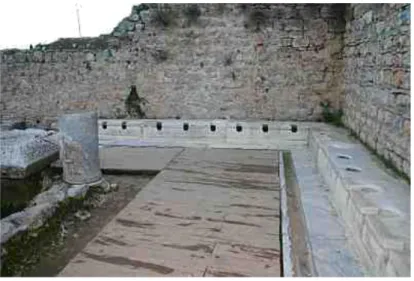
Just as baths were public facilities in early Roman and Greek civilizations, so were the latrines. Although, some early evidence of the house chamber pot was also recorded, Roman latrines were actually flushed by water (Figure 2.2).
Figure 2.2 Latrines Ephesus, Turkey (Mahfouz, Salma, 2013)
While the Romans did not invent the aqueduct, primitive canals for irrigation and water transport existed earlier in Egypt, Assyria and Babylon (Beamish, et al. 2013). Romans were not concerned with privacy in the latrines and they sat next to each other. Roman technology was astonishingly ahead of its time, but these latrines disappeared along with the civilizations they came from. Human waste was used for the fertilization of the fields. “The god Stercutius, considered to be the brother of Cloacina, was also worshipped” (Eveleigh 2003).
Romans used sponge sticks for cleaning themselves after using the closet. Such sticks were simply a natural sponge on a stick and were kept in containers of salt water so they would be sterilized ready for the next user. They would often be washed before being replaced in a creative sewer of flowing rainwater in which they could be further washed (Lambton 2007).
The Romans were masters at constructing sewerage systems. They used closely fitting cut stones to carry fresh water and sewage. To be sure that rainwater would not damage the walls below; they would use floating floors completely separate from the ceiling immediately below. This was the room used for relieving and adorning the
body. Sewage channels were connected very skillfully. Water pipes led from fountains powered by gravity into the houses, ending in holes under the floor where they were used as water reservoirs. Sewage ended its journey in a huge basin built of very thick and strong oak boards anchored firmly in the ground. The pipes rested on a bed of pebbles. This ingenious technology was not continued beyond the Roman period and in medieval times Roman pipes rotted, while former water reservoirs were used for garbage and human waste. Only in Rome itself was the famous “Cloaca maxima” still used today. But it was also considered to be perfect for water disposal under the ground (Illi and Steiner 1992).
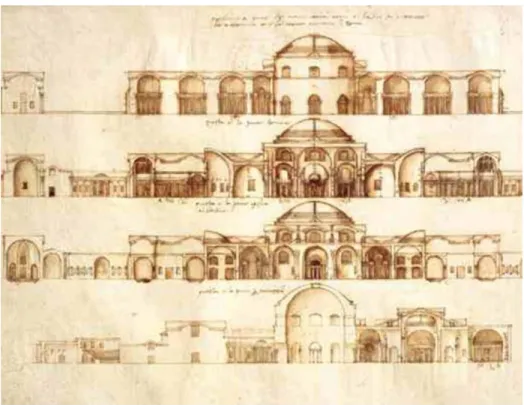
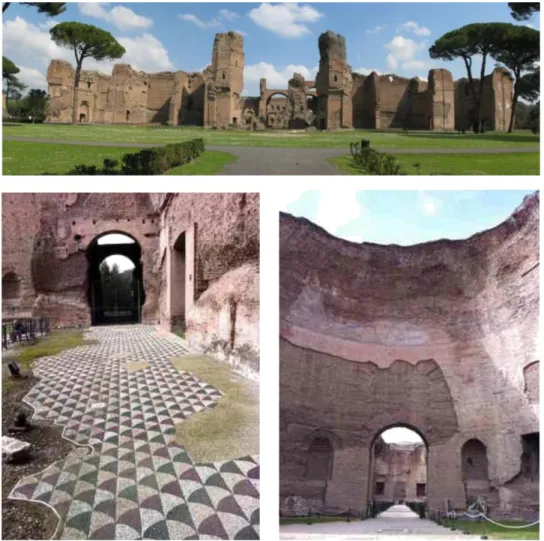
Italian “Terme di Caracalla” is a good example of which scale a bathhouse the Romans enjoyed. At the baths of Caracalla, ancient (Latin) Thermae
Antoninianae “Antonine Baths”, public baths in ancient Rome begun by the emperor Septimius Severus in 206 A.D. and completed by his son emperor Caracalla in 216 A.D. Similar to all bathhouses in ancient Rome, the Baths of Caracalla, included three fundamental bathing rooms. These rooms consisted of the cold pool or
“frigidarium”, the warm pool or “tepidarium” and the hot pool or “calidarium”. Between Rome’s most beautiful and luxurious baths, designed to accommodate about 1,600 bathers, the Baths of Caracalla continued to be in use until the sixth century. The bath complex stands on a vast rectangular platform, measuring 328 by 400 meters, that was partially quarried out of the side of the Aventine hill (About Rome.info n.d.). The underground level carries the water system. The rectangular plan is typical of the great royal baths. The central thermal building itself was oriented in North-East/South-West, for the exploitation of sunlight. Following the traditional plan of Roman baths, the principal rooms were lined up on the short
central axis of the bath block in the ritual order in which the Romans would use them. They used the technique of raised floors and created spaces between the walls to let hot air from the heater to circulate through. The heater was close to the Tepidarium and Calidarium. In the middle of the building the frigidarium was situated and edged by two massive areas called Palaestra. These were outdoor gymnastic areas. Palaestra was an area to run and workout or competitions and games took place. Both areas were 328 by 400 meters in size (Murray and Murray 1998). The Natatio, an Olympic size pool 80 meters long and reserved for recreational swimming activities was found at the back of the building. The decorations and works of art: The baths of Caracalla were adorned with columns, precious marble slabs on the vaults, stucco paintings and hundreds of statues and colossal sculptures. Two basic functions for the baths for the ancient Romans were a necessity in sanitation or sanitary facilities and they provided an opportunity for socialization (Smith 1990).
Figure 2.4 Current situations of the baths of Caracalla, Italy (Manalin, Jugem, 2015)
The Caracalla bath complex of buildings was more a leisure center than just a series of baths. It was massive, covering about fifty acres that included swimming pools, exercise yards, a stadium, steam rooms, libraries, meeting rooms, fountains, and other amenities. All were enclosed in formal gardens.
With the fall of the Roman Empire, the bath was no longer an important part of daily life and disappeared for centuries. But people were not dirty in medieval times, only their attitudes changed. Private and public baths were used for meetings, eating, drinking and sometimes gambling. People washed, had their hair dressed and generally enjoyed their time in the sauna. This inevitably encouraged the brothel culture, which was at the time much criticized by the church.
2.3 Middle Ages
Through the Middle Ages, from fifth to fifteenth centuries, bathing was not a common activity and little attention was given to personal hygiene. There was a similar fear that water was a carrier of disease and high class society embraced perfumes as replacements. The spread of diseases and the tightening of church policy eventually closed down communal baths in Europe. Sanitation in general suffered during the Middle Ages (Beamish, et al. 2013). Few, if any, advances were made in devices to collect waste. Without a sewer system or other disposal methods, chamber pots were usually emptied out the windows. Sometimes that meant pouring waste onto the streets below and often onto people using the streets. Water for domestic use was drawn from the closest water supply, which could easily be contaminated by free‐flowing waste. During the Middle Ages, there was an awareness of the link between sanitation and disease. But no real effort was made to improve the circumstances (Newman 2001). There is indication of flushing toilets as early as the sixteenth century. Sir John Harington designed and invented the first flushing toilet with a reservoir. Harington worked from drawings by the Italian architect, Barozzi da Vignola. He also was the godson of Queen Elizabeth I and when she visited shortly after he had fitted it and saw his closet, she was so impressed that she asked him to make an exact copy for Richmond Palace (Palmer 1973). The toilet was fitted in his house in 1592, but this did not turn out to be common until the explosion of innovations and patents in the mid-nineteenth century that corresponded with the Great exhibition of 1851 in London (Palmer 1973). The large quantity of ceramic
industries, which had developed through the industrial revolution, began to turn their fabrication to bathroom products which had earlier been produced in wood and metal. The origin of Islam can be traced back to seventh century Saudi Arabia ("Who is God?" All About GOD Ministries n.d.). Under Islamic rule, Islamic bath or Ḥammam in Arabic was established, public bathing developed in countries that reflects the fusion of an original Eastern bath tradition and the elaborate Roman bathing process. In Islamic culture, bathing was part of a purification ritual attached to religious beliefs, along with a source of meditation, relaxation, and entertainment (Benrens-Abouseif 1999).
2.4 Seventeenth, Eighteenth and Nineteenth Centuries
In the mid-eighteenth century, the benefits of washing the body with water were not believed in. Taking a bath was considered to be unhealthy. People who studied medicine at this time considered water to be poisonous for the body. They thought that dirt protected the skin against diseases and bathing would remove this protection (Bonneville 2002). This point of view changed at the end of the eighteenth century with the French philosopher Jean Jacques Rousseau. With the emphasis on getting “back to nature” bathing became a habit again. Doctors re-discovered the value of water for health and for cleaning the body as prevention of disease. From about 1850 onwards the bath was not concealed, only the closet and bidet being hidden or disguised. Women started to decorate their bathrooms attractively (Bonneville 2002). European immigrants brought similar beliefs about the unpleasantness and the harmful effects of bathing to America. During the seventeenth and much of the eighteenth centuries little attention was given to body care. Pioneers
who desired to bathe did so infrequently because it was so difficult. At the beginning they needed to find a container big enough to bathe in, and then carry in water and heat it. The bathroom did not become common in the average house until there was a reliable supply of running water and the accessibility of economical metal pipe and ceramic fixtures which were made possible through mass production during the Industrial Revolution. The introduction of running water made it both economical and practical to bring personal hygiene activities all into the same space. it made sense to locate a house’s bathroom on the second floor because of the location of the water supply in the roof space, even though many were also on the first floor next to the kitchen. The second floor location in houses helped in providing the privacy that many people desired. The next generation of water closets (WC) was a “washout” or “wash down” design that used a remarkable amount of water to flush waste away completely because of the availability of running water (Palmer 1973). the first application of indoor plumbing for the middle class people was incorporated because of the availability of running water (Figure 2.9).
Figure 2.9 Advertisement of the early flush toilets used overhead tank to hold the water that should be used (Errol on 3oclockballcock, 2015)
The first patent for water closets (WC) was taken in 1775 by Alexander Cummings, a Scottish watchmaker. The S-shaped trap was invented by him to prevent sewer gases from entering buildings. This was considerably improved three years later by Joseph Bramah, a joiner from Yorkshire, who was granted a patent in 1778 for a double valve closet which sealed off smells (Lambton 2007).
Dealing with human waste became a cause that was embraced by social reformers, physicians, technicians and researchers in the nineteenth century. There were several systems for solving the waste problem. But it generally depended on the wealth of the community: which system was chosen. Nonetheless, in the middle of the nineteenth century, the more wealthy areas occasionally selected to have no system at all. The rich were powerful enough to prevent the implementation of sewerage systems, and sometimes did so because they feared a rise in property taxes. It was argued that the damage caused by sewage, and the cost of necessary treatment plants, were a worse evil than the systems or non-systems of earlier times (Beamish, et al. 2013).
In many towns sewerage systems were voted down. It was argued that a private problem would become a public concern, as far as the dispersal of excrement was concerned. Until mid/to late nineteenth century, cesspools, Underground hole or container for holding liquid waste from a building, were mostly used to deal with sewage. But these often leaked into the nearest stretch of water or, when not regularly emptied by “rakers” also known as “scavengers”, the people whose job it was to empty cesspools, caused soil saturation and consequent damage (Landau 2006). Inventors worked very hard to find solutions to these problems. Reverend Moule, the inventor of the earth closet, said that W.C.s were more of an evil than a benefit because of the polluted water associated with them. Some municipalities such as
Manchester attempted to reduce this problem by discouraging the use of W.C.s. Many northern towns and cities in England continued to use dry privies due to the lack of necessary infrastructure (Palmer 1973).
Drainage was the main problem with the W.C., not only because of the waste, but also because of water pollution. Water source was also very costly and created unpopular increases to property rates. The city of Liverpool, however, set a very positive example, which many subsequently followed: the Council developed and built a water supply and sewerage system second to none in Britain, and installed it between 1847 and 1867 (Eveleigh 2003).
In 1883 the English firm T. W. Twyford created the “Unitas”, which later became known as the “Queen of Closets”. It was the first W.C., which encased the trap in one piece of ceramic and therefore was a special W.C. It became extremely successful and later became the model which set several standards on which many closets were based, (for example the height of the W.C. still used today at 420mm), including future Twyford models (Lambton 2007).
At this time Liverpool had approximately 250 miles of sewers. Water did not come cheap. Between 3% and 5% of a council tenant’s annual rent was allocated to the cost of supply. Many cities followed Liverpool’s example when the benefits became clear. Until this time, sewage from cities was mostly plumbed straight into tidal rivers. London’s sewerage system construction began in 1859 and had an amazing 1300 miles of sewers which connected to 82 miles of main tunnels (Eveleigh 2003).
In 1895, a siphon action water closet or flushing toilets was developed that used vacuum or sucking action to more efficiently flush away the waste or excess with a
smaller amount of water. This siphonic action or flushing is used by most modern toilets (Palmer 1973).
Bathing methods also improved with the accessibility of running water. A concern about hygiene encouraged people to question how someone could become hygienic while sitting in a tub of water that developed gradually dirty as one bathed. Such concerns led to an attention in the vapor or steam bath and the shower as better options to the bath tub. The shower became promising when a method was created to pump warm water up a pipe for the overhead spray. The first shower was a simple device that used a hand pump to transfer water up a pipe over a manageable or outdoor tub. In the long run, public water supplies included enough pressure to force the water to the showerhead. Most likely the last fixture to be followed was the lavatory (Beamish, et al. 2013). The new fixture was designed much like the previous wash basin and stand, emerging as a bowl‐shaped basin on a stand base with a drain in the middle (Figure 2.10).
Figure 2.10 The photos are taken from magazines, books and online sources covering the early 1900′s to the 1920′s
(1912bungalow, 2004)
The first tap used a hand pump to draw water, and later a tap with hot and cold water controls was attached. Soon the stand lavatories disappeared as cabinetry entered the bathroom, and sinks were installed into vanities that contained the much desired and needed built‐in storage. This design became common by the 1950s (Eveleigh 2003).
2.5 Globalization and development of bathroom design
in today’s world starting the 20th century
Globalization is the ongoing process that is linking people, neighborhoods, cities, regions and countries much more closely together than they have ever been before. This has resulted in our lives being tangled with people in all parts of the world via the food we eat, the clothing we wear, the music we listen to, the information we get and the ideas we hold. Development of the Internet makes information collaborative communication faster around the world. Global cultural combination enriches the design type of bathroom products, with the closer
economic integration and the impact of globalization has entered into a deeper level of human life. As one of the most dynamic groups of companies operating in the sanitary industry, Duravit AG develops and manufactures sanitary ceramics,
bathroom furniture, shower trays and bathtubs, whirl and wellness systems, shower-toilets, kitchen sinks and accessories for the international market. Overall, Duravit operates with more than 30 affiliated companies and is present in almost 120
countries. Manufacture takes place in Germany and at several international locations: Egypt, China, France, India, Tunisia and Turkey (IF world design guid n.d.). Other international companies like kohler, Grohe, HansGrohe, Crestial, Toto and many more provide international products that were not available because at that time there was not much scope for the bathroom design. But now the story has taken a new turn. Every variety of national and international products has become available which is helping in boosting the bathroom design. Globalization in design is also responsible for the growing market.
Bathroom design was moving away from the lavish toward the convenient layout as it shows in figures 2.11, 2.12, and 2.13. A concern for sanitation and hygiene was dominant in bathroom design, emphasizing on maintenance and safety emerged. A foot tub, pedestal lavatory, and water closet made up the standard three‐piece bathroom. The cage shower was introduced as a single shower fixture (Figure 2.14) (Beamish, et al. 2013).
Figure 2.11 Standard Bath Lavatory Bathroom, Figure 2.12 Khohler of Khohler (tumblr, 2015) 1905 (vintageadbrowser, 2015)
Figure 2.13 Standard Sanitary Manufacturing Co Figure 2.14 Bathroom Fixtures Mother Baby
Bathroom & Plumbing Fixtures (pintrest, 2015) Standard Sanitary, 1906 (pintrest, 2015)
According to the decade of 1920’s, the closed‐in rectangular porcelain tub was produced. Faucets and shower controls lined up vertically under the showerhead. Pedestal lavatories were popular, as well as console lavatories supported by metal legs (Figure 2.15 and 2.16). Lavatories were often made of Monel, a corrosive resistant, light‐weight, white metal containing a mix of copper and nickel. Nickel was used for bright work on faucets. White was still popular, but porcelain made it possible to add color. The color matching of vitreous china glazes and cast iron enamels was perfected. Colors included blue, green, ivory, yellow (Figure 2.24), brown, lavender, and gray. The bathroom continued to be viewed as a functional space, not for relaxation. Lighting consisted of a center ceiling lamp surrounded by milk‐glass diffusers of various shapes. The first copper plumbing systems were installed late in the decade (Beamish, et al. 2013).
Figure 2.15 Standard Plumbing Fixtures (etsy, 2015) Figure 2.16 Khohler of Khohler ( tumblr, 2015)
In the 1940s, new colors has been introduced such as rouge (burgundy), Tuscan (gold), and spring green (light green), as well as pink (see Figure 2.17) and bright blue, emerged. By the mid‐1940s, the dental lavatory disappeared from ads. The single, mixing lever for showers was available. The bench bath allowed parents to sit on the edge to watch children as they bathed (Figure 2.18). Laminates, mirrored walls, glass counters, and cork floors were trendy. Stainless steel became popular for lavatories and countertops (Beamish, et al. 2013).
Figure 2.17 Kohler of Kohler, 1940 (retrorenovation, Figure 2.18 Kohler of Kohler, 1949 ( retrorenovation, 2015) 2015)
In the 1950’s, small lavatories called dental lavatories were marketed as a means to help children practice dental hygiene (Figure 2.19). A foot tub, pedestal lavatory, and water closet made up the standard three‐piece bathroom. The leak‐proof, one‐piece shower was developed. Bathrooms were lit by a single, flush‐mounted ceiling fixture in the center of the room, which remained the norm until the 1970s (Beamish, et al. 2013).
Figure 2.19 The “lavette,” later called the powder room, was marketed by Kohler as a way to incorporate an extra bathroom by converting small spaces, such as bedroom closets and spaces under stairs, into a small bathroom (tumblr, 2015)
Figure 2.20 Standard Plumbing Fixtures (ebay, 2015)
New bathrooms in the 1960’s were more luxurious and second bathrooms were promoted. The idea of relaxation was finally coming back to the bathroom. Ads portrayed hometown girls and happy moms relaxing in the bathroom (Figure 2.21 and 2.22). Bold colors emerged, including orange, bright yellow, deep red, dark brown, dark green, avocado green and harvest gold (Figure 2.23) (Beamish, et al. 2013).
Figure 2.21 Kohler of Kohler (pintrest, Figure 2.22 Kohler of Kohler (gogd.tjs-
2015) labs, 2015)
Figure 2.23 Kohler of Kohler (pintrest, 2015)
The bathroom started to gain its status as a place of relaxation. In 1975 Villeroy & Boch was created bathroom design almost revolutionary when they gave the public a design based on ergonomic principles and imaginative soft shapes and tailored to the body (Villeroy & Boch 2012). The double lavatory was an important selling point in new houses. The nostalgic look reappeared in a vintage toilet with elevated tank and chain pull, the ball‐and claw‐foot tub, and pedestal lavatory. Homeowners switched to fluorescent lamps to save energy, and to track lighting to increase the amount of light. Hydromassage tubs, such as the whirlpool tub, were available. Colored fixtures were an important part of the bathroom design. Theme designs were shown for the bathroom, including the patriotic, desert southwest and Caribbean motifs. Solid surface countertops with integral lavatory were developed in 1968, but were not introduced to the builder market until 1971. Later in the decade; bathrooms were becoming a place of leisure with larger tubs for relaxation (Beamish, et al. 2013).
Figure 2.24 Exklusive from a German magazine dated 1974 Geometric wall tile design and floating Lavatory vanity (uglyhousephotos, 2015)
Figure 2.25 From an English magazine (flashbak, 2015)
Figure 2.26 Hülsta Arkansas dutch magazine (uglyhousephotos, 2015)
Figure 2.27 EuroBad 74 (uglyhousephotos, 2015)
2.6 Historical development of bathroom design in residential buildings in the world.
Bathrooms have transformed the world we live in. Two hundred years ago, bathrooms did not exist. The bathroom's development has not been a straightforward matter, the idea of a room in a home dedicated to personal hygiene and grooming is a recent one. Houses that are built much before the turn of the century did not have bathrooms. So, in the span of about one hundred years, the modern bathroom has evolved from an innovation into a universal residential feature. On the other hand, disposing of human waste has always been a need, as well as a need for providing facilities for grooming and bathing. Those human needs evolved into the modern bathroom in both technology and culture (Buckley 2005). The first indoor bathrooms that were made possible by the modification of the toilet were communal affairs shared by many people. More rich residences might require a dedicated dressing room that contained a water closet, a portable bath, and a washstand, but this type of centralized bathroom didn't become widespread until indoor plumbing and
permanent water closets gained acceptance toward the end of the nineteenth century (Landau 2006). The followings examples has been chosen to allow expanding and generalizing theories by combining the existing theoretical knowledge with new realistic insights. These examples are useful in capturing new layers of reality, and developing new valid theoretical and practical point of view.
2.6.1 House Takumi (Pictures taken by Takumi in 2014) (Takumi 2014)
This house is located Toshima,Tokyo,Japan. It was built in 2009. Site pictures
Lighting design
No source for natural lighting as a result it has ceiling light fixture and light fixtures over the mirror.
Evaluation
The sink, toilet, and bath are in separate rooms. Japanese bathrooms are usually wet-rooms made out of acrylic. Hooked on the top of the toilet tank, a small sink may be built. There is a tap with the top of the tank forming the sink, and the water draining into the tank which runs during the flush cycle. This is common mainly in mid-twentieth century buildings. A clothes changing room is the room with the sink, usually includes a space for a clothes-washing machine. The room which contains the bathtub is waterproof with a space for washing, and often for showering, adjacent to the tub. As a result, bathwater is neither soapy nor dirty, and can be reused.
2.6.2 House Adam (Pictures taken by Adam in 2015) (Adam 2015)
This house is located London, United Kingdom. It was built in 2009 Site pictures
Figure 2.29 Site Pictures, (Adam U.K., 2015)
Lighting design
No windows available it depends on artificial lights. It has spot lights in the ceiling and over the mirror.
Evaluation
The area of the bathroom is approximately 6 m². It includes a sink, a toilet and a bathtub, all the basic fixtures. Hard surface materials are used as a counter top and on the floor for better maintenance. As for ventilation, air conditioning system is used.
2.6.3 House Venkatesh (Pictures taken by Venkatesh in 2012) (Venkatesh 2012)
This house is located North Parramatta, NSW, Australia. It was built in 2005. Site pictures
Figure 2.30 Site Pictures, (Venkatesh, Australia, 2012)
Lighting design
A small window is available for natural day light as well as ceiling light. Evaluation
The area of the bathroom is approximately 7.2 m². It includes a sink, a toilet, a shower and a bathtub. Hard surface materials are used from floor to walls for better maintenance. The existence of the window allows natural ventilation.
2.6.4 House Tamara (Pictures taken by Tamara in 2014) (Tamara 2014)
This house is located New York, United States. It was built in 2005. Site pictures
Figure 2.31 Site Pictures, (Tamara U.S.A., 2014)
Lighting design
Windows are absent in this bathroom as a result it has a ceiling light fixture.
Evaluation
The area of the bathroom is approximately 4.5 m². It includes a sink, a toilet and a bathtub, all the basic fixtures. Hard surface materials are used from floor to walls for better maintenance.
2.6.5 House Sahar (Pictures taken by Salma Mahfouz in 2014)
This house is located Cairo, Egypt. It was built in 2010. Site pictures
Figure 2.32 Casa Apartments, (Salma Mahfouz Cairo, Egypt, 2015)
Lighting design
A small window is used for natural lighting as well as a ceiling light fixture and light fixtures over the mirror.
Evaluation
The area of the bathroom is approximately 4 m². It includes a sink, a toilet and a bathtub, all the basic fixtures. Hard surface materials are used as a counter top, on walls and on the floor for better maintenance. The existence of the window allows natural ventilation.
Evaluation of 2.6
Larger houses of this period brought additional bathrooms. Energy and water conservation features are incorporated into more eco‐friendly bathrooms. Furniture pieces are taking the place of cabinetry, and contemporary styling is emerging with its clean lines and floating cabinetry. More color is coming into the bathroom, including colored bathroom fixtures and the use of more ornamental design
elements. The master bath suite becomes multipurpose, incorporating space for two users and activities such as dressing, laundry, and relaxation. Feng Shui and the Asian culture are influencing bathroom designs. Jetted tubs became popular. Vessel lavatories are appearing in many styles, materials, and mounting configurations. A keen awareness of universal design is influencing bathroom design, materials, and styling. Showers are more popular than ever and are emerging as the preferred bathing method for most adults. Technology is an important part of the modern bathroom and is used for entertainment, relaxation, and grooming.
2.7 Conclusion
This chapter looked at bathroom space, its relationship and development over centuries and people's bathing cultures from a historical perspective. Since ancient time’s baths introduced people how to enjoy nature in entertainment bathing process. Bathroom was intended as a place for relaxation. Thousands of years of civil
engineering and social change are the result of the privacy, comfort, luxury and extreme sanitary conditions that people associate with the bathrooms today. People have always had the need to use toilet facilities and have used bathing as a way to cleanse themselves. It took centuries to bring these two important utilities together into one convenient space. A clear understanding of space and how this space will be used in order to fulfill the needs, desires and personal tastes of people, leads to a successful bathroom planning. While globalization is not a new process, it has accelerated rapidly since the late 1930’s till the 1940’s, and is having many effects on people, the environment, cultures, national governments, economic development and human well-being in countries around the world. Throughout the duration of the bathroom hauntings, the research has aided me in making knowledgeable decisions about the relationship between space, body, and products. In a world dominated by standardized, industrial products, the bathroom explores what an interior space designed specifically for an individual could be. Through the study of the case studies, an observation has been made about that there is great value in not
standardizing a bathroom or filling it with collections of mass-produced accessories and products. Each individual bathroom could be unique on its own to suit its inhabitants, mimicking their movements, daily rituals and routines to form a space
that fits its user in comparison to the rigid geometries, aesthetics and
mass-production of common domestic bathrooms and the fixtures they contain. Designing for one’s individual rituals and routines allows the shape, structure, and aesthetics of one’s bathroom to take on the form of the movements required to perform in that area. Because the design has taken on the form of these activities of such daily rituals and routines, the bathroom space transforms into a room that fits one’s own body and accommodates activities which occur within the bathroom. Ergonomics is a new interdisciplinary field of studying the anatomy, physiology and psychology of various factors for instance, its content, method and means as scientific and technological progress, improved living standards constantly change and improve (Baoxiang and Xianghua 2008). As a result, the introduction of the principles of ergonomics to the interior space design's objective is to optimize the relationships between users and fixtures. The improvement of fixtures to achieve the highest levels of effective interaction (Jun 2008), and strive to make people - machine -
3
Ergonomics, Environmental Consideration and Material
Finishes in Bathroom Design
3.1 Introduction
The bathroom design environment is mainly related to the interface space shapes, sizes, toilet sound, light, electricity and thermal comfort factors. Older houses did not have an extra space, area or room that could be devoted to a complete bathroom. It was somewhat easy to add a small lavatory or toilet. But including a bathtub required a major amount of space (Eveleigh 2003). Bathrooms can be built-into a bedroom or dressing room, it was considered a waste to dedicate too much room to them, because they were supposed to be as a practical or functional space.
Sustainability is a way of life, and so is sustainability in the bathroom. A person don’t need to compromise on style, quality or individuality to care for the environment. “Act so that the effects of your action are compatible with the permanence of genuine human life”, philosopher Hans Jonas actually defined a personal understanding of sustainable building which is about fulfilling s the needs of the present and, at the same time, keeping a livable environment and healthy for future generations.
Water is the lifeblood of any bathroom. It’s also a precious resource. Using it wisely is not just about how much of it we use in the bathroom. It is also about how we heat it and what products we select to deliver it. The right solution to ventilation will make an enormous difference to the feeling of the bathroom, as well as helping to use the energy more efficiently. Ventilation is especially important in bathrooms in order to remove unwanted moisture, and prevent the growth of mold and mildew.
Too much moisture in a house can result in mold, mildew, and other organic growths. This in turn can lead to a variety of negative health effects ranging from allergic reactions, asthma attacks and to more serious illnesses. In addition to health problems, severe moisture problems can result in rotting, structural damages or premature paint failure.
Since bathrooms are often the center of activity, durability is as important as design. After exploring various bathroom designs and layouts, the client should have a clear vision of what the new bathroom will look like. Most materials used in the bathroom will require an exterior finish to protect it from the environment and to improve the look of the material. Finishes are usually applied to protect the material from moisture, wear, abrasion, fungus, mold or insect attack, to change the materials appearance, its color or texture, and to enhance the materials durability, surface hardness or other properties. Bring bathrooms to life with finishes for instance: ceramic tiles, granite countertops and vanities, Corian vanities, travertine sinks, porcelain sinks, stainless steel sinks and more.
3.2 Application of Ergonomics in Bathroom Design
The first complete bathrooms belonged to the wealthy, who usually converted an extra bedroom into a bathroom (Beamish, et al. 2013). Better-quality houses were built, by the mid‐nineteenth century, with a separate bathroom. Even though it was possible to obtain hot and cold running water by the late 1800s and early 1900s, it was still considered a luxury and it was combined only into the houses of the wealthy. The finest luxury bathrooms of the time often included a sit bath, foot bath, bidet, pedestal lavatory, siphonaction toilet, enameled tub, and shower bath with receptor
(Palmer 1973). Servants were no longer around to transfer water and perform other duties, when smaller and more functional bathrooms were introduced because they had fixtures crowded together for efficiency. It was hard during the late nineteenth and early twentieth centuries for people who did convert a room to a bathroom, because they were not sure how it should appear. So the first bathrooms were unique in layout and design. Many styles emerged during this era, including wood floorings bathrooms, with a wooden toilet container, seat, and a wooden bathtub that were massive and imposing. Some luxury rooms were heavily draped, elaborately wallpapered, and carpeted (Palmer 1973). They included marble, glass, and glazed tiles. For the middle class, however, hardwood floors in the plain, simple, hygienic bathroom with plaster walls became eventually the standard. Early in the twentieth century, the compact sanitary bathroom with its white walls and fixtures became the model of the modern bathroom. Color was the innovation that manufacturers hanged attractively to homeowners after 1925. Colors from the late twenty’s forward were available at a small additional cost (Figure 3.1).
Figure 3.1 Kohler Bathroom, (antiquehomestyle, 1928)
“Pipes were left exposed, partly to show the shiny, sanitary fixtures. The early bathroom was minimal in size; a toilet, a lavatory, and a bathtub/shower were the three standard fixtures. The popularity of the bathroom increased, and more households found ways to convert a space to accommodate a bathroom” (Beamish, et al. 2013).
Today’s bathroom contains countless numbers of the basic elements of earlier bathrooms. But new technologies, materials, and lifestyles have made the bathroom into a more inviting, relaxing, and comfortable space to enjoy. Since the end of World War II, lots of awareness to the need for universal and accessible design has been growing, especially with the requirements of disabled patients, and the aging population becoming more important (Beamish, et al. 2013).
3.3 Environmental Considerations
3.3.1 Air Quality
Good indoor air quality makes a space enjoyable and healthy to be in. Part of the design process is to secure that space is pollution free. Providing good indoor air quality needs source control by minimizing or preventing the sources of indoor air pollution in a room or building. Ventilation is needed by providing adequate air exchange, through mechanical or natural ventilation, the need to dilute the absorption of indoor air pollutants and ensure that the space has a supply of fresh air; and air cleaning by when necessary. “Filters or other devices can be used to remove potentially harmful indoor air pollutants. There are a number of sources of potential air pollution, in the bathroom”. (European Communities 2014).
3.3.2 Water
A bathroom is a wet place. Water is used for many purposes, both functional and luxurious. In the process of using a bathroom, swallowing, inhaling and absorbing water may occur. For these reasons, the water used in a bathroom should be safe and healthy, in addition to its taste, and purity. Much of the water used in a bathroom is heated. The energy used to heat the water is also contributing in wasting water. Conserving and reducing energy to heat water are part of a sustainable house (Beamish, et al. 2013). Water used in the bathtub is largely related to the size of the tub. A tub for soaking needs to have enough water to cover most of a person’s body. Sometimes smaller, but deeper, tubs may use less water. In jetted tubs or Jacuzzis, the jets are placed lower in the tub to provide an effective massage with less water. When
designing shower systems with multiple showerheads, put individual controls on each fitting. By Adjusting showerheads, the user can then provide only the desired amount of water and it will result in reducing waste, especially of hot water. Aerators on taps are important to water conservation. With an aerator, the air added to the water flow increases the force and makes the running water seems greater. Water use is reduced. Often water is wasted in a bathroom’s lavatory tab during teeth brushing because it is inconvenient to turn the water on and off. “A method to control water is by using a tap with an electronic and motion-activator that only turns on when a hand, toothbrush, or a razor is under the tap”. In most houses, the single greatest use of water is for flushing the toilet. Older toilets may use three to five or more gallons per flush (Figure 3.2).
Figure 3.2 The number of gallons (liters) per flush has decreased as toilets became more efficient. Sustainable Design Methods for Architecture (New York: John Wiley & Sons, 2012)
“Some toilet products on the market today use even a reduced amount of water per flush. An effective flushing system reduces the likelihood that a second flush will be
used to remove all the waste. In addition to saving water, efficient and effective flushing systems reduce costs of maintenance. Some toilets have dual-flush systems that let the user choose the amount of water per flush” (U.S. Enviromental Protection Agency 2014). An important factor in efficient use of water is to avoid water leaks. Toilets or taps that drip can waste great amounts of water. Selecting good quality fixtures, fittings and water-using appliances will be ways to maintain and less likely to develop leaks. This is important as water conservation measure, but will also save money and reduce maintenance for the client.
3.3.3 Moisture, Molds and Health in Bathrooms
Excess moisture is at the top of the list Moisture gets created while showering, soaking in the bathtub, using running water in the lavatory, water evaporating from the toilet bowl, and towels drying. In a new bathroom, water is available in many building products such as grout, joint compounds, plaster and latex paints. As these products dry and cure, and water vapor released. A lot of moisture can create a humid space for the bathroom user and can also lead to structural damage (Figure 3.3).
Figure 3.3 As warm, moist air moves through a wall, condensation will occur when the air is cooled to the dew point temperature. Rendered in 20-20 (Brgoch, Michael, CKD, 2015)
When the level of moisture is high in an enclosed space like a bathroom creates and fosters the growth of biological pollutants such as molds, viruses, and bacteria. As a result of Excess moisture in building materials, structural problems can occur, such as peeling paint, rusting metal and deterioration of joints and framing. Building materials that are damp tend to draw dirt and as a result it requires more maintenance and cleaning. Many organic pollutants have better chances of growth because Damp spaces make good environments. “Viruses and bacteria grow well as dust mites to cockroaches. Further structural damage can be led by Wet building materials which also can be a factor in harboring mold. Mold can be a threat to the health. In addition, mold growing on interior finish materials smells bad and is ugly” (U.S. Department of Health and Human Services & Housing and Urban Development 2011). Molds are fungi. There are thousands of varieties of molds, which reproduce by bacteria that are blown out into the air. The bacteria can be dormant for years. Then, given the right conditions of food and moisture, they can begin to grow. Molds
can affect people in different ways. Some people are allergic to specific species, that can cause problems such as headaches, breathing difficulties, and skin irritation, as well as aggravating other heath conditions such as asthma can be caused by Molds producing chemicals. Molds can sensitize the body so that someone becomes more susceptible to health effects from future exposures. Some molds produce toxins. The likelihood of health effects increases with the amount of exposure to mold, and also depends on the sensitivity of the individual. Moisture problems can be prevented by selecting the right finish materials. The more absorbent the materials, after exposure to water and humidity the longer they will stay damp. Requiring hard surface or nonabsorbent materials such as solid surfacing, glazed tiles, engineered stone, or vitreous china reduces the likelihood problems cause by moisture (Figure 3.4).
Figure 3.4 Place a vapor retarder material on the warm or interior side of the wall, to help prevent moisture condensation inside the wall, in climates with cold winters. In hot, humid climates, where air conditioning is used most of the year, the placement of the vapor retarder may be different. Rendered in 20-20 (Brgoch, Michael, CKD, 2015)