77
Araştırma Makalesi / Research Article
Evaluation Of Patch Test Positivity In Patients With Chronic
Urticaria And Comparison With Voluntary Controls
Kronik Ürtikerli Olgularda Patch Test Pozitifliğinin Değerlendirilmesi ve Sağlıklı Kontrollerle Karşılaştırılması
Fatma Gülru Erdoğan, Aslıhan Gül Çakır, Aysel Gürler
Ufuk Üniversitesi Dermatoloji Anabilim Dalı
Received: 02.09.2008 • Accepted: 08.12.2008 Corresponding author
Fatma Gülru Erdoğan
Ufuk Üniversitesi Dermatoloji ABD Phone : (312) 204 40 00 E-mail address : [email protected]
Background: Chronic urticaria is one of the enigmas of dermatology. Although studies have
shown that %30 - 50 of cases are autoimmune in origin exact role of contact sensitization is still unclear. Objectives: Prick tests are recommended for etiologic work up of chronic urticaria. We aimed to evaluate patch and prick test reactivities in patients with chronic urticaria and compare patch test reactivities with healthy controls.
Material and Methods: We enrolled 27 patients and 20 healthy controls to the study. Patients are
selected so that they didn`t have a history of allergic rhinitis,conjunctivitis, eczema or contact ur-ticaria and had negative intradermal autologous tests. All laboratory examinations were normal. Both patch and prick tests are performed after the acute flare is over and their madicationa have been stopped for at least 4-6 weeks while only patch test is performed to the controls.
Results: Fourteen of 27 patients had at least one positive patch test result. Prick test positivity
was present in 14 patients as well. Seven of patch positive patients were prick negative and vice versa. Six patients didn`t have either patch or prick test positivities. Out of 20 control subjects 4 had positive patch test results.
Conclusion: Patch test positivity was as frequent as prick test positivity. Comparing with healthy
controls contact sensitization may be more prevalent in patients with chronic urticaria however whether this is the reason or the result of urticaria is to be further evaluated.
Key Words: urticaria, contact sensitization, patch test, prick test, contact allergy
Amaç: Kronik Ürtiker dermatolojide etyolojisi tam aydınlatılamamış konulardan biridir. Son
yıllar-da yapılan yayınlaryıllar-da olguların %30 ile 50 sinde otoimmun mekanizmaların sorumlu olabileceği bildirilmiş olup kontakt sensitizasyonun etyolojideki rolü hala iyi anlaşılamamıştır. Kronik ürtiker etyolojik araştırmalarında prik testleri önerilmektedir. Bu çalışmada kronik ürtikerli hastaların deri yama ve prik test sonuçlarının değerlendirilmesi ve yama testi sonuçlarının sağlıklı kontrollerle karşılaştırılması amaçlanmıştır.
Gereç ve Yöntem: Bu amaçla tüm laboratuar bulguları normal, otolog serum testi negatif, başka
herhangi bir allerjik reaksiyon öyküsü olmayan 27 hasta ve 20 sağlıklı kontrol çalışmaya alınmıştır. Hasta grubunun lezyonları tamamen gerileyip tedavileri kesildikten 4-6 hafta sonra deri prik ve yama testleri uygulanmış, öte yandan sağlıklı kontrollere yalnızca deri yama testi yapılmıştır.
Bulgular: Yirmiyedi hastanın 14 ünde deri yama testi en az bir allerjene karşı pozitif iken, prik testi
pozitifliği de 14 hastada bulunmuştur. Prik testi negatif olup yama testi pozitif 7 hasta saptanmış olup, prik testi pozitif iken yama testi negatif gene 7 hasta tesbit edilmiştir. Toplam 6 hastada her iki test de negatif olarak değerlendirilmiştir. Kontrol grubunda ise yama testi pozitifliği 20 kişinin 4ünde saptanmıştır.
Sonuç: Kronik ürtiker etyolojisi araştırılmasında önerilen deri prik test pozitifliği deri yama test
pozitifliğinden daha sık bulunmamıştır. Sağlıklı kontrollerle karşılaştırıldığında kronik ürtikerliler-de ürtikerliler-deri yama testi pozitifliği daha sık bulunmuştur. Bu durumun ürtikerin etyolojisi mi yoksa bir sonucu mu olduğu sorusu ise ileri çalışmalarla sorgulanabilir.
Ankara Üniversitesi Tıp Fakültesi Mecmuası 2008, 61(2)
78 Evaluation Of Patch Test Positivity In Patients With Chronıc Urticaria And Comparison With Voluntary Controls
Chronic urticaria is still one of the enigmas in dermatology. It was shown to be related with many different medical conditions but still exact etiology is contraversial especially in a subgroup of pati-ents having no detectable systemic cause. Chronic urticaria was once considered to be a manifestation of an anxiety disorder but in time it is concluded that there has not been good data to support this supposition (1).
It was also thought to be related with infections. Recent data to sup-port or refute an infectious cause of chronic urticaria, is still being debated, but an infectious cause seems to be unlikely according to some authors (1).
An autoimmune mechanism appears to be likely, at least in a subpopula-tion of patients, but 60 percent of cases remain idiopathic. Autologo-us skin test was found to be a Autologo- use-ful screening test for autoimmune chronic urticaria (1-4).
An increased prevalence of clinically important thyroid disease or subc-linical thyroid autoimmunity has been noted in patients with chro-nic urticaria (5,6). The significan-ce of this is unsignifican-certain. At present anecdotal evidence both supports and refutes the idea of prescribing lthyroxine for euthyroid chronic urticaria patients who have thyro-id autoimmunity (5).
It is shown that a small proportion of patients like less than 5% may pro-ve to be reactipro-ve to certain foods and food additives so diagnostic work up is recommended to inc-lude a prick test specially for food allergy (1,7). On the other hand adherence to a diet of rice, lamb and water for five days has shown to have no effect on chronic urtica-ria or angioedema (1).
An even smaller number of patients were thought to be associated with parasite infestations who usually have blood eosinophilia (7,8). Chronic idiopathic urticaria is the
diagnosis given when diagnoses of urticarial vasculitis, physical ur-ticarias and all possible etiologic factors have been excluded. We ai-med to check skin patch and prick test reactivities in patients with chronic urticaria without any iden-tifiable systemic etiologic factor with detailed laboratory tests and negative autologous skin tests and compare their patch test positivi-ties with normal control subjects without any allergic reactions and no history of atopy.
Patients and Methods
We selected patients in an outpati-ent setting from april 2006 till july 2007. Only adult patients aged bet-ween 18 to 60 without any syste-mic disease and not receiving any systemic treatments for any reason are included to the study.
Patients having physical factors or drugs as a possible causative fac-tor are excluded from the study. As diagnostic procedures we checked complete blood count, erythrocyte sedimentation rate, blood chemist-ries, urinalysis, thyroid hormones and autoantibodies, stool exami-nation for parasites, anti nuclear antibodies, chest x ray, immunog-lobulin and complement levels. Further tests are performed in
suspi-cious cases like urine culture, si-nus tomography, dental and gyne-cologic examination. Only patients who do not have any positive or suspicious results with these tests are enrolled to the study group. Selected patients also had negative
intradermal autologous skin tests and did not have a history of
ec-zema, allergic rhinitis or conjunc-tivitis. Control group is selected among voluntary health personnel who were in the same age group, who did not have allergic diseases like urticaria, eczema, rhinitis or conjunctivitis, who do not have any systemic diseases and who have not been receiving any medi-cations. We had a total of 20 cont-rol cases.
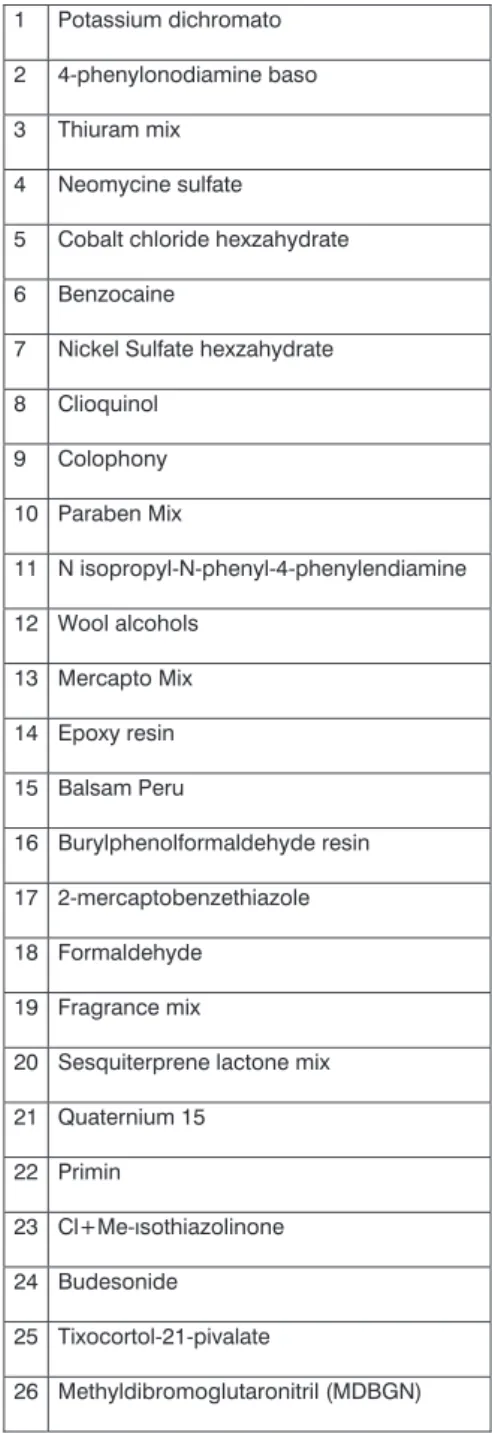
1 Potassium dichromato 2 4-phenylonodiamine baso 3 Thiuram mix
4 Neomycine sulfate
5 Cobalt chloride hexzahydrate 6 Benzocaine
7 Nickel Sulfate hexzahydrate 8 Clioquinol 9 Colophony 10 Paraben Mix 11 N isopropyl-N-phenyl-4-phenylendiamine 12 Wool alcohols 13 Mercapto Mix 14 Epoxy resin 15 Balsam Peru 16 Burylphenolformaldehyde resin 17 2-mercaptobenzethiazole 18 Formaldehyde 19 Fragrance mix
20 Sesquiterprene lactone mix 21 Quaternium 15 22 Primin 23 Cl+Me-sothiazolinone 24 Budesonide 25 Tixocortol-21-pivalate 26 Methyldibromoglutaronitril (MDBGN)
Table 1: List of European standard patch test
Journal of Ankara University Faculty of Medicine 2008, 61(2)
79
Fatma Gülru Erdoğan, Aslıhan Gül Çakır, Aysel Gürler
We performed both patch tests with 26 allergens and prick tests with 40 allergens to all patients while their acute flare was over for a mi-nimum of 4 and a maximum of 6 weeks and while they were not re-ceiving systemic antihistaminics or steroid for at least 10 days. Table 1 has a list of patch test allergens and table 2 is the list of prick test allergens used. On the other hand, we performed only patch tests to the control group.
Results
We had a total of 312 patients with urticaria, 43 has met our selection criteria (13%). Of these 43 patients 27 accepted to have patch and prick tests and so enrolled to the study. In the patient group, mean age was 37.19 ± 6.00 whereas in the control group mean age was 33.25 ± 5.39.
In the patient group, fourteen pati-ents had a positive reaction to at least one prick test allergen where-as fourteen patients had a positive reaction to at least one patch test allergen.
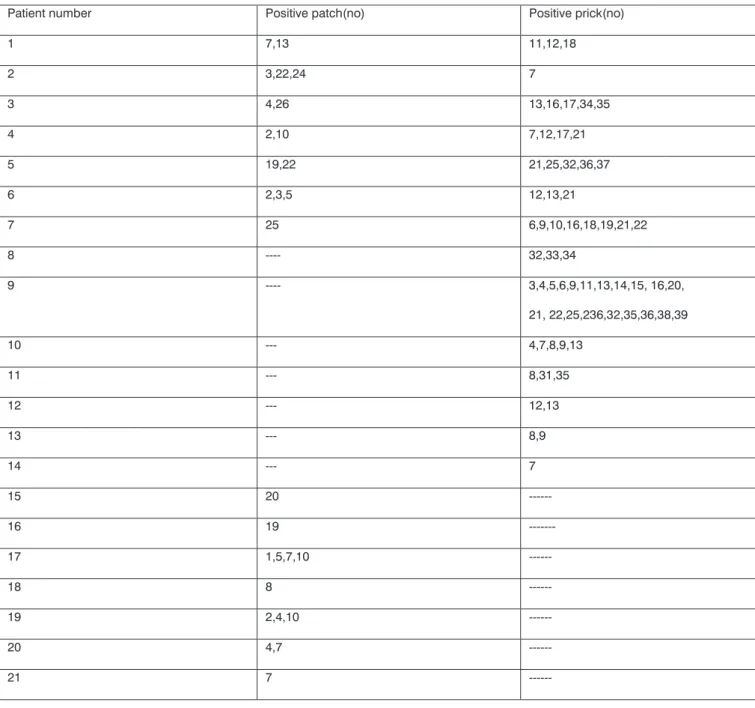
Seven patients had a positive patch and negative prick test, seven had positive reactions to both patch and prick tests, seven had positive prick and negative patch test re-sults and six had negative rere-sults to both patch and prick tests (Tab-le 3).
Fourteen patients who had positive reaction to skin prick tests, accor-ding to a recent classification, are not considered to be idiopathic urticaria cases while the rest 13 patients with negative prick tests can be considered as chronic idi-opathic urticaria (7). Six of the fo-urteen patients with positive skin prick tests had a food allergen positivity while the remaining 8 patients were positive non-food derived allergens (table 3). Seven of these 13 patients had a positive patch test reaction. Overall these seven patients had positive reac-tions to 9 allergens. Three pati-ents had positive reaction towards nickel sulfate hexzahyde, two wards neomycine sulfate, two to-wards paraben mix, one patient towards potassium dichromato, 4-phenylonodiamine baso, cobalt chloride hexzahydrate, clioquinol, fragrance mix and sosquiterpenoi-actone mix.
In the control group, on the other hand we had only 4 positive re-sults out of 20 with patch tests. One of these was nickel, second one to neomycine sulfate, third to paraben mix and last to formal-dehyde. When compared with he-althy controls, patch test positivity was statistically more prevalent in urticaria group (chi-square test, p < 0.05 ).
Comments
Urticaria was once considered as an Ig E mediated hypersensitivity reaction whereas recentstudies showed the existence of different subgroups of the urticaria cases, some of which having an autoim-mune mechanism (1-4,9). In chro-nic urticaria skin prick tests are re-commended for the etiologic work up while patch tests are not (10). Although we have limited number of patients, we still had interesting results, for example in our patients
1 Positive control (histamine) 2 Negative control 3 Betulaceae 4 Salicaceae 5 Trees mixture 6 Compositae 7 Mixture of 12 grasses 8 D.Farinae 9 D.Pteronyssinus 10 Cladosporium 11 Aspergillus mix 12 Cat hair 13 Dog hair 14 Mixture of hairs 15 Poa pratensis 16 Pinus sylvestris 17 Mixture of 4 cereals 18 Secale cereale 19 Latex 20 Cocroach 21 Mosquito 22 Cocoa 23 Olive 24 Onion 25 Paprica 26 Pepper 27 Tea 28 Wheat flour 29 Mixture of 7 cereals 30 Apple 31 Banana 32 Orange 33 Peach 34 Strawberry 35 Peanut 36 Hazelnut 37 Walnut 38 Tomato 39 Egg (whole) 2 Negative control 3 Betulaceae 4 Salicaceae 5 Trees mixture 6 Compositae 7 Mixture of 12 grasses 8 D.Farinae 9 D.Pteronyssinus 10 Cladosporium 11 Aspergillus mix 12 Cat hair 13 Dog hair 14 Mixture of hairs 15 Poa pratensis 16 Pinus sylvestris 17 Mixture of 4 cereals 18 Secale cereale 19 Latex 20 Cocroach 21 Mosquito 22 Cocoa 23 Olive 24 Onion 25 Paprica 26 Pepper 27 Tea 28 Wheat flour 29 Mixture of 7 cereals 30 Apple 31 Banana 32 Orange 33 Peach 34 Strawberry 35 Peanut 36 Hazelnut 37 Walnut 38 Tomato 39 Egg (whole) 40 Chicken meat
Ankara Üniversitesi Tıp Fakültesi Mecmuası 2008, 61(2)
80 Evaluation Of Patch Test Positivity In Patients With Chronıc Urticaria And Comparison With Voluntary Controls
group patch test positivity was as common as prick test positivity. Al-most half of the positive prick test reactions were towards food, the rest being towards non food al-lergens (table3). When compared with healthy controls, patch test positivity was statistically more in urticaria group (chi-square test, p < 0.05 ). We performed patch tests 4 to 6 weeks after the acute flare is over which may be quite early when skin is still readily
re-active. Repeating the same tests with same patients 6 months later, in the condition that the patients didnot have a new urticarial attack may result in different findings. There has been limited reports
of chronic urticaria found to be caused by common contact sensitizers(11-14).Interestingly many such patients of chronic urticaria has not exhibited signs of contact allergy before
urticari-al attack. These studies have urticari-also shown that testing for contact sensitization can be helpful in the management of chronic urticaria (15).
In another recently published study, out of 121 patients with chronic urticaria, 50 (%41) had positive patch test results (16). Although patients were not selected among idiopathic cases, 47 of 50 patch positive patients were idiopathic
Table 3: List of positive patch and prick test results in patients with chronic urticaria
Patient number Positive patch(no) Positive prick(no)
1 7,13 11,12,18 2 3,22,24 7 3 4,26 13,16,17,34,35 4 2,10 7,12,17,21 5 19,22 21,25,32,36,37 6 2,3,5 12,13,21 7 25 6,9,10,16,18,19,21,22 8 ---- 32,33,34 9 ---- 3,4,5,6,9,11,13,14,15, 16,20, 21, 22,25,236,32,35,36,38,39 10 --- 4,7,8,9,13 11 --- 8,31,35 12 --- 12,13 13 --- 8,9 14 --- 7 15 20 --- 16 19 --- 17 1,5,7,10 --- 18 8 --- 19 2,4,10 --- 20 4,7 --- 21 7 ---
81
Fatma Gülru Erdoğan, Aslıhan Gül Çakır, Aysel Gürler
REFERENCES
1. Kaplan AP. Chronic Urticaria and an-gioedema. N Engl J Med 2002; 346: 175-179.
2. Clive EH, Grattan MA. Autoimmune ur-ticaria. Immunol Allergy Clin N Am 2004; 24:163-181.
3. Fusari A, Colangelo C, Bonifazi F, et al.The autologous serum skin test in the folowup of patients with chronic urticaria. Allergy 2005; 60: 256-258. 4. Sabroe RA, Grattan CEH, Francis DM,
et al. The autologous serum skin test: a screening test for autoantibodies in chronic idiopathic urticaria. Br J Der-matol 1999; 140: 446-452.
5. Dreskin SC, Andrews KY. The thyroid and urticaria. Curr Opin Allergy Clin Immunol 2005; 5: 408-412.
6. Tong LJ, Balakrishnan G, Kochan JP,et al. Assessment of autoimmunity in patients with chronic urticaria. J Al-lergy Clin Immunol 1997; 99: 461-465.
7. Bindslev-Jensen C, Finzi A, Greaves M, et al. Chronic urticaria: diagnostic recommendations. Eur Acad Derma-tol Venereol 2000; 14: 175-180. 8. Staumont-Salle D, Dombrowicz D,
Capron M, et al.Eosinophils and urticaria. Clin Rev Allergy Immunol 2006; 30: 13-18.
9. Tong LJ, Balakrishnan G, Kochan JP, et al. Assessment of autoimmunity in patients with chronic urticaria. J Allergy Clin Immunol 1997; 99: 461-465.
10. Jacob SE, Steele T.Allergic Contact Dermatitis: Early recognition and di-agnosis of important allergens. Der-matol Nurs 2006; 18: 439-443. 11. Abeck D, Traencker I, Steinkraus V, et
al. Chronic Urticaria due to nickel in-take. Acta Derm Venereol 1993; 73: 438-439.
12. Hallab N, Merritt K, Jacobs JJ. Metal sensitivity in patients with orthopae-dic implants. J Bone Joint Surg 2001; 83: 428.
13. Warin RP, Smith RJ. Chronic urticaria investigations with patch and chal-lenge tests. Contact Dermatitis 1982; 8: 117-121.
14. Piskin G, Akyol A, Uzar H, etal. Com-parative Evaluation of type 1 latex hypersensitivity in patients with chronic urticaria, rubber factory workers and healthy control sub-jects. Contact Dermatitis 2003; 48: 266-271.
15. Deb Sharma A. Use of patch testing for identifying allergen causing chro-nic urticaria. Indian J Dermatl Vene-reol Leprol 2008; 74: 114-117. 16. Guerra L, Rogkakou A, Massacane P,
et al. Role of contact sensitization in chronic urticaria. J Am Acad Derma-tol 2007; 56: 88-90.
meaning that in only 3 patients there has been another possible etiologic factor identified. On the other hand out of 71 patch nega-tive patients 50 had an etiologic factor identified like chronic infec-tion, thyroiditis, immune or me-tabolic diseases. This finding was in favor of our patient selection criteria and also confirmed that contact sensitization may be one
of the many possible mechanisms involved in the etiology of chronic urticaria.
Urticaria, at least a sub group of it, can have a delayed type reaction component which may be expla-natory to many patients. Patients with chronic urticaria without a detectable underlying etiologic factor can have positive skin patch
test results. Limitation of our study is the lack of data after the elimina-tion of the allergen and evaluaelimina-tion of clinical relevance wth larger gro-ups. According to our present fin-dings, delayed type reaction may be involved in the etiopathologic mechanisms of chronic idiopathic urticaria.