Yılmaz Çengel et al. 373 _____________________________________________________________________________________________________
Original article / Araştırma
Factors affecting treatment compliance in patients
with substance use disorder under probation
Hanife YILMAZ ÇENGEL,
1Utku UZUN,
2Müge BOZKURT,
3Cüneyt EVREN
4_____________________________________________________________________________________________________
ABSTRACT
Objective: The present study aims to determine the factors that affecting the treatment compliance in patients with
substance use disorder (SUD) under probation in terms of sociodemographics, substance use characteristics, addiction severity, perceived family support, treatment motivation and impulsiveness. Methods: In this study, 93 substance use disorder patients who were taken three-month outpatient treatment program were included consecu-tively. Sociodemographic Data Form, Addiction Profile Index (API), Perceived Social Support from Family Scale (PSS-Fa), Barratt Impulsiveness Scale and Treatment Motivation Questionnaire were applied to patients before the treatment program. Results: At the end of three months follow-up period 55 (59.1%) of the 93 patients were treatment-incompatible while 38 (40.9%) were treatment-compatible. When the tests results are examined; the craving subscale score of API had significantly higher and the PSS-Fa scores had significantly lower in the treat-ment-incompatible group than the treatment-compatible group. Conclusion: In our study, craving and low per-ceived family support were found to be factors affecting treatment compliance in patients with SUD on probation. These results emphasized the importance of including the family in the treatment program, evaluating craving at each session and providing pharmacological or psychotherapeutic support for craving. (Anatolian Journal of
Psychiatry 2020; 21(4):373-379)
Keywords: probation, substance use disorder, treatment compliance, craving, family support
Denetimli serbestlik önlemi ile tedavi kararı verilen madde kullanım
bozukluğu olgularında tedavi uyumuna etki eden etkenlerin
incelenmesi
ÖZ
Amaç: Bu çalışmanın amacı, hakkında ‘denetimli serbestlik tedbiri ile tedavi’ kararı verilmiş madde kullanım
bozuk-luğu (MKB) olan sanık veya hükümlülerde madde kullanım özellikleri, bağımlılık şiddeti, algılanan aile desteği, teda-vi motivasyonu ve dürtüsellik düzeyleri açısından tedateda-viye uyumuna etki eden etkenlerin saptanmasıdır. Yöntem: Çalışmaya MKB tanısı konularak üç aylık ayaktan tedavi programına alınmasına karar verilen ve çalışmaya onay veren ardışık 93 erkek hasta alınmıştır. Tedavi programı öncesinde hastalara Sosyodemografik Veri Formu, Bağım-lılık Profil İndeksi (BAPİ), Algılanan Aile Desteği Ölçeği (PSS-Fa), Barrat Dürtüsellik Ölçeği, Tedavi Motivasyonu Anketi uygulanmıştır. Bulgular: Tedavi programına alınan 93 hastanın 55’i (%59.1) tedaviye uyumsuz, 38’i (%40.9) tedaviye uyumlu olarak programı tamamlamıştır. Çalışmamızda tedavi uyumsuz grubun tedavi uyumlu gruba göre,
_____________________________________________________________________________________________________
1 MD, Psychiatrist, İstanbul Gelişim University, Faculty of Economics Administrative and Social Sciences, Department of
Psychology, İstanbul, Turkey
2 MD, Psychiatrist, Luleburgaz State Hospital, Kırklareli, Turkey
3 MD, Psychiatrist, İstanbul University, Faculty of Medicine, Department of Psychiatry, İstanbul, Turkey
4 MD, Psychiatrist, Bakırköy Training and Research Hospital for Psychiatry Neurology and Neurosurgery, İstanbul, Turkey
Correspondence address / Yazışma adresi:
Hanife YILMAZ ÇENGEL, MD, İstanbul Gelisim University, Faculty of Economics Administrative and Social Sciences, Department of Psychology, Avcılar/İstanbul, Turkey
E-mails: [email protected]; [email protected]
Received: December 10th, 2019, Accepted: February 07th, 2020, doi: 10.5455/apd.71429
374 Factors affecting treatment compliance in patients with substance use disorder under … _____________________________________________________________________________________________________
BAPİ’nin şiddetli madde kullanma isteği alt ölçeği puanları anlamlı olarak daha yüksek, PSS-Fa puanları anlamlı düzeyde daha düşük saptanmıştır. Sonuç: Çalışmamızda şiddetli madde kullanma isteği ve algılanan aile deste-ğinin düşük olması MKB tedavisinde tedavi uyumuna etki eden etkenler olarak bulunmuştur. Bu sonuçlarla aileyi de tedaviye katmanın önemi, madde kullanma isteği ve aşermenin her oturumda sorgulanması ve aşermeyi azalt-maya yönelik farmakolojik veya psikoterapötik desteğin sağlanması gerektiği vurgulanmıştır. (Anadolu Psikiyatri
Derg 2020; 21(4):373-379)
Anahtar sözcükler: Denetimli serbestlik, madde kullanım bozukluğu, tedavi uyumu, aşerme, aile desteği
_____________________________________________________________________________________________________
INTRODUCTION
Substance use disorder (SUD) is a disease that affect not only individual also has a high adverse effects on public safety and economy. In order to reintegrate individuals with illegal substance use into society, the concept of Probation Measure (PM) was born as part of the criminal pro-ceedings and as an alternative penal execution system.1 Probation system in Turkey was
estab-lished in 2005 and between the years 2006 and 2015, 107,920 who were under probation were treated for SUD in Turkey.2 In the treatment of
SUD, even self-referral is always considered a good prognostic factor, compulsory treatments are also effective when appropriate treatment programs and services are provided. Important factors in order to increase the effectiveness of compulsory treatments are: longer duration of intervention, having a structured but flexible treatment program, evaluation of the treatment efficacy at regular intervals, monitoring the change in the patients. It has been shown that familial, environmental and personal characteris-tics of individual are other factors that affect the treatment success.3 Family has a key role in
pre-vention of the onset of SUD.4 When individuals
have low family support they have difficulties in maintaining the treatment. Since the treatment motivation involves desire to change and being ready for change, it has been considered as an important factor for responding to treatment.5,6
Impulsiveness is defined as a tendency to act quickly without giving prior thought than indivi-duals with similar abilities and knowledge.7 It has
been suggested that impulsiveness may be ef-fective both in the onset and maintenance of substance use,8 as well as in recurrence during
and after the process of stopping substance use.9,10
In the direction of all these studies, the investiga-tion of the factors that are effective in the suc-cessful completion of treatment for SUD within the scope of probation has a critical importance. There are several studies that investigate treat-ment program characteristics or familial, person-al or substance use characteristics of individuperson-als separately. In our study we try to examine all of
these factors at the same time under a structured treatment program. The aim of this study is to determine the factors affecting treatment compli-ance among patients with SUD who have been on probation in terms of substance use charac-teristics, addiction severity, perceived family support, treatment motivation and impulsive-ness.
METHODS
Participants
The sample of the study consists of 104 conse-cutive male patients who have been given the ‘Probation Measure (PM) and Treatment’ deci-sion in respect of the Article 191 of Turkish Criminal Law and observed by the Istanbul Pro-bation Measure and Help Branch Offices, who have applied to the Probation Measure Outpa-tient Clinic of Bakırköy Mental Health and Neuro-logical Diseases Training and Research Hospital for treatment purpose between October 10th,
2016 and December 10th, 2016. The Ethics
Committee approval was obtained before the study. All of the participants were informed about the interview and tests to be applied and written consent was taken from each participant. After their first interview was completed by the speci-alists in the branch office, who have been diag-nosed with substance use disorder and have been decided to be taken in the 3-month outpa-tient program but does not need pharmacother-apy, and who have given approval to participate in the study. The exclusion criteria for the study are: to be under 18 years and over 65 years old, to be illiterate, to have cognitive impairment or mental retardation to prevent the process of the treatment, to have a psychiatric disorder other than SUD, to have severe physical illness. Among 104 patients, nine patients who have been diagnosed with a psychiatric disorder other than SUD and two illiterate patients were ex-cluded from the study. Thus, 93 patients taken to the study were followed for three months. Procedure
Sociodemographic Data Form, Addiction Profile Index (API), Perceived Social Support from Anatolian Journal of Psychiatry 2020; 21(4):373-379
Yılmaz Çengel et al. 375 _____________________________________________________________________________________________________
Family Scale (PSS-Fa), Barratt Impulsiveness Scale (BIS-11) and Treatment Motivation Ques-tionnaire (TMQ) were applied to 93 male patients who have been diagnosed with SUD, before the treatment program. Patients were then taken to a three-month outpatient treatment program. Each patient was taken to the Smoking, Alcohol, and Substance Abuse Treatment Program (SAMBA) in accordance with a three-month out-patient treatment program. SAMBA is a struc-tured treatment program of which pilot re-searches were conducted for its effectiveness, and has been used in addiction clinics in our country.11 The SAMBA program is a group
therapy program based on cognitive behavioral therapy and motivational interviewing and is structured as six sessions every 15 days for PM practices. Urine samples were routinely taken from patients before each session and the substance metabolite test was performed. Those who did not participate in at least four sessions of the treatment program or who were found to be positive for the substance metabolite in one of the last three urine toxicology tests: consid-ered as treatment-incompatible; and others con-sidered as treatment-compatible.
Data collection tools
Addiction Profile Index (API): API is a
self-report scale consisting of 37 questions and five subscales. Subscales measure the substance use characteristics, addiction diagnostic criteria, the effect of substance use on the life of the individual, the severe desire for substance use and the motivation to stop substance use. The validity and reliability study was carried out by Ogel et al.12
Perceived Social Support from Family Scale (PSS-Fa): The scale developed by Procidano
and Heler has 20 questions answered as correct, incorrect and partially, which evaluates family support.13 The validity and reliability of the scale
were studied by Eskin.14
Barratt Impulsiveness Scale-11 (BIS-11): It is
a self-report scale to evaluate impulsiveness.It consists of thirty items and has three subscales in it: attention (carelessness, cognitive disorder), motor (motor impulsiveness, impatience) and non-planning (inability to make control, intoler-ance to cognitive complexity). When BIS-11 is evaluated, four different subscores are obtained: total points, non-planning, attentional and motor impulsiveness scores. When the total BIS-11 score is higher, the impulsiveness of patient gets higher, too. The Turkish validity and reliability study of the BIS-11 was performed by Gulec et
al.15
Treatment Motivation Questionnaire (TMQ):
TMA is a self-report questionnaire with 26 ques-tions developed by Ryan et al. designed to evaluate the reasons for participation and stay in alcohol/substance abuse treatment of sub-jects.16 It is a 5-point Likert-type scale that
sub-jects answer in a varying manner from ‘I strongly disagree’ to ‘I strongly agree’. Factor analysis have showed that the scale included 4 identifi-able factors, namely internal motivation (IM), external motivation (EM), interpersonal help seeking (IHS), and non-confidence in treatment (NCT). Evren et al. conducted the Turkish validi-ty and reliabilivalidi-ty study of the TMQ.6
Statistical analysis
The statistical analysis of the study was evalu-ated by SPSS version 20.0 for Mac OSX. In statistical evaluations, descriptive statistics (fre-quency and ratio) was used for sociodemog-raphic variables. We performed chi-square test to investigate the relationship of categorical vari-ables and Mann-Whitney U test for continuous variables of independent groups when they are not normally distributed. The results will be evaluated at the level <0.05 of significance.
RESULTS
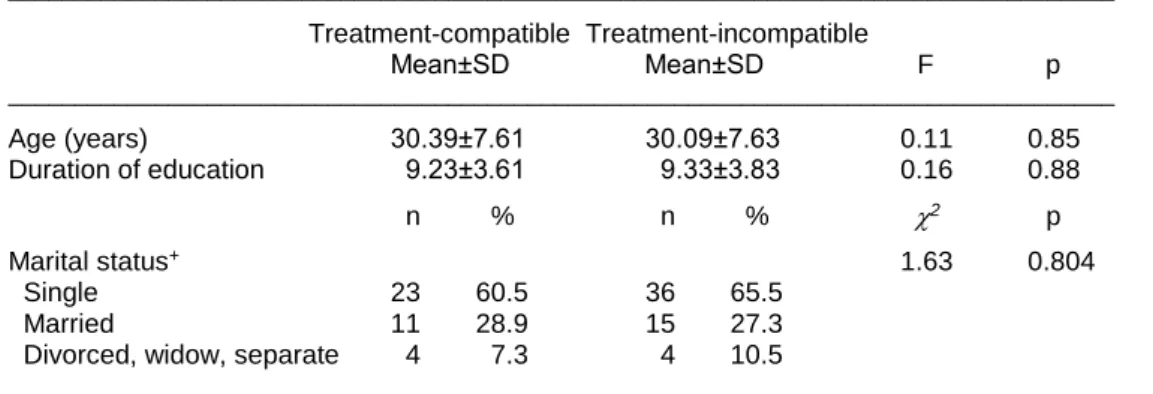
Fifty five (59.1%) of the 93 patients who partici-pated in the treatment program completed the program as treatment-incompatible, and 38 (40.9%) completed the program as treatment-compatible. Twenty-eight (50.9%) of the treat-ment-incompatible patients were considered in-compatible because they did not attend the treat-ment program regularly, and 27 (49.1%) were also considered as incompatible because they were found to be positive for the substance metabolite in one of the last three urine tests even though they continued to the treatment program. There were no significant differences between the two groups in terms of socio-demographic variables. The sociosocio-demographic characteristics of the sample participating in the study are presented in Table 1.
When the study sample was compared in terms of API total score, the treatment-compatible group had a score of 8.63±4.49, the treatment-incompatible group had a score of 10.3±4.41, and at that rate there was no significant differ-ence between them (p=0.10) (Table 2). Although treatment incompatible group had higher scores in substance use subscale, addiction diagnostic criteria subscale, effect of substance use on
376 Factors affecting treatment compliance in patients with substance use disorder under … _____________________________________________________________________________________________________
Table 1. Comparison of sociodemographic variables of the participants
___________________________________________________________________________________ Treatment-compatible Treatment-incompatible Mean±SD Mean±SD F p ___________________________________________________________________________________ Age (years) 30.39±7.61 30.09±7.63 0.11 0.85 Duration of education 9.23±3.61 9.33±3.83 0.16 0.88 n % n % 2 p Marital status+ 1.63 0.804 Single 23 60.5 36 65.5 Married 11 28.9 15 27.3
Divorced, widow, separate 4 7.3 4 10.5
___________________________________________________________________________________
Table 2. Findings obtained from data collection tools
___________________________________________________________________________________________________ Treatment-compatible Treatment-incompatible
Mean±SD Mean±SD u p ___________________________________________________________________________________________________ Perceived Family Support Scale (PSS-Fa) 29.11±6.48 25.72±7.42 -2.27 0.03 Addiction Profile Index (API)
Criteria for addiction diagnosis 9.75±6.77 12.05±6.54 1.64 0.10
Substance use specifics 1.42±1.31 1.87±1.34 1.61 0.11
Effect of substance use on life 20.63±12.6 23.07±12.8 0.91 0.36
Craving for substance use 5.15±4.85 7.78±4.43 2.70 0.008
Motivation to quit using substance 8.84±3.67 10.31±3.31 0.66 0.51
API total score 8.63±4.49 10.30±4.41 1.78 0.08
Treatment Motivation Questionnaire (TMQ)
Internal motivation 28.19±11.8 27.58±10.3 -0.26 0.79
External motivation 8.73±3.53 9.36±3.17 0.89 0.37
Interpersonal help seeking (IHS) 12.07±5.72 12.14±5.18 0.06 0.95
Non-confidence in treatment (NCT) 8.50±3.58 8.92±3.57 0.56 0.57
Barrat Impulsiveness Scale-11 (BIS-11)
Attention impulsiveness 8.95±2.95 9.49±2.65 0.93 0.36
Motor impulsiveness 8.39±4.76 9.87±4.71 1.48 0.14
Planning inability impulsiveness 13.39±5.18 14.03±5.03 0.59 0.55
Total 30.73±11.04 33.40±9.87 1.21 0.23
___________________________________________________________________________________________________
individual's life subscale, motivation to quit sub-stance use subscale according to treatment-compatible group the difference was not statis-tically significant. In the severe craving for sub-stance use subscale scores: the treatment-compatible group had significantly lower scores (5.15±4.85) than the treatment-compatible group (7.78±4.43) (p=0.008) (Table 2). When the study sample was compared with the PSS-Fa scores, the total score of treatment-compatible group (29.11±6.48) was significantly higher than the treatment-compatible group (25.72±7.42) (p=0.03) (Table 2). Treatment-incompatible group also had higher scores on both BIS-11 total score and all BIS-11 subscales than the treatment-compatible group but no statistically
significant difference was found between the two groups (Table 2). When the study sample was compared in terms of TMA scores no significant difference was detected between treatment compatible group and treatment incompatible group (Table 2).
DISCUSSION
Fifty five (59.1%) of the 93 patients who partici-pated in the treatment program completed the program as treatment-incompatible, and 38 (40.9%) completed as treatment-compatible. These data share similarities with those given in the results of the studies carried out in our country and abroad.3 Studies have proven that
Yılmaz Çengel et al. 377 _____________________________________________________________________________________________________
there is a significant relationship between the PM treatment content and the treatment success.17
Low perceived family support in our study was found to be one of the factors affecting the treat-ment compliance in SUD. Family support is an important factor in preventing all criminal behav-ior of individuals also preventing substance use and reducing the risk of use.18,19 Studies have
demonstrated that the quality of social relation-ships at the time of the treatment is related to the outcome of the treatment and the risk of recur-rence.20,21 According to these data, it can be
considered that including family and social circle into the PM follow-up and the treatment program will increase the success rate.22 With our study,
it has been once again emphasized the impor-tance of including family into the treatment pro-cess. Providing the participation of family mem-bers and time to time friends into the treatment process, informing them about addiction and treatment process and getting their support will also be beneficial.
In this study craving was found to be another factor affecting treatment compliance in SUD. It has been observed that individuals with severe craving have difficulty for completing the PM treatment program. It was reported that craving and sensation seeking subscales of API were the factors determining the success rate of completing the PM treatment program.11 When
the relationship between substance use charac-teristics and treatment outcome in individuals who receive a compulsory treatment is exa-mined, low severity of SUD, absence of multiple substance use, low frequency of substance use, and low craving for substance use during treat-ment were associated with positive treattreat-ment outcomes.3 Similarly, in the studies conducted in
the US on the PS follow-up and treatment pro-gram, substance use with high-risk, high severity of SUD, frequent substance use in the last period, and severe craving for substance use were associated with incompatible treatment outcomes.21-23 It is important to question craving
for substance use at each session of the meetings and to provide a pharmacological or psychotherapeutic support for reducing craving. General impulsivity level and all impulsivity sub-scale levels were found to be higher in treat-ment-incompatible group than the treatment-compatible group but no statistically significant difference was found between groups. It has been shown in previous studies that the impulsi-vity level of an individual is related to the absti-nence of substance use,24 prevention
recur-rence,25 and the treatment success.26 Finding a
high level of both general impulsiveness and attentional, motor, and non-planning impulsive-ness in this study sample of individuals who were given PM and treatment decision due to sub-stance abuse crime was consistent with similar data in the literature. In those individuals who have substance abuse and criminal history, behavioral and motivational counselling for their impulsiveness besides medical treatment may be useful for the successful completion of the treatment.
When the results of the treatment motivation questionnaire were evaluated, there was no significant difference between the groups in internal motivation, seeking help, confidence in the treatment and external motivation scores. The theories about the treatment motivation suggest that there is a relationship between the seriousness of the problems of substance users and continuing the treatment and getting positive results.27,28 Our study sample consisted of
pa-tients sent to the compulsory treatment, so it can be said that the treatment motivation of this sample is low and this property of our sample may explain the lack of a significant difference between groups in terms of TMA. Although the pre-treatment motivation of individual is low in compulsory treatments such as legal require-ment, it may be effective in gaining awareness about the treatment and substance-related prob-lems.29 It is important for clinicians to apply
treat-ment approaches that increase motivation in individuals with low motivation.
Study limitations
The most important limitation of this article is that the study was conducted in a patients with sub-stance use disorder who were under probation. Therefore, the study results cannot be general-ized for all patients with substance use disor-ders. The fact that all of the participants in the study are male leads us to be unable to comment on female PM subjects. The fact that this study sample was randomized in a consecutive sequ-ence has led to different substance use charac-teristics of patients. The frequency of substance use and duration of severity vary among pa-tients. Multiple SUD were found to be associated with incompatible treatment outcomes.21,22 The
lack of standardization in terms of substance use characteristics may have caused confounding effects. The participants sent to the treatment with legal obligation so they may have led the physician to misguide, to show themselves bet-ter than they are, and to tend to hide the facts. By emphasizing that this study and the PM
378 Factors affecting treatment compliance in patients with substance use disorder under … _____________________________________________________________________________________________________
process are separate things, it has been tried to ensure that the possible measurement errors are minimized.
CONCLUSION
Since 2005, those who commit substance abuse offense are referred to treatment by the PM offices in our country. In this study, it has been aimed to determine the factors affecting treat-ment compliance in terms of substance use characteristics, addiction severity, perceived family support, treatment motivation and impul-sivity levels. According to our results severe
craving for substance use and low perceived family support in those who were referred to treatment by PM Offices were found to be the factors determining treatment compliance. In light of these results it can be suggested that patients with low family support and high craving levels need to be monitored closely and perhaps more intensive support programs should be arranged for them. It is clear that further studies are needed in order to determine the charac-teristics of individuals directed to the compulsory treatment and to arrange the appropriate treat-ment for them.
Authors’ contributions: H.Y.Ç: findind subject, data collection, writing manuscript; U.U: finding subject, data
collection; M.B: reviewing the manuscript; C.E: statistics, reviewing the manuscript.
REFERENCES
1. Kaeble D, Glaze L, Tsoutis A, Minton T. Correcti-onal Populations in the United States, 2014. Bureau of Justice Statistics 2016; 1-19.
2. Bilici R, Ögel K, Bahadır GG, Maçkan A, Orhan N, Tuna O. Treatment outcomes of drug users in probation period: three months follow-up. Psychi-atry Clin Psychopharmacol 2018; 28(2):149-155. 3. Turan R, Yargic I. The relationship between
sub-stance abuse treatment completion, sociodemog-raphics, substance use characteristics, and crimi-nal history. Subst Abus 2012; 33(2):92-98. 4. Mackensen G, Cottone RR. Family structural
issues and chemical dependency: A review of the literature from 1985 to 1991. Am J Fam Ther 1992; 20(3):227–241.
5. Conner BT, Longshore D, Anglin MD. Modeling attitude towards drug treament: the role of internal motivation, external pressure, and dramatic relief. J Behav Health Serv 2009; 36(2):150-158. 6. Evren C, Saatçioğlu Ö, Dalbudak E, Danışmant
BS, Çakmak D, Ryan RM. Factorial structure and reliability and validity of Turkish version treatment motivation questionnaire (TMQ) in alcohol depen-dents. J Depend 2006; 90(216):117-122.
7. Cuomo C, Sarchiapone M, Giannantonio M Di, Mancini M, Roy A. Aggression, impulsivity, per-sonality traits, and childhood trauma of prisoners with substance abuse and addiction. Am J Drug Alcohol Abuse 2008; 34(3):339-345.
8. Lane SD, Cherek DR, Rhoades HM, Pietras CJ, Tcheremissine OV. Relationships among labora-tory and psychometric measures of impulsivity: implications in substance abuse and dependence. Addict Disord Their Treat 2003; 2(2):33-40. 9. Patkar AA, Murray HW, Mannelli P, Gottheil E,
Weinstein SP, Vergare MJ. Pre-treatment mea-
sures of impulsivity, aggression and sensation seeking are associated with treatment outcome for African-American cocaine-dependent patients. J Addict Dis 2004; 23(2):109-122.
10. Berkowitz L. Is criminal violence normative behav-ior? J Res Crime Delinq 1978; 15(2):148-161. 11. Ogel K, Bilici R, Guvenc Bahadir G, Mackan A,
Orhan N, Tuna O. The effectiveness of the tobac-co, alcohol and drug dependence treatment pro-gram (SAMBA) on drug users in probation. Ana-tolian Journal of Psychiatry 2016; 17(4):270-277. 12. Ogel K, Evren C, Karadağ F, Tamar Gürol D. Bağımlılık Profil İndeksi’nin (BAPİ) geliştirilmesi, geçerlik ve güvenilirliği. Türk Psikiyatr Derg 2012; 23(4):264-273.
13. Procidano ME, Heller K. Measures of perceived social support from friends and from family: three validation studies. Am J Community Psychol 1983; 11(1):1-24.
14. Eskin M. Reliability of the Turkish version of the Perceived Social Support from Friends and Family scales, Scale for Interpersonal Behavior, and Suicide Probability Scale. J Clin Psychol 1993; 49(4):515-522.
15. Güleç H, Tamam L, Güleç MY, Turhan M, Karakuş G, Zengin M, et al. Psychometric properties of the Turkish Version of the Barratt. Bull Clin Psycho-pharmacol 2008;18(March 2014):251-258. 16. Ryan RM, Plant RW, O’Malley S. Initial
motiva-tions for alcohol treatment: relamotiva-tions with patient characteristics, treatment involvement, and drop-out. Addict Behav 1995; 20(3):279-297.
17. Brown R. Associations with substance abuse treatment completion among drug court partici-pants. Subst Use Misuse 2010; 45(12):1874-1891.
Yılmaz Çengel et al. 379 _____________________________________________________________________________________________________
18. Zimet GD, Dahlem NW, Zimet SG, Farley GK. The Multidimensional Scale of Perceived Social Sup-port. J Pers Assess 1988; 52(1):30-41.
19. Velleman R, Templeton L, Copello A. The role of the family in preventing and intervening with sub-stance use and misuse: a comprehensive review of family interventions, with a focus on young people. Drug Alcohol Rev 2005; 24(2):93-109. 20. Knight DK, Logan SM, Simpson DD. Predictors of
program completion for women in residential substance abuse treatment. Am J Drug Alcohol Abuse 2001; 27(1):1-18.
21. Evans E, Jaffe A, Urada D, Anglin MD. Differential outcomes of court-supervised substance abuse treatment among California parolees and proba-tioners. Int J Offender Ther Comp Criminol 2012; 56(4):539-556.
22. Lang MA, Belenko S. Predicting retention in a resi-dential drug treatment alternative to prison pro-gram. J Subst Abuse Treat 2000; 19(2):145-160. 23. Roque L, Lurigio AJ. An Outcome Evaluation of a Treatment Readiness Group Program for Proba-tioners with Substance Use Problems. J Offender Rehabil 2009; 48(8):744-757.
24. Perry JL, Carroll ME. The role of impulsive behav-ior in drug abuse. Psychopharmacology (Berl) 2008; 200(1):1-26.
25. Moeller FG, Dougherty DM, Barratt ES, Schmitz JM, Swann AC, Grabowski J. The impact of impul-sivity on cocaine use and retention in treatment. J Subst Abuse Treat 2001; 21(4):193-198.
26. Carli V, Mandelli L, Zaninotto L, Alberti S, Roy A, Serretti A, et al. Trait-aggressiveness and impulsi-vity: Role of psychological resilience and child-hood trauma in a sample of male prisoners. Nord J Psychiatry 2014; 68(1):8-17.
27. Cosden M, Basch JE, Campos E, Greenwell A, Barazani S, Walker S. Effects of motivation and problem severity on court-based drug treatment. Crime Delinq 2006; 52(4):599-618.
28. Hiller ML, Knight K, Simpson DD. Risk factors that predict dropout from corrections-based treatment for drug abuse. Prison J 1999; 79(4):411-430. 29. Bahr SJ, Harris PE (Lish), Strobell JH, Taylor BM.
An evaluation of a short-term drug treatment for jail inmates. Int J Offender Ther Comp Criminol 2013; 57(10):1275-1296.