Differentiated ABR: A New Architecture for Flow
Control and Service Differentiation in Optical
Burst Switched Networks
Nail Akar and Hakan Boyraz
Electrical and Electronics Engineering Dept.
Bilkent University, Bilkent 06800, Ankara, Turkey
Email: [email protected]
Abstract— In this paper, we study a new control plane protocol, called Differentiated ABR (D-ABR), for flow control and service differentiation in optical burst switched networks. Using D-ABR, we show using simulations that the optical network can be designed to work at any desired burst blocking probability by the flow control service of the proposed archi-tecture. This architecture requires certain modifications to the existing control plane mechanisms as well as incorporation of certain scheduling mechanisms at the ingress nodes; however we do not make any specific assumptions on the data plane for the optical core nodes. Moreover, with this protocol, it is possible to almost perfectly isolate high priority and low priority traffic throughout the optical network as in the strict priority-based service differentiation in electronically switched networks.
I. INTRODUCTION
Optical Burst Switching (OBS) has recently been pro-posed as a candidate architecture for the next generation optical Internet [1]. The central idea behind OBS is the promise of optical technologies to enable switch recon-figuration in microseconds therefore providing a near-term optical networking solution with finer switching granularity in the optical domain [2]. At the ingress node of an IP over OBS network, IP packets destined to the same egress node and with similar QoS requirements are segmented into bursts which are defined as a collection of IP packets whereas IP packet re-assembly is carried out at the egress OBS node.
In OBS, the reservation request for a burst is signalled out of band (e.g., over a separate wavelength channel) as a Burst Control Packet (BCP) and processed in the electronic domain. We assume the JET reservation model [1] in which each BCP has an offset time information that gives the Optical Cross Connect (OXC) the expected arrival time of the corresponding burst. The offset time, on the other hand, is adjusted at each OXC to account for the processing/switch configuration time. When the BCP arrives at an OXC toward the egress node, the burst length and the arrival time are extracted from the BCP and the burst is scheduled in advance to an outgoing wavelength upon availability. Con-tention happens when multiple bursts contend for the same
outgoing wavelength and it is resolved by either deflection or blocking [3]. The most common deflection technique is in the wavelength domain; some of the contending bursts can be sent on another outgoing wavelength channel through wavelength conversion [4]. In Full Wavelength Conversion (FWC), a burst arriving at a certain wavelength can be switched onto any other wavelength towards its destination. In Partial Wavelength Conversion (PWC), there is a lim-ited number of converters, and consequently some bursts cannot be switched towards their destination (and therefore blocked) when all converters are busy despite the availability of free channels on wavelengths different from the incoming wavelength [5]. Other ways of deflection-based contention resolution are in time domain by sending a contending burst through a Fiber Delay Line (FDL) or in space domain by sending a contending burst via a different output port so as to follow an alternate route [1]. If deflection cannot resolve contention using any of the techniques above then a contending burst is blocked (i.e., data is lost) whose packets might be retransmitted by higher layer protocols (e.g., TCP). Burst blocking in an OBS domain is undesirable and minimization of such blocking probabilities is crucial for OBS-based protocols and architectures.
Differentiated services model adopted by the IETF serves as a basis for service differentiation in the Internet today [6]. However, class-based queueing and advanced scheduling techniques (e.g., Deficit Round Robin [7]) that are used for service differentiation in IP networks cannot be used in OBS domains due to the lack of optical buffers with current optical technologies. It would be desirable to develop a mechanism by which operators can coherently extend their existing service differentiation policies in IP networks to their OBS-based networks as well. For example, if the legacy policy for service differentiation is based on packet-level strict priority queueing then one would desire to provide a service in the OBS domain that would mimic a strict priority-based service differentiation. How this can be done without queueing and complex scheduling at the OBS nodes is the focus of this paper. An approach is to
assign different offset times to different classes of bursts which increases the probability of successful reservation for a high-priority burst at the expense of increased blocking rates for low-priority bursts, therefore providing a new way of service differentiation [8]. However, this approach suffers from increased end-to-end delays especially for high-priority traffic which has larger offset times [9]. In the alterna-tive “acalterna-tive dropping” approach [9], low-priority bursts are dropped using loss rate measurements to ensure proportional loss differentiation.
In this paper, we propose a new explicit-rate based flow-control architecture for OBS networks with service differentiation. This flow control mechanism is implemented only at the control plane and the optical core network is kept unchanged. We propose that this flow control is based on the explicit-rate distributed control mechanism used for ATM networks, for example the ERICA algorithm [10]. In this architecture, we propose that Resource Management (RM) packets in addition to BCPs are sent through the out-of-band control channel to gather the available bit rates for high- and low-priority bursts using a modification of the Available Bit Rate (ABR) service category in Asyn-chronous Transfer Mode (ATM) networks [11]. We use the term “Differentiated ABR” for the proposed architecture in this paper. Having received these two explicit rates, a scheduler at the ingress node is proposed for arbitration among high- and low-priority bursts across all possible destinations. Putting such an intelligence at the control plane to minimize burst losses in the OBS domain has a number of advantages such as improving the attainable throughput at the data plane. Moreover, the proposed architecture moves congestion away from the OBS domain to the edges of the network where buffer management is far easier and less costly, substantially reducing the need for expensive contention resolution elements like OXCs supporting full wavelength conversion and/or sophisticated FDL structures. The paper is organized as follows. Section 2 is devoted to the proposed flow control and service differentiation architecture for OBS networks. In Section 3, we present a simulation example in the context of an OBS multiplexer for “proof of concept” purposes. We conclude in the final section.
II. DIFFERENTIATEDABR (D-ABR) ARCHITECTURE
FOROBS NETWORKS
We envision an OBS network comprising edge and core OBS nodes. A link between two nodes is a collection of wavelengths that are available for transporting bursts. We also assume an additional wavelength control channel for the control plane between any two nodes. Incoming IP packets to the OBS domain are assumed to belong to one of the two classes, namely High-Priority (HP) and Low-Priority (LP) classes. For the data plane, ingress edge nodes assemble
the incoming IP packets based on a burst assembly policy (see for example [12]) and schedule them toward the edge-core links. We assume a number of tuneable lasers available at each ingress node for the transmission of bursts. The burst de-assembly takes place at the egress edge nodes. We suggest to use shortest-path based fixed routing under which a bidirectional lightpath between a source-destination pair is used for the burst traffic. We assume that the core nodes do not support deflection routing but they have PWC and FDL capabilities on a share-per-link basis [13].
The proposed architecture has the following three central components
• Off-line computation of the effective capacity of optical
links,
• D-ABR protocol and its working principles,
• Algorithm for the edge scheduler.
A. Effective Capacity
In this paper, we study an asynchronous (i.e., unslotted) OBS switch and we first focus on one of its output links. We
assume that this optical link hasK wavelength channels per
link, each channel capable of transmitting atp bits/s. Given
the burst traffic characteristics (e.g., burst interarrival time and burst length distributions) and given a QoS requirement
in terms of burst blocking probability Ploss, the Effective
Capacity (EC) of this optical link is the amount of traffic
in bps that can be burst switched by the link while meeting the desired QoS requirement. In order to find the EC of an optical link, we need a burst traffic model. In our study, we propose the effective capacity to be found based on
a Poisson burst arrival process with rate λ (bursts/s), an
exponentially distributed burst service time distribution with
mean 1/µ (sec.), and a uniform distribution of incoming
burst wavelength. Once the traffic model is specified and the contention resolution capabilities of the optical link are given, one can use off-line simulations (or analytical techniques if possible) to find the EC by first finding
the maximum λmax that results in the desired blocking
probabilityPloss and then settingEC = λmaxp/µ.
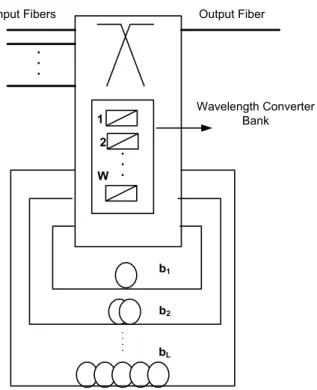
We note that improved contention resolution capability of the OBS node also increases the effective capacity of the corresponding optical link. We study two contention resolution capabilities in this paper, namely PWC and FDL. In PWC, we assume a wavelength converter bank of size 0 < W < K dedicated to each fiber output line. Based on the model provided in [5], a new burst arriving at the switch
on wavelengthw and destined to output line k
• is forwarded to output linek without using a Tuneable
Wavelength Converter (TWC) if channelw is available,
else
• is forwarded to output line k using one of the free
TWCs in the converter bank and using one of the free wavelength channels selected at random, else
Wavelength Converter Bank b1 bL b2 1 2 W Output Fiber Input Fibers
Fig. 1. The general architecture of the OBS node under study
• is blocked.
An efficient numerical analysis procedure based on block-tridiagonal LU factorizations is given in [5] for the blocking probabilities in PWC-capable optical links and therefore the EC of an optical link can very rapidly be obtained in bufferless PWC-capable links.
In addition to W wavelength converters, when desired
we also use FDLs in our numerical experiments. We study
the case of L FDLs per output link where the ith FDL,
i = 1, 2, . . . , L can delay the burst bi = i/µ sec. The burst reservation policy that we use is to first try wavelength conversion for contention resolution and if conversion fails to resolve contention we attempt to resolve it by suitably
passing a contending burst through one of the L FDLs.
To the best of our knowledge, no exact solution method exists in the literature for the blocking probabilities in OBS nodes supporting FDLs and therefore we suggest to use off-line simulations in the latter scenario to compute the EC of FDL-capable optical links. The optical link model using PWC and FDLs that we use in our simulation studies is depicted in Fig. 1. We note however that the EC for more general OBS nodes with more sophisticated architectures can still be calculated using off-line simulations although such a detailed analysis is outside the scope of the current paper.
B. D-ABR Protocol
The feedback information received from the network plays a crucial role in our flow control and service
differ-entiation architecture. Our goal is to provide flow control so as to keep burst losses at a minimum but also emulate strict priority queueing through the OBS domain. For this purpose, we propose that a feedback mechanism similar to the ABR service category in ATM networks, is to be used in OBS networks as well [14]. In the proposed architecture, the ingress edge node of the bidirectional lightpaths sends
Resource Management (RM) packets with periodT sec. in
addition to the BCPs through the control channel. These RM packets are then returned back by the egress node to the ingress node using the same route due to the bidirectionality of the established lightpath. Similar to ABR, RM packets have an Explicit Rate (ER) field but we propose for OBS networks one separate field for HP bursts and another for LP bursts. RM packets also have fields for the Current Bit Rate (CBR) for HP and LP traffic, namely HP CBR and LP CBR, respectively. This actual bit rate information helps the OBS nodes in determining the available bit rates for both classes. On the other hand, the two ER fields are then written by the OBS nodes on backward RM packets using a modification of ABR rate control algorithms, see for example the references for existing rate control algorithms [15],[16],[17].
In this paper, we choose to test the basic ERICA (Explicit Rate Indication for Congestion Avoidance) algorithm due to its simplicity, fairness, and rapid transient performance [10]. Moreover, the basic ERICA algorithm does not use the queue length information as other ABR rate control algo-rithms do, but this feature turns out to be very convenient for OBS networks with very limited queueing capabilities (i.e., limited number of FDLs) or none at all. We leave a more detailed study of rate control algorithms for OBS networks for future work and we outline the basic ERICA algorithm and describe our modification to this algorithm next in order to mimic the behaviour of strict priority queuing.
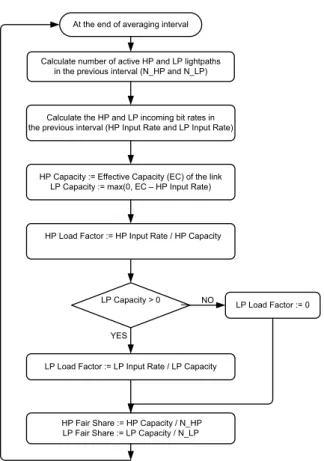
We define an averaging intervalTa. The pseudo-code of
the algorithm that is run by the OBS node at the end of each averaging interval is given in Fig. 2. The EC of the link is the capacity that HP traffic can use. The remaining capacity is for use for LP traffic. The load factors and fair shares for each class of traffic are then calculated along the lines of the basic ERICA algorithm [10]. All the variables set at the end of an averaging interval will then be used for setting the HP and LP Explicit Rates (ER) upon the arrival of backward RM cells within the next averaging interval. Note that all the information used in this algorithm is available at the BCPs and therefore the algorithm runs only at the control plane.
The algorithm to be used for calculating the explicit rates for the lightpath is run upon the arrival of a backward RM cell. The pseudo-code for the algorithm is depicted in Fig. 3. The central idea of the basic ERICA algorithm is to achieve fairness and high utilization simultaneously whereas with our proposed modification we also attempt to provide
At the end of averaging interval
Calculate number of active HP and LP lightpaths in the previous interval (N_HP and N_LP)
Calculate the HP and LP incoming bit rates in the previous interval (HP Input Rate and LP Input Rate)
HP Load Factor := HP Input Rate / HP Capacity
HP Fair Share := HP Capacity / N_HP LP Fair Share := LP Capacity / N_LP HP Capacity := Effective Capacity (EC) of the link
LP Capacity := max(0, EC – HP Input Rate)
LP Capacity > 0
LP Load Factor := LP Input Rate / LP Capacity
LP Load Factor := 0
YES
NO
Fig. 2. Proposed algorithm to be run by the OBS node at the end of each averaging interval
isolation between the HP and LP traffic.
Having received the information on HP and LP explicit rates, the sending source decides on the Permitted Bit Rate (PBR) for HP and LP traffic, namely HP PBR and LP PBR, respectively. These PBR parameters are updated on the arrival of a backward RM packet at the source:
HP PBR := min(HP ER, HP PBR + RIF*HP PBR), LP PBR := min(LP ER, LP PBR + RIF*LP PBR), where RIF stands for the Rate Increase Factor and the above formula conservatively updates the PBR in case of a sudden
increase in the available bandwidth with a choice of RIF<
1. On the other hand, if the bandwidth suddenly decreases, we suggest in this study the response to this change to be very rapid. The HP (LP) PBR dictates the maximum bit rate at which HP (LP) bursts can be sent towards the OBS network over the specified lightpath.
We use the term Differentiated ABR (D-ABR) to refer to the architecture proposed in this paper that regulates the rate of the HP and LP traffic. The distributed D-ABR protocol we propose distributes the effective capacity of the optical links to HP traffic first using max-min fair allocation and the remaining capacity is then used by LP traffic still using the same allocation principles; see [18] for a definition of max-min fairness.
On receiving a backward RM packet
Lightpath HP Share := HP CBR / HP Load Factor
HP Load Factor > 0 Lightpath HP Share := 0
LP Load Factor > 0
Lightpath LP Share := LP CBR / LP Load Factor
Lightpath LP Share := 0
HP ER := max(HP Fair Share,Lightpath HP Share ) LP ER := max(LP Fair Share, Lightpath LP Share)
HP ER > HP Fair Share (LP) (LP) and HP CBR < HP Fair Share (LP) (LP) HP ER := HP Fair Share (LP) (LP)
HP ER := min(HP ER, HP Capacity) LP ER = min(LP ER, LP Capacity)
HP ER in RM := min(HP ER, HP ER in RM) LP ER in RM := min(HP ER, LP ER in RM) YES YES YES NO NO NO
Fig. 3. Proposed algorithm to be run by the OBS node upon the
arrival of a backward RM packet
C. Edge Scheduler
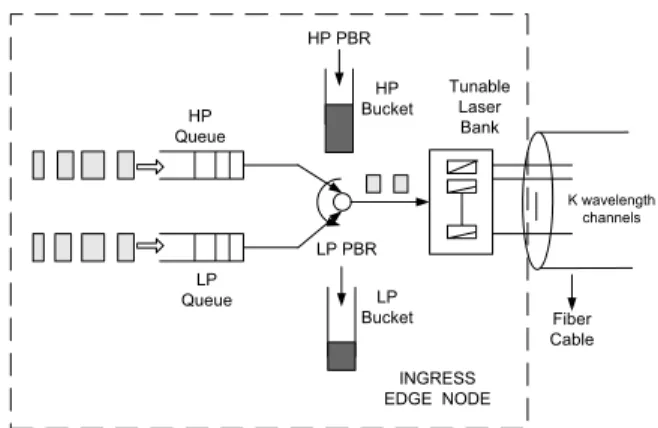
An ingress edge node maintains two queues, namely the HP and LP queues, on a per-egress basis. Since there are multiple egress edge nodes per ingress, a scheduler at the ingress edge node is needed to arbitrate among all per-egress queue pairs while obeying the rate constraints imposed by PBR values that are described in the previous subsection. The ingress node structure is presented in Fig. 4 for the special case of a single destination (i.e., single lightpath).
In Fig. 4, there are two buckets of size B bytes for HP
and LP traffic. The HP (LP) bucket fills with credits at the rate dictated by HP (LP) PBR. Whenever the HP bucket
occupancy is at least Lb bytes (Lb denotes the length of
the burst at the head of the HP queue) then that burst can
be transmitted using one of the M tuneable lasers while
LP Queue HP Queue HP PBR LP PBR HP Bucket LP Bucket Tunable Laser Bank Fiber Cable INGRESS EDGE NODE K wavelength channels
Fig. 4. The structure of the edge scheduler
empty or if there not enough credits for the HP burst at the head of the HP queue then the LP bucket is checked whether the burst at the head of the LP queue can be transmitted. A similar procedure then applies to LP bursts as for HP bursts. If either there are no waiting bursts or neither of the credits suffices to make a transmission, the edge scheduler goes into a wait state until either a new burst arrival or a sufficient bucket fill. The extension of this method to multiple destinations is possible by checking first the HP bursts and transmitting them upon credit availability and trying later the LP bursts.
III. SIMULATIONSTUDY
We study the effectiveness of the proposed D-ABR pro-tocol in the simulation topology depicted in Fig. 5. All the
links are assumed to have the same propagation delay D.
In this study, there are 25 ingress nodes and one single egress node, thus representing an OBS multiplexing system.
Each of the fibers has K = 100 wavelength channels. The
capacity p of each channel is assumed to be 10 Gbps.
The burst length is exponentially distributed with mean 20 Kbytes. We set all the bucket sizes to B = 2 Mbytes and all the HP and LP queues maintained at the ingress nodes are assumed to have infinite storage capacity. The
RM cells are sent everyT = Ta seconds. The RIF is set to
1/16. Each of the ingress nodes is connected to the single
OBS core node using M = 4 tuneable lasers. Sources are
classified into 5 classes, each comprising 5 ingress nodes where the HP and LP Poisson burst arrival rates are the same within a class. We also vary the traffic demands in bps in time based on the Table I.
For comparison purposes, we tested four different scenar-ios which are described in Table II. In the scenarscenar-ios A and B, we use EC = 700 Gbps which is separately shown to ensure
Ploss≈ 3.2 10−5by off-line simulations for an optical link with L = 15 FDLs and W = 20 TWCs. In scenario C, we seek a target utilization being equal to 0.95 so that we set EC = 700 * 0.95 Gbps to further reduce burst losses.
Control Channel E Data Channel BHP RM Burst I I I Backward RM Optical Switch E: Egress Node I: Ingress Nodes
Fig. 5. The simulation topology
Scenario A B C D D (ms) 2 20 2 2 Ta (s) 0.1 1 0.1 01 W (# converters) 20 20 20 50 L (# FDLs) 15 15 15 0 EC (Gbps) 700 700 700*0.95 500 TABLE II
THE SIMULATION SCENARIOSA, B, C,ANDD
We finally use EC = 500 Gbps in the final scenario D (i.e.,
no FDLs) and this choice of EC yields Ploss ≈ 1.8 10−4
(obtained by the numerical algorithm given in [5]). First we study the total number of bursts (HP or LP)
dropped in time(0, t) for the four scenarios A-D in Fig. 6.
The best performance in terms of dropping rate is achieved with Scenario C but at the expense of reduction in through-put since the EC of the OBS node is set such that the load on the node is smaller. The burst drop rate is generally
constant in all the scenarios except for t = 150s when
there is an abrupt change (i.e., increase) in the overall traffic demand. This change is followed by a substantial number of blocked bursts and the blocking performance immediately improves once the D-ABR protocol reaches the steady-state.
Since the traffic demand decreases at t = 300s we do not
see any additional burst drops due to traffic change at this
instant. We monitorPloss in the interval 155s < t ≤ 450s
(i.e., in the steady-state) and these steady-state blocking probabilities are also shown on Fig. 6. The steady-state measured burst blocking probabilities in Scenarios A and
B (Ploss = 8.4 10−6 and 7.9 10−6, respectively) are
less than the desired blocking probability the EC was set
for (i.e., we recall desired Ploss ≈ 3.2 10−5). Similar
results also hold for Scenario D. The provisioned burst blocking probability was obtained using the Poisson arrival assumption but with the D-ABR burst shaping protocol the burst arrival process becomes more regular than Poisson thus reducing the Coefficient of Variation (CoV) of the arrival
0 ≤ t < 150s 150s ≤ t < 300s 300s ≤ t < 450s
HP rate (Gbps) LP rate (Gbps) HP rate (Gbps) LP rate (Gbps) HP rate (Gbps) LP rate (Gbps)
Class 1 35 20 35 20 15 20 Class 2 15 5 20 5 20 5 Class 3 18 0 35 0 25 0 Class 4 12 30 12 30 10 30 Class 5 0 25 0 25 0 25 TABLE I
THE BURST RATES FORHPANDLPTRAFFIC FOR EACH OF THE FIVE CLASSES
0 100 200 300 400 0 0.5 1 1.5 2 2.5 3x 10 4 time (sec) # of Dropped Bursts Scenario A, P loss = 8.4 10 −6 0 100 200 300 400 0 0.5 1 1.5 2x 10 5 time (sec) # of Dropped Bursts Scenario B, P loss = 7.9 10 −6 0 100 200 300 400 0 500 1000 1500 2000 2500 3000 time (sec) # of Dropped Bursts Scenario C, P loss = 2.4 10 −8 0 100 200 300 400 1 1.5 2 2.5 3 x 10⁴ time (sec) # of Dropped Bursts Scenario D, P loss = 6.3 10 −6
Fig. 6. Total number of dropped bursts at the OBS node in time
(0, t) for the scenarios A-D
process. Such a reduced CoV has an improving effect on burst blocking performance [5] and therefore the results are as expected. In this sense, the provisioned QoS under the Poisson assumption provides a lower bound on the measured steady-state blocking performance.
Moreover, Scenarios A and B differ from each other in the link delays which does not seem to have much of an impact on the steady-state blocking probability. However, the D-ABR algorithm performance at the instant of abrupt
changes (i.e.,t = 150s or t = 300s) is significantly better
for Scenario A than B; note the number of burst drops that
take place att = 150s for these scenarios. The settling time
is defined as the time it takes to reach a steady-state in control systems terminology. The RTT (Round Trip Time) is the time delay of the system which increases also the settling time of the control system. The RTT in Scenario A is much less than that of Scenario B, which explains the difference in the transient response of these two scenarios. As an example, the effective bit rate of LP traffic for Class
4 is depicted before and aftert = 300s in Fig. 7. Scenario
A which has a smaller RTT and therefore a smaller ERICA
averaging interval Ta reaches the steady-state much faster
than Scenario B.
We also study the service differentiation aspect. The HP
280 285 290 295 300 305 310 315 320 13 14 15 16 17 18 19 20 21 22 23 time (sec) Rate (Gbs) Class 4 LP Traffic Ta = 1 sec T a = 0.1 sec
Fig. 7. The transient response of the system upon the traffic
demand change att = 300s in terms of the throughput of Class 4
LP traffic
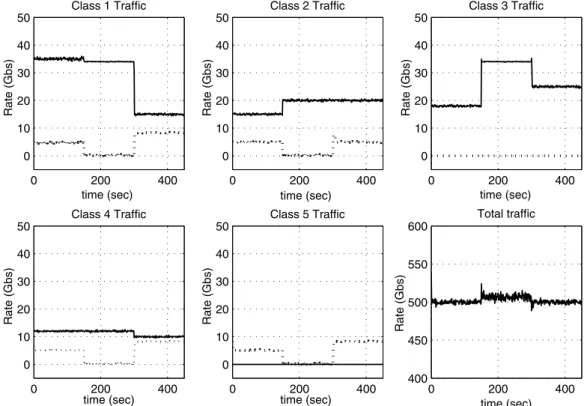
and LP smoothed throughputs are depicted in Fig. 8 for Scenario D for which the solid (dotted) line is used for denoting HP (LP) throughput. The results demonstrate that the effective capacity of the optical link at the OBS node is distributed using prioritized max-min fair share; we refer to [18] for a max-min fair share calculation algorithm. To
show this, we focus on the time interval0s ≤ t < 150s as an
example. In this time interval, the aggregate HP demand is 400 Gbps < EC, therefore the max-min share vector for HP
traffic is(35, 15, 18, 12, 0) where the ith entry of this vector
represents the HP throughput of thei th class lightpaths. If
the remaining capacity EC − 400 Gbps = 100 Gbps is
allocated to LP traffic on a max-min fair share-basis, then the max-min fair share vector for LP traffic is found to be (5, 5, 0, 5, 5). Fig. 8 shows that the max-min fair shares are attainable using the distributed D-ABR protocol proposed in this paper. One can show that this argument is valid for the other time intervals as well.
IV. CONCLUSION
In this paper, we study a new control plane protocol, called Differentiated ABR (D-ABR), for flow control and service differentiation in optical burst switched networks. Using D-ABR, we show using simulations that the optical
0 200 400 0 10 20 30 40 50 time (sec) Rate (Gbs) Class 1 Traffic 0 200 400 0 10 20 30 40 50 Class 2 Traffic time (sec) Rate (Gbs) 0 200 400 0 10 20 30 40 50 time (sec) Rate (Gbs) Class 3 Traffic 0 200 400 0 10 20 30 40 50 Class 4 Traffic time (sec) Rate (Gbs) 0 200 400 0 10 20 30 40 50 time (sec) Rate (Gbs) Class 5 Traffic 0 200 400 400 450 500 550 600 time (sec) Rate (Gbs) Total traffic
Fig. 8. The HP and LP smoothed throughputs for Scenario D. Solid (dotted) line denotes HP (LP) throughputs.
network can be designed to work at any desired burst block-ing probability by the flow control service of the proposed architecture. This proposed control plane intelligence to minimize burst losses in the OBS domain has a number of advantages such as improving the attainable throughput at the data plane. Moreover, the proposed architecture moves congestion away from the OBS domain to the edges of the network where buffer management is far easier and less costly, substantially reducing the need for expensive contention resolution elements like OXCs supporting full wavelength conversion and/or sophisticated FDL structures. Moreover, D-ABR enables strict isolation among high pri-ority and low pripri-ority traffic throughout in OBS networks. This feature of D-ABR can help operators to extend their existing strict priority-based service differentiation policies to OBS domains. Topics that are left open for future research include the study of different rate control algorithms and their comparative performances, the performance of the proposed architecture for elastic traffic, and more realistic traffic models.
ACKNOWLEDGMENT
This work is supported in part by The Science and Research Council of Turkey (T¨ubitak) under project No. EEEAG-101E048 and by the Commission of the European Community IST-FP6 e-Photon/ONe Network of Excellence project.
REFERENCES
[1] C. Qiao and M. Yoo, “Optical burst switching (OBS) - a new paradigm for an optical Internet,” Jour. High Speed Networks
(JHSN), vol. 8, no. 1, pp. 69–84, 1999.
[2] G. N. Rouskas and L. Xu, “Optical packet switching,” in
Optical WDM Networks: Past Lessons and Path Ahead,
K. Sivalingam and S. Subramaniam, Eds. Norwell,
Mas-sachusetts: Kluwer, 2004.
[3] Y. Chen, C. Qiao, and X. Yu, “Optical burst switching: A new area in optical networking research,” IEEE Network Mag., vol. 18, no. 3, pp. 16–23, 2004.
[4] R. A. Barry and P. Humblet, “Models of blocking proba-bility in all-optical networks with and without wavelength changers,” IEEE J. Sel. Areas Commun., vol. 14, pp. 858– 867, 1996.
[5] N. Akar and E. Karasan, “Exact calculation of blocking probabilities for bufferless optical burst switched links with partial wavelength conversion,” in 1st Conference on
Broad-band Networks (BROADNETS’04), Optical Networking Sym-posium, 2004.
[6] S. Blake, D. Black, M. Carlson, E. Davies, Z. Wang, and W. Weiss, “RFC 2475: An architecture for differentiated services,” dec 1998, status: proposed standard.
[7] M. Shreedhar and G. Varghese, “Efficient fair queueing using deficit round robin,” in ACM SIGCOMM, 1995, pp. 231–242. [8] M. Yoo, C. Qiao, and S. Dixit, “QoS performance of optical burst switching in IP-over-WDM networks,” IEEE JSAC, vol. 18, pp. 2062–2071, October 2000.
[9] Y. Chen, M. Hamdi, and D. H. Tsang, “Proportional QoS over OBS networks,” in GLOBECOM’01, 2001, pp. 1510–1514. [10] R. Jain, S. Kalyanaraman, R. Goyal, S. Fahmy, and
R. Viswanathan, “ERICA switch algorithm: A complete description,” August 1996, ATM Forum/96-1172.
[11] J. B. Kenney, ATM Traffic Management. Prentice-Hall, Inc., 2004.
[12] X. Yu, Y. Chen, and C. Qiao, “Study of traffic statistics of assembled burst traffic in optical burst switched networks,” in Proc. Opticomm, 2002, pp. 149–159.
[13] V. Eramo, M. Listanti, and P. Pacifici, “A comparison study on the wavelength converters number needed in synchronous and asynchronous all-optical switching architectures,” IEEE
Jour. Lightwave Tech., vol. 21, pp. 340–355, 2003.
[14] R. Jain, “Congestion control and traffic management in ATM networks: Recent advances and a survey,” Computer
Networks and ISDN Systems, vol. 28, no. 13, pp. 1723–1738,
1996.
[15] S. Mascolo, D. Cavendish, and M. Gerla, “ATM rate based congestion control using a Smith predictor: An EPRCA implementation,” in INFOCOM (2), pp. 569–576, 1996.
[16] A. Kolarov and G. Ramamurthy, “A control-theoretic ap-proach to the design of an explicit rate controller for ABR service,” IEEE/ACM Transactions on Networking, vol. 7, no. 5, pp. 741–753, 1999.
[17] S. Chong, S. Lee, and S. Kang, “A simple, scalable, and stable explicit rate allocation algorithm for max-min flow control with minimum rate guarantee,” IEEE/ACM Transactions on
Networking, vol. 9, no. 3, pp. 322–335, 2001.
[18] D. Bertsekas and R. Gallager, Data Networks. Prentice Hall, 1992.