PARADIGMS AND DYNAMIC CHANGE IN THE TURKISH PARTY SYSTEM
A Ph.D. Dissertation by F. MICHAEL WUTHRICH Department of Political Science Bilkent University Ankara May 2011
PARADIGMS AND DYNAMIC CHANGE IN THE TURKISH PARTY SYSTEM
The Graduate School of Economics and Social Sciences of
Bilkent University by
F. MICHAEL WUTHRICH
In Partial Fulfilment of the Requirements for the Degree of DOCTOR OF PHILOSOPHY
in
THE DEPARTMENT OF POLITICAL SCIENCE BİLKENT UNIVERSITY
ANKARA May 2011
I certify that I have read this thesis and have found that it is fully adequate, in scope and in quality, as a thesis for the degree of Doctor of Philosophy in Political Science. ---
(Professor Dr. Metin Heper, Provost) Supervisor
I certify that I have read this thesis and have found that it is fully adequate, in scope and in quality, as a thesis for the degree of Doctor of Philosophy in Political Science. ---
(Professor Dr. Ergun Özbudun) Examining Committee Member
I certify that I have read this thesis and have found that it is fully adequate, in scope and in quality, as a thesis for the degree of Doctor of Philosophy in Political Science. ---
(Professor Dr. Sabri Sayarı) Examining Committee Member
I certify that I have read this thesis and have found that it is fully adequate, in scope and in quality, as a thesis for the degree of Doctor of Philosophy in Political Science. ---
(Assistant Professor Dr. Ioannis N. Grigoriadis) Examining Committee Member
I certify that I have read this thesis and have found that it is fully adequate, in scope and in quality, as a thesis for the degree of Doctor of Philosophy in Political Science. ---
(Assistant Professor Dr. Aida Paskeviciute Just) Examining Committee Member
Approval of the Graduate School of Economics and Social Sciences ---
(Professor Dr. Erdal Erel) Director
iii ABSTRACT
PARADIGMS AND DYNAMIC CHANGE IN THE TURKISH PARTY SYSTEM
Wuthrich, F. Michael
PhD, Department of Political Science Supervisor: Prof. Dr. Metin Heper, Provost
May 2011
This study argues that, contrary to popular assertions of the Turkish party system as inexplicable or unpatterned or as the persistent manifestation of an essential socio-cultural cleavage, the historic operation of the Turkish party system in the national electoral arena has demonstrated both dynamic change and significant sets of patterns that illuminate the outcomes of electoral contest in different periods. These can be traced through careful observation of the dimensions of competition and domains of identification operating in a contingent set of circumstances, the pattern of which I refer to as the political paradigm. One can best understand the behavior of the system, its parties and the electorate in elections by observing these paradigmatic patterns and the points at which they shift. Dynamic change, thus, is intended to reflect the interactive nature of the party systems and the interdependent forces— institutions, actors, structures—that combine and interact to bring about
iv
significant shifts in the political paradigm—i.e. the contingent ―system of interactions,‖ a key component of the standard definitions of parties as systems.
In the Turkish case, through the study of national campaign discourse, existing social and political research and national and provincial-level electoral data for general elections, one can detect four periods in which a distinctive paradigmatic pattern is in operation. In the first period from 1950 to 1965, structural and institutional factors shaped the nature of multiparty politics such that the primary strategies for voter mobilization were various forms of patron-client relationships and the exploitation of existing local social structures. From 1965 to 1977, parties began to utilize ideological imaging to frame both themselves and their opponents within the system of party competition while also mobilizing votes through the growing power of trade unions and machine politics in the large urban squatter communities. After a three year period of military junta rule, multiparty politics and its accompanying paradigm beginning in 1983, guided strongly by the military, emphasized moderation, centrism and an aversion to ideology, and the selection of party was reduced to particular policies and the moderate appeal to service (hizmet) to the people while the political elites utilized rapidly expanding media technology to disseminate their appeal. The success of the religiously-oriented Welfare Party in 1994 and 1995, initiating the final paradigm, was primarily the result of an anti-establishment party capitalizing on existing mundane strategies for voter mobilization, specifically providing effective governance at the municipal level which translated to ―vote banks‖ for the party in national elections. This paradigm witnessed the importance of local governance, strong regional tendencies in
v
voting behavior, and an increasingly identity-based element in campaign discourse, primarily set along a religious-secularist divide and entwined with a secondary Turkish nationalist versus Kurdish nationalist- pluralist pole.
vi ÖZET
TÜRK SĠYASĠ PARTĠ SĠSTEMĠNDE PARADĠGMALAR VE DĠNAMĠK DEĞĠġKENLĠK
Wuthrich, F. Michael Doktora, Siyasi Bilimi Bölümü
Tez Yöneticisi: Prof. Dr. Metin Heper, Provost Mayıs 2011
Bu çalıĢma, Türk parti sisteminin açıklanamaz olduğu ya da belli bir motif sergilemediği, veya sosyo-kültürel bir bölünmenin süregelen bir göstergesi olduğu gibi yaygın iddiaların aksine, Türk parti sisteminin ulusal seçim arenasında tarihsel iĢleyiĢinin hem dinamik değiĢkenlik gösterdiğini, hem de değiĢik dönemlerde seçim mücadelerinin sonuçlarını aydınlatan önemli motifler sergilediğini ileri sürmektedir. Bu motifler, benim siyasi paradigma olarak adlandırdığım, bağımlı tarihsel koĢullarda rekabet boyutlarının ve özdeĢleĢme alanlarının dikkatlice gözlemlenmesi ile ortaya konulablir. Seçim sisteminin, siyasi partilerin ve seçmenlerin seçim sırasındaki davranıĢları, en iyi, bu paradigmatik motifler ile bu motiflerin kayma noktaları gözlemlenerek anlaĢılabilir. Bu durumda, dinamik değiĢkenlik, birleĢerek ve etkileĢerek siyasi paradigmada – baĢka bir deyiĢle, partilerin sistem olarak tarif edildiği klasik tanımların anahtar unsuru olan bağımlı ―etkileĢim sistemleri‖nde – önemli
vii
kaymaları meydana getiren, parti sistemleri ile bağımsız tesirlerin – kurumlar, aktörler, yapılar - etkileĢimini yansıtmayı amaçlamaktadır.
Ulusal seçim kampanyaları söylemleri, varolan sosyal ve siyasi araĢtırmalar ve genel seçimler için ulusal ve vilayetler düzeyindeki seçim verilerinin incelenmesi sonucu, Türkiye örneğinde, belirgin bir paradigmatic motifin iĢlediği dört dönem saptanabilir. 1950’den 1965’e kadar süren birinci dönemde, yapısal ve kurumsal etkenler çok partili siyaseti öyle biçimlendirmiĢlerdir ki, seçmen mobilizasyonu içn kullanılan öncelikli yöntemler çeĢitli patron-yanaĢma bağları ve varolan yerel sosyal yapıların istismarı olmuĢtur. 1965’den 1977’ye kadar olan dönemde, partiler, geniĢ kent gecekondu topluluklarında sendikların büyüyen gücü ve seçmenlere menfaat dağıtılmasını öngören parti politikası aracılığı ile oy toplarken, hem kendilerini, hem de parti rekabeti sistemi içerisindeki rakiplerini tanımlayacak ideolojik imaj oluĢturmadan yararlanmıĢlardır. Üç yıllık askeri yönetimden sonra, 1983’te baĢlayan çok partili siyaset ile ona eĢlik eden, ve ağırlıklı olarak ordu tarafından yönlendirilen paradigma, ılımlılık, merkezcilik ve ideolojiden sakınmayı vurgulamıĢ ve parti seçimi, siyasi seçkinler, politikalarını duyurmak için hızla geliĢen medya teknolojisinden yararlanırken, belli baĢlı politika seçimlerine ve partilerin insanlara hizmet etme söylemlerine indirgenmiĢtir. Son paradigmaya ön ayak olan, din-yönelimli Refah Partisi’nin 1994 ve 1995’teki baĢarısı, temel olarak, düzen karĢıtı bir partinin varolan sıradan seçmen mobilizasyonu stratejilerinden, özellikle de, ulusal seçimlerde parti için ―seçim bankası‖na dönüĢen belediye düzeyinde etkili yönetim sağlamak yönteminden yararlanmasının bir sonucudur. Bu paradigma, yerel yönetimin önemine, seçmen
viii
davranıĢında güçlü bölgesel eğilimlere, ile temel olarak dinci-laik ekseni doğrultusunda Ģekillenen ve ikincil olarak Türk ulusalcı’ya karĢı Kürt ulusalcı-çoğulcu karĢıt uçlarıyla çevrelenen ve kampanya söyleminde önemi gittikçe artan, kimlik-bazlı unsurlara Ģahit olmuĢtur.
ix
ACKNOWLEDGMENTS
I would first like to thank my dissertation advisor, Professor Dr. Metin Heper, whose timely and detailed assistance and guidance were critical to the development of this work. His willingness to take on another advisee despite his incredibly packed work-load and his detailed and excellent feedback on the work in progress demonstrated once again his character of going above and beyond the call of duty. I will always be grateful for the superb assistance, guidance and encouragement that I have received from him.
The development of this work has also profoundly benefited from the input, feedback, and guidance of my other committee and jury members. I would like to thank Prof. Dr. Ergun Özbudun and Prof. Dr. Sabri Sayarı for there willingness to come in from Istanbul to provide face-to-face feedback on my work as it was developing. Their feedback, observations, suggestions proved to be extremely poignant and very useful in guiding me while I developed this work, and I appreciate the encouragement and attention that they paid this young scholar-in-process. Assistant Prof. Dr. Ioannis Grigoriadis and Assistant Prof. Dr. Aida Paskeviciute Just, though their official role as jury member put them at the end of the process, their suggestions, observations and encouragement were a tremendous help, not only for the dissertation but also as
x
I consider further developments for a book project. I am very grateful to them for the very important contributions that they have made.
I would also like to thank the Bilkent Political Science Department for giving me the incredible opportunity of doing my PhD here, and I am grateful and will never forget all the great instruction I received from my instructors in the PhD program, both in and out of the classroom context: Prof. Dr. Metin Heper, Assistant Prof. Dr. Esra Çuhadar-Gürkaynak, Assistant Prof. Dr. Saime Özçürümez-BölükbaĢı, Associate Prof. Dr. Alev Çınar, Assistant Prof. Dr. Nedim Karakayalı, Prof. Dr. Ergun Özbudun, Prof. Dr. Torsten Selck, Assistant Prof. Dr. James Alexander, and Assistant Prof. Dr. Zeki Sarıgil. While the quality of education within class was excellent and as much as one could hope for from a quality PhD program, the additional guidance, support, kindness and instruction that continued throughout my three years in the program is something that I will also be deeply grateful for.
I would also like to express sincere thanks to my fellow classmates and the other PhD students and candidates who were sojourning with me. Not only were my classmates my academic peers, as we progressed through the program together, I found myself surrounded by dear friends who had become like 10 very wonderful brothers and sisters thousands of miles from my original home. So I would like to thank my Turkish syblings: Murat Ardağ, Deniz Uğur, Duygu Öztürk, AyĢenur Kılıç, Emine Bademci, Deniz Yetkin, Bahadır Dinçer, Mehmet Yeğin, and Banu Arslan. Many of these poor souls had to put up with my endless ramblings about the Turkish party system, and they did so with great patience. Beyond my classmates, I have come to find dear friends among my
xi
fellow PhD students and candidates, and I would like to send a special thanks to my final office mate, GülĢen Seven, who not only put up with my incessant babling about electoral politics, but also wrote the brilliant translation of my abstract into Turkish, for which I am greatly indebted. I would also like to thank Gökhan Güler, fellow student and Air Force Major Nedim Karabulut, and Volkan Ġpek for their kind support, help and friendship along the way. Beyond this, I would have to go through nearly the entire list of Political Science PhDs to cover all the people I should list and who have shown great kindness and help to me along the way. Some were former students of mine from my previous career, and these have to have credit for instilling in me the desire and enthusiasm for studying political science. Those classes of students that followed my class in years also proved to be great friends. I would like to thank all of these dear friends for their kindness and friendship toward me, and they have made leaving such an environment the bitter side of a major accomplishment.
I would also like to express my deep gratitude for a number of people who provided critical help to me by freeing up my time so that I could focus on my dissertation and finish it within the time needed. Primary among these is my mother-in-law, Kathy Mosier, who flew across the ocean and provided six weeks of critical support and babysitting when we were without a nanny. This was a terrific personal sacrifice for which I will always be extremely grateful. I would also like to thank Beth Prochaska, Elizabeth Pullen and Christy Randl for volunteering to watch our daughter, Maya, at numerous points so that I could
xii
work. There is no way that I would have finished even close to the time that I did without the help of these saints.
Finally, I would like to thank my family for the love, support and encouragement that they provided me during this process. I would like to thank my mother and father-in-law, Kathy and Dr. Stan Mosier for both emotional and very tangible support that they provided along the way. I would like to particularly thank my parents, Fred and Jacky Wuthrich; much of my accomplishments in life have their handprints on it. Their personal modeling of irreproachable work ethic in their careers, the intangible values within which they raised me, and their tireless love, support and encouragement have a lot to do with my own personal success and accomplishments. I owe them more than a lifetime of gratitude.
I owe a very special thanks to my wife and very best friend, Aimee. She has tirelessly stood behind me and undergone much difficulty to ensure that I completed this dissertation and PhD. It was also she who at some point in the winter of 2007/2008 sat down with me and insisted that I pursue a PhD, and she even bought a preparation book for the GRE for me. The sacrifices and love that she has shown me throughout this process has known no bounds, and I can never repay her for all that she has done to help me see this through to the end. I would also like to thank my little one and a half year old daughter, Maya, for providing me with necessary diversions from my dissertation and with hundreds of extra smiles and laughter that put the whole of my work in its proper perspective.
xiii
Finally, though it might not fit into the ―modern‖ and ―scientific‖ narrative of some, I would like to thank the Lord, who, I am convinced, led me to such a wonderful place as Turkey and Bilkent University, gave me the opportunity to pursue doing something that I love, and endowed me with the abilities needed to accomplish the task. It is to the Lord that I dedicate whatever is praiseworthy in this work. May my endeavors at excellent scholarship and my behaviors toward others always display God’s character.
xiv
TABLE OF CONTENTS
ABSTRACT ...iii
ÖZET ...vi
ACKNOWLEDGMENTS ...ix
TABLE OF CONTENTS ...xiv
LIST OF TABLES ...xvii
LIST OF FIGURES ...xix
CHAPTER 1: INTRODUCTION...1
1.1 Context of the Study and its Case...1
1.2 Previous Approaches to the Turkish Party System...9
1.3 An Outline of the Argument in this Study...19
1.4 Methodology...35
1.5 Final Note on Research Paradigms in Previous Studies...38
CHAPTER 2: POLITICAL CULTURE AND THE ELECTORAL SYSTEM IN TURKEY...44
2.1 Conceptualizations of Political Culture and their Relevance...45
2.2 ―Nation Party‖ Culture and the Turkish Party System...53
2.3 Intraparty Leadership Structure and the Turkish Party System...69
2.4 Electoral System Change and the Party System in Turkey...75
2.5 Conclusion...87
CHAPTER 3: VOLATILITY, FRAGMENTATION, AND POLARIZATION: MEASURING CHANGE...89
3.1 Volatility in Comparative Literature and in Turkish Electoral Behavior...93
3.2 What Fragmentation of the Votes in Party Systems can Tell us...104
xv
3.4 Conclusion...120
CHAPTER 4: ESSENTIAL HISTORICAL CLEAVAGES AND THE TURKISH PARTY SYSTEM...123
4.1 Theoretical Underpinnings of ―Center and Periphery‖...127
4.2 An Explanative Center-Periphery Cleavage in the Turkish Party System? ...139
4.3 Conclusion...156
CHAPTER 5: POSITIONING, INTERACTION AND THE TURKISH PARTY SYSTEM...161
5.1 Left-Right Linear Descriptions and Giovanni Sartori...163
5.2 The Left and Right in the Turkish Party System...169
5.3 Relational Change and Party Competition—Structure and Agency...181
5.4 Conclusion...192
CHAPTER 6: THE INITIAL PARADIGM – 1950-1965...195
6.1 The Context of Initial Multiparty Competition...199
6.2 The General Trends of the Period...206
6.3 Dimensions of Competition...209
6.3.1 National Campaign Discourse...209
6.3.2 Non-Discursive Electoral Strategies..………..232
6.4 Domains of Identification………..…………252
6.5 Conclusion……….254
CHAPTER 7: THE IDEOLOGICAL IMAGING PARADIGM – 1965-1980 ……….260
7.1 The Context of the Period……….263
7.2 Dimensions of Competition………..274
7.2.1 National Campaign Discourse………..274
7.2.2 Non-Discursive Campaign Strategies………..……290
7.3 Domains of Identification………..300
7.4 Conclusion……….301
CHAPTER 8: THE NATIONAL CENTER PARADIGM – 1983-1991….….305 8.1 The Context of the Period……….309
xvi
8.2.1 National Campaign Discourse………..322
8.2.2 Non-Discursive Campaign Strategies………..…334
8.3 Domains of Identification………..348
8.4 Conclusion……….350
CHAPTER 9: THE CULTURE-IDENTITY PARADIGM – 1995-2007…...353
9.1 The Context of the Period: The Rise of the Welfare Party………...…357
9.2 Dimensions of Competition……….……..370
9.2.1 National Campaign Discourse………..370
9.2.1.1 Religion-Secularism Axis...370
9.2.1.2 Left-Right and Center Imaging...384
9.2.1.3 Nationalist Discourse...392
9.2.1.4 Economy, Corruption and ―Hizmet‖...400
9.2.2 Non-Discursive Campaign Strategies...403
9.3 Domains of Identification and the Emergence of Regional Party Systems...410
9.4 Conclusion...420
CHAPTER 10: CONCLUSION...360
10.1 The Relevance of this Work for Individual Case Studies of Party Systems...424
10.2 Interactive Principles of the Turkish Party System, 1950-2007...428
10.3 Conclusion...438
xvii
LIST OF TABLES
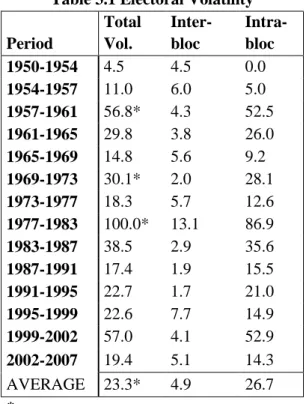
1. Electoral Volatility ...96
2. Voting Bloc Patterns ...103
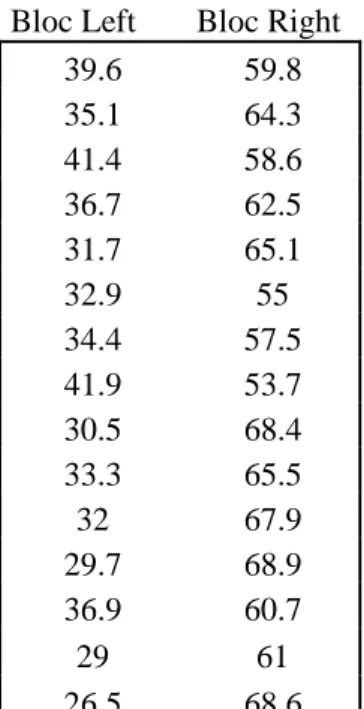
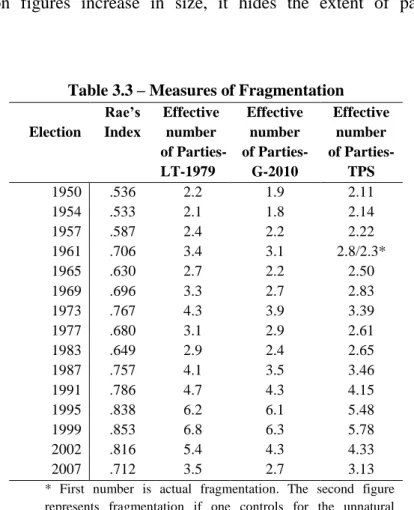
3. Measures of Fragmentation ...105
4. Electoral Trends of the Period (1950-1965) ...207
5. Political Parties of the Paradigm in General Elections at a Glance (1950-1965) ...211
6. Particular Election ―Shapers‖ in 1950-1965 General Elections ...232
7. Correlations of Party Support with Development and Regions ...243
8. Regional Volatility from 1950-1965 ...248
9. Regional Effective Number of Parties from 1950-1965 ...248
10. Party Support by Development and Region, 1950-1977 ...262
11. Political Parties of the Paradigm in General Elections at a Glance (1965-1977) ...270
12. Electoral Trends of the Period (1965-1977) ...283
13. Regional Effective Number of Parties, 1965-1977 ...283
14. Particular Election ―Shapers‖ in 1965-1977 General Elections ...290
15. Changing Fortunes of the CHP in Large Industrial Centers ...294
16. Regional Variation in Voting Behavior Comparison ...308
17. Electoral Trends of the Period (1983-1995) ...308
18. Political Parties of the Paradigm in General Elections at a Glance (1983-1991) ...324
xviii
20. The Changing Regional Fortunes of the SHP ...347
21. Electoral Trends of the Period (1995-2007) ...370
22. Major Political Parties of the Paradigm in General Elections at a Glance (1983-1991) ...371
23. Religious Discourse in Elections for the Major Parties ...374
24. Nationalist Discourse by Major Parties from 1995-2007 ...392
25. Particular Election ―Shapers‖ in 1995-2007 General Elections ...403
26. AKP National Election Fortunes in Relation to 2004 Local Election ..407
xix
LIST OF FIGURES
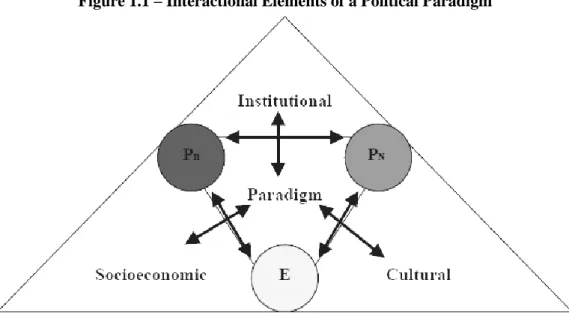
1. Interactional Elements of a Political Paradigm ...23 2. Percentage of Vote by Top Two Parties in Turkish National Elections
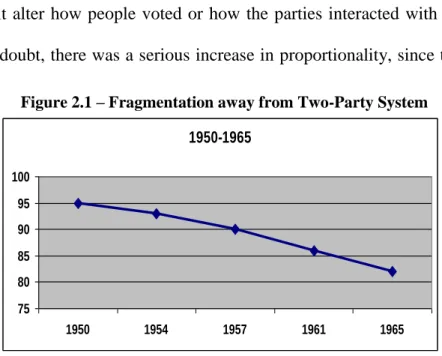
...25 3. Fragmentation away from Two-Party System ...82 4. The Fifteen Highest and Lowest Average Vote Totals by Province for
the CHP (1950-1957) ...147 5. The Fifteen Highest and Lowest Average Vote Totals by Province for
the CHP (1969-1977) ...154 6. The Highest and Lowest Average Vote Totals by Province for the
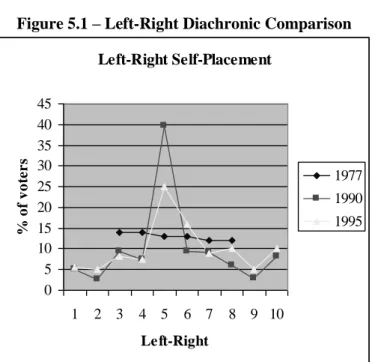
―Center Left‖ (1950-1957) ...154 7. Left-Right Diachronic Comparison ...178 8. Classic ―Center-Periphery‖ Electoral Cleavage ...239 9. Cross-Cleavage Competition for Peripheral Votes ...239 10. Two Forms of Patron-Client Relations for Political Mobilization ...241 11. Two-Pronged Campaign Attack (1987-1991) ...334
1 CHAPTER 1
INTRODUCTION
Only careful historical, sociological, and political analysis can do full justice to the distinct qualities of any given political system.1
Few would dispute the proposition that the Turkish political party system in the electoral arena is a complex case. Consider that in 2002, in a spectacular reversal of fortunes, a party that received a plurality of votes in the previous election (22.2 percent) in 1999 managed to accumulate only 1.2 percent of the vote, leaving itself beneath the required 10 percent threshold and, thus, along with all the other incumbent parties, outside of parliament. In the same election, a party slightly more than a year old garnered 34.3% of the vote. In 1983, every party running for election was a party previously untested in elections. The party of the founder of the Turkish Republic—Mustafa Kemal Atatürk—the Republican People‟s Party (CHP), has in one election received up to 41.4 percent of the vote and as low as 8.7 percent in another; it has been banned from politics, arguably in the name of Atatürk,2 its spirit has existed through another party (the SHP), and it has returned with its old name and is currently the leading party of the opposition
1 Hans Daalder, “Party Elites, and Political Developments in Western Europe,” in Joseph
Lapalombara and Myron Wiener, eds. Political Parties and Political Development (Princeton, NJ: Princeton University Press, 1966), p. 67.
2 The military‟s intervention on 12 September 1980 was carried out with the expressed aim of
preserving the essential values and unity of the Turkish Republic as entrusted to the people by Atatürk.
2
taking in 20.9 percent of the vote in the last general election in 2007. These are just some of the examples of a system that has been described as exhibiting an extreme amount of electoral volatility.3 While this observation is undoubtedly accurate, one must also not forget that in the early 1960s a student of Turkish politics observed, “[The] consistent voting pattern is the major factor in Turkey‟s political life today.”4
And he seems to express the existence of this stability with a sense of foreboding.
We should add to this portrait a number of other significant complicating factors. After the initiation of a multiparty system led by İsmet İnönü in 1945, and beginning in earnest with the Democrat Party in 1946,5 the military has intervened and punched the “reset” button on democratic, electorally-mandated governance three times, two of which involved ushering in new constitutions (in 1961 and 1982) and one (in 1971) that amounted to a reset with only amendments to the existing constitution.6 In each case, after a relatively short amount of time and with the declared intention of “re-equilibrating” the democratic system as deemed appropriate by the military, there was a return to multiparty politics. In terms of the operating (electoral and party rules, etc.) and relational structure
3 Sabri Sayarı, “Towards a New Turkish Party System?” Turkish Studies, Vol. 8, No. 2 (2007), p.
200; Ergun Özbudun, “From Political Islam to Conservative Democracy: The Case of the Justice and Development Party in Turkey,” South European Society & Politics, Vol. 11, No. 3/4 (2006), p. 555.
4 Joseph Szyliowicz, “The Political Dynamics of Rural Turkey,” Middle East Journal, Vol. 16,
No. 4 (1962), p. 431.
5
The Democrat Party was not the first political party to usher in the multiparty period. The first was the National Development Party (Milli Kalkınma Partisi) founded by Nuri Demirağ in July of 1945. By “in earnest” I am saying that the Democrat Party was the first party with the
organizational structure and support to be a serious threat to the Republican People‟s Party.
6
It is also true that in 1997, the military along with elements from civil society pushed a
government out of power and, ultimately, brought about the closure of the party; undoubtedly, this too affected the political system, but it was a much softer intervention into the system than the earlier three events were.
3
(issues/positions parties can/cannot take in relation to other parties) of the party system, the military has certainly been a confounding factor—the influence of which is the primary explanation of the nature of the 1983 general elections, for instance.
The military is not the only group, however, that has attempted to tinker with the electoral system; governing parties have, from time to time, also played a part in restructuring the electoral rules of the game. Such tinkering, in certain instances, could be chalked up to attempts to stabilize and consolidate Turkish democracy (primarily by the military), but it has also been a means for short term gain (usually the apparent intent of governing parties); in both cases, the manipulation of the electoral system has often had effects on the interaction of the party system, even if it was not the change in electoral law itself that generated the change. The environment associated with the electoral changes has often, perhaps paradoxically, been more predictive of electoral outcomes than the changes themselves.
While the picture is indeed complex, the well-known comment by Frederick Frey in his seminal work on Turkish politics elites—“Turkish politics is party politics”7—essentially remains as true today as when it was penned in 1965. One is hard-pressed to find an effective vehicle for the representation of the interests of the people in the realm of government in Turkey outside the domain of political parties and the party system. Therefore, in the midst of such complexity, because of its prominent place in the operation of Turkish politics
4
and democracy, the onus falls on students of the party system in the electoral arena8 to try to understand and explicate it, ideally illuminating patterns in such a way that its general portrait is both simplified to increase understanding yet able to capture shifting dynamics in such a way as to anticipate and explain change. In order to accomplish this, several considerations seem particularly relevant: distance, tools, and assumptions. By distance, I am referring to one‟s metaphorical distance from the system—i.e. the position of distance from which one observes the action and interaction of the system. Varying distances have distinct advantages. In the context of political research, if your intention is comparative and nomothetic, to get a broad picture of trends and make generalizations applicable in a vast array of cases, greater distance is necessary. Maintaining such a distance, however, while convenient and parsimonious at the comparative level, would greatly limit what one is able to glean from a particular case. Conversely, a lack of distance that results in a plethora of detail could also have clear drawbacks that would inhibit “seeing the forest through the trees,” so to speak. Arguably, even when one‟s focus is the description of a particular case, it seems prudent to position oneself in such a way as to be able to observe the particular dynamics at work in the system, and yet be far enough away to be able to detect patterns and trends occurring at the case level. Some distance allows the student of the system, rather than just providing unframed details or observed
8
Bardi and Mair, in suggesting the parameters of approach toward studying party systems, argue that party systems behave and are structured differently depending on their context, and thus, that studies of party systems could be beneficially limited to specific arenas, such as electoral,
governmental, or parliamentary arenas. Though there is overlap between these, certainly, it would indeed help precision of analysis to specify a particular arena and focus one‟s attention
accordingly. Thus, this study will analyze the party system as it has operated in the electoral arena from 1946-2009. See Luciano Bardi and Peter Mair, “The Parameters of Party Systems,” Party Politics, Vol. 14, No. 2 (2008), pp. 154, 156-7.
5
behaviors, to explain behavior and perhaps, to some extent, make predictions. If one is trying to understand one particular system as a whole, such a mid-range position seems to optimize the observation.
Likewise, the tools—the language, methods and application of existing theory—that one chooses to appropriate also become crucial in maximizing the observation. Nowhere is this more obvious than with the language of description. The descriptors one uses to delineate a system can greatly hamper understanding if such descriptors are intended for different purposes or contexts. Certain descriptors are the tools of particular distances that operate only very roughly from locations other than what was intended. Fitting the Turkish case in such conceptual frameworks can be of great benefit if the intent is to integrate Turkey into a broad study of other systems, but it is of little explanative value when examining the individual case. Methods may also be extremely reliable but fall short in terms of logic and validity when applied to a specific case, as they, like descriptors, are derived for certain distances, contexts, or purposes. Although quantification and statistics can be very useful, as Sartori has warned, an uncritical reliance on such methods could be “in fact driving us into a march of either false precision or of precise irrelevancy.”9 Methods utilized and the comparative theories exploited must be carefully chosen so that their intrinsic logic harmonizes with the study at hand.
Finally, the assumptions one lays as the cornerstone for study of a particular system is also of critical import. If one begins with an assumption of
9 Giovanni Sartori, “Where is Political Science Going?” PS: Political Science and Politics, Vol.
6
stability where, in fact, change is the norm, or vice versa, it will confound the intention to explicate. Furthermore, if one relies on a paradigm that assumes established and rigid structures that pre-dominantly determine the course of political events or on one that places decisive political elites as actors on a white background—i.e. which marginalizes the framework within which an actor is also acted upon and provided with opportunities and constraints—one‟s picture of the system will arguably miss very significant dynamics that are in operation and shape and are being shaped by the other existing dynamics. Additionally, when appropriating the well-known descriptors and classifications existing in the literature of comparative politics, it becomes too easy to set as a reference point the classifications of countries in the particular historical juncture from which those concepts have been derived. In other words, the classification or description, rather than operating as the framework through which the system is analyzed, becomes the sufficient analysis of the system itself through explicit or implicit evaluation of how the system in question measures up to the “standard” cases though the realization of these standards might not even exist in any system at this particular point in time.
Embedded within these various approaches to party systems that have gained wide usage in comparative politics, for example, are latent standards and assumptions that invariably color the interpretation of newer systems. For example, in an excellent study of the Brazilian party system by Mainwaring, the author establishes his study on a foundational inquiry into the status quo assumptions regarding party systems in relation to newer systems in so-called
7
“Third Wave” democracies.10
His argument rests on the observation that newer party systems are operating differently from the established democracies from which party system theory is derived; therefore, we need to approach them differently.11 While this is undoubtedly true, the existing standards set by the classifications of primarily European party systems at a particular juncture in time leads to conclusions that the systems or political elites are behaving contrary to “standards” rather than manifesting current historical realities. In other words, new democracies have deficiencies because of problematic cultural norms or poor decision-making by political actors, and it is for this reason that they are not meeting the standards of “good” party systems.12
Again, though the issue of difference (or in many cases problematic operation) among newer democracies is not the question, the issue of the explanation of why, for example, levels of institutionalization and volatility are different needs to be addressed.
For example, the lack of mass parties in an organizational sense in newer democracies and the frequency of catch-all parties tend to be viewed as poor choices made by new democracies rather than a natural tendency of young nations entering electoral competition with universal suffrage and widespread media access.13 With apparently the comparative literatures‟ embedded standards as a guide, Mainwaring suggests that “weak party roots in society and a high degree of
10 Scott Mainwaring, Rethinking Party Systems in the Third Wave of Democratization: The Case
of Brazil (Stanford: Stanford University Press, 1999).
11 Ibid., pp. 3-4. 12 Ibid., p. 5.
13 Katz and Mair have also noted that patterns established in comparative organizational literature
have tended to place the “mass party” structure as the teleological end of a linear process, despite the fact that such an organizational form sprung from “dated” historical contingencies. Richard Katz and Peter Mair, “Changing Models of Party Organization and Party Democracy: The Emergence of the Cartel Party,” Party Politics, Vol. 1, No. 1 (1995), p. 6.
8
personalism enhance the role of television in campaigns.”14
If one accounts for the historical context, however, it seems more likely to propose that the inevitable role of television in campaigns weakens party roots in society and enhances personalism. Considering that these trends have been increasingly observed in the “advanced industrial democracies,”15
it seems problematic to consistently see these trends in newer democracies as evidences of problems stemming solely from local considerations or novice political actors. Such assumptions of particularism, when in fact global and structural forces are at work, could lead the study of “non-Western” systems in particular down a less fruitful path. We might likely see “self-interested politicians” or “clientelism” or “manipulations by state elites” as the causes of the problem in these newer democracies despite the fact that such phenomena has been observed (and often still is) in the established countries though the operation of the party system was less volatile and far more institutionalized.16 Thus, our initial assumptions when approaching the individual case can make a critical difference in analytical outcomes.
In light of these concerns, it would be helpful to briefly outline how the system has often been approached in relation to these three points—distance, tools and assumptions.
14
Ibid., p. 38.
15 For an extensive account of deinstitutionalization and volatility in established democracies, see
Russell J. Dalton and Martin P. Wattenberg, eds., Parties without Partisans: Political Change in Advanced Industrial Democracies (Oxford: Oxford University Press, 2000).
16
While I do not want to take away from the importance of state or political elites and their behavior in affecting the quality of democracy, the phenomena of deinstitutionalization and volatility, for example, seem to be operating on forces independent of these actors and global in scope.
9
1.2 Previous Approaches to the Turkish Party System
In describing the Turkish party system in the electoral arena as it has operated through the period of Republican multiparty politics (1946-2011), a large body of work has appropriated one of two contradictory assumptions (and their related tools and distances), both of which are arguably problematic. One assumption emphasizes the historical continuity of the dynamics in the system; the other assumes incessant unframeable change. In assuming continuity—i.e. that the essential dynamics in operation determining the outcomes of elections in 1950 are just as evident and relevant today as they were then—certain tools of interpretation, general descriptors and great overarching and static national cleavages, are often utilized in correspondence with positions arguably more distant from the system. On the other hand, where continuous change is the assertion, tools such as descriptors, if used, are often quickly passed over to focus on the rich historical details and the interactions of political parties and political and state elites without any systematic framework.
One common approach residing under the assumption of system continuity, which will be discussed in greater depth in chapter three, utilizes the descriptive tools existing in comparative politics but at a great distance, allowing for a conclusion of continuous unaltered change. The widely used descriptors, “volatility, fragmentation and polarization” are often posited, with one great brush stroke, as the key elements of the Turkish party system.17 While such
17 For a few examples, see Ersin Kalaycıoğlu, “Turkish Democracy: Patronage versus
Governance,” Turkish Studies, Vol. 2, No. 1 (2001), p. 55; Üstün Ergüder and Richard Hofferbert, “The 1983 General Elections in Turkey: Continuity or Change in Voting Patterns,” in Metin
10
generalities may be true, they seem to be unhelpful and even misleading for a number of reasons. For example, while volatility has indeed been a regular feature of the system, leaving the explanation to the descriptor and the numbers would suggest much more irrational and unpredictable behavior by the electorate than is the case in the Turkish context. Furthermore, stopping with conclusions of high volatility also prioritizes an assumption that the system falls short of the standard of other systems in which volatility is indeed lower, ignoring the important historical contingencies that lie behind the observed phenomena and the possibility that levels of volatility could mean very different things depending on the case.18 Other critical factors that effectively explain the volatility need to be brought into the discussion if one wants to understand and explain the system. Political culture and such observed phenomena as the attitude toward opposition, the desire for unity, and aversion toward particular interests along with organization structure of the parties themselves, for example, could have important effects on how parties are formed and how they interact with one another, which could also account for some of the trends in these descriptors, as will be seen in chapters two and three. In other words, although volatility could be a useful tool, when used at a great distance or as self-explanative analysis, its descriptive benefit is hamstrung.
At a distance, there is ambiguity inherently embedded in these existing comparative terms at the individual case level, which requires the scholar to
Heper and Ahmet Evin, eds., State, Democracy and the Military: Turkey in the 80s (Berlin: Walter de Gruyter, 1988), p. 85.
18 For an article strongly supporting this concern, see Scott Mainwaring and Edurne Zoco,
“Political Sequences and the Stabilization of Interparty Competition: Electoral Volatility in Old and New Democracies,” Party Politics, Vol. 13, No. 2 (2007), pp. 155-78.
11
provide greater precision in specifying and locating the phenomenon when it is applied as a descriptor. Polarization, for example, can be understood in different ways and can be located at different points within the system. Are we simply talking about belligerent behavior among the political elites or ideological polarization, or both simultaneously? Are we talking about polarization generated from within the system itself or polarization occurring within the society outside the system? Knowing which form of polarization that we are referring to is essential. For example, in contrast to the familiar possibility of fragmentation from ideological polarization as pointed out by Sartori, a phenomenon which is typified well by the Italian case, polarization generated within the political party system, depending on the interaction and organization structure of the parties and the values of the electorate, could arguably reduce fragmentation and volatility. If voting is polarized, it could lead to a decrease in fragmentation and reduction of volatility as, in such a case, transferring one‟s vote to another ideologically similar but less competitive option becomes more costly as it gives advantage to the “other” party. Thus, due to polarization around a divisive issue, votes are channeled to a major party that can address the polarizing concern opposite the dominant party on the other side. This would make general descriptions of “volatility, polarization, and fragmentation” problematic as they may indeed have a dynamic, interactive relationship. Arguably such a dynamic interaction from polarization—i.e. increasing or reducing volatility and fragmentation—has been observed in Turkey, both in the 1970s and the 2000s. After spikes in both fragmentation and volatility while the electorate shifts in relation to a new
12
polarizing division (as in 1973 and 2002), the stabilizing line of conflict effectively lowers fragmentation and brings volatility numbers down to lower levels as the vote is channeled toward the two major parties competing at that line (1977 and 2007). Thus, one needs to move closer to the system; the tools to understand dynamics need to be unpacked and considered in relation to one another, in order to maximize the benefit they offer.
These comparative descriptors often stem from observations of certain contexts, and if used elsewhere, need to be logically re-conceptualized for the specific case. While many of the descriptors derived from Sartori‟s classic work could be useful in the Turkish case, they were not conceived with Turkey in mind;19 thus, in some cases, descriptors that work well for certain countries, when applied to Turkey, either hide essential dynamics or mislead. When Sartori developed his parsimonious classification of various party systems, the democratic cases that functioned as the foundational testing ground for such application were Italy and established democracies in the West. As discussed in chapter three, these systems emerged in a very particular historical juncture that greatly contributed to the eventual “freezing” that Lipset and Rokkan have so famously observed.20 The democracies that have emerged simultaneously with universal suffrage and very different technological opportunities for the prospective competing party have exhibited less “freezing” of the party system,
19 Sartori does indeed refer to Turkey in his definitive work in the section where he is discussing
the transition from single-party to multi-party regimes; however, my point is that his derivation and utilization of the descriptors seems to have largely had Western European systems, and particularly Italy, in mind.
20 Seymour Lipset and Stein Rokkan, “Cleavage Structures, Party Systems and Voter Alignment:
An Introduction,” in Seymour Lipset and Stein Rokkan, eds, Party Systems and Voter Alignment: Cross-National Perspectives (New York: Free Press, 1967), pp. 50-1.
13
for obvious reasons.21 The net result, though, is that such classifications, which could offer meaningful description to these frozen systems, provide little help for democracies like Turkey, emerging under more modern conditions, whose classification could potentially need revision from election to election. The description given ultimately provides the weakest of benefit, both for including Turkey in a meaningful comparison of other similarly labeled countries, and in understanding the particular system in Turkey, potentially leading to two important misinterpretations: one, that the system has consistently demonstrated the features of such a descriptor over time, or two, for the reader familiar with previous accounts, that the Turkish system is inherently unstable and changing in such a way that no meaningful framing of its dynamics is possible.
Another typical approach to establish continuity in the party system in Turkey is to sweep all the complexity under the rug of one massive, national cleavage, purported to explain the system‟s electoral competition since multiparty politics began in Turkey in 1945. While many scholars find the center-periphery cleavage explanative,22 others argue a Left-Right cleavage,23 secularist-Islamist cleavage,24 or a traditionalist-modernist cleavage.25 Even the most oft used center-periphery cleavage is often interpreted in different ways, sometimes, in
21
Of course, the “freezing” hypothesis of Lipset and Rokkan has been consistently challenged by scholars based on more recent trends since the 1970s though some have also maintained its usefulness. See Peter Mair, Party System Change: Approaches and Interpretations (Oxford: Oxford University Press, 1997), pp. 57-66.
22
For one example, see Ali Çarkoğlu and Gamze Avcı, “An Analysis of the Electorate from a Geographical Perspective,” in Sabri Sayarı and Yılmaz Esmer (eds.), Politics, Parties and Elections in Turkey (Boulder, CO: Lynne Reiner, 2002), p. 132.
23 See Yılmaz Esmer, “At the Ballot Box,” in Sabri Sayarı and Yılmaz Esmer (eds.), Politics,
Parties and Elections in Turkey (Boulder, CO: Lynne Reiner, 2002), p. 110.
24 Zeyno Baran, “Turkey Divided,” Journal of Democracy, Vol. 19, No. 1 (2008), pp. 55-69. 25 İlter Turan, “Unstable Stability: Turkish Politics at the Crossroads?” International Affairs, Vol.
14
substance, suggesting a secularist-Islamist interpretation of the cleavage.26 This ambiguity is problematic. The fact that scholars posit a single persistent cleavage without being able to agree upon its essential nature is itself a clear demonstration of the problem. None of the cleavages expressed above can effectively encompass changes that have occurred in the system. Thus, attempting to stretch one socio-political division across more than 60 years of Turkish political space leads to an inevitable lack of consensus on interpretation.
The problem with positing a single cleavage is that, in a multi-dimensional cleavage polity, it is so easily done. If one wants to find evidence for conflict over religion, it can be found from the earliest days of the Republic, or even be taken back into the Ottoman Empire. If one proposes a traditional left-right economic divide, substantiation from the first years of multi-party politics can also be quite easily appropriated for use. The same could be said for other cultural or ethnic cleavages. Regardless of what one chooses to emphasize, there is historical material ready to be employed as anecdotal evidence to support a division in society. One cannot object to the fact that these divisions have existed in Turkish society; the critical question, however, is to what extent these particular divisions sufficiently explain how the party system has operated over time and how the parties within that system have primarily taken up space in relation to the other parties with which they have competed electorally. No one cleavage offers such explanatory power for the operation of the system (or systems) since 1950. This will be clarified further in chapters four and five.
26 Ali Çarkoğlu, “A New Electoral Victory for the „Pro-Islamists‟ or the „New Centre-Right‟? The
Justice and Development Party Phenomenon in the July 2007 Parliamentary Elections in Turkey,” South European Society and Politics, Vol. 12, No. 4 (2007), p. 501.
15
Other approaches that have examined Turkish politics and the party system have taken a predominately historical perspective that enumerates all the detailed interactions and changes that have occurred in the Turkish polity through time. Rich narrative of the actions of political parties and political and state elites are provided without much of an explicit framework. These are offered as “histories” of politics in Turkey and a number of notable works fit this category.27
While they provide the reader with an abundance of information regarding political leaders and parties throughout Turkish history, there is little framework given to contain the dynamics that are described in detail and how these dynamics have emerged, disappeared, and/or shifted to accommodate new conditions and dynamics that enter the system. To grasp the dynamics of the party system (or systems), one needs a bit more distance so that not only the dynamics between political actors—i.e. the party and elites—can be seen, but also the dynamics of the political space in which they are interacting.
Besides these studies on Turkish politics, which address the party system, and approach it with foundational assumptions of change or continuity, from great distances or close up, there is a great deal of beneficial work on the party system from one cross-section of time. While some maintain a linear cleavage28 or simply provide a great deal of detail about the state of politics at that moment,29
27 Several good examples include Kemal Karpat, Turkey’s Politics, (Cambridge, MA: Harvard,
1959); and Ersin Kalaycıoğlu, Turkish Dynamics: Bridge Across Troubled Lands (New York: Palgrave Macmillan, 2005).
28 A particularly problematic example of this type from recent years would be Baran, “Turkey
Divided,” pp. 55-69; for a stronger example of such an approach, see Ziya Öniş, “Conservative Globalism at the Crossroads: The Justice and Development Party and the Thorny Path to Democratic Consolidation in Turkey,” Mediterranean Politics, Vol. 14, No. 1 (2009), pp. 21-40.
29 For example, İlter Turan, “Political Parties and the Party System in Post-1983 Turkey,” in Metin
16
other studies have applied quantitative or spatial methods to specific periods of time with fruitful results. Electoral data and other statistics have been used to detect emergences of new voting alignments,30 helping to indicate the ruptures of past patterns, leading to new spatial positioning taken up by both old and new parties across altered lines of demarcation. Other works on the party system have attempted to capture a rendering of the spatial positioning of parties within the party system at a given time through the method of spatial analysis.31 While these works have provided synchronic snapshots of the party system that have been particularly helpful in understanding the interactions of elites and parties within the system at a particular time, it is also beneficial to see how these individual synchronic pictures of the relationships within the system have changed and adjusted through time—i.e. diachronically. One particular problem with only having access to even excellent studies of the party system within one time period is an assumption of the continuity of the relationships of one period could be interpolated into the past—i.e. stability in party positioning can be too often the conclusion that is drawn.
For example, an outside observer that is aware that the CHP has existed in
Walter de Gruyter, 1988), or Michael Hyland, “Crisis at the Polls: Turkey‟s 1969 Elections, Middle East Journal, Vol. 24, No. 1 (1970).
30
Several good examples of these are, Ergun Özbudun and Frank Tachau, “Social Change and Electoral Behavior in Turkey: Toward a „Critical Realignment‟?” International Journal of Middle East Studies, Vol. 6, No. 4 (1975); Ergüder and Hofferbert, “The 1983 General Elections in Turkey”; and Sayarı, “Towards a New Turkish Party System?”
31
For two recent studies spatially representing political cleavages see, Ali Çarkoğlu and Melvin Hinich, “A Spatial Analysis of Turkish Party Preferences,” Electoral Studies, Vol. 25 (2006), pp. 369-92; and Anna J. Secor, “Ideologies in Crisis: Political Cleavages and Electoral Politics in Turkey in the 1990s,” Political Geography, Vol. 20 (2001), pp. 539-60. For studies employing electoral geography to effective ends, see Ali Çarkoğlu, “The Geography of the April 1999 Turkish Elections,” Turkish Studies, Vol. 1, No. 1 (2000), pp. 149-71; and W. Jefferson West II, “Regional Cleavages in Turkish Politics: An Electoral Geography of the 1999 and 2002 National Elections,” Political Geography, Vol. 24, No. 4 (2005), pp. 499-523.
17
some form throughout most of the multi-party system years might assume that it has largely occupied a similar position in the party system space. Although it has not abandoned certain positions, other positions, such as its expressed attitude toward the market, toward labor, toward the EU, toward pluralism and its approach toward nationalism have clearly shifted in response to available space existing in the political sphere, and various segments of the electorate, therefore, have approached it in different ways at different times. Furthermore, if an author argues that these cross-sectional pictures of the system demonstrate the continuity of a certain pattern or cleavage,32 without access to a historical portrait of the system, there is little at hand to refute such a claim.
As a rare diachronic work that provides electoral geographical modeling, Güvenç and Kirmanoğlu have recently provided a geographical portrait of electoral behavior and party fortunes at the ballot box spanning from 1950 to 2009.33 While this provides much that is of benefit to the student of Turkish electoral politics, it is limited in a number of areas that this study hopes to address. First, while the authors‟ intent is to provide a statistical rendering that largely speaks for itself, while it illustrates patterns of change in the electoral environment, it does not attempt to explain the “continuities and changes” evident in general elections. Furthermore, while it effectively manifests the geographical and regional elements in voting behavior, due to the reliance on Bertin Graphics, clustering voting patterns where a particular party registered a high concentration
32
Çarkoğlu and Hinich, “A Spatial Analysis of Turkish Party Preferences,” (2006), p. 370.
33 Murat Güvenç and Hasan Kirmanoğlu, Türkiye Seçim Atlası 1950-2009 / Electoral Atlas of
Turkey 1950-2009: Continues and Changes in Turkey’s Politics (Istanbul: Bilge University Press, 2009).
18
of votes, the geographical mappings of electoral fortunes ultimately placed minor parties at the forefront of the renderings. As the history of Turkish electoral politics is filled with small parties that, for whatever reason, could only manifest regional or provincial followings, the drastic nature of their vote distribution, precisely because they received so few, causes the minor parties to dominate the color-coded clusterings. The major parties that largely dictated the nature of electoral competition and voter orientations toward politics and elections are clearly represented in a position of secondary importance due to the methodology. The greater the likelihood that a party has captured the hearts and minds of the nation in an election so also is the corresponding likelihood that such a party is almost invisible in the geographical renderings as their votes are not concentrated but diffuse throughout the country. Thus, the illustrations of Turkey‟s general elections and the local elections of 2009 provided by Güvenç and Kirmanoğlu are a better tools to study the electoral fortunes of minor parties rather than those that more clearly manifest the contingent nature of the party system in those elections.
It must be acknowledged at this point, that there have been a number of seminal studies that have looked at the Turkish party system across time and have provided important insights into the continuities and change within the system with a high level of nuanced interpretation. In doing so they have complicated and challenged the previous simplistic descriptions of the system.34 This study
34 Sabri Sayarı, “The Changing Party System,” in Sabri Sayarı and Yılmaz Esmer, eds., Politics,
Parties and Elections in Turkey (Boulder, CO: Lynne Reiner, 2002); Frank Tachau, “An
Overview of Electoral Behavior: Toward Protest or Consolidation of Democracy?” in Sabri Sayarı and Yılmaz Esmer, eds., Politics, Parties and Elections in Turkey (Boulder, CO: Lynne Reiner, 2002); Sayarı, “The Turkish Party System in Transition,” (1978); and Ergun Özbudun, “Changes and Continuities in the Turkish Party System,” Representation, Vol. 42, No. 2 (2006), pp. 129-37.
19
intends to continue the path blazed by these students of Turkish politics with an aim to expand further on their significant contributions. Though previous works have provided a great number of foundational premises underlying this particular study, those accounts of the whole system (or systems) over time were largely limited to the space of an article or chapter. Thus, this work endeavors to simultaneously summon the major factors and dynamics acting on the system (synchronically) and explore their interaction (diachronically) through the history of the multiparty system of the Turkish Republic competing in general (i.e. parliamentary) elections from 1950-2007.
1.3 An Outline of the Argument in this Study
The focus of this study will be primarily an analysis of the Turkish party system as a relational and competitive mechanism in the electoral arena. This distinguishes it from other works on the Turkish party system in two critical ways. First, though a great deal could be gleaned from a study of the operation of the party system over time in relation to the governmental or legislative arenas, this study limits itself to the analysis of the party system in electoral combat. While it is true that the party system in these various arenas—i.e. electoral, governmental, legislative—would have a number of overlapping patterns and themes, there are also important differences in behavior in the differing contexts. 35 Obviously, the space required to adequately do justice to a total history of the party systems in all of these spheres would demand multiple volumes; hence, focusing on the electoral arena in this instance seems a prudent limitation.
20
Secondly, as the intention is an analysis of the party system, relationally and competitively, it necessarily prioritizes the pattern or system of behaviors engaged in by parties more so than a detailed profile or biography of all existing parties operating in the system at various times; thus, while many studies intend careful descriptions of parties in particular periods of time, this work sets the behavior and interactions of parties in electoral competition as its focus of analysis. Thus, while many parties will inevitably be discussed, the emphasis will be directed toward their relevant patterned behavior in the campaigns for general elections. In the chapters addressing the various periods of party system competition, though tables providing a snapshot of the parties, leaders, and outcomes of the period will be given to assist the reader, the framework of the chapters will necessarily avoid a simple biography of the parties of the period.
The argument of this study is that, contrary to popular assertions of the Turkish party system as the persistent manifestation of an essential socio-cultural cleavage or as inexplicable or unpatterned, the historic operation of the Turkish party system in the national electoral arena has demonstrated both dynamic change and significant sets of patterns that illuminate the outcomes of electoral contest in different periods. These can be traced through careful observation of the dimensions of competition and domains of identification operating in a contingent set of circumstances, the pattern of which I refer to as the political paradigm. One can best understand the behavior of the system, its parties and the electorate in elections by observing these paradigmatic patterns and the points at which they shift. Dynamic change, thus, is intended to reflect the relational and
21
interactive nature of the party systems and the interdependent forces—institutions, actors, structures—that combine and interact to bring about significant shifts in the political paradigm—i.e. the contingent “system of interactions,” a key component of the standard definitions of party systems.36
In order to operationalize this usage of “paradigm” for party systems in the electoral arena, these political paradigms are described as the summative interaction of historically contingent “domains of identification” and “dimensions of competition” referred to by Sani and Sartori and later by Mair,37
which, to use Mair‟s words, help distinguish “what parties are” from “what parties do,”38 respectively. In this study, the usage of dimensions of competition—i.e. what parties do—will indicate the actively employed strategies of parties to mobilize or persuade voters to cast their votes in the party‟s direction. Within this classification, campaign discourse takes a prominent role. How parties select and frame a constellation of issues in a certain election or series of elections and the images of themselves and other parties that they create to establish the lines or positional space in a competitive arena will be given careful attention. Non-discursive strategies for collecting votes, such as various forms of patron-client relations, the selection of certain types of candidates for representation and the utilization of local governance records, for example, will also be examined for their role in shaping electoral outcomes. These discursive and non-discursive strategies must be seen as the “front plan” in terms of engaging the electorate and
36 Giovanni Sartori, Parties and Party Systems (Colchester, UK: ECPR Press, 2005), p. 39. 37
Giacomo Sani and Giovanni Sartori, “Polarization, Fragmentation and Competition in Western Democracies,” in Hans Daalder and Peter Mair, eds., Western European Party Systems: Continuity and Change (London: Sage Publications, 1983), p. 330; Mair, Party System Change, p. 23.
22
collecting votes in electoral contest; in other words, these strategies are explicitly used as such and not incidental features of the contingent competitive space.
Domains of identification—i.e. what parties are—on the other hand, will be utilized to describe the various secondary identities that exist within the electorate that, in some way, guide the ultimate outcome of voting. For example, in the European context, the “Christian” identity of a Christian Democrat party will undoubtedly direct certain segments of the electoral population to vote for the party despite the fact that this identity was never explicitly appealed to by the party during the election campaign. In this case, “Christian identity” acts as a secondary means of shaping electoral outcomes and is, therefore, a domain of identification. If, however, a party explicitly utilizes an image in order to appeal to voters, it must be understood as one of the existing dimensions of competition. In the Turkish context, for example, the “Alevi” identity has rarely, if ever, been used as the primary means to appeal to voters; nonetheless, parties, particularly those on the “left”, have benefited from having an “Alevi-supportive” identity in accumulating votes from this population. Thus, the critical distinction in this study between a “domain of identification” and a discursive imaging strategy considered a “dimension of competition” is that, in the latter, it is actively used as a campaign tactic—hence, a strategy—whereas the former remains on the level of a passive factor.
By examining the combined relevant patterns of the dimensions of competition and the domains of identification, this study also intends to straddle the three major emphases in the comparative literature on parties and party