:н£ аоАо то
custois
ш ш
»*?
■, П.Н
à èàij j
gilt of Politics;! S cienes ,
РоУі
Еіііуш
m ш т ышжы
^ / ^ S L S
Z d f é
/ ѳ э ^
У і і к і і і іU n i
t. т^· ·■ · <■ '^· :':->4Ϊ j^rvr· kêü À Ш ibäQ! Fuifiümeiiî’
l
.-,. ІЭііы
Л г Dsgre-s of üsstsrs of Scisfcs
ΐ
îmber, I9S5
T H E R O A D T O C U S T O M S U N IO N A T H E S IS S U B M IT T E D T O T H E D E P A R T M E N T O F P O L IT IC A L S C IE N C E A N D P U B L IC A D M IN IS T R A T IO N AND T H E IN S T IT U T E O F S O C IA L S C IE N C E S O F B IL K E N T U N IV E R S IT Y IN P A R T IA L F U L F IL L M E N T O F T H E R E Q L T R E M E N T S F O R T H E D E G R E E O F M A S T E R S O F S C IE N C E M U R A T z e n g i n S E P T E M B E R , 1995 ... / 4/ - ...
/. 2 г
•
тэ
^(fí>
quality, as a thesis for the degree o f Master of Science in Political Science and Public Administration.
Prof Dr.
I certify that I have rjead this thesis and in my opinion it is fully adequate, in scope and in quality, as a thesis for the degree o f Master o f Science in Political Science and Public Administration.
-Assistant Pro uftuler
I certify that I have read this thesis and in my opinion it is fully adequate, in scope and in quality, as a thesis for the degree of Master o f Science in Political Science and Public Administration.
Assistant Prof Fuat Keyman
I certify that I have read this thesis and in my opinion it is fully adequate, in scope and in quality, as a thesis for the degree o f Master o f Science in Political Science and Public -Administration.
Prof Dr. Ali Karaosmanoglu
Firstly I like to thank to my family for their love and support through all of my education. Without them, this was impossible.
I am very grateful to my supervisor Assistant Prof Meltem Müftüler who showed me the right path for my study. This thesis can not be written without her support and suggestions. I have to thank to Prof Dr. Ahmet Evin and Assistant Prof Fuat Keyman for their encouragement.
I own much to my fnends through my studies for the Masters degree, but I have to thank especially to Siret, Mert and Ahu for their support. I have to thank to an old fnend Murat for his encouragement to me in choosing Bilkent University for my Master study.
The international politics increases the importance o f European Community membership for Turkey. The modernization process that was started with the foundation o f the Turkish Republic can reach its target through full membership. The willingness o f all the Turkish governments has showed that the way o f Turkey is on the West. Turkey tries to increase its strength in world politics through EC membership.
The possibility o f Turkey’s full membership to EC is examined on the basis o f whether Turkey shares the European ideals or not. The effects o f the changes in the EC politics to Turkey’s application will also be examined. The EC was founded on the security base after the World War Two. EC changed its dynamics and democracy became the most important concept for the Community. EC demands improvements in Turkish democracy for both the customs union and the full membership. The political parties attitudes for the EC is also important in the full membership process. The lack of a consistent policy for the European Community seems to be the main obstacle for Turkey’s foil membership.
As a conclusion, Turkey has some disadvantages and advantages for the foil membership. The weakness of the Turkish economy, the Cyprus issue and the high population growth rates seem to be the main obstacles. On the other hand, Turkey’s geo-political situation and its impact on Caucasus region with the will o f Turkish governments are the advantages. The European Community and Turkey can overcome these problems and Turkey can be a foil member if there is political will to achieve the membership.
Uluslararası politika Türkiyenin Avrupa Topluluğu üyeliğinin önemini arttırdı. Cumhuriyetin kurulmasıyla başlayan modernizasyon hareketi Avrupa Topluluğu tam üyeliği ile hedefine ulaşabilir. Bütün Türk hükümetlerinin Avrupa Topluluğu tam üyehği için istekhliği Türkiyenin yönünün Bab olduğunu kanıtladı. Türkiye dünya politikasındaki gücünü Avrupa Topluluğu tam üyeliği ile güçlendirmeye çalışıyor.
Türkiyenin Avrupa Topluluğu tam üyeliği Türkiyenin Avrupa ideallerini paylaşıp paylaşmadığı temel ahnarak incelendi. Avrupa Topluluğu pohtikalanndaki değişikliğinin Türkiyenin başvurusu üzerinde etkiside ayrıca incelendi. Avrupa Topluluğu güvenlik amacıyla İkinci Dünya Savaşmdan sonra kuruldu. Avrupa Topluluğu daha sonra dinamiklerini değiştirdi ve demokrasi en önemh olgu oldu. Avrupa Topluluğu Türkiyeden hem Gümrük Birliği hem de tam üyelik için demokratik gelişmeler talep etti. Türkiyedeki partilerin bu taleplere ve tam üyeliğe bakışlanda önemlidir. Türkiyenin tutarh bir pohtikasımn olmaması tam üyeliğinin önündeki en büyük engel olarak görülmektedir.
Sonuç olarak, Türkiye tam üyelik için belli avantajlara ve dejavantajlara sahiptir. Türk ekonomisinin zayıflığı, Kıbrıs sorunu ve yüksek oranlan en önemli engel olarak görülmektedir. Diğer taraftan, Türkiyenin jeo-politik konumu ve Kafkaslar üzerindeki etkisi Türk hükümetinin istekhliğiyle Türkiyenin avatajlan olarak ortaya çıkıyor. Avrupa Topluluğu ve Türkiye bu problerin üzerinden ortak politik isteklilikle gelebilir.
Abstract i
Ozet ii
Table of Contents iii
List o f Tables v
Introduction vi
C h ap ter One : The hypothesis testing for EC-Turkey Integration I C h ap ter Two: The Theory of European Community Integration 15
2 .1 . The Approaches to Integration 20
2 .1 .a. 1945 - 1960 22
- The Speech o f Winston Churchill 24
- The European Recovery Program 26
- The Brussels Treaty, The Western European Union,
NATO 26
- The Council o f Europe 28
- The European Coal and Steel Community 29
- The Messina Conference 32
- The Spaak Report 33
2.2.b. 1958 - 1972. 36
2.2.C . 1973 - 1980, 37
2.2.d. 1980s: The Process of European Integration 37
2.2.e. 1990s 40
3.1. The Attitudes of the Political Parties in Turkey 58
3.1. a. Motherland party 59
3.1. b. True Path Party 66
3.1 .c. Republican Peoples Party 69
3.1. d. Democratic Left Party 71
3.1. e. Welfare Party and Nationalist Movement Party 71 C h ap ter Four: A Theoratical Analysis o f Turkey - EC Relations 75
4.1. The Dimensions of Integration 77
4.1 .a. The Demographic Dimension 77
4.2. b. The Economic Dimension 80
-TheTextile Sector 88
- The Stock-Exchange Market 89
- The Automobille Sector 89
- The Iron Industry 89
4.2. C. The Political Dimension 90
C h ap ter Five: Conclusion 93
References 98
T ab le 1: GNP per capita for the EC M em bers and Turkey T ab le 2: Populations o f the EC M em bers and Turkey T ab le 3: Average Population Increase in EC
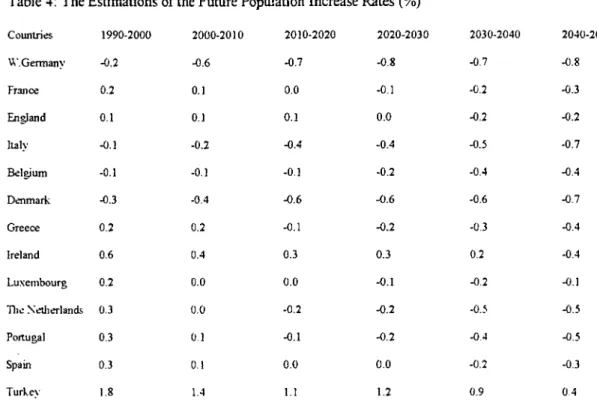
T ab le 4: The Estim ations o f the Future Population Increase R ates T a b le 5: Exports and Im ports o f T urkey
T ab le 6: E C ’s share in T urkey’s total Exports and Im ports
11
78 79 79 81 82Turkey aims at generating an acceptance as a European country since the Turkish R epublic’s foundation in 1923. All the reform s o f 1920s and 1930s aim to catch up with the W est. The European Com m unity is a target for Turkey for the approval o f its European character. Turkey tries to be a part o f this supranational organization and share the European identity that is in the core o f the European Comm unity. The m em bership o f the European C om m unity seem s to be one o f the m ain determ inants for future o f Turkey. The problem atic o f the thesis is to show w hether Turkey is ready to be a part o f the European Com m unity by sharing the E uropean ideals.
The thesis w ill consist o f five chapters. The apphcation o f the full m em bership o f Turkey in 1987 shows that Turkey’s aim is to
integrate
with EC. The European C om m unity has a com plex structure. The sim ilarities and differences betw een Turkey and EC are the key point for a healthy integration. R oger Cobb and C harles Elder's hypothesizes that define a healthy integration w ill be the tools to elaborate the possibility o f the integration. The second chapter aim s to see the theoretical basis o f the European Com m unity. The approaches to integration will create a basis in order to understand the logic o f the European Comm unity. The evaluation o f the European C om m unity w ill be specified in historical intervals.relations. T urkey’s first application in 1959 and the A nkara Treaty in 1963 will be elaborated. The im portance o f the Joint Protocol in 1973 will be specified but the attention will be given to the im provem ents in the relations after the T urkey’s application for full m em bership in 1987. The debates are not only limited to the custom s union but also to the full m em bership procession in Turkey. The attitudes o f the political parties are significant to see w^hether Turkey is ready for the custom s union politically.
The fourth chapter w ül consist o f a theoretical analysis o f Turkey - EC relations. The dem ographic, political and econom ic aspects o f a possible integration will be exam ined through the hypothesis testing in chapter one.
The argum ent o f the thesis will be defended in the fifth chapter. The answ'er to the question w hy Turkey should be a part o f the European Com m unity will be answ ered w ith the help o f the first four chapters. R oger C o b b ’s and Charles E ld er’s hypothesis will be the key determ inant if Turkey is ready to integrate with Europe. The points in w hich Turkey fits the European norm s w ill be specified. A b rie f conclusion will be at the end o f the thesis for the future o f the relations.
Turkey showed her willingness to be a part o f the Com m unity since 1959. The activation o f the custom s union is the final point in the relations if the custom s union agreem ent is approved by the European Parliam ent in D ecem ber 1995. Turkey has some advantages and disadvantages on her way for an integration w ith the Community.
A healthy integration is difficult even i f it is done betw een two countries. WTien a country tries to integrate w ith a community, the integration process is more delicate. In the case o f the Turkey-EC integration, Turkey faces vdth this kind o f problem . A lthough the M em ber C ountries accept to behave according to the EC laws, it should be noted that each o f them also protects their own laws, regulations and values. All the m em ber states have certain interactions with Turkey and m ost o f them have different attitudes against Turkey. The simple exam ple o f this com plication is the G reece problem . Greece is a m em ber o f E uropean C om m unity yet, its foreign policy against Turkey is m ostly concentrated on national level. It should be noted th at although the national characters o f the m em ber countries may create certain com plications, this com plications is n o t only applicable for Turkey. All m em ber countries experience these kinds o f problem s but find solutions at least
rem em ber these points one should keep in mind Turkey tries to integrate with EC, not the each m em ber country one by one. If the necessary harm onization is sustained, that should be sufficient.
There are several variables that show if tw'O sides fit to each other's norm s. It will be useful to test the possibility o f the integration process betw een Turkey and EC. The m ethod w ill be the usage o f the hypothesis o f R oger Cobb and C harles E lder’s (1970) about the propensity o f any tw o countries to interact w ith each other.*
1. ‘The m ore geographically proxim ate tw o nations are, the m ore they will be integrated with each other.’
Since we are not com paring tw o nations but a nation and a community, it is hard to say an exact thing. Turkey has boundaries w ith G reece who is a m em ber o f EC but there are thousands o f kilom eters to reach U nited Kingdom. Turkey can considered to be geographically close to EC because EC m ust be thought as a totality. T urkey’s geography is also significant w hen h er south border to the M iddle East is considered. Since m ost o f the roads com ing fi-om
' Roger Cobb arid Charles Elder’s hypothesis are listed inorder to compare tw o countries integration possibilities but I believe that the Turkey’s application for the integration with EC has some
similarities. Besides, some authors as I mentioned before, believed as Hallstein claimecLEurope is no creation. It is a rediscov'ery of shared ideals, history and culture. So this test will be influential, if it is accepted as comparison between the European and Turkish identities.
The hypothesis are taken from Michael Haas’s article, international integration in Michael Haas, International Systems (New York and London: Chandler Publishing Company, 1974), p.207-208. * Ibid., p.207.
and the M iddle East and this increases T u rk ey ’s strategic importance.
The geography factor is im portant for Turkey. Turkey controls the traffic from Black Sea to the A egean Sea. Turkey has also a beneficial geographic situation through its eastern borders. The C aucasus region that recently becom es very im portant in w orld politics has direct contact w ith Turkey. The historical and cultural linkages o f Turkey w ith this region are o f course other positive points.
W hen the subject is the geography. The question to be answ ered seems to be w hat is the Community. The tw o gear C om m unity discussion has to be rem em bered. The C om m unity is Brussel or the C om m unity is M editerranean countries. The m em ber states w ho have stronger econom ies or the other m edium sized economies. It w ill be useful to think o f the Com m unity as whole.
2. ‘The more public opinion is cognitively and affectively favorable among the peoples o f two nations, the m ore they w ill be integrated each oth er’.
The possibility o f the fiill m em bership fo r Turkey in the near future seem s to be low. EC enlarged once m ore in 1 January 1995. Finland, Sweden and A ustria are the new m em bers. The integration o f these new m em bers has to be m aintained before a new enlargem ent. In the next round o f enlargem ent, Turkey will come after the B altic R epublics, Estonia, Lethonia, Litvania and East European countries as Poland, H ungary, Bulgaria, Romania, Slovenia and C heck Republic. The top officials' view s are different to a large extend. Even
m em ber o f EC before the year 2000, and the Turkish citizens are supporting the fiill membership. It is rem arkable that more than 80% o f the population is for the fullm em bership.'’
There is another side o f the coin. The image o f Turkey is not so good in Europe. There are tw o im portant reasons for this image. The first reason is historical. Turkey is perceived to be the descendant o f the O ttom an Em pire w hich w as an enem y o f Europe. The image as the
defender o f Islam
o f the O ttom an Empire creates also a hostility against Turks as the enem ies o f Christianity. W hen the O ttom an Em pire broke down, Turks had beaten the w estern albes once m ore and founded Turkey. The second reason fo r the image o f Turkey is more recent. D em ocratization and the hum an rights problem s also strengthen the Turk im age w hich w as not already good in the European minds. WTien these two reasons are exam ined separately, it should be noted that the historic reason can be overcom e m ore easily. A fter the breakdow n o f the Soviet U nion, some o f the authors like S. H untington in his fam ous article.The Clash
o f Civilizaiions
, claim s that the new threat for the W est is the clash o f cultures. A lthough religion is a subcultm e, fundam ental Islam is accepted as the new enemy. The dangerous trend in the W est is, they take the Islam ic society as a w hole. There are variations in Islam as there are variations in Christianity. Turkey is the only secular country w ho has a M uslim population in a large m ajority and she has good relations w ith m ost o f the M uslim countries. TurkeyCouncil and NATO. She is also betw een the problem atic M iddle East and Europe geographically so Turkey m ay play the role o f a m ediator betw een the tw o civilizations by sharing characters o f the both sides. Dem ocratization and hum an right problem s are m ore severe because the improvem ents in this areas need tim e. The public reacts to the dem ands o f EC and accepted them as interventions to the Turkish internal politics that creates a negative atm osphere against EC. The new constitutional reform has positive effects on both sides. The authorities are claim ing that Turkey needs im provem ents in these areas but they m ust be done not because o f the dem ands o f W est but they will be done because Turkey needs them for further im provem ents.
3. ‘The m ore culturally hom ogeneous tw o nations are, the more they w ill be integrated each other.
Turkey and all the countries in EC have very different cultural background. First, the religions o f the tw o sides are totally different. T m key is M uslim but all o f the EC countries are Christian. The religious difference creates an im portant problem but it is claim ed several tim es by the EC authorities that EC is not a Christian club. The truth in this claim is open to discussion but although they share the same religion, there are im portant differences betw een the m em ber countries. The problems betw een the C atholics and Protestants som etim es becom e very severe for instance. The
Michael Haas. Intematioal Systems (New York and London: Chandler Publishing Company, 1974), p.207.
the cultural differences seem to be detailed. The am ount o f the cultural differences are not a crucial barrier betw een two sides for several reasons. First, each society contains conservatives, liberals, m oderates and fanatics. Second, the history o f Turkey should be rem em bered at this point because the Ottoman Em pire controls the land up to V ienna in the history and they have direct interaction w ith the Europeans so both sides has the chance to absorb some o f th eir cultural characteristics. Third, although Turkey has not been a full m em ber o f EC, there are m illions o f Turks living and w orking in Europe who are in total more than some o f the m em ber countries populations such as Luxem bourg. A lthough there are some existing problem s, it is seen that both sides can live together despite o f the cultural differences.
The m em ber states faced problem s w ithin th eir history as difference o f the languages or rising nationalism . They have overcom e these problems through constant debating. The European ideal is based on jfreedom to choose so respect to different cultures is an outcom e o f this understanding.
4. ‘The m ore sim ilar the tw o nations are in term s o f their historical experience, the m ore likely they will be integrated with each other.
Turks are a part o f European history. The interaction w as not good for centuries since Turks have acted as the defenders o f Islam since the Crusaders. W ith the foundation o f the O ttom ans Empire, Turks becom e the m ain enem y o f
* Michael Haas, Inlernatioal Systems (New York and London: Chandler Publishing Company. 1974). p.207.
not only bring opposition but also a tradition o f alliances betw een Ottom ans and Europe. France w as the first European country to obtain im portant econom ic privileges from O ttom ans under the nam e o f
Capitulations.
Ottom an Em pire w as an im portant ally o f G erm any in the first W orld W ar. Turkey took her place in the Second W orld W ar tw enty years later. Although Turkey did not participate actively, Turkey declared w ar against G erm any at the end o f second W orld W ar and showed her side. The Turkish soldiers fought in the Korean W ar in 1950 with W estern allies. T he, m ost recent exam ple o f T urkey’s allegiance with the W est is the G u lf crisis in 1990-1991. In addition, after the w ar started in form er Yugoslavia, Turkey play a very active role in the resolution efforts. Turkish troops are still in Z enecia in Bosnia-Herzegovina. Turkey share the m ost im portant events in the European history. Turkish soldiers fight with European soldiers against a common threat. The im portant point here is Turkey experiences all im portant historical events w ith the Europe actively so they share the com m on historical history.5. ‘The greater the hom ogeneity o f tw o nations w ith respect to social welfare y
values, the more those tw o nations vvill be integrated with each other.’
The dynamics o f the social w elfare are quite different on both sides. First o f all, the m em ber countries in the EC have stronger econom ies than Turkey . This creates m ore capacity for the m em ber countries to create better social welfare systems. States need m oney to bring social services to their
non-profit organizations are quite popular in EC m em bers, it is hard to com pare them both in quality and quantity w ith their Turkish counterparts. The unem ploym ent fees are sufficient in the m ajority o f the mem ber countries but the ones with even having a regular jo b , experience difficulties in Turkey due to the low wages. The econom ic capacities o f the both sides are crucial in here. Turkey is econom ically backw ard and lack a w elfare state. This seem to create the biggest obstacle against T urkey’s full m em bership.
6. ‘The greater the hom ogeneity o f tw o nations w ith respect to internal social
Q
developm ents, the m ore they will be integrated w ith each other.’
The level o f the social developm ents m ay be different but Turkey also experiences the sam e kind o f developm ents. Social problem s are caused by the insufficient econom ic conditions. U nem ploym ent caused problem s on both sides. B ut Turkey has larger social problem s caused by her relatively w eak econom y to EC. The internal m igration fi-om east to w est o f Turkey cause adaptation problem s in the cities. It should also be noted here that Turkey is faced w ith terrorism to an extent th at none o f the EC m em bers are experiencing. There are also existing sim ilarities in the internal social developm ents. W om en rights organizations are becom ing active in Turkey and people starts to be related w ith environm entalism .
7. ‘The greater the hom ogeneity o f tw o nations in term s o f regim e stability, the more they will be integrated w ith each other.
W hen the question is regim e stability, it is very hard to compare a country w ith a com m unity. Turkey faces w ith three interruptions in her dem ocracy since 1960. But there are also some interruptions w ithin the same period in some m em ber countries. G reece experienced m ilitary intervention in 1967. Spain and Portugal w ere dictatorships from 1930s to 1974 and 1975. Even, France experienced an intervention in 1958. The first condition for the regim e stability is the free and regular elections. W hen the m ilitary coups in the history o f Turkey are exam ined, they have an unique character. AH the leaders o f the coups stated right after the coups that they intervened in ci\alian governm ents in order to protect dem ocracy and after they sustained the regime stability, the army w ould return to his original position. W hen the conditions before the tw o m ilitary interventions are exam ined, it is seen th at the country w as in chaos both econom ically and politically. The econom ic conditions o f Turkey has been im proved since 1980s . Although the past interventions were w elcom ed by the society, people now believe that the problem s o f Turkey must be solved through the dem ocratic institutions. The top officials o f the army declares this kind o f view as well. This can be considered as the strength o f the regim e stability. D em ocratization is one o f the m ost discussible topic in Turkey. The improvem ents in Turkish dem ocracy has the chance to strengthen the regim e stability.
8. ‘The m ore hom ogeneous tw o nations are with respect to m ilitaiy power, the more they will be integrated with each other.’’®
The European U nion is an econom ic and political institution. Since it does not have unique army, the com parison can be m ade on the country base. But w hen the Europe and W est is the case, N A TO seems to be the arm y o f the W est. Turkey is a m em ber o f N A TO since 1952 so she is already integrated to the European institutions on the m ilitary base. Turkish army is the second largest arm y in N A TO after USA. Turkey and m ost o f the m em ber countries o f EC already cooperate under N A TO command.
9. ‘The m ore hom ogeneous tw o nations w ith respect to economic capabilities, the m ore they wiU b e integrated w ith each other.’”
EC is the biggest economic organization o f th e world controlling 39.5% o f the w orld trade and w hen the new three m em ber are added to this share they com e close to 4 5 % .’^ W hen the com parison is m ade on the countries level it is seen that Turkey is the poorest am ong all m em ber countries in term s o f GNP per capita.
Table 1; GNP for the EC M em bers and Turkey
Coumries GNP (Billion dollars) GNP/Capila ( Dollars)
Germany 2041.5 24945 France 1318.9 22757 Italy 1020.2 17805 Spain 480.3 12259 Turicev 132.2 2182 Ibid, p. 207. Ibid, p. 207.
'■ Haluk Ce}’han, isletmeler Yönünden Türkiye - Avrupa Birliği Gümrük Birliği^ ( İstanbul,!994) p.21.
Holland Belgium Austria Sweden Portugal Greece Denmark Finland Ireland Luxembourg 328.5 226.7 195.6 194.7 87.5 77.6 147.4 95.9 51.8 13.6 21301 22715 24166 22201 8874 7460 28286 18837 14494 36757
The Table was taken from Yeni Yiizyyl., 3 April 1995, pp. 14
A barrier to closer econom ic integration betw een Turkey and EC lie in unequal economic capacities o f the tw o sides. The health o f the Community lies in the econom ic pow ers o f its m embers. I f there are trem endous gaps betw een the econom ies, the system can not work. The rich ones will dominate the poor ones so EC should strengthen Turkish econom y through various resources. W hen the history o f the C om m unity is examined, it is seen that the econom ies o f Spain, Portugal and especially G reece w as not so good, either in the integration years but the problem is tried to be overcome by certain EC funds. Laffan states in her book Integration and co-operation in Europe that G reece is the country with the low est per capita incom e in the community. “G reek entry into the C om m unity in 1981 w as the culm ination o f a relationship that began with the A ssociation A greem ent o f 1962, the fu st such agreem ent signed by the EC. The m ilitary dictatorship (1967-1974) stalled the operation o f the agreement. W ith the resum ption o f dem ocratic governm ent in 1975, the governm ent o f C onstantine K aram anlis applied fo r full membership. A lthough
the Com m unity w anted to treat the Greek application in tandem with Iberian countries, the Council o f M inisters w as prevailed upon to accept speedy Greek accession in order to protect dem ocratic institutions.” '^ Greece econom y has been supported by EC to a large extend. “ N otw ithstanding significant financial transfers from the Community, the incom e gap betw een the EC and G reece w idened during 1980s. G D P p er capita declined from 58 percent o f the C om m unity average to 54 percent in 1989. High inflation, and budget and trade deficits in recent years leave G reece ill-equipped to m eet the challenge o f EM U w ithout a period o f econom ic stabilization.” '^’ The point here is, w hether EC is w illing to give such an aid to Turkey or not.
10. ‘The more hom ogeneous the bureaucratic capabilities o f tw o nations, the m ore tw o nations w ill be integrated w ith each other
The bureaucratic capability o f the tw o sides is hard to com pare. B ut it is a fa c t that Turkey has a very slow functioning bureaucracy that tries to be com puterized where EC has a w orking com puterized bureaucracy although certain problem s exist. A lthough the technological systems seem s to be different within the bureaucracies o f the tw'O sides, the dymamics are m ore or less th e same. They have a sim ilar type o f bureaucratic organization and every EC organization has more or less an equivalent in the Turkish bureaucracy.
Brigid Laffan. Integration and Co-operation in Europe^ (London: Routledge. 1992), p. 198. Ibid, p. 199.
’ ■'Michael Haas. Internationa! Systems^, (New York and London: Chandler Publishing Company 1974.) p.207.
11. ‘Two nations will be m ore likely to be integrated with each other if they have collaborated previously to g eth er.’’^
This assum ption is valid fo r tw o countries b u t w hen a com m unity is the subject, it is very hard to com pare because m ost o f the coimtries as Turkey did, had w ar w t h each other in a shared history. B ut the same countries also cooperated w ith each other in different times. B ut Turkey is cooperating with m ost o f the EC countries under N A T O com m and fo r years. Turkey is a m em ber o f O EC D and Council o f Europe fo r years. The collaboration is observed in defense subjects m ore or less. The K orean W ar and the G ulf crisis are two exam ples o f this. Turkey also collaborated w ith these countries under the UN com m and in Somalia and B osnia-H erzegovina.
Although the assum ptions are for the com parison o f integration o f two countries, I believe that they are useful to show h o w uneasy and complicated the relations betw een Turkey and EC are. It is very hard to give a direct answer to the questions and this show s that Turkey fit the European ideals to certain extend w hich is veiy norm al for the interaction that goes on for centuries.
CHAPTER TWO
The year 1989 w as significant in the history o f the European Com m unity. The post w ar conditions effected the Com m unity to give m ore im portance to political issues. The dem ocracy and the individual rights o f the people increased their role in the C om m unity’s agenda. European Com m unity aim ed to reach its m ain objective, the form ulation o f a common m arket by the y e ar 1992. The deepening o f the integration through economic, m onetary and the political union seem ed to be the new objectives. The breakdow n o f the So\det U nion and the Germ an unification w ere the tw o im portant historical events th at increased the level o f deepening and widening. “The EC is faced w ith the enorm ous challenge o f deepening the level o f integration, w hile at the sam e tim e com ing to term s w ith the revolutionary changes in Eastern Europe and w ith the fact o f Germ an unification.” *’
A fter W orld W ar II, Europe w as divided into tw o parts having different econom ic, political and social system s. The E uropean Community em erged as a regional organization at that time. EC had a significant place in the integration theories. It had the characteristics o f both international co-operation and integration. EC could be regarded as an exam ple o f international co-operation
' ' Brigid LaSan, Integration and Co-Operation in Europe (London and New York: Routledge, 1992). p .l.
at the beginning. It turned to be an integration later on. Brigid Laffan stated the difference between international co-operation and integration. “International co-operation and integration both involve states in collective action, but the latter can be distinguished from the form er by the intensity o f relations betw een the participating states and the m anner in w hich those relations are organized and m anaged.” The organizations that aim ed to promote international co operation do not exercise pow er on the participating states’ sovereignty. H aas claim ed on the other hand that “integration is a process for the creation o f political communities.” *^ The states share some o f their sovereignty Avith other states w hen they integrate w ith each other.
There were two kinds o f integration according to W allace. O ne is the form al integration and the other is the inform al integration. Form al integration is defined as “deliberate actions by authoritative policy-m akers to create and adjust rules, to establish com m on institutions and to w ork w ith and through those institutions where inform al integration includes intense patterns o f interaction like communication, technology, m arket dynam ics and social change.” ^** European Com m unity h ad the characteristics o f both lands o f integration through its institutions and its dynamics.
Ibid. p.3.
E.B. Haas. 'The Studj of Regional Integration; Reflections on the Joys and Anguish of
Prelheonizing'. in . Lindbcrg and S.A. Schcingold (cds), Regional Integration: Theory' and Research (Cambridge. Mass: Han ard Universih’ Press. 1971), p.6. in Brigid Laffan. Integration and Co- Operation in Europe ( London and New York: Routledge, 1992), p.3
W. Wallace, The Transformation o f Western Europe (London: Frances Pinter, 1990). p.54. in Brigid Lafifan, Integration and Co-Operation in Europe (London and New York: Routledge, 1992). p.6.
There were various attem pts for collective action in the European history. The Council o f Europe, the O EC D , N A TO and the W estern European U nion can be given as examples. The E uropean Com m unity differed from these exam ples with its integration dim ension. The Com m unity showed the characteristics o f international co-operation in the foundation years but turned out to show its willingness to integrate in the follow ing years. The Single E uropean A ct had an im portant place in this integration attem pt that will be exam ined specifically later on.
Before the historical sequence that show s the change in the C om m unity’s agenda from the security-econom ic dom ain to political domain, the aim o f the integration and the levels o f the econom ic and political integration will be specified. The aim o f an integration has to be specified in order to understand the European C om m unity exam ple clearly. The economical dim ension should be cleared first. “Potential econom ic benefits arising from increased specialization, econom ies o f scale, im proved term s o f trade and increased competition provide the econom ic rationale for integration.” As Laffan indicated, John Finder developed tw o w ays o f integration. Negative integration by dem olishing the barriers against free flow o f goods, capital and labor and positive integration by form ation com m on policies and laws. It can be stated that the negative and the positive integration were on the core o f the form ulation o f the Community. Laffan also claim ed that the econom ists
■' Brigid Lafifan. Integration and Co-Operation in Europe ( London and New York: Routledge, 1992). p.4.
determ ined levels o f economic integration w hich are the
free trade area,
customs union, common market, economic and monetary union and total
economic integration.
The tariffs and quotas elim inated for m em ber states in free trade area w here barriers to trade are rem oved and a common external ta riff is applied to third countries in a custom s union. The free m ovem ent o f labor, capital and services are allowed in a com m on market. H arm onization o f national econom ic policies and single currency are the prerequisites in econom ic and m onetary union. The econom ic policies are integrated in a total econom ic integration as a final step. The E uropean Com m unity achieved free trade area, custom s union and form ulation o f a com m on m arket. A single currency and the integration o f the econom ic policies o f the m em ber states seem to be the new targets o f the Com m unity.W hen the political integration is exam ined, “it is useful to distinguish betw'een four different aspects o f political integration. The institutional integration, policy integration, attitudinal integration and security integration.” The supranational institutions can take decisions independently from the m em ber states in institutional integration. The decisions that w hich particular policies w ill be taken into consideration in a co-ordinated w ay is achieved through the policy integration. A legitim ate dom estic consensus is necessary for attitudinal integration. Security integration depends on D eutsch’s
" Ibid., p.5.
This categorization is taken from R.S. Jordan and W.J. Feld, Europe in Balance (London; Faber & Faber, 1986), p.91. The different categories are elaborated on b\’ J.S. Nye, Peace in Parts: Integration and Conflict in Regional Organization (New York: University Press o f America, 1987), pp.21-54 in Brigid Laffan, Integration and Co-Operation in Europe (London and Ne\v York; Routledge. 1992). p.6.
notion o f security community characterized by a w ell-established expectation o f non-violent inter-state relations. “A ccording to Deutsch there are tw o types o f ‘security com m unity’- an am algam ated security community w hich achieves a com m on government, and a pluralistic com m unity which preserves peace but falls a com m on governm ent.”^'’ It can be stated that the first three approaches to political integration was achieved to a certain extend in the history o f the E uropean Community. The security integration has not been achieved yet.
There are various approaches to European Community integration. Federalist, neo-functionalist, intergovem m entalist and domestic politics, and interdependence perspectives w ill be m entioned in the following.
The federalist ideas w ere im portant in post-w ar Europe. The idea o f E uropean Federation started to be discussed. A lthough it was very hard to talk about a federation fully functioning in Europe, some o f the characteristics o f a federation seemed to have influence on European Com m unity’s political system . The basic im plication o f this sim ilarity is ‘the locus o f external sovereignty at the higher level.
The neo-functionalist view s on integration em phasized on the social and econom ic issues among the states. D avid M itrany also claimed that ‘integration is the gradual trium ph o f the rational and the technocratic over the political.
K.W. Deutsch, ‘Attaining and Maintaining Integration", in M. Hodges (ed), op. Cit.. pp. 108-23. in Brigid LafFan, Integration and Co-Operation in Europe (London and New York: Routledge, 1992),
p6.
Brigid Laffan. Integration and Co-Operation in Europe (London and New York; Routledge. 1992). p.8.
C. Penüand ‘Political theories of European integration: between science and ideology’, in D.Lasok and P. Soldâtes (eds), The European Communities in Action (Brussels: BrmlanL 1981), p.551. in Brigid Laflfan. Integration and Co-Operation in Europe (London and New York: Routledge, 1992), p.9.
the neo-functionalist approach to integration gave im portance to M itrany’s view s and stated that the political actors shifted their loyalties to higher institutions having authority over nations. The critics to neo-functionalism focused on that point. The expectation o f the national politicians to shift their loyalties to higher institutions w as not fulfilled in European comm unity. The Council is the m ost powerful institution in European Com m unity and this is accepted as the national governm ents protect their power. The domestic dim ension o f the integration seem s to be underestim ated in the neo-functional approach to integration.
The traditional school o f international relations claimed th at the national governm ents were the most im portant figures in integration. H offinan claimed th at the national governm ents can ‘stop or slow dow n the building o f a central political system .’ The intergovem m entalists claim s that the decision-m aking process in Brussel is ju s t the top o f an iceberg. It is very influential into the national politics.
The authors like S. B u h n er stressed on the domestic politics. The national politics is the basic unit in the European com m unity. The EC policies are form ed in the national level and lead to international arena.
The interdependence perspective on the other hand claim ed that no governm ent had the potential to direct this kind o f an international system. The international econom ics has already been active. The national sovereignty has
“ S.HofEman, ‘Obstinate or obsolete: the fate of the nation state and the case of Western Europe'. Daedalus, 1966. vol.95. pp.862-915, and S.Hoflftnan, ‘Reflections on the nation stale in Western Europe Today' Journal o f Common Market Studies, 1982, voI.21. p.30. in Erigid Lañan, Integration and Co-Operation in Europe (London and New York: Routledge, 1992), p. 11.
been reduced by international trade, the flow o f international capital and m ultinational com panies. There w as a need for inter-state collaboration for ‘environment, public health and the problem o f crim e .’"* The interdependence approach stressed that the conditions in interstate relations forced the national governm ents to create a higher authority. The international econom ics has already gone beyond the national level. K eohane and N ye stated that ‘in the absence o f a central authority in the international system s, regim es are based on coalitions betw een governm ents and involve procedures, rules, norm s and institutions for the conduct o f interstate relations.
N o theory or approach has been able to capture the European Com m unity w ith its all dimension. The C om m unity has a com plex structure and it changes over tim e. It will be useful to see the evaluation o f the European C om m unity through tim e intervals since the dynam ics o f the Community changed according to the specific conditions o f this intervals.
1945 -1960
Europe faced w ith im portant problem s after the W orld W ar II.. All o f the countries that w ere effected from the w ar experienced an econom ic, politic and social troubles. Although the w ar w as finished, there w ere still international problem s. The German question kept its im portance. A lthough
Brigid Laffan, Integration and Co-Operation in Europe (London and New York: Routledge. 1992). p .l2.
R. 0 . Keohane and J. S. Nye, Power and Interdependence: World Politics in Transition (Boston: Little, Brown, 1977) in Brigid LafEan, Integration and Co-Operation in Europe (London and New York: Routledge, 1992), p .l3.
Germ any was beaten, it rem ained as a m ajor problem . The precautions to protect Europe from a future G erm an threat seem ed to be the m ajor political goal. The Germ an threat w as over at least in the n ear future but the Soviet pow er w as the new threat over Europe. The w a r destroyed m ost o f the European cities. There w ere problem s o f reconstruction, housing, food and refugees in each European country. The European dom inated international system seemed to be weaken. U nited States o f A m erica (USA) and the Soviet U nion (USSR) w ere the new w orld pow ers. USA h ad both the econom ic and the m ilitary powers. She m ade agreem ents under th e nam e ‘Pax A m ericana’ against communism so Soviet Union. On the other hand, Stalin w as the leader o f the Soviet U nion and his R ed Arm y w as the biggest m ilitary pow er in Europe. Soviet U nion started to dominate the E astern European countries through the com m unist parties in these countries. She refused to jo in the international organizations and form ed its ovm m ultilateral econom ic system under the name o f CO M ECO N .
A fter the W orld W ar Two, Germ any w as controlled b y USA, French, B ritish and USSR. This d i\isio n led to tw'o different countries. Federal R epublic o f G erm any w as founded in 1949 in the territories controlled by US.A, French and British. O n the other hand, Germ an D em ocratic Republic was founded in the territories controlled by USSR.
All these developm ents in the world politics increased the need o f a E uropean economic integration. The extreme nationalism needed to be overcome. Germany had to be controlled. Small states had to be helped to
overcom e the w ar damage but m ost im portant o f all, an integrated Europe could only resist to USSR and USA.
There w ere various steps for this integration. The British Prim e-M inister Sir. W inston Churchill had a significant place in this integration.
The Speech of W. Churchill for the European Integration.
The significance o f the BEU is, it creates a m odel o f integration for Europe but it is quite interesting that a European integration idea was offered by W inston Churcill, prim e-m inister o f U nited K ingdom in a speech he gave in Z urich U niversity on 19 Septem ber 1946, ju s t after the second w orld war. C hurchill stated that;
“I am going to say som ething that w ill astonish you. The first step in the re creation o f the European fam ily m ust be a partnership betw een France and G erm any. In this w ay only can France recover the m oral leadership o f Europe. There can no revival o f Europe w ithout a spiritually great France and spiritually great Germany. The structure o f the
United States o f Europe,
if well and truly built, will be such to m ake the m aterial strength o f a single state less important. Sm all nations will count as much as large ones and gain their honor by their contribution to the common cause ....I shall not try to make a detailed program for hundreds o f m illions o f people...but i f this is th eir wish, they have only tosay so, and means can certainly be found, and m achinery erected, to carry that wish into full fruition.”
W. Churchill clearly states that Europe should unite to gain m ore strength. The only way to protect Europe from a future w ar w as to unite so there w ould be no enemy. He saw France and G erm any as the leaders o f new Europe. W hen it is rem em bered that G erm any and France w ere the tw o enemies o f the past tvN’o W orld W ars, W. C hurchill’s aim can be im derstood as if they cooperate together, they can n o t fight w ith each other. He also added the small nations into this integration so as to share this honor and increase the strength o f new Europe. A nother interesting point in C hurchill’s speech was, he did not count U nited Kingdom as a part o f this new Europe but only stated his w ish to co operate. “In all urgent work, France and G erm any m ust take the lead together. G reat Britain, the B ritish C om m onw ealth o f N ations, mighty Am erica, and 1 trust Soviet Russia- for then indeed all w ould be w ell- m ust be friends and sponsors o f the new Europe and m ust cham pion its right to live and shine.” It is very clear that C hurchill w as for a U nited States o f Europe but he did not w ant the United K ingdom in it. C hurhill’s speech w as quite im portant politically in order to show the w ill for an integration but the economic conditions o f the continent w as not so good. The tw o w orld w ars gave damage to all o f the m em ber countries and they tried to rebuild their countries. USA (U nited States o f A m erica) decided to help Europe at that time.
‘^■^eon Hun\itz. The European Community' and the Management o f International Cooperation (London: Greenwood Press, 1987). p.l 1.
T h e E u ro p ea n R ecovery P ro g ra m (1947)
The European Recovery Program w as well known with its founder's nam e as M arshall Plan. US Secretary o f State George C. M arshall declared for the US wish for an econom ic assistance program for the W estern Europe in his speech at Harvard university on 5 June 1947. A fter M arshall Plan was approved by the US Congress in 1948, it started to operate for four years. O EEC ( O rganization for European Econom ic C ooperation ) w as founded in order to coordinate the funds on 16 A pril 1948. “B ut the OEEC went beyond ju s t finding w ays to spend the A m erican funds: the countries involved recognized the interdependence o f their econom ies, the need to m axim ize trade w ithin the area, and the necessity o f im proving the international paym ent system .” OEEC helped the European countries to come nearer and to work under an organization. OEEC turned to be O rganization for Economic C ooperation and developm ent (O ECD ) in 1961 and w ent beyond European character. M arshall plan and OEEC gave the econom ic cooperation in European 1950s but the European countries also started to integrate through m ilitary alliances by that time.
The Brussels Treaty, The Western European Union, NATO
After the Second W orld W ar the common enem y w as changed for France and the U nited Kingdom. It w as no longer G erm any but the Soviets.
The organization fo r European Economic Cooperation: History’ and Structure^ Paris: OEEC. 1953) in Leon Hun^itz. The European Community- and the Management o f International Cooperation (London: Greemvood Press. 1987). p.l4.
Although France and United K ingdom signed the Dunkirk Treaty on 4 March 1947 against a possible future Germ an aggression, the change in the enemy created the Treaty o f Brussels on 17 M arch 1948 with the co-operation o f Belgium, France, Luxem bourg, the N etherlands, and the United Kingdom against the Soviet threat. “The B russels Treaty w as m uch m ore than a limited m ilitary alliance, it w as a defensive partnership. The treaty called for collective self-defense and econom ic, social and cultural collaboration.” The economic, social and cultural collaboration w as not im plem ented too m uch but the em phasis was on the m ilitary cooperation. The L ondon conference was held inorder to strengthen the m ilitary alliance in 1954 and the W estern European U nion (W EU) w as founded in Paris m inisterial conference in O ctober 1954. The agreem ent w as ratified on 6 M ay 1955 and U nited Kingdom, France, Italy, the N etherlands, Belgium, Luxem bourg and W est G erm any founded the WEU. The im portance o f Paris conference is to call W est G erm any to jo in both W EU and N A TO so to take her place in the European integration. The m ost important m ilitary organization o f the W estern integration is N A TO (The N orth Atlantic Treaty O rganization). It w as founded in 1949. “The basic m otivation for the creation o f NATO w as the enhancem ent o f the security o f the m em ber states because even the capabilities o f the m ost pow erful m em ber- the United States - w ere perceived as insufficient to m eet the threat o f aggression in Europe by the Soviet U nion.”^'' The im portance o f NATO agreem ent is if a m em ber country is
33
Leon Hunntz. The European Community· and the Management o f Internationa! Cooperation (London: Greenwood Press. 1987). p .l5.
attacked, the other m em ber countries accept to com e to help so the m ilitary integration in Europe strengthened to a large extent.
The Council o f Europe
The Council o f Europe w as founded in M ay 1948 through the report o f the International Com m ittee o f the M ovem ents fo r European Unity. The tw o w orld w ars gave considerable dam age to the Europe because o f rising nationalism . The idea o f protecting Europe from nationalism brought the E uropean countries to transfer some sovereignty to an international organization. “The Council o f E urope’s m ajor success has not been in the area o f political integration; rather, it is w ithin the area o f the harm onization across Europe o f certain law s and standards and operating procedures.”^^
The aim o f the Council o f Europe w as to adapt the common values o f W estern European Dem ocracy. The m ost im portant o f them w as the rule o f law . The Council o f Europe also has sim ilar bodies with the European C om m unity. M itrany’s functionalist approach corresponds to the Council o f E urope w ith its stress on the intergovernm ental aspect. ‘The range o f the policy instrum ent at its disposal remain, how ever, very limited, it relies on conventions or intergovernm ental agreem ents w ith no independent law -m aking p o w e r.’‘^^The harm onization o f several law s and procedures with addition to sim ilar organizational structure, the Council o f Europe opens the way for the
Ibid. p. 19-20.
35
Brigid Lañan, Integration and Co-Operation in Europe (London and New York: Routledge. 1992). p.29
European Coal and Steel Com m unity that will be EEC and than EC in the future.
The European Coal and Steel Community (ECSC)
ECSC w as founded as a free trade area for the coal and the steel sectors. The general aim o f the ECSC is to m ake the E uropean governm ents to w ork together on coal and steel so a com m on understanding on other issues can be developed. “ This spillover effect did indeed take place: the ECSC w as basically an econom ic solution to a political problem , but, as the econom ic benefits m ounted fo r the participating governm ents, it w as all but inevitable that the functional areas w ould be expanded.” T he ECSC w as the idea for Jean M onnet, a French econom ist w ho is for the European co-operation and integration. H is colleague, Robert Schum an was the French Foreign M inister w ho w as able to convince other countries’ officials so as to found European C oal and Steel Com m unity. The Paris Treaty announced that ECSC w'as foim ded by France, W est Germany, Italy, Belgium , Luxem bourg and the N etherlands on 18 A pril 1951. R obert Schum an announced the proposal o f the EC SC as to “assure the establishm ent o f com m on bases for econom ic d ev elopm ent w hich is the first stage for the European federation, and will change the destiny o f these regions w hich have long been devoted to the production o f arms to w hich they them selves w ere the first to fall constantly
^ Leon Hun^itz. The European Community and the Management o f International Cooperation (London: Greenwood Press. 1987). p.20.
. . «»38
\actim .” The ECSC seem to be the cornerstone o f the European integration. The supranational characters o f the duties o f ECSC w as stated in Paris Treaty. The institutional form ation o f ECSC as a m ixture o f supranational and federal institutions like the Com m ission, the A ssem bly, the Courts o f Justice, the Council o f M inisters created the basic institutional roots o f European Com m unity. ‘Strong supranational institutions w ere to constitute one o f the unique features o f the European C om m unity and form ed the neo-fim ctionalist approach to integration.’^^As Mr. Schum an stated the aim w as to stop w ars betw een the European countries. The sources o f the European countries w ere aim ed to be used fo r the econom ic developm ent o f Europe, rather than producing arms and destroying it. One o f the reasons o f the second w orld w ar w as the Saar region. The Saar has valuable coal and steel resources and the control o f the region created a hostility betw een France and Germany. A fter the second w orld w ar, France w as controlling the region up to 1948 as w ar reparation and it w as left to International R uhr A uthority that was bringing USA, G reat Britain, France, and the B EN EL U X countries to control. The tension betw een W est Germ any and France w as going on and the problem w as solved through ECSC. ECSC w as an institution for peace. It also helped W est G erm any to participate other European countries under a higher authority so the hostility left its place to cooperation by ECSC.
^^Statement of Robert Schuman. Minister of Foreign Affairs ofFrance (9 may 19.^0). U S. Department of Stale Bulletin ( 12 June 1950 ) p.936. in Leon Hun>itz. The European Community- and the
Sianagement o f International Cooperation (London: Greenwood Press. 1987)
Brigid Lafifan. Integration and Co-Operation in Europe (London and New York: Routledge. 1992). p.33.
W'Tien the pow er o f the W est G erm any is thought, another advantage o f ECSC beside its potential o f creating E uropean cooperation w as to keep W est G erm any under control. “French foreign-policy planners were cognizant o f the fact th a t W est G erm any could not be kept under allied control forever. This seem ed especially true in the heavy industry sector, w here the K orean W ar had placed em phasis on the renew ed production o f European steel.” Europe w as divided into tw o in both o f the w orld w ars. W hen G erm any gained too m uch pow er, the struggle for more pow er begins and this struggle m ostly ended w ith w ar. The other European countries this tim e aim ed to solve the problem by not w ar b u t taking G erm any to their club to cooperate. The cooperation betw een these six countries opened the w ay for European integration later on. The nationalistic barriers betw een the six countries w ere abolished in the coal and steel sectors and the ECSC opened the w ay fo r the European Econom ic C om m unity so as to expand the num bers o f the sectors and increase cooperation. “There were too m any other sectors o f the econom y that w ere related to coal and steel but with w hich the ECSC structure had no com petence to deal. The developm ent o f the ECSC revealed the need to enlarge the com m on m arket.”
The Common M arket idea w ill be in the heart o f the E uropean C om m unity. The general will to form a com m on m arket in Europe w as stated in the M essina Conference.
Leon Hureitz. The European Communit}· and the Management oj lnternational Cooperation (London; Greenwood Press. 1987). p.23.
The Messina Conference
The Foreign M inisters o f the six m em ber countries o f ECSC m et on 1 June 1955 in M essina. They form ed the idea o f a com m on m arket by taking the B EN EL U X jo in t M em orandum as a base. The Joint M em orandum consisted o f the ideas o f the B EN ELU X countries that the tim e fo r an economic integration in Europe comes. This is necessary in order to achieve developm ents in the national econom ies. A large com m on m arket and harm onization o f the social policies in order to support this m arket has to be form ed. The foreign M inisters announced that the efforts for an integrated Europe has to proceed by integrating the national econom ies and b y form ing a common market. They decided w hat has to be done first is to form a com m on market.
the speed o f the abolishm ent o f the trade barriers and the common custom s p o licy that w ill be im plem ented to the third coim tries.
- to obtain the common financial, econom ic and social policies. - to obtain the fi'ee flow o f labor step by step.
- to define the com petition laws and regulations so as to abolish all the nationalist protection measures.
- to create a developm ent fund so as to develop the undeveloped regions o f the m em ber countries.
to obtain the sim ilarity for the w orking periods in the m em ber countries.’,42
Jean-François Deniau & Gerard Dniesne. Ortak Pazar ( İletişim Ya>inlari; Presses Universitaries De France. 1995) p.25-26.
o f the Common M arket.
The Spaak Report
The report is know n with the nam e o f the head o f the com m ittee . The report was given in A pril in 1956. The Council o f M inisters o f the European com m unity met in M ay in 1956 and they accepted the report com pletely. The report stated that the aim o f an E uropean Com m on M arket is to create a large production unit for continuos grow th, developm ent and increase in w elfare by m aking the countries to create a harm onized com m on econom ic policy region. The common m arket can only be successful if the necessary tim e is given to m ake the necessary adjustm ents. The tools and the applications that will define the competition betw een the producers can only b e defined that way. The liberalization o f trade in w orld is good but the com m on m arket can only consist o f lim ited countries. The com m on m arket can be regional w hich m eans it can only consist o f the countries that can m ake their regulations harm onized and th at can supply the political cooperation.
The Spaak R eport also define the necessary institutions that can reach to the common market. The E uropean Com m ission w ill be responsible for the execution, the other institution will be Council o f M inisters w ho w ill represent the m em ber countries and take the necessary decisions. The C ourt o f Justice and the Parliament w ill be the other tw o institutions that will control the evaluation o f the process. The Spaak Report creates the core o f the European Econom ic Community Treaty.
“ The signing o f the European E conom ic C om m unity ( EEC ) Treaty in Rom e on 25 M arch 1957 by France, W est G erm any, Italy, Belgium , the N etherlands and Luxem bourg represented a historic event. Six sovereign independent countries- each w ith its ow n separate history, culture, language, and traditions, and whose past relations w ere usually characterized m ore by suspicious and w arfare” than by cooperation and the resolution o f conflict by peaceful m eans- willingly and voluntarily created a supranational organization. This historic transfer o f sovereignty w as based on the realization that the future o f w estern Europe could be secured only b y greater international cooperation and integration.”^^
The aim o f the agreement is stated briefly in A rt.2 o f EEC treaty.
” T he Com m unity shall have as its task, by establishing a common m arket and progressively approxim ating the econom ic policies o f M em ber States, to prom ote throughout the com m unity a harm onious developm ent o f econom ic activities, a continuos and balanced expansion, an increase in stabihty, an accelerated raising o f the standard o f living and closer relations betw een the States belonging to it.
In o rd er to m eet these basic objectives, the EEC Treaty goes on, in its next article, to list the following priority activities:
(a) th e elimination, as betw een M em ber States, o f custom s duties o f quantitative restrictions on the im port and export o f goods, and o f all other m easures having equivalent effect;
(b) the establishm ent o f a common external custom s tariff and o f a com m on com m ercial policy tow ards third countries;
Hurwitz, Leon .. The European Communitj’ and the Management of International Cooperation. (London. Greenwood Press .1987).pp. 11
movem ent for persons, services and capital;
(d) the adaptation o f a com m on policy in the sphere o f agriculture; (e) the adaptation o f a com m on policy in the sphere o f transport;
(f) the institution o f a system ensuring that com petition in the common m arket is not distorted;
(g) the application o f procedures by w hich the econom ic policies o f M em ber States can be co-ordinate and disequilibria in th eir balances o f paym ents rem edied;
(h) the approxim ation o f the law s o f M em ber States to the extend required for the proper functioning o f the com m on m arket;
(I) the creation o f a European Social Fund in order to improve emplo>'ment opportunities for w orkers and to contribute to the raising o f their standard o f li\'ing;
(j) the establishm ent o f a European Investm ent B ank to facilitate the econom ic expansion o f the C om m unity by opening up fresh resources;
(k) the association o f the overseas countries and the territories in order to increase trade and to prom ote jo in tly econom ic and social development.
(Art. 3 EEC)44
The international institutions that em erged betw een the years 1945 - 1960 can be categorized in two groups. The political-security institutions as N A TO , W EU and the political-econom ic institutions as the Council o f Europe, the European Com m unity, EFTA, BEU.
The political security domain becam e very im portant as Europe w as divided into tw o after the W orld W ar II. ‘The politics o f security were
John Cole & Francis Cole, The Geography o f the European Community (London & New York: Routledgc. 1993) p.l 1-12.