METAL DICYANAMIDES AS SOLID ADSORBENTS FOR CO2/N2
SEPARATION AND EFFICIENT WATER OXIDATION CATALYSTS
A THESIS SUBMITTED TO
THE GRADUATE SCHOOL OF ENGINEERING AND SCIENCE OF BILKENT UNIVERSITY
IN PARTIAL FULFILLMENT OF THE REQUIREMENTS FOR THE DEGREE OF MASTER OF SCIENCE IN CHEMISTRY By Aysun Başaran July 2016
METAL DICYANAMIDES AS SOLID ADSORBENTS FOR CO2/N2 SEPARATION AND
EFFICIENT WATER OXIDATION CATALYSTS By Aysun Başaran
July 2016
We certify that we have read this thesis and that in our opinion it is fully adequate, in scope and in quality, as a thesis for the degree of Master of Science.
___________________________ Ferdi KARADAŞ (Advisor)
___________________________ Ömer DAĞ
___________________________ Atilla CİHANER
Approved for the Graduate School of Engineering and Science:
_______________________ Levent ONURAL
iii
ABSTRACT
METAL DICYANAMIDES AS SOLID ADSORBENTS FOR CO
2/N
2SEPARATION AND EFFICIENT WATER OXIDATION CATALYSTS
Aysun Başaran
M.S. in Chemistry Advisor: Ferdi KARADAŞ
July 2016
The demand for the energy has been increasing exponentially and it is expected to double by 2050 as a result of population increase in the world. The fact that fossil-based fuels are limited and they releases CO2 gas, which affects the environment negatively. This situation
encourages researchers to two important disciplines of science: 1) removal of CO2 from
atmosphere and 2) developing alternative sources of energy that are clean and efficient. Low carbon future will be realized by post-combustion CO2 capture with air separation
therefore adsorbents are needed for CO2 capture. Since surface volume, adsorption enthalpy,
and functional groups inside the pores affect the interactions between CO2 and surface, new
porous materials should be designed specifically that possess all of the aforementioned features. In this thesis study, a new metal dicyanamide compound, Co(hmt)(dca)2, with free
nitrogen atoms in the pores were synthesized. A high adsorption of CO2 was observed while
the material exhibits almost no N2 uptake at room temperature. In the Co(hmt)(dca)2 crystal,
the pore opening defined as almost 3.8 Å and kinetic diameters of N2 and CO2 are 3.6 Å and
3.3 Å, respectively. There is a similarity between kinetic diameter of the crystal and N2
iv
study. Although metal dicyanamides have widely been studied in different fields it is the first study in the area of CO2 gas storage.
The negative effects of the CO2 level can also be overcome by developing alternative sources
of energy that are carbon-free. Hydrogen economy, which involves splitting water using light to produces O2 and H2 has received much attention in the recent years since it is carbon-free
and it is based on only water and sun light that are of great abundance. Novel catalysts should be developed to overcome one of the most challenging steps of hydrogen economy, water oxidation, which is one of the half reactions of water splitting. In this thesis study, simple metal dicyanamides have been investigated as water oxidation catalysts. A new family of metal dicyanamides with the formula, M(dca)2(DMF)2, (M = Co, Ni, and Fe), was
synthesized and characterized. A current density of 1 mA.cm-2 obtained at an overpotential of 580 mV and by Ni doping the value could be decreased down to 513 mV. This is the first study that involves the application of cobalt-dicyanamide systems in electrochemical water oxidation catalysis. Electrocatalytic studies as well as long term (70 h) electrolysis studies show that these materials can efficiently oxidize water and are robust during long courses catalytic processes.
Keywords: Energy, gas storage, metal dicyanamides compounds, porous material, water oxidation catalyst
v
ÖZET
CO2/N2 GAZ KARIŞIMININ AYRILMASI İÇİN KATI ABSORBAN VE ETKİLİ SU
OKSİTLEYİCİ KATALİZÖRLER OLARAK METAL DİSİYANAMİT BİLEŞİKLERİNİN KULLANILMASI
Aysun Başaran
Kimya, Yüksek Lisans Tez Danışmanı: Ferdi KARADAŞ
Temmuz 2016
Enerjiye olan ihtiyaç katlanarak artmakta ve 2050 yılında nüfus artışından dolayı bu ihtiyacın ikiye katlanması beklenmektedir. Fosil kaynaklı yakıtlar kısıtlıdır ve çevreyi olumsuz etkileyen CO2 gazı yayarlar. Bu durum araştırmacıları iki önemli disipline teşvik etmektedir:
1) atmosferden CO2 uzaklaştrılması ve 2) temiz ve etkili alternatif enerji kaynaklarının
geliştirilmesi.
Karbon emisyonunun azaltılması için endüstriyel işlem sonrası CO2'i seçici olarak
ayırabilecek katı adsorbanların geliştirilmesine ihtiyaç vardır. Yüzey alanı, adsorpsiyon entalpisi ve boşluklardaki fonksiyonel gruplar gibi etkenler CO2 ve yüzey alanının
etkileşimini etkilediği için bahsedilen bütün özelliklere sahip olan yeni gözenekli malzemeler tasarlanmalıdır. Bu tez çalışmasında, gözeneklerinde serbest azot atomu bulunduran yeni metal disiyanamit bileşiği Co(hmt)(dca)2 sentezlenmiştir. Yüksek CO2 tutunumu oda
sıcaklığında gözlemlenmesine rağmen malzemede N2 alımı sergilenmemiştir. Co(hmt)(dca)2
bileşiğinde boşluklar arası 3.8 Å, N2 veCO2 kinetik yarıçapları ise 3.6 Å and 3.3 Å olarak
vi
seçiciliği arttırmaktadır.Metal disiyanamit bileşikleri farklı alanlarda yaygın olarak çalışılmasına rağmen CO2 gaz depolama alanındaki ilk çalışmadır.
CO2 oranının olumsuz etkileri, karbon içermeyen alternatif enerji kaynakları geliştirilerek
aşılabilir. O2 ve H2 üretimi için suyun ışıkla ayrıştırılmasını içeren Hidrojen ekonomisinin,
karbon içermeyen sadece su ve güneş ışığına dayanması son zamanlarda çok ilgi çekmiştir. Hidrojen ekonomisinin en zor basamağı olan yarı reaksiyonlardan suyun oksitlenmesi aşaması, özgün katalizörlerin geliştirilmesiye aşılabilir. Bu tez çalışmasında, basit metal disiyanamit bileşikleri su oksitleyici katalizör olarak incelenmistir. Yeni bir metal disiyanamit ailesi M(dca)2(DMF), (M = Co, Ni, Fe) sentezlenip, karakterize edilmiştir. 1
mA.cm-2 akım yoğunluğu 580 mV aşırı potansiyelde elde edildi ve bileşiğe Ni ekleyerek aşırı potansiyel 513 mV’a kadar düşürüldü. Bu çalışma, kobalt disiyanamit bileşiklerinin elektrokimyasal su oksitleyici katalizör olarak kullanıldığı ilk çalışmadır. Elektrokatalik çalışmaları ve uzun süreli elektroliz calışmaları bu malzemelerin etkili bir biçimde suyu oksitlediğini ve uzun süreli katalitik işlem boyunca da dayanıklı olduğunu göstermektedir.
Anahtar Sözcükler: Enerji, gaz depolama, metal disiyanamit bileşikleri, gözenekli malzeme, su oksitleyici katalizör
vii
ACKNOWLEDGEMENT
It is a great pleasure to thank my supervisor Assist. Prof. Ferdi Karadaş for his patience, guidance and motivation. He always supported me throughout my thesis and shared his knowledge. I always feel so lucky for working such a great, helpful and understanding advisor.
I also would like to thank thesis committee members Prof. Dr. Ömer Dağ, and Prof. Dr. Atilla Cihaner for their suggestions and patient.
I would like to thank The Scientific and Technological Research Council of Turkey, TÜBİTAK, for supporting my study and accepting to the National Scholarship 2210-C Programme for MSc Students. Additionally, I also would like to thank The Scientific and Technological Research Council of Turkey- Defense Industries Research and Development Institute, TÜBİTAK-SAGE, for permission to complete my MSc thesis.
I offer so many thanks to our group members Dr. Emine Ülker and Dr. Satya Vijay Kumar Nune for their encouragement and sharing valuable experiences. I also thank to Pınar Alsaç, Dr. Rupali Mishra, Saghir Abbas and Merve Demirkıran for their enjoyable friendships and supports.
I want to express my special thanks to my family for their endless love and support. They always encouraged me throughout my life, life is better with you.
Finally, I would like to offer my endless thanks to my all, my husband: Caner BAŞARAN. The are no words to express my gratitude for all things you have done for me. Thank you with all my heart for your patience, support and love.
viii
ix
Contents
1. INTRODUCTION ... 1
1.1. The Dicyanamide Chemistry ... 1
1.2. Modification of Metal-Dicyanamide Compounds ... 5
1.2.1. Metal Dicyanamide Compounds with Terminal Coligands... 6
1.2.2. Metal Dicyanamide Compounds with Bridging Coligands ... 10
1.2.3. Anionic Metal Dicyanamide Compounds with Cation Templation ... 12
1.3. Metal-Dicyanamides as Solid Adsorbents ... 14
1.4. CO2/N2 Separation... 14
1.5. Literature View for Water Oxidation Catalyst ... 15
2. EXPERIMENTAL ... 18
2.1. The Synthesis of Co(hmt)(dca)2 for CO2/N2 Selectivity ... 18
2.2. The Synthesis Pathway of Electrodes for Water Oxidation Catalyst ... 18
2.3. Instrumentation... 20
2.3.1. Fourier Transform Infrared Spectroscopy (FTIR) ... 20
2.3.2. Powder X-Ray Diffraction (PXRD)... 20
2.3.3. Single Crystal X-Ray Diffraction ... 20
2.3.4. Thermogravimetric Analysis (TGA)... 21
2.3.5. CHNS/O (Elemental) Analysis ... 21
2.3.6. Scanning Electron Microscopy (SEM) and Energy Disperse X-Ray Analysis (EDX)………21
x
2.3.7. Gas Adsorption Measurements ... 21
2.3.8. X-Ray Photoelectron Spectroscopy (XPS) ... 22
2.3.9. Electrochemical Mesurements ... 22
3. RESULTS AND DISCUSSION FOR METAL DICYANAMIDES AS SOLID ADSORBENTS FOR CO2/N2 SEPARATION ... 23
3.1. STRUCTURAL CHARACTERIZATION ... 23
3.2. GAS ADSORPTION STUDIES ... 31
4. RESULTS AND DISCUSSION FOR METAL DICYANAMIDES AS WATER OXIDATION CATALYSTS ... 39
4.1. Characterization of Metal Dicyanamides ... 39
4.1.1. Single Crystal XRD studies ... 39
4.1.2. Powder X-ray Diffraction Studies of Metal Dicyanamides ... 44
4.1.3. Fourier Transform Infrared Spectra of Metal Dicyanamides ... 45
4.1.4. X-ray Photoelectron Spectroscopy Studies ... 46
4.2. Electrochemical Studies of Metal Dicyanamides ... 49
4.2.1. Cyclic Voltammetry and Catalytic Activity Measurements of Metal Dicyanamides ... 49
4.2.2. Mixed Metal Dicyanamides as WOCs ... 55
5. CONCLUSION ... 64
xi
List of Figures
Figure 1. Possible dicyanamide coordination modes ... 2
Figure 2. The rutile-related structure of Cu(dca)2. The circles represent in order of decreasing size Cu, N and C. ... 4
Figure 3. Structure of the sheet in -[Co(dca)2] ... 5
Figure 4. Possible Terminal Coligands ... 6
Figure 5. Linear chain structure of Mn(dca)2(pyridine)2 ... 7
Figure 6. Zigzag chain structure of Cd(dca)2(2,2’-bipy) ... 8
Figure 7. 2D structure of Mn(dca)2(4-cyanopyridine)2 ... 8
Figure 8. 2D structure of Cd(dca)2(1,10-phen) ... 9
Figure 9. 3D structure ofCu(pn)2][Mn(dca)4] ... 9
Figure 10. Possible Bridging Coligands ... 10
Figure 11. Structure of Co(dca)2(pyrazine)... 11
Figure 12. 2D topology of (Ph4E)Mn(dca)3 ... 12
Figure 13. 3D topology (MePh3P)Mn(dca)3 ... 13
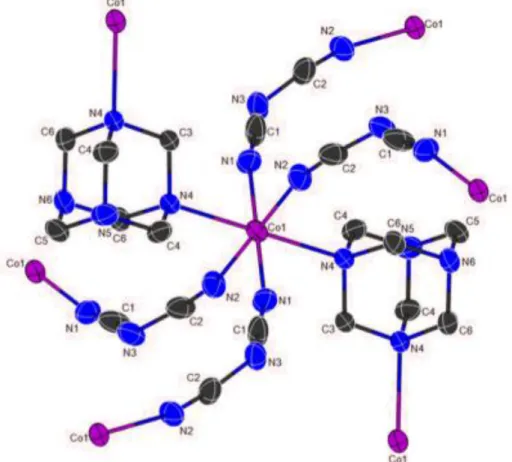
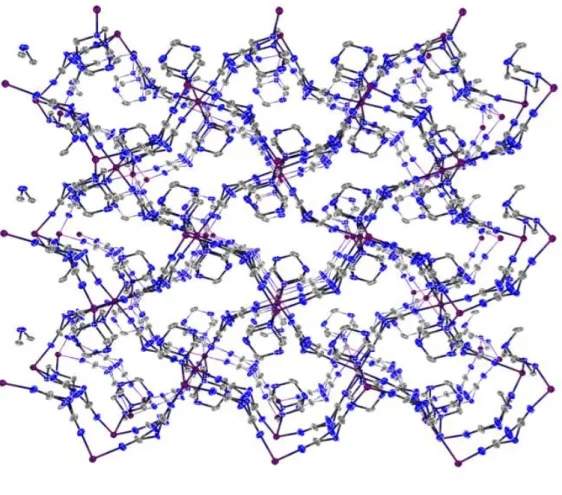
Figure 14. Cobalt center coordination and binding ways to hmt and dicyanamide (Hydrogen atoms are not illustrated for the sake of simplicity) ... 24
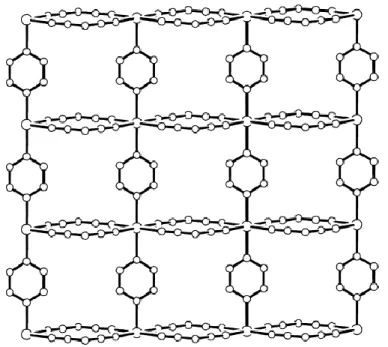
Figure 15. 2D illustration of Co(dca)2 connected by hmt groups (Hydrogen atoms are not illustrated for the sake of simplicity.) ... 25
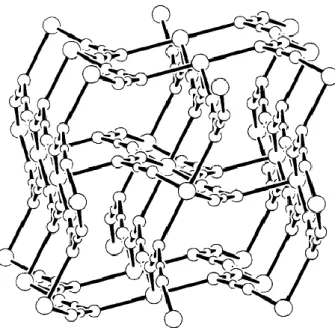
Figure 16. 3D illustration of Co(hmt)(dca)2 (Hydrogen atoms and solvent molecules are not illustrated for simplicity.)... 26
Figure 17. Space filling diagram of Co(hmt)(dca)2 (Hydrogen atoms and solvent molecules are not illustrated for simplicity.)... 26
Figure 18. Crystal structure of Co(hmt)(dca)2. ... 28
xii
Figure 20. The infrared spectrum of Co(hmt)(dca)2 ... 30
Figure 21. CO2 and N2 gas adsorption/desorption isotherms until 1 bar at 273 K and 295 K. Solid symbols show gas adsorption and open symbols show gas desorption... 31
Figure 22. Single and dual site Langmuir isotherms fit for CO2 adsorption at 273 K ... 32
Figure 23. Single and dual site Langmuir isotherm fits for CO2 adsorption at 295 K ... 33
Figure 24. Single site Langmuir isotherm fits for N2 adsorption at 273 K ... 33
Figure 25. Single site Langmuir isotherm fits for N2 adsorption at 295 K ... 34
Figure 26. Heat of adsorption with CO2 loading by dual-site Langmuir isotherms ... 35
Figure 27. Change of the Qst with N2 loading by single-site Langmuir isotherms ... 36
Figure 28. Change in the CO2 over N2 selectivity with pressure (CO2:N2 15:85) ... 37
Figure 29. Adsorption selectivity of CO2 over N2 by ratio of initial slopes, Henry’s constants. ... 37
Figure 30. Fragment of the crystal structure of Co(dca)2(DMF)2 depicting the MN4O2 coordination sphere for metal site. Thermal ellipsoids are projected at the 50% probability level. Hydrogen atoms are not shown for the sake of clarity. ... 40
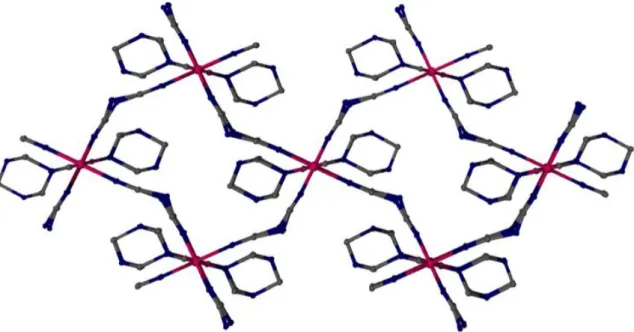
Figure 31. 1D chain structure of Co(dca)2(DMF)2. Colour code: Co = purple; O = red; C = grey; N = blue. Thermal ellipsoids are projected at the 50% probability level. Hydrogen atoms are not shown for the sake of clarity. ... 41
Figure 32. Packing diagram of M(dca)2(DMF)2 depicted along the a axis... 41
Figure 33. Packing diagram of M(dca)2(DMF)2 depicted along the c axis... 42
Figure 34. XRD pattern for metal dicyanamides. ... 45
Figure 35. FT-IR spectra of metal dicyanamides compound ... 46
Figure 36. XPS spectra of the Co 2p region of the surface of the pristine and post-catalytic electrodes ... 47
xiii
Figure 37. XPS spectra of the O 1s region of the surface of the pristine and post-catalytic
electrodes ... 48
Figure 38. Cyclic voltammograms of metal dicyanamides ... 49
Figure 39. Cyclic voltammogram of Co(dca)2(DMF)2 ... 50 Figure 40. a) Cyclic voltammogram of Co(dca)2 at different scan rate (25-225 mV sec-1) b) Linear dependence of the peak current of the Co2+/ Co3+ oxidation peak vs. scan rate. ... 51
Figure 41. Tafel plots for Co(dca)2 obtained in 50 mM KPi buffer solution with 1 M KNO3
as electrolyte ... 52
Figure 42. Long-term electrolysis profile of Co(dca)2 modified electrodes for 3 days at 1.2 V
vs. Ag/AgCl. ... 53
Figure 43. Catalytic oxygen evolution recorded (blue) during bulk electrolysis and
theoretical assuming Faradaic behavior (black). ... 54
Figure 44. XRD patterns of metal dicyanamide compounds. ... 56
Figure 45. FTIR spectra of metal dicyanamide compounds ... 57
Figure 46. SEM images of a) Co(dca)2(DMF)2, b) Co0.9Ni0.1(dca)2(DMF)2, and c)
Co0.5Ni0.5(dca)2(DMF)2 ... 58 Figure 47. N2 sorption isotherms of a) Co(dca)2(DMF)2, b) Co0.9Ni0.1(dca)2(DMF)2 , and c)
Co0.5Ni0.5(dca)2(DMF)2. ... 59 Figure 48. Cylic voltammograms of the Co(dca)2, Ni(dca)2, and Co1-xNix(dca)2 (x = 0.1 & 0.5)
recorded in 50 mM KPi buffer solution with 1 M KNO3 as electrolyte at pH = 7.0 with a
sweep rate of 50 mV/s... 61
Figure 49. Tafel plots obtained for Co(dca)2 , Co0.9Ni0.1(dca)2, and Co0.5Ni0.5(dca)2. ... 62 Figure 50. Contour plot of the mixed metal dicyanamides obtained by chronoamperometric
xiv
List of Tables
Table 1. The crytal data for Co(hmt)(dca)2 ... 23
Table 2.Selected bond distances and angles... 27
Table 3. The parameters for single-site Langmuir isotherm ... 34
Table 4. The parameters for dual-site Langmuir isotherm ... 34
Table 5. Crystal and Structure Refinement Data... 43
Table 6. Selected bond distances (Å) and bond angles (o) ... 44
Table 7. The structural and elemental composition representation of the compounds ... 60
xv
Abbreviation
Γ : Surface coverage (surface concentration) η : Overpotential
υ : Potential scan rate BET : Brunauer–Emmett–Teller
CV : Cyclic voltammetry DCA : Dicyanamide
DMF : Dimethylformamide
E : Potential
Eo : Standard redox potential E1/2 : Half-wave potential
EDX : Electron Dispersive X-ray spectroscopy F : Faraday’s constant
FTIR : Fourier Transform Infrared Spectroscopy FTO : Fluorine doped Tin Oxide
HMT : Hexamethylenetetramine
KPi : Potassium phosphate buffer PXRD : Powder X-Ray Diffraction SEM : Scanning Electron Microscopy TGA : Thermogravimetric Analysis TOF : Turnover frequency
WOC : Wateroxidation catalyst XRD : X-ray Diffraction
1
Chapter 1
INTRODUCTION
1.1. The Dicyanamide Chemistry
In the past few years, coordination polymers have attracted great interest because of the potential applications in the fields of magnetism, gas sorption, and catalysis.1–3 The ligand dicyanamide (dca), [N(CN)2]-, which was first utilized by Köhler4–6, has been
widely studied for many years to design polymeric structures since it serves as a convenient bridging group to connect metal ions using its N-donor atoms. It is frequently referred as a 'pseudohalide' due to its negative charge. The dicyanamide is a versatile ligand and compounds with various structures ranging from one-dimesional to three-dimensional networks with different properties can be obtained.7–10 This variety is mainly due to the possibility of dicyanamide anion to bind metal ions in eight different ways. To illustrate the binding between metal ion and nitrogen atom in the dicyanamide anion, a notation µa,b,c,d,e is used, where subscripts define the position of nitrogen atom.1
The possible coordination modes, monodentate, bidentate, tridentate, and tetradentate are illustrated in Figure 1. µ1 and µ3 are monodentate notation; µ1 defines the binding to
metal ion through one of the nitrile nitrogen atoms and µ3 defines the binding to metal
ion by amide N-atom. µ1,5 is bidentate and bind to metal ions by nitrile N atoms. µ1,3 is
also bidentate and shows binding to metal ions through both nitrile and amide N atom. µ1,3,5 and µ1,1,5 are tridentate and at first both nitrile N atoms and amide N atom are used
to bind metal ions, at last one of the nitrile N atoms binds to two different metal ions and other nitrile N atom binds to metal ion.
2
A tetradentate possible binding notation µ1,1,3,5 means one of the nitrile N atom and
amide N atom are µ-coordinated and the other nitrile atom bis-bidentate to different metal ions.6 The rare alternative for binding to metal ion, µ1,1,3,5,5 represents the two
different metal ion bindings by both nitrile N atom and a central amide N atom binding to metal.
3
Coordination to metal through nitrile N atom is more possible compared to amide N atom coordination because of the high electron density on the terminal N-atoms.12 Therefore, µ1,5 is the most common type of binding modes observed in
dicyanamide-based compounds.
To determine coordination modes of dicyanamide anion, vibrational spectroscopy can be applied to monitor the shift in v(CN). Typically, strong v(CN) bands of free ions can be observed at 2232 cm-1 in addition to 2179 cm-1 for dicyanamide anion in the sodium salt.12 If there is a monodentate coordination of dicyanamide anion by nitrile N atom as µ1 two bands will be shown and the ranges of bands are generally 2235-2220 cm-1 and
2175-2160 cm-1. The v(CN) vibration will shift to higher frequencies when there is coordination through amide N-atom like µ3. Bidentate coordination to metal ion µ1,3 and
µ1,5 shows v(CN) vibration almost 2250-2235 and 2200-2190 cm-1. Vibration ranges,
however, are not enough to distinguish the coordination modes of bidentate µ1,3 and µ1,5
binding modes. The v(CN) vibration of tridentate coordination mode, µ1,3,5, could be
observed within the ranges of 2280-2260 and 2220-2210 cm-1. Although coordination mode does not have an influence on other vibration frequencies like vas(N-C) in
dicyanamide anion, there is a characteristic strong band around 2280 cm-1 related to vs+vas(C-N) of dicyanamide compounds.12
Metal dicyanamide [M(dca)2] compounds have been studied since the mid 1960s and
mainly two phases were determined. One of the phases is -[M(dca)2], where M= Mn,
Fe, Co, Ni, and Cu. The other phase is -[M(dca)2], where M= Mn, Co, and Zn. In the
phase, there are octahedral metal centers in addition to tridentate dca ligands. On the other hand, the phase includes tetrahedral metal centers with bidentate dca ligands.
4
In 1998, Batten clearly reported the crystal structure of -[M(dca)2], which consists of a
single rutile-like network as illustrated in Figure 2.9,13
Figure 2. The rutile-related structure of Cu(dca)2. The circles represent in order of decreasing size Cu, N and C.9,13
In the rutile-related structure of Cu(dca)2, each dicyanamide anion is coordinated to
three metal atoms through two nitrile and one amido central nitrogen. Coordination of each copper includes six dicyanamide ligands, four of which are nitrile nitrogens while the rest are amide nitrogens. Cu(II) site shows significant Jahn-Teller distortion with the two axial amide nitrogens noticeably further from the Cu(II) atom than the four equatorial nitrile nitrogens. Batten et al.9 reported the presence of long-range ferromagnetic order exhibited by Co(dca)2 and Ni(dca)2 with Tc values of 9 and 20 K,
respectively. Until recently, Cu(dca)2 was thought to have no magnetic ordering due to
Jahn-Teller distortion since elongation of axial N amide bonds leads to weaker Cu-Cu magnetic interactions. Recently, ferromagnetic ordering was detected below 1.7 K.14
5
The compound -[Co(dca)2] is isostructural to -[Cu(dca)2] and the structure is shown
in Figure 3.12
Figure 3. Structure of the sheet in -[Co(dca)2]12
-[Co(dca)2] consists of metal atoms connected to the dicyanamide ligands only through
nitrile nitrogens.
1.2. Modification of Metal-Dicyanamide Compounds
The topology of metal-dicyanamide network can be modified via the introduction of a coligand or cation templation. Coligands can be a variety of molecules and they can be classified as terminal and bridging ligands.15 Given that dicyanamide ligand can also be coordinated to metal ion through various coordination modes as explained in the previous section, the concept of metal-dicyanamide coligand compounds is diverse covering many different structures and properties. In addition to this diversity, introducing coligand or cation templation make the metal dicyanamide compounds more open to crystal engineering of coordination polymers in the fields of gas adsorption and magnetism.9
6
1.2.1. Metal Dicyanamide Compounds with Terminal Coligands
Terminal non-bridging coligands are generally employed to occupy certain positions of metal coordination sphere. For example, when terminal coligand such as pyridyl group is incorporated into structure metal atoms are coordinated to pyridine nitrogen atoms and 1D chains can be obtained.3 As a terminal coligand, pyridine, imidazole, 2-aminopyrimidine, 2,2'-bipyridine, 4-cyanopyridine,1,10–phenanthroline, 1,3-diaminopropane can be used (Figure 4), and they are widely used to modify metal dicyanamide compounds.
7
The simplest 1D network geometry can be a linear or zigzag shaped, in the structure just one bridging dicyanamide is connected to the per metal. Compared to only one dicyanamide per metal coordination, two bridging 1,5–dca ligands per metal is more
common. In Figure 5, Mn(dca)2(pyridine)2 with a linear structure is shown. In the
structure, terminal pyridine ligands are in trans arrangement with a linear geometry.10 The metal atoms next to each other are connected by two dicyanamide ligands and metal ions are linked to each other by four equatorial dca ligands into a linear chain.10
8
The other form of 1D network is zigzag and it includes two bridging ligands per metal. The zigzag structure of Cd(dca)2(2,2’-bipy) illustrated in Figure 6. In zigzag chain,
terminal ligands are in cis arrangement.
Figure 6. Zigzag chain structure of Cd(dca)2(2,2’-bipy)10,18
The metal dicyanamide compounds with terminal or non-bridging coligand in 2D network are also examined. One of the most popular structure in 2D network is the Mn(dca)2(4-cyanopyridine)2.10,19 In the compound coligands are in trans position as
shown in Figure 7.
9
Another example for metal dicyanamide compounds with 2D framework is Cd(dca)2(1,10-phen) as shown in Figure 8. 10,18
Figure 8. 2D structure of Cd(dca)2(1,10-phen)
One of the examples of 3D metal dicyanamide networks with terminal coligand is [Cu(pn)2][Mn(dca)4], pn=1,3-diaminopropane in Figure 9.10,20
10
Overall, metal dicyanamide compounds can be modified with terminal coligands resulting in different topologies and dimensionalities. When metal atoms are coordinated to pyridine nitrogen atoms, 1D structure can be obtained. To extend the chain to 2D or 3D architectural network, - stacking interactions from pyridyl groups and hydrogen bonding interactions from uncoordinated groups and the intermolecular interactions are included in the extended network.3Although there is an exception, many compounds with a typical 1,5-dicyanamide bridging show very weak antiferromagnetic coupling.
1.2.2. Metal Dicyanamide Compounds with Bridging Coligands
Bridging coligands are incorporated to metal dicyanamide compounds to increase dimensionality with coordination interaction. Pyrazine and 4,4'-bipyridine21, illustrated in Figure 10, are widely used in metal dicyanamide compounds as bridging ligands. Dicyanamide act as a connector and bridge longer distances. To stabilize the network, hydrogen bond of structures will be accepted by uncoordinated nitrogen atoms.
Pyrazine 4,4-bipy Figure 10. Possible Bridging Coligands
11
In the Co(dca)2(pyrazine) structure, illustrated in Figure 11, metal centers are connected
by double
µ
1,5-dca bridges and the linear chains are bridged to each other by pyrazineligands.
Figure 11. Structure of Co(dca)2(pyrazine)10
Similar to pyrazine, 4,4'-bipyridine ligand is also a linear pyridyl-donor bridging ligand. 4,4'-bipyridine bridging coligand is longer in structure and so has the possibility to generate more different structures with metal dicyanamide compounds.
When dca ligands are modified with bridging coligand, a diverse range of 1D, 2D, and 3D structural networks can be obtained. Although there are exceptions,
µ
1,5-dca binding12
1.2.3. Anionic Metal Dicyanamide Compounds with Cation Templation
The topology of metal dicyanamide compounds can also be modified by creating anionic metal dicyanamide network. To create diverse anionic networks like M(dca)3-
and M(dca)4- topologies, countercations like Ph4E+ and R4N+with different sizes,
shapes, and charges are used in the netwok.
The Mn(dca)3- network are modified by cation templation using Ph4E (E=P, As) as
shown in Figure 12. 10,22,23 In the structure, metal ions are connected to each other by single
µ
1,5-dca in one direction while metal ions are connected to each other by doubleµ
1,5-dca bridges in the other direction creating (Ph4E)Mn(dca)3 with a 2D topology.Figure 12. 2D topology of (Ph4E)Mn(dca)310
The anionic layers formed by metal-dicyanamide alternate with (Ph4E)+ cation layers.
13
Phenyl groups of cation can be replaced by alkyl substituent disrupting intercation supramolecular interactions. Substitution of smaller (MePh3P)+ cations into network has
two effects. First, substitution of smaller MePh3P+ disrupts the anion and
cation-cation interactions. Second, Mn(dca)3- network is not flexible enough to insert smaller
cations without reducing the packing efficiency of cation layer.2 These effects change the network of (MePh3P)Mn(dca)3 from 2D to 3D as illustrated in Figure 13.
Figure 13. 3D topology (MePh3P)Mn(dca)3
The 3D network of Mn(dca)3- includes singly and doubly bridged metal atoms that are
connected to sheets by single dicyanamide bridges from above and below, which forms a 3D network with hexagonal channels. The smaller (MePh3P)+cation lie in pairs within
the network cavities rather than discrete layers as seen in the (Ph4E)Mn(dca)3 network.
In summary, the anionic pseudohalide dcyanamide is an excellent versatile ligand in the formation of engineered networks. Modification of metal-dicyanamide network by introduction of coligands or cation templation make the network possible to design a diverse range of crystal structures with different physical properties.
14
1.3. Metal-Dicyanamides as Solid Adsorbents
Dicyanamide is a versatile ligand and it can coordinate to metal ion in many different ways. The network of metal dicyanamide compound can be enlarged inserting ligands into structure. Until now, metal dicyanamide compounds are widely studied and new compounds with different structures were synthesized. Metal dicyanamide network with coligands are widely studied in the field of magnetism; however, selective gas sorption studies were not so popular until 2014. [Cd(µ-hmt)(µ-dca)2]24,25 was studied for its gas
sorption ability. Although Cd is a heavy metal, the porous nature of metal dicyanamide network is utilized in the study. In addition, M(dca)2(H2O)nhmtn (M=Co, Mn) compound
have also been studied.11 It is, however, not appropriate for gas adsorption because of the coordination of water molecules to metal ions resulting in the collapse of the network under vacuum.
1.4. CO2/N2 Separation
In the recent years, fossil fuels have been extensively used over centuries, but the reserves of these fossil fuels are depleting rapidly.26–29 Moreover these fuels have serious impact on the environment like hazardous greenhouse gases emission, change in atmospheric equilibrium.30–34 CO2 release has dramatically increased mainly because of
the consumption of fossil fuels and CO2 increased the air toxicity and ocean acidity.35,36
To decrease the global warming, the selective capture of CO2 has gained an interest in
the world. In the industry, post-combustion CO2 capture with air separation is crucial for
a better sustainable low carbon future; therefore, CO2 needs to be captured by
15
functional groups inside the pores.37–41 Creating polarizing groups in the pores, like nitrogen based one, essentially increases the selective adsorption of CO2. Creating
accessible nitrogen atoms inside the pores is an effective way to increase CO2/N2
selectivity. The Lewis acid characteristic of CO2 with nitrogen donor sites increases the
CO2 uptake capacity and selectivity by dipole-quadrupole interactions between the
available nitrogen atoms and CO2. This fact has been utilized in many studies.42,43,44 For
example, SBA-15 surface basicity was changed by nitrogen base molecules like amines and imidazole and CO2 was used to characterize basic sites. Coordination of CO2 with
basic sites results in the decrease of activation energy and so inert molecules can be turned to functional products.
1.5. Literature View for Water Oxidation Catalyst
In the world, the need for energy is dramatically increasing with sharp increase in the CO2 level. To overcome the negative effects of the CO2 level, synthetic photosynthesis
approach must be developed. Over the past few decades, many research groups have been working on perfecting the art of mimicking the photosynthesis process of splitting water to generate energy.45–47 Water is a sustainable and affordable source of hydrogen, but O-H bond cleavage is an energetic process.48 Conversion of solar energy into chemical energy in form of carbon-based molecules by splitting water molecules in photosynthesis is a well-defined by the association of the pigment chlorophyll. The whole procedure works on the association of an electron acceptor and an electron donor.49,50 Water splitting is not so easy process, the process requires two catalysts: One of them is to split water into O2 andthe other catalyst is for H2 formation via reduction
16
of protons. As seen in the detailed oxidation and reduction process, oxidation of water into O2 requires high oxidation potential.51
2H2O O2 + 4e- + 4H+ Eanode = 1.23 – 0.059×(pH) V (vs. NHE at 25oC)
4e- + 4H+ 2H2 Ecathode = 0 – 0.059×(pH) V (vs. NHE at 25oC)
The overcome the high kinetic barrier, water oxidation catalyst needs to be synthesized and they need to be stable, cheap and work in low overpotential. For this reason, many researchers focused on water oxidation catalyst.
As a water oxidation catalyst (WOCs), cobalt based one with high catalytic activity and diversity has gained an interest. Oxide and non oxide forms of cobalt base WOCs are widely studied in this field. One of the most important studies in the oxide form of cobalt based WOCs belongs to Daniel G. Nocera.52 In the study, as an electrode indium tin oxide was used and cobalt phosphate thin film synthesized from phosphate buffered cobalt(II) solution. The metal oxides as water oxidation catalyst showed high catalytic activities and they required sensible overpotential and concentrated basic solutions. However, creating a catalysis working at pH 7 with low potential is problematic and many catalysts do not operate in neutral water within the ambient conditions.52 Over the past few years, non-oxide systems have been of greater emphasis. Various cobalt-based non-oxide systems such as cyanide systems53–55 and carbodiimides56 are reported to be efficient and robust catalysts. Non-oxide catalysts including Co-Fe Prussian Blue networks have been synthesized.
17
As heterogeneous water oxidation catalysis, this network has advantages over oxide forms of WOCs such as robustness and stability in both neutral and acidic media. Although, non-oxide forms of WOCs have advantages, the low current density because of the low surface concentration is their main disadvantage. To overcome the drawback of the non oxide ones, a study was recently performed.52 In the study, for preparation of Co-Fe coordination polymers, synthetic pentacyanometalate-based metallopolymer was used and increase in surface concentration with increase in the catalytic activity was observed.
One of the other important studies belongs to Galán-Mascarós research group. In the study, cobalt hexacyanoferrate (CoHCF) Prussian blue type cyanide bridged coordination polymer is used for electrocatalytic water oxidation. They investigated the catalytic activity of CoHCF and compared it with cobalt oxides. The TOF value 2.6 × 10⁻³ s-1 was observed at η = 410 mV for cobalt oxides while it is η = 305 mV for CoHCF, which showed that the water oxidation performance of CoHCF is comparable to those of cobalt oxides.53 The other study in the field of water oxidation catalysis is related to cobalt carbodiimide by Patzke research group.57 Compared to the oxide form, carbon and nitrogen based ones are more stable, oxide free, and include positively polarized carbon active sites with nitrogen. Over the years, the demand for water oxidation catalyst has been increasing. As seen in the studies, catalytic activities of cyanied bridged CoHCF and cobalt carbodiimide have been studied. In this thesis, catalytic activities of cobalt dicyanamide compounds are investigated in the field of water oxidation catalysis.
18
Chapter 2
EXPERIMENTAL
2.1. The Synthesis of Co(hmt)(dca)2 for CO2/N2 Selectivity
In the synthesis of the new microporous metal dicyanamide compound, all chemicals and solvents were purchased from Aldrich and used without further purification. Firstly, a starting material Co(NO3)2.6H2O(1g,3.43mmol) dissolved in methanol.
Hexamethylenetetramine (hmt) and sodium dicyanamide also dissolved in methanol solution separately. When all chemicals were dissolved completely, methanol solutions of hmt and sodium dicyanamide were slowly added to the methanol solution of Co(NO3)2.6H2O to obtain the 1:1:2 (Co:hmt:dca) stoichiometric ratio in the mixture. The
mixed solution was stirred for 24 hours and then filtered. After precipitation, a red powder precipitate was obtained and the precipitate was washed with distilled water and methanol. The precipitate was kept at 60oC for drying and the yield is 27%. To synthesize fine crystals of the compound, Co(NO3)2.6H2O (25 mg, 3.43 mmol) was
dissolved in a 30 mL methanol solution. The methanol solution of Co(NO3)2.6H2O,
slowly layered with the 30 mL methanol mixture of hmt and sodium dicyanamide. After three weeks, red crystals were obtained.
2.2. The Synthesis Pathway of Electrodes for Water Oxidation
Catalyst
All the chemicals were purchased from Sigma-Aldrich and water with 18 MΩ resistivity used during the preparation of solutions. In the water oxidation catalyst study, eight
19
different combinations of materials were synthesized which are: Co(dca)2 ,Fe(dca)2,
Ni(dca)2, Co0.5Ni0.5(dca)2, Co0.9Ni0.1(dca)2, Co0.5Fe0.5(dca)2, Co0.9Fe0.1(dca)2, and
Co0.9Fe0.05Ni0.05(dca)2. All materials were coated onto fluorine doped tin oxide ( FTO)
via drop-casting method. The conductive working electrode FTO is 1x2 cm, 2 mm thickness with 7 Ω/sq surface resistivity. The procedure for the coating of the catalyst onto an FTO electrode is the same for each materials listed above. Before coating, FTO electrode was cleaned for 10 minutes in basic soapy solution, deionized water and lastly isopropanol. After that, FTO glasses were annealed for 30 minutes at 400oC for a more hydrophilic surface. The buffer solutions were prepared from K2HPO4 and KH2PO4, the
pH was changed using H3PO4 and KOH. To prepare the catalyst, dicyanamide was
dissolved in DMF solution and slowly added into water solution of metal salt in a stoichiometric ratio 1:2:2 (M2+: dca: DMF). The resulting suspension was stirred for all day and then filtered. The precipitate was dried over the night at 60oC and prepared for the electrochemical studies. To prepare catalyst modified electrodes, 5 mg catalyst, 1 mL DMF, and 100 L Nafion were used and sonicated for 30 minutes. After sonication, 50 L of the mixture was dropped onto a clean FTO electrode only in 1x1 cm and the rest of the surface masked with a polymeric band. Then, the electrode was dried at 80oC for 10 minutes. Before the analysis, the electrode needs to be washed with deionized water. Cyclic voltammograms (CV) were recorded with a scan rate of 50 mV/s in 50 mMKPi (pH 7) containing 1 M KNO3 as electrolyte between 0 V and 1.5 V (vs
20
2.3. Instrumentation
2.3.1. Fourier Transform Infrared Spectroscopy (FTIR)
Fourier transform infrared spectra (FTIR) in transmission mode were recorded by Bruker ALPHA Tensor 27 model. As a detector, a Digi Tech TM DLATGS with a 4.0 cm-1 resolution was used. The spectra were recorded by 64 scans in the range of 400-4000 cm-1.
2.3.2. Powder X-Ray Diffraction (PXRD)
X-ray diffraction studies were performed using Miniflex Rigaku diffractometer with Cu Kα X-ray radiation. The diffaction pattern were collected in the 2diffraction angel with a range of 3-63°, step size of 0.01 and a scan rate of 1° min-1. For the powder samples the crystalline behavior PANalytical’s X’Pert Powder X-ray diffractometer (Multiple Purpose Diffractometer) was also used with a CuKα X-ray source .
2.3.3. Single Crystal X-Ray Diffraction
The data was collected using Rigaku MicroMax 007HF diffractometer with a monochromatic Mo Kα radiation. The crystal, suspended in polybutene oil, was placed on a holder and the data taken from Rigaku CrystalClear software one. The data indexed to orthorhombic unit cell and it indicated the space group as Pnma. To solve the crystal structure, SHELX suite of programs and Olex258 was used.
21
Metal atoms, hydrogen and non-hydrogen atom positions were placed in the crystal structure and CrystalMaker program was used to illustrate crystal structures.
2.3.4. Thermogravimetric Analysis (TGA)
In the thermogravimetric analysis of the sample, TA Instruments TGA Q500 Model was used. Measurement was performed under N2 atmosphere, 10oC/min from 30 to 500oC.
2.3.5. CHNS/O (Elemental) Analysis
Elemental analysis measurements performed by Thermo Scientific FLASH 2000 CHNS/O Analyzer.
2.3.6. Scanning Electron Microscopy (SEM) and Energy Disperse X-Ray
Analysis (EDX)
Scanning electron microscopy (SEM) imaging was performed at beam voltage 5 kV and Energy-dispersive X-ray spectroscopy (EDX) analysis was carried out at 30 kV using FEI-Quanta 200 FEG ESEM.
2.3.7. Gas Adsorption Measurements
The gas adsorption data taken from Micromeritics Tristar 3000 surface area and pore size analyzer to perform N2 adsorption studies at 77 K to obtain surface area.
22
2.3.8. X-Ray Photoelectron Spectroscopy (XPS)
In order to detect the elements and the oxidation states, Thermo Scientific K-Alpha X-Ray Photoelectron Spectrometer system operating with Al Kα micro-focused monochromator source (h-1486.6 eV & 400 mm spot size) along with a flood gun for charge neutralization, pass energy 200 eV was used for survey scan and 30eV individual element scans.
2.3.9. Electrochemical Mesurements
The electrochemical measurements were performed at room temperature by Gamry Instruments Interface 1000 Potentiostat/Galvanostat. In the experiment; reference, counter and working electrode were used. As a reference electrode, Ag/AgCl electrode saturated with 3.5 M KCl, a Pt wire as counter electrode and a modified fluorine doped tin oxide was used as a working electrode. In the experiment, 50 mM potassium phosphate buffer solution (KPi, pH7) including 1 M KNO3 was used as electrolytes.
Buffer solutions were prepared by K2HPO4 and KH2PO4. H3PO4 or KOH was used to
change pH. During cyclic voltammetry and chronoamperometry measurements, the system including counter and reference electrodes was bubbled with N2 gas to remove
dissolved oxygen gas. When nitrogen gas was removed from the system, the working electrode was inserted into the system for the measurement.
23
Chapter 3
RESULTS
AND
DISCUSSION
FOR
METAL
DICYANAMIDES AS SOLID ADSORBENTS FOR CO
2/N
2SEPARATION
3.1. STRUCTURAL CHARACTERIZATION
This study, performed by our group was published.59 The crystal data indicates the space group as Pnma and shows an orthorhombic unit cell. The data related to Co(hmt)(dca)2
crystal structure is shown in Table 1.
Table 1. The crytal data for Co(hmt)(dca)2
[Co(hmt)(dca)2].H2O
Empirical Formula C10H14CoN10O1
Space group Pnma (No. 62)
Formula Weight 349.24 g/mol
Unit Cell : orthorhombic a=12.5771(3) Ǻ, b=12.1488(3) Ǻ, c=10.3245(3) Ǻ
Unit Cell Volume 1577.55(7) Ǻ3
Z 4
Density, calc 1.470 g/cm3
abs. coeff., 1.106 mm-1 Crystal color and habit Red block
Crystal size 0.4 x 0.5 x 0.6 mm3
Temperature (K) 293
Radiation, Mo K, 0.71075 Ǻ Min. and max. 2 - 27.5o
Reflns collected 4643
Independent reflns 1182
Data/parameters/restrains 1882/132/0
24
According to the X-ray structural data, a 3D coordination network of Co(hmt)(dca)2 is
illustrated in Figure 14. In the inversion center Co(II) is placed and metal ion are connected by hmt and dicyanamide bridging ligand. In the structure, each Co(II) metal center linked to six nitrogen atoms. Four of the nitrogen atoms belong to terminal nitrogen atom of dicyanamide anion and two of them belong to hmt groups.
Figure 14. Cobalt center coordination and binding ways to hmt and dicyanamide
25
In the structure of the coordination modes of Co(II) center, bindings to metal ion form a distorted octahedral geometry as shown in Figure 14. In the dicyanamide binding, nitrile nitrogen atoms are used and 1,5-dca type of bonding is observed. In the 2D layer of
Co(dca)2, each dicyanamide is linked to two metal centers with a distorted square
geometry as illustrated in Figure 15.
Figure 15. 2D illustration of Co(dca)2 connected by hmt groups (Hydrogen atoms are not illustrated for the sake of simplicity.)
The 2D array of Co(dca)2 is connected to each other by hmt groups and a 3D network
structure is described as shown in Figure 16. The space filling diagram is illustrated in Figure 17. In the network, only two of the four nitrogen atoms of one hmt ligand for binding to metal center was used for binding to metal center while remaining two nitrogens are free.
26
Figure 16. 3D illustration of Co(hmt)(dca)2 (Hydrogen atoms and solvent molecules are
not illustrated for simplicity.)
Figure 17. Space filling diagram of Co(hmt)(dca)2 (Hydrogen atoms and solvent molecules are not illustrated for simplicity.)
27
In the Co(hmt)(dca)2network, selected bond distances and angles are shown in Table 2.
Compared to previous studies of metal dicyanamides with hmt ligand15,25,58 the bond angles and distances are in good accordance.
Table 2.Selected bond distances and angles
Atoms Bond Distances Å
Co1-N1 2.1409(14) Co1-N2 2.1048(13) Co1-N4 2.2834(12) N1-C1 1.170(2) N2-C2 1.147(2) N4-C4 1.5410(19) C2-N3 1.352(5) C1-N3 1.372(5) Bond Angles N1-Co1-N4 90.32(5) N2-Co1-N4 88.80(5) N2-Co1-N1 86.70(6) C3-N4-Co1 109.07(9) C4-N4-Co1 112.37(8) C1-N1-Co1 164.34(14) C2-N2-Co1 166.14(15) N2-C2-N3 162.3(5) C2-N3-C1 117.2(3) C4-N5-C5 108.29(14) C6-N4-Co1 110.73(9)
28
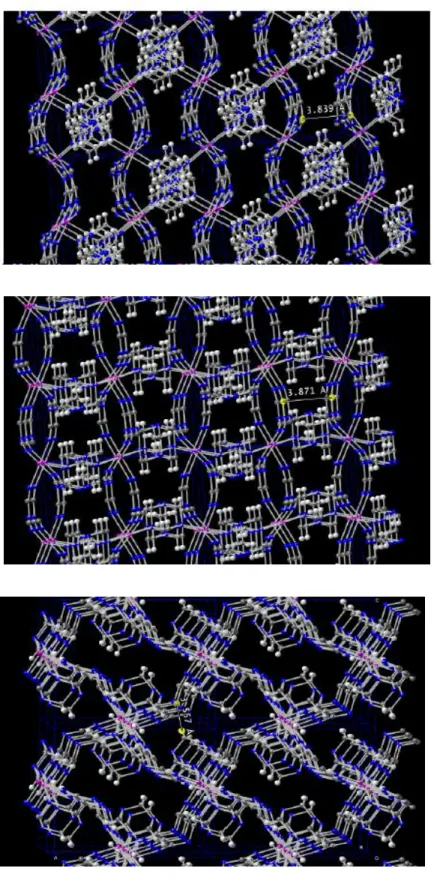
The pore apartures of the crystal in different sizes are illustrated in Figure 18.
29
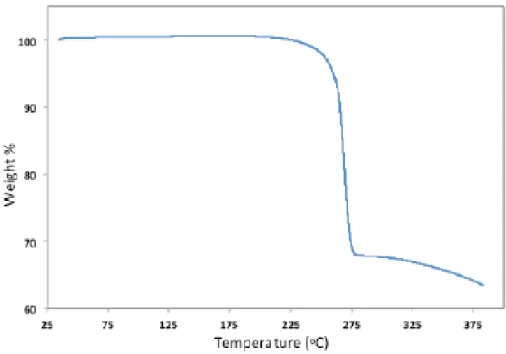
In the thermogravimetric analysis percent weight change started almost at 225oC. The weight change behaviour of the Co(hmt)(dca)2 while increasing in the temperature is
shown in Figure 19.
Figure 19. Thermogravimetric analyis of Co(hmt)(dca)2 powder
An infrared spectrum of the compound is illustrated in Figure 20. The spectrum contains three absorptions in the υ(C≡N) region; 2180, 2237, and 2325 cm−1 in addition to a stretch at 930 cm−1, which are attributed to the assymmetric and symmetric cyanide stretches of dicyanamide bridging ligands. The compound also shows two strong bands at 1031 and 1236 cm−1 and several weak bands in the range 2900–3000 cm−1, which can be assigned to the C-N and aliphatic υ(CH) stretching vibrations of hmt group, respectively.
30
Figure 20. The infrared spectrum of Co(hmt)(dca)2
Elemental analysis of the compound, Co(hmt)(dca)2, CoC10H12N10: calculated C 36.26,
H 3.65, N 42.29; found C 36.02, H 3.33, N 41.92. Elemental analysis data studied on powder ones indicate that powder samples and crystals are isostructural.
31
3.2. GAS ADSORPTION STUDIES
For the compound Co(hmt)(dca)2 CO2 and N2 adsorption studies were performed until
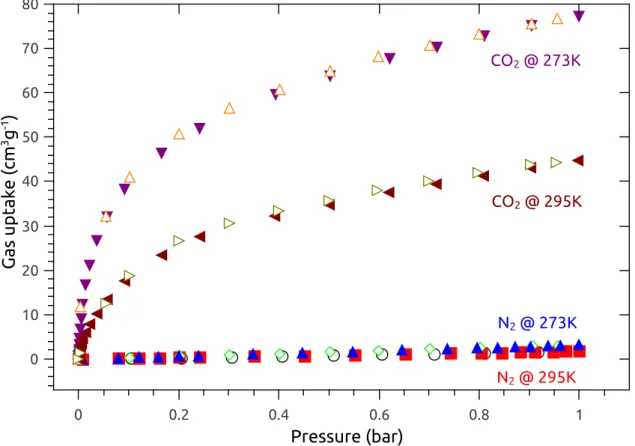
1 bar at temperatures of 273 and 295 K. The maximum CO2 loading is 77.3 cm3.g-1 at
273 K and 1 bar and 44.8 cm3.g-1 at 295 K and 1 bar while the isotherms are fully reversible as shown in Figure 21.
Figure 21. CO2 and N2 gas adsorption/desorption isotherms until 1 bar at 273 K and 295
32
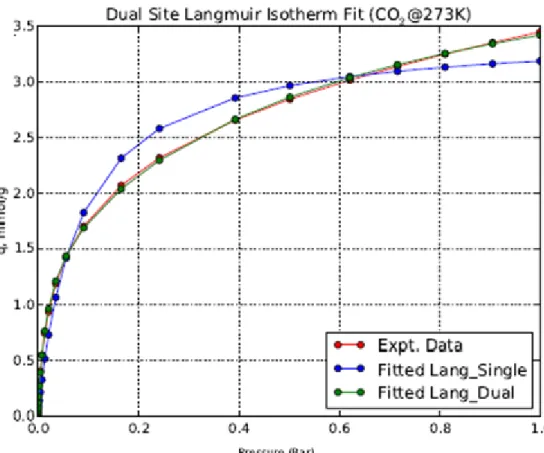
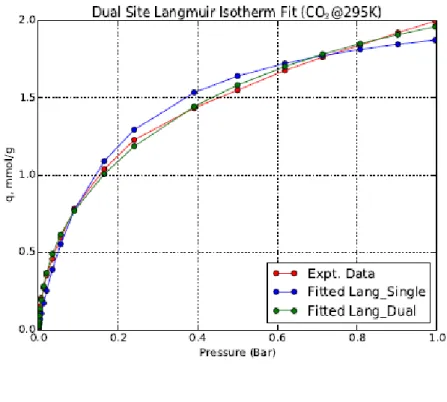
For the calculation of selectivity and heat of adsorption values; dual site Langmuir model (two available binding sites for the CO2 molecule),60 (Figure 22 and Figure 23)
are appropriate for the CO2 isotherms and single site Langmuir model (Figure 24 and
Figure 25) are suitable for the N2 isotherms.
33
Figure 23. Single and dual site Langmuir isotherm fits for CO2 adsorption at 295 K
34
Figure 25. Single site Langmuir isotherm fits for N2 adsorption at 295 K
The parameters for the single-site Langmuir isotherm and dual-site Langmuir isotherm were reported in the Table 3 and Table 4, respectively.
Table 3. The parameters for single-site Langmuir isotherm
35
The heat of adsorption values were calculated by Clasius-Clapeyron, equation 1, as given below:
(Eq. 1)
At low loadings of CO2, heat of adsorption for CO2 is 35 kJ mol-1. With the increase in
the CO2 loading after 0.9 mmol g-1, plateau was observed at around 58 kJ mol-1 as shown
in Figure 26, which can be attributed to two different available binding sites. There are two different N-donor atoms in the compound, each of N atoms belongs to dca and hmt ligands. Thus, dual-site Langmuir isotherm was used for the case of CO2 adsorption.
36
Unlike CO2, the heat of adsorption of N2 as shown in Figure 27 is just 17.7 kJ mol-1 and
does not change upon N2 loading.
Figure 27. Change of the Qst with N2 loading by single-site Langmuir isotherms
The CO2/N2 selectivity for binary mixtures was calculated by the ratio of the initial
slopes and selectivity factor equation as shown in equation 2, loadings from the pure single component isotherm. The selectivity change for the CO2:N2 15:85 is illustrated in
Figure 28.
37
Figure 28. Change in the CO2 over N2 selectivity with pressure (CO2:N2 15:85)
The CO2:N2 15:85 selectivity was determined to be 95 at 273 K and 83 at 295 K and 1
bar. A decrease in the CO2/N2 selectivity was observed with the increase of the gas
mixture pressure.
The selectivity from the ratio of initial slopes that is obtained by Henry’s law ratios is illustrated in Figure 29.
Figure 29. Adsorption selectivity of CO2 over N2 by ratio of initial slopes, Henry’s
38
The selectivity obtained from low loading site of the single adsorption isotherms are 603 and 463. The higher adsorption enthalpy of CO2, thus larger quadrupole with stronger
interaction, could be the origin of high CO2/N2selectivity. In the crystal, two of the pore
openings are around 3.8 Å and kinetic diameter of N2 is 3.6 Å, CO2 is 3.3 Å. The similar
kinetic diameter of N2 results in the limited diffusion of N2 causing a molecular sieving
effect, which contributes to high selectivity.61,62 In addition, BET surface area is 242 m2/g, measured by CO2 sorption at 273 K while nitrogen sorption studies failed at
77 K, which was also observed previously in some of porous compounds.24,38
To conclude, a new metal dicyanamide compound, Co(hmt)(dca)2 was synthesized and
characterized. The network includes octahedral Co(II) center as well as hmt and dicyanamide groups connected to the metal center. In the dicyanamide group each uses one terminal nitrogen while the other one is free. Each hmt group, however, uses two of its nitrogen atoms while remaining two are free. The available free N-atoms can form a polarizable environment and so high CO2/N2 selectivity and high heat of adsorption can
39
Chapter 4
RESULTS
AND
DISCUSSION
FOR
METAL
DICYANAMIDES AS WATER OXIDATION CATALYSTS
4.1. Characterization of Metal Dicyanamides
A series of metal dicyanamides with molecular formulas of M(dca)2(DMF)2 (M: Co, Ni,
and Fe) have been studied as water oxidation catalysts. Characterization of these compounds was performed by X-ray diffraction, Infrared spectroscopy and X-ray Photoelectron Spectroscopy.
4.1.1. Single Crystal XRD studies
Single crystal X-ray diffraction studies performed on fine crystals of the compounds reveal that all of the compounds are isostructural and that each of them crystallizes in a monoclinic system with space group P21/n. The asymmetric unit of a M(dca)2 structure
contains one M(II) site, two dicyanamide groups, and two DMF molecules. Each metal ion shows distorted octahedral MN4O2 coordination environment (Figure 30) from four
nitrogen atom of independent dca groups and two oxygen atoms that belong to DMF molecules. Therefore, the crystal structure could be explained as a one dimensional ladder-like double chain coordination polymer (Figure 31). Double–chain frameworks consist of two one–dimensional linear chains, which extend in parallel pairs and, thus, are joined at metal node in a ladder fashion (Figure 32). Two ligands adopt certain configuration to connect two metal centers in such a way to form rectangular units (Figure 33).
40
All of the metal sites coordinated N and O distances are within normal range of statistical errors. The supramolecular framework is stabilized by H••••N interactions [2.555(5) − 2.686(5) Å] originating from the H−atoms of coordinated DMF molecules and central N atom of dca groups. The details of crystal structures are represented in Table 5. Selected bond angles and bond lengths are listed in Table 6.
Figure 30. Fragment of the crystal structure of Co(dca)2(DMF)2 depicting the MN4O2
coordination sphere for metal site. Thermal ellipsoids are projected at the 50% probability level. Hydrogen atoms are not shown for the sake of clarity.
41
Figure 31. 1D chain structure of Co(dca)2(DMF)2. Colour code: Co = purple; O = red;
C = grey; N = blue. Thermal ellipsoids are projected at the 50% probability level. Hydrogen atoms are not shown for the sake of clarity.
42
43
Table 5. Crystal and Structure Refinement Data
Compound Fe(dca)2(DMF)2 Co(dca)2(DMF)2 Ni(dca)2(DMF)2
Formula C5 H7 Fe0.50 N4 O C5 H7 Co0.50 N4 O C5 H7 N4 Ni0.50 O
Formula
weight 167.07 168.61 168.50
T, K 100(2) 100(2) 100(2)
System Monoclinic Monoclinic Monoclinic Space
group I2/m I2/m I2/m
a, Å 8.061(5) 8.061(5) 8.061(5) b, Å 7.319(5) 7.319(5) 7.319(5) c, Å 12.699(5) 12.699(5) 12.699(5) α (°) 90.000(5) 90.000(5) 90.000(5) β (°) 103.336(5) 103.336(5) 103.336(5) γ (°) 90.000(5) 90.000(5) 90.000(5) V [Å3] 729.0(7) 729.0(7) 729.0(7) Z 4 4 4 ρcalc [g/cm3] 1.522 1.536 1.535 µ [mm-1] 1.052 1.195 1.349 F(000) 344 346 348 GOF 1.324 1.151 0.736 Final R indices [I>2(I)] R1= 0.0387 WR2= 0.1080 R1= 0.0339 WR2= 0.0973 R1= 0.0325 WR2= 0.0934 R indices (all data) R1= 0.0387 WR2= 0.1080 R1= 0.0339 WR2= 0.0973 R1= 0.0325 WR2= 0.0934
44
Table 6. Selected bond distances (Å) and bond angles (o)
Fe(dca)2(DMF)2 Co(dca)2(DMF)2 Ni(dca)2(DMF)2
M1 O1 2.070(3) 2.070(2) 2.069(3) M1 N2 2.072(2) 2.071(2) 2.072(2) O1 M1 O1 180.00(12) 180.00(10) 180.00(10) O1 M1 N2 91.60(9) 91.58(7) 88.42(8) N2 M1 N2 92.05(13) 92.07(12) 92.08(12) O1 M1 N2 88.40(9) 88.42(7) 91.58(8) N2 M1 N2 87.95(13) 87.93(12) 87.92(12) N2 M1 N2 180.00(11) 180.00(12) 180.00(18)
4.1.2. Powder X-ray Diffraction Studies of Metal Dicyanamides
X-ray diffraction studies performed on metal dicyanamides show that Co(dca)2(DMF)2,
Fe(dca)2(DMF)2 and Ni(dca)2(DMF)2 are isostructural with different degrees of
crystallinities as shown in Figure 34. In the XRD pattern, 2 positions almost overlap each other, which can be attributed to the negligible change in the ionic radius of metals ions.
45
Figure 34. XRD pattern for metal dicyanamides.
4.1.3. Fourier Transform Infrared Spectra of Metal Dicyanamides
In the infrared data as shown in Figure 35, Co(dca)2(DMF)2 and Ni(dca)2(DMF)2
illustrate sharp and strong stretching bands while Fe(dca)2(DMF)2 compound shows
broad and weak bands. sym&asym(C N)stretches were observed in the wavenumber
ranges of 2360 – 2184 cm-1, asym(C-N) at around 1380 – 1364 cm-1, and sym(C-N) at
around 938 cm-1, which can be attributed to the cyanide group in dicyanamide group.59 Strong bands in the wavenumber range of 1108 – 1015 cm-1 corresponding to C-N group, bands at around 1647 – 1640 cm-1 can be assigned to the (C=O) stretches, and bands at around 2970 – 2934 cm-1 can be assigned to aliphatic (C-H) stretching
46
vibrations of DMF.63 Presence of a broad stretch at around 3500 – 3250 cm-1 in the Fe compound can be due to excess moisture adsorbed, which can also be a reason for the relatively poor crystallinity of the Fe derivative.
Figure 35. FT-IR spectra of metal dicyanamides compound
4.1.4. X-ray Photoelectron Spectroscopy Studies
XPS analysis was realized for pristine and post-catalytic samples as shown in Figure 36 to study changes in the oxidation states and composition of the catalyst. Co 2p3/2 signal
was observed at 782.78 eV and Co 2p1/2 signal at 798.78 eV as broad peaks with high
FWHM (>4 eV) in the pristine electrode, which corresponds well with standard CoII (782.28 eV and 798.38 eV respectively).64 Additionally, scalable satellite bands were
47
observed 4-8 eV above the principle signals. Where in the post catalytic electrode a slight shift to lower binding energies (~2.5 eV) was observed with Co 2p3/2 signal at
780.48 eV and Co 2p1/2 at 795.88 eV.65 The signals appear relatively sharper, with lower
FWHM (~3 eV) and the satellite bands, though identifiable, are less distinctive. Earlier studies reported that these changes can be attributed to partial oxidation of the surface metal sites. FTIR studies on the pristine and post catalytic electrodes have no visible changes that can be attributed to the structural or compositional changes in the catalyst. Hence, it can be said that the partial oxidation of the surface cobalt sites is not permanent and reversible.66
Figure 36. XPS spectra of the Co 2p region of the surface of the pristine and
48
Additionally, the O1s signal of the pristine and post catalytic samples (Figure 37) have been analyzed to study the nature of the partial oxidation. O1s signal at binding energy higher than 530 eV corresponds to oxygen species like –OH67, adsorbed onto the surface of the catalyst, indicating the absence of any Co-O species during the course of the electrolysis.56 The mild shift in the O1s position and the relatively higher intensity can be contributed to partial replacement of DMF on the surface with water due to their miscibility.
Figure 37. XPS spectra of the O 1s region of the surface of the pristine and
49
4.2. Electrochemical Studies of Metal Dicyanamides
4.2.1. Cyclic Voltammetry and Catalytic Activity Measurements of Metal Dicyanamides
Cyclic Voltammetry (CV) measurements of Co(dca)2(DMF)2, Fe(dca)2(DMF)2 and
Ni(dca)2(DMF)2 were performed under nitrogen atmosphere with a scan rate of 50 mV/s
between 0 V and 1.5 V (vs. Ag/AgCl) in the electrolyte of 50 mM KPi (pH 7) containing 1 M KNO3. Although metal dicyanamides are isostructual the catalytic activity of
Co(dca)2(DMF)2 is better than the other ones as shown in Figure 38.
Figure 38. Cyclic voltammograms of metal dicyanamides
The following studies mainly focus on the Co(dca)2(DMF)2 due to its high catalytic
50
Cyclic voltammograms of Co(dca)2(DMF)2 was performed in the range of 0 V-1.5 V vs.
Ag/AgCl reference electrode as shown in Figure 39. It shows a quasi-reversible redox couple with a significant oxidation peak at 0.95 V and a reduction peak at 0.83 V vs. Ag/AgCl reference electrode (E1/2 = 0.89 V, Ec − Ea = 120 mV) which can be attributed
to Co2+/Co3+ redox couple. Also, a second oxidation process was observed at 1.35 V vs. Ag/AgCl, which can be assigned to catalytic water oxidation process.68
51
For the determination of the coverage of redox-active Co centers on the electrode, cyclic voltammogram was recorded between 0.5 V - 1.1 V vs. Ag/AgCl reference electrode with different scan rates as illustrated in Figure 40.a, with the help of the slope, Figure 40.b, the concentration of the redox active center was calculated as 5.8 nmol/cm2 by the equation 3 below.
Slope (Eq. 3)
n =1 (1 e- redox process), F= Faraday’s constant, A= Surface Area, Γ =Surface concentration (mol/cm2
), R= ideal gas constant, and T= Temperature
Figure 40. a) Cyclic voltammogram of Co(dca)2 at different scan rate (25-225 mV sec-1)
b) Linear dependence of the peak current of the Co2+/ Co3+ oxidation peak vs. scan rate.
52
Chronoamperometry measurements for assessment of catalytic activity of modified electrode was performed at different applied potentials in a two-compartment cell with a glass frit separation in pH 7.0 KPi buffer solution with 1 M KNO3 as electrolyte. Steady
current densities at the end of 600 sec were plotted vs. overpotential as shown in Figure 41. It shows linear behaviour between 323 - 483 mV with slope 94 mV / decade, with a current density of 1 mAcm-2 at η= 580 mV. Surface concentration was used to determine turnover frequency (TOF) 2×10⁻³ at η= 218 mV while the TOF value = 2×10⁻³ and 2.6×10⁻³ were reported at 300 mV and 410 mV for CoFe(CN)6-modified FTO
electrode51 and cobalt oxide film at pH 7.0, respectively.69
Figure 41. Tafel plots for Co(dca)2 obtained in 50 mM KPi buffer solution with 1 M KNO3 as electrolyte
53
To determine the stability of Co(dca)2 compounds, chronoamperometry studies were
performed at 1.2 V vs. Ag/AgCl for 3 days as shown in Figure 42. During this period, the experiment was realized with 12 hours intervals. In the first 12 hours interval of the experiment, the current density decreased until 2.5 hours and then started to increase for a while, lately current density decreased until reaching stabilization at almost 0.2 mA.cm-2 after 12 h. During the other 12 hours intervals, similar current densities were observed, which indicate that cobalt dicyanamides are robust and retain their structures during the catalytic process.
0 10 20 30 40 50 60 70 0.1 0.2 0.3 0.4 0.5 0.6 0.7 C urr en t D en si ty (m A cm -2 ) Time (h)
Figure 42. Long-term electrolysis profile of Co(dca)2 modified electrodes for 3 days at
54
The O2 formation was measured at 1.2 V constant potential and detected by YSI 5100
oxygen-sensing instrument equipped with a dissolved oxygen field probe inserted into the anodic compartment. The faradaic efficiency of the process is performed by bulk electrolysis for 3 hours. O2 evolution is compared with theoretical amount calculated
from Faraday’s law for a 4e– redox process as shown in Figure 43. The amount of dissolved O2 molecules detected during bulk electrolysis matches the theoretical amount
of evolved O2 with an efficiency of 100%. This confirms that no competing redox
reactions are taking place and that current density is quantitative for oxygen production.
Figure 43. Catalytic oxygen evolution recorded (blue) during bulk electrolysis and
theoretical assuming Faradaic behavior (black). 0 0,5 1 1,5 2 2,5 3 3,5 4 0 2000 4000 6000 8000 10000 12000
µ
m
ol
O
2Time (sec)
55
4.2.2. Mixed Metal Dicyanamides as WOCs
Introduction of a secondary metal ion such as Ni to cobalt based heterogeneous WOCs has been studied previously for both oxide and non-oxide systems.70 It was shown that this method can lead to enhanced water oxidation performances. This strategy has been employed for the catalysts studied herein as well not only to obtain a detailed mapping of catalytic performances of mixed-metal dicyanamides but also to investigate the origin of the effect of doping to catalytic activity. Five different mixed metal dicyanamides, Co0.5Ni0.5(dca)2(DMF)2, Co0.5Fe0.5(dca)2(DMF)2, Co0.9Fe0.1(dca)2(DMF)2,
Co0.9Ni0.1(dca)2(DMF)2, and Co0.9Ni0.05Fe0.05(dca)2(DMF)2 with different stoichiometric
ratios of Co, Fe, and Ni were synthesized using the same synthesis protocols in addition to three compounds M(dca)2(DMF)2 (Co, Ni, and Fe). The increase in the catalytic
activity was determined with partial Ni substitution of Co sites in Co(dca)2 system. To
determine the structural, morphological, and compositional effect of Ni in the compound, they were characterized with XRD, FT-IR, SEM, EDX, and XPS.
The XRD patterns of compounds and their infrared spectra are shown in Figures 44 and 45, which indicate that compounds are isostructural. Low degrees of crystallinities particularly for Fe derivatives were obtained due to their hygroscopic nature.
56
Figure 44. XRD patterns of metal dicyanamide compounds.
Applying Scherrer formula, crystallite sizes of these compounds were calculated, which reveal a phenomenal change. The crystallite sizes dropped down to 602 Å and 584 Å, respectively, in Co0.9Ni0.1(dca)2(DMF)2 and Co0.5Ni0.5(dca)2(DMF)2, compared to