Y. YILDIZ et al.: PREPARATION AND APPLICATION OF POLYMER INCLUSION MEMBRANES (PIMs) ...
PREPARATION AND APPLICATION OF POLYMER
INCLUSION MEMBRANES (PIMs) INCLUDING
ALAMINE 336 FOR THE EXTRACTION OF METALS
FROM AN AQUEOUS SOLUTION
PRIPRAVA IN UPORABA MEMBRANE IZ POLIMERA (PIM) IN
ALAMINA 336 ZA LO^ENJE KOVIN IZ VODNIH RAZTOPIN
Yasemin Yildiz1, Aynur Manzak1, Büºra Aydýn1, Osman Tutkun2 1Department of Chemistry, Sakarya University, Sakarya, Turkey
2Beykent University, Department of Chemical Engineering, Engineering and Architecture Faculty, Istanbul, Turkey [email protected]
Prejem rokopisa – received: 2013-10-12; sprejem za objavo – accepted for publication: 2013-11-12
Polymer inclusion membranes (PIMs) present an attractive approach for the separation of metals from an aqueous solution. The present study is about the application of Alamine 336 as an ion carrier in PIMs. The separation of copper (II), cobalt (II), nickel (II) and cadmium (II) from aqueous solutions with polymer inclusion membranes was investigated. PIMs are formed by casting a solution containing a carrier (extractant), a plasticizer and a base polymer, such as cellulose tri-acetate (CTA) or poly(vinyl chloride) (PVC), to form a thin, flexible and stable film. Several important transport parameters such as the type and amount of the plasticizer, the type of the stripping solution, the thickness of the membrane, the pH of the acid in the donor phase and the concentration of the base in the acceptor phase are discussed. The membrane was characterized to obtain information regarding its composition using AFM, FT-IR and SEM.
Keywords: polymer inclusion membranes, plasticizer, extractant, thickness of membrane
Membrane, ki vsebujejo polimere (PIM), so zanimive za lo~enje kovin iz vodnih raztopin. Prikazana je {tudija uporabe Alamina 336 kot nosilca ionov v PIM. Preiskovano je bilo lo~enje bakra (II), kobalta (II), niklja (II) in kadmija (II) iz vodnih raztopin z membrano s polimeri. PIM je bila izdelana z ulivanjem raztopine z nosilcem (ekstraktantom), z meh~alcem in osnovo iz poli-mera, kot je celuloza-tri-acetat (CTA) ali polivinil klorid (PVC), da je nastala tanka, gibljiva plast. Razlo`enih je ve~ pomemb-nih transportpomemb-nih parametrov, kot so dele` meh~alca, vrsta raztopine za snemanje, debelina membrane, pH kisline v donorski fazi in koncentracija baze v aceptorski fazi. Izvr{ene so bile preiskave z AFM, FT-IR in SEM, da bi dobili podatke o sestavi membrane.
Klju~ne besede: membrane s polimerom, meh~alec, ekstraktant, debelina membrane
1 INTRODUCTION
The separation of metals from sulphate and chloride media has been of practical interest to the researchers. Solvent extraction is a well-established technology used for the production of metals from a relatively concen-trated feed. However, industrial diluent effluents pose an important challenge as the solvent-extraction technique is not cost effective for the separation of metals from a dilute solution1.
Recently, the supported liquid membrane (SLM) extraction has been emerging as an alternative to the conventional solvent extraction due to its advantages such as high selectivity, operational simplicity, low solvent inventory, low energy consumption, zero effluent discharge, and a combination of extraction and stripping in a single unit2,3. Currently, considerable attention is
fo-cused upon polymer inclusion membranes (PIMs)4. Their
specific advantages are an effective carrier immobili-zation, easy preparation, versatility, stability, good che-mical resistance and better mechanical properties than in the case of SLM5. The large surface-area-to-volume ratio
exhibited by PIMs gives them the potential to be used in
nuclear and harmful-metal waste remediation on an industrial scale. They consist of a polymer providing the mechanical strength, a carrier molecule that effectively binds and transports the ions across the membrane, and a plasticizer that provides elasticity and acts as the solvent, in which the carrier molecule can diffuse. PIMs are formed by casting a solution containing a carrier (extrac-tant), a plasticizer and a base polymer, such as cellulose tri-acetate (CTA) or poly(vinyl chloride) (PVC), to form a thin, flexible and stable film6.
The choice of different constituents of the membrane is crucial to ensure its separation efficiency, so it is important to investigate the effect of different compo-nents on the extraction and transport of the target species. Among the polymers used to form a gel-like network that entraps the carrier and plasticizer/modifier, poly(vinyl chloride) (PVC) and cellulose triacetate (CTA) are most frequently encountered7.
Examples of such membranes are those containing only PVC and Aliquate 336 that have been used success-fully for the transport of both metallic (e.g., Cd (II) and Cu (II)8and non-metallic (e.g., thiocyanate)9ionic
spe-cies. Moreover, Konczyk et al.10have used Aliquate 336
2 EXPERIMENTAL WORK 2.1 Materials
All the reagents used were of analytical grade. Cellulose triacetate (CTA), 2-nitrophenyl pentyl ether (NPPE) and 2-nitrophenyl octyl ether (NPOE) were obtained from Fluka. Tributyl phosphate (TBP), dichlo-romethane, CoCl2 · 6H2O, NiSO4 · 6H2O, 3CdSO4 ·
8H2O, CuSO4· 5H2O, acetic acid, NaOH, ammonium,
triethanolamine, NH4SCN and Alamine 336 were of
analytical grade (Merck) and all the stock solutions were prepared by dissolving the salts in distilled water.
2.2 Preparation of PIMs
PIMs were prepared in accordance with the casting solution. CTA (480 mg) was dissolved in 70 mL of dichloromethane at room temperature. In the following step 0.1–0.5 mL of 2-NPPE was added into the solution. After stirring, the carrier (Alamine 336 and TBP) was added and the solution was stirred for 6 h to obtain a homogenous solution. The solvent of this mixed solution was allowed to slowly evaporate in a square glass con-tainer (24 cm × 24 cm). The organic solvent was allowed to evaporate overnight at room temperature. After the evaporation of the solvent, a few drops of cold and distilled water swirled on the top of the polymer film. Afterwards, the membrane was peeled out of the con-tainer. The average thickness of the membrane was determined as 25 μm with a digital micrometer (Salu Tron Combi-D3).
2.3 PIM transport experiment
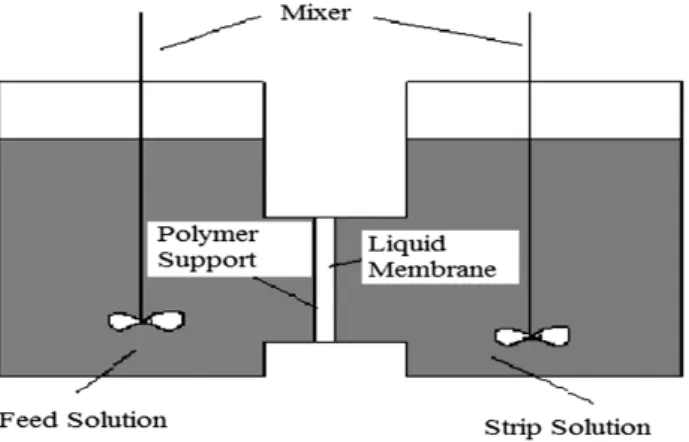
The prepared polymeric film was sandwiched bet-ween two glass cells. The transport of metal ions across the PIM from the aqueous solutions was studied by using a two-compartment permeation cell made from Pyrex glass, having flat-sheet membranes with the 12.56 cm2
area (A), as shown schematically in Figure 1.
The volumes of both the aqueous feed and the strip phases were 250 mL. The feed solutions were prepared by adding cobalt, nickel, cadmium and copper salts to study the effect of the feed composition. Ammonium thiocyanate (NH4SCN) was added into the feed mixture
to increase the selectivity of cobalt against nickel. 1 M acetic acid/1 M sodium acetate buffer was used to main-tain the desired feed pH. A stripping solution conmain-taining
1 M NH3+ 1 M TEA was selected as the stripping-phase
mixture. The feed and stripping phases were mechani-cally stirred at the desired mixing speed of (20 ± 1) °C to avoid the concentration polarization conditions at the membrane interfaces and in the bulk of the solutions. During the PIM-transport experiments, the samples of the feed and strip phases (about 1 mL) were periodically removed for a determination of the metal concentration with ICP-OES.
3 RESULTS AND DISCUSSION 3.1 Plasticizer type and concentration
The nature of the plasticizer used to form the mem-brane is also a key parameter to consider. Plasticizers are organic compounds incorporating a hydrophobic alkyl backbone and one or several highly solvating polar groups. They are added to hard, stiff plastics to make them softer and more flexible. The softening action of the plasticizers, plasticization, is usually attributed to their ability to reduce the intermolecular attractive forces between the polymer chains. For this reason, it is anticipated that in PIMs the presence of these com-pounds may also influence the mobility of membrane components, the degree of interaction between different constituents of the membrane and the characteristics of the polymeric medium7. A low plasticizer concentration
may cause more rigid and brittle membranes. So, it is not preferred4. The minimum plasticizer concentration varies
widely depending on both the plasticizer and the base polymer. The influence of the plasticizer nature on the Cd2+, Co2+, Ni2+, and Cu2+ transport through PIMs with
different plasticizers, i.e., 2-Nitrophenyl octyl ether (NPOE) and 2-nitrophenyl pentyl ether (NPPE) was tested. Copper was precipitated in the feed phase. Nickel was not transferred to the stripping solution. The cobalt and cadmium ions in the acidic feed solutions reacted with the excess NH4SCN, whereas in the case of nickel
ions, they hardly formed a thiocyanate complex12,13.
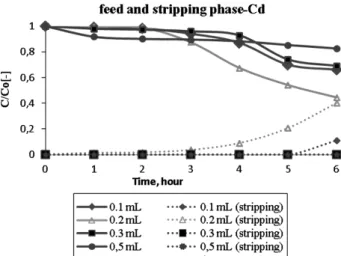
The results obtained for the Cd2+ and Co2+ ion
transport with different concentrations of the plasticizers
Figure 1:Schematic diagram of the experimental apparatus Slika 1:Shema naprave za preizkuse
in the PIMs are shown in Figures 2 and 3. For NPPE, this concentration can be in the range of up to 0.2 mL (w = 27 %) (Figure 2). Above this upper limit the mass transport diminishes.
The results obtained for the Cd2+and Co2+ion
trans-port with different types of plasticizers in the PIMs are shown in Figures 4 and 5. 2-Nitrophenyl pentyl ether (NPPE) is the most frequently used plasticizer in PIMs due to its high dielectric constant that enhances the
membrane permeability. A decrease in the permeability, together with an increase in the plasticizer content, is probably related to a reduction in the viscosity of the medium4.
The recovery factor (RF) of the metal ions from the feed phase into the stripping phase is given by:
RF C C
C
I I
= − ⋅100% (1) where C is the metal-ion concentration in the feed phase at some given time and Ciis the initial metal-ion
con-centration in the feed phase. Recovery factors (RF) for different plasticizers are shown in Table 1.
Table 1:Effect of the plasticizer type on the cobalt and cadmium transport
Tabela 1:Vpliv vrste meh~alca na prenos kobalta in kadmija
Plasticizer type RF (Co) RF (Cd)
Figure 4:Effect of the plasticizer type on the cadmium transport (feed phase: 100 mg/L Co2+, 100 mg/L Ni2+, 100 mg/L Cd2+, 100 mg/L Cu2+; feed stirring speed: 1200 r/min; strip-phase stirring speed: 1200 r/min; strip solution: 1 M NH3+ 1 M TEA; complex reagent (NH4SCN): 0.5 mol/l; temp.: 20 °C; feed solution pH: 4)
Slika 4:Vpliv vrste meh~alca na prenos kadmija (raztopina: 100 mg/L Co2+, 100 mg/L Ni2+, 100 mg/L Cd2+, 100 mg/L Cu2+; hitrost me{anja raztopine: 1200 r/min; hitrost me{anja v fazi traku: 1200 r/min; raz-topina traku: 1 M NH3+ 1 M TEA; kompleksni reagent (NH4SCN): 0.5 mol/l; Temp.: 20 °C; raztopina pH: 4)
Figure 2:Effect of the NPPE concentration on the cadmium extrac-tion (feed phase: 100 mg/L Co2+, 100 mg/L Ni2+, 100 mg/L Cd2+, 100 mg/L Cu2+; feed stirring speed: 1200 r/min; strip-phase stirring speed: 1200 r/min; strip solution: 1 M NH3+ 1 M TEA; complex reagent (NH4SCN): 0.5 mol/l; temp.: 20 °C; feed solution pH: 4)
Slika 2: Vpliv koncentracije NPPE na ekstrakcijo kadmija (iz raztopine: 100 mg/L Co2+, 100 mg/L Ni2+, 100 mg/L Cd2+, 100 mg/L Cu2+; hitrost me{anja raztopine: 1200 r/min; hitrost me{anja v fazi traku: 1200 r/min; raztopina traku: 1 M NH3+ 1 M TEA; kompleksni reagent (NH4SCN): 0.5 mol/l; Temp.: 20 °C; raztopina pH: 4)
Figure 5:Effect of the plasticizer type on the cobalt transport (feed phase: 100 mg/L Co2+, 100 mg/L Ni2+, 100 mg/L Cd2+, 100 mg/L Cu2+; feed stirring speed: 1200 r/min; strip-phase stirring speed: 1200 r/min; strip solution: 1 M NH3+ 1 M TEA; complex reagent (NH4SCN): 0.5 mol/l; temp.: 20 °C; feed solution pH: 4)
Slika 5:Vpliv vrste meh~alca na prenos kobalta (raztopina: 100 mg/L Co2+, 100 mg/L Ni2+, 100 mg/L Cd2+, 100 mg/L Cu2+; hitrost me{anja raztopine: 1200 r/min; hitrost me{anja v fazi traku: 1200 r/min; raz-topina traku: 1 M NH3+ 1 M TEA; kompleksni reagent (NH4SCN): 0.5 mol/l; temp.: 20 °C; raztopina pH: 4)
Figure 3:Effect of the NPPE concentration on the cobalt extraction (feed phase: 100 mg/L Co2+, 100 mg/L Ni2+, 100 mg/L Cd2+, 100 mg/L Cu2+; feed stirring speed: 1200 r/min; strip-phase stirring speed: 1200 r/min; strip solution: 1 M NH3+ 1 M TEA; complex reagent (NH4SCN): 0.5 mol/l; temp.: 20 °C; feed solution pH: 4)
Slika 3:Vpliv koncentracije NPPE na ekstrakcijo kobalta (raztopina: 100 mg/L Co2+, 100 mg/L Ni2+, 100 mg/L Cd2+, 100 mg/L Cu2+; hitrost me{anja raztopine: 1200 r/min; hitrost me{anja v fazi traku: 1200 r/min; raztopina traku: 1 M NH3+ 1 M TEA; kompleksni reagent (NH4SCN): 0.5 mol/l; temp.: 20 °C; raztopina pH: 4)
the reagents to strip and separate the cobalt and cadmium from the membrane phase to the aqueous phase.
3.3 Membrane characteristics
One important aspect of PIMs is the microstructure of the membrane materials, which determines the distri-bution of the carriers in the polymer matrix and ultima-tely affects the membrane transport efficiency. Conse-quently, a considerable research effort was devoted to clarifying this issue. While a variety of surface-characte-rization techniques were employed in these studies, scanning electron microscopy (SEM) and atomic force microscopy (AFM) were most frequently used. The results obtained from the SEM and AFM studies consi-stently indicate a remarkable influence of the polymeric composition on the membrane morphology.
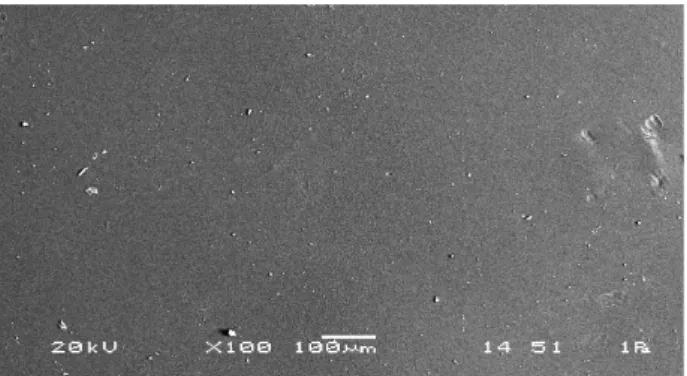
The membrane was characterized to obtain informa-tion regarding its composiinforma-tion using AFM (Figure 6), SEM (Figure 7) and FT-IR (Figure 8).
The AFM technique was used to characterize the sur-face morphology of the prepared membranes. The AFM picture of the PIM formed with CTA + NPPE + TBP +
Alamine 336 is shown in Figure 6. The surface morpho-logy of the membrane shows a rough surface. These regions may have occurred because of either a different speed of the solvent vaporization14, 15 or the membrane
having a porous structure where the pores were filled by NPPE or NPPE + Alamine 336 + TBP16,17.
Although both SEM and AFM techniques are versa-tile and can provide a good image of the membrane surface and, to some degree, of the membrane interior structure, to date, the studies employing these techniques have not been able to clearly elucidate the distribution of the carrier and the plasticizer within the membrane. Con-sequently, more advanced material-characterization tech-niques have been attempted.4
In order to investigate the absorption bands of the constituents of the membranes containing CTA + NPPE+ Alamine 336 + TBP, FTIR was performed as shown in
Figure 8. The bands at 2986 cm–1 and 2936 cm–1were
attributed to the stretching vibration of C–H in -CH2and
-CH3. The absorption at 1750 cm–1 was assigned to the
stretching vibration of C=O in CTA.
The fingerprint region of the spectra becomes com-plicated because of the P–O, C–O and C–N vibrations. These three vibrations are absorbed in the same region. For example, the peaks in the 1250 cm–1and 1100 cm–1
region appear in both CTA and TBP and they overlap completely. The expected peaks in the spectra appear in almost the same region as in the case of pure compo-nents like CTA, Alamine 336 and TBP. This indicates that these four compounds do not form any new covalent interactions, but only secondary interactions like hydro-gen bonding or electrostatic interactions18.
Consequently, the analysis and comparison of the obtained spectra revealed that all the membrane consti-tuents remained as pure components inside the membra-ne17,18. The surface of the films shows a good uniformity
and the absence of cracks indicates a good regularity of the membranes as shown in Figure 7.
3.4 Membrane thickness
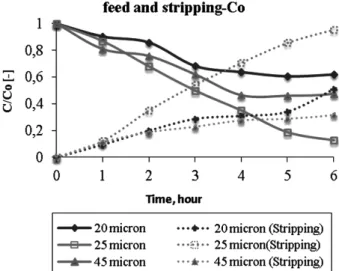
The investigated membrane thickness was 20 μm to 45 μm, shown in Figures 9 and 10. The best recovery factor (RF) was obtained with a thickness of 25 μm, with 81 % in the feed phase over 5 h as shown in Table 2. The
Figure 7:CTA + NPPE + Alamine 336 + TBP, SEM image Slika 7:SEM-posnetek CTA + NPPE + Alamin 336 + TBP Figure 6:CTA + NPPE + Alamine 336 + TBP, AFM image Slika 6:AFM-posnetek CTA + NPPE + Alamin 336 + TBP
Figure 8:CTA + NPPE + Alamine 336 + TBP, FT-IR Slika 8:FT-IR-posnetek CTA + NPPE + Alamin 336 + TBP
optimum membrane thickness was 25 μm. As the mem-brane thickness increased, the extraction would decrease. As shown in19 thinner membranes exhibiting high
permeability are formed. However, the thinnest mem-branes only partly allow high permeability due to a decrease in the extractant content limiting the transport efficiency.
As shown in reference20 the flux decreased linearly
with the membrane thickness. This is unambiguous evi-dence that the slow step in the transport process repre-sents the migration through the membrane and not a decomplexation from the carrier.
4 CONCLUSIONS
With the use of Alamine 336 and TBP as the carriers, the competitive transport of metal ions shows the prefe-rential selectivity order: Co (II) > Cd (II). The transport facilitated through the polymer inclusion membranes containing Alamine 336 and TBP was found to be an effective method for separation and recovery of cobalt (II) and cadmium (II) from aqueous solutions. Copper was precipitated in the feed phase. Nickel was not transferred to the stripping solution. The recovery factor for the cobalt ions was over 87 % over a period 6 h.
Acknowledgement
The financial support of this work, provided by the scientific research commission of Sakarya University (BAPK), Project No: 2010-02-04-025, is gratefully acknowledged.
5 REFERENCES
1G. M. Ritcey, A. W. Ashbrook, Solvent Extraction Principles and
Applications to Process Metallurgy, volume 2, Elsevier, Amsterdam 1979, 279–361
2B. Swain, K. Sarangi, R. P. Das, Separation of cadmium and zinc by
supported liquid membrane using TOPS-99 as mobile carrier, Sep. Sci. Technol., 39 (2004) 9, 2171–2188
3B. Swain, K. Sarangi, R. P. Das, Effect of different anions on
sepa-ration of cadmium and zinc by supported liquid membrane using TOPS-99 as mobile carrier, Journal of Membrane Science, 277 (2006) 1–2, 240–248
4L. D. Nghiem, P. Mornane, I. D. Potter, J. M. Perera, R. W. Cattrall,
S. D. Kolev, Extraction and transport of metal ions and small organic compounds using polymer inclusion membranes (PIMs), Journal of Membrane Science, 281 (2006), 7–41
5A. O. Saf, S. Alpaydin, A. Coskun, M. Ersoz, Selective transport and
removal of Cr(VI) through polymer inclusion membrane containing 5-(4-phenoxyphenyl)-6H-1,3,4-thiadiazin-2-amine as a carrier, Jour-nal of Membrane Science, 377 (2011), 241–248
6C. Sgarlata, G. Arena, E. Longo, D. Zhang, Y. Yang, R. A. Bartsch,
Heavy metal separation with polymer inclusion membranes, Journal of Membrane Science, 323 (2008), 444–451
7O. Kebiche-Senhadji, S. Tingry, P. Seta, M. Benamor, Selective
extraction of Cr(VI) over metallic species by polymer inclusion membrane (PIM) using anion (Aliquat 336) as carrier, Desalination, 258 (2010), 59–65
Figure 10:Effect of the membrane thickness on the cobalt transport (feed phase: 100 mg/L Co2+, 100 mg/L Ni2+, 100 mg/L Cd2+, 100 mg/l Cu2+; feed stirring speed: 1 200 r/min; strip-phase stirring speed: 1200 r/min; strip solution: 1 M NH3+ 1 M TEA; complex reagent (NH4SCN): 0.5 mol/l; temp.: 20 °C; feed solution pH: 4)
Slika 10:Vpliv debeline membrane na prenos kobalta (raztopina: 100 mg/l Co2+, 100 mg/l Ni2+, 100 mg/l Cd2+, 100 mg/l Cu2+; hitrost me{anja raztopine: 1 200 r/min; hitrost me{anja v fazi traku: 1 200 r/min; raztopina traku: 1 M NH3+ 1 M TEA; kompleksni reagent (NH4SCN): 0.5 mol/l; temp.: 20 °C; raztopina pH: 4)
Figure 9:Effect of the membrane thickness on the cadmium transport (feed phase: 100 mg/L Co2+, 100 mg/L Ni2+, 100 mg/L Cd2+, 100 mg/L Cu2+; feed stirring speed: 1200 r/min; strip-phase stirring speed: 1200 r/min; strip solution: 1 M NH3+ 1 M TEA; complex reagent (NH4SCN): 0.5 mol/l; temp.: 20 °C; feed-solution pH: 4)
Slika 9:Vpliv debeline membrane na prenos kadmija (raztopina: 100 mg/L Co2+, 100 mg/L Ni2+, 100 mg/L Cd2+, 100 mg/L Cu2+; hitrost me{anja raztopine: 1200 r/min; hitrost me{anja v fazi traku: 1200 r/min; raztopina traku: 1 M NH3+ 1 M TEA; kompleksni reagent (NH4SCN): 0.5 mol/l; temp.: 20 °C; raztopina pH: 4)
Table 2:Effect of the membrane thickness on the cobalt and cadmium transport
Tabela 2:Vpliv debeline membrane na prenos kobalta in kadmija Membrane thickness
(μm) RF (Co) RF (Cd)
20 39 15
25 81 46
S. Sanuki, M. Yata, H. Majima, Stripping of silver from Primene JMT loaded with silver thiocyanate complexes, Hydrometallurgy, 52 (1999), 123–135
12M. S. Uddin, M. Kathiresan, Extraction of metal ions by emulsion
liquid membrane using bi-functional surfactant: equilibrium and kinetic studies, Sep. Pur. Technol., 19 (2000) 1–2, 3–9
13R. R. Amirov, Influence of cations on the formation of cobalt (II)
complexes with thiocyanate ions in solutions of nonionic micelles, Russ. J. Coord. Chem., 29 (2003), 559–563
14C. A. Kozlowski, W. Walkowiak, Applicability of liquid membranes
in chromium (VI) transport with amines as ion carriers, Journal of Membrane Science, 266 (2005), 143–150
15A. Tor, G. Arslan, H. Muslu, A. Celiktas, Y. Cengeloglu, M. Ersoz,
Facilitated transport of Cr(III) through polymer inclusion membrane with di(2-ethylhexyl)phosphoric acid (DEHPA), Journal of Membrane Science, 329 (2009), 169–174
using anion (Aliquat336) and cation (D2EHPA) metal carriers, Journal of Membrane Science, 310 (2008), 438–445
19E. R. San Miguel, M. Monroy-Barreto, J. C. Aguilar, A. L. Ocampo,
J. Gyves, Structural effects on metal ion migration across polymer inclusion membranes: Dependence of membrane properties and transport profiles on the weight and volume fractions of the compo-nents, Journal of Membrane Science, 379 (2011), 416–425
20A. Gherrou, H. Kerdjoudj, R. Molinari, P. Seta, Preparation and
cha-racterization of polymeric plasticized membranes (PPM) embedding a crown ether carrier application to copper ions transport, Materials Science and Engineering C, 25 (2005), 436–443