244 AUJES Adıyaman University Journal of Educational Sciences
ISSN:2149-2727
DOI: http://dx.doi.org/10.17984/adyuebd.478815
Türkiye'de Erasmus Konusunda
Yazılan Lisansüstü Tezlerin
İncelenmesi
Hacı Hüseyin Taşar1*
1Adıyaman Üniversitesi, Eğitim Fakültesi, Türkiye MAKALE BİLGİ Ö Z ET Makale Tarihçesi: Alındı 05.11.2018 Düzeltilmiş hali alındı 25.11.2018 Kabul edildi 28.11.2018 Çevrimiçi yayınlandı 31.12.2018
Bu çalışmanın amacı Türkiye’de 2006-2018 yılları arasında Erasmus konusunun çalışıldığı yüksek lisans ve doktora tezlerini bibliyografik açıdan incelemektir. Araştırmada betimsel tarama yöntemi ve içerik analizi tekniği kullanılmıştır. Araştırmanın kapsamını YÖK'ün ulusal tez merkezinde yer alan Erasmus konusunda 2006-2018 yılları arasında yazılmış 42 lisansüstü tez oluşturmaktadır. Bu tezlerden 2 tanesine erişim izni verilmediğinden değerlendirmeye alınmamıştır. Araştırmaya ilişkin veriler 36 yüksek lisans ve 4 doktora tezinden elde edilmiştir. Araştırma sonuçlarına göre; Erasmus konusunda en çok tezin 2014 yılında yazıldığı; tezlerin büyük çoğunluğunun yüksek lisans düzeyinde olduğu; Erasmus konusuna kadın araştırmacılar daha fazla ilgi gösterdiği; en çok tez çalışmasının Orta Doğu Teknik Üniversitesinde yapıldığı; çalışılan tezlerin daha çok Sosyal Bilimler Enstitüsü bünyesindeki Eğitim Yönetimi, Teftişi, Planlaması ve Ekonomisi Ana Bilim Dalı, İşletme Ana Bilim Dalı ve Eğitim Bilimleri Enstitüsü bünyesindeki Eğitim Yönetimi Ana Bilim Dalında çalışıldığı; tez dilinin büyük oranda Türkçe (f=28) olduğu; çalışma grubunun büyük oranda öğrencilerden (f=37) ve 0-199 (f=28) kişi aralığında alındığı; örneklem seçiminde Basit Tesadüfi (f=11) yöntemin daha çok kullanıldığı; çalışmalarda daha çok nitel (f=24) araştırma yönteminin temel alındığı, verilerin analizinde daha çok faktör analizi (f=14) ve t testi (f=13) istatistik yöntemlerinin kullanıldığı görülmüştür.
© 2018 AUJES Tüm hakları saklıdır. Anahtar Kelimeler: Erasmus programı, Erasmus hareketliliği, öğrenci değişim programı, yükseköğretim.
Geniş Özet Amaç
ERASMUS, “European Region Action Scheme for the Mobility of University Students (Üniversite Öğrencilerinin Hareketliliği için Avrupa Topluluğu Eylem Programı)” kelimelerinin baş harflerinden oluşmakladır. Adını, Hollandalı filozof Desiderius ERASMUS’dan almıştır. Erasmus programı ise Avrupa Birliği (AB) tarafından 1987 yılında kurulmuş öğrenci değişim programıdır. Program, yükseköğretim kurumları arasında müfredat ve öğretim tekniklerinin paylaşımı gibi uluslararası düzeyde işbirliğinin teşvik edildiği projeler ile bireysel olarak gerçekleştirilen öğrenci, öğretim elemanı ve personel hareketliliklerinden oluşmaktadır (Eurydice, 2009).
*Sorumlu yazarın adresi: Adıyaman Üniversitesi, Eğitim Fakültesi, Adıyaman e-posta: [email protected]
245 Erasmus Programı, 2007-2013 yılları arasında uygulanmak üzere Hayat Boyu Öğrenme Programına dâhil edilmiştir. 2013’de AB Kültür ve Eğitim Komitesi, AB’nin eğitim, öğretim, gençlik ve spor alanındaki tüm mevcut planlarını “Erasmus+” adı altında topladı. Erasmus+ programı, 2014-2020 yıllarını kapsamakta olup, 28 AB üyesi ülke ile Norveç, İzlanda, Lihtenştayn, Makedonya ve Türkiye’yi kapsamaktadır (Ulusal Ajans, 2011).
Bu araştırmanın amacı Türkiye’de 2006-2018 yılları arasında Erasmus konusunun çalışıldığı yüksek lisans ve doktora tezlerini bibliyografik açıdan incelemek, mevcut durumu ortaya çıkarmak ve gelecekte yapılacak çalışmalara ışık tutmaktır. Araştırmada, lisansüstü tezlerin; yıllara, türlerine, yazarların cinsiyetlerine, yazıldığı dillere, sayfa sayısına, danışmanların unvanlarına, yazılan üniversiteye, enstitüye, ana bilim dalına, çalışma desenine, katılımcı profiline, örneklem sayısına, örnekleme türüne, kullanılan analizlere, göre dağılımı nasıldır? Sorularına cevap aranmıştır.
Yapılan araştırmada, Türkiye’de Erasmus konusunda yazılan tez ve makaleleri inceleyen çalışmanın olmadığı görülmüştür. Çalışma bu gereksinimden dolayı yapılmıştır. Bu bağlamda çalışmanın özgün olduğu ve gelecekte bu yönde yapılacak araştırmacılara yol göstereceği beklenmektedir.
Yöntem
Bu araştırma betimsel tarama modelinde kurgulanmıştır. Betimsel tarama modelinde bilimin gözlem, kaydetme, olaylar arasındaki ilişkileri tespit etme ve kontrol edilen değişmez ilkeler üzerinde genellemelere varma söz konusudur (Yıldırım ve Şimşek, 2013). Çalışma evreni olarak; Yüksek Öğretim Kurulu, Yayın ve Dokümantasyon Daire Başkanlığı’nın “Ulusal Tez Merkezi” bölümünde yer alan ve erişim izini verilen Erasmus konusunda Türkiye’de yapılmış olan yüksek lisans ve doktora tezleri alınmıştır. 21 Eylül 2018 tarihi itibariyle, Ulusal Tez Merkezinde Erasmus konusunda kayıtlı 40 lisansüstü tezin tamamı örnekleme dâhil edilerek incelenmiştir.
Araştırmada içerik analiz tekniği kullanılmıştır. İçerik analiz tekniği, verilerde benzer anlamları çağrıştıran kavramların kodlanması ve ortak kategoride birleştirilmesi, diğer bir deyişle, verilerin kodlara ve kategorilere göre düzenlenmesi, tanımlanması ve bulgulara gidilmesi aşamalarını içermektedir (Yıldırım ve Şimşek, 2013; Patton, 2014; Falkingham ve Reeves, 1998). Tez ve makalelerinin toplanmasında, Sözbilir vd., (2008)’ne ait olan “Yayın Sınıflama Formu” kullanılmıştır. Toplanan veriler üzerinde yüzde ve frekans hesaplamaları yapılmıştır. Frekans analizi, birim ve öğelerin sayısal, yüzdesel ve oransal bir tarzda görülme sıklığını ortaya koyar (Bilgin, 2006).
246 Bulgular, Tartışma ve Sonuç
Bu araştırmada Türkiye’de Erasmus konusunda yazılan tezlerin içerik bakımından analizi yapılmıştır. Konu ile ilgili tezlerin en fazla çalışıldığı yıl 2014 olmuştur. Yazılan tezlerin genellikle yüksek lisans seviyesinde olduğu ve daha çok kadın araştırmacılar tarafından çalışıldığı sonuçlarına ulaşılmıştır. Doktora seviyesinde yazılan tezlerin azlığı ise dikkat çekmektedir. Erasmus konusuna kadınların daha fazla ilgi gösterdikleri söylenebilir. Bu sonucun aksine, Bıkmaz ve Arkadaşları (2013) “doktora tezlerinin içerik çözümlemesi” konulu kadın ve erkek araştırmacıların birbirine yakın sayıda olduğu bulgusuna ulaşmıştır.
Erasmus konusunda yapılan tez çalışmaların çoğunlukla Orta Doğu Teknik ve Boğaziçi
Üniversitelerinde gerçekleştirildiği belirlemiştir. Yapılan tezler büyük oranda Türkçe yazılmıştır. İngilizce yazılan tezlerin oranı Türkçe yazılanlara oranla düşük düzeydedir. İngilizce yazılan tezlerin çoğu Orta Doğu Teknik ve Boğaziçi Üniversiteleri bünyesinde hazırlandığı bulgulanmıştır. Yazılan tezlerin dilinin ağırlıklı olarak Türkçe olması, uluslararası bağlamda farkındalık oranını düşürebilir. Erasmus konusunda yazılan tezler Enstitü bağlamında incelendiğinde, en çok tezin Sosyal Bilimler Enstitüsü ve Eğitim Bilimleri Enstitülerinde yazıldığı görülmüştür. Sağlık Bilimleri enstitüsünde ise konu ile ilgili herhangi bir çalışmaya rastlanmamıştır.
Anabilim dallarına bakıldığında çalışmaların yoğun olarak; Eğitim yönetimi, teftişi, planlaması ve ekonomisi ve işletme anabilim dallarında gerçekleştirildiği görülmektedir. Erasmus konusunda yazılan tezlerin büyük çoğunluğunda nitel yöntemler temel alınmıştır. Bu sonucun aksine; Tavşancıl ve arkadaşları (2010) araştırmalarında; eğitim konusunda yazılmış yüksek lisans tezlerinde beşte dört oranında nicel araştırma yönteminin kullanıldığını belirtmiştir. Konu ile ilgili olarak Şahin ve arkadaşları (2013) araştırmalarında çoğunlukla nicel yöntemlerin tercih edildiğini bulgulamıştır. Benzer şekilde Balcı ve Apaydın (2009), çalışmalarında, yapılan araştırmalarda daha çok nicel araştırma yöntemlerinin tercih edildiği yönünde sonuçlar elde edilmiştir. Nicel veya nitel yöntemlere oranla karma yaklaşımların kullanımı düşük düzeyde görülmektedir (Ulutaş ve Ubuz, 2008; Çiltaş, Güler ve Sözbilir (2012). Derinlemesine çalışmak ve daha güvenilir bilgiler elde emek için karma yöntemlerin tercih edilmesi önemlidir.
Araştırmalarda nitel ve nicel verilerin birlikte toplanması ve birbirine dönüştürülmesi sonuçların güvenirliği (Creswell, 2003) açısından önemlidir. Daha derinlemesine bilgi toplama imkânı sunması sebebiyle araştırmacılar nitel ve karma yöntemlerle çalışmaya teşvik edilmelidir (Alpaydın ve Erol, 2017). Erasmus konusunda yapılan araştırmalarda çalışma gruplarının genellikle öğrencilerden oluştuğu ve örneklem büyüklüğünün 0-199 aralığında seçildiği belirlenmiştir. Bu durumun aksine Türkiye’de farklı konularda yapılan
247 benzer araştırmalarda örneklem büyüklüğünün 100 kişinin altında olduğu tespit edilmiştir (Çiltaş, Güler ve Sözbilir, 2012; Ulutaş ve Ubuz, 2008). Akademisyenlerin örneklem grup olarak seçilmesi oldukça düşük düzeydedir. Erasmus hareketliliğine katılan idari personelin çalışma grubu olarak alındığı herhangi bir araştırmaya da rastlanmamıştır.
Araştırmada, Erasmus konusunda yazılan tezlerin daha çok; sosyal bilimler alanında, yüksek lisans düzeyinde ve Türkçe dilinde yazıldığı, tezlerin analizinde ise “faktör analizi”, “t testi” ve “anova testi” yöntemlerinin kullanıldığı belirlenmiştir. Yapılacak çalışmalarda daha güvenilir bilgiler elde emek ve sonuçların geçerlik ve güvenirliğini arttırmak için; Erasmus hareketliliğine katılan öğrencilerin yanı sıra akademisyen ve diğer çalışanların görüşlerinin de alınması, nicel veya nitel desenlerin tek başına kullanılması yerine karma desenli modellerin ve analiz tekniklerinin tercih edilmesi ve Türkçenin yanı sıra İngilizce dilinde de yayın yapılması önerilir.
248 ADYÜEBD Adıyaman Üniversitesi Eğitim Bilimleri Dergisi
ISSN:2149-2727
DOI:http://dx.doi.org/10.17984/adyuebd.478815
Investigation of Graduate Thesis in Turkey related to Erasmus
Hacı Hüseyin Taşar1*
1Adıyaman University, Faculty of Education, Turkey
AR T I C L E I N F O ABSTRACT Article History: Received 05.11.2018 Received in revised form 25.11.2018 Accepted 28.11.2018 Available online 31.12.2018
The purpose of this research is to review from a bibliographic standpoint the master’s and Ph.D. theses written in Turkey between 2006-2018 which studied the subject of Erasmus. For the population, the researcher has accepted the master’s and Ph.D. theses about Erasmus Programme which were written in Turkey between the years 2006-2018 which are located in the "National Thesis Center" section of the Council of Higher Education, Head of Publication and Documentation Department, and permitted to be accessed. This research was designed in the descriptive survey model. Content analysis technique was used in the research. The theses on the subject were written at most in 2014. It is concluded that the theses were mostly at the master’s level and written by female researchers. It can be said that women are more interested in the subject of Erasmus than men. Theses on the subject of Erasmus were determined to be written mostly in Middle East Technical University and Boğaziçi University. When the theses concerning the Erasmus Programme were viewed within the context of the institute, the highest number of the theses was found in the Institute of social sciences and Institute of educational sciences. When the departments are considered, it is seen that the studies are predominantly carried out in the Department of Educational Management, Inspection, Planning, and Economy, and in the Department of Management. It was determined that in the studies about Erasmus, study groups were comprised mostly of students. In the research, it was determined that the theses about Erasmus are mostly written in the field of social sciences, at master’s level, and in the Turkish language; and “factor analysis”, “t-test” and “ANOVA test” methods were used in the analysis of theses.
©2018 AUJES. All rights reserved Keywords: Erasmus programme, Erasmus student mobility, higher education
Introduction
“ERASMUS” consists of the initial letters of the phrase “European Region Action Scheme for the Mobility of University Students”. It is named after the Dutch philosopher Desiderius ERASMUS. Erasmus programme is a student exchange program established by the European Union (EU) in 1987. Along with mobilities of students, faculty members and staff carried out individually, the program is comprised of projects through which collaboration on an international level, such as the sharing of curricula or teaching techniques among higher education institutions, is promoted. (Eurydice, 2009).
So as to be put into practice between 2007-2013, the Erasmus Programme was included in the Lifelong Learning Program. In 2013, the EU Culture and Education
249
Committee gathered EU's all existing plans in the fields of education, training, youth, and sports under the title of “Erasmus +”. Erasmus + covers the years 2014-2020, and Norway, Iceland, Liechtenstein, Macedonia and Turkey along with 28 EU member states.
In order to participate in Erasmus student mobility, academic success and a good level of foreign language skills are required (National Agency, 2011). Besides, in order to participate in student mobility in higher education students should be enrolled in full-time formal education. Students who study in distance education or similar programs cannot benefit from mobility. And for the faculty members, the Erasmus staff mobility is implemented in the form of giving lectures and receiving education for the administrative personnel. In order to carry out the mobility, mutual agreements between the departments of the two universities should be made. It has been observed that the foreign language skills of the students who participate in the Erasmus student mobility have developed, that they do not have difficulties in finding a job, their prejudices against foreign cultures have been disappeared and their self-confidence has increased (Teichler and Maiworm, 1997; Cushner and Mahon, 2002: Cushner and Mahon, 2002).
Within the high educational system of Turkey, the responsibility for planning the Erasmus student and faculty member mobility was given to the European Union Education and Youth Programs Center which was established as a National Agency. By 2016, in Turkey, there are 202 common programs in the 56 universities. In recent years, an increasing trend is observed in the number of international students included in the Turkish higher education system. According to the 2008 data of EU Education and Youth Programs Center, while the number of international students in our country in the 2000-2001 academic year was 16.656, in 2014-2015 making a great leap this number reached at 72.178, and in 2015-2016 it reached at 87.903. In 2016-2017 this number reached at 108.076 increasing approximately by 23%. The issue of international students displayed a great improvement in the Turkish Higher Education System with the Tenth Development Plan. Within this period various strategies were developed such as the Bologna Process, TURQUAS Project, Erasmus and Erasmus + programs, Turkey scholarship, Mevlana Exchange Program, Joint diploma programs, Project-Based International Exchange Program, YABSİS (FAIS: Foreign Academic Information System) Project, School Recognition and Accreditation Regulations, extending the duration of stay of Ph.D. students’ in Turkey after graduation, providing scholarships for international students (YÖK, 2018). Thanks to these strategies, international students’ access to higher education in Turkey has also facilitated and increased. Today, significant quantitative growth has been achieved in Turkish higher education with 182 higher education institutions, 7.2 million students and more than 150 thousand faculty members. Thus, Turkey became the second country that has the most number of students after Russia in the European Higher Education Area (Saraç, 2018: 1).
By the 2016-2017 academic year, in Turkey, 160 higher education institutions among 164 institutions that have the Higher Education Erasmus Declaration
250
participate in the student and staff mobility activities (YÖK, 2018). While the number of students going abroad was 1.441 in the 2004-2005 academic year when considered with regard to the 2015 call projects it rose to 23.016 increasing 16 times. As for the staff mobility, while the number of personnel going abroad was 339 in 2004, it increased 7.5 times in 2015 and reached at 2.551 (YÖK, 2018).
The purpose of this research is to review from a bibliographic standpoint the master’s and Ph.D. theses written in Turkey between 2006-2018 which studied the subject of Erasmus, to uncover to current status regarding the issue, and to shed light upon the future studies. The research has sought answers for the questions such as how is the distribution of the graduate theses according to their years, types, gender of their authors, the languages in which they have been written, number of pages, title of the supervisors, university, institute, department, research design, participant profile, sampling number, sampling type, the analysis used? Surveying the literature it has been seen that there is no study reviewing theses and articles that have been written in Turkey about the Erasmus. The study was carried out upon this requirement. Within this context, the study is considered to be original and expected to guide the researchers who will make studies in this direction in the future.
Method
This research was designed in the descriptive survey model. In the descriptive survey model, the procedures of science such as observation, recording, determining the relationships between the events, and generalizations based on the unchanging principles that are controlled are implemented. (Yıldırım and Şimşek, 2006).
A survey model is a research approach that aims to describe a current or past situation as it is/was (Kaptan,1998; Karasar,2007). For the population, the researcher has accepted the master’s and Ph.D. theses about Erasmus Programme which were written in Turkey between the years 2006-2018 which are located in the "National Thesis Center" section of the Council of Higher Education, Head of Publication and Documentation Department, and permitted to be accessed. Graduate theses, which are 40 in number, found by 21 September 2018 in the National Thesis Center about Erasmus were included in the sample and reviewed.
Content analysis technique was used in the research. The content analysis technique involves coding of concepts that evoke similar meanings in the data and gathering them into a common category. In other words, it is comprised of the steps of arranging the data according to the codes and categories, describing them and making findings (Yıldırım and Şimşek, 2013; Patton, 2014; Falkingham and Reeves, 1998). In the content analysis, coding and categories should be obvious so that the data of the research should be able to give the same results when analyzed by another researcher (Fraenkel and Wallen, 2009). In the collection of theses and articles, “Publication Classification Form” belonging to Sözbilir et al. (2008) was used.
For the reliability of the data, expert’s opinion was received during coding the theses according to their subjects and processing of the data. In order to systematize
251
the acquired data, the theses are coded as T1, T2 ... T40. Percentage and frequency calculations were made on the collected data. Frequency analysis manifests the incidence of units and elements in a numerical, percental and proportional way (Bilgin, 2006). Krippendorf (2004) describes the frequency analysis as a research method used to make reproducible and valid inferences from data.
Findings
This chapter covers the findings which are made through the content analysis method as a result of reviewing 40 postgraduate theses written on the issue of Erasmus from 2006 to October 2018 with.
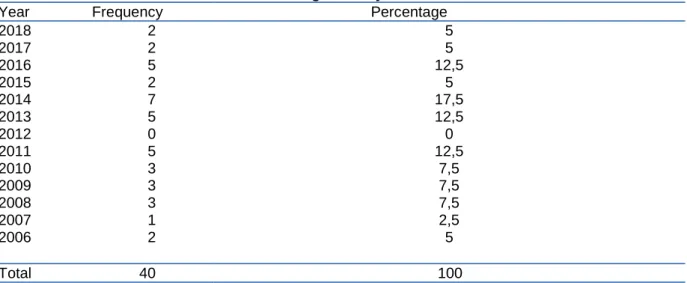
Table 1. Distribution of theses according to the year Year Frequency Percentage
2018 2 2017 2 2016 5 2015 2 2014 7 2013 5 2012 0 2011 5 2010 3 2009 3 2008 3 2007 1 2006 2 5 5 12,5 5 17,5 12,5 0 12,5 7,5 7,5 7,5 2,5 5 Total 40 100
It is seen that the reviewed graduate theses written on the issue of Erasmus were spread between the years of 2006 and 2018. When the theses included in the study were reviewed according to the date, the highest number of the graduate thesis is seen in the year 2014. This year was followed by 2011, 2013 and 2016 each with 5 studies.
Table 2. Distribution of theses according to theses
Theses Frequency Percentage
Master Ph.D.
36 90
4 10
Total 40 100
Among the studies included in the research 36 (90%) of them were master’s theses and 4 (10%) were Ph.D. dissertations. It is seen that most theses were written at the master’s level. The scarcity of Ph.D. dissertations about Erasmus is noteworthy.
Table 3. Distribution of theses according to the genders
When the genders of the authors of the reviewed theses considered it is seen that 28 of them are female and 12 male. It is observed that women who write a
Genders Frequency Percentage
Female 28 70
Male 12 30
252
graduate thesis on the issue are more than men. When we look at the gender distribution within the field, it can be said that female researchers show more interest in Erasmus.
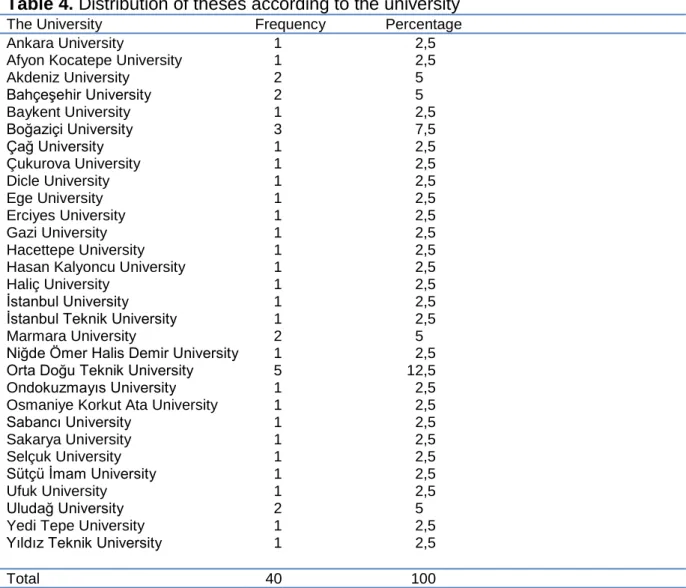
Table 4. Distribution of theses according to the university
The University Frequency Percentage
Ankara University
Afyon Kocatepe University Akdeniz University Bahçeşehir University Baykent University Boğaziçi University Çağ University Çukurova University Dicle University Ege University Erciyes University Gazi University Hacettepe University Hasan Kalyoncu University Haliç University
İstanbul University İstanbul Teknik University Marmara University
Niğde Ömer Halis Demir University Orta Doğu Teknik University Ondokuzmayıs University Osmaniye Korkut Ata University Sabancı University Sakarya University Selçuk University Sütçü İmam University Ufuk University Uludağ University Yedi Tepe University Yıldız Teknik University
1 2,5 1 2,5 2 5 2 5 1 2,5 3 7,5 1 2,5 1 2,5 1 2,5 1 2,5 1 2,5 1 2,5 1 2,5 1 2,5 1 2,5 1 2,5 1 2,5 2 5 1 2,5 5 12,5 1 2,5 1 2,5 1 2,5 1 2,5 1 2,5 1 2,5 1 2,5 2 5 1 2,5 1 2,5 Total 40 100
The university in which the highest number of theses about Erasmus was written was Middle East Technical University with a rate of 12.5%. This was followed by Boğaziçi University at a rate of 7.5%. Akdeniz, Bahçeşehir, Marmara and Uludağ Universities share the 3rd place in the rank with a rate of 2%.
Table 5. Distribution of theses according to the publication languages The Publication Languages Frequency Percentage
Turkish 28 67,5 English 12 32,5
Total 40 100
When the publication languages of the theses about Erasmus viewed, it is seen that 67.5% is in Turkish and 32.5% in English.
253 Table 6. Distribution of theses according to the number of pages
The Number Of Pages Frequency Percentage 0-100 101-150 151-200 201 and above 6 15 22 55 8 20 4 10 Total 40 100
When the distribution of the theses written about Erasmus is viewed according to the number of pages, it is seen that 55% (f: 22) of the theses are within the range of 100-150 pages, 20% (f: 8) are between 151-200 pages, and 15% (f: 6) are between 0-100. And the remaining 10% of them are 201 pages or above.
Table 7. Distribution of theses according to the supervisors of the theses The Supervisors of The Theses Frequency Percentage
The Associate Professors The Assistant Professors The Professors
11 27,5 12 30 17 42,5 Total 40 100
When the titles of the supervisors of the theses are viewed, it is seen that the 42.5% are professors, 30% are associate professors, and 27.5% are it can be said that the supervisors of the theses about Erasmus usually consist of professors. It is seen that the rate of the associate professors and the assistant professors who supervise the theses were close to each other.
Table 8. Distribution of Theses according to the institutes
The Institutes Frequency Percentage
The Social Sciences The Educational Sciences The Health Sciences The Institute of Science
21 52,5 16 40 0 0 3 7,5 Total 40 100
When the distribution of the theses according to the institutes to which they were submitted is viewed, 52.5% (f: 21) of them were written within an institute of social sciences, and 40% (f: 16) within an institute of educational sciences. And 7.5% of the theses (f: 3) were submitted to an institute of science. In this respect, it can be said that the theses related to the subject are mostly written within the scope of the social sciences institute. In the Institute of Health Sciences, no theses related to the subject was found.
254 Table 9.Distribution of theses according to the department
The Department Frequency Percentage Management
Business Administration
Human Resources Management The Social Sciences
The Educational Sciences
Department Of Management And Department. Turkish Education Social Service Public Administration Foreign Language Psychology Science Education
European Union Politics And International Communication Department Of Art 7 17,5 2 5 2 5 2 5 6 15 9 22,5 1 2,5 1 2,5 2 5 4 10 1 2,5 1 2,5 1 2,5 1 2,5 Total 40 100
It is seen that on the issue of Erasmus many theses were written in diverse departments. The Department of Educational Management, Inspection, Planning, and Economy has the highest theses number with a percentage of 22.5%. This branch is followed by the Department of Management and Department of Educational Sciences with rates of 17.5% and 15% respectively. Table 10. Distribution of Theses according to the research methodology The Research Methodology Frequency Percentage Quantitative Qualitative Mixed 12 30 24 60 4 10 Total 40 100
The majority of theses on Erasmus were based on qualitative patterns (f = 24). It is observed that studies with quantitative patterns are less than qualitative patterns (f = 12). In the theses, it was observed that mixed research in which quantitative and qualitative methods were used together was not emphasized (f = 4). Based on these findings, it can be said that qualitative designs were mostly used in the studies about Erasmus and mixed studies appeared rarely. Table 11. Distribution of theses according to the sample and study groups Participants Frequency Percentage Students Academics Administrative Staff 37 97,5 1 2,5 0 0 Total 38 100
When the theses written about Erasmus were viewed in terms of the characteristics of its participants, It is seen that 97.5% of them are comprised of students and 2.5% academics. Only 2 of the theses were a document analysis. The selection of academics as a sample group is at a rather low rate. There was no study found in which the administrative staff who participated in the Erasmus mobility were taken as a study group.
255
Table 12. Distribution of theses according to the sample size
The Sample Size Frequency Percentage 0-199 200-399 400 and above 28 70 5 12,5 5 12,5 Total 38 100
It is observed that 70% (f: 28) of the theses on the Erasmus Programme were conducted with 0-199 participants and 12.5% (f: 5) of them were carried out with 200-399 participants or 400 and above.
Table 13. Distribution of theses according to the sampling method
Sampling Method Frequency Percentage Simple Random Sampling
Layered Convenience No Information Purposive Sampling Other 11 28 0 0 0 0 14 38 5 13 8 21 Total 38 100
In the 38% (f: 14) of the theses on the subject of Erasmus no information was given regarding which sampling method was used, 28% (f: 11) were based on
“simple random sampling”, %13 (f:5) was based on “purposive sampling”. It was
found that “convenience” and “layered” sampling methods were not used in the theses written on the subject.
Table 14. Distribution of theses according to the statistical analysis types utilized
The Statistical Analysis Types Frequency Percentage Factor Analysis T-Test Anova Test Correlation Simple Regression Multiple Regression
Structural Equation Modeling Mann Whitney U Test
Kruskal Wallis-H Chi - Square Test Identifier Only
Other Statistical Analysis Types
14 22,6 13 20,8 7 11,3 4 6,5 0 0 3 4,8 0 0 2 3,2 0 0 4 6,5 0 0 15 24,1
When the distribution of the statistical analysis types utilized in the theses on the subject of Erasmus is viewed, it is seen that the analysis type which has the highest rate of use is factor analysis with a percentage of 22,6%. This was followed by the “t-test” with 20,8%, and “ANOVA “t-test” with 11,3%. Other statistical analysis types such as simple regression, structural equation modeling, Kruskal Wallis-H etc. were never used.
Discussion, Conclusion and Recommendations
In this research, the content analysis of the theses written in Turkey on the subject of the Erasmus Programme was made. The theses on the subject were
256
written at most in 2014. This year is followed by 2011, 2013 and 2016. It is concluded that the theses were mostly at the master’s level and written by female researchers. The scarcity of the theses written at the Ph.D. level is noteworthy. It can be said that women are more interested in the subject of Erasmus than men. Unlike this result,
Bıkmaz et al. (2013) found in their study concerning "the content analysis of the
Ph.D. dissertations" that the number of male and female researchers were close. The supervisors of the theses are mostly professors. Theses on the subject of Erasmus were determined to be written mostly in Middle East Technical University and Boğaziçi University. As for the language of the theses, 67.5% of them were written in Turkish. The rate of theses written in English is low compared to the ones written in Turkish. Most of the theses in the English language were written in Middle East Technical University (f = 5) and Boğaziçi University (f = 3). And one thesis was written in English in each of the Sabancı, Çağ, Çukurova, Bahçeşehir and Akdeniz Universities. It is observed that the theses which are written in English mostly pertain to the state universities. The fact that the language of the theses is predominantly Turkish can reduce the awareness within the international context. It was observed that 55% of the theses were in the range of 100-250 pages. When the theses concerning the Erasmus Programme were viewed within the context of the institute, the highest number of the theses was found in the Institute of social sciences and Institute of educational sciences. And no studies related to the issue were found in the Institute of health sciences. When the departments are considered, it is seen that the studies are predominantly carried out in the Department of Educational Management, Inspection, Planning, and Economy, and in the Department of Management. The majority of theses on Erasmus are based on qualitative methods. Contrary to this result, Tavşancıl et al. (2010) reported in their research that quantitative research methods were used in the four-fifths of the master’s theses on education. Şahin et al. (2013) found in their research that mostly quantitative methods were preferred. Likewise, in the studies carried out by Biral and Apaydin (2009), findings were made pointing out the fact that quantitative research methods were mostly preferred in the studies. Compared to the quantitative or qualitative methods, the use of mixed approaches is observed to be at a low level (Ulutaş and Ubuz, 2008; Çiltaş, Güler, and Sözbilir (2012). In order for in deep study and acquisition of more reliable information the preference of the mixed methods is important. Gathering the qualitative and quantitative data together, and transforming them to each other is important for the reliability of the results (Creswell, 2003). Since they provide the possibility of collecting relatively in-depth information, researchers should be promoted to use qualitative and mixed research methods (Apaydın and Erol, 2017). In 28% of the theses “simple random”, and in 21% “other (compilation)” sampling method was used. In 38% of the theses, no information was given regarding which sampling method was used. It was determined that in the studies about Erasmus, study groups were comprised mostly of students, and the sample size is selected within the range of 0-199. Unlike this situation, it has been determined that the sample size is under 100 people in the similar studies conducted about different subjects in Turkey (Çiltaş, attentiveness and Sözbilir, 2012; Ulutaş
257
and Ubuz, 2008). The selection of academics as a sample group is at a very low level. And no study was found in which the administrative staff participating in the Erasmus mobility was taken as a study group.
In the research, it was determined that the theses about Erasmus are mostly written in the field of social sciences, at master’s level, and in the Turkish language; and “factor analysis”, “t-test” and “ANOVA test” methods were used in the analysis of theses. To obtain more reliable information in the studies to be conducted, and to increase the validity and reliability of the results, it is recommended that in addition to that of the students participating in Erasmus mobility, opinions of the academics and other personnel are received, instead of using the quantitative or qualitative patterns alone, mixed patterned models and analysis techniques are preferred, and publications are made in English along with Turkish.
References
Alpaydın, Y. ve Erol, İ. (2017). Türkiye’de eğitim ekonomisi alanında yapılan
lisansüstü tezlerin incelenmesi. Marmara Üniversitesi Atatürk Eğitim Fakültesi
Eğitim Bilimleri Dergisi. Volume-Issue: 45 ss/pp. 23-41 • ISSN: 1300-8889. Balcı, A. ve Apaydın, Ç. (2009). Türkiye’de eğitim yönetimi araştırmalarının durumu:
kuram ve uygulamada eğitim yönetimi dergisi örneği. Kuram ve Uygulamada Eğitim Yönetimi Dergisi. 59 (15), 325–343.
Bıkmaz, F. H., Aksoy, E., Tatar, Ö., ve Altınyüzük, C. A. (2013). Eğitim programları ve öğretim alanında yapılan doktora tezlerine ait içerik çözümlemesi
(1974-2009). Eğitim ve Bilim Dergisi, 38 (68), 288-303
Bilgin, N. (2006). Sosyal Bilimlerde İçerik Analizi Teknikler ve Örnek Çalışmalar.
Anakara: Siyasal Yayınları.
Creswell, J. W. (2003). Research design: qualitative, quantitative, and mixed methods approaches (2ndEd.). CA: Sage Publications.
Cushner, K., & Mahon, J. (2002). Overseas student teaching: Affecting personal, professional, and global competencies in an age of globalization. Journal of Studies in International Education, 6(1), 44-58.
Çiltaş, A., Güler, G. ve Sözbilir, M. (2012). Türkiye’de matematik eğitimi araştırmaları: Bir içerik analizi çalışması. Kuram ve Uygulamada Eğitim Bilimleri, 12(1), 565-580.
Eurydice. (2009). Higher education in Europe 2009: developments in the bologno
process. brussels: education, audiovisual and culture executive
agency.ıSBN978-92-9201-023-2.
Falkingham, L.T. & Reeves, R. (1998). Context analysis- a technique for analysing research in a field, applied to literature on the management of R and D at the section level. Scientometrics, 42(2), 97-120.
Fraenkel, J. R., & Wallen, N. E. (2009). How to design and evaluate research in education. New York: McGraw-Hill.
Kaptan, S. (1998). Bilimsel Araştırma ve İstatistik Teknikleri. Ankara: Tekisik Ofset.
258
Krippendorff, K. (2004). Content Analysis: An İntroduction to İts Methodology (2nd
ed.). Thousand Oaks, CA: Sage Publications.
Patton, M. Q. (2014). Nitel Araştırma ve Değerlendirme Yöntemleri. M. Bütün ve S. B.
Demir (Çev.), Ankara: Pegem Akademi.
Saraç, M. Y. A. (2018). Yükseköğretim Uluslararasılaşma Strateji Belgesi: 2018-2022. Erişim adresi: http://www.yok.gov.tr/web/guest/yuksekogretimde-
uluslararasilasma-strateji-belgesi-2018-2022. (Erişim Tarihi: 21.09.2018).
Sözbilir, M. & Kutu, H. (2008). Development and current status of science education research in Turkey. Essays in Education [Special issue], 1-22.
Sözbilir, M., Kutu, H., & Yaşar, M.D. (2012). Science education research in turkey: a content analysis of selected features of papers published. In J. Dillon & D. Jorde (Eds.). The World of Science Education: Handbook of Research in Europe (pp. 1-35). Rotterdam: Sense publishers.
Şahin, E. (2013).”Erasmus programına katılan Türk öğrencilerin görüşlerinin değerlendirilmesi.” Yüksek Lisans Tezi, Bahçeşehir Üniversitesi, İstanbul. Tavşancıl, E., Erdem, D., Yalçın, N., Yıldırım, Ö. & Bilican, S. (2010). Examination of
data analyses used for master’s theses in educational sciences. Procedia Social and Behavioral Sciences, 9, 1467-1474.
Teichler, U. & Janson, K. (2007). The professional values of temporary study in another European country: Employment and work of former Erasmus students. Journal of Studies in International Education, 11(3), 486-495.
Ulusal Ajans. (2005). Bologna süreci temel belgeleri. Ankara: Punto. Ulusal Ajans.
(2008). 2007-2008 Hayat boyu öğrenme programı Erasmus el kitabı. AB
Eğitim ve Gençlik Programları.
Ulusal Ajans. (2011). 2010-2011 Hayat boyu öğrenme programı yükseköğretim
kurumları için Erasmus el kitabı. AB Eğitim ve Gençlik Programları.
Ulutaş, F., ve Ubuz, B. (2008). Matematik eğitiminde araştırmalar ve eğilimler: 2000 ile 2006 yılları arası. İlköğretim Online, 7(3), 614-626.
Yıldırım, A. ve Şimşek, H. (2013). Sosyal Bilimlerde Nitel Araştırma Yöntemleri. Ankara: Seçkin Yayıncılık.
YÖK-Yükseköğretim Kurulu. (2018). Yükseköğretimde Uluslararasılaşma Strateji
Belgesi. Erişim Adresi:
www.yok.gov.tr/web/guest/yuksekogretimde-uluslararasilasma-strateji-belgesi-2018-2022. Erişim Tarihi 3 Mayıs-2018.