T.C.
ISTANBUL AYDIN UNIVERSITY INSTITUTE OF SOCIAL SCIENCES
CUSTOMER PREFERENCES ON MORTGAGE FINANCE IN TURKEY A STUDY WITH CONJOINT ANALYSIS
MASTER THESIS
Muhammad Haseeb KHAN
Department of Business Business Administration Program
Thesis Supervisor: Asst. Prof. Dr Nurgün KOMŞUOĞLU YILMAZ
T.C.
ISTANBUL AYDIN UNIVERSITY INSTITUTE OF SOCIAL SCIENCES
CUSTOMER PREFERENCES ON MORTGAGE FINANCE IN TURKEY: A STUDY WITH CONJOINT ANALYSIS
MASTER THESIS
Muhammad Haseeb KHAN (Y1412.130037)
Department of Business Business Administration Program
Thesis Supervisor: Asst. Prof. Dr Nurgün KOMŞUOĞLU YILMAZ
Dedication,
To my Parents The reason of what I become today. Thanks for your support and continuous care.
FOREWORD
I would like to acknowledge the help of my thesis supervisor, Dr.Nurgün KOMŞUOĞLU YILMAZ in every step of thesis research. In addition my warm thanks to Dr. Ilkay KARADUMAN for his supports in research period. I’m thankful to all teachers and friends whose names I did not mention here.
I am grateful especially to my mother and my brother Muhammad Kaleem KHAN for moral, material help, believe and for supporting me in my decisions. Thanks for the assistance, care and guidance in my life.
TABLE OF CONTENTS Page FORWARD……….……...ix TABLE OF CONTENTS………...xi ABBREVIATIONS..……….…. xiii LIST OF TABLES………....xv LIST OF FIGURES………xvii OZET………....xix ABSTRACT………...xi 1. INTRODUCTION ... 1
1.1 Basic Concept of Mortgage loans ... 1
1.2 Mortgage System in Turkey ... 2
1.3 History of Mortgage System in Turkey ... 2
1.4 Research Aim and Objective ... 4
1.5 Significance and Purpose of the Research ... 5
2. LITERATURE REVIEW ... 7
MORTGAGE SYSTEMS IN US, GERMANY, AND TURKEY ... 7
2.1 Mortgage systems in Developed and Developing Countries ... 7
2.1.1 Mortgage Systems in the USA ... 7
2.1.1.1 Federal Housing Authority (FHA) ... 10
2.1.1.2 Federal National Mortgage Association (FNMA) ... 10
2.1.1.3Government National Mortgage Association (GNMA) ... 11
2.2 Mortgage in Germany ... 14
2.2.1 German Mortgage System ... 15
2.2.1.1 Pf and Brief System ... 16
2.3 Mortgage in Turkey... 17
2.3.1 Turkish Mortgage Law ... 18
2.3.2Mortgage System of Turkey ... 19
3: HOUSING FINANCE SYSTEMS ... 21
3.1 Turkish Real Estate Market ... 23
3.1.1 Price Effect ... 26
3.1.2 Population Effect ... 26
3.1.3 Income Effect ... 27
3.1.4 Interest Rate Effect ... 28
3.2 Housing Finance History in Turkey ... 28
3.3 General Types of Housing Finance ... 31
3 .4 The Direct Route ... 35
3.5 The Contractual Route ... 36
3.7 The mortgage bank ... 39
3.8 Secondary mortgage markets route ... 40
4: METHODOLOGY ... 42
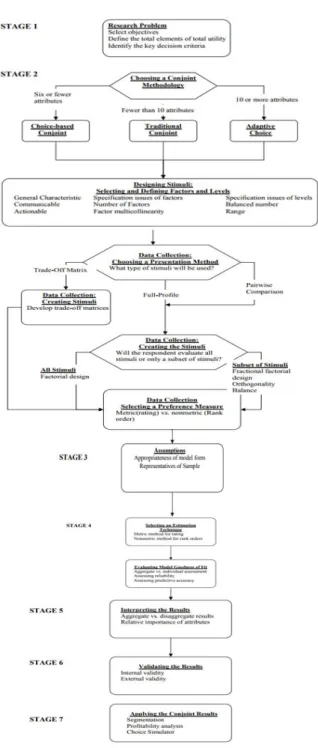
4.2 Stages of Conjoint Analysis ... 45
4.3 Objective of Conjoint Analysis ... 46
4.5 Designing the Conjoint Analysis ... 48
4.6 Conjoint Analysis Methodology Selection ... 49
4.6.1 The Traditional Conjoint Analysis ... 49
4.6.2 Adaptive Conjoint Analysis ... 50
4.6.3 The Choice Based Conjoint Analysis ... 50
4.7 Selecting the Appropriate Method of Conjoint Analysis ... 51
4.8 Types of mortagege and interest rate system offered by Turkish Banks used in the Study ... 52
4.8.1 Fixed Rate Mortgage ... 53
4.8.2 Adjusted Rate Mortgage ... 54
4.8.3 Balloon payment Mortgage ... 54
4.8 Incresing and Decreasing structure of Repayment of loan ... 55
4.9 Conceptual Model ... 56
4.10 Data Preparation for Analysis ... 56
4.5 Data Collection through Survey Cards... 59
4.6 Chapter Summary ... 62
5.1 Data Analysis ... 63
5.2 Results ... 69
6. CONCLUSION ... 79
REFERENCES ... Hata! Yer işareti tanımlanmamış. CV………...94
ABBREVIATION
FRM. Fixed rate mortgage ARM. Adjustable rate mortgage MBS. Mortgage backed security FHA. Federal housing authority
FNMA. Federal national mortgage association GNMA. Govt. national mortgage association TCA. Traditional conjoint analysis
ACA. Adoptive conjoint analysis CBCA. Choice based conjoint analysis
LIST OF TABLES
Page
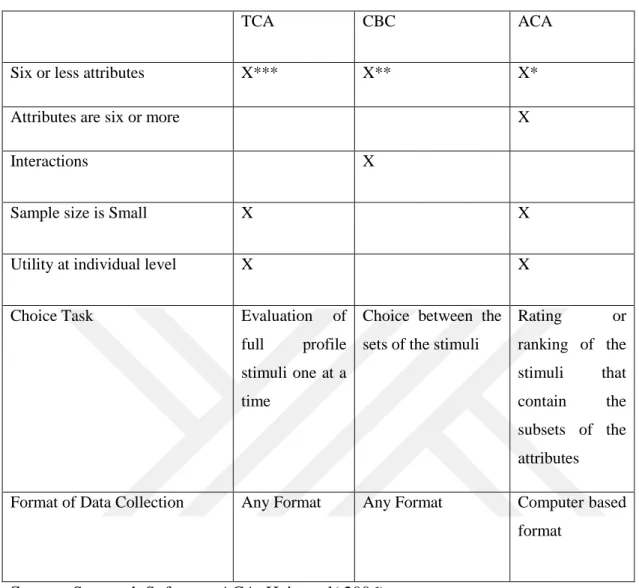
Table 4.1: Criteria for the selection of Conjoint Analysis Methodology….……..,..50
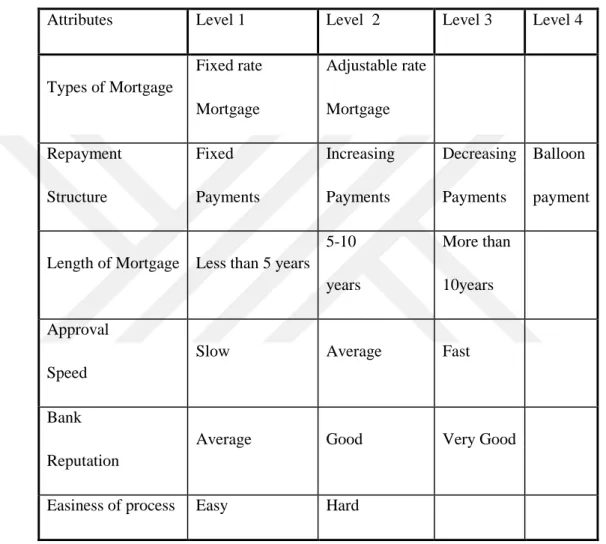
Table 4.2: Attributes and attribute levels of the conjoint study…...55
Table 4.3: Attribute levels for a full-profile, fractional design conjoint study.1-8...56
Table 4.4: Attribute levels for a full-profile, fractional design conjoint study.8-16.57 Table 4.5: Conjoint analysis card 1-4 for respondent rating.………58
Table 4.6: Conjoint analysis card 4-8 for respondent rating.……….…...58
Table 4.7: Conjoint analysis card 8-12 for respondent rating...59
Table 4.8: Conjoint analysis card 12-16 for respondent rating.………59
Table 4.9: Responding Rating.………..60
Table 5.1: Conjoint Study Design……….62
Table 5.2: Respondent’s preference pathway...……….63
Table 5.3: Market Share Simulation...………..….65
Table 5.4: Market Share……….66
LIST OF FIGURES
Page
Figure 2.1 - Mortgage Interest Rate History in the US….……….10
Figure 2.2 - Interest Rate on Mortgage after the year 2009.………..11
Figure 2.3 - Housing Ownership Rates for the US………12
Figure 2.4 - Pf and Brief System……….………...15
Figure 3.1 - Comparison of GDP to Real Estate Growth…….………..21
Figure 3.2 - FDI in Property and FDI Total……….………..23
Figure 3.3 - FDI in Property and FDI Total……….………..23
Figure 3.4 - Population Forecast………25
Figure 4.1: Algorithm of Conjoint Analysis………..43
Figure 4.2: Conceptual Model………...68
Figure:4.3: Predicted Market Share……….………...70
Figure 4.4: Optimal Product 1……….………...70
Figure:5.1: Results of Optimal Product 2……….……….71
Figure 5.2: Results of Optimal product 3………...72
Figure 5.3: Results of Optimal product 4………..74
Figure 5.4: Results of Optimal product 5………..75
TÜRKİYE'DE KONUT FİNANSMANINA İLİŞKİN MÜŞTERİ TERCİHLERİ: KONJOINT ANALİZ İLE BİR ARAŞTIRMA
ÖZET
Her ülkeye etkin bir konut finansmanı sisteminin önemi, bireylerin hem konut ihtiyaçları hem de finans, inşaat ve bu pazarlarla ilgili sektörlerin geliştirilmesindeki güçlendirilmesinin taleplerini karşılama açısından önemi nedeniyle ihmal edilemez. Ülkelerde makroekonomik istikrarın sağlanamamasının başlıca nedenleri arasında, konut finansmanı sektöründe önemli bir gelişme kaydedilmiştir. En önemli gelişmelerden biri de Meclis tarafından onaylanan yeni Mortgage Yasası ile ipotek sisteminin geliştirilmesidir. Bu tezin amacı, Türkiye'de konut ipoteği sistemini analiz etmek ve konut ipoteği almaya karar verirken tüketicilerin tercih ve tercihlerini etkileyen faktörleri vurgulamaktır.
Araştırma, Türkiye'de ipotek sistemine ilişkin tüketicilerin tercihlerinin derinlemesine bir analizini yapmaktadır. Veriler, birincil kaynak kullanılarak toplanmıştır. Katılımcılardan, ipotek piyasalarında önceden belirlenmiş seçeneklerin bir kombinasyonunu içeren 16 karta dayalı tercihlerin sıralanması istenmiştir. Kartlar Excel yazılımındaki Microsoft Engineering aracını kullanarak oluşturularak toplanan veriler tüketicilerin tercihleri hakkında ayrıntılı bilgi veren birleşik analiz gerçekleştirmek için kullanılmıştır. Dolayısıyla, bu araştırma, Türkiye'de konut finans piyasasındaki oyunculara, Türkiye'de ikamet etmeleri nedeniyle tüketicilerin tercihlerini ne almaya istekli olduklarını bilmek için önem taşımaktadır.
CUSTOMER PREFERENCES ON MORTGAGE FINANCE IN TURKEY: A STUDY WITH CONJOINT ANALYSIS
ABSTRACT
The importance of an efficient housing finance system for every country cannot be neglected as it has its significance for meeting the demands of both the housing needs of the individuals and also the reinforcement in developing the finance, construction and the sectors related to these markets. The major reasons for being the unavailability of sources are macroeconomical and political stability in these countries, there has been a significant development in the housing finance sector of Turkey. One of the major developments is the mortgage system development along with the new Mortgage Law approved by the Parliament. The purpose of this thesis is to analyze the mortgage system in Turkey and also to highlight the factors that influence the choices and preferences of the consumers while they decide to take mortgage housing finance.
The research provides an in-depth analysis of the preferences of the consumers with regards to the mortgage system in Turkey. The data was collected through primary source where the respondents were asked to provide their response based on 16 cards that contain a combination of available options in the mortgage markets for the consumer to choose from. The respondents were asked to rank each card according to their preferences. The cards were formed using the Microsoft Engineering tool on the excel software. The data collected was then used to perform conjoint analysis that provided an in depth information about the preferences of the consumers. Therefore, this research has significant importance to provide the players of the housing finance market of Turkey to know what are the preferences of the consumers are willing to take loans for owing their residency in the Turkey.
1. INTRODUCTION
The housing finance is a very broad topic whose concepts may vary based on different continents and regions. The housing finance system of any country can bring together a multi-sector and a complex issue that can be driven by the ever-changing features of the local community that may include the legal environment of the country, the culture of people residing in the country, the economic makeup, environmental regulatory system or the country’s political system. (Loic&Lea, 2009) The entire concept of house finance and housing finance system has been observed to evolve over the time. In mid 80’s the concept was rather regarding the residential mortgage finance system. As discussed by Boleat, Mark (1985) that the sole purpose and objective of housing finance system is providing the home buyers with the finance required for purchasing their homes. The objective of housing finance is however simple but the ways in which it can be achieved is very limited. In the recent years, there has been an introduction of a number of complex and difficult housing finance systems in countries but the essential feature of the housing finance system has been unchanged that is the ability of financial institutes to provide their clients with an opportunity to purchase their own residential home.
The house finance system is, however, in recent years, not limited to the residential mortgage finance but also includes the other forms of mortgage available for the consumers that may include developer’s finance, the finance for rental purpose, or microfinance that is applied for the housing purpose. (Loic& Lea, 2009)
1.1 Basic Concept of Mortgage loans
With accordance to the Anglo-American property law, the term mortgage is used when the owners pledges their interest, having the right of the property, as security or in relation to the loan applied for. The main purpose of the mortgage is to acquire money or loan by securing it with the owner’s property. The mortgage is the primary lending mechanism that is being used in a number of countries in order to finance the
ownership of residential along with the commercial property in the country. However, there might be the difference in the terminologies and the terms that are being used in various countries, along with the different mortgage options available to the consumers in the market to acquire from the financial institutes. The government, in most of the countries, regulates the mortgage system directly or indirectly. Other than this, the system of mortgage in any country can be based on the historical, regional or even derived from the specific characteristics associated with the legal finance system in the country. (Cobandag, 2010)
1.2 Mortgage System in Turkey
The mortgage system in Turkey was unable to make its grounds in the past as a result of unpredictable and substantial inflation rates, the requirements for the large down payments, ambiguities in the country’s economy and the very high rate of interest. The problems are also associated with the shortage of finance with the banks in Turkey along with the lack and shortage of land located in prime locations and the nonavailability of the standardization in the appraisals and the ownership. (Demirhan&Lale, 2006). The mortgage system problems in Turkey is not limited to only these but also include the lengthy procedures of the bureaucracy, the Turkish Market’s dysfunctional nature and one of the most significant issue is the lack of proper infrastructure for legal proceedings.
1.3 History of Mortgage System in Turkey
During the time period, 1960s to the 1990s, major support of the housing finance system was three organizations in almost all the countries of the world. These three institutes include the government institutions, the security institutions and the commercial banks of the respective country. The housing finance market in Turkey was of monopolistic nature where there were only a few entities who dominated the housing finance sector. It was in the 2000s that the mortgage market of Turkey gained growth that too very significantly. This was the result of the changes which were compulsory in the policies regarding the investments of the country’s commercial banks.
The consumer credit in Turkey saw a substantial growth in the year 2003, as a result of the gradual falls with regards to the interest’s rates in the country. This not only resulted in the increase in consumer credit but also there were extensions provided to the term of the loan. It was since then that the conventional mortgage system has evolved and existed in the Turkish housing market. (Tsatsaronis& Zhu, 2004)
The house buyers in the housing finance system of Turkey are bearing the burden of high costs that are a result of the banks that bear the burden along with the risks associated with the nonpayment of assigned credits along with the ban that has been imposed on the variable interest rate application and the cost of operations.
Under the Turkish Civil Code, there are two main types of mortgage options available to the consumers in the Turkish house financing market. These two include: (Kenstaneci, 2015).
1. Principal Amount Mortgage 2. Limit Mortgage
The mortgage system in Turkey is quite complex when we compare it with the rest of the world. It is because there have been many different variables which include the interest rate, the borrowed amount by the consumer, the price of the property that the consumer desires to purchase, issues pertaining to the documentation and permissions. The whole system of mortgage is comparatively new, where the average rate of interest being charged by various banks follows index rate. That is kept at this level in order to encourage and support foreigner investors to invest in the housing market. The entire process of acquiring mortgage loan has been made very easy for the consumers with time. The Turkish banks are offering mortgage amount up to 70%. The major banks in Turkey that offer the mortgage loans include the Garanti Bank, Finansbank, DenizBank, HSBC Bank, ING Bank, Alternative Bank, Sekerbank, IsBank (Turkey Is Banks), and the ZiraatBankasi. (Gokce, 2014)
The mortgages in the Turkish housing finance system are granted to the buildings along with a deed. It is difficult for the consumer to secure the mortgage with respect to a non built property. The consumers are required to fill in their applications forms to start the process of the mortgage with the bank of their choice. The banks charge different fees for the whole processing of the loan.
The loans are even granted to foreigners and that is why, the banks offer loan amount in terms of dollar, Turkish Liras, British pound and Euros. The types of interests in the Turkish market include the fixed and early repayment. People belonging to age group 25 to 70 are all eligible for filing an application. (Pair-Gallop, 1991)
Although new, the mortgage system in the Turkish house financing market is strongly and rapidly making its grounds in the Turkish markets. Both the foreigners and the local actors of the capital market are of the opinion that in order to make it stronger there is a need to develop three favorable conditions. These include the establishment of a stronger legal system, the portfolio of the existing mortgage loan on the Turkish banking system and also a real estate sector that have a promising future for the consumers.
1.4 Research Aim and Objective
The main aim and objective of this research are to highlight the issues that are related to the mortgage system of the housing finance avenues that are available to the consumers in the Turkish housing market.
The research aims to identify the application of the mortgage and also the influence it has on the housing finance sources that are available in the Turkish markets. The research will also highlight the issues and problems that are faced by the consumers in the housing finance activities in the Turkish housing markets. The focus of the research will be mainly on the market of the largest city of Turkey, Istanbul.
The research seeks to summarize the main concepts regarding the mortgage system and focus on the review of the mortgage system that is being followed in the developing and developed countries of the world. This will then be compared to the system of housing finance in Turkish housing markets. The research will also focus on the mortgage development in some of the developed foreign countries and these will be compared with the mortgage development in the Turkish market. The research will also focus on the percentage of mortgage rates that are being used in the Turkey as compared to the other foreign countries. The research will also focus on the economists and other effects that re-associated with the mortgage market in Turkey.
1.5 Significance and purpose of the Research
The significance of this research is due to the fact that Turkey is one of the rapidly growing countries of the world with increasing population. Although the family size in Turkey is small the majority of the population is young people who have high demands for housing properties in the country. Not only the local people of Turkey, but the refugees that are coming to Turkey from the countries which are being affected also creates the demand for residential properties in the Turkish housing market.
These factors are creating a high demand in the recent years for people to own their residential property, but not everyone is able to afford the cost of housing property in the country. Thus creating a high demand and need for the housing finance and loans among the people of Turkey. The rise in the prices of the residential property is also becoming one of the major reasons why the demand for these housing loans has increased in the country.
The main purpose of this research is to focus on the sources and types of housing loans that are available for the consumers in the Turkish house financing market and how the individual consumers prefer to adapt those loans in order to gain housing properties for themselves. The research will focus on the mortgage systems, the housing systems and the problems that are associated with the housing finance system in the Turkish housing market. There has been a significant development in the real estate sector of the Turkish markets. The research will also focus on the housing needs of the individuals in the Turkish Markets based on the increased number of house seekers who looks for funds for purchasing houses for themselves. The significance of this research is also due to the fact that the mortgage system is comparatively new in Turkey and there is still lack of information and any formal empirical analysis related to the mortgage system in the Turkish housing market. This is also mainly because of the fact that there is lack of available data regarding this system in the Turkish Market. The research is of different nature as the main focus will be the analysis of the effect of inflation, the nominal rate of interest and the total number of loans that are given to the consumers on the preference of the house financing consumers in the Turkey.
2. LITERATURE REVIEW: MORTGAGE SYSTEMS IN GERMANY, TURKEY, AND US
2.1 Mortgage Systems In Developed and Developing Countries
In the view of King (2009), there are some key aspects which different the mortgage systems of different countries. Those key aspects vary from characteristics of the mortgage market to the nature of loans and terms of financing prevailing in the country. The nature of mortgage financing in a country is highly dependent on the development stage of a country. Generally, the conditions of financing are more stringent in the developing countries as compared to the developing counterparts. As defined by Greenlaw, Hatzius, Kashyap, and Shin (2008), the mortgage market refers to a credit agreement where the creditor takes over the possession of the real property being mortgaged to obtain the loan in consideration of the loan being granted. Since the property being purchased is not under the use of debtor, therefore, the investment in property is often termed as dead investment from their viewpoint. The mortgage system was pioneered by England to accommodate the housing finance and other long-term loans. The system has emerged with respect to changing needs of the public and passage of time.
For the purpose of this research, the analysis of mortgage systems is performed in the case of US and Germany as developed countries and Turkey being the developing one).
2.1.1 Mortgage Systems in the USA
According to Callis & Kresin (2011), the United States has a typically complex mortgage market including the housing mortgage system. It has been found that both primary and secondary mortgage markets of US are very complex as compared to rest of the world. In addition, the mortgage industry of USA is also classified as largest in the entire globe. According to a research, in the first quarter of 2016, the
mortgage loan was more than six times greater than a student loan and more than 11 times greater than credit card loans in the USA. As per the estimate, the USA mortgage rate in 2015 was 3.5% and the total residential mortgage-backed security issuance was $ 923.5 billion (Facts, 2017).
It is noteworthy to mention that the mortgage system of US started in the shape of housing finance. The US housing financing started back in the 19th century mainly based on informal channels and it has evolved consistently with respect to time. The major developments to formalize the mortgage system housing financing started in early 20th century with the establishment of Federal Administration Bank and The Federal Home Loan Bank. After the establishment of these institutes, the process of housing finance was expedited by the government after the great depression (Colton, 2002). As prescribed by Coles and Hardt (2000), each country despite the level of development has their own housing finance system but it follows the fundamentals of US housing finance. It suggests the validity and reliability of the basic model of housing finance in the UK.
In the USA, the mortgage system is in a way that when a mortgage agreement is initiated, the ownership of collateral security is transferred to the lender on a conditional basis, which is transferred back to the borrower once he repays the entire borrowed mortgage amount. During this period, the lender does not have a right to sell or use the collateral property unless the borrower defaults on payment. The creditor executes a foreclosure process for collateral security if the borrower defaults, which are that the lender files a public default, notice. The collateral security can also be sold by the lender in the auction if this is specifically mentioned in the mortgage agreement (Coles & Hardt, 2000; Markus, Steinfield and Wigand, 2003).
Another type of mortgage lending in the USA is mortgage-backed securities which are the most common way of lending for securitization, in which the lenders create a pool of mortgage loans. The mortgage loan certificates are then sold in the secondary market as securities. The investors who buy the mortgage loan certificates from the pool acquire the share when the amount of mortgage loan is returned. In this way, the lenders increase their cash flow and use it to borrow to other mortgage borrowers in the market. (An Evaluation of Turkish Mortgage System from the Perspective of Global Economic Crisis, 2012).
According to Colton (2002), the mortgage system in the USA does not fully meet the requirements of hypothecation backed mortgaged specifically in civil law countries. In the US, the owner transfers ownership of a property to a trustee who is a third party in the agreement between debtor and creditor. However, it must be noted that the transfer of ownership is conditional and dependent upon the will of both debtor and creditors; the ownership is transferred back to the debtor once has repaid the debt against mortgaged property. In the majority of states of the US, despite having an entitlement to take over the property, the creditors do not take over the property unless there is a case of default. In some cases, the property is left with the debtor himself until such situation arises.
The US law has some conditions which favor the debtor in case of a worse situation. One of those clauses is that any condition in loaning agreement which makes the creditor absolute owner of the property primarily due to non-repayment of debt within the tenure is considered null and void and cannot be exercised in the light of US civil law (Stuart, 2003). In the above-mentioned situation, the creditor has a right to start foreclosure steps against mortgage real property. The law also permits the creditor to sell the house by means of the auction if a condition is put in mortgage agreement at the time of drafting the agreement. However, a minor mistake in the proceedings of the sale of property can be termed as null & void by the court. Therefore, the creditors often persist with foreclosure by taking courts into the process (Colton, 2002).
In the view of Stuart (2003), the US law also permits the creditor to transfer the mortgaged property to a third person. The transfer is performed by the delivery or endorsement of valuable papers; there is a need for official registration besides the delivery or endorsement in the case of a regular mortgage. As the mortgages are often transferred between two financial institutions in the financial market, the requirement to register the property is a core hindrance to this activity. To accommodate the registration process, the US state has already established an electronic mortgage registration system which has resolved the issue to a certain degree (Hawtrey, 2009). As discussed earlier, a common type of mortgage in the US is mortgage-backed securities (MBS). MBS need to go through the process of securitization and their operations mainly take place in secondary markets. To form an MBS, a pool of multiple mortgage loans is formed by the financial institution and
then these securities are sold to investors present in the secondary market by the issuance of certificates similar to shares or bonds. The investors in MBS share the return earned on the loans in the pool; however, they are not obliged to share any cost item of the pool. This illustrates that the investors in MBS are safeguarded against losses and entire credit risk is borne by the bank initiating the mortgage. The advantages of MBS to the issuing bank include the improved liquidity of the bank as a result of cash collection against issuance of the pool (Chatterjee &Eyigungor, 2011).
There are some key institutions operating in the US with the aim to perform mortgage financing duties. Some important of those institutions mainly focused on housing finance are discussed below.
2.1.1.1 Federal Housing Authority (FHA)
The FHA of US was established in 1934 by the department of housing and urban development. The institute was formed keeping some key objectives and needs of the state in mind. Those objectives include the provision of funds to the public at a low-interest rate, provision of guarantee for hypothecation and enhancement of secondary mortgage market in the country. The implementation of these factors has proved to be helpful for low and medium income groups in purchasing home (Hawtrey, 2009). Moreover, the FHA also ensures the default risk by households for the mortgage finance institutions. Today, FHA is the largest mortgage insurance company around the globe with over 34 million accounts insured since its inception (Hawtrey, 2009). 2.1.1.2 Federal National Mortgage Association (FNMA)
According to Wallison and Ely (2000), FNMA was established in 1938 and its main purpose is to organize the secondary market activities in the US. It helps the country balance the demand and supply for housing and enhance the liquidity of the housing market in the US. One of the rules of FNMA states that it will facilitate house loans to only those houses which have obtained a guarantee from the government and are also insured by Federal Housing Authority or Veterans Administration. FNMA has been active in the US mortgage market but it could not reach the desired level over the years. As a result, the FNMA was separated into two new corporations. One of the two counterparts was named New FMNA; it was privately owned and sponsored
by the US government. The purpose of separation was to extend the credit facilities through non-government-guaranteed mortgages (Courchane & Giles, 2001).
2.1.1.3Government National Mortgage Association (GNMA)
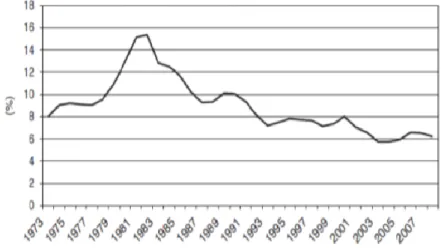
As a result of the division of FNMA, the GNMA was formed as a state-owned enterprise to finance the houses under the same department and ministry. The aims of the newly formed institute were also similar to FNMA; these include the provision of support to secondary markets and provision of insurance to mortgage-backed securities. At the same time, the GNMA aimed to start the securitization process in housing loans in the US. GNMA is wholly reliant on the federal budget and self-financing. The mortgage-backed securities of GNMA are generally insured by the Federal Housing Authority. Further, it is notable that the GNMA is very well reputed in the US; a guarantee obtained by GNMA is similar to a government guarantee which has the highest rating in any society (Hepsen, 2008; Dunn & McConnell, 1971).These are three main institutions handling mortgage lending in the US; there are numerous other institutions performing the same function which include Federal Home Loan Mortgage Corporation and Veterans Administration. These two institutions also perform similar tasks focusing on the issuance of housing mortgages and their insurance. The importance of the role played by these institutions is highly dependent on the housing mortgage loan rates prevailing in the US. The historical mortgage loan rate in the US is depicted in the figure below:
/
Figure 2.1 - Mortgage Interest Rate History in the US Source: Hawtrey (2009).
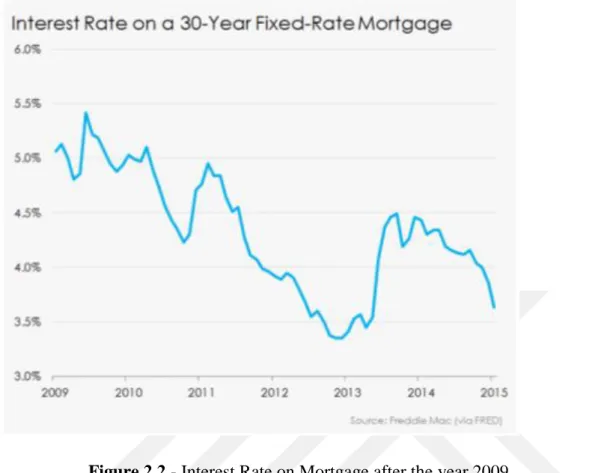
Further, the mortgage rate after these years is shown in the figure below:
Figure 2.2 - Interest Rate on Mortgage after the year 2009 Source: Hawtrey (2009).
The figure above clears that the housing mortgage loan has declined from 8% in 1973 to 6% in 2008 despite very high increase till the year 1983. After 1983, the government has reduced mortgage interest in order to promote the construction and purchase of houses in order to improve the social indicators. The mortgage interest rate was around 3.6% at the end of the year 2015. In this respect, the house ownership rate in the US is shown in the figure below:
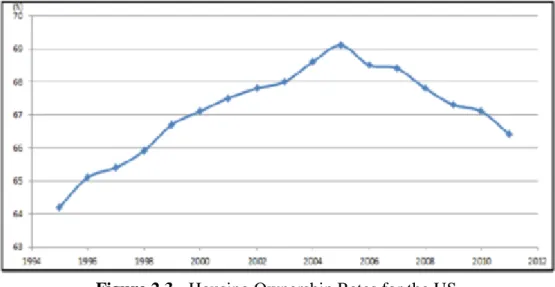
Figure 2.3 - Housing Ownership Rates for the US Source: Callis &Kristin (2011)
The figure above illustrates that the housing ownership rate in the US was continuously rising till the year 2005. It started declining from 2006 due to the anticipation of the crisis in the sector and the rate further went down after the global financial crisis triggered from the US. It can further be noticed from the figure that the ownership rate has not started its recovery till the year 2011. However, despite the downfall in recent years, there is a net increase in ownership rate in the last 20 years (Callis &Kresin, 2011). The above discussion highlights that these institutions boosted the house ownership rate in the country to the extent possible but global financial crisis has affected the confidence of both the investors and debtors.
In the view of DU and CHU (2008), the contribution of US mortgage and financial market towards the construction and supply of houses has been enormous over the years. These institutions have provided shelter to a significant proportion of the population over the years. As a result, the gap between supply and demand has reduced boosting the country’s economy at the same time. The positive impacts of US mortgage market are emphasized as a result of this research. However, there are researchers who have opined the negative prospects of the US mortgage and housing finance market. A research by Markus, Steinfield, and Wigand (2006) on the US mortgage market found that despite the high amount of money involved in the US financial markets, its mortgage market is very risky indeed. With the issuance of Mortgage Based Securities and Asset-Backed Securities, the default risk or credit risk of the loans is very high. It is generally agreed that the Asset-Backed Securities
focus onto provision of loan to the borrowers with lower credit rating and have the capacity to repay as per an analysis of creditor. Therefore, it suggests a high credit risk in the US as the borrower may be able but unwilling to repay the debt. The global financial crises which triggered from the US and affected almost all countries around the globe were also initiated mainly due to the role played by Asset-Backed Securities. It suggests that the US mortgage or housing finance market is highly volatile as compared to other countries (Greenlaw, Hatzius, Kashyap & Shin, 2008).
2.2 Mortgage in Germany
In the view of King (2009), the Germany has struggled with severe housing problems as a consequence of First and Second World War as the housing stocks became very unstable. As a result of World War II, approximately, 80% of the housing in Germany was destroyed or became unstable. Due to this instability, the demand for housing finance and development grew instantly and the higher role of capital markets was desired. According to Çobandağ, (2010), Germany is among those countries which have lowest occupation rate in their housing market, yet the mortgage system of Germany was the firstly used contract system majorly than in the other countries. It has special mortgage banking system and specialists are spread across the financial systems. Banks prefer to use extensive deposits to be used for granting loan over the mortgage market. Germany had the largest market in the Europe for a residential mortgage in 2004, due to mortgage the debt ratio in the GDP ratio in the country with 47.7 percent.
The mortgage market in Germany was dependent on the capital markets rather relying on the depositories. The bank in Germany focuses on bond markets to finance their mortgages which initiated in the 1800s. The mortgage banks are funded by dispensing the mortgage bonds (Geiger, Muellbauer, &Rupprecht, 2016). The Government of Germany regulates the mortgage banks and the mortgage bond markets. The licensed mortgage banks only can issue the bonds of the mortgage. The activity of these licensed mortgage banks are scrutinized and restricts them to lend residential and commercial property and to state and local Governments. Strict regulatory bodies have pertained made the market strong and investors were attracted to it yet borrowers were encouraged to finance their house through a mortgage. Initially, the amount of loan was less than 60% of the value of the asset.
Currently, mortgage lending is dominated by the cooperative banks which hold the 50 percent of the mortgage market; however specialized mortgage bank also has a strong role in the market. The market is supported by the local investors, not by the foreign investors due to competitive market but strict parameters restrict the funding to only loans with a loan to the value ratios of or below 60 percent (King, 2009). A mortgage system accompanied by the contractual method is used in Germany. Different types of financial institutions including savings bank and specialized banks contribute to the housing finance in the country. All of these financial institutions are privately owned and they lend their own capital without any interference by the government. The German law only permits the long-term mortgages and there is a strict prohibition on short-term mortgages given the risk and difficulties involved for the debtor and creditor both (Hepsen, 2008). In the view of Stolz and Wedow (2011), building savings banks in Germany are specialized banks which focus on the provision of mortgage loans for housing. In the modern era, building savings banks are best operated in the Germany and have contributed significantly to the housing sector of Germany. The world is learning from this model and incorporating the necessary actions in their policies and procedures.
2.2.1 German Mortgage System
As prescribed by Stephen (2003), the German housing finance is mainly acquired by a completion of savings contract. The savings contract employs that when an individual is able to save his savings in a bank at a discounted rate in comparison to market can only avail the housing loan at a lower cost. This system generally does not help the lower middle class as seen in the case of US. This system is not friendly for the end debtors; if a guy cannot afford to maintain savings then he will not be able to obtain housing finance and purchase house accordingly. The core objective of this policy by financial institutions is that they operate by keeping mortgage interest loans as low as possible in order to lower the cost of housing finance in the country. The sources of these funds are also individuals who save with the bank at the lower rate and down payment of house to be purchased by debtors to the creditor (Green & Wachter, 2007).
The building savings banks are still operated in the Germany and have achieved success over the time as well. There are total 17 private sectors and 11 public sector
building savings bank in Germany and these have cumulatively built nearly 13 million houses in the country. The funds provided by these banks amounts to 800 Billion Euros since the World War II (Stephen, 2003).
2.2.1.1 Pf and Brief System
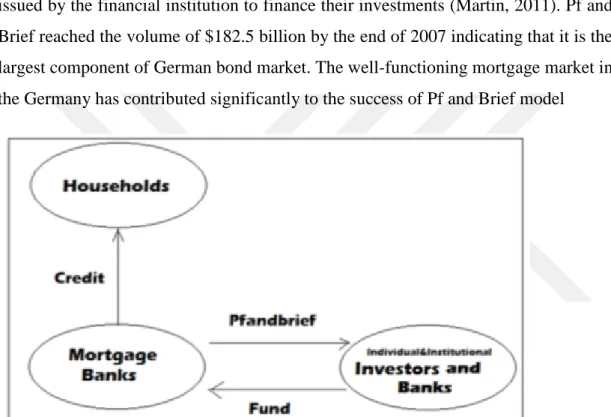
Another type of housing finance system used in the Germany is Pf and Brief System of housing finance. In Pf and Brief model, the housing loan is securitized and the funds are compiled into a pool. After the formation of this pool, the Pf and Brief are issued by the financial institution to finance their investments (Martin, 2011). Pf and Brief reached the volume of $182.5 billion by the end of 2007 indicating that it is the largest component of German bond market. The well-functioning mortgage market in the Germany has contributed significantly to the success of Pf and Brief model
Figure 2.4 - Pf and Brief System Source: Hepsen (2008)
The figure above can help the readers understand the Pf and Brief model currently operating in the Germany. It can be understood from the figure that the credit to households is provided by mortgage banks. However, to finance the credit provided to households, the bank also needs to generate funds at a reasonable cost. In this case, the banks generate funds from the investors and other banks by selling Pf and brief to the investors and collecting funds from them in return (Martin, 2011).
In Germany, mortgage banks are providing housing loans up to tenure of 25 years and finance maximum 60% of the value of the house. Remaining 40% has to be borne by the household applying for a loan. These measures are incorporated in order to limit the default risk on the part of the applicant. When an applicant inputs his own capital equaling 40%, he does not like to be sold through auction and will not like to involve in legal problems by making a default (Hardt & Lichtenberger, 2001). Further, it is mentioned by German lawmakers that the institutions involved in the housing finance cannot bear interest rate risk in addition to high credit risk. Therefore, the mortgage rate on housing finance and the securitized rate remain same at every time in Germany reducing the risk for the mortgage banks. As a result, it is impossible for a household to pay his future installments in advance except when the interest rate is deemed to be fixed for certain period. If the borrowers have become capable and want to repay the loan availed earlier than the end of tenure, they must pay an early repayment penalty to the respective bank as their revenue streams are hit adversely due to early termination of loans (Martin, 2011).
As mentioned in the discussion earlier, the government of Germany does not involve itself in the loaning business directly but it plays a role in the market by providing incentives and tax waivers to the investors and mortgage banks in order to support housing finance. This motivates the private sector to place their investments in the housing finance niche (Proxenos, 2002). From the above discussion, it must be clear that the German mortgage system is one of the efficient systems around the globe and many developing as well as developed countries are imitating their models so that the housing demand and supply can be met effectively. These findings are supported by an earlier research conducted by Hardt and Lichtenberger (2001) as well. This research found that the Germany has developed mortgage system which balances the risks for debtor, creditor, and investors at the same time. It is due to safety policy measures enforced by the government. The financial institutions are prohibited from taking the excess risk while issuing mortgage loan for housing or any other purpose.
2.3 Mortgage in Turkey
According to a research in 2014, Turkey is the 18th largest economy in the world and the 6th largest country in Europe. Turkey is also one of the countries around the
globe, whose population is growing at a much higher rate than the increase in global population. According to Taner (2014), the annual population growth rate was around 4.47% from 2008-2011. The increase in population directly increases the demand for houses in the country and in order to meet the demand, the supply of houses and housing financing needs to be increased. Despite the higher population increase rate and urbanization rate, the supply of housing is increasing at an ordinary pace. This is due to numerous factors and the weak mortgage market is one of the key factors behind lower supply. The mortgage system in Turkey has a huge potential to grow due to a number of factors such as increase in economic activity, increase in population, modernization, etc. The risk of default by borrowers is low in Turkish market due to stringent default risk related policies (Facts, 2017).
After the foundation of Turkish Republic, different housing policies were followed by governments in Turkey. Before its establishment in 2006, there were no private institutions which could involve in the business of housing finance in the country; however, government promoted private sector to contribute to housing finance as well (Taner, 2014; Ansay & Wallace, 2011). Historically, a reasonable housing finance environment has not been established in Turkey despite many improvements in models and policies over the years. As a result, people mostly rely on the personal savings and finance excess requirement by means of informal finance based on their personal relations and channels other than financial institutions. It is evident from the fact that, in the year 1999, approximately 62% of the houses were financed by the personal savings of individuals or households (Taner, 2014; Ansay & Wallace, 2011). However, the Turkish government has taken certain steps recently to improve the situation of housing finance mainly by the introduction of Turkish Mortgage Law as discussed in the following heading.
2.3.1 Turkish Mortgage Law
A draft mortgage law revamping the existing laws of housing finance was introduced to revise the housing finance system in 2007. This law was implemented effective March 6, 2007. It introduced several other laws such as Execution and Bankruptcy Law, Financial Leasing Law, and Law regarding Protection of the Consumers, several tax laws, particularly into the Capital Market Law. The purpose of introducing this law was to create a relationship between investors and consumers to
create a practical condition for a mortgage. However, this law did not succeed in the country (An Evaluation of Turkish Mortgage System from the Perspective of Global Economic Crisis, 2012; Ansay & Wallace, 2011).
The mortgage system in Turkey is such the lenders only provide mortgage facility to people who are high earners as this will provide them an opportunity to yield high adjusted rate of return. In the case of an executive proceeding, the collateral security is sold by tendering process if the borrower defaults on payment. In some cases, the lender can sell the property with borrower’s consent without any executive proceeding. There are housing finance corporations available in Turkey which give information and awareness to the consumers on the interest rates, types of mortgages etc. (An Evaluation of Turkish Mortgage System from the Perspective of Global Economic Crisis, 2012; Ansay & Wallace, 2011). An important feature of Turkish mortgage market is uniformity. There is a consistency in rates, documentation, amortization, the maturity of mortgage in all types of mortgages available in Turkey. The mortgage systems in Turkey also involve the process of the undertaking which is a written directive which assures the lender that the borrower has the ability to return the amount borrowed and the worth of collateral security is similar to the mortgage (Lea, 1994).
Today, the mortgage system in Turkey is complex due to high-interest rates, complex documentation, different laws etc. Its mortgage system is different than other countries. The banks which offer this facility are DenizBank, Finansbank, Garanti Bank, HSBC Bank etc. The borrower will have to fill in an application and submit forms to avail this facility. The mortgage also includes an application fee which is different for every bank (Affidata.co.uk, 2017).
2.3.2 Mortgage System of Turkey
The housing finance of Turkey was established on the basis of US mortgage law. However, the mortgage is not fully applicable in the case of Turkish law and it differentiates the mortgage system in the two countries. As the US mortgage focuses on the transfer of possession of the property to the creditor and also permits the issuance of the mortgage by issuance of a promissory note to hand over the real property to the creditor. The case in Turkey is different; the Turkish law allows the mortgage on the guarantee to property only and no other instrument such as
promissory note is eligible for the issuance of the loan. There is also a stringent civil law which prohibits the acts specified above and financial institutions involved in such acts will have to face severe consequences (Ansay & Wallace, 2011).
The housing finance corporations of Turkey are also required to get the agreement of consumers on terms and conditions of the loan prior to the contractual arrangement and starting of transactions. The housing finance institutes are also required to complete these pre-contractual agreements at least 48 hours before the start of transactions. In the case of an early payment, the law requires the debtors to pay 2% more than the installment expected as the rate can vary. The interest rate is linked to the discount rate prevailing in the economy as the mortgage loan is long-term with tenure around 20-25 years (Chiquier & Lea, 2009).
In the case of default of housing loan, the treatment must be same as that of the consumer loan. Firstly, it is important to serve the debtor with a notice and not to initiate any other action against him simultaneously. In the case where the debtor is not paying installments on a consistent basis, housing finance providers are authorized to terminate the loan agreement. In the case of a termination, there are two methods to collect the entire amount due including interest on their investment. Firstly, they are required to send a notice to the debtor to pay the amount in full within a specified time. In the case of non-compliance, the creditor can sell the property by means of the auction and recover his amount similarly (Chiquier & Lea, 2009).
The housing finance method called mortgage-based securities is permitted under the new Turkish Mortgage system. It is called off the balance sheet method in Turkey; it does not have a legal identity and also do not belong to the assets of the issuer. It is prohibited to dispose of off assets of the fund in the case of losses because it is considered separate from the worth of fund. Further, it must be noted that the Turkish mortgage system was not much affected as a result of Global financial crisis despite a big hit to their banks. It was due to the fact that the Turkish system was not based on securitization and even it is less reliant on securitization in the modern era. Therefore, it did not get a major hit as seen in the case of developed countries where mortgage based securitization was so common (Chiquier & Lea, 2009).
In accordance with Chiquier & Lea (2009), the Turkish mortgage system has historically underperformed due to lack of progress in terms of policy specifics. However, as the new law has been passed, there have been significant changes in Turkish mortgage system and its performance and contribution to housing sector have improved. The public financial institution of Turkey namely TOKI has been able to do financing of houses domestically and has contributed to the economy at the same time. It is now recognized as one of the best housing finance institutions in the developing countries.
3. HOUSING FINANCE SYSTEM 3.1 Turkish Real Estate Market
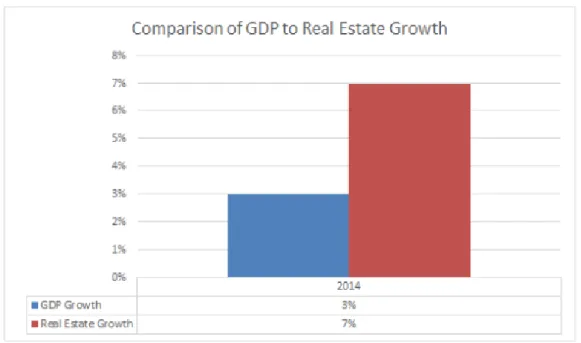
In the view of Crowe, Dell’Ariccia, Igan & Rabanal (2013), the real estate market has seen growth all around the world in the recent decades. It is primarily due to the increase in population as people require houses to live in an increase in affordability of people in general. The real estate market has grown primarily due to investment by investors for the purpose of earning rent and capital gain. In line with global trends, the Turkish real estate market is also grown immensely in the last few years. In accordance with a recent report by Deloitte Turkey partner, Yildirim (2015), the real estate market growth rate even outperformed the GDP growth rate of the country in the year 2014 as supported by the following figure as well. However, the growth in real estate sector has shown a slowdown and as a result GDP growth rate has become higher than the growth rate in real estate.
Figure 3.1 - Comparison of GDP to Real Estate Growth Source: Yildirim (2015).
In another report by Global Property Guide (2017), the prices in the real estate sector went up by around 18% during the year 2016 suggesting a real increase of 8.17%. Conversely, the price went up by around 15% during the same year which implies a real increase of 5.43%. It is further discussed in the report that the future long-term outlook on the sector by financial and real estate analysts is also positive suggesting that price and volume both are expected to increase further. This suggests the potential of real estate in the Turkey and implies that it is one of the important sectors of the economy (Global Property Guide, 2017).
According to Cash4OverseasProperty (2016), Turkey has recently faced numerous socioeconomic problems in the form of terrorist activities as well as the recent attempt of a coup by the military. Despite these destabilizing events, the property in Turkey is surging continuously and is expected to go further up in the years to come. It is mainly due to the interest of foreigners in the real estate of the country. Two big foreign investors in Turkey are China & Arab countries which contribute a significant amount of FDI into the country. It is noteworthy to mention that apart from these nations, the British and German are also highly interested in acquiring real estate property in Turkey. The German population is acquiring property in Turkey because many Germans have Turkish origin and therefore, want to have some property in their country of origin. On the other hand, the British are impressed due to the leisure facilities, beaches and living standards in Turkey and therefore, are interested in acquiring property as well (Cash4OverseasProperty, 2016).
The report by Yildirim (2015) further illustrates that the foreigner investment in real estate in Turkey forms a sufficient portion of total FDI in the country. This usually varies around 20% to 30% of total FDI in each year. The growth of foreign investment in FDI can be traced to the fact that it was USD 2,013 Million in 2011 and after growth over 5 years, it reached USD 4,156 Million in 2015 despite a minor dip in 2015 when real estate sector and GDP growth rate of Turkey experienced negative growth. The trend line of total FDI investment and foreign investment in real estate sector is shown in the figure below:
Figure 3.2 - FDI in Property and FDI Total Source: Invest in Turkey (2017).
Further, the trend in foreign investment in property is shown in the trend line below:
Figure 3.3 - FDI in Property and FDI Total Source: Invest in Turkey (2017).
The figure above suggests that the FDI in property was growing persistently till the year 2014 but it saw a dip in the year 2015.
In accordance with Plazzi, Torous and Valkanov (2010), the real estate sector growth is affected by a number of factors both sector based and macroeconomic variables. Four of those key factors influencing growth are price, population, income on average and interest rate prevailing in the country. All four variables are discussed briefly in the following sub-sections.
3.1.1 Price effect
According to Iacoviello and Neri (2010), the pricing of houses plays an important role in the determination of growth of real estate market. It must be noted that likewise other sectors, the growth in this sector is also generated as a result of demand and supply in the market. As the demand exceeds supply, the prices go up and vice versa. As prescribed by Cash4OverseasProperty (2016), the pricing in the housing market of Turkey is high because of both foreign and local investment in the sector leading to higher demand. The pricing has started to hinder the growth in the sector as well because everyone cannot afford a home then as seen in the year 2015. It is also noteworthy that many people cannot even afford housing financing given the markup expense and repayment capacity of the borrowers.
3.1.2 Population effect
In the view of Saiz (2010), one of the major causes in increasing demand for houses is due to growth in population. As the population grows, people need shelter so their purpose is to purchase a house for their living or take on the rental agreement. In both cases, the increase in population contributes to the demand for housing and hence affects each and every dimension of real estate sector. The population of Turkey is around 77.7 million at the end of 2014 and its median age is about 30 years at the end of same year. According to the Association of Real Estate, the urbanization rate in Turkey is 78%; it suggests that the urban population of 60 million in 2014 will be 71 million in 2023 (TOKI, 2017). The graph showing a forecast of the population is shown below:
Figure 3.4 - Population Forecast
Source: WorldoMeters (2017).
It suggests that both population and urbanization in Turkey are expected to grow steadily and increase the demand for the housing sector and contribute to its growth. In the case of Turkey, the population grew at 1.3% in the year 2013 and grows more than 1% in the years following as well (1.22% in the year 2016). It suggests a high growth rate in population and illustrates that demand for housing will further be boosted in the years to come. It implies that the housing sector will continue experiencing higher growth as the shelter is a basic need of individuals (WorldoMeters, 2017).
3.1.3 Income effect
Many researchers have stated that the higher income of people is quite necessary to achieve sufficient growth in the real estate sector in any country. As the GDP per capital increases, the investment in real estate also increases at a rate similar to that of income. The rate of growth of property can even be higher than the growth in income because real estate growth is affected by multiple factors at any given time (Iacoviello and Neri, 2010). Though the GDP per capital growth in case of Turkey has fluctuated the housing market has grown which is possibly due to the investment by foreigner into the housing sector of Turkey (World Bank, 2017).
3.1.4 Interest Rate Effect
As explained by Plazzi, Torous, and Valkanov (2010), all the financial markets are highly correlated regardless of whether these are based on financial assets or real assets. Therefore, the discount rate or market interest rate plays an important role in determining the demand for housing and eventually growth in the sector. As the interest rate goes up, investors find it unattractive to invest in risky real estate assets and find it easier to invest in the bond market. In the case of Turkey, the interest rate has been on the average side. Therefore, it is perceived that the interest rate affects the growth of housing sector negatively because investors find it reasonable to invest in bond markets.
Overall, the discussion on Turkish Real Estate market shows that the sector has grown immensely in the recent years and is further expected to grow considering both domestic and international investment into the country. It is noticeable from the discussion that key factors affecting real estate markets are also positive for the outlook of the sector in Turkey. In a nutshell, it can be stated that the real estate property in Turkey is a desirable investment and contributes significantly to the economy of the country.
3.2 Housing Finance History in Turkey
According to Davis and Van Nieuwerburgh (2014), the need for housing finance arises as a result of rapid urbanization and poverty in the developing countries. As a result of non-affordability, the government in developing countries often provides individuals with subsidized housing finance as the shelter is one of three basic needs of an individual. In line with other developing countries, the public of Turkey also requires housing finance to afford houses in the urban areas as the percentage of house ownership is 70% suggesting that other 30% still require houses. It is widely agreed that Turkey has been able to improve the system of housing finance to cater its demand. However, the housing finance in Turkey is still not sufficient to meet the needs of potential house buyers as only 3% of the housing finance is derived from business system suggesting an insufficient role of the banks (Yildirim, 2015).
In the view of Özdemir (2011), likewise, other countries, the purpose of housing finance in Turkey is to provide finances to individuals who tend to buy houses and
builders who want to build a housing project. An effective housing finance institution in the society leads to the easy purchase of housing by common individuals and hence increases demand for housing in the country. It has many multiplier effects on income, employment, and GDP of the country. As per the constitution of Turkey, article no. 56 and 57 housing is a basic social and economic right of common public and therefore, it is important to finance houses in the economy for better satisfaction of needs of individuals (Özdemir, 2011). In order to accomplish the objectives of housing finance, a developmental financial institution named TOKI was formed in the 1980s which are directly looked over by the chief of state. The TOKI is termed as a great housing financial institution considering the development taken place in real estate after its formation. The first successful period of TOKI was between 1984 and 2002 when the institution was able to develop 43,145 houses around the country and it also financed 940,000 houses during the same 19 year period.
However, despite milestones achieved by TOKI, the housing supply in Turkey is unable to match the housing demand in the country. As a result of this shortfall, the number of illegal houses is on a rise. It refers to the construction of a building on a public land or owned by someone else. During the five-year period ending 2000, the demand for new houses was estimated to be more than 2.5 million houses and only 1.3 million houses were built during the same period suggesting a significant shortfall during the period. This shortfall does not only pertain to these specific years but is observed in Turkey generally (Coşkun, 2016). Further, in the view of Coşkun (2016), the main reason behind the construction of shanty or illegal houses is due to the fact that people with lower income are not considered in housing plans because of inaccessibility to housing finance and non-affordability of that particular segment. It is further argued that due to excess amount of illegal houses present in Turkey, it appears to have sufficient houses to accommodate citizens. However, if those houses are removed or not considered into the analysis, there is a strong need for construction of houses in Turkey even in 2017.
Historically, Turkey has opened various institutions to accommodate housing finance over the decades. Last public sector institution was TOKI, which is already highlighted under discussion. After the formation of TOKI in the 1980s, it has been able to finance some portion of unsatisfied housing needs in the real estate sector. TOKI is key institutional public development to not only finance the housing in the
country but perform development acts at the same time. Currently, TOKI is performing effectively but the lack of capital available to TOKI is hindering its growth and therefore, the major chunk of excess housing demand is still not met by the supply (TOKI, 2017; Coşkun, 2016).
Though the historical aspects suggest that there are severe problems pertaining to housing finance in Turkey, some measures have been taken recently to improve the situation. The improvements are primarily due to studies carried out by TOKI and other milestones achieved in the perspective of housing finance and development of the sector as a whole. Numerous other steps have also been taken by regulatory authorities to better the public; these steps include the focus on insurance of houses and fast registry system (Turel & Koc, 2015).
Though Turkey has a fast housing registry system and housing insurances are available in the country by the public sector but there are numerous challenges faced by the sector in Turkey as well (Turel & Koc, 2015). These challenges have hindered the growth of housing finance in the country over the years and these can be resolved by taking the following measures:
• Firstly, there is a need to define the housing finance and primary borrowers in the books of Turkish law.
• As the time needed to foreclose the mortgage is significantly higher in Turkey like other developing countries, there is a need to form regulations which can reduce the mortgage closure time. These may include expediting all the processes necessary before the mortgage is issued.
• As the appraisal of the property is weak and slow in Turkey, there is a strong need to regulate appraisal profession including both individual appraisals and companies doing the same business.
• The regulation of customer service issues is also needed in Turkey alongside other strategies.
• The mortgage capital market instruments also need to be regulated.
• The secondary financial markets are highly important so it is important to regulate secondary market institution as well.