MANTAR DERGİSİ/The Journal of Fungus Ekim(2019)10(2)87-90
87
Geliş(Recevied) :22/04/2019Kabul(Accepted) :17/05/2019 Araştırma Makalesi/Research Article Doi:10.30708mantar.556750
Psathyrella typhae, a new macrofungus record for Turkey
Raziye İLERİ
1, Yasin UZUN
2, Abdullah KAYA
3**Corresponding author: [email protected]
1Karadağ Private Anatolian High School, 70100 Karaman, Turkey
Orcid ID: 0000-0002-7290-1778/ [email protected]
2,3Karamanoğlu Mehmetbey University, Science Faculty, Department of Biology, 70100
Karaman, Turkey
2Orcid ID:0000-0002-6423-6085/ [email protected] 3Orcid ID: 0000-0002-4654-1406/ [email protected]
Abstract: The basidiomycete species Psathyrella typhae (Kalchbr.) A.Pearson & Dennis,
was given as new record for Turkey. A brief description of the species is provided together with its photographs related to its macro and micromorphology.
Key words: Biodiversity, new record, Psathyrellaceae, taxonomy, Turkey
Psathyrella typhae,
Türkiye için yeni bir makromantar kaydı
Öz: Bir bazidiyomiset türü olan Psathyrella typhae (Kalchbr.) A.Pearson & Dennis, Türkiyeiçin yeni kayıt olarak verilmiştir. Türün kısa deskripsiyonu, makro ve mikromorfolojisine ilişkin fotoğrafları ile birlikte verilmiştir.
Anahtar kelimeler: Biyoçeşitlilik, yeni kayıt, Psathyrellaceae, taksonomi, Türkiye Introduction
Psathyrella (Fr.) Quél. is a genus of
Psathyrellaceae (Kirk et al., 2008). The members of the
genus have a saprotrophic habit and mainly characterized by a membraneous, hygrophanus, straight margined pileus with a cellular pileipellis composed of ellipsoid more or less rounded cells, reddish-brown to brownish-black spore deposit, smooth or rarely granulose basidiospores. Most species of the genus are thought to be cosmopolitan and grow on soil or wood, while some grow on dung or other substrates (Kits van Waveren, 1985; Vašutová, 2008; Seok et al., 2010; Yan and Bau., 2018).
Yan and Bau (2018) mention about the existance of approximately 500 species of the genus while Index Fungorum presents 1037 records, 637 of which are confirmed species (Index Fungorum, 2019).
Though 50 members of the genus have so far been reported from Turkey (Sesli and Denchev, 2014; Güngör et al., 2014, 2015; Demirel and Koçak, 2016), the current checklists (Sesli and Denchev, 2014; Solak et al., 2015) and the latest contributions (Işık and Türkekul,
2017; Kaşık et al., 2017; Öztürk et al., 2017; Uzun and Acar, 2018; Sadullahoğlu and Demirel, 2018; Sesli, 2018; Keleş, 2019; Acar et al., 2019; Özkazanç and Yeşilbaş Keleş, 2019; Türkekul and Işık, 2019) indicate that Psathyrella typhae has not been reported before.
The study aims to make a contribution to Turkish mycobiota.
Materials and methods
The macromycete samples were collected from central district of Karaman province in 2016. The fruit bodies were photographed in the field and necessary morphological and ecological characteristics were recorded. Then the specimens were transferred to the fungarium within paper bags. Investigation related to its microscopy were carried out under a Nikon Eclipse Ci trinocular light microscope by mounting the specimen in water, Congo red and Melzer’s reagent. The samples were identified by comparing the obtained data with Boudier (1897), Kotlaba (1952), Redhead (1979), Moser (1983) and Breitenbach and Kränzlin (1995). The specimens are kept at Karamanoğlu Mehmetbey
MANTAR DERGİSİ/The Journal of Fungus Ekim(2019)10(2)87-90
88
University, Kamil Özdağ Science Faculty, Department of Biology.
Results
Basidiomycota R.T. Moore
PsathyrellaceaeVilgalys, Moncalvo & Redhead
Psathyrella typhae (Kalchbr.) A. Pearson &
Dennis
Syn: [Agaricus typhae Kalchbr., Drosophila typhae (Kalchbr.) Romagn., Pilosace typhae (Kalchbr.)
Kuntze, Psathyra typhae (Kalchbr.) Sacc., Psathyra
typhae var. iridis Boud., Psathyrella typhae f. acori J.
Veselský, Psathyrella typhae var. bispora Kits van Wav.]
Macroscopic and microscopic features: Pileus
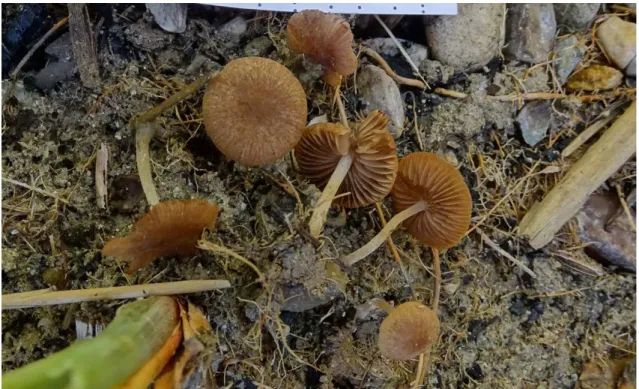
8-16 mm in diameter, hemispherical when young, convex to almost plane when mature, some slightly umbonate, dull, hygrophanous, pale brown to greyish brown with a
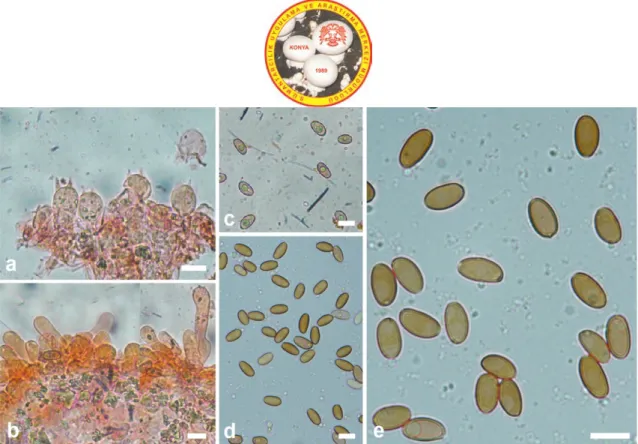
darker center, margin acute and slightly crenate. Flesh thin, taste mild, odour insignificant. Lamellae ochraceous to light brownish or brown, adnexed. Stipe 8-18 × 0.7-1.7 mm, cylindrical, slightly enlarged towards the base, hollow, fragile, generally whitish above, light to greyish brownish below, finely tomentose especially towards the base (Figure 1). Basidia 15-29 × 9-13 µm, 4-spored. Cheilocystidia 20-60 × 8-18 µm. Basidiospores 9-12.5 × 5-7.5 µm, ellipsoid, oil drops visible especially in Congo red, germ pore indistinct, some with tiny apiculus, brownish (Figure 2).
Ecology: Psathyrella typhae was reported to grow
on dead parts of various aquatic plants, especially Typha L. species (Redhead, 1979; Breitenbach and Kränzlin, 1995).
MANTAR DERGİSİ/The Journal of Fungus Ekim(2019)10(2)87-90
89
Figure 2. Basidia (a), cheilocystidia (b) and basidiospores (c-e) of Psathyrella typhae (bars 10 μm) (a-c in Congo red; d,e in Melzer)
Specimen examined: Karaman, Dereköy village,
on decaying remains of Typha latifolia L. in muddy soil, 37°12′N-33°26′E, 1100 m, 09.05.2018, K.12952.
Discussions
Psathyrella typhae was given as new record for
the mycobiota of Turkey. General characteristics of the specimen, studied here, are in aggreement with those given in literature (Redhead, 1979; Breitenbach and Kränzlin, (1995).
Morphologically P. typhae is closely related to P.
lacuum Huijsman and P. rubiginosa A.H. Sm. and P. sulcatotuberculosa (J.Favre) Einhell. Psathyrella lacuum
is distinguished from P. typhae by its white pileal color with a grey to brownish grey centre. P. rubiginosa differs by the presence of pleurocystidia and darker spores. P.
sulcatotuberculosa differs by sulcate pileal margin and
smaller spores (Smith, 1972; Redhead, 1979; Kits van Waveren, 1985; Battistin et al., 2014).
Sesli and Denchev (2014) and Solak et al. (2015) list 47 Psathyrella species occurring in Turkey. Later on three species, P. sacchariolens Enderle, P. canoceps (Kauffman) A.H. Sm.
and P. pseudovernalis A.H. Sm.,
were also added to this list by Güngör et al. (2014, 2015) and Demirel and Koçak (2016) respectively. With the addition of P. typhae, the current taxa number of the genus Psathyrella in Turkey increased to 51.
Acknowledgement
The author would like to thank Karamanoğlu Mehmetbey University Research Fund (14-YL-16) for its financial support.
References
Acar, İ., Uzun, Y., Keleş, A., Dizkırcı, A. (2019). Suillellus amygdalinus, a new species record for Turkey from Hakkari Province. Anatolian Journal of Botany, 3(1): 25-27.
Battistin, E., Chiarello, O., Vizzini, A., Örstadius, L., Larsson, E. (2014) Morphological characterisation and phylogenetic placement of the very rare species Psathyrella sulcatotuberculosa. Sydowia, 66(2): 171-181.
Boudier, J.L.É. (1897). Nouvelles espèces ou variétés de champignons de France. Bulletin de la Société Mycologique de
France, 13(1): 11-18
Breitenbach, J., Kränzlin, F. (1995). Fungi of Switzerland, Volume 4. Boletes and Agarics, Switzerland: Verlag Mykologia. Demirel, K., Koçak, M.Z. (2016). Zilan Vadisi’nin (Erciş-VAN) Makrofungal Çeşitliliği. Mantar Dergisi, 7(2): 122-134. Güngör, H., Solak, M.H., Allı, H., Işıloğlu, M., Kalmış, E. (2014). New macrofungi records to the Turkish mycobiota.
Biological Diversity and Conservation, 7(3): 126-129.
Güngör, H., Solak, M.H., Allı, H., Işıloğlu, M., Kalmış, E. (2015). New records for Turkey and contributions to the macrofungal diversity of Isparta Province. Turkish Journal of Botany, 39(5): 867-877.
MANTAR DERGİSİ/The Journal of Fungus Ekim(2019)10(2)87-90
90
Işık, H., Türkekul, İ. (2017). A new record for Turkish mycota from Akdağmadeni (Yozgat) province: Russula decolorans (Fr.) Fr. Anatolian Journal of Botany, 1(1): 1-3.
Kaşık, G., Aktaş, S., Alkan, S. and Öztürk, C. (2017). Additions to the Macrofungi of Selçuk University Alaeddin Keykubat Campus (Konya). The Journal of Fungus, 8(2): 129-136.
Keleş, A. (2019). Mycena ustalis, a new record for the mycobiota of Turkey. Anatolian Journal of Botany, 3(1): 18-20. Kirk, P.M., Cannon, P.F., Minter, D.W. and Stalpers, J.A. (2008). Dictionary of the Fungi, 10th ed., Wallingford: CAB
International.
Kits van Waveren, E. (1985) The Dutch, French and British species of Psathyrella. Persoonia, suppl. 2: 1-300.
Kotlaba, F. (1952). Křehutiěka orobincová - Psathyrella typhae (Kalchbr.) Kühner in Favre v Československu. Česká
Mykologie, 8-10: 169-175.
Moser, M. (1983). Keys to Agarisc and Boleti: Polyporales, Boletales, Agaricales, Russulales. Stutgart: Mad River Pr Inc. Özkazanç, N.K., Yeşilbaş Keleş, Y. (2019). Macrofungi of Küre Mountains National Park in Bartın region of Turkey. Turkish
Journal of Forestry, 20(1): 8-14.
Öztürk, C., Pamukçu, D., Aktaş, S. (2017). Nallıhan (Ankara) İlçesi Makrofungusları. Mantar Dergisi, 8(2): 60-67. Redhead, S.A. (1979). Psathyrella typhae. Fungi Canadensis No. 133.
Sadullahoğlu, C., Demirel, K. (2018). Flammulina fennae Bas, A new record from Karz Mountain (Bitlis). Anatolian Journal
of Botany, 2(1): 19-21
Seok, S.J., Kim, Y.S., Kim, W.G., Kwon, S.W., Park, C. (2010). Notes on some new species of Psathyrella. Mycobiology, 38(4): 323-327.
Sesli, E. (2018). Cortinarius ve Lyophyllum Cinslerine Ait Yeni Kayıtlar. Mantar Dergisi, 9(1): 18-23.
Sesli, E. and Denchev, C.M. (2014). Checklists of the myxomycetes, larger ascomycetes, and larger basidiomycetes in Turkey. 6th edn. Mycotaxon Checklists Online (http://www.mycotaxon.com/resources/checklists/sesli-v106-checklist.pdf): 1-136.
Smith, A.H. (1972) The North American species of Psathyrella. Memoirs of the New York Botanical Garden 24: 1-633. Solak, M.H., Işıloğlu, M., Kalmış, E. and Allı, H. (2015). Macrofungi of Turkey, Checklist, Volume- II. İzmir: Üniversiteliler
Ofset.
Türkekul, İ., Işık, H. (2019). Macrofungal Biodiversity of Reşadiye (Tokat) District. Acta Biologica Turcica 32(2): 95-101. Uzun Y., Acar İ. (2018). A New Inocybe (Fr.) Fr. Record for Turkish Macrofungi. Anatolian Journal of Botany, 2(1): 10-12. Vašutová, M. (2008): Taxonomic studies on Psathyrella sect. Spadiceae. Czech Mycol., 60(2): 137–171.
Yan, J.Q., Bau, T. (2018). The Northeast Chinese species of Psathyrella (Agaricales, Psathyrellaceae). MycoKeys, 33: 85-102.