
FRIENDSHIP, CRISIS AND ESTRANGEMENT: U.S.-ITALIAN RELATIONS, 1871-1920 A Ph.D. Dissertation by Bahar Gürsel Department of History Bilkent University Ankara March 2007
FRIENDSHIP, CRISIS AND ESTRANGEMENT: U.S.-ITALIAN RELATIONS, 1871-1920
The Institute of Economics and Social Sciences of
Bilkent University
by
BAHAR GÜRSEL
In Partial Fulfillment of the Requirements for the Degree of DOCTOR OF PHILOSOPHY
in
THE DEPARTMENT OF HISTORY BILKENT UNIVERSITY
ANKARA
I certify that I have read this thesis and have found that it is fully adequate, in scope and in quality, as a thesis for the degree of Doctor of Philosophy in History.
---
Asst. Prof. Dr. Timothy M. Roberts Supervisor
I certify that I have read this thesis and have found that it is fully adequate, in scope and in quality, as a thesis for the degree of Doctor of Philosophy in History.
---
Asst. Prof. Dr. Nur Bilge Criss Examining Committee Member
I certify that I have read this thesis and have found that it is fully adequate, in scope and in quality, as a thesis for the degree of Doctor of Philosophy in History.
---
Asst. Prof. Dr. Edward P. Kohn Examining Committee Member
I certify that I have read this thesis and have found that it is fully adequate, in scope and in quality, as a thesis for the degree of Doctor of Philosophy in History.
--- Asst. Prof. Dr. Oktay Özel Examining Committee Member
I certify that I have read this thesis and have found that it is fully adequate, in scope and in quality, as a thesis for the degree of Doctor of Philosophy in History.
---
Asst. Prof. Dr. Tanfer Emin Tunç Examining Committee Member
Approval of the Institute of Economics and Social Sciences ---
Prof. Dr. Erdal Erel Director
ABSTRACT
FRIENDSHIP, CRISIS AND ESTRANGEMENT: U.S.-ITALIAN RELATIONS, 1871-1920
Gürsel, Bahar
Ph.D., Department of History
Supervisor: Assist. Prof. Dr. Timothy Mason Roberts April 2007
In the 1870s, the united Kingdom of Italy brought together nearly the whole Italian peninsula under a single flag, and the United States left behind a civil war and strengthened the country and its institutions. This dissertation is an account of the relations between the United States and Italy from 1871 to 1920. This era witnessed numerous important incidents like the mass Italian immigration to America beginning in the 1880s, military service and the problem of naturalization, the lynchings of Italian immigrants particularly in the southern United States, anarchism in both countries, Italian colonialist activities in North Africa, the beginning of American overseas expansion, and World War I. By analyzing both countries’ laws, political circumstances, internal affairs and ideological developments, the dissertation aspires to explore the aspects that shaped Italian and American foreign relations. While emphasizing these features, it seeks to clarify the fact that the main issue which both countries focused on was national greatness.
Keywords: United States, Italy, foreign relations, late nineteenth century, Risorgimento, World War I
ÖZET
DOSTLUK, BUNALIM, YABANCILAŞMA: A. B. D.-İTALYA İLİŞKİLERİ, 1871-1920
Gürsel, Bahar Doktora, Tarih Bölümü
Tez Yöneticisi: Yard.Doç. Dr. Timothy Mason Roberts Nisan 2007
1870’li yıllarda Birleşik İtalya Krallığı neredeyse bütün İtalyan yarımadasını tek bir bayrak altında toplamış ve Amerika Birleşik Devletleri de bir iç savaşı geride bırakıp ülkeyi ve kurumlarını güçlendirmişti. Bu tez, 1871 ve 1920 yılları arasında Amerika Birleşik Devletleri ve İtalya arasında gelişen ilişkileri anlatmaktadır. Sözü geçen dönem, İtalya’dan Amerika’ya 1880’li yıllarda başlayan kütlesel göç, askerlik hizmeti ve vatandaşlığa kabul edilme sorunu, özellikle Birleşik Devletler’in güney eyaletlerinde İtalyan göçmenlerinin linç edilmesi, her iki ülkedeki anarşizm hareketleri, Kuzey Afrika’da İtalya’nın kolonileşme faaliyetleri, Amerika’nın denizaşırı genişlemesinin başlangıcı ve Birinci Dünya savaşı gibi sayısız önemli olaya şahit olmuştur. Bu tez, her iki ülkenin yasalarını, siyasi koşullarını, içişlerini ve ideolojik gelişmelerini inceleyerek, İtalya ve Amerika’nın dış ilişkilerine şekil veren şartları belirlemeyi hedeflemektedir. Bu konuların üzerinde dururken, aslında her iki ülkenin de içişleri ve dış ilişkilerinde odaklandığı ana unsurun ulusal büyüklük olduğunu vurgulamaya çalışmaktadır.
Anahtar Kelimeler: Amerika Birleşik Devletleri, İtalya, dış ilişkiler, Risorgimento
ACKNOWLEDGEMENTS
First of all, I would like to thank my parents for supporting me throughout my entire life. Thanks to their presence, I have learned the meaning of self-confidence and sanguinity.
Next, special thanks to Dr. Mehmet Kalpaklı for providing me much-needed support. If I did not have the chance to go to Rome by benefiting from the financial aid of Bilkent University’s Department of History, this dissertation could never be written. I am indebted to my supervisor Dr. Timothy M. Roberts who is one of the most patient and concerned people in the world. He gave the entire manuscript a very careful reading for several times. Thanks to all of my dissertation committee members, Dr. Nur Bilge Criss, Dr. Edward P. Kohn and Dr. Tanfer Emin Tunç for their constructive criticism and comments. I would also like to thank Dr. Oktay Özel for his everlasting encouragement and support.
As a consequence of the warm friendship which Drs. Gülriz Büken and Paul Latimer provided, the long and painful process of writing a dissertation became less difficult for me. I would also like to express my gratitude to Prof. John Grabowski and Prof. Rudolph J. Vecoli. I really do appreciate their intellectual kindness and support.
Finally, all of my love and thanks to my beloved friends… v
TABLE OF CONTENTS ABSTRACT iii ÖZET iv ACKNOWLEDGMENTS v TABLE OF CONTENTS vi CHAPTER 1. INTRODUCTION 1
1.1The Argument and its Context 2
1.2 Sources 8
1.3 Dissertation Blueprint 10
CHAPTER 2. THE UNITED STATES AND THE ITALIAN PENINSULA: THE PRELIMINARY ERA 16
2.1 Italy before the Unification 16
2.2 The Italian Revolutions of 1848 and American Responses 21
2.3 The Unification of Italy 27
2.4 Garibaldi, “Washington of Italy 30
2.5 Mazzini and a Transatlantic Risorgimento 34
2.6 Italy, Rome and the American Civil War 39
2.7 Rome, the Italian Capital 46
2.8 Conclusion 48
CHAPTER3. IMMIGRATION, NATURALIZATION & CITIZENSHIP 51
3.1 Changing Times, Changing Immigrants: Italians in 19th Century America 53
3.2 Send them to L’America!: Italian “birds of passage” 54
3.3 Americans and Italian Immigrants 58
3.4 American Concept of Citizenship and Military Service 63
3.5 Italian Concept of Citizenship and Military Service 71
3.6 The Controversy 75
3.7 Immigration and Citizenship: The Case of Garibaldi 79 vi
3.8 “Good Americans” or “Good Italians” 82
3.9 American Duty to American Citizens 84
3.10 Disagreement over Dual Citizenship and a Naturalization Treaty 94
3.11 Conclusion 98
CHAPTER 4. MYTH OR REALITY? AMERICAN AND ITALIAN STEREOTYPES 101
4.1 The Definitions 102
4.2 Christopher Columbus 104
4.3 Giuseppe Garibaldi in America 114
4.4 Anarchists and Mobsters 119
4.5 American Heroes, Italian Dreams 127
4.6 Conclusion 131
CHAPTER 5. LYNCHING: A NEW PHASE IN U.S.-ITALIAN RELATIONS 133 5.1 Lynching, an “American practice” 135
5.2 Were Italians really “white”? 137
5.3 The Rehearsal and the Actual Mass Mob Lynching 141
5.4 The Tampa Lynching 146
5.5 Private Lynchings 150
5.6 Italian Lynchings in Colorado 155
5.7 Italian and American Reactions to Italian Lynchings 158
5.8 Conclusion 168
CHAPTER 6. THE MALFATTORI: ITALIAN ANARCHISM AND ITALIAN ANARCHISTS IN THE U.S. BEFORE WORLD WAR I 171
6.1 Luigi Galleani and La Cronaca Sovversiva 176
6.2 Carlo Tresca alias “Carluccio” 179
6.3 Conclusion 182
CHAPTER 7.American Imperialism: The Italian Perspective 188
7.1 The Spanish-American War 189
7.2 Italy and the Venezula Crisis of 1902-1903 200
vi
7.3 Conclusion 206
CHAPTER 8. AMERICA AND AFRICA: DIFFERENT TYPES OF ITALIAN COLONIALISM 209
8.1 From the Heirs of Ancient Rome to a “Proletariat Nation” 210
8.2 Italian Government’s Emigration Policy 216
8.3 Italian Agricultural Colonies in the United States 221
8.4 Tontitown 224
8.5 Conclusion 229
CHAPTER 9. THE IMPACT OF WORLD WAR I ON U.S.-ITALIAN RELATIONS 234
9.1 Americans and the Italian Army 235
9.2 Woodrow Wilson and the Italians 241
9.4 The War and the Peace Conference 253
9.5 Conclusion: Friendship, Crisis and Estrangement 257
CHAPTER 10. CONCLUSION: SACCO AND VANZETTI: TWO ITALIANS IN AMERICA 260
BIBLIOGRAPHY 264
APPENDICES A. Monongah Mine Disaster 281
B. The FBI Files-Carlo Tresca 288
C. Goiran’s Italian Army 301
D. Woodrow Wilson’s Fourteen Points 308
LIST OF TABLES
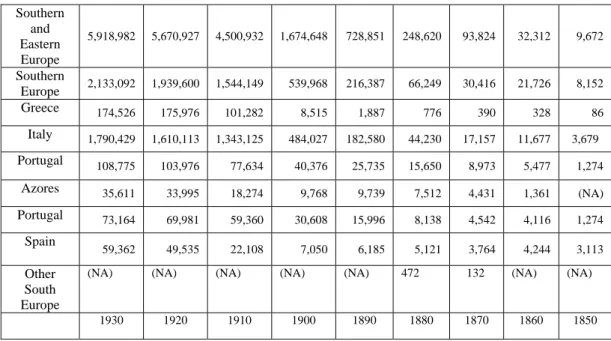
1. Region and Country or Area of Birth
of the Foreign-Born Population 50
LIST OF FIGURES
1 Map of Italy in 1815 15
2 Garibaldi Guard! 41
3 Two Boy Scouts Talking to Two Italian Immigrant Boys 64
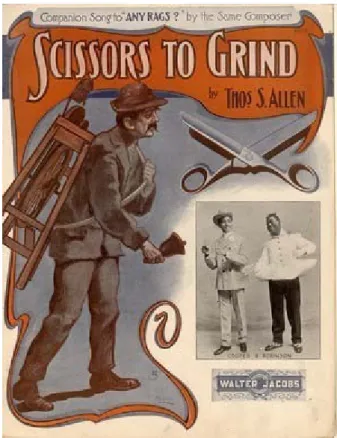
4 “Scissors to Grind” 121
5 “When Verdi Plays the Hurdy Gurdy” 122
6 The Murdered Policeman 142
7 Albano & Ficcarotta 149
8 I Cinque Poveri Italiani 153
9 Theodore Roosevelt and Judge Bernard Barasa 205
10 Father Pietro Bandini 232
11 Father Bandini Celebrating Mass in Tontitown 233
12 The entrance of the Monongah coal mine after the explosion 283
CHAPTER 1
INTRODUCTION
U.S.-ITALIAN RELATIONS, 1871-1920
This study is an account of the relations between the United States and Italy from 1871 to 1920, and the story of two young nations aspiring to global power, and the relationship they made to contribute to the acquisition of power. The late nineteenth and the early twentieth centuries witnessed numerous events that brought the United States and Italy into relations with each other, especially the mass Italian immigration to America beginning in the 1880s. This mass immigration precipitated other issues including problems of citizenship, military service, and naturalization, and the lynchings of Italian immigrants particularly in southern United States. Other issues that involved both countries were anarchism, Italian colonial activities in the late nineteenth and early twentieth centuries, the beginning of American overseas expansion, and World War I. By analyzing the relationship between popular attitudes and policy-making in both countries, this dissertation will trace the intersections of cultural and diplomatic history in Italian and American foreign relations.
1.1 Argument and Its Context
There are only a few works about Italian foreign policy concerning history before World War I. Exceptions are the works of Federico Chabod and R. J. B. Bosworth. Chabod’s work, Italian Foreign Policy was first published in 1951.1 It covers the period between 1870 and 1896. Chabod thought that foreign policy is based not only on “pure diplomacy,” but also on the ideologies, the social conditions, and the internal developments of a country. In addition to that, Chabod focused on the importance of the individuals that shaped Italy’s foreign policy. He stated in his work “the deeds of a single statesman always make a difference to the course of events.”2 Chabod also emphasized one aspect’s continuity in Italian foreign policy. According to him, there was a “growing nationalistic sentiment” going back to Mazzianism that “grounded itself solely in the power, prestige, and greatness of Italy alone.”3
In Italy, the Least of the Great Powers, R. J. B. Bosworth also emphasized the lasting effects of the Italian sense of national greatness, but he made a distinction between the essence and style of Italian foreign policy.4 Bosworth focused on the period between 1902 and 1915 and emphasized that fascism did not represent change in the ideas about Italy’s greatness and establishing the third Rome. Only the style of Fascist Italy was different from the style of the liberal period. “The foreign policy of Liberal Italy was more covert, more hesitant, more verbally restrained than of fascist Italy, but it was not different in kind; instead, from the Risorgimento to the
1
Federico Chabod, Italian Foreign Policy: The Statecraft of the Founders, William McCuaig, trans., (Princeton: Princeton University Press, 1996).
2
Ibid., xiiv.
3
Ibid., 66.
4
R. J. B. Bosworth, Italy, the Least of the Great Powers: Italian Foreign Policy Before the First World War (London: Cambridge University Press, 1979).
fall of fascism, Italy pursued the foreign policy of the least of the Great Powers.” The motto was always the same: “to be strong and to seem strong.” 5
The analyses made by Chabod and Bosworth are accurate to a great extent. There was continuity in Italian foreign relations, and particular policy-makers like Agostino Depretis and Giovanni Giolitti influenced the development of domestic and diplomatic affairs. Hence this dissertation will attempt to reflect the Italian sense of greatness that continuously increased throughout the late nineteenth and the early twentieth centuries.
Older historical works about U.S.-Italian relations concentrate on two major stages: The Risorgimento period and the post-World War I era. H. Nelson Gay, an early twentieth century expert of Italian culture and history, wrote about the early stages of Italo-American relations and the consequences of World War I.6 Howard R. Marraro devoted his work to the diplomatic relations between the United States and Italy during the Risorgimento. Marraro’s works like Diplomatic Relations between the United States and the Kingdom of the Two Sicilies, L’unificazione Italiana Vista dai Diplomatici Statunitensi [The Unification of Italy from the Eyes of the American Diplomats], Relazioni fra l’Italia e gli Stati Uniti [Relations between Italy and the United States] and American Opinion on the Unification of Italy, 1846-1861 uncover most of the aspects of the American public and diplomatic opinion about the Italian unification as well the diplomatic correspondence of chief American officials such as George Perkins Marsh, the first U.S. minister to Rome.
5
Ibid., 419.
6
H. Nelson Gay, Le Relazioni fra l’Italia e gli Stati Uniti, 1847-1871 [The Relations between Italy and the United States, 1847-1871] (Roma: Nuova Antologia, 1907); La Miopia del Congresso di Parigi, L’Ingiustizia dei Mandati Coloniali [The Myopia of the Congress of Paris, the Injustice of the Colonial Mandates] (Milano: Tip. Popolo d’Italia, 1927).
More recent dissertations written about U.S.-Italian relations focus on the period after the 1920s. These are Carl James Francese’s “United States Policy toward Italy on Arms Limitation and War Debts, 1929-1933” (University of Houston, 1982), Eric Steven Edelman’s “Incremental Involvement: Italy and the United States Foreign Policy, 1943-1948” (Yale University, 1981), John Lamberton Harper’s “The United States and Italian Economy, 1945-1948” (Johns Hopkins University, 1981), Emory Timothy Smith’s “The United States, Italy and NATO: American Policy toward Italy, 1948-1952” ( Kent State University, 1981) and David F. Schmitz, “United States Foreign Policy toward Fascist Italy, 1922-1940” (Rutgers University, 1985). Published works appearing recently are Daniela Rossini’s Il Mito Americano nell’Italia della Grande Guerra [The American Myth in Italy in the Great War], and Christopher M. Sterba’s Good Americans7. Italian fascism, World War II, and America’s Cold War policy towards Italy have all found their place in historical analysis.
In describing American foreign policy, Michael H. Hunt’s ideological approach is going to be useful in this dissertation. In Ideology and U.S. Foreign Policy8 Hunt examines and rejects two preceding approaches to American foreign policy. In The Tragedy of American Diplomacy, William Appleman Williams stressed the importance of an economic national interest in American foreign policy based on expansionism, whereas George F. Kennan in American Diplomacy explained the driving force of American foreign policy as “the pursuit of national interest free from the vagaries of short-sighted legislators, moralizing critics, and an
7
Daniela Rossini, Il Mito Americano nell’Italia della Grande Guerra, (Roma: Laterza & Figli Spa, 2000); Christopher M. Sterba, Good Americans: Italian and Jewish Immigrants during the First World War (Oxford: Oxford University Press, 2003).
8
ignorant public.”9 By referring to United States foreign policy, Kennan stated that the responsibility of the governments is to conduct diplomacy, and moral considerations in foreign relations are related to the governments, not to individuals or entire people.10
As Hunt indicates, there is a strong relation between policy making and ideology, and “foreign policy ideologies are sets of beliefs and values, sometimes only poorly and partially articulated, that make international relations intelligible and decision making possible,”11 Ideologies help historians to understand diplomatic relations more easily and clearly. The practices of the policy makers reflect both their ideologies and the general public opinion about the world affairs.
From this perspective, culture, as well as ideology, becomes an important aspect in foreign policy. As Hunt indicates, “ideology cannot be understood apart from cultural context, relationships of power, and the creation, transmission, and interpretation of meaning.”12 The culture widely shared and absorbed by the society from which the policy makers come shapes their ideologies. In short, ideology has a distinct relation with culture, and that also should attract the attention of diplomatic historians.
According to Hunt, there are three ideologies that shaped American foreign policy: the quest for national greatness, the attitudes toward foreigners in terms of a racial hierarchy, and a general pessimism about foreign revolutions.13 The idea of national greatness was related to Thomas Paine’s idea about the “power to begin the
9
Ronald Steel, “Birth of an Empire,” Reviews in American History 16(1988), 151.
10
George F. Kennan, “Morality and Foreign Policy,”
http://www.foreignaffairs.org/19851201faessay8456/george-f-kennan/morality-and-foreign-policy.html, Jan5, 2007.
11
Michael H. Hunt, “A Round Table: Explaining the History of American Foreign Relations: Ideology,” The Journal of American History, 77(1990) 108.
12
Ibid., 110.
13
world again,”14 and goes back to the establishment of the United States. Hunt explains U.S. expansionism by revealing a dominant “Anglo-Saxonism” in American foreign policy, by which the United States was regarded as “a greater England with a noble destiny.” With the arrival of immigrants, the racial differences became clearer and a hierarchy among the European nationalities appeared. At the top, there were Americans and the English. The Irish and the Germans, who “lost their love for liberty” came after. At the third level there were the Spaniards and Italians who “lacked vigor; they were sentimental, undisciplined and superstitious, and consequently they were of small account in international affairs.”15 Lastly, American opinions about revolutions were related to the American interest in the political and social changes abroad, especially how dangerous and violent they were likely to be. In brief, “American policy makers measured the worth of other peoples and nations against a racial hierarchy. They displayed hostility toward revolutions that diverged from the American norm, especially those on the left. Finally, they were convinced that national greatness depended on making the world safe for liberty.” 16
Principally, this dissertation will examine Hunt’s ideas about national greatness and racial hierarchy. Each chapter will approach the development of the United States and Italian foreign policies from these two perspectives, and will emphasize their influence and continuity in Italo-American relations. Both nations were seeking greatness, which impacted their foreign policies and the way Italian immigrants to the United States were treated in both countries. It will also show that American ideologies about national greatness and racial superiority generally
14 Hunt, Ideology, 20. 15 Ibid., 17. 16 Ibid., 171.
clashed with Italian opinions about nationalism, italianitá and ethnic supremacy as well the designs about world hegemony. Cultural and social expressions of nativism and prejudice impacted United States and Italian foreign policies. The main idea of the dissertation is to point out that American and Italian foreign policies developed according to the dominant American and Italian national ideologies, and they did not display drastic changes throughout the indicated time period.
It will be noted that the dissertation does not study the Vatican’s approach to Italo-American relations in the era. Firstly, Italy was an independent country from the Holy See, which during Italian unification was deprived of its former secular powers. There was a solid rivalry and suspiciousness between the monarchy and the Vatican, and many Italians had strong anticlerical feelings in the late nineteenth and the early twentieth centuries. In this period, Italian anticlericalism lived its most intense phase because of the emergent liberal, republican, nationalist, and socialist movements in the peninsula. Mazzinians and the Italian socialists hated each other, but the Church, regarded as the greatest enemy of the newly emerged country of the Italians, was largely isolated from policy making and did not play a major role in the relationship between the two countries. The Italian immigrants in the United States practiced a type of Catholicism known as the Virgin Mary cult. They regarded themselves as Catholics, but they did not obey the orders of the Catholic Church since it symbolized oppression and tyranny for the poor and illiterate Italian. Nevertheless, Catholicism became a significant aspect preserving the italianitá of the immigrants, as an outcome of Italian nationalism’s development.
1.2 Sources
The primary sources for U.S.-Italian foreign relations are rich and give the opportunity to analyze both American and Italian attitudes. The major source about the American perspective is The United States Foreign Relations correspondence (FRUS). This correspondence includes the translation of the Italian documents sent to the United States and the records of the Paris Peace Conference in 1919. Also, the papers of the United States presidents like Woodrow Wilson are useful in comprehending the relations between Italy and the United States. Additionally, the FBI files about the Italian American anarchist Carlo Tresca are noteworthy in comprehending the American attitude about anarchism.
Italian diplomatic sources like I Libri Verdi [The Green Books] issued by the Italian Ministry of Foreign Affairs on specific occasions-like honoring a diplomatic success, or representing the aspects of an international crisis-constitute a significant source for explaining Italo-American relations. The records of the Ministry of Foreign Affairs’ Historical Diplomatic Archive present a wide range of information about the Italian diplomatic presence in the United States, the Commissariato dell’Emigrazione (Commissary of Emigration), and the Italian Office of Immigration and Protection at Ellis Island.17 In addition, the pamphlets about
17
Cinzia Maria Aicardi e [and] Alessandra Cavatella, I Fondi Archivistici della Legazione Sarda e della Rappresentanze Diplomatiche Italiane negli U.S.A. (1848-1901) [The Archival Sources of the Sardinian Legation and Italian Diplomatic Representation in U.S.A. (1848-1901)] (Roma: Istituto Poligrafico e Zecca dello Stato, 1988); Patrizia Catani e [and] Roberto Zuccolini, I Fondi Archivistici dei Consolati in Chicago, Cleveland, Denver, New Orleans e San Francisco Conservati presso L’Archivio Storico Diplomatico [The Archival Sources of the Consulates in Chicago, Cleveland, Denver, New Orleans and San Francisco Conserved in the Historical Diplomatic Archive] (Roma: Istituto Poligrafico e Zecca dello Stato, 1990); Laura Pilotti, L’Ufficio di Informazioni e Protezione dell’Emigrazione Italiana di Ellis Island [The Italian Office of Information and Protection on the Ellis Island] (Roma: Istituto Poligrafico e Zecca dello Stato, 1993).
immigration laws and regulations published by the Commissariato dell’Emigrazione of the Ministry of Foreign Affairs specify the Italian attitude about immigration.18 Apart from the diplomatic sources about U.S.-Italian relations, there is also a broad variety of resources that clarify the different aspects about the subject. Both American and Italian magazines and newspapers are important to understand the conditions and the atmosphere of the times. In addition to the newspapers with large circulation like The New York Times, the influential Italian American newspapers like The Progresso Italo-Americano (Italian-American Progress) and La Fiaccola (The Torch), and the socialist and anarchist newspapers like L’Avvenire (The Future) and La Cronaca Sovversiva (The Subversive Chronicle) are significant to realize the consequences of certain incidents both in Italy and among the Italian immigrants in the United States.
Furthermore, the works composed by Italian writers about the United States, and by American writers about Italy in the nineteenth and twentieth centuries are beneficial. The accounts of the American and Italian travelers provide anecdotal impressions about the two countries.19 The revolutions of 1848 and their
18
Disposizioni sull’Emigrazione [Arrangements about Emigration], Legge 31 Gennaio 1901, n. 23 e sulle Tutela delle Rimesse e dei Risparmi degli Emigranti Italiani all’Estero, Legge 1° Febbraio1901, n.24 Annotato [Law 31 January, n. 23 about the Protection of the Remittance and the Savings of the Italian Emigrants Abroad, Law 1°February1901, n.24 Annotated] (Milano: Ditta Editrice Libraria Luigi di Giacomo Pirola, 1901); Ministero degli Affari Esteri, Commissariato dell’Emigrazione [Ministry of Foreign Affairs, Commissary of Emigration], Leggi, Regolamenti, Norme
Complementari della Legge sull’Emigration [Laws,Regulations, Complementary Rules of the Law of Emigration] (Roma: Cooperativa Tipografica Manuzio, 1910); Ministero degli Affari Esteri, Commissariato dell’Emigrazione [Ministry of Foreign Affairs, Commissary of Emigration],
Istruzioni a chi Intende Emigrare per gli Stati Uniti [Instructions for whom Intend to Emigrate to the United States],(Roma: Stab. Tip. Società Cartiere Centrali, 1913).
19
For detail, see Jenny Frenchot, Roads to Rome: The Antebellum Protestant Encounter with Catholicism (Berkeley: University of California Press, 1994); Klaus Lanzinger, Jason’s Voyage: The Search for the Old World in American Literature. A Study of Melville, Hawthorne, Henry James, and Thomas Wolfe (New York: Peter Lang, 1989); Giuseppe Massara, Viaggatori Italiani in America (1860-1970) [Italian Travelers in America (1860-1970)] (Roma: Edizioni di Storia e Letteratura, 1976); William L. Vance, America’s Rome: Catholic and Contemporary Rome (New Haven: Yale University Press, 1989).
repercussions attracted the attention of many contemporary American intellectuals.20 In addition, some late nineteenth-century books reveal the Italian attitude about American imperialism, and the Spanish-American War of 1898 in particular.21 Finally, and more importantly, American history books written by Italian writers display the nineteenth-and the early twentieth-century Italian views about American history, politics, institutions and society.22
1.3 Dissertation Blueprint
The last part of this introduction outlines the chapters that constitute the dissertation. The dissertation is divided into thematic chapters to display the features of the relations between the U.S. and Italy thoroughly. The second chapter is about the preliminary period of U.S.-Italian relations between 1796 and 1870.
20
See Sara Antonelli, Daniele Fiorentino e [and] Giuseppe Monsagrati, a cura di [eds. al.], Gli Americani e la Repubblica Romana del 1849 [The Americans and the Roman Republic of 1849], (Roma: Gangemi Editore, 2003); Daniele Fiorentino e [and] Matteo Sanfilippo, a cura di [eds. al.], Gli Stati Uniti e L’Unità d’Italia [The United States and Italian Unification] (Roma: Gangemi Editore, 2004); Margaret Fuller, “These Sad but Glorious Days”: Dispatches from Europe, 1846-1850, Larry J. Reynolds and Susan Belasco Smith eds, (New Haven: Yale University Press, 1991)
21
Domenico Bonamico, Comandante [Commander], Il Conflitto Ispano-Americano [The Spanish-American Conflict] (Roma: Rivista Marittima, 1898); Alfredo Feliciangeli, la Guerra Ispana-Americana, 1898 [The Spanish-American War, 1898] (Roma: Enrico Voghera, 1898); Augusto Pierantoni, Cuba e il Conflitto Ispano-Americano [Cuba and the Spanish-American Conflict] (Roma: Stabilimento Tipografico della Tribuna, 1898); Timone (pseud.), Riflessioni sulla Guerra Marittima tra Spagna e Stati Uniti, in relazione alla Marina Nostra [Reflections about the Maritime War between Spain and the United States in Relation to our Navy] (Napoli: Stabilimento Tipografico R. Pesole, 1898); Ferruccio Vitale, La Politica Imperialista degli Stati Uniti [The Imperialist Policy of the United States] (Firenze: Ufficio della Rassegna Nazionale, 1901).
22
Diego Angeli, La Repubblica Stellata [The Star Republic] Firenze: R. Bemporad & Figlio, Editori, 1918); Umberto Biasoli, Piccola Storia degli Stati Uniti d’America [A Short History of the United United States of America], (Milano: Antonio Vallardi, 1917); Vito Garretto, Storia degli Stati Uniti d’America del Nord, 1492-1914 [History of the United States of America of North, 1492-1914] (Milano: Librico Hoepli, 1916); Rodolfo Giani, Storia degli Stati Uniti d’America [History of the United States of America] (Milano: Carrera, 1902); Luigi Rava, La Fortuna di Beniamino Franklin in Italia, Prefazione al Volume “Beniamino Franklin” di Lawrence Shaw Mayo [The Success of Benjamin Franklin in Italy, Preface to Lawrence Shaw Mayo’s “Benjamin Franklin”] (Firenze: R. Bemporad & Figlio, Editori); Gedeone de Vincentiis, L’America del Nord [North America] (Napoli: Luigi Pierro Tip.-Editore, 1905).
Commencing with the accounts of the late eighteenth- century travelers, this chapter focuses on the incidents like the 1848 revolutions, the creation and fall of the Roman Republic, the Risorgimento, and the American Civil War in the diplomatic relations between the two countries.
Chapter 3 is about immigration, the related issue of naturalization, and the problem of military service. After indicating the different implications of immigration for the United States and Italy, this chapter discusses naturalization as a diplomatic problem between the two countries. Naturalization, which was regarded by the United States as a standard consequence of immigration, emerged as a huge risk for the Italians since it represented the loss of a significant number of Italian subjects. Since American and Italian officials had conflicting opinions about immigration, the outcome was a problem in Italo-American relations, especially after the mass immigration of the 1880s. This problem turned out to be most perceptible during World War I when the two countries argued about the compulsory military service of Italian Americans in their mother country.
Chapter 4 is about American and Italian stereotypes. As an outcome of the miscellaneous information about Italy among Americans, Italian stereotypes were often depicted as an organ grinder, or a vicious Mafia member, but sometimes they turned out to be republican heroes who saved their country like Guiseppe Garibaldi. This dualism in American images of Italians owed to the conflict between Americans’ racial prejudice in the late nineteenth century, and the effect of the Italian Risorgimento on the American public. On the other hand, the American images among Italians generally were heroes and saviors from George Washington to Woodrow Wilson, resembling ancient Roman personages. In brief, Chapter 4
explains the importance of cultural images in shaping ideologies, and consequently foreign policies.
Chapter 5 focuses on the lynching of Italian immigrants, including Italian Americans who had gained U.S. citizenship, by “native” Americans, especially in southern states. This chapter explains lynching as an outcome of American racial attitudes and Italian immigrants’ settlement patterns. In addition, it demonstrates that the two countries could not comprehend the basis of each other’s legal institutions like American federalism and the Italian Civil Code; each lynching incident in the late nineteenth and the early twentieth centuries brought these institutions into collision. The Italian immigrants, who chose to live within their “colonies”, and sometimes under the protection of their own illegal organizations like the Mafia, did not assimilate. Thus, they were victimized by vigilantism, the ultimate safeguard of the American racial order at the time.
Chapter 6 is about anarchism. It concentrates on the definition of anarchism in United States and Italy, and highlights anarchist leaders like Carlo Tresca and Luigi Galleani who lived in America, and had a significant effect on the American working class. Anarchism emerged as diplomatic problem especially after the assassinations of the Italian King Umberto I in 1900 by Gaetano Bresci (an Italian immigrant in America) and President William McKinley in 1901 by Leon Czolgosz (a Polish immigrant), which initiated a fierce discussion about anarchism on both sides of the Atlantic. The problem about immigrant anarchists turned out to be one of the most important and urgent issues in the agenda of American politicians. Anarchism, which had its background in Europe (communist anarchism, socialist anarchism, anarcho-syndicalism), and the United States to a certain extent (individual anarchism that focused on the individuals’ non-violent, passive
resistance to the system), turned out to be a common danger for the two countries’ political systems. The consequences of the problems about immigration and the negative Italian stereotype revealed themselves again in relation to the international problem of anarchism.
Chapters 7 and 8 demonstrate the features of American imperialism and Italian colonialism respectively. Firstly, the definition of expansionism from the Italian and American perspectives is given. The motives that directed Italy and the United States to expansionism are discussed. Additionally, Italy’s aspiration of establishing “agricultural colonies” on the American continent is described in Chapter 7 as another problematic outcome of the Italian perception of emigration and colonization. Lastly, the two countries’ opinions about their policies of colonialism and imperialism are explored in this part.
Chapter 9 focuses on World War I and its consequences in U.S.-Italian relations. It demonstrates the different American and Italian ideologies in entering the war, the role of Woodrow Wilson in the war for the two countries, the meaning of “irredentism” for the Italian and American governments, and the American and Italian opinions about each other’s armies. The Paris Peace Conference appears to be the vital point in the deterioration of Italo-American relations; the different expectations by the end of the war and during the conference became the reasons for the Italian frustration about the United States and Wilson in particular by 1919. This final chapter serves as a conclusion that symbolizes the termination of a significant era in U.S.-Italian relations. The cordial friendship which had started after the 1848 revolution came to an end with the Treaty of Versailles, and Italian frustrations about America were transformed first into fury and then resentment. The rise of fascism in Italy after 1922 was related to the immense Italian frustration and sense
of isolation in response to the United States’ attitude during the Peace Conference. Mussolini’s fascism initiated a new period in Italo-American relations that was going to last until the end of the Second World War. During that era, the two countries’ divergent ideologies and policies clashed, and U.S.-Italian cordiality was not recover until the Cold War.
In brief, this dissertation seeks to concentrate on the neglected and crucial period of U.S-Italian relations from the establishment of the united Kingdom of Italy in the early 1870s to the end of World War I. By study of the cultural and diplomatic histories of the two countries, their different ideologies, perspectives and practices are going to be revealed in the subsequent chapters. Each part will focus on an essential theme that uncovers these differences and disputes between the United States and Italy. While exposing the two countries’ emerging differences, the dissertation is going to argue that the basis of these differences was anchored in the greatest similarity between the United States and the united Kingdom of Italy; each countries’ longing for national greatness.
Italy before Risorgimento
CHAPTER 2
THE UNITED STATES AND THE ITALIAN PENINSULA:
THE PRELIMINARY ERA
By 1871, the kingdom of Italy brought together nearly the whole Italian peninsula under a single flag, and the United States left behind a civil war that united the country and its institutions. This chapter will seek to concentrate on the initial, often telescopic U.S.-Italian relations before the Risorgimento, which would frame the future relations between the two countries. In pursuing that, the accounts of individual travelers from both countries, as well as the diplomatic correspondence between Italy and the United States are going to be utilized.
2.1 Italy before the Unification: 1796-1846
At the beginning of the nineteenth century, the Italian peninsula was under French control. The Treaty of Vienna, concluded in 1815 after the final defeat of Napoleon at Waterloo, restored the map of Italy to a state similar to that of 1748.1 As the Austrian Chancellor, Prince Klemens Wenzel Lothar Metternich stated, Italy was only a geographical expression in the early nineteenth century. Nevertheless,
1
Derek Beales, The Risorgimento and the Unification of Italy (London: George Allen & Unwin Ltd, 1971) 39.
the most important consequence of Napoleon’s rule in Italy “was to establish in men’s minds the idea that Italy could become a unitary state.”2
During this period, the Italian elite became interested in America. In 1821, the poet Vittorio Alfieri wrote his L’America Libera [Free America], which consisted of five odes after the surrender of the English at Yorktown. In 1791, Count Paolo Andreani from Milan brought a copy of L’America Libera as a present to the United States President George Washington. He became a member of the American Philosophical Society, moved to Louisiana, and stayed in America long enough to write to Thomas Jefferson in 1808 from New Orleans. Another Milanese count, Luigi Castiglioni wrote the first Italian travel book about America under the title, Viaggio negli Stati Uniti dell’America Settentrionale fatto negli 1785, 1786, 1787 [Journey made in Northern United States of America in 1785, 1786, 1787]. Castiglioni also became a member of the American Philosophical Society.3 These writers composed their works on a romantic basis. America was a mysterious land where people made a revolution against an empire, and united their country.
Benjamin Franklin appears to be one of the prominent figures of the eighteenth-century Italo-American cultural and intellectual contact. He regularly corresponded with Padre Beccaria and other Italian scientists like the mathematician and physicist, Paolo Frisi, and the translations of his Information to Those who would Remove to America were published in Padova and Cremona in 1785.4 Nonetheless, the most well known Italo-American companionship in the eighteenth century was the one of Thomas Jefferson and his Florentine neighbor in Virginia,
2
John Gooch, The Unification of Italy (London: Routledge, 1989) 3.
3
For detail, see Giuseppe Massara, Viaggatori Italiani in America (1860-1970) [Italian Travelers in America (1860-1970)] (Roma: Edizioni di Storia e Letteratura, 1976), 11-13.
4
Filippo Mazzei.5 For Monticello’s garden, Jefferson asked for help from Mazzei who brought him orange trees, vaga loggia peach, the angelica apricot, the baccon di re plum, and the Poppe di Venere [Breast of Venus] peach from Italy. In return, Jefferson sent birds, seeds, and plants of Virginia to the Grand Duke of Tuscany with Mazzei.6
Pursuant to the Treaty of Vienna, Italy from 1815 to 1846 was divided into seven sovereign states: the Kingdom of Piedmont, the Kingdom of Lombardy-Venetia, the Grand Duchy of Tuscany, the Duchy of Modena, the Kingdom of Parma-Piacenza, the Papal States, and the Kingdom of the Two Sicilies. Austrian archdukes ruled Modena and Tuscany. Parma, which had been under Spanish rule, became an Austrian dukedom in 1815. An Austrian viceroy in Milan governed the Kingdom of Lombardy-Venetia. The Papal States, under the rule of the Pope, consisted of Lazio, Umbria, the Marches, and the Romagna. The Kingdom of the Two Sicilies was under the control of the Spanish Bourbon, King Ferdinand IV. San Marino and Monaco were other small Italian states. In short, “this was Metternich’s Italy-a country of small states dependent on Austria’s good-will and so organized as to be a bulwark against any revival of revolutionary tendencies.”7 The Kingdom of Piedmont, which consisted of the Piedmont region in northern Italy and the island of Sardinia, turned out to be the most significant threat to Metternich’s Italy. By the second half of the nineteenth century, the Dukes of Savoy became the kings of the united Kingdom of Italy.
5
For detail, see Howard R. Marraro, “The Four Versions of Jefferson’s Letters to Mazzei,” The William and Mary College Quarterly Historical Magazine 22 (1942), 18-29; “Jefferson’s Letters Concerning the Settlement of Mazzei’s Virginia Estate,” Mississippi Valley Historical Review 30 (1943), 235-42; “Unpublished Mazzei Letters to Jefferson,” The William and Mary Quarterly 1 (1944), 374-396.
6
William Howard Adams, Jefferson’s Monticello (New York: Albeville Press, 1983), 182-183.
7
The first official correspondence between the United States and the Kingdom of Sardinia occurred on January 28, 1818 when Vittorio Adolfo Sasserno became the first American consul in Nice where he resided until the end of 1849. Gaspare Deabbate became the first representative of the Sardinian Kingdom in the United States on 18 May 1820, during James Monroe’s presidency.8 Robert Wickliffe, Jr. of Kentucky served as the American representative in Turin between 1843 and 1848. He supported the construction of a railroad from Turin to Genoa, and believed that when its Milan branch was terminated, American commerce with the port of Genoa would expand since more American commercial goods could be transported to Lombardy.9
The Italian travelers who went to the United States in the 1800s regarded America as a land and frontier of liberty. Their vague comprehension of the continent was often a combination of “an anarchist instinct or a romantic restlessness, of unforeseeable emotional components-fear and unconscious enthusiasm, the fascination of the unexplored regions, the wild land that could be never discovered or dominated entirely, and the taste of the primitive.”10 Some of the most prominent Italian travelers of the early nineteenth century were Eusebio Valli, a doctor who died in America during his vaccination experiments; Orazio de Attellis, an ex-official of Napoleon in Russia who wrote in four languages; Carlo Vidua, a professional traveler; Giacomo Costantino Beltrami, the discoverer of the unknown springs of the Mississippi; Francesco Arese, a friend of Louis Napoleon and an exile in America; Leonette Cipriani, a patriot and adventurer who went to the
8
Howard R. Marraro, Relazioni fra l’Italia e gli Stati Uniti [Relations between Italy and the United States] (Roma: Edizioni dell’Ateneo, 1954), 58.
9
Ibid. 62.
10
United States for three times, and finally, Antonio Caccia, one of the participants in the California Gold Rush.11
Meanwhile, the experience of American travelers in Italy during the early 1800s was analogous to the one of the voyagers in Rome during ancient times. Different from the Italian travelers in America, American tourists, particularly New England intellectuals and artists, chose the peninsula as their destination for “the legendary cultural treasures of the Old World and a lost heritage.”12 As well as that, traveling to other places helped the American tourists and Italian travelers to grasp their national characteristics. “Travel itself was both a cultural activity necessary to the continued formulation of national identity and a spiritual enterprise.”13 While exploring the remnants of Ancient Rome, American travelers tried to find their self-identity which was unique, but also attached to its glorious past in the Old World. The discovery of “pre-Cavourian Italy by pre-Civil War Americans was part of something larger and deeper in the shaping of a new American conscience: it partook of a phase and a stage toward the molding of American self-consciousness as a civilization.”14 Aside from its magnificent past, Italy was admired for its natural beauties, its cultural and intellectual heritage. It became “Dear Italy,” a place “where ‘a wind, ever soft, from the blue heaven blows, and the groves are of laurel and myrtle and rose.’”15 Italy was an eternal country, and as James Fenimore Cooper stated in 1830, “If New Yorkers thought only of the future, all Romans had to be shown ‘ruminating’ upon the past. Romans proudly traced their ancestry back
11
For detail and some other names, see Ibid. 17-19.
12
Klaus Lanzinger, Jason’s Voyage: The Search for the Old World in American Literature. A Study of Melville, Hawthorne, Henry James, and Thomas Wolfe (New York: Peter Lang, 1989), 1.
13
Jenny Franchot, Roads to Rome: The Antebellum Protestant Encounter with Catholicism, (Berkeley: University of California Press, 1994), 16.
14
A. William Salomone, “The Nineteenth-Century Discovery of Italy: An Essay in American Cultural History Prolegomena to a Historiographical Problem,” The American Historical Review 73 (1968), 1372.
15
to dwellers on the Palatine, while New Yorkers scarcely knew their own grandmothers, or ‘to what nation they properly belonged.’”16 In brief, the first half of the nineteenth century witnessed the American intellectuals’ pursuit of a mythic past in the Old World and Italy was one of the significant focal points of that search. For Italians, America was an uncivilized land of opportunity.
2.2 The Italian Revolutions of 1848 and American Responses
On June 17, 1846 Giovanni Mastai Ferretti became Pope Pius IX and immediately began to undertake liberal acts that affected the entire Italian peninsula; “it was the first time in many centuries that words of democracy had fallen from pontifical lips.”17 Amnesty for political prisoners and the end of censorship created pressure for the governments of Piedmont and Tuscany to make similar concessions and support grew for the idea of a confederation of Italian states presided over by the Pope.18 However, the Pope frustrated the Roman people and liberal reformers elsewhere. In a short time, he returned to the conservative practices of his predecessors.
American opinion about the Pope was mixed. In 1847, Margaret Fuller arrived in Italy as the correspondent of The New York Daily Tribune to report the events during the Italian revolution. Fuller, by the end of the same year, sensed that the Pope “meant only to improve, not to reform, and should keep things in status
16
William L. Vance, America’s Rome: Catholic and Contemporary Rome (New Haven: Yale University Press, 1989), 115.
17
Howard R. Marraro, American Opinion on the Unification of Italy, 1846-1861 (New York: Columbia University Press, 1932), 4.
18
quo, safe locked with the keys of St. Peter.”19 Fuller remained long enough in Rome to witness the flight of the pope from Rome and the establishment of the Roman Republic. The American public was divided into two camps over the establishment of an American mission to Rome, “the Protestants which took sides with the revolutionists [in Rome], and the Catholics who rallied to support the Pope.”20 While these types of divisions often dominated American opinion about Italy in the early period of U.S-Italian relations, most Americans in the period came to believe Italian republicanism was flawed and futile.
In 1848, the first European insurrection started not in Rome but Sicily and spread to other parts of Italy and throughout the continent as well. The quarantotto was “a necessary stage in the development of national consciousness,”21 but could not unite the Italian people under a single flag because the revolutions were not well coordinated and had different objectives.22 The American public supported the 1848 Italian revolutions, but, for the U.S. government, “European stability was more important than European liberty.”23 The revolutions in general could end up with a political and social chaos, and that could be dangerous for the status quo in the Old World. Also, the establishment of an Italian republic similar to the United States did not seem very likely in the near future. The U.S. government did not have confidence in the Italians’ ability to make revolutions. John Rowan, the American minister in Naples stated, “The Italian people, unable to comprehend the principle
19
Rome, December 17, 1847, Margaret Fuller, “These Sad but Glorious Days”: Dispatches from Europe, 1846-1850, Larry J. Reynolds and Susan Belasco Smith eds, (New Haven: Yale University Press, 1991), 176.
20
American Opinion, 309.
21
Denis Mack Smith, “The Revolutions f 1848-1849 in Italy,” R. J. W. Evans and Hartmut Pogge von Strandmann, eds, The Revolutions in Europe, 1848-1849: From Reform to Reaction (Oxford: Oxford University Press, 2002), 79.
22
Ibid., 55.
23
Timothy M. Roberts and Daniel W. Howe, “The U.S. and the Revolutions of 1848,” Evans, The Revolutions in Europe, 172.
which binds our country, in a union of peace, power & prosperity seem unsuited to the reception of Democratic Institutions.”24 Thus, the primary relation between the United States and the Kingdom of the Two Sicilies remained commercial, and American officials’ principal objective was to have commercial relations with Sicily comparable to those of France and Britain. During the revolution, that objective did not change; Americans “were strictly neutral, not meddling in [Sicilians’] affairs in any way whatever, and by doing so [gained] the respect of both parties which neither England nor France [could] boast of.”25 Until World War I, American neutrality in diplomatic relations won it favor in Italy.
The escape of the Habsburg minister Clemens von Metternich to England, after the revolution in Vienna on March 8, 1848, triggered the revolutions in the Lombardo-Venetian area. The “Five Glorious Days” in Milan between March 18 and 23 resulted in the expulsion of the Austrian troops under the command of General Josef Radetzky. Count Gabriele Cassati, the leader of the moderates in Milan, asked for the help of the King of Piedmont, Charles Albert, who was enthusiastic to enter Milan. Carlo Cattaneo, the leader of the Milanese republicans, was uncertain about Milan’s future under Piedmont’s control. He formed a war council separate from Cassati, and asked for France’s help. But Giuseppe Mazzini, the champion of Italian republican self-determination, arrived in Milan, and “undermined him by emphasizing the need to gain independence first, whereas Cattaneo saw the first requisites as the establishment of a republic and democracy.”26 The plebiscite about the annexation of the city of Milan to the
24
John Rowan to James Buchanan, Naples, March 3, 1849, Howard R. Marraro, Diplomatic
Relations between the United States and the Two Sicilies, Vol 1: 1816-1850 (New York: S. F. Vanni, 1951-52), 670.
25
Francis X. Holbrook and John Nikol, “Reporting the Sicilian Revolution of 1848-1849,” American Neptune 43 (1983), 175-6.
26
Kingdom of Piedmont resulted with Charles Albert’s victory, although it did not prevail for a long time. On August 6, 1848 Austrian troops entered Milan, and on August 9, Charles Albert signed an armistice with the Austrians. Internal divisions hurt the Italians’ attempt at independence.
Meanwhile, Daniele Manin organized the revolution in Venice. On March 28, 1848, President Manin sent an address to the United States in which he stated: “The ocean divides us, but we are not divided by the bounds of sympathy ... We have much to learn from you; and, though your elders in civilization, we blush not to acknowledge it.”27 At the American consulate, “the American Consul, William A. Sparks, appeared, bearing in one hand the flag of the United States and in the other the Italian tricolor with the winged lion.”28 Revolutionary euphoria tested the American commitment to neutrality.
The Austrian defeat of the King of Piedmont at the battle of Novara on March 23, 1849 had mixed repercussions in the United States. The American press supported the Italians’ war against Austria from the beginning, but there were different views in the newspapers after Charles Albert’s defeat. For instance, the Cincinnati Morning Chronicle reported, “Charles Albert had fought for the Kingdom of Upper Italy, and not for the Italian independence.”29 But there were also supporters of the King of Piedmont. The editor of the New Orleans Daily Picayune said, “we must look for a resolution of the questions of liberty and progress in Europe. Their defeat would have the most disastrous effects, not only on
27
Ibid. 37.
28
Marraro, American Opinion, 36.
29
Italy but on the world.”30 Americans viewed early Italian independence-seeking as either too provincial or too universal.
The establishment of the Roman Republic was the incident that attracted the greatest attention of the United States. No nation of the world, including the United States, recognized the Roman Republic, but its establishment divided the American public.31 The tension between the republicans and the clergy in Rome started with Pius IX’s Allocution of April 29, 1848 in which he “stated flatly his opposition to the ‘extremist’ movements that were everywhere challenging authority, his refusal to declare war on the [Austrian] Empire, his disavowal of any intentions to lead a unification movement in Italy.”32 The declaration of the Pope caused a great upheaval and shock among the republicans. After the assassination of Count Pellegrino Rossi, the Pope’s chief minister, on November 15, Pius IX “was forced to appoint as Premier, Giuseppe Galletti, a Mazzinian democrat.”33 In a short time, the Pope lost control of the city and fled to Gaeta, and “patriots flooded into Rome, among them, Giuseppe Garibaldi.”34 By the end of December, an assembly in Rome declared the city a republic on February 9, 1849.
However, it did not take a long time for the Austrians and the French to restore the Pope. The Romans defended the city for a month, but on July 2, 1850 French troops entered Rome. Giuseppe Garibaldi left the city on that night to continue his fight. One year later, he went to New York. Giuseppe Mazzini
30
Ibid.
31
For American views about Italian republicanism, see Paola Gemme, Domesticating Foreign Struggles: the Italian Risorgimento and Antebellum American Identity (Athens, GA & London: Georgia University Press, 2005).
32
George Fasel, Europe in Upheaval: The Revolutions of 1848 (Chicago: Rand McNally & Company, 1970), 91.
33
Ibid., 92.
34
meanwhile had slipped out Civita Vecchia on July 12 in disguise and using an American passport.35
In the United States, the Catholic clergy and laity condemned the Roman republicans whereas Protestants supported them wholeheartedly, if temporarily. A controversy between Archbishop John Hughes and Horace Greeley, the editor of The New York Daily Tribune, about American Catholics sending gold to Pius IX occupied American newspapers for a certain period of time. There was also debate about the United States’ official recognition of the Roman republic. For instance, Margaret Fuller urged the U.S. government to recognize the Roman republic. Secretary of State James Buchanan and Lewis Cass, Jr., American chargé d’affaires in Rome, “discouraged such recognition on the ground that the new government would be short lived.”36 The eventual return of Pius IX to Rome “was celebrated in New York City by a Te Deum at St. Patrick’s Cathedral.”37
The last essential consequence of the 1848-1849 revolutions in the United States was the arrival of immigrants to America. During the revolutions over half a million immigrants arrived from Europe,38 and that had a direct impact on the growth of anti-immigrant feelings, which later affected Italian-American relations. The coming of large numbers of the Irish and German immigrants beginning in the mid-nineteenth century inspired hatred among the native-born population, but Italian immigrants also met with hostility, as will be shown. “Provided the immigrant adopt[ed] American ways he [was] readily accepted, but those who [did not] comply with American habits and standards of living [met] with no mercy.”39
35
Ibid., 18.
36
Marraro, American Opinion, 100.
37
Ibid.
38
Arnold Whitridge, Men in Crisis: The Revolutions of 1848 (New York: Charles Scribner’s Sons, 1949), 293.
39
2.3 The Unification of Italy
In 1849, “the old regimes [in Italy] were again restored, and although some people had tasted liberty and learned to fight on the barricades, the bitterness of civil war and defeat secured the cause of patriotism.”40 The only Italian state that preserved its constitutional government was the Kingdom of Piedmont,41 and, as a consequence, that state became the major decisive factor in the Italian unification. The period between 1850 and 1861 was the time when the government of Piedmont under Victor Emanuel II took every opportunity to support the unification of the peninsula under its control. It entered the Crimean War on the side of France and Britain, thus, in 1856, the Kingdom of Piedmont “earned the right to sit down with the great powers of the peacemaking congress in Paris.”42 France became Piedmont’s ally in its struggle against Austria on the condition that Nice and Savoy would become French territories. After a war with the Austrian Empire in 1859, Piedmont conquered Umbria and the Marches. In November 1860, Garibaldi resigned the dictatorship of Sicily and Naples, and “he left Victor Emanuel II acknowledged as constitutional monarch in all those territories.”43
In 1861, Italy became a unified kingdom under the reign of Victor Emanuel II. Piedmont’s constitution of 1848 was maintained. It was “strongly monarchical; the king was head of the state, and had his own share in its legislative, juridical and executive functions.”44 Rome became the capital of the country in 1870 after Louis Napoleon’s withdrawal of the French troops from the city because of the
40
Denis Mack Smith, Modern Italy: A Political History (New Haven: Yale University Press, 1997), 12.
41
For detail, see Holt, The Making of Italy, 176-200.
42
Ibid., 191.
43
George Macaulay Trevelyan, Garibaldi and the Thousand (London: Cassell Publishers Ltd, 1989), 11-12.
44
Prussian war. As Denis Mack Smith states, “whatever the expense, Italy was at last substantially united and complete.”45 By the end of the nineteenth century Italy was one of the most populous European countries.
The main goal of the leaders of the Risorgimento was to secure Venice and Rome. In 1861, Count Camillo Cavour, the prime minister of the Kingdom of Italy, stated, “Ho detto, o signori, e affermo ancora una volta che Roma, Roma sola deve essere la capitale d’Italia.”46 Thus, Italy moved toward Bismarck’s Prussia, fought against Austria for Venice and Trentino, and established friendly relations with Britain and France.
Italy also developed relations with the United States. Italians perceived the United States as a commercial partner, but sometimes a competitor. In cotton manufacturing, Italians wished to compete with the United States, but their plans during the American Civil War did not succeed.47 The Civil War only worsened Italy’s economic conditions.48 Cavour’s fundamental ambition was to have a united Italy, and, for that reason, Italy was going to be the ally of the most beneficial countries. Cavour’s choice was France, and that was known among the members of the American diplomatic circle. John Moncure Daniel of Virginia served as the American consul in Turin during Cavour’s period in office. He was a typical Southern aristocrat, perhaps predisposed to oppose any threat to rights of property. His views about Cavour were harsh and critical. For instance, when Cavour wanted
45
Ibid., 89.
46
I said, gentlemen, and I affirm once again that, Rome, only Rome must be the capital of Italy.” March 25, 1861, Camillo Cavour, “Roma Capitale,” Giuseppe Talamo, ed., Gli Ideali del Risorgimento e dell’Unità [The Ideals of the Risorgimento and the Unification] (Roma: Ente Nazionale Biblioteche Popolari e Scolastiche, 1961), 171.
47
Ibid., 43, 47.
48
George P. Marsh, the U.S. Minister to Italy, to William H. Seward, Secretary of State, Turin, April 4, 1862, The Diplomatic Correspondence and Foreign Relations of the United States (Washington: Government Printing Office, 1863), 580.
to pass a law to confiscate church property, Daniel thought that it was “monstrous,” even though Daniel was hardly a defender of Catholicism. In 1853, he stated that the Italian Premier was “an able man, but did not impress [him] as being either bold or sincere. Hence his ministry [was] cautious and timid in small and great things.”49
Nevertheless, American opinion about Cavour was generally positive and supportive. In 1859, the American Radical Republican Charles Sumner described Cavour as the international personage of the moment “who [was] acting as a transcendent part in the world’s history.”50 In 1871, the American Committee for the celebration of the unification of Italy, presided over by Theodore Roosevelt, the father of the future United States president, praised Cavour’s ideas, especially a “free Church in a free State” that rendered the Italian institutions very similar to those of the United States.51
The second half of the nineteenth century was an era when American travelers experienced a different Italy. Previously, American intellectuals perceived the Italian peninsula as a scene from ancient times. The idealized account of Italy now was converted into a more realistic and critical version. Apart from the history and the remains of an ancient culture, the late nineteenth-century travelers noticed dirt, poverty, ignorance, and disorder in Italy. From this perspective, this period is an important stage in the formation of the negative Italian stereotypes in American mind. An excellent example for that is the depiction of Civita Vecchia and its people by Mark Twain in The Innocents Abroad, which was published in 1869:
This Civita Vecchia is the finest nest of dirt, venim[sic], and ignorance we have found yet, except that African perdition they call Tangier, which is just like it ... [The people] are
49
Ibid., 58.
50
Gilles Pécout, “Cavour Visto dagli Stati Uniti” [Cavour seen from the United States], a cura di Daniela Fiorentino and Matteo Sanfilippo, Gli Stati Uniti e L’Unità d’Italia [The United States and Italian Unity] (Roma: Gangemi Editore, 2004), 128.
51
indolent, as a general thing, and yet have few pastimes. They work two or three hours at a time, but not hard, and then they knock off and catch flies ... They are very uncleanly-these people-in face, in person, and dress. When they see anybody with a clean shirt on, it arouses their scorn. The women wash clothes, half the day, at the public tanks in the streets, but they are probably somebody else’s ... Their education is at a very low stage. One portion of the men go into the military, another into the priesthood, and the rest into the shoemaking business.52
The details given above by Twain about the residents of Civita Vecchia anticipated the future depiction of Italian immigrants in America. Their idleness, occupations, and even their skin color are the same characteristics of the future “dago” image in the United States, and the consequences of that depiction were going to dominate an important part of U.S.-Italian relations in the late nineteenth and the early twentieth centuries.
2.4 Garibaldi, “Washington of Italy”
Nevertheless, the Italian revolutionary Giuseppe Garibaldi, the most famous exile on American soil, overall enjoyed high esteem in the United States. Theodore Dwight, in the preface of his translation of Garibaldi’s autobiography, said that the book showed the general’s “pure and noble heart, a character eminently humane and disinterested.”53 Margaret Fuller praised the general and his troops who were “sparkling with genius and ennobled with the noble spirit, ready to dare, to do, to die.”54 Giuseppe Garibaldi was unquestionably a hero in the United States in the
52
Charles Neider, ed., The Travels of Mark Twain (New York: Cooper Square Press, 2000), 213.
53
Marraro, American Opinion, 244.
54
Letter XXXIII, Rome, July 6, 1849 from Margaret Fuller Ossoli, At Home and Abroad, or Things and Thoughts in America and Europe, Arthur B. Fuller, ed.,(Boston: Crosby, Nichols and Company, 1856), 413.
second half of the nineteenth century. The American public observed Garibaldi’s actions in the Italian peninsula carefully, and praised him wholeheartedly.
When news was heard that Garibaldi was on his way to the United States in 1850, a committee composed of the Italian immigrants in New York City began to make arrangements. “It must be remembered that his heroic defense of the Roman republic against overwhelming force had been watched in America, except in Catholic circles, with keen and sympathetic interest, earning for Garibaldi unbounded admiration and esteem.”55 Garibaldi was welcomed with a public reception in New York. Garibaldi’s residence in the United States lasted nine months, 1850-1851, and four months, 1853-1854.56 He led a different life from the other Italian immigrants because of his status. On his arrival, “two Americans, Robert B. Coleman and Charles A. Stetson, owners of the Astor House, 221 Broadway, offered the hospitality of their hotel to General Garibaldi.”57 Then he moved to Clifton, Staten Island and worked in the wax factory of Antonio Meucci, who, by the Italian Americans, recognized as the inventor of telephone. While he was there, Garibaldi joined the Tompkinsville Masonic Lodge No, 401, to which Meucci also belonged.58
In November 1850 Garibaldi set off for Washington with a letter for appointment written by M. H. Grinnell of New York to the Secretary of State, Daniel Webster. The letter asserted that:
General Garibaldi visits Washington for the purpose of presenting to you, a communication signed by a large number of respectable merchants and other citizens, asking him for an appointment to some respectable place by which he[could] be able to support himself and family ... if our Government
55
Howard R. Marraro, “Garibaldi in New York,” New York History (1946), 2.
56
“Garibaldi’s Claim for American Citizenship,” 7.
57
Marraro, Garibaldi in New York, 4.
58
![Figure 5.3 FIVE POOR ITALIANS Lynched in Talulah [sic] in America](https://thumb-eu.123doks.com/thumbv2/9libnet/5758557.116442/166.892.170.778.107.495/figure-poor-italians-lynched-talulah-sic-america.webp)
