Yazışma Adresi/Address for Correspondence: Dr. Salih Beyaz, Başkent University School of Medicine Adana Training and Research Centre Department of Orthopedic and Trauma Surgery, Adana, Turkey E-mail: [email protected] Geliş tarihi/Received: 07.03.2016 Kabul tarihi/Accepted: 28.04.2016
OLGU SUNUMU/CASE REPORT
Intractable pain following core decompression caused by salmonella
septic arthritis
Salmonella septik artritinin yol açtığı kor-dekompresyon sonrası geçmeyen ağrı
Salih Beyaz
1, Ümit Özgür Güler
1, Bekir Murat Çinar
1, Filiz Aka Bolat
21Başkent University School of Medicine Adana Training and Research Centre Department of Orthopedic and Trauma Surgery, 2Department of Pathology, Adana,Turkey
Cukurova Medical Journal 2016;41(Suppl 1):42-46.
Abstract Öz
Glucocorticoids (GC), often used in the treatment of diseases caused by autoimmune mechanisms, are the most common nontraumatic causative factor of femoral head avascular necrosis (FHAN). FHAN is, in turn, the most common cause leading to orthopedic surgery in patients using GCs. As GCs suppress the immune system, patients experience increased susceptibility to infections, including FHAN, which has a similar clinical manifestation with septic arthritis. In rare cases, septic arthritis may be caused by salmonella in patients using GCs. Core decompression is the gold standard in the treatment of early stage FHAN. We report a 28-year-old male patient with multiple sclerosis (MS) presenting with the complaints of hip pain. The patient had been treated with two megadoses of steroids. FHAN was considered due to X-ray and MRI findings. The patient underwent core decompression (CD) and salmonella bacteria growth was found in the hip puncture culture. Avascular necrosis associated with septic arthritis was determined. The patient was re-operated and irrigation and debridement for synovial tissues were performed two days following the first operation. While the association of septic arthritis with causative Salmonella and FHAN is rare except in sickle cell patients, septic arthritis must be considered and ruled out in patients who have previously undergone CD and did not show expected relief in early stage FHAN.
Glikokortikoidler (GK) otomimmün hastalıkların tedavilerinde sıklıkla kullanılmaktadırlar ve femur başı avasküler nekrozunun (FBAN) bilinen en sık travmatik olmayan sebebidirler. GK kullanan hastalardaki en sık ortopedik cerrahi nedeni ise FBAN’dur. GK’ler immün sistemi baskılayarak enfeksiyona yatkınlığı artırır. FBAN septik artrit ile benzer klinik tabloya sahiptir. GK kullanan hastalarda Salmonella nadir bir septik artrit sebebidir. Erken evre FBAN tedavisinde kordekompresyon altın standart tedavi yöntemidir. Hastamız 28 yaşında erkek ve kliniğimize kalça ağrısı şikayeti ile başvurdu. Öyküsünden Multipl Skleroz tanısı (MS) sebebiyle iki kere megadoz steroid tedavisi gördüğünü öğrendik. Röntgen ve MRI bulguları FBAN’u destekler nitelikteydi. Hastaya kordekompresyon operasyonu uyguladık ve eklem sıvısından örnek aldık. Operasyondan sonra alının örnekte Salmonella bakterisi üremesi üzerine FBAN’nun septik artrit ile birlikte olduğunu anladık. Hastayı ilk operasyonunundan 2 gün sonra tekrar opere ederek sinoviyal dokulara yönelik debridman ve yıkama işlemi uyguladık. Salmonella septik artriti ile FBAN birlikteliği orak hücreli anemisi olan hastalarda bildirilmesine rağmen nadirdir. Erken evre FBAN sebebiyle kordekompresyon uygulanan ve beklenen klinik iyileşme görülmeyen hastalarda septik artrit ekarte edilmelidir
Key words: Salmonella, septic arthritis, avascular necrosis. Anahtar kelimeler: Salmonella, septik artrit, avasküler nekroz.
INTRODUCTION
Impaired circulation is an important source of tissue infection. Intraosseous pressure occurs due to intramedullary venous statis produses edema, fibrosis or necrosis1. This area causes joint
destruction and requires repeated surgeries at a young age. Core decompression (CD) is the best method to decrease intraosseous pressure and provide symptom relief in early stage femoral head avascular necrosis (FHAN)2. Among skeletal system
disorders, FHAN most frequently accompanies diseases treated with glucocorticoids (CGs)3. FHAN
is diagnosed through clinical and radiological investigation and can often be overlooked.
Studies have been published showing an association between FHAN and septic arthritis. Salmonella is a GR (-) bacillus located in the membrane of the gastrointestinal system and has been reported to cause septic arthritis in sickle cell disease (SCD) and systemic lupus erythematosus (SLE) patients. Like in SLE, autoimmune mechanisms are thought to be responsible for the etiology of multiple sclerosis (MS). GCs are used in the treatment of diseases such as SLE and MS requiring immunosuppression. Salmonella septic arthritis and FHAN rarely occur together in patients without SLE or SCD4. We
present a rare case of the development of septic arthritis following FHAN caused by salmonella. Avascular necrosis and septic arthritis have similar findings and are clinically similar to each other. Salmonella should be considered as the causative factor in patients with intractable pain after CD.
CASE
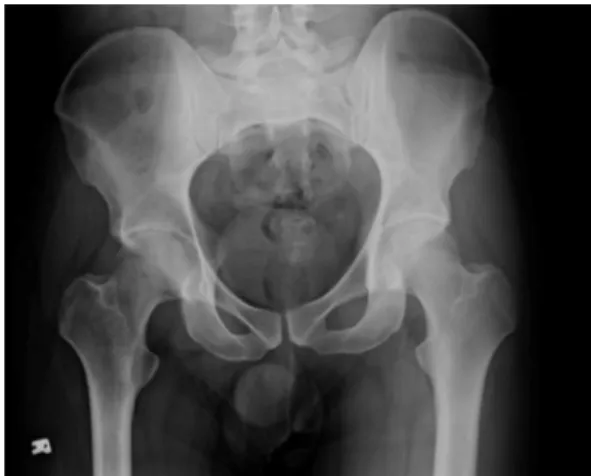
A 28 year-old active male patient presented to the polyclinic with the complaint of right hip pain for 2 months. He reported that the pain increased in the previous week, strengthening at night and awaking him from sleep, and he had difficulty standing. A diagnosis of MS was established 7 months prior to admission and a megadose of GC at 3 months intervals was advised in order to prevent MS episodes. The second steroid dose was given one month prior to admission. The patients did not have a fever during this time. Pain increased with activity and he was unable to walk without a crutch. On examination, hip pain occurred with ROM between 0 and 80º (extension - flexion), internal rotation between 0º and 10º and external rotation between 0º and 10º. Radiographs showed osteopenia beginning from the trochanteric region and involving the entire iliac wing (Fig. 1). Ficat-Arlet stage 1 avascular necrosis and increase in the joint fluid in the anterosuperior of the femoral head was found on unenhanced MRI T2 fat supressed coronal sections (Fig. 2).
No specific findings of septic arthritis (bone marrow edema, irregularity on the joint surface) were found. In the preoperative examination, white blood cell (WBC) count was 9.65 x 10³/µl, erythrocyte sedimentation rate (ESR) 104 mm/hour and C-reactive protein (CRP) 96 mg/dl. Core
decompression and aspiration from the hip were performed in the operating room under fluoroscopic assistance. Samples obtained from the femoral head and joint fluid were sent to the pathology and microbiology department. Pain decreased postoperatively, although it did not completely resolve. No abnormality was detected in rheumatologic examinations (Rheumatoid factor, HLA-B27, Antinuclear antibody, Antimitochondrial antibody). Gram (-) bacilli was observed in the smear and teicoplanin 400 mg 2x1 was initiated.
Figure 1. X-ray AP pelvis. Osteopenia beginning from the trochanteric region and includes all of the iliac wing on the right hip.
On the first postoperative day, ESR was 114 mm/hour, CRP 79.80 mg/dl and WBC count 6.63 x 10³/µl. Salmonella Enterica grew in the culture by the 48th postoperative hour. The patient was found
to be susceptible to ciprofloxacin on antibiogram. Teicoplanin therapy was discontinued. Intravenous ciprofloxacin of 400 mg 2/day was initiated. The patient was taken to the operating room and underwent posterior capsulotomy, joint drainage, debridement and synovectomy through a posterolateral incision. Care was taken during the operation to avoid entering the quadratus femoris muscle. The hip was not dislocated. No damage was detected in the femoral head cartilage. Samples obtained from the synovial tissue during the operation were sent for antibiogram and pathology testing. Complaints of the patient decreased after the second surgery. ESR, CRP and leukocyte values regressed. The highest measured fever of the patient was 37.1ºC during hospitalization. On the 15th postoperative day ESR was 53 mm/hour, CRP 40
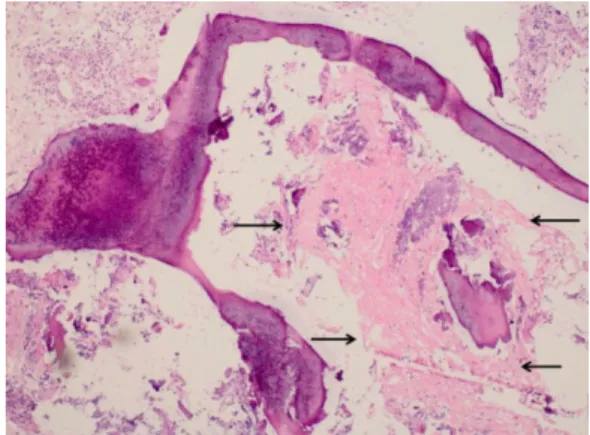
mg/dl and WBC count 5.04 x 10³/µl. The patient was discharged and prescribed oral ciprofloxacin 500 mg 2 times a day. The preoperative diagnosis of avascular necrosis as a result of pathology taken from the femoral head in the first operation was confirmed (Fig. 3).
Figure 2. Unenhanced MRI,T2 fat suppressed coronal section. Increased intraarticular fluid. Arrow shows the avascular spaces.
Figure 3. Necrosis spaces between bone specule The patient was re-admitted to the hospital with the complaints of high fever (38.1oC), severe hip pain
and limping one week after discharge. ESR was 120 mm/hour, CRP 90 mg/dl and WBC count 10.2 x 10³/µl. Effusion in the hip joint and destruction of the femoral head cartilage was observed on MRI. The patient was immediately re-operated. The joint
was approached again from the posterior, while irrigation and debridement for synovial tissues were performed. Erosion and collapse were found in the femoral head cartilage. No growth was observed in the culture collected from the joint fluid. In addition to ciprofloxacin 2x400 mg, daptomisyn 1x500 mg IV was initiated. The patient developed Sudeck's atrophy in the right lower extremity. Passive exercise therapy was started. The patient did not develop fever in the follow-up period. Pain and limping continued at the 6th postoperative month. ESR, CRP
and WBC tests were normal but stage 3 avascular necrosis was observed in radiographs (Fig 4). The patient underwent total hip arthroplasty at the 8th
postoperative month and pain was relieved and the patient was able to walk without the aid of a crutch at the 1 year follow-up.
Figure 4. Ficat-Arlet grade 3 avascular necrosis on the right hip.
DISCUSSION
GCs are the most important medications used in diseases in which autoimmune mechanisms are responsible for etiology, such as SLE, MS and RA. It is not clear whether avascular necrosis is related to the maximum GC dose which produces avascular necrosis5. However, GCs are known to suppress
immune response, leaving the human body vulnerable to infection6.
More than quarter century has passed since the 1979 publication of an article titled “Septic Arthritis Associated With Avascular Necrosis Of The Femoral Head”, in which Habermann reported a patient with salmonella septic arthritis who was
treated with repetitive aspiration7. Only a few
publications have reported the association between septic arthritis and FHAN and none have discussed the treatment protocols or progression in cases of septic arthritis associated with avascular necrosis. Among the small number of papers in the English literature, Young et al. reported 5 patients with association of avascular necrosis and septic arthritis and found S.Aures to be the causative factor in 14.
In Although microorganisms could not be produced in the remaining 4 cultures, they found infection findings on the biochemical analysis of the joint fluid samples4. Two thousand patients with SCD
were retrospectively screened and hip septic arthritis was found in 36 patients and avascular necrosis in 56. However, no association between avascular necrosis and septic arthritis was reported8. Another
study retrospectively examined 41 patients with salmonella septic arthritis, including 11 patients with SLE and hip avascular necrosis was found to accompany septic arthritis in 6 patients in the SLE and 10 in the non–SLE groups9. Septic arthritis in
the hip joint occurs hematogenously in nontraumatic cases. Septic arthritis in which salmonella bacteria is the causative factor occurs more frequently in patients having predisposing factors such as sickle cell anemia and SLE. Some authors have reported that repetitive tiny necrosis developed in the intestinal mucosa cause formation of salmonella (and other enteric Gr negative) bacteraemia in patients with sickle cell anemia10, 11.
MRI findings of septic arthritis include increased fluid in the joint, periarticular bone edema and irregularity of the bone surface and should be considered on MRIs ordered for FHAN. In the surgical treatment of FHAN, samples should be taken from the joint fluid and the surgery plan reviewed preoperatively before administration of prophylactic antibiotics. Samples from the aspiration culture should be sent for culture cell count and pathology.
In the event that microorganisms cannot be incubated in the culture from joint fluid aspiration but biochemical parameters and pathology support infection, the hip should be considered to have septic arthritis based on the presence of avascular necrosis. Pain relief is expected starting on the first day following CD12. However, as we did not
consider septic arthritis in our patient when we planned CD surgery, the patient had to undergo a second surgery 2 days after the first.
In conclusion, while salmonella septic arthritis rarely occurs in conjunction with avascular necrosis, it should be remembered that is a possible causative factor in intractable hip pain after CD. Salmonella septic arthritis shows rapid progress in patients with steroid induced early stage avascular necrosis and hip pain in FHAN patients may mask septic arthritis. It must be ruled out in early stage avascular necrosis patients who continue to suffer pain following CD surgery or in patients with rapid progression visible on radiographs. It should also be kept in mind that results of bacteremia and septicemia following a missed diagnosis of septic arthritis may be catastrophic.
REFERENCES
1. Smith SW, Fehring TK, Griffin WL, Beaver WB. Core decompression of the osteonecrotic femoral head. J Bone Joint Surg Am. 1995;77:674-80. 2. Mont MA, Marulanda GA, Seyler TM, Plate JF,
Delanois RE. Core decompression and nonvascularized bone grafting for the treatment of early stage osteonecrosis of the femoral head. Instr Course Lect. 2007;56:213-20.
3. Koo KH, Kim R, Kim YS, Ahn IO, Cho SH, Song HR, Park YS, Kim H, Wang GJ. Risk period for developing osteonecrosis of the femoral head in patients on steroid treatment. Clin Rheumatol. 2002;21:299-303.
4. Lee YK, Lee YJ, Ha YC, Kim KC, Koo KH. Septic arthritis of the hip in patients with femoral head osteonecrosis. Arch Orthop Trauma Surg. 2011;131:1585-90.
5. Powell C, Chang C, Naguwa SM, Cheema G, Gershwin ME. Steroid induced osteonecrosis: An analysis of steroid dosing risk. Autoimmun Rev. 2010;9:721-43.
6. Listing J, Gerhold K, Zink A. The risk of infections associated with rheumatoid arthritis, with its comorbidity and treatment. Rheumatology. 2013;52:53-61.
7. Habermann ET, Friedenthal RB. Septic arthritis associated with avascular necrosis of the femoral head. Clin Orthop Relat Res. 1978:325-31.
8. Hernigou P, Daltro G, Flouzat-Lachaniette CH, Roussignol X, Poignard A. Septic arthritis in adults with sickle cell disease often is associated with osteomyelitis or osteonecrosis. Clin Orthop Relat Res. 2010;468:1676-81.
9. Chen JY, Luo SF, Wu YJ, Wang CM, Ho HH. Salmonella septic arthritis in systemic lupus erythematosus and other systemic diseases. Clin Rheumatol. 1998;17:282-7.
10. Johnston RB, Jr., Newman SL, Struth AG. An abnormality of the alternate pathway of complement
activation in sickle-cell disease. N Engl J Med. 1973;288:803-808.
11. Landesman SH, Rao SP, Ahonkhai VI. Infections in children with sickle cell anemia. Special reference to pneumococcal and salmonella infections. Am J Pediatr Hematol Oncol. 1982;4:407-18.
12. Beckmann J, Schmidt T, Schaumburger J, Rath B, Luring C, Tingart M, Grifka J. Infusion, core decompression, or infusion following core decompression in the treatment of bone edema syndrome and early avascular osteonecrosis of the femoral head. Rheumatol Int. 2013;33:1561-5. .