Procedia - Social and Behavioral Sciences 210 ( 2015 ) 301 – 309 Available online at www.sciencedirect.com
ScienceDirect
1877-0428 © 2015 The Authors. Published by Elsevier Ltd. This is an open access article under the CC BY-NC-ND license (http://creativecommons.org/licenses/by-nc-nd/4.0/).
Peer-review under responsibility of the International Conference on Leadership, Technology, Innovation and Business Management doi: 10.1016/j.sbspro.2015.11.370
4
thInternational Conference on Leadership, Technology, Innovation and Business Management
Individual and organizational effects of the corporate practices with
the mediating role of lean intrapreneurship: differences between
public and private sector in Turkey
Tuna Uslu
a, Nimet Eryiğit
b, Duygu Çubuk
c, a
aGedik University, Gedik Vocational School, Occupational Health And Safety Program, Istanbul, 34876, Turkey b
Ordu University, Unye Economics And Administrative Sciences, Ordu, 52300, Turkey c
Beykent University, Vocational School, Printing and Broadcasting Technologies, Istanbul, 34398, Turkey
Abstract
In our century the most important institutional infrastructural tools (IIT) of the companies are knowledge management (KM), occupational health and safety (OHS), quality management (QM) and standardization. Beforehands OHS practices were just aiming to recover the results of the risks after they had occured; but nowadays a proactive approach is applied, in which precautions are taken and also the psychological and social mood of the employees, ergonomics, work load, workplace conditions and managerial applications are taken into consideration. The relationship between all these IIT and a new concept which is lean start-up, that means to deliver the most simple and pure product or service to the customer is not known yet. Besides; in between IIT, of which are influential on the intrapreneurship of the employees are needed to be understood. In this study we discuss the effects of these IIT on the employee performance and organizational effectiveness with the mediating role of lean intrapreneurship.
Keywords: Occupational health and safety, Knowledge management, Quality management, Lean start-up, Organizational effectiveness
© 2014 Published by Elsevier Ltd. Selection and/or peer-review under responsibility of 4th International Conference on Leadership, Technology, Innovation and Business Management
1. Introduction
In the organizations the knowledge management (KM), quality management (QM) and organizational health and safety (OHS) have organizational outcomes in addition to the positive impacts on human resources of the companies. By QM and other managerial techniques IIT create an entrepreneural organizational environment and effectiveness. The aim of this study is to understand the difference in public and private sectors in Turkey, in terms of the individualistic performance perception and organizational effectiveness of IIT with the mediating role of lean intrapreneurship (LI).
Corresponding author. Tel. + 90-216-595-2185 fax. +90-216-595-2155
E-mail address: [email protected]
© 2015 The Authors. Published by Elsevier Ltd. This is an open access article under the CC BY-NC-ND license (http://creativecommons.org/licenses/by-nc-nd/4.0/).
2. The Impacts Of IIT On The Employees
Safety climate is described as the personal perceptions on the policies, procedures and actions aiming to establish the workplace safety or the safety perceptions of the employees in the working environment (Clarke, 2010). Also the accreditation standards and international process models have different impacts on the companies and employees (Uslu et al., 2010). Lean approach has been applied in order to enhance the optimization and processes in production management for a long time. Lean start-up is opposed to the traditional models as focusing on the individuals, which establishes a process model from the customer to the source (Ries, 2011). So the last point of the process is if the IIT is proper for the model or not.
2.1. Institutional Standards And QM
Quality is the capacity of the products and services in providing the needs and expectations of the customers. This concept is emerged as a production concept; but turned out to be a management philosphy nowadays. Quality is described in the service sector as ‘the degree of excellence or convenience to the standards of the variant parts of the service system’.
In our century one of the most important life sources of the companies who aim to be institutionalized is quality. So the sustainable existence of the companies depends on their production of qualified goods and services (Yılmaz, 2007). In this respect quality improvement process has a lot of positive results in organizational and individual level.
Besides organizational outcomes such as producing more products and services, increasing productivity, reducing absences and quitting work, and strengthening the relationships between departments and sections, QM also has individual outcomes such as perceived performance, increasing self-confidence, fair distribution of the rewards, employees feeling better about themselves and having more authority. Also, during the quality improvement process, the employee participation in the decision making process helps them boost their motivation towards their work, causes them to get stronger and take charge. Human is the basic unit of the quality concept. Appreciating his value, trusting him, taking care of his needs, being at the top of the needs hierarchy, and his happiness; briefly, being a “quality human being” in fact form the basic objective of the quality philosophy. Amongst the predecessors of this transformation, comes the structural applications of the institution, meaning when the viewpoint of the board of directors could be explained to the employees and when this could be properly managed, we can then talk about a continuous quality improvement and quality human beings as individuals. Because of this reason, quality objectives are hung in places that the employees can easily see, quality circles are formed, and the employees become a part of these processes.
2.2. The Impact Of KM On Employees
KM has created lots of changes in both company lives and our daily lives. We have new models for inside and outside organizational communication by the development of KM. With the established KM system in the companies, the employees feel empowered and achieve their individualistic and organizational goals better. KM also provides interactive communicative skills, simplified organizational learning processes, increased business life quality and self control on the work-private life equilibrium. So the traditional walls leave themselves to the collaborative business culture and positive results are created on employees. In the companies, in order to establish an influential KM management system, the managers should understand the emphasis of the social interaction, communication and institutionalization (Nonaka and Takeuchi, 1995). While Drucker (1993) saw the information system as the only way that would lead the company’s to success, Nonaka and Takeuchi (1995) claimed that to continuously create innovations would be possible by creating a database on inner and outer information concepts.
Barutcugil (2002) defines KM as creating the information, keeping it on hand, sharing, and developing. Also, in order to acquire the organizational objectives in a better way, the author sees knowledge management as a new discipline that helps present, share and apply the information to all the agents (to the individuals, teams and the whole organization) collectively and systematically. Thus, the author includes information communication concept and its applications in the management process.
KM, informatics and information technology have made strong changes in the work life just like in every aspect of life. The rapid development of information and communication technologies have been changing the organizational structure, business and work methods, manager and employee profile, and in general work life, and have been bringing out new models particularly in communication in inside and outside the organization.
Through the KM systems, and informatics, the employees, who have been adequately informed of the institution’s strategy, general performance, and other units’ work, feel stronger and reach their individual and organizational objectives. Sharing information and increasing cooperation, employees with more authority and autonomy, mutual communication opportunities, eased down organizational learning processes, increasing quality of work life and the balance of work-private life with the employees switching to their own autonomy, the destruction of traditional walls, and the formation of the sharing and cooperation culture with have positive impacts on the employees.
As can be seen, interaction that forms as a result of sharing every single type of information, expectation, emotion and thought has both social and organizational functions. These functions can be classified as education and development, unified, innovation, persuasion, guidance, communication, coordination and conflict management (Saal and Knight, 1988; Ozcaglayan, 1998). In order to bring the business to the target quality and for the decision making mechanism to work in a healthier way, the institution should relay all the information regarding job description and processes (Uslu and Demirel, 2003). The information being relayed to all the employees to make business more competitive is provided by an effective communication model with a feedback mechanism and infrastructure (Uslu and Demirel, 2003). In the KM activities, communication methods, techniques, and channels are heavily utilized, and because of this reason, in your writing, it is emphasized that the communication aspect has a stronger influence than the management aspect of KM (Capar, 2002), meaning that KM applications especially through communication influences outcomes. As a result of this, in order for the information to be shared in the institutions, managers who understand the importance of social interactions and communication with the employees and an institutional management are needed, because socialization of the individuals in the business is one of the dynamics of the KM (Nonaka ve Takeuchi, 1995).
In the study to analyse the influence of KM on organizational entrepreneurship a significant relationship is found. Except knowledge application; knowledge acquisition, knowledge conversion, knowledge protection, culture, structure and technology has highly significant relationship with organizational entrepreneurship (AbdeAli and Moslemi, 2013). KM is a mean to encourage corporate entrepreneurship in the companies. Knowledge creation is the most determinant part of this process. On the other hand knowledge utilization can’t be disregarded as an important factor in knowledge based economy (Soleimani et al., 2013).
2.3. Intrapreneurship and Lean Start-Up
Intrapreneurship can be described as the involvement of the employees in the innovation activities of the firms mentally. Pinchot (1985) expresses the concept as the imagination which takes the responsibility to create innovation. Intrapreneurship depends on the existance of the innovative environment in the firms (Morris and Kurakto, 2002). Intrapreneurs are the employees who have a tendency to be an entrepreneur in the company and can activate their new ideas and methods in the companies in order to increase the management performance (Kirby, 2003).
On the other hand, lean start-up is defined as depending on the information gathered from the customers with a humanitarian view, the methodology of developing effective new business processes, goods and services with minimum resources simply and fastly (Ries, 2011). This methodology consists of three steps which are establishment, measurement and learning. The difference between entrepreneurship and lean start-up is the customer focus in the second one. Because lean start-up is based on the customers’ views about the development of the business processes.
A lot of studies mentioned about the comparison between start ups and big companies in business innovation literature. In parallel with resources large companies are expected to be more innovative; whereas a lot of new products and services are created by start ups. According to Ries “lean” word comes from the Toyota Production System in Japan. This means to separate the valuable processes from the waste ones. On the other hand, lean start up idea is different as referring itself to the innovation concept on its own (Ries and Euchner, 2013).
In the study (Sijde et al., 2013) the perception of the conditions in the organization and intrapreneural behaviour are measured. Results highlight that firm size is related with intrapreneurship; large companies tend to have more relative to smaller companies. If organizational conditions support intrapreneurship more, people feel more positive and score more about organizational conditions and intrapreneurship behaviour questions.
In the companies entrepreneurial spirit dimensions are passion, internal ecosystems, organizational climate, internal cooperation, organizational support, management support and availability of rewards and resources (Aned O and Alya O, 2013).
Sigler and Pearson (2000), in their study, determined that an organizational climate that strengthens its employees has a significant effect on individual performance. Institutional support and positive interventions associated with the business appear to have improved performance. (Cameron et al, 2004). For this reason, institutional applications as mentioned can be assumed to be effective on the employees who work directly and indirectly.
3. Methodology 3.1. Research Goal
The studies about the impacts of IIT on organizations and individuals are limited in the literature and in Turkey. In our survey we used questionnaire method to the convenient sampled 585 employees in Istanbul. A 6-item scale was presented to the respondents that would allow them to conduct evaluations regarding each entry. (1 = never, 6 = all the time). Demographic analysis for the findings, factor and reliability tests and regression analyses were performed with SPSS 18.0 statistical software package. Factor analysis towards findings and progressive intermediary variable tests are carried out by verifying different models. For the purpose of determining the intermediation roles of the intermediary variables, three-step method proposed by Baron and Kenny (1986) was adapted to our research.
Hypotheses:
H1. According to OHS, QM, KM, LI, individual performance and organizational effectiveness, there are
significant difference between public and private sector.
H2. There is a strong positive relationship between the OHS, QM, KM, LI, individual performance and
organizational effectiveness.
H3. In private sector, LI will function as a variable between the OHS, QM, KM and the organizational
effectiveness.
H4. In public and private sector, LI will function as a variable between the OHS, QM, KM and the individual
performance.
3.2. Sample and Data Collection
A printed questionairre was created to collect data associated with the variables in the research. These forms were handed to the employees who were selected using the convenience sampling method and were actively involved in the working life. In this way, a total of 585 questionnaires were collected from Istanbul. The questionnaire used in two parts: "Demographic Information Form" (8 items), and the "Corporate Standards Form" made up of 54 expressions, consists of a total of 62 questions.
For other scales associated with institutionalization, JCI Accreditation Standards for (Joint Commission International, 2010), Organizational-Oriented Standards under the "Quality Improvement" (2010: 145-163) and "Knowledge Management" section (2010: 229-245) were the main ingredients used (Uslu and et al, 2010). "Occupational Health and Safety" developed by Choudhry and others’ (2007). In measuring the "Lean
Intrapreneurship”, Ries (2011), Erdem and others’ (2011) inventories are used. In constructing the "Perceived Individual Performance” scale, expressions were used that were added to the Williams and Anderson’s (1991), Welbourne and others’ (1998), Sigler and Pearson's (2000) inventories. In measuring the "Organizational Effectiveness”, Staples and Ratnasingham’s (1998) items are used.
3.3. Analyses and Results
Demographic characteristics of the sample used in this study are as follows: 42% of female respondents and 58% of males and the mean age was 41. Of 83% bachelor's degree and the remaining 17% portion of the participants were the elementary, middle school and high school graduates The average working time among the participants was approximately 10,5 years in this business, and they have been in working life for an average of 18,5 years.
Factor analysis of the scales is shown in Tables 1 and 2. In order to determine the sub-dimensions of our variables and positive organizational behaviors, with varimax torsion in SPSS, exploratory (descriptive) factor and internal consistency analyses were performed. Each scale was run through the factor analysis separately, and their reliability was tested with Cronbach's alpha values, and the scales were translated in the following tables. Cronbach's alpha reliability coefficients of the scales were 0.70 and higher, therefore the scales were found to be reliable. Explanatory factor value for individaul work performance which is composed of two factors as perceived role and extra role performance with 15 variables is %68 (Table 2).
Table 1: LI Factors and Internal Consistency Results
LI Item Weight
Factor 1: LI (Dimension Explanation =%23,106/Cr. Alpha=%82,9)
I suggest new and innovative methods which bring long term profit for my company. ,730 I look for and find information about the financial performance of our work. ,658 I make constructive suggestions for my company’s development and sustainability. ,648 I trust in myself during preparation of the budget increase offer about my working area. ,618
Factor 2: Lean Management (Dimension Explanation =%22,944/Cr. Alpha=%74,6)
I behave properly about my opinions, plans and actions. ,525 I can design new methods which can solve the problems. ,519 I think about the results and effects during my work. ,500 I observe the effects and results of my behaviours. ,486 I gather as much information as I can in new situations and steps in the actions to be taken. ,486
I update my working style with my experiences. ,398
Factor 3: Support To Working Friends (Dimension Explanation =%13,292/Cr. Alpha=%71,4)
I make constructive suggestions to my working friends to improve their lives. ,557 I encourage my working friends to try new ways for improving their work efficiency. ,557
N 298
Explanatory Factors (%): 59,342
Kaiser-Meyer-Olkin Value: ,757
Bartlett Value: ,000
Table 2: Individual Performance Factors and Internal Consistency Results
Individual Performance Item Weight
Factor 1: Perceived Role Performance (Dimension Explanation =%35,508/Cr. Alpha=%92,7)
I achieve my unit and team goals. ,795
I am more successful than my competitors in my work. ,790
I achieve my work targets more than my working friends. ,768
My individual influence on the positive results of my work is high. ,763
I achieve high standards with my work quality. ,758
I do the most work with least sources. ,721
I suggest the fastest solutions when a problem occurs. ,715
I realize the responsibilities and tasks which are in my work description. ,704
Factor 2: Extra Role Performance (Dimension Explanation=%32,182/Cr. Alpha=%91,6)
I find ways to make my company and unit more successful. ,832
I make suggestions to increase my unit’s total quality. ,811
I apply the ways to increase the efficiency of my work. ,799
I save my company from potential problems and obstacles. ,752
I create a positive difference in the success of my company. ,740
I am more productive in my work place than usual. ,666
My work performance is influential on the profitability of my company. ,630
N 308
Explanatory Factors (%): 67,690
Kaiser-Meyer-Olkin Value: ,954
Bartlett Value: ,000
Approximate Chi-Square Value: 3311,143
Our first hypothesis is supported with the difference analyses statistically significant with 0,01 in between the variables (Graph 1).
Graph 1: The Difference Between Private-Public Sectors
Grafik 1: Kamu ile Özel Sektör Ayrımına Göre Değişkenler Arasındaki Farklar
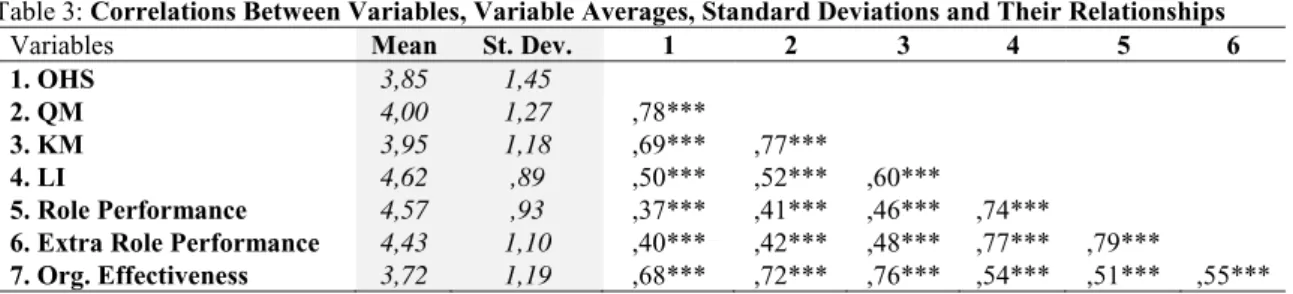
According to Pearson's correlation coefficients, our second hypothesis is also supported (Table 3). A high positive correlation was found between OHS, QM, KM, LI, role performance, extra role performance and organizational effectiveness.
G G
Gr
Table 3: Correlations Between Variables, Variable Averages, Standard Deviations and Their Relationships
Variables Mean St. Dev. 1 2 3 4 5 6
1. OHS 3,85 1,45
2. QM 4,00 1,27 ,78***
3. KM 3,95 1,18 ,69*** ,77***
4. LI 4,62 ,89 ,50*** ,52*** ,60***
5. Role Performance 4,57 ,93 ,37*** ,41*** ,46*** ,74***
6. Extra Role Performance 4,43 1,10 ,40*** ,42*** ,48*** ,77*** ,79***
7. Org. Effectiveness 3,72 1,19 ,68*** ,72*** ,76*** ,54*** ,51*** ,55***
all correlations are significant at ***p< 0.001, n=569
Progressive intermediary variable tests towards the individual performance are performed with verification of different models with SPSS (Table 4 and 5).
OHS (model 1), QM (model 2) and KM (model 3) increase the effectiveness of LI. OHS (model 4), QM (model 5) and KM (model 6) also increase the organizational effectiveness. However, when the LI joins the analysis as an independent variable, the effect of OHS (model 7), QM (model 8), KM (model 9) is decreased for private sector. Our third hypothesis was partially supported (table 4).
Table 4: Impact of OHS, QM, KM on Organizational Effectiveness and Multiple Regression Models created for LI as intermediate variable (*** p <0.00l, ** p <0.01, * p <0.05 significant value, standard errors in parentheses) Dependent Variables LI Organizational Effectiveness Model 01 Model 02 Model 03 Model 04 Model 05 Model 06 Model 07 Model 08 Model 09 Public Sector OHS .265*** -.106 -.008 .597*** .117 .227** .546*** .134 .205* (.047) (.102) (.114) (.040) (.083) (.077) (.056) (.097) (.103) QM .427*** -.123 .683*** .001 .697*** .064 (.114) (.170) (.098) (.111) (.117) (.155) KM .569*** .702*** .731*** (.115) (.070) (.113) LI .189* .133 -.072 (.082) (.078) (.081) Adjusted R² .152 .169 .315 .459 .567 .700 .449 .604 .684 F 31,309 16,587 20,333 220,343 160,177 169,118 67,462 75,602 65,933 Significance .000 .000 .000 .000 .000 .000 .000 .000 .000 N 170 154 127 260 244 217 164 148 121 Priv ate Sector OHS .281*** .081 .078 .541*** .010 .020 .436*** .055 .046 (.036) (.070) (.065) (.029) (.047) (.042) (.039) (.059) (.053) QM .266** -.156 .684*** .279*** .534*** .251** (.077) (.105) (.053) (.068) (.066) (.085) KM .518*** .520*** .429*** (.094) (.060) (.083) LI .433*** .293*** .200** (.073) (.066) (.063) Adjusted R² .248 .295 .387 .544 .709 .779 .629 .725 .781 F 62,720 38,198 37,656 356,737 353,777 335,223 155,811 153,731 152,304 Significance .000 .000 .000 .000 .000 .000 .000 .000 .000 N 188 179 175 299 290 286 184 175 171
Respectively, OHS (model 10 and 14), QM (model 11 and 15), KM (model 12 and 16) and LI (model 13 and 17) increase the effectiveness of individual performance dimensions. In public sector, our fourth hypothesis was partially supported (table 5).
Table 5: Impact of OHS, QM, KM on Individual Performance and Multiple Regression Models created for LI as intermediate variable (*** p <0.00l, ** p <0.01, * p <0.05 significant value, standard errors in parentheses)
Dependent Variables
Perceived Role Performance Extra Role Performance
Model 10 Model 11 Model 12 Model 13 Model 14 Model 15 Model 16 Model 17 Public Sector OHS .141** -.125 -.188 -.234* .220** -.141 -.120 -.031 (.053) (.115) (.127) (.092) (.063) (.140) (.147) (.095) QM .329* -.043 .265 .404* -.327 -.035 (.130) (.177) (.137) (.158) (.206) (.142) KM .537*** -.133 .883*** .106 (.124) (.101) (.145) (.104) LI .880*** .811*** (.072) (.075) Adjusted R² .031 .052 .156 .609 .054 .057 .236 .705 F 7,166 5,842 10,274 50,042 12,100 6,404 16,538 76,221 Significance .008 .003 .000 .000 .001 .002 .000 .000 N 195 179 152 127 195 179 152 127 Priv ate Sector OHS .242*** .126 .131 .120* .291*** .155* .159* .152* (.035) (.069) (.069) (.057) (.039) (.078) (.079) (.066) QM .174* -.042 -.002 .200* .037 .054 (.077) (.114) (.092) (.087) (.129) (.105) KM .257* -.100 .191 -.185 (.103) (.089) (.118) (.102) LI .670*** .771*** (.067) (.076) Adjusted R² .184 .224 .235 .504 .207 .242 .239 .512 F 47,598 29,416 20,728 45,227 54,890 32,466 21,228 46,573 Significance .000 .000 .000 .000 .000 .000 .000 .000 N 207 198 194 175 207 198 194 175
***p < 0.001, **p < 0.01 ve *p < 0.05 significance level, standard errors in parantheses
3. Conclusion
Educational level which is undergraduate and graduate and the men have higher tendency for innovation in the general framework. Private sector practices and private sector employees’ perceptions about innovation are higher than public sector employees’ in Turkey. OHS, QM and KM of IIT have positive effects on employees’ LI motivation and performance. IIT have directly influence the organizational effectiveness and indirectly LI also has a mediating role in this process. But all these influences are less in public sector than private sector in Turkey. We suggest the public sector managers in Turkey, in order to increase their employees’ perceived role performance and encourage LI in their organizations; they should use IIT effectively, so they can increase their organizational effectivenss.
References
AbdeAli, G. and Moslemi, R. (2013), “Analyzing the Impact of Knowledge Management on Organizational Entrepreneurship in Isfahan Alfa Sam Company”, International Journal of Management Academy, 1 (1), pp. 49-57.
Aned O, A.M. and Alya O, A.M. (2013), “Invigorating Entrepreneurial Spirit Among Workforce”, International Journal Of Management and Sustainability, 2 (5), pp. 107-112.
Baron, R.M. and Kenny, D.A. (1986). “The moderator-mediator variable distinction in social psychological research: Conceptual, strategic and statistical considerations,” Journal of Personality and Social Psychology, 51, pp. 1173–1182.
Barutcugil, I. (2002). Information Management, Istanbul: Kariyer.
Cameron, K. S., Bright, D. and Caza, A. (2004). “Exploring the relationships between organizational virtuousness and performance”, American Behavioral Scientist, 47, pp. 766-790.
Capar, B. (2002). “Baskent University Faculty of Communications, Department of Information Management”, I. UNAK General Conference 10-12 October 2002, Samsun 19 Mayis University.
Clarke, S. (2010). An Integrative Model of Safety Climate: Linking Psychological Climate and Work Attitudes to Individual Safety Outcomes Using Meta-analysis, Jou. of Occupational and Organizational Psychology, 83, pp. 553–578.
Choudhry, M.R., Fang, D.P. and Mohamed, S. (2007). The Nature of Safety Culture: A Survey of the State of the Art, Safety Science, 45, 10, pp. 993–1012.
Drucker, P.F. (1993). Post-Capitalist Society, London: Butterworth Heinemann.
Erdem, B., Gokdeniz, A. and Met, O. (2011). “Yenilikçilik ve İşletme Performansı İlişkisi: Antalya’da Etkinlik Gösteren 5 Yıldızlı Otel İşletmeleri Örneği”, Dokuz Eylül Üniversitesi İktisadi ve İdari Bilimler Fakültesi Dergisi, 2(26), pp. 77-112.
Joint Commission International (2010) Joint Commission International Accreditation Standards for Hospitals, 4. Edition, Joint Commission Resources, Illinois, ISBN: 978-1-59940-434-9, pp. 177-193.
Kirby, D.A. (2003). Entrepreneurship, Berkshire: McGraw-Hill Publication.
Morris M. and Kuratko D.F. (2002). Corporate Entrepreneurship: Entrepreneurial Development Within Organizations, Orlando-Florida: Harcourt College Publishers.
Nonaka, I. and Takeuchi, H. (1995). The Knowledge Creating Company: How Japanese Companies Create the Dynamics of Innovation, New York: Oxford University Press.
Ozcaglayan, M. (1998). New Communication Technologies and the Change, Istanbul: Alfa Pinchot, G. (1985). Intrapreneuring, New York: Harper and Row.
Ries, E. (2011). The Lean Startup: How Today's Entrepreneurs Use Continuous Innovation to Create Radically Successful Businesses, Crown Publishing, ISBN 978-0-307-88791-7.
Ries, E. and Euchner, J. (2013), “What Large Companies Can Learn From Start-ups: An Interview With Eric Ries”, Research-Technology Management, July-August, pp. 12-16.
Saal, F.E. and Knight, P. A. (1988). Industrial and Organizational Psychology: Science and Practice, California: Brooks State University. Sigler, T.H. and Pearson, C.M. (2000). “Creating an empowering culture”, Journal of Qua. Management, 5, pp. 27–52.
Sijde, P., Veenker, S. and During, W. (2013), “Intrapreneurship In SMEs: About The Role Of Management and R&D”, European Journal of Business and Social Sciences, 1(11), pp. 24-30.
Soleimani, M., Hamidibeinabaj, M. and Bafrani, M.J. (2013), “Studying the relationship among components of knowledge management and Corporate Entrepreneurship”, Advances in Environmental Biology, 7(8), pp. 1643-1647.
Uslu, S. and Demirel, Y. (2003). “A Study on Problems of employees in SMEs ", Erciyes University Journal of Social Sciences Institute Faculty, 12, pp. 173-184.
Uslu, T., Aydoğdu, C., Gündoğdu Şanlı, Z. and Çam, E.M. (2010) “The Mediating Effect of Psychological Empowerment and Positive Organizational Behaviors Between Organizational Accreditation Standards and Individual Performance”, International 8th Knowledge, Economy & Management Congress Proceedings, Istanbul University Faculty of Economics, Istanbul, ISBN: 978-9944-0203-7-4, pp. 1426-1439.
Yılmaz, M. (2007). Kalite Yönetim Sisteminin İş Doyumuna Etkisi: Kalite Belgesi Bulunan Ve Bulanmayan Matbaa İşletmelerinde Bir Uygulama, PhD Thesis, Gazi University, Ankara.
Welbourne, T. M., Johnson, D. E. and Erez, A. (1998). “The role-based performance scale: Validity analysis of a theory-based measure”, Academy of Management Journal, 41, pp. 540-555.
Williams, L. and Anderson, S. (1991). “Job Satisfaction and Organizational Commitment as Predictors of Organizational Citizenship and In-Group Behaviors”, Journal of Management, 17, pp. 601-617.