and Human Rights Violations
Lerna K. Yanik
Human Rights Quarterly, Volume 28, Number 2, May 2006, pp. 357-388 (Article)
Published by Johns Hopkins University Press
DOI:
For additional information about this article
Access provided by Bilkent Universitesi (3 Oct 2017 07:30 GMT)
https://doi.org/10.1353/hrq.2006.0026
Human Rights Quarterly 28 (2006) 357–388 © 2006 by The Johns Hopkins University Press
Guns and Human Rights: Major Powers,
Global Arms Transfers, and Human
Rights Violations
Lerna K. Yanik*
AbSTRAcT
In the recent past, there have been countless instances of arms transfers to countries with problematic human rights records, many of which have been cited in the reports of various advocacy groups. However, so far, the amount of research classifying these flows has been limited. This study examines the trends between 1999 and 2003 in arms transfer to countries with poor hu-man rights records, as well as the reasons for continuation of these transfers. It puts forward two major arguments for these transfers to such countries. First, the national and international codes ostensibly “prohibiting” transfers to these countries are crafted in a way that eventually plays into the hands of the countries and manufacturers that want to transfer. Second, the end of the Cold War has turned the arms transfer market into a buyer’s market more than ever. The declining domestic military spending experienced in most of the seller countries has forced arms manufacturers to pursue markets beyond their borders, sometimes even illegally and illicitly.
I. INTRodUcTIoN
As the first Gulf War started in January 1991, the Coalition forces that were determined to remove the Iraqi occupation forces in Kuwait quickly discovered that some of their weapons were not quite usable. While the
* Lerna K. Yanik is Assistant Professor, Department of Political Science, teaching international
politics at Bilkent University in Ankara, Turkey.
A previous version of this article was presented at the Annual Meeting of the International Studies Association (ISA) 17–21 March 2004, Montreal, PQ, Canada. The author would like to thank the Stockholm International Peace Research Institute (SIPRI) for their kind permission to use the data on arms transfers. The usual disclaimers apply.
French were unable to use their Mirage fighter jets because the Coalition forces could not distinguish the French Mirages from “enemy” Iraqi Mirages sold to Iraq by France, it also soon became clear that the radar jamming systems purchased by Iraq from the British created a great danger for the Coalition forces.1 The French and the British were not alone in arming Iraq,
a country that was at war with Iran and that brutally repressed its minorities. The Soviet Union, the United States, Germany, and many other countries throughout the 1970s and the 1980s had literally raced with each other to sell arms, both conventional and unconventional, to Iraq.2 Similarly, before
the Rwandan genocide in 1994, various countries, including South Africa, Israel, Albania, France, and Bulgaria, had no problems showering arms on a country where ethnic tensions were on the brink of explosion.3
These two examples are the best-known cases of arms sales by mostly Western powers to countries undergoing violations of human rights in conflict. Yet, they are not part of a distant history. While the international community has embargoed the delivery of arms to several countries in conflict,4 the
practice of delivering arms to conflict zones or to countries with imperfect human rights still continues, and there are many examples. For example, in the early 1990s, Italian arms and ammunition made their way to Sierra Leone and Congo, two countries embroiled in ethnic conflict.5 Similarly, The Guardian, in a July 2002 article, noted sharp increases in British arms
exports to Israel, Pakistan, Turkey, Saudi Arabia, Indonesia, Jordan, and India.6
On the other hand, when the approval of arms sales to Nepal, a country in conflict and with a poor human rights record, surfaced in Belgium in July 2002, it led to the resignation of the Finance Minister Magda Alvoet.7 More
1. Neil Cooper, The BusiNessof DeaTh: BriTaiN’s arms TraDeaT homeaND aBroaD 147 (1997).
2. Stockholm International Peace Research Institute (SIPRI), Imported Weapons to Iraq, 1970– 2004, available at http://www.sipri.org/contents/armstrad/atirq_data.html/view?searchterm=.
See also Neil Mackay, Revealed: 17 British Firms Armed Saddam with His Weapons,
suNDay heralD, 25 Feb. 2003, available at http://www.zmag.org/content/print_article.
cfm?itemID=3124§ionID=10; BBC News, On This Day: 15 February, 1996: Arms-to-Iraq Report Published, available at http://news.bbc.co.uk/onthisday/hi/dates/stories/febru-ary/15/newsid_2544000/2544355.stm; Fred Barbash, Report Reveals British Deceit, Denial,
And Cover-up in ‘80s Arms Sales to Iraq, Wash. posT, 16 Feb. 1996, at A3; Michael Dobbs, US Had Key Role in Iraq Buildup, Wash. posT, 30 Dec. 2002, at A1.
3. George Bloch, France Discloses Arms Sales: Exports Grow Despite Curbs Imposed by
EU, Wash. Times, 9 Apr. 2000, at C-10; Lisa Misol, Weapons and War Crimes: The Com-plicity of Arms Suppliers, in humaN righTs WaTCh, WorlD reporT 2004 (2004), available at http://hrw.org/wr2k4/13.htm.
4. SIPRI, International Arms Embargoes, 1998–2004, available at http://www.sipri.org/con-tents/armstrad/embargoes.html.
5. Brian Wood, Stopping the Global Terror Trade, Speech at the European Social Forum (2002), available at http://web.amnesty.org/pages/ec_briefings_fora_msp.
6. Richard Norton-Taylor, Britain Doubles Arms Sold to Israel: Annual Report of Weapons
Exports Lists Destinations from Channel Islands to Pakistan, guarDiaN, 20 July 2002, available at http://www.guardian.co.uk/armstrade/story/0,10674,758666,00.html.
7. Bernard Adam, Belgium Makes the European Code of Conduct Legally Binding, iaNsa
importantly, the United States, a country that is considered to have the most sophisticated laws on arms transfers, decided to lift the sanctions imposed on India and Pakistan after 11 September 2001 and resumed the transfer of arms to both of these countries as new allies of the United States in the “War Against Terrorism.”8
The examples of arms transfers to countries with problematic human rights records are countless. There are many more contextual examples cited in the reports of various advocacy groups,9 but so far, there has been limited
research classifying these flows. This article examines the trends between 1999 and 2003 in arms transfer to countries with poor human rights records and the reasons for the continuation of these transfers in spite of the presence of various international and national laws ostensibly “prohibiting” transfers to these countries. Some statistical studies have argued that after the end of the Cold War, the United States started to pay attention to human rights conditions in recipient countries; and thus, “countries that abuse human rights were less likely to be recipients of American arms.”10 While these statistical
studies tend to classify arms transfers as “less likely,” when we look at the practice, most supplier countries, including the United States, eventually uphold their commercial and national security concerns and turn their backs on human rights concerns that they have long championed.
The relation between arms transfers and the exacerbation of conflicts and human rights violations has long been an established fact.11 This nasty
8. Bush Lifts Sanctions on India, Pakistan, assoC. press, 23 Sept. 2001.
9. See, e.g., Wood, supra note 5; amNesTy iNTerNaTioNal, a CaTalogueof failures: g8 arms exporTs aND humaN righTs ViolaTioNs (2003), AI Index IOR 30/003/2003, available at http://web.
amnesty.org/library/pdf/IOR300032003ENGLISH/$File/IOR3000303.pdf; Press Release, Amnesty International, Global Arms Trade Dangerously Unregulated (9 Oct. 2003),
available at http://www.controlarms.org/latest_news/launch_pr.htm.
10. Shannon Lindsey Blanton, Foreign Policy in Transition? Human Rights, Democracy, and
U.S. Arms Transfers, 49 iNT’l sTuDies Q. 647, 660 (2005).
11. Shannon Lindsey Blanton, Promoting Human Rights and Democracy in the Developing
World: US Rhetoric versus US Arms Exports, 44 am. J. pol. sCi. 123 (2000); Shannon
Lindsey Blanton, Instruments of Security or Tools of Repression? Arms Imports and
Hu-man Rights Conditions in Developing Countries, 36 J. peaCe res. 233 (1999); Cassady
Craft & Joseph P. Smaldone, The Arms Trade and the Incidence of Political Violence in
Sub-Saharan Africa, 39 J. peaCe res. 693 (2002); Gregory S. Sanjian, Promoting Stability or Instability? Arms Transfers and Regional Rivalries, 1950–1991, 43 iNT’l sTuD. Q. 641
(1999); Mohammed Ayoob, The Security Problematic of Third World, 43 WorlD pol. 257,
274 (1991); Michael T. Klare, Wars in the 1990s: Growing Firepower in Third World, 46 Bull. aTom. sCieNTisT 9 (1990); William D. Hartung & Bridget Moix, Deadly Legacy: US Arms to Africa and the Congo War, WorlD pol. iNsT. arms TraDe res. CeNTer (2000), available at www.worldpolicy.org/projects/arms/reports/congo.htm. A statistical study
conducted by David Kinsella and Howard K. Tillema argues that while the arms supplies by the United States into Middle East had a stabilizing effect, this was not the case for Soviet arms transfers. See David Kinsella & Howard K. Tillema, Arms and Aggression in
relation between arms trade and human rights forced supplier countries, which correspond mostly to the most developed countries of the world, to enact various laws and codes at the national and international level. For example, supplier countries enacted laws prohibiting or “discouraging” arms transfers to countries with poor human rights records. Despite all of these laws and codes, supplier countries do transfer conventional weapons to countries with dubious human rights records. This practice, in most cases, eventually creates a cycle that worsens human rights conditions in these recipient countries.
This article is composed of eight sections. After this brief introduction, the second section introduces the article’s methodology. The third and fourth sections examine the top ten suppliers of conventional arms between 1999 and 2003, followed by the top sixty recipients of conventional arms during these years and their share in global arms transfers, as well as human rights records in these countries. The fifth section discusses arms exports laws and codes in major supplier countries at the domestic and international levels. While discussing these laws, special attention is paid to whether these laws and codes consider human rights conditions in recipient countries. The sixth and seventh sections analyze the changing dynamics of the post-Cold War global arms trade, including the black and gray markets for small arms. Finally, the conclusion reiterates the findings and arguments and describes current attempts to regulate conventional arms transfers globally.
While making this analysis regarding arms transfers to countries with poor human rights and conflict zones, I develop two main arguments as factors that contribute to the continuation of arms transfers to such countries. First, as will be elaborated in detail below, national and international codes are crafted in a way that creates an enormous space in which supplier countries can maneuver. The laws, whether national or international, are in place in theory; but when one looks at the way in which these laws are crafted, they are open to interpretation. Second, with the end of the Cold War, the global conventional arms market has become an unprecedented buyer’s market. The Cold War created a decline in domestic military expenditures and forced arms manufacturers to look beyond their own domestic markets. This decline was much worse in the countries of the former Soviet Union and in some Eastern European countries. These countries ended up looking for customers around the world more aggressively and sometimes more illegally and more illicitly than ever before. These legal, illegal, and illicit alternatives not only reduce compliance with laws and regulations that are
306 (1995). However, Jochen Mayer and Ralph Rotte, by using a more sophisticated statistical method, have argued that stability in the Middle East was provided only when there was a low level of arms supplies. Higher levels of supplies, they argued, created instability in the region. See Jochen Mayer & Ralph Rotte, Arms and Aggression in the
supposed to impede arms transfers, but faced with competition, legal and illegal, major supplier countries are more unwilling to come up with tighter laws and regulations at national and international levels that might entirely halt transfers to countries with poor human rights records.
II. THE METHod
This article utilizes several different databases and rankings. First, to rank top supplier and recipient countries between 1999 and 2003, the article uses the rankings provided by the Stockholm Peace Research Institute (SIPRI) in Chapter 12 of their SIPRI Yearbook 2004: Armaments, Disarmament and
International Security. Because the article examines whether the top ten
suppliers of global arms were equipped with laws and regulations, both at the national and international level, it took human rights conditions in the recipient country into consideration; the laws by which these countries were bound nationally and internationally were checked from the National Export Control Table, which can be accessed at the SIPRI website.12 The results are
reflected in Figure 1 below.
Second, the article determines the top arms recipients with problematic human rights records by matching the top sixty recipients rankings between the years 1999 and 2003 with the rankings of the Freedom House between 1999 and 2003 (see Figure 2).13 The article utilizes the same categorizations
(Free, Partly Free, and Not Free) used in the Freedom House Report.14
Furthermore, because conflicts and human rights violations go hand in hand, the article tracks whether an internal or an external conflict existed in these countries between 1999 and 2003. For this, the author mainly relied on the International Peace Research Institute’s armed conflict database.15
III. THE SUPPLIERS
The end of the Cold War led to a decline in the volume of arms transfers around the world. In 1988, $35 billion worth of arms was transferred globally.16 This number was reduced to $20 billion in 1995 and has been
12. SIPRI, National Export Control Table, available at http://projects.sipri.se/expcon/natexp-con/country_matrix.html.
13. Freedom House, Freedom in the World Comparative Rankings: 1973–2005, Freedom in the World, available at http://www.freedomhouse.org/template.cfm?page=15&year=2005. 14. Id.
15. International Peace Research Institute, Oslo (PRIO), Active Conflicts 2003, available at http://www.prio.no/cwp/armedconflict/current/active_conflicts_2003.pdf.
16. Björn Hagelin et al., International Arms Transfers, in SIPRI yearBook 2003: armameNTs,
DisarmameNT aND iNTerNaTioNal seCuriTy 440, fig. 13.1 (2003) [hereinafter SIPRI yearBook
fluctuating around this level since then.17 Since the end of the Cold War,
the lion’s share of the arms trade belongs to the United States. According to SIPRI estimates, between 1999 and 2003 the United States accounted for the 34 percent of all global conventional arms transfers.18 During the same
period, Russia ranked second with a 30 percent share, followed by France with a 7.2 percent share in global arms transfers.19 Germany and the United
Kingdom ranked fourth and fifth, respectively, with almost a 5.9 percent and a 4.8 percent share each.20 Ukraine’s share was almost 2.5 percent,
followed by Italy at seventh with a 1.9 percent share.21 China, the largest
importer of arms, with a 1.7 percent share, ranked as the eighth supplier.22
The Netherlands and Canada ranked ninth and tenth, respectively, with a 1.4 percent share each.23 All ten countries accounted for almost 91 percent
of the global arms transfers between 1999 and 2003.24
17. Id.
18. Derived from Björn Hagelin et al., Appendix 12A: The Volume of Transfers of Major
Conventional Weapons: By Recipients and Suppliers, 1999–2003, in SIPRI Yearbook
2004: armaments, DisarmamentanD international securitY 479–80 (2004) [hereinafter SIPRI
Yearbook 2004]. 19. Id. 20. Id. 21. Id. 22. Id. 23. Id.
24. Id. See Figure I.
25. Id. at 479–80; SIPRI, Table of Membership of Multilateral Military Related Export Control Regimes, National Export Control Table, available at http://projects.sipri.se/expcon/nat-expcon/countrymatrix.html.
FIGURE I
The Top Ten Suppliers and The Treaties That They Have Signed25
Arms Transfers to the World (1999–2003) National Legislation Code of EU Conduct Wassenaar Agreement OSCE UN Register (Regular Contribution) 1 USA 34.0% Yes NA X X X 2 Russia 30.0% No NA X X X 3 France 7.2% Yes X X X X 4 Germany 5.9% Yes X X X X 5 UK 4.8% Yes X X X X 6 Ukraine 2.5% No NA X X X 7 Italy 1.9% Yes X X X X 8 China 1.7% No NA --- --- ---9 Netherlands 1.4% Yes X X X X 10 Canada 1.4% Yes NA X X X
Total For Top Ten Supplier Countries 90.8%
All top supplier countries have domestic laws regulating arms exports. However, only the laws in the United States, France, Germany, the United Kingdom, Italy, the Netherlands, and Canada stipulate that when exporting arms, the licensing authorities must consider human rights records in the recipient country.26 With the exception of China, all top supplier countries
have become parties to various international codes and regimes. These international regimes and codes, again to varying degrees, also urge these countries to take human rights conditions in recipient countries into consid-eration when transferring arms. These regimes and codes are: the European Union (EU) Code of Conduct,27 the Wassenaar Agreement,28 the Organization
for Security and Cooperation in Europe (OSCE) Principles,29 and the United
Nations (UN) Register.30 After examining the top suppliers and recipients,
the article examines these national laws and international regimes and how they approach the issue of human rights in the recipient country to which arms are being transferred.
IV. THE REcIpIENTS: THE cLIENTS: THE “BEST” BUYERS
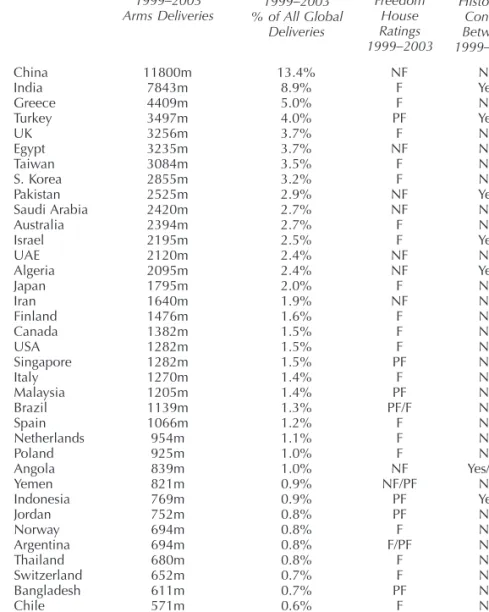
Figure 2, below, details the top sixty recipients of arms in the world between 1999 and 2003, human rights conditions in these countries, and the pres-ence or the abspres-ence of a conflict (internal or external) in these countries. These top sixty countries received almost 96 percent of the arms globally transferred during this period. In this list there are thirty countries classified as Not Free or Partly Free between 1999 and 2003 in the Freedom House Ratings. Furthermore, among the top sixty recipients, there are fourteen countries that were involved in some form of conflict between 1999 and 2003. Two of these countries, namely India and Israel, are considered Free but were involved in various degrees of conflict during these years. In sum-mary, among the top sixty, twelve countries have both poor human rights records and have been engaged in conflict.
These thirty countries accounted for almost 46 percent of the $40 billion worth of arms delivered globally between 1999 and 2003.31 In other words,
almost half of the global arms trade ended up in the hands of countries with poor human rights records.
26. Id.
27. European Union (EU) Code of Conduct, available at http://www.fas.org/asmp/campaigns/ code/eucodetext.htm.
28. SIPRI, Public Statement, 2005 Plenary Meeting of the Wassenaar Arrangement on Export Controls for Conventional Arms and Dual-Use Goods and Technologies, 13–14 Dec. 2005, available at http://projects.sipri.se/expcon/wass_elements.htm.
29. See generally Organization for Security and Cooperation in Europe (OSCE), available at http://www.osce.org/.
30. General and Complete Disarmament, Transparency in Armaments, U.N. GAOR, 46th Sess., U.N. Doc. A/RES/46/36 (1991).
FIGURE II
The Top Sixty Recipients of Arms Between 1999 and 2003 and Their Human Rights Records32
1999–2003
Arms Deliveries % of All Global 1999–2003 Deliveries Freedom House Ratings 1999–2003 History of Conflict Between 1999–2003 1 China 11800m 13.4% NF No 2 India 7843m 8.9% F Yes 3 Greece 4409m 5.0% F No 4 Turkey 3497m 4.0% PF Yes 5 UK 3256m 3.7% F No 6 Egypt 3235m 3.7% NF No 7 Taiwan 3084m 3.5% F No 8 S. Korea 2855m 3.2% F No 9 Pakistan 2525m 2.9% NF Yes 10 Saudi Arabia 2420m 2.7% NF No 11 Australia 2394m 2.7% F No 12 Israel 2195m 2.5% F Yes 13 UAE 2120m 2.4% NF No 14 Algeria 2095m 2.4% NF Yes 15 Japan 1795m 2.0% F No 16 Iran 1640m 1.9% NF No 17 Finland 1476m 1.6% F No 18 Canada 1382m 1.5% F No 19 USA 1282m 1.5% F No 20 Singapore 1282m 1.5% PF No 21 Italy 1270m 1.4% F No 22 Malaysia 1205m 1.4% PF No 23 Brazil 1139m 1.3% PF/F No 24 Spain 1066m 1.2% F No 25 Netherlands 954m 1.1% F No 26 Poland 925m 1.0% F No 27 Angola 839m 1.0% NF Yes/No 28 Yemen 821m 0.9% NF/PF No 29 Indonesia 769m 0.9% PF Yes 30 Jordan 752m 0.8% PF No 31 Norway 694m 0.8% F No 32 Argentina 694m 0.8% F/PF No 33 Thailand 680m 0.8% F No 34 Switzerland 652m 0.7% F No 35 Bangladesh 611m 0.7% PF No 36 Chile 571m 0.6% F No 37 Colombia 490m 0.6% PF No 38 Myanmar 478m 0.5% NF Yes 39 Germany 477m 0.5% F No
32. Hagelin et al., Appendix 12A: The Volume of Transfers of Major Conventional Weapons:
By Recipients and Suppliers, 1999–2003, supra note 18, at 475–76. Additional data was
received from SIPRI via e-mail. Freedom House, Freedom in the World Comparative Rankings: 1973–2005, Freedom in the World, supra note 13; PRIO, Active Conflicts 2003, supra note 15.
40 Syria 470m 0.5% NF No
41 New Zealand 450m 0.5% F No
42 Sri Lanka 423m 0.5% PF Yes
43 Bahrain 403m 0.5% NF/PF No 44 Sweden 391m 0.4% F No 45 Mexico 383m 0.4% PF/F No 46 Vietnam 376m 0.4% NF No 47 Kazakhstan 373m 0.4% NF No 48 Cyprus 372m 0.4% F No 49 Kuwait 365m 0.4% PF No 50 Morocco 357m 0.4% PF No 51 Denmark 324m 0.4% F No 52 Venezuela 283m 0.3% PF No 53 France 273m 0.3% F No 54 Peru 264m 0.3% PF/F No 55 Eritrea 254m 0.3% NF Yes 56 Sudan 239m 0.3% NF Yes 57 Afghanistan 226m 0.3% NF Yes 58 Ethiopia 220m 0.2% PF Yes 59 Congo 218m 0.2% NF/PF Yes/No 60 Macedonia 216m 0.2% PF No 84552m 96%
FIGURE II, continued
The Top Sixty Recipients of Arms Between 1999 and 2003 and Their Human Rights Records
1999–2003
Arms Deliveries1 % of All Global 1999–2003
Deliveries Freedom House Ratings 1999–2003 History of Conflict Between 1999–2003
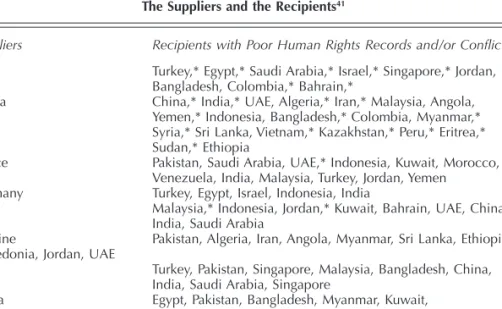
When transfers to these recipient countries in the top ten are considered, Russia emerges as the major supplier to China and India, while the United States emerges as the major supplier to Turkey, Egypt, and Saudi Arabia.33
Russia’s emergence as the top supplier to China and India is mainly due to the sanctions imposed on China by the United States and the European Union, and on India by the United States.34
The United States and the European Union imposed an arms embargo on China in the aftermath of the Tiananmen Square Massacre in 1989, pointing out severe human rights violations in that country.35 Yet Russia, by
becom-ing the top and the only supplier, was quite effective in fillbecom-ing the void that
33. See Figure III.
34. Björn Hagelin et al., Transfers of Major Conventional Weapons, in siPri Yearbook 2000:
armament, DisarmamentanD international securitY 29–30 (2000) [hereinafter SIPRI Yearbook
2000].
35. Gabrielle Kohlmeier, EU Eyes Lifting China Arms Embargo (2004), available at http://www. armscontrol.org/act/2004_09/EU.asp.
the Westerners had left. The United States also imposed sanctions on India following a nuclear test in May 1998.36 Sanctions on Pakistan were imposed
in 1979, 1990, 1998, and finally in 1999 after Pervez Musharraf toppled the civilian government with a military coup.37 After 11 September 2001, with
the exception of the sanctions imposed on Pakistan in 1999,38 all sanctions
were lifted by the United States; and Pakistan along with India were declared allies in the “War Against Terror.”39 Meanwhile, like in the case of China,
Russia became the major supplier for India, while arms to Pakistan were provided by China, France, Ukraine, and Italy during the sanction years.40
36. Press Release, The White House: Office of the Press Secretary, India Sanctions (13 May 1998), available at http://www.mac.doc.gov/sanctions/wh-state.htm.
37. Howard Diamond, U.S. Imposes Sanctions on Pakistan, N. Korea Following Missile Test (1998), available at http://www.armscontrol.org/act/1998_04/sanap98.asp; Robert Gard, India-Pakistan Sanctions Legislation Fact Sheet (2001), available at http://www. armscontrolcenter.org/archives/000124.php.
38. Alex Wagner, Bush Waives Nuclear-Related Sanctions on India, Pakistan (2001), available
at http://www.armscontrol.org/act/2001_10/sanctionsoct01.asp. The sanctions imposed
in 1999 prohibit Pakistan from receiving American loans and military training. 39. Bush Lifts Sanctions on India, Pakistan, supra note 8.
40. See Figure III.
41. Hagelin, et al., Appendix 12A: The Volume of Transfers of Major Conventional Weapons:
By Recipients and Suppliers, 1999–2003, supra note 18, at 474–80. Additional data
were received from SIPRI via e-mail.
USA Turkey,* Egypt,* Saudi Arabia,* Israel,* Singapore,* Jordan, Bangladesh, Colombia,* Bahrain,*
Russia China,* India,* UAE, Algeria,* Iran,* Malaysia, Angola, Yemen,* Indonesia, Bangladesh,* Colombia, Myanmar,* Syria,* Sri Lanka, Vietnam,* Kazakhstan,* Peru,* Eritrea,* Sudan,* Ethiopia
France Pakistan, Saudi Arabia, UAE,* Indonesia, Kuwait, Morocco, Venezuela, India, Malaysia, Turkey, Jordan, Yemen
Germany Turkey, Egypt, Israel, Indonesia, India
UK Malaysia,* Indonesia, Jordan,* Kuwait, Bahrain, UAE, China, India, Saudi Arabia
Ukraine Pakistan, Algeria, Iran, Angola, Myanmar, Sri Lanka, Ethiopia, Macedonia, Jordan, UAE
Italy Turkey, Pakistan, Singapore, Malaysia, Bangladesh, China, India, Saudi Arabia, Singapore
China Egypt, Pakistan, Bangladesh, Myanmar, Kuwait,
Netherlands India, Bangladesh, Turkey, UAE, Indonesia, Malaysia
Canada Saudi Arabia, Sri Lanka, Venezuela,
*Denotes a major supplier (more than 50% of all arms transfers) to this country.
FIGURE III
The Suppliers and the Recipients41
As demonstrated in Figure 3, between 1999 and 2003, the United States supplied arms to nine of the thirty-two countries classified as Not Free or
Partly Free and/or with a conflict. Russia provided arms to twenty countries;
France to twelve; Germany to five; the United Kingdom to nine; Ukraine to ten; Italy to nine; China to five; the Netherlands to six; and Canada to three. While Russia ranked second and supplied 30 percent of all the arms transferred globally between 1999 and 2003, it had the most diversified client portfolio.
Why do major suppliers, given their diversified portfolios, and despite the proven adverse effects of supplying arms to countries in conflict and/or with poor human rights records, continue supply weapons to these nations?
There are several reasons. First, as described below, almost all of the major suppliers follow domestic and international codes that, to some de-gree, force the officials of the state issuing arms export licenses to consider human rights conditions in the recipient country. However, these laws and regulations fail to stop the arms transfers to such countries because of their elastic wording. Second, the end of the Cold War contributed to a decline in domestic military expenditures in the major supplier countries, leading manufacturers and suppliers of arms to market their products more aggres-sively in the global market. The situation was more acute for the former communist countries because of their dependency on arms exports as their major export. This dependency forced them to pursue marketing policies, sometimes illegal and illicit, especially in small arms.
V. THE LAwS
As stated above, with the exception of Russia, China, and Ukraine, all top ten supplier countries have national legislation that urge the export license-issuing authorities to consider human rights conditions, albeit to varying degrees, in recipient countries. These laws have one point in common: their openness to interpretation that creates uncertainty about whether the law in question will be applied. This, in a sense, indicates the unwillingness of countries with greater stakes in global arms transfers to create stricter laws.
A. National codes on Arms Transfers in Top Supplier countries
Among supplier countries, the United States is probably the country with the most sophisticated laws on arms exports that leave the country either as a foreign military sales (FMS) (i.e., sale directly from the US government to another government) or direct commercial sale (i.e., sale from US arms manufacturers to public or private persons around the world). There are
different sets of laws and regulations that wholly or partially govern US arms exports: The Foreign Assistance Act (FAA) of 1961,42 the Arms Export
Control Act (AECA) of 1976, which are located respectively in Chapters 32 and 39 of Title 22 of the United States Code,43 the International Traffic in
Arms Regulations (ITAR),44 the Export Administration Act (EAA) of 1979,45
and parts of the Foreign Operations Appropriations Act.46
The Foreign Assistance Act of 1961 regulates foreign (economic and military) assistance from the United States to other countries. The Act states that the foreign policy goal of the United States is “to promote the increased observance of internationally recognized human rights by all countries.”47
The second part of the Act stipulates that “no security assistance may be provided to any country the government of which engages in a consistent pattern of gross violations of internationally recognized human rights.”48
However, the very same paragraph grants the President the right to make exceptions when necessary.49
The Arms Export Control Act of 1976 is considered the main law that directly regulates the arms exports of the United States.50 Section 2751 of the
Code states that arms transfers can only take place if they are “consistent” with the principles set forth in Section 2304.51 Section 2778 of Chapter 39
authorizes the President to regulate the arms exports of the United States.52
This authority, however, has been delegated to the State Department and put
42. 22 U.S.C. § 2304 (2002).
43. lora lumPe & Jeff Donarski, the arms traDe revealeD: a GuiDefor investiGatorsanD activists
(1998), available at http://www.fas.org/asmp/library/handbook/WaysandMeans.html. In addition to these laws, in June 1999, there was an attempt to create a Code of Conduct for American arms exports. The resolution, HR 2269, contained clauses that would pro-hibit the sale of American arms to countries that did not “promote democracy, respect human rights and participate in UN Register of Conventional Arms.” H.R. 2269, 106th Cong. (1999). However, the bill its original shape did not become a law. A diluted ver-sion of the bill that was enacted in November 1999 stated that the American president “shall attempt to achieve the foreign policy goal of an international arms sales code of conduct . . . [and] take the necessary steps to begin negotiations within appropriate international fora not later than 120 days after the date of the enactment of this Act.” Pub. L. 106–13, div. B, § 1000(a)(7), 29 Nov. 1999, 113 Stat. 1536, 1501A–508. See
also Emanuela Gillard, What is Legal? What is Illegal? A Background Paper on the ATT
Convention, Limitations on Transfers of Small Arms Under International Law (2003),
available at http://www.grip.org/bdg/g4509.htm; Jonathan T. Stoel, Codes of Conduct on Arms Transfers—The Movement Toward a Multilateral Approach, 31 l. & Pol’Y int’l
bus. 1291, 1291–99 (2000).
44. lumPe & Donarski, supra note 43.
45. Id. 46. Id.
47. 22 U.S.C. § 2304, supra note 42. 48. Id.
49. Id.
50. lumPe & Donarski, supra note 43.
51. 22 U.S.C. § 2751 (1999). 52. 22 U.S.C. § 2778 (2004).
into practice as the International Traffic in Arms Regulations.53 The Export
Administration Act of 1979, on the other hand, regulates the exports of dual-use goods.54 Neither ITAR nor EAA contains direct references to human
rights in recipient countries.
The final set of regulations that conditions US arms transfers upon human rights conditions in recipient countries (though not exports specifically) is the “Leahy Law” within the Foreign Operations Appropriations and Defense Appropriations Acts.55 This law, introduced by Vermont Senator Patrick Leahy,
prohibits American military assistance to “any unit of the security forces of a foreign country if the Secretary of State [or the Secretary of Defense] has credible evidence that such unit has committed gross violations of human rights.”56 The Leahy Amendment was first introduced as part of the
Interna-tional Narcotics Control Program of the State Department. In 1998, the law was applied to all security assistance programs that were part of the Foreign Operations Appropriations Act.57 In 1999, it became part of the Defense
Department Appropriations Act.58
Unfortunately, the Leahy Law has two weaknesses. First, the language is open to interpretation. The Foreign Operations Appropriations Act, for example, allows the Secretary of State to resume funding if the country with human rights violations in question “is taking effective measures to bring the responsible members of the security forces unit to justice.”59 The Defense
Appropriations Bill includes similar language, authorizing the Secretary of Defense to proceed with the funding if “all necessary corrective steps have been taken.”60 The State Department eventually agreed that the law’s
53. lumPe & Donarski, supra note 43. International Traffic in Arms Regulations (ITAR) lists
several countries such as Afghanistan, Iraq, etc., (of course, along with exceptional circumstances) to which US arms exports are prohibited. See, e.g., U.S. Dept. of State, ITAR, Part 126—General Policies and Provisions, available at http://pmdtc.org/docs/ ITAR/2005/22cfr126_Part_126.pdf.
54. The Export Administration Act of 1979 (EAA) was extended several times in the past and last expired in 1994. The US President maintained EAA by executive order. A new EAA was introduced in Congress in January 2001 but did not become law. The EAA of 2001 contains very equivocal language regarding human rights, stating several times that the goal of the United States should be to “promote . . . respect for human rights.”
See s. reP. no. 107–10, 107th Cong., 1st Sess. (2001), available at http://thomas.loc.
gov/cgi-bin/cpquery/T?&report=sr010&dbname=cp107&.
55. Foreign Operations Appropriations Act of 2002, Pub. L. No. 107-115, § 556, 115 Stat. 2118 (2002), available at http://leahy.senate.gov/issues/humanrights/107-115.html; Foreign Operations Appropriations Act of 2001, Pub. L. 106-429, § 563, 114 Stat. 1900 (2001),
available at http://www.ciponline.org/facts/leahy.htm.
56. See, e.g., id.
57. Center for International Policy, Limitation on Assistance to Security Forces, available at http://www.ciponline.org/facts/leahy.htm.
58. Id. 59. Id.
60. See, e.g., Department of Defense Appropriations Bill of 2002, Pub. L. No. 107-117, § 8093, 115 Stat. 2230 (2002), available at http://leahy.senate.gov/issues/humanrights/107-117.html.
ing should indicate that when the individual responsible for human rights violations is “expelled” from the “unit,” the funding of the “unit” could continue.61 The second weakness of the Leahy Amendment is that it is not
a permanent feature of either the Foreign Operations Appropriations Act or the Defense Operation Act. The amendment must be reintroduced every year with the respective Foreign Operations Appropriations and Defense Appropriations Acts. The Leahy Law has been applied to military assistance to several countries. For example, assistance to Colombia has been condi-tion on the certificacondi-tion of the improvement of human rights in the country by the US Secretary of State.62 However, the efficiency of this certification
procedure has been debated by various nongovernmental organizations (NGOs). In a July 2003 statement, Human Rights Watch (HRW) argued that these certifications were being issued by the Secretary of State without improvement in human rights conditions.63
In 1939, France began drafting a series of laws to regulate its arms exports.64 The “Statement on French policy on Export Controls for
Conven-tional Arms and Dual-use Items Submitted to the Wassenaar Arrangement” stipulates that France would exhibit “respect for the Purposes and Principles of the Charter of the United Nations, human rights, embargoes and other globally-agreed restrictive measures, arms control, and non-contribution to regional instability or to the prolongation of ongoing armed conflicts.”65
Furthermore, the same “Statement” notes that France “complies with the cri-teria laid down by the United Nations, the OSCE and the European Council” and “[respects] human rights in the country of final destination.”66 Similarly,
before recommending a transaction to the Prime Minister, the Committee on the Export of War Weapons (CIEEMG) should evaluate human rights conditions in the recipient country.67
Like France, the United Kingdom has laws governing arms exports dating from 1939.68 The most recent of these laws that makes direct reference to
61. Center for International Policy, Limitation on Assistance to Security Forces, available at http://www.ciponline.org/facts/leahy.htm.
62. See, e.g, Foreign Operations Appropriations Bill of 2002, supra note 55, § 567; see also Center for International Policy, Pub. L. 107-115, FY 2002 Foreign Operations Appropria-tions Bill, 2002 CondiAppropria-tions on Aerial Fumigation Programs in Colombia, available at http://leahy.senate.gov/issues/foreign%20policy/107-115-colombia.html.
63. Human Rights Watch, Colombia: Human Rights Certification Under Public Law 108-7,
available at http://www.hrw.org/backgrounder/americas/colombia-certification5.htm.
64. SIPRI, France: Policy on Export Controls and Conventional Arms, Export Controls,
avail-able at http://www.sipri.org/contents/expcon/frenchpolicy.html.
65. Id. 66. Id.
67. SIPRI, France: National Policy Statement, Export Controls, available at http://www.sipri. org/contents/expcon/fraosce.html.
68. British American Security Information Council, Export Control in the Framework Agree-ment Countries, available at http://www.basicint.org/pubs/Research/2001ExportControls2. htm.
human rights conditions in the recipient countries is the Export Control Act of 2002. This legislation was created as a result of the Labor Party’s campaign promise to overhaul the arms exports laws when it was revealed that various British companies were involved in arms and technology transfers to Iraq in the 1980s and 1990s.69 The Export Control Act states:
[E]xport controls may be imposed in relation to any goods the exportation or use of which is capable of having a relevant consequence. . . . [T]ransfer con-trols may be imposed in relation to any technology the transfer or use of which is capable of having such a consequence. . . . [T]echnical assistance controls may be imposed in relation to any technical assistance the provision or use of which is capable of having such a consequence. . . . [T]rade controls may be imposed in relation to any goods the acquisition, disposal, movement or use of which is capable of having such a consequence.70
In these articles the phrases “having a relevant consequence” or “such a consequence” refer to a wide range of instances ranging from “having an adverse effect on the national security of the United Kingdom and other countries” to the “breaches of international law and human rights.”71 Although
there is a direct reference to human rights in this law, the ambiguous wording “may be imposed” creates uncertainty about the applicability of the law.72
Italian laws that regulate arms transfers and exports, enacted in 1990, also make a direct reference to human rights conditions in the recipient country. Italian Law 185 “forbids” arms exports to states “whose governments are responsible for proven violations of international human rights conventions.”73
German laws regarding arms exports and transfers are based on several different pieces of legislation: the German Weapons Control Act of the Basic Law;74 the War Weapons Reporting Ordinance of 1995;75 the Foreign Trade
and Payments Act of 1961;76 the Foreign Trade and Payments Ordinance of
1986;77 and the Policy Principles of the Government of the Federal Republic
of Germany for the Export of War Weapons and other Military Equipment.78
Among all of these, only the Policy Principles refer to human rights condi-tions in the recipient country.
69. amnestY international, a cataloGueof failures: G8 arms exPortsanD human riGhts violations, supra note 9.
70. SIPRI, UK: Export Control Act, 2002, Export Controls, available at http://www.sipri. org/contents/expcon/act2002.html.
71. Id. 72. Id.
73. SIPRI, Italy: Provisions Governing the Export, Import, and Transit of Armaments, Export Controls, available at http://www.sipri.org/contents/expcon/ita90law.html.
74. SIPRI, Germany: Export Controls, available at http://www.sipri.org/contents/expcon/ger-many.html.
75. Id. 76. Id. 77. Id. 78. Id.
The Policy Principles of the Government of the Federal Republic of Germany for the Export of War Weapons and Other Military Equipment, introduced in 1982 (and later amended in 1999), are to be the “guidelines” for German officials dealing with arms export licenses, and thus “limit . . . discretion open to them.”79 These Policy Principles are composed of three
sections. The first section, “General Principles,” states that the goal of German exports is to “secur[e] respect for human rights and promot[e] sustainable development in all parts of the world.”80 It further states that human rights
conditions in recipient countries are a “key factor” in the issuing of exports licenses.81 According to these Policy Principles, export licenses “will not be
granted where there are reasonable grounds to suspect that they may be used for internal repression as defined in the EU Code of Conduct for Arms Exports, or the sustained and systematic abuse of human rights.”82
However, the second section, which sets the guidelines for arms exports to “NATO members, EU members, and countries with NATO-equivalent status,” has more ambiguous language regarding human rights conditions in recipient countries.83 This section stipulates that
[the] Federal Government will raise objections against . . . exports where there are reasonable grounds to suspect that they may be used for internal repression as defined by the EU Code of Conduct for Arms Exports or the sustained and systematic abuse of human rights.84
The third section of the Policy Principles dealing with arms transfers to “other countries” uses the same ambiguous language:
Export licenses pursuant to the War Weapons Control Act and/or the Foreign Trade and Payments Act will not be granted where the internal situation in the country concerned precludes such action, e.g. in the case of armed conflict or where there are reasonable grounds for suspecting such exports may be used for internal repression or the sustained and systematic abuse of human rights. In this context the human rights situation in the recipient country is a major factor to be considered.85
79. SIPRI, Germany: Response to the Questionnaire on OSCE Policy for the Export of Con-ventional Arms, Export Controls, available at http://www.sipri.org/contents/expcon/frgosce. html.
80. SIPRI, Germany: Policy Principles for the Export of Military Equipment, Export Controls,
available at http://www.sipri.org/contents/expcon/frg-guide.html. 81. Id. 82. Id. 83. Id. 84. Id. 85. Id.
While Dutch laws reiterate “the international commitments” of the country,86 the latest available arms export policy report issued by the Dutch
Ministry of Economic Affairs and Foreign Affairs states that “applications for licenses for the export of military equipment are assessed on a case-by-case basis against the eight criteria of the arms export policy with due consideration for the nature of the product, its country of final destination and end user.”87 The same report goes on to list the eight criteria of the EU
Code of Conduct, which include “the respect of human rights in the country of final destination.”88
Canadian arms exports are regulated by “guidelines” set forth in the Export and Import Act of the country. The Act states that
Canada closely controls the export of military goods and technology to countries that . . . have governments that have a persistent record of serious violations of the human rights of their citizens, unless it can be demonstrated that there is no reasonable risk that the goods might be used against the civilian population.89
By adding the “unless” clause, Canadian laws, like the laws of other nations, create room for interpretation. Yet when it comes to exporting fire-arms, Canada has a slightly different procedure. According to the Canadian Automatic Firearms Country Control List, Canadian manufacturers can sell their automatic firearms to only sixteen countries.90
Among major supplier countries, only Russian, Chinese, and Ukrainian arms exports laws do not directly refer to human rights conditions in the recipient country. The closest that Russian law comes to mentioning human rights is in Article 6 of the Federal Law of the Russian Federation on Mili-tary-Technical Cooperation of the Russian Federation With Foreign States. This article stipulates, again very ambiguously, that the Russian president will work to “support the execution of decisions of the Security Council of the United Nations on action to maintain or restore international peace and security and also to protect the national interests of the Russian
86. SIPRI, Netherlands, Export Control, available at http://www.sipri.org/contents/expcon/ netherlands.html.
87. ministrYof economic affairsanD the ministrYof foreiGn affairs, the netherlanDs arms exPort
PolicYin 2002 (2003), available at http://hei.unige.ch/sas/resources/Export%20Reports/
Netherlands.2002.Eng.pdf. 88. Id.
89. Department of Foreign Affairs and International Trade, Canada, Military and Technology,
available at http://www.dfait-maeci.gc.ca/trade/eicb/military/intro-en.asp?#introduction;
Department of Foreign Affairs and International Trade, Canada, Answers to Questions about Canada’s Export Control on Military Goods, available at http://www.dfait-maeci. gc.ca/trade/eicb/military/documents/20qa-eng.pdf.
90. When the law was first initiated, this number was thirteen. See id.; Department of Jus-tice, Canada, Automatic Firearms Country Control List (Export and Import Permits Act) SOR/91-575 (Can.), available at http://laws.justice.gc.ca/en/E-19/SOR-91-575/100057. html.
eration.”91 In a similar fashion, the Regulations of the People’s Republic of
China on Administration of Arms Exports stipulate that while conducting the arms trade, “no injury to the peace, security and stability of the region concerned and the world as a whole” should ensue.92 Ukraine has various
laws directing arms exports, none of which refer to human rights conditions in the recipient country.93
In summary, there are various national laws that tell these major supplier countries to consider human rights conditions in recipient countries, albeit in ambiguous language. Similar language can be found in international codes. However, it can be argued that the language and usage of international codes are much more flexible than national laws and codes.
B. International codes and Regimes on Arms Transfers
The end of the Cold War saw the creation of a series of laws and regimes in arms exports. These new laws and regimes were in part due to pressure from civil society, in part due to the optimistic environment created in the aftermath of the Cold War in which East-West conflict looked like a distant memory, and in part due to various arms transfer scandals. Unfortunately, these regimes, codes, and laws at the international level have not reached their stated goal of creating a more responsible legal environment for arms transfers.
1. UN Register of Conventional Arms (1992)
The goal of the UN Register of Conventional Arms was to create a medium in which both supplier and recipient states disclose information about their sales and purchases, as well as their domestic arms production and holdings.94
It is not, in other words, a regime prohibiting or discouraging arms transfers to countries with imperfect human rights per se, but simply an exercise en-couraging transparency of conventional arms transfers, as well as holdings and production. However, participating in the UN Register of Conventional Arms is voluntary, meaning that states may choose not to participate at all or that they can participate only when they wish to do so. This feature of
91. SIPRI, Federal Law of the Russian Federation on Military-Technical Cooperation of the Russian Federation With Foreign States, available at http://projects.sipri.se/expcon/nat-expcon/Russia/114law.htm.
92. SIPRI, Regulations of the People’s Republic of China on Administration of Arms Exports,
available at http://projects.sipri.se/expcon/natexpcon/China/chi_234reg.htm.
93. SIPRI, Ukraine, available at http://projects.sipri.se/expcon/natexpcon/Ukraine/ukraine. htm.
94. See, e.g., Foreign Affairs, Canada, The UN Conventional Arms Register, available at http://www.dfait-maeci.gc.ca/arms/convweap2-en.asp.
the Register has created debates about the efficiency and the effectiveness of the Register. In 1992, the first year of the Register, only ninety-five of the 179 existing members of the United Nations reported their arms purchases along with their domestic production and holdings.95 The largest number of
countries reporting was reached in 2001 when 126 of the 189 members of the United Nations reported to the UN Register.96 In 2004, 115 countries
had submitted a report to the Register.97
All top ten supplier countries, with the exception of China, have regularly contributed to the Register since 1992. China, the eighth largest arms sup-plier and the largest arms recipient in the world between 1999 and 2003, stopped responding to the Register in 1998.98 Although all of the major
supplier countries, again with the exception of China, have responded to the Register, some major recipient countries have either not responded or simply responded sporadically. For example, Iran has not reported to the Register since 1998; and Egypt, Angola, Algeria, Syria, and Saudi Arabia have not disclosed any information to the Register on their arms transfers since the Register was launched in 1992. In the case of recipient countries, nondisclosure of arms transfers does not damage the Register greatly because the imports of these nonreporting countries are the exports of major supplier countries. This practice ensures disclosure of arms transfers.
2. Wassenaar Agreement (1996)
The Wassenaar Agreement came to life in 1996 after the dissolution of the Coordinating Committee for Multilateral Export Controls (COCOM) in 1994.99
The main goal of the Wasennaar Agreement is to encourage “transparency and greater responsibility in transfers of conventional arms and dual-use goods and technologies, thus preventing destabilising accumulations” by creating “control lists.”100 Currently, there are thirty-nine countries that have
signed the Agreement. All top ten suppliers, with the exception of China, are parties to the Agreement.101
95. See United Nations Register of Conventional Arms, Composite Table, available at http:// disarmament2.un.org/UN_REGISTER.NSF.
96. Id. 97. Id.
98. The Chinese mission to the UN reports this date as 1998, but according to UN Register it is 1996. See United Nations Register of Conventional Arms, Overall Participation,
available at http://disarmament.un.org/UN_Register.nsf.
99. COCOM was established by the United States and its NATO allies during the Cold War as an “informal agreement” that made nonbinding recommendations on arms transfers to participating states. See Michael Lipson, The Reincarnation of COCOM: Explaining
Post- Cold War Exports Controls, non Proliferation rev. 33–52 (1999).
100. SIPRI, Public Statement, 2005 Plenary Meeting of the Wassenaar Arrangement on Export Controls for Conventional Arms and Dual-Use Goods and Technologies, supra note 28. 101. For the most recent list of members, see id.
The Wassenaar Agreement, in its original formulation, did not stipulate that the supplier country should take into consideration human rights con-ditions in the recipient country. However, an additional document entitled “Elements for Objective Analysis and Advice Concerning Potentially Desta-bilising Accumulations of Conventional Weapons: Explanatory Note” defines some “non-binding” guidelines by listing two questions regarding human rights conditions in recipient countries.102 Although these added guidelines
“encourage” the participant states to consider human rights conditions in recipient countries, they are not binding. It is simply “recommended” that signatory states take these guidelines into consideration.
3. European Union (EU) Code of Conduct (1998)
In the aftermath of the Gulf War, when arms transfers to Iraq by EU member states was revealed, the EU started work on a document that would guide arms exports and standardize the national laws and practices.103 The EU
Code of Conduct (the Code), which has eight criteria binding the members politically but not legally, was approved in June 1998.104
While Criterion Two extensively deals with human rights conditions in the recipient country, the rest of the criteria encourage EU members to consider vari-ous conditions varying from “the behaviour of the buyer country with regard to the international community” to “internal” and “regional peace, security and stability” when transferring arms.105 The member states are expected to
apply these criteria while issuing or denying arms export licenses.
The language in the EU Code of Conduct regarding human rights in recipient countries is more clearly defined, but still subject to interpretation. Criterion 2 states that
Member States will:
a) not issue an export license if there is a clear risk that the proposed export might be used for internal repression;
102. SIPRI, Elements for Objective Analysis and Advice Concerning Potentially Destabilizing Accumulations of Conventional Weapons: Explanatory Note, available at http://projects. sipri.se/expcon/waoban.htm. These questions are:
Is there a clearly identifiable risk that the weapons might be used for the violation and suppression of human rights and fundamental freedoms? Does the state comply with internationally-recognised human rights, anti-terrorism and non-proliferation norms?
103. Ian anthony, natIonal PolIcIesand RegIonal agReementson aRms exPoRts (2000), available at http://www.unidir.ch/pdf/articles/pdf-art155.pdf; Council of Europe, Parliamentary
Assembly, Recommendation 1382 (1998), available at http://assembly.coe.int/Docu-ments/AdoptedText/ta98/EREC1382.htm.
104. SIPRI, EU Code of Conduct for Arms Exports, available at http://projects.sipri.se/expcon/ eucode.htm.
b) exercise special caution and vigilance in issuing licenses, on a case-by-case basis and taking account of the nature of the equipment, to countries where serious violations of human rights have been established by the competent bodies of the UN, the Council of Europe or by the EU.106
The ambiguity here lies in the criterium’s wording. The phrase “might be used for internal repression” leaves the assessment of the possibility of repression to the supplier country. Furthermore, the Code does not specifically prohibit the transfer of arms to countries in which human rights violations are documented by various international institutions. Rather, it tells sup-plier countries simply to pay more attention, or as it is stated, to “exercise special caution and vigilance” in transfers to countries with human rights violations.107 This wording makes the Code open to interpretation and limits
its efficiency. Even David Andrews, then Irish Minister for Foreign Affairs, was reported to have expressed his disappointment with human rights the criterion when the Code was accepted.108
In case of license denials, the EU members are expected to inform other members of these denials, as well as the reasons for the denials, “through diplomatic channels.”109 If another member decides to grant a license for an
“identical transaction within three years,” it has to inform the member state that previously denied the license and provide that state with reasons for the issuance of the license in question.110 The denials and the consultations
regarding these denials, according to the EU Code of Conduct, should be done in “confidentiality.”111
Various NGOs also argued that there were flaws with the EU Code of Conduct in general. The most important flaw is that the Code is not legally binding on the EU member states.112 Amnesty International in a 2004 report
argued that the Code had various weaknesses, such as containing language very open to interpretation, a review mechanism that was not transparent enough, and no provisions for arms brokering, which in turn, created seri-ous loopholes in the Code.113
106. Id. 107. Id.
108. Wade Boese, Arms Control Assoc., European Union Adopts Code of Conduct on Arms Sales, available at http://www.armscontrol.org/act/1998_05/wb2my98asp.
109. SIPRI, EU Code of Conduct for Arms Exports, supra note 104. 110. Id.
111. Id.
112. Oxfam, The EU Code of Conduct on the Arms Trade, Final Analysis Statement on Behalf of Oxfam, Christian Aid, Saferworld, Amnesty International, BASIC and WDM (1998),
available at
http://www.oxfam.org.uk/what_we_do/issues/conflict_disasters/conflict_eu-rocode_final.htm; amnestY international, unDermininG Global securitY: the euroPean union’s
arms exPorts (2004), available at
http://www.iansa.org/regions/europe/documents/under-mining_security/flaws_eu.htm.
113. Amnesty International, EU Code of Conduct on Arms Exports, Criterion Two, AI Index: IOR61/007/2004 (14 Apr. 2004) available at http://web.amnesty.org/library/Index/ENGI OR610072004?open&of=ENG-390.
Furthermore, transparency and coordination problems have plagued the Code from its inception. It has been argued that because member states inform each other about the denials through “diplomatic channels” and “in confidentiality,” rather than publicly, this further limits the transparency of the arms exports.114 In the first five years of the EU Code of Conduct, for
example, the Code did not even have a central database for denials issued for export licenses. The establishment of such a database was declared one of the goals in December 2003 in the Fifth Annual Report According to Operative Provisions 8 of the European Union Code of Conduct on Arms Exports. The very same Annual Report accepted that “there is still work to be done,” especially in the harmonization of reporting procedures and creation of a comparable statistical database.115
C. Principles Governing Conventional Arms Transfers adopted by the Organization for Security and Cooperation in Europe (OSCE) (1993)
The OSCE Principles, like other international agreements, are not binding. These principles simply recommend that the OSCE member states “exercise due restraint” through their national arms export control laws when transferring arms to other countries and “take into account . . . the respect for human rights and fundamental freedoms in the recipient country.”116 The OSCE Principles
instruct the participating states to “avoid transfers which would be likely to be used for the violation or suppression of human rights and fundamental freedoms.”117 The OSCE Principles also assume member states will “reflect”
these principles in their national codes regulating arms transfers.
The analysis of the domestic and international laws governing arms transfers of major supplier indicates that the real problem is not the absence of laws or codes. Rather, coupled with various transparency problems, the real problem is the ambiguous wording of these laws, which in turn creates serious loopholes for arms traders and officials issuing export licenses. Do national and international laws that both stipulate and encourage states to consider human rights in the recipient country work at all?
114. See Bernardo Mariani & angus urquhart, transparencyand accountaBilityin european arMs
exports controls: towards coMMon standardsand Best practice (2000), available at http://
www.saferworld.org.uk/publications/pubtrans.htm.
115. sipri, FiFth annual report accordingto operative provisions 8 oFthe european union codeoF
conducton arMs exports (2003), available at
http://projects.sipri.se/expcon/EU_Code_Re-port5.pdf.
116. organization For security and co-operation in europe, principles governing conventional
arMs transFers (1993), available at http://www.osce.org/documents/fsc/1993/11/4269_
en.pdf. 117. Id.
Sometimes the media and the NGOs end up playing an important role by disclosing some of these controversial arms transfers to the public. In particular, the British media and NGOs have been quite critical of the current Labour government that promised “an ethical foreign policy” dur-ing their election campaigns but then made several controversial deals. In May 2002, according to a report that appeared in The Independent, British cabinet members were allegedly involved in persuading the Indian government to purchase £1 billion worth of Hawk fighter jets, despite the Kashmir conflict.118 The same report also mentioned that British jets sold to
Indonesia were used during the conflict in East Timor in July 1999.119 In July
2002, the United Kingdom was plunged into a controversial debate when Foreign Secretary Jack Straw announced his government’s intention to “‘modif[y]’ . . . the rules on arms sales to reflect the ‘new reality’ of the multinational defence projects.”120 Concurrently, British Prime Minister Tony Blair was
accused of damaging the Kashmir talks by selling arms to both sides, he brushed these accusations aside by saying that “the idea that we shut down our defence industry in these circumstances I find bizarre.”121
In Belgium, a country party to the Code, but not on the top ten suppliers list, the revelation of arms sales to Nepal in July 2002, a country with a poor human rights record, created a huge scandal. This scandal had two important consequences. First, it led to the resignation of the Finance Minister Magda Alvoet. Second, Belgium in October 2002 became the first EU country to make the EU Code of Conduct on Arms Exports a domestic law.122
Several controversial arms transfers by the United States have also re-ceived considerable media and NGO attention. For example, the possible sale of $3.5 billion worth of 145 Super Cobra attack helicopters to Turkey in the recent past was one such example.
In summary, given these lax domestic laws and international codes and regimes, it is difficult to expect that arms transfers to countries with poor human rights records will completely halt. However, in addition to the laws that govern arms transfers, the changing nature of the global arms market following the Cold War has complicated the situation.
118. Paul Eavis, Analysis Arms Trade-A Question That Won’t Go Away for Labour-Is It Ethical
to Sell Arms to Countries At War?, inDeP., 28 May 2002.
119. Id.
120. Jason Beattie, Government Under Fire on Arms Sales, scotsman, 8 July 2002.
121. Id. For other criticisms, see, e.g., Andrew Parker, Ethical Dimension to be Pursued if
Granted More Time, fin. times, 25 May 2001.
VI. THE CHANGING NATURE of THE PoST-CoLd WAR GLobAL ARMS MARkET
A recent Amnesty International report concluded that “it is short term profit making and political advantage that guide the bulk of the international arms trade.”123 That “profit” stems from the fact that arms trade is a big business for
some countries. According to SIPRI estimates, despite the decline following the end of the Cold War, between 1995 and 2004, the annual world military expenditure has continued to fluctuate between $800 and $950 billion.124
Of this amount, it is estimated that approximately $26 to $34 billion was spent globally on conventional arms trade in 2002.125
The end of the Cold War has, however, twisted this “profit” scheme by leading to a decline in the domestic military expenditures of almost all of the top ten suppliers.126 Although this downturn started to rebound around
1998, most of the major supplier countries have not been able to return to their Cold War military expenditure levels.127 In addition to this decline in
military expenditures, “profit” concerns that were relegated to a secondary role in arms transfers during the Cold War because of strategic concerns became more important than ever when the Cold War ended.128 These
changes had two important consequences. First, the arms market ended up becoming a buyer’s market.129 Second, in order to offset this decline
in military expenditures and to realize economic benefits, some supplier countries and manufacturers in these countries have started to pursue more aggressive policies in their international sales.130 For example, since the
123. Amnesty InternAtIonAl, A CAtAlogueof fAIlures: g8 Arms exportsAnd HumAn rIgHts VIolAtIons, supra note 9.
124. SIPRI, SIPRI Military Expenditure Database, available at http://www.sipri.org/contents/mi-lap/milex/mex_world_graph.html; SIPRI, Recent Trends in Military Expenditure, available
at http://www.sipri.org/contents/milap/milex/mex_trends.html.
125. According to SIPRI Yearbook 2004, which takes into account only actual deliveries, annual global arms trade in 2002 was somewhere between $26 and $34 billion. See sIprI yeArbook 2004, supra note 18, at 469. For 2003, Richard F. Grimmet estimated
that the value of arms agreements was $25.6 billion. rICHArd f. grImmet, CongressIonAl
reseArCH SerVICe, ConVentIonAl Arms trAnsfersto deVelopIng nAtIons, 1996–2003, at CRS-3
(2003), available at www.fas.org/man/crs/RL32547.pdf.
126. For data for each of these countries, see SIPRI, The SIPRI Military Expenditure Database,
available at http://first.sipri.org/non_first/result_milex.php?send.
127. SIPRI, Recent Trends in Military Expenditure, available at http://www.sipri.org/contents/ milap/milex/mex_trends.html.
128. World eConomIC And soCIAl surVey 169 (1997), available at http://web.nps.navy.mil/
~relooney/3040_2htm.
129. William Hartung, A Tale of Three Arms Trades: The Changing Dynamics of Conventional
Weapons Proliferation, 1991–2000, in AmerICA’s peACe dIVIdend (Ann Markusen ed., 2000), available at http://www.ciaonet.org/book/markusen/hartung.html.
130. Janne E. Nolan et al., The Imperatives for Cooperation, in globAl engAgement: CooperAtIon And seCurItyIntHe 21st Century 19, 25 (Janne E. Nolan ed., 1994); keItH krAuse, ArmsAnd tHe stAte: pAtternsof mIlItAry produCtIonAnd trAde 125 (1992); Ian Anthony et al., The Trade in Major Conventional Weapons, in sIprI yeArbook 1995: ArmAment, dIsArmAment And InternAtIonAl seCurIty 502 [hereinafter SIPRI yeArbook 1995].